




Abstract
This study aimed to investigate the relationship between the design elements of Chinese dragon patterns and the emotional responses and preferences of participants, while exploring esthetic differences between novice and professional groups. We employed the E-prime method and multiple linear regression analysis to examine the visual features that elicit emotional responses and preferences among participants. A total of 100 college students were categorized into novice and professional groups based on their expertise in traditional patterns and evaluated a series of dragon pattern stimuli using the Self-Assessment Manikin (SAM) scale. The findings revealed a significant correlation between the design elements of dragon patterns and participants’ expertise, emotional responses, and preferences. Shape variations in dragons were more likely to elicit emotional responses in the novice group, influencing preference choices, while simplified designs evoked emotional responses in the professional group. Notably, the use of circular borders in dragon patterns significantly impacted the emotional responses and preference evaluations of both groups. This study provides valuable insights into the modernization of dragon pattern design and contributes to the preservation and sustainability of Chinese culture. The universal preference for circular borders in dragon patterns suggests a commonality in esthetic appreciation, highlighting the significance of understanding cultural-specific esthetics in design practices. The research fills a gap in the literature regarding the association between preferences and esthetic emotional feedback toward traditional Chinese pattern design elements and offers a theoretical foundation for future research exploring esthetic differences and emotional experiences across different cultural backgrounds.
Plain language summary
Study explores emotional responses to Chinese dragon patterns, using E-prime and regression analysis. Results show design elements influence preferences and emotions, especially for novices and professionals. Circular borders have universal impact. Findings aid modernization of dragon design, preserving Chinese culture.
Introduction
With emotional response often regarded as the foundation of the art experience, the creation of emotional experiences considered a central objective of artistic expression (Fellous & Robinson, 2006). Chinese dragon patterns hold significant cultural and symbolic meanings within Chinese tradition, intertwining with religious beliefs and eliciting various emotional responses. With the implementation of the “cultural confidence” policy in China, a large number of dragon patterns have been widely applied in the decoration of modern products to showcase the distinctive features of Chinese culture (X. Wang & Bingbing, 2019). Additionally, recent research showed that dragon patterns not only have the highest frequency in furniture decoration but are also deeply loved by the Chinese people among the cultural characteristics of Chinese patterns and are widely considered the most representative (Xue et al., 2025).
In the realm of traditional Chinese dragon motif design, dragons exhibit a variety of forms, often framed by distinct geometrical borders, please refer to Figure 1 for a and b. Although these motifs all convey similar symbolic meanings, the variations in their design elements compel us to explore which types of dragon motifs are more likely to resonate with contemporary audience.
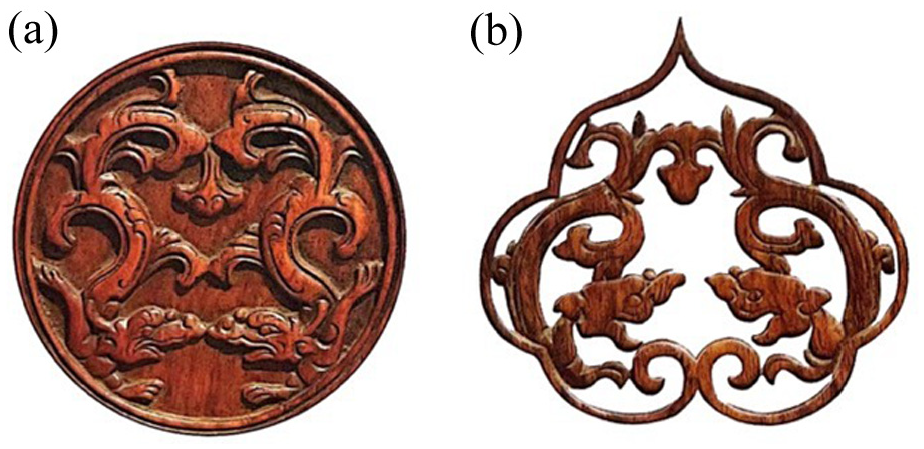
Two types of dragon patterns on Ming-style furniture.
Previous studies have explored the evolution and composition characteristics of dragon patterns (Liao, 2023) and their modern redesign. However, there is a gap in understanding how different design elements of dragon patterns elicit emotional responses and preferences among viewers. Our study fills this gap by employing the E-prime method and multiple linear regression analysis to investigate the relationship between visual features of dragon patterns and participants’ emotional responses and preferences. Additionally, while domain expertise is known to influence esthetic judgment (Leder et al., 2004; Monteiro et al., 2022), there is limited research on how expertise affects emotional responses to the visual characteristics of artworks, particularly traditional Chinese dragon patterns. Our study compares the emotional responses and preferences between novice and professional groups, revealing esthetic differences and providing insights into how expertise shapes esthetic experiences. Furthermore, our findings offer valuable insights for the modernization of dragon pattern design, addressing the need for empirical evidence on which design elements are more effective in eliciting positive emotional responses and preferences (Fu & Shana, 2021)."
Emotional Response to the Characteristics of Artworks
Art research has long been engaged in uncovering the complex associations between specific attributes — such as color, complexity, and expressiveness of emotional expressiveness and esthetic judgments, which encompass beauty, creativity, and preference. Notably, there is considerable interest in examining the relationship between the complexity characteristics of artistic elements and esthetic judgments. Complexity encompasses the quantity of graphic elements, their physical properties, the extent of their divergence, and the regularity of their arrangement (Day, 2013). It can also refer to the complexity of an artwork in terms of form, content, construction, and expressive techniques(Li et al., 2013). Empirical evidence suggests that objects with low complexity stimulate at a lower level, causing less pleasure compared to a medium level of complexity; whereas high complexity may lead to confusion and similarly does not result in a high level of pleasure(Li et al., 2013). The relationship between complexity and preference shows an inverted U-shaped relationship, indicating that designs of moderate complexity are the most welcomed (Cox & Cox, 2002). Consumers are inclined to prefer products that exhibit lower complexity and high symmetry (Creusen et al., 2010), with this level of complexity influencing their perception of beauty. Studies using functional magnetic resonance imaging have confirmed the importance of symmetry and complexity in our judgment of beauty (Jacobsen et al., 2006). Furthermore, in the empirical research on art appreciation, Scholars have simplified pattern form attributes such as contrast, clarity, color, symmetry, and grouping into a dynamic visual property, as delineated by Gestalt psychology, employing “Dynamicity” as a metric for measurement(Lin, 2023). These studies have concluded that artistic design elements significantly influence esthetic judgment.
Traditional patterns, as an important part of cultural heritage, not only enrich the connotations of visual elements when applied in modern design, but also enhance the depth of emotional feedback. Emotional theories provide a theoretical basis for understanding how visual elements impact emotions. Visual elements such as color, shape, and texture can evoke emotional responses in people. Research indicates that when users select a product, they consider the emotional experience aroused by the product’s color (Ding & Bai, 2019). However, this perception becomes more complex and dynamic when shaped by the product’s form characteristics. Designers. in realm of visual design, leverage their understanding of emotional arousal to create works with emotional impact, such as guiding emotional experiences through user interface design(Gasah et al., 2019). In esthetics, Clive Bell, in his seminal work “Art,” proposed that the value of an artwork lies in the esthetic emotions conveyed by its form, rather than its ability to represent reality or convey information. This theory profoundly influenced early 20th-century formalist art criticism. Recent psychological studies have endeavored to deconstruct the sensory attributes universally considered beautiful, such as complexity, orderliness, proportional harmony, and color coordination. These studies not only attempt to address the questions posed by Bell but also reflect the enduring impact of formalist art perspectives on the psychology of art appreciation and esthetics.
In recent years, Chinese scholars have turned their attention to the aesthetic emotional value that Chinese patterns bring. For instance, researchers such as Yao and colleagues have studied the emotional value of traditional Chinese patterns in advertising marketing and their impact on consumers (Yao & Zhiyu, 2024). Meanwhile, scholar Mao Ming has delved into the emotional value reflected by these patterns in packaging design (Mao, 2023). However, these studies have all been conducted from a qualitative perspective, and they have not truly measured user emotional feedback, nor have they analyzed the relationship between user emotions and traditional patterns. Although there is a dearth of literature on the relationship between dragon patterns and emotional feedback, dragon patterns, as a form of art, can be analyzed in terms of the emotional response they elicit from the experience of the art.
Emotion Evaluation Triggered by Visual Perception
Emotional experience is considered the purpose of artistic expression (Fellous & Robinson, 2006) and has been an intrinsic aspect of esthetic experience (Leder et al., 2004). However, for a variety of reasons, emotions have often been overlooked in esthetic research (Leder & Nadal, 2014). In recent years, scholars have placed a great importance on the study of emotions within esthetics (Nawaz & Omigie, 2023; Roald et al., 2023),suggesting that esthetic emotions can be used to explain the formation of preferences(Menninghaus et al., 2019).
Numerous studies on visual arts perception have highlighted the role of emotional assessment in visual perception (Bose et al., 2021; Cakmak et al., 2024; Kühnapfel et al., 2024; Lin, 2023; Mastandrea, 2019; Rashmi et al., 2024; Schubert, 2024; Suhaimi et al., 2020; J. Z. Wang et al., 2023;). Particularly in China, researchers have concentrated on measuring emotions elicited by patterns in clothing. For example, Dr. Xu Bing (Xu, 2018) employed the PAD model (Pleasure, Arousal, Dominance) to measure emotional responses to traditional Ming and Qing clothing patterns, categorizaing each with negative and positive emotional valences. Chen and Yang Meng (2022) explored the distinct effects of the angle and width design of diamond patterns on consumer emotions.
Building upon the domain of visual arts perception, it has been demonstrated that visual stimuli across a spectrum of domains are capable of inciting emotional responses. This includes, but is not limited to, popular illustration (Lin, 2023), advertising (Septianto et al., 2023), architecture (Verma et al., 2023), destinations(Qu et al., 2024), and restaurant services(Im & Seo, 2024). Although current studies have not explicitly addressed the area of traditional patterns, we propose the following hypothesis:
The Association Between Emotion and Preference in Visual Perception
Preference, which mirrors an individual’s relative inclination toward a choice, can be quantified using a set of polarized adjectives, such as dislike-like ( Hagtvedt et al., 2008; Hosany & Gilbert, 2010). A thorough review of the literature reveals that several studies have explored the relationship between emotions and preferences(Adeboye et al., 2023; Iigaya et al., 2021; Kühnapfel et al., 2024; Liu et al., 2023; Pelowski et al., 2020; Vanderlind et al., 2020). While these studies have not directly investigated the correlation between preferences and emotional responses to visual perceptions, they have substantiated that emotions aroused during the perception of visual art perceptions can influence preference assessments. Leveraging this insight, we hypothesize that
Domain Expertise in Perceptual Evaluation
Domain expertise plays a pivotal role in perceptual evaluation, a face well-documented in the literature (Jam et al., 2022; Juslin et al., 2023; Leder et al., 2004; Monteiro et al., 2022). While expertise accounts for a segment of art appreciation, research exploring emotional responses to the visual characteristics of artworks is scarce, particularly regarding how artistic proficiency modulates these responses. It is a well-established phenomenon that, devoid of specific contexts, individuals generate emotional responses even to simple geometric features (Larson et al., 2007, 2012). For instance, downward-pointing triangles and sharp angles are often perceived as threatening, whereas circular shapes like circles are associated with pleasantness. Studies underscore the unique impact of specific artworks attributes, such as composition, balance, and symmetry (Locher, 2003), which are likely to elicit esthetic responses. Chatterjee proposed a neurocognitive framework of visual esthetics where emotional experiences are central to esthetic viewing (Chatterjee, 2003). In addition, Pessoa et al. emphasized that visual features of artworks, like any visual object, engage the ventral attention network (Pessoa et al., 2003), leading to heightened attention to features associated with salience/arousal.
Dragon patterns, with their intricate forms, compositions, and symbolism, elicit diverse experiences among individuals. To effectively evaluate dragon patterns, it is crucial to distinguish between novice and professional groups. In this study, the “novice group” is defined as individuals in the initial stages of learning, lacking specialized knowledge and experience, and requiring fundamental guidance. Conversely, the “professional group” comprise individuals with extensive experience and expertise in traditional patterns. Building on this distinction, we proposed the hypothesis:
In conclusion, the conceptual model is shown in the Figure 2.

Conceptual model.
Materials and Methods
According to hypothesis H1, H2, and H3, we conducted the research presented in this paper. The research framework is depicted in Figure 3.

Research Framework.
Stimulus
Analysis of Dragon Patterns Design Elements
Dragon patterns are a versatile decorative element in furniture design, gracing various components such as backrests, armrests, knots, stoppers, and terminations. Following an exhaustive review of relevant literature and scholarly works, such as Research on Ming style Furniture Patterns(
Design Elements of Chinese Dragon Patterns.

Stimulus Design for Experiment
Our study initiated with the careful selection of initial samples for stimulus creation. To ensure the suitability of the experimental samples, a focus group comprising two dragon pattern researchers and two visual art perception researchers was convened. This panel engaged in deliberatations regarding the research objectives and questions, ultimately determining that the experimental samples should exhibit complete compositions. Based on this criterion, we proceeded to screen 30 dragon patterns. Additionally, to meet the objectives of the experiment, the screening criteria included a variety of dragon pattern postures, such as C-shape, S-shape, G-shape, single dragon, and double dragon. After group discussions, six original samples were chosen, as presented in Table 2.
Initial Samples for Stimulus Creation.


Using these six original experimental samples (Table 2) as a basis, we conducted vector mapping on the remaining samples with design features requiring alteration. By adhering to the “Shape design, Border design, and Simplified design” requirements, we changed the design features of the original samples using the control variable method. Specifically, we altered only one specific design feature of the original sample while keeping the rest of the features constant. For example, for a derivative dragon pattern sample, we altered only the border of the original dragon pattern and maintained the remaining features. Based on this design strategy, each dragon pattern was derived from the original sample with three border variations (square, round, wave) and two simplified variations, resulting in a total of five variations. This experiment generated 30 dragon pattern samples (6 × 5), plus 6 original samples, totaling 36 experimental samples (refer to Appendix 5).
Method
Scale measurements were conducted using E-prime software, a versatile psychological laboratory tool applicable to experiments encompassing attention, memory, perception, cognition, and behavior. The Self-Assessment Manikin (SAM) was adopted as the scaling instrument, derived from the PAD model (Bradley & Lang, 1994; Zhao et al., 2020). As a non-verbal emotional assessment tool, SAM uses five-character graphics to represent varying levels of emotional experience, with a 9-point scale employed to capture scores for pleasure, arousal, and dominance, alongside a pair of polar adjectives (dislike-like) for preference evaluation.
This study has obtained ethical approval from the Institutional Review Board, with rigorous measures in place to ensure participant protection and ethical compliance.
In terms of limiting harm risks, the experimental design prioritizes minimizing potential harm to participants. The experimental task only requires participants to sit in front of a computer, watch stimulus patterns according to program instructions, and complete the scoring of the SAM scale (pleasure, arousal, dominance) and Like value by clicking the mouse. The entire process involves no strenuous physical or mental activities, nor any invasive operations. The experiment was conducted in a computer room with strictly controlled environmental conditions: temperature was maintained at a comfortable 22°C to 25°C, blackout curtains ensured standardized lighting, and soundproofing measures were implemented to create a quiet atmosphere, avoiding discomfort from environmental factors. Upon launching E-prime, stimulus images were presented sequentially following the protocol of the International Affective Picture System (Figure 4; Huang & Shiguang, 2014), with content rigorously screened to exclude violent, horrific, or other elements that might induce intense negative emotions, further reducing potential psychological risks. Each trial lasted approximately 55 s, with a total experimental duration not exceeding 10 min to prevent fatigue or anxiety among participants due to long-term experiments.

Experimental procedure.
The study’s potential benefits substantially outweigh the minimal risks. For society, the findings will contribute foundational data for emotion assessment methodologies and deepen the understanding of relationships between visual stimuli and psychological responses, thereby advancing theoretical frameworks in psychology and informing applications in education and human-computer interaction—particularly by providing empirical support for the modernization of traditional Chinese dragon pattern design, which supports the preservation and sustainable inheritance of Chinese culture. For participants, involvement enhances understanding of psychological research processes and traditional cultural patterns, satisfies curiosity about scientific inquiry, and may include compensation (e.g., tokens or remuneration). Given that risks were rigorously constrained through study design; the research adheres to ethical principles of risk-benefit equilibrium.
Prior to participation, written informed consent was obtained from all participants, with the consent form detailing the study’s purpose, procedures, expected duration, task content, data usage, confidentiality measures, and participants’ right to withdraw unconditionally at any stage without any negative consequences. Only after fully understanding this information did participants sign the form to confirm their voluntary participation. All consent forms were securely stored by the research team in strict compliance with privacy protection standards.
Participants
Following the guidelines for psychology experiments, a sample size of 32 or more participants is typically deemed reliable (T. Chen, 2015). Given that college students aged 18 to 25 generally exhibit strong cognitive abilities and a high receptiveness to new experiences (Hagtvedt et al., 2008), we recruited 100 college students within this age range. Descriptive statistics for the participants are provided in Table 3. The novice group comprised freshman English majors, while the professional group consisted of senior art majors. To ensure that both groups were capable of accurately assessing the patterns, we administered a “self-rating of knowledge of traditional patterns” questionnaire prior to the experiment.
Descriptive Analysis of Participants.

Data Analysis
Multiple linear regression is a statistical method used to investigate the relationship between a dependent variable and multiple independent variables. The basic equation of multiple linear regression can be expressed as:

Where Y is the dependent variable, X1, X2, etc. are independent variables, β0, β1, β2, etc. are the regression coefficients of the model, and ε is the error data.
However, there are two standard conditions required for the regression equation to be valid:
1) Goodness-of-fit of the model: R-squared is a commonly used measure of the goodness-of-fit of the model, and the value of R-squared ranges from 0 to 1. The closer the R-squared is to 1, and, the better the model is at explaining the observed data the better the fit is. The closer the R-squared is to 0, the poorer the model’s ability to explain the observed data and the poorer the fitting effect. Generally speaking, R-squared greater than 0.6 is considered to be the model superiority to meet the standard.
2) The independent variables should be linearly independent of each other to avoid the existence of multicollinearity. VIF (Variance Inflation Factor) is an indicator used to detect the degree of covariance between independent variables. Generally speaking, VIF value less than 5 can be considered that there is no serious multicollinearity problem.
Results
Differential Analysis
Differential analysis is a statistical analysis used to compare differences between two or more groups. It aims to determine the extent to which variables differ between groups and to test whether these differences are significant. In this study, analysis of variance was performed using t-test.
Table 4 reports the differences between genders on a total of four indicators: Pleasure, Arousal, Dominance and Preference. The result show that the gender group did not show significant differences in Pleasure, Arousal, Dominance and Preference (p > .05), which implies that the gender group performed consistently and did not have significant differences in Pleasure, Arousal, Dominance and Preference.
Gender Group_t-Test Analysis Results.

Similarly, Table 5 reports that the expertise group showed significant differences (p < .05) in Pleasure, Arousal, Dominance, and Preference.
Expertise Group_t-Test Analysis Results.

p < .05; **p < .01.
In summary, when assessing the emotion and preference of the design elements of the dragon patterns, there was no significant difference between the gender groups for Pleasure, Arousal, Dominance, and Preference, but there was a significant difference between the expertise group for Pleasure, Arousal, Dominance, and Preference.
Regression Analysis of Preference and Emotion Values of Design Elements
Firstly, the pattern design elements were coded as shown in Table 6. We first number the experimental samples as shown in Table 6 to construct a regression equation and analyze the relationship between pattern design elements and preferences.
Sample Categorization.

Table 7 indicates that the R-squared values for Equations 1–3 are all above 0.7, while the VIF values for each do not exceed 5. According to Table 6, we derived the following regression equations for the Novice group:
Regression Analysis of the Novice Group.

Note. Dependent variable: Preference-value.
Expressions for the p-value (Pleasure) and preference values of design elements:
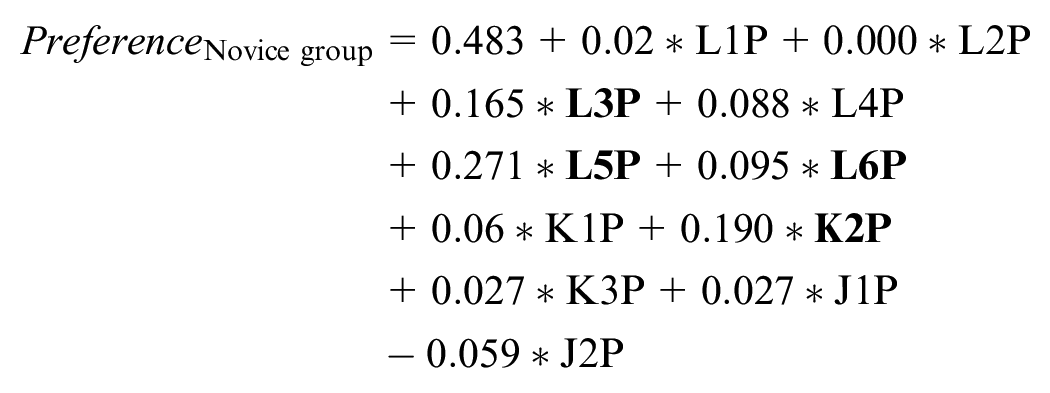
Expressions for the A-value (Pleasure) and preference values of design elements:

Expressions for the D-value (Pleasure) and preference values of design elements:
Regression equation of Preference value with D value of pattern design elements:
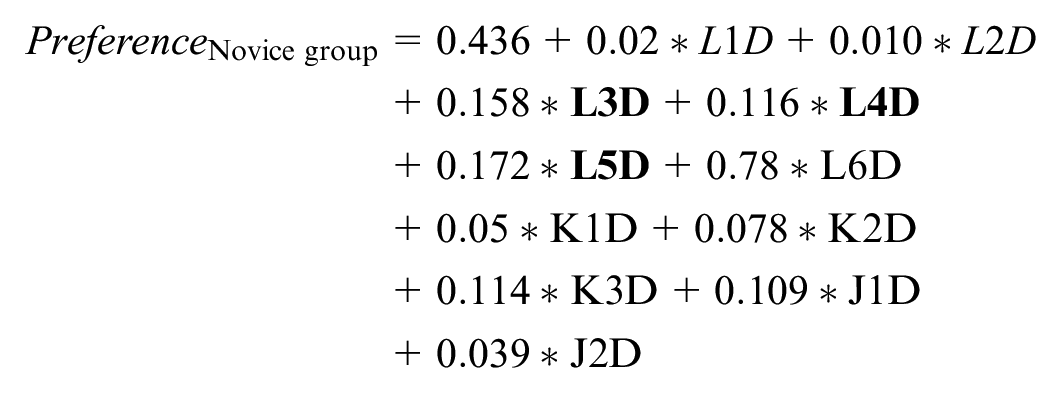
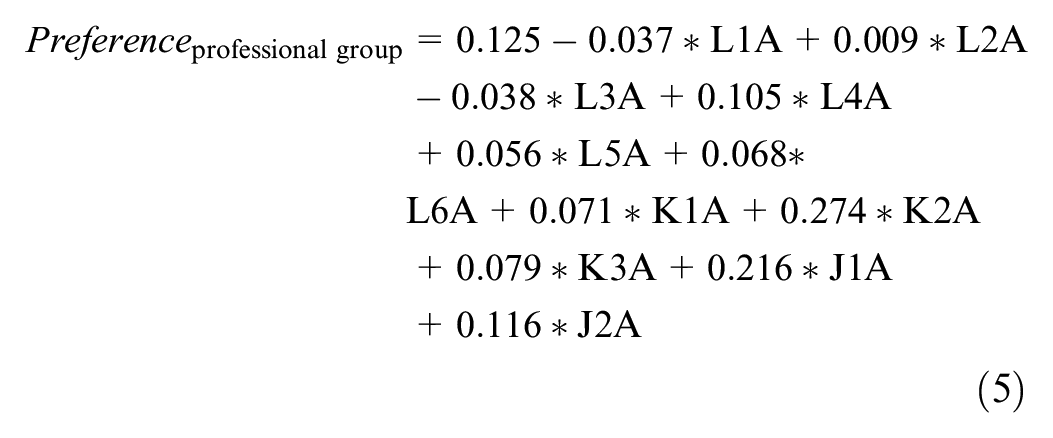
Table 8 demonstrates that the R-squared values for Equation 4, Equation 5, and Equation 6 are all above 0.7, while the VIF values for each do not exceed 5. Therefore, the regression equation can be considered valid. According to Table 7, we derived the following regression equations for the professional group:


Regression Analysis of the Professional Group.
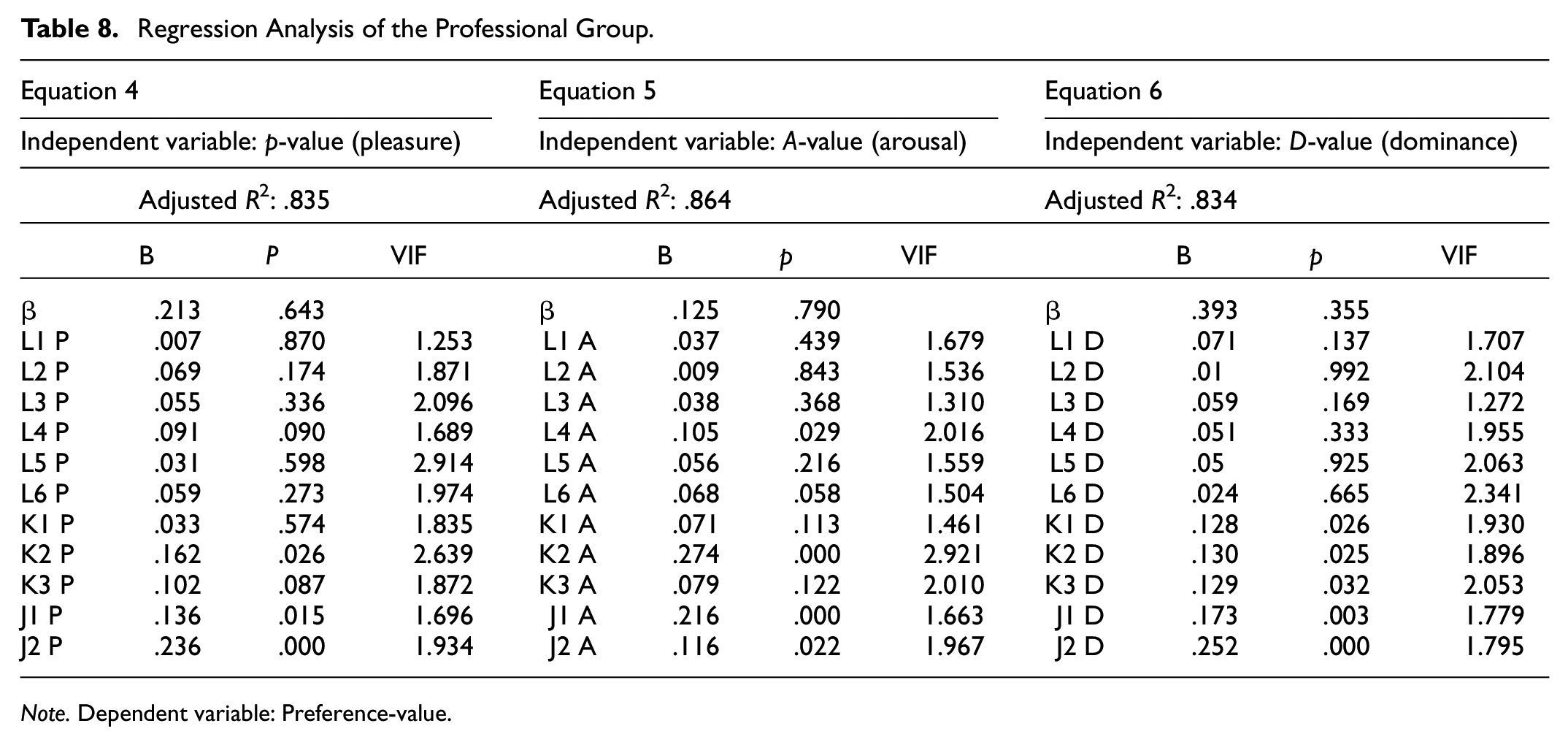
Note. Dependent variable: Preference-value.
Interpretation of Regression Equations
In regression analysis, each design element is associated with a specific partial regression coefficient. A positive coefficient suggests that the introduction of the design element will lead to an increase in the corresponding “Like” rating; while a negative coefficient indicates that it is associated with a decrease. Furthermore, a p-value below .05 indicates that the variable has a statically significant effect on the dependent variable. By examining the p-values presented in Tables 7 and 8, we can identify design elements with significant impact and positive partial regression coefficients, as illustrated in Table 9.
Design Elements with Significant Variables and Positive Partial Regression Coefficients.

For the non-professional group’s preference judgments, the design elements that significantly contribute to an increase in the associated “Like” ratings are posture elements (L3, L5&L6), circular frames (K2), and simplified designs (J2). However, the elements that elicit a three-dimensional emotional response are posture elements L3 and L5. In contrast, for the professional group’s preference judgments, the design elements that significantly lead to an increase in the associated “Like” ratings include circular frames (K2), square frames (K3), wavy frames (K1), simplified designs (J1&J2), and posture (L4). The elements that elicit a three-dimensional emotional response are only circular frames (K2) and simplified designs (J1&J2). It can be inferred that variations in dragon posture are more likely to cause emotional fluctuations among the novice group and can actively lead to an increase in “Like” ratings, while simplified designs of dragon patterns are more likely to cause emotional fluctuations among the professional group and can actively lead to an increase in “Like” ratings. Additionally, both groups prefer circular frames around the dragon patterns. Therefore, the commonalities and differences in esthetic emotional feedback between the professional and novice groups will be discussed in the conclusion section.
Discussion
The Differential Impact of Expertise on Emotional Feedback and Preferences for Design Elements
In this study, we measured emotions across three key dimensions: pleasure, arousal, dominance. The findings reveal that distinct pattern design elements and emotional dimensions exert varying influences on preference evaluations across different user groups, as detailed in Table 9. While the impact of individual differences in esthetic on these evaluation is well-documented(Menninghaus et al., 2019), our study delves into the specific design elements that different groups favor. The data from the novice group indicated that variations in the dragon’s posture (L3 & L5) significantly influence preference evaluations through the dimensions of pleasure, arousal, and dominance. This suggests that novice participants, when experiencing heightened levels of pleasure, arousal, and dominance, are more likely to positively evaluate and prefer design elements that feature varied dragon posture. Conversely, the professional group’s data highlight, that rounded edges and simplified designs have a more substantial impact on preference evaluations through pleasure, arousal, and dominance. This observation implies that professionals, with their deeper understanding and appreciation of design principles, are more likely to be drawn to and prefer designs that incorporate rounded edges and simplified elements. These features may resonate with professionals due to their alignment with principles of esthetic harmony and the functional aspects of design.
While the current research landscape lacks specific studies comparing novice and professional preferences for traditional pattern design elements, we can draw analogous support from existing literature to inform our understanding. In this experiment, the professional and novice groups can serve as proxies for pattern familiarity, allowing us to speculate based on the categorization motivation model (Whitfield, 2000). This model suggests that categorization and organization are cognitive strategies that reduce cognitive load, thereby making complex information more manageable and memorable. According to Sweller et al. (1998), novice group may face greater cognitive resources challenges in cognitive tasks, particularly in pattern recognition and understanding. This implies that the novice group might require more cognitive resources for these tasks, making shape variations relatively easier to comprehend and perceive, which in turn could expedite their emotional responses. Shape changes are more salient to novices, likely because they are more readily noticeable and require less domain-specific knowledge to appreciate.
In contrast, the professional group, with their deeper understanding of design principles, may prioritize subtler differences in changes, as these nuances can be critical in assessing the quality and functionality of design elements. Fayn et al. (2018) suggests that the ability to discern and recognize more subtle emotional states may be linked to individuals’ understanding of the art domain and their curiosity. Simplified dragon patterns may stimulate the curiosity and interest of the professional group, possibly due to the novelty and complexity of esthetics, both of which can readily elicit emotional responses (Leder et al., 2004).
The Esthetic Commonality of Circular Boarder Surrounding Dragons
The preference for circular borders in dragon patterns among both novice and professional groups is a fascinating finding that invites further exploration into the realm of esthetic universals. Contours are fundamental to visual perception, playing a crucial role in the detection and representation of objects. Contour integration binds disjoint elements into a coherent overall shape and aids in differentiating the interior from the exterior of objects(Chuquichambi et al., 2022). From the perspective of shape preference theory, the type of contour that visual objects possess, whether sharp or curved, impacts on people’s attitudes toward those objects (Bar & Neta, 2006). Compared to angular shapes, people tend to prefer objects with curved shapes (Bar & Neta, 2006; Silvia & Barona, 2009). Angular shapes often evoke associations of aggression, while circular shapes tend to evoke associations of compromise (Y. Zhang et al., 2006). ,Neuroanatomically, curved contours specifically activate the anterior cingulate cortex, an area that strongly responds to the rewarding properties and emotional salience of objects (Vartanian et al., 2013). The UMA model (Hekkert, 2006) suggests that people generally prefer products that align with their deeply rooted needs for safety and achievement while achieving a balance between unity, diversity, typicality, novelty, autonomy, and relatedness. In experiments on preferences for product appearance design, researchers have found that people generally prefer rounded design elements compared to sharp and angular ones (Westerman et al., 2012). Additionally, making indulgent food in a circular shape increases its attractiveness, choice probability, and consumption level (S. Zhou et al., 2021). The findings of this paper are in concordance with those of prior studies, confirming the preference for circular shapes among people.
However, a study on the influence of professional knowledge and expertise on people’s preference for circular shapes (Silvia & Barona, 2009) suggests that professionals with certain artistic or design backgrounds may have a greater appreciation for and preference for angular objects, as these shapes may be associated with traits like innovation, modernity, and technical excellence. The findings of this paper contrast with those of the aforementioned study, leading us to posit that the subjects’ familiarity with the stimuli may be a contributing factor. Compared to the novice group, the circular border (K2), wavy border (K1), and square border (K3) designs were more effective in eliciting emotional responses from the expert group. However, when considering the dimension of emotion induction, it is necessary to take into account the attribute characteristics of the experimental stimuli and the participants’ familiarity with them. This is because the dragon patterns used in this study inherently possess three different types of surrounding borders, which the expert group may be well-acquainted with. Consequently, they might recognize that the curvilinear, square, and circular borders are inherent features of dragon patterns, not innovations, but rather optimal choices. Therefore, under these conditions, the professional group preferred the circular border over the curvilinear and square ones. Further experimental research is required to validate these assumptions, such as introducing border shapes that have not previously been associated with dragon patterns, like pentagonal borders, to rule out the possibility that the professional group’s preferences are due to their familiarity with the traditional border forms surrounding dragon patterns.
But why do dragon patterns with circular borders evoke more emotions and preferences compared to those without borders? This can perhaps be explained through Gestalt psychology. Individuals tend to integrate new information with existing knowledge and expectations to better understand and process this information. When circular borders are added to different patterns, viewers may tend to perceive the entire pattern as having a “circular” shape, rather than just focusing on the pattern itself, following the perception of art is a cognitive process (Leder et al., 2004). For example, one may express a preference for trains because they evoke memories of travel. In Chinese culture, circles symbolize joy and are revered as symbols of good luck and happiness. Signs of a preference for circular shapes are found in traditional Chinese architecture, such as the design of circular doors and windows, where circles often symbolize auspiciousness (Bo & Xiaomin, 2024). Therefore, when different patterns are adorned with circular borders, viewers may perceive the patterns as “circular,” symbolizing concepts of happiness and auspiciousness. This cognitive explanation stems from Chinese expectations and prior knowledge of circular shapes, embodying a pursuit of meaning. As models proposed by Leder, Belke, Oeberst, and Augustin suggest, esthetic emotions are merely by-products of cognitive stage progression. Understanding style and content is considered self-rewarding and aligns with the “effort after meaning” theory, which posits that viewing art is enjoyable in part due to the ability to interpret information and intentions (Russell, 2003).
Research Contributions and Practical Applications
This paper delves into the relationship between the design elements of Chinese dragon patterns and the emotional responses and preferences of subjects, with particular consideration given to esthetic differences between expert and novice groups. Employing the E-prime methodology and multiple linear regression analysis, we found a close association between the design elements of dragon patterns and participants’ professional knowledge, emotional responses, and preferences. Specifically, variations in the shape of dragons are more likely to elicit emotional responses in novice groups, while simplified designs provoke emotional responses in expert groups. Furthermore, the use of circular frames in dragon patterns significantly influenced the emotional responses and preference evaluations of both groups.
The study’s implications and significance span theoretical, practical, and societal realms:
Theoretical Implications: The research fills a gap in the existing literature regarding the relationship between preferences and esthetic emotional feedback to traditional Chinese pattern design elements, providing new insights into how emotional experiences influence design preferences, particularly in the field of modernizing traditional Chinese patterns. Moreover, the findings offer a theoretical foundation for future research, especially in exploring esthetic differences and emotional experiences across different cultural backgrounds.
Practical Implications: Designers can leverage these findings to create more appealing dragon pattern designs by adjusting design elements based on the target group’s level of expertise; businesses can apply these principles in product design to enhance market competitiveness, especially in the Chinese market or among consumer groups interested in Chinese traditional culture. The study also provides insights into how to evoke specific emotions through design elements, which could be useful for marketing and brand-building strategies.
Societal Implications: By preserving and transmitting Chinese traditional culture through modern design, this study contributes to the enhancement of cultural confidence and identity; it may also stimulate discussions on the application of Chinese traditional cultural elements in contemporary society, encouraging more innovation and experimentation.
Incorporating the aforementioned impacts, we propose the following recommendations for the modern design of dragon patterns to enhance their efficiency in contemporary design and to augment esthetic experiences, thereby improving the market competitiveness of products: The emotional fluctuations and esthetic preferences of novice groups are influenced by variations in shape; thus, in modern design, various shape alterations can be attempted to create diverse emotional experiences. For instance, different emotions and esthetic tastes can be expressed by altering the curvature, angles, and posture of the dragon. Professional groups are more sensitive to simplified designs. Therefore, designers should emphasize streamlined pattern design. The inclusion of circular frames affects the emotional fluctuations and esthetic preferences of both novice and professional groups. Consequently, designers may consider incorporating circular frames in pattern design to evoke emotional experiences in the audience.
Furthermore, the theoretical significance of this study lies in understanding the key factors that influence the esthetic emotional response to Ming-style furniture patterns and exploring the differences in esthetic experiences between professional and novice groups. Additionally, the research outcomes will deepen the comprehension of visual esthetics psychology based on traditional patterns, while providing a theoretical basis for the contemporary audience’s esthetic psychology toward traditional patterns. Through these comprehensive findings and recommendations, we anticipate being able to offer scientific theoretical support and practical guidance for the modern application of dragon patterns.
Limitation and Future Direction
Although our study has revealed some interesting findings, there are still limitations and directions for future expansion.
Firstly, our research explored the relationship between different dragon patterns and emotions, but did not investigate which design elements evoke specific emotions. For example, the study results showed that circular borders can evoke three-dimensional emotions in the novice group, while the novice group is more concerned about the posture changes of the dragon patterns. Is this emotion negative or positive? The PAD model categorizes emotions into eight types based on these three dimensions: P + A + D, such as happy; - P - A - D, such as bored; However, due to the large number of experimental questions, it may easily induce negative emotions in the subjects during the answering process, which is not conducive to further analysis of emotions. Therefore, future research can also explore which postures of dragon patterns and which simplified designs can evoke positive and negative emotions. A combination of subjective and objective measurement methods can be used, and some physiological measuring instruments can directly measure the emotional states of the subjects, such as electrodermal activity (EDA), heart rate, respiration, and body temperature. These physiological measurements are often used as relevant factors in emotion arousal (Feng et al., 2018; Kumar et al., 2023; Yu & Sun, 2020), so that designers can more accurately grasp the impact of design elements on emotional experiences.
Secondly, in real-world contexts, the design elements of dragon patterns often combine with specific materials and colors to present a complete visual effect. However, the focus of this study is solely on the design elements of the dragon patterns themselves. This decision is based on two considerations: on the one hand, the dragon patterns selected for this study are typically carved on wood, with the natural color being that of the wood itself, thus creating a certain uniformity in terms of material and color. On the other hand, the purpose of this study is to explore the impact of variations in the design elements of dragon patterns on the emotional responses and preferences of the subjects; therefore, to ensure the accuracy of the research findings, it is necessary to control for potentially interfering factors such as material and color. Nevertheless, the findings of this study provide a valuable foundation for future research. For instance, this study reveals that both groups prefer dragon patterns with circular borders, suggesting that future research could further investigate how different materials or colors might influence visual preferences, thereby leading to optimal design choices.
Lastly, it should be acknowledged that our study sample was confined to Chinese participants. Given the documented variations in esthetic experiences across diverse cultural backgrounds(Bao et al., 2016), we advocate for future research to include individuals from a range of cultural backgrounds. This would facilitate a comparative exploration of esthetic differences experienced by Eastern individuals when exposed to Western culture.
Conclusion
This study utilized multiple regression analysis to explore the correlation between design elements of Chinese dragon patterns and emotional responses and preferences. The research confirmed the hypotheses H1, H2, and H3 that we proposed, filling a theoretical gap in existing literature regarding the association between preferences and esthetic emotional feedback toward traditional Chinese pattern design elements. Furthermore, this study offers theoretical references for the contemporary redesign of dragon patterns. Our findings reveal that shape variations, simplified designs, and the use of circular borders significantly influence participants’ emotional responses and preference evaluations. Based on these results, we propose recommendations for the modernization of dragon pattern design, such as focusing on diverse shape designs for novice individuals and maintaining traditional elements within simplified designs for professional individuals. These insights hold significant importance for the application of Chinese dragon patterns in modern design. To gain a deeper understanding of these conclusions, we compared them with previous research. For instance, we found that the novice group was more sensitive to changes in the posture of the dragon, which may be related to their limited cognitive resources for pattern recognition. The professional group, on the other hand, preferred simplified designs, possibly due to their pursuit of novelty and complexity in esthetics. These findings align with Gestalt psychology theories, suggesting that individuals tend to integrate new information with existing knowledge and expectations to better understand and process this information. Additionally, our study found that despite different preferences for design elements between novice and professional groups, both tend to favor patterns with circular borders. This discovery adheres to the esthetic principle established by previous research that “people generally prefer rounded shapes,” yet contradicts the finding that “professionals prefer angular shapes.” We have provided a detailed discussion on this point within the paper. Although our study offers some intriguing findings, there are limitations and directions for future expansion. Future research could explore which postures and simplified designs of dragon patterns elicit positive and negative emotions, as well as expand the participant pool to investigate esthetic differences when Eastern and Western cultures encounter each other. Lastly, we hope that more studies will include traditional patterns and traditional art to explore the impact of different forms of expression within the same art on participants’ esthetic emotional responses and preferences.
Footnotes
Appendix
Samples for Experiment.


|

Ethical Considerations
Approval was obtained from the Institutional Review Board of Guangdong University of Technology (GDUT20230907). The procedures used in this study adhere to the tenets of the Declaration of Helsinki.
Consent to Participant
Informed consent was obtained from all individual participants included in the study.
Consent for Publication
Participants signed informed consent regarding publishing their data.
Author Contributions
Conceptualization: Yisi Xue, Jun Cai, Qiuli Lin. Data curation: Yisi Xue. Formal analysis: Yisi Xue. Methodology: Yisi Xue, Jun Cai. Writing – original draft: Yisi Xue, Qiuli Lin. Writing – review & editing: Yisi Xue, Jun Cai, Qiuli Lin.
Funding
The authors received financial support for the research, authorship, and/or publication of this article: (1) Research on Modeling of Pedestrian Wayfinding Behavior and Optimization of Wayfinding Systems in Large-scale Rail Transit Hubs Based on VR Simulation (
Declaration of Conflicting Interests
The authors declared no potential conflicts of interest with respect to the research, authorship, and/or publication of this article.
Data Availability Statement
All data generated or analyzed during this study are included in this published article (and its supplemental information files).
Supplemental Material
Supplemental material for this article is available online.