




Abstract
This study investigates the current state of interdisciplinarity within undergraduate English language major curricula in Chinese public universities, 7 years after the implementation of the National Quality Criteria for Undergraduate Teaching (Foreign Language Majors) (NQC). Grounded in integrationist theories of interdisciplinarity (Repko, Newell), this research conceptualizes interdisciplinarity as the structured integration of five academic disciplines: English language linguistics, English language literature, translation, comparative literature and transcultural studies, and international and regional studies. Drawing on responses from 1,210 students across eight universities, this study develops five empirically grounded and psychometrically validated competence scales, which are then employed in a series of multiple regression analyses to assess interrelationships among disciplinary domains. The findings indicate a generally high level of student-reported academic competence and significant positive associations among most disciplines—particularly in literature studies—suggesting substantive interdisciplinary integration. Moreover, notable disjunctions remain, especially within the subdimensions of translation practice, phonetics, and historical cognition. These patterns underscore both the achievements and the ongoing challenges of recent curricular reforms, and point to specific areas where deeper interdisciplinary alignment may be pursued. By introducing a set of robust disciplinary competence measures and demonstrating their utility in mapping curricular integration, this study offers a methodological framework that may inform future research on interdisciplinarity in diverse educational settings.
Keywords
Introduction
Driven by the evolving demands of academia and society, interdisciplinarity has recently emerged as a critical component of contemporary university curricula. As Hannon et al. (2018, p. 1425) noted, “Interdisciplinarity has become part of contemporary university discourses.” This trend underscores the increasing recognition within educational systems of the necessity to address complex, multifaceted issues—such as effective global communication, media representation, and ongoing efforts for human rights and social justice—which cannot be comprehensively examined from a single disciplinary perspective. By integrating knowledge from multiple academic fields, interdisciplinary curricula empower students to address intricate global challenges and cultivate versatile, highly skilled individuals with multidisciplinary expertise, who are increasingly sought after in the labor market. Consequently, interdisciplinarity has become a strategic imperative in higher education, vital for addressing complex societal issues and fostering well-rounded talent. Therefore, research examining interdisciplinarity within university curricula is of paramount importance.
Interdisciplinarity within the English language major is an especially valuable and transferable research field that merits further exploration. English, as the most widely spoken international language, plays a pivotal role in global communication and is a central area of study in universities around the world. China, the most populous country and the second-largest global economy, has recently emphasized the interdisciplinarity of English language curricula through specific national policies. This study contributes a distinctive Chinese perspective, enriching the global academic discourse.
In recent years, the Chinese government has become a significant proponent of interdisciplinary development, actively promoting interdisciplinary initiatives within higher education. Among these initiatives, the interdisciplinary curriculum of undergraduate English language majors in China offers context-specific insights that enrich the broader conversation on interdisciplinarity in higher education. While these findings are rooted in the Chinese context, they may be relevant to international discussions, though their applicability beyond China would require further comparative and cross-cultural validation.
Two recent national documents highlight the Chinese Ministry of Education’s focus on interdisciplinary curriculum development for undergraduate English language majors. In 2018, key educational guidance bodies under China’s Ministry of Education published the National Quality Criteria for Undergraduate Teaching (Foreign Language Majors) (hereinafter referred to as the National Quality Criteria, NQC), followed by the Teaching Guide for Foreign Languages and Literature Undergraduate Majors in Colleges and Universities (hereinafter referred to as the Guide) in 2020. Both the NQC and the Guide declare directly and officially that the English language and literature discipline is inherently interdisciplinary (J. Zhang, 2023). Supported by the English language and literature discipline, the English language major constitutes a core component of the broader foreign languages and literature field. In China, this academic discipline differs from its counterparts in other countries, as it fundamentally exists as an interdisciplinary composite. Its inherent complexity and diversity naturally endow it with interdisciplinary characteristics (Ruan, 2023).
In this study, we understand interdisciplinarity as the integration of perspectives from multiple disciplines, in alignment with both international theoretical frameworks and national policy guidelines in China. Specifically, our conceptualization draws on the integrationist perspectives of Repko (2012) and Newell (2001), as well as curriculum reforms outlined in two authoritative documents: the NQC and the Guide, both of which were issued by the Ministry of Education in China.
Newell (2001) defines interdisciplinarity as a process that involves drawing on two or more disciplines to integrate insights and construct a more comprehensive understanding of complex problems. Similarly, Repko (2012) emphasized integration as the central feature distinguishing interdisciplinarity from multidisciplinarity, which may juxtapose disciplinary perspectives without synthesizing them. Chinese scholars (Nie, 2021; J. Zhang, 2023) also express a similar understanding of interdisciplinarity in relation to integrating multiple disciplines.
This theoretical foundation resonates with China’s national policy framework, which formally designates the English language major as “a major of interdisciplinarity” (Ministry of Education Foreign Language and Literature Teaching Steering Committee, 2020, p. 1). According to the Guide, the English language major encompasses five disciplinary domains: English language linguistics; English language literature; translation; comparative literature and transcultural studies; international and regional studies. Each of these domains represents a distinct body of knowledge with its own methodologies and epistemological traditions. This study focuses on the five academic disciplines, rather than solely on language skills such as listening, speaking, reading, and writing.
The interdisciplinary nature of the English language major lies not only in the coexistence of multiple disciplines but also in their systematic integration into a unified curriculum framework. Together, these five disciplines aim to prepare undergraduates “to meet the demands of international exchange, national and regional economic development, and the growing need for various types of professional and interdisciplinary foreign language talents” (Teaching Steering Committee for Higher Education Institutions, 2018, p. 92). This aligns with what Repko and Newell identify as an “integrationist” model of interdisciplinarity, which aims to synthesize disciplinary insights into a coherent and goal-oriented framework.
In this context, we adopt the following working definition:
Interdisciplinarity in the English language major curriculum refers to the structured integration of the five disciplinary domains outlined in the NQC and the Guide, with the aim of cultivating professionals capable of responding to the demands of global communication, regional development, and cross-cultural understanding.
This definition serves as the analytical foundation for our investigation into the curricular structure of English language programs across Chinese universities.
Literature Review
Previous research on the intersection of the English language major and interdisciplinarity is limited. Existing studies have focused primarily on the interdisciplinarity of the English language major in relation to fields such as medicine, agriculture, computer science, and engineering (Hou, 2012; Ziegler, 2014) or the intersection between the English language major and other humanities disciplines, such as sociology and psychology (Langum & Sullivan, 2021).
Perhaps owing to differences in the national context and the period of research, these studies have largely overlooked the internal interdisciplinarity of the English language major itself, a concept that is clearly defined in two recent reformative Chinese national documents, the NQC (2018) and the Guide (2020). The publication of the NQC and the Guide has sparked extensive discussion in Chinese scholarship. These discussions have largely remained at the theoretical level, focusing on the interdisciplinary nature of English language major curricula or exploring how to link interdisciplinarity to China’s New Liberal Arts initiative and the construction of disciplines in the artificial intelligence era (J. Chen, 2023; Hu, 2020; H. W. Liu, 2020; Ren & Liu, 2019; J. Zhang, 2023). However, there remains a significant gap in quantitative research that provides empirical data and scientific evaluation methods to assess curriculum interdisciplinarity.
Makhachashvili and Semenist (2021) also recognized the internal interdisciplinarity within the English language major, but their focus was limited to various branches of linguistics (such as syntax, phonetics, semantics, pragmatics, etc.) and their integration into foreign language teaching, as well as their fusion with technology. However, this approach does not fully align with the specific connotation of interdisciplinarity outlined in China’s national policies for the English language major. Overall, there is a noticeable lack of quantitative research that focuses on the interdisciplinary integration of the five major disciplines defined by the NQC in a way that is relevant to China’s national context.
Moreover, considering the potential risk that interdisciplinary education may erode disciplinary boundaries—leading a discipline to lose its intrinsic disciplinary identity (Millar, 2016; J. Zhang, 2023)—this study employs five discipline-specific competence scales, each demonstrating strong reliability and validity. These scales measure the current competence levels of English language majors across five distinct disciplinary domains. Specifically, the study assesses disciplinary competencies 7 years after the implementation of the NQC and 4 years after the introduction of the Guide. This assessment aims to ensure that English language majors preserve their disciplinary essence amid the global trend toward interdisciplinary curriculum development.
The alignment of the NQC’s concept of interdisciplinarity with Repko’s (2012) and Newell’s (2001) theoretical understanding of interdisciplinarity strengthens the theoretical validity of our use of multiple regression analysis. Specifically, Repko (2012) explains that the prefix “inter” implies a connection that occurs “between, among, [or] in the midst” of different disciplines (p. 3). According to Repko, the starting point for understanding interdisciplinarity involves the relationship “between two or more disciplines,” whereas correlation coefficients are an efficient tool for indicating the relationship “between two or more disciplines” (p. 3). In our case, standardized regression coefficients among disciplinary competencies serve as a proxy for the connections between disciplines within the curriculum. Standardized regression coefficients quantify the magnitude and sign of these associations, reflecting the degree and nature of interconnectedness among the five disciplines without implying directionality or causality. This method provides a clearer, quantifiable understanding of the interdisciplinary nature of the English language major curriculum. For instance, if Chinese undergraduates’ competence in English language linguistics is found to be significantly negatively correlated with their performance in English language literature, this may suggest failure in current interdisciplinary curricula. This ineffective course design could hinder the cultivation of students who are capable of developing mutually reinforcing expertise in both areas.
Prior to our study, empirical research on the degree of interdisciplinarity in the English language major in China was lacking. Although national policies such as the NQC and the Guide have promoted the conceptualization of the English language major as an interdisciplinary field, empirical investigations into how this vision translates into actual educational practice—particularly regarding the relationships among students’ disciplinary competencies—remain scarce. Our research addresses this significant gap by providing the first quantitative assessment of interdisciplinarity within the English language major curriculum in China. By supplying concrete evidence that demonstrates the integration of various disciplinary competencies, our study extends the foundational frameworks of interdisciplinarity proposed by Repko (2012) and Newell (2001) into a new educational context. Moreover, it enriches the ongoing academic discourse by contributing robust, data-driven insights into the practical realization of interdisciplinarity within the English language major.
Moreover, Al Fraidan’s (2024a, 2024b) insightful analysis of monitor theory and his enhanced adaptive Presage–Process–Product (PPP) Model—originally applied to test-taking strategies—offer conceptual tools that can be extended to interdisciplinary education. Although neither framework was developed specifically for interdisciplinarity, monitor theory highlights how self-monitoring and adaptive strategy use shape learning processes, and the enhanced adaptive PPP model elucidates the dynamic interplay among learner characteristics, instructional strategies, and learning outcomes. These mechanisms may be productively applied to interdisciplinary learning contexts when adapted accordingly. Together, these frameworks, when conceptually extended, help illuminate how various disciplinary competencies may codevelop or compete, enriching our understanding of interdisciplinary dynamics within the English language major curriculum.
Consequently, the following three research questions (RQs) are posed:
Methods
Participants
This study was conducted in November 2023 across a number of public universities representing different tiers of Chinese higher education. These institutions, while operating under unified national curriculum frameworks such as the NQC and the Guide, maintain some degree of autonomy in developing distinctive features within their English language departments. The sample comprised undergraduate students enrolled in English language majors.
A total of 1,596 students completed five online self-report questionnaires measuring their perceived competence across five academic disciplines related to their major. The questionnaires were distributed via a secure link and completed anonymously to ensure participant privacy. All responses were treated as confidential and used solely for research purposes.
Participation was voluntary. Prior to data collection, participants were informed of the study’s aims and their rights, including the right to withdraw at any time without penalty. The items were non-invasive in nature, measured on a 5-point Likert scale (1 = completely disagree to 5 = definitely agree), and were designed to minimize any discomfort or perceived pressure.
Following data cleaning, responses from 273 students majoring in other languages and 10 graduate students were excluded. The final sample included 1,210 undergraduate students majoring in English language, with a valid response rate of 75.8%. The aggregated data were then used to examine the perceived disciplinary development of English language majors 7 years after the introduction of the NQC, with comparisons across academic year levels.
Sample Characterization
A total of 1,210 respondents were drawn from eight universities in China. Eighty-four percent of the respondents (n = 1,014) were female, and 16% of the respondents (n = 196) were male. All the respondents were undergraduates majoring in English. The distribution of respondents by grade is as follows: 35% were freshmen (n = 425), 29% were sophomores (n = 351), 24% were juniors (n = 292), and 12% were seniors (n = 142) (see Table 1).
Sample Characterization.

Measures
Five instruments comprising a total of 77 items were employed in this study (see Appendix 1): the English language linguistics scale (LIN scale, five subdimensions), the English language literature scale (LIT scale, three subdimensions), the translation scale (TRA scale, two subdimensions), the scale of comparative literature and transcultural studies (LITCUL scale, two subdimensions), and the scale of international and regional studies (CNT scale, three subdimensions). A complete overview of the hierarchical organization of these subdimensions is provided later in Table 3. Each subdimension represents a specific category of competence within the respective domain.
These instruments were developed by three experts in the Department of English at top Chinese universities, each with more than 20 years of teaching experience. The development was grounded in relevant literature, particularly the NQC and the Guide outlining competence requirements for English language majors in China, ensuring both academic rigor and practical applicability.
The study assessed both the reliability and structural validity of the instruments. The results of the reliability analysis showed that all scales had Cronbach’s alpha coefficients greater than .70, indicating acceptable internal consistency (Nunnally, 1978, p. 245). Confirmatory factor analysis (CFA) was conducted using R Studio, with model fit evaluated via established indices: comparative fit index (CFI), Tucker–Lewis index (TLI), root mean square error of approximation (RMSEA), and standardized root mean square residual (SRMR). The evaluation criteria were based on established thresholds, specifically: CFI and TLI greater than 0.90, RMSEA less than 0.10, and SRMR less than 0.05, as recommended by Hooper et al. (2008).
The CFA results for each scale were as follows: English language linguistics scale (CFI = 0.923, TLI = 0.912, RMSEA = 0.066, SRMR = 0.047), English language literature scale (CFI = 0.957, TLI = 0.944, RMSEA = 0.061, SRMR = 0.049), translation scale (CFI = 0.985, TLI = 0.980, RMSEA = 0.078, SRMR = 0.038), comparative literature and transcultural studies scale (CFI = 0.978, TLI = 0.963, RMSEA = 0.072, SRMR = 0.026), and international and regional studies scale (CFI = 0.964, TLI = 0.955, RMSEA = 0.068, SRMR = 0.028).
Overall, the psychometric results confirm that the five instruments are both methodologically sound and psychometrically robust. They are therefore well suited to assess the competencies of English language majors across the five academic domains, and to explore the extent of interdisciplinarity embedded in the curriculum through the interrelationships among these competencies.
Procedures
This study empirically analyzed data from 1,210 English language major undergraduates using five measurement scales. The subdimensions within each academic domain were established through principal component analysis with varimax rotation, supplemented by a review of relevant literature and expert evaluations by three field specialists.
To address the three research questions, a series of multiple regression analyses were conducted, with each competence treated in turn as the dependent variable and the remaining four as independent variables. Gender and grade were included as control variables in all the models. Standardized regression coefficients are reported. The subsequent section outlines the primary findings, and discusses their underlying reasons and implications for developing tertiary-level English language major curricula.
Results
Current State of the English Language Major Curricula
The data presented in this study provide an insightful overview of the competence levels of Chinese undergraduate students majoring in English across the five academic disciplines. The mean scores indicate a moderate to high level of competence in LIT, LIN, TRA, LITCUL, and CNT. Specifically, the highest mean score was observed for LITCUL (3.58), followed by LIT (3.55), LIN (3.43), CNT (3.43), and TRA (3.39). These results suggest that, overall, English language major undergraduates enjoy a relatively high level of academic competence.
The discipline of LIT yielded an overall mean score of 3.55. The scores increased progressively by year: 3.33 for freshmen, 3.42 for sophomores, 3.49 for juniors, and 3.57 for seniors. The total increase from freshman to senior year was 0.24 points.
The discipline of LITCUL recorded the highest overall mean score of 3.58. The year-specific scores were 3.54 for freshmen, 3.65 for sophomores, 3.50 for juniors, and 3.68 for seniors (see Figure 1). From the freshman to senior year, the total change amounted to an increase of 0.14 points.

Changes in mean scores of competence levels across the years.
In CNT, the overall mean score was 3.43. Freshmen had a mean score of 3.42, sophomores 3.47, juniors 3.40, and seniors 3.39. The year-to-year scores did not follow a consistent directional pattern.
The overall mean score for TRA was 3.39, which was the lowest among the five disciplines. The yearly breakdown was as follows: 3.33 for freshmen, 3.44 for sophomores, 3.38 for juniors, and 3.41 for seniors. Although the yearly scores in TRA did not follow a linear progression, the overall trend was upward.
LIN produced an overall mean score of 3.43. The scores were 3.42 for freshmen, 3.46 for sophomores, 3.43 for juniors, and 3.40 for seniors. The values remained relatively stable across the 4 years.
In response to RQ1, the findings indicate that the current undergraduate English language major curriculum in Chinese public universities has generally succeeded in fostering academic competence across the five core disciplines, particularly in literature-related areas. However, the year-to-year patterns suggest that while foundational curricular structures are effective during the early stages, the continuity and coherence of progression in most disciplines may warrant further pedagogical refinement and sustained curricular alignment.
Associations Among the Five Academic Disciplines Within the English Language Major Curricula
To examine the explanatory associations among five core academic competences within the English language major curriculum—English language linguistics competence (FLIN), competence in English language literature (FLIT), translation competence (FTRA), competence in comparative literature and transcultural studies (FLITCUL), and competence in international and regional studies (FCNT)—a series of multiple regression analyses were conducted. Each competence was treated in turn as the dependent variable, with the remaining four competences as independent variables. Gender and grade were included as control variables in all models. Overall, all five multiple regression models demonstrated good reliability and strong explanatory power, with significant F-tests, adjusted R2 values ranging from approximately 0.46 to 0.65 (Field, 2018), and no evidence of multicollinearity (VIFs well below 5; Hair et al., 2010; Kutner et al., 2004).
The standardized regression coefficients are presented in a three-line table (see Table 2). Across the five regression models, multiple significant associations were observed among the core academic competences, indicating a commendable state of interdisciplinarity within the English language major curriculum. FLIT emerged as the most consistently associated dimension, showing significant positive relations in all four other models. To illustrate these results in detail, the following is a breakdown of the five models.
Standardized Regression Coefficients (β) for Five Academic Competence Models with Gender and Grade as Controls.
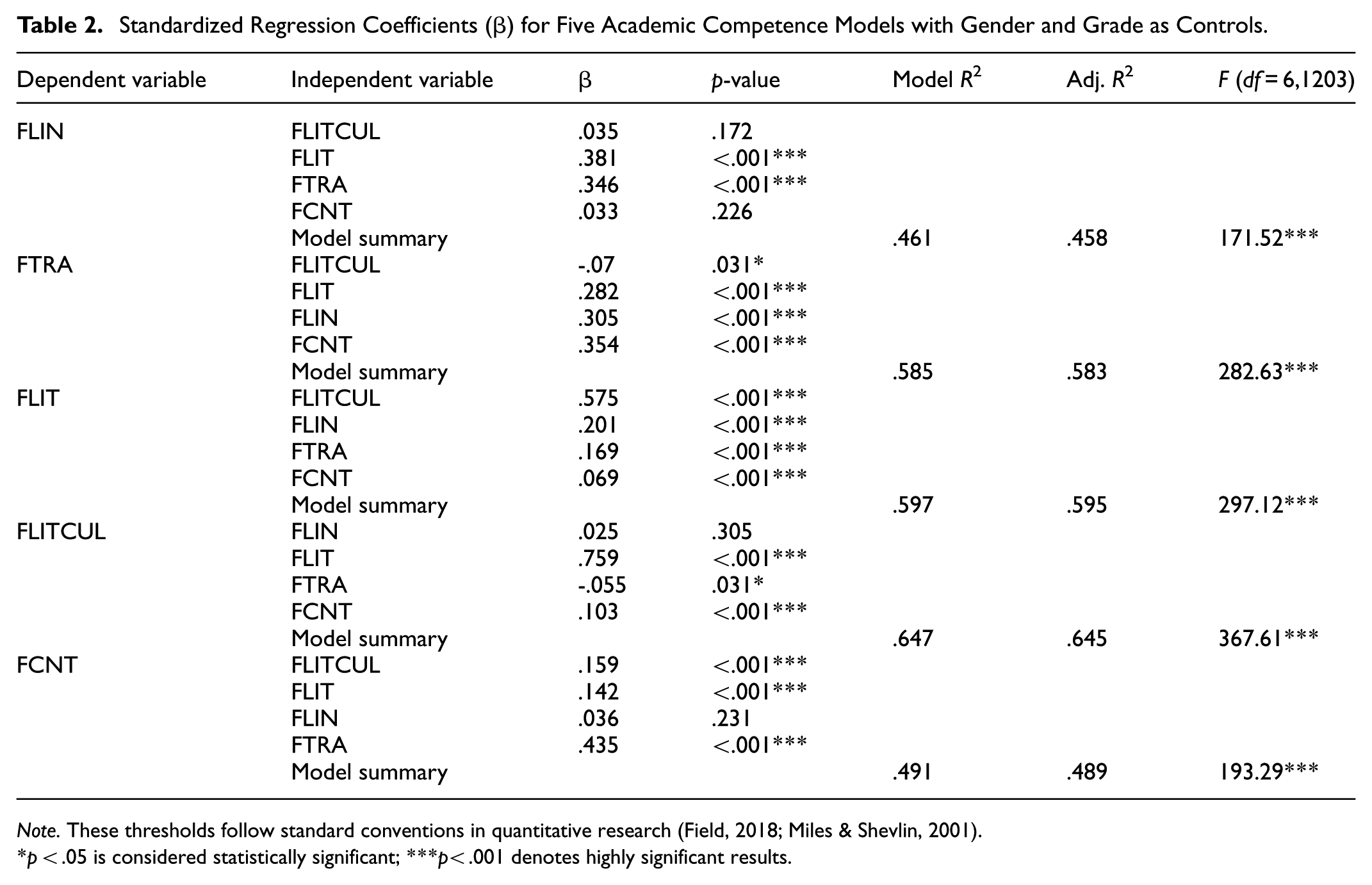
Note. These thresholds follow standard conventions in quantitative research (Field, 2018; Miles & Shevlin, 2001).
p < .05 is considered statistically significant; ***p< .001 denotes highly significant results.
FLITCUL was strongly associated with FLIT and FCNT, but showed a negative and non-significant association with FTRA and FLIN, respectively. FLIN was positively related to FTRA and FLIT, but did not demonstrate broader connections beyond these two domains. FCNT was most strongly associated with FTRA, and also contributed positively to FLITCUL and FLIT, with a non-significant association with FLIN.
In the FLIN model, positive and significant associations were found with FTRA and FLIT. No significant associations were observed with FLITCUL or FCNT.
In the FTRA model, positive associations were observed with FCNT, FLIN, and FLIT, in descending order of strength. FLITCUL showed a significant negative association.
In the FLIT model, all four explanatory variables—FLITCUL, FLIN, FTRA, and FCNT—were positively and significantly associated. The strongest association was with FLITCUL, followed by FLIN, FTRA, and FCNT.
In the FLITCUL model, the strongest positive association was observed with FLIT, followed by a weaker positive association with FCNT. A significant negative association was found with FTRA, while the association with FLIN was not statistically significant.
In the FCNT model, the strongest positive association was found with FTRA, followed by weaker positive associations with FLITCUL and FLIT. The association with FLIN was not statistically significant.
In response to RQ2, these results suggest that nearly all academic disciplines exhibit highly significant positive associations, with the exception of a negative association between FLITCUL and FLIN and non-significant relationships between FLIN and both FLIT and FLITCUL. Taken together, these results reflect a pattern of notable but varied interdisciplinarity within the curriculum.
Associations Among the Subdimensions of the Five Academic Disciplines Within the English Language Major Curricula
To further investigate the explanatory relationships among the 15 subdimensions of the five core academic competences within the English language major curriculum, a series of multiple regression analyses was conducted. Specifically, the English language linguistics competence (FLIN) dimension comprises five subdimensions: semantics and pragmatics (F1LIN), phonetics (F2LIN), grammar (F3LIN), language acquisition (F4LIN), and basic concepts of the English language (F5LIN). The English language literature competence (FLIT) dimension includes three subdimensions: appreciation of English language literature (F1LIT), critical thinking in English language literature (F2LIT), and basic knowledge of English language literature (F3LIT). The translation competence (FTRA) dimension consists of: translation practice (F1TRA) and basic knowledge of translation (F2TRA). The competence in comparative literature and transcultural studies (FLITCUL) dimension encompasses: cultural understanding (F1LITCUL) and cultural behavior (F2LITCUL). Finally, the competence in international and regional studies (FCNT) dimension comprises: spatial cognition (F1CNT), historical cognition (F2CNT), and social awareness (F3CNT). The hierarchical structure of these competences and their corresponding subdimensions is presented in Table 3.
Hierarchical Structure of Core Academic Competence Subdimensions in the English Language Major.

Given that each of the 15 multiple regression models involves 14 independent variables, a total of 210 relationships were identified. The complete results for all relationships are provided in the supplementary dataset (see DOI: https://doi.org/10.5281/zenodo.15812012). Gender and grade were included as control variables in all models. All multiple regression models demonstrated good reliability and strong explanatory power, with significant F-tests and adjusted R2 values ranging from 0.540 to 0.738, indicating a substantial proportion of variance explained by the explanatory variables (Field, 2018). No evidence of multicollinearity was detected, as all variance inflation factor (VIF) values were well below the recommended threshold of 5 (Hair et al., 2010; Kutner et al., 2004). These results suggest that the explanatory relationships among the subdimensions within the English language major curricula can be interpreted with confidence.
To ensure clarity and relevance, the following results section focuses on the associations among the 15 subdimensions where β > .1 and p < .001 (see Table 4).
Key Multiple Regression Results for 15 Subdimensions across Five Academic Disciplines.
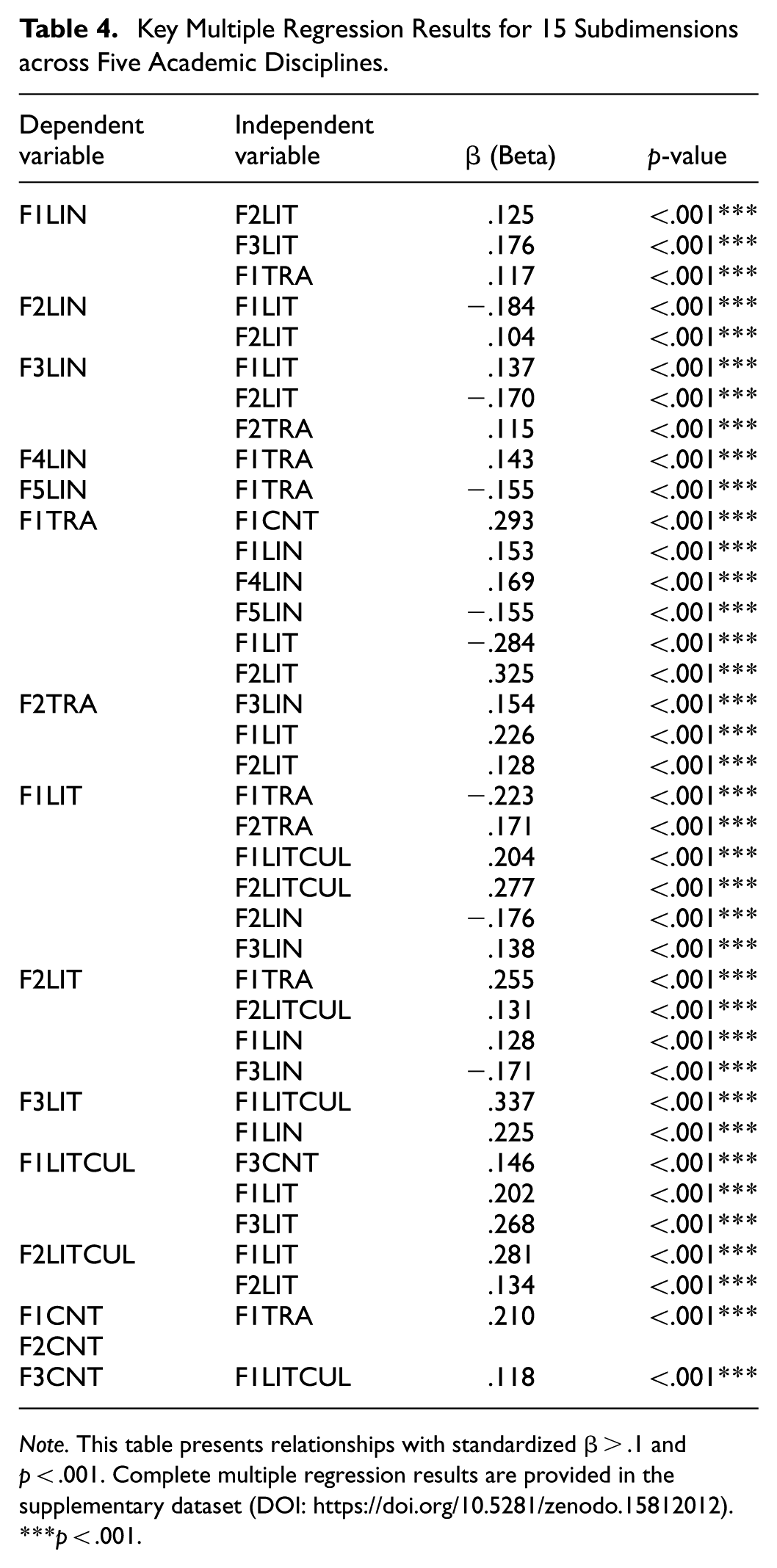
Note. This table presents relationships with standardized β > .1 and p < .001. Complete multiple regression results are provided in the supplementary dataset (DOI: https://doi.org/10.5281/zenodo.15812012).
p < .001.
Among the five subdimensions of FLIN (i.e., English language linguistics competence), F1LIN (i.e., semantics and pragmatics) presented three positive associations, with the strongest link to F3LIT (i.e., basic knowledge of English language literature), followed by F2LIT (i.e., critical thinking in English language literature) and F1TRA (i.e., translation practice). F2LIN (i.e., phonetics) demonstrated two significant associations in opposite directions: it was positively associated with F2LIT (i.e., critical thinking in English language literature), whereas its strongest relationship was a negative with F1LIT (i.e., appreciation of English language literature). F3LIN (i.e., grammar) showed three significant links, with the most positive association occurring with F1LIT (i.e., appreciation of English language literature), followed by F2TRA (i.e., basic knowledge of translation), and a negative association with F2LIT (i.e., critical thinking in English language literature). F4LIN (i.e., language acquisition) revealed a single significant relationship that was positively associated with F1TRA (i.e., translation practice). F5LIN (i.e., basic concepts of the English language) also yielded one significant result, showing a negative relationship with F1TRA (i.e., translation practice).
Within the subdimensions of translation competence (FTRA), F1TRA (i.e., translation practice) displayed a complex pattern of six significant associations. It was positively linked with F1CNT (i.e., spatial cognition), F2LIT (i.e., critical thinking in English language literature), F2LIN (i.e., phonetics), and F4LIN (i.e., language acquisition), with the strongest association observed with F1CNT (i.e., spatial cognition). In contrast, negative associations were found with F1LIT (i.e., appreciation of English language literature) and F5LIN (i.e., basic concepts of the English language). F2TRA (i.e., basic knowledge of translation) exhibited three positive associations, the strongest being with F1LIT (i.e., appreciation of English language literature), followed by F3LIN (i.e., grammar) and F2LIT (i.e., critical thinking in English language literature).
With respect to English language literature competence (FLIT), F1LIT (i.e., appreciation of English language literature) presented a broad profile of four positive associations and two negative associations. It was most positively related to F2LITCUL (i.e., cultural behavior), followed by F1LITCUL (i.e., cultural understanding), F2TRA (i.e., basic knowledge of translation), and F3LIN (i.e., grammar). Negative associations were found with F1TRA (i.e., translation practice) and F2LIN (i.e., phonetics). F2LIT (i.e., critical thinking in English language literature) presented four significant associations: the strongest positive association was with F1TRA (i.e., translation practice), followed by F1LITCUL (i.e., cultural understanding) and F1LIN (i.e., semantics and pragmatics), whereas the only negative association was with F3LIN (i.e., grammar). F3LIT (i.e., basic knowledge of English language literature) demonstrated two significant positive associations, most strongly with F1LITCUL (i.e., cultural understanding), and additionally with F1LIN (i.e., semantics and pragmatics).
Within the competence in comparative literature and transcultural studies (FLITCUL), F1LITCUL (i.e., cultural understanding) presented three positive associations, with F3LIT (i.e., basic knowledge of English language literature) having the strongest associations, followed by F1LIT (i.e., appreciation of English language literature) and F3CNT (i.e., social awareness). F2LITCUL (i.e., cultural behavior) was positively associated with F1LIT (i.e., appreciation of English language literature) and F2LIT (i.e., critical thinking in English language literature).
Finally, in competence in international and regional studies (FCNT), F1CNT (i.e., spatial cognition) was positively associated with F1TRA (i.e., translation practice). F2CNT (i.e., historical cognition) showed no significant relationships with any of the variables. F3CNT (i.e., social awareness) was positively associated with F1LITCUL (i.e., cultural understanding).
In response to RQ3, the findings reveal that 14 out of 15 disciplinary subdimensions exhibit positive and significant relationships with other subdimensions, indicating a strong level of interdisciplinary integration within the English language major curricula. However, seven subdimensions, namely F1LIN (i.e., semantics and pragmatics), F2LIN (i.e., phonetics), F3LIN (i.e., grammar), F5LIN (i.e., basic concepts of the English language), F1LIT (i.e., appreciation of English language literature), F2LIT (i.e., critical thinking in English language literature), and F1TRA (i.e., translation practice), display negative interdisciplinary relationships, and one subdimension, F2CNT (i.e., historical cognition), shows no significant interdisciplinary connections. These results suggest that, while overall academic interdisciplinarity is well-established, there are still areas where integration between specific subdimensions could be further enhanced. This nuanced understanding highlights both the strengths and the potential areas for improvement within the current interdisciplinary curricula.
Discussion
Current State of the English Language Major Curricula
The overview of the competence levels of Chinese English language majors across five academic disciplines and the year-by-year breakdown of the data revealed distinct trends across the academic progression from the freshman year to the senior year. Analyzing these data provides insight into the current state of the present curricula.
The elevated mean scores in LITCUL and LIT may be partially attributed to students’ prior exposure to literary and cultural content in Chinese secondary education, which emphasizes both classical and modern texts in Chinese and English, as well as translated works. This early foundation likely fostered familiarity with literature-oriented coursework at the tertiary level. Notably, LIT was the only discipline that exhibited a consistent year-to-year increase in mean scores from the freshman year to the senior year. This steady upward trajectory suggests that the literature curriculum is structurally progressive and pedagogically effective, enabling students to build and consolidate academic competencies over time.
This progression aligns with the paradigm shift advocated by both the NQC and the Guide, which challenged the long-standing “language-as-tool” orientation in favor of a more humanistic, research-driven, and disciplinarily grounded curriculum. As L. Sun (2022) observed, both documents intentionally moved away from traditional skills- and utility-based frameworks, instead prioritizing the cultivation of critical thinking, cultural literacy, and disciplinary depth through the literature and related fields. Furthermore, under the guidance of the NQC and the Guide, recent reforms have promoted a “tiered, progressive, and integrative” model of literature education that emphasized vertical coherence across foundational, expansion, and research-oriented modules (Z. Wang, 2019). Rather than succumbing to the marginalization trend described in earlier scholarship (Fan, 2012; Guo, 2012), this national recalibration enabled the literature curriculum to maintain its academic integrity and achieved measurable gains in fostering students’ literary competence.
In contrast, TRA recorded the lowest overall mean score (3.39) and exhibited fluctuations across the 4 years, indicating possible inconsistencies in curricular implementation or differences in students’ developmental readiness. Prior curriculum research had identified several structural challenges. For instance, S. Chen (2022) noted that undergraduate translation programs were frequently affected by outdated pedagogical concepts, redundant course content, and fragmented curricular designs. Such structural disjunctions might have hindered students’ ability to experience coherent academic development, leading to a diminished sense of disciplinary identity and, ultimately, lower perceived competence. This curricular misalignment with the NQC’s broader objectives of cultivating interdisciplinary and professionally adaptive talent might have helped explain the underperformance in this domain.
Additionally, a closer examination of the score trajectories revealed that all five academic disciplines experienced noticeable gains in competence from the freshman year to the sophomore year. However, except LIT, the remaining four disciplines—LIN, TRA, CNT, and LITCUL—experienced a decline from the sophomore year to the junior year. This pattern suggested that while the first 2 years of instruction might have laid the groundwork for academic growth, the subsequent lack of curricular continuity and pedagogical scaffolding might have contributed to a regression in students’ competence. These findings underscored the need for not only robust entry-level course design but also a sustained and systematically aligned curriculum throughout the entire undergraduate program.
To gain a more detailed understanding of the English language major curriculum and its areas for improvement, the following sections examined the internal structures of each academic discipline and the relationships among them.
Associations Among the Five Academic Disciplines Within the English Language Major Curricula
The quantitative analysis demonstrated that FLITCUL occupied the most peripheral position among the secondary disciplines of the English language major. It recorded the fewest nonpositive interdisciplinary ties, and the only statistically significant negative tie in the table appeared between FLITCUL and FTRA. Such isolation prompted a closer look at the structural and historical factors that have shaped FLITCUL’s present trajectory.
First, FLITCUL was formally reinstated in the foreign-language disciplinary catalog only after the introduction of the NQC. Before that, FLITCUL had been reassigned to the Chinese language and literature discipline for two decades. This prolonged “exit-and-return” not only blurred its disciplinary identity but also deprived it of the multilingual expertise that typically flourished inside foreign-language departments; scholars whose research relied on such expertise gradually migrated elsewhere (Y. Sun et al., 2024).
Second, the sudden re-entry of FLITCUL created a capacity gap. Most foreign-language faculty are trained in traditional linguistics, literature-in-language, or translation and therefore lack the cross-cultural theory base and multilanguage reading competence that FLITCUL demands (Peng, 2018). As a result, universities struggle to offer robust FLITCUL curricula or integrate the field into department-wide research agendas, limiting day-to-day collaboration with neighboring subdisciplines.
Finally, FLITCUL’s short accumulation period—relative to longer-standing areas such as the FTRA, FLIN, and FLIT—means that its research corpus, undergraduate programs, and professional societies are still in nascent stages. This discipline, therefore, has fewer institutional conduits through which to develop joint projects or team-taught courses, perpetuating the quantitative patterns observed.
In sum, FLITCUL’s peripheral status is not a reflection of intrinsic scholarly value but rather the outcome of (a) two decades of disciplinary displacement, (b) a shortage of suitably trained faculty, and (c) limited time for systematization. To redress this imbalance, researchers in foreign-language studies should consciously deepen their engagement with FLITCUL through cross-listed modules, joint grant schemes, and bilingual research clusters. Strengthening FLITCUL will, in turn, foster a more balanced and synergistic development of competencies across all secondary disciplines.
Despite the early-stage developmental constraints of FLITCUL, the statistically significant negative association between FLITCUL and FTRA revealed in our regression analysis warrants special attention. While prior studies have often discussed the conceptual and methodological frictions between these two subfields, our study provides the first empirical evidence of such disciplinary tension and its impact on interdisciplinary construction within the English language major curriculum in China.
In the Chinese academic context, translation studies did not evolve from comparative literature—as was the case in some Western settings—but rather developed more rapidly as an independent, professionally oriented subfield under the foreign language studies framework with no obvious dispute over the affiliation of the discipline. Unlike in the West, where scholars such as Bassnett (1993) famously argued that “Comparative literature as a discipline has had its day… Translation Studies should be the principal discipline from now on” (p. 161), this type of disciplinary tension has not shaped the historical trajectory of these fields in China. In fact, the leading Chinese comparatist Cao (2013) has directly criticized such replacement logic as exaggerated, emphasizing the need to view both disciplines as complementary rather than mutually exclusive.
While China does not share the same disciplinary history as the West does, the enduring divergence between FLITCUL and FTRA appears to be rooted in broader structural incompatibilities. As such, the type of tension articulated in Western academic debates continues to surface in China’s own curricular and institutional frameworks, albeit through different trajectories. For example, from a theoretical standpoint, Cao (2013) highlights that the process of domestication in FTRA—where foreign literary works are adapted to the cultural expectations of the target society—can result in the dilution or alteration of the original cultural distinctiveness. While FLITCUL emphasizes cross-cultural negotiation and hybridity, FTRA may prioritize cultural readability and functional fit. Excessive domestication may thus undermine the intercultural richness that FLITCUL seeks to preserve, offering one explanation for the observed negative association.
In addition, the two fields differ markedly in terms of their academic focus and methodological orientation. FLITCUL typically engages with aesthetic, philosophical, and civilizational questions, situating literature within long-term cultural-historical frameworks. In contrast, FTRA often emphasizes linguistic precision, functional equivalence, and practical application, especially in professional contexts such as interpreting, localization, or technical translation. These divergent goals and epistemologies have constrained deeper collaboration and, in turn, limited the potential for organic interdisciplinary integration within English departments.
As Large (2015) observed, while translation studies and comparative literature may have once shared intellectual ancestry, they have in recent decades been “growing further apart” (p. 347), with each field increasingly pursuing its own research priorities. FTRA theorists today often exhibit benign indifference toward FLITCUL, seldom engaging with its theoretical concerns. This divergence is visualized as two parallel tracks: occasionally intersecting, but more often operating independently, with limited mutual referencing or integration.
Another noteworthy result from our quantitative analysis was that, among the five academic disciplines, the FLIN presented the greatest number of statistically nonsignificant associations—specifically with FLITCUL and FCNT.
A key reason for this pattern lies in the epistemic insularity of FLIN at the undergraduate level in Chinese universities, largely stemming from its heavily theoretical orientation. Unlike the other four disciplines, FLIN remains unfamiliar to most students upon entering university. In contrast, foundational exposure to English language literature, cross-cultural knowledge, and translation has already been embedded in students’ secondary education through textbooks and national exams. This disparity has led to a curriculum design in which linguistics instruction is confined primarily to the internal mastery of key concepts, terms, and theories rather than interdisciplinary integration. This tendency was reflected in the structure of our questionnaire items, which largely assessed students’ knowledge of the theoretical constructs outlined in the Guide (2020)—for instance, “I understand and grasp the concepts of ‘signifier’ and ‘signified’” (LIN21) or “I understand and master the connection and difference between ‘language’ and ‘speech’” (LIN22). (See Appendix 1: English language linguistics scale.) This pedagogical focus has rendered FLIN a relatively closed academic system at the undergraduate level, emphasizing core modules such as English phonetics, English lexicology, and English syntax, while offering limited cognitive or curricular intersection with adjacent disciplines.
In addition, both FLITCUL and FCNT share two structural features that further explain their nonsignificant associations with FLIN. First, both disciplines were formally incorporated only into the English language major after the implementation of the NQC, which means that they have had less time to accumulate institutional legitimacy or curricular integration within English departments. As such, their alignment with existing academic frameworks, interdisciplinary module designs, and diversified faculty training pipelines remains incomplete. Second, FLITCUL and FCNT were conceived as key vehicles through which English departments in China would respond to the New Liberal Arts Initiative and should exhibit strong interdisciplinary orientations by design to better serve national initiatives such as the “Belt and Road,”“Introduce the Chinese Culture Abroad,” and promote cross-cultural exchanges (Peng, 2018). FLITCUL naturally engages with literature through the lenses of history, culture, and politics, whereas FCNT—by definition—necessitates the fusion of knowledge from media studies, educational theory, sociolinguistics, and technological literacy (Ning, 2020; Zheng & Tian, 2022). This epistemic expansiveness stands in stark contrast to the compartmentalized nature of FLIN at the undergraduate level.
Taken together, these three factors—the theoretical enclosure of FLIN’s undergraduate curriculum, the recent institutional emergence of FLITCUL and FCNT, and the intensive interdisciplinary demands of the latter two—offer a coherent explanation for why FLIN registered the most nonsignificant associations, particularly in relation to FCNT and FLITCUL.
Moreover, this study quantitatively revealed that FLIT was the only regression model that all other disciplines are positively and significantly associated with, with FLITCUL showing the highest correlation. This finding suggests that FLIT remains central to the English language major. Several factors may have contributed to this observation.
The emphasis of the NQC on humanistic qualities demonstrates the alignment of China’s English language curriculum with the curricular models of English-speaking countries such as the UK and the US, promoting a strengthened focus on interdisciplinarity. The NQC has shifted the focus of English curricula from vocational training to enhancing cultural literacy and critical thinking and integrating Chinese cultural elements, which collectively explained FLIT’s significant correlation, especially with FLITCUL. Before the introduction of the NQC, English language major curricula focused mainly on language skills training and vocational skills development. This pre-NQC model, often referred to as the “remedial” model, led to a lack of emphasis on students’ humanistic literacy and critical thinking skills (Gu, 2016; Z. Wang, 2019). With the release of the NQC, the positioning of major English language curricula has undergone significant changes. The new orientation emphasizes the English language as a humanities discipline, aiming to enhance students’ cultural literacy and critical thinking abilities through English learning, particularly by incorporating interdisciplinary perspectives in literature courses to improve students’ overall quality (Z. Wang et al., 2019). The NQC and the Guide highlight the importance of humanistic literacy and literary education, which closely align with the humanistic spirit deeply embedded in English language major curricula in the UK and the US. In the UK, English language programs have traditionally placed significant emphasis on literary education and the cultivation of humanistic values (Qu, 2021). Similarly, American universities’ English programs prioritize literary studies and humanistic literacy. Harvey J. Graff, in an article published in Times Higher Education, underscores the unique role of the humanities in fostering interdisciplinary integration (Dirks, 2021). The inherent nature of the humanities values intellectual breadth and openness, naturally creating fertile ground for interdisciplinary collaboration. Furthermore, Ivy League universities in the US offer a wide range of interdisciplinary programs that integrate literature with disciplines such as sociology, law, and others, aiming to develop students’ comprehensive literacy and critical thinking skills (Luo & Li, 2021). These practices reinforce the idea that an emphasis on the humanities not only cultivates cultural and intellectual depth but also actively facilitates interdisciplinary learning—a direction increasingly reflected in China’s English language education under the NQC framework.
This phenomenon explains why LIT, the discipline most closely associated with humanistic qualities, holds a central and highly interdisciplinary position within the post-NQC English curriculum. It not only highlights the core status of literary studies in a curriculum that emphasizes humanistic education but also reflects the internationalization trend in English language education at Chinese universities in the era of globalization.
The NQC’s emphasis on integrating Chinese cultural heritage has significantly contributed to LIT and LITCUL forming the strongest interdisciplinary association among all disciplines. Zeng (2019) noted that the post-NQC curriculum not only prioritizes the foundational training of English language skills but also emphasizes the cultivation of humanistic literacy and cross-cultural competence. Importantly, it advocates for the integration of Chinese cultural elements into the curriculum to increase students’ cultural confidence. Additionally, the Guide’s focus on embedding Chinese cultural content within English language major programs (Peng, 2018) further reinforces the strong association between FLIT and FLITCUL. This alignment reflects a deliberate effort to internationalize English language education while preserving and promoting Chinese cultural identity. By doing so, the curriculum positions LIT and LITCUL as central hubs for interdisciplinary learning, fostering both global perspectives and national cultural pride.
Associations Among the Subdimensions of the Five Academic Disciplines Within the English Language Major Curricula
Despite the overall high level of interdisciplinarity discussed in the Results section, four pairs of negative interdisciplinary associations, revealing underlying curricular tensions were identified.
Among the subdimensions of the five academic disciplinary competencies, the strongest negative interdisciplinary association emerged between F1LIT (i.e., appreciation of English language literature) and F1TRA (i.e., translation practice). This discrepancy likely reflected that the English language major curriculum in China has not overcome the longstanding cognitive and pedagogical dissociation embedded within these two subdimensions. Drawing on Al Fraidan’s (2024b) enhanced adaptive PPP model—which extends Biggs’ PPP framework into a feedback-responsive and interstage-adaptive system—we interpret this divide as a misalignment across instructional intent (Presage), strategic implementation (Process), and outcome expectations (Product). Although the model was originally developed for test-taking strategy research in EFL assessment contexts, its core architectural logic is transferrable to broader curriculum design analysis, particularly where cross-strategic engagement is absent.
In the case of F1LIT and F1TRA, the presage-level modular separation entrenches isolated learning trajectories: students engage either in affective, interpretive immersion or procedural, rule-based translation, with limited opportunity for conceptual or cognitive integration. Monitor Theory (Al Fraidan, 2024a; Krashen, 1982) supports this account by highlighting the divergence between intuitive, acquisition-driven strategies and those rooted in explicit monitoring. Al Fraidan further notes that when instructional design fails to scaffold the interplay between these strategic repertoires, learners internalize subdisciplinary divides—resulting in bifurcated cognitive development. This dissociation is particularly entrenched in the Chinese English language major context. As Huang and Li (2014) observed, students are typically exposed either to literature classes centered on canonical texts and thematic analysis, or to translation courses emphasizing linguistic fidelity and task accuracy—with few instructional mechanisms encouraging conceptual cross-talk. This bifurcation is not merely logistical but epistemological, reflecting an institutional logic of functional segmentation. Huang and Li further noted that literature instruction in China often lacks a grounded aesthetic methodology and remains dominated by teacher-led interpretation, which can alienate students when literary complexity is not reconciled with procedural learning expectations.
To address this curricular divide, instructional design can draw more proactively on the principles of the enhanced adaptive PPP model, especially its emphasis on reciprocal stage interaction and outcome-informed instructional recalibration. Within the English language major, where F1LIT and F1TRA are typically siloed, students often fail to perceive any mutual relevance between interpretive engagement and translational execution. One pedagogical intervention consistent with this model is the “dual-read-through” translation task, wherein students first conduct an aesthetic reading of an English literary text, then translate while explicitly referencing their aesthetic, interpretive impressions. Crucially, after completing the translation, learners engage in reflective feedback sessions that trace how interpretive choices influenced procedural execution, and vice versa. This feedback mechanism transforms the product stage into an active informant of future process-level refinements—thus operationalizing the feedback-driven adaptability central to Al Fraidan’s model. This method—used by Huang and Li (2014) in a literature–translation hybrid course—scaffolded learners through interpretive analysis, stylistic mimicry, and collaborative critique, without collapsing the two subdomains. Rather, it preserved their disciplinary identities while constructing cognitive bridges between them. Students learned that affective resonance and analytic control, often seen as oppositional, could become mutually enriching when linked through reflective practice. Complementary tools such as bilingual self-assessment journals further support this integration by prompting students to trace how specific aesthetic impressions (e.g., rhythm, tone, metaphor) are—or are not—operationalized in translation. This fosters strategic self-monitoring and forward-planning, where product-level realizations feed back into future process decisions and instructional focus. By aligning presage, process, and product through iterative feedback and scaffolded integration, instructors can foster adaptive strategy transfer, bidirectional disciplinary awareness, and a more cohesive F1LIT–F1TRA curricular experience.
A similarly surprising negative association was observed between F2LIN (i.e., phonetics) and F1LIT (i.e., appreciation of English language literature), despite a widely held pedagogical assumption that phonological sensitivity facilitates engagement with the rhythmic and sonic textures of English poetry and performance texts. This counterintuitive result pointed not to an inherent incompatibility between the two subdimensions, but rather to systemic curricular fragmentation and a failure to scaffold meaningful integration between them.
In many Chinese English language major programs, phonetics is positioned as a first-year technical foundation course, typically delivered through decontextualized drills, articulation charts, and pronunciation practice (H. Zhang, 2010). Literary courses, on the other hand, are introduced later, often with little continuity or pedagogical bridging to earlier phonetic knowledge. These literature courses—particularly in prose—rarely engage students in auditory aesthetics, prosodic variation, or vocal delivery (S. Wang, 2011), thus bypassing opportunities to connect sound with interpretive meaning-making. As a result, students acquire phonological awareness and literary appreciation skills in parallel, but cognitively disconnected, trajectories.
From the perspective of Al Fraidan’s (2024b) enhanced adaptive PPP model, this reflects a form of process-level isolation rooted in presage-stage misalignment. Without integrative design intent at the curriculum planning level, instructional processes remain siloed, and learners receive no scaffolding for applying knowledge across domains. Furthermore, the cognitive strategies required in each domain differ in orientation: phonetic instruction tends to activate monitor-regulated control—deliberate, accuracy-focused strategies often reinforced through correction and rehearsal—while literary appreciation often thrives on acquisition-based intuition, requiring affective resonance, inference, and symbolic interpretation (Al Fraidan, 2024a; Krashen, 1982). When students are not guided to coordinate or toggle between these strategic repertoires, they internalize a false dichotomy: that phonetic knowledge is irrelevant to literary experience, and vice versa.
To remediate this cognitive and strategic divide, instructional designs must aim to operationalize reciprocal alignment between phonetics and literary appreciation. For example, rhythm-guided poetic recitation, dramatic reading with stress modulation, or sound-based text interpretation tasks can invite students to explore how phonetic form shapes literary tone, cadence, and emotional effect. Genre-specific modules such as Yan’s (2023) opera translation training exemplify this integration by embedding aesthetic reception within embodied phonetic enactment. Students engage in rhythm-driven vocal practice not merely as pronunciation drills, but as interpretive acts—training both their prosodic sensitivity and symbolic awareness. Crucially, these activities incorporate feedback-informed integration across stages. When learners reflect on how their phonetic choices affect meaning delivery—or revise performance based on peer or instructor feedback—they begin to transform outcome-level awareness (Product) into adaptive adjustments in performance strategies (Process) and even revise their conceptual approach to future tasks (Presage). In this way, phonological knowledge is no longer confined to low-level pronunciation drills, nor is literary interpretation treated as a purely symbolic endeavor. Instead, through integrated, feedback-rich practices, learners are supported in bridging the F2LIN–F1LIT divide.
A third significant negative association was observed between F3LIN (i.e., grammar) and F2LIT (i.e., critical thinking in English language literature), reflecting a deeper disconnect between rule-based instruction and interpretive engagement. Grammar teaching in Chinese EFL contexts has long emphasized rule internalization, sentence correction, and syntactic classification—aiming for structural accuracy over meaning construction. In contrast, literary critical thinking requires learners to navigate ambiguity, build arguments, and interpret language flexibly in context. The two domains therefore activate conflicting cognitive demands: one privileges prescriptive certainty and error avoidance, the other rewards inferential openness and analytical risk-taking. Xiang (2019) critiqued grammar pedagogy in China for being decontextualized and exam-oriented, dominated by rote memorization and discrete-point drills. Such instruction not only limits authentic language use but also discourages learners from treating grammar as a meaning-making resource. As a result, students become proficient at identifying syntactic patterns but struggle to apply these structures in argumentative reasoning or close textual analysis—skills essential to critical literary engagement.
Xiang’s (2019)“learning–interpreting–doing grammar” model helps remediate this cognitive and pedagogical disconnect by reorienting grammar instruction away from static rule application toward dynamic literary meaning construction. The model encourages learners to view grammar not as an abstract system to be memorized, but as a functional resource for interpreting literary texts, constructing critical arguments, and expressing evaluative stance. This approach fosters a recursive learning trajectory: learners receive grammar input embedded in authentic literary discourse (Presage), explore its interpretive affordances through dialogic analysis and contextualized rewriting (Process), and apply their insights in literary close reading or essay composition tasks (Product). Addressing the F3LIN–F2LIT disjunction, then, is not simply a matter of merging grammar and literature into a single course, but of reimagining how form-focused instruction can scaffold meaning-driven performance.
The fourth negative relationship, between F5LIN (i.e., basic concepts of the English language) and F1TRA (i.e., translation practice), points to a deeper divide between linguistic theory and applied translation. Students often acquire abstract linguistic knowledge through metalinguistic definitions and typological taxonomies but lack opportunities to operationalize this knowledge in real-world translation contexts (Meng et al., 2023). S. Liu (2022) argued that translation competence required the activation of conceptual structures rooted in cognitive linguistics, not just procedural matching. Without application-oriented modules linking abstract theory with practical decision-making, learners remain unable to transfer declarative insights into translational reasoning. This divide is structurally reinforced through genre misalignment, as linguistic content is presented in argumentative formats, whereas translation tasks involve narrative, interpersonal, or hybrid genres (Wang, 2023). This represents another case of disconnected presage−process−product alignment, where input-level abstraction fails to activate task-relevant strategic processing or outcome interdisciplinarity.
To address this challenge, language theory instruction can be redesigned around application-oriented modules that explicitly link linguistic abstraction to concrete translational demands. For example, phonological concepts could be applied through bilingual subtitling tasks; syntactic theory might support reflective commentaries on clause restructuring across language pairs; and semantic analysis could guide the evaluation of fidelity, ambiguity, or interpretive nuance across multiple translation drafts. Crucially, these application tasks should not be treated as terminal exercises, but as generative platforms for conceptual refinement. Product-stage reflections—whether in the form of comparative annotations, self-assessment logs, or instructor feedback—can serve to deepen learners’ theoretical awareness, prompting them to revisit and reinterpret initial linguistic concepts in light of translational complexity—an approach consistent with the feedback-driven logic of the enhanced adaptive PPP Model (Al Fraidan, 2024b). In this way, theoretical insight is not only applied, but recursively reconstructed through use. Such integrative, feedback-driven designs facilitate the convergence of theoretical insight and applied competence, responding constructively to the F5LIN–F1TRA misalignment within the curriculum.
In contrast to the above negative associations, F2CNT (i.e., historical cognition) also exhibited no significant links with any other subdimension, indicating a notable degree of disciplinary isolation within the current curricular structure. This is a critical weakness, given the foundational role that historical understanding plays in fostering the other four disciplinary competencies. As noted in Discussion B, FCNT is a newly established discipline within English departments and remains in its developmental infancy; the present study further identifies F2CNT as the weakest node in the disciplinary network.
Moreover, China’s increasing emphasis on FCNT underscores the need to reposition historical cognition as an interdisciplinary hinge rather than a disciplinary cul-de-sac. As H. W. Liu (2020) and J. Chen (2023) observed, English language majors are now expected to contribute to national talent pipelines for regional expertise—an endeavor that demands historically grounded language education.
This calls for embedding historical cognition tasks within other disciplinary modules—for instance, analyzing the evolution of colonial discourse in Anglophone literature, or comparing translation strategies in Cold War-era political texts. Such integrative practices can activate learners’ ability to trace, interpret, and represent historical meaning across genres and modalities.
In parallel, recent work on adaptive AI-supported pedagogy (Al Fraidan, 2025)—originally applied to vocabulary assessment—offers conceptual pathways that we extend toward revitalizing historical cognition learning in English language major curricula. Adaptive systems can sequence historical reasoning tasks in response to learners’ metacognitive profiles—for example, triggering inference-building exercises when students engage with cultural narratives, or modulating text complexity when exploring period-specific materials. These technologies transform historical cognition from passive content reception into dynamic, inference-driven construction, fostering skills transferable to adjacent domains.
To bridge the F2CNT disjunction, curriculum reform must embed historically informed content across the other four disciplines of instruction, supported by AI-enhanced adaptability and aligned with national interdisciplinary objectives. Such reconfiguration would realign presage-level design, process-level strategy use, and product-level learning outcomes—restoring historical cognition as a vital node within the interdisciplinary architecture of English language curricula.
In contrast to these nonpositive associations, the strongest positive interdisciplinary association was observed between F3LIT (i.e., basic knowledge of English language literature) and F1LITCUL (i.e., cultural understanding). This suggests that foundational literary knowledge is positively linked to students’ capacity for cultural comprehension. The literature provides access to diverse cultural narratives, aligning with prior research that underscores literature as a medium for intercultural awareness (Byram, 1997; Kramsch, 1993). The second strongest positive relationship—also the only other coefficient exceeding 0.3—was found between F2LIT (i.e., critical thinking in English language literature) and F1TRA (i.e., translation practice). This finding indicated that analytical literary skills fostered translation proficiency by enhancing learners’ sensitivity to ambiguity, tone, and stylistic nuance (Hatim & Mason, 1997; House, 2015). These findings suggest that the FLIT dimension functions as a central hub in the interdisciplinary curricular network, with its subcomponents exerting meaningful influence on all four other competencies. Importantly, the subdimensional approach reveals differentiated pathways through which literature-based skills support broader academic integration.
Taken together, these findings demonstrated that while the English language major curriculum in China has promising interdisciplinary alignments, it also harbors persistent structural and cognitive segmentations. Al Fraidan’s (2024a, 2024b) insightful work, which conceptualizes presage, process, and product as mutually shaping stages, offers a valuable theoretical lens for interpreting these patterns. Addressing these tensions requires pedagogical innovation that scaffolds cross-strategic engagement, fosters metacognitive awareness, and embeds feedback mechanisms that allow assessment outcomes to inform and recalibrate both instructional design and learner strategy use.
Conclusion and Limitations
This study offers the first large-scale empirical examination of curriculum interdisciplinarity in China’s undergraduate English language major, grounded in a dataset of 1,210 students across five disciplinary domains. By employing standardized regression coefficients among disciplinary competencies as a quantitative proxy for curricular integration, this research moves beyond conceptual discussions to propose a replicable model for measuring interdisciplinarity in practice. The observed interrelations—particularly the strong and consistent associations involving literature and comparative cultural studies—suggest that China’s national curriculum reforms, as guided by the NQC and the Guide, have facilitated measurable interdisciplinary alignment, especially in public institutions.
However, our findings also reveal persistent epistemic and pedagogical disconnections across specific subdimensions. F2LIN (i.e., phonetics) and F2CNT (i.e., historical cognition) remain structurally and instructionally isolated, with limited interdisciplinary integration. Likewise, F1TRA (i.e., translation practice) demonstrates negative associations with both F1LIT (i.e., appreciation of English language literature) and F5LIN (i.e., basic concepts of the English language), reflecting longstanding segmentation between interpretive, theoretical, and applied domains. Viewed through the lens of the enhanced adaptive PPP model, these patterns exemplify a systemic misalignment across its three dynamically recursive stages. Addressing these challenges requires not only thoughtful structural integration, but also the cultivation of cognitive flexibility and cross-strategic transfer—underpinned by feedback mechanisms that transform learning outcomes into actionable insights for continuous curricular refinement.
By transforming integrationist theories of interdisciplinarity (Newell, 2001; Repko, 2012) into quantifiable curricular metrics, this study contributes both conceptual and methodological advancements to interdisciplinary curriculum research. While the framework is rooted in the Chinese context, it offers potential adaptability for cross-national applications—provided that local institutional and cultural variables are carefully considered.
This study also has several limitations. First, in the absence of standardized external performance benchmarks, our reliance on self-reported data means that these findings should be interpreted with appropriate caution. Nonetheless, the systematic design provides a foundation for future validation and policy refinement. Second, although the framework has potential cross-national applicability, any broader use must be preceded by context-specific validation. Third, the sample—drawn solely from public universities in Zhejiang Province—may not capture the full diversity of English language programs across China, especially in private or non-mainland institutions. Future research should extend this model to a wider institutional and regional spectrum, and incorporate longitudinal and qualitative data to examine developmental patterns and classroom-level mechanisms.
Overall, this research lays a foundation for evidence-based curriculum interdisciplinarity evaluation and offers practical implications for enhancing interdisciplinary talent development in global higher education.
Footnotes
Appendix
e. Scale of International and Regional Studies

| Factor name | Indicator entry |
|---|---|
| F1CNT Spatial Cognition | CNT1 I know the geographical environment of a certain country or region |
| CNT2 I understand the territory of a certain country or region | |
| CNT3 I know the cyberspace situation of a certain country or region | |
| CNT4 I understand other features of a given country or region in a spatial dimension | |
| F2CNT Historical Cognition | CNT5 I understand the historical development of a certain country or region and the accumulation of historical experience |
| CNT6 I understand other characteristics of a given country or region in a historical dimension | |
| CNT7 I know the language usage in a certain country or region | |
| CNT8 I know about religious beliefs in a particular country or region | |
| F3CNT Social Awareness | CNT9 I understand the prevailing cultural characteristics of a country |
| CNT10 I know other characteristics of a country in the field of humanities | |
| CNT11 I understand the political situation of a certain country or region | |
| CNT12 I know the economy of a certain country or region | |
| CNT13 I know about education in a certain country or region |
Acknowledgements
The authors would like to acknowledge the support from the Ningbo Program for Distinctive Educational Cooperation with China and Eastern European Countries: China-Poland Bilingual Virtual Teaching & Research Program.
Author’s Note
Dr. Yanping Sun: List of all past publications: https://docs.google.com/document/d/1nsqQdAFzm_ox7vHoORS2F_St9KT1CpK0/edit?usp=drive_link&ouid=111661839190732584866&rtpof=true&sd=true

Ethical Considerations
Ethical clearance for this research was granted by the Medical Ethics Committee of the Department of Psychology and Behavioral Sciences at Zhejiang University (Approval No. [2021]074). All human participant procedures adhered to both the institutional guidelines and the ethical principles outlined in Section 8.05 of the APA Code of Conduct.
Consent to Participate
Informed consent was obtained from all participants prior to their involvement in the study. They were clearly informed about the purpose of the research, their voluntary participation, data confidentiality, and the option to discontinue participation at any time without consequences.
Consent for Publication
Not applicable.
Author Contributions
Yanping Sun: Conceptualization, Questionnaire distributions, Key direction management, Writing —— review & editing, Critical feedback.
Yang Liu: Conceptualization, Formal analysis, Investigation, Writing —— original draft, Writing —— review, editing, and revision.
Jie Hu: Conceptualization, Supervision, Project administration, Software, Validation, Writing —— review & editing, Critical feedback.
Funding
The authors disclosed receipt of the following financial support for the research, authorship, and/or publication of this article: This work was supported by the Research Project of Philosophy and Social Sciences of the Ministry of Education in China, entitled “Research on Subaltern Narratives in Post-War British Novels and Common Values of Humanity” (Grant number 23YJA752010).
Declaration of Conflicting Interests
The authors declared no potential conflicts of interest with respect to the research, authorship, and/or publication of this article.