




Abstract
Previous studies on linguistic politeness in Japanese have focused either on the system of honorifics, which reflects an indexical view of politeness, or on polite expressions used in speech acts, which reflect a strategic view. Moreover, such studies have often been influenced by stereotypical views of Japanese culture and have largely overlooked the significant cultural changes that occurred in the 20th century. This study advocates a broader view of politeness in Japanese, grounded in an examination of considerate expressions in the language. We hold that a variety of considerate expressions is key to understanding politeness in Japanese. These include not only honorific expressions, but also various other constructions that function to make the hearer feel good, ultimately fostering interpersonal harmony. The widespread use of considerate expressions can be attributed to the emphasis on harmony in Confucian teachings, which have played a significant role in Japanese culture since their introduction in the fifth century. This offers a more comprehensive account of linguistic politeness in Japanese culture.
Plain language summary
The Japanese language is well known for its system of honorifics, namely, words or expressions that are used by the speaker to show respect for the hearer in conversation. However, in order to have a comprehensive understanding of politeness phenomena in Japanese, it is necessary to investigate the numerous patterns of considerate expressions in the language. We focus on four major types of considerate expressions in Japanese, discussing how they are used to convey politeness and to achieve interpersonal harmony. We also argue that considerate expressions in Japanese can be explained with reference to the key ideas of Confucianism, namely, relations and harmony.
Introduction
Since Brown and Levinson (1978/1987) introduced the Face-Saving Theory, politeness has become a central topic in the field of pragmatics. The universality hypothesis—particularly the applicability of the concept of negative face in collectivist cultures—has sparked considerable debate (Ide, 1989; Matsumoto, 1988). Although Leech’s (1983) Politeness Principle offers a complementary framework for analyzing politeness phenomena, its Western-centric assumptions do not fully account for the characteristics of East Asian communication, which is deeply rooted in relational hierarchies and group harmony. This theoretical limitation is particularly evident in the context of Japanese communication.
However, existing studies have predominantly focused on the cultural aspects of the honorific system, which has led to several limitations. While honorifics primarily reflect linguistic norms within hierarchical structures, an overreliance on their analysis tends to obscure the crucial role of non-honorific expressions in the enactment of politeness. Indeed, the use of honorifics is neither sufficient nor necessary for expressing politeness in Japanese. Moreover, the spread of Western egalitarian ideals has brought about fundamental shifts in interpersonal relationships in Japanese society; yet these structural changes have not received adequate scholarly attention.
To address these gaps, this study investigates Japanese linguistic politeness in the framework of hairyo hyōgen (considerate expressions), a crucial linguistic practice that connects Japanese politeness with Confucian thought. Considerate expressions, a defining feature of Japanese linguistic culture, can be traced back to the Nara Period (710–784) (Koyanagi, 2014, p. 54). Deeply rooted in everyday communication, they serve as social lubricants that reinforce hierarchical relationships and in-group/out-group distinctions. Since the incorporation of politeness theories into Japanese scholarship, considerate expressions have attracted growing academic attention. However, much of the existing research has relied heavily on applying universal politeness principles to interpret a wide range of expressions, neglecting the constraints of intercultural theories when applied to particular sociocultural settings. This approach raises two key concerns: (1) the relative importance of Leech’s six politeness maxims differs substantially across cultures and (2) numerous linguistic phenomena remain insufficiently explained within the politeness principle framework.
In light of these limitations, this study re-examines Japanese linguistic politeness through the lens of Confucian ethical relations and the ideology of wa (harmony as a guiding principle). This theoretical framework offers a more robust explanation for the hierarchical awareness and harmony-preserving mechanisms inherent in considerate expressions, thereby advancing a more nuanced understanding of linguistic politeness in Japanese culture.
The study seeks to answer the following research questions (RQs):
(1) What role do considerate expressions play in shaping a comprehensive understanding of linguistic politeness in Japanese culture?
(2) What are the typical patterns of considerate expressions in Japanese speakers’ everyday communication?
(3) What key factors influence the use of considerate expressions in Japanese culture?
The rest of the paper is organized as follows. Section Two is literature review, where we will identify research gaps in previous studies of politeness. Section Three is concerned with the conceptual framework and methodology. Section Four is a detailed exploration of considerate expressions, oriented to the three research questions. Section Five is a summary of the research findings.
Literature Review
Linguistic politeness in Japanese culture is most prominently characterized by its intricate system of honorifics. However, politeness extends beyond honorific usage, as evidenced by the widespread employment of considerate expressions, which further demonstrates the complexity of polite communication in Japanese society.
The early 21st century witnessed a resurgence of scholarly interest in Japanese politeness phenomena. Western politeness frameworks, particularly Leech’s (1983) Politeness Principle and Brown and Levinson’s (1978/1987) Face-Saving Theory, gained significant attraction among Japanese linguists and were extensively applied to analyses of honorifics and speech acts. This adoption sparked considerable debate regarding the suitability of these theoretical models for explaining Japanese politeness norms.
Scholars have engaged in robust discussions about the applicability of these Western theories to Japanese linguistic contexts. Himeno (2003, 2005), Moriya (2003), and Shinya (2004) challenged the universal validity of the Politeness Principle, highlighting the cultural specificity of Japanese considerate expressions. Kyono (2017) further contended that the use of such expressions is fundamentally shaped by Japanese social norms.
Conversely, another cohort of researchers has demonstrated the explanatory value of these theories. Yamaoka (2010, 2019), Makihara (2012), Ono (2015), and Wu (2020) have successfully applied Leech’s and Brown and Levinson’s frameworks to Japanese politeness phenomena. Notably, Yamaoka (2010) employed Brown and Levinson’s model to analyze considerate expressions in requests, apologies, and complaints. Wu (2014) advanced the argument that while politeness manifests universally across speech communities, deference serves as the primary motivator for politeness strategies. Yamaoka’s (2019) conceptualized considerate expressions as conventionalized linguistic formulas for politeness realization. This perspective was further developed by Ono and Makihara (2021), who emphasized the interpersonal functions of these expressions that transcend their grammatical meanings.
Brown and Levinson (1978/1987) conceptualized face as the central motivation behind polite behavior, arguing that individuals employ linguistic strategies to maintain “positive face” (the need for approval) and “negative face” (the need for autonomy). Their politeness model was structured around three social variables: Power, Social Distance, and the Rank of Imposition. However, this framework presupposes an individual as an abstract entity detached from cultural contexts, overlooking the existence of group face in collectivist cultures. Moreover, as a theory rooted in English-speaking cultures, it exhibits certain limitations in accounting for discernment politeness, which is based on social role obligations in East Asian culture. Discernment politeness emphasizes adherence to social conventions, rather than strategic choices. For example, in Japanese, the use of honorifics is not a matter of strategic politeness, but a normatively enforced obligation dictated by hierarchical structures (Ide, 1989).
Building on this critique, we argue that any discussion of politeness must first acknowledge its cultural underpinnings. Linguistic politeness reflects the collective worldview and mindset of a particular speech community (Mambetniyazova et al., 2024), and thus exhibits inherent diversity. The notion of politeness as defined in Leech’s (1983) Politeness Principle, represents only one of the many conceptualizations of politeness in the West, one that is constructed within an other-oriented paradigm and primarily concerns the individual’s self-image. In this sense, politeness serves as a key criterion for determining whether an individual’s behavior is appropriate and socially acceptable (Qu, 2017). Both Leech’s (1983) six maxims and Brown and Levinson’s (1978/1987) face model ultimately focus on personal refinement and recognition within an individualistic social framework.
By contrast, li (礼) in East Asian Confucian culture extends beyond behavioral norms to encompass fundamental moral principles governing society. While its core function of maintaining social harmony and demonstrating respect for others aligns with the Western concept of politeness (Chen, 2023, p. 35), li surpasses individual interactions and emphasizes a group-oriented and interdependent self (Cook, 2022). It constitutes a collectively internalized cultural awareness rather than a means of personal image management, fundamentally shaping the social atmosphere within a group. From this perspective, the frequent use of considerate expressions in Japanese can be understood as an obligatory practice driven by a shared cultural consciousness, whereas politeness strategies in Western cultures function more as discretionary choices motivated by self-image concerns.
Cultural cognition and societal value orientations are deeply rooted in a nation’s ideological and historical foundations. Applying intercultural theories to examine linguistic politeness within specific sociocultural frameworks may lead to an oversimplification or misinterpretation. As a result, recent politeness research has shifted toward emphasizing its diversity and dynamic nature, moving from universalist approaches to cultural relativism and from static models to dynamic relational paradigms (Park, 2022).
Given the theoretical and methodological limitations identified in previous research, this study makes a systematic investigation of linguistic politeness in Japanese culture through the analytical lens of considerate expressions. The following section delineates the study’s conceptual framework and methodological approach, which together aim to address these research gaps while accounting for the sociocultural specificity of Japanese communicative norms.
Conceptual Framework and Methodology
Justification for Adopting the Confucian Ethical Framework
The Confucian ethical system derives its fundamental value from its dialectical formulation of the Five Cardinal Relationships (五伦). These relationships establish not only vertical social hierarchies (exemplified by ruler-subject and father-son dynamics) but also foster horizontal ethical connections through bonds such as husband-wife, elder-younger siblings, and friendships. This dual framework constitutes a social matrix that harmonizes hierarchical distinctions with egalitarian coexistence.
In contrast to the theoretical frameworks advanced by Leech (1983) and Brown and Levinson (1978/1987)—which operate within an “individual rational choice” paradigm and view politeness as strategic exchanges between autonomous actors—Confucian politeness emerges from an ontology of relational interdependence. Here, individuals actively participate in maintaining ethical harmony as interconnected nodes within a social web, their conduct guided by a structured moral order (Chen, 2019). This system evaluates social interactions through two primary dimensions: the continuum of intimacy-distance and the axis of superiority-subordination (Huang, 2006, p. 40). The Doctrine of the Mean (《中庸》) succinctly captures this twofold principle: “The gradation of affection among kin and the ranking of the virtuous—these constitute the foundation of li (propriety).”
This ethical paradigm demonstrates significant cross-linguistic consistency throughout the East Asian Confucian cultural sphere (Kádár & Mills, 2011). Ide’s (1989) conceptualization of wakimae (discernment) fundamentally reorients our understanding of Japanese honorifics—revealing them not as optional politeness strategies but as obligatory manifestations of social position and hierarchical awareness. This linguistic norm emerged during the Edo Period (1603–1868) as an integral component of a comprehensive Confucian social regulation system, embodying the institutionalization of li as collective praxis. The Tokugawa shogunate’s formal adoption of Confucianism as state ideology systematically codified these ethical principles to reinforce social stratification (Maruyama, 1998).
Our analysis demonstrates that the Five Cardinal Relationships constitute an exceptionally precise framework for examining the socio-structural determinants of linguistic behavior. Unlike Western theoretical models constrained by individualistic assumptions, the Confucian ethical system transcends these limitations through its relational ontology, offering superior explanatory power for understanding East Asian communicative norms.
The regulatory efficacy of li through the Five Cardinal Relationships stems from its inherent ethical foundations and its fundamental social function of maintaining harmony (Zhou & Li, 2017, p. 156). As articulated in The Analects (《论语》), “礼之用,和为贵” (“The value of li resides in its capacity to achieve harmony”). This Confucian principle demonstrates how li operates as a dynamic system for the following three purposes: (1) Structuring social relationships, (2) guiding communicative behavior, and (3) sustaining social equilibrium that prioritizes collective harmony over individual face concerns.
Empirical research in Japanese pragmatics substantiates this Confucian paradigm. Haugh and Hinze’s (2003) seminal work distinguishes between “static politeness” (maintaining hierarchical structures through honorifics) and “compensatory politeness” (conflict resolution through apologetic mitigation). Fukushima (2024) further conceptualizes this as “interactional attentiveness”—linguistic practices fundamentally oriented toward preserving intra-group and inter-group harmony. These empirical findings reveal a dynamic social equilibrium that Western “strategic interaction” frameworks cannot adequately account for, but which resonates profoundly with the Confucian maxim “和为贵” (“harmony is most precious”). This theoretical alignment underscores how East Asian communicative norms emerge from fundamentally distinct philosophical foundations compared to Western models of politeness.
The historical trajectory of Confucianism in Japan reveals its profound sociocultural influence across multiple epochs. Initially transmitted in the fifth century CE, Confucian thought rapidly became integral to the cultural capital of Japan’s aristocratic elite. This is exemplified by Prince Shōtoku’s Seventeen-Article Constitution (604 CE), which prominently features the Confucian maxim “和为贵” as its governing principle for rulership.
The Edo Period (1603–1868) witnessed the systematic institutionalization of Confucianism as state ideology, when it achieved paradigmatic dominance as the primary framework regulating social behavior (Maruyama, 1998, pp. 183–184). This ideological hegemony continued through the Meiji Era (1868–1912), when Confucian ethics were formally incorporated into the national education system via the Imperial Rescript on Education. Mori (2020, p. 188) documents how this institutional mechanism ensured the vertical diffusion of Confucian values, particularly the hierarchical structure of the Five Cardinal Relationships, throughout all strata of Japanese society.
Japan’s historical development as an island nation with agrarian social foundations has cultivated profound cultural emphases on social cohesion and collective conformity. These sociocultural conditions created particularly fertile ground for the Confucian ideal of harmony to become deeply institutionalized. Through centuries of cultural sedimentation, Confucian principles have become thoroughly interwoven into Japan’s ideological fabric, fundamentally shaping the conceptual foundations of considerate expressions and providing essential cultural parameters for understanding Japanese politeness phenomena.
Notably, canonical Confucian texts, including The Analects and Mencius(《孟子》), maintain their place in modern Japanese education, with core concepts like li and wa being introduced during primary socialization. This enduring pedagogical tradition ensures the continuous reproduction of Confucian cultural logic across generations.
Consequently, employing the Confucian ethical system—particularly its harmony principle—as an analytical framework for examining Japanese linguistic politeness represents both (1) a methodological imperative for culturally-grounded analysis, and (2) a theoretical necessity for achieving explanatory depth beyond Western individualistic paradigms.
This dual justification underscores the framework’s unique capacity to capture the normative rather than strategic dimensions of Japanese communicative etiquette.
Methodology
To ensure objective data collection and interpretation, this study followed standard procedures for both data gathering and analysis.
First, we compiled a diverse dataset of popular audiovisual works, categorized by genre, production period, and target audience. The dataset includes 28 TV dramas (300 episodes), 6 films, 12 animated series, and 1 stage play (111 episodes). The variety of these materials provides rich communicative contexts and interpersonal dynamics, enabling thorough analysis of our research focus while ensuring the representativeness and generalizability of the linguistic data. Subsequently, all audiovisual materials were transcribed using the iFlyRec platform (https://www.iflyrec.com/), and two researchers meticulously reviewed and verified the transcriptions multiple times to eliminate transcription errors. Once the accuracy was confirmed, all transcribed text data were compiled into a small-scale corpus of audiovisual scripts.
Next, we conducted preliminary corpus screening using keyword searches and construction markers. For the analysis of giving-and-receiving constructions, we identified instances containing the markers -tekureru, -temorau, and -teageru. Due to Japanese’s agglutinative nature and rich inflectional morphology, we also included variant forms such as -temorai, -temorae, and -temorao. To capture these variations, we performed searches using the stem forms -tekure, -temora, and -teage, which yielded 2,139; 844; and 452 occurrences respectively.
Two researchers then refined the dataset by manually selecting representative dialogue segments based on three criteria:
(1) Conciseness of expression.
(2) Clarity of communicative intent.
(3) Distinctiveness of portrayed interpersonal relationships.
To ensure comprehensive and reliable data, this study incorporated the Balanced Corpus of Contemporary Written Japanese (BCCWJ), developed by the National Institute for Japanese Language and Linguistics. As a large-scale, authoritative collection of modern Japanese written texts, the BCCWJ served two key purposes:
(1) It complemented our audiovisual dataset by addressing potential gaps or sampling biases.
(2) It provided a representative foundation for linguistic analysis, given its established reliability in Japanese linguistics research.
This dual dataset approach (audiovisual + written corpus) strengthened both the validity and generalizability of our findings.
The research team conducted thorough discussions of all extracted linguistic data, with additional review by domain experts to verify applicability and accuracy. For ambiguous dialogue samples requiring further clarification, we implemented supplementary verification protocols to maintain research objectivity and reliability.
Each selected dialogue underwent systematic analysis focusing on three key dimensions: character identity and social relationships, communicative purpose and intent, and situational and contextual factors. Special emphasis was placed on identifying distinctive linguistic strategies, analyzing their structural features, and interpreting findings through Confucian ethical and cultural lenses.
In our description and analysis of data, The following abbreviations are used: AV = auxiliary verb; SFP = sentence-final particle; PTCL = particle; F. PTCL = final particle; HON = honorific; PFX = prefix; AM = assertive marker; C. PTCL = case particle; PL = plural; CONJ = conjunctive; PV = passive voice; ImpF = imperative form; L.PTCL = linking particle; QMP = question-marking particle; NegF = negative form; Adv.PTCL = adverbial particle; AffF = Affirmative form; VolF = volitional form; PSSV = possibly semantic state verb; CAW = citing auxiliary words; FN = formal noun; AF = attributive form; CF = causative form; B = benefactive.
Analysis
In this section we make an analysis of considerate expressions in the Japanese language with reference to the three research questions raised in Section 1.
Status of Considerate Expressions in Japanese culture
Any examination of considerate expressions in contemporary Japanese must account for the profound societal transformations since the 19th century. Japan’s social relations have undergone significant restructuring, evolving from a strictly hierarchical system to a more complex two-dimensional framework that incorporates both vertical (superior-inferior) and horizontal (in-group/out-group) distinctions. This sociolinguistic shift prompted official recognition of the need for linguistic reform, with the Japanese government advocating for modifications to the traditional honorifics system to better reflect these changing social dynamics.
In 1952, the Advisory Committee for the Standard Japanese Language (ACFSJL), operating under the Ministry of Education, Science, and Culture, issued a landmark document titled Korekara no kēgo (The Future of Honorifics). Article II of this document established fundamental guidelines, stating: “While honorifics have historically developed within hierarchical frameworks, future honorific usage should be grounded in principles of mutual respect and recognition of each individual’s inherent dignity.” This declaration implicitly called for the simplification of traditional honorific forms by eliminating certain complex expressions.
The evolution of Japan’s honorific system—a cornerstone of Japanese cultural identity—has paralleled broader sociocultural transformations. Current academic discourse posits that contemporary Japanese honorifics increasingly serve as markers of generalized social etiquette rather than explicit indicators of hierarchical deference (Takiura, 2020, 2022). Building on this perspective, Kikuchi (1996, p. 5) introduced the alternative designation kēiteki hyōgen (respect-marking expressions), contending that this formulation more accurately captures their modern communicative function.
This conceptual development was formally recognized in 2000 when ACFSJL advanced the notion of kēi hyōgen (deference expressions) in its report Gendai shakai ni okeru kēi hyōgen (Deference Expressions in Modern Society). The report operationally defines kēi hyōgen as “linguistic expressions through which interlocutors mutually demonstrate consideration grounded in reciprocal respect, encompassing both traditional honorifics and other polite formulations.” This terminological innovation subsequently generated a constellation of related concepts, including taigū hyōgen (interpersonal treatment expressions) and hairyo hyōgen (considerate expressions).
Kēi hyōgen represents a form of linguistic etiquette oriented toward demonstrating interpersonal respect rather than hierarchical deference. This concept differs fundamentally from traditional kēgo (honorific language), which specifically encodes vertical social relationships through prescribed linguistic markers that acknowledge relative status positions (e.g., subordinates showing deference to superiors). Whereas kēgo operates within a framework of social stratification, kēi hyōgen encompasses a broader spectrum of respectful communication that transcends hierarchical distinctions. For example, in contemporary Japanese society, parents may employ kēi hyōgen when addressing their children, reflecting evolving egalitarian norms.
Linguistically, kēi hyōgen incorporates:
(1) Conventional honorific forms.
(2) Syntactic constructions (conditional phrases, elliptical expressions, interrogative formulations).
(3) Pragmatic strategies that facilitate reciprocal respect between interlocutors of equal status.
This paradigm shift reflects the transition from unilateral deference to mutual respect as the foundational principle of Japanese politeness in modern social interactions.
The concept of taigū hyōgen, first proposed by Yamazaki Hisayuki in 1955, gained limited academic attention until Western politeness theories became prominent in the late 20th century. This framework offers a systematic approach to examining politeness variations in communication, covering the complete range from standard polite forms to deliberate impoliteness, including self-promoting statements and other face-threatening behaviors.
Beginning in the 1970s, researchers have extensively investigated how considerate expressions contribute to Japanese politeness norms. Key studies (Itasaka, 1971; Kindaichi, 1975; Suzuki, 1973) have explored the social and cultural factors influencing these expressions in Japanese communication. Scholars generally agree that Japan’s island environment and agricultural heritage help explain the widespread use of such expressions, a view supported by most Japanese linguistics experts.
This linguistic phenomenon is not just academic—ordinary Japanese speakers also value considerate expressions. Table 1, compiled by the author, presents survey data from Japan’s Agency for Cultural Affairs (ACAGJ) and NHK Broadcasting Culture Research Institute (NHKBCRI), with the latter based on findings reported by Shiota (2012, 2024), that demonstrates this public recognition.
Results of Surveys by ACAGJ and NHKBCRI.

As evidenced in Table 1, over 60% of respondents in both the 1998 and 2012 surveys reported using considerate expressions in situations involving gift-giving, party invitations, or public announcements. Notably, the data reveal a more recent behavioral pattern: 51.7% of respondents employed considerate expressions when providing directions to strangers. While this latter usage remains relatively less frequent compared to traditional contexts, it demonstrates a significant and growing trend in contemporary Japanese communicative practices.
Patterns of Considerate Expressions in Japanese
In the following sections, we focus on four typical patterns or constructions of special importance in Japanese, especially from a cross-cultural perspective. They go far beyond conventional honorifics and are widely employed to make subtle distinctions in people’s social classes, statuses, identities, and distances (Usami, 2021).
Stative Constructions
Japanese speakers frequently use specific linguistic patterns to remove agency or volition from actions, thereby avoiding encroachment on the hearer’s nawabari (personal territory boundaries). This linguistic strategy helps maintain a safe social distance between speakers during interactions.
Patterns Removing the Volition of the Agent
In addition to using honorific verbs as general verbs, speakers often describe actions objectively by removing the subject’s volition or agency. This makes their expressions more indirect and polite. For example:

The two examples above describe the same event of someone coming, yet they use different forms of kuru (to come) based on interpersonal relationships. In the first situation, Shioka (Aya’s mother) informs her that Takano (the editor) is coming to collect Aya’s manuscript. Since Shioka holds higher seniority than Takano, she can use kuru directly. However, due to their previous publishing-related interactions, they maintain some social distance within the horizontal network of relationships. To reflect this dynamic, Shioka chooses mieru (can be seen), which conveys a more relaxed tone and signals minimal social distance between them.
The verb mieru describes something entering the hearer’s visual field. This shift in focus—from emphasizing volitional action to describing results—serves to avoid intruding on the hearer’s personal space (nawabari). Furthermore, it frames the act of coming as a natural outcome rather than a deliberate action. In contrast, using kuru would emphasize the subject’s intentional action and potentially show disrespect toward the hearer. Shioka also consciously avoids the honorific irassyaru (to come-HON), as this would imply excessive social distance between herself and Takano.
In the second situation, Naoko (a nurse) informs Professor Asou that his son Haruto has delivered a document. Given the high social status of doctors and professors in Japanese society, Naoko uses the deferential form omiedesu to show proper respect. The o-desu form in Example 2 derives from Example 1, combining the honorific prefix “o-” with the assertive marker desu to create a nominalized sentence. This nominalization process renders the sentence meaning more abstract.
Additionally, there exists a more polite variant: omie ni narimasu. While this form did not appear in our primary corpus, it is well-documented in formal contexts, as evidenced by its 40 occurrences in the BCCWJ (Balanced Corpus of Contemporary Written Japanese). Most instances appear in highly formal settings such as the National Diet records, as illustrated in the following example.

In Example 3, the assertive marker desu is replaced by ninarimasu, converting the sentence into a spontaneous-change expression. This transformation achieves two key pragmatic effects. It further diminishes the sense of agent volition, and consequently elevates the level of respect shown to the hearer.
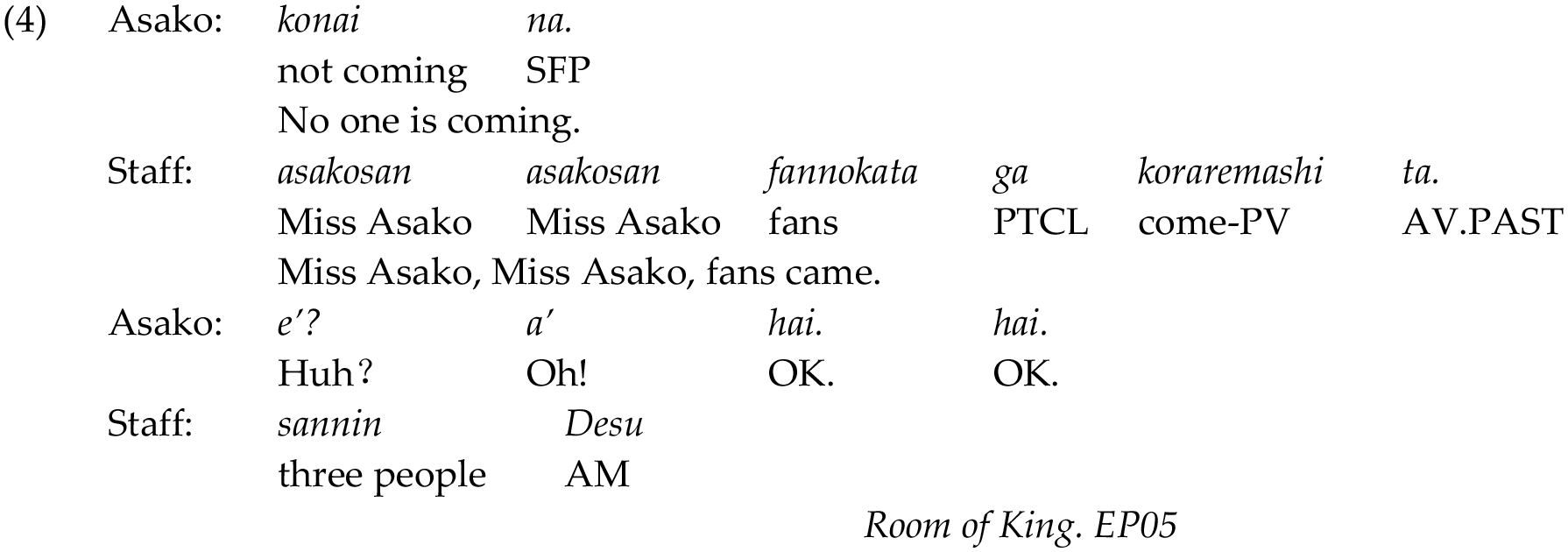
In Example 4, Asako—a former office worker pursuing a pop star career—waits extensively at an autograph session, yet only three fans appear. This situation creates an interesting status dynamic. Normally, staff would use kuru for fans of an established, idolized star. However, Asako’s limited fame inverts this hierarchy. Though still technically “fans,” their scarce attendance elevates their perceived status. Consequently, the staff employ koraremasu to show appropriate respect and appreciation for their attendance.
The form koraremasu in Example 4 represents the passive form of kimasu (to come). In Japanese, the auxiliary verbs reru and rareru have undergone semantic expansion, evolving from purely passive constructions to express spontaneous actions, potentiality and deferential meaning. When used passively as in this case, the construction positions the subject in a resultant state, obscures agent identification, and frames the act of coming as a natural event rather than a deliberate action. This grammatical strategy effectively maintains social decorum while acknowledging the fans’ elevated status in this particular context.
Our analysis of kuru variants reveals multiple linguistic options for describing the same event, each reflecting different degrees of politeness and social distance. This demonstrates Japanese speakers’ remarkable sensitivity to interpersonal dynamics. Their choice of linguistic forms considers both vertical (hierarchical) relationships and horizontal (egalitarian) relationships. Although these kuru forms are typically categorized as honorifics in textbooks, they in fact extend well beyond conventional honorific usage, encode more complex social information, and serve as nuanced relational markers.
Stative Patterns Involving the Speaker
A common strategy in extending offers or invitations is to diminish the speaker’s agency through linguistic means. For example, the conventional honorific counterpart of the assertive marker desu is degozaimasu, which conveys a high degree of respect. The expression degozaimasu is employed in formal situations where the parties involved maintain a hierarchical relationship.
The use of desu necessitates a nuanced understanding of interpersonal relationships. If a Japanese speaker opts for the honorific form degozaimasu, regardless of the context or their relationship with the hearer, they may inadvertently increase the social distance between the two parties. Consequently, an interesting linguistic construction has emerged in modern Japanese that delineates the appropriate balance of respect between desu and degozaimasu. For example:

Example 5 occurs in a pharmacy scene from the television drama One Litre of Tears. Here, the pharmacist, Uketsuke, hands over medications to the patient’s relatives. In this context, the speaker and hearer are on equal footing and positioned at the periphery of interpersonal relations. The honorific form degozaimasu, which is suitable for hierarchical interactions, is inappropriate in this situation. In contrast, the term ninaru, which describes a change from an objective standpoint, effectively removes the agency or volition of the speaker. This unconventional honorific form aligns seamlessly with the context, even if it appears illogical or ungrammatical.
Other expressions that adopt a similar strategy involve the use of intransitive verbs instead of transitive verbs to diminish the speaker’s agency or initiative, thereby alleviating the hearer’s sense of indebtedness. For example:

In the two examples above, different verbs are used to describe the act of making tea. In Example 6, Kiki speaks to her friend Urusura. Here, the transitive verb ireru (put in), which indicates the speaker’s agency, may lead the hearer to feel indebted.
A corpus search revealed 16 expressions related to making tea, with ireru occurring 11 times. These instances are found in contexts involving relationships among colleagues, fellow students, close friends, spouses, or individuals of differing seniority. In essence, the speaker and hearer belong to the inner circle of vertical relations, meaning the hearer is not expected to feel indebted.
In Example 7, Kiki converses with an older woman who holds a superior status due to her age. However, Kiki opts for the intransitive verb hairu (enter) out of respect for the older woman. This construction indicates that the tea is entering the cup, effectively shifting the focus from the speaker to the tea itself, thereby removing the agency of the speaker and rendering the utterance more indirect. Consequently, the hearer does not feel a sense of indebtedness.
Negative Constructions
In general, Japanese speakers tend to avoid explicitly stating yes or no in daily conversations, particularly when refusing invitations or requests. They often prefer positive constructions or elliptical expressions to preserve the face of the other party. When needing to decline, speakers anticipate that the hearer may refuse the invitation or request, thus they do not have to state a direct “no.” This strategy reduces the pressure on the hearer. We examined the following expressions:
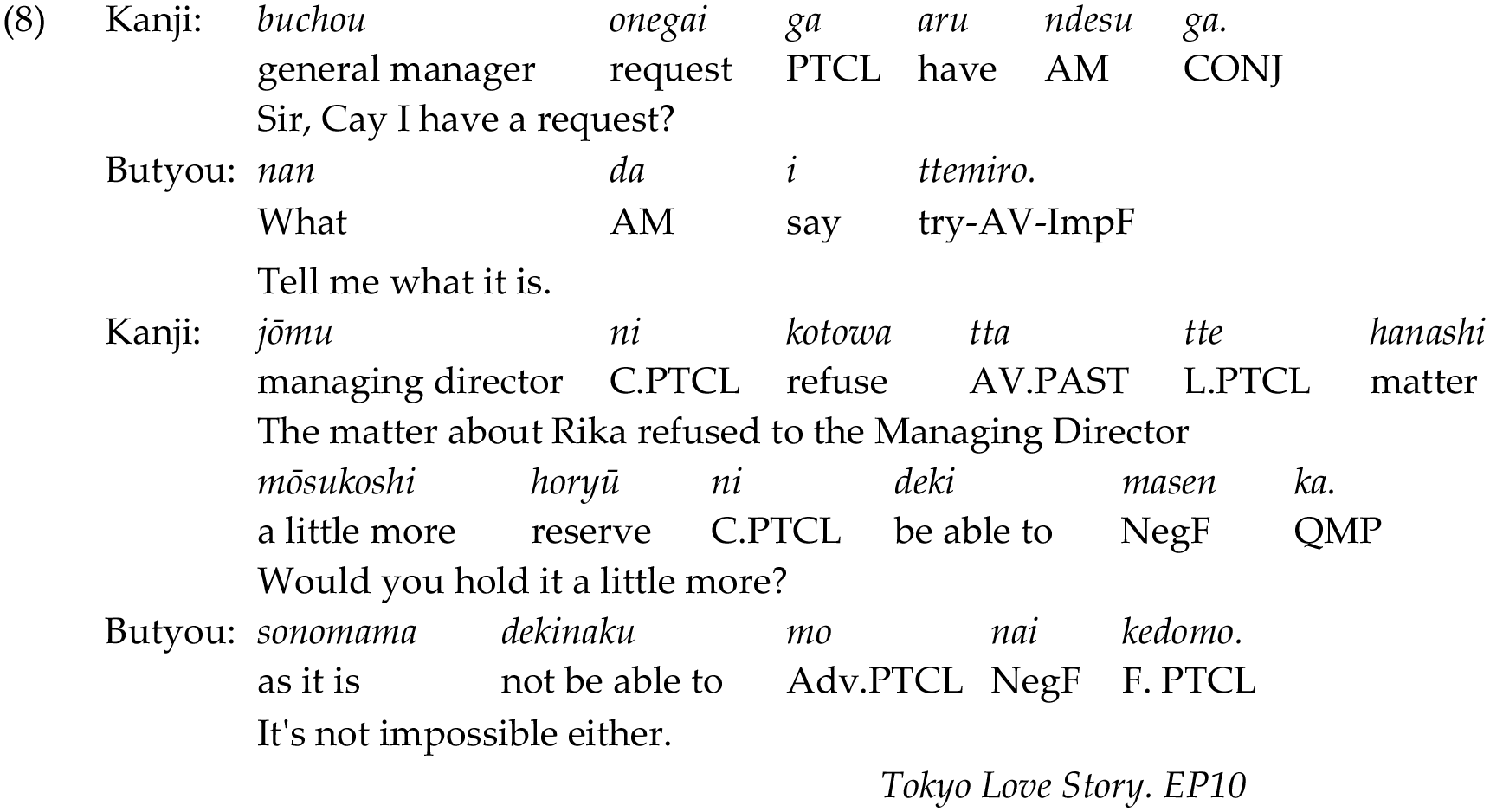

In Example 8, Kanji, the protagonist, engages with Waga, the company manager, in an asymmetrical relationship where Kanji ranks below Waga. Kanji requests Waga’s assistance in maintaining Rika’s position in the company’s overseas branch. In Example 9, Kanji invites Rika to dinner years after their separation. Although these examples differ in context, Kanji employs negative questions for both requests and invitations.
In contrast to their equivalents in Chinese or English, negative questions are a common polite form of expression in Japanese culture for making requests or invitations. A Japanese speaker presumes that the hearer will not accept the request or invitation, anticipating a potential refusal. Thus, the hearer does not feel uncomfortable when declining.
The use of negative questions to extend requests or invitations is neutral regarding interpersonal relations; it is applicable in contexts where the speaker and hearer are on equal terms, as well as in situations where the speaker holds a lower social status than the hearer. Negative questions, as a distinctive pattern in the Japanese language, demonstrate mutual care between the speaker and hearer, as reflected in their responses. For example, in Example 8, the manager’s response is sonomama dekinaku mo nai kedomo (although it is not impossible to do so either), while in Example 9, Rika responds with iijan (Is it not good?). Clearly, both responses avoid the direct affirmative hai (yes) and the negative iie (no). This illustrates that Japanese speakers generally prefer not to express agreement or disagreement explicitly. Instead, they favor seemingly positive expressions such as ii (okay, which implies no need), kekkō (fine, which suggests no need), and kangaete okimasu (I’ll think about it, implying not considered) to indicate refusal, thus preserving the hearer’s face.
However, this does not suggest that negative questions are the sole linguistic pattern employed for making requests or invitations. Depending on the speaker’s status or relationship with the hearer, simple questions may be used, similar to practices in many other languages. For example:


In Example 10, Ootaki, Rika’s junior, invites her to play pachinko (Japanese pinball). Ootaki opts for a straightforward question because Rika, having grown up in the United States, is not encumbered by the hierarchical dynamics prevalent in Japanese companies. Furthermore, Ootaki views playing pachinko as a fun way to pass the time while waiting for the train, believing there is little chance Rika will refuse the invitation. Indeed, Rika initially responds positively, leading Ootaki to assume she will accept. However, when Ootaki prepares to check her baggage, Rika states her intention to visit another place and suggests they meet later.
Whether the speaker employs a simple question or a negative question to extend a request or invitation, they always anticipate a corresponding response. The distinction between the two patterns lies in the former, where the speaker presumes the hearer will respond positively, potentially threatening the hearer’s face. A notable example of Japanese speakers’ sensitivity to interpersonal relations occurs when four characters dine together. Beppu and Suzume squeeze lemon juice onto a plate of fried chicken without consulting the others, triggering a conflict.

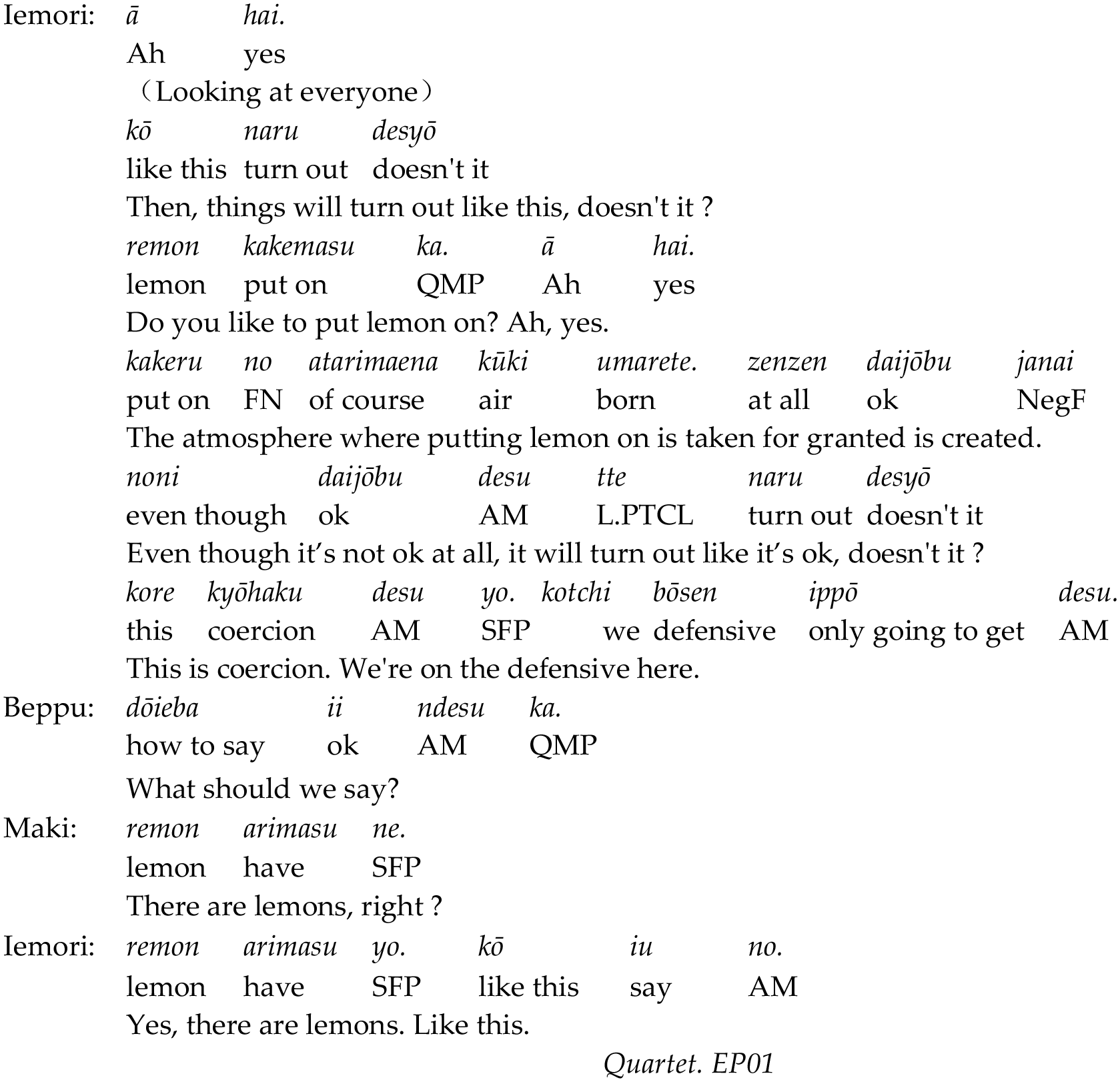
Iemori dislikes lemon juice on fried chicken. When observing Beppu and Suzume’s actions, he feels uncomfortable. Beppu apologizes for his thoughtlessness, but his use of a direct question causes Iemori and Maki to frown. In Japanese communication norms, such straightforward questioning creates difficulty for the hearer to refuse, as it implicitly pressures agreement, violates conversational nawabari, and contradicts cultural expectations of indirectness. Thus, while Beppu’s words appear polite superficially, they actually breach fundamental Japanese interaction principles by removing the hearer’s comfortable refusal option, disregarding implicit communication protocols, and crossing established social boundaries.
Japanese request/invitation questions exhibit unique linguistic characteristics by implicitly expecting the hearer’s compliance. This differs significantly from comparable structures in Chinese or English, where acceptance remains optional. This linguistic convention explains the Japanese preference for negative-question formulations when making requests or invitations—the construction naturally facilitates refusal while maintaining conversational harmony.
Elliptical Constructions
In Japanese, elliptical constructions refer to linguistic patterns that appear incomplete. Speakers utilize these constructions to avoid causing emotional discomfort for the hearer. By leaving gaps in their utterances, speakers allow the hearer to infer their intentions rather than explicitly stating them. Japanese, like Chinese, is a high-context language (Shen, 2019, p. 151); thus, successful communication heavily relies on the ability of both parties to infer meaning. Given their shared social and cultural backgrounds, speakers and hearers can easily decipher each other’s intentions. The following examples illustrate situations in which elliptical constructions are employed:
Invitation

In Example 12, Eriko and Yukiho are classmates in middle school. Eriko, who often feels inferior to Yukiho, is deeply honored when Yukiho invites her to her home. Typically, such an invitation between two students is trivial. A speaker might use negative questions to extend the invitation, but Eriko instead opts to express her desire to go home together with Yukiho, even though they have already agreed to do so. Her utterance demonstrates heightened politeness due to her longstanding feelings of inferiority. By using an elliptical expression, Eriko focuses on her own intention without directly asking if Yukiho shares the same desire, thus avoiding encroaching on Yukiho’s nawabari.
The greater the social distance between the speaker and the hearer, the more polite the expressions the speaker will choose. Communicators need to consider not only their social relations but also their psychological distance. As the above analysis reveals, the selection of appropriate expressions by Japanese speakers demonstrates remarkable subtlety and sensitivity, which is far more complex than the calculations involved in face-threatening acts predicted by Brown and Levinson (1978/1987).
Request

In Example 13, the protagonist Ryouji disguises himself as a recruitment worker to observe the heroine Yukiho from a close distance. At this moment, a female student approaches, expressing interest in joining the group. Ryouji, who is not inclined to engage with her, tells her that it is overdue and walks away. The girl employs an elliptical expression, making her request implicit:
There are additional constructions that can be used to make requests, as indicated by the following three linguistic patterns.

Among the three patterns for making requests listed above, Pattern 14(c) is a counterfactual sentence that expresses the speaker’s wish for the hearer to allow them to join the group. This construction avoids a direct statement of the speaker’s intention, thus softening their request while simultaneously conveying gratitude to the hearer. It remains for the hearer to decide whether the speaker should be allowed to join the group. Although we limit our discussion to these three patterns due to space constraints, a variety of constructions are available to Japanese speakers.
These three patterns represent different strategies for making requests. Pattern 14(a) employs the directive form hairaseru (let me join), which diminishes the speaker’s autonomy while elevating the authority of the hearer. This pattern is used when the speaker has a strong desire to join. Pattern 14(b) utilizes the cognate transitive verb ireru (join me in), combined with giving and taking constructions and negative constructions. This pattern also defers the decision to the hearer, thereby conveying deference.
Refusal

The example occurs on George’s Day, when Sanae, a contract worker, offers handmade chocolate to Kensuke, the office director. Kensuke initially expresses gratitude for Sanae’s affection but then employs an elliptical expression to convey his refusal, indicated by the ellipsis marker chotto. This strategy allows Sanae to infer Kensuke’s refusal instead of an explicit rejection. The vague nature of his refusal suggests considerable social or psychological distance between them, stemming from their differing positions within the company. Moreover, in response to Sanae’s direct profession of love, Kensuke apologizes and expresses happiness, but notably, he does not conclude with an explicit refusal. This behavior illustrates Kensuke’s consideration for Sanae’s feelings.
Other Situations
In addition to speech acts such as invitations, requests, or refusals, speakers frequently use elliptical expressions to avoid hurting the hearer’s feelings in various contexts, such as when delivering bad news or making offers. The following examples illustrate this:
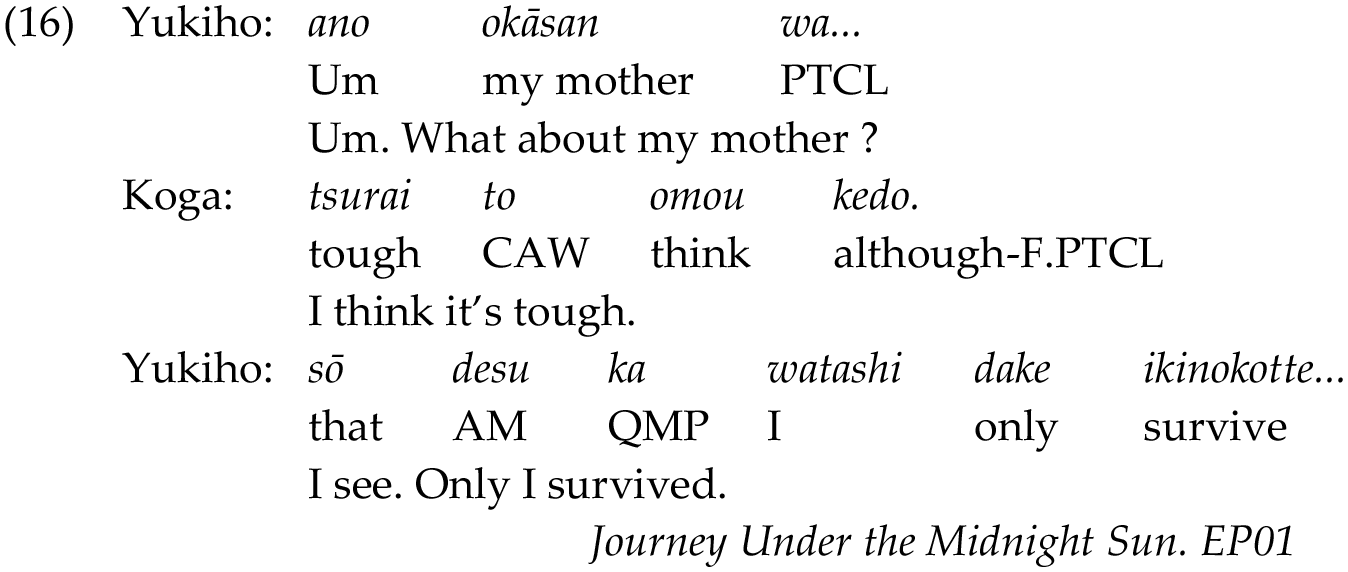
In Example 16, at the scene of a gas leak, police officer Koga speaks with Yukiho, the victim’s daughter. Koga refrains from mentioning her mother’s death, demonstrating care and sympathy for Yukiho, as such distressing news can be particularly challenging for young girls. This situation is not merely about face-saving; Yukiho, sharing Koga’s cultural background, immediately recognizes his intentions.
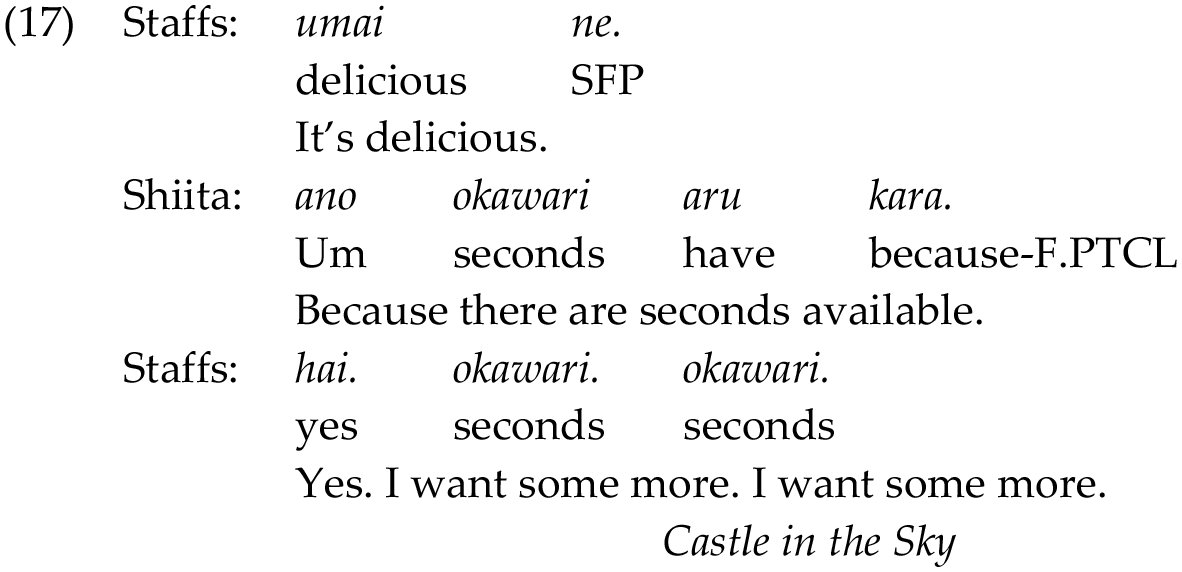
In Example 17, the workers assist the hostess Shiita in preparing dinner in the kitchen. They praise her for the delicious meals, and she responds by stating that there is plenty of food available. By conveying this information without explicitly asking the participants to eat more, Shiita allows for an indirect inquiry into their willingness to continue eating, thus avoiding any potential infringement on their autonomy.
The elliptical constructions discussed in this section are deeply rooted in the high-context communication style of Japanese speakers, where verbal exchanges rely heavily on an implied understanding of situations. Two fundamental concepts underpin Japanese culture in this context: the first is ishin denshin (literally, “what the heart thinks, the mind transmits”), which describes the tacit understanding many Japanese people share, akin to a form of telepathy. It is assumed that those around one can intuit what one is thinking. The second concept is sasshi no bunka (discernment), suggesting that one should be able to understand the thoughts of others even in silence. Guided by these cultural assumptions, it is customary for individuals to attempt to decipher the thoughts of others, even when they are unspoken. Elliptical constructions thus represent a specific manifestation of this social psychology, enabling Japanese speakers to infer each other’s intentions with relative ease.
Giving-and-Receiving Constructions
A fundamental rule of etiquette in Japanese culture is the principle of avoiding causing trouble for others in any aspect of life. This mindset is reflected in the language, particularly in the frequent use of apologetic expressions such as sumimasen (sorry). For example, in daily interactions, actions like passing soy sauce or holding the elevator door open for someone are often viewed as favors that may inconvenience the person performing the action. In contrast, in languages such as Chinese or English, people typically express their appreciation by saying “thank you.” This cultural nuance highlights the different ways that politeness and consideration are expressed across languages and societies, emphasizing the importance of context and relational dynamics in communication.
However, this does not imply that Japanese speakers refrain from expressing gratitude. In fact, saying “sorry” and saying “thank you” are both integral components of daily interactions in Japanese culture. When a speaker benefits from a favor granted by another person, they express gratitude while simultaneously offering an apology. Additionally, it is almost obligatory for speakers to explicitly convey their indebtedness. Consequently, there are numerous constructions for giving and receiving favors in Japan, with some of the most frequent patterns outlined below:
Tekureru

In Example 18, Satomi and Kanji, who are childhood friends, navigate a challenging moment in their friendship. Satomi asks Kanji to call him in the future. Kanji agrees, but more importantly, he employs the giving-and-receiving construction -tekureru to indicate that he is the beneficiary of this calling event. This strategy reduces Satomi’s psychological burden while simultaneously elevating her status in their relationship. As a result, their close friendship is restored.
Temorau
The -tekureru pattern emphasizes the status of the subject benefiting from an event. In contrast, the -temorau pattern, as illustrated in Example 19, focuses on the ego of the speaker and the beneficiary, as the speaker makes a request of the other party.
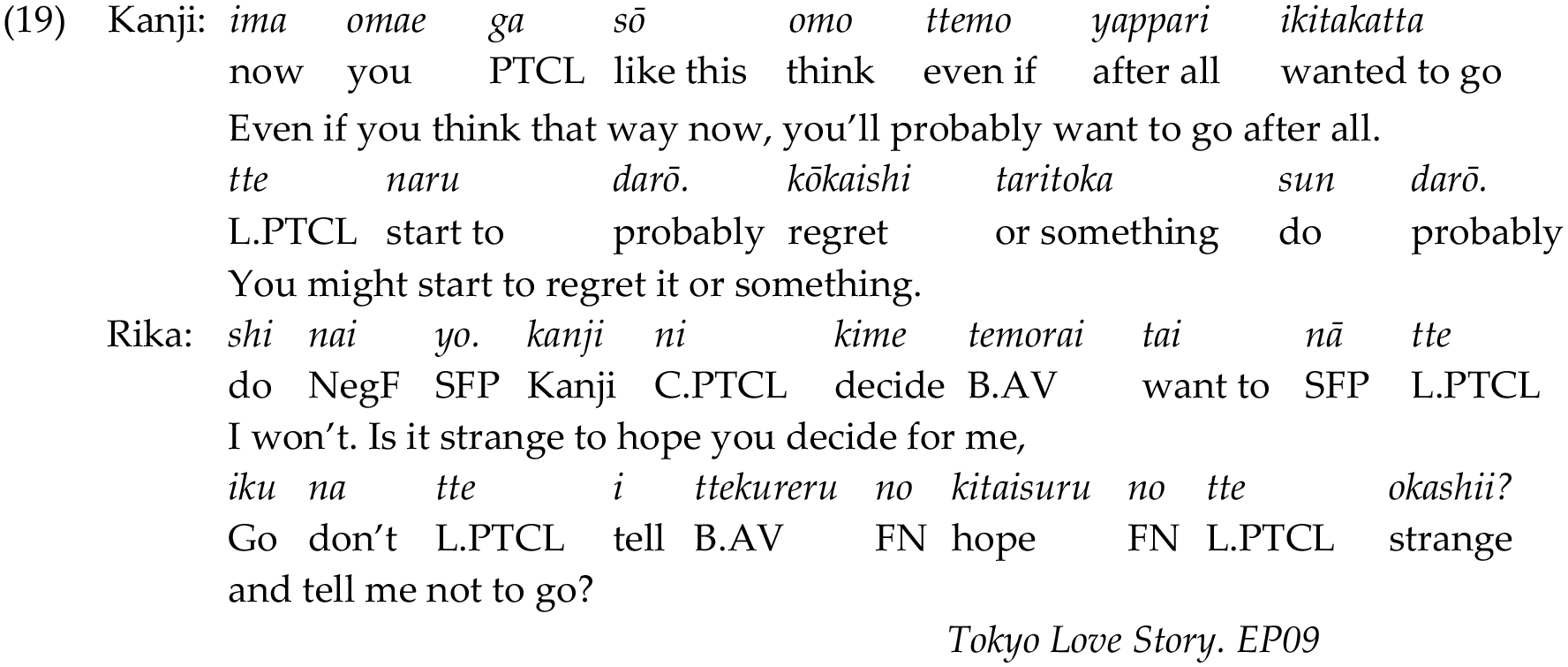
In this example, Kanji and Rika discuss her potential posting to an overseas branch. Rika uses both the -temorau and -tekureru patterns. She wishes to leave the decision about working overseas to Kanji, so she employs the -temorau pattern. Subsequently, she expresses her hope that Kanji will advise her against taking the overseas position, as this would indicate his care for her. Thus, she uses the -tekureru pattern, accentuating Kanji’s role as the agent of action. In this interaction, Rika is the beneficiary of Kanji’s actions.
In everyday life, the -temorau pattern can be employed regardless of whether the speaker is making an actual request. For example:

In Example 20, Tsumiki, a lawyer and stepmother to Asuka, the victim of bullying, approaches Tomomi, a fellow student, to uncover the truth behind the incident. Posing as a pianist, Tsumiki engages Tomomi on their way home. When Tomomi inquires whether she can play the piano at her house, she employs both directive and giving-and-receiving expressions. Her politeness strategies can be analyzed on several levels: first, Tomomi seeks Tsumiki’s permission, respecting her negative face—that is, the desire not to have one’s freedom of action impeded. Second, the directive form of the verb allows Tsumiki to retain decision-making power. Lastly, Tomomi utilizes the -temorau pattern, a giving-and-receiving expression, to convey her gratitude. This aligns with Japanese cultural norms, where individuals are expected to express gratitude whenever there is a possibility of benefiting from someone else’s actions. Acknowledging that one benefits from another’s actions helps maintain interpersonal harmony.
Moreover, the giving-and-receiving constructions, which are fundamentally used to show respect for others, are independent of the power dynamics or social status between the speaker and hearer. For example, in Example 21, a teacher asks students to reflect on questions and write down their opinions. He employs the -temorau pattern to indicate that he is making a request while expressing gratitude to the students. This approach reflects his respect for the students and aligns with the idea of equality among individuals. The difference in social status between teachers and students is deemed irrelevant in this context.

Teageru
The -teageru pattern is also used for giving and receiving favors. For example:

In Example 22, Rika and Ootaki are on a business trip to Ehime. Ootaki offers to carry Rika’s luggage. He chooses the verb mochimasu (I will carry it) rather than motte agemasu (I will help you carry it) to ensure that Rika does not feel indebted.
Japanese culture has been significantly shaped by Confucianism over the centuries, which emphasizes the principle of reciprocity in interpersonal relationships. When one person does a favor for another, it creates an imbalance, leaving the recipient in a position of indebtedness. The beneficiary is expected to reciprocate the favor at some point in the future. This social convention is a fundamental aspect of Japanese culture. Therefore, when a person interacts with someone of higher rank or social status, or someone with whom there is a considerable social distance, they must be cautious not to appear to favor the hearer. Otherwise, the hearer may feel burdened by a debt that needs to be repaid later.
It is worth noting that the -teageru pattern may still occur in specific contexts. For example, in Example 23, Rika expresses her happiness to Kanji for his honesty. She decides to forgive him for his confession. Typically, forgiveness is not considered a favor, as it aims to resolve misunderstandings between the speaker and hearer. Thus, the verb yurusu (forgive) would be an appropriate choice. However, in this example, Rika employs the -teageru pattern, seemingly contravening social conventions by framing her act of forgiveness as a favor. This highlights her special relationship with Kanji as his girlfriend. In this case, the use of -teageru is more effective in alleviating the pressure on Kanji than simply using yurusu.
This nuanced use of language reflects the complexity of social interactions in Japanese culture, where expressions of gratitude, indebtedness, and respect are intricately woven into the fabric of daily communication.

Key Factors Influencing the Use of Considerate Expressions
The discussion of various patterns of considerate expressions highlights the fact that native speakers of Japanese are consistently oriented toward interpersonal harmony in their linguistic communication. This emphasis on harmony can be attributed to the significant influence of Confucian teachings on Japanese culture.
Confucianism, as a relationship-oriented ethical system, is fundamentally a value-based framework centered on relationality. It posits that individuals exist in a state of co-being; they are not isolated entities but rather individuals embedded within a collective. The Five Cardinal Relationships—ruler-subject, father-son, husband-wife, elder-younger siblings, and friends—provide a structured framework for social existence in Confucianism, prescribing ethical norms that individuals are expected to follow in accordance with this order. The Mencius articulates this structured relational framework as follows:
(1) The ruler should be benevolent and loyal to the subject.
(2) The father-son relationship is governed by a hierarchical order: fathers should be kind, and sons should be filial.
(3) Siblings, as blood relatives, should adhere to a generational hierarchy: elder brothers should care for younger siblings, while younger siblings should respect their elders.
(4) Husbands and wives should love and protect one another while fulfilling distinct responsibilities: husbands manage external affairs, and wives oversee household matters.
(5) Friendship should be founded on sincerity and mutual trust.
These relational roles are governed by two fundamental cognitive dimensions: superiority-subordination and intimacy-distance (Huang, 2006, p. 40). The former pertains to differences in hierarchical status, while the latter refers to the degree of closeness in interpersonal relationships. Relational individuals assess ethical principles applicable to a given relationship based on the dimensions of status hierarchy and relational proximity. By fulfilling their respective roles within an established moral order, individuals contribute to the maintenance of overall social harmony.
This principle aligns with the Confucian concept of li, a system of ritual propriety that regulates relationship-oriented ethical behavior. Li prescribes appropriate manners and etiquette, encompassing respect, humility, refinement, and warmth in demeanor (Chen, 2019, p. 253). It constitutes a codified set of interactional rules governing social conduct (He et al., 2007, p. 196). This relational perspective is deeply internalized in both daily behaviors and language use. In interpersonal communication, speakers are acutely aware of the presence of others and select expressions that are appropriate to their positions within the relational framework.
Therefore, it is essential to transcend the constraints of Western individualism (He et al., 2007, p. 5) and shift the unit of analysis from individuals as independent entities to individuals as integral components of a relational system.
The various relationships in society are illustrated in Figure 1, which encompasses both vertical (hierarchical) and horizontal (equal) scales. The vertical scale reflects asymmetry in rank or status between the ego and the alter, determined by factors such as age, identity, wealth, and social class. In contrast, the horizontal scale pertains to the perceived closeness between the ego and the alter. Typically, horizontal relations manifest when the ego and alter—such as relatives, friends, husbands, and wives—are considered equals. However, as the figure illustrates, the vertical scale intersects with the horizontal scale, indicating that when the ego and alter possess differing social statuses, they may still experience a sense of closeness. For example, in traditional Japanese society, husbands and wives share a close relationship, yet the husband typically holds a higher status. In such cases, the vertical scale takes precedence over the horizontal scale, necessitating the use of appropriate linguistic expressions to indicate the status difference between husband and wife. Conversely, for the younger generation, which has been influenced by concepts of equality and feminism from the Western world, the horizontal scale often takes precedence in the relationship between husband and wife. This trend also applies to relationships between individuals of different statuses, such as between generations. In modern Japanese society, for example, the horizontal scale tends to precede the vertical scale in the relationship between a grandfather and his grandson, despite the former holding a significantly higher status. This seemingly paradoxical phenomenon reinforces the relational orientation of Confucian li, embodying the dynamic equilibrium between the two cognitive dimensions of superiority-subordination and intimacy-distance.

Confucianist conceptions of interpersonal relations.
Individuals in the system of relations, according to the ethics of Confucianism, include not only the speaker and hearer, but also the persons in question or the third parties at present, as shown in Figure 2.
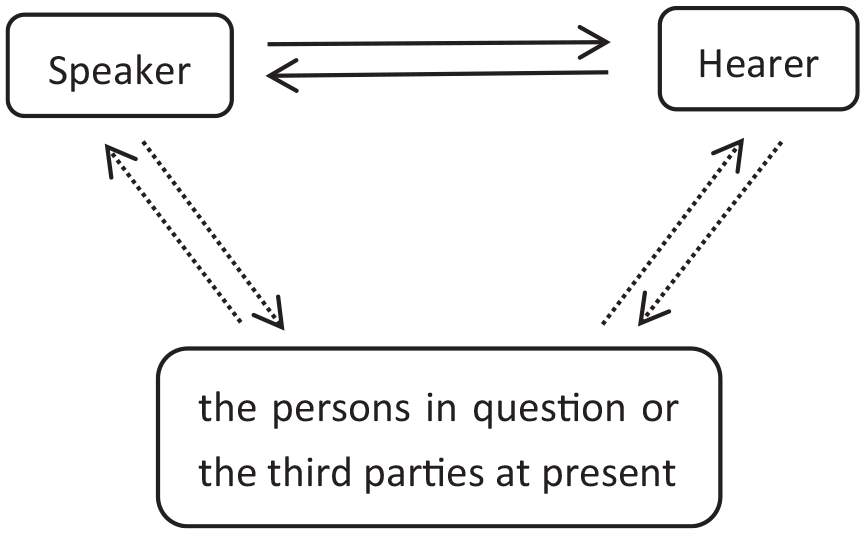
Individuals in the system.
Individuals must continually assess their positions within the social system during daily communication and select appropriate linguistic expressions accordingly. In this context, an individual’s position is dynamic and flexible, yet it remains firmly rooted in the cultural values of society. Furthermore, the emphasis on harmony within Confucian teachings guides individuals in their behavior and communication, facilitating both interpersonal and social harmony.
Conclusion
Linguistic politeness has been a significant topic in pragmatics and sociolinguistics for the past five decades. However, the debate over the universality or relativity of Leech’s (1983) Politeness Principle and Brown and Levinson’s (1978/1987) Face-Saving Theory of politeness continues. This paper has investigated linguistic politeness in Japanese culture. Our analysis has demonstrated the importance of considerate expressions for a comprehensive understanding of linguistic politeness in this context. The traditional view that equates honorifics with politeness is overly simplistic and untenable. Considerate expressions frequently occur in everyday interactions and cannot be overlooked.
We have conducted a detailed exploration of typical patterns of considerate expressions based on corpus analysis. Our survey revealed four patterns of considerable importance from a cross-cultural perspective: stative, negative, elliptical, and giving-and-receiving constructions.
Additionally, we have provided an account of the prevalence of considerate expressions in Japanese. Our discussion centered on the teachings of Confucianism, which emphasize relationships and harmony. Given the dominant influence of Confucian teachings in Japanese culture, it is not surprising that considerate expressions, which serve to maintain interpersonal harmony, are nearly ubiquitous in social interactions among Japanese speakers.
To appreciate the emphasis on harmony in a broader context, one must understand the role of Confucianism in Japanese society. Since the Meiji Restoration (1868-1912), Western ideas of individualism and equality have rapidly permeated Japanese society. Consequently, the emphasis on hierarchy and social order has diminished, with greater focus being placed on interpersonal relations based on equality and social distance. However, this shift is compatible with the teachings of the Five Cardinal Relationships of Confucianism, which encompass both vertical and horizontal relationships. As a result, in Japanese, the selection of particular expressions is strictly governed by interpersonal relations, often reflecting a one-to-one correspondence.
The variety of considerate expressions poses a challenge for Japanese learners from diverse cultural backgrounds. Recognizing the difficulties associated with intercultural communication, the Japanese government has recently promoted Easy Japanese (EJ) or Plain Japanese (PJ) to foster a sustainable multicultural society. This initiative parallels the concept of World English, which has evolved into a global lingua franca not only due to its relatively accessible grammar but also because of its numerous regional varieties. Given the projected decline in Japan’s population and the rapid increase in immigration, it is anticipated that the Japanese language will undergo significant changes in the future, potentially leading to the emergence of various dialects (Iori, 2023).
Moreover, it is essential to adopt a cultural approach in teaching Japanese as a foreign language. This entails presenting elements of national culture, traditions, customs, and value systems to overcome stereotypes and foster readiness for sociocultural dialogue and compromise (Kolodkina & Tan, 2008, p. 31). In this context, a team of 15 scholars, led by Masanori Yamaoka, is currently compiling a dictionary of Japanese considerate expressions under the auspices of the Japan Society for the Promotion of Science (JSPS) (project number: JP23K21942, 2024.04.01-2026.03.31). This endeavor will undoubtedly assist future learners of Japanese as a foreign language.
Footnotes

Consent to Participate
Informed consent was obtained from all participants involved in the study.
Author Contributions
Dr. Jingjing Li is responsible for writing the first draft of the paper under the guidance of Profess Hang Gao and also for completing all the technical details. Professor Hang Gao is responsible for the organization of the study and the continual revision of the paper. All authors have read and agreed to the published version of the manuscript.
Funding
The authors received no financial support for the research, authorship, and/or publication of this article.
Declaration of Conflicting Interests
The authors declared no potential conflicts of interest with respect to the research, authorship, and/or publication of this article.
Data Availability Statement
The data used to support the findings of this study are available from the corresponding author upon request.