




Abstract
To examine applicability of Brown and Levinson’s politeness theory to facework in a non-Western culture, we conducted a questionnaire survey of native Japanese speakers. A rank order of influences on facework behavior was investigated among the five factors: (a) intrinsic factor (Ri; that is, effects caused by difference in settings), (b) contextual factor (Rc; that is, effects caused by difference in types of interlocutor’s contradictory attitudes), (c) power factor (P; that is, effects caused by age difference with the interlocutor), (d) distance factor (D; that is, effects caused by difference in familiarity with the interlocutor), and (e) gender factor (G; that is, whether the participant is male or female). Results revealed that factors related to the intrinsic content of the situation (Ri) and the interlocutor’s attitudes (Rc) had stronger influences than those of the inter- and intrapersonal factors of P, D, and G. Based on these findings, we conclude that Brown and Levinson’s formula is applicable to a non-Western culture, Japan.
This replication study applies the politeness theory proposed by Brown and Levinson (1978, 1987) to social interaction among native Japanese speakers. Following Goffman (1955, 1967), Brown and Levinson assume that the motivation behind facework behavior is a human universal trait, whereas there are cultural differences in the way that particular facework behaviors are realized. Although several empirical studies (e.g., Bond, Wan, Keung, & Giacalone, 1985; Cousins, 1989; Hofstede, 1980; Kim-Jo, Benet-Martinez, & Ozer, 2010; Leung, 1988; Merkin, 2006; Ting-Toomey et al., 1991; Wheeler, Reis, & Bond, 1989) have supported their assumption, some Japan-based researchers have continuously criticized Goffman’s and Brown and Levinson’s models, claiming that they are Western-biased (Hill, Ide, Ikuta, Kawasaki, & Ogino, 1986; Ide, 1989, 2006; Matsumoto, 1988, 2003). They disagree with Brown and Levinson’s model in which individuals select politeness strategies by using three factors to estimate the weight of a face-threatening act (FTA) to the interlocutor.
These Japanese researchers propose that people in Japanese culture emphasize fixed social relationships based on hierarchical power structures (i.e., seniority systems). Ide (1989, 2006) called the system “discernment” or “wakimae” in which Japanese people are obliged, in every utterance, to use addressee honorifics, such as “-desu,”-masu,” and “gozaimasu” so that they can keep appropriate relations with seniors and/or strangers. According to Ide’s interpretation, honorific usages represent facework or politeness behaviors in the Japanese language, and hence Japanese people are scarcely able to select spontaneous facework (politeness) strategies, which Brown and Levinson’s (1978, 1987) formula predicts on the basis of estimation of an FTA to the interlocutor. This study is, then, an empirical investigation of whether native Japanese speakers are free to adopt facework behaviors with the interlocutor. For this purpose, we analyze effects of multiple factors influencing exchanges among native Japanese speakers, with reference to the Brown and Levinson’s formula.
In a landmark series of studies, Goffman (1955, 1967) introduced the concept of “facework,” or the process of face being threatened or saved in individual social interactions, with “face” defined as the positive social value a person ef-fectively claims for himself or herself (Goffman, 1967, p. 5). According to Goffman, it is universal that any individual has face and wants it to be acknowledged by other members of society. As face can only be acknowledged by others, we make an effort to acknowledge other members’ faces, with the expectation that ours will in return be acknowledged by them. In other words, individuals are expected to make efforts to save their own face and other members’ faces in interpersonal interaction.
Facework can be viewed as the process in which people try to keep a balance between multiple persons’ faces in social encounters. Moreover, facework should be realized as a result of interactional effects caused by multiple factors. These factors influencing one’s facework behaviors are efficiently summarized by Brown and Levinson’s (1978, 1987) formula in which one estimates the degree of his or her FTA to the interlocutor. Brown and Levinson assume that one selects a politeness (i.e., face-redressing) strategy appropriate for the degree to which an act is face-threatening (FT) to the interlocutor. To estimate the degree of an FTA, they propose three factors using the following formula:

where Wx is the weight of an FTA, D refers to the distance (D) between somebody and the interlocutor, P refers to the power (P) the interlocutor has over him or her, and R refers to the value that measures the degree to which the FTAx is rated as an imposition in that culture (i.e., ranking of imposition [R]; Brown & Levinson, 1987). Brown and Levinson state that these three factors are all relevant and at the same time independent. Consequently, their framework predicts that these factors interact to determine how people engage in facework.
This formula is supported by several empirical studies based not only on an investigation of American (i.e., Western) participants (Baxter, 1984; Lim & Bowers, 1991) but also on a cross-cultural comparison between American (i.e., Western) and Korean (i.e., Far Eastern) participants (Holtgraves & Yang, 1990). However, some Japan-based researchers (Hill et al., 1986; Ide, 1989, 2006; Matsumoto, 1988, 2003) disagree with Brown and Levinson’s (1978, 1987) theory in which actors select politeness strategies by estimating multiple factors. They argue that the honorific usages represent facework or politeness behaviors in the Japanese language, and hence Japanese people are rarely able to use spontaneous politeness strategies other than honorific expressions.
The Japanese language, unlike European languages, has a distinction of referent honorifics that are used for referred contents and persons (e.g., verbs such as “nasaru” and “itasu” with meanings of “honorably do” and “humbly do,” respectively) and addressee honorifics (e.g., copulas such as “-desu” and “-masu”) that represent a grammatical encoding to directly reflect interpersonal relationships between the speaker and the hearer (e.g., Kim, 2006; Martin, 1964; Takiura, 2005, 2008; Tokieda, 1939; Wetzel, 2004). In fact, “-desu” and “-masu” should be attached to every utterance when it is addressed to seniors and/or strangers, irrespective of topic matter or referent. However, Fukada and Asato (2004) and Takiura (2005, 2008) demonstrated that whether Japanese speakers are forced to attach honorifics depends on vertical and horizontal interpersonal relationships between the speaker and the hearer, which corresponds to factors of P and D proposed by Brown and Levinson (1978, 1987). Usami (2002) conducted an empirical study of speech levels (i.e., addressee honorifics) in Japanese based on large amounts of actual conversation data, showing that native Japanese speakers often shift speech levels from honorific forms to nonhonorific forms, even when speaking to seniors and/or strangers. Likewise, Saito (2010) has qualitatively demonstrated that Japanese subordinates spontaneously adopt nonhonorific forms (i.e., no use of addressee honorifics) if the contextual situation warrants. The above-mentioned studies suggest that native Japanese speakers are able to make spontaneous use of honorifics to successfully maintain interpersonal relationships, as previously indicated by Pizziconi (2003).
Although Brown and Levinson’s (1978, 1987) groundbreaking theory of politeness includes perspectives of language form (i.e., how to say) and contents of utterance (i.e., what to say), previous studies mainly focused on speech forms of honorifics. However, to truly confirm the universality of the Brown and Levinson theory, it is also necessary to conduct empirical investigations of politeness focusing on contents of utterance by non-Western people. This study, therefore, attempts to examine whether native speakers of Japanese freely engage in facework, by conducting a content-based analysis. In particular, we analyze effects of multiple factors influencing native Japanese speakers’ selections of agreement/disagreement to the interlocutor’s preceding utterance, with reference to Brown and Levinson’s formula that predicts the weight of an FTA.
According to Brown and Levinson (1978, 1987), these three factors can be viewed in various ways. P is assessed as being great because the interlocutor is eloquent and influential, and D is usually a measure of social distance between speaker and hearer. The present quantitative study adds some specific attributes in terms of P and D to the hypothetical interlocutors who will appear in our questionnaire. By doing this, we depict a rank order of strength among multiple factors. In this study, we will assume P as age differences among the interlocutors, and D as differences in familiarity between a participant and the hypothetical interlocutor.
Brown and Levinson (1978, 1987) subsumed all variables influencing facework other than P and D into R and rendering the conceptualization of R as abstract. As they explain R as “culturally and situationally defined ranking of impositions,” it is clear that R includes situational factor together with cultural factor. For the purpose of a specific analysis of the rank order of strength among multiple factors influencing facework behaviors, the effect of cultural factor should be investigated independently from that of situational factor. In this study focusing on the single culture of Japan, we assume the R factor specifically as a situational factor, as an independent predictor candidate of facework behaviors.
In Brown and Levinson’s (1978, 1987) formula to estimate the weight of an FTA, the initial two factors of D and P deal with person-to-person relationships, although the third factor of R of the act is rather vague. Previous studies on speech acts have reported different operations of facework depending on relationships between the speaker and the hearer (see Holtgraves, 2009). Furthermore, many studies have generally supported Lakoff’s (1975) hypothesis that women are politer (i.e., hearer oriented) than men (e.g., Bodine, 1975; Ervin-Tripp, 2001; Fox, Bukatko, Hallahan, & Crawford, 2007; Hannah & Murachver, 2007; Jenkins & Aube, 2002; McMillan, Clifton, McGrath, & Gale, 1977; Mulac, Bradac, & Gibbons, 2001; Tannen, 1990). Several empirical studies with a particular focus on speech styles by native Japanese speakers also have provided general support for Lakoff’s hypothesis (e.g., Ide, 1982; Itakura & Tsui, 2004; Lauwereyns, 2002; Tamaoka, Lim, Miyaoka, & Kiyama, 2010; Uchida, 1997; Usami, 2002). It suggests that gender (G) may also be an influential factor in addition to the three factors assumed by Brown and Levinson.
If Ide (1989, 2006) is correct in the contention that native Japanese speakers manage facework in the same way as honorifics (especially addressee honorifics) used in every utterance to seniors and strangers regardless of what they are interacting about, then the situational factor, which Brown and Levinson (1978, 1987) treat as R, should be insignificant on Japanese facework behaviors. However, it is quite possible for Japanese speakers to make a FT remark on the use of addressee honorifics in interactions. In brief, face management and the use of honorifics seem to be separate issues. Several critical reviews of Ide’s discernment (wakimae) theory have exemplified the process in which native Japanese speakers engage in spontaneous facework (Fukada & Asato, 2004; Pizziconi, 2003; Takano, 2005; Takiura, 2008; Usami, 2002), which implies that Brown and Levinson’s R factor (i.e., situational factor) plays an important role in Japanese social interaction.
To confirm whether Japanese people are able to engage in spontaneous facework, we compare the strengths of the situational factor (R factor) and other inter-/intrapersonal factors (i.e., P, D, and G) influencing facework behaviors of native Japanese speakers. Hypothesis 1 is proposed as follows:
Hypothesis 1: The situational factor, which Brown and Levinson (1978, 1987) proposed as R, has a stronger influence on facework behaviors of native speakers of Japanese, more than the interpersonal factors of P and D, and the intrapersonal factor of G (i.e., one is male or female).
As for the factor of R, Brown and Levinson (1978, 1987) further provide complex descriptions. According to them, even in a particular FTA in a particular culture, the imposition of the FTA can vary depending on whether actors have rights and/or obligations to perform the act. In other words, the R of an FTA in a particular culture is determined not only by the intrinsic content of a situation but is also influenced by how actors are related to the situation. Following the description by Brown and Levinson, this study distinguishes the R factor into two further subfactors: (a) the intrinsic content of a situation (i.e., intrinsic factor, Ri) and (b) the preceding attitude that the interlocutor adopts (i.e., contextual factor, Rc).
The second hypothesis is concerned with the Ri, which refers to the content of a situation. Some previous studies have reported that the content of a situation affects one’s facework behaviors (e.g., Dillard & Burgoon, 1985; Keck & Samp, 2007; Lustig & King, 1980; Muntigl & Turnbull, 1998; Rees-Miller, 2000; Rogan & La France, 2003). In particular, Tanaka, Spencer-Oatey, and Cray (2000) have observed that Japanese people, unlike Canadian and British people, likely refuse to apologize to the interlocutor unless they accept responsibility for having committed a fault. Although Tanaka et al. themselves decline to specify any reasons behind this result, one possible interpretation is that the more native Japanese speakers value avoidance of an explicit conflict, the more they would require their interlocutor to take cooperative attitude with themselves. If that is the case, it would cause a substantial negative reaction that when Japanese were certain about their innocence, they should take a severe attitude against unreasonable accusations. Likewise, MacGeorge, Lichtman, and Pressey (2002) have revealed the importance of responsibility to be the most significant influence on the facework behaviors for American people. Based on these studies, Hypothesis 2 is proposed as follows:
Hypothesis 2: One’s facework behaviors vary depending on the intrinsic content of the situation (i.e., Ri), particularly depending on whether she or he feels at fault for the situation or not.
Finally, the third hypothesis is formulated concerning the Rc. Pomerantz (1978, 1984) presented a model of preference organization in which it is proposed that to one’s agreement with the interlocutor is basically a preferred action, and one’s disagreement a dispreferred action. However, when the interlocutor disapproves himself or herself previously, one’s disagreement may be adopted as a preferred action, whereas one’s agreement as a dispreferred action. Furthermore, when a dispreferred response is selected, Pomerantz observes that one often stumbles over his or her words and/or takes hedged expressions. Such hedged expressions can be explained as a face-redressing strategy (Brown & Levinson, 1978, 1987), with which one reduces the possible threat that such a dispreferred response may bring about on the face of the interlocutor. It appears that preferred actions alternate depending on context and that one can use the same utterance for the purposes of saving the interlocutor’s face and threatening it, in accordance with contexts.
Based on the Pomerantz model, we assume that the effects of one’s selection of agreement/disagreement can alternate, depending on whether the interlocutor had before taken a “self-approving” or “self-disapproving” attitude. When the interlocutor’s preceding attitude was self-approving, one’s agreement would serve as face-saving (FS), whereas one’s disagreement as FT. Inversely, when the interlocutor’s preceding attitude was self-disapproving, one’s agreement would be FT, whereas one’s disagreement would be FS. From the above assumption, Hypothesis 3 is as follows:
Hypothesis 3: Effects of facework on the interlocutor vary depending on what attitude the interlocutor previously took (i.e., Rc), particularly depending on whether the interlocutor’s attitude was self-approving or self-disapproving.
Method
Participants
The sample included 57 male and 53 female (N = 110) undergraduate and postgraduate Japanese students enrolled in universities in Chiba and Hiroshima prefectures in Japan. Their ages ranged from 18 years and 2 months to 32 years and 7 months (M = 20.25 years; SD = 2.16 years). All of the participants were native speakers of Japanese. All participants received financial compensation for their participation.
Material
Participants completed a survey composed of material specifically designed for this study. To measure the Ri, three scenarios using different settings were presented to examine participants’ selection of agreement/disagreement, irrespective of how to express it. We prepared only three choices of “agreement,” “disagreement,” and “no response” to hypothetical interlocutors in the scenarios to exclude confounding effects of honorific expressions on our participants’ selection of response.
The three settings differed in terms of whether a fault was involved and, when it was, whether only the interlocutor was at fault, or both the participant and the interlocutor were at fault. In Setting 1 where only the interlocutor was at fault, each participant was asked to imagine that she or he was working part-time in a restaurant and one day an expensive chair had been damaged by rain because another coworker (i.e., the interlocutor) had forgotten to shut a nearby window. In Setting 2 where both the participant and the interlocutor were at fault, each participant was asked to imagine that she or he guided a cousin (i.e., the interlocutor) to the place for a relative’s wedding but they arrived late to the party because the interlocutor had been late to their appointment and the participant got lost on the way there. Setting 3 had nothing to do with anyone’s fault but was a situation concerning the election of the next leader of a club. In the setting, each participant was asked to imagine that she or he and the interlocutor were candidates to become the next leader of a club, and both were eager to get the position. In each setting, two types of interlocutor’s utterances were shown: one self-approving and the other self-disapproving (i.e., Rc).
The following question-reply sequences presented the three choices of “agreement,” “disagreement,” and “no response” to previous utterances by the hypothetical interlocutors. Four hypothetical interlocutors were prepared for each setting by a combination of P and D factors. Conditions of P were differentiated between “older” as higher powered interlocutor and “younger” as lower powered interlocutor, whereas D was differentiated between “the interlocutor with whom you have talked much” as familiar interlocutor and “the interlocutor with whom you have not yet talked much” as unfamiliar interlocutor. In this way, P (i.e., two conditions of older and younger interlocutors) and D (i.e., two conditions of familiar and unfamiliar interlocutors) were measured using four (i.e., two conditions of P × two conditions of D) hypothetical interlocutors per setting. As there were three types of settings (i.e., conditions of Ri) and two types of the interlocutor’s utterances (i.e., condition of Rc) with four hypothetical interlocutors each, participants responded to a total of 24 (i.e., four hypothetical interlocutors × three conditions of Ri × two conditions of Rc) different choices. The full content of the questionnaire is given in English translation in the appendix.
Procedure
Participants were required to select their answers as either to “agree,” or to “disagree,” and reserve the selection of a “no response” answer only when they really could not make a decision. They were asked to imagine themselves as “you” in the scenarios and try to imagine what they would say before going into the answer selection. The questionnaire took about 20 min to complete.
Analysis
To examine the order of strength of the five factors that are said to influence selection of agreement/disagreement to accusation (i.e., Ri, Rc, P, D, and G), the decision tree analysis by SPSS Classification Trees (Version 15.0; SPSS, 2006) was used. It aims to select a useful subset of predictors in descending order from a larger set of independent variables with respect to a dependent variable. This tool is built on the basis of CHAID, or chi-squared automatic interaction detector, originally proposed by Kass (1980). According to user’s guide provided by SPSS (2006), CHAID automatically chooses the independent variable that has the strongest interaction with the next highest one. In the tree-growing process, each parent node splits into child nodes only if a significant effect is found among independent variables. Every step for splitting nodes uses Bonferroni’s adjusted p values to avoid Type I error, or “false positive,” which refers to the error of rejecting the null hypothesis when it is actually true.
The independent variables in the present survey were arranged in a 3 × 2 × 2 × 2 × 2 design: (a) Ri (i.e., three types of settings), (b) Rc (i.e., the interlocutor’s attitude is self-approval/disapproval), (c) P (i.e., higher/lower powered interlocutor), (d) D (i.e., familiar/unfamiliar interlocutor), and (e) G (i.e., the participant is male/female). Ri, Rc, P, and D are within-participant variables (i.e., repeated measures), whereas only G is a between-participant variable. A dependent variable concerned the frequencies of “agreement,” “disagreement,” or “no response” to the interlocutor’s preceding utterance.
Results
Overall Results of the Classification Tree Analysis
Overall, as shown in Figure 1, the results of the classification tree analysis revealed that the Ri, which was assumed as a subfactor of R influencing facework behaviors, ranked on the top of the classification tree (Node 0), χ2(4) = 157.336, p < .001. The factor of Ri had consistent influences on native Japanese speakers’ selection of agreement/disagreement to accusation among all of the three settings. The next strongest was the Rc, which was assumed as another subfactor of R, and differentiated between the interlocutor’s self-approving and self-disapproving attitudes. The significant effects caused by Rc occurred throughout all three settings, as Node 1 of Setting 1, χ2(2) = 16.795, p < .001, Node 2 of Setting 2, χ2(2) = 58.016, p < .001, and Node 3 of Setting 3, χ2(2) = 16.677, p < .001. The factors of P, D, and G also affected the selection of agreement/disagreement. The whole classification tree (i.e., dendrogram) including all four independent variables is too large to display on a single page; in the following sections, this single dendrogram was divided into the three dendrograms in Figures 2, 3, and 4, which present detailed results of Setting 1 (i.e., the interlocutor is at fault), Setting 2 (i.e., the participant and the interlocutor are at fault), and Setting 3 (i.e., the election of the next leader of a club), respectively.
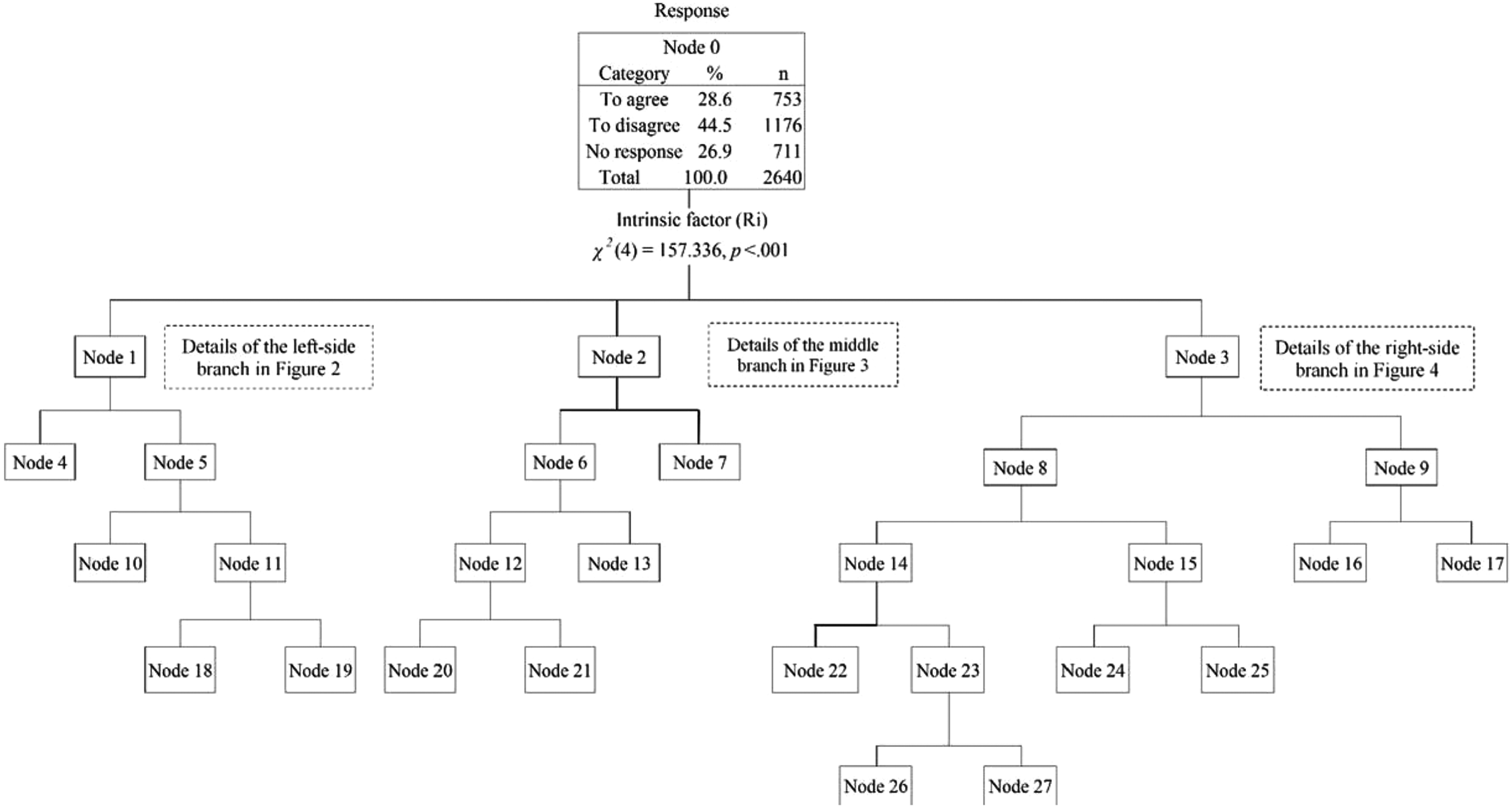
Dendrogram of the classification tree analysis for responses of native speakers of Japanese in situations related to responsibility
Results of the Classification Tree Analysis in Setting 1 Where the Interlocutor Is at Fault
This was a scene in which rain blew in through an unclosed open window at a restaurant and ruined an expensive chair. In this setting, a participant recognized that the blame should be laid at the interlocutor. As shown in Figure 2, in the case of the interlocutor’s self-approving utterance, the most frequent selection was disagreement to the interlocutor (64.3%, Node 4), which was assumed as FT response in this case. In the case of the interlocutor’s self-disapproving utterances, disagreement was also the most frequent (50.9%, Node 5), as in Node 4. However, this disagreement was assumed to serve as FS response to the interlocutor because the interlocutor admitted his or her fault.

Dendrogram of the classification tree analysis for responses of native speakers of Japanese in situations related to responsibility: Setting 1 where the interlocutor is at fault
Unlike Node 4, Node 5 generated a further split to Nodes 10 and 11, which indicated a significant effect of the D, χ2(2) = 10.104, p < .01. Furthermore, Node 11 gave a split to Nodes 18 and 19, indicating a significant effect of the G, χ2(2) = 6.154, p < .05. These results showed that participants tended to react with FS utterance to familiar interlocutors (57.7% FS, Node 10) more often than to unfamiliar ones (44.1% FS, Node 11), and that female participants (50.0% FS, Node 18) tended to take FS responses to unfamiliar interlocutors compared with male participants (38.6%, Node 19).
Results of the Classification Tree Analysis in Setting 2 Where Both Parties Are at Fault
In this setting, a participant guided a cousin (i.e., the interlocutor) to a wedding party. As shown in Figure 3, Node 6 revealed that in response to the interlocutor’s self-approving utterance, disagreement was the most frequent answer (57.7%), which was assumed as a FT response to the interlocutor. In response to the interlocutor’s self-disapproving utterance (Node 7), frequent answers were disagreement (FS response in the case; 34.1%) and “no response” (38.0%), compared with agreement (FT response in the case; 28.0%).

Dendrogram of the classification tree analysis for responses of native speakers of Japanese in situations related to responsibility: Setting 2 where the participant and the interlocutor are at fault
Node 6 split into Nodes 12 and 13, representing the effect of the G, χ2(2) = 17.296, p < .001, and then Node 12 was followed by the D shown in Nodes 20 and 21, χ2(2) = 12.566, p < .01. Male participants tended to retort against the unfamiliar interlocutor (67.1% FT, Node 13), compared with female participants (47.6% FT, Node 12). Furthermore, female participants likely retorted against familiar interlocutors (56.6% FT, Node 20) more than against unfamiliar ones (38.7% FT, 39.6% FS, Node 21). In response to the interlocutor’s self-disapproving utterance in Node 7, neither G factor nor D factor was significant, as no further child nodes were generated from the Node 7.
Results of Classification Tree Analysis in Setting 3 Where Both Parties Compete for the Club Leader
In Setting 3, participants competed with the interlocutor to become the next leader of a club. Although the first two settings dealt with someone’s fault, Setting 3 was concerned with the election for the position of club leader, which both the participant and the interlocutor wanted to get. In the setting shown in Figure 4, in response to the interlocutor’s self-approving utterance (Node 8), “agreement” was the most frequent answer (47.3%), which was assumed to be FS response to the interlocutor. In response to the interlocutor’s self-disapproving utterance (Node 9), however, there was no dominant answer (34.1% to “agree,” 32.3% to “disagree,” and 33.6% “no response”).

Dendrogram of the classification tree analysis for responses of native speakers of Japanese in situations related to responsibility: Setting 3 where the participant and the interlocutor compete for the position of club leader
Node 8 was the case of the interlocutor’s self-approving utterance. This was the only node that yielded child nodes of all the personal factors of P, D, and G. Node 8 split into Nodes 14 and 15 for the P factor, χ2(2) = 32.428, p < .001, both of which generated Nodes from 22 to 25 for the D factor, χ2(2) = 18.204, p < .001 for higher power; χ2(2) = 6.054, p < .05 for lower power. Node 23 further yielded Nodes 26 and 27 for the G factor, indicating a partial influence by familiarity and the higher power of the interlocutor, χ2(2) = 6.011, p < .05.
Node 9, the interlocutor’s self-disapproval, split into Nodes 16 and 17, both of which were concerned with the P, χ2(2) = 15.221, p < .001. In this case, a significant difference occurred, indicating that participants tended to choose a FS response to the higher powered interlocutor (39.1% to “disagree,” Node 16), whereas they tended to select a FT response to the lower powered interlocutor (42.3% to “agree,” Node 17). The tendency in Setting 3 that the P affected participants’ selection of agreement/disagreement provided a sharp contrast to Settings 1 and 2 concerning someone’s fault.
Review of Hypotheses
The survey provided support for Hypothesis 1. Both subfactors of the R (i.e., Ri and Rc) ranked at higher levels than inter-/intrapersonal factors of P, D, and G. Hypothesis 2 was concerned with the Ri, and it was supported. The classification tree analysis revealed that Ri was the strongest predictor of participants’ selection of agreement/disagreement to accusation. All three settings of the Ri factor showed significant differences, which means that participants’ facework behaviors were different depending on whether a fault was involved and, when it was, whether only the interlocutor was at fault, or both the participant and the interlocutor were at fault. Hypothesis 3 was concerned with the Rc, and it was generally supported. Rc was the second strongest predictor, following Ri. Participants’ selection of agreement/disagreement to accusation almost always changed throughout the three settings, depending on whether the interlocutor’s attitude was self-approving or self-disapproving.
Discussion
To confirm whether native Japanese speakers spontaneously engage in facework, this survey investigated effects of multiple factors influencing selection of agreement/disagreement to the interlocutor’s accusation with contradictory attitudes. With reference to Brown and Levinson’s (1978, 1987) formula that predicts the weight of an FTA, we conducted a classification tree analysis to investigate a rank order of significance among the five factors: (a) Ri (i.e., effects caused by difference in settings), (b) Rc (i.e., effects caused by difference in types of interlocutor’s contradictory attitudes), (c) P (i.e., effects caused by age difference with the interlocutor), (d) D (i.e., effects caused by difference in familiarity with the interlocutor), and (e) G (i.e., whether the participant is male or female). The results revealed that factors concerning the intrinsic content of the situation (i.e., Ri) and the interlocutor’s attitudes (i.e., Rc) had stronger influence than those of the inter- and intrapersonal factors such as P, D, and G. Within the R, the Ri ranked higher than Rc, suggesting that the intrinsic content of the situation (Ri) is the most dominant predictor of Japanese facework behaviors, and that the interlocutor’s prior attitude is also a significant predictor. The factors P, D, and G had only partial influences on our participants’ responses. The following sections examine effects of the situational factors (i.e., subfactors of the R) and other inter-/intrapersonal factors (i.e., P, D, and G) and discuss an implication for the universality of Brown and Levinson’s politeness theory.
Effects of Multiple Factors Influencing Facework Behaviors by Native Speakers of Japanese
Setting 1 is a scene where only the interlocutor is at fault, whereas Setting 2 is a scene where both sides of the participant and the interlocutor are at fault. In both settings, it is the same for participants to disagree (i.e., FT response to the interlocutor in this case) when the interlocutor is self-approving (Node 4, Figure 2 and Node 6, Figure 3), suggesting that when they feel their faces being threatened, they get motivated to retort against the interlocutor. This proportion of the disagreement answer is significantly higher in Setting 1 where the participant does not recognize his or her fault (64.3%) than in Setting 2 where the participant recognizes his or her fault as well as the interlocutor’s (57.7%).
In the case of the interlocutor’s self-approving utterance in Setting 1 where only the interlocutor is at fault, Node 4 (Figure 2), in which FT response is the most frequent, is not affected by any inter-/intrapersonal factors of P, D, and G. In Setting 2 where both parties are at fault, however, Node 6 (Figure 3), in which FT response is the most frequent, is affected by factors of G and D. This result implies that when Japanese people are certain about their innocence, they easily determine their response to the interlocutor, without considering interpersonal relationships. Tanaka et al. (2000) reported that Japanese people, unlike British and Canadian people, do not easily apologize to the interlocutor, unless they recognize their fault for the accident. The present results are consistent with Tanaka et al.’s conclusions.
In the case of the interlocutor’s self-disapproving utterance, however, it reveals that participants tend to disagree with the interlocutor (Node 5 in Figure 2 and Node 7 in Figure 3). Because disagreement with the interlocutor’s self- disapproving utterance is assumed to be FS response to the interlocutor, the result suggests that participants seem to refrain from further blaming the interlocutor who admits his or her fault. This tendency is stronger in Setting 1 where only the interlocutor is at fault (50.9% disagreement, Node 5) than in Setting 2 where both the participant and the interlocutor are at fault (34.1% disagreement, Node 7). Goffman (1955, 1967) maintained that mutual acceptance is the basis of social interactions, and people tend to try to agree with the interlocutor, even though the agreement is only “lip service.” The results of this study support this view. Our Japanese participants try to save face of the interlocutor who admits his or her fault, no matter whether the participants are at fault or not.
Setting 3 concerns itself with competition for the club leader position, which is unrelated to the question of being anyone’s fault. In this setting, unlike previous two settings, the P has an integral effect following the effect caused by Rc. In Settings 1 and 2, the most frequent selection by the participants is the same in both cases of the interlocutor’s self-approving and self-disapproving utterances: FT response is always the most frequent to the interlocutor’s self-approval (the left-side nodes in Figures 2 and 3), whereas FS response is always the most frequent to the interlocutor’s self-disapproval (the right-side nodes in Figures 2 and 3). In Setting 3, however, the most frequent selection by the participants differs depending on whether the interlocutor’s attitude is self-approving or self-disapproving: In both cases of the interlocutor’s self-approving and self-disapproving utterances, FS response is the most frequent to the higher powered interlocutor (Nodes 14 and 16), whereas FT response is the most frequent to the lower powered interlocutor (Nodes 15 and 17). This result implies that when they compete to be the leader, Japanese people have to care about power relations with the interlocutor.
Factors of D and G are also found in all three settings, although the two factors remain in complementary positions to the factor of R, as well as the P in Setting 3. The question as to whether D or G had a stronger influence on facework behaviors seems to depend on the setting. This issue should be further explored in future research.
Applicability of Brown and Levinson’ Formula to Japanese Facework Behaviors
There have been criticism of the universality of Brown and Levinson’s (1978, 1987) politeness theory, based on Goffman’s (1955, 1967) facework model. Some Japan-based researchers (Hill et al., 1986; Ide, 1989, 2006; Matsumoto, 1988, 2003) argue that facework behaviors of Japanese are restricted by use of honorifics (especially addressee honorifics), which necessarily attaches to every utterance to seniors and strangers regardless of what they are interacting about, and hence they cannot engage in spontaneous facework. Despite their claims, however, the results of this study revealed that the intrinsic content of a situation (i.e., the Ri factor) has a stronger influence on facework behaviors of native speakers of Japanese, even more than the interpersonal relationships of P and D. This means that native speakers of Japanese can make a choice between FS responses and FT responses, even to the seniors and strangers. In other words, native speakers of Japanese spontaneously engage in facework.
It should also be noted that effects caused by the interlocutor’s contradictory attitudes (i.e., the Rc factor) occur throughout all the three settings in the present survey. Participants’ responses differ depending on whether the interlocutor’s attitude is self-approving or self-disapproving. When the problem arises who is at fault for the accident involved in our questionnaire, participants’ responses always differ from FS to FT, depending on whether the interlocutor’s attitude was self-approving or self-disapproving. When the problem arises as to who is at fault for the accident (i.e., Settings 1 and 2: conditions of Ri), our Japanese participants tend to console the feelings of the interlocutor who admits his or her fault (i.e., the case of interlocutor’s self-disapproving utterance: a condition of Rc). This effect of interaction between the Ri and the Rc implies a hearer-oriented behavior by native Japanese speakers.
The effect caused by power relations (seniority), which has been emphasized in Ide’s (1989, 2006) discernment (wakimae) theory, occurs only in Setting 3 concerning an election of the leader. The result suggests that the seniority system based on age does not always influence facework behaviors among native Japanese speakers. Rather, it seems that they change facework behaviors according to the intrinsic content of the situation and the interlocutor’s preceding attitude.
Conclusion
The present survey demonstrated the effects of multiple factors influencing facework behaviors by native speakers of Japanese. The results of a content-based analysis empirically indicated that the two subfactors of the situational factor, which represent the R termed by Brown and Levinson (1978, 1987), had a highly substantial influence on facework behaviors by our Japanese participants. The strongest predictor was the intrinsic contents of situations (i.e., the Ri), followed by the interlocutor’s contradictory attitudes (i.e., the Rc). Effects caused by interpersonal relationships of P and D and intrapersonal factor of participants’ G were less substantial than those caused by subfactors of R.
The finding that subfactors of R, P, and D were all significant in Japanese participants’ facework provides support for the universality of Brown and Levinson’s (1978, 1987) formula, which predicts facework behaviors on the basis of these three factors. Furthermore, the finding that subfactors of R (i.e., situational factor) had stronger influences on Japanese participants’ facework than inter-/intrapersonal factors (P, D, and G) suggests that native Japanese speakers can engage in spontaneous facework. Brown and Levinson’s politeness theory was originally proposed to explain communicators’ motivation behind violation of Grice’s (1975) cooperative principle (CP). CP proposes that efficient communication requires a speaker to be truthful, informative, relevant, and clear. However, if the information to be conveyed is FT to the interlocutor, the speaker cannot comply with CP anymore. These results suggest that the factors of R, P, D, and G can be useful predictors of when and how people violate CP.
Although this study has provided empirical findings and an implication for the universality of the Brown and Levinson (1978, 1987) theory, it contains methodological and theoretical limitations, some of which provide avenues for future research. The questionnaire survey was limited in scope to investigate interpersonal relationships between a person and the interlocutor. If greater differences in interpersonal relationships such as the difference of power between a professor and a student (e.g., Thomas, 1985) and/or the difference in distance between a stranger and an intimate friend (e.g., Tannen, 1981) were closely investigated, we might identify further effects of factors influencing interpersonal relationships. In addition, although this study focused on the two types of interlocutor’s utterances (i.e., self-approving and self-disapproving) within the questionnaires, authentic sequences of facework behaviors are more complicated when observing authentic conversation data (e.g., Hayashi, 1996; Mori, 1999; Pomerantz, 1978, 1984; Saito, 2010; Schegloff, 2007; Takano, 2005; Usami, 2002). Complementary studies are necessary for different organized utterances and sequences when individuals engage in facework.
Footnotes
Appendix
Acknowledgements
The authors would like to express their gratitude to Shingo Tokimoto, Kieran G. Mundy, Michael P. Mansbridge, and Yayoi Miyaoka as well as two anonymous reviewers of the SAGE Open for their valuable comments and suggestions on previous versions of this article.
Declaration of Conflicting Interests
The authors declared no potential conflicts of interest with respect to the research, authorship, and/or publication of this article.
Funding
The authors disclosed receipt of the following financial support for the research and/or authorship of this article: This study was supported by JSPS KAKENHI Grants 24652080 and 23320106.