




Abstract
This study aims to build and examine a model of sustainable supply management (SSM) practices and sustainability performance (SP) from a dynamic capability perspective. More precisely, this article examines whether SSM practices have an affect on SP, and this relation is mediated by supply chain risk management (SCRM) and network capability (NC), and moderated by firm size. We collected data from 436 supply management professionals through a survey instrument from six manufacturing and logistics companies in China. The hypothesized direct and indirect linkages were tested through structural equation modeling. Our findings highlight that SSM practices positively affect SCRM, NC, and SP. The link between SSM practices and SP is mediated by SCRM and NC. The results indicate that firm size moderate the hypothesized relationships differentially based on small and medium-sized enterprises (SMEs) versus large enterprises. Our study is novel in establishing empirically how SSM practices influence SP as an integrative model bringing together firm size, SCRM, and NC. Our empirical results have critical implications for both supply chain management literature and supply management professionals.
Keywords
Introduction
What determines the sustainable performance of a business? In search of the answer to this question, recent literature mainly paid attention to firm’s social and green practices and technological adaptation strategies (Bai et al., 2012; Beske-Janssen et al., 2015; Chardine-Baumann & Botta-Genoulaz, 2014; Mårtensson & Westerberg, 2016; Paulraj, 2011; Rathore et al., 2020). Furthermore, supply management literature reveals that considerable attention has been paid to environmental, social, and economic performances (Hong et al., 2018; Kumar et al., 2018). Limited studies have been carried out on supply chain sustainability practices and performance outcomes (Hong et al., 2018; Kamble et al., 2020). In response to the call for more in-depth research (Hong et al., 2018; Kähkönen et al., 2018), we devised this study to conceptualize further sustainable supply management (SSM) practices and sustainability performance (SP).
Nonetheless, the relationship between SSM practices and SP is valuable; empirical and theoretical evidence suggests that this link can be the best posit as a multidimensional mechanism with diverse linkages via several mediating and moderating variables. To date, however, limited research has been conducted to offer a comprehensive understanding of how and through which mechanisms SSM practices could enhance SP, although SSM practices are critical sources of risk minimization in supply chain management (Carter & Rogers, 2008; Kähkönen et al., 2018), and typically these practices vary across different firms having a different size (Mani et al., 2020; Zhu et al., 2008). For example, prior literature has shown that SSM practices have a direct and positive relation to sustainable performance (Kähkönen et al., 2018). Previous research has failed to reveal empirical evidence mediating roles in the SSM practices and SP model. Following recent calls (Hong et al., 2018; Kilubi & Rogers, 2018), we included supply chain risk management (SCRM) and network capability (NC) as important mediators to comprehensively understand SSM practices and SP model. Furthermore, we also included a critical boundary condition of firm size in the linkages of SSM practices and SCRM, and NC. We are also intended to strengthen the SP model to study firm size’s moderating role on SP through SCRM, and NC previously neglected to report.
Considering that in practice, firms’ sustainability is simultaneously affected by multiple factors (D’Souza et al., 2020; Lourenço & Branco, 2013), moderations and mediation pathways may exist in the relationship between SSM practices and SP. The governance mechanisms for a firm performance recently proposed that the differentiated effects of sustainable supply chain management (SSCM) practices could be significantly revealed through probing supply chain dynamic capabilities (Hong et al., 2018; Vijayan & Kamarulzaman, 2020), the performance of supplier risk management and performance of manufacturing risk management (Kumar et al., 2018), social networks and network governance as critical intermediaries between SSCM institutional forces and SSCM commitment (H. E. Lu et al., 2018). This article focuses on SCRM and NC as important mechanisms because businesses frequently adjust their risk management practices and networking capabilities when they notice that they have successively sustained their supply chain management practices. As a result, that might contribute positively to the sustainable performance of a business.
Prior literature reveals that SSCM leads businesses to perform supplier management for risk and performance (da Silva et al., 2020; Seuring & Müller, 2008), and proactive and dynamic practices have a crucial role in enhancing the sustainable performance of a business (Kähkönen et al., 2018). Empirical evidence reveals that intervening effects have not been reported in the literature. Hallikas and Lintukangas (2016) argued that firm size could be a key factor impacting risk management capabilities and performances. Hence, it would be interesting to know whether firm size strengthens differences in the extent of SSM practice’s effectiveness. Accordingly, our study raised a crucial question of whether SCRM and NC mediate the SSM practices–SP relationship and these mediating mechanisms can be moderated by firm size, what would their total impacts on SP act identically? What would be the combined impact if they are applied collectively? It could be probable to reveal SSM practices–SP link by unveiling differences in the context of SCRM and NC and check how such effects are conditioned by firm size.
This article intends to check the complicated structural association between various proactive and dynamic notions, capabilities, and SP. Previous literature reveals that agility (as a dynamic capability) has been linked with supply chain sustainability and SP, respectively (e.g., Ciccullo et al., 2018; Nath & Agrawal, 2020). As organizational processes, dynamic capabilities purposely alter, adjust, and reinstate organizational resources (Ambrosini & Bowman, 2009) and are also considered a source of sustainable competitive advantage in an environment where competitiveness is featured by unpredictable and rapid fluctuations (Teece, 2007). However, despite the fact of higher importance of dynamic capabilities to the theory and practice (e.g., Ciccullo et al., 2018; Eikelenboom & de Jong, 2019; Nath & Agrawal, 2020; Stokes et al., 2013; Teece, 2007), dynamic capabilities such as NC, and SCRM have been largely ignored, particularly their role in the relationship been SSM practices and SP. Moreover, in response to the recent call that SP’s dynamic capabilities perspectives should be addressed (Eikelenboom & de Jong, 2019), this study at hand is devised to address this issue by focusing on the capability notions: SSM practices, NC, and SCRM. Since businesses have a non-linear supply management structure, we devised a multifaceted structural model from conceptual and theoretical underpinning to the dynamic capability viewpoint to test direct and indirect relationships. We also examined the moderating role of the firm size of the hypothesized relationships.
Review of Literature
Sustainable Supply Management Practices
Sustainability practices of businesses are the element of capability (Dabhilkar et al., 2016; Pullman et al., 2009), and in literature, SSM practices have been referred to as businesses’ dynamic capabilities (Kilubi & Rogers, 2018; Reuter et al., 2010). SSM practices outline how businesses device and attain sustainability in the process of supply management and purchasing decisions (Kähkönen et al., 2018). The definition of SSM practices is rooted in the definition of SSCM. In literature, SSCM practices have been defined in varied ways; for example, according to Pagell and Wu (2009), the particular managerial activities relating to the supply chain aim to make them genuinely sustainable chain. However, many other authors deemed SSCM as supply chain management, the focus of which is to maintain stability relating to environment, economic and social activities to achieve further long-term sustainable growth (Ahi & Searcy, 2013; Ciccullo et al., 2018; Fahimnia et al., 2015; Seuring & Müller, 2008). According to Kähkönen et al. (2018), the definition of supply chain management can be considered for SSM study since such studies focus on the business activities that ensure sustainability while they select, assess, and manage suppliers.
Altogether, from these conceptions, it is clear that society’s sustainable growth rests on sustainable supply chain management up to a certain degree. Hence, many academicians focus on the SSCM notion to study theoretical and practical issues. However, when traditional supply management and purchasing practices compared, many stakeholders and customers do not distinguish between business sustainability’s practices and supply base (Roy et al., 2018; Touboulic & Walker, 2015), where the issues in and failure of suppliers’ sustainability imitate directly on the business performance (Awasthi et al., 2018) and realization of business sustainability risk (Hajmohammad & Vachon, 2016). Therefore, Kähkönen et al. (2018) considered that SSM practices might present a broader viewpoint, which integrates the need to study social and environmental values, along with economic values. Giunipero et al. (2012) reported that such integration of values helps businesses attain their overall objectives sustainably and profitably. Thus, concentrating on SSM practices is a decent starting point for achieving business sustainability. Giunipero et al. (2012) referred to SSM as the degree to which businesses supply management practices of social, environmental, and economic values integrated with their supply base relating to the selection, evaluation, and management. Our study is based on this definition as we concentrate on organizational practices to ensure sustainability about the selection, evaluation, and management of suppliers.
Sustainability Performance
Gualandris et al. (2014) refer SP to as a “firm’s performance regarding environment and society” (p. 263). However, firm performance is traditionally defined as economic achievement measured by financial performance measures: return on investment, profit, and so on (Orlitzky et al., 2003). Also, Pagell and Wu (2009) referred to a sustainable supply chain of a firm that achieves both objectives of traditional measures of revenue and cost and extended performance conception, including environmental and social dimensions.
A necessary recent review of SSCM literature reveals that (Davis-Sramek et al., 2018; Ghadimi et al., 2019; Hong et al., 2018; Matthews et al., 2016; Touboulic & Walker, 2015) further research is called for more investigation and viewpoints beyond instrumental logic, where solely focal aim is to address economic and financial performance. Performance measured through these factors may create a paradox in the present organizational scenario, mainly since it might provoke tradeoff through giving priority to profit over society and assumes a firm-level context rather than studying their network or supply chain (Montabon et al., 2016). Primarily, management of SP is an essential component of performance management; however, little attention has been paid to the writings’ notion (Beske-Janssen et al., 2015; Maestrini et al., 2017).
Studies show that sustainable development can be stimulated in a certain period based on static abilities required in the supply chain (Kannan et al., 2014; Vanalle et al., 2017). Regarding SSM practices as a firms’ fundamental action about sustainable development of supply chain, researchers have synthesized their concepts based on sustainable theory and supply chain management (Ahi & Searcy, 2013; Carter & Rogers, 2008; Matthews et al., 2016) to examine firm performance and sustainability (Hong et al., 2018). In particular, Kähkönen et al. (2018) proposed a model of SSM practices, representing that a firm can gain higher SP by adopting these SSM practices. Furthermore, the resource-based view (RBV) basic assumptions are also applied since consistent with the RBV. Those resources that are non-substitutable, unique, rare, and more valuable are important to gain business competitiveness and value creation (Nason & Wiklund, 2018). As a result, if a business has distinct expertise and resources relating to SSM and is proficient in defining practices for managing effectively and gain sustainability in its supply and purchasing decisions, it can achieve a sustainable performance advantage compared with their competitors.
Nevertheless, since the market is turbulent, businesses are supposed to be proactively developed themselves in the perspective of sustainability (Beske-Janssen et al., 2015). Hence, extending the RBV context, the dynamic capability viewpoint is required to study (Kähkönen et al., 2018). RBV’s focus is on manipulating businesses’ existing resources; however, the dynamic capability also consists of strategies for evolving novel capabilities. It develops the business capabilities relating to SSM, and suppliers’ capabilities help enhance long-term sustainability’s performance. Therefore, this study is devised to address this crucial issue to study SSM practices and relate it to SP using a dynamic capability viewpoint as a theoretical underpinning.
Supply Chain Risk Management
Manuj and Mentzer (2008) refer SCRM to a process through which a firm can identify potential risk sources and then implement suitable approaches via a synchronized style between supply chain associates to minimize their vulnerability. In critical situations, a proactive and responsive approach regarding SCRM is the key concern to deal with supply chain risks (Sodhi et al., 2012). The approach adopted in SCRM should essentially be striving to recognize and holistically minimize supply chain risk by using partnership capabilities among supply chain members (Kilubi & Rogers, 2018). In a non-static environment marked by a higher degree of volatility and complexity, firms are required to manage their supply chain in a well-organized way to enhance their responsiveness and flexibility (Ho et al., 2015; Louis & Pagell, 2019; Yoon et al., 2018). Therefore, SCRM is considered an important dimension of business existence.
The above argument is well supported by social capital theory, one of the most rapidly developing notion of a network study. Consistent with the viewpoint of Nahapiet and Ghoshal (1998), we think that social capital theory is the aggregated potential and existing resources rooted within, accessible though, and resulting from the network of links owned by a social unit or an individual in a society. Consist of the social capital theory proposition, SCRM is a constant process that needs lasting dedication and commitment involving all supply chain members (Kilubi & Rogers, 2018; Wu & Chiu, 2018).
Strategically the important firm capability is to restrain external risks and devise countermeasures in networks within the supply chain (Carnovale et al., 2019). The study at hand theorizes that those businesses that assume SSM practices are better at managing supply chain risks. Likewise, SCRM actions to attain or enhance business sustainability may become futile or have a surprisingly negative influence when a firm does not adopt SSM practices.
Network Capability
NC referred to capabilities that a firm has in a relational context on shared competitive advantage (Dyer & Singh, 1998; Wang & Rajagopalan, 2015), and the ability to successfully devise and handle many interfirm networks (Yeung & Coe, 2015). When two or more businesses’ combined actions are well coordinated, the supplier capabilities and performance increased, and supply-side hazards are decreased (J. Chen et al., 2013). A high degree of responsiveness may be attained through supply chains with ironic relational resources, enhancing value creation across the supply chain (Hong et al., 2018).
Social capital portrays the advantages of partnerships ties and networks in which actors of these ties underpins (Harper, 2015). The focal rationale of this point of view is demonstrated through an organization that structures partnerships ties of relations with another company that is essential assets for that organization, for example, a contract of purchasing (Ahuja et al., 2012). Relational allies are framed with stakeholders (such as competitors, unions, government departments, and suppliers) as a portion of the relational asset. The current varieties as a component of the relational asset are viewed as an expected result of the supply chain competition (Kim et al., 2011). The network capability assists in overhauling various relationships and it improves correspondence with various contacts at different dimensions (for example, managerial and technical). Network capability also improves multiple functions at business operations, such as sales, engineering, and quality, allow the creation of a social structure that string-pulling the two side of the network (Hearnshaw & Wilson, 2013) in the context of responsiveness and flexibility. Notwithstanding, contending supply chains recognize more notable increases through coordinated effort and exploit nearer connections that leave space for joint improvement possibilities (Kanda & Deshmukh, 2008). Consequently, we propose that NC mediates the relationship between SSM practices and SP.
Firm Size
SSM practices are considered to be dispersed through the enterprise and the network or chain to get the maximum influence. As expressed before, businesses are unfit to put on wholly SSM practices due to various practices and constrained capital. The quantity of SSM practices is large when all measurements are considered. In this way, firms must perceive which practice is highly significant and persuasive in SSM as the firm size is also considered as a primary factor affecting a business supply risk management (Kumar et al., 2018) and network resources (Huggins & Johnston, 2010) since large firms are found to have better data conveyance and perform better in utilizing information (Ellegaard, 2008), as compared with small enterprises (Raza et al., 2019; Raza & Majid, 2016). Therefore, this study argument grounded in the conception that SSM practices can amplify SCRM and NC linked with firm size, which, in turn, strengthens the path between SSM practices and SP.
Research Model and Hypotheses
Various organizational dynamic capabilities have been identified that may drive the sustainable performance of a business. However, the organizational capabilities influence sustainable performance depending on the extent of mechanisms to which these influences occur. This study considers the two most broadly studied notions that may be probable mechanisms are SCRM and NC between the relationship of SSM practices and SP. Firm size used as a necessary boundary condition in the above mention mediating mechanisms. All the hypothesize linkages are shown in Figure 1.
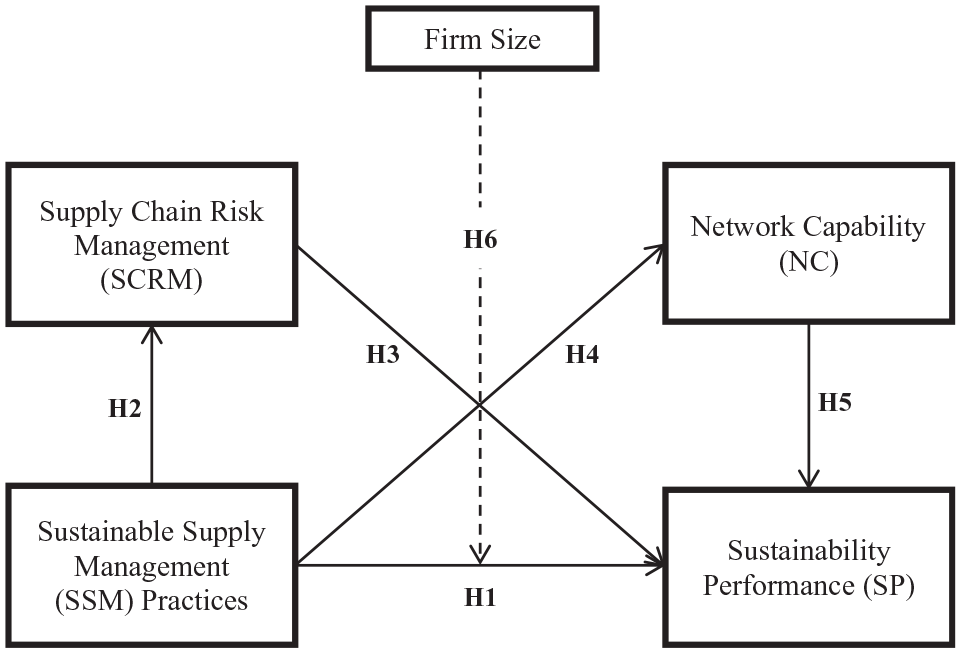
The conceptual framework showing hypothesized relationships.
Method
This part of the article highlights the study approach and methodological procedures adopted, such as the context of research, sampling, and data collection processes, instrumentation, and data analysis methods.
Data and Sample
The data were collected from supply management professionals of manufacturing and logistics companies in China. The respondent’s companies clustered into six key industries: food; logistics services; wood, paper, and chemical; manufacture of equipment and machinery (such as electronic, plastic, metal, and nonmetal products); construction; and other industries. We hired 12 research assistants from the EMBA (Executive Master of Business Administration) class to find potential respondents. Only those firms considered a study population whose complete record of postal addresses, phone numbers, and email addresses were available on the online business dictionary. So, they can quickly contact data collection. The study might have a higher response rate. The data were collected through personal visits to postal addresses of businesses and email addresses by sending a soft copy of the questionnaire. These research assistants sent emails to randomly selected supply management professionals working in manufacturing and logistics companies across China to participate in this survey, explaining the research’s purpose. Also, supply management professionals of these organizations contacted telephonically. As a result of these efforts, the 544 companies ensured their participation in filling the survey instrument.
Next, we divided the 12 research assistants into two groups; one group (six members) was responsible for collecting data from large companies. The second group (six members) was responsible for small-to-medium enterprises. Subsequently, the selected respondents were trained about filling survey instruments, and the aim of the research also clarified to them. We get 436 responses back in a useful form, providing a response rate of 80.15% (436/544). Out of 436 responses, 211 (48.39%) responses were from large companies, and 225 (51.61%) were from on small and medium-sized enterprises (SMEs). The average firm age of the respondents was 19.79 years. Out of 436 respondents, 51.83% (226) were female; 34.63% (151) were single. Each response was given a unique number as proof of identity and kept on a protected drive to ensure the respondent’s data privacy. The survey lasts about 50 days. The appendix indicates the items of the constructs.
Measurements
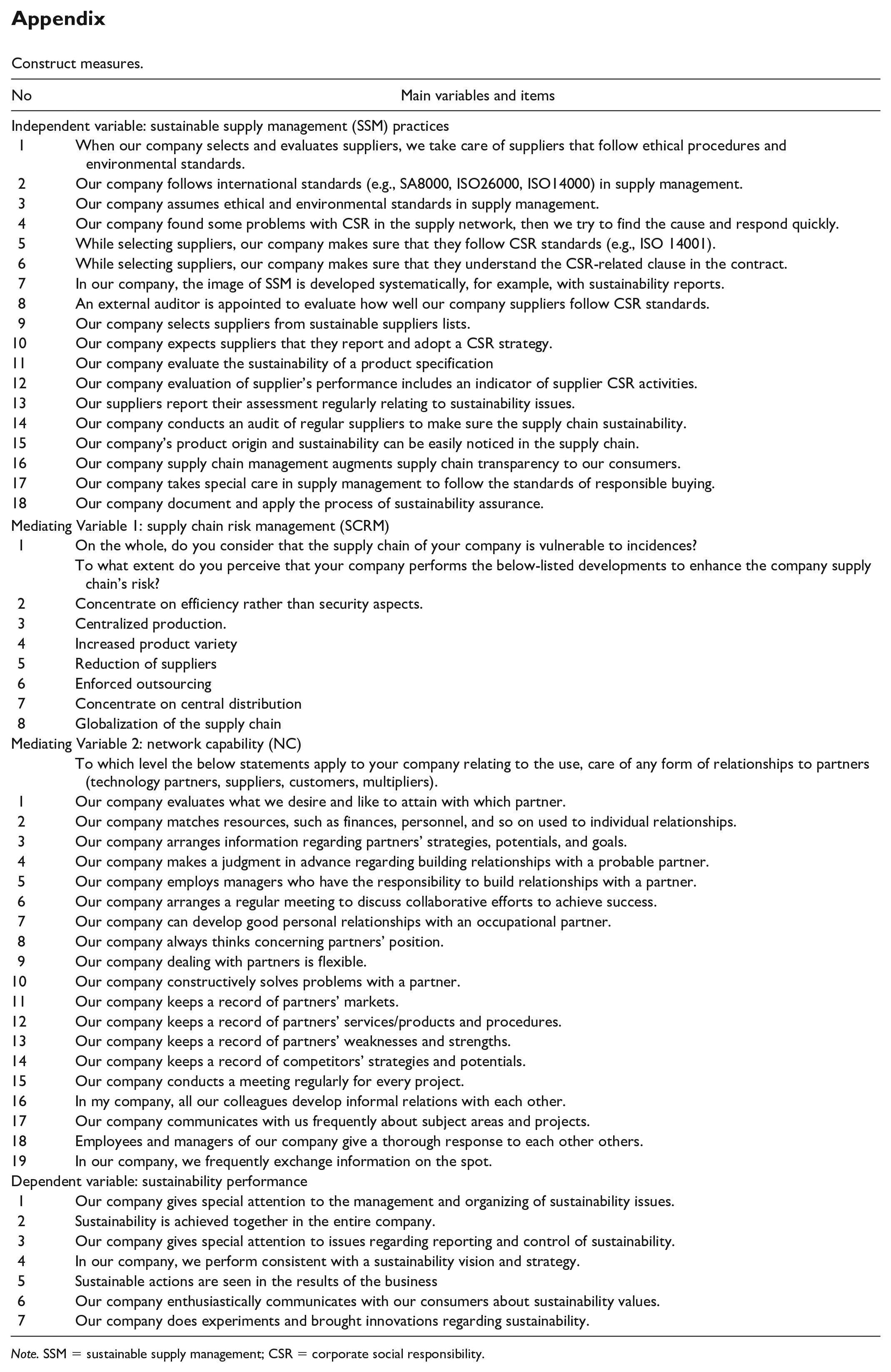
SSM practices measures concern whether processes of supply management of respondent organizations incorporated these practices. SSM practices (α = 0.96) were measured using 18 items construct with seven response options (Kähkönen et al., 2018), which contained six items for guidelines dimension, six items for reporting dimension, three items for SCM upstream dimension, and three items for SCM downstream dimension.
Supply Chain Risk Management (SCRM) scale measuring developments driving supply chain risks developed by Thun and Hoenig (2011) was adapted for this study. Eight items were used to measured SCRM (α = .91). SCRM measures concern whether certain organizational developments contribute to a rise or decline of risk within the company supply chain.
Networking Capability (NC) (α = .95) construct was measured using 19 items construct with seven response options (Walter et al., 2006), which contained six items for coordination dimension, four items for each relational skill, partner knowledge dimensions individually, and five-item for internal communication.
Sustainability Performance—A seven-item SP scale used in Kähkönen et al. (2018) was adapted for our study to measure SP (α = .89). SP measures concern the evaluation of how respondents (supply management professionals) well assumed their company has successfully attained sustainability in the context of communication, strategy, organizing, and reporting.
Firm Size—The firm was divided into two groups, that is, small-to-medium enterprises (SMEs) and larger enterprises. SMEs were differentiated from large companies based on the most cited definition of SMEs provided by American SBA (Small Business Administration) (J. W. Lu & Beamish, 2001), signifying that SMEs are enterprises with less than 500 working employment sizes. A recent study applied this definition to measure the SMEs’ corporate performance relationship in China (Guo et al., 2019). Hence, our study also follows the same criteria to measure firm size: Firms with less than 500 employment sizes were considered SMEs, and firms with higher employment size than 500 were considered large enterprises.
Our study accounted for the influence of firm age and firm type. These variables control for their impacts on the SP.
Construct Validity
Since the study’s model contains several constructs, confirmatory factor analysis (CFA) was performed to test the constructs’ discriminant and convergent validity. We started by testing the one-factor model’s construct fit; this CFA model contains all latent constructs with their entire items. For this model, the CFI (comparative fit index) was .93; the SRMR (standardized root mean square residual) was .04; the RMSEA (root mean square error of approximation) was .07. We followed a two-index approach of Hu and Bentler (1999); accordingly, SRMR and RMSEA were used to examine the measurement model fit. SRMR value (.04) of our study measurement model was better than the threshold value of .09; however, RMSEA value (.07) was a somewhat high value compared with the threshold value .06 proposed by Hu and Bentler (1999). In total, our study measurement model fit the data reasonably.
Next, we checked convergent validity by composite reliability (CR) and average variance extracted (AVE); accordingly, each latent construct CR value was greater than the cutoff value of .70 (Bagozzi & Yi, 1988), and the AVE values (Table 1) were beyond the threshold value of .50 (Fornell & Larcker, 1981). Besides, following Fornell and Larcker (1981) recommendations, we assessed discriminant validity by comparing the square root of AVE of each construct with the corresponding correlation estimates. The results indicated that all the values of square roots of the AVE of the studied variables were greater than the respective correlational values, providing support for discriminant validity.
Results of the Measurement and Correlations.
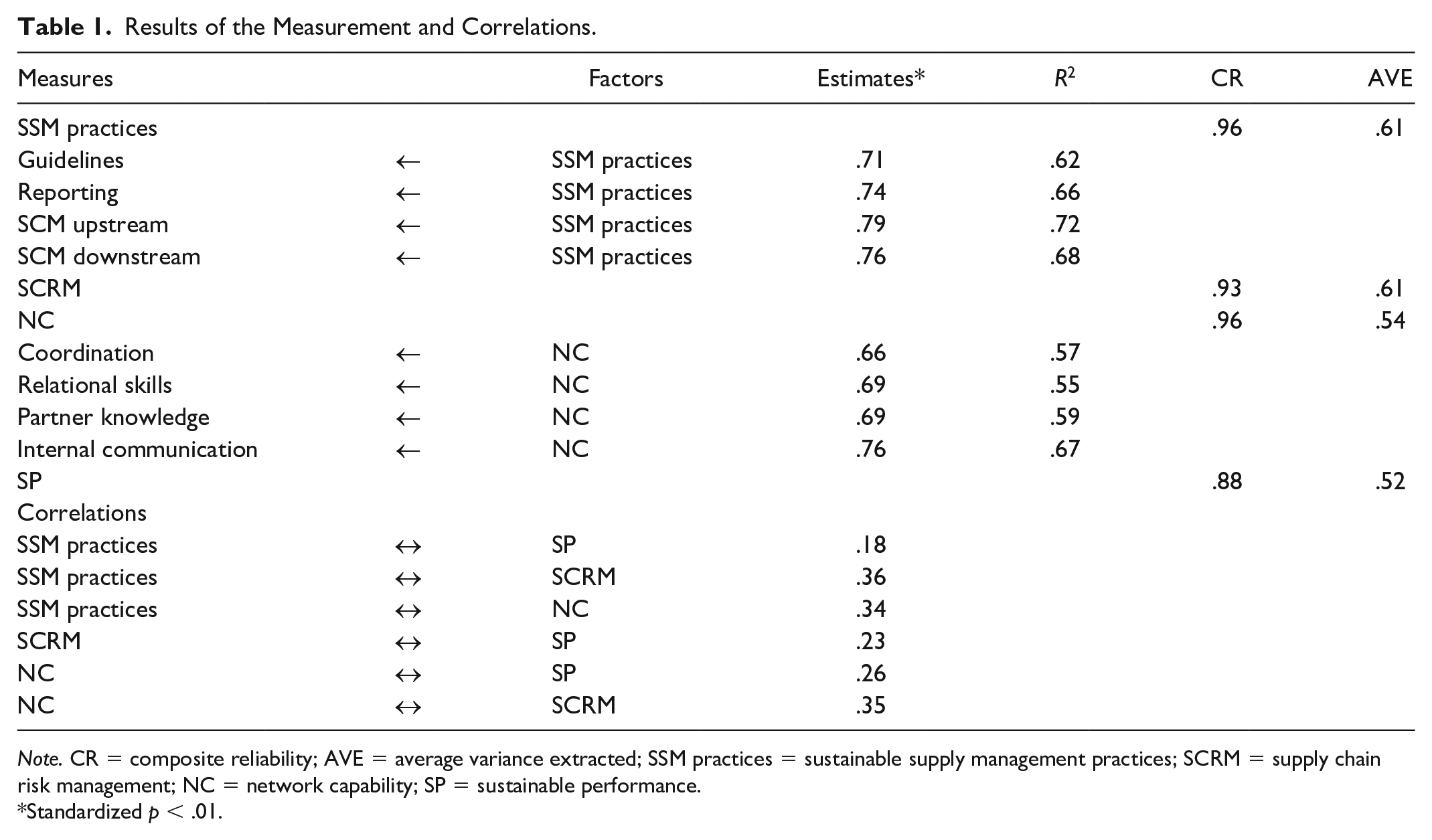
Note. CR = composite reliability; AVE = average variance extracted; SSM practices = sustainable supply management practices; SCRM = supply chain risk management; NC = network capability; SP = sustainable performance.
Standardized p < .01.
Since data were collected from a single source, common method bias may be a potential problem before checking hypothesized relationships. Hence, we performed additional tests to explore common method bias issues. Harman test was used to check the common method variance (CMV); the results reveal that CMV was not a severe problem associated with our study. However, Podsakoff et al. (2003) also reported the sensitivity of the Harman test. Instead, we also used a more refined analysis of directly measuring latent common method factor. We examined the model in which the whole items were loaded on their constructs (theoretical), in addition to on a CMV latent factor. We equated the results of weights of regression of a model without the common latent factor, which indicated that the common method bias was not a serious issue associated with our data. Whatsoever, our study measures possess suitable reliability and validity, and it is deemed adequate to test hypothesized relationships further.
Analyses and Results
The hypothesized relationships were tested through maximum likelihood estimation following the structural equation modeling (SEM) technique. We used the SEM technique due to these reasons: First, both mediators, that is, SCRM and NC can occur simultaneously in the relationship between SSM practices (independent variable) and SP (dependent variable) (Kähkönen et al., 2018; Lourenço & Branco, 2013); second, SEM is more convenient as it utilizes latent factors to compute measurement error, rather than combining measurement error of the study in a residual-error term (Palmatier et al., 2007); third, testing mediating influences through SEM is more suitable (Hu & Bentler, 1999) instead of regression.
The results of Table 1 show some differences that emerged while examining SSM practices, SCRM, NC, and SP. Such difference can help to understand the organizational contexts relating to studied variables. SCM upstream dimension of SSM practices has a stronger influence on SSM practices (β = .79) than SCM downstream (β = .76), reporting (β = .74), and guidelines (β = .71) dimensions of SSM practices. Furthermore, internal communication dimension of NC takes a stronger relationship to NC (β = .76) than other dimensions. However, Partner knowledge and relational skills dimensions of NC have equal influence on NC (β = .69) and coordination has lowest influence ranking among all dimension on NC (β = .66). Table 1 also reveals that all the key variables are significantly correlated with each other. The mean (M) and standard deviation (SD) of the main variables were as follows: SSM practices (M = 4.14, SD = .72), SCRM (M = 3.79, SD = .63), NC (M = 4.32, SD = .79), and SP (M = 4.61, SD = .89).
In the SEM model, we estimated the relationships between the constructs consistent with the hypothesized model shown in Figure 1. SSM practices were the exogenous construct, with SCRM and NC as the mediating variables, and SP as the outcome constructs. Firm age and firm type linked with SP as control variables. SSM practices and NC were having multiple measurements, and they included as latent constructs in the model. Each SSM practice and NC constituted second-order factors with four first-order reflective constructs (i.e., SSM practices, guidelines, reporting, SCM upstream, and SCM downstream) in NC (internal communication, relational skills, partner knowledge, and coordination). As highlighted in Table 2, an adequate fit is indicated by the mediating effect model fit indices (χ2/df = 2.24; CFI = .97; SRMR = .03; RMSEA = .04).
Direct and Mediating Effects (Standardized Path Estimates).

Note. Parentheses indicate standard errors. SP = sustainable performance; SCRM = supply chain risk management; NC = network capability; CFI = comparative fit index; SRMR = standardized root mean residual; RMSEA = root mean square error of approximation.
p < .05. **p < .01.
To test hypothesized relationships, we first tested direct relationship through direct effect models (excluding the mediating role of SCRM and NC and moderating role of firm size). Table 2 indicates significantly positive and direct effect of SSM practices on SP (β = .12, p < .01), supporting H1. Next, we compared the first direct effect model with a second mediating and moderating effect model. Accordingly, we included SCRM and NC as mediators and firm size as moderator into the second model. As highlighted in Table 2, SSM practices have significant and positively relates to SCRM (β = .37, p < .01) and NC (β = .49, p < .01), supporting H2 and H4. Moreover, SCRM (β = .32, p < .01) and NC (β = .41, p < .01) also have significantly positive effects on SP, supporting H3 and H5. However, the effect of SSM practices on SP in the presence of SCRM and NC becomes nonsignificant (β = .05, n.s.). Thus, Table 2 results support the mediating influences of SCRM and NC underlying effects of SSM practices on SP, revealing both mediators’ effects as full mediated relationships.
Likewise, following Zhao et al. (2010) suggestions, we also isolated the indirect effects of SSM practices on SP though SCRM and NC individually, and perform the related Sobel z-test (Table 3). The results indicate that the effects of the SCRM and NC as isolated mediators are significant and in line with our mediating propositions. The indirect effects of SSM practices on SP via SCRM (β = .11, p < .05) and NC (β = .16, p < .01) were significantly positive in the bootstrapping test. Overall, the mediating results of Tables 2 and 3 provide enough support to accept H6 and H7.
Effects of Mediators (Isolated).
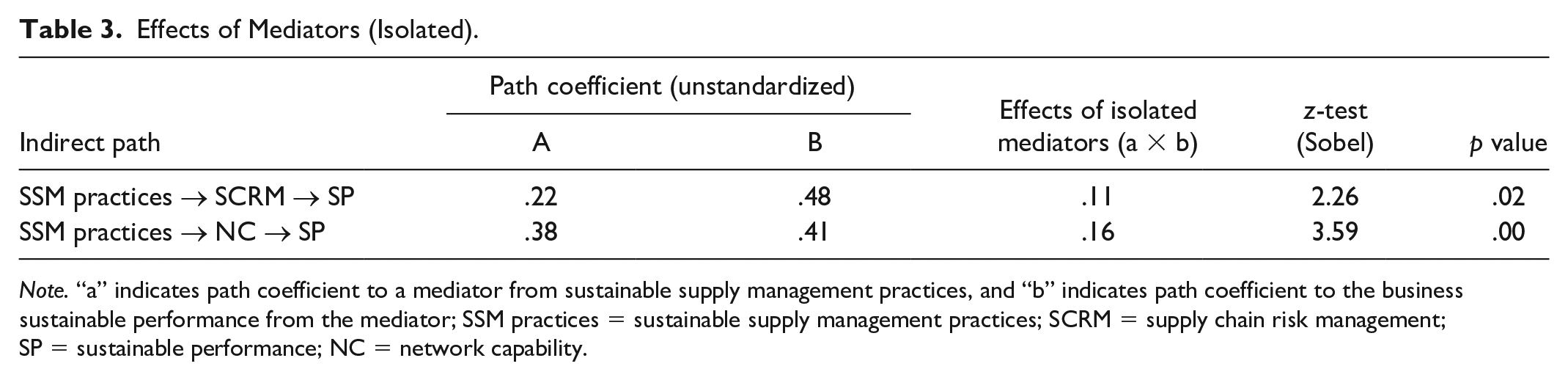
Note. “a” indicates path coefficient to a mediator from sustainable supply management practices, and “b” indicates path coefficient to the business sustainable performance from the mediator; SSM practices = sustainable supply management practices; SCRM = supply chain risk management; SP = sustainable performance; NC = network capability.
H6 predicted that firm size has moderating effects on the hypothesized linkages. Following Schumacker and Lomax’s (2004) suggestions, we performed a multigroup analysis to examine firm size’s moderating effects (SMEs and large enterprises). However, before performing multigroup analysis, configural invariances and measurement metrics were evaluated (Cheung & Rensvold, 2002). Accordingly, the invariances measurement analysis validates the perpetuation of the configural invariance, as the model estimation of M0 yields a good fit (χ2/df = 1.16, CFI = .97, and RMSEA = .03). Therefore, this construct has the same denotation for each group. The metric invariance existence was also proved as the model estimation of M1 yields a good fit (χ2/df = 1.21, CFI = .97, and RMSEA = .03). The model’s comparison (M0 with M1) indicates that for M1 − M0, the Δχ2 was nonsignificant. Moreover, following F. F. Chen’s (2007) suggestions, the loading embraces equality constraints since no change was observed in the ΔCFI and ΔRMSEA values. Thus, significant comparisons of the two groups of firm size (SMEs and large enterprises) are feasible in this case. Accordingly, after verifying measurement invariance, the structural coefficient analysis was performed.
Table 4 reveals the structural coefficient estimates about two different firm sizes contexts. The results indicate a deviant pattern of the relationships between the two groups. For the SMEs, SSM practices explain SP and SCRM. The SSM practices have a higher impact on SCRM (β = .41, p < .01) than on SP (β = .29, p < .01). In addition, SCRM also explains SP and has a stronger influence (β = .39, p < .01). However, SSM practices–NC and NC–SP relationships were not significant in SMEs’ case. For the large enterprises, SSM practices explain SP and SCRM; however, the influence is weak, that is, SSM practices–SP (β = .11, p < .05), and SSM practices–SCRM (β = .13, p < .05). Yet, SCRM has no influence on SP in the case of large enterprises. Inconsistent with SMEs results, in case of large enterprises SSM practices and NC relationship was significant (β = .59, p < .01). Moreover, NC has also significant and a stronger influence on SP (β = .63, p < .01). These results indicate that hypothesized relationships for firm size in SMEs and large enterprises are different and deviant. Thus, H6 is also supported.
Results of Multigroup Analysis.

Note. SMEs = small and medium-sized enterprises; SP = sustainable performance; SSM = sustainable supply management; SCRM = supply chain risk management; NC = network capability.
p < .05. **p < .01.
Discussion
In response to a recent call for a more in-depth study into the role of SSM practices in business performance (Hong et al., 2018), particularly SP of a business (Kähkönen et al., 2018), we devise this study to comprehend how SSM practices influence SP from supply management professionals’ viewpoints. This article responds to this question from dynamic capabilities perspectives by unveiling the mediating effects of SCRM and NC on the linkage between SSM practices and SP, in addition to the moderating and moderated mediation role of firm size on the effectiveness of SCRM and NC in SP. Our article’s empirical results have crucial implications for both supply chain management literature and supply management professionals.
Our study results indicate that SSM practices have significant positive influence on SP. This finding is consistent with the previous findings that SSM practices predict business performance (Hong et al., 2018; Kähkönen et al., 2018; Kumar et al., 2018). In addition, our results also show that SSM practices have a significant positive influence on SCRM and NC, which in turn have significant impact on SP. These findings of our study highlight that SCRM and NC are important capabilities that have the propensity to boost SP. These findings are consistent with the previous studies that reveal that risk management capabilities (Kumar et al., 2018) and network resources (Huggins & Johnston, 2010) are critical organizational resources. Hence, our study contributes to the dynamic capability perspective that highlights that when organizations purposely alter, adjust, and reinstate organizational resources (Ambrosini & Bowman, 2009) then these organizations are able to attain a sustainable competitive advantage in an environment where competitiveness is featured by unpredictable and rapid fluctuations (Teece, 2007).
Our study findings relating to the firm size has a crucial contribution to the dynamic capability perspective. Previous studies indicated that large firms are found to have better data conveyance and perform better in utilizing information (Ellegaard, 2008), as compared with small enterprises (Raza et al., 2019; Raza & Majid, 2016). Consistent with these studies arguments, our study reported that, in case of SMEs, SCRM is important dynamic capability as compared with NC. However, in case of large enterprises, NC is the crucial dynamic capability as compared with SCRM. The below sections highlight important theoretical contributions, managerial implications, limitations, and future directions of the study.
Theoretical Contributions
First, our article enriches the knowledge of the linkage between SSM practices and performance outcomes of a business in the context of supply management professionals. This article has examined the role of SSM practices in increasing SP. The findings demonstrate that SSM practices have a positive influence on SP in the context of supply management professionals. This finding lends empirical evidence to recent theoretical arguments that highlighted the significance of examining SSM practices’ effect on a business’s performance (Golicic & Smith, 2013; Hong et al., 2018; Kähkönen et al., 2018; Kumar et al., 2018).
Second, the current article’s significant contribution is to reveal the two crucial underlying mediating mechanisms (SCRM and NC) by which SSM practices influence SP, echoing a recent call by Kähkönen et al. (2018). A stream of current research has focused on the mediating relationship between SSCM practices and various performance outcomes, such as SSCM practices and social, environmental, and economic performance through dynamic capabilities as a mediator (Hong et al., 2018). In additon, the relationship between stakeholder pressure and the SP of a firm has been also explored through SSCM as a mediator (Wolf, 2014). However, we know little relating to SSM practices and SP relationships and underlying mechanisms. Our findings show that the influence of SSM practices on SP is fully mediated by SCRM and NC simultaneously and individually, which advocates that dynamic SSM practices of business develop both SCRM and NC, which improves SP. The findings of these underlying mechanisms of SCRM and NC are in line with the RBV assumptions and dynamic compatibility perspectives, and together with SSM practices, businesses must develop approaches for creating novel capabilities, such as SCRM and NC, and accordingly to achieve SP.
Third, the SCRM literature identifies that firm size might be the critical factor influencing risk management capabilities (Kumar et al., 2018) and network resources (Huggins & Johnston, 2010). As SSM practices are considered to be dispersed all through the enterprise and the network or chain to get the maximum influence (Hallikas & Lintukangas, 2016), therefore, large firms are considered to have better data conveyance and perform better in utilizing information (Ellegaard, 2008), as compared with small enterprises. Our article extends this knowledge stream by considering firm size as an essential boundary condition and explores how firm size differentially moderates the influence of SSM practices on SCRM and NC to enhance SP further.
The exploration of the impact of the two different types of firm size, namely, SMEs and larger enterprises on the hypothesized model, indicates crucial and unexplored findings. With respect to SMEs, the greater value was given to SP resulted from SSM practices and SCRM. In this regard, SME owners in China focus on the guidelines, reporting, SCM upstream, SCM downstream, and SCRM to achieve sustainable performance. Furthermore, owners of SMEs in China also give importance to SSM practices and SCRM to attain sustainable performance. These findings are novel and noteworthy for theoretical progression relating to SMEs. The results about Chinese larger enterprises are identical to SMEs about SSM practices and SP, and SCRM. However, larger enterprises give less importance to SCRM to achieve sustainability as compared with SMEs. In addition, the results also indicate that larger enterprises in China mainly focus on NC to attain sustainable performance and on SSM practices to achieve NC, which are noteworthy findings of this article. Largely, these findings offer fresh insight into how to tie the appropriate dynamic capabilities mechanisms with performance and sustainability outcome of a business in the SSCM context (Hallikas & Lintukangas, 2016; Hong et al., 2018; Kumar et al., 2018) that highlight the essence of Chinese supply management professionals’ dynamic capabilities in SSCM context.
Managerial Implications
As an emerging market, China offers higher growth opportunities and makes a business adopt pervasive opportunistic behaviors (Sheng et al., 2018) and gain competitive advantage through enhancing performance (Hong et al., 2018). Our research presents several substantial managerial implications. First, SSCM practitioners and policymakers should be aware and adhere to SSM practices within their businesses as SSM practices of supply management professionals may enable the SP. Second, managers should recognize that SCRM and NC fully mediate the influence of SSM practices on SP. Hence, in businesses with sound SSM practices, managers should focus on developing and adopting the dynamic capabilities of SCRM and NC to achieve SP. Finally, our study suggests that organizational characteristic such as firm size is important to understand how supply management professionals react to SSM practices. Thus, firm size as a crucial organizational characteristic in SSM practices is essential to realize. Our findings establish that SSM practices’ effects weakened at a lower firm size level, that is, SMEs about NC. Therefore, SSM practitioners and policymakers should focus more on SMEs NC as compared with large businesses supply management practices to achieve sustainability in their businesses. However, larger enterprises pay less attention to SCRM as compared with SMEs. These findings have important implications for managers.
Limitations and Future Studies
This article is subject to various limitations. First, the target population was based on only supply management professionals from China; businesses in emerging economies vary in their resources and growth rate, so special care should consider while generalizing the findings to other contexts. Future studies could examine and validate our conceptual model in other developing markets. Second, a longitudinal design is highly recommended for future studies to know about the levels of technological capabilities. Third, there are different approaches to defining SSM related practices in literature besides SSM practices. Future research is recommended to examine another integration mechanism, for example, process coordination and system integration. Third, future studies may also follow to associate the integrating mechanisms considering other mediating mechanisms and boundary conditions.
Our study verifies the influence of SSM practices on SP. Furthermore, this article also extends the dynamic capability perspective of RBV by examining how SCRM, NC, and firm size influence the linkage between SSM practices and SP. Our results suggested that SSM practices have a crucial direct and indirect impact on SP through SCRM and NC, revealing that both SCRM and NC fully mediated the linkage between SSM practices and SP. Our findings also emphasized that the firm size (SMEs and larger enterprises) is an essential organizational characteristic that moderates the hypothesized model.
Conclusion
In a nutshell, three key conclusions can be drawn from the above findings and discussion. First, SSM practices have a significant role in boosting SP. Second, SCRM and NC emerge as the firm’s dynamic capabilities that mediate the SSM practices and SP relationship. Third, SMEs and large enterprises reflecting firm size influence the hypothesized model in different approaches. In the case of SMEs, SSM practices verify the development of SCRM, which, as a result, boost SP. However, in large enterprises, SSM practices have a significant influence on NC, which enhances SP. These findings take on even higher importance since past research could not report evidence of the SSM practices and SP model relating to distinct firm size effects.
Footnotes
Appendix
Construct measures.
| No | Main variables and items |
|---|---|
| Independent variable: sustainable supply management (SSM) practices | |
| 1 | When our company selects and evaluates suppliers, we take care of suppliers that follow ethical procedures and environmental standards. |
| 2 | Our company follows international standards (e.g., SA8000, ISO26000, ISO14000) in supply management. |
| 3 | Our company assumes ethical and environmental standards in supply management. |
| 4 | Our company found some problems with CSR in the supply network, then we try to find the cause and respond quickly. |
| 5 | While selecting suppliers, our company makes sure that they follow CSR standards (e.g., ISO 14001). |
| 6 | While selecting suppliers, our company makes sure that they understand the CSR-related clause in the contract. |
| 7 | In our company, the image of SSM is developed systematically, for example, with sustainability reports. |
| 8 | An external auditor is appointed to evaluate how well our company suppliers follow CSR standards. |
| 9 | Our company selects suppliers from sustainable suppliers lists. |
| 10 | Our company expects suppliers that they report and adopt a CSR strategy. |
| 11 | Our company evaluate the sustainability of a product specification |
| 12 | Our company evaluation of supplier’s performance includes an indicator of supplier CSR activities. |
| 13 | Our suppliers report their assessment regularly relating to sustainability issues. |
| 14 | Our company conducts an audit of regular suppliers to make sure the supply chain sustainability. |
| 15 | Our company’s product origin and sustainability can be easily noticed in the supply chain. |
| 16 | Our company supply chain management augments supply chain transparency to our consumers. |
| 17 | Our company takes special care in supply management to follow the standards of responsible buying. |
| 18 | Our company document and apply the process of sustainability assurance. |
| Mediating Variable 1: supply chain risk management (SCRM) | |
| 1 | On the whole, do you consider that the supply chain of your company is vulnerable to incidences? |
| To what extent do you perceive that your company performs the below-listed developments to enhance the company supply chain’s risk? | |
| 2 | Concentrate on efficiency rather than security aspects. |
| 3 | Centralized production. |
| 4 | Increased product variety |
| 5 | Reduction of suppliers |
| 6 | Enforced outsourcing |
| 7 | Concentrate on central distribution |
| 8 | Globalization of the supply chain |
| Mediating Variable 2: network capability (NC) | |
| To which level the below statements apply to your company relating to the use, care of any form of relationships to partners (technology partners, suppliers, customers, multipliers). | |
| 1 | Our company evaluates what we desire and like to attain with which partner. |
| 2 | Our company matches resources, such as finances, personnel, and so on used to individual relationships. |
| 3 | Our company arranges information regarding partners’ strategies, potentials, and goals. |
| 4 | Our company makes a judgment in advance regarding building relationships with a probable partner. |
| 5 | Our company employs managers who have the responsibility to build relationships with a partner. |
| 6 | Our company arranges a regular meeting to discuss collaborative efforts to achieve success. |
| 7 | Our company can develop good personal relationships with an occupational partner. |
| 8 | Our company always thinks concerning partners’ position. |
| 9 | Our company dealing with partners is flexible. |
| 10 | Our company constructively solves problems with a partner. |
| 11 | Our company keeps a record of partners’ markets. |
| 12 | Our company keeps a record of partners’ services/products and procedures. |
| 13 | Our company keeps a record of partners’ weaknesses and strengths. |
| 14 | Our company keeps a record of competitors’ strategies and potentials. |
| 15 | Our company conducts a meeting regularly for every project. |
| 16 | In my company, all our colleagues develop informal relations with each other. |
| 17 | Our company communicates with us frequently about subject areas and projects. |
| 18 | Employees and managers of our company give a thorough response to each other others. |
| 19 | In our company, we frequently exchange information on the spot. |
| Dependent variable: sustainability performance | |
| 1 | Our company gives special attention to the management and organizing of sustainability issues. |
| 2 | Sustainability is achieved together in the entire company. |
| 3 | Our company gives special attention to issues regarding reporting and control of sustainability. |
| 4 | In our company, we perform consistent with a sustainability vision and strategy. |
| 5 | Sustainable actions are seen in the results of the business |
| 6 | Our company enthusiastically communicates with our consumers about sustainability values. |
| 7 | Our company does experiments and brought innovations regarding sustainability. |
Note. SSM = sustainable supply management; CSR = corporate social responsibility.
Declaration of Conflicting Interests
The author(s) declared no potential conflicts of interest with respect to the research, authorship, and/or publication of this article.
Funding
The author(s) disclosed receipt of the following financial support for the research, authorship, and/or publication of this article: The research was supported by the National Natural Science Foundation of China (72074024; 72041002) and by the Grant of Key Program for Beijing Educational Science Planning during the 13th Five-Year Plan Period, 2020 (Exploring the Influence of University Students’ Practical Activities on Leadership Emergence, No. CEAA2020047).
