



Abstract
The Covid-19 pandemic began as early as November 2019, and its first negative impact on business activities was in the retail industry since isolation orders pushed the market into closed environments that restricted payment and delivery services. With the Internet and apps, special delivery platforms are popular and changes in mobile payment methods have facilitated retail operations, such as delivery services. Mobile payments and delivery service have increased globally as attractive transaction methods during the Covid-19 pandemic. Along with mobile payments, with the growing demand for convenience and cultural climate, delivery services in Vietnam became even more popular during the Covid-19 pandemic since they are considered useful, convenient, and safe means to reduce the risk of exposure to infection. This empirical study investigates Vietnamese consumer behaviors with mobile payment and delivery services during the pandemic. Data mining analytics, including association rules and clustering analysis for investigating mobile payment and delivery service business model development. Thus, this study finds several knowledge clusters, which are named the Cluster-1 Women’s Workforce Group; the Cluster-2 Men’s Workforce Group; and the Cluster-3 Student Group. In addition, patterns and rules which found the associations of consumer behavior and delivery service preferences; and the associations of consumer behavior and mobile payment and delivery service preferences; in terms of for indicating how mobile payment and delivery services can serve customers for Vietnam retail businesses.
Plain language summary
With Vietnamese government promotion, mobile payments have popularized the willingness of consumers to use electronic payment, as a pushing force. On the other hand, with the market draw, delivery services provide increased consumer choice for product delivery and assist in developing a contactless economy, as a pulling force. Thus, this empirical study aims to investigate Vietnam consumer behaviors with mobile payment and delivery services in retailing in this period. It finds several meaningful clusters, patterns, and rules for investigating how mobile payment and delivery services can serve retail customers in business models for Vietnam.
Keywords
Introduction
Vietnam is a member of the Association of Southeast Asian Nations, the World Trade Organization, the Asia-Pacific Economic Cooperation, the International Organization of the Francophonie and the Next 11 countries. Its GDP has grown between 4.9% and 5.8% in 2023, less than prior to the epidemic, though the international community is confident in Vietnam’s future global supply chain performance. With a per capita GDP of US$5174.0 in 2023 Vietnam is a developing Asian nation and an emerging market (Britannica, 2024). After the Covid-19 pandemic began in November 2019, many people remained at home much of the time, along with the shutdown of nonessential services and restrictions on restaurants, markets and other group gatherings. This drastically increased the trend to use delivery services for a wide range of products, ranging from prepared foods to consumer electronics. The choice of payment methods is flexible, including cash, cards, or mobile payments. Since covid-19 has become a global pandemic, consumers now prioritize contactless payments, and vendors also encourage consumers to use contactless methods. During the pandemic period 69% of retailers recognized an increase in contactless payments and nearly 94% expect this increase to continue over the next 18 months. Mobile payments, either in-store or proximity, increased to 29% in 2022 in Vietnam (Sieber, 2023). According to a Standard Chartered Bank report, Vietnam previously had the lowest rate of non-cash payment transactions in Asia, but now about 30% of young people regularly make online transactions and 39% of them are reducing purchases at physical stores (Van Anh, 2023). The State Bank of Vietnam encourages citizens to replace cash payments with mobile payments to reduce the risk of infection, implementing a national financial strategy to increase non-cash payments by approximately 20% to 25% by 2025 (Nguyen Quy, 2023).
Regarding mobile payment and delivery service development, along with mobile payments, with the growing demand for convenience and cultural climate, delivery services in Vietnam became even more popular during the Covid-19 pandemic since they are considered useful, convenient, and safe means to reduce the risk of exposure to infection. The Vietnam express delivery services market was valued at $700.4 million in 2020, and is projected to reach $1655.96 million by 2028, a compound annual growth rate of 11.9% from 2021 to 2028 (Research and Markets, 2023). The two biggest delivery apps in the US - Postmates and Door Dash – provide no-contact delivery services, where shippers just need to leave deliveries at the customer’s door. Thus, delivery services have evolved into a powerful means to support local businesses while reducing the chance of infection (Vietnamplus News, 2023).
Regarding retailing and business development, the Covid-19 outbreak in Vietnam has hit fast-moving consumer businesses, and almost all categories and retailers will suffer negative impacts, particularly beverages such as beer, carbonated soft drinks, along with other items such as dairy products, packaged foods and personal care products that previously had growth rates of 1.7% to 14.5 % in 2022. Growth for the consumer goods market in 2019 was 6.3%, slowing down in the first few months of 2020 to 5.2% (Vietnam Briefing, 2023). According to a survey conducted by Nielsen Vietnam on COVID-19 consumer behavior, consumer demand for products that boost health and the immune system has risen significantly. Furthermore, people are cooking more at home and doing less shopping in-person, and online shopping has increased with many consumers using apps to purchase by 18%. Individual who had groceries delivered at home increased by 14%, and an early half, or 47%, of survey respondents said that were eating more home-cooked meals than before the pandemic. They were also ordering less takeout or delivery than usual, and around 16% said that they were ordering in more often than they used to in 2021 (Vietnamplus News, 2023a). Along with the development of purchasing essentials online, retailers are more likely to adapt to the digital platforms. For example, in 2022 the number of Google searches increased by nearly eleven times in July compared to May and around 3.6 times compared to June during the months of social distancing. Compared to the previous quarter, Vietnamese consumers are more concerned with purchasing fresh food, beverages, packaged products, fruits and vegetables as indicated by the fact that Google searches for these items increased by 99%, 51%, 30% and 11%, respectively (Vietnamplus News, 2023b).
This background leads to several research question regarding of mobile payment and delivery service issues in Vietnam retailing during the Covid-19 pandemic:
Literature Review
Mobile Payment in Retailing
Mobile payments are an alternative payment medium that is more convenient than traditional bank deposits or physical cash, but before the COVID-19 epidemic, consumers in many countries preferred cash or credit card transactions in daily transactions, and their mobile payments were not commonly accepted (Balakrishnan & Gan, 2023). In contrast, Denmark’s central bank stopped printing money and minting coins in 2014. The Danish government also stopped paper currency trading in January 2016 and deployed a nationwide digital payment method that allows everyday transactions to be paid through mobile payments or credit cards (Rahardja et al., 2023). India was one of the Asian countries with relatively low usage of mobile payment, and due to the preference of the public for cash payment, it almost disappeared as a medium of exchange. With promotion by the Indian government promotion, consumers are more willing to use electronic payments, which is motivating industry and business (Loh et al., 2022). The trend of increasing use of mobile payment has also changed the service appearance of the finance and retail industries and the interaction mode with consumers. For example, mobile payments at convenience stores, snack bars, restaurants and other catering stores can avoid the hygiene problem that occurs when clerks touch both money and food. For small stores, contactless payment demand is expected to prevail after the pandemic subsides (Loh et al., 2021). The impact of mobile payment on the consumer market is clearest in the car-hailing and delivery service industries. It can save customers the trouble of making change, and also support competition in terms of payment digitation, so consumers can receive more advanced services (Belanche et al., 2022). For the retail industry, increasing the willingness of small stores to install electronic payment equipment and pursuing integrated services for mobile payment can attract more customers to join the cashless society for a faster and more convenient digital economic ecology (Timoumi et al., 2022).
Peer-to-Peer Mobile Payment
Peer-to-peer or P2P payments allow you to send money directly to someone else. P2P payment systems (also known as remittance applications, such as Venmo, PayPal, and Cash App) allow users to send and receive funds from a mobile device through a linked bank account or card (Kalinic et al., 2019). With P2P payments, users can send money quickly while keeping their bank account details private. All that is needed to send a payment is the recipient's e-mail address or phone number; you can use one of these pieces of information to add someone as a contact in the application. Generally, these services are free and it's easy to split bills with friends and family (Belanche et al., 2022). On the other hand, review the provider's security procedures and fraud policies before signing up and take precautions when using P2P payment services, as you may not be able to get your funds back once you authorize a payment. Banks and credit unions are not responsible for loss of funds due to P2P fraud (Perea-Khalifi et al., 2024).
Delivery Service in Retailing
With the rapid development of the sharing economy, crowd-sourcing has become an emerging business model. The term crowd-sourcing refers to work traditionally performed by designated agents that is now outsourced to an unspecified public (Prassida & Hsu, 2022). Under this concept, online platform operators began to handle deliveries through crowd sourcing distribution operations, using a crowd logistics business model (Olsson et al., 2022). Of these services, the retail delivery service platform is the fastest growing, primarily through three-way matchmaking for consumers, stores and delivery staff (Chen et al., 2022). For this, consumers first select products online and then send orders to the platform. The delivery service platform transmits the received order information to the designated store, and starts stocking after the order is confirmed. At the same time, the platform assigns a delivery person and estimates a waiting time for the consumer, and the delivery person then picks up the goods from the store. The goods are delivered to the location designated by the consumer, and the consumer receives the product and completes the order (Rashid & Rasheed, 2024). The catering delivery platform is a rapidly developing business model of delivery service and different platforms have different operating strategies according to their own business policies. In general, the differences in service product types of catering delivery service platforms lie in the type of restaurant and whether they provide other services, such as fresh cooked food or shopping malls (YAŞA, 2023). In addition to food delivery services, this service type has expanded to other retail commodity delivery services, such as: fresh groceries, daily necessities, gifts, flowers, and special goods (Melián-González, 2022). Driven by customer demand, this delivery service increases consumer choice for product delivery, assists the development of the contactless economy, and supports these markets (Wan et al., 2023).
Mobile Payment and Delivery Service in Retailing
There are a few studies investigating issues of mobile payment and delivery service at the same time on a specific area or state. Sharma and Sharma (2023) focused on Go-Jek, a technology company that provides a wide range of online services including shipping, delivery, and mobile payments by bringing consumers and service providers together, thereby acting as an information intermediary that collects information from users and shares it with business operators. Anjum and Chai (2020) presented a case study on McDonald’s that found how McDonald’s improved order processing with information technology on electronic payment and delivery service. Liao, Widowati, and Cheng (2022) discussed how the role of mobile payment is determined with a new retail payment mechanism that improves consumer purchasing in an online-to-offline business environment. Vij and Dühr (2022) proposed the Mobility-as-a-Service (MaaS) platform to provide consumers with multiple modes of transportation and services owned and/or operated by different mobility service providers through an integrated digital platform for planning, booking and digital payment. They found that MaaS could help strengthen complementary relationships between services, provide operators with access to new customers and a larger market, and help them manage assets more efficiently. However, there is no study or case investigation on the development of mobile payments and delivery services in a specific market of area or state.
Data Mining Analytics
Clustering Analysis (K-Means Clustering)
Clustering analysis (K-means clustering) is an unsupervised machine learning method. The concept of k-means clustering, that is, a concept of things are grouped together. Boys are boys, girls are girls, boys will gather themselves into a group, and girls will gather themselves into a group. But in this group of boys will not move to form a group, and the girls will not move to form a group (Liao, Widowati, and Puttong, 2022). In machine learning, what we have is a group of height and weight data that will not move. So, what is it that moves, and what is it that separates the boys from the girls? Look back at the name of the algorithm, k-means, where k is the number of groups you want to divide into, and means is the center of each group, so anything that moves is the center of the group (Liao et al., 2023). The k-means operation concept steps (Liao et al., 2024a):
Set the number of groups (k) to be divided.
Then k group centers are randomly assigned in the feature space (the 2-dimensional space from the x-axis and the y-axis. If the data is d-dimensional, a d-dimensional space will be formed).
Divide the observed value (

Each data will have a mental calculation of the Euclidean distance of all k groups (Euclidean distance, which is the straight-line distance formula, the distance formula we have learned from elementary school to adulthood. Of course, the distance here can also be replaced by other distance formulas, but the basic The Euclidean distance is still the main method.) Assuming there are K (must be ≤n) clusters {S1, S2, …, Sk}, K-means clustering aims to minimize the sum of squared errors between the data in the cluster and the cluster center. The mathematical formula is as follows (formula 2):

Classify each piece of information and assign it to the group center that is closest to it.
Each group heart will contain classified information and use this information to update a new group center.
Repeat steps 3–6 until all group centers no longer change much (converge).
Association Rules
Association rules are one of the most important data mining methods used in the study of data correlation (Agrawal et al., 1993). For example, in a sales transaction database, we are interested in discovering the association between items. If in many transactions, we find that the appearance of one item will trigger the appearance of another item, this is called an association rule (Agrawal & Srikant, 1994). For example: An association rule is that if a customer buys milk, he will also buy bread at the same time, that is, milk + bread for a buddling purchase. Association rules are determined by two values: minimum support and minimum confidence. The concepts of minimum support and minimum confidence. The minimum support controls the minimum amount of data that a rule must cover, while the minimum confidence controls the predictive strength of the rule. The support and confidence of a rule are measures of the interestingness of the rule. A rule is considered valid when the mining algorithm finds a related rule that satisfies the minimum support and confidence set by the user. For example, if we want to generate the association rule AB (when A occurs, B occurs), the itemsets we need to find are {AB}. If we set the minimum support value to 40%, If there are 10,000 transaction records in the database, then the number of itemsets {AB} that appear must be greater than or equal to 4,000 (10,000 × 40%) to be considered a frequent itemsets (also called large itemsets). The proportion of records in which {B} also appears is the confidence of the A⇒B association rule. If the minimum confidence value we set is 60%, the number of occurrences of {AB} divided by the number of records containing {A} is If the ratio of the number of records is greater than or equal to 60%, it means that this rule is established. If we express the above example in mathematical terms, support is the probability of P(A∪B), and confidence is expressed as the conditional probability P(B|A), which can be organized into the following formula:

When we want to mine related rules, the key points of the operation include the following two steps (Liao et al., 2024b):
(1) Find all frequent itemsets:
The number of occurrences of each frequent itemsets must be greater than or equal to the pre-defined minimum number of supports.
(2) Generate association rules from the found frequent itemsets:
The first step determines the efficiency of the entire operation. It takes up most of the time of all operations. After the first step is completed, the second step can be easily completed. Therefore, when exploring the mining of related rules, all focus on how to find frequent itemsets efficiently.
However, there is no study or case in which it investigates the development of mobile payment and delivery service using data mining analytics on a complex retailing problem on a specific market of area or state. Accordingly, this literature review shows that the topic of mobile payment and delivery service is very important in retailing research. Data mining analytics can find different patterns and rules to generate possible alternatives, and then propose business model improvements to retailers.
Research Design
Subject Background and Sampling
To analyze mobile payment and delivery service business models by data mining, mobile payment and delivery service customers in Vietnam during the COVID-19 pandemic are the subjects for this study. Data was collected through a detailed structured online questionnaire sent to individuals using messages via social media or communication apps, such as Facebook, Zalo etc. Questionnaire distribution was from June 20 to September 13, 2021, a total of 2,271 questionnaires were answered and returned. After reviewing completed questionnaires and discarding incomplete responses from, 2,204 questionnaires were entered into the database. Respondents were 71.50% female, 72.90% were 25 years and under, 24.30% were 26–36 years, and 2.60% were 37 years and above. The second part of the survey covered mobile payment usage behavior, and the third part covered delivery service usage behavior.
Questionnaire Design
This questionnaire has five parts with nominal and ordinal scale questions to understand how respondents feel, think, and act. The first part was six questions about personal information such as gender, age, education background, occupation, etc. The second part was six mobile payment usage behavior questions regarding reasons to use mobile payment and the convenience factors retaining users such as technologies, services etc. This part also asked how consumers learn about mobile payment transaction information. The third part had eight delivery service usage behavior questions regarding frequency of use and reasons to use delivery services during this period. This part concerned factors retaining users such as diversity in service, payment method; as well as ways to choose a store for delivery service, references and their satisfaction with food delivery. The fourth part contained five questions about offline and online shopping through mobile payment and delivery service during this period, such as consumers’ preferred services, shopping discount methods, etc. The fifth part contained five questions about offline and online shopping through mobile payment and delivery service behavior to understand what consumers mostly purchase offline and online, how the preferred marketing methods for offline and online shopping attracted their attention, as well as reasons that consumers prefer to buy in-store instead of online during this period. The study also suggests other business models for using both mobile payment and delivery service. All items of questionnaire are designed as the nominal and ordinal scales (not Likert scale) (Supplemental Appendix—the questionnaire). For example: What kind of preferential method will increase your willingness to buy on the delivery platform using mobile payment during the COVID-19 pandemic? (Multiple choice) (1) Free shipping (2) Buy one get one free (3) Discount (4) Free goods in full (5) Consumption can participate in the lucky draw (6) Get discounts on specific items (8) Give a discount code for the next purchase (9) Other (Please list the top three rankings of your preferences
Database Development—The Entity-Relationship Model (E-R Model)
Berson and Smith (1997) proposed combining dimension data tables and fact data tables to form a data warehouse. The structure of data dimensions was divided into three types: Star schema, Snowflake schema, and Fact constellation schema. A multi-dimensional data model is designed used to organize and store a large amount of data in a data warehouse to optimize query and analysis decisions. The database schema developed in this study is an E-R model that includes 16 strong entities, 4 associative entities, 16 associations, and 123 attributes (Figure 1).

E-R model.
Data Mining Analytical Tool—SPSS Modeler
Using
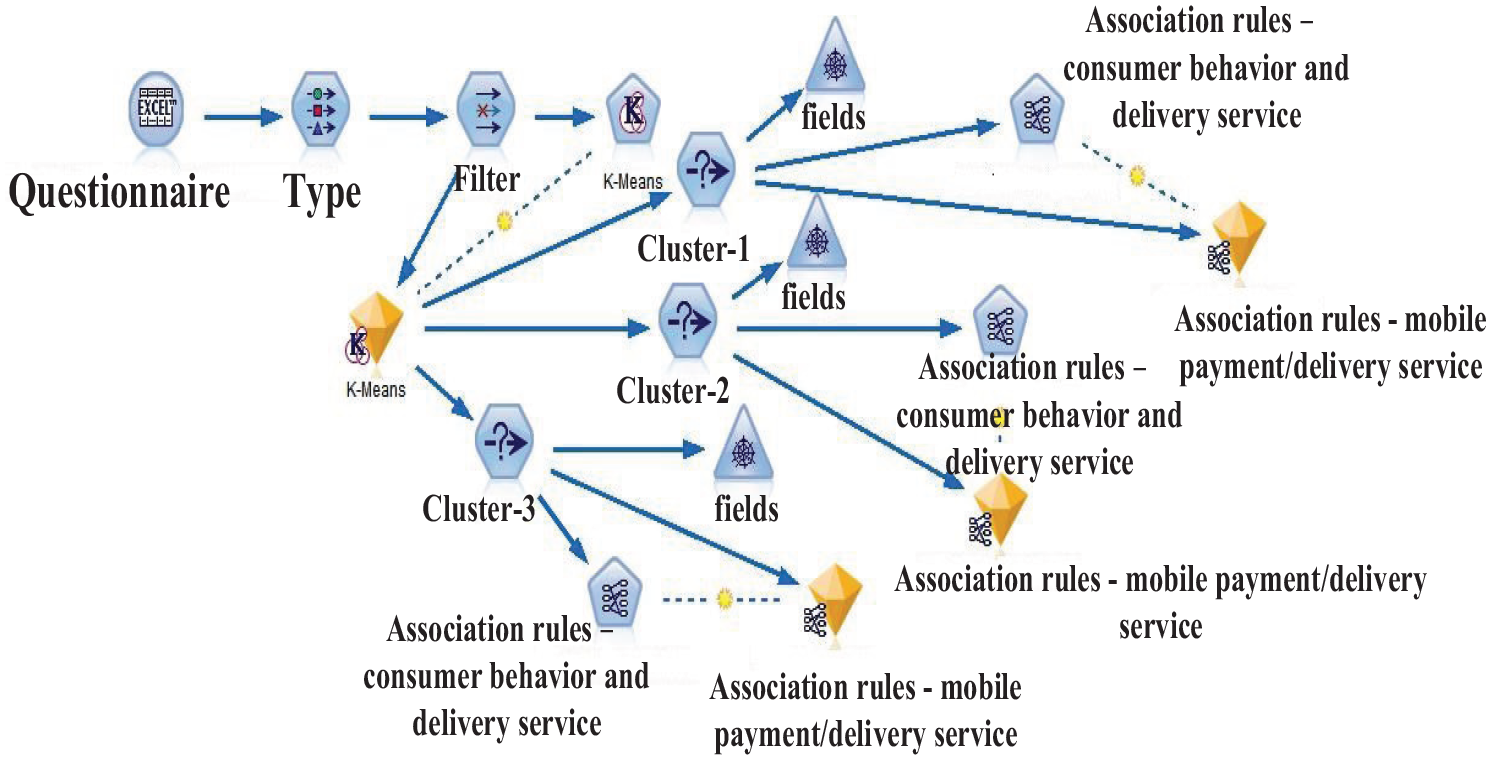
Data mining analytics tool—SPSS Modeler.
Data Mining Analytics Results
Clustering Analysis
For
K-Means Clustering Results.

Cluster-1: Women’s Workforce Group
This cluster includes 711 female respondents, mainly aged between 26 and 36 years old. They are mostly employed full-time, with an average monthly income of 10,000,000 VND–20,000,000 VND. The found mobile payment transaction information by word-of-mouth recommendations from relatives and friends, and mainly use mobile payment to pay utility bills, such as electricity, water, internet, and TV.
Cluster-2: Men’s Workforce Group
This cluster includes 541 male respondents’ men 26–36 years old including. They are mostly employed full-time, with an average monthly income of 10,000,000 VND–20,000,000 VND. Unlike the women’s workforce, the male workforce found mobile transaction information from previous experience and use mobile payments mainly to transfer money.
Cluster-3: Student Group
This cluster group includes 772 respondents, mainly female students aged 25 and under, with an average monthly income under 5,000,000 VND. The way found mobile payment transaction information by word-of-mouth recommendation from relatives and friends. Mobile top-ups is their main purpose for using mobile payments.
Association Rules
Pattern 1: Associations of Consumer Behavior and Delivery Service Preferences
To use
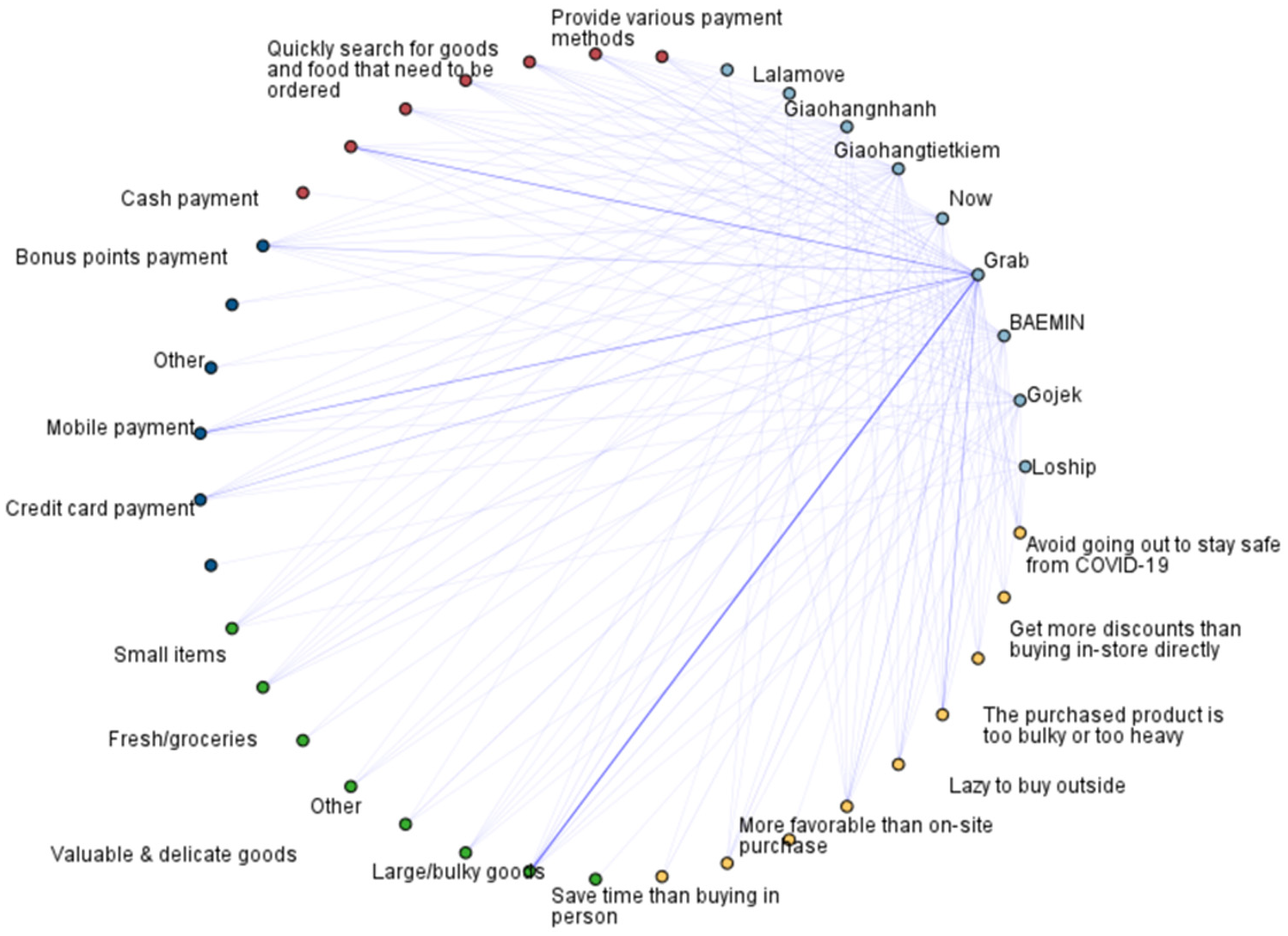
Cluster-1. Associations of consumer behavior and delivery service.
Cluster-1. Associations of Consumer Behavior and Delivery Service.

Regarding Cluster-2 the minimum antecedent support and minimum rule confidence used are 2% and 33%, respectively. The lift values in this group are all greater than 2 as shown in Table 3. Both support and confidence must be used to determine if a rule is valid. In Rule 1 respondents use Giaohangnhanh, primarily because they do not want to line up during peak dining hours for buying fresh food and groceries. In Rule 2 they choose Giaohangtietkiem for large or bulky goods because the purchased product is too bulky or heavy and provide various payment methods. In Rule 3 they use Lalamove for delivering small items because they receive more free shipping or discounts. In Rule 4, Grab they chose the tech-based transport firm for buying fresh food and groceries by credit card payment since they get more free shipping or discounts. In Rule 5, they use Now Delivery service because they lack shopping time, they can keep track of delivery progress for food and drinks.
Cluster-2. Associations of Consumer Behavior and Delivery Service.

The motivation for Cluster-3 customers to use a type of delivery service is determined by monitoring the consumer’s shopping habits and their behaviors (Table 4). In Rule 1 Cluster-3 consumers prefer to purchase food and drinks using Giaohangtietkiem and pay by mobile payment. The reason for using a delivery service is that they are feel too lazy to buy outside in Rule 1 Rule 2, and Rule 3. In addition, their satisfaction with food delivery service depends of various payment methods. In Rule 2 they prefer to use Baemin as a delivery platform to purchase valuable and delicate goods using credit cards. In Rule 3 they choose Gojek to quickly search for food or goods that need to be ordered, and to to purchase food and drinks by using mobile payment. In Rule 4, they use Now Delivery as a tech-based transport firm during the pandemic to avoid going out and stay safe from COVID-19, and they prefer to use mobile payment for purchasing fresh groceries. They are satisfied with food delivery service in Rule 2 Rule 4, and Rule 5 due to food and commodity diversity. Customers in Rule 5 prefer to choose Grab to purchase fresh and groceries due to bad weather and they use cash payment.
Cluster-3. Associations of Consumer Behavior and Delivery Service.

Pattern 2: Associations of Consumer Behavior and Mobile Payment and Delivery Service Preferences
Concerning consumer behavior related to choosing the type of service for mobile payment when shopping offline, the minimum support and minimum confidence were individually adjusted to 2.2% and 30%, respectively, generating five association rules. Both support and confidence must be used to determine if a rule is valid, and the lift value of every association rule is more than 1.9, as shown in Figure 4 and Table 5.

Cluster-1. Associations of consumer behavior of mobile payment and delivery service.
Cluster-l. Associations of Consumer Behavior of Mobile Payment and Delivery Service.

For Cluster-1 in Rule 1 customers prefer to use mobile payment to purchase food and drinks when shopping offline, and books, music, or stationery when shopping online. Discount prices are the main reason to use mobile payment in both physical stores and ecommerce. Consumers in Rule-1 Rule 2 and Rule-3 chose Shopee as the ecommerce online shopping platform. In Rule-2 consumers prefer to purchase financial services because of quick check-out without waiting for offline shopping, food and drinks to get give away for online shopping. In Rule 3 due to integration of payment methods, consumers tend to purchase cosmetics and personal care products via offline shopping, but apparel and footwear via online shopping. In Rule-4, consumers prefer to retail purchasing in physical stores, but books, music, and stationary in ecommerce stores via Tiki online shopping platform. Consumers in Rule-5 choose Lazada as the ecommerce online shopping platform to purchase cosmetics and personal care products to obtain bonus points, but to purchase apparel and footwear off line because of price discounts or gifts.
In Cluster-2 (Table 6), the main reason to use mobile payment in physical stores due to quick check-out, and consumers in Rule 1 prefer to purchase apparel and footwear in physical stores, but daily necessaries in online stores via Tiki to get bonus points. Thegioididong is an online shopping platform where consumers prefer to purchase 3C electronic products because of price discounts, but still purchase food and drinks in physical stores. In Rule 3 due to interaction of payment methods, consumers prefer to purchase financial services; and to get free shipping they prefer to purchase food and drinks via Shopee. Consumers in Rule 4 also choose Shopee as an online shopping platform to purchase daily necessaries to obtain gifts; and prefer to purchase food and drinks in physical stores. In Rule 5, due to credit card issuing bank and merchant points, they prefer to purchase retail and purchase via Lazada for apparel and footwear to get a discount price.
Cluster-2. Associations of Consumer Behavior of Mobile Payment and Delivery Service.

For Cluster-3 (Table 7), students are the main consumers in Rule 1 and they prefer to purchase 3C electronic products in physical stores because of quick checkout and use ecommerce online shopping via Shopee to get price discounts. In Rule 2 due to price discounts they prefer to purchase apparel, footwear via offline shopping, but books, music and stationary via Lazada for online shopping. In Rule 3 they prefer to make retail purchases in physical stores because of quick checkout and purchase daily necessaries through Tiki because of free shipping. In Rule 4 and Rule 5, most consumers use the transportation service due to its guaranteed after-sales service. Consumers in Rule 4 prefer to purchase food and drinks via Shopee for price discounts, and consumers in Rule 5 prefer to purchase daily necessaries through Tiki to get bonus points.
Cluster-3. Associations of Consumer Behavior of Mobile Payment and Delivery Service.

Practical Implications and Discussions
Delivery Service Business Model
According to a recent Statista (2023) survey on increasing online shopping purchases during the months of social distancing in Vietnam, about 59.4% of respondents explained that they made more online purchases because they were practicing social distancing and wanted to reduce their time outside, and more than 58.4% of respondents claimed that they liked to purchase via online shopping. With many reasons given from consumers on delivery service, there is a very large amount of data processing. The major reason for using delivery services in Vietnam for all three clusters is being lazy to buy outside. Using advanced technology to improve lives and eliminate busy work today and replace every single day to do other tasks. Some consumers are now often ordering their meals due to the limited free time during office hours. Though some individuals still choose to make shop directly in stores, delivered groceries may become the norm (Choe et al., 2021). The results suggest that Cluster-1 Women’s workforce usually uses a delivery service rather than buying in-store because they like to avoid going out to stay safe from COVID-19, to save time, and to get more discounts. Cluster-2 Men’s workforce use online services because they prefer not to line up during peak dining hours, the purchased items are too bulky or heavy, and because of insufficient shopping time. Due to bad weather, Cluster-3 Students prefer to use a delivery service so they do not need to go out frequently and can stay safe from Covid-19. Thus, reluctance to go outside due to reasons such as laziness, bad weather or saving time are the main reasons to use the delivery service.
In Figure 5, which delivery services customers usually use mobile payment when shopping online during the pandemic explains services for delivery that customers often use in the wake of the Covid-19 pandemic? On-demand delivery services are convenient and extremely fast. They can deliver items in a few hours to fulfill the growing customer demand for quick service. These services are used for items such as food products or groceries, and be used for transportation. Consumers can select what they want to be delivered to their location using a mobile device and possibly also making payment by the mobile, and the items will be delivered within a short time. The results suggests that Cluster-1 Women’s workforce usually prefers to purchase small items and transportation; Cluster-2 Men’s workforce prefers to purchase small items, fresh food and groceries, as well as large and bulky goods; while Cluster-3 Students prefers to purchase fresh food and groceries, along with valuable and delicate goods. All three clusters choose food and drinks for delivery service using mobile payment.
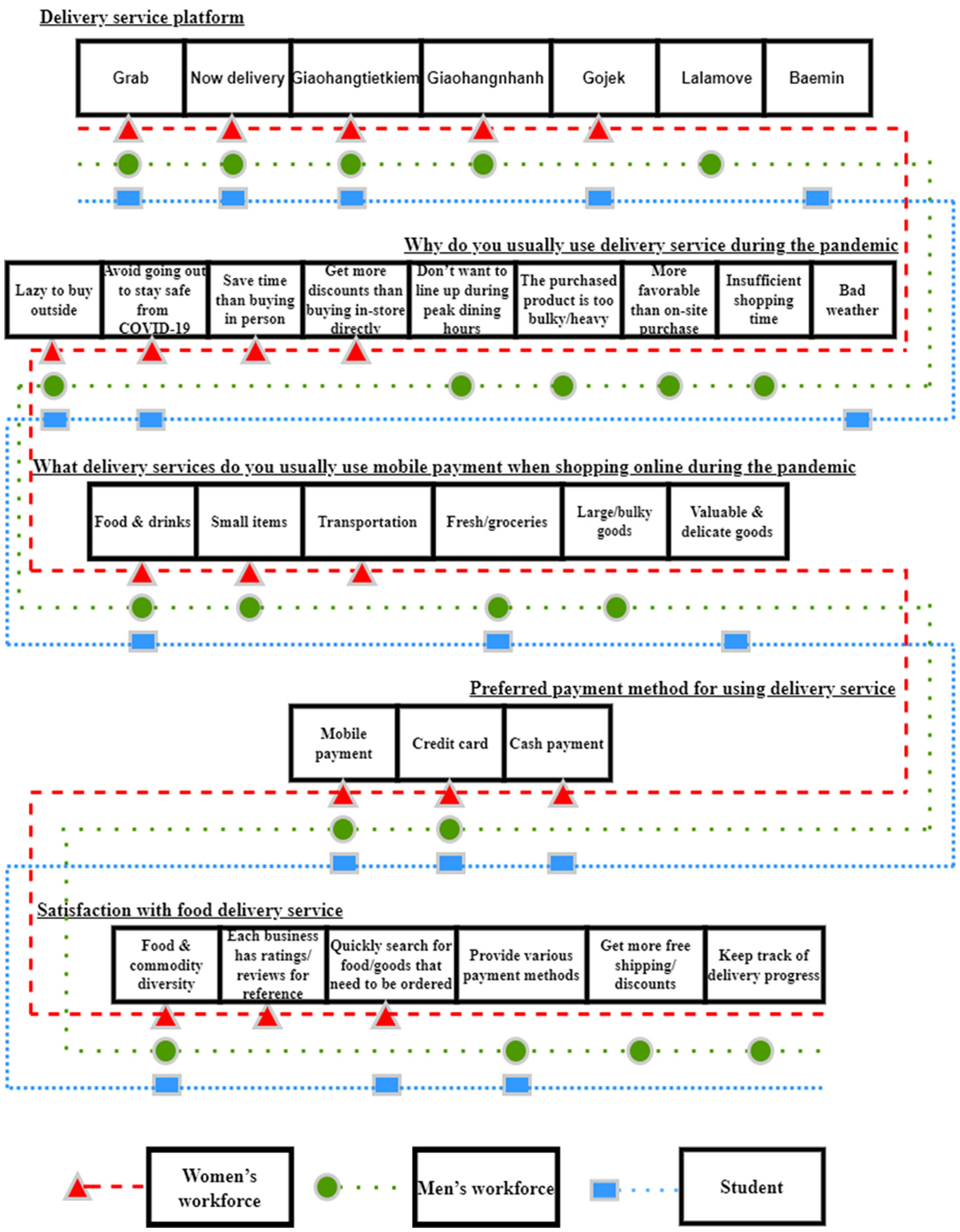
Association map of delivery service business model.
Consumers increasingly expect convenience, speed, and secure delivery services for their purchases. These preferences accelerate the shift to an e-commerce ecosystem, and the main changes in Vietnamese consumer shopping habits were furthered by the Covid-19 pandemic, when there was a sudden explosion in demand. This sudden growth of omni-channel has brought sharp focus to the capabilities of delivery services. According to Tyrväinen and Karjaluoto (2022), major changes in consumer shopping habits were brought on by the pandemic: “People have been forced to live differently, and as a result they are also shopping differently and spending their time differently.” Going into lockdown under Government Directive 16 in Vietnam substantially increased the need for online shopping, giving rise to changes in behavior that could have taken years. By now, Vietnamese people have become familiar with purchasing groceries online, and consumers have adapted to purchasing more personal essentials online. Consumer behavior has completely changed during the COVID-19 outbreak, consumers are now searching many other options for online shopping such self-care, health or clothing and other fashion items.
Mobile Payment and Delivery Service Business Model
Using
Figure 6 shows that online marketing has a set of powerful tools and methodologies to promote businesses’ products and services, though. Of course, any service needs to must be tailored adjusted to meet the business needs of the customers at a price they can afford. Comparing prices and discounts were the main reasons for doing online research while out shopping, which followed by looking up product information and checking electronic word-of-mouth. Our results suggest that all three cluster groups were attracted by real shots photographs of online goods and could easily compare price and discount on those platforms. Cluster-1 Women’s workforce, and Cluster-3 Students, prefer payment offers and giving back rebates to consumers. Meanwhile, Cluster-2 Men’s workforce, prefer electronic word-of-mouth. Overall, prices and promotions such as free shipping, discounts or buy-one-get-one etc. are the factors most likely to influence consumers’ decision regarding which products or services to buy online. The preferential methods for delivery platform using mobile payment that all three clusters prefer free shipping and possibly give a discount code for next purchase. Cluster-1 Women’s workforce prefer buy-one-get-one, and getting discounts on specific items, Cluster-2 Men’s workforce prefer discounts, and consumption can participate in the lucky draw lotteries. Cluster-3 Students prefer buy-one-get-one and free goods in full.
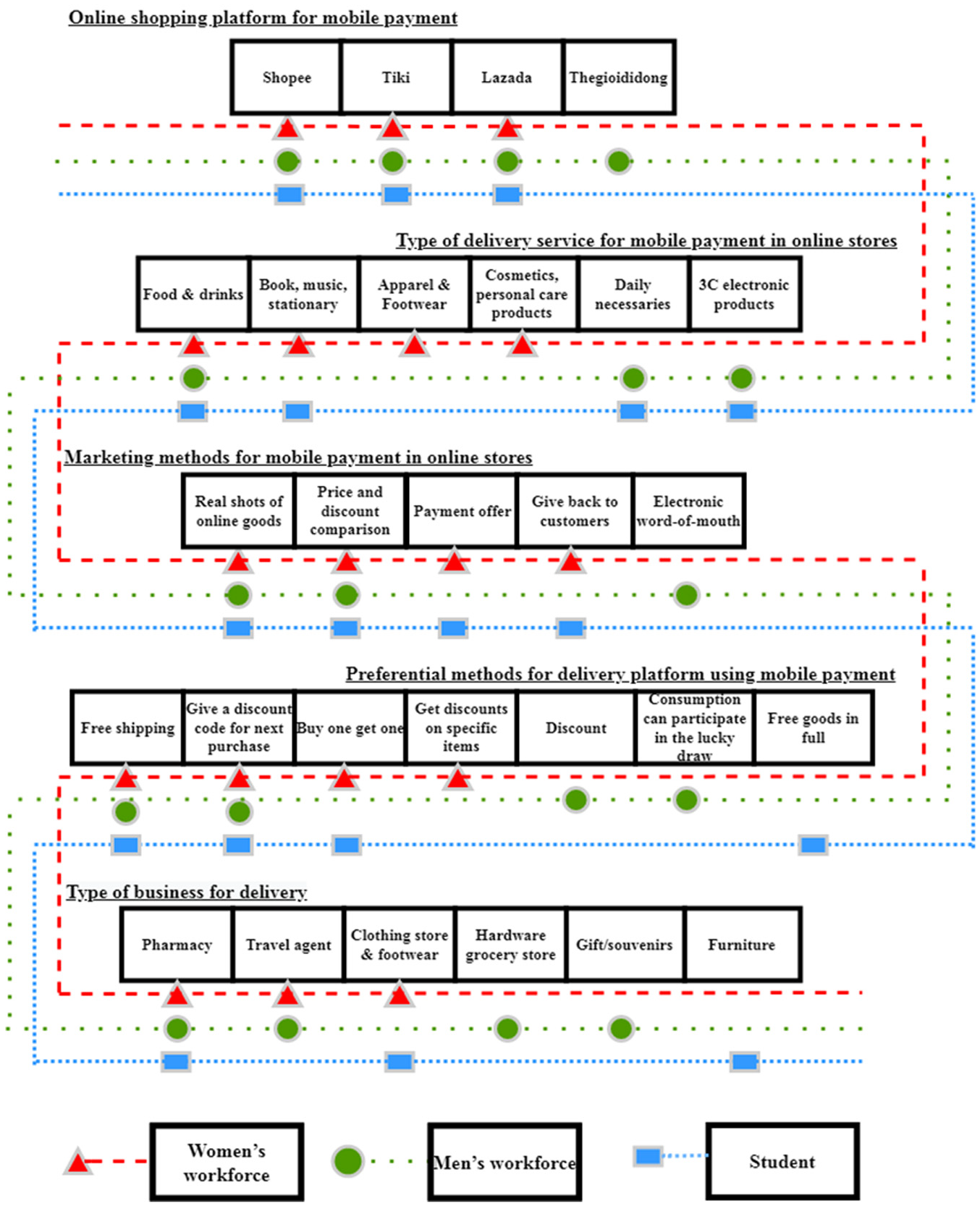
Association map of mobile payment and delivery service business model.
This online shopping overview shows changes in the types of services offered online during the pandemic. Our results find willingness to buy new products and service categories online, especially items traditionally sold in physical stores. For example, greater options for delivery service and using mobile payment made it easier and more convenient to buy bulkier or heavier products online such as hardware, groceries and furniture. However, easier-to-ship products such as clothing, footwear, gift or souvenirs still remain the most popular categories online. All three cluster groups expect that they can purchase online and make payment through mobile payment for pharmacies in the future. Cluster-1 Women’s workforce expects to use travel agents, along with purchasing clothing and footwear. Cluster-2 Men’s workforce expects to use travel agents, and purchase hardware, groceries, gifts and souvenirs. Cluster-3 Students expect to purchase furniture, clothing, and footwear on delivery platforms using mobile payment. In general, major growth categories online tend to be those that do not need a trial or those in which consumers have more trust in the quality of the products and services.
In summary, for
Conclusion, Limitation, and Future Works
With Vietnamese government promotion, mobile payments have popularized the willingness of consumers to use electronic payment, as a pushing force. On the other hand, with the market draw, delivery services provides increased consumer choice for product delivery and assists the development of a contactless economy, as a pulling force. Although Vietnam is a developing country, with government support and the efforts of enterprises, new payment technologies and service business models have created new business opportunities in the difficult time of this pandemic. Thus, this empirical study aims to investigate Vietnam consumer behaviors with mobile payment and delivery services in retailing in this period. It finds several knowledge clusters, patterns and rules for investigating how mobile payment and delivery services can serve retail customers in business models for Vietnam. However, due to limited study sampling source, the suburban and economically underdeveloped areas were not included in the scope of this study. Furthermore, due to the limitations of data mining analytics methods, a complete understanding of this data cannot be reached. Future studies could investigate mobile payment and delivery services as a global trend, market and business development. Further research in different economies and areas is warranted to enhance innovation in technology, society and business markets.
Supplemental Material
sj-docx-1-sgo-10.1177_21582440251367114 – Supplemental material for Mobile Payment and Delivery Services in Vietnam During the Covid-19 Pandemic: A Data Mining Analytics Investigation
Supplemental material, sj-docx-1-sgo-10.1177_21582440251367114 for Mobile Payment and Delivery Services in Vietnam During the Covid-19 Pandemic: A Data Mining Analytics Investigation by Shu-Hsien Liao, Retno Widowati and Pham Nguyen My Hanh in SAGE Open
Footnotes

Funding
The author(s) disclosed receipt of the following financial support for the research, authorship, and/or publication of this article: This research was funded by the National Science and Technology Council, Taiwan, Republic of China [MOST 113-2410-H-032-051-MY2].
Declaration of Conflicting Interests
The author(s) declared no potential conflicts of interest with respect to the research, authorship, and/or publication of this article.
Data Availability Statement
The authors do not have permission to share data.
Supplemental Material
Supplemental material for this article is available online.
References
Supplementary Material
Please find the following supplemental material available below.
For Open Access articles published under a Creative Commons License, all supplemental material carries the same license as the article it is associated with.
For non-Open Access articles published, all supplemental material carries a non-exclusive license, and permission requests for re-use of supplemental material or any part of supplemental material shall be sent directly to the copyright owner as specified in the copyright notice associated with the article.
