




Abstract
The advantages of an O2O instant delivery service over the traditional retail model for grocery retailers in the local market lie in the ability to increase sales by expanding consumer channels. This study aims to explore how merchants can optimize their pricing and delivery service decisions, including order delivery fees, range, and starting price, to maximize profit with the adoption of instant delivery services. Using the Stackelberg game model, the research examines the retailers’ optimal decision-making within the classical Hotelling linear city model while considering a more realistic cost differentiation between online and offline services. The analysis incorporates variations in the number of consumer purchases and geographic locations. The study finds that increasing product prices while maintaining zero delivery fees consistently outperforms charging delivery fees while keeping prices constant in terms of their impact on retailers. Additionally, rarely-discussed aspects like starting delivery price and delivery range are also considered. Comparing parameter variations between the traditional retail model and the O2O instant delivery model leads to three primary conclusions. Firstly, the cost disparity between online and offline services significantly affects the optimal price and profit for the retailer. Secondly, when the cost of online service is slightly higher, setting a starting delivery price can enhance retailers’ profits compared to not having a starting price. Finally, the study outlines three strategies for implementing the O2O instant delivery model and suggests that defining a reasonable delivery range can help merchants reduce costs, improve delivery efficiency, and ultimately increase profits.
Plain Language Summary
Purpose- This paper discusses how traditional retailers can increase profitability through O2O just-in-time delivery services, and proposes effective measures that retailers can take when faced with the problems of price, delivery fees, starting prices, and delivery range settings. Design/methodology/approach- The article focuses on consumers and retailers, and we set up a retailer-driven Stackelberg game to analyze the strategies that retailers should choose to achieve dominance. Findings-First, the optimal price and profit of the retailer are influenced by the cost disparity between online and offline services; second, when the cost of online service is slightly higher—perhaps due to increasing platform commissions—establishing a starting delivery price can enhance retailers’ profits compared to a scenario where no starting price is set; finally, the study delineates the selection criteria for three strategies when implementing the O2O instant delivery model, suggesting that defining a reasonable delivery range can help merchants reduce costs, enhance delivery efficiency, and ultimately, yield higher profits. Practical implications –First, it makes sense to avoid losses as traditional grocery retailers consider how to offer online ordering and instant offline delivery services to time-sensitive consumers. Merchants should take into account the difference between online and offline service costs. Secondly, the delivery fee is a key factor that affects both the consumer’s willingness to buy and the merchant’s profit, so the merchant should consider it carefully. Finally, consumers choose O2O instant delivery on the premise of higher efficiency and quality, so we set delivery to consumers within a certain range, which can not only improve the delivery quality but also reduce the delivery cost. limitations – First, the article does not discuss the retailer’s competition. Second, the research scrutinizes the retailers’ optimal decision-making within the classical Hotelling linear city model.
Keywords
Introduction
Online shopping has dramatically changed due to the COVID-19 pandemic since consumers increasingly embrace on-demand consumption and switch to instant delivery services. Nowadays, more consumers turn to mobile phones to order groceries from O2O platforms such as Instacart, Uber Eats, DoorDash, or GoPuff. And more offline grocery retailers, such as Wegmans, Walmart, and many small and medium-sized (S.M.) vendors, partner with these O2O platforms to join the instant retailing. When consumers place orders on an O2O platform, offline grocery retailers accomplish instant delivery through three-party or platform-owned logistics, and the delivery time is typically 30 to 60 minutes.
According to market research analyst IBISWorld (Akman, 2023), U.S. online grocery sales will reach $36.3 billion in 2023. In an environment replete with promising market prospects, an increasing number of retailers elect to participate in this sector. Paradoxically, despite the proliferation of businesses engaging in instant retail and the rapid growth of the market, numerous businesses fail to turn a profit. What could account for this phenomenon? It can be attributed to the decision-making process that retailers must undertake when opting for instant delivery services—a process that necessitates affiliating with a third-party platform and discerning the appropriate course of action in terms of pricing, delivery charges, starting price, and delivery range. The often suboptimal performance of businesses within instant retail is driven by these factors, underscoring the imperative of researching business decision-making in this context. P. Zhang et al. (2022) research finds that retailers may not always benefit from online delivery services. Retailers only benefit when the incremental demand generated by online services is high, which provides a foundational basis for our research on how to improve grocery retailers’ profits in an O2O even delivery model.
In the event that grocers opt to participate in instant delivery services—a likely course of action given that typical grocers do not possess their own platforms—these retailers generally align themselves with third-party O2O platforms. This arrangement enables consumers to select between in-person purchases or online orders paired with instant delivery services, as per their personal preferences and circumstances. The motivation for retailers to engage in instant delivery lies in the potential to circumvent the significant costs incurred through traditional brick-and-mortar operations, such as rental expenses, wages for service personnel, and warehousing costs. This potential for cost reduction results in a stark discrepancy between the costs of online and offline services, encouraging many businesses to consider joining the fray. However, in reality, when formulating an instant delivery strategy, retailers should ground their research in objective facts. Firstly, the impact of delivery costs (
Under the O2O instant distribution mode, although retailers provide new retail services to meet customer needs, problems related to this retail mode also emerge. First of all, compared with the traditional retail model, what pricing plan should we choose under the O2O instant delivery model? Secondly, how much delivery fee should consumers charge when choosing O2O instant delivery service? Because delivery fees can directly affect consumers’ choices of offline and online channels, as well as purchase decisions. To put it succinctly, when the delivery fee is high, most consumers will choose to shop offline instead of ordering online, especially for groceries. According to a report from the UPS research organization “UPS Pulse of the Online Shopper” states that, the cost of delivery is one of the important reasons why Americans do not buy groceries online. Third, while the waiting cost for consumers under the O2O instant delivery model has been greatly reduced, the online service costs that retailers need to bear are increasing (commission fees charged by the platform, service fees paid to couriers, etc.), so it should be How much starting fee should be set in this mode to allow retailers to guarantee profit margins? Finally, on the basis of taking into account both cost and efficiency, how to set the scope of timely delivery?
To address these issues, we first consider retailer sales under the traditional model. Then, we established a linear model of the O2O instant delivery model, which takes into account the impact of pricing on consumers, the relationship between delivery fees and customers, and the changes caused by changes in commission fees and courier service fees. The impact of the difference in offline and online service costs on sales. Then we continued to study and discussed the threshold for retailers to make profits by setting a minimum delivery price in order to keep the delivery fee at a very low level. We explore the impact of the parameter on increasing the distribution range on the retailer’s profit, so that the retailer can guarantee the optimal strategy under certain circumstances. The main contributions of this paper are as follows:
(1) Unlike most of the existing articles on O2O instant delivery, most of the existing research focuses on distribution efficiency and delivery path, and the article is more inclined to discuss the situation of retailers.
(2) Existing literature studies online sales of general goods, some of which only consider offline service costs, and some consider both online and offline service costs but assume that the two costs are the same. Our article considers the difference in online and offline service costs. Under different circumstances, offline service costs may be greater than online, or online may be greater than offline. These differences will have an impact on the choice of strategies and also Will be ignored or considered irrelevant in general product online sales.
(3) In contrast to the current literature on just-in-time delivery, existing studies focus on the delivery process and rider scheduling. And we focus on how to set the starting price and delivery range online.
The organization of the remainder of this paper is as follows. We revisit the literature in Section 2, and in Section 3, we delineate the traditional retail model and the O2O instant delivery model. The Section 4 delves into pricing decisions within the traditional model, while the fifth scrutinize decisions regarding pricing, delivery fees, minimum order amounts, and delivery range under the O2O instant delivery model. The Section 6 conducts a numerical analysis. The Section 7 presents a discussion and summarization of our research conclusions and further furnishes managerial implications derived from our research findings.
Literature Review
Our research is related to four streams of literature, including the O2O instant delivery service, service cost difference, order delivery fee, and the delivery range and the starting price.
Studies in the first stream set out to explore the development of the O2O instant delivery service. Through the investigation of urban freight, Soerss et al. (2016) and Dablanc et al. (2017) found that instant delivery is developing rapidly in European and American countries, and young consumers are more inclined to choose timely delivery. In the context of the emergence of emerging technologies that have led to a surge in orders on the Online to Offline (O2O) platform, J. Chen et al. (2022) and Wang et al. (2020) proposed a hybrid algorithm to enable the platform to respond to instant delivery at the city level. Cui et al. (2022) and Y. Zhang et al. (2020) respectively established models for optimizing customer satisfaction under the timely delivery service. Research in this stream also investigates instant delivery as an advantage in reducing overall costs and increasing shipping efficiency. Shi et al. (2019) research uses the joint distribution model of B2C and O2O to reduce the total cost and improve distribution efficiency in the field of instant distribution. The emergence of platforms such as Meituan and Uber Eats has completely changed the way consumers find and order restaurants. G. Xue et al. (2021) can reduce the number of riders and delivery time by optimizing rider resources. They also pointed out that the urgency of timely delivery order time is related to the number of riders, and the tight time window is positively related to the number of riders, but at this time, each rider gets orders decreased. Belavina et al. (2017) calculated the most profitable scenario for the retailer by comparing two revenue models for online grocery retailing, and this article is similar to ours in that it also utilizes a game model for analysis. In addition to reflecting on the characteristics of instant delivery, this paper also focuses on the optimal strategy of when retailers choose to provide O2O instant delivery. The above studies have explored the optimization of customer satisfaction through just-in-time delivery services, and these studies have also highlighted the potential benefits of just-in-time delivery in terms of cost reduction and transportation efficiency. However, no attention has been paid to the important decision-making issue of how grocery retailers adopt O2O instant delivery services, nor to the impact of delivery fees on consumers and how to adopt strategies to maximize grocery retailers’ profits. This paper will focus on these aspects to fill the research gap.
The second stream of literature focuses on Service cost. Z. He et al. (2016), Chai et al. (2020), and Long and Shi (2017) all study the impact of offline service cost on product pricing. X. Xue et al. (2021) mentioned the influence of service cost on profit in the catering industry in their research. Kong et al. (2017) used the return rate as the service cost as a parameter to extend the model. Zhou et al. (2018) studied the impact on service cost when differentiated pricing and non-differentiated pricing strategies are chosen differently. The above studies are all about the cost of offline services. B. He et al. (2021) researched the retailer platform to choose the optimal strategy under the background of the epidemic to reduce the cost of online services. Niu et al. (2019) research pointed out that the high cost of online services will lead to higher purchase costs for consumers. Some studies take into account both online and offline service costs. Wu et al. (2021) pointed out that when the cost of online and offline operations is high at the same time, the promotion of low-carbon operations is effective. Guo et al. (2022) discuss the online and offline costs and set the online cost to
The third stream of literature focuses on order delivery fee. Chang (2021) considers the impact of the delivery fee on the B&M retailer profit. Du et al. (2022) conducted a study on two delivery modes and found that higher delivery costs would lead to higher product prices. In the context of the redevelopment of the epidemic, B. He et al. (2021) research has concluded that with the reduction of order delivery fees, the self-built model will bring higher profits than the platform model, and the self-built delivery cost will be lower. Li et al. (2020) studied pricing strategies for delivery services. Du, Fun & Chen (2023) study the impact of unit takeaway delivery costs and takeaway service levels on offline demand. Tong et al. (2020) evaluated the impact of factors such as weather, distance, and festivals on delivery fees. The above studies have explored the research on delivery charges on retailers’ profits and product pricing. However, there is a research gap in studying the impact of delivery charges on the demand for O2O instant delivery services, which this paper aims to address.
The last stream of literature focuses on the delivery range and the starting price. Regarding the scope of delivery, Patier et al. (2014) research can increase the scope of delivery by booking in advance. Xuping et al. (2019) researched the impact of the distribution range of O2O fresh food experience stores on costs and benefits. Both Li et al. (2022) and Du et al. (2022) studied the delivery range through the model. Du, Fun & Sun (2023) examines the phenomenon of delivery delays in the takeout industry, where some firms offer delay compensation policies to consumers, which is closely related to the delivery range, which is an important factor affecting delivery quality. Due to the limited delivery range of the instant delivery system, customers are usually recommended to dine nearby or pay a higher delivery fee for long-distance delivery. The order allocation strategy proposed by Li et al. (2022) can effectively expand the delivery range of the courier, stimulate more potential orders, and ensure the timeliness of meal delivery. Regarding the starting price. Our instant O2O delivery decision model for grocery retailers builds directly on a large body of literature that studies retailer location and pricing models. Unlike our setup, most pricing decision models focus either on pricing decisions or on site selection. There is less literature analyzing starting prices. Li et al. (2020) researched the O2O platform of crowdsourcing vehicles and found that high-tier cities should prefer high starting prices, while low-tier cities are the opposite.
In summary, although there have been extensive studies on instant delivery in the literature, there is still limited research on the B&M retailer instant delivery service strategies considering the starting price and delivery range under the O2O model, and most of them are based on algorithm models. Moreover, we also consider offline and online service cost differences and demonstrate that the magnitude of service cost differences can affect retailers’ delivery services.
Model Description
Traditional Retail Model
Assume that only monopoly retailer A is located at the origin of the unit line segment in the market and sells a product at retail price
Assume that the consumer can obtain utility
The Online-to-Offline Instant Delivery Model
On the basis of following the parameter settings in the previous section, the retailer the unit distribution cost is denoted as
In addition to the traditional way of purchasing goods from retailers on their own by
Notations.

Retail Price Decisions Under the Traditional Retail Model
In this section, considering the homogeneity of consumers’ preferences for retailers, we discuss the retail price pricing problem of monopoly retailers in the traditional retail model.
In order to ensure that retailers can achieve profitability under the traditional model, we assume that

Obviously, the optimal purchase quantity of consumers is

In the traditional model, the retailer’s profit function is as follows:

Only when the expected utility is non-negative, that is,
Retailer’s Decisions Under the Online-to-Offline Instant Delivery Model
As can be seen from the previous section, in the traditional retail mode, some customers who are far away from retailer A will not buy any products. In order to attract customers who are far away from A to purchase goods, the monopoly retailer in this section considers providing customers with services such as home delivery and home service based on an O2O platform. When the unit delivery cost is too high, retailers are unwilling to bear the higher delivery cost and will not choose to provide the online-to-offline instant delivery service. Therefore, the paper further assumes that g satisfies
As shown in Figure 1, under the online-to-offline instant delivery model, the delivery fee charged by retailers to consumers within a certain delivery range does not fluctuate significantly with respect to distance, so this section considers the retailer’s delivery fee as a fixed value
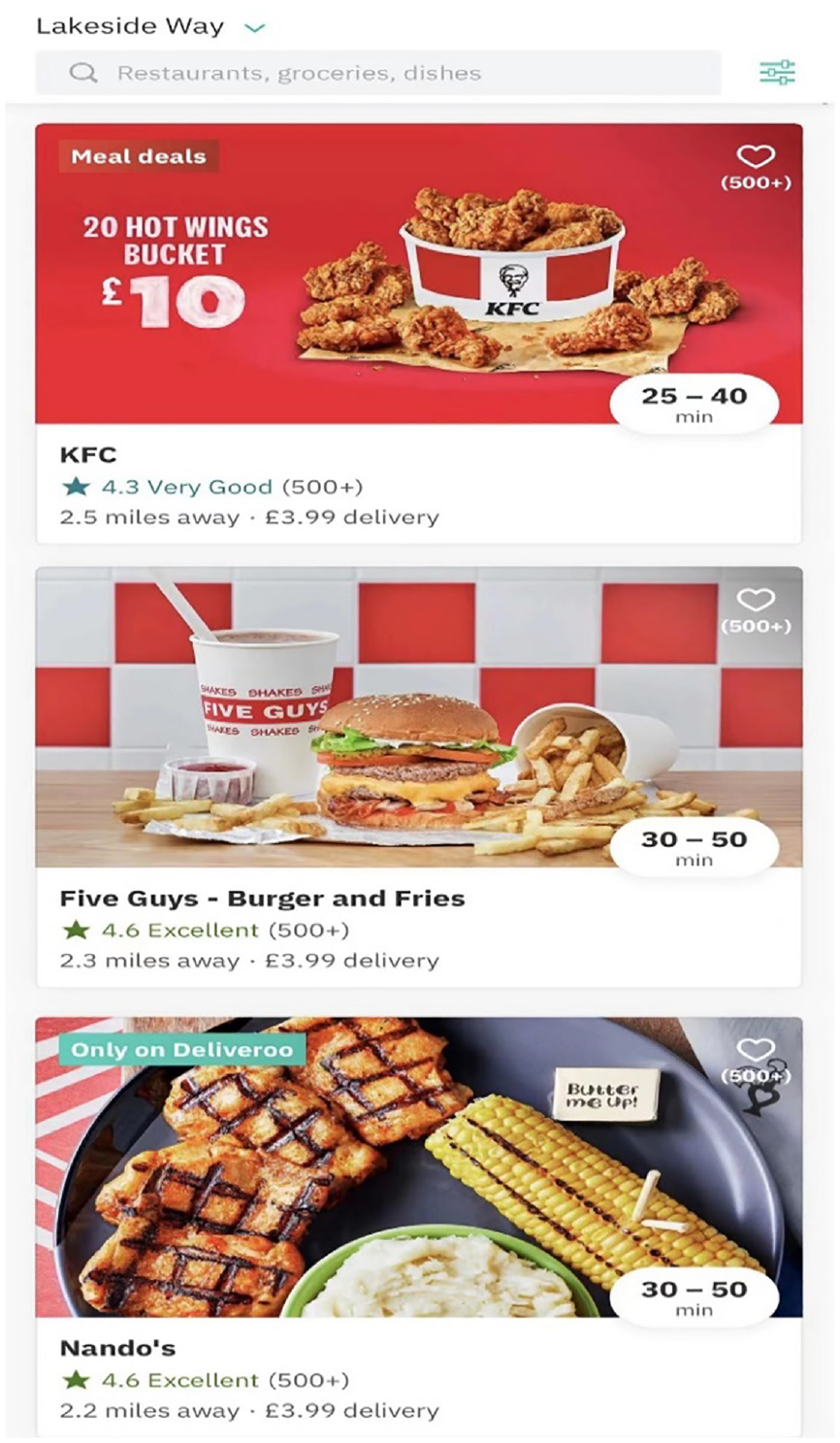
Deliveroo UI screenshot.
The expected utility


In order to ensure that the waiting cost of consumers in timely delivery is low enough, it should satisfy
When a certainly expected utility
When the consumer location distance
Joint Decision-Making of Retail Commodity Price and Order Delivery Cost in the O2O Instant Delivery Model
In the online-to-offline instant delivery mode, according to the analysis of consumer position in Section 5, when

The first part of the formula (6) is the income of the traditional retail model, and the second part is the income of the online-to-offline instant delivery model. In this section, we discuss how to achieve better profits than the traditional retail model by setting the retail price of the product and the delivery fee of the order. The optimal retail price and optimal distribution fee can be determined by solving the joint optimization problem

According to

Price comparison of retailers under traditional retail mode and the O2O instant delivery mode.
Delivery Fees Decision in the O2O Instant Delivery Model
In the O2O instant delivery mode, the retailer can also only consider setting the optimal delivery cost on the basis of the optimal retail price
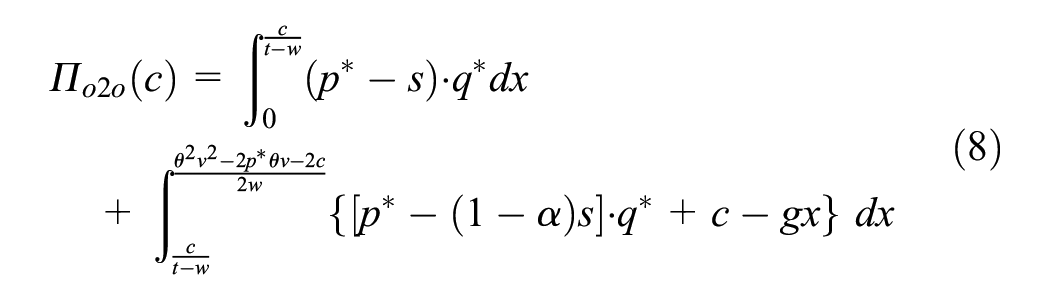
The optimal delivery fee can be determined by solving the optimization problem
(1) In the O2O model, retailers have two pricing strategies to choose from, pricing strategy(a): Increase the retail price and free delivery strategy, that is, increase the retail price of the product to
(2) Pricing strategy (a) is consistently more profitable for retailers than pricing strategy (b), this is,
In this section, we discuss the pricing problem of monopoly retailers in O2O mode, considering the homogeneity of consumers’ preference degree to retailers. We propose that retailers can choose to raise the retail price, free distribution fee strategy or retail price unchanged, charging distribution strategy, and find that when the difference between online and offline service costs is small, the strategy of increasing the retail price and free distribution is the optimal strategy of retailers.
It is worth noting that the above discussion is carried out when the unit distribution cost meets
Starting Price Decision in the O2O Instant Delivery Model
While the waiting cost for consumers in O2O at home has been greatly reduced, the online service cost that retailers need to bear is increasing. This section studies how retailers can increase profits by setting the starting price. As shown in Figure 3, merchants provide delivery services to consumers only when the consumption amount of a single order reaches a certain price threshold, and this price threshold is called the minimum delivery price. Setting the starting price is the main means for O2O retailers to offset the cost of delivery services and ensure profit margins. At the same time, Figure 3 also shows that by investigating the price settings of retailers on the O2O instant delivery platforms, it is found that if a minimum delivery price is set, the delivery fee charged by the retailer to consumers is very low or even free. Zero delivery fee can greatly improve consumers’ experience in the O2O instant delivery model, and combined with our conclusion in Section 5.2 that zero delivery fee is the retailer’s optimal order delivery price decision, this section will no longer Consider the influencing factor of the delivery fee, the main focus is on the retailer’s starting price in the O2O instant delivery model.

O2O instant delivery consumer user mobile screenshot.
The rapid development of the O2O instant delivery model in the local life service industry is inseparable from its unique market environment. The first is the localization of buyers and sellers, which can ensure the high efficiency of delivery services. High delivery efficiency makes consumers feel better in the O2O timely delivery mode, and the impact of waiting costs, which is proportional to the distance between consumers and merchants considered at the beginning of Section 5, gradually weakens on consumers’ purchasing behavior. The second is that the types of traded commodities are becoming more and more extensive, including almost all the necessities of life, which makes consumers less sensitive to the retail price of commodities. With the acceleration of the pace of urban life, in addition to transportation costs, the mental and time costs for consumers to go to retailers to buy goods are getting higher and higher. If O2O instant delivery services only charge lower delivery fees or even free delivery fees, then the influence of the distance factor from the consumer to the merchant on the consumer’s O2O purchase behavior gradually weakens or even disappears.
Choosing the home delivery service has become a consumption habit of consumers. Under the high-efficiency and high-quality delivery service, the geographical location and waiting cost of consumers are not the main factors affecting consumer purchasing behavior in this section, but the retail delivery cost that the merchant needs to bear is related to the geographical location of the consumer. In addition, considering that consumers are less sensitive to the price of daily necessities, and the retail prices of daily necessities are mostly dominated by market industry prices, we regard the retailer prices of commodities as exogenous variables in this section.
In order to ensure that the market demand for commodities is not negative, it is assumed that consumers’ valuation

Same as Section 4, the optimal purchase quantity of individual consumers is

Only when

It can be seen that when the starting price is not set, the service cost varies greatly and satisfies
However, in the face of consumers’ high demands on instant delivery services and O2O platforms’ commissions for retailers, the online service costs that retailers need to bear in O2O instant delivery have increased, and the difference in online and offline service costs have decreased. It is very likely to exceed the profit threshold of retailers in the O2O timely delivery mode, that is,
Considering that the retailer sets the starting price of a single order as

The optimal starting price can be determined by solving the optimization problem
Proposition 5 shows that the conditions for retailers to set the starting delivery price are related to the size of the service cost difference coefficient. It shows that the conditions for the retailer to set the starting price are related to the size of the service cost difference coefficient. In this model, the greater the coefficient of service cost difference, the greater the difference in online and offline service costs of retailers, and the lower the cost of online services. When the service cost difference coefficient is greater than
The following discusses how retailers should solve the problem if the cost difference between online and offline services is small enough to set a minimum delivery price that still cannot make the retailer profitable in O2O instant delivery. We will discuss the retailer’s delivery scope decision in Section 5.4.
Delivery Range Decision in O2O Instant Delivery Model
Following the parameter setting in Section 5.3, we assume that the monopoly retailer located at the origin of the unit line segment limits its distribution range to

The following attempts to jointly optimize the starting price and delivery range for the purpose of maximizing retailers’ profits. The optimal starting price and distribution range can be determined by solving the optimization problem
Proposition 6 shows that when the retailer’s service cost difference α is small, and the consumer’s valuation v of the product is high, the retailer can increase the profit of the O2O instant delivery business by setting the starting price and limiting the delivery range. Among the life service commodities, compared with the non-necessities of life, consumers have higher valuations for daily necessities such as rice, grain, oil, and so on, but due to the volume and weight of rice, grain, oil, and other commodities, the online service cost is also high, so retailers may consider set a minimum shipping price and limit the scope of delivery.
In the O2O instant delivery mode, if the retailer’s price of a certain type of life service commodity sold by the retailer is the market industry price, that is, it is difficult for the retailer to adjust the retail price by itself. The conclusions of Proposition 4, Proposition 5, and Proposition 6 show that retailers have three strategies to choose from: The first is the zero minimum delivery price strategy, that is, not to adopt any strategy related to setting the minimum delivery price or limiting the scope of delivery. The second is to set the minimum delivery price strategy, that is, the customer’s order amount must reach the minimum delivery price
The applicable conditions and specific decision-making content of the above three strategies are summarized in Table 2 below.
The Starting Price and Distribution Scope Strategy of Monopoly Retailer O2O Timely Delivery.

Table 2 lists the applicable conditions of various strategies in detail, indicating that each applicable condition is described by two dimensions: the service cost difference coefficient
From Proposition 7, it can be seen that retailers should choose the corresponding strategy according to the service cost difference coefficient
In order to highlight the practical guidance provided by the research conclusions in Sections 5.3 and 5.4 for retailers, based on the service cost difference coefficient α that retailers need to bear and the consumer’s valuation of goods

O2O instant delivery strategy selection guide map.
As shown in Figure 4, in a plane Cartesian coordinate system where the consumer’s valuation of goods
In the following contents, we make a further comparison between setting the starting price strategy and setting the starting price and limiting the distribution range. See Proposition 8 for the comparison results.
Compared with setting only the starting price in the strategy of setting the starting price, the retailer increases the delivery scope limit in the strategy of setting the starting price and restricting the scope of delivery. The results show that restricting the distribution scope of retailers in O2O instant delivery can reduce their requirements for the starting price of consumer orders and increase profits.
To sum up, we consider the heterogeneity of consumers’ valuation of goods and discuss the starting price and delivery range of monopoly retailers in the O2O instant delivery model. Three strategies are proposed: zero minimum delivery price strategy, set minimum delivery price strategy, and set minimum delivery price and limit delivery range strategy, and discuss in detail the specific decisions in each strategy and the applicable conditions of each strategy. By further comparing the applicable conditions and profit levels of each strategy, specific suggestions are put forward on how to choose the dominant strategy for retailers.
Online and Offline Service Cost Differences Impacting in the O2O Instant Delivery Model
A sensitivity analysis is performed based on the optimal commodity price


According to Table 2, the optimal starting price in the strategy of “setting the starting price” is


Corollary 4 shows that when a monopoly retailer only sets the starting price in the O2O instant delivery model, the optimal starting price decision will decrease as the difference in online and offline service costs increases. When setting the starting price and limiting the delivery range, as the difference in online and offline service costs increases, the monopoly retailer will expand the delivery range. At this time, the retailer will make a starting price decision based on the commodity valuation and retail price. The starting price is not affected by the difference in online and offline service costs.
Numerical Study
In this section, we executed four numerical investigations to delve into deeper managerial insights concerning the O2O immediate delivery model. The first initiative was an analysis of fluctuations in retailer profits within the conventional framework. The second endeavor entailed a comparative study of the differential in price and profit for retailers under the O2O instantaneous distribution model when offline and online service costs diverge. The third examination contrasted the profits of retailers when levying delivery charges versus when opting not to. The fourth and final investigation juxtaposed the optimal pricing and delivery charges for retailers when the cost disparity between offline and online services varies.
Numerical Study I
This paper examines the dynamics of the retail market under various conditions. To begin with, we consider a hypothetical consumer who has a preference for retailer A with a preference coefficient of

Optimal price and profit maximization for a monopoly retailer.
Furthermore, the paper explores the traditional retail model and its impact on a monopoly retailer’s profit. Figure 5 showcases that the retailer’s profit is a convex function of the retail price. This means that as the retail price of the commodity increases from a low value, the retailer’s profit initially rises, indicating a positive relationship between price and profit. However, after reaching a certain point, the profit begins to decline with further increases in the retail price, showing a negative relationship between price and profit at higher price levels.
This convex profit curve in the traditional retail model indicates that the monopoly retailer can optimize its profit by strategically setting an appropriate retail price. The retailer should aim to identify the optimal price point where profit is maximized. Setting the retail price too low might not yield the highest profit due to the higher unit transportation cost and the offline service cost. Conversely, setting the retail price too high may lead to a decrease in consumer demand, resulting in reduced overall revenue and profit. Thus, finding the right balance in pricing is crucial for maximizing the retailer’s profit under the traditional retail mode.
In summary, this numerical study sheds light on the complex interplay of consumer preferences, product valuation, transportation costs, and service costs in the retail market. By analyzing the traditional retail model’s impact on a monopoly retailer’s profit, the study provides valuable insights for businesses to make informed decisions about pricing strategies, ensuring they can achieve their maximum profitability in a competitive market environment.
Numerical Study II
According to
The adoption of O2O instant delivery services by retailers with different service costs between online and offline services is discussed. Under the traditional retail model, the retailer incurs an offline service cost
To visualize the results, the paper uses Figure 6, which plots the profits of retailers under both the traditional retail mode and the O2O instant delivery mode.
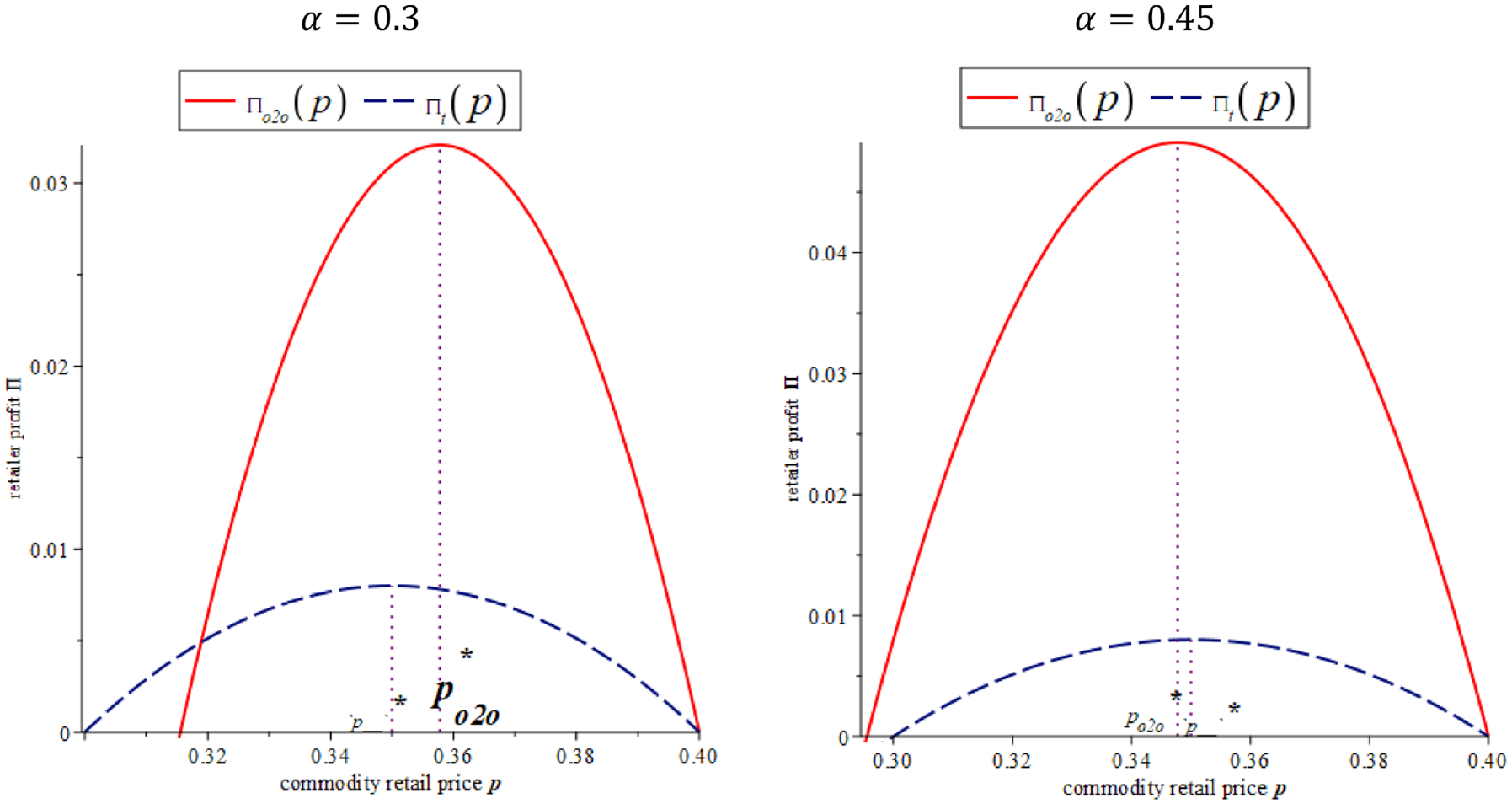
Profit comparison between the traditional retail mode and the O2O instant delivery mode.
Interpreting Figure 6, the paper reveals that consumers’ preferences for retailers are homogeneous. When the difference in online and offline service costs is relatively small, monopoly retailers can achieve higher profits by adopting the O2O instant model. In this case, retailers increase retail prices while offering free delivery services, capitalizing on consumers’ preferences for the retailer and the high valuation of the goods.
However, when there is a significant disparity in online and offline service costs, the monopoly retailers in the O2O instant delivery model adopt a different strategy. They provide free delivery services while lowering retail prices. This strategy aims to expand their market reach and attract a larger number of consumers, which in turn leads to increased profits despite the lower individual profit margins per transaction.
In summary, this paper emphasizes the impact of different online and offline service costs on retailers’ profitability, demonstrating how retailers adjust their pricing and service strategies based on the difference in online and offline service costs, consumer preferences, and goods’ valuation. This analysis provides valuable insights into the dynamics of the O2O instant delivery model and its effects on retailers in comparison to traditional retail modes.
Numerical Study III
In the third numerical analysis of the paper, the focus is on studying the behavior of a retailer (retailer A) and the impact of different pricing strategies under the O2O instant delivery mode. The analysis considers various parameters that affect the retailer’s profit and decision-making process.
The consumer-related parameters include the consumer’s preference for retailer A
On the retailer’s side, the retailer faces a unit distribution cost (
The paper analyzes two different pricing strategies that the retailer can adopt under the O2O instant delivery mode:
a) Pricing Strategy A: This involves increasing retail prices while offering free delivery to consumers.
b) Pricing Strategy B: This strategy keeps the retail prices unchanged, but charges a fee for delivery services.
Figure 7 presents the results of the analysis, where the maximum profits obtained by the retailer under Pricing Strategy A and Pricing Strategy B are denoted as
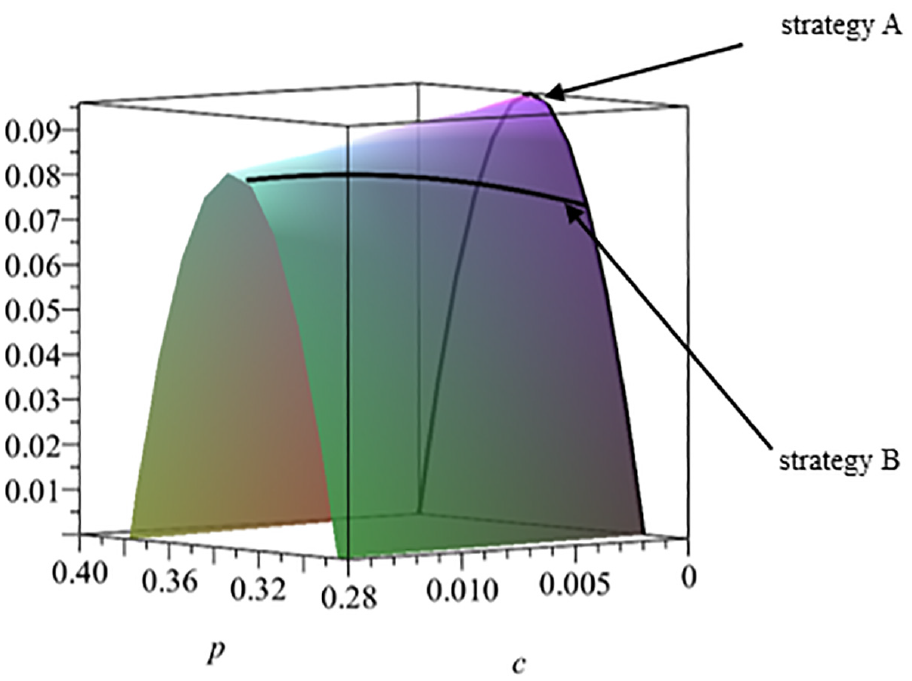
Profit comparison between pricing strategy A and pricing strategy B.
The key observation from Figure 7 is that
In simpler terms, the analysis demonstrates that when the retailer raises retail prices and provides free delivery services, it leads to higher profits compared to keeping retail prices the same and charging for delivery. This finding suggests that the retailer can optimize its profit in the O2O instant delivery mode by leveraging consumer preferences, valuations, and cost structures to determine the most effective pricing strategy.
Numerical Study IV
In the fourth numerical analysis, we consider a scenario where consumers have a preference (

Influence of online and offline service cost difference on the optimal retail price and order delivery fee under O2O instant delivery mode.
Figure 8 presents the results of a sensitivity analysis for the monopoly retailer’s optimal retail price and order delivery fee under the O2O instant delivery model. This analysis explores how the difference in online and offline service costs impacts the retailer’s decisions. From the graph, we observe that when the difference in online and offline service costs increases, the retailer adjusts its optimal retail price and order shipping costs, reducing them accordingly.
To put it more intuitively, the consumer’s preference for retailer A and their valuation of the goods determine the attractiveness of the product. The consumer’s costs for transportation and waiting play a role in the decision-making process. Simultaneously, the retailer’s delivery costs, both for online services, and the coefficient of service cost difference between online and offline also affects the retailer’s pricing strategy.
The absence of an order delivery fee simplifies the analysis in this context. Figure 8 demonstrates that when the online service is more cost-effective than the offline service (i.e., a larger difference in costs), the retailer can afford to set a lower retail price and charge lower order shipping costs, thereby gaining a competitive advantage.
In summary, this numerical simulation sheds light on how variations in costs between online and offline services impact the retailer’s pricing decisions, allowing them to optimize their strategy for the O2O instant delivery model.
Discussion and Conclusion
Conclusion
In this paper, we study how brick-and-mortar retailers achieve optimal profits through strategy selection under the O2O instant delivery model. We study the pricing decisions of traditional retailers, as well as four kinds of decisions under the O2O timely delivery model: commodity retail price decision, order delivery fee decision, initial delivery price decision, and delivery scope decision. 1. When analyzing the profits of the traditional retail model and the O2O instant delivery model, it can be found that the traditional retail profit is always lower than the O2O instant delivery model. Then we discuss the factor of delivery fee separately, because in most cases, when consumers choose O2O instant delivery service, the delivery fee often becomes an important consideration factor when placing an order.2. We find that grocery retailers, in the case of O2O instant delivery services, would do well to adopt no or very low delivery charges, which would motivate consumers to purchase the goods and increase the retailer’s profits.3. However, in order to offset the delivery cost without setting a delivery fee, we point out through the results of the study on the starting price that when the cost difference between online and offline services is within a certain range, it is possible to increase the profit by setting the starting price. In fact, many companies (e.g., Deliveroo in the UK and DoorDash in the U.S.) do this. On this basis, there is another factor that has not been taken into account.4. Then we discussed the decision on the delivery range and concluded that the decision to set the starting price and limit the scope of delivery is the optimal decision. This decision leads to higher profits compared to the decision of limiting only the starting price of delivery. To sum up, in practice, offline physical stores can conduct direct sales through instant delivery platforms. This is similar to the model of companies such as Meituan, Deliveroo, and Ubereats. Therefore, the delivery platform will not only determine the delivery fee and starting price but also limit the scope of delivery. The qualitative properties of Section 5.4 would then continue to have applicability to this situation.
Managerial Insights and Future Research
Benefiting from the wide coverage of mobile smart terminals, the popularization of O2O platforms, and the changes in people’s consumption patterns, brick-and-mortar retailers are facing the update of consumers’ consumption concepts in the post-epidemic era. Customers have higher requirements for merchants and need more convenience and timeliness. But on the other hand, this is a great test for traditional retailers to choose online sales. Retailers need to meet consumer expectations under the instant delivery model and meet customers’ different requirements when delivery costs are relatively low.
The key management insights are as follows: First, the difference in online and offline service costs plays a key role in retailer commodity prices. This commodity price will also affect the optimal profit of the O2O instant delivery model. Therefore, retailers should fully and cautiously understand the difference in online and offline service costs. Secondly, with the accelerated pace of urban life, in addition to transportation costs, the mental and time costs for consumers to go to the store to buy goods are getting higher and higher, so O2O instant delivery only charges a very low delivery fee or even free delivery. Consumers’ inclination towards O2O instant delivery will reach a very high level, which is something that many business platforms can learn from. Finally, consumers choose O2O instant delivery on the premise of higher efficiency and quality, so we set delivery to consumers within a certain range, which can not only improve the delivery quality but also reduce the delivery cost.
However, this paper has some limitations. First, we study the monopoly situation of a single retailer. In reality, there is usually a situation where several retailers compete. In future research, we can discuss the situation where multiple retailers compete with each other. Second, we assume that consumers are evenly distributed along a unit line. In fact, in most cases, the distribution of consumers is concentrated and dispersed. Therefore, future research can proceed to the optimal O2O instant delivery mode strategy with the non-uniform distribution. Third, when retailers sell through the O2O instant delivery model, they face not only competing with other online retailers but also competitors with a monopoly advantage in offline channels due to geographic location.
Footnotes
Declaration of Conflicting Interests
The author(s) declared no potential conflicts of interest with respect to the research, authorship, and/or publication of this article.
Funding
The author(s) disclosed receipt of the following financial support for the research, authorship, and/or publication of this article: This research is supported by the National Natural Science Foundation of China (72001182), the National Natural Science Foundation of Sichuan Province (2024, Research on the operational strategy of small and medium-sized retailers based on private domain traffic driven by data elements), Ministry of Education of Humanities and Social Sciences (22YJAZH075), the National Natural Science Foundation of Sichuan Province (2023NSFSC1043), the Open Fund of Sichuan Oil and Gas Development Research Center (SKB22-09), Special Fund for Humanities and Social Sciences of Southwest Petroleum University (2021RW060), Sichuan Province Social Science Key Research Base Project (XCZX-004).

Data Availability Statement
Data sharing not applicable to this article as no datasets were generated or analyzed during the current study.