




Abstract
Under the Covid-19 pandemic, Vietnam has not only seen in a clear shift from traditional trade to modern trade channels, but also there has been a shift from traditional trade to omni-channel online and offline. This leads to investigate several questions regarding retailing in Vietnam during the Covid-19 pandemic. What omni-channel process of delivery service is provided by operators in Vietnam? What are the profiles of the delivery service for omni-channel consumers in Vietnam? What are different consumer segment delivery service preferences in omni-channel and purchasing modes for online and offline? What profiles/patterns/rules should retail operators consider making their omni-channel delivery service model more competitive for online and offline in retailing? This study investigates Vietnamese consumer behaviors with delivery services and omni-channel online and offline (N = 2,204). Data mining analytics, including clustering analysis and association rules, reveal meaningful clusters/patterns/rules for investigating delivery service and omni-channel online and offline development.
Plain Language Summary
With Vietnam’s government support as a pushing force, online and offline business models have increased consumer willingness to use e-commerce for retail purchases. On the other hand, there are pulling forces from increased consumer choice for product delivery and logistics, together with the development of a contactless economy. Although Vietnam is a developing country and emerging market, with government promotion and the efforts of private enterprise, new delivery service business models have created business opportunities in the challenging time of this pandemic. This empirical study investigates Vietnam’s consumer behaviors with delivery services in and omni-channels in retailing during this period. Data mining analytics, including clustering analysis and association rules, reveal several meaningful clusters, patterns and rules that can explain how delivery services can better serve retail customers in omni-channels with online and offline business models for Vietnam. However, due to limitations of the study sampling source, beyond the scope of a case study, suburban and economically underdeveloped areas were not included. Furthermore, due to the limitations of data mining analytic methods, a complete understanding of this data was not possible. Future studies could investigate delivery services and omni-channel online and offline as a global co-operation trend, for example, Southeast Asia’s geoeconomics and regional cooperation, for logistics and retail market and business development. Further research in different economies and areas is warranted to enhance innovation in technology, society, and business markets.
Introduction
Vietnam is a developing country. But since joining the World Trade Organization (WTO) in 2007, it has become an important destination for global overseas investment and an emerging Asian manufacturing center by introducing foreign capital, building industrial parks, developing an export-oriented economy, and undertaking the transfer of global industrial supply chains. Vietnam is a member of the Association of Southeast Asian Nations (ASAN), the WTO, the Asia-Pacific Economic Cooperation Organization (APECO), the International Organization of the French Circle (IOFC) and one of the 11 emerging countries. From 2000 to 2023, Vietnam’s economic growth rate averaged 6.27%, and in 2022 it was 8.02%, a record high since 1997. In 2023, Vietnam’s fiscal revenue was 1,923.6 trillion VND, which is 138.7% of the annual budget, an increase of 19% over the same period last year; fiscal expenditure is 1,892.8 trillion VND, equivalent to 92.6% of the annual budget, an increase of 9.1% over the same period last year. With this economic growth, Vietnam is a strongly emerging Asian market (Britannica, 2024). As a developing country and emerging market, Vietnam is facing challenges in terms of technology, social services, the economy, and industrial development due to effects of the global pandemic.
The global COVID-19 pandemic has changed people’s living environments and customs, as well as commercial habits of consumers. Consumer behavior is a critical issue for the retail industry to predict future purchases and actions that respond to market changes. For example, Nielsen (2022) investigated changes in the behavior of Vietnamese consumers as affected by COVID-19 restrictions. The results showed that Vietnamese consumers were highly aware of the source and symptoms of the disease, and they follow news updates multiple times a day through social media, text messages from the Ministry of Health, and television news. Vietnamese consumers are acting protect themselves by wearing masks, washing hands frequently, and avoiding public or crowded places. COVID-19 has also changed the eating habits and entertainment activities Vietnamese people. At the same time, online shopping has increased by 55%, providing an opportunity for marketers to be more active with digital strategies. There is a trend toward certain food categories, such as instant noodles, frozen food, and sterilized sausage, as well as increased purchase of personal care and home care products. The 2022 survey by Statista in Vietnam for online shopping behavior during the COVID-19 pandemic found that over 58% of respondents reported increased online shopping frequency. Additionally, the survey revealed that most respondents reported making online purchases several times a month on different market channels (Statista, 2023).
Regarding retail market channel, with the rising popularity of e-commerce, evaluating market channel is an important operation strategy for brands and product sales. An omni-channel provides a complete and uninterrupted consumption experience by combining data and marketing content, acting as an offline physical channel and online with consistent services and information (Hou et al., 2023). In omni-channel retail, multiple channels closely integrate the transmission of information, member information, member behavior on multiple channels, etc. (M. Zhang, Li, et al., 2022). All omni-channel experiences use multiple channels, but not all multi-channel experiences are omni-channels. Therefore, using omni-channels is an effective strategy for the retail industry to develop a business model that integrates business online and offline channels (O2O; Chen et al., 2023). In contrast to online and offline interactive behaviors following the integration of O2O (e.g., online promotion and offline promotional activities), omni-channel retail is more concerned with data analytics of consumer behavior. This analysis begins with consumer engagement, ensures that consumers have brand content placed in each engagement, and verifies that services and information throughout the engagement promote consumers’ desire to buy products (Choi & Kim, 2022). Thus, omni-channel retailing provides more opportunities for consumer interaction online and offline.
Regarding delivery service, with the rapid development of the sharing economy, crowdsourcing has become an emerging business model for delivery services. Crowd outsourcing refers to work traditionally performed by designated agents that is instead outsourced to unspecified individuals (Howe, 2006), and some delivery platform operators now carry out freight distribution operations through crowd outsourcing. Last-mile delivery is the last link in logistics, the final connection to consumers (Olsson et al., 2022). Under this model, the efficiency of delivery service, the convenience of picking up goods, and the quality of goods all affect consumers’ continued purchase intention. For retail operators, using mass logistics platforms (third-party) to match consumers and delivery staff, transportation services are outsourced to delivery services (Yaşa, 2023). Through the third-party platform, delivery staff continue to increase orders during off-peak hours, earn more profit, and serve customers in different regions (Kaplan et al., 2023). This form of delivery service can reduce a store’s labor costs and make manpower allocation more effective, eliminating the need for employees to guarantee the delivery risk (Talukdar & Ganguly, 2022). For online marketing and publicity, the delivery service uses the mass logistics platform to increase exposure the number of orders, providing a certain percentage of the platform’s commission (Zhong et al., 2022). For consumers, delivery service platforms can deliver products without limitations on time and space, and most platforms charge lower delivery fees in order to attract consumers (Yen, 2023).
Under the Covid-19 pandemic, Vietnam has not only seen in a clear shift from traditional trade to modern trade channels, but also there has been a shift from traditional trade to omni-channel online and offline development. This leads to investigate several questions regarding delivery logistics and retailing in Vietnam during the Covid-19 pandemic.
Literature Review
Omni-channel Delivery Service
Jindal et al. (2021) estimated a multivariate probability model using data from customer surveys and found that offline retailers should also focus on providing online customers with the essentials of retailing, such as greater variety, competitive prices, and convenience of buying on an omni-channel. Aktas et al. (2021) used a Monte Carlo simulation to estimate grocery delivery demand for each 1-hr time window. They estimate the impact of collaboration using the simulation output as input to an example of the everyday vehicle routing problem under independent and collaborative last-mile delivery operations. Their findings support policies that incentivize vehicle- and infrastructure-sharing setups and decouple last-mile delivery from core grocery retail services for an omni-channel. Schubert et al. (2021) developed a decision support model and a general variable neighborhood search-based algorithm to address the described problem by considering the trade-off between picking and delivery costs, while ensuring delivery time windows for customers. The results show that the integrated solutions yield an average total cost savings of approximately 13% over the sequential approach typically employed in retail omni-channel practice. On the other hand, the COVID-19 pandemic changed the shopping environment and behaviors in Vietnam, with omni-channel practices becoming more generally accepted. Overall, omni-channel approaches are convenient for consumers and help retailers exploit digital growth to reach new customer segments and increase customer interaction. This trend is also supported by government incentives aimed to increase the proportion of the population with an electronic payment account to over 50% by 2025 and over 80% by 2030 (VietnamCredit, 2022). On the other hand, Risberg (2023) demonstrated how the focus of the e-commerce logistics literature has evolved into multi-channel logistics and, more recently, all-channel logistics. The recent boom in omni-channel logistics publications underscores the importance of logistics in omni-channel retailing, with its increasing complexity and variety of logistics design options. By synthesizing 373 articles, a decision framework for omni-channel logistics covering 43 decision elements including supply and internal distribution, last mile consumer lead generation, last mile back-end fulfillment, last mile delivery, and reverse logistics was created.
Delivery Service for Online and Offline
Wang and Scrimgeour (2022) examined how innovation adoption characteristics, food choice motivations, segmentation, and socio-demographics affect consumer adoption of online and offline food delivery services (O2O-FDS) in a Western developed country—New Zealand—and an Asian developing country—China. Research findings indicated that food choice motivations had statistically significant effects on consumer attitudes and/or purchase intentions under O2O-FDS in the pooled and/or two-country samples: perceived incentives, perceived complexity, ease of processing, cheapness, attractive taste, safe and secure, and ease of purchase. Agarwal and Sahu (2022) examined the antecedents of reuse intention (RUI) for online and offline food delivery (OFD) services using the integrated framework of use and gratification theory (UGT) and the unified theory of adoption and use of technology 2 (UTAUT 2). Results showed that negative impacts of going with the crowd on satisfied consumer RUI reflects discrepancies between published ORT/ORV and personal experience. By comparing the business models of online and offline service platform (O2OSP), traditional online and offline, and platform-based e-commerce channels, S. Zhang, Pauwels, and Peng (2022) determined the short- and long-term impact of adding an O2OSP channel to a company’s offline and total sales and profits. The panel data regression with fixed effects showed that increasing O2OSP channels reduces both offline and total profits in the short run but increases offline and total sales and profits in the long run. In the long run, offline and total sales increased by 23.28% and 33.94% respectively. Li and Wang (2022) found significant differences between home and workplace eating environments in Shanghai, and that home eating environments have a greater impact on eating through O2O takeaway services than through workplace eating environments. That study also found that availability and accessibility of healthy food in residential areas significantly reduces food consumption through O2O meal delivery service eating likelihood; lack of healthy food options and suburbs explain O2O food delivery consumption in the workplace. The online and offline wholesale e-commerce segment is expected to experience a boom in Vietnam because it is currently the fastest growing online and offline e-commerce market in Southeast Asia, with a market value of 13.2 billion USD in 2020 and is expected to grow at a compound annual growth rate of 43% through 2025. According to Deloitte Vietnam, these trends are geared toward Vietnam’s retail industry digitalization. This segment will see broad digitization for the entire retail supply chain, beyond simply online and offline or from shopping to delivery service and payments (Deloitte Vietnam, 2023).
Data Mining Analytics for Delivery Service Development in Retails
Yeh and Chen (2018) proposed a service design approach that combines Kansei engineering and data mining techniques. This integrated approach first collects customers’ relevant perceived vocabulary and service attributes based on a perceived engineering procedure. It then quantifies the relationships among service attributes, perceived responses, and usage intentions through data mining techniques using decision trees. It was found that combinations of key perceptual responses yielded positive (or negative) usage intentions, and combinations of attributes resulted in these key perceptual responses, so D2DD service providers could improve or create their services based on the research results. He et al. (2020) evaluated the impact of traffic conditions on key performance indicators of an online food delivery service. They found that traffic conditions had no real impact on transaction volume and delivery time fulfillment, although early delivery was slightly associated with the number of positive reviews customers provided after receiving their order at home. Y. Zhang et al. (2023) used crowdsourced riders’ online reviews as a source of data to analyze the factors that bring satisfaction and dissatisfaction to the riders using text mining techniques such as sentiment analysis and Latent Dirichlet Allocation (LDA) topic modeling. The results of the study show that in addition to basic income, riders expect platforms to provide them with better services, skills training, and safety insurance to bring satisfaction to riders. Currently, the platform’s lack of timely information feedback and inaccurate order matching are reasons for rider dissatisfaction. Research has also shown that cyclists can easily gain a sense of fulfillment from helping others in the process of completing RTL deliveries. Interactions with merchants and customers also influence rider satisfaction.
Accordingly, above literature review shows that delivery service for omni-channel online and offline applications is a very important topic in retail research. However, there is no empirical study investigate on how delivery service can support the online and offline approach for omni-channel retailing in an emerging market. Thus, this study uses data mining analytics, including clustering analysis and association rules, to find patterns and rules that generate possible alternatives, and then proposes business model development for retailers.
Method
Subject Background and Sampling
To analyze delivery service for omni-channel online and offline by data mining, delivery service consumers in Vietnam during the Covid-19 pandemic are the subjects for this study. The main retail omni-channel operators in Vietnam such as LazMall, Lazada, Thegioididong, Bachhoaxanh and Dienmayxanh, Vatgia, and Chotot etc. are the omni-channel sampling sources. For comparison, Grab, Gojek, Now delivery, Baemin, Lalamove, Giaohangnhanh and Giaohangtietkiem etc. are sampling sources to investigate consumer delivery service. This study adopted purposive sampling method. Data was collected through a detailed structured online questionnaire sent to individuals using messages via social commerce media and apps, such as Facebook and Zalo etc. Questionnaire distribution was from July 12 to October 20, 2021, a total of 2,587 questionnaires were answered and returned. This online survey is not only increasing response intention, but also is good to transform response data to database with an Excel file for further analytics. The online questionnaire recorded the IP address of the respondent and deleted repeat actions from the same IP address, to avoid repeated answers and to enhance the correctness and completeness of data quality. After reviewing completed questionnaires and discarding incomplete responses, a total of 2,354 valid questionnaires were entered into the database (92%). Respondents were 74.80% female, 52.50% were 25 years and under, 24.30% were 26 to 36 years, and 23.20% were 37 years and above.
Questionnaire Design
This questionnaire has five parts with nominal and ordinal scale questions to understand how respondents feel, think, and act. The first part was five questions about personal information such as gender, age, education background, occupation, etc. The second part was six retailing delivery service usage behavior questions regarding reasons to use delivery service. The third part had six delivery service on offline purchase behaviors usage behavior questions regarding frequency of use and reasons to use delivery services on offline stores. The fourth part contained eight questions about delivery service on online purchase behaviors, such as consumers’ preferred services, shopping discount methods, etc. The fifth part contained five questions about delivery service on omni-channel online and offline purchases behavior to understand what consumers mostly purchase omni-channel offline and online, how the preferred marketing methods for offline and online shopping attracted their attention. All items of questionnaire are designed as the nominal and ordinal scales (not Likert scale). For example: What online delivery service platform have you ever used or tend to use during the Covid-19 pandemic? (Multiple choice) (1) Grab (2) Gojek (3) Now delivery (4) Baemin (5) Lalamove (6) Loship (7) Giaohangnhanh (8) Giaohangtietkiem (9) Other (Please list the top three rankings of your preferences
Data Mining Analytics
Clustering Analysis
Clustering analysis is one of the common data mining algorithms. It is considered unsupervised learning in some fields such as machine learning or pattern recognition. It plays an important role in a huge variety of application domains such as direct marketing, business intelligence, psychology, social science etc. (Su & Chou, 2001). The similarity between individuals in the same group will be relatively high, while the similarity between individuals in different groups will be lower than the same group and the dissimilarity will be greater. The algorithm proceeds as follows:
1. Divide the observation

2. When each cluster is generated with three observations, recalculate the centroids of each k cluster for observations assigned to each cluster. The algorithm can be expressed as follows:

The process is repeated until the change of the cluster becomes smaller and smaller, and observations no longer change, then the final structure is generated.
Association Rules
Association rules are defined as a method for finding frequent associations and similar relationships among item sets of data items, and its purpose was to find the associations on the database (Agrawal et al., 1993). It is an effective data mining technique which is used to search for rules that expose the nature of the associations among the data of entities (Agrawal & Srikant, 1994). For instance, one may cluster retail companies in an area according to their household size, household income, head of household occupation, and geographical location from nearest urban area.
To calculate Support, Confidence and Lift value, we follow the formula as follows.
1. Support: The transactions’ percentage consists of all items in an itemset, where X and Y are itemset. The higher Support the more frequently items occur.

2. Confidence: Probability that a transaction contains both item X and Y.

3. Lift value: Probability of all items in a rule which is divided by the product of probabilities of items X and Y occurring if there is no association among them found. The larger lift value the higher association between two items.

Using RQ1 to explore the process of delivery services in omni-channel, the data in the entire database is searched and analyzed repeatedly, and then the analyzed content and the minimum support are compared, and the above actions are repeated until no new candidate item sets are combined.
Database Development—The Entity-relationship Model (E-R model)
Entity-relationship (E-R) Model is a widely recognized and respected entity-relationship diagram notation used to represent entities, attributes, and relationships within a data model. It is a valuable tool for designing conceptual models, and it sets itself apart from other entity-relationship diagram notations by showcasing entity attributes and relationships in distinct boxes that are connected to the entities (Berson & Smith, 1997). In this study, the E-R model has been used to capture and represent customer information and habits, as well as their expectations toward a specific delivery service platform with purchase behavior of omni-channel online and offline. The E-R diagram comprises 14 strong entities, 9 relationships, and 65 attributes, which together provide a detailed representation of customer data. The resulting E-R model illustrated in Figure 1.

The entity-relationship model (E-R model).
Data Mining Analytical Tool—SPSS Modeler
IBM SPSS Modeler is a powerful data analytics tool for businesses to extract insights from structured and unstructured data. It supports various modeling techniques, including association models, which find patterns in data where entities are associated with each other. Apriori algorithm is an example of an algorithm used in association models, and it extracts a set of rules from the data with high information content. K-means is another clustering algorithm used to create distinct groups or clusters in the dataset, which can be used to tailor marketing efforts for different customer segments and purchase preferences (Figure 2).

Data mining process-SPSS modeling.
Results
Clustering Analysis
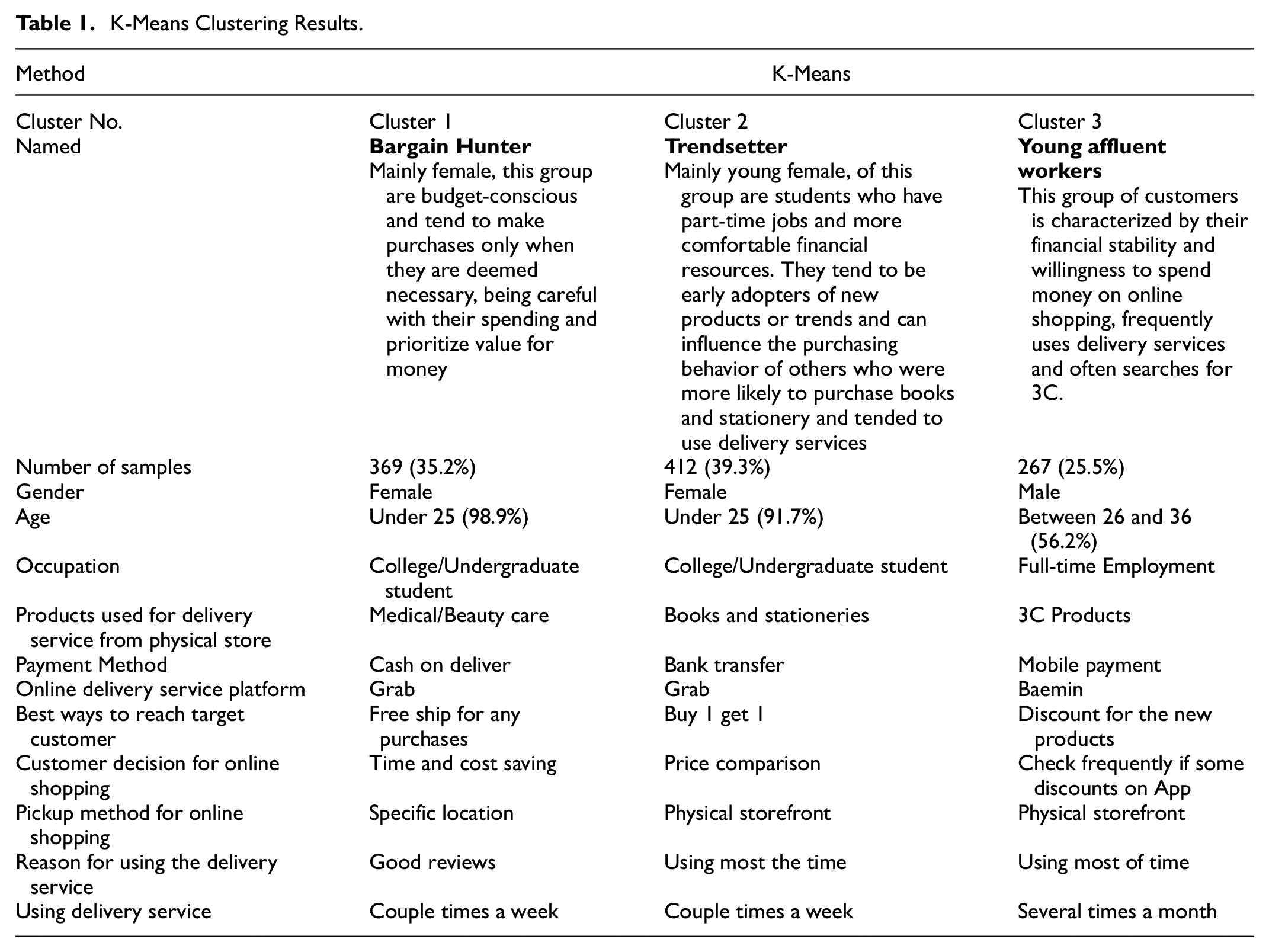
For RQ1 and RQ2 to find the profiles of the delivery service and omni-channel online and offline implementation of consumers, where K represents distinct elements from a fixed set. Cluster 1: Bargain hunters’ group includes 769 respondents (32.6%); cluster 2: Trendsetter group includes 812 respondents (34.6%); cluster 3: Young affluent workers group includes 773 respondents (32.8%). Detailed customer profiles and characteristics are described below, with clustering results and profiles shown in Figure 3 and Table 1.

Clustering analysis results.
K-Means Clustering Results.
Cluster-1: Bargain Hunters’ Group
Cluster 1, named the Bargain hunters’ group which has 769 respondents, with 32.6% being female and the majority being teenagers without part-time jobs. This group has a strong preference for purchasing medical and beauty care products from physical stores that offer delivery services, especially during the Covid-19 pandemic. In addition, this group is also likely to prioritize purchasing from stores that offer a wide range of products, including both medical and beauty care items, to meet their diverse needs. They often consider customer star rating reviews when choosing a store and believe that free shipping is the most effective way to attract them as customers. They also value the convenience of delivery options and the cost-saving benefits of cash on delivery payment methods. Time efficiency and cost savings are the main factors influencing their decision to make online purchases. They may also appreciate the option of being able to return products if they are not satisfied with their purchases.
Cluster-2: Trendsetter Group
Cluster 2, named the Trendsetter group which has 812 respondents, with 34.6% being female and the majority being under the age of 25. During the Covid-19 pandemic, they were more likely to purchase books and stationery and tended to use delivery services from physical stores most of the time. They consider that promotions such as “buy one get one free” are the most effective way to increase their willingness to purchase from a multichannel platform. They also typically compare prices before making online purchases. In addition to these purchasing habits, this group also tends to use social media or celebrity reviews to inform their purchasing decisions. For delivery service, they frequently use the Grab platform and prefer the convenience of options such as ordering in-store and using the shop’s delivery service or order online and picking up in the store a few times a week.
Cluster-3: Young Affluent Workers Group
Cluster 3, named the young affluent workers group which has 773 respondents, with 32.8% being male and the majority being between the ages of 26 and 36. This group frequently uses delivery services and often searches for 3C products such as computers, electronics, and appliances. Males in this group tend to focus on technology devices and believe that discounts on new product launches are the most effective way to attract them as customers. They are also more likely to make purchases using mobile payment methods such as Apple Pay or Google Pay. The majority of this group are full-time employees with more established, stable careers and are willing to pay delivery service fees in order to receive their purchases conveniently. They tend to regularly check for the best prices and discounts on applications such as Amazon or eBay, rather than focusing on their needs when making purchases.
Association Rules
Pattern 1—Associations of Consumer Behavior and Delivery Service Preferences on Omni-channel
For RQ3, this study identified six association rules, where both support and confidence value were used to validate the rules, with the minimum support and minimum confidence levels (1% and 63%), resulting in a lift value greater than 2.5 for each association rule, as shown in Figure 4 and Table 2. For Cluster 1, Rules 1 and 4 indicate that since they had no choice during the pandemic and were willing to try out delivery services, their expectations were focused on free shipping, and they were more likely to trust a service with high star ratings. Rule 4 and rule 6 are especially related to food delivery. According to rule 3, for in-store purchases when seeking a wide variety of food and drink commodities, these respondents are concerned about the potential for incorrect deliveries when using delivery services. Prior to the pandemic, they frequently engaged in leisurely shopping at retail stores. However, they would be willing to utilize delivery services if the cost of delivery and the quality of the product were both acceptable.

Cluster 1—Associations map of consumer behavior and delivery services on omni-channel.
Cluster 1—Associations table of Consumer Behavior and Delivery Services on Omni-Channel.

For Cluster 2, Rules 3 and 4 show that this customer segment prefers reduced shipping rates for products they purchase in the retail store. Rules 4 and 1 find the delivery service to be convenient as they most likely use it for their clothing, footwear, medical and beauty care products. Rule 3 finds that this group thinks not exactly what they ordered if using the delivery service, they would try if they were recommended by relatives or friends. However, before the pandemic, they preferred to shop in-store, as it was their preferred choice for leisure time, and it made them feel relaxed and helped reduce stress. Rules 2, 5, and 6 suggest that this customer segment was less inclined to use delivery services for purchases during the pandemic. For Cluster 3, Rules 1 and 4 indicate that this group places great emphasis on the attitude of staff during the delivery process. The group considers delivery service to be a convenient option and is willing to shift to e-commerce for their purchases. Rules 3, 5 and 6, on the other hand, indicate that most of the group favors delivery services, particularly for purchasing food and drinks, medical care products and groceries. The study further suggests that the group is open to switching to e-commerce at some point after the pandemic for rule 5, rule 3 indicates looking for the best price on both product and shipping cost, and rule 6 is looking for the free shipping.
Pattern 2—Associations of Consumer Behavior and Delivery Service Offline on Omni-channel
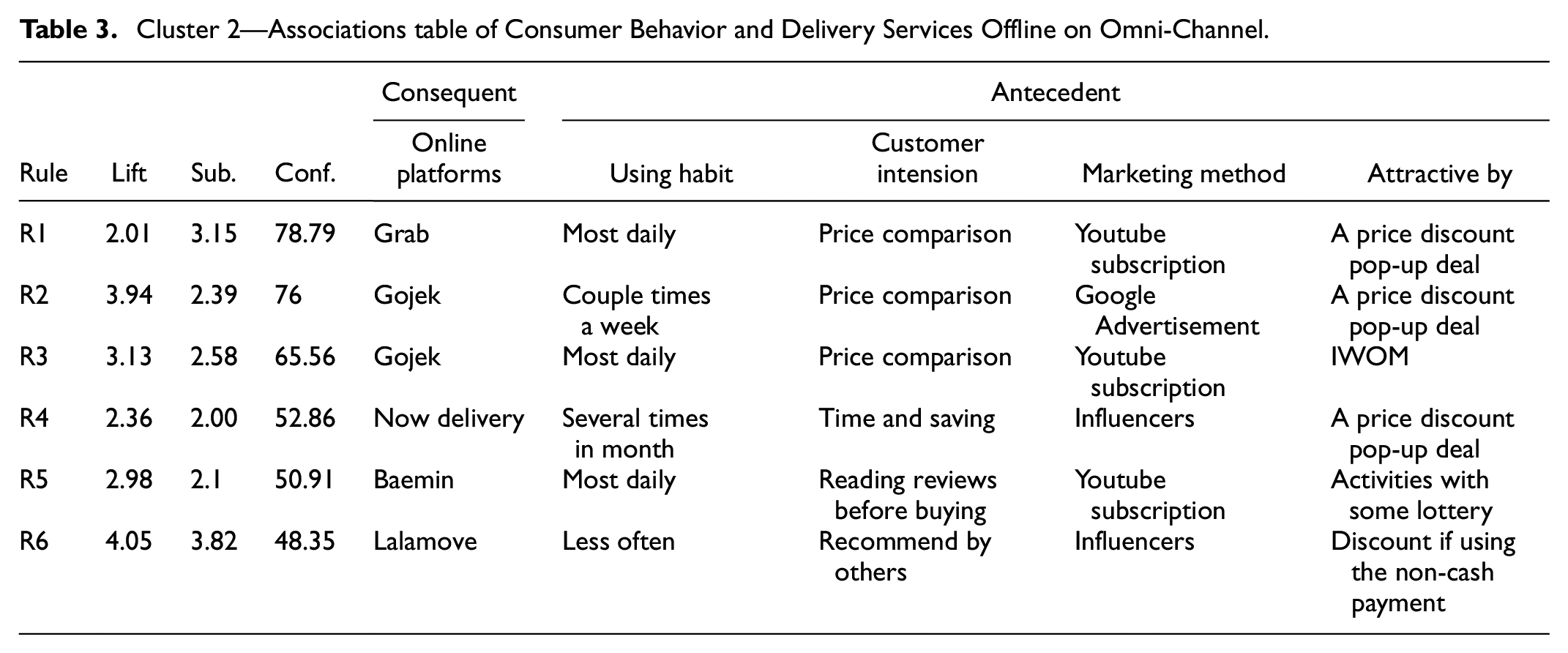
To establish the association rules, we utilized a minimum support of 2% and a minimum confidence of 42%, which yielded six rules. Both support and confidence values were used to validate the generated rules. All association rules had a lift value in which greater than 2.4, indicating a significant association between the antecedent and consequent items. In terms of cluster 1, In Rules 1 and 5, consumers have become accustomed to the novel function, which they perceive as a time and cost-saving tool. They utilize the app on multiple occasions per week, a frequency that is comparable to their traditional in-store shopping habits. Conversely, Rule 3 primarily concerns Gojek, an application that is less popular than Grab but also offers numerous discount activities. in Rules 2 and 4, the individuals in question exhibit a tendency to frequently monitor the Giaohangnhanh and Now delivery applications for available discounts, perceiving this to save time and shipping costs. Moreover, they rely on word-of-mouth recommendations to inform their decisions to utilize these delivery services, with Rule 2 utilizing the service several times a month and Rule 4 utilizing it daily.
Regarding cluster 2 (Figure 5 and Table 3), for Rules 1 and 3, the use Youtube subscription has been found to be highly effective in attracting customers from this group, while Google advertisements have been noted to catch the attention of customers who are searching for products online. Additionally, for Rule 3, it has been found that customers use Gojek with a similar intention of price comparison, but rely more heavily on word-of-mouth, and rule 6 with recommendations from friends and co-workers. For Rules 4 and 5, it has been found that customers rely on Nowdelivery and Baemin for their daily purchases with rule 5 and several times in month with rule 4. This group is highly attracted to the unique marketing strategy of the delivery app, which focuses on building its own brand image and offering diverse activities, including lotteries for customers who use their services. Regarding cluster 3, Rule 4 recommends the use of Giaohangnhanh. This app specializes in providing speedy delivery options and offers discounts to customers, making it an attractive option for this group of customers. For Rule 6, our research found that the Loship delivery service application is used a few times a month by this group. The main reasons for using this app are to save time and costs. This group relies on recommendations from influencers, and they prefer in-store shopping to try, touch, and see the products before making a purchase.

Cluster 2—Associations map of consumer behavior and delivery service offline on omni-channel.
Cluster 2—Associations table of Consumer Behavior and Delivery Services Offline on Omni-Channel.
Pattern 3—Associations of Consumer Behavior and Delivery Service Online and Offline on Omni-channels
This study sets up the minimum support at 2.2% and the minimum confidence at 58%, which generated six association rules. It is crucial to consider both support and confidence to determine the validity of each rule. All rules reach a lift value larger than 1.3. For cluster 1, results reveal association rules that govern the relationship between customer attitudes and their delivery service preferences on the online and offline omni-channel business model. For Rules 1 and 3, it seems that the Shopee application is the most preferred option among cluster 1, especially for those who purchase medical and beauty care products. Customers appreciate the app’s discount offerings, wide range of products, and low delivery service costs. Rule 4 indicates that consumers prefer using mobile payments for convenience and appreciate occasional discounts offered by the delivery service platform. For rules 2 and 5, bank transfers and credit card are the payment method of choice. They also appreciate the option to provide direct in-app ratings and reviews. Door-to-door delivery service is also a preferred option for these consumers (Figure 6 and Table 4).

Cluster 3—Associations map of consumer behavior and delivery service online and offline on omni-channels..
Cluster 3—Associations table of Consumer Behavior and Delivery Service Online and Offline on Omni-Channels.

For cluster 2, Rules 2 and 3 indicate a preference for the Tiki delivery service platform, with a tendency to use mobile payment and cash-on-delivery as the payment method of choice. These two rules are aimed at different target customers, and their strategies differ accordingly. Rules 1, 4, and 6 prefer physical storefront delivery, which is different from traditional delivery methods. Rule 4 indicates a preference for the Lazada platform and the use of icons for feedback, as it is the more traditional and easier method. Rules 2 and 6 prefer mobile payment, such as digital wallets. Rule 5 suggests sending out coupons for future purchases, with the caveat that not all coupons will be useful to all customers. Rules 1 and 6 stand out as an exception, since they indicate a preference for the Shopee platform and cash-on-delivery or mobile payment as a payment method for online and offline purchasing. For Cluster 3 (Figure 5 and Table 3), rules 1 and 2 mostly prefer using the Lazada delivery service platform. In addition, these customers prefer to pay using the digital wallets or mobile payment options available on Momo and Sendo for rules 3 and 6. They also tend to prefer post office and specific location as a trend for modern workers and students. Therefore, the best choice of target customer strategy for rule 1, 2 would be to offer reward points for the next purchase. For rule 4 and 5 with the Bachhoaxanh platform option, this group mostly purchases books and prefers delivery directly to their location.
Discussions
Theoretical Implication
In terms of theoretical contributions, the literature review finds that the topics of distrbution services and online-offline omni-channels are very valuable issues in logistics and retailing research. However, a few articles have used data mining analysis to examine the integration of these issues, considering the integration of mechanisms of specific business models or case studies. Thus, this study proposes a two stage data mining approach, including cluster analysis and association rules, to find meaningful profiles/patterns/rules of consumer behavior and preferences. This study also proposes for the first time that a two stage data mining approach can be used on databases with different data mining methods to investigate delivery services and online-and-offline purchases and to discover useful and practical meanings of consumer preferences and behaviors through research finding. This may make theoretical and methodological contributions to logistics and retail research.
Translated with DeepL.com (free version)
Delivery Service Business Model
For RQ4, the Covid-19 pandemic has led to a significant shift in consumer behavior and preferences, and it is crucial for businesses to understand how these changes impact their customers’ needs and expectations. For this, retail operators must delve deeper and conduct in-depth analyses to determine which products customers purchase most frequently in-store and how the pandemic has affected their buying habits. Our research findings reveal that the three clusters—Bargain Hunter, Trendsetter, and Young Affluent Worker groups—have distinct preferences in terms of the products they purchase in-store. Cluster 1 is more likely to purchase clothing and footwear, as well as 3C products. Prior to the pandemic, they enjoyed leisurely shopping in physical stores, but during the pandemic, many products were sold out from retail stores, leading them to explore other shopping options. In contrast, Cluster 2 primarily purchases clothing and footwear, and they typically view shopping as a favorable activity that helps them relax and reduce stress. However, the pandemic presented significant challenges for this cluster, since many stores were out of stock of preferred products, which led to frustration and disappointment. Cluster-3 tends to purchase books and stationeries or groceries, and values safety and social distancing during the pandemic. Though they enjoy the shopping experience in physical stores, they have shifted toward e-commerce due to the pandemic’s impact. Overall, the three clusters tend to purchase food and drinks, medical, and beauty products in retail stores. They typically enjoy the shopping experience in physical stores but have been forced to consider e-commerce as a viable alternative due to the pandemic (Figure 7).

Association map of delivery service business model.
Figure 7 indicates that some customers were concerned about waiting for days or weeks to receive their items, while others were hesitant to try the delivery service due to concerns about staff attitude. Poor customer service in the event of any issues with their orders was another concern. However, cost was the primary factor for most customers, with fears that the cost would be too high or would increase if they opted for third-party delivery services. Figure 7 also shows that the three clusters prioritize competitive pricing when it comes to their satisfaction with delivery services. Furthermore, considering products that the three clusters frequently purchase, delivery services could be a more cost-effective and time-saving option. In addition, it is important for retail operators to address the concerns and issues raised by customers regarding delivery services. By doing so, customers may be reassured and willing to try the service, eventually becoming regular users. It is crucial for retailers to find effective ways to engage with customers and encourage them to adopt new habits. This could involve offering incentives such as discounts or free shipping or ensuring prompt and efficient delivery. By understanding the needs and preferences of their customers, businesses can tailor their delivery services to meet customer expectations and build a loyal customer base.
Delivery Service Offline on Omni-channel
Research findings indicate that three clusters’ groups demonstrate a higher frequency of utilizing delivery service platforms, including both food and other product items. While some individuals from these groups may use such services several times per month, others may use them more frequently, up to a couple of times a day. However, a minority of respondents from the cluster 2 reported using such platforms less often. In today’s fast-paced world, people are constantly looking for convenient solutions to make their lives easier, and the online food delivery industry has become increasingly popular. With the advent of technology and intelligent devices, industry has ample room for development. As a result, retails must understand and cater to users’ needs to stay competitive in the market. When it comes to food delivery applications, the choice varies according to user preferences and needs. For example, Grab is a preference choice for the cluster 1 and cluster 2 groups. Alternatively, Giaohangnhanh and Lalamove are other options after Grab. In contrast, Loship and Giaohangnhanh are popular for cluster 3 group. In general, these three groups tend to favor Gojek, Baemin, and Now Delivery service platforms (Figure 8).

Association map of delivery service offline on omni-channel.
In Figure 8, furthermore, this study found distinct consumer clusters with preferential purchasing behavior patterns. Specifically, cluster 1 and cluster 3 exhibit a strong tendency to frequently check their mobile applications for discounts or new product launches. On the other hand, cluster 2 relies more on recommendations from relatives, friends, or family members before making purchasing decisions. Across all three clusters, time and cost savings are critical factors when using delivery service platforms. In addition, some consumers within these clusters engage in price comparisons to ensure that they receive the best value for the items they frequently purchase. Additionally, many consumers rely on reviews from other buyers to inform their purchasing decisions, as they find these comments helpful in evaluating the quality of the products. These insights can be invaluable for companies aiming to effectively target these consumer clusters. By tailoring their marketing and promotional strategies to these specific groups, companies can attract and retain customers, resulting in increased sales and brand loyalty.
Delivery Service on Omni-channel Online and Offline
The present study investigates omni-channel online and offline delivery services, including interactions with customers via feedback, online and offline purchasing preferences, pick-up and delivery service preferences, the best way to reach target customers, and online payment methods. Cluster 1 prefers to shop or browse online via Shopee, Tiki, and Sendo; Cluster 2 prefers to shop or browse online via Shopee, Tiki, and Momo; Cluster 3 prefers to shop or browse online via Sendo, Momo, and Bachhoaxanh. However, all three clusters use LAZADA. Therefore, retailers should focus on the customer feedback loop strategy that emphasizes continuous brand improvement based on users’ opinions and suggestions. This feedback loop can help retailers identify areas that need improvement and make changes to improve the customer experience. The study also suggests that the Bargain Hunter and Young Affluent Worker cluster groups prefer to use email to ask questions, while the Trendsetter cluster prefers a dedicated form. Additionally, all three clusters prefer to use stickers to express their satisfaction or provide In-App ratings since they are more convents. On the other hand, all three clusters prefer pick-up options such as specific locations, physical storefronts, and post offices as the most efficient way to receive their purchases (Figure 9).

Association maps of delivery service online and offline on omni-channels.
In addition, mobile payment, cash on delivery, bank transfer, and credit card are the preferred payment methods across all three clusters. However, cluster 1 shows a preference for bonus points as an additional payment option. Technology has a crucial role in every aspect of e-commerce, from recruitment and marketing to supply chain management and payments. Furthermore, Cluster 1 prefers “buy 1 get 1” promotions, while Cluster 2 responds well to coupon offers. Cluster 3 is more likely to respond to direct discounts on their total bill. In general, all three clusters tend to appreciate earning points for their next purchase, free shipping for a certain total bill amount, and half-price promotions for new products. For e-commerce operators, on-time delivery is a crucial factor for differentiation, and managing extreme market demand has become a new focus rea. Effective supply chain management processes, enabled by technological innovations, are critical role for ensuring efficient and faster delivery models. Additionally, mobile devices have revolutionized the way people living, becoming an integral tool for day-to-day transactions. Understanding these preferences can help businesses tailor their marketing and promotional efforts to better reach and engage with their target customers. Overall, gaining deeper insights into customer preferences and behaviors is a key factor in building a successful business. By leveraging technology and data analytics tools, retailers can gain better understanding of their customers and tailor their marketing and promotional efforts to better meet their needs and expectations.
In summary, for RQ5, this study has three suggestions. First, the pandemic has had a profound impact on consumer behavior, with many people opting for delivery services due to social distancing measures and restrictions on in-person shopping. The emergence of delivery services has transformed the retail industry, with a significant focus on customer satisfaction and convenience. As a result, it is crucial for Vietnam retailers to adapt to these changes and prioritize delivery services to meet the evolving needs and expectations of their customers. Second, Grab, a ride-hailing company in Vietnam, expanded its services in December 2020 by introducing a shopping and home delivery service. The company utilized its existing infrastructure to enable consumers to purchase items online from traditional markets linked to the company’s app. This research explores the impact of retail delivery services on customer purchasing behavior across online and offline platforms. It identifies the most influential factors driving customer decisions, effective marketing strategies, and ways to improve customer relationships. Third, Vietnam’s retail industry has undergone significant changes due to the COVID-19 pandemic, and consumer behaviors have been a key driving force in this transformation. The business model moves to online and offline has also raised consumer expectations from brands and retailers. Customers now expect exceptional customer service, convenience, and an outstanding shopping experience both online and offline in addition to high-quality products. Omni-channel retailers need to provide an all-around experience to meet these expectations, as they play a crucial role in driving customer loyalty and repeat business from offline to online and online and offline using delivery service.
Conclusion, Limitation, and Future Works
The COVID-19 pandemic caused a global slowdown in business activities and market, and a significant transformation has occurred in customer behavior in the way they make purchases and shop at retail stores. Thus, the concept of customer satisfaction when offering delivery services from physical stores is highly influential. With Vietnam’s government support as a pushing force, online and offline business models have increased consumer willingness to use e-commerce for retail purchases. On the other hand, there are pulling forces from increased consumer choice for product delivery and logistics, together with the development of a contactless economy. Although Vietnam is a developing country and emerging market, with government promotion and the efforts of private enterprise, new delivery service business models have created business opportunities in the challenging time of this pandemic. This empirical study investigates Vietnam’s consumer behaviors with delivery services in and omni-channels in retailing during this period. Data mining analytics, including clustering analysis and association rules, reveal several meaningful clusters, patterns and rules that can explain how delivery services can better serve retail customers in omni-channels with online and offline business models for Vietnam. However, due to limitations of the study sampling source, beyond the scope of a case study, suburban and economically underdeveloped areas were not included. Furthermore, due to the limitations of data mining analytic methods, a complete understanding of this data was not possible. Future studies could investigate delivery services and omni-channel online and offline as a global co-operation trend, for example, Southeast Asia’s geoeconomics and regional cooperation, for logistics and retail market and business development. Further research in different economies and areas is warranted to enhance innovation in technology, society, and business markets.
Footnotes
Declaration of Conflicting Interests
The author(s) declared no potential conflicts of interest with respect to the research, authorship, and/or publication of this article.
Funding
The author(s) disclosed receipt of the following financial support for the research, authorship, and/or publication of this article: This research was funded by the National Science and Technology Council, Taiwan, Republic of China. [MOST 113-2410-H-032-051-MY2].

Data Availability Statement
Data sharing not applicable to this article as no datasets were generated or analyzed during the current study.