




Abstract
Postharvest losses erode Nepal’s ginger value chain and farm incomes, affecting food and income security; yet the behavioral drivers of loss-reducing practices remain poorly understood. A cross-sectional survey was conducted among 256 ginger-growing farmers randomly selected from Bagnaskali, Ribdikot, and Tansen municipalities in the Palpa district, using a structured questionnaire. A semi-log OLS model of the percentage of crop loss was evaluated to understand the factors affecting postharvest loss, and a logit model of willingness to adopt improved storage was used to investigate the drivers of willingness to adopt improved technologies. Household demographics, farm, and institutional covariates were included. Farmers reported losing an average of 27.8% of harvested ginger. Using a polypropylene sack and receiving extension advice lowered those losses by 39.7%. Additionally, membership in group-saving schemes and women’s associations increased the odds of adopting improved storage by a factor of 5 and 21-fold, respectively. In contrast, receipt of an input subsidy decreases the odds of adoption by 32% ceteris paribus. The study concludes that leveraging social capital channels (particularly women-led associations and rotating savings groups) could sharply curb ginger losses, while indiscriminate subsidies may dampen storage incentives. Scaling participatory extension that couples hands-on advice with low-cost sack technology offers a practical first step. Future research should test these relationships across Nepal’s diverse agroecologies and incorporate climatic and market-infrastructure variables to refine policy design.
Introduction
Ginger is a high-value crop in Nepal, with significant potential to reduce rural poverty among smallholder farmers (Khatiwada & Yadav, 2022). After India, Nigeria, and China, Nepal is the fourth-largest ginger producer in the world, producing 298,945 metric tons on 23,500 hectares of land in 2020 (FAOSTAT, 2022). Ginger production is carried out by approximately 4.3% of the population, primarily located in the country’s mid-hill region (GIZ, 2017), and accounts for 1.88% of the national GDP (MoALD, 2021). Most of the production is carried out by smallholder female farmers (CRS, 2020), who typically cultivate between 0.1 and 0.15 hectares of land. On fertile soils, they are commonly interplanted with maize, whereas on infertile soils, they are frequently grown as a monoculture (Chapagain et al., 2018). Ginger thrives well in a warm and humid climate, from sea level to an altitude of 1,500 m, with the optimum elevation being between 300 and 900 m (Nybe & Raj, 2016).
Rainfall of 150 to 300 cm during the growing season, combined with dry spells during land preparation and before harvest, is required for the cultivation of ginger. In areas with limited rainfall, irrigation is necessary to provide sufficient water for cultivation. Regarding soil, ginger can be grown in a wide range of soils with a minimum depth of at least 30 cm, ranging from heavy laterite loams to clayey loams. The most favorable soil pH is 6.0 to 6.5 (Nybe & Raj, 2016). Soils with uniform loamy texture are more suitable than other soil types. Intercropping with maize, chili, okra, and pigeon pea has been explored to enhance yield, income, and environmental sustainability, with maize and ginger showing the highest yields (Chapagain et al., 2018). Adoption of Good Agricultural Practices (GAP) significantly increased ginger yield by 39.8% (Baral et al., 2021) compared to traditional practices. GAP also provided higher net farm income and was suggested for sustainable ginger production in Nepal.
In Nepal, ginger is traded in various forms, including fresh, dry, and processed. The value of exported ginger has grown over time, doubling in the last decade (CRS, 2020). Ginger is given priority in the Government of Nepal’s (GoN’s) Agriculture Development Strategy (2015–2035), which addresses food and nutritional security in Nepal as one of the top 10 exportable commodities (GoN, 2015). The Nepal Trade Integration Strategy also set a goal of increasing the export price of Nepalese ginger from 217 USD/MT to 815 USD/MT through potential value addition, including activities like grading, washing, cleaning, and processing ginger into powder, candies, and jams by 2020 (Khatiwada & Yadav, 2022). The majority (90%) of the ginger produced in Nepal is exported to India, with 75% in fresh form and the remainder processed as sutho (dried ginger) and powdered ginger (N. Acharya et al., 2019). The domestic market is especially significant because fresh ginger is used in some form in most nutritious Nepali cuisine. The rhizome is frequently used as a spice and flavoring in food dishes and beverages both in Nepal and around the world (El Sayed & Moustafa, 2016). The crop has several health benefits and is used as a traditional herbal remedy due to its anti-emetic, antioxidant, and anti-inflammatory properties in the treatment of respiratory tract infections (Shahrajabian et al., 2019).
The ginger production industry in Nepal is constrained by several problems that limit the crop’s economic potential. Smallholder farmers in Nepal who grow ginger suffer a substantial obstacle in terms of postharvest losses (NARC, 2014). Fresh ginger is easily perishable and susceptible to degradation from fungal rot and insect damage (Adhikari et al., 2015). Farmers’ postharvest procedures are typically inadequate, resulting in significant losses in crop weight and quality. Along with a decline in the quality of the produce, storage losses exceeding 20% have been documented (Behera et al., 2020). In addition to insect damage and fungal rot, significant weight losses of 10% to 15% are also reported during seed storage due to moisture loss (CRS, 2020). Farmers’ capacity to make a living is threatened by such storage loss, which also compromises the region’s food security and sustainability. Farmers are compelled to sell their produce at a lower price after harvest to minimize loss because they lack suitable storage facilities. They sell approximately 75% of their ginger immediately after it is harvested, with the remainder used domestically or sold later at local markets (GoN, 2016). Other constraints include inadequate domestic facilities for industrial extraction and distillation, traditional drying and processing methods, and the monopoly of one trade outlet in India (MEX Nepal, 2010).
Initiatives by Catholic Relief Services (CRS) and Caritas/Nepal, which aimed to increase ginger production on small-scale farms in the nation’s Palpa District, also addressed opportunities to control storage losses (CRS, 2020). The initiatives mentioned above have made significant progress, bringing together various stakeholders, including ginger producers and the government, and connecting them to the market. Other initiatives include the FAO’s improved storage pit technology, which has a storage capacity of about 350 kg and could hold ginger seed rhizomes for 5 to 6 months (FAO, 2013), the Nepal Agricultural Research Council’s (NARC) low-cost raw brick storage unit, which can hold 300 kg, and the four-ton bamboo storage technology, which was developed by the ICAR Research Complex for NEH regions in Barapani, Meghalaya, India (ICAR, 2020).
Notwithstanding the positive benefits of these storage techniques, farmers continue to suffer significant losses due to multiple reasons, such as inadequate postharvest management practices (Chhetri et al., 2023) and lack of scaling up of the storage units. These practices include sorting, grading, washing, and curing to add value to the harvested ginger. The failure to scale up the storage units has led farmers to rely on their traditional storage methods, such as using sacks (gunny bags), bamboo baskets and below-ground pits (CRS, 2020). These methods, characterized by poor design, including inadequate ventilation, vulnerability to pests and rodents, and water seepage with excessive depth for pit storage, are less effective and contribute to further losses (CRS, 2020). As a result, farmers continue to face significant storage challenges, which exacerbate postharvest losses and negatively impact the overall quality of their produce. Therefore, storage units such as sacks, bamboo baskets, and below-ground pits used by farmers need to be modified and improved to make them more suitable for smallholder farmers and scalable across different parts of the country. However, without adequate storage options, farmers (especially women) are compelled to sell their ginger at low prices when harvesting. However, developing effective interventions and enhancing agricultural practices for the farmers requires an understanding of the factors that contribute to their postharvest losses and influence their storage decision-making.
A collaborative initiative of researchers is working together to tailor storage solutions to the specific physical, social, and economic contexts of the communities involved. This paper aims to identify and analyze the determinants of storage decision-making among smallholder ginger farmers in three localities within Nepal’s Palpa District, with a focus on the use of storage units to prevent postharvest losses.
Literature Review
This literature review focuses on empirical studies of postharvest loss and storage decision-making, as well as related issues concerning practices in ginger production in Nepal.
Chhetri et al. (2023) studied the adoption of postharvest handling practices by ginger farmers in Palpa District and found there is a need for modern postharvest practices to boost production, enhance product quality, and secure higher market prices. Furthermore, they remarked that there is a belief and practice among farmers that deters the washing of ginger as it affects shelf life and reduces weight, leading to lower prices. However, this is not the case, as the study found that washed ginger fetched higher prices and was preferred by retailers and consumers (Chhetri et al., 2023).
The major issues that ginger farmers face in Nepal include a lack of quality planting materials, technical expertise, and difficulties with pest management (Poudel et al., 2015). Chaudhary et al. (2023) identified pest management as one of the major problems that farmers face in ginger production. According to B. Acharya and Regmi (2015), fungi attacking ginger rhizome may reduce rhizome production or lead to crop failure if not controlled. Moreover, B. Acharya and Regmi (2015) specifically noted that farmers reported the major prevailing diseases and pests to be shoot borer, leaf roller, and rhizome rot.
Notably, Dahal and Rijal (2020) mentioned that rhizome rot affects the mother rhizome, which eventually leads to low ginger productivity. Additionally, Dahal and Rijal (2020) observed that pest management practices for rhizome rot include applying chemical pesticides for rhizome rot management, such as dipping the mother rhizome in a fungicide solution before planting. According to B. Acharya et al. (2016), a field experiment was conducted to reduce dependency on synthetic fungicides by managing rhizome rot disease of ginger using a mixture of onion, garlic, chili, and tobacco, combined with a product of beneficial microbes and Biofit. The results indicated that high height, low disease incidence, and high fresh rhizome yield were observed for all treatments compared to the national average.
Mahat et al. (2019) remarked that limited information is available on factors affecting ginger yield. They determined a strong positive correlation between farm size and ginger production. They further indicated that training, subsidy and labor availability had a positive correlation with higher ginger production. However, family size and years of schooling had a less significant positive correlation. The study recommends an emphasis be placed on farmer training, extension services, and subsidies to enhance ginger production.
Another area of interest to scholars of ginger in Nepal is the quality of the ginger. The quality of agricultural products can be attributed to various stages of production, including good practices in cultivation, harvesting, and post-harvesting (Baral et al., 2021). According to Meena et al. (2013), poor postharvest handling techniques can result in inferior quality. Writing on processes of postharvest loss and ginger storage, Kaushal et al. (2017) indicated the perishability of fresh ginger makes it highly liable to spoilage from improper handling, the growth of damaging microorganisms, susceptibility to rhizome rot, wilting and sprouting, chemical reaction from naturally occurring enzymes, and chemical reactions and structural changes during storage.
Cooperatives in Nepal have the potential to facilitate farmers attaining economies of scale during production, reducing transaction costs and associated risks, gaining access to distant markets, and efficiently receiving development services and inputs through cooperative farming (Kopp & Mishra, 2022; Shrestha & Adhikari, 2010). Nevertheless, this favorable opportunity is offset by mismanagement, cronyism and corruption among cooperative leadership, undermining the advantages of collective bargaining (Fulton & Giannakas, 2020; Simkhada, 2013; Tortia et al., 2013).
In their recent study, Chhetri and Ghimire (2023) found that a significant portion of ginger farmers lacked awareness of postharvest methods and technology. The majority manually transported ginger from fields to their homes or gathering points, with no temperature and humidity control system in storage facilities. They also noted a lack of processing for various ginger products in the area, such as dried ginger, ginger powder, candies, and oils, highlighting the need for extension services to promote these products globally. The primary barrier to adopting postharvest handling practices was identified as a lack of knowledge.
The Nepalese government has made efforts to improve agricultural practices and access the international market. For example, Baral et al. (2021) investigated the adoption of Good Agricultural Practices (GAPs) to improve yield and profitability in ginger farming in Nepal. Their study suggests policymakers and related stakeholders promote GAPs for sustainable agricultural production in countries such as Nepal. Elsewhere, Dahal and Rijal (2020) emphasized the need to address barriers to new market access and organize cooperatives for sustainable value chain development among smallholder ginger producers in the middle hills of Nepal. Building on this, Kopp and Mishra (2022) explored the relationship between perishability and market power in Nepalese food crop production, revealing that crops with higher perishability face greater market barriers. Their findings suggest that good storage practices lead to a substantial increase in smallholders’ farm profitability (by 18%) and a 50% reduction in crop perishability, resulting in better market positioning.
Given Nepal’s present reliance on exporting fresh ginger to India, Gyawali et al. (2022) describe the design and study of a mixed-mode solar dryer for ginger and turmeric, highlighting the need for improved postharvest management practices in Nepal. Key obstacles to ginger production in Nepal, identified by Baral et al. (2021) in small-scale farming, include a scarcity of improved cultivars and issues with bacterial wilt and rhizome rot. Moreover, Kiran et al. (2013) emphasized the importance of selecting appropriate cultivars and harvesting at the optimal maturity to maximize the composition of essential oils and gingerol concentration, which are desirable characteristics in the market.
Taken together, a comprehensive strategy is needed to tackle postharvest loss in ginger production in Nepal. This strategy should involve the adoption of effective drying methods (including solar drying), enhancement of postharvest management protocols, refinement of cultivar selection and harvest timing, and careful consideration of the economic implications of ginger production in the area. It is plausible to suggest that there is a paucity of research focusing on ginger postharvest loss and storage decision-making in Nepal. Most scholars write scientific empirical studies that focus on the chemical properties of ginger. Other scholars are interested in understanding the value chain of ginger (specifically marketing, processing, value addition, and other value chain aspects). Therefore, there is a need for studies that focus on preventing postharvest loss and optimizing ginger storage.
The literature on postharvest storage systems and decision-making processes reveals several gaps and contradictions. While Chhetri et al. (2023) highlight the effectiveness of storage for ginger, but did not address their willingness to adopt the, unlike our study. Gyawali et al. (2022) advocate for solar dryers but fail to address their high costs. Contradicting Mahat et al. (2019), who suggest subsidies boost storage technology uptake, our findings indicate that subsidies may foster dependency, deterring long-term investment. Hodges et al. (2011) emphasize extension services’ role in storage practices but neglect inconsistent access in remote areas. Kopp and Mishra (2022) discuss group savings’ influence on innovation yet miss the role of women’s associations in storage decisions, which we highlight. Bernard et al. (2008) focus on cooperatives but offer limited insight into ginger-specific storage, unlike our study. El Sayed and Moustafa (2016) report benefits of modern storage units without exploring cost-efficacy trade-off and Shrestha and Adhikari (2010) claim traditional methods are cost-effective but ignore spoilage risks under varying climates. Coble and Barnett (2013) provide behavioral economics frameworks for risk aversion but lack application to storage adoption. Nybe and Raj (2016) note improved storage benefits without assessing but lacks to show the difference among different social and demographics groups, which gaps our research bridges.
Material and Methods
From 11 April 2023 to 29 May 2023, the study team conducted data collection in the research area. The team’s goal was to investigate obstacles that prevent women in the Bagnaskali, Ribdikot and Tansen municipalities of the Palpa district from implementing ginger storage technologies (Figure 1). Figure 2 illustrates the selected ginger growing study site in the Palpa District of Lumbini Province in Central Nepal. The study addressed knowledge gaps identified in earlier research on fresh ginger conducted by CRS and its partners.

Factors to consider for storing fresh ginger.

Selected ginger growing study site, Palpa District in Lumbini Province in Central Nepal.
Study Design
Palpa District is situated in Lumbini Province, in the western region of Nepal, and is known for its diverse agricultural practices. The district was selected for this study because it is one of the primary areas for ginger production and has been designated a “super zone for ginger” by the government (GoN, 2016). In addition, CRS has established close working relationships with producer groups and is linked to networks encompassing local municipalities, the Agriculture Knowledge Centre and the Prime Minister’s Agricultural Modernization Project’s (PMAMP) ginger zone (CERRP). The municipalities also host a high density of smallholder producers and cover the district’s three dominant agro-ecological zones (upper mid-hill, lower mid-hill, and peri-urban valley), which capture variations in elevation, market access, and gendered labor patterns.
In general, participants and stakeholders identified a lack of storage options as a primary barrier, compelling farmers to sell their ginger immediately after harvest, which results in low incomes for ginger producers. CRS initiated work with traders and aggregators to create linkages with producers, which are expected to help farmers establish contract farming such that ginger quantity and price are pre-set and documented.
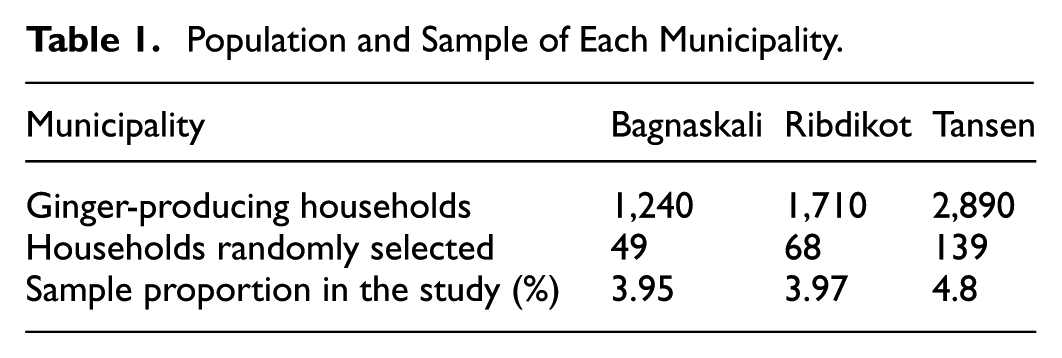
A two-phase sampling design was employed for this study. The first stage of the sampling focused on the Bagnaskali, Ribdikot, and Tansen municipalities in Palpa District, with households randomly sampled in the second phase. The number of households sampled from each municipality was determined based on the proportion of ginger-producing households within that municipality. In total, 256 households were surveyed across the three municipalities, with 49 located in Bagnaskali, 68 in Ribdikot, and 139 in Tensen, the most populous municipality. Table 1 provides information about the population of each municipality and the proportion of farmers sampled. Face-to-face interviews were then conducted using a structured questionnaire designed to collect detailed information on ginger production practices, challenges faced by farmers, storage methods, farmers’ experiences with production and sales, constraints related to storage and marketing, and the socioeconomic and demographic characteristics of participants.
Population and Sample of Each Municipality.
Variables in this study were selected based on the extent of literature about postharvest loss and technology adoption. Variables such as group-saving participation and membership in women’s associations were included because recent empirical evidence identifies collective finance and gendered networks as strong, close determinants of smallholder technology adoption, particularly under cash constraints for postharvest investments (Bantilan & Aupama, 2006; Karakara & Osabuohien, 2019). Riemer (2018) also demonstrated that social capital, through group membership and bonding networks, has a substantial influence on the adoption of sustainable land management, more so than weakly varying structural factors. By contrast, Po and Hickey (2020) demonstrated that climatic conditions and market-infrastructure variables often exhibit minimal cross-sectional variation within small geographic areas, making it difficult to isolate their effects due to measurement error and collinearity.
The structured questionnaire’s content validity was ensured through expert review, where three postharvest specialists and two local extension officers evaluated each item for relevance and clarity, resulting in a minor rewording of six questions. Reliability was assessed in a 2-week pilot with 20 ginger farmers outside the study area. Translation and back-translation between English and Nepali minimized the semantic gap, and enumerators received a full day of role-play training to standardize delivery.
Data Analysis
After data collection, exploratory data analysis was performed on the dataset to identify outliers, inconsistencies, missing values, and other anomalies that may affect the quality of the analysis. Because non-response on critical variables averaged below 5%, we opted for listwise deletion. This minor attrition did not alter coefficient magnitudes and significance in robustness checks. Potential outliers in continuous variables were identified using box-plot screening and cross-checked against the enumerator’s field notes. Values judged realistic (were retained), thereby preserving data integrity while avoiding arbitrary trimming.
Descriptive statistics were calculated using relative and absolute frequencies for qualitative variables and mean and standard error for quantitative variables. The decision by ginger producers to adopt a new storage technology can be quantified in an econometric model. When studying whether farmers decide to adopt an innovation, the literature suggests two critical models: the tobit and logit models. The logit model is a type of regression model used when the dependent variable is binary (i.e., a dependent variable that takes on two possible outcomes, such as 0 and 1, or “yes” and “no,” etc.). The logit model is part of a larger set of models known as generalized linear models, where the log odds of the probability of the outcome are modeled as a linear combination of predictor variables. The Tobit model, however, is a type of regression model used when the dependent variable is subject to some form of limitation. This typically means that the dependent variable is observed only within a certain range or is “censored” at a particular value, beyond which it cannot be observed or measured. A logit model is particularly useful, as many of the assumptions of linear regression are not required to be met; therefore, it provides researchers with considerable flexibility and has become the preferred method (Günerï & Durmuş, 2020). Here, the unobservable variable obtained from the independent variable

With γ representing the threshold value. The relationship between the dependent variable and the set of independent X can be expressed as:

with α and β representing the coefficients of in the regression model, and

In the present study,

The
Descriptive Statistics and Comparison/Association/Correlation with Percentage of Postharvest Loss.

Note.***p < 0.01, **p < 0.05, *p < 0.1.
To understand the factors affecting postharvest loss in detail, we analyzed the data by categorizing it, for example, educated versus non-educated farmers, farmers with access to extension services versus those without, and male versus female producers. This approach helps identify specific determinants and their relative impact on postharvest losses, facilitating targeted interventions. By comparing these groups, we can discover potential disparities and inform policy recommendations that address the specific needs of each group.
Results
The variables used in this study are described in Table 2 below. Regarding education, 62.67% of producers have no formal education, while 37.33% have at least completed primary school. The sample is predominantly composed of female producers, with women accounting for 64.89% of the study sample. Also, a majority of participants (54.67%) have more than 3 years of experience in ginger production, and the average household size is 5.27. Regarding income, the average revenue generated from ginger production is 7,809 Nepalese Rupees.
Participants, on average, cultivate ginger on 0.145 acres of land, with 40% reporting they practice group savings and 30.67% reporting access to different types of loans. The data also show the prevalence of extension services within the community, with 77.78% of respondents reporting access to such services.
Farmers also use diverse storage practices. In the sample, 68% of farmers use sacks for storage, 59% use pit storage, and 13% use bamboo baskets. It is worth noting that many farmers in the study combine storage types as a common practice. Collective work on form is observed among 64.89% of respondents in the study area.
Regarding storage use, 86.67% of participants reported some familiarity with storage practices. Lastly, respondents expressed a wide range of satisfaction regarding the quality of information related to best practices for ginger storage. In the sample, 13.78% felt not at all informed about storage practices, 57.33% perceived themselves as moderately informed, and 21.11% and 7.11% felt they were well- and very well-informed, respectively.
Postharvest Loss and Ginger Storage Practices
This study investigated the reported loss of ginger after harvest in Nepal and the willingness to store ginger in storage to reduce losses. Farmers reported an average percentage loss of 27.8% with a wide standard deviation (23%). Additionally, more than 10% of farmers (27) reported the loss of more than half of their production. Despite no significant difference, the data show that the reported percentage loss is, on average, higher for female farmers (29.4%) than for their male counterparts (24.8%). The same difference is observed between farmers who are not educated (30.8%) and those who are educated (26%). We also observed in the data that farmers unwilling to store their products have, on average, a higher reported percentage loss (34.7%) compared to those who are willing to store (26.9%). Overall, users of storage materials experience less loss compared to non-users. In particular, farmers who use sacks as storage have reported an average loss of 26%, while those who do not use sacks lose 30% of their production. Farmers storing in bamboo baskets lost 26%, compared to those who did not use the bamboo (37%). However, there is no difference between users of pit storage (27.8%) and the non-users of that storage (27.7%).
In terms of storage material preferences, 155 farmers use sacks, while 134 have indicated that they use pit storage. The bamboo basket is the least popular, with only 30 producers in the sample using it at the time of the survey. These numbers sum to more than the sample size because many farmers use a combination of storage methods.
Factors Affecting Postharvest Loss Among Farmers with and Without Access to Extension
Table 3 presents the results of two linear regressions that evaluate the determinants of ginger loss: one for the subgroup of farmers who have access to extension services and another for those who do not. When farmers do not have access to extension services, using pit storage significantly reduces ginger loss compared to those who do not use the technology (coefficient = −0.84, p < .001). Knowledge about ginger significantly decreases postharvest loss, even among farmers without access to extension services, as compared to those who do not have access to extension services and feel they lack knowledge about ginger storage. (coefficient = 0.764, p < .05).
Determinants of Postharvest Ginger Loss for Farmers with and Without Access to Extension.

Note.***p < 0.01, **p < 0.05, *p < 0.1.
Moreover, larger families with access to extension services experience reduced postharvest loss, as indicated by the regression result (coefficient = −0.065, p < 0.1), which suggests that an increase in household size is associated with a decrease in postharvest loss. When farmers have access to extension services, and these services are located within the community, it contributes as expected to reduce postharvest loss (coefficient = 0.477, p < 0.05). The regression results also indicate that pit storage (coefficient = −0.159, p < 0.001) and the sack (coefficient = −0.506, p < 0.001) reduce ginger loss when farmers have access to extension services. Moreover, farmers with access to extension services and who reported having some knowledge about ginger storage experienced a reduction in ginger loss (coefficient = −0.491, p < 0.001). It also follows that an experienced farmer in ginger production with more than 3 years of experience, who also has access to extension, significantly reduces his postharvest loss (coefficient = 0.42, p < 0.1).
Overall, both categories experienced a reduction in postharvest loss when they utilized pit storage and had some knowledge about ginger storage. However, extension is essential for a user of the sack to reduce ginger loss.
Factors Affecting Postharvest Loss Among Educated and Non-educated Farmers
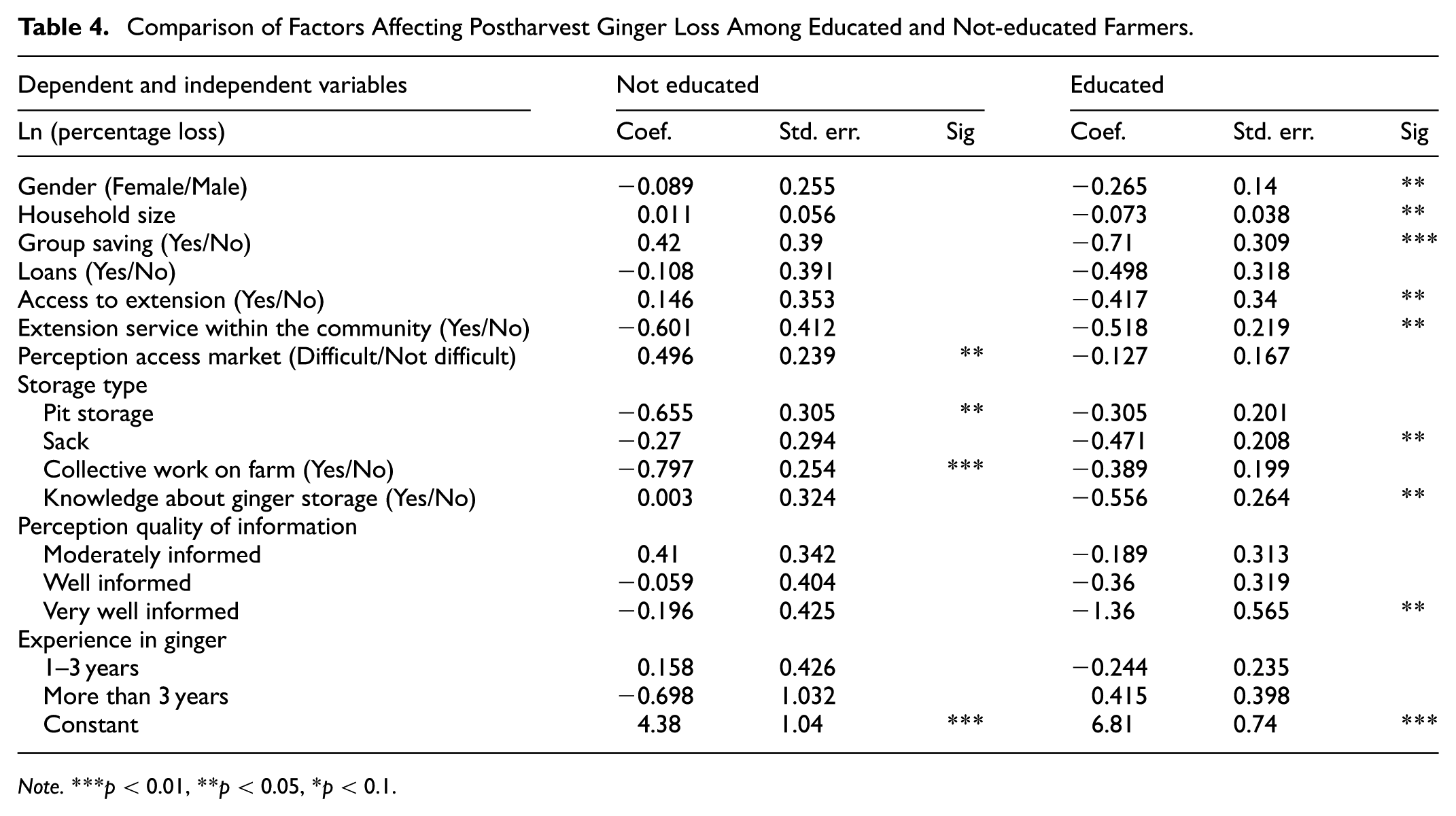
Among farmers who did not attain formal education, perceiving that market access is difficult leads to an increase in postharvest loss (coefficient = 0.496, p < 0.05). However, pit storage has a positive impact on postharvest loss among non-educated farmers (coefficient = −0.655, p < 0.05). Additionally, working collectively has a significant impact on reducing postharvest loss among non-educated farmers (coefficient = −0.797, p < 0.001).
When farmers are educated, many factors contribute to reducing postharvest loss. An educated male farmer has significantly lower losses than an educated female ginger farmer, ceteris paribus (coefficient = −0.265, p < 0.05). The result of the regression also indicates that a larger household with an educated head of household reduces significant ginger postharvest loss (coefficient = −0.073, p < 0.05). Group saving contributes to reducing postharvest loss when the farmer is also educated (coefficient = −0.71, p < 0.001). As expected, when educated farmers have access to extension services, they can significantly reduce their postharvest losses (coefficient = −0.417, p < 0.05). In particular, when the extension service is within the community of educated farmers, the effect on postharvest ginger loss is significant (coefficient = −0.518, p < 0.005). Using sacks for storage by educated farmers significantly contributes to reducing postharvest loss, as indicated by the regression model in Table 4 (coefficient = 0.471, p < 0.05). Additionally, knowledge about ginger storage enables educated farmers to reduce postharvest loss (coefficient = −0.556, p < 0.05). In particular, highly informed farmers, among the educated ones, significantly lower ginger losses (coefficient = −1.36, p < 0.001), which demonstrates the importance of information quality in reducing ginger post-harvest loss. These findings are summarized in Table 4.
Comparison of Factors Affecting Postharvest Ginger Loss Among Educated and Not-educated Farmers.
Note.***p < 0.01, **p < 0.05, *p < 0.1.
Factors Affecting Postharvest Loss Among Female and Male Farmers
Women experience higher loss compared to men; however, access to extension reduces this loss significantly, as indicated by the results of the regression model applied to the subgroup of women (coefficient = −0.012, p < 0.001). Moreover, women use effective storage technologies such as sacks and pit storage. Among women, users of the sack significantly reduce ginger loss (coefficient = −0.478, p < 0.05) compared to women who do not use the sack for storage, all else being equal. Additionally, women who use pit storage significantly reduce postharvest loss (coefficient = −0.44, p < 0.05) compared to those who do not use pit storage, all else being equal. Additionally, women practicing collective work significantly reduce postharvest loss (coefficient = −0.581, p < 0.001).
Regarding male producers, we observed that, like women, access to extension services significantly reduces postharvest loss (coefficient = −0.718, p < 0.05). Moreover, men benefit more than women when the extension is within the community. The results of the regression show that when the extension is within the community, men can significantly reduce their postharvest loss (coefficient = −0.708, p < 0.1; Table 5).
Comparison of Factors Affecting the Loss of Ginger for Male and Female Farmers.

Note.***p < 0.01, **p < 0.05, *p < 0.1.
Willingness to Store Ginger in Storage Technologies
The logistic regression analysis examines the factors influencing farmers’ willingness to adopt a storage technology for ginger. The binary dependent variable, willingness to store (Yes/No), is regressed against a set of independent variables. The results displayed in Table 6 provide the coefficient, standard error, z-value, and p-value for each variable.
Determinants of the Willingness to Store Ginger in an Improved Storage Technology.

Note.***p < 0.01, **p < 0.05, *p < 0.1.
Several interesting findings emerge from the regression analysis. Group saving appears to significantly increase the likelihood of willingness to store ginger (coefficient = −0.175, p = 0.055), all else being equal. This suggests that farmers participating in group saving activities are more likely to store ginger than those who are not involved in any group saving activities. The result of the logistic regression also reveals that experience plays a crucial role in the desire to store ginger. As farmers gain more experience in ginger production, they are more likely to store their postharvest production (coefficient = 0.44, p = 0.035). Participating in a women’s association increases the likelihood of the willingness to store ginger after harvest (coefficient = 3.065, p = 0.001). Government subsidies affect the willingness to store ginger products. However, unlike group saving and experience, government subsidy decreases the likelihood of storing ginger after harvest (coefficient = −1.378, p = 0.076). This result suggests that ginger farmers who receive government subsidies are less likely to store ginger than those who do not.
Additionally, as farmers sell more of their ginger during mid-season, they are less likely to store it (coefficient = −0.014, p = 0.00). Early sale of ginger affects the motivation to store ginger, as farmers who sell during an abundance period of ginger are less likely to be motivated to store ginger, as indicated by the regression result (coefficient = −4.469, p = 0.001). As expected, farmers who practice off-farm storage are also more likely to store ginger in new storage technologies (coefficient = 1.761, p = 0.005). Revenue derived from ginger production is also a significant factor in determining the willingness to store ginger after harvest. The model results show that the more revenue farmers receive from ginger production, the more they are willing to store their product after harvest (coefficient = 0.637, p = 0.099).
Discussion
In many developing countries, postharvest losses remain a critical obstacle to food security, dietary quality, and rural livelihoods. Large volumes of crops are damaged during harvest, handling, storage, and transport due to sub-optimal practices, insufficient infrastructure, and restricted access to suitable technologies. These systemic shortcomings diminish both the quantity and nutritional value of the food supply, disproportionately threatening the welfare of low-income households. Human capital and social networks drive the adaptation of technology. In our study, we found that farmers with access to extension services are significantly more likely to reduce postharvest loss. Specifically, extension services reduced losses by 38.7% (based on an odds ratio of −0.491, p < 0.001) compared to farmers without access to these services. For example, sack storage users with extension access experienced a 26% postharvest loss, compared to 30% among non-users. This effect is mainly due to the knowledge, training, and facilitation of technology adoption provided by extension services. These findings are consistent with evidence from Nigeria, where poor extension services have been identified as a significant factor in postharvest onion losses, and improving these services has been shown to reduce spoilage significantly (Falola et al., 2023). Similarly, in South Africa, improved extension and agribusiness investments were found to decrease postharvest losses among smallholder vegetable farmers (Qange et al., 2024).
The substantial and statistically significant impact of agricultural extension emphasizes its central role in improving postharvest outcomes in Nepal’s ginger production system. Rather than relying solely on subsidies, targeted knowledge transfer and hands-on coaching from extension officers yield greater efficiency gains. Evidence from Tanzania indicates that access to extension services can reduce the time to adopt improved storage technologies, such as hermetic bags, by 49%, with adoption accelerating to 61% when combined with social learning approaches (Manda et al., 2024). These findings prove the need for integrated approaches (pairing technology dissemination with extension) since scaling storage innovations without adequate support infrastructure and farmer training may limit their benefits. Consequently, extension should be seen not as an auxiliary service but as a foundational mechanism for achieving sustainable reductions in postharvest loss.
Education significantly reduces postharvest losses, with our study showing a 39.8% reduction among educated farmers. This highlights the importance of adult education programs and the delivery of appropriate content through extension services to help farmers adopt best practices (Ricker-Gilbert et al., 2022). Research indicates that better-educated farmers are more likely to adopt pest control techniques, such as neem biopesticides, and utilize advanced storage solutions, including hermetic bags and metal silos, which reduce pest and moisture damage (Benimana et al., 2023). Additionally, farmer education enhances awareness of the economic benefits of postharvest management and promotes investment in storage infrastructure. Studies also show that educational level is a significant determinant of technology adoption, and extension programs designed with adult learning in mind are more likely to improve the uptake of innovations that reduce loss (A. Adams & Jumpah, 2021; Yokamo, 2020).
Education significantly reduces postharvest losses, with our study showing a 39.8% reduction among educated farmers. This highlights the importance of adult education through extension services and delivering engaging content that encourages farmers to adopt best practices. Education not only improves awareness of effective postharvest practices but also enhances farmers’ ability to calculate economic benefits and invest in better handling and storage solutions (Ricker-Gilbert et al., 2022)
Experience in agriculture and social capital are crucial drivers of the adoption of storage technology. In our study, ginger farmers with more than 3 years of experience were over twice as likely to adopt storage practices (odds ratio = 2.11, p = 0.035). This finding is consistent with those from Central America, where prior experience and participation in training have been shown to significantly influence the adoption of metal silo storage technologies among smallholder farmers (Bokusheva et al., 2012). Similarly, social capital (defined by trust, norms, and networks within farmer groups) plays a pivotal role in encouraging the adoption of innovative storage techniques, as shown in studies from Kenya and the Philippines, where social connectedness enhanced both technology uptake and efficiency (Mamiit et al., 2021). Moreover, farmers with larger networks and higher trust levels are more likely to experiment with and adopt new agricultural technologies (Zhao et al., 2024).
The positive effect of farming experience highlights how knowledge accumulated through repeated production cycles reduces the perceived risks associated with storage and fosters confidence in adopting postharvest technologies. This aligns with findings in Ghana, where sustained exposure to improved storage solutions, such as Purdue Improved Crop Storage (PICS) bags, significantly increased adoption, and reduced postharvest losses by up to 19.1% (F. Adams et al., 2024). Extension programs in Tanzania also demonstrate that combining hands-on training with storage technology effectively boosts uptake and reduces losses (Chegere et al., 2022). Recruiting experienced ginger farmers as “lead farmers” to demonstrate best practices and mentor peers could reduce perceived risks and encourage adoption among less experienced farmers.
Women’s associations further enhance the adoption of storage. In Tanzania, membership in women’s or farmer groups increased the likelihood of adopting improved maize storage technologies by enhancing access to training and collective purchasing power (Mwinuka & Hyera, 2022). A study in Rwanda found that group membership and access to credit significantly influenced the adoption of hermetic storage (Benimana et al., 2023). Similarly, Nigerian maize farmers who received postharvest training within groups were significantly more likely to adopt improved cribs and protectants (Mbesa et al., 2024). These findings confirm that empowering farmer groups, particularly those led by women, is a scalable approach to promoting the adoption of storage technologies. They foster community networks, address gender inequities, support promotable practices, and reduce and minimize post-harvest. Their role is crucial for scaling agricultural innovations and enabling the effective leveraging of women’s contributions to drive economic growth. Strengthening these associations is key to building resilient, inclusive agricultural systems, particularly in developing countries. The result highlights the importance of social capital and demonstrates that leveraging experienced farmers and women’s groups as knowledge hubs can accelerate the adoption of storage across Nepal. The role of women’s associations in storage adoption, as revealed by the logistic model, shows that gender-centered collective action is one of the strongest levers for scaling postharvest technologies in Nepal’s ginger production system. Savings-and-credit cooperatives can leverage established community relationships, where members trust each other and monitor one another’s activities and also benefit from the shared savings accumulated by the group. One policy implication of this study is that most postharvest vouchers or subsidies should be subject to active participation in these groups rather than being distributed to individual farmers, with the association acting as a guarantor. Additionally, capacity-building workshops on storage management, pest control, and market timing could be organized through these groups to foster a culture of knowledge sharing and peer support.
Our logit model indicates that households receiving government input subsidies are 32% less likely to invest in improved ginger storage technologies than those who do not (OR = 0.68, p < 0.05). The unexpected negative odds ratio suggests that the current subsidy scheme alleviates liquidity constraints at planting but leaves farmers cash-strapped at harvest, thereby discouraging private investment in postharvest infrastructure. Comparable evidence supports this pattern. In India, high input subsidies for fertilizer and electricity have been shown to crowd out public investment and reduce long-term incentives for farmers to invest in productivity-enhancing technologies (Zafar & Tarique, 2023). Similarly, findings from the Democratic Republic of the Congo suggest that combining input subsidies with extension services boosts short-term input use. Still, it does not meaningfully support sustained investment in infrastructure due to structural market barriers (Leuveld et al., 2018). A randomized study in Mozambique found that savings interventions, rather than subsidies alone, are more effective in sustaining the adoption of agricultural technologies after the subsidy ends due to reduced risk exposure (Carter et al., 2016). This suggests that Nepal’s current subsidy program, which focuses on agricultural inputs, unintentionally reduces the incentive for smallholder ginger farmers to adopt storage technologies, thereby sustaining the high postharvest losses that the government aims to mitigate. Redirecting a portion of the subsidy budget into harvest-time support (delivered through farmer groups already demonstrating storage adoption) may yield better outcomes, as seen in Malawi, where targeted subsidies improved food retention and technology uptake (Jayne et al., 2018).
This study provides important insights, but limitations temper our conclusions. The sample is restricted to 256 households in three municipalities (Bagnaskali, Ribdikot, and Tansen) in Palpa district, which may not represent the diverse agro-ecological and socioeconomic conditions of ginger farmers across Nepal, particularly in high-humidity Terai regions where fungal pressure is more severe. The reliance on cross-sectional data limits the ability to capture dynamic changes in storage practices over time. Additionally, self-reported data on postharvest losses and storage behaviors may be prone to measurement errors, such as recall bias or overestimation, which could impact the accuracy of the model estimates. The study did not measure farmers’ risk preferences, which recent research indicates significantly influence storage decisions. Incorporating preferences could enhance the behavioral model. The focus on ginger limits generalizability to other crops with distinct postharvest characteristics, such as grains or vegetables. Finally, the study did not account for the influence of middlemen or traders, who may pressure farmers to sell immediately, potentially impacting their willingness to store and requiring further investigation.
Conclusion and Future Research Directions
This study demonstrates that social capital (group savings schemes and women’s associations), human capital (education and extension contact), and market timing jointly drive the storage behavior of Nepali ginger smallholder farmers, while poorly designed input subsidies can inadvertently suppress investment in postharvest infrastructure. Policymakers should, therefore, prioritize expanding savings-and-credit groups, embedding storage vouchers and extension modules within farmers’ associations, and sequencing subsidies so that support is delivered at harvest rather than planting. Strengthening these channels would not only reduce physical losses but also raise seasonal prices and enhance the bargaining power of the women who dominate ginger processing and trade.
Future studies should employ longitudinal or experimental designs to establish causal effects, replicate findings in diverse regions such as the Terai, and incorporate behavioral measures to gain a deeper understanding of storage decisions. These directions, along with research on other crops and climate impacts, can guide Nepal toward reducing postharvest losses and enhancing food security.
Addressing these gaps will strengthen the evidence base for a nationwide, gender-responsive strategy to halve postharvest ginger losses by 2030.
Footnotes
Acknowledgements
We want to thank our research collaborators team in Nepal for their contributions in this research program.

Ethical Considerations
This study received ethical approval from the Purdue IRB (approval # IRB-2022-1101) On November 11, 2022.
Funding
The author(s) disclosed receipt of the following financial support for the research, authorship, and/or publication of this article: This study is made possible by the generous support of the American people through the United States Agency for International Development (USAID) under the Feed the Future initiative - USAID Feed the Future Food Systems for Nutrition Innovation Lab at Tufts University cooperative agreement number 7200AA21LE00001. The Purdue Grant number is PO EP0233973: Reducing Ginger Storage with Women Producers in Nepal. The contents are the responsibility of Purdue University and do not necessarily reflect the views of USAID or the United States Government. Others that we are grateful to include the Agriculture Knowledge Centers, Agricultural Department of Local Municipalities, the Ginger Research Program of NARC, credit providers, the Institute of Agriculture and Animal Sciences, Agriculture and Forest University, Heifer International, the Rural Economic Development Association (REDA), Federation of Nepalese Chambers of Commerce & Industry (FNCCI) and the Nepal Ginger Producers and Traders Association (NGPTA).
Declaration of Conflicting Interests
The author(s) declared no potential conflicts of interest with respect to the research, authorship, and/or publication of this article.
Data Availability Statement
The data will be shared on request after the publication of this paper.