




Abstract
This study investigates the relationship between socio-psychological factors, innovation attributes, behavior intention, and green fertilizer technology (GFT) adoption among Malaysian paddy farmers. The study also examined whether behavior intention mediated the relationship between socio-psychological factors and green fertilizer technology. The study collected data from 170 paddy farmers in Malaysia’s Kedah and Perak states. The study used a quantitative research design and analyzed the data using the SmartPLS 4 software. The study’s results indicate a positive and significant relationship between the socio-psychological factors, innovation attributes, behavior intention, and the adoption of GFT. Specifically, the study found that the socio-psychological factors significantly positively affect farmers’ behavior intention to adopt GFT. Further, innovation attributes significantly impact farmers’ behavior and intention to adopt GFT. The study’s findings provide several implications for policymakers, extension agents, and other stakeholders interested in promoting the adoption of GFT among Malaysian paddy farmers. The study suggests that promoting positive attitudes toward GFT, creating awareness of the benefits of GFT, and improving farmers perceived behavioral control may increase farmers’ intention to adopt GFT. Additionally, policymakers should develop GFT that is simple and compatible with farmers’ needs, making it easier for farmers to adopt. Moreover, this study contributes to the literature on adopting green technologies by highlighting the importance of socio-psychological factors and innovation attributes in shaping farmers’ behavior intention to adopt GFT. The study’s findings have practical implications for policymakers and other stakeholders interested in promoting the adoption of GFT among Malaysian paddy farmers.
Keywords
Introduction
Green fertilizer technology (GFT), such as using green fertilizer (GF), has been identified as a promising approach to addressing the challenges facing Malaysia’s agriculture sector (Adnan et al., 2018). However, despite its potential benefits, the adoption of GFT among smallholder farmers remains low. This is due to several factors, including limited access to information and technical knowledge and the perception that traditional practices are more effective. A study by Adnan et al. (2020) found that while smallholder farmers in Malaysia were aware of the benefits of GF, they lacked the technical knowledge and support needed to implement the technology effectively. Previous studies, such as Nordin et al. (2014) recommended training programs, information dissemination, and policy support to promote the adoption of GFT among smallholder farmers in Malaysia. This highlights the current issue facing the Malaysian agriculture context, which requires further efforts to promote and support adopting sustainable agricultural practices such as green fertilizer.
According to Chojnacka et al. (2022), GFT has the potential to improve soil health, increase crop yield, and reduce environmental degradation. However, its adoption by farmers is influenced by various socio-psychological factors, innovation attributes, and behavior intention. Although several socio-psychological factors have been found to influence farmers’ attitudes and behaviors toward adopting GFT (Meijer et al., 2015). Studies have identified education level, age, farming experience, and income level as significant predictors of adoption behavior (Prokopy et al., 2019; Sharifzadeh et al., 2019). Additionally, farmers’ environmental attitudes and awareness of the benefits of sustainable practices have positively influenced their adoption behavior (Mwangi & Kariuki, 2015; Sennuga et al., 2020).
Innovation attributes, such as perceived usefulness, ease of use, and compatibility, are also significant predictors of farmers’ adoption of GFT (Zeweld et al., 2017). Research has shown that farmers are more likely to adopt innovations that they perceive to be useful, easy to use, and compatible with their existing farming practices (Adebiyi et al., 2017; Kernecker et al., 2020). While the perceived benefits of GFT, such as improved soil fertility and reduced environmental impact, are strong predictors of adoption behavior (Oluwasusi, 2014). Furthermore, previous researchers such as Adnan et al. (2019) argued that farmers’ behavior intention is a crucial determinant of their adoption behavior toward GFT. The Theory of Planned Behavior (TPB) has been used extensively to explain farmers’ intention to adopt environmentally friendly technologies. According to TPB, farmers’ behavior intention is influenced by their attitude toward the technology, subjective norm (social pressure from family, friends, and peers), and perceived behavioral control (ability to adopt the technology) (Borges et al., 2014; Miheretu & Yimer, 2017). Studies have found that these factors significantly influence farmers’ behavior intention toward adopting GFT.
According to Desa (2018), Malaysia’s population is expected to grow by 45% from 32.4 million to 46.4 million by 2050, so existing food systems will be challenged to meet demand. As a result, the food industry in Malaysia is upgrading and developing to accommodate local and global markets. However, the agriculture sector faces numerous challenges related to low production crises, adversely impacting the country’s economy (Adnan & Nordin, 2021). Although agriculture contributes 8.2% of total GDP only, it plays a crucial role in the national socio-economic development agenda, particularly in achieving the Sustainable Development Goals (SGDs), economic equity, protecting and ensuring food safety and a stable and prosperous planet for future generations (Fao, 2018). With a growing population, supplying excellent food and attaining food security in the future becomes a crucial economic challenge that must be addressed immediately (I. Ali et al., 2021).
Recently, the Twelve Malaysian Plan (2021–2025) has revealed its development roadmap aims to reset the economy, strengthen security, well-being, inclusivity, and advance sustainability. In the Twelve Malaysian Plan, Malaysia focuses on rice and paddy production, as its staple food and staple crop (Firdaus et al., 2020). About 70% of Malaysia’s rice is produced domestically, while the remaining 30% is imported (Zahiid, 2019). According to the Malaysian Ministry of Agriculture and Agro-Industry, the country traded in 740,000 tons worth RM 1.18 B (The star, 2019 [https://www.thestar.com.my/news/nation/2019/01/23/malaysia-in-bid-to-increase-rice-production-by-5/#piT2rMOX16jpO2qd.99]) rice the preceding year. Thereafter, the authorized government agency came up with an approach to formulate a policy that would modernize and revolutionize rice agribusiness in Malaysia to be able to address the problem which has been encountered by this sector in the past (Dardak, 2015). The government has also taken proactive and progressive steps to increase rice production through sustainable development (Firdaus et al., 2020).
Green fertilizers (e.g., control-release fertilizers) may be espoused in order to achieve highly sustainable paddy production. There is a green technology known as controlled release fertilizer (CRF) that reduces the amount of nitrogen lost due to volatilization and leaching on the crop as well as alters the way the nitrogen is released from the crops (Remya et al., 2021). As a result of applying CRFs, soil fertility can be improved, growth can be promoted, rice production can be increased, pollution can be reduced, and biocompatibility can be increased (Vejan et al., 2021). GFT is introduced as an improved fertilizer application in the agricultural sector to increase yield and sustain environmental quality. Several CRF has been introduced with special coating technology and tested successfully through experimental and field trials. The espousal of CRF promotes high yield and lowers the pollution impacts from fertilization (Mohammad et al., 2017). However, the espousal of GFT in paddy farming is relatively slow and the decision to espouse the GFT has gained the interest of scholars. The acceptance rate of the GFT is also too low in order to exclusively discuss the intention decision between ShPFs without considering a local demographic perspective. The main reason was the lack of understanding toward “green practices” and their significance, which assist farming activities by increasing production while maintaining sustainable environmental practices. This paper aims to investigate the behavior of ShPFs in Malaysia to be able to develop strategies for GFT to be espoused through a socio-psychological and innovation attribute framework based on the TPB and TAM.
While previous studies have examined the factors that influence the adoption of GFT among smallholder farmers in Malaysia (Adnan et al., 2017), there is a gap in the literature regarding the relationship between socio-psychological, innovation attributes and behavior intention toward the adoption of GFT. Specifically, previous research has focused on factors such as access to information, technical knowledge, and policy support in promoting the adoption of GFT (Takahashi et al., 2020). Although, previous studies have shown that socio-psychological factors, such as perceived relative advantage, compatibility, complexity, trialability, and observability of the innovation, can significantly influence the adoption of new technologies in agriculture (de Oca Munguia & Llewellyn, 2020; Meijer et al., 2015). However, there is a need for further research to investigate the relationship between Scio-psychological, innovation, and behavior intention toward adopting GFT among smallholder paddy farmers in Malaysia. However, there is a need to explore how socio-psychological, innovation and behavior intention influence on GFT among smallholder paddy farmers in Malaysia. This research gap highlights the need for a deeper understanding of the socio-psychological factors, innovation and behavior intention that affect the adoption of GFT and the potential to use this knowledge to develop more effective strategies to promote sustainable agricultural practices among smallholder farmers in Malaysia.
In the context of Malaysia, this research study offers significant insights into the potential of GFT to promote sustainable agriculture among smallholder rice farmers. According to Fahmi et al. (2013), Malaysia’s agricultural sector is a vital component of the country’s economy, with rice being a key staple crop. However, smallholder farmers often face significant challenges, including limited resource access and poor soil quality. This study’s findings on the benefits of GFT provide promising opportunities for smallholder rice farmers in Malaysia to improve soil fertility, reduce input costs, and increase yields. Moreover, promoting sustainable agricultural practices such as green fertilizers align with Malaysia’s commitment to achieving the United Nations’ Sustainable Development Goals, including Goal 2 of zero hunger and Goal 15 of life on land (Mahdi et al., 2023). In particular, this research study’s implications are of great significance in the Malaysian context and could positively impact the country’s agricultural sector’s sustainability and resilience. This research study is an important contribution to sustainable agriculture, as it presents a wealth of new and valuable information on the benefits of green fertilizers for smallholder rice farmers. The study highlights the many advantages of using green manures, such as increased soil fertility, reduced pest and disease pressure, and improved crop yields. Additionally, the research indicates that green fertilizers can be a cost-effective and sustainable way for smallholder farmers to manage soil health and enhance their agricultural productivity. The findings of this study provide exciting opportunities to promote green fertilizers among smallholder rice farmers and to support the adoption of more sustainable agricultural practices.
Although there have been studies investigating the adoption of GFT among farmers in various countries, there is a research gap on the relationship between socio-psychological factors, innovation attributes, and behavior intention on GFT, specifically in Malaysia. While some studies have explored the factors that influence the adoption of sustainable agriculture practices in Malaysia (Adnan et al., 2018; Tey et al., 2014), these studies have focused on broader concepts such as sustainable agriculture or organic farming and have not specifically examined the adoption of GFT. Additionally, few studies have used a comprehensive framework, such as the TPB, to examine the relationship between socio-psychological factors, innovation attributes, and behavior intention on the adoption of GFT in Malaysia (Adnan et al., 2020). Therefore, there is a need for further research to explore the unique factors that influence the adoption of GFT in Malaysia, which can inform the development of effective policies and extension services to promote its adoption among farmers.
In most of these studies, agricultural technologies were studied in developing countries, with a particular focus on the factors affecting espousal by ShPFs. For example, Chi and Yamada (2002) studied the factors affecting farmers’ espousing technologies in farming systems in Japan. It is also worth mentioning that much of the literature has explained how different factors influence an individual’s decision to espouse a particular technology (Akudugu et al., 2012). Two major factors influencing technology adoption are the availability and affordability of new agricultural technologies and farmers’ expectations of long-term profitability (Foster & Rosenzweig, 2010). Similarly, in a study by Foster and Rosenzweig (2010), various factors affect the espousal of technologies by ShPFs in Sub-Saharan Africa, including assets, income, institutions, vulnerability, awareness, labor, and innovativeness. In light of this, the factors that influence the espousal of GFT by ShPFs through their behavior intentions need to be studied. Moreover, in Malaysia’s states of Perak and Kedah, the factors that strongarm ShPFs espousal of new technology will be examined based on socio-psychological factors and innovation attributes.
As discussed above, the adoption of GFT among farmers is influenced by various socio-psychological factors, innovation attributes, and behavior intention. Farmers’ education level, age, farming experience, and income level, as well as their environmental attitudes and awareness of the benefits of sustainable practices, are significant predictors of their adoption behavior. The perceived usefulness, ease of use, compatibility of GFT, and farmers’ behavior intention also strongly influence their adoption behavior. The current study investigates the impact of socio-psychological factors, innovation attributes, and behavior intention on the adoption of GFT in Malaysia is important for several reasons. Firstly, the agriculture sector is a significant contributor to Malaysia’s economy. Promoting the adoption of sustainable farming practices, such as GFT, can help increase productivity, reduce environmental degradation, and enhance farmers’ livelihoods. Secondly, understanding the factors that influence farmers’ adoption behavior can inform the development of effective policies and extension services to promote the adoption of GFT. Finally, given Malaysia’s diverse farming systems and cultural contexts, investigating the relationship between socio-psychological factors, innovation attributes, and behavior intention on adopting GFT in Malaysia can contribute to a better understanding of the factors that influence the adoption of sustainable farming practices in Southeast Asia.
Literature Review and Hypotheses Development
In terms of agricultural sustainable growth, espousal decision concepts are among the most well-established fields of study. Many different theoretical models from fields including social psychology, sociology, and marketing have been merged and updated throughout time to better explain and forecast the substantiated factors that influence espousal (Adnan et al., 2017). It is extremely challenging to choose theories and variables based on substantial theoretical background (Venkatesh et al., 2012). The purpose of this study was to extend the model by analyzing a few models and variables. There is a substantial amount of published research on choosing precise variables.
Theory of Planned Behavior
While applications of Theory of Planned Behavior (TPB) theory in agriculture and related industries are currently limited, the findings from Ansari and Tabassum (2018), Bergevoet et al. (2004), and Hrubes et al. (2001) that have been conducted so far are promising. Behavioral control (how easy or hard it is to accept the activity) has been shown to affect farmers’ espousal intentions in several previous types of research (Bergevoet et al., 2004; Hattam, 2006; Wu & Chen, 2014). According to Ajzen (2020) TPB can be used as a framework for behavioral approaches in agriculture. Nonetheless, obtaining substantial justification of self-efficacy, normative influences, and identity can be more beneficial. Recently, the research added perceived practice qualities to TPB to improve its reliability in analyzing espousal behavior (Reimer et al., 2012). These traits affected farmers’ espousal behavior empirically. As highlighted by Barr and Cary (2000) which traits best reflected the major aspects of sustainable farming methods that make acceptable to landowners (Reimer et al., 2012).
The Theory of Planned Behavior (TPB) has been widely adopted in Malaysia’s agricultural sector to encourage GFT adoption (Yang et al., 2022). According to Ajzen (2020) TPB is a psychological theory that explains how attitudes, subjective norms, and perceived behavioral control influence human behavior. In the context of GFT, the TPB has been used to understand farmers’ intentions to adopt an environmentally friendly approach to agriculture (Despotović et al., 2019). The theory has been employed to identify the factors influencing farmers’ attitudes toward GFT, such as their beliefs about its effectiveness and environmental benefits. In this study, we employed the TPB, socio-psychological factors, and innovation attributes to understand the impacts of behavior intention on adopting GFT in the Malaysian context. The socio-psychological factors include subjective norms, perceived behavioral control, and attitudes toward the use of GFT. Innovation attributes were used to assess the characteristics of GFT that influence its adoption, such as its compatibility with existing practices, complexity, and trialability. By employing the TPB along with socio-psychological factors and innovation attributes, this study provides a comprehensive understanding of the factors that influence the adoption of GFT in the Malaysian agricultural sector. The results of this study can inform policies and interventions aimed at promoting the adoption of GFT in the agricultural sector in Malaysia. Consequently, the adoption of the TPB in the agricultural sector of Malaysia has been instrumental in promoting GFT and achieving sustainable agricultural practices compared to other behavioral theories, such as the Theory of Self Efficacy, and the Theory of Reasoned Action.
Technology Acceptance Model
Known as Technology Acceptance Model (TAM), it is a structured approach to studying technology acceptance by end users. A major determinant of usage behavior is behavior intention; behavior intention can be measured in order to predict behavior (Jayasingh & Eze, 2015). An individual’s behavior intention is determined by the perceived usefulness (PU) and ease of use (EU) of the technology. “PU and EU are postulated a priori and are meant to be fairly general determinants of user acceptance” (Caffaro et al., 2020). Achieving self-efficacy and striving for instrumentality are the two mechanisms by which the EU influences behavior. Consequently, if the technology is easily accessible and successful, users are more likely to use it. According to TAM, external factors such as individual differences, constraints and organizational characteristics influence internal behavior and decision-making (Armitage & Conner, 2001).
The Technology Acceptance Model (TAM) has been widely treated to understand the factors that influence the adoption of new technologies in various contexts, including the agricultural sector (Kim et al., 2017). In the context of GFT adoption in the Malaysian agricultural sector, the TAM is related to socio-psychological factors, innovation attributes, and behavior intention. The TAM posits that perceived usefulness and perceived ease of use are the key factors that influence the adoption of a new technology (Ma et al., 2017). In the case of GFT, these factors are influenced by socio-psychological factors such as subjective norms, attitudes toward environmental sustainability, and perceived behavioral control. Innovation attributes such as compatibility with existing practices, complexity, and trialability is also influence perceived usefulness and ease of use. In addition, behavior intention, a key construct in the TPB, is also incorporated into the TAM. Behavior intention reflects an individual’s readiness to perform a specific behavior, such as adopting GFT (Lou et al., 2021). Considering behavior intention, perceived usefulness, and ease of use, the TAM provides a more comprehensive understanding of the factors that influence the adoption of GFT in the Malaysian agricultural sector. Overall, by incorporating socio-psychological factors, innovation attributes, behavior intention, and the TAM, researchers can gain a deeper understanding of the factors that influence the adoption of GFT in the Malaysian agricultural sector and develop interventions to promote its adoption.
Green Fertilizer Technology (GFT)
Espousing agricultural technology and innovations has often been an important pathway for ensuring the transformation of smallholder farming systems, better agricultural production, food security, and rural economic development (Rahaman et al., 2021). In agriculture, innovation might take the form of new seeds, new varieties of fertilizer, or insecticides for espousal, all of which contribute to higher agricultural yields (Gray & Gibson, 2013). GFT is a term often used in the agriculture industry to refer to improving fertilizer application. Green fertilizer application contributes to increased food yield (Timsina, 2018). GFT, which emerged at the end of the 1960s, currently receives much attention since farmers are still paying less attention to raising agricultural productivity using GFT (Ritzema et al., 2017). The GFT application is meant for a couple of farming activities that include environment-friendly innovation, contributing to sustainable agriculture and increased production (Hayat et al., 2020). However, increasing the GFT acceptance rate has been low in new developing nations (Ariga et al., 2019). Despite the mixed results that have been experienced by some African countries in the promotion of the GFT fertilizer (Cholo et al., 2018), South American countries are doing better, but there is still a considerable improvement. According to remarks by researchers from Iran (Farzaneh et al., 2021), Pakistan (Ullah et al., 2020), the Philippines (Briones, 2016), and Malaysia (Abdullah et al., 2016), similar findings have occurred in Asia (Amekawa et al., 2017). As of now, the observable levels of GFT espousal do not justify the significant investments and efforts made to approve and disseminate their advantages, contrary to the expectations of policymakers (Adnan & Nordin, 2021). Malaysia aims to increase the GFT’s espousal rate as an emerging nation in the future. The current research focuses on the paddy industry as it is one of the important food sources. Given its significance as the nation’s primary crop, the Malaysian government-affiliated organization has prioritized paddy cultivation (Yusof et al., 2019). Despite this, as previously reported, the entire yearly rice output amounted to 1.51 million metric tonnes, falling short of the ingesting threshold (Yusof et al., 2019). Previous research on GFT espousal focused on a wide variety of elements, for instant the sociological aspects of farmers’ incentives functioning as behavior triggers (Adnan & Nordin, 2021).
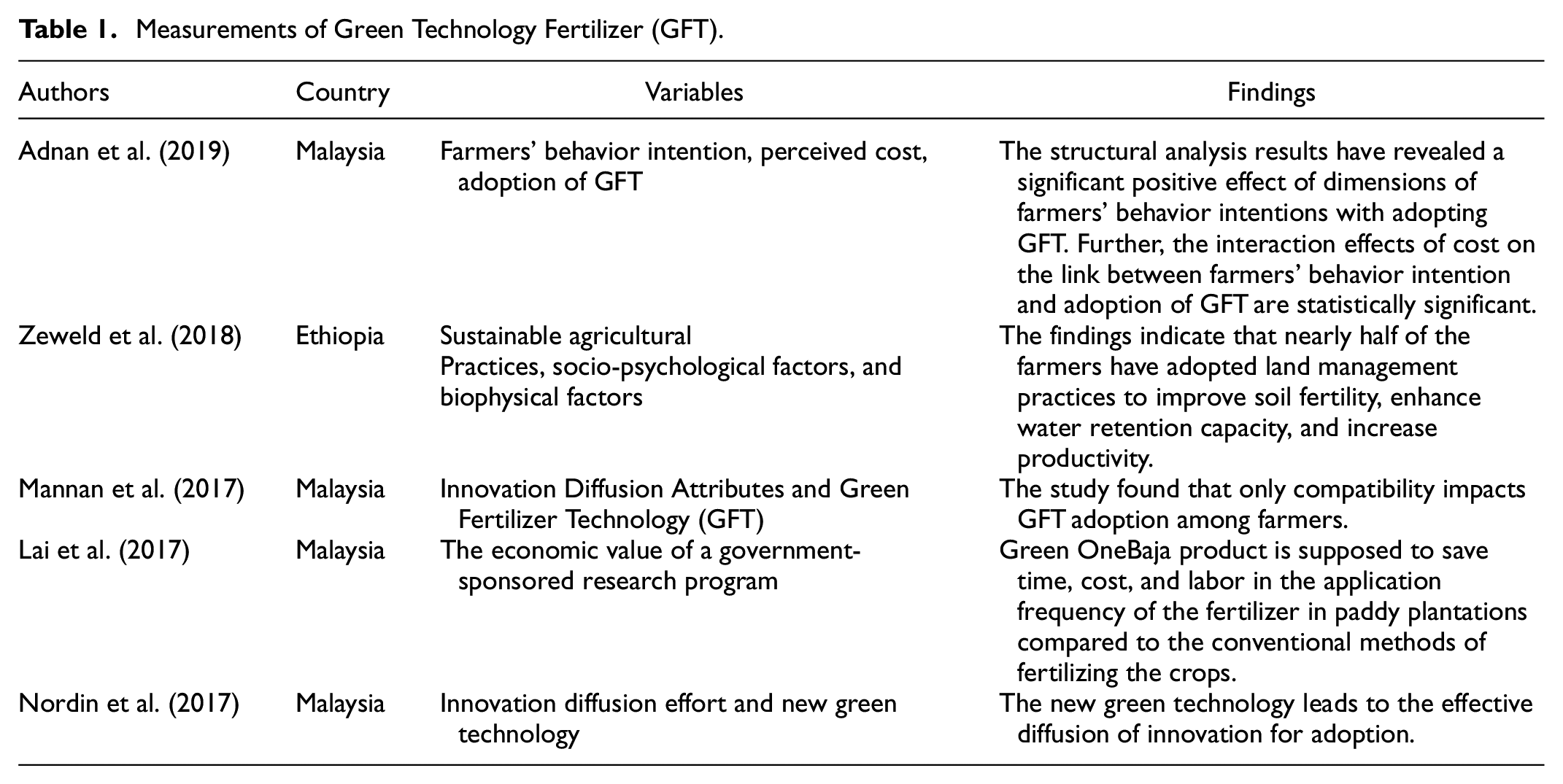
The adoption of green technology fertilizer (GFT) has gained momentum in recent years due to its potential to improve soil health, increase crop yields, and reduce environmental pollution. Table 1 highlights that previous literature in Ethiopia and Malaysia has explored the adoption of GFT, but more studies are required to investigate the role of socio-psychological factors, innovation attributes, and behavior intention in the context of Malaysia. It is crucial to understand these factors as they can influence the adoption and diffusion of GFT among farmers, which is vital for sustainable agricultural development. Therefore, further research is necessary to provide insights into the drivers of GFT adoption and devise strategies to encourage its widespread implementation.
Measurements of Green Technology Fertilizer (GFT).
Factors Affecting GFT Espousal
Espousing technology within the agricultural community is critical to ensure that ShPFs can engage in an ever-changing environment, with technology gradually incorporated into the population’s lives (Adnan et al., 2019). The countenance “espousal” refers to the process of selecting technology to be implemented by individuals or entities referred to as technology users. The perspectives of technology users on the espousal of new technologies are, unsurprisingly, different (Dilipkumar et al., 2021). In essence, espousal is a personal choice on how to respond to new circumstances. The espousal of various agricultural technology and advances is hindered by several reasons, making understanding the process complex and challenging. Several variables, including farm size, have been identified to substantially affect espousal decision-making (Klerkx et al., 2019).
According to a report on technology espousal among Malaysian farmers, farmers’ decision to embrace innovations was influenced by cost (H. Rahim et al., 2022). Furthermore, Bui and Nguyen (2021) identified three other elements that contribute to technology espousal: farmers’ educational level, loan accessibility, and support services. As previously mentioned, the espousal of any agricultural innovation is determined mainly by the amount and revenue of the technology. It has been revealed that large, fixed expenses impede innovation espousal in small farms (H. Rahim et al., 2022). Asodina et al. (2021) found that soybean farmers’ educational level was positively related to their ability to analyze soil samples and determine the quantity of fertilizer to apply to their crops. Similar research (Acevedo et al., 2020) found that farmers with acceptable education and experience played a more substantial role in assuring the successful espousal of the tillage reduction strategy in maize plantations. In accordance with Rezaei et al. (2020) research investigations, pricing is a powerful tool for influencing the espousal of targeted innovations based on technology acceptance models (TAMs).
According to Dan et al. (2019), the great complexity of technology has a detrimental impact on espousal behavior, which can only be overcome by teaching prospective users. According to Dan et al. (2019), a farmer’s rate of the espousal of a resource-saving technology is determined by “an increase in net income due to the acceptance of the innovation, the household-education head’s level, the entire irrigated cropped zone, information source, the farm household’s ownership of a tractor, and the ability of the innovation to save possessions like labour.” On the other hand, age affects the tendency to espouse. According to Adnan and Nordin (2021), the problem of land rights and future tenure security among farmers may impact espousal choices. Another element that aided the espousal of GFT crops was the potential economic advantage from increased production, efficiency, and flexibility (Dilipkumar et al., 2021). Even more so, farmers are more likely to reject technological espousal if they are unsure about their land title status.
Furthermore, if a new technology fails to gain traction in the early stages, the subsequent pace of progress significantly impacts the technology’s acceptance (Liu et al., 2019). The initial failure of a new technique might cause skepticism, distrust, and even rejection among farmers, and its trustworthiness will be questioned. Generally, evaluating the components that promote acceptance is crucial to boosting agricultural development. In this study, Malaysian rice farmers explore GFT innovation and its benefits. Conversations led to numerous agrarian advancements. However, the previous argument led us to conclude that certain elements substantially affect inventions, such as GFT Individual farmer views and the lack of institutional innovation impact on espousal choices. In general, understanding the role of internal and external elements impacting espousal is required to meet the farmers’ goals. Consequently, understanding the factors influencing acceptance varies from socio-psychological to innovative aspects.
Espousing agricultural innovation has long been a central focus of agricultural research, with sociologists and economists debating the issue for decades (Klerkx et al., 2019). Researchers have used the TPB and TAM factors and communication routes to help them understand how agricultural innovations get adopted. These theories represent technology users’ knowledge and attitudes concerning technological qualities as critical factors influencing their choice to embrace GFT from a different angle. Espousal was traditionally seen as a result of a mix of farmer qualities and the unique structures of the specific technology (Evenson, 2003). The qualities of a farmer, such as education, age, and experience level, all affect the espousal choice to varying degrees and signals, depending on the technology under consideration, for example Tey (2013). Espousal researchers have often examined the farmer’s age, and it is generally thought that the farmer’s age is adversely associated with espousal (Evenson, 2003). It is sometimes assumed that elderly farmers have a limited planning horizon and are less interested in espousing new technologies. Espousal is positively influenced by experience and education (Tey, 2013). Subjective norms, social norms, behavior intention, perceived behavioral control and attitude are the constructions that correspond to their respective socio-psychological categories. The following hypotheses have been developed based on the present literature review:
Socio-Psychological and GFT
A substantial advancement in the study of socio-psychological factors over the past few decades has also been evident, reflecting the increasing sophistication in the area of socio-psychological factors (Gupta et al., 2012). As a result of research conducted in recent years, perceived risk, perceived benefit, trust, knowledge, individual differences, and attitude have been reported or cited as the most influential factors influencing behavioral decisions (Hansen et al., 2003). As a result of understanding the socio-psychological factors, it should be possible to contextualize its development and implementation, as well as potentially allocate resources to important areas where they are needed. Despite this, socio-psychological factors play a crucial role in the decision-making process for GFT espousal (M. H. A. Rahim et al., 2012). As a result, the key aspects that influence ShPFs’ espousal decisions are socio-psychological factors. It has been shown that social, political, and cultural factors play a significant role in fertilizer application; however, the socio-psychological factors that play a role in fertilizer application are not well known. In this study, sociological factors are examined that motivate GFT espousal. There is also some evidence that suggests a slight understanding of the psychological paradigms that underlie a farmer’s espousal decision on GFT (Borges et al., 2014). There has been an increasing interest in socio-psychological approaches to studying espousal decisions (Reimer et al., 2012).
H1: Socio-psychological factors impact farmers’ behavior and intention to espouse GFT.
Innovation Attributes and GFT
The results of previous research suggested that farmers’ perceptions of crops are continuous processes that involve diverse but interrelated stages throughout the crop’s life cycle. The perception of farmers concerning new technology espousal remains unaddressed despite all these studies (Thompson et al., 2019). Most farmers, especially those from Malaysia, cannot understand the “innovation” terminology and its importance for the next generation (Adnan & Nordin, 2021). The benefits of innovation might be unknown to farmers because they are more confident in traditional practices. Despite this, new technology adoption is often viewed as an indirect threat to more traditional agricultural methods. A better understanding of farmers’ perceptions of green technology and in particular the barriers related to its adoption is needed (Bukchin & Kerret, 2018). Farmers use innovations based on characteristics related to innovation; in this case, the GFT suggests there hasn’t been enough research on the effect of innovation traits on farmers’ behavioral intentions. The following hypothesis has been proposed based on current research:
H2: Innovation attributes impact farmers’ behavior and intention to espouse GFT.
Behavior Intention and GFT
One research by Adnan et al. (2019) stated that attitude is an important precursor to behavior intention. Martey et al. (2013) surveyed to determine farmers’ intentions toward the use of GFT. Their article strongminded that farmers concerned about the environment are more likely to utilize GFT According to Ajzen (2020), customers with positive views are more likely to engage in particular actions. In line with the literature studied and the above discussion, the following hypotheses were proposed:
H3: Behavior intention has an impact on farmers espousing GFT.
Research Methodology
Measurement of Variables
The present study includes four main variables, each item adopted from previous research. All variables and their items are presented in Table 2. By adopting these items from previous studies, the present study aims to build upon existing knowledge and contribute to the development of the field. A five-point Likert scale was used to assess participants’ views on the topic. The Likert scale ranged from one to five, with one representing “strongly disagree” and five representing “strongly agree.” Participants were asked to choose the response that best expressed their feelings. We collected quantitative data using a Likert scale to better understand participants’ opinions. We carefully considered the wording and order of the response options to minimize bias and ensure that the participants fully understood the scale. Overall, using a Likert scale effectively measures participants’ attitudes and perceptions in our study.
Measurement of Variables.

Data Collection and Sample Size
This study collected data from two Malaysian states, Perak and Kedah. Researchers deliberately chose these areas because of their high concentration and attentiveness of ShPFs during the study period. The total number of registered ShPFs in these two states was 115,945 (DOSM, 2015). Through the use of these two states, a broader range of perspectives and experiences were able to be represented among ShPFs in Malaysia. Overall, the data collection process from these two states was crucial to ensuring a comprehensive and accurate understanding of the topic under investigation. Data was collected through a hardcopy survey distributed to farmers in both states. Direct visits were conducted to the participants to ensure the reliability of the data. Approximately 200 farmers in the paddy industry were approached before the data collection process started. A total of 170 farmers agreed to participate in the survey out of 200. Face-to-face surveys were conducted in both states to gather data from the participants. However, only 170 valid and comprehensive questionnaires were collected, resulting in an 56% response rate, which is considered acceptable for inclusion in the study (Nix et al., 2019). The high response rate indicates that the data collected is representative of the population under investigation and can be used to conclude the attitudes and perceptions of farmers in the paddy industry.
The sample size was calculated using the table developed by Krejcie and Morgan (1970) for determining sample sizes in research studies. Based on the Krejcie and Morgan table, a sample size of 169 is appropriate for a population size of 300. To ensure that enough responses were collected to reach the desired sample size, the researchers approached 200 farmers from the paddy industry to participate in the study. Of the 200 farmers approached, 170 valid and comprehensive survey questionnaires were collected. Thirty questionnaires have been rendered invalid and cannot be processed due to errors or mistakes made during data collection. The exact nature of the mistakes is not specified, but they have rendered the questionnaires unusable. This may have implications for the accuracy and completeness of the overall data set, as these 30 missing questionnaires may have contained valuable information or perspectives. Moving forward, it may be important to take steps to minimize errors during data collection, such as implementing clearer instructions or more rigorous quality control measures. The sample size of 170 is considered sufficient to provide reliable and accurate results that can be used to make informed conclusions about the attitudes and perceptions of farmers in the paddy industry in Perak and Kedah. Using the Krejcie and Morgan (1970) table provides a systematic and standardized approach to determining sample sizes and helps ensure that the study is reliable and valid. In this study we used non-probability sampling and convenience sampling techniques to collect data because of geographic proximity, availability at a given time, or willingness to participate in the research.
This study’s respondents were total registered paddy farms in Perak and Kedah, Malaysia. As reported by Estet sepakat - Agriculture Technology, Malaysia Agritech, 300 registered paddy farms in these two states. The use of total registered paddy farms as the target population ensures that the data collected is representative of the entire population of paddy farms in these states. This approach provides a comprehensive understanding of the attitudes and perceptions of paddy farmers in the region and also helps researchers to identify areas where improvements can be made in the Peddy farms. Overall, using the total registered paddy farms as respondents in this study is a reliable and effective way to gather data that accurately reflects the population under investigation.
Data Analysis and Results
An analysis of the correlations illustrated in Figure 1. conceptual framework was performed using partial least squares structural equation modeling (PLS-SEM). The PLS-SEM method employs two steps: first, the measurement model is validated, and then the structural model is calculated. It is feasible to analyze measurement model validity by evaluating the convergent and discriminant validity and reliability of the variables (Wetzels et al., 2009). To fit the model to the data, path coefficients were developed following the validation of the structural model.

Conceptual framework.
In this study, the SmartPLS 4 software has been used for data analysis. According to Sarstedt and Cheah (2019) SmartPLS 4, a powerful and widely used structural equation modeling (SEM) software package, is ideal for analyzing complex research data. SmartPLS is an advanced software tool that is designed to help researchers make sense of large and complex data sets (Memon et al., 2021). The software has a plethora of features and tools that enable researchers to examine their data and provide actionable findings. SmartPLS software is user-friendly and can be used by researchers with varying levels of experience in statistical analysis. The use of SmartPLS 4 in this study provides rigor and accuracy to the data analysis process, ensuring that the study’s findings are reliable and valid.
Socio-Demographic Characteristics of Respondents
Using the respondents’ demographics, the study provided insight into the characteristics of the ShPFs community in the IADA and MADA regions. Data are transformed into descriptive information describing the sample’s situation in a way that is easily understandable and interpreted using descriptive analysis (Sekaran & Bougie, 2016). Under the “Respondent Profile” section, the sample’s statistics results are explained in detail. An initial step in the analysis is to describe the demographic profile of the respondents. Table 3 illustrates necessary information like gender, age, education level, experience, and marital status. It is deliberate to provide a better understanding of farmers’ conditions, which may aid in explaining their espousal behavior. Considering samples might have few disagreements in their situation; thus, assuming all samples are homogeneous will make interpreting results less helpful.
Demographic of Respondent’s Profile.

This study has collected data from a sample group that included both males and females. The data set comprised 117 males and 53 females, suggesting more male participants than female participants. The gender distribution of the sample group is an essential factor to consider, as there could be gender-based differences in the data collected. The data collected in this study did not only account for gender, but it also gathered information from participants of different age groups. The data set comprised respondents under 18 years old (30 participants), those aged between 18 and 29 years old (84 participants), 30 to 39 years old (44 participants), 40 to 49 years old (8 participants), and those aged 50 or above (4 participants). The age distribution of the sample group is crucial to consider, as age can influence factors such as behavior, beliefs, and attitudes toward a given topic. Additionally, 40 participants were single, 109 were married, and 21 were widowed. Furthermore, state-wise data were also collected, with 114 participants from Kedah and 56 from Perak. Among the participants in this study were 76 primary school participants, 76 high school participants, 16 diploma participants, and only 2 bachelor’s degree participants. Participants with 10 or less work experience in farms were 103, 11–20 54, 21–30 10 and more than 31 years only 3 participants.
Furthermore, researchers asked the questions to participants do you have work other than agriculture 44 participants replied to yes and 126 respondents replied to no. Less than 4 participants were 104, 5 to 10 participants, 11 to 15 participants were 1 and no income from the farm was 15. While self-owned participants were 120 and rental were 50 participants. Furthermore, researchers asked questions of the farmers about the brand of fertilizer used, AgroBridge were 10, Diamond H were 3, Ezigrow were 6, CR 13-13-13 were 16, CRF Smartgro were 34, Ajimino Baja Kopi were 20, TrioBaja were 29, Osmogreen were 20 and other participants were 32. Moreover, researchers asked questionnaire participants about farm support, 115 farmers answered yes, and 55 participants answered no. Government agents assisted 54 participants, 23 received private assistance, 9 received public and private assistance, and 84 received no assistance from any source. At the end of the demographic information, the researchers asked the participants about membership in the farmers’ association. One hundred fifty-four participants answered yes, and 16 participants answered no.
Measurement Model
Tables 2 to 4 present the measurement model findings, which comprise reliability, validity, and factor loading. Cronbach’s alpha and composite reliability tests were utilized after examining the consistency of the linked variables. These tests were considered following the guidelines of Edeh et al. (2023). The Average Variance Extracted (AVE) method was employed to assess convergent validity. To ascertain whether the index was dependable for the measurement model, the item loadings were examined. To make sure the index’s reliability is not conceded, each measure’s loading needs to be at least 0.70 (Hair et al., 2021). Each load conformed to the standards. Cronbach’s alpha and composite consistency were used to evaluate the reliability of each reflective construct. Past studies’ evaluation criteria should be more than or equal to 0.7, with values less than 0.6 indicating a lack of reliability (Asadi et al., 2017). Cronbach’s alpha and the composite reliability in Table 4. satisfy the required benchmarks, so the internal consistency can be considered reliable.
Constructs’ Reliability and Convergent Validity.

The convergent validity was assessed using the AVE method. If the AVE values of all the variables are more than 0.50, this technique is acceptable (Fornell & Larcker, 1981). According to Table 4, the AVE falls within 0.509 and 0.607. As per Fornell and Larcker (1981), Table 5, discriminant validity was determined by comparing the square root of each AVE on the diagonal with the correlation coefficients (off-diagonal) for each construct in the pertinent rows and columns. Table 5 demonstrates that the square roots of each construct were significantly higher than the correlation generated with other constructs. Therefore, the discriminant validity is accepted for this measurement model and supports the discriminant validity between the constructs.
Discriminant Validity-Fornelle-Larcker Criterion.

When analyzing the model’s validity and multicollinearity, the heterotrait–monotrait (HTMT) ratio must be computed; HTMT is described as the relationship of correlation between traits and correlation within each trait (Henseler et al., 2015). From Table 6, if the HTMT value is likely to increase by more than 0.90, the test will no longer be able to differentiate between constructs. Based on the data in Table 5, it’s evident that all the variables meet the threshold levels, which means that the related model is valid in terms of being able to tell different things apart.
Discriminant Validity-Heterotrait – Monotrait (HTMT).

Structural Model
During the evaluation of the structural model, the variable path coefficients were determined. The path coefficients were computed in the second step of the PLS-SEM method. The SmartPLS was utilized to assess and investigate the research model, and the hypotheses were evaluated in comparison with that. To test the developed hypotheses, the researchers estimated the p-value and t-value in the structural model. The proposed hypotheses can be accepted when the t-value exceeds 1.96 and the p-value is lower than .05. Table 7. displays the outcomes of the bootstrapping method. Table 6. is an intercorrelation table that displays the correlation coefficients between variables. Table 6 typically includes all possible pairs of variables, along with their corresponding correlation coefficients. The correlation coefficient is a statistical measure that indicates the degree of association between two variables. It ranges from −1 to +1, with 0 indicating no correlation, -1 indicating a perfect negative correlation, and +1 indicating a perfect positive correlation. In this study, we found perfect positive correlation between the variables.
Direct and Indirect Hypotheses Relationship Results.

The results indicate that IA has a profound impact on GFT (β = .153, t = 2.825, p-value = .000), hence H1 was supported. Moreover, the findings reveal that SP has a statistically positive effect on GFT (β = .271, t = 5.480, p-value = .002), confirming that hypothesis 2 was supported. Based on the analysis, hypothesis 3 was supported since BI had a statistically positive effect on GFT (β = .219, t = 5.706, p-value = .000). Table 5 also shows the indirect relationship with mediation. The H4 hypothesis was shown that behavioral intention had an indirect relationship with IA and GFT, which was positive and significant. It confirmed that hypothesis H4 was supported. Finally, the H5 hypothesis was shown that behavioral intention had an indirect relationship with SP and GFT, which was positive and significant. Thus, it confirmed that hypothesis H5 was also supported. In this study, Table 7, behavior intention is shown to be partially mediated by socio-psychological factors, innovation attributes, and adoption of Green Food Technology (GFT). The study suggests that while these three factors influence behavior intention toward GFT, they do not fully account for the relationship between behavior intention and GFT.
Common Method Bias (CMB)
Common method bias (CMB) is a potential threat to the validity of research studies. According to Jordan and Troth (2020) when data on endogenous and exogenous variables are collected through questionnaires simultaneously, there is a possibility that CMB may occur. Furthermore, it occurs when the method used to collect data influences the results more than the variables being studied. One common way to identify CMB is through the use of Herman’s single-factor method, which tests whether a single factor accounts for most of the variance in the data (H. Y. Ali et al., 2020). In a current study, the single-factor method was used, and it was found that a single factor explained 46.665% of the total variance, which is less than 50%. This suggests that there is no significant issue with CMB in the study, and the results can be considered valid.
Predictive Relevance and Effect Size
Researchers assess the reliability of the PLS path model differently, allowing them to calculate the Q2 and R2 (Stone, 1974). The SmartPLS 3.3.7 determines Q2 using the blindfolding method mentioned below. A value of Q2 larger than 0.02, 0.15, and 0.35 implies modest, sufficient, and significant predictive relevance, respectively, according to L. Cohen et al. (2018), GFT’s predictive relevance effects (0.247) are less than BI. Because it was demonstrated that this research model could predict endogenous traits, the outcomes of this study were deemed noteworthy. According to J. Cohen (1988), applying f2 to each path coefficient in the structural model yields indecent outcomes. According to Borges et al. (2014) the impact sizes F2, 0.04, 0.15, and 0.35 are modest, average, and considerable, respectively, and this assumption is largely recognized in the scholarly community. The value of F2 indicates whether an external construct has a considerable effect on an endogenous construct (Götz et al., 2010). Table 8 illustrates that BI has a substantial impact on GFT, but a greater impact than PS. Simultaneously, AI has had a minor impact on GFT. In addition, R2 specifies the item that includes all endogenous variables. The positive association between AI, PS, and BI revealed by this study indicates that all three components favorably affect GFT. All external elements in GFT, which account for 45% of total GFT, may be explained. R2 can be categorized as “weak” (a value between .02 and .13), “moderate” (a value between .13 and .26) and “substantial” (a value greater than .26).
Predictive Relevance and Effect Size.

Discussion and Conclusion
Discussion of Key Findings
The main aim of this research was the three-fold scheme. This study examined the relationship between socio-psychological, innovative attributes on espousing of GFT. The current study also determined the role of ShPFs behavioral intention and espousal of GFT. The results indicate a significant and positive innovations attribute (H1), and a significant and positive effect for socio psychological (H2). While H3 as a behavioral intention and espousal of GFT has been established, the data suggest an influence of farmer behavioral intention (H3) on espousal of GFT, therefore supporting H3. However, H4 and H5 hypotheses with the effect of behavioral intention on the relationship between innovations attribute, socio psychological and GFT were positive and significant. The first hypothesis (H1) predicted the significant positive influence of innovation attributes on farmers’ behavioral intention to adopt GFT. The results demonstrated a positive association between innovative qualities and the behavioral intention of farmers to adopt GFT; hence, H2 is supported. The second hypothesis (H2) looks at socio-psychological factors affecting the farmers’ behavioral intention to adopt GFT, and whether these aspects are embedded internally within the individuals or influenced by the environment and conditions these farmers are living their life. Another element of espousal to be inspected is the characteristics of the innovation itself. The research finding in line with revealed that innovation attributes positively influence farmers’ intention to adopt GFT. The H3 was the last construct from farmers’ behavioral intention and was the strongest positive predictor for the espousal of GFT.
The finding of this study is that the farmers’ behavioral intention has impacted the uptake of GFT among Malaysian ShPFs in a substantial way. Thus, the outcome of this study supported the H3 hypothesis. Behavioral intention and its relationship to behavior are commonly known in TPB. Behavioral intention is a reliable forecaster of the actual espousal as it is the antecedent. Researchers have extensively used behavioral intention to gauge the espousal level for agricultural innovation. The result was consistent with the study of Sharifzadeh et al. (2019) adopted TPB and TAM in measuring farmers’ acceptance of precision agriculture technology in Iran, where the behavioral intention was used in the theoretical model linking the antecedent factors of approval to the actual espousal of the technology. The result of this study was also supported by Tang et al. (2020), where researchers found that it was significantly related to the intention of farmers to adopt non-subsidized agri-environmental initiatives. Observing behavioral intention was mentioned as an essential and robust predictor in this research as it was consistent with many studies asking the targeted respondents about their intention to adopt an innovation, acting as a proxy for actual espousal. This research also uses the same approach by observing the behavioral intention and its relationship to the espousal of GFT in H3.
A current study investigated the impacts of socio-psychological factors, innovation attributes, and behavior intention on adopting GFT. The study found that socio-psychological factors, innovation attributes and behavior intention significantly influenced GFT, which affected the adoption of the technology. In addition, the study highlighted the role of behavior intention as a mediator between socio-psychological factors and the adoption of GFT. The results of this study provide insights for policymakers and practitioners seeking to promote the adoption of sustainable technologies, such as GFT. By targeting socio-psychological factors and innovation attributes and fostering positive behavior intention toward GFT, policymakers can increase the likelihood of successful adoption of GFT and other sustainable technologies.
Theoretical Implications
The Theory of Planned Behavior (TPB) has been widely used in previous studies to understand the factors that influence the adoption of pro-environmental behaviors, including the adoption of GFT (e.g., Adnan et al., 2018). This study investigates how behavior intention mediates the relationship between psychological factors, innovation attributes, and GFT adoption. We gain a deeper knowledge of GFT adoption determinants and emphasize the role of behavior intention. Our study shows that TPB can explain GFT adoption and that behavior intention mediates the psychological factors and GFT adoption relationship.
In this study, we employed the Theory of Planned Behavior (TPB) and Technology Acceptance Model (TAM) to investigate the relationship between socio-psychological factors, innovation attributes, behavior intention, and adoption of (GFT) which has significant theoretical implications. The study’s findings contribute to the existing literature by confirming the importance of socio-psychological factors and innovation attributes in shaping behavior intention toward GFT, and, subsequently, the adoption of green technology. These findings suggest that to increase the adoption of GFT, policymakers and practitioners should consider the socio-psychological factors and innovation attributes that influence behavior intention toward the GFT. Furthermore, the study highlights the mediating role of behavior intention in the relationship between socio-psychological factors, innovation attributes, and adoption of GFT. The integration of TPB and TAM provides a comprehensive framework for understanding the complex relationships among the variables and the mechanisms that influence the adoption of GFT. This study contributes to the theoretical understanding of how socio-psychological factors and innovation attributes affect the adoption of sustainable technologies.
Theoretical implications of this study extend beyond GFT adoption and can be applied to other domains where sustainable technologies are being developed and promoted. Policymakers and practitioners can use these findings to design effective interventions and strategies that foster positive attitudes, subjective norms, and perceived behavioral control toward sustainable technologies while enhancing their innovation attributes. By considering both the socio-psychological factors and innovation attributes that influence behavior intention and adoption of sustainable technologies, policymakers, and practitioners can develop more effective strategies to promote the adoption of these technologies. In conclusion, the study’s theoretical implications using the TPB and TAM highlight the importance of socio-psychological factors and innovation attributes in shaping behavior intention and adopting sustainable technologies, such as GFT. Furthermore, this study provides valuable insights for policymakers and practitioners seeking to promote the adoption of sustainable technologies, and its findings can be applied to other domains where sustainable technologies are being developed and promoted.
Practical/Managerial Implications
This study suggests that policymakers and practitioners should address socio-psychological factors like attitudes, subjective norms, and perceived behavioral control when promoting GFT adoption. Positive attitudes, social norms, and perceived behavioral control may improve GFT adoption. Furthermore, the study identifies the innovation attributes such as critical factors that influence the adoption of GFT. These findings can help policymakers and practitioners to boost GFT innovation and promote its advantages over competing technologies. In addition, the study’s identification of behavior intention as a mediator in the relationship between socio-psychological factors, innovation attributes and adoption of GFT has practical implications for designing interventions to promote its adoption. Education and awareness initiatives may promote GFT adoption better than those that simply raise knowledge of green technology.
The study’s practical and managerial implications extend beyond GFT adoption in paddy farmers and can be applied to other domains where sustainable technologies are being developed and promoted. Policymakers and practitioners can use these findings to design effective interventions and strategies that foster positive attitudes, subjective norms, and perceived behavioral control toward sustainable technologies while enhancing their innovation attributes. Furthermore, this study’s practical and managerial implications using the TPB and TAM highlight the importance of considering socio-psychological factors and innovation attributes when promoting the adoption of sustainable technologies such as GFT. Policymakers and practitioners can use these findings to develop effective interventions and strategies that increase the adoption of sustainable technologies while also promoting their benefits over other technologies.
Limitations of the Study
This study has several limitations that should be taken into account. Firstly, the current study’s findings relied on a small sample size drawn from the Malaysian paddy industry, limiting the results’ generalizability to other industries or countries. Secondly, respondents to this study were predominantly Malay male and female, which may affect the sample’s representativeness. Moreover, the COVID-19 pandemic might have affected the adoption of GFT, but this was not accounted for in the study. Additionally, this study used SmartPLS, one of the Structural Equation Modeling (SEM) techniques and may have limitations compared to other SEM techniques. Furthermore, this study is quantitative, which may not capture the rich context and subjective experiences of the participants. Another limitation is that only four variables were used in this study, including socio-psychological factors, innovation attributes, behavior intention, and adoption of GFT, while other variables might have contributed to the adoption of GFT. Finally, this study employed two theories, including the TPB and TAM, and thus, other theories might provide additional insights into the factors influencing GFT adoption.
Future Recommendations
Based on the current study’s limitations, there are several recommendations for future research. Firstly, future studies should aim to include a larger and more diverse sample from different industries and countries to increase the generalizability of the findings. Secondly, researchers should consider including a more diverse group of respondents to capture a wider range of perspectives. Moreover, future studies should account for the impact of COVID-19 on the adoption of GFT, which might have played a role in the current study. Furthermore, researchers might consider using other SEM techniques in addition to SmartPLS to ensure the validity of the findings. Additionally, future research could employ a mixed methods approach to capture the participants’ rich context and subjective experiences. Moreover, future studies should consider incorporating additional variables, such as organizational culture, leadership, and technological infrastructure, which may affect the adoption of GFT. Finally, future studies could explore other theories in addition to the Theory of Planned Behavior (TPB) and Technology Acceptance Model (TAM) to gain a more comprehensive understanding of the factors influencing GFT adoption.
Conclusions of the Study
The study examines significant factors affecting the decision of ShPFs in GFT espousal. Factors like innovation attributes and socio-psychological factors affect farmers’ espousal. As part of this study, the authors are also investigating GFT’s espousal among Malaysian ShPFs laid under TPB and TAM theories. Based on the study’s findings, ShPFs are consistently encouraging green fertilizers (GF), and the results are persuasive. Nonetheless, socio-psychological benefits are key factors that influence the social behavior of ShPFs when they make an espousal decision. In this study, the TPB was applied to assess determinants of ShPF behavior intentions regarding GF. This theory has received much attention from researchers in agriculture studies to understand the factors influencing farmers’ decisions. Moreover, the TPB is beneficial because it is structurally and theoretically rational, methodologically replicable, and predicts the fundamental determinants of farmers’ intentions.
Apart from that, GFT espousal is hindered primarily by sponsorships and enticements. According to H. Rahim et al. (2022), variables like farmers’ education qualification, age, experience, income, farm size, training, household number, and fertilizers’ utilization amount are variables used to expound the farmers’ decision and behavior regarding the low rate of GFT espousal. However, regardless of their knowledge, most of them are unable to grasp the benefits of GFT espousal to produce and enhance their paddy productivity. Considering the thought on the next generation’s involvement and accurate information about farm operations, the scholars noticed that farmers openly advocate for GFT. Those with extensive experience, however, are diffident, and therefore are reluctant to espouse GFT, owing to cultural norms and community support. Therefore, the espousal of GFT increases knowledge and awareness about sustainability and the challenges that Malaysian ShPFs face in producing rice, thus ensuring food security.
Footnotes
Declaration of Conflicting Interests
The author(s) declared no potential conflicts of interest with respect to the research, authorship, and/or publication of this article.
Funding
The author(s) disclosed receipt of the following financial support for the research, authorship, and/or publication of this article: The authors acknowledge the support of the Ministry of Higher Education (MOHE), Malaysia to provide financial assistance under the Fundamental Research Grant Scheme (FRGS). Reference number: FRGS/1/2020/SS0/UTP/02/3. “The publication fee was covered by the Faculty of Social Science and Humanities, Universiti Kebangsaan Malaysia, under GGPM-2022-053”
Data Availability Statement
Data sharing not applicable to this article as no datasets were generated or analyzed during the current study.
