




Abstract
In such an uncertain world, education means more than just knowledge transmission; it also involves comparison and competition. This 3-year longitudinal study (September 2020–September 2023) tracked 94 students from a rural junior high school in Guangdong, China, selected via convenience sampling. Through structural equation modeling (SEM), we aimed to understand which factors influenced students’ academic advancement directions and the role of online education in this process. The results were surprising, as we found that fluctuations in academic performance did not significantly impact students’ advancement directions. Instead, initial performance and self-directed learning abilities played a decisive role. Cluster analysis also revealed that students who worked hard but had a weaker academic foundation could not overcome the disadvantages associated with their starting point. Unfortunately, online learning appeared to provide limited assistance in such situations. These conclusions imply that the education system needs better instruction strategies and information technology tools to support the development of disadvantaged students and bridge the educational trajectory disparities caused by differing starting points.
Plain language summary
Does school have any impact on students’ development trajectory? This three-year study hopes to answer this question. We tracked the grades of 94 junior high school students from the beginning of the school to graduation, and then observed whether they entered academic high schools or vocational schools. Through modeling analysis, we found that changes in grades have no effect on students’ academic advancement direction. Only the initial scores determine the choice of entering different schools. This means that school education does not provide substantial help for students with a low starting point. Not only that, considering the COVID-19 pandemic during the study period, the study also focused on the impact of online teaching. In fact, online teaching provided by ordinary schools does not have the magical effect advocated by promoters. Judging from the results, this new form has not brought obvious benefits.
Introduction
Education has long been heralded as a cornerstone of social mobility, promising to level inequities through knowledge dissemination. Yet beneath this egalitarian ideal lies a persistent tension: schools simultaneously function as engines of individual advancement and arbiters of systemic inequality—a paradox crystallized in Illich’s (2017) seminal critique that “the educational system fails to ensure equal opportunities but rather monopolizes the allocation of opportunities” (p. 18). While empirical studies overwhelmingly affirm schools’ capacity to enhance academic achievement through targeted interventions (Moore, 2019), these micro-level successes often obscure a macro-level dilemma. The very systems that cultivate individual growth may inadvertently entrench disparities by rewarding preexisting advantages—what we term the efficacy-inequity paradox.
This paradox emerges from a critical disconnect: micro-educational research frequently sidesteps the structural dynamics of credential competition. By romanticizing isolated factors (e.g., self-efficacy, pedagogical methods) while neglecting how these interact within stratified systems, scholars risk mistaking localized gains for systemic progress.
Global educational systems increasingly intertwine individual development with institutional selection, creating tension between equity ideals and competitive realities. Nowhere is this tension more acute than in China’s high-stakes tracking regime, where rural junior high school students—the focus of this study—compete for limited academic high school seats (Jin, 2023). This context magnifies the consequences of early academic stratification: students who fall behind risk relegation to vocational tracks, often cementing lifelong socioeconomic disadvantages (Yang & Qiu, 2016).
Within such systems, students’ psychological adaptation to competitive pressures reveals a critical tension. While one’s academic abilities predict achievement gains (Huang, 2011; Pinxten et al., 2010). These psychological resources are mediated by structures. For instance, high-performing classes may erode student confidence through relentless peer comparisons (Marsh et al., 2014), whereas low-performing environments breed inflated self-assessments misaligned with actual competitiveness (Televantou et al., 2021). This dissonance exposes a fundamental limitation of existing research: by decoupling psychological processes from structural competition dynamics, scholars overlook how institutional sorting mechanisms transmute individual efforts into systemic outcomes.
While prior studies have extensively explored how psychological traits and pedagogical tools enhance academic achievement, they largely overlook how these factors operate within competitive tracking systems that prioritize initial advantages. This implies that, despite educators advocating equal treatment for everyone, the reality is that the emergence of an advantaged student can “deprive” opportunities from weaker ones (Goudeau et al., 2025; Gruijters et al., 2024). This gap is critical: if interventions that boost short-term performance fail to alter educational trajectories, equity efforts risk perpetuating the very inequalities they aim to dismantle. Our study addresses this by examining two core questions:
How do initial performance and self-directed learning interact to determine academic advancement in the system?
Does online learning contribute to academic advancement due to its theoretical potential?
We investigated these questions through a 3-year longitudinal study of 94 rural Chinese junior high students. This context provides a crucial test case for understanding how structural constraints mediate the impact of individual and technological factors.
Our findings reveal several key insights. First, the study demonstrates how initial academic advantages become structurally entrenched, with students’ early performance exerting enduring influence on their educational pathways. Second, while self-directed learning contributes to academic success, its benefits remain constrained by systemic barriers that favor those with initial advantages. Most strikingly, online learning implementations that simply replicate traditional classroom dynamics fail to mitigate these inequalities, and may inadvertently reinforce existing disparities by disproportionately benefiting students with supplemental resources.
These conclusions carry important implications for both research and practice. They challenge conventional assumptions about educational technology’s democratizing potential, highlighting instead how structural factors shape the effectiveness of interventions. The study ultimately calls for more nuanced approaches to educational equity—ones that recognize how institutional structures interact with individual and technological factors to shape student outcomes.
Literature Review
This review systematically examines the multidimensional determinants of academic progress in the online learning ecosystem. We focus on helpless and disadvantaged students in the educational transformation during the pandemic era, integrating three key dimensions: (1) academic achievement and dynamic changes, (2) the impact of emotional and cognitive attributes, and (3) self-directed learning in a technology-mediated environment. The comprehensive framework directly provides us with information on how micro-level factors collectively shape the macro-level development trajectory of K-12 online education.
School Transition
The transition between schools is a profoundly challenging experience for students. (Rodrigues et al., 2018). This developmental crucible simultaneously disrupts three core domains. (A) academic ecosystems that transitioning from elementary to middle school necessitate adaptation to departmentalized instruction and heightened performance expectations, often triggering achievement declines (Schwerdt & West, 2013). (B) social reconfiguration. The dissolution of established peer networks during junior-to-senior high transitions exacerbates emotional instability, particularly for disadvantaged learners (Benner & Wang, 2014). (C) Identity reconstruction, which means students must navigate reconfigured social hierarchies while developing new academic identities under institutional pressures (Symonds & Galton, 2014).
These transitional stressors create compounding effects—academic anxiety amplifies emotional dysregulation (Evans et al., 2018), while social alienation undermines self-efficacy development (Morinaj & Hascher, 2019). The pandemic’s hybridization of learning modalities (H. Morgan, 2022) has further complicated this process, as evidenced by longitudinal data showing online learners experiencing greater transition-related attrition than traditional peers (Baker, 2021).
Prior research has abundantly established the impact of factors like online learning attitude (Tang et al., 2021; Y. Wang et al., 2023), academic emotions (Camacho-Morles et al., 2021), self-efficacy (Komarraju & Nadler, 2013), and self-directed learning (Breitwieser et al., 2022; Dent & Koenka, 2016). On students’ academic achievements. While under the influence of the COVID-19 pandemic, online learning has had a significant impact on school education (C. Morgan et al., 2022). However, almost no research has explored how students’ transition directions are affected when online education enters K-12 education from a longitudinal perspective. These institutional transitions establish the foundational context for understanding subsequent academic trajectories. Therefore, this study tried to comprehend how these factors, in conjunction with academic performance, shape their direction in academic advancement. These structural transitions ultimately manifest in measurable academic outcomes, making performance analysis a critical lens for understanding progression barriers.
Academic Performance
There is a significant impact of initial performance or prior knowledge levels on students’ academic performance (Brod, 2021; Koretz et al., 2016). A study involving 679 elementary students showed that although the initial scores bring higher growth rates, the final scores are still significantly correlated with the starting point (Adauto et al., 2020). Some other research also explored the influence of middle students’ prior knowledge on their post-hoc levels got the similar conclusions (J. Wang, 2020). However, the current mainstream research focuses on short-term performance differences and correlations, and relatively few studies have examined the impact of initial performance on the final outcome (school transition) from a long-term perspective.
On the other hand, researchers have discovered that the level of prior knowledge exerts a significant influence on students’ academic performance fluctuations, as indicated in Bandeira Scheunemann and Campos Lopes (2022), Zhang et al. (2015). Nevertheless, the conclusions of current research are not consistent. Studies that employed the intervention method often pointed out that a lower initial value implies a higher degree of fluctuation (Firmansyah et al., 2018; Suranto et al., 2020), whereas longitudinal tracking studies have shown that a higher initial value may be associated with greater changes (Bartosh et al., 2006).
Therefore, this study attempts to determine the impact of the level of prior knowledge on academic performance fluctuations during the secondary school period. Moreover, there are scarcely any existing studies that have explored school transition from the perspective of academic performance fluctuations. Considering that academic performance fluctuations essentially reflect the effectiveness of school teaching (Lei & Hongmei, 2022; J. Li et al., 2019), it is of utmost importance to pay attention to the influence of such changes on the outcomes. The pandemic’s disruption of traditional instruction modes necessitates examining how online learning adaptations mediate these performance trajectories.
Attitudes Toward Online Learning
Over the past years, many schools had to temporarily transition from face-to-face to online instruction. Therefore, participants who started their secondary learning in the first year of the pandemic gained experience with an alternating “offline-online” learning. In the schools where the study was conducted, approximately one-third of the curriculum content was delivered in an online format throughout the school years.
Studies have been conducted in the past to explore how the acceptance level of online learning affects learning performance (Mustafa & Garcia, 2021). For example, Hanham et al. (2021) investigated how acceptance influences academic achievement in an online environment, and Larmuseau et al. (2018) found a significant correlation between technology acceptance and learning performance in a Moodle-based teaching environment. However, the impact of middle school students’ technology acceptance and academic performance has received relatively little attention. This is because, prior to the outbreak of the pandemic, online teaching was not essential for the K-12 educational environment (Gürbüz & Gülçin, 2022; Watson et al., 2011). Therefore, based on the previous evidence, we hypothesize that attitudes toward online learning significantly influence students’ academic performance (Osei et al., 2022; Venkatesh & Davis, 2003). Such technology-mediated learning environments simultaneously heighten the salience of emotional regulation as a determinant of academic engagement.
Academic Emotions
Stable emotions serve as a prerequisite for cognitive development (Essex et al., 2013). While positive emotions enhance motivation and effectiveness in learning by fostering connections between students and teachers (Allen et al., 2021). Scholars have focused on the impact of emotions on learning, such as C. Li’s (2020) Discussion of emotional intelligence in relation to English scores and Yu et al.’s (2022) Emphasis on the significance of emotional efficacy in online learning outcomes. Artino and Jones’s (2012) research Underscores the vital influence of academic emotions on online learning performance. Additionally, researchers have found that learners with more positive emotions tend to be those inclined toward proactive learning (L. Li et al., 2020; Schweder & Raufelder, 2022).
Moreover, numerous pieces of evidence indicate that there is a connection between emotions and self-directed learning (Eynde et al., 2007; Webster & Hadwin, 2015). As expounded in the research, since online learning requires a considerable degree of self-regulation, it demands stable emotions to facilitate a high level of metacognitive abilities (Artino & Jones, 2012). This has been verified in the early traditional classroom environment (Pekrun et al., 2002). However, there are currently few studies that focus on the impact of emotions on adolescents over a longer period of time. The sustainability of emotional coping strategies appears contingent upon students’ belief in their capabilities to overcome transitional challenges.
Self-Efficacy of Subjects
Self-efficacy refers to a student’s confidence in achieving goals in a specific domain (Bandura, 1982). Rooted in social cognitive theory, this construct originates from four primary sources: mastery experiences, vicarious learning, verbal persuasion, and physiological states (Bandura, 1997). Students with higher self-efficacy often exhibit greater motivation (Artino, 2012). This motivational effect is particularly salient in transitional periods, where efficacious students demonstrate greater persistence in overcoming academic setbacks compared to peers with lower self-belief (Honicke & Broadbent, 2016). Research demonstrates that strong efficacy can drive students to engage in self-directed learning (Seeman & Seeman, 1983), making them more amenable to internal motivation (Kryshko et al., 2022). The reciprocal relationship between these constructs is evidenced by longitudinal data showing self-efficacy gains predicting 41% variance in autonomous learning behaviors over 3 academic years (Zimmerman & Kitsantas, 2005).
Moreover, self-efficacy is also associated with higher academic resilience (Chen & Tu, 2021; Menon & Sadler, 2016). This buffering effect manifests through two pathways: (1) enhanced cognitive strategies during knowledge acquisition (Schunk & DiBenedetto, 2020), and (2) reduced emotional exhaustion when facing transitional stressors (Kim et al., 2022). Students with academic resilience are believed to be able to move forward (Supervía et al., 2022) and achieve better learning outcomes (Carmona-Halty et al., 2019; Shao & Kang, 2022). In online learning contexts specifically, self-efficacy accounts for the variance in final grades through its mediation of engagement levels (Broadbent & Lodge, 2021). This psychological empowerment naturally translates into proactive learning behaviors, particularly in self-directed educational contexts.
Self-Directed Learning
SDL significantly and positively impacts academic performance (Jeong & Feldon, 2023; Nirmala et al., 2022). This effect is amplified during transitional phases, where self-regulated learners demonstrate less performance decline compared to peers with lower SDL capacities (Jansen et al., 2022). By encouraging students to continue growing, persevere in learning, and gradually gain a competitive advantage in both their studies and lives (Güler et al., 2023) SDL has been proven to be a critical ability in academic learning (Fokkens-Bruinsma et al., 2021; Morris & Rohs, 2023).
Mechanistically, SDL mediates the relationship between school transition stress and final achievement through enhanced metacognitive monitoring (Dörrenbächer-Ulrich et al., 2024). Researchers also have consistently observed the positive and significant effects of SDL on student learning outcomes (Broadbent & Poon, 2015; Zimmerman, 1990). Notably, evidence reveals that SDL competence developed during elementary transitions can predict variance in high school academic resilience (Montemayor, 2022). However, there is limited research that focuses on the impact of SDL in the K-12 stage from the perspective of school transition. Emerging pandemic-era studies suggest SDL may buffer online learning’s negative impacts on transitional outcomes by fostering adaptive strategy use (Zhu et al., 2024).
Collectively, these autonomous learning practices may serve as the behavioral conduit through which micro-level factors shape macro-level transitional outcomes. Therefore, the study presents the following hypotheses:
H1: Initial performance (IP) will impact students’ transition directions (TD).
H1a: IP will affect students’ performance fluctuations.
H2: Performance Fluctuations (PF) will influence students’ TD.
H3: Attitude toward online learning (OLA) impacts students’ PFs.
H3a: OLA indirectly influences students’ TDs.
H4: Academic emotion (AE) impacts students’ PFs.
H5: AE impacts students’ self-directed learning abilities (SDL).
H6: AE indirectly impacts students’ TDs.
H7: Academic self-efficacy (SE) impacts students’ PFs.
H8: SE impacts students’ SDL.
H9: SE indirectly impacts students’ TDs through SDL.
H10: Self-directed learning (SDL) impacts students’ TDs.
H11: SDL impacts students’ PFs.
Accordingly, the model proposed by the study is depicted in Figure 1.

Hypothetical model.
Method
Participants
The research spanned from September 2020 to September 2023, totaling 36 months. This project has been approved by the Education and Psychology Academic Committee where the author is located, and has obtained permission from the implementing school. The study utilized a convenience sampling method by selecting two intact classes, taught by the same teachers to control for the effect of instruction, from a rural middle school in Guangdong province, China, based on accessibility and the school’s willingness to participate. The inclusion and exclusion criteria were:
Inclusion Criteria: (A) Students enrolled in the selected classes during the entire study period (September 2020–September 2023). (B) Signed informed consent from both students and their parents/guardians. (C) Completion of all required surveys or measurements without significant missing data.
Exclusion Criteria: (A) Students who transferred in/out of the classes during the study period (to ensure longitudinal consistency). (B) Students who have missed multiple mid-term or final exams. (C) Students whose parents refuse to report their school transition directions.
Initially, 101 students were included, but 7 were excluded due to incomplete data or transfer, resulting in a final sample of 94 participants. This approach aimed to balance practical constraints with data credibility, as rural middle schools represent a critical target population for this research context. The school is designated as a “low-performing school” and a “target for assistance” in the city (Zhao, 2013).
Online Learning Context
During the 3-year pandemic period, the studied rural middle school implemented online learning in three types for 14 months in total, alternating between fully remote and face-to-face formats based on local lockdown policies. The three modalities included:
Synchronous Live Sessions: Delivered via Tencent Meeting for core subjects, these sessions mirrored traditional classroom instruction, with teachers lecturing to entire classes for 4 to 6 hr weekly. Interactions were limited to text-based Q&A, and recordings were not archived. After the online class, the teacher will assign homework based on a uniformly distributed exercise book. Students need to check their answers and make corrections themselves, while teachers will only select some questions for explanation.
Asynchronous Video Courses: Pre-recorded 20-min lectures (provide by the government) covered standardized curricula, without automated attendance checks. At the same time as the course, homework assigned by the teachers was also released, but the teachers only conducted explanation videos without correcting the homework or providing feedback.
Online Explorations: In the later stage of the pandemic, teachers assigned three web-based exploration tasks to students, all of which were about the application of textbook content in daily life. Teachers spent approximately 3 to 4 hr of exploratory time with students using Tencent Meeting software. But these courses focus more on the process and do not leave behind homework or further exploration. In sum, this implementation prioritized continuity over innovation, defaulting to broadcast-style delivery that replicated face-to-face class.
Additionally, it should be noted that digital literacy has not had an impact on self-directed learning in the current environment. This is because prior to the pandemic, China prohibited K-9 students from using digital devices for learning in school, rendering all participants uniformly inexperienced with formal online education. During the study, schools mandated that online learning devices (e.g., smartphones, tablets) be managed by parents, minimizing variations in digital literacy. This institutional control over technology access reduced confounding effects of self-regulated device usage, allowing clearer attribution of observed outcomes to pedagogical rather than technical factors.
Data Collection
Academic Performance and Fluctuation
Initial academic performance data were obtained from school records for all participating students. Raw scores in language (Chinese and English), mathematics, social studies (politics and history), and physics were standardized using z-scores to serve as observed variables for baseline achievement. Over the subsequent 3 years, academic performance data were collected twice per semester—once during midterm examinations (Week 10 of each semester) and again during final examinations (the last week of each semester). Given that baseline assessments were limited to language, mathematics, social studies, and physics, newly introduced subjects in Years 2 and 3 (e.g., geography, biology, and chemistry) were excluded from analysis. The standard deviation of each subject’s grade sequence was computed as raw score fluctuation, which was subsequently standardized to serve as the observed variable for academic volatility.
Academic Emotions
Academic environments frequently elicit varied emotional responses, which may significantly influence learners’ cognitive and behavioral engagement (Pekrun, 2006). Although established instruments for measuring academic emotions exist (e.g., the Academic Emotions Questionnaire (Bieleke et al., 2021)), these tools are typically designed for context-specific assessments. In this longitudinal study, the focus was instead on understanding how students’ subject-specific academic emotions shaped their learning experiences over time. Accordingly, direct subject-based measurements were employed—for instance, “Over the past three years, your overall feeling toward mathematics has been: extremely negative, somewhat negative, neutral, somewhat positive, or highly positive.” Observations across six distinct subjects were aggregated to form a composite measure of participants’ academic emotions.
Self-Efficacy
Self-efficacy refers to an individual’s belief in their capacity to execute behaviors necessary to attain specific performance outcomes (Bandura, 1978). Recognized as a critical motivational construct, it influences task selection, effort expenditure, persistence, and achievement (Schunk & DiBenedetto, 2021). While numerous instruments measure self-efficacy, this study prioritized breadth across subjects over comprehensive domain-specific assessment. Aligning with theoretical definitions, perceived difficulty was used as a proxy for subject-specific self-efficacy—for example, “Over the past three years, your overall perception of history has been: very difficult, somewhat difficult, neutral, easy, or very easy.” Responses from six subjects were synthesized into a holistic self-efficacy metric.
Attitudes Toward Online Learning
Innovation diffusion theory posits that user acceptance is pivotal for the adoption of innovations (Da Silveira, 2001). In educational contexts, the Technology Acceptance Model (TAM) is widely applied to examine how new technologies reshape learning environments (Granić & Marangunić, 2019). This study adapted the Unified Theory of Acceptance and Use of Technology (UTAUT) scale, a globally validated instrument (Tamilmani et al., 2021), to assess participants’ acceptance of online learning. Upon completing their final examinations in Year 3, respondents rated statements such as “Compared to in-person schooling, online learning is more engaging” and “I find online learning more comfortable than traditional classrooms.”
Self-Directed Learning (SDL)
Self-directed learning (SDL) denotes an educational paradigm wherein learners autonomously guide their knowledge acquisition (Doo et al., 2023). Given the decentralized nature of online education, SDL competencies are particularly salient (Doo & Zhu, 2024). At the study’s conclusion, participants’ SDL propensity was retrospectively evaluated using the Self-Directed Learning Scale (SDLS), a tool validated in Chinese populations (Zhoc & Chen, 2016). Sample items included “I frequently engage in self-study outside class” and “When encountering difficulties in lectures, I proactively seek independent learning solutions.”
Transition Directions
Post-graduation trajectories were documented for all participants. Reflecting China’s educational structure, junior high graduates typically pursue one of three paths: academic high schools, vocational high schools, or direct workforce entry. In this cohort, no families opted for immediate employment post-graduation. Thus, transition direction (TD) data were dichotomized into academic or vocational tracks, with all students classified into one of these categories.
Analysis
Data were subjected to cluster analysis to explore different student groups and their characteristics using Weka (Witten et al., 2011). Given variations in total scores across subjects, we standardized the grades by transforming initial scores and PFs into a range from 0 to 5. Regarding TDs, students entering vocational schools were coded as 1, while students entering academic schools were coded as 0. Partial least squares (PLS) path modeling was employed for structural equation modeling, since it has the advantages of not requiring data normalization, being capable of handling complex models, and exhibiting no distortion in the case of small samples (Hair et al., 2019; Ringle et al., 2015).
Result
Cluster
Using the K-Means clustering method, this study classified the surveyed students based on IP, PF, SDL, SE, AEs, and OLA. Due to one category having only two individuals in the classification results of four centers, the study chose the three-center classification results after comparing the outcomes of 3 and 4 center classifications. The data and schematic representation of the classification results are presented in Table 1 and Figure 2.
Cluster Result.
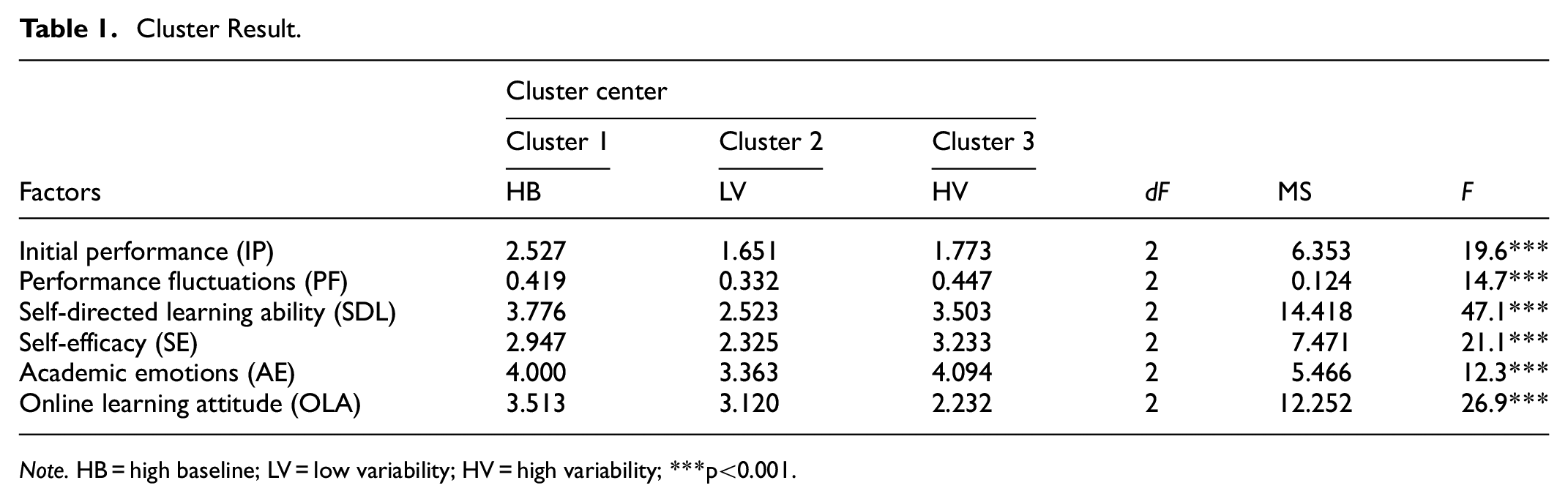
Note. HB = high baseline; LV = low variability; HV = high variability; ***p<0.001.
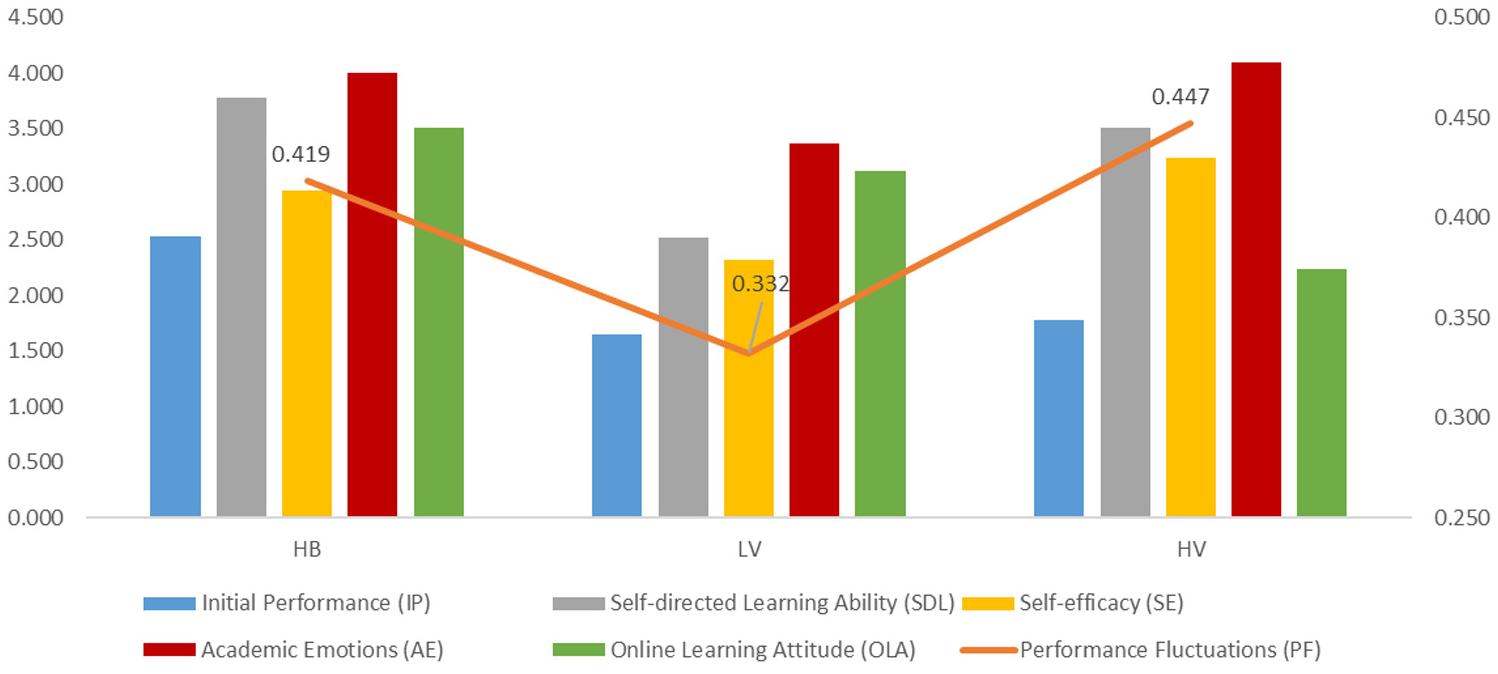
Cluster result.
According to these results, the study named the three categories as follows: the High Baseline Group (Category 1), the Low Variability Group (Category 2), and the High Variability Group (Category 3). The High Baseline Group exhibited the best initial scores (2.527), relatively high PFs (0.419), the highest SDL (3.776), relatively high academic SE (2.947) and AEs (4), and the highest OLA (3.513). The Low Variability Group had the lowest initial scores (1.651), PFs (0.332), SDL (2.523), academic SE (2.947), AEs (3.363), and relatively high OLA (3.120). The High Variability Group had relatively low initial scores (1.773) and OLA (2.232), relatively high SDL (3.503), the highest PFs (0.447), academic SE (3.233), and AEs (4.094).
Intergroup Differences
Building upon the clustering analysis, the study conducted a further analysis of numerical differences between the different groups. The post-hoc analysis results effectively explain the distinctions between the groups, as displayed in Table 2. According to the results, the High Baseline Group (HB) significantly outperformed the other two groups in initial scores. The Low Variability Group (LV) exhibited significantly lower values compared to the other two groups in PFs, SDL, academic SE, and AEs. In terms of online learning attitude, the High Baseline Group significantly surpassed the Low Variability Group, with the High Variability Group (HV) occupying the lowest position. Lastly, in terms of TDs, the High Baseline Group was significantly lower than the other two groups, indicating that students in the High Baseline Group were more likely to follow the academic high school route.
Intergroup Differences.

Note. Transition Directions: 0 means academic high school, 1 means vocational school. HB = high baseline; LV = low variability; HV = high variability.
Differences in the Transition
The study conducted a differential analysis of the overall sample based on educational outcomes to identify factors affecting students’ TDs. The results of independent sample t-tests (Table 3) demonstrate that only IP and SDL significantly impact directions.
Differences in Academic Advancement.

Online Learning and Academic Achievement
Over the course of 3 years, the study tracked one initial score and eight test scores. The proportion of each group’s scores to the total score is depicted in Figure 3. The green area at the bottom represents normal face-to-face teaching conducted, while the red area indicates at least 1 week or more of online teaching during the corresponding period. As seen in the graph of online teaching and academic achievement, Cluster 1 with a high baseline level consistently maintained a higher overall academic performance, while Cluster 2 and Cluster 3 did not exhibit distinct differences in overall scores. On the other hand, the implementation of online teaching did not demonstrate significant parallel or lagging characteristics in relation to students’ PFs.

Sequential map of the research.
Common Method Bias
To address potential common method bias, two diagnostic approaches were employed. First, Harman’s single-factor test (Podsakoff et al., 2003) was conducted through exploratory factor analysis (EFA), revealing that a single factor accounted for 29.006% of the total variance—well below the critical threshold of 50%, suggesting no dominant common method bias. Second, variance inflation factors (VIFs) for latent variable relationships were calculated using the full collinearity test (Kock, 2015), with all values falling below 3.3 (range: 1.069–1.997). This complies with the conservative threshold of VIF < 3.3 for PLS-SEM models (Kock & Lynn, 2012), indicating acceptable collinearity levels and further supporting the absence of substantial CMV. Together, these results confirm that common method variance does not constitute a major threat to the validity of our findings.
Measurement Model
Following the methodology recommended by Anderson and Gerbing (Anderson & Gerbing, 1988), the study first examined the structural reliability and validity of the model. Subsequently, it assessed the path coefficients between latent variables and the variance of endogenous latent variables explained by exogenous latent variables. SmartPLS 3 was used for estimating both the measurement and structural models.
Factors with external model loadings exceeding 0.5 indicate item reliability (Hair, 2010). As shown in Table 4, all factor loadings for the structural model exceeded 0.5, with statistical significance (p < .001). For the language item within the PF (0.416), which is not derived from a scale and had a loading close to 0.5, the study retained it to ensure the model’s fit to real-world conditions.
Load of External Model.
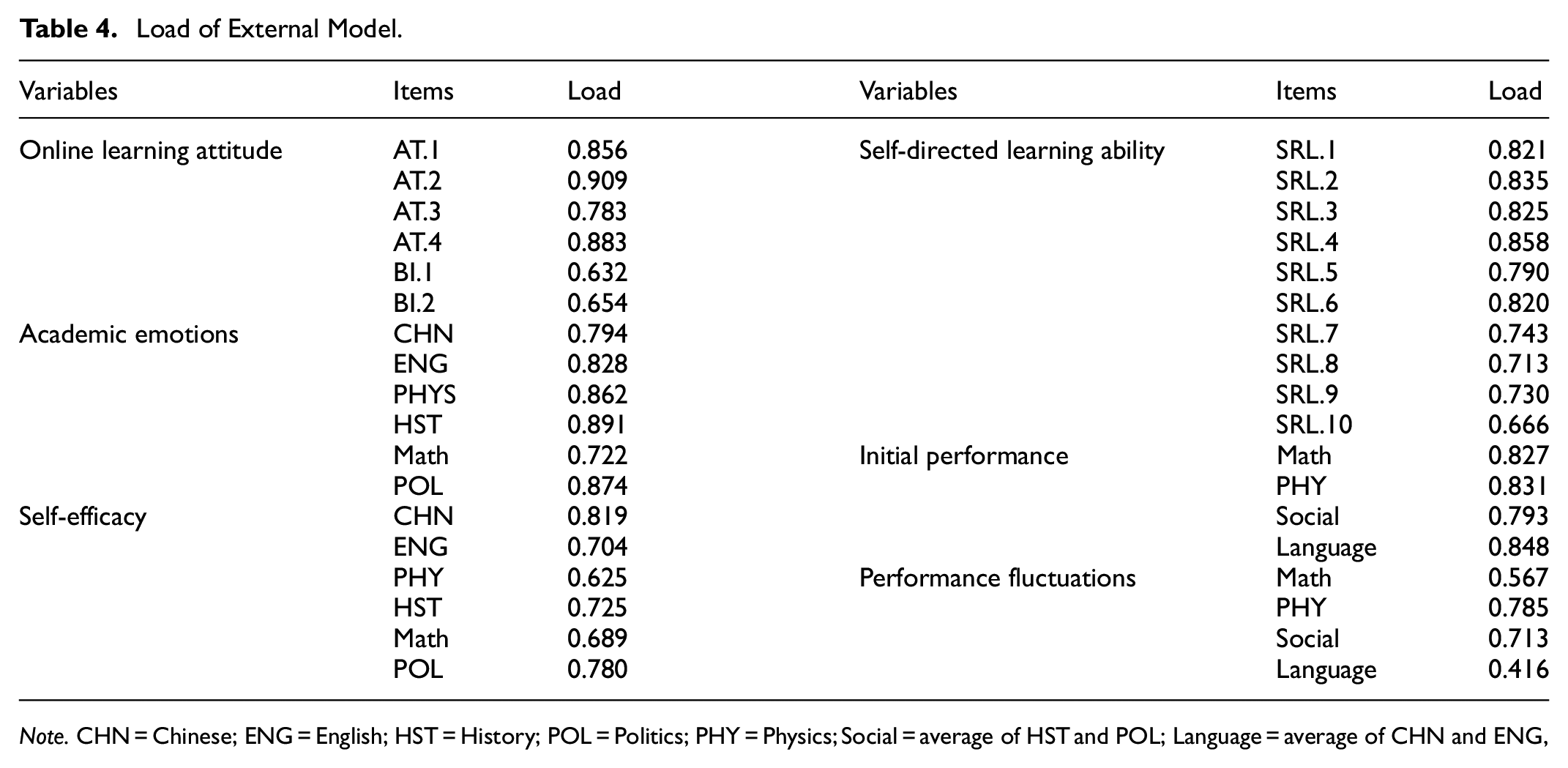
Note. CHN = Chinese; ENG = English; HST = History; POL = Politics; PHY = Physics; Social = average of HST and POL; Language = average of CHN and ENG,
The study also assessed reliability, convergent validity, and discriminant validity to validate the measurement model. Composite reliability exceeding 0.70 indicates the internal consistency of the measurement model (Bagozzi & Yi, 1988). Table 5 demonstrates that the composite reliability values for all questionnaire items exceeded 0.70, indicating structural reliability. The Average Variance Extracted (AVE) for each latent variable should exceed 0.50 to ensure adequate construct validity (Fornell & Larcker, 1981). As indicated in Table 5, all structural AVE values exceeded 0.50.
Reliability and Validity.

Based on the analysis of discriminant validity, the results obtained using the Fornell-Larcker criterion confirmed discriminant validity, as the square root of the AVE for each construct exceeded its correlations with other constructs (Fornell & Larcker, 1981). The results for discriminant validity are presented in Table 6. In conclusion, all these results affirm that the research model exhibits acceptable reliability and validity for the complete dataset.
Discriminant Validity.

Structural Model
The Standardized Root Mean Square Residual (SRMR) is a model fit parameter in the PLS method, and a value less than 0.10 suggests a good fit (Henseler et al., 2014). In this study, the SRMR value was 0.088, indicating an acceptable model fit. Another strategy for detecting the model fit of PLS methods is to compare d_ULS and d_G, which test the statistical (bootstrap-based) inference of the discrepancy between the empirical covariance matrix and the covariance matrix (Schuberth et al., 2023). In this study, the value of d_ULS was 6.331 and the value of d_G was 2.227, both within the 99% confidence interval, indicating a good model fit (Dijkstra & Henseler, 2015).
Following the evaluation of the measurement model, the assessment of the structural model becomes crucial. Determining the significance of hypothesis paths and the variance explained (R2) in endogenous variables is of paramount importance. The results indicate that the variance in PFs is 45%, SDL is 44.3%, and TDs are 20.1% (as shown in Figure 4). The results of the hypothesis tests are presented in Table 7.
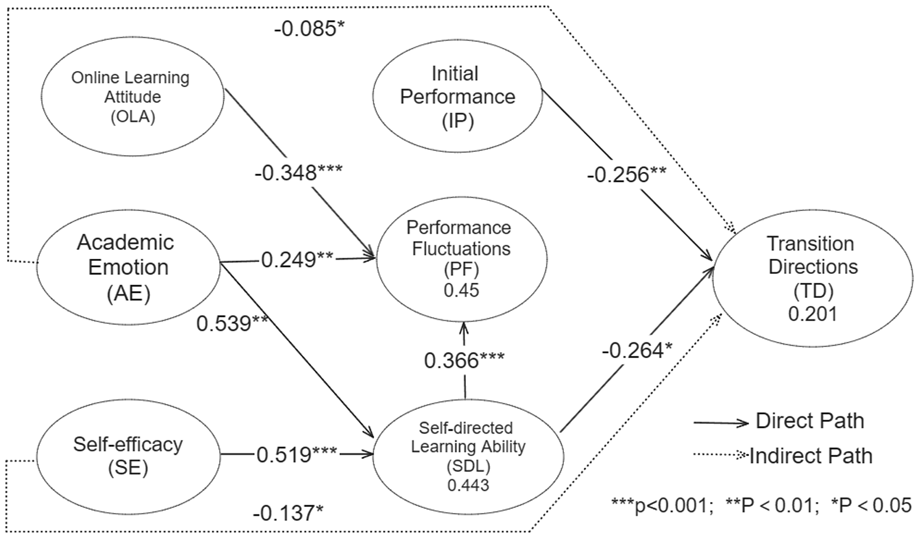
Structural model.
Hypothesis-Testing.

p < .001. **p < .01. *p < .05.
Effect Size
Consistent with the methodological framework of partial least squares (PLS) analysis, two categories of effect sizes were computed and evaluated against Cohen’s conventional benchmarks (Cohen, 2013).
The first type is explanatory effect of endogenous latent variables. The variance explained (R2) in endogenous constructs was examined to assess the model’s predictive power. The analysis revealed substantial explanatory effects for both performance fluctuations (PF; R2 = .450) and self-directed learning (SDL; R2 = .443), with both values exceeding the threshold of .26 for large effect sizes. Transition direction (TD) demonstrated a moderate level of explained variance (R2 = .201), surpassing the 0.13 benchmark for medium effects.
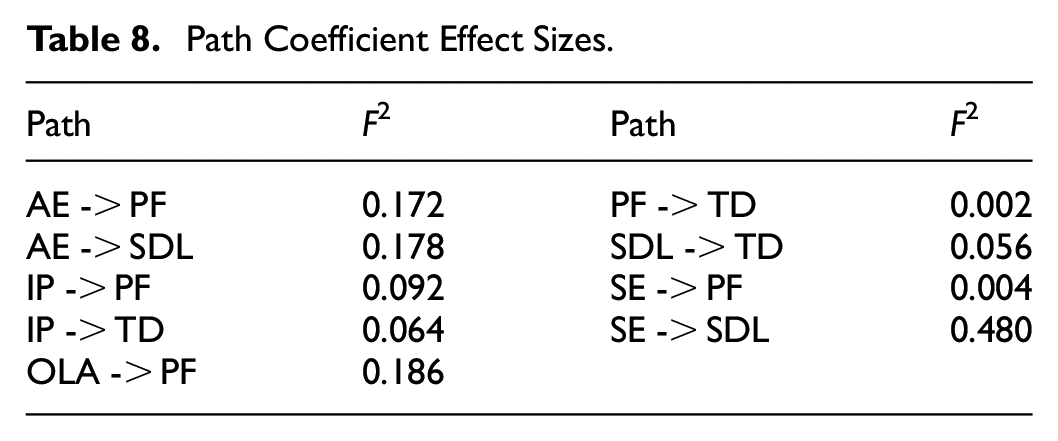
The other type is path coefficient effect sizes. The strength of relationships between exogenous and endogenous variables was evaluated through standardized path coefficients (Table 8). With the exception of the PF→TD and SE→PF pathways—both of which fell below conventional significance thresholds—all other paths exhibited effect sizes ranging from small to substantive magnitudes.
Path Coefficient Effect Sizes.
Discussion
This study examined whether online learning, academic emotions (AEs), self-efficacy (SE), and self-directed learning (SDL) influenced rural middle school students’ advancement to academic high schools during the pandemic. Longitudinal data from 94 students revealed that only initial performance and SDL significantly predicted high school admission, while AEs, SE, and online learning had no measurable impact. These findings suggest that early academic advantages tend to persist, highlighting structural barriers in educational equity.
Key Determinants of Academic Trajectories
The longitudinal analysis revealed a critical divergence: students’ initial performance (IP) strongly predicted their likelihood of entering academic high schools, whereas performance fluctuations (PF) showed no measurable impact. This indicates two interrelated mechanisms, and the first is early advantage persistence. Higher IP students maintained their competitive edge throughout junior high school, despite schools’ ostensibly equitable knowledge delivery (Ritchie & Tucker-Drob, 2018).
The other one is structural inertia in equity, which indicates disadvantaged students’ efforts to improve (via PF) failed to alter outcomes, suggesting that preexisting sociocultural conditions—such as family resources and early cognitive capital (Gruijters et al., 2024; Summers et al., 2023)—are crystallized into IP during school competition, creating a locked-in trajectory.
Thus, while schools appear “fair” in providing equal access to instruction, they inadvertently reinforce preexisting inequalities by treating IP as a neutral benchmark. This paradox transforms educational “fairness” into systemic gatekeeping, where disadvantaged students’ agency is negated by structural inertia.
Dual Mechanism of Self-Directed Learning
This study reveals the dual role mechanism of self-directed learning ability (SDL) in academic development. Firstly, the research results further validate the direct impact of SDL as a core metacognitive ability on learning outcomes, which is consistent with the “self-regulated learning model” (Du et al., 2023). Specifically, learners with strong SDL abilities are able to more effectively set goals, integrate resources, and self-monitor (Xu et al., 2023), which directly translates into a more stable knowledge construction process and optimized application of learning strategies.
In terms of performance fluctuation (PF), this study found that although SDL can significantly predict PF levels, this predictive relationship does not constitute a mediating path for changes in educational trajectories. This discovery deepens discussion on the factors influencing academic fluctuations (Karaca & Bektas, 2023), suggesting that there may be a threshold effect of SDL on PF—when SDL reaches a specific threshold, its marginal benefit in enhancing academic improvement will significantly decrease. This may be due to the multidimensional nature of the decisive factors in the educational trajectory, involving deep interactions between institutional frameworks (such as curriculum design and evaluation systems) and individual cognitive structures, which go beyond the explanation of pure academic fluctuations.
It is worth noting that SDL’s direct impact on the educational trajectory is independent of its ability to control fluctuations in grades. It suggests that the adjustment of educational trajectories relies more on fundamental changes in learners’ internal ability structures rather than simply the stability of academic performance. From a practical perspective, this requires educational intervention design to distinguish between two dimensions: short-term strategies to enhance learning outcomes should focus on SDL cultivation, while long-term planning to adjust educational trajectories requires the integration of deeper psychological construction elements such as cognitive development and professional identity.
Academic Emotions and Self-Efficacy
Existing research establishes that stable academic emotions (AEs) and strong self-efficacy (SE) promote self-regulated learning and academic achievement (Haidt & Rodin, 1999; Pekrun et al., 2023). Our findings extend this understanding by revealing how these psychological factors operate within competitive educational systems. Evidence suggests emotions serve as cognitive gatekeepers by activating engagement (Tyng et al., 2017), which this study observes particularly among disadvantaged students who maintain persistent learning efforts despite systemic barriers.
The role of self-efficacy proves more complex. While previous work posits direct effects on achievement (Olivier et al., 2019), our analysis reveals SE primarily functions through enabling self-directed learning. This mediated pathway suggests SE acts as a foundational support for sustained learning processes rather than a direct determinant of academic outcomes.
Most critically, the study uncovers a fundamental paradox: even students exhibiting strong academic emotions, robust self-efficacy, and notable performance changes remain unable to alter their educational trajectories within the 3-year timeframe. This persistent pattern underscores how structures that initial advantages can suppress the benefits of psychological efforts. These findings suggest that positive academic emotions and self-efficacy serve more as psychological tools helping students adapt to, rather than transform, the existing educational landscape—even when students possess these psychological resources, the screening mechanisms in education systems that favor early advantages still maintain the original competitive outcomes.
Online Learning is Helpful But Not Enough
The limited efficacy of online learning in addressing educational inequities underscores a systemic paradox: technologies designed to democratize access often inadvertently entrench existing disparities. This phenomenon aligns with social reproduction theory (Bourdieu et al., 1990), which posits that educational systems tend to replicate societal inequalities rather than disrupt them. Our findings extend this framework to technology-mediated contexts, revealing how ostensibly neutral tools like online platforms become complicit in reinforcing hierarchies when implemented within structurally rigid environments.
Cluster analysis delineated three learner archetypes—High Baseline (HB), Low Variability (LV), and High Variability (HV)—whose engagement with online learning mirrored their preexisting resource landscapes. As previous research indicated (Broadbent & Poon, 2015; Ma & She, 2023), HB students, equipped with robust initial competencies (IP) and self-directed learning (SDL) skills, leveraged online formats to consolidate their advantages, akin to the “Matthew effect” (Merton, 1968) where early advantages breed cumulative gains. Conversely, while LV students reported moderate acceptance of online learning, their limited SDL capacity and low SE restricted their ability to convert this preference into meaningful academic gains—a phenomenon consistent with self-determination theory’s emphasis on the interplay between competence beliefs and behavioral enactment (Ryan & Deci, 2000).
The structural model’s most striking revelation—online learning’s negative association with performance fluctuations (PF)—exposes a critical implementation failure. Rather than personalizing instruction, the dominance of standardized, broadcast-style delivery (most of online hours) homogenized learning experiences, privileging HB students’ ability to self-regulate while offering LV learners few avenues for meaningful growth. This aligns with critiques of “zombie EdTech”—technologies that mimic innovative pedagogies but lack the adaptive capacity to address diverse needs (Selwyn, 2022).
HV students’ resistance to online formats further illustrates this disconnect. Their high PF potential, indicative of dynamic learning trajectories, clashed with the static design of online instruction. Prior research suggests such students require flexible, feedback-rich environments to harness their variability—a need unmet by the rigid platforms observed here (VanLehn, 2011).
Crucially, the absence of PF’s impact on academic trajectories reflects institutional evaluation regimes that valorize baseline competence over growth. In high-stakes systems like China’s secondary school entrance exams, which emphasize foundational knowledge retention, incremental improvements—no matter how significant—rarely alter admission outcomes for LV students. This institutional inertia transforms online learning from a potential equalizer into what scholar terms a morphotactic force, preserving existing structures (Archer, 2020).
To transcend these limitations, we propose reorienting online learning through adaptive structuration (DeSanctis & Poole, 1994), where technologies actively reshape—rather than conform to—educational practices. For LV students, this means embedding SDL scaffolds to compensate for early deficits. For HV learners, it necessitates competency-based progression systems that reward growth trajectories. Such reforms demand abandoning techno-centric optimism in favor of designs that explicitly counterbalance structural inequities—a shift from tools for learning to tools for justice.
Implications
Our findings reveal that initial performance (IP) fundamentally constrains educational trajectories, while academic emotions and self-efficacy (SE) operate through self-directed learning (SDL) without counterbalancing structural inequities. This “locked-in” pattern mirrors the “winner-takes-all” dynamics observed in educational systems globally (Attewell, 2001; UNESCO, 2020), where early advantages grant privileged access to teacher attention, peer recognition, and institutional trust—resources disproportionately accumulated by high-IP students.
Crucially, this study challenges the assumption that educational technologies inherently mitigate such disparities. Despite innovations like personalized online learning (Bernacki et al., 2021) and intelligent tutoring systems (Slemp et al., 2020), our longitudinal data demonstrate that technology-enhanced school practices over 3 years failed to disrupt existing hierarchies; instead, they risk amplifying resource concentration among advantaged groups (Warschauer & Xu, 2017 ), particularly in resource-constrained contexts like rural China and comparable Southeast Asian settings (Grant, 2020 ).
To translate these insights into actionable reforms, we propose three strategies: The first one is a resource prioritization framework. Redirecting a fixed proportion of teacher time and digital infrastructure (e.g., AI tutors) explicitly toward students with lower starting point, informed by learning analytics. This counters the “Matthew effect” wherein generic reforms disproportionately benefit high-IP groups during implementation (Attewell, 2001).
Secondly, introducing SDL scaffolding for disadvantaged learners. Developing adaptive learning platforms that not only personalize content but also embed metacognitive training (e.g., goal-setting modules, self-assessment prompts) to compensate for early SDL deficits linked to socioeconomic status (Xu et al., 2023).
Last, organization need to conduct equity-focused audits, which means that mandating longitudinal evaluations of edtech interventions using disparity indices (e.g., Gini coefficients of resource access) alongside academic outcomes.
These measures require abandoning one-size-fits-all techno-optimism and instead designing systems that deliberately “unbalance” resource distribution to offset inequalities—a paradigm shift from equal treatment to equitable investment.
Limitation
First, the current results are likely to be limited to low-level rural schools in China, where students have lower average abilities and teaching resources are constrained, with only 30% to 50% of students entering academic high schools. While our findings illuminate transitional dynamics in resource-scarce contexts, their applicability to urban Chinese schools with advanced digital infrastructure requires verification. Furthermore, cultural and institutional specificities, such as China’s centralized curriculum and rural-urban migration patterns (Hannum et al., 2021), may limit direct generalizability to international settings with differing educational policies and family support systems. Second, the study’s reliance on a convenience sample from a single rural school, while necessary to ensure longitudinal data integrity, limits the generalizability of findings. Additionally, pandemic-related restrictions precluded expanding the sample mid-study, a common challenge in longitudinal educational research. Although PLS-SEM is robust for small samples, future multi-site replications are needed to confirm patterns across diverse contexts. Third, due to contextual limitations, this study was unable to collect qualitative data, and information from a single group may not capture nuanced experiential dimensions. Future research should actively adopt multi-informant method for further exploration. Lastly, the current results are based on the specific context of the past 3 years, and finding similar spatiotemporal scenarios shortly may be challenging, especially in terms of reproducibility in the context of online learning.
Conclusion
School education undeniably has a significant impact on students’ development. Research confirms that for each year of school education, students’ average IQ test scores increase by 1 to 5 points (Ritchie & Tucker-Drob, 2018). However, the social competition that students face is real as well. Can schools and teachers make a difference in helping students succeed? In this study, we tracked the performance of 94 students over 3 years and explored the impact of online education, AEs, SE, and SDL on their paths to high school. We found that only students’ initial performance and SDL significantly and positively influenced their admission to academic high schools. AEs, online learning, and SE, while affecting students’ academic performance, appeared powerless in the context of academic advancement and competition. This implies that the “big fish” who gained a competitive advantage at the outset will maintain that advantage until the end of this stage of learning. Meanwhile, if students are already in a disadvantaged state at the beginning, it seems that no matter how hard they try, they may not be able to reverse this disadvantage. Furthermore, online learning aimed at promoting educational equality and providing personalized learning does not seem to improve this situation. We believe that the reason for this situation may be that the online learning provided by schools largely continues the style of traditional classrooms, while the possibility of the “Winner-Take-All” effect in online learning cannot be ruled out.
In summary, the current research makes us realize that even in schools using modern educational technology, it may not be possible to make a very significant impact on students’ educational trajectories. School education urgently needs more profound reforms to provide better support to disadvantaged students.
Footnotes

Funding
The author(s) received no financial support for the research, authorship, and/or publication of this article.
Declaration of Conflicting Interests
The author(s) declared no potential conflicts of interest with respect to the research, authorship, and/or publication of this article.
Data Availability Statement
The datasets generated during and/or analyzed during the current study are available from the corresponding author on reasonable request.