




Abstract
Green human capital (GHC) is regarded as one of the primary attributes individuals need to develop in the era of environmental degradation. Many existing studies indicate that it is probably an important indicator of employees’ satisfaction in the workplace. Thus, based on trait theory and ability–motivation–opportunity theory, the current study examines the antecedents and outcomes of GHC among 630 employees from the manufacturing and service companies in Guangdong Province. The research employs Big Five personality and green training as the predictors of GHC, and job satisfaction as the outcome variable. Partial least squares structural equation modeling is used to analyze the data. The findings show that, in Big Five personality domains, only agreeableness and openness have a positive as well as significant impact on the individuals’ GHC, and that green training also has a positive influence on the GHC. GHC has a positive impact on the employees’ job satisfaction. The research findings and managerial implications are then discussed in detail.
Introduction
Currently, climate change is considered one of the major green environmental problems, posing great threats to human kind. International organizations, countries around the world, and companies have all realized the importance of protecting the environment (Ansari et al., 2020; Fawehinmi et al., 2020; Hameed et al., 2020; Harris et al., 2017; Ogbeibu et al., 2020; Pham, Hoang, & Phan, 2019; Pham et al., 2020; Raut et al., 2020; Ren et al., 2018, 2020; Shahriari & Hassanpoor, 2019; Song et al., 2020). The 2015 United Nations Climate Change Conference reached the Paris consensus and, according to the agreement, it aims to strengthen the global response to the threat of climate change, to hold the global average temperature rise to no more than 2°C compared with preindustrial times, and to strive to control the temperature rise within 1.5°C. The global greenhouse gas emission will reach a peak as soon as possible and net zero emissions of greenhouse gas will be realized in the second half of this century (Harris et al., 2017). China, a country that once developed its economy at the expense of the environment, is also beginning to realize the importance of protecting the environment. A famous saying goes in China that “Lucid waters and lush mountains are invaluable assets,” reflecting this mental change. In addition, the Chinese government has also promulgated various legislative and administrative measures to solve the increasingly serious environmental problems and has written the environmental protection policy into the new national 5-year plan (Ren et al., 2018; Tseng et al., 2013). Companies, in general, and particularly those in manufacturing and service industries, are gradually combining environmental protection practices with human resource management to produce so-called “green human resource management” (GHRM) practices (Pham, Hoang, & Phan, 2019; Shahriari & Hassanpoor, 2019).
Job satisfaction refers to “individuals’ affective relations to their work roles” (Judge et al., 1998). Although classical theory holds that salary level is a major predictor of job satisfaction, there are many publications that have investigated the impact of nonmonetary factors such as human capital (Danchev & Sevinc, 2012). The concept of human capital is also evolving. At first, it refers to the knowledge and skills associated with individuals, and then it includes health status and value systems, and so on (Danchev, 2010). Currently, an increasing number of companies are encouraging their employees to protect the environment, enrich environmental knowledge, and enhance environmental awareness, and therefore research on whether green human capital (GHC) is related to job satisfaction is worth exploring. In addition, although studies have examined the relations between personality factors, such as the Big Five personality model, and the components of GHC, such as green knowledge (Akomolafe, 2017), environmental concern (Hirsh, 2010), and attitudes toward the environment (Verma et al., 2017), few studies have explicitly examined the relations between personality and GHC. Moreover, studies show that training in general can contribute to human capital enhancement (Bontis et al., 2009; Riley et al., 2017), so we examine whether training in environment-related issues can enhance employees’ GHC.
Based on these identified research gaps, the research objectives of this study are as follows:
To investigate employees’ personality characteristics (i.e., conscientiousness, agreeableness, extraversion, emotional stability, and openness) and their GHC;
To evaluate the relations between green training and employees’ GHC;
To examine the relations between GHC and employees’ job satisfaction.
The current study contributes to the existing literature in two aspects. First, it responds to the calls of a recent article to carefully examine the antecedents and outcomes of GHC in the GHRM research field (Pham, Hoang, & Phan, 2019). Specifically, we examined the impacts of personal as well as contextual factors on employees’ GHC and investigated the impact of GHC on job satisfaction. Although previous studies examined some issues, such as human capital and job satisfaction (Danchev & Sevinc, 2012), and training and human capital (Riley et al., 2017), few focused on the environment-related human capital, namely, GHC. In addition, although personality and environmental related knowledge (Akomolafe, 2017) and attitudes (Verma et al., 2017) have been explored before, few treated environmental knowledge, skills, experience, and attitudes as a whole, and investigated the relations between personality and GHC. Our study is the first empirical work to fill these gaps.
The organization of this research is as follows. The “Literature Review” section reviews relevant research articles, developed the hypotheses to be tested, and established the research models; the “Method” section presents the methodology employed to analyze the data and clarify the sample’s structures; the “Data Analysis” section shows the data analysis process and presents the results; and, finally, the “Discussion” section presents the implications, limitations and future research directions, and conclusions.
Literature Review
Big Five Personality and GHC
According to trait theory, individuals can be described by relatively lasting patterns of thoughts, feelings, and actions; personalities can be quantitatively evaluated; and they also demonstrate a certain degree of cross-situational consistency (Robert & Paul, 2008). The Big Five framework is extensively utilized in the research of personality (McCrae & Costa, 1999) and it is a hierarchical model of personality characteristics, representing personality at the broadest abstract level. These five factors are conscientiousness, extraversion, agreeableness, openness, and emotional stability (Barrick & Mount, 1991). It shows that the majority of individual differences in human personality can be attributed to these five aspects. Conscientious individuals are well-organized, self-disciplined, goal-oriented, responsible, persevering, and hardworking (Kumar et al., 2009). Highly conscientious individuals will spare no effort to complete their tasks and engage more fully in their work (Bernerth et al., 2007).
Extraverted individuals are talkative, outgoing, confident, ambitious, and actively seeking opportunities from the outside, and it is seen as an important personality determinant of social behavior. They are willing to accept any challenges proposed in their work (Kumar et al., 2009). Agreeableness symbolizes one’s concern for cooperation, selflessness, and social harmony. It is regarded as the main indicator of interpersonal relationships (Bernerth et al., 2007). People who are high in agreeableness are naturally compassionate and always willing to help others and undertake huge workload and responsibilities (Bernerth et al., 2007; Kumar et al., 2009).
Openness to experience personality demonstrates the diversity of information-seeking attitude, creativity, imagination, thirst for knowledge, and interests (Bozionelos et al., 2014). People who are high in openness tend to actively seek performance feedback from others and show greater interest in social learning and positive social relations. They are also highly involved in various activities to enhance their abilities. People who are emotionally stable tend to be calm, confident, and less anxious (Bozionelos & Bozionelos, 2010).
GHC refers to “the summation of employees’ knowledge, skills, capabilities, experience, attitude, wisdom, creativities, and commitments, etc. about environmental management and environmental concern” (Y.-S. Chen & Chang, 2013, pp. 84–85).
Although studies so far have not explicitly investigated the relations between Big Five personality traits and GHC, much work has explored the relations between Big Five personality traits and the components of GHC mentioned in its definition, such as knowledge, concern, engagement, and attitudes of environments.
For example, research that randomly selected 462 secondary school students in Nigeria found that conscientiousness, extraversion, and agreeableness had a significant influence on environmental knowledge, whereas neuroticism and openness had no significant impact (Akomolafe, 2017). Another study conducted among German adults found that, among these five factors, agreeableness and openness are highly associated with environmental concern followed by neuroticism, conscientiousness, and extraversion (Hirsh, 2010). A representative and national sample data from the New Zealand revealed that agreeableness, conscientiousness, and openness to experience are the main predictors of environmental engagement (Milfont & Sibley, 2012). Using the self-administrated questionnaire from India, a study found that agreeableness, extraversion, conscientiousness, and openness had positively significant impacts on the tourist’s intention to visit green hotels (Verma et al., 2017).
Therefore, based on this research, we proposed the following hypotheses:
Green Training and GHC
Green training “provides employees with the needed knowledge about the environmental policy of a company, its practices, and necessary attitudes” (Jabbour et al., 2010, p. 1057). According to ability–motivation–opportunity theory (Appelbaum et al., 2000), human resource management practices could enhance employees’ abilities, motivations, and opportunities, which could further promote organizational success (Appelbaum et al., 2000). Although preview work examined the relations between green training and components of GHC, such as knowledge (Akomolafe, 2017), concern (Hirsh, 2010), engagement (Milfont & Sibley, 2012), and attitude (Verma et al., 2017), this study proposed the initial viewpoints to investigate the relations between green training and GHC. Based on this, we proposed the sixth hypothesis:
GHC and Job Satisfaction
Job satisfaction refers to “individuals’ affective relations to their work roles” (Judge et al., 1998). Among all GHRM practices, green training is one the most common activities implemented in organizations (Jabbour, 2013). GHC plays a significant role in company growth in the era of environmentalism. Professional skills, excellent experience, creativity, and environmental protection awareness are all important indicators of the quality of employees, which are conducive to companies’ growth (Y.-S. Chen & Chang, 2013). For example, GHRM is seen as a possible factor in predicting employees’ intention to quit (Dumont et al., 2015). In addition to this, companies that implemented GHRM practices also had a positive impact on the job pursuit intention of prospective employees (Chaudhary, 2018). Although we did not identify any obvious evidence concerning the linkage between GHC and job satisfaction, the positive relations between the two variables could be proposed and the negative relations between quit intention and job satisfaction have been well-explored in previous work (Shields & Ward, 2001). Based on this, we proposed the following hypothesis:
The Mediation Role of GHC
In sum, we link Big Five personality traits and green training with GHC as well as job satisfaction. GHC plays a mediation role for understanding the indirect effects. In other words, we aimed to set up the relationships between the main predictors (e.g., green training, Big Five personality traits) and the outcome variable (e.g., job satisfaction). Thus, we made the following hypotheses:
Figure 1 shows the research framework of the study.

Research model.
Method
Measurement Instruments
A 7-point Likert-type scale was employed to assess the constructs used in this study, ranging from 1 (strongly disagree) to 7 (strongly agree). Except for the scale that had already been translated into Chinese and had its reliability confirmed in other published works (Li, 2013), the rest of the scales were all originally developed in English. To reduce the translation bias, one author translated them into Chinese first, and then a native English speaker was paid to translate them back to English, and finally, authors discussed these items and improved the scales.
Green training was measured with five items developed previously (Daily et al., 2012; Jabbour et al., 2015). A sample item is “Employees can get opportunities to be trained on environmental issues.” The scale had fairly good reliability in earlier research (Pham, Tuckova, & Viet, 2019) and, in our research, composite reliability and average variance extracted (AVE) are 0.925 and 0.712, respectively.
Big Five personality was measured with a 10-item Personality Inventory in China (Gosling et al., 2003; Li, 2013). Big Five personality refers to the traits of conscientiousness, agreeableness, extraversion, emotional stability, and openness. Sample items for conscientiousness are “dependable, self-disciplined”; for agreeableness “sympathetic, warm”; for extraversion “extraverted, enthusiastic”; for emotional stability “calm, emotionally stable”; and for openness “open to new experiences, complex.” This 10-item scale showed good reliability previously (Li, 2013) and, in our research, Cronbach’s alpha ranges from .809 to .896 and the AVE from 0.519 to 0.689.
GHC was measured with the five items proposed previously (Y.-S. Chen, 2008). A sample item is “the green products and services developed by the employees of the company are better than those of its major competitors.” The scale displayed good reliability in previous work (Y.-S. Chen & Chang, 2013) and the composite reliability and AVE in our research are 0.910 and 0.670, respectively.
Job satisfaction was measured with five items developed earlier (Brayfield & Rothe, 1951). A sample item is “I find real enjoyment in my work.” The scale showed good reliability in the previous research in the Chinese context (C. C. Chen et al., 2020) and the composite reliability and AVE are 0.918 and 0.691, respectively.
Data Collection and Sampling
Online questionnaires were employed to collect data and China’s professional survey platform Questionnaire Star (https://www.wjx.cn/) was used to distribute the questionnaire. We utilized its customized service to pick up the appropriate respondents in Guangdong Province. We confined our sample to those working in various kinds of manufacturing and services firms in Guangdong. The reason we selected the manufacturing and service industry in China as the research context is because these sectors have infamous environmental records (Roscoe et al., 2019). China’s unprecedented development in the past decades has been at the cost of environmental degradation (Ledger, 2018). Before participants answered the questions, we explicitly asked them whether their company has some environmental management initiatives and only those who said yes were invited to finish the following survey. Finally, 630 samples were collected, and their demographic information is displayed in Table 1.
Sample Demographics.

Data Analysis
Partial least squares structural equation modeling (PLS-SEM), using SmartPLS (V.3.2.6; Hair et al., 2019; Ringle et al., 2017; Shmueli et al., 2019), was utilized to assess the measurement and structural models suggested by scholars (Anderson & Gerbing, 1988; Chin, 2010). A two-step approach was employed, involving (a) outer model validation (or the measurement model) and (b) inner model validation (or the structural model). The main reason we employed the PLS-SEM is because this research was exploratory in nature and little empirical research was being conducted to investigate the Big Five personality traits in the GHRM research field. In other words, this work was designed to develop a theory instead of simply testing one. PLS-SEM is very good for developing theory and analyzing the data of exploratory research (Hair et al., 2011). In addition, the bootstrapping method with bias-corrected confidence estimation was used to estimate the mediation effects.
Outer Model and Scale Validation
The relations between the indicators and latent constructs are termed as the outer model. Table 2 tabulates the factor loadings and the results of the reliability test of all the dimensions. The Cronbach’s alpha and composite reliability values of all factors in this study were above .8, suggesting that the constructs were acceptable.
Outer Model Assessment.
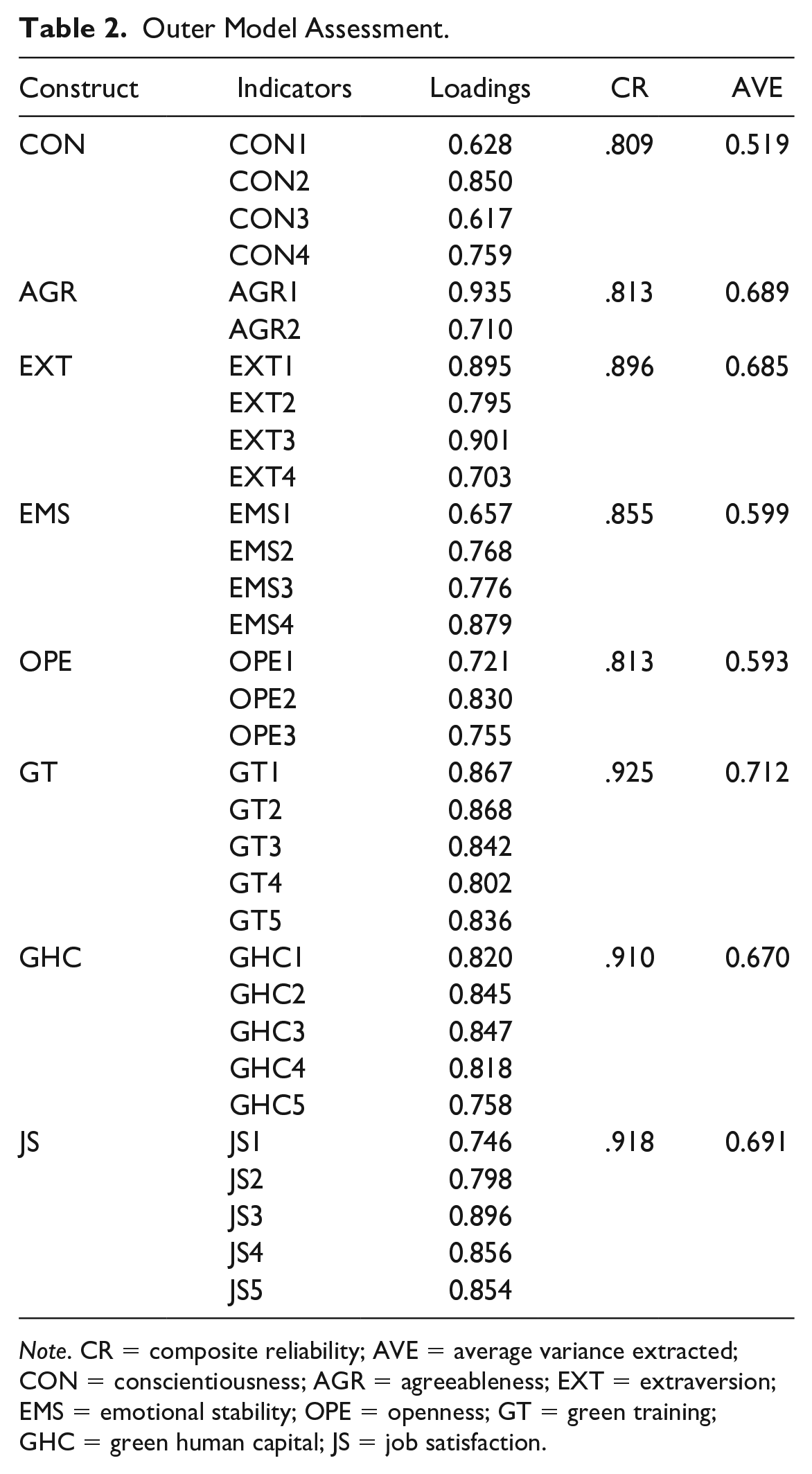
Note. CR = composite reliability; AVE = average variance extracted; CON = conscientiousness; AGR = agreeableness; EXT = extraversion; EMS = emotional stability; OPE = openness; GT = green training; GHC = green human capital; JS = job satisfaction.
The convergent and discriminant validity tests were performed to validate the construct validity. According to the literature, the requirements for the convergent validity would be met if the factor loadings of each construct were above 0.6, the AVE was more than 0.5, and reliability was greater than 0.7 (Fornell & Larcker, 1981).
The discriminant validity was tested by the heterotrait–monotrait ratio (HTMT). Based on the multitrait–multimethod matrix, the HTMT of the correlations was performed to examine the discriminant validity. The discriminant validity criterion would be met if the HTMT value was below the HTMT0.90 value of 0.90 (Gold et al., 2001). All values shown in Table 3 indicate that the discriminant validity was achieved for all the values lower than .90.
Results of Discriminant Validity by HTMT.

Note. HTMT = heterotrait–monotrait ratio; CON = conscientiousness; AGR = agreeableness; EXT = extraversion; EMS = emotional stability; OPE = openness; GT = green training; GHC = green human capital; JS = job satisfaction.
Inner Model and Hypotheses Testing
The inner model was utilized to test the proposed hypotheses. The path coefficients, t value, p value, and bias-corrected confidence interval were presented. The path coefficients illustrate the intensity and direction of the variable relationships to demonstrate the relations between the observed factors and latent factors. We performed bootstrapping to evaluate the significance of each path coefficient. The assessment was conducted by resampling data; its estimated figures were more accurate than the commonly used approximate value (Purvis et al., 2001).
Data in Table 4 and Figure 2 illustrate that conscientiousness positively affected GHC, but this finding was not statistically significant, with β = .002 and p = .960. Thus, H1 was rejected. Agreeableness significantly influenced GHC in a positive manner, with β = .075 and p = .039. Therefore, H2 was supported. Extraversion positively affected GHC, but it was not statistically significant, with β = .071 and p = .084. Thus, H3 was rejected. Emotional stability has a negative impact on GHC, but it was not statistically significant, with β = –.007 and p = .868. Therefore, H4 was not supported. Openness significantly influenced GHC with β = .002 and t = 2.384. Thus, H5 was supported. Green training had a positive impact on GHC, with β = .632 and t = 23.018. Thus, H6 was supported. GHC positively influenced job satisfaction, with β = .493 and t = 14.624. Therefore, H7 was supported.
Inner Model Assessment.

Note. Number of bootstrap samples = 10,000. CON = conscientiousness; AGR = agreeableness; EXT = extraversion; EMS = emotional stability; OPE = openness; GT = green training; GHC = green human capital; JS = job satisfaction.
p < .05. **p < .01. ***p < .001.
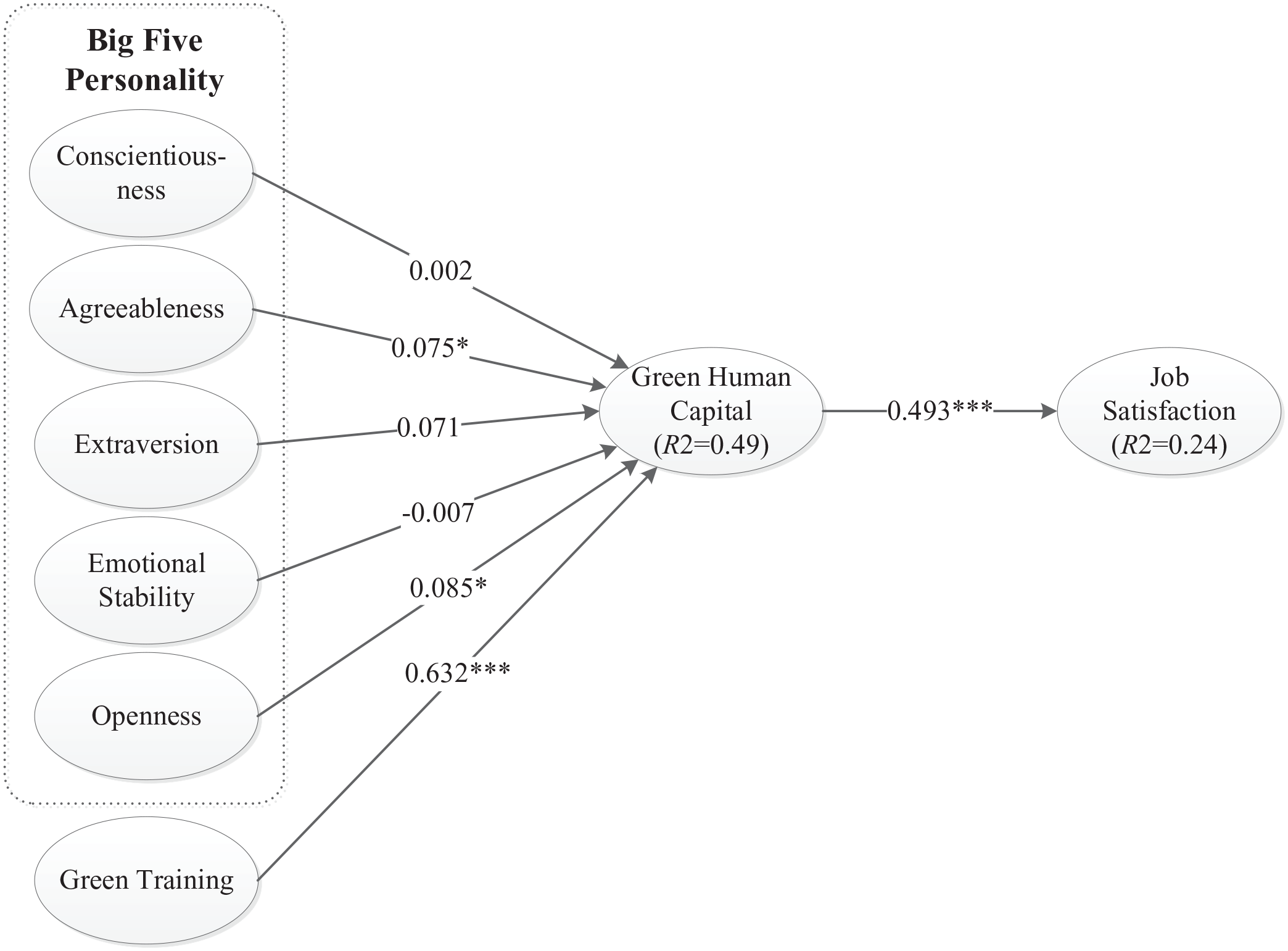
Path coefficients and R2 of the inner model.
Mediation Effect Testing
The mediation effects were evaluated with the bootstrapping approach by showing the bias-corrected confidence interval (Hayes & Preacher, 2014). The 95% confidence interval for the specific mediating effects was employed with 10,000 bootstrap resamples. If the 95% confidence interval did not contain a zero value, it indicated that the significance of the effects was established. Table 5 shows the results.
Mediation Effects Testing.

Note. Number of bootstrap samples = 10,000. CON = conscientiousness; AGR = agreeableness; EXT = extraversion; EMS = emotional stability; OPE = openness; GT = green training; GHC = green human capital; JS = job satisfaction.
p < .05. **p < .01. ***p < .001.
Discussion
Based on trait theory and ability–motivation–opportunity theory, the current study established a theoretical model to examine the influence of the Big Five personality traits and green training on GHC, and GHC on job satisfaction, on a sample of employees working at manufacturing and service industries in Guangdong Province. We have contributed to the existing theory by establishing a theoretical framework to explore the interplay between individuals and the environment in a GHRM context. As argued by Professor David (2008), “these factors (personal or situational) do not—except in rare and extreme circumstances—compete with each other in some kind of zero-sum game” (p. 569). Although previous studies examined the relations between Big Five personality traits and components of GHC, such as environmental knowledge (Akomolafe, 2017), environmental concern (Hirsh, 2010), environmental engagement (Milfont & Sibley, 2012), and environmental attitude (Verma et al., 2017), our study is the first empirical work to explicitly explore the relations between Big Five personality traits and GHC.
Regarding hypothesized paths that were supported in the Big Five personality domains, agreeableness and openness have positively significant impacts on GHC. This is in line with the previous studies that explored the environmental settings (Hirsh, 2010; Hirsh & Dolderman, 2007). Agreeableness and openness are two important antecedents of pro-environmental values (Hirsh & Dolderman, 2007). People who are agreeable in nature are cooperative, selfless, and tend to be concerned about others’ welfare and value social harmony (Kumar et al., 2009). Openness to experience personality indicates the diversity of knowledge seeking, attitude, imagination, and interest (Bozionelos et al., 2014). They tend to show greater interests in social learning and harmonious social relations. People of this type place great emphasis on the value of nature (Hirsh, 2010).
The rest of the Big Five personality domains, such as conscientiousness, extraversion, and emotional stability, did not have significant impacts on GHC. An unexpected finding was the negative relation between emotional stability and GHC. The associations between emotional stability and variables related to the environments were inconsistent; some studies found positive relations between emotional stability and environmental engagement (Milfont & Sibley, 2012), whereas others found negative relations between it and environmental preservation (Wiseman & Bogner, 2003) or environmental concerns (Hirsh, 2010). One possible explanation could be that these individuals are much more likely to be concerned about the negative outcomes associated with environmental issues. Their concern about the environment may demonstrate their concern with the consequences of environmental pollution and degradation. People with stable emotions may experience less emotional distress when thinking about similar issues (Hirsh, 2010).
The positive relations between green training and GHC supported the assumptions suggested by Y.-S. Chen (2008). This means that individuals who received green training tend to have more skills, capabilities, attitudes, and commitments about environmental management. Green training could provide employees with more knowledge of environmental issues and help them realize the importance of environmental protections (Wong, 1998). In addition, a company’s ethical green culture could be cultivated through green training (Guerci et al., 2015), thereby contributing to employee engagement. Green knowledge, awareness, and culture are proposed as mechanisms between green HRM practices and GHC, and future studies could investigate this issue more deeply.
The findings of this study also illustrated the positive association between GHC and job satisfaction. Those with large volumes of GHC tend to positively evaluate their jobs. In the environmentalism age, companies pay much attention to environmental issues and, against this background, besides professional skills and innovation abilities, employees’ environmental perceptions are also the important indicators of labor force quality (Y.-S. Chen & Chang, 2013). Companies that adopt green HRM practices are more attractive to future employees (Chaudhary, 2018) and those who have already worked in these companies had the lowest intentions to quit (Dumont et al., 2015). Therefore, future studies could investigate whether the intention to quit is the mechanism between GHC and job satisfaction.
The findings of this study could be used to inform the following practices. First, personality traits in general, openness to the environment and agreeableness in particular, could be cultivated. Although there is considerable debate about the nature and nurture of personality, longitudinal studies of personality traits have illustrated changes in personality with age (Roberts & DelVecchio, 2000). It tends to be increase with age until it stagnates in the middle of adulthood and eventually declines in old age. In other words, personality development is a lifelong process (Kandler, 2012). Therefore, positive personality aspects can be strategically cultivated. For example, positive affirmations and visualizations, making friends with emotionally successful people, reading inspirational books and magazines, receiving training and developing positive health habits, and holding positive expectations about oneself are all effective approaches to develop a positive personality (Tracy, 2020).
Second, contextual factors, such as green training, can be implemented at organizational levels to enhance employees’ GHC. Environmentally oriented workshops and courses can be designed and delivered to employees regularly. Employees could also be encouraged to work in groups to deliver green services to their customers or to carry out volunteer activities to put into practice their environmental protection knowledge. Finally, employees’ job satisfaction could be improved by upgrading their environment-related knowledge, skills, experience, engagements, and attitudes. Companies need to consider environmental issues when carrying out their strategic development plan.
This study has several limitations that could inform directions for future work. First, cross-sectional data were utilized and therefore the relations between variables cannot be regarded as causal. Future research could employ a longitudinal or experimental research design to evaluate whether the correlations could be interpreted as causal. Second, the study only employed green training to represent green HRM practices and, although it is seen as one of the important components (Jabbour, 2013), future work should incorporate other green HRM practices, such as green engagement, to better investigate the issue.
Third, this work assessed the direct impact of green training and GHC, and future work should examine the mechanism between these two factors, which has also been suggested by Tang et al. (2018), such as the environment-related awareness, knowledge, and skills. Last but not least, the sample makeup was limited to those who are in the manufacturing and service industries in Guangdong Province. This is one of China’s leading industrial provinces; thousands of factories are located there, producing almost everything from toothpicks to high-tech products (Stewart, 2015). In addition, its total service economy has been ranked first in China for 33 consecutive years (China, TUCO, 2017). Therefore, generalizations should be cautiously made to other areas of China.
Conclusion
Our study examined the antecedents and outcomes of GHC among 630 employees from manufacturing and service companies in Guangdong Province. The findings show that, in the Big Five personality domains, only agreeableness and openness significantly impacted individuals’ GHC, and that green training is another predictor of GHC. GHC in turn has a positive impact on the employees’ job satisfaction. Although this study has its limitations, the findings are meaningful because they respond to the recent calls for examination of the predictors and outcomes of GHC in the GHRM research field and also carry practical implications for the employees’ GHC cultivation.
Footnotes
Declaration of Conflicting Interests
The author(s) declared no potential conflicts of interest with respect to the research, authorship, and/or publication of this article.
Funding
The author(s) received no financial support for the research, authorship, and/or publication of this article.
