




Abstract
Food insecurity remains a persistent challenge in rural Vietnam despite economic growth, particularly among rice-producing households. The study aims to assess how participating in non-agricultural activities impacts the diversity of food available in Vietnam. The study used a combination of Propensity Score Matching (PSM) and fixed-effects estimators to control bias from variable selection and unobservable time-invariant factors. In addition, the heteroscedasticity-based instrumental variable (IV) approach was established to check the above relationship. Results from the study reveal that engaging in non-farm activities significantly boosts the diversity of food within rural Vietnamese households. This suggests that rural households could enhance their livelihood strategies by diversifying into non-agricultural pursuits. To facilitate this transition, policy interventions such as workshops, seminars, and vocational training programs should be tailored to the specific socioeconomic characteristics of rural Vietnam.
Introduction
Food and nutrition insecurity remains a major global challenge, particularly in rural areas of developing countries (Bitana et al., 2023; Kassegn & Endris, 2021; Knippenberg et al., 2020; Kolog et al., 2023; Mannaf & Uddin, 2012; Mehraban & Ickowitz, 2021; Sher et al., 2018). Food insecurity persists in the majority of developing countries despite substantial gains in economic growth and well-being in the last several decades (Bitana et al., 2023; Mota et al., 2019). In rural regions, problems like unpredictable rainfall patterns and restricted availability of funding and infrastructure worsen food shortages and deficits in vital nutrients (Abera et al., 2021; Bitana et al., 2023; Kassegn & Endris, 2021; Minot et al., 2006; Musumba et al., 2022; Sambo et al., 2022).
Historically, attempts to tackle these problems have predominantly centered on boosting agricultural productivity (Adofu et al., 2013; Darkwah et al., 2019; Mota et al., 2019). Nevertheless, this approach fails to acknowledge the important role of other livelihood strategies in ensuring household food security in rural regions in developing countries. While non-farm earnings affect household food security, the connection between agriculture and dietary patterns often fails to consider non-farm activities, resulting in an incomplete understanding of the relationship between agriculture and nutrition (Owusu et al., 2011).
The majority of studies examining the impact of diversifying income through non-farm jobs have mostly concentrated on alleviating poverty while neglecting the issue of food security (Kassegn & Endris, 2021; Osarfo et al., 2016; Owusu et al., 2011; Pritchard et al., 2019; Rahman & Mishra, 2020). Gaining insight into the impact of non-farm activities on food security is essential for implementing structural reform. The agricultural sector is experiencing a decline in both revenue and employment opportunities as economies transform (Omotesho et al., 2014; Osarfo et al., 2016). The redistribution of agricultural resources can enhance economic growth (Koomson et al., 2023; Osarfo et al., 2016). Households can mitigate income instability caused by seasonal agricultural changes and weather calamities by diversifying into non-farm occupations (Osarfo et al., 2016). Supplemental income from sources other than farming can alleviate financial limitations, facilitating agricultural investment and promoting more stable expenditure patterns (Nguyen et al., 2021).
Both the ‘pull’ and ‘push’ factors have an impact on the transition away from agriculture to other fields, such as non-farm activities (Asfaw et al., 2019; Atamanov & Van den Berg, 2012; Habib et al., 2022; Newman & Kinghan, 2015; Rahman & Mishra, 2020). Increased agricultural production and income growth enable households to transition into non-farm industries, resulting in positive consequences. Nevertheless, in cases where agricultural sectors experience a lack of development and farmers fail to generate sufficient income from their land and employment, they choose to pursue alternative occupations (Rahman & Mishra, 2020). Does this shift have an impact on food security? Increased wages allow individuals to access a wider range of food choices. Non-agricultural income enhances the ability of households to buy goods and lessens the risk of food scarcity throughout the year (Ellis, 1998). According to livelihood diversification theory (Ellis, 1998), Non-farm income may improve household nutritional intake through two mechanisms: reducing agricultural income volatility (risk hedging) and enhancing market purchasing power (income effect). However, it also increases households’ reliance on commercially available food (Rahman & Mishra, 2020). Market price volatility may jeopardize their food security due to this dependency (Poon & Weersink, 2011; Rahman & Mishra, 2020). Therefore, additional research is required to examine the influence of non-agricultural activities on the food accessibility of farming households.
Food diversity is a critical aspect of food security and nutrition, particularly for farming households. It encompasses the variety of foods consumed, which is essential for ensuring adequate nutrient intake and improving overall health outcomes. Previous research showed that a higher household dietary diversity score (HDDS) correlates positively with micronutrient intake and overall nutritional status (Chen et al., 2023; Fraval et al., 2020; Sibhatu & Qaim, 2017; Waha et al., 2018). Households with greater dietary diversity tend to consume a wider range of micronutrients, vital for health, particularly in rural settings where access to diverse foods may be limited. Food diversity contributes to food security by enhancing resilience against food shortages and price fluctuations (Fraval et al., 2020).
Vietnam is one of the countries with impressive economic growth in recent years, and the average income has increased. However, reducing poverty and ensuring food security remains a major challenge, especially in rural areas. In 2018, Vietnam had 105,000 households (420,000 people) suffering from hunger (Phan et al., 2022). In addition, Vietnam has a GHI score of 11.3, indicating a moderate level of hunger. This is a slight improvement from the 2023 score of 11.8, reflecting progress in reducing undernourishment, child stunting, and child mortality (Wiemers et al., 2024). Despite Vietnam’s economic growth and higher average income levels, poverty and food insecurity persist in rural areas, making it imperative to study the relationship between non-farm activities and household food diversity. In Vietnam, farm households that engage in non-farm activities typically have 5 to 25% more income or consumption per capita compared to those that do not (Mulia et al., 2021). The exact difference in income or consumption per capita varies by the kind and scale of non-farm activities (Mulia et al., 2021). The urgent necessity to tackle food insecurity in the nation is brought to light by this. In addition, (Rahman & Mishra, 2020) emphasized the need to understand how non-farm income impacts food security. The study found that in India, the relationship between non-farm income and dietary diversity is complex and poorly characterized. This lack of clarity highlights the need to study how non-farm activities affect food diversity in Vietnam to create focused interventions. In addition, it is important to acknowledge the diversity among smallholder farm households when discussing ways to improve food security (Frelat et al., 2016; Vu & Rammohan, 2022). Additionally, exploring the impact of the informal non-farm sector is crucial for effectively addressing food insecurity (Vu & Rammohan, 2022).
Since the relationship between participation in non-farm activities and household food security is complex and depends on the context, this study aims to examine the effect of non-farm livelihoods in shaping household food diversity in rural Vietnam. While existing studies predominantly examine the impact of non-farm employment on income, this paper is the first to empirically validate its direct effect on food diversity in the Vietnamese context, thereby filling the empirical gap in the ‘livelihood strategy–nutrition outcome’ linkage. In addition, this paper is the first to utilize panel data from the Vietnam Access to Resources Household Survey (VARHS) spanning 2010 to 2018 and to apply a combined propensity score matching (PSM) and fixed-effects (FE) estimation strategy. This methodological approach allows for robust control of observable and unobservable household-level heterogeneity, offering stronger causal inference than previous cross-sectional or regression-only studies. In addition, the heteroscedasticity-based instrumental variable (IV) approach was established to check the above relationship. The analysis reveals a significant positive association between participation in non-farm activities and household food diversity, highlighting the potential of off-farm livelihoods to improve food security and well-being. These findings make an important contribution to the literature by isolating the nutritional effects of livelihood diversification in the Vietnamese context. They also provide actionable insights for policymakers aiming to strengthen rural food systems through multi-sectoral development strategies for Vietnam and developing countries.
Data Source
The Vietnam Access to Resources Household Survey (VARHS) is an extensive dataset that offers detailed information on the socioeconomic status of families in Vietnam and the accessibility of resources for these households. The Vietnam Access to Resources Household Survey can provide this information. The data was collected from a study conducted on Vietnamese families to ascertain the resources at their disposal. This study aimed to examine the influence of non-farm activities on household food diversity among rice-producing families in rural Vietnam. We employed the Vietnam Access to Resources Household Survey (VARHS) to conduct the necessary research for this study. This study utilizes panel data from the VARHS, covering the period from 2010 to 2018, with 2 years of data available for each year. The data covers a broad spectrum of years. To have an accurate understanding of the conditions faced by households in each of Vietnam’s twelve provinces, it was crucial to gather responses to a diverse range of questions presented in the Vietnam Association of Rural Health Surveys (VARHS). Figure 1 shows a map illustrating the several study sites and their positions in their respective landscapes. The regions as mentioned above encompass the provinces of Ha Tay, Lao Cai, Phu Tho, and Lai Chau in the northern part; the provinces of Nghe An, Quang Nam, Khanh Hoa, Dak Lak, and Dak Nong in the central part; and the province of Long An in the Mekong River region.

Study sites from VARHS in rural Vietnam (Phan et al., 2022).
Numerous studies consider important factors, including household head and farm characteristics, that link participation in non-farm activities in rural areas. Earlier research (Akhtar et al., 2019; Nguyen et al., 2021; Pritchard et al., 2019; Rahman & Mishra, 2020; Reardon et al., 2008) shows that the age, gender, and level of education of household heads significantly impact their choice to engage in activities outside of farming. In addition, specific characteristics of farms influence the participation of rural Vietnamese households in non-farm activities. They are the total rice production area, the total number of plots for rice production, soil, and water conservation investments, and the rice production land that is being affected by climate change (Musumba et al., 2022; Sisay, 2024). A lot of resources, like agricultural extension services, irrigation, rural credit, the Internet, and information on agricultural production, are important for figuring out how involved households are in things other than farming (Abera et al., 2021; Musumba et al., 2022; Sisay, 2024). Additionally, the probability of participating in non-farm activities can be influenced by household-specific factors such as health status and household size (Musumba et al., 2022; Zhao & Barry, 2014). The longitudinal dataset offers critical insights into household agricultural practices, socio-economic characteristics, and environmental factors, with implications for rural development and food security. The Household Food Diversity Index (HFDI) remains stable, ranging from 5.98 in 2014 to 6.22 in 2018, suggesting consistent dietary diversity despite external pressures. Participation in non-farm activities declines from 0.27 in 2010 to 0.18 in 2018, indicating growing reliance on agriculture and potential vulnerability to risks like climate change, which increasingly impacts rice production land, peaking at 0.99 in 2016. The age of household heads rises from 50.37 to 56.58 years, reflecting an aging farming population, possibly due to rural-urban migration or waning interest in agriculture among younger generations. Education levels of household heads fluctuate slightly, peaking at 8.86 years in 2016 but dipping to 7.96 in 2018, warranting further investigation. Male-headed households predominate, with a slight decrease over time. Land fragmentation, measured by the Simpson Index, decreases from 0.57 to 0.44, potentially enhancing land use efficiency, while soil and water conservation investments drop sharply from 0.59 to 0.28, raising concerns about sustainable land management. Access to irrigation remains consistently high, but rural credit access falls from 0.53 to 0.25, potentially limiting agricultural investment. Internet access surges from 0.16 to 0.60, signaling improved connectivity, while access to agricultural extension services and production information remains relatively stable, supporting informed decision-making. These trends underscore the need for targeted interventions to address aging farming populations, declining non-farm employment opportunities, and environmental challenges, thereby ensuring sustainable agricultural development (Table 1).
Descriptive Statistics of Samples.

Source. Calculated by author from VARHS.
Note. HFDI is the cumulative count of food categories consumed by individuals within a household during a specific time frame (within 24 hr). Consuming a wider variety of foods leads to an improved intake of calories and protein, and addresses both the quality and diversity aspects of food (Knippenberg et al., 2020). The Simpson index is determined as
Methodology
Combination Between PSM and Fixed Effect
Endogeneity in non-farming participation can introduce bias and underestimate the influence on household food diversity when employing OLS models. When there is no experimental data available, it is essential to use non-experimental methods such as instrumental variables (IV) and propensity score matching (PSM) to estimate the average treatment effect (ATT).
Propensity Score Matching (PSM): PSM is first used to control for selection bias due to observable characteristics. Households that engage in non-farm activities may differ systematically from those that do not. By matching each treated household with one (or more) control household(s) with similar observed covariates, we ensure comparability and construct a balanced pseudo-experimental sample. A shared support zone is crucial in PSM to guarantee comparability between the treatment and control groups. The common support region refers to the propensity score range that includes participating and non-participating households (Abate et al., 2014). To avoid bias, it is crucial to limit the matching process to households inside the common support region, as deviating from this region can create bias (Heckman et al., 1997). Following established guidelines not only increases the dependability of estimates but also enhances the accuracy of matches by reducing insufficient comparisons (Abate et al., 2014; Duong & Thanh, 2019).
Fixed Effects (FE) Regression: PSM is commonly applied to cross-sectional data to reduce selection bias by matching treated and control units based on observable covariates, ensuring comparability within the common support region (Abate et al., 2014). However, PSM does not address time-invariant unobserved heterogeneity, as it cannot account for unmeasured factors that remain constant over time. To handle such unobserved effects, methods like fixed-effects regression with panel data are more suitable, as they control for both observable and time-invariant unobserved factors (Becker & Ichino, 2002). To address selection bias when examining the influence of non-farm participation on household food diversity, the study utilizes fixed effect regression after utilizing propensity score matching (PSM). This involves employing fixed-effect regression on observations within the common support region after performing propensity score matching (PSM) to ensure a thorough and dependable analysis (Becker & Ichino, 2002; Khandker et al., 2009).
First, a logit model with a set of matched covariates can be used to estimate the propensity score for predicting participation in non-farm activities.

where NFit is a binary variable that equals 1 if a household participates in non-farming and 0 otherwise, Xit is a set of explanatory variables from equation (1) that is presented above. HIDi is the household fixed effect; St is the year fixed effect; ξit is the error term.
Next step, each household participating in non-farm is matched to a non-participant with the nearest propensity score. The study considers the single-nearest neighbor matching as this matching algorithm is expected to produce the smallest bias (Nguyen Chau & Scrimgeour, 2022).
To estimate the effect of participating in non-farm activities on household food dietary diversity, this study uses the following model:

where Yit refers to the measurement of dietary diversity in a household, which is determined by the variety of food types ingested (Cholo et al., 2019). It provides a comprehensive assessment of the breadth and nutritional sufficiency of the household’s diet, going beyond a narrow focus on calorie intake (Smith & Subandoro, 2007). NFit is a binary variable defined as 1 when the household engages in non-farm activities and 0 in all other cases; εit is the random interference term. The factors that make Xit are the household head’s age and level of education, their gender, the land fragmentation index, investments made to protect soil and water, the amount of climate change-affected rice production land, the number of household members, the availability of agricultural extension services, access to irrigation, access to rural credit, health stock, internet connectivity, the number of plots used for rice production, the total area set aside for rice production, and the number of plots used for rice production. HIDi denotes the household fixed effect, St signifies the year fixed effect, and εist represents the error term. The analysis utilizes the Ordinary Least Squares (OLS) methodology, incorporating household fixed effects and year-fixed effects after the matching process.
Rosenbaum (2002) states that matching methods effectively reduce intrinsic selection bias in observational data. A synthetic comparison group that closely matches the treatment group’s features is the basic idea. This study can decrease additional factors that could affect outcomes by carefully balancing the observable characteristics of the treated and comparison groups. Using observational identification, treatment efficacy can be more accurately assessed. Propensity Score Matching (PSM) is used in this study to ensure equality between non-farm households and those that have not. PSM uses untreated people with the same odds of receiving treatment to create hypothetical outcomes for the treated group (Lee et al., 2022). The PSM approach, employed in fixed effect regression, evaluates the link between non-farm activities and household food consumption diversity and creates a region of common support.
Instrumental Variables Estimation
Even though there are efforts to reduce the bias when estimating the effect of participating in non-farm activities by combining PSM and fixed effect methods, the results can be weak since the balance test can not show full similarity between household and farm characteristics (Table 2). Therefore, the study applied the heteroscedasticity-based instrumental variable (IV) approach established by Lewbel (2012) to check the above relationship. In addition, the IV method can reduce reverse causality, such as households with higher food diversity may be more inclined to engage in non-farm activities. This study uses
Balance Test for the Treatment (Participate in Non-farm) and Control Group (Non-participate in Non-farm).

Source. Calculated by authors from VARHS.
Instrumental variables (IVs) are valid if two key assumptions are satisfied: (1) the IVs are uncorrelated with the error term in Equation (1) (i.e., Cov (Xit, εit, ξit) = 0), ensuring exogeneity, and (2) the IVs are correlated with the endogenous variable NF_it (i.e., Cov (Xit, ξit2) ≠ 0), ensuring relevance. To test these assumptions, we apply the Pagan-Hall and Breusch-Pagan tests, following Baum and Lewbel (2019), to assess heteroskedasticity (null hypothesis: homoscedasticity) and the validity of the IVs. Results in Table 4 confirm that both assumptions hold, with all p-values significant at the 1% level, indicating that the IVs are exogenous and relevant.
The Placebo Test
To further validate the causal relationship between non-farm participation and household food diversity, we conducted a placebo test by regressing lagged household food diversity (HFDIt−1) on current non-farm activity status (NFt). The rationale is that if the observed effect of non-farm work on dietary diversity is truly causal, then future participation in non-farm activities should not influence past food consumption behavior. In this specification, a significant relationship would suggest that the original estimates might be confounded by omitted variables or reverse causality, where households with already diverse diets are more likely to seek or access non-farm work. Conversely, an insignificant coefficient would support the assumption that non-farm engagement leads to improved food diversity rather than the reverse.
Results and Discussion
Figure 2 shows that the proportion of households participating in non-farm activities shows a slight decline, from 27% in 2010 to 18% in 2018, with some fluctuations. The overall mean across all years is 23%, indicating that non-farm participation is relatively low but significant among rice-producing households.

Trend of non-farm participation in rural Vietnam (2010–2018).
The investigation begins by delineating the systematic disparities between the treatment and control groups. Table 2 offers a concise overview of the particular agricultural attributes employed in the model. The study includes performing balance tests on each covariate before and after matching for both the unpaired and matched groups. After the matching procedure, the majority of covariate means in the treatment and control groups exhibit no significant differences (Table 2).
To equalize the pre-treatment characteristics of the treatment and control groups using Propensity Score Matching (PSM), which depends on the propensity score, the convergence of the propensity score distributions for both groups must be assessed as the initial step. Figures 3 and 4 illustrate the distributions of the propensity scores after the matching procedure. In neither of the two graphs is there a substantial accumulation of probability mass in the vicinity of 0 or 1. Furthermore, there is considerable similarity in the estimated densities, and their primary masses intersect. As a result, no indication of a breach of the overlap supposition can be found.

Distribution of food diversity index before and after matching with single-nearest neighbor.
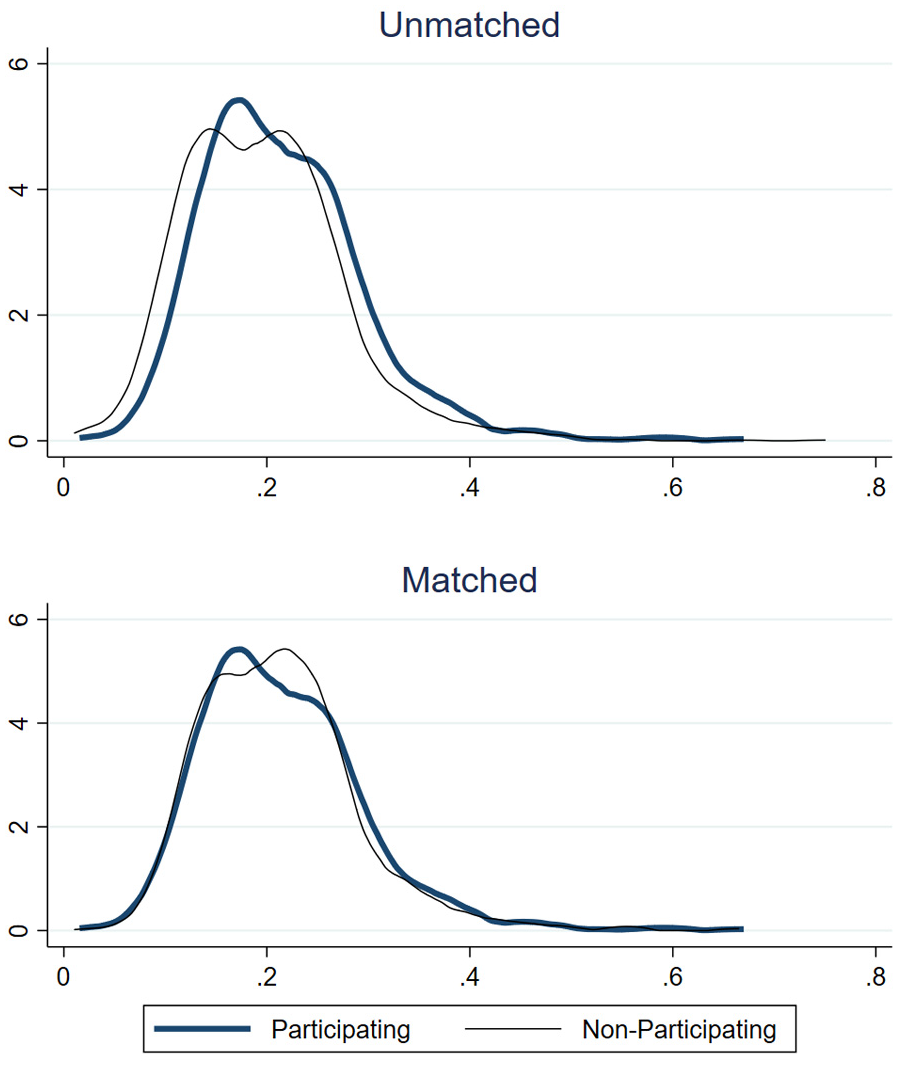
Distribution of food diversity index before and after matching with the Kernel.
The socio-demographic attributes of household leaders have a notable impact on their propensity to engage in non-agricultural endeavors, as demonstrated by recent research done in rural Vietnam. Logit estimation reveals that age significantly influences household decisions about participating in non-farm activities. The finding shows a statistically significant positive correlation between age and non-farm activity. The marginal impact coefficient is 0.009, and this association is significant at a 5% level of significance. This indicates that older folks are more likely to participate in activities outside of farming in comparison to younger individuals. This case can be explained by a range of causes, such as the inclination of some older farmers to expand their sources of income or explore new interests and hobbies that go beyond conventional farming operations. Engaging in non-farm activities provides chances to achieve these goals, such as starting small businesses, participating in community gardening projects, or being involved in environmental conservation endeavors (Demissie, 2013).
Conversely, the gender of the household head is linked to lower participation in non-farm activities, indicated by a marginal effect coefficient of −0.193 (Table 3). This suggests that female heads of households tend to engage in non-farm activities more than their male counterparts. The disparity in the number of individuals involved in non-farm labor versus agricultural tasks can be attributed to non-farm work typically being less physically strenuous (Adepoju & Osunsanmi, 2018). This quality makes it particularly appealing to individuals, especially those facing health challenges or physical constraints.
Factors Affecting the Participation in Non-farming in Rural Vietnam Using Logit Estimation.

Note. Standard errors in parentheses.
, **, *** denote significance at 10%, 5%, 1%, respectively.
Source. Calculated by authors from VARHS.
In addition, the analysis reveals that land fragmentation is a hindering factor that affects non-farm participation. A negative marginal effect coefficient of −0.233, statistically significant at a 1% level of significance, supports this. Due to the uneven distribution of land ownership, households often have to focus their resources and skills on maintaining agricultural production. This leaves them with little time and money to do non-agricultural activities like starting businesses, providing services, or looking for work in other industries (Milne et al., 2022).
Table 4 presents the findings about the influence of participating in non-farming on household food diversity, employing ordinary least squares with and without PSM estimation. OLS estimations without matching reveal that participating in non-farming increases the diversification of food use for households in rural Vietnam. Similarly, the coefficient between participating in non-farm and household food diversity index is positive after regression with a combination of fixed effect and PSM, with a coefficient of 0.202 and 0.203. In addition, the study used the heteroscedasticity-based instrumental variable (IV) approach for robustness testing in Table 4, with a coefficient of 0.301 and a significance level of 5%. All results indicate that an increase in the probability of households participating in the non-farm sector led to an increase in the index of household food diversity. In addition, the estimation results from the placebo regression (Table 4) indicate that current non-farm participation has no statistically significant effect on lagged food diversity. This finding is consistent across matching methods and IV estimation. It reinforces the credibility of the main results by ruling out reverse causality and supporting the temporal ordering assumed in the identification strategy. Moreover, the lack of significance in the placebo test suggests that unobserved factors affecting household food diversity are unlikely to influence future non-farm decisions, thus reducing endogeneity concerns simultaneously.
The Effect of Non-farming Activities on Household Food Diversity.

Note. Standard errors in parentheses.
Matched with single-nearest neighbor.
Matched with Kernel.
Estimation of the relationship between household dietary diversity in the previous period and participation in non-farm activities in the current period.
, **, *** denote significance at 10%, 5%, 1%, respectively.
Source. Calculated by authors from VARHS.
Non-farming activities have a crucial role in augmenting the income of rural households, going beyond what is generated from agricultural endeavors. This supplementary income acts as a safeguard during periods of agricultural decline or when specific food commodities are rare within the local area. Dependence on agricultural revenue alone can be precarious, particularly when confronted with crop failures or volatility in market prices. Participating in non-agricultural occupations assists in broadening the range of revenue sources, which decreases susceptibility to uncertainties in agriculture and establishes a more secure financial foundation for purchasing food. Furthermore, Market mechanisms play a pivotal role in shaping the impact of non-farming activities on household food diversity. By engaging in non-agricultural employment, rural households gain access to broader markets beyond the local agricultural sector, which often exposes them to a wider variety of food options. This expanded market access can lead to improved availability of diverse food items, including those not locally produced, thereby enhancing dietary diversity (Israr et al., 2014). Moreover, non-farm income can stabilize household purchasing power, enabling consistent access to food even when local agricultural markets face disruptions due to seasonal shortages or supply chain issues. For instance, households with non-farm income can procure food from regional or national markets, mitigating the risks associated with localized crop failures or limited agricultural output (Rahman & Mishra, 2020). In addition, increased income from non-farm sources can buffer households against rising food prices, allowing them to maintain or even improve their dietary diversity during periods of inflation or market volatility. This financial resilience is critical in rural Vietnam, where agricultural commodity prices can be highly variable due to factors such as unpredictable weather, global trade dynamics, and local supply-demand imbalances (Poon & Weersink, 2011). For example, during periods of drought or flooding, staple crops like rice may experience price spikes, making it difficult for agriculture-dependent households to afford sufficient food. Non-farm income provides a critical lifeline, enabling households to purchase diverse food items despite these price surges. To mitigate the adverse effects of price fluctuations, policies should focus on strengthening market mechanisms that support rural households engaged in non-farm activities. Improving market infrastructure, such as transportation and storage facilities, can reduce post-harvest losses and stabilize food supply chains, thereby moderating price volatility (Minot et al., 2006). Additionally, providing rural households with access to market information, such as real-time price data via mobile technology or extension services, can empower them to make informed purchasing and selling decisions, maximizing the benefits of non-farm income (Musumba et al., 2022). Furthermore, supporting the development of stable, high-value non-farm employment opportunities, such as small-scale enterprises or vocational training programs, can enhance income reliability, reducing the risks posed by market price fluctuations. In general, engaging in non-agricultural employment also provides opportunities to improve the prices of farming products, as households with diverse income streams may invest in better agricultural inputs or technologies, leading to higher-quality produce and potentially better market prices (Israr et al., 2014).
Several studies suggest that in rural economies, especially in developing nations, non-farm income sources have gained considerable importance in recent decades (Idris-Adeniyi et al., 2020). The act of diversifying income through non-farm activities has been proven to have a good effect on rural households, providing a multitude of advantages (Osarfo et al., 2016). In areas where agricultural production is decreasing as a result of variables such as climate change and population expansion, it is crucial to engage in non-agricultural activities to maintain sustainable livelihoods. The finding from this study is linked to previous research such as Pritchard et al. (2019) in rural Myanmar, Rahman and Mishra (2020) in India, Sisay (2024), Kassegn and Endris (2021), Endiris et al. (2021) in Ethiopia.
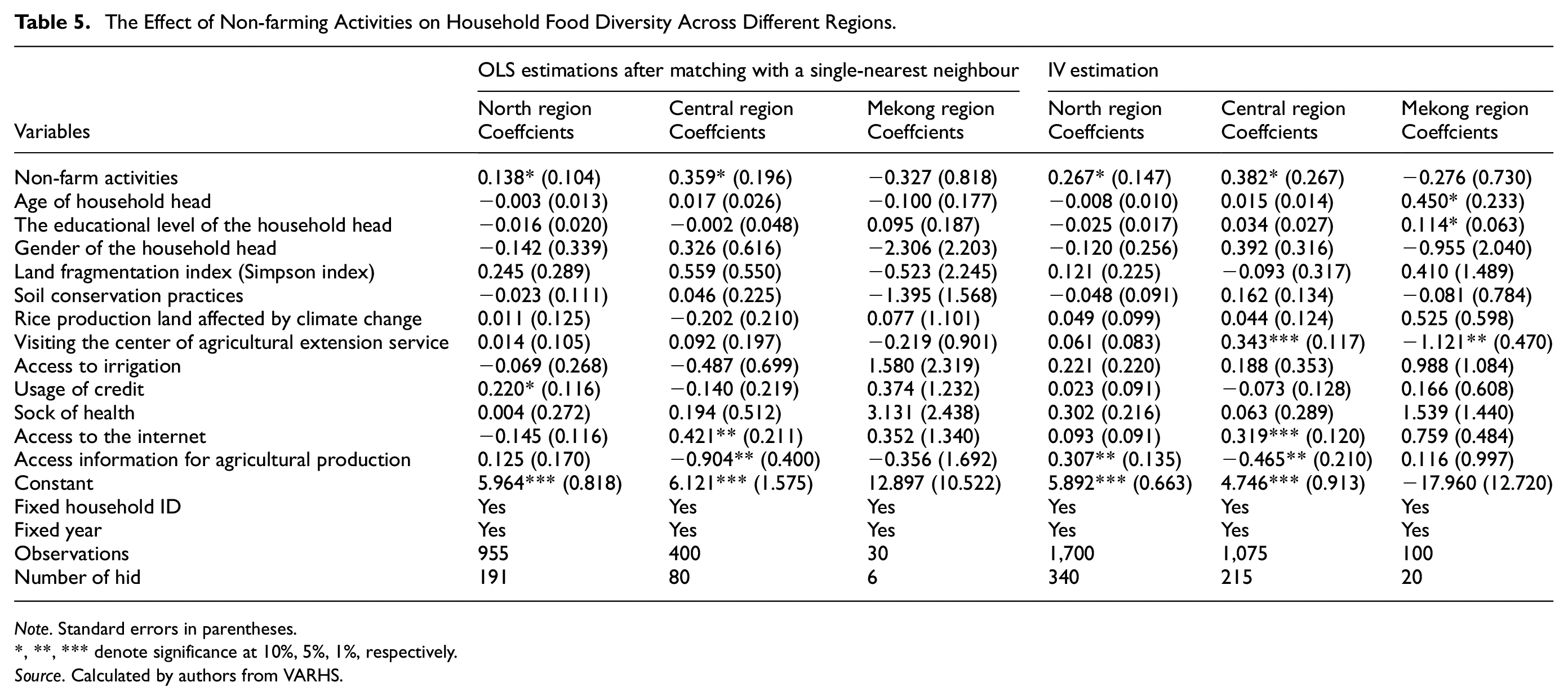
Table 5 presents the results of OLS and IV estimations assessing the impact of non-farm activities and other covariates on household food diversity across Vietnam’s North, Central, and Mekong regions. The findings show that non-farm activities significantly increase food diversity in the North and Central regions. However, their effect is statistically insignificant in the Mekong region, likely because farmers in this region benefit from strong agricultural production. Participation in non-farm activities may reduce the efficiency of agricultural efforts, thereby limiting improvements in household food security, as measured by the diversity index.
The Effect of Non-farming Activities on Household Food Diversity Across Different Regions.
Note. Standard errors in parentheses.
, **, *** denote significance at 10%, 5%, 1%, respectively.
Source. Calculated by authors from VARHS.
Conclusion and Policy Implications
The study evaluated how engaging in non-farm activities influences the diversity of available food within rural households in Vietnam. Utilizing a comprehensive dataset from 2010 to 2018 from VARHS, the research employs a combination of Propensity Score Matching (PSM) and fixed-effects estimators to address data variations. PSM helps mitigate selection bias stemming from observed time-invariant and time-varying factors, while fixed-effects estimators adjust for unobservable variations in farming household characteristics. In addition, an internal íntrumental varibales (IV) is used to issue the robustness test for results that show the relationship between participation in non-farm and household food security in rural Vietnam.
Regarding the factor linked to participation in Non-farm activities, logit estimation reveals that older household heads are more likely to engage in non-farm activities, possibly seeking to diversify income or pursue alternative interests. Conversely, female-headed households show higher participation, reflecting the appeal of less physically demanding non-farm work. However, land fragmentation hinders participation, as households prioritize scarce resources for agricultural maintenance. These findings highlight the nuanced interplay between household characteristics and structural constraints in shaping livelihood strategies.
In addition, the findings reveal that non-farm activities significantly contribute to household food diversity in rural Vietnam. Regression analysis with fixed effects post-PSM indicates a positive coefficient between non-farm participation and the household food diversity index. Similarly, the result of IV shows that participation in non-farm activities leads to an increase in household food security. More importantly, the study shows that the heterogeneous effect of participation in non-farm activities on household food security. This underscores the importance of diversifying livelihood strategies in rural areas through non-farm engagement. Based on the result, local governments can promote and encourage older farmers to engage in non-farm activities by providing targeted training programs. Similarly, offering training to women can enhance their likelihood of participating in such activities. Most importantly, reducing land fragmentation can lower production costs, thereby increasing the chances of farmers diversifying into non-farm pursuits.
Despite our efforts to address selection bias, limitations persist. While our fixed-effect estimation with a propensity score matched sample helps mitigate selection concerns, disparities in our matched sample may still exist between non-farm and farming households. Furthermore, the study does not pinpoint specific non-farm sectors that may offer greater welfare for rural households. Therefore, future research utilizing more detailed panel data is essential to address these gaps and provide policymakers with effective insights for local governance.
Footnotes

Ethical Considerations
In this study, data are used from the Vietnam Access to Resources Household Survey (VARHS), and these data are solely for research. The anonymity of the respondents and the communities must be respected. No user should make any attempt to identify or contact any individual, household, or commune in the VARHS data.
Consent to Participate
All participation in the Vietnam Access to Resources Household Survey (VARHS) is voluntary, and participants may skip any questions they do not wish to answer or stop participating at any time without consequences.
Author Contributions
Funding
The author(s) disclosed receipt of the following financial support for the research, authorship, and/or publication of this article: This research is funded by Hue University, under grant No. DHH2025-06-163.
Declaration of Conflicting Interests
The author(s) declared no potential conflicts of interest with respect to the research, authorship, and/or publication of this article.