



Abstract
This paper analyses how farmers to take decision to allocate and use their lands for potato production when both contract and non-contract farming options are available in West Bengal. We used a primary data collected from 327 potato producing households in Bankura and Bardhaman districts of West Bengal. We used generalized least squares fixed effect model in the empirical analysis. We observed that imposed restriction of seed supply limits the choice of both potato farming and non-potato farming. The benefits from contract farming are not accrued by the farmers who are mainly small and marginal landholders. They are also in a moment of ambiguity to choice their land use under non-potato cultivation. The choice of the farmers, therefore, remains constrained. This uncertainty can be overcome only through effective land use planning and institutional intervention.
Introduction
Contract farming is a market led growth model with industrial mode of production in the neoliberal era (Little & Watts, 1994; Martiniello & Azambuja, 2019). Thus, the primary intention of contract farming is to increase production as well as profit. The review of literature suggests that there are two dominant views on contract farming. One view is on the positive effects and the other view is on the adverse effects of contract farming. Several scholars observed that contract farming has significant socio-economic effects in developing countries (Barrett et al., 2010; Dev & Rao, 2005; Eaton & Shepherd, 2001; McCullough et al., 2008; Reardon & Gulati, 2008; Singh, 2002; Swain, 2016; Swinnen, 2007). It is further recognized as a phenomenal reform in the agriculture sector with positive multiplier effects on employment generation, rural infrastructure and market development and establishing linkage between local farmers and global markets(Barrett et al., 2012; Key & Runsten, 1999).On the contrary, issues like indebtedness, production risk, soil degradation, and loss of autonomy under contract farming have been raised by scholars (Little & Watts, 1994; Opondo, 2000; Rehber, 1998; Singh, 2002). Little and Watts (1994) pointed out that contract farming in sub-Saharan Africa has raised conflicts of unequal power relations between contractee (a processing firm or institution) and farmers, and issues relating to the exploitation of agricultural labor. Irrespective of negative perspectives, various empirical studies have identified that contract farming improves the income (Barrett et al., 2012; Bellemare, 2012; Ramaswami et al., 2006; Swain, 2011; Warning & Key, 2002), and it is used by farmers as hedging assets against the price risk in India (Bellemare & Bloem, 2018; Ghosh & Raychaudhuri, 2010).
Amidst two notions of contract farming coexist, farmers are extremely cautious of their decision to participate, spare land and invest capital in contract farming due to persistent risk, growing uncertainties of income for future and rising inequality within farming community itself. The decision of farmers to participate in contract farming varies according to the expected level of utility from participation, based on the terms and conditions of the contract, and the position of the market that includes the market price for non-processing potatoes and other crops. Studies have reported that contracts are biased towards the firm and often expose smallholders to ex-post risk (Abebe et al., 2013; Boyabatlı et al., 2019; Meemken & Bellemare, 2020; Singh, 2002). The majority of studies have either supported or criticized the role and benefits of contract farming, but very few studies, for instance, Swain (2016) noted farmers’ choice of allocation and utilization of land under contract farming from their existing landholdings, contractual norms, related input supply, and market demand among others. Therefore, a clear and systematic understanding of the factors that influence farmers’ decisions on the allocation of land for growing the crop under contract farming is important.
This decision to allocate a specific quantity of land is particularly important, where land is scarce, the market is too volatile and risk is prominent. In general, the choice and decision of using a particular parcel of land for cultivation depends on the specific aims of a household that is to obtain utility maximization. Kokoye et al. (2013) by referring (Adégbidi, 1994) developed some other important aims such as ensuring food security of a household; ensure cash income in order to satisfy the material needs, minimize risk and ensure survival, maximize the leisure and related activities time, increase the household’s patrimony in order to guarantee survival during old age, ensure the wellbeing of family members, and access to certain social classes in the community (Kokoye et al., 2013). In addition, the decisions of households for allocating the land for different crops are based on geo-climatic, socio-cultural, economic, historical, and political factors (Todkari et al., 2010). The decisions on the allocation of land for the purpose are based on the knowledge, experience, and observation carried out by a household from generation to generation. The land tenure system, which includes land holding, land ownership, land distribution, and land leasing arrangements, etc., play a key role to take decision in allocating land and land use strategies (Kokoye et al., 2013). Therefore, there are mainly three types of mobility factors that influence in the decision-making strategies (Adégbidi, 1994; Altieri, n.d). These are institutional arrangements, socio-economic conditions of households, and market factors (Khan, Nakano et al., 2019; Kokoye et al., 2013).
The socioeconomic factors like the price of processing and non-processing potato varieties in the market, supply of the processing seed, contractual norms, market situation, etc., influence farmer households’ decision toward participation in contract farming in which a farmer often decides about the quantity of land to be spared from his or her total land possession for the specific purpose and for a specific period. These aspects of land allocation and utility constraints are not adequately focused in previous studies. In this context, the present study in an eastern Indian state West Bengal focuses on farmers’ practices regarding the allocation and utilization of fixed assets (land) for potato cultivation under both contract and non-contract modes of production. The authors attempt to examine how farmers take decision to allocate and use land for potato production when both contract farming and non-contract farming options are available in the region.
The potato market is usually volatile, which puts the farmers under uncertain situations. The majority of the farmers in West Bengal are poor or in the lower economic category. Therefore, it is important for farmers to take right decisions at the right time for a specific quantity of land for its allocation under potato contract farming or non-contract farming to avoid loss and counter uncertain markets. In contract farming, however, the price is predetermined, but there are a few other unstable factors that affect farmers’ choice to allocate land.
In the context of backwardness of the eastern India region and agriculture being the mainstay of a large section of the population in the region, selection of the state of West Bengal from eastern India is particularly important. Contract farming ventures in this part of India are relatively new compared to other agriculturally prosperous states like Punjab, Haryana, Uttar Pradesh, Andhra Pradesh, and Karnataka, amongst other states in India. Also, the studies on contract farming are few in the eastern Indian states, including Bihar, Jharkhand, Odisha, and West Bengal.
West Bengal is among the leading agricultural producers in the country. Potato is the most popular staple crop in the state. Several districts in the lower Gangetic river basin are fertile, and soil is conducive for food grains as well as vegetable production. Most of the landholders in the state belong to the marginal landholding categories (with less than 1 hectare of landholding size), unlike the landholders in the states of Punjab, Haryana, and Andhra Pradesh. West Bengal has above 95% of total landholders belong to small and marginal categories who possess less than two hectares of land and account for above 80% of total operational holdings (Agriculture Census, 2015-16). The average size of marginal landholdings is 0.49 hectares for a total of 5.85 million landholders. The average size of small landholdings is 1.59 hectares for 0.97 million landholders (Behera et al., 2018; Khan, Nakano et al., 2019). These small-marginal landholders are poor and lack adequate socio-economic opportunities. Due to the high concentration of marginal landholdings (up to one hectare) and landlessness, land leasing has been a popular practice in the state. Both landless households and very marginal and marginal landholders lease in land for growing cash crops like potato and cereals. Land leasing is legally permitted in the state under the Bargadar Act.
Potato has been a popular cash crop among farmers in West Bengal for more than decades. Contract farming of potato in West Bengal has been started by PepsiCo in the first half of the 2000s (Behera et al., 2018). It has attracted different types of farmers irrespective of their size of landholdings and socioeconomic conditions due to pre-fixed prices and assured procurement. Each year a landholder grower decides about the amount of land to be allotted for potato cultivation under the contract farming (cf) and non-contract farming (ncf) mode of production. The varieties of seeds used under the cf are entirely different from the varieties of seeds used under the ncf. A farmer can grow only such varieties of seed that are recommended by a firm under the cf. The major processing varieties of potato grown under contract farming are ATL, FC3, and FC5, which are normally not used for domestic use. As per the contract, a farmer is not legally permitted to sell their produce under contract mode of production in the open market. The staple varieties of potato, such as Jyoti, Chandramukhi, and Asha are grown for open markets. Thus, the allotment of land is the primary decision of farmers for the purpose of the cf and ncf. This can be further considered as the hedging mechanism used by potato growers by allotting a few parcels of their landholdings for the cf and ncf. The hedging mechanism can be defined as a set of measures against uncertainties by minimizing the risk. It usually involves taking offsetting potion against the related asset value (here, it is the price of potato).
Materials and Methods
Study Area and Data
The two-stage sampling method was adopted to collect the primary data. The PepsiCo led potato contract farming was taken into account for the purpose of the study. Before employing the survey, we obtained a list of the villages in different districts in the state from the firm PepsiCo, which is involved in contract farming (Appendix A.1). Based on the data obtained, we identified the blocks with high and medium concentrations of contract farmers. Further, we randomly selected one block each from Bardhaman as well as Bankura districts of the state. These two blocks are Memari from Bardhaman district and Kotulpur from Bankura district. Further, we randomly selected three villages (two from Bardhaman district and one from Bankura district) from among the selected blocks. The focused group interviews (FGIs), personal interviews (PIs) and household questionnaire method were adopted during the survey. Altogether 327 households were surveyed during 2015 to 2016 for the purpose of our study with focus on three specific periods 2013, 2014, and 2015. Farmers’ views were recorded and their land allocation and utility pattern was discussed during the field survey. The researchers conducted three FGIs separately with one for each of the following groups: farmers in cf only, farmers in ncf only, and farmers in both cf and ncf. The size of each group was between 12 and 15 farmers. The main focus of the FGIs was to understand the nature of contract between the firm and farmers, prospects and challenges in contract farming, expected price for potato from cf and ncf, land allocation choice for each of the group, seed supply in cf and ncf, potato price in the cf and ncf, and reasons to continue or exit from cf among others.
There are several internal factors such as family size, landholding size, family income etc., that influence farmers to participate in contract farming (Behera et al., 2018; Dev & Rao, 2005; Swain, 2011). Some empirical studies identified that landholding size is the most important component in determining the decision on the participation in contract farming (see Behera et al., 2018). Therefore, the questionnaire used for data collection included questions about types of farmers socio-economic condition including family size, family type, family income from agriculture and non-agriculture, landholding size, owned land and leased-in land. Also, included questions about the participation and non-participation in cf, area under potato farming including cf and ncf, area under potato cf, area under potato ncf from the year 2013 to 2015, fallow land or used land for non-potato crop (other crop varieties), supply of seed and other supplements for cf, market price of potato under cf and ncf, etc.
Analytical Framework
At the beginning we considered analyzing socio-economic conditions of the farmers participating in different types of farming, followed by the comparison of the socio-economic conditions between different groups (ncf, both ncf and cf, and then cf only). The binary logistic regression has been used to determine the effect of socioeconomic factors of households to participate in contract farming. This analysis is based on the comparative account of households’ socioeconomic conditions such as secondary occupation (other than agriculture), family size, and land holding, etc., and their relationship with farmers’ decision whether or not to participate in contract farming.
From the socio-economic analysis we observed that, land, which is non-elastic in nature is one of the key determining factors. Therefore, a rational farmer has to allocate the land judiciously to maximize utility either from the ncf or cf or may be from both cf and ncf. The distribution of the total cultivable land (L) between the ncf and cf and between the unused land and used land for other crop varieties (µ) held by the ith farmer is represented in the equation (1).

Where, the allocation of land for the cf can be written as

Equation (1) indicates the distribution of land by the ith farmer for time t (from year 2013–2015).
Utility Maximization Framework
To understand the process of land allocation and farmers’ behavior a utility framework has been adopted in this study. The framework was obtained from Vani (1971), where he developed a utility model for the treatment of farmer’s behavior under this uncertainty on the basis of Tobin (1958) and Markowitz (1970) theories to analyze the portfolio selection of a household (Ouattara et al., 2019). The utility equation of household for land allocation under staple potato (ncf) and processing potato (cf) on the motive of utility maximization is formulated accordingly in the present study, which is given below.

Subject to the budget constraint

ρ is the function of the price of potato (P), Y indicates yield,
Here,
However, in the case of ncf, the supply of seed and other supplements are available in the open market. Therefore, there is no restriction on seed supply. Therefore, the equations for U ncf and U cf are as follows:


Prices and yields are random variables and the allocation of land for the cf and ncf depends on these factors. Therefore, to obtain the allocation of land for cf, it can be formally written as

Furthermore, we have observed that there are some common factors such as geo-climatic conditions for both the cf and ncf. The average yield per acre of land for both the crop varieties (processing and staple) is more or less the same, and there is equal access to credit and cash flow for both the cf and ncf. Besides, fixed land policy, and government and non-government intervention are more or less common for both the cf and ncf, respectively. With these additional observations simple stochastic estimation model for land allocation under contract farming is rewritten as

Where, P is the expected price obtained by the ith household after harvesting staple potato varieties and P* is the price under contract farming, particularly at the time of contract (different for each year t). S denotes the average supply of specific types and quantities of seeds, chemicals, pesticides, and other technical supports by the firm under the contract, and Lncf is the land allocated to staple varieties crop. ε is the invisible factor impacting the land allocation of the ith household for contract farming. To establish the relation GLS fixed effect model was used for the analysis (equation (8)). The GLS fixed effect model allows the variation among the households, while the slope of the parameter is assumed to be constant in both the individual and time dimensions. The model considers the assumption that the explanatory variables are non-stochastic and independent of error. It also carries the assumption of the random terms are independent and homoscedastic (
Further, the analysis of utility maximization has been depicted with the help of graphical representation to show the relationship obtained between price and land allocation of a household using the indifference curve. The analysis has been extended in the results and discussion by depicting the observed phenomenon.
Results
Here, the landholding classification is based on the operational landholding size as marginal, small, semi-medium, medium, and large. The operational landholding size below 1 acre is considered as marginal landholding; 1 to 2.47 acres is the small landholding, above 2.47 to 4.94 acres is semi-medium landholding, and above 4.94 acres is considered as medium and large operational landholding (Table 1). The composition of selected 327 households includes 45.6% marginal landholdings; 39.8% small landholdings; 10.7% semi-medium landholdings; and, the rest 4% medium and large landholdings (Table 1). The average agricultural landholdings for marginal, small, semi-medium and medium and large landholders are 0.6, 1.61, 4.48, and 5.2 acres, respectively. It is observed that the average family size of the marginal landholding households is 4.6 (Table 1). Similarly, the family size of medium and large landholders is 9.1, which is normally high due to respondents’ joint family structure. The average annual income from agriculture is found minimum among the marginal landholders and highest among the medium and large landholder (Table 1).
Socioeconomic Profile of Farmers.

Note. Figure in parentheses are percentage.
Out of the total 327 households, 39.45% belonged to only ncf, 49.24% belonged to both ncf and cf, and 11.31% belonged to only cf. The percentage share of marginal landholders among the ncf, both ncf and cf, and cf categories includes 56.16%, 26.71%, and 17.12%, respectively. Similarly, the percentage share of non-marginal landholders among the ncf, both ncf and cf, and cf includes 25.97%, 67.40%, and 6.63%, respectively. The average landholding size of owned land among the households of each cf and ncf is 0.78 acre, and for both cf and ncf is 1.85 acre. The average agricultural land leased-in for ncf only, for both ncf and cf, and for cf only includes 0.20, 0.28 and 0.24 acres respectively. It is observed that the households engaged in either ncf or cf has lower income from agriculture compared to the households involved in both ncf and cf. It is also observed that the people with lower income from non-agriculture are more in cf than ncf (Table 2).
Socio-Economic Profile of Farmers by Their Landholding for the Year 2015.

From the binary logistic regression results (Table 3), it is inferred that landholding size (category), secondary occupation, and non-agricultural income have significant effects on the contract farming. It was also found that other factors such as land transaction (leased-in or leased-out land), secondary occupation, and non-agricultural income have significant effects on contract farming participation. The B values −3.491 and −0.788 indicate that households with secondary occupation non-labor and annual income below Rs. 10,000 have high probability to participate in contract farming. On the households’ social conditions such as, family type (nuclear), family size (more than 3), and education above primary level of education have positive effects, but significant to involve in contract farming. The results show that the farmers who are mainly small and marginal landholders and also in lower income category have the tendency to invest their land in cf than ncf to maximise income opportunity.
Influence of Socioeconomic Factors on Contract Farming Participation (Binary Logistic Regression).

Note. Sample Size is 327. Count R2 value = 77.7%. Nagelkerke R2 = 0.415.
Land Allocation Under Contract Farming (Utility Maximization)
It was found that, 96.14%, 89.30%, and 88.86% lands from the total 460.26, 483.80, and 485.20 acres of farmers’ cultivable lands allocated for the potato cultivation (for both processing variety and staple variety potato) during the years 2013, 2014, and 2015, respectively (Table 4). Of the total lands allocated for cultivation, 230.13, 242.5, and 243.2 acres of land have been used for ncf and 163.74, 165.66, and 165.98 acres of land have been used for cf during the years 2013, 2014, and 2015, respectively (Table 4). Out of the total cultivable land, 66.39, 75.64, and 76.02 acres of land were either left fallow or they were used for crops other than potato. The firm sets target each year for production and supply of the processing seeds accordingly from each unit of land. Usually, the firm provides five quintals of processing seeds for each acre of land to farmers in the study village for production under the cf. The seed supplied by the firm for the years 2013, 2014, and 2015 are 818.70, 828.30, and 829.90 quintals, respectively. Regardless of the increase in the number of households’ participating in the cf from the year 2013 to 2015, there is no such remarkable increase in the land allocation to cf for the same period. One can observe the phenomenon of shift of total land under potato cultivation from 96.14% in 2013 to 88.96% in 2015. It was also observed that at the same time, there was an increasing land cover under the ncf from 230.13 acres in 2013 to 242.50 acres in 2014, and 243.2 acres in 2015. The shift in acreage of land in cf was however minimal irrespective of the increase in the number of households’ participating in contract farming in these 3 years (Table 4). From Table 4, it is observed that despite there is an increase in the total land under cultivation, there is a decrease in the proportion of land used for potato cultivation during the same period.
Year-wise Household Participation in Contract Farming and Allocation of Land.

In the following paragraphs, the analysis on the farmers’ land allocation decision is described in two segments. The first segment describes the stochastic land allocation model based on the utility equation (equation (8)) (see Table 5). The results identified the significant economic factors in determining the allocation of land for the cf and the second segment describes a hypothetical situation considering the findings and results obtained from the first segment.
Land Allocation in Contract Farming (Utility Maximization) (GLS Fixed Effect Model).
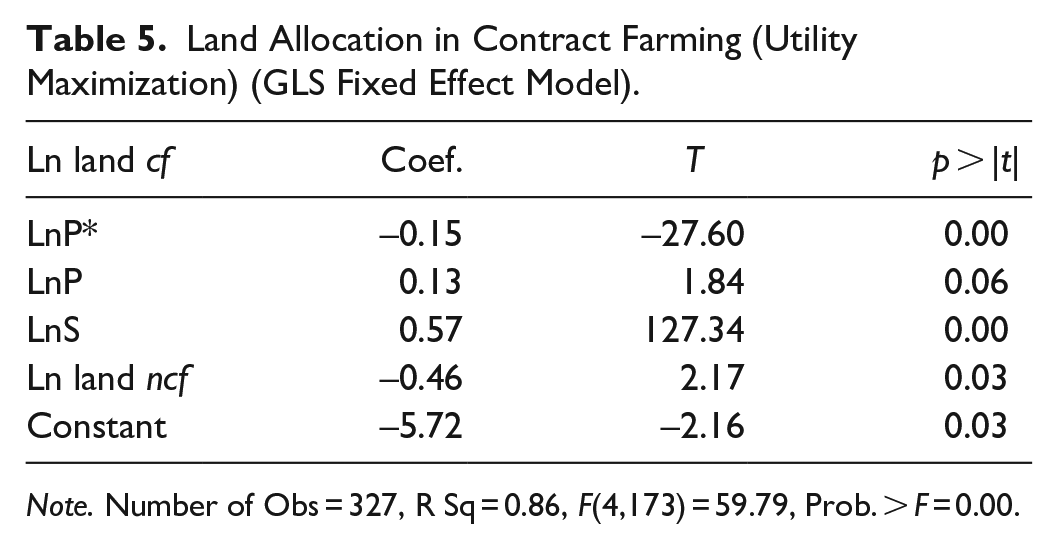
Note. Number of Obs = 327, R Sq = 0.86, F(4,173) = 59.79, Prob. > F = 0.00.
To normalize both the dependent as well as independent variables (equation (8)), natural log is applied for further analysis (Table 5). It was found that land under cf (Lcf) has a positive relationship with the market price of staple potato (P) and average supply of processing seed and supplement (S) by the firm. Although, the market price of staple potato (P) is slightly insignificant at the 95% of confidence interval, but it is significant at the 90% confidence interval. However, the market price of processing potato (P*) and land under ncf (Lncf) have an inverse relation with the allocation of land for cf. Because landholding is more or less constant, it is observed that with the increase in allocation of land under the ncf, there is decrease in the land allocation size under the cf (equation (1)).
In view of the above, the paper further discusses on the land allocation behavior of a cultivator based on a utility maximization framework. For further analysis, a hypothetical situation is created in the next segment to emphasize on the behavior of the cultivator and the indifference curve is used.
Land Allocation Under Contract Farming (Indifference Curve)
It was observed that the decision of allotment of cultivable land for growing potato is based on the price a producer expects to get in return from the buyers (Table 4). In the case of the cf, the sale price of potato is known to the farmer before taking decision on the allocation of land. As per the contract, the farmers should follow the quality standard of the produce. However, in the case of ncf, potato is grown without any price guarantee for the anticipated production due to market uncertainty. On the one hand, an individual potato producer is certain about the return from each unit of landholding under the cf, but on the other hand, he lives with uncertainty about the price he can secure from the uncertain market under the ncf.
The decision on allocation of land for the contract and non-contract farming is very significant in the backdrop of poor or moderate socioeconomic conditions of the farmers who mainly belong to the small and marginal landholding groups. Further, potato production involves high input cost and it is labor intensive than other cash crop production. Right decision at right time on the distribution of land by a farmer is therefore very important for potato farming. Here, we consider a producer for an illustration of the situation and the decision he takes about the distribution of land between the cf and ncf (Figure 1). The basis of distribution of land, as discussed before, is based on the expected market price per unit of sale before cultivation. Usually, among the producers, the expected price is determined by using the last few years price they secured from the market. Based on the expected price, he/she decides the proportion of land to be allocated for the cf and ncf.
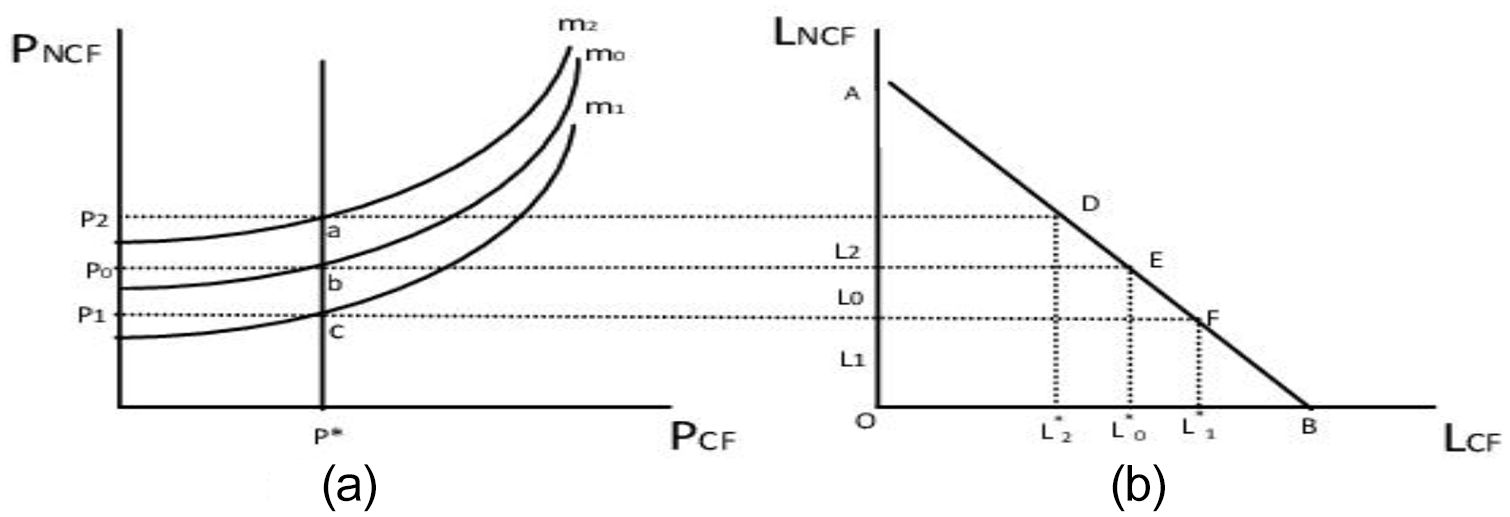
The relation between market price and land allocation
In Figure 1, the expected price of ncf potato is denoted as PNCF represented in the Y-axis, and the price of the cf potato is denoted as PCF represented in the X-axis; m0, m1, and m2 are the locus of market price of ncf potato; P0, P1, and P2 are the expected price of the potato under ncf, and P* is the price of potato under the cf per unit (determined as per the contract for that particular year of cultivation) in segment (a) of Figure 1. Segment (b) in Figure 1 indicates the total cultivable landholding of an individual, represented by straight line AB, which is the locus of different combinations of land for utilization under the ncf and cf to obtain the same level of satisfaction. The LCF in the X-axis represents the unit of land allocated for the cf, and on the Y-axis, the unit of land allocated for the ncf is denoted by LNCF. The L0, L1, and L2 on the Y-axis and L*0, L*1, and L*2 on the X-axis denote the possible combination of land for the purpose of ncf and cf, which is based on the expected market price of ncf (Figure 1a). The price of cf potato (P*) is predetermined and will be the same over the particular period. It is represented by a horizontal line. The price of the ncf potato is market driven. Under the ncf a farmer expects price for the current year primarily based on the price he could fetch from the previous year.
The figure identifies three possible price conditions; the first condition, the price of the ncf potato is expected to be equal to the last year’s price (P0); the second condition, the price of potato is expected to be lower than the last year’s price (P1); and the third condition, the expected price of potato is higher than the last year’s price (P2), denoted in Figure 1a, (such that P1 < P0 < P2). Thus, to reduce the risk from the uncertainty of price fluctuation of the ncf potato, the individual producer sets the position by altering the quantity of land allocation between the cf and ncf from the total availability of land with him/her. The allotment of land can be observed as a function of the expected market price of potatoes. However, a general perception of the farmers is that the potato price goes up and down in every alternative year. For instance, if the price of the ncf potato was high (low) last year, the price of the ncf potato in the current year would be low (high).
Now, consider both Figure 1a and b together. Let us consider the first condition, where the expected price of the ncf potato is P0. Therefore, there will not be any change in the allotment of land and it will remain on the same level of combination of land for the ncf (OL0) and cf (OL*0) as the previous year. This condition will be the basis for further analysis. If the expected price is P1(P1 < P0), then the allocation of land will shift to the cf from OL*0 to OL*1, by reducing the ncf land from OL0 to OL1. If the expected price is P2 (P2 > P0), the land allocation will be drifted towards the ncf than the cf. This shifting is due to a rational farmer’s attempt to realize better profit or secure his position from the land allocation process.
Although the utility of land for the purpose of the ncf and cf is a function of the price of ncf potato, yet there is a constraint from the limited supply of cf seeds by PepsiCo. In the case of low market demand the lower quantity seed and in the case of better market demand the higher quantity seed is supplied to the vendors. Subsequently, the vendors also controls the supply of seed to the farmers. Thus, the relative function of land utility becomes a function of the expected price of the ncf with the constraint of quantity of seed and supplements supplied for the cf cultivation. In such a situation, if the expected price of the ncf is P1 (Figure 2), the rate of allocation of land for cf is comparatively less than that of the allocated under a normal situation noticed in Figure 1. By not shifting the surplus land obtained from the cf to ncf would indicate farmers’ restraint to avoid market uncertainty.

The relationship between market prices and shift in land allocation due to reduction of supply.
Now, we shall try to understand the consumption and utility behavior further by drawing the indifference curve and attempt to draw the allocation behavior more explicitly.
The utility of land based on the indifference curve (I1) of an individual producer describes the level of satisfaction of the farmers (Figure 3). Let e be the initial equilibrium point where AB implies the various combinations of distribution of land between the ncf and cf to maintain the same level of satisfaction. As we have already discussed about the supply of seed constraint, the AB line shifts to the left represented by AʹBʹ (Figure 3). The result of this shift from AB to AʹBʹ should gain producer land up to OL1 in the ncf and OL*1 in cf to maintain same level of satisfaction represented as eʹ, the point of equilibrium (Figure 3). However, due to high price uncertainty associated with the ncf, farmers not always shift their land to the ncf and settle with the lower level of indifference curve at point eʹ (Figure 4). As a result, the land allocated for the cf purpose reduces from OL*0 to OL*1. It is observed that the farmers are not willing to open their position by employing more than the OL0 level of land due to price risk. The leftover land is thus generated due to the shift of AB to AʹBʹ. It is observed that this leftover land from potato farming is not usually diverted to other crops in the same season. However, a few small and marginal landholders use such leftover land indiscriminately for hardly any productive return.

The optimal satisfaction level of farmers by allocating land for potato cultivation in cf and ncf.

The shifting of the optimal level of satisfaction by allocating land for potato cultivation in cf and ncf with the constraint of reduction in seed supply of cf variety.
Discussion
Contract farming is an agribusiness model. In the case of potato farming, it is a monopsony market structure in which there is only one buyer, but there are many growers (producers). PepsiCo, which is the only firm associated with potato contract farming in West Bengal, provides certain processing variety of seeds (ATL, FC3, and FC5) along with other inputs and technical assistance to the farmers. But this input and assistance is given through the vendors only, where the farmers have to pay for every input they are bound to purchase as per the agreement. The contract farming agreement in the state is based on the written agreement between the vendor and the firm, followed by the agreement between the vendors and the growers. It is solely the responsibility of the vendor whom he would like to choose for growing processing variety under contract farming by which the inputs can be sold and used, and they can meet supply criteria of the firm. In a true sense, vendors are intermediaries or middlemen between the firm and the farmers (growers). It was observed that a few credit and cooperative societies are also working as vendors in the contract farming operation in West Bengal. In Memari block, the Gope Gantar Union Co-operative Agricultural Credit Society is selected as the vendor, whereas, in Kotulpur block, a few private large landholder-cum-farmers are selected as vendors. We observed that apart from the vendor’s large landholding or the potential to aggregate large landholdings by mobilizing local farmers, a set of other criteria also fixed by the firm for the selection of vendors. Some of these criteria are the ability to deposit security money, the ability to supply quality produce and anticipated quantity as per contractual norms, resource mobilizing capacity, and social and political influence in the community amongst others.
The supply of processing variety seeds and supplementary items by the firm to farmers (growers) are routed through these recognized vendors. However, the distribution of processing seed and supplementary items is closely monitored and regulated by the firm. The allocation of seeds and supplements is based on the expected consumer demand for the processed food items and also the production capacity of the processing unit. Based on production requirement, the company curtails seed supply to the vendors. The vendors thereafter decide on the quantity of seed supply to the farmers. This altogether affects the producers’ choice to the proportion of land investment in the cf and ncf by which they can set their position to obtain optimal utility (Ouattara et al., 2019).
The quantity of seeds supply to the farmers by the vendors depends on the former’s commitment to purchase of inputs and their use for production of the processing variety. Also, it depends on the farmers’ loyalty to the vendors. There is a set of better-off farmers with advantageous position in terms of landholdings and socio-economic conditions. They have been associated with contract farming since the very beginning of contract farming introduced or they are associated for longer time. These farmers have already won the confidence of the vendors by their strong commitment. Thus, these farmers’ interests need to be protected. Most of the farmers who are committed to the quality and process get special attention from the vendors. Moreover, the vendors choose new farmers when more farmers show interest in contract farming. This loyalty factor also affects seed supply and land distribution and use for the contract farming.
In general, there is more or less a fixed quantity of seeds required for each unit of landholding in both the cf and ncf. In the case of a short supply of processing seed, even a regular contract farmer has to compromise with the size of land allocation for the cf. This results the AB line shifts to AʹBʹ, an incline to LNCF (Figure 2).
However, it is noticed that a farmer is not always able to use the surplus land for the ncf irrespective of the price condition. Many farmers get information about short supply of processing seed in late hours. Therefore, it becomes difficult for farmers to effectively engage their land in time for non-contract potato farming or for the other crops. Irrespective of surplus land obtained, the cultivators remain interested in the position of risk averse by not allocating gained land to non-contract potato. They remain unwilling to allocate their resources (land, labor, and capital) beyond a certain level of risk, which they can afford. It is rather they choose to keep their land fallow for certain period. From the data obtained for the said period (2013, 2014, 2015), it was observed that 66.39 acres in 2013, 76.24 acres in 2014, and 76.62 acres in 2015 were left fallow despite increasing offer of sale price under contract farming in each year (Table 4). It is also observed that some farmers use their unused land for growing non-potato cash crops, which can be considered a diversifying strategy to obtain profit from other different cash crops (Table 4). The shift of land area under allocation for non-potato crops or decision to keep land fallow in West Bengal is due to farmers’ inability to fetch stable income opportunities from an unreliable market. These fallow and non-potato cultivated lands are the surplus land that was kept reserved by the farmers for cf under a specific land utility strategy.
Adopting the processing seed for cultivation purposes (contract farming) is one of the economic strategies of households, which is linked to fixed income opportunity compared to conventional farming. However, households adopt contract farming fully, partially, or not adopting at all is based on their risk appetite (Bellemare & Bloem, 2018; Brush et al., 1992; Smale et al., 1994). However, the risk apatite depends on socio-economic conditions and future objectives of the farmers and the level of risk they can bear (Gai & Vause, 2005; Mishra et al., 2019). Here in the case of contract farming, the risk is bounded by unstable market prices for staple potato, market demand for processed food items followed by the short supply of processing seeds and the vendors’ choice to continue with existing farmers or choose new farmers in potato contract farming.
Conclusions
The primary motive of a farmer to involve in contract farming is to obtain a secure venue for earnings. Due to an alternative option available since last few years, the farmers have thought of hedging their position by carefully employing the land and other resources between the cf and ncf. The allocation of land was such that the farmers can average their position from the losses incurred at the time of low price and gain accrued at the time of higher prices under the ncf. But the restrictive nature of seed supply by the agro-processing firm (PepsiCo) to the vendors and vendors to the farmers’ affect the land utility pattern. The farmers, mainly the marginal and small farmers have to be extra careful, extra cautious, committal, and loyal to continue winning the confidence of the vendors who supply them seeds. The abrupt decision taken on the restriction of quantity when farmers are not prepared to divert land or not in a position to take extra burden or risk leave farmers with little scope to use land meaningfully. This brings down their level of satisfaction by bringing the indifference curve down. As a result, there is again an inclination of position towards uncertainty by relatively having an unbalanced ratio between the ncf and the cf. The imposed restriction of seed supply and vendors biasness limits the cultivation choice of small and marginal cultivators. Therefore, the real opportunity to gain from contract farming is not accrued by the small and marginal landholders and they are compelled to live in uncertainty.
While twenty Indian States had amended the Agricultural Produce Marketing Committee (APMC) Act to accommodate contract farming, West Bengal had not yet amended or notified (West Bengal Agricultural Produce Marketing (regulations), Rules) for provision of contract farming (Chand & Singh, 2016), and therefore, contract farming practice has not been formally recognised in the state. In 2020, the Indian government has passed three farm laws in which the Farmers’ Produce Trade and Commerce (Promotion and Facilitation) Act, 2020 was directly linked to facilitation of contract farming, which is outside the APMC. In this context, the state can create a separate Contract Farming Board for better regulation of contract farming practice in the state in view of both the farmers, vendors, and the contract farming agency. The Board can address issues in advance related to the agreements for input supply, purchase, and sale with adequate emphasis on farmers’ security. Further, effective land use planning by the state agricultural departments at the block and the village level and incentives for the small and marginal farmers can overcome land utility constraints.
Footnotes
Appendix A
Contract Farming Concentration Block Wise.

| Burdwan district | Bankura district | ||
|---|---|---|---|
| Block | No. of village | Block | No. of village |
| Memari-I | 128 | Kotulpur | 83 |
| Memari-II | 64 | Joypur | 71 |
| Kalna II | 10 | Onda | 41 |
| Raina II | 9 | Bishnupur | 29 |
| Raina I | 3 | Patrasayer | 22 |
| Taldangra | 7 | ||
| Indas | 3 | ||
| Borjora | 1 | ||
Source. Data collected from the field study.
Acknowledgements
This paper is an outcome of the research project titled, “Contract farming participation and emerging agrarian relations: A study of potato growers in West Bengal” with Dr. Hari Charan Behera as Principal Investigator (PI). Shri Ashish Aman was also associated with the project for research support. The authors are thankful to Professor Amita Majumder, Economic Research Unit, Indian Statistical Institute Kolkata for her comments and insights to improve the paper. We are also grateful to the Technical Advisory Committee (TAC) who found this project worth for research and recommended funding under plan project grant of Indian Statistical Institute (ISI). The Authors are also thankful to Professor Manoranjan Pal of Indian Statistical Institute Kolkata for his kind inputs in the paper.
Declaration of Conflicting Interests
The author(s) declared no potential conflicts of interest with respect to the research, authorship, and/or publication of this article.
Funding
The author(s) disclosed receipt of the following financial support for the research, authorship, and/or publication of this article: This paper is a part of the research project undertaken by Dr. Hari Charan Behera as PI and Ashish Aman Sinha (PLP) during 2015-16 under plan project grant of Indian Statistical Institute (ISI).
