




Abstract
Addressing the gap in cross-cultural understanding of school-based social capital, this study examines its effects on student reading literacy across 14 economies using PISA 2009 data, selected for Parent Questionnaire availability. A two-stage analysis involved country-specific two-level hierarchical linear models (HLM) controlling for demographics, followed by meta-analysis to assess effect heterogeneity and overall patterns for indicators like teacher-student relationships and disciplinary climate. Results show school-based social capital significantly predicts reading achievement beyond demographics, but its net explanatory power (1%–7.8% variance) and the effects of specific predictors vary significantly across countries (heterogeneity p < .01). While some indicators show generally positive effects, others like parental involvement yield unexpected results in many contexts. Findings underscore the culturally contingent nature of social capital effects, highlighting limitations of universalist frameworks and standardized data, and calling for culturally sensitive policies and research.
Plain language summary
This study looked at whether things like good teacher relationships and school atmosphere (“school social capital”) affect teenagers’ reading skills similarly across 14 different countries, as prior studies were mainly based on data from a single country. Analysing 2009 PISA test data, we found that school social capital does matter for reading, even considering family background, but its impact varies greatly between countries. Positive teacher relationships and school discipline generally helped, but surprisingly, more parental involvement in school activities often correlated with lower scores, possibly because parents step in when kids struggle. This means cultural context is crucial; what works in one school system might not work elsewhere, so policies need to be culturally sensitive rather than one-size-fits-all.
Introduction
The global landscape of education increasingly recognizes social capital as a pivotal force shaping various outcomes within society, and its significance in influencing student achievement has garnered substantial attention in recent years. Social capital, fundamentally characterized by the intricate web of networks, the adherence to shared norms, and the presence of trust within social structures, provides a robust framework for understanding the dynamics that underpin educational success. Foundational theories articulated by scholars such as Bourdieu (1986), Coleman (1988), and Putnam (1995) have illuminated how social connections and the inherent structures within them facilitate access to vital resources and provide crucial support mechanisms that enhance the learning process (Portes, 2024) . This growing acknowledgment of social capital’s role in education signifies a notable shift in research focus, moving beyond an exclusive emphasis on individual student attributes or purely economic determinants to a more holistic understanding that encompasses the complex social dynamics operating within educational environments.
Educational systems and the corresponding outcomes they yield exhibit considerable diversity across the globe, a phenomenon largely attributable to the wide array of cultural norms, the varying societal structures, and the distinct educational practices that characterize different nations (OECD, 2010a, 2019, 2023a). To formulate effective and equitable educational policies and interventions, a thorough understanding of these cross-cultural differences is paramount. Cross-national research plays an indispensable role in discerning patterns of influence that are either universally applicable or are specific to particular contexts (Hanushek, 2021). It is also crucial to recognize that social capital itself is not a monolithic concept but is inherently influenced by cultural factors (Ream, 2003, 2005) . Consequently, the very definition and the ways in which factors like strong social ties, the extent of parental involvement, and the prevailing school climate manifest can differ significantly across diverse cultural environments (Chun & Devall, 2019; Min, 2018; Thórsson & Ólafsdóttir, 2024). Therefore, investigations that confine their scope to a single national context may yield conclusions that do not accurately reflect the intricate dynamics at play in other cultural settings.
A notable limitation in the current body of research is its predominant reliance on single-country studies, with a significant portion originating from the United States (Dika & Singh, 2002; Portes, 2024; Ream, 2005). This geographical concentration raises concerns about the generalizability of findings due to the inherent cultural and national specificities of educational systems and social dynamics (Ream, 2003). For instance, the nature of parent-school interactions or the dynamics of teacher-student relationships can differ considerably across countries due to varying cultural norms and educational practices (Goodall, 2018, 2022). Moreover, prior investigations have often yielded inconsistent results regarding the effects of social capital on student achievement (Daly et al., 2021; Dika & Singh, 2002; Gentry et al., 2025; Magson et al., 2014; Salloum et al., 2018; Virtanen et al., 2013). These inconsistencies may stem from the aforementioned cultural and national differences, but also from the considerable variation in how social capital is conceptualized and operationalized across different studies (Engbers et al., 2017; Magson et al., 2014; Portes, 1998; Portes, 2024). Researchers have employed a wide array of indicators and measures to represent social capital, making direct comparisons of their findings a challenging endeavour (Engbers et al., 2017; Gamoran et al., 2021; Lisnyj et al., 2021; Magson et al., 2014).
Fortunately, the PISA 2009 dataset presents a unique opportunity to address these limitations by offering comparable data on student achievement and various aspects of social capital from a large number of countries, including the 14 specified for this research. PISA’s standardized questionnaires for students, schools, and parents allow for a more uniform conceptualization and operationalization of social capital indicators across participating nations. This rigorous data collection methodology enhances the feasibility of conducting a meaningful cross-country comparative study. Specifically, PISA 2009 collected information pertinent to school type, student-teacher ratio, teacher-student relationships, disciplinary school climate, parental involvement in school activities, and extra-curricular activities provided by the school—the very indicators of school-based social capital outlined for this research 14. By utilizing this rich dataset and employing Hierarchical Linear Modelling (HLM) to account for the nested structure of the data (students within schools), this study can provide valuable insights into the cross-country differences in the effects of these social capital factors on student reading literacy. The primary purpose of this study is to conduct a rigorous cross-country comparative analysis of the effect of school-based social capital, as indicated by these specific factors, on student reading literacy using PISA 2009 data from 14 countries. This will be achieved through fitting country-specific HLMs and subsequently performing meta-analyses to examine the heterogeneity of these effects across the selected nations.
Literature Review
Theoretical Foundation of Social Capital
The concept of social capital has been defined through various lenses by prominent theorists, each offering a unique perspective on its nature and function. Bourdieu (1986) conceptualized social capital as the aggregate of resources that are linked to durable networks of mutual recognition. His perspective underscores the role of social capital in the process of social reproduction, where advantages are often conferred through established social connections. This view suggests that social capital can act as a mechanism for perpetuating existing social hierarchies. Coleman (1988), in contrast, defined social capital by its function in facilitating action. He emphasized the importance of norms, trust, and obligations within social structures as key components that enable individuals to achieve their goals. Putnam (1995) focused on the role of networks, norms, and trust in enabling collective action, highlighting the benefits of social connections for community well-being. The Organisation for Economic Co-operation and Development (OECD) (2001) offered a more policy-oriented definition, characterizing social capital as networks coupled with shared norms that facilitate cooperation within and among groups.
These varying definitions underscore the multifaceted nature of social capital (Baker-Doyle & Yoon, 2020). Bourdieu’s (1986) perspective emphasizes the potential for individual advantage and the perpetuation of structural inequalities, while Coleman (1988) and Putnam (1995) focus more on the collective benefits and the role of social capital in fostering social cohesion. The OECD’s (2001) definition is particularly relevant for policy considerations, highlighting the utility of social capital in promoting cooperation within educational systems. Given these diverse theoretical perspectives, it becomes crucial for researchers to clearly articulate the specific theoretical framework that underpins their analysis.
Within the broader concept of social capital, distinct dimensions have been identified, including bonding, bridging, and linking capital (Baker-Doyle & Yoon, 2020; Portes, 2024; Putnam, 2000). Bonding capital refers to the strong ties within homogeneous groups, often providing emotional support and a sense of belonging. Bridging capital encompasses weaker ties connecting heterogeneous groups, facilitating access to diverse resources. Linking capital refers to ties across power hierarchies, enabling access to institutional resources. These dimensions are critical for analysing how school-based factors contribute to social capital and student achievement.
School-Based Social Capital Indicators and Student Achievement
The school environment represents a complex ecosystem that significantly shapes the experiences and outcomes of students. Within this system, several indicators of social capital are particularly prominent. This section delves into six key indicators of school-based social capital: school type, student-teacher ratio, teacher-student relationship, disciplinary school climate, parental involvement, and extracurricular activities. For each indicator, we will explore its theoretical connections to the concept of social capital and critically analyse the existing empirical evidence that highlights cross-cultural and cross-national variations in its impact on student achievement.
School Type
Different types of schools, such as public versus private institutions or academic versus vocational programs, can foster distinct forms of social capital (OECD, 2010b). Private schools, for instance, may cultivate stronger bonding capital among their students and staff due to more homogenous populations, potentially leading to higher shared expectations and values within the school community (OECD, 2010b). This homogeneity, however, might also limit opportunities for developing bridging capital, which arises from interactions with individuals from diverse backgrounds.
Research has consistently indicated that the relationship between school type and student achievement is not uniform across the globe and often exhibits significant variations depending on the specific country and its cultural context (OECD, 2010b). Factors such as the level of public funding for education, the specific curriculum offered by different school types, and the prevailing societal perceptions regarding the quality and prestige of various educational institutions can all play a crucial role in shaping this relationship. For example, while private schooling might be perceived as advantageous in some national contexts, this perceived benefit is not consistently observed worldwide. Studies focusing on Ghana and the USA have explored the link between school type and social capital, highlighting the importance of school social capital in improving learning outcomes (Asiedu-Akrofi, 2022; Nyatsikor et al., 2021). Furthermore, research in Sweden suggests that school composition, particularly the socioeconomic background of the student body, can significantly influence the levels and effects of school-based social capital (Van Lancke & Ghysels, 2012). A comparison between Norway and Romania also hints at differences in social capital and achievement related to school types (Böhlmark et al., 2016; Huang et al., 2015). These findings underscore that the impact of school type on social capital and student achievement is not a straightforward phenomenon but is deeply embedded within the specific national, cultural, and socioeconomic landscape.
Student-Teacher Ratio
The student-teacher ratio within a school can have notable implications for the development of social capital among students and between students and teachers. A lower student-teacher ratio may afford teachers more opportunities to cultivate stronger, more personalized relationships with their students, which can in turn foster an environment of greater trust and a stronger sense of belonging to the school community (Coleman, 1988; Dika & Singh, 2002). This individualized attention has the potential to enhance students’ connection to their peers and to the broader school environment, thereby contributing to the formation of relational social capital.
However, cross-national data examining the direct relationship between student-teacher ratio and student achievement has yielded mixed results (OECD, 2023a; Yıldırım, 2017). For instance, an analysis of PISA 2009 data revealed no statistically significant relationship between student-teacher ratio and reading comprehension scores in the Netherlands or Korea, but it did indicate a negative correlation in Turkey, suggesting that a higher number of students per teacher was associated with decreased reading performance in Turkish schools (Yıldırım, 2017). These findings suggest that the effectiveness of the student-teacher ratio is likely mediated by other important factors, such as the overall quality of teachers, the pedagogical approaches they employ, and the broader educational context within which they operate (OECD, 2023a). While a lower student-teacher ratio offers a greater potential for individualized support and the development of stronger teacher-student relationships, its actual impact on student achievement appears to be contingent upon how these opportunities are utilized in practice and the influence of other contextual variables.
Teacher-Student Relationship
The quality of the teacher-student relationship stands out as a critical form of relational social capital within the educational (Coleman, 1988; Dika & Singh, 2002; Kasperski & Blau, 2023; Liu et al., 2015). Positive relationships, characterized by mutual trust, care, and respect, have been shown to significantly contribute to students’ emotional well-being and to positively influence their academic performance (Coleman, 1988; Dika & Singh, 2002; Kasperski & Blau, 2023; Liu et al., 2015). Strong teacher-student relationships can provide students with invaluable social and emotional resources, fostering a learning environment that is both supportive and conducive to academic growth.
However, the strength and nature of this correlation between teacher-student relationships and student outcomes can vary considerably across different countries. For example, an analysis of PISA 2009 data revealed a weak positive relationship between students’ perception of teacher-student relations and their academic results at the individual student level, but interestingly, it showed a negative relationship at the country level (Mikk et al., 2016). This seemingly paradoxical finding suggests that cultural norms and societal expectations play a significant role in shaping the dynamics and impact of these relationships (Hofstede, 1998; Rothbaum et al., 2000). Cultural differences in the perceived authority of teachers and the typical patterns of interaction between teachers and students can influence how the quality of this relationship affects academic outcomes. Research conducted in international schools in Hong Kong highlights the importance of teachers’ cultural competency in fostering student engagement (Jabal, 2013; Lai et al., 2015). Studies comparing teacher-student relationships in Belgium, China, and Italy have also revealed nuanced differences influenced by cultural values around individualism and collectivism, as well as the perceived legitimacy of teacher authority (Xu et al., 2023). These cross-cultural variations underscore the need to consider the specific cultural context when examining the role of teacher-student relationships in student achievement.
Disciplinary School Climate
A positive disciplinary school climate plays a crucial role in fostering social capital within a school by establishing an environment characterized by trust, respect, and clearly defined shared norms (Ning et al., 2015; Scherer, 2020; Thapa et al., 2013; Wang et al., 2020; Zhang, 2023; Zullig et al., 2010). In schools where order is maintained effectively and disruptions are minimized, students benefit from enhanced learning opportunities and experience an increased sense of safety and security (Cahu & Quota, 2019; Ma & Willms, 2004; Ning et al., 2015). This sense of safety and order contributes significantly to the overall social capital of the school community.
Cross-national studies, such as those utilizing data from PISA, have demonstrated a positive association between a better disciplinary climate within a school and the overall reading performance of students in most participating countries (Ning et al., 2015; Zhang, 2023). Notably, the strength of this positive relationship varied across different regions, with Eastern Asian countries often exhibiting particularly strong positive effects (Rudolf & Lee, 2023; Su & Lee, 2023). This variation suggests that cultural norms and expectations regarding classroom management, student behaviour, and the role of discipline in education play a significant role in shaping the impact of disciplinary climate on academic outcomes. In contrast, some countries with relatively less strict disciplinary climates, such as Finland, still achieve high levels of reading performance, indicating that disciplinary climate is not the sole determinant of academic success (Su & Lee, 2023). Research in the US has also shown that disciplinary climate is associated with academic achievement, particularly for students from low socioeconomic backgrounds (Ma & Willms, 2004; Thapa et al., 2012). Furthermore, the relationship between school discipline and social capital has been explored, with findings suggesting that school discipline can sometimes decrease teacher and school social (Cameron & Sheppard, 2006). These cross-cultural and cross-national findings underscore the complex interplay between disciplinary school climate, social capital, and student achievement.
Parental Involvement
Parental involvement in education is widely recognized as a significant contributor to students’ academic success and overall well-being. It plays a crucial role in building bridging social capital between the school and the wider community, thereby providing students with an expanded network of support and resources (Caño et al., 2016; Sheldon & Epstein, 2005). Different forms of parental engagement, such as regular communication with teachers, providing assistance with homework, and participating in school events, can contribute to various dimensions of social capital, strengthening the vital link between the home and the educational institution.
Analysis of data from PISA 2009 has revealed that the impact of different types and levels of parental involvement on student achievement varies considerably across different nations (Hartas, 2015; OECD, 2010b). These variations are often influenced by cultural expectations regarding parental roles in education and the specific structure of the education systems in different countries (Ishiyama et al., 2021; Lareau, 2018). For instance, research suggests that less instrumental and more subtle forms of parental involvement, such as engaging in conversations with children about topical social issues, can be strong predictors of continued parental support for literacy development, particularly as students reach adolescence (Hartas, 2015). Studies have also explored how socioeconomic status and cultural capital influence the relationship between parental involvement and student achievement, with findings indicating that children from families with higher socioeconomic status may benefit more from parental involvement due to greater cultural capital. In other words, it is not only channels but also goods going through those channels that count. However, parental involvement remains a crucial factor in mitigating disadvantages faced by students from lower socioeconomic backgrounds (Agarwal, 2021; Sharma, 2024). Cross-cultural perspectives also highlight the importance of understanding diverse parenting styles and their impact on academic outcomes. Researches comparing parental involvement across countries like England, the US, and China, Qatar, Kenya reveal disparities in access to social capital and its effect on educational outcomes (Cheung & Pomerantz, 2011; Ihmeideh et al., 2020) . Parental involvement in education exhibits notable variation across countries and social classes, influenced by differing levels of motivation and enthusiasm (Kimu & Steyn, 2013; Newman et al., 2019). The effectiveness of such involvement is contingent not only on the specific patterns of engagement but also on the student’s stage of schooling. Research indicates that parental involvement directly linked to learning exerts the most substantial impact on academic achievement during primary school years. In contrast, involvement that is not directly related to student learning or that occurs during secondary school appears to have a diminished or negligible effect (Goodall, 2018, 2022).
These findings collectively underscore the complex and culturally nuanced nature of parental involvement and its impact on student achievement.
Extra-Curricular Activities
Participation in extracurricular activities offers valuable opportunities for students to enhance both their bonding and bridging social capital by providing structured settings for social interaction and the development of peer networks (Coleman, 1988; Kasperski & Blau, 2023; Putnam, 2000). These activities offer opportunities for students to connect with peers who share similar interests, fostering strong in-group bonds (bonding capital), and they can also expose students to diverse groups and networks beyond their immediate social circles (bridging capital).
However, the impact of participation in extracurricular activities on academic achievement is complex and exhibits variations across different countries (Chambers & Schreiber, 2004; Covay & Carbonaro, 2010). While participation in these activities is often associated with the development of valuable non-cognitive skills such as teamwork, leadership, and time management, their direct impact on academic performance, as measured by grades or test scores, appears to be less pronounced and varies depending on the specific national and cultural context. Some research suggests a positive correlation between extracurricular involvement and academic achievement, while other studies indicate a more complex or indirect relationship, or even find no significant direct effect. For instance, research in Russia suggests that while extracurricular participation is associated with better grades and university aspirations, it might also contribute to social reproduction as participation is higher among socioeconomically advantaged students (Kravchenko & Nygård, 2023). Similarly, studies using PISA 2015 data found no significant or even negative associations between the provision of extracurricular activities and collaborative problem-solving or math achievement after accounting for other factors (Borgonovi & Pál, 2016; OECD, 2017; Özkan, 2020). These mixed findings highlight the need for further research to understand the nuanced ways in which extracurricular activities, social capital, and academic performance intersect across different cultural and educational landscapes. The magnitude and consistency of the school-based social capital effects observed vary across the reviewed studies. This variability can be attributed to differences in research methodologies, the specific instruments used to measure social capital and student achievement, and the challenges inherent in accounting for the wide array of cultural factors that can influence these relationships.
Fortunately, the PISA 2009 dataset presents a unique opportunity to address these limitations by offering comparable data on student achievement and various aspects of social capital from many countries, including the 14 specified for this research. PISA’s standardized questionnaires for students, schools, and parents allow for a more uniform conceptualization and operationalization of social capital indicators across participating nations. This rigorous data collection methodology enhances the feasibility of conducting a meaningful cross-country comparative study. Specifically, PISA 2009 collected information pertinent to school type, student-teacher ratio, teacher-student relationships, disciplinary school climate, parental involvement in school activities, and extra-curricular activities provided by the school—the very indicators of school-based social capital outlined for this research. By utilizing this rich dataset and employing Hierarchical Linear Modelling (HLM) to account for the nested structure of the data (students within schools within countries), this study can provide valuable insights into the cross-country differences in the effects of these social capital factors on student reading literacy. The primary purpose of this study is to conduct a rigorous cross-country comparative analysis of the effect of school-based social capital, as indicated by these specific factors, on student reading literacy using PISA 2009 data from 14 countries. This will be achieved through fitting country-specific HLMs and subsequently performing a meta-analysis to examine the heterogeneity of these effects across the selected nations.
Methodology
Data Description
International assessments, such as the Programme for International Student Assessment (PISA), provide a robust platform for exploring cross-cultural variations in social capital theory. These surveys collect high-quality, representative data from diverse educational systems spanning a wide range of socioeconomic contexts. Initiated in 2000 and conducted every three years, PISA evaluates 15-year-old students’ competencies essential for adult life, focusing on literacy in reading, mathematics, and science, rather than traditional academic achievement (OECD, 2004). Each cycle prioritizes one major domain alongside two minor domains. In 2009, the focus was on reading literacy, with mathematics and science as secondary domains. Beyond literacy assessments, PISA administers questionnaires to students, schools, and families, gathering detailed insights into school processes and familial environments. This rich contextual data supports quantitative analyses of school-based social capital’s effects, complementing the influences of human and economic capital. This study utilizes data from 14 participating countries that reported school-based social capital metrics.
PISA employs item-response theory (IRT) to convert assessment outcomes into scale scores, generating five plausible values per student to reflect performance variability (OECD, 2012). Additional background data are collected via questionnaires completed by students, school administrators, and, in some instances, parents.
To ensure data integrity, PISA adopts a two-stage stratified sampling approach. In the first stage, schools with 15-year-old students are systematically selected using probabilities proportional to the size (PPS) of their eligible student populations. In the second stage, up to 35 students per school are randomly sampled with equal probability; in schools with fewer than 35 eligible students, all are included, with a minimum of 20 students per school (OECD, 2005). Each country contributes data from at least 150 schools, each with 20 or more students, where feasible. Sampling weights adjust for differential selection and participation probabilities across schools and students.
This study draws on the 2009 PISA OECD sample, emphasizing reading literacy—a domain heavily influenced by social interactions at home and school—as the primary outcome. Reading achievement scores, the dependent variable, were vertically equated to the PISA 2000 scale, standardized with an international mean of 500 and a standard deviation of 100.
PISA 2009 was selected for its comprehensive Parent Questionnaire, administered in 14 economies, which provides detailed measures of family-based social capital, critical for studying reading literacy. These measures, derived through factor analyses, capture the frequency and types of parental involvement in school activities, aligning with Coleman’s (1988) social capital framework. While PISA 2018 also emphasizes reading literacy and included an optional Parent Questionnaire, it placed less emphasis on detailed social capital measures, relying more on student-reported data for constructs like ESCS. Additionally, PISA 2009’s post-2008 financial crisis context enriches our analysis of socio-economic influences on family dynamics, making it uniquely suited for this study.
This study examines how school-based social capital—such as teacher-student relationships, disciplinary climate, and parental involvement—affects reading literacy among 15-year-old students across 14 countries, using data from PISA 2009. We analyse differences between countries by applying multilevel modelling to account for students nested within schools and meta-analysis to compare effects across nations. This approach helps identify universal and culture-specific patterns, informing educational policies to enhance student outcomes.
School-based social capital is operationalized using PISA 2009 variables, categorized into structural and process dimensions per the frameworks of Coleman’s (1988) and Putnam’s (1995). The structural dimension, represented by the student-teacher ratio (STRATIO), reflects the potential for social interactions by indicating resource availability for relationship-building. Process dimensions include school type (SCHTYPE), parental involvement respectively on the student and school level (PARINVOL, CPARINVOL), disciplinary climate on the student and school level (DISCLIMA, CDISCLIMA), teacher-student relationships on the student and school level (STRELAT, CSTRELAT), and extracurricular activities (EXCURACT). These capture relational dynamics, norms, and trust within schools, aligning with Coleman’s emphasis on functional social structures. For example, disciplinary climate (DISCLIMA) measures shared norms through student-reported classroom order, while teacher-student relationships (STRELAT) reflect trust via perceptions of teacher support. These variables were selected for their theoretical alignment and cross-country comparability, though PISA’s standardized design may limit capture of culture-specific dynamics. These are summarized in Table 1.
Variables used in this study.

Control variables encompass individual and school-level socioeconomic status, gender, and immigrant status, as outlined in prior sections (see Table 1). Detailed variable descriptions appear in Table A.1, Appendix A.
Research Design
Research Hypothesis
This study investigates the extent to which the overall impact and specific components of school-based social capital on reading literacy vary across countries, leveraging PISA 2009 data to test two hypotheses. These hypotheses are grounded in Coleman’s (1988) framework, which posits that social capital—encompassing norms, trust, and obligations within social structures—facilitates academic achievement by providing supportive resources. Hypothesis 1 (H1) aligns with Coleman’s view, predicting that school-based social capital (e.g., teacher-student relationships, disciplinary climate) positively impacts reading literacy by fostering trust and support. Hypothesis 2 (H2) challenges Coleman’s universalist perspective by hypothesizing that these effects vary across countries due to cultural differences, resonating with Bourdieu’s (1986) view that social capital can reproduce inequalities in stratified systems. For instance, cultural norms in collectivist societies may amplify the role of parental involvement compared to individualistic ones, necessitating a cross-cultural analysis to test these theoretical tensions.
Analytical Procedure
This study investigates cross-national variations in the impact of school-based social capital on students’ reading literacy using a two-stage analytical framework based on country-specific two-level hierarchical linear modeling (HLM). Drawing on data from the PISA 2009 data across 14 economies, the methodology includes data preparation, model estimation and cross-country comparisons to evaluate the explanatory power and heterogeneity of social capital effects (Figure 1 visualizes the procedure of data analysis).
Stage 1: Model Estimation.

The procedure of data analysis.
In the first stage, four hierarchical linear models were estimated for each country to assess the contributions of demographic characteristics and social capital to reading literacy. Each model accounts for students (Level 1) nested within schools (Level 2).
Null Model (Model 00): Baseline with no predictors
This model partitions the variance in reading literacy into within-school and between-school components:
Level 1 (Student Level):

Level 2 (School Level):

Where:
-
-
-
-
-
Demographic Model (Model 01): Controls for background characteristics
Level 1:

Level 2:

Where:
- ESCS = Economic, Social, and Cultural Status
- Immigrant = Immigrant status
- School_ESCS = Aggregated ESCS at the school level
Social Capital Model (Model 02): Social capital predictors only
Level 1:

Level 2:

Comprehensive Model (Model 03): Combined Demographic and Social Capital Predictors
Level 1:
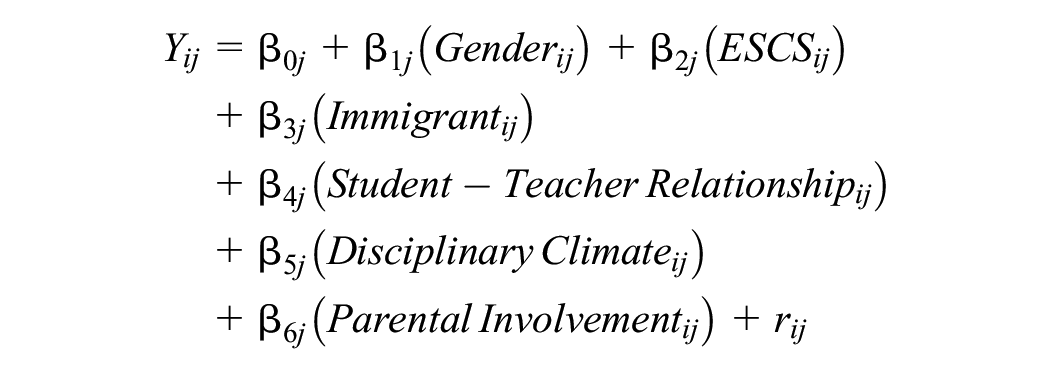
Level 2:

The explanatory power of each model was assessed using Snijders and Bosker’s (1999) total R-squared:

Stage 2: Cross-Country Comparisons
Three cross-national comparisons were conducted to compare explanatory power by total

Where

Where
This two-stage HLM/meta-analytic framework allows for robust modeling of nested PISA data. HLM accounts for the hierarchical structure (students within schools), while Snijders and Bosker’s R2 and Hedges’ Q test offer rigorous metrics for model fit and cross-national generalizability (Hedges & Olkin, 1985; Raudenbush & Bryk, 2002b).
Final student weights (W_FSTUWT; see Table A.1, Appendix A) were used to account for the sampling strategy to ensure unbiased estimates (Carle, 2009). The missing values are imputed with PROC MI in SAS® 9.4 with EM algorithm, which can handle sampling weights in complex survey data. Weighted mean coefficients assume a normal distribution of regression coefficients across countries, calculated per Hedges and Olkin (1985). Analyses were performed using SAS® 9.4 for multilevel linear mixed modeling and the graphs were created with Python 3.13.
Analytical Report
This section analyzes the role of school-based social capital in student reading achievement across 14 economies, focusing on explanatory power, between-school inequality, and the magnitude of social capital effects. We examine whether social capital predicts achievement beyond human and economic capital (H1) by comparing hierarchical linear models (Bosker & Scheerens, 1994) that incorporate demographic and social capital factors, such as teacher-student relations and school-level parental involvement. Additionally, we assess between-school inequality using the intra-class correlation coefficient (ICC) and explore cross-country variations in social capital effects (H2), employing Hedges’ Q tests to evaluate heterogeneity with a meta-analysis.
Cross-Country Comparison of Model Explanatory Power
Figure 2 illustrates the explanatory power of school-based social capital on student reading literacy across 14 economies, measured by Bosker and Scheerens (1994) R-squared relative to the null model (Model 00). The figure presents the total R-squared for three models: Model 01 (including demographic factors, including student-level gender, economic, social, and cultural status, immigrant status, and school-level economic, social, and cultural status), Model 02 (including social capital factors, including school type, student-teacher ratio, parental involvement, student-teacher relationships, school-level student-teacher relationships, student perceptions of disciplinary climate, school-level disciplinary climate, and extracurricular activities), and Model 03 (including both demographic and social capital factors).

Cross-country comparison of variance explained by Model 01–Model 03 in terms of Snijder and Bosker’s total
Model 01 explains a substantial proportion of variance in reading literacy, ranging from 48.2% in Hungary to 7.1% in Denmark (Figure 2). Notably, economies where demographic factors have the lowest explanatory power—Denmark (7.1%), Macao (8%), and Hong Kong (18%)—are predominantly from East Asia, suggesting regional differences in the influence of socioeconomic and demographic background.
Model 02, incorporating social capital factors, shows higher explanatory power compared to Model 01. The R-squared for Model 02 ranges from 52% in Hungary to 8% in Macao (Figure 2). Economies with the highest explanatory power for social capital include Hungary (52%), Panama (45%), and Qatar (38%), while the lowest are Macao (8%), Lithuania (14%), and Denmark (18%), indicating considerable cross-country variation.
Model 03, combining demographic and social capital factors, yields the highest R-squared values, ranging from 56% in Hungary to 9% in Macao (Figure 2). Other high-ranking economies include Germany (52%) and Panama (49%), while the lowest are Macao (9%), Korea (30%), and Denmark (31%). The consistent ranking of economies across models suggests that demographic factors remain a dominant influence, with social capital providing additional but limited explanatory power.
The net explanatory power of social capital, calculated as the difference between Model 03 and Model 01 R-squared values, is modest, ranging from 1% in Macao (9%–8%) to 7.8% in Hungary (56%–48.2%). This modest increment highlights a significant overlap between demographic and social capital effects, indicating strong correlations between school-based social capital and student characteristics, particularly socioeconomic background, at both student and school levels. This overlap suggests that part of the demographic effect may be mediated through school processes or contexts shaped by social capital (Liu & Van Damme, 2011; Liu et al., 2015). However, school-based social capital may also independently influence student achievement alongside socioeconomic factors, warranting further investigation into its unique contribution.
Cross-Country Analysis of Between-School Inequality
We further examine the role of school-based social capital in explaining between-school inequalities in student reading literacy across 14 economies, using the intra-class correlation coefficient (ICC). The ICC quantifies educational inequality potentially arising from unequal learning experiences, selective enrolment, or both (Raudenbush & Bryk, 2002a). Figure 3 compares the ICC for Models 00 to 03 to assess the extent to which demographic and social capital factors explain these inequalities.

Cross-country comparison of between-school differences in student reading achievement (by ICC) in Model 00–Model 03.
The ICC for the null model (Model 00) reveals substantial cross-country variation in between-school inequality, ranging from 67.5% in Hungary to 19.0% in Denmark (Figure 3). High inequality in Hungary (67.5%), Panama (57%), and Germany (56.9%) reflects their tracked educational systems, where students are streamed into academic, technical, or vocational tracks (e.g., Gymnasium, Realschule, Hauptschule in Germany) often based on socioeconomic background as well as academic capacity. For instance, PISA 2000 data indicate that in Germany, even after accounting for primary school achievement, students whose parents attended Gymnasium were three times more likely to enroll in Gymnasium than those whose parents attended Hauptschule (OECD, 2010b). In contrast, lower ICC values in Denmark (19.0%), New Zealand (19.6%), and Lithuania (31.5%) suggest more equitable systems.
Model 01, incorporating demographic factors (student-level gender, economic, social, and cultural status, immigrant status, and school-level economic, social, and cultural status), reduces the ICC across all economies. The largest reductions occur in Hungary (to 31.3%), Germany (to 25.8%), and Chile (to 32.5%), while the smallest reductions are in Macao (to 15.8%), Hong Kong (to 15.0%), and Denmark (to 6.1%) (Figure 3). This suggests that between-school inequality is closely tied to socioeconomic and demographic background, particularly in tracked systems like Hungary and Germany.
Model 02, which includes school-based social capital factors (school type, student-teacher ratio, parental involvement, student-teacher relationships, school-level student-teacher relationships, student perceptions of disciplinary climate, school-level disciplinary climate, and extracurricular activities), further reduces the ICC. The most significant reductions from Model 00 are in Panama (to 26.6%), Italy (to 35.3%), and Croatia (to 35.4%), while the smallest are in Lithuania (to 24.2%), New Zealand (to 9.4%), and Denmark (to 7.1%) (Figure 3), indicating that social capital explains a notable portion of between-school inequality, though varying in extent.
Model 03, combining demographic and social capital factors, yields the lowest ICC values, ranging from 28.7% in Hungary to 5.1% in Denmark (Figure 3). The net contribution of social capital, calculated as the difference between Model 03 and Model 01 ICC values, is most pronounced in Macao (15.8% to −0.7%, a 16.5% reduction), Hong Kong (15.0% to 0.1%, a 14.9% reduction), and Panama (26.6% to 15.1%, an 11.5% reduction), highlighting social capital’s role in explaining inequality beyond demographic factors.
In summary, both the gross (Model 02 vs. Model 00) and net (Model 03 vs. Model 01) explanatory power of school-based social capital vary across countries. The substantial disparity between gross and net effects indicates significant overlap between demographic and social capital influences, suggesting that social capital may mediate the effects of socioeconomic background (Liu & Van Damme, 2011; Liu et al., 2015). This aligns with Bourdieu’s (1986) theory that social capital is influenced by economic and human capital, though further research is needed to disentangle these effects.
Cross-Country Analysis of Predictor Effects on Reading Achievement
We continue to examine the effects of school-based social capital on student reading achievement, with and without controlling for socioeconomic and demographic characteristics, across 14 economies. Tables 2 to 5b report the results of Models 00 to 03, alongside a meta-analysis of effect heterogeneity using Hedges’ Q test (Hedges & Olkin, 1985).
Cross-Comparison of School Achievement (Model 00).

p < .01
Cross-Country Comparison of Baseline Model (Model 01).

p < .01, **p < .05, *p < .1.
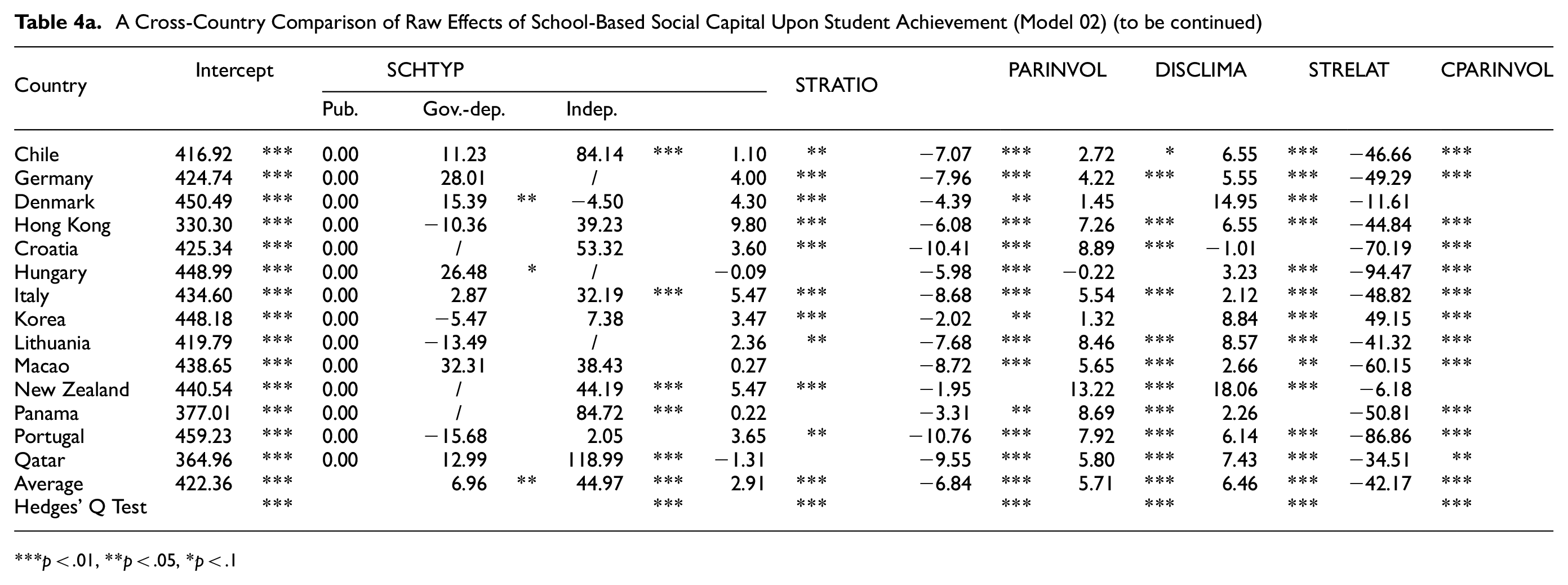
A Cross-Country Comparison of Raw Effects of School-Based Social Capital Upon Student Achievement (Model 02) (to be continued)
p < .01, **p < .05, *p < .1
A Cross-Country Comparison of Raw Effects of School-Based Social Capital Upon Student Achievement (Model 02) (continued)

p < .01, **p < .05, *p < .1
A Cross-Country Comparison of Net Effects of School-Based Social Capital Upon Student Achievement (Model03) (to be continued).

p < .01, **p < .05, *p < .1
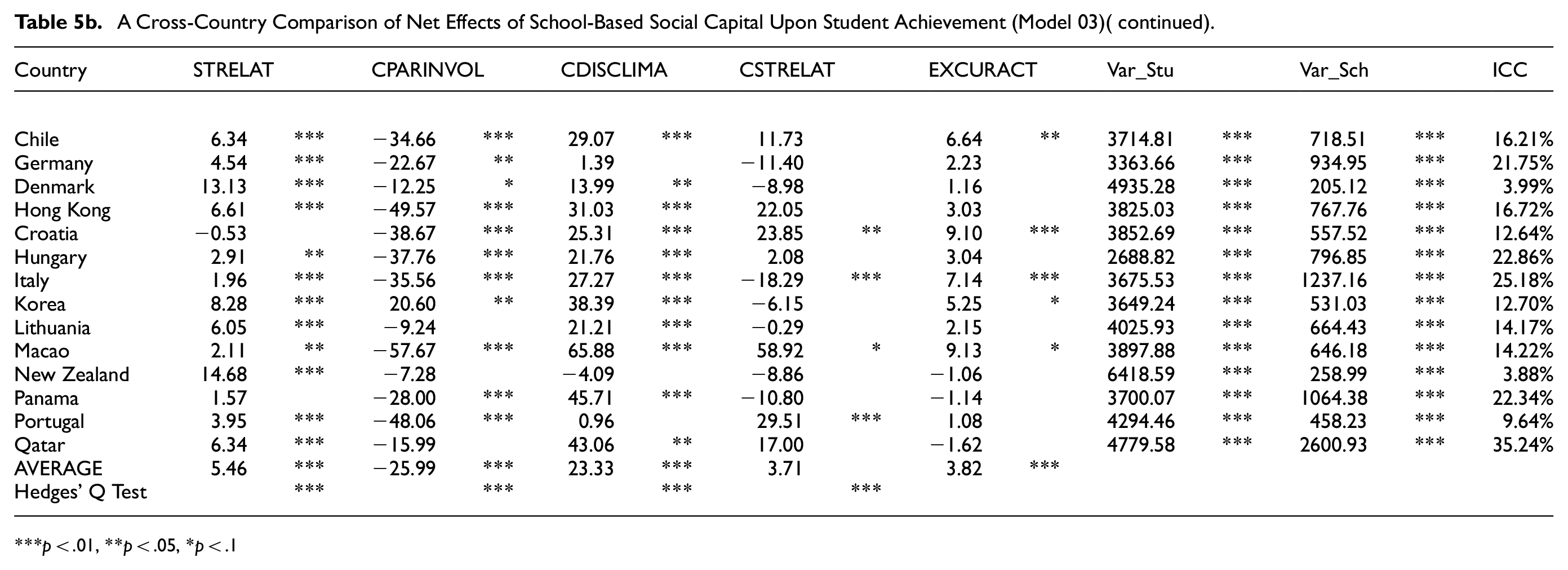
A Cross-Country Comparison of Net Effects of School-Based Social Capital Upon Student Achievement (Model 03)( continued).
p < .01, **p < .05, *p < .1
Null Model (Model 00)
Table 2 presents the null model (Model 00) results, including country intercepts (average reading achievement), student-level variance (Var_Stu), school-level variance (Var_Sch), and the intra-class correlation coefficient (ICC). Country intercepts range from 538.78 in Korea to 369.35 in Panama, with an overall mean of 473.15 (Table 2). Hedges’ Q test indicates significant heterogeneity in intercepts across countries (p < .01), reflecting diverse educational contexts. The ICC, indicating between-school inequality, varies significantly, from 67.5% in Hungary to 19.0% in Denmark.
Demographic Effects (Model 01)
Table 3 reports Model 01 results, incorporating demographic predictors: gender, immigration status, student-level economic, social, and cultural status, and school-level ESCS. The ICC decreases across all economies (e.g., Hungary: 67.5% to 31.32%), indicating that demographic factors explain a portion of between-school inequality. Economic, social, and cultural status positively predicts achievement in all countries, with a weighted mean effect of 12.97 (Hedges & Olkin, 1985), ranging from 39.22 in New Zealand to 4.96 in Hong Kong (Table 3). Hedges’ Q test confirms significant heterogeneity across countries (p < .01). School-level ESCS, reflecting school composition, also positively predicts achievement in 13 countries (mean effect: 60.43), with effects ranging from 114.41 in Germany to 35.96 in Denmark, except in Macao where it is insignificant; Hedges’ Q test shows significant heterogeneity (p < .01). Girls outperform boys in all countries (mean difference: 29.24), with the largest gap in Lithuania (52.74) and the smallest in Chile (16.87); Hedges’ Q test indicates significant heterogeneity (p < .01). Native students outperform non-natives in eight countries but score lower in Macao and Qatar, with significant heterogeneity (p < .01).
Gross Effects of Social Capital (Model 02)
Tables 4a and 4b present Model 02 results, estimating the gross effects of school-based social capital without controlling for demographic factors. Independent private schools (school type: Indep.) outperform public schools in Qatar (118.99), Panama (84.72), Chile (84.14), and Italy (32.19), while government-dependent schools (school type: Gov.-dep.) show positive effects only in Denmark (15.39) and Hungary (26.48); Hedges’ Q test indicates significant heterogeneity (p < .01). Student-teacher ratio positively correlates with achievement in 10 countries (mean effect: 2.91), though insignificant in Macao, Panama, Hungary, and Qatar; heterogeneity is significant (p < .01). Parental involvement in their children’s school negatively correlates with achievement in 13 countries (mean: −6.84), except in New Zealand (13.22); Hedges’ Q test shows significant heterogeneity (p < .01). School-level parental involvement also shows a negative correlation in 11 countries (mean: −42.17), ranging from −94.47 in Hungary to −34.51 in Qatar, but is positive in Korea (49.15); heterogeneity is significant (p < .01). Disciplinary climate positively correlates with achievement in 11 countries (mean: 6.46), from 18.06 in New Zealand to 2.12 in Italy; Hedges’ Q test confirms significant heterogeneity (p < .01). School-level disciplinary climate is positive in 13 countries (mean: 38.97), from 73.74 in Macao to 19.56 in Denmark, except in Portugal; heterogeneity is significant (p < .01). Teacher-student relations positively correlate with achievement in 12 countries (mean: 5.71); Hedges’ Q test indicates significant heterogeneity (p < .01). School-level teacher-student relations show mixed effects, with negative correlations in five countries and positive but insignificant effects in Macao and Portugal; heterogeneity is significant (p < .01). Extra-curricular activities offered by school positively correlate in nine countries (mean: 9.93), with a marginal effect in Macao (p < .1); Hedges’ Q test shows significant heterogeneity (p < .01).
Net Effects of Social Capital (Model 03)
Tables 5a and 5b report Model 03 results, estimating the net effects of social capital after controlling for demographic factors. The positive effects of government-dependent private schools (school type: Gov.-dep.) in Denmark and Hungary become insignificant, while independent private school (school type: Indep.) effects decrease (e.g., Qatar: 118.99 to 89.67; Panama: 84.72 to 33.78) or turn negative (e.g., Portugal: −35.43; Croatia: −64.66); Hedges’ Q test indicates significant heterogeneity (p < .01). The effects of student-teacher ratio are reduced or rendered insignificant in all countries (mean: 1.12); heterogeneity is significant (p < .01). The negative effects of parental involvement in their children’s school persist (mean: −6.78), with a new significant effect in New Zealand (−5.83); Hedges’ Q test shows significant heterogeneity (p < .01). School-level parental involvement negative effects in 10 countries are reduced or become insignificant (e.g., Hungary: −94.47 to −37.76), while Korea’s positive effect drops from 49.15 to 20.60; heterogeneity is significant (p < .01). Disciplinary climate remains positively correlated in 10 countries (mean: 5.02), with minimal changes, except in Chile where it becomes insignificant; Hedges’ Q test confirms significant heterogeneity (p < .01). School-level disciplinary climate effects decrease in eight countries (e.g., Hungary: 55.74 to 21.76), but increase in Chile (25.65 to 29.07); heterogeneity is significant (p < .01). Teacher-student relations positive effects persist in 12 countries (mean: 5.46); Hedges’ Q test indicates significant heterogeneity (p < .01). School-level teacher-student relations negative effects in four countries (e.g., Germany, Hungary) become insignificant or positive (Croatia: 23.85), while Portugal’s effect strengthens (22.74 to 29.51); heterogeneity is significant (p < .01). Extra-curricular activities offered by school positive effects decrease in magnitude in all countries (mean: 3.82), except in Macao, with significant relations decreasing to 3 (i.e., Chile. Croatia, and Italy) from 9 in Model 02; Hedges’ Q test shows significant heterogeneity (p < .01).
Hedges’ Q tests consistently indicate significant heterogeneity in the effects of predictors across countries for all models (p < .01), underscoring diverse educational contexts. School-level social capital effects (e.g., parental involvement, school disciplinary climate, school-level student-teacher relationship) are often correlated with school SES composition, as evidenced by bivariate correlations (e.g., school SES composition and school-level parental involvement: negative in 11 countries, positive in Macao, Hong Kong, Korea). Student-level effects (e.g., individual perception of school disciplinary climate, student-teacher relationship) are largely independent of demographic factors, suggesting direct contributions to achievement. These findings align with Bourdieu’s (1986) theory that social capital interacts with economic and human capital, though further research is needed to disentangle mediation and selection effects.
Summary of the Comparative Analysis
This cross-country analysis across 14 economies confirms that school-based social capital significantly predicts student reading achievement beyond human and economic capital (H1), with Models 01 to 03 explaining 7.1% (Denmark) to 56% (Hungary) of variance (Bosker & Scheerens, 1994), and a net social capital effect ranging from 1% (Macao) to 7.8% (Hungary); the intra-class correlation coefficient (ICC) decreases from 67.5% (Hungary) in Model 00 to −0.7% (Macao) in Model 03, with social capital reducing inequality by up to 16.5% (Macao). Teacher-student relations and disciplinary climate positively correlate with achievement in most countries (means: 5.46 and 5.02 in Model 03), while school-level parental involvement often shows negative correlations (e.g., Hungary: −37.76); Hedges’ Q tests confirm significant heterogeneity in effects across countries (p < .01), supporting H2 and highlighting diverse educational contexts.
Discussion and Conclusion
Major Findings
This cross-country study explored how school-based social capital predicts reading literacy across 14 economies using PISA 2009 data. Employing hierarchical linear modeling and meta-analysis with Hedges’ homogeneity tests (Hedges & Olkin, 1985), we evaluated the explanatory power, between-school inequality, and effect sizes of social capital indicators, including teacher-student relations, disciplinary climate, parental involvement in their children’s school, school-level parental involvement, student-teacher ratio, and extracurricular activities offered by school. Social capital significantly predicts reading achievement beyond human and economic capital (H1), reducing between-school inequality, though its contribution varies due to overlap with Economic, Social, and Cultural Status (ESCS). Teacher-student relations and disciplinary climate positively correlate with achievement in most economies, supporting Coleman’s (1988) theory on the role of social norms in academic success. Unexpectedly, parental involvement in their children’s school and school-level involvement often negatively correlate with achievement, except in Korea, where school-level involvement shows a positive correlation. Student-teacher ratio positively correlates in several economies, challenging assumptions of its benefits. Extracurricular activities initially predict achievement positively in most countries, but this effect diminishes after controlling for ESCS. While student-level teacher-student relations consistently predict higher achievement, school-level relations positively correlate in only three economies (Hong Kong, Macao, Portugal), with negative or insignificant correlations elsewhere. Significant heterogeneity in effect sizes (p < .01) supports H2, underscoring the context-specific nature of social capital’s influence.
Cultural Perspectives on Social Capital Effects
The negative correlation found in the PISA 2009 study between parental involvement in school activities (as measured by the PARINVOL index) and student achievement across 14 countries presents an intriguing contradiction to much of the existing literature. A plausible explanation lies in the distinction between parental involvement and parental engagement (Goodall, 2022; Goodall & Montgomery, 2014). PISA’s parental involvement index focuses on school-based involvement activities (e.g., volunteering), potentially missing home-based engagement prevalent in cultures like East Asia, where parental monitoring is critical (Kim, 2020). This measurement limitation may explain the counterintuitive negative effects, as PISA’s standardized design may not capture culturally specific forms of parental involvement in student’s learning. Furthermore, the negative correlation could reflect compensatory involvement or demonstrate reverse causality (Gustafsson, 2013; Gustafsson & Nilsen, 2022), where parents increase their participation in school activities in response to their children’s academic struggles. The types of involvement measured (e.g., volunteering in extracurriculars) might also have a weaker direct link to academic outcomes (Goodall, 2022). Cultural biases in PISA’s design, such as assuming universal applicability of involvement metrics, may also skew results in collectivist societies where indirect support (e.g., academic expectations) is more impactful (Chiu & Chow, 2011). These factors highlight the need for nuanced interpretations of parental involvement’s effects. At the school level, a negative correlation (except in South Korea) might suggest that schools with lower achievement actively encourage more parental involvement in school activities (OECD, 2023b). These findings underscore the complexity of the relationship and the importance of distinguishing between different forms of parental support (Goodall, 2018; Jeynes, 2024; Phillipson & Phillipson, 2007) and call for nuanced policy responses. Schools should emphasize parental engagement in home-based learning, which more strongly correlates with academic gains, over school-led activities (Goodall, 2022). Culturally tailored workshops, noting South Korea’s unique positive school-level correlation, can enhance engagement strategies (OECD, 2023a, 2023b). Policies should differentiate involvement from engagement, at early age in particular (Borgonovi & Montt, 2012; Liu et al., 2014), reflecting cultural contexts (Goodall, 2018), thus optimizing parental support’s impact.
The positive correlation with student-teacher ratio in several economies may reflect systemic factors, where higher ratios are found in high-performing schools with greater socioeconomic resources, offsetting potential negative effects (OECD, 2023a, 2023b). In East Asian economies, strong disciplinary climates and teacher efficacy may mitigate high student-teacher ratio effects (Ning, 2019; Ning et al., 2015). However, if these resources are not integrated with genuine community engagement, they may undermine organically developed social capital—such as trust, collaboration, and parental involvement — that is crucial for school improvement (García & Weiss, 2017; Woolcock, 1998). These cultural and systemic variations challenge Coleman’s (1988) universalist view of social capital, aligning more with Bourdieu’s (1986) perspective that social capital reproduces inequalities, mediated by socioeconomic status and cultural norms, particularly in stratified systems like Germany and Hungary where between-school inequality is pronounced.
This cross-country analysis reveals the nuanced interplay between school-based social capital and student achievement across 14 economies. Individual teacher-student relations consistently correlate with higher achievement, acting as direct social capital that fosters academic success through trust and support (Coleman, 1988). Conversely, school-level teacher-student relations negatively correlate with achievement in countries like Germany, Hungary, Italy, and Croatia, possibly due to aggregation bias or cultural emphasis on academic rigor over relational warmth (Xu et al., 2023). In stratified systems, this may reflect a focus on discipline, potentially alienating students (Bourdieu, 1986). Extracurricular activities initially predict achievement positively in 10 countries, supporting their role in building bonding and bridging capital (Putnam, 2000). However, controlling for Economic, Social, and Cultural Status (ESCS) diminishes these effects, rendering half insignificant, as socioeconomic advantage mediates access to quality programs (Kravchenko & Nygård, 2023). Collectivist cultures may leverage extracurricular activities for social cohesion, while individualistic ones see less impact (Hofstede, 1998). These findings highlight that school-based social capital’s academic benefits are embedded within broader social structures, varying significantly across cultural contexts, necessitating culturally sensitive policies to address relational dynamics and resource disparities.
Limitations
The reliance on PISA 2009 data, while enabling cross-country comparability, limits the study due to its standardized measurement of social capital. PISA’s indicators, such as parental involvement in their children’s school, disciplinary climate, and teacher-student relations, are designed to be universally applicable, potentially overlooking culture-specific dimensions, limiting the capture of nuanced dynamics in specific cultures. For instance, parental involvement in their children’s school focuses on school-based activities, which may not capture home-based involvement prevalent in East Asian economies, where parental monitoring is a primary social capital mechanism (Kim, 2020). This misalignment likely contributes to unexpected negative correlations. Moreover, PISA’s standardized scales assume equivalence across diverse educational systems, potentially masking contextual nuances. For example, disciplinary climate may be interpreted differently in high-context versus low-context cultures (Chiu & Chow, 2011; Ning et al., 2015), and extra-curricular activities offered by school may not account for informal activities valued in community-oriented cultures. The cross-sectional nature of PISA data limits causal inferences, particularly regarding the interplay between social capital and socioeconomic factors (Liu et al., 2015; Parcel & Dufur, 2001). Beyond PISA’s constraints, this study omits variables like instructional leadership or peer networks, which recent research identifies as critical (Wang & Degol, 2015). The cross-sectional design precludes longitudinal analysis, and the focus on 14 economies may not generalize to other contexts, particularly low-income systems absent from PISA 2009 (OECD, 2012).
Implications for Future Research
Future research should adopt mixed-methods approaches to capture culture-specific social capital dimensions, integrating qualitative data to complement PISA’s standardized measures. Longitudinal studies could elucidate causal relationships, particularly the mediating role of social capital in socioeconomic effects. Investigating additional social capital components, such as peer interactions and community networks, is essential, given their emerging significance (Boat et al., 2021). Focused studies on East Asian and other non-Western systems could clarify unique mechanisms, such as Korea’s parental involvement patterns. Finally, developing culturally sensitive social capital measures, potentially through region-specific PISA modules, could enhance cross-country comparability without sacrificing contextual depth.
Besides, the 2009 financial crisis, occurring just before PISA 2009 data collection, may limit the generalizability of findings. Economic instability likely affected family dynamics, school resources, and parental involvement, potentially altering social capital measures. For example, reduced school funding in some economies may have constrained extracurricular activities, while economic stress may have shifted parental focus from school-based involvement to home-based support, not fully captured by PISA. This temporal context may skew results, limiting applicability to non-crisis periods and necessitating caution when generalizing findings to stable economic conditions.
Conclusion
This study underscores the complex, culturally contingent effects of school-based social capital on reading literacy, with significant cross-country variations driven by local norms and student agency. While some findings align with Coleman’s (1988) theory, unexpected results, such as negative parental involvement effects, highlight the limitations of universalist frameworks and PISA’s standardized measures. By integrating recent cultural perspectives, we reveal how social capital operates differently across educational systems, advocating for policies that prioritize cultural sensitivity and student agency. These insights contribute to a nuanced understanding of educational effectiveness in globalized contexts, urging researchers to refine social capital theory through culturally informed lenses.
Footnotes
Appendix A
Description of variables used in the Hierarchical Linear Modelling (HLM).

| Variable | Label | Definition |
|---|---|---|
| Control variables | ||
| GENDER | Gender | Gender of students |
| NATIVE | Immigration status | The index on immigrant background (NATIVE) has the following categories: (1) native students (those students born in the country of assessment, or those with at least one parent born in that country; students who were born abroad with at least one parent born in the country of assessment are also classified as “native” students), (0)students with immigrant status including second-generation students (those born in the country of assessment but whose parents were born in another country), and first-generation students (those born outside the country of assessment and whose parents were also born in another country). |
| ESCS | Index of economic, social and cultural status (WLE) | The PISA index of economic, social and cultural status (ESCS) was derived from the following three indices: highest occupational status of parents (HISEI), highest educational level of parents in years of education according to ISCED (PARED), and home possessions (HOMEPOS). The index of home possessions (HOMEPOS) comprises all items on the indices of WEALTH, CULT POSS and HEDRES, as well as books in the home recoded into a four-level categorical variable (0–10 books, 11–25 or 26–100 books, 101–200 or 201–500 books, more than 500 books). |
| CESCS | School aggregates of ESCS | |
| School-based social capital indicators | ||
| SCHTYPE | School Type | Schools are classified into as either public or private, according to whether a private entity or a public agency has the ultimate power to make decisions concerning its affairs (SC02). This information is combined with SC03 which provides information on the percentage of total funding which comes from government sources to create the index of school type (SCHTYPE). This index has three categories: (1) public schools controlled and managed by a public education authority or agency, (2) government-dependent private schools controlled by a non-government organisation or with a governing board not selected by a government agency that receive more than 50% of their core funding from government agencies, (3) government-independent private schools controlled by a non-government organisation or with a governing board not selected by a government agency that receive less than 50% of their core funding from government agencies. |
| STRATIO | Teacher-Student ratio | Student-teacher ratio (STRATIO) was obtained by dividing the school size by the total number of teachers. |
| PARINVOL | Parental involvement in their children’s school | The index of parents’ involvement in school (PARINVOL) was derived from parents’ responses to whether they have participated in various school-related activities during the previous academic year (PA15). Parents were asked to report “yes” or “no” for the following statements: i) discuss my child’s behaviour or progress with a teacher on my own initiative; ii) discuss my child’s behaviour or progress on the initiative of one of my child’s teachers; iii) volunteer in physical activities; iv) volunteer in extracurricular activities; v) volunteer in school library or media centre; vi) assist a teacher in school; vii) appear as a guest speaker; and viii) participate in local school. Higher values on this index indicate greater parents’ involvement in school. |
| DISCLIMA | Disciplinary climate | The index of disciplinary climate (DISCLIMA) was derived from students’ reports on how often the followings happened in their lessons of the language of instruction (ST36): i) students don’t listen to what the teacher says; ii) there is noise and disorder; iii) the teacher has to wait a long time for the students to <quieten down>; iv) students cannot work well; and v) students don’t start working for a long time after the lesson begins. As all items are inverted for scaling, higher values on this index indicate a better disciplinary climate. |
| STRELAT | Teacher student Relations | The index of teacher-student relations (STRELAT) was derived from students’ level of agreement with the following statements in ST34: i) I get along well with most of my teachers; ii) most of my teachers are interested in my well-being; iii) most of my teachers really listen to what I have to say; iv) if I need extra help, I will receive it from my teachers; and v) most of my teachers treat me fairly. Higher values on this index indicate positive teacher-student relations. |
| CPARINVOL | The overall parental involvement in their children’s school | School aggregate of PARINVOL |
| CDISCLIMA | Overall class atmosphere | School aggregate of DISCLIMA |
| CSTRELAT | Overall teacher-student relationship in school | School aggregate of CSTRELAT |
| EXCURACT | Extra-curricular activities offered by school | The index of extra-curricular activities (EXCURACT) was derived from school principals’ reports on whether their schools offered the following activities to students in the national modal grade for 15-year-olds in the academic year of the PISA assessment (SC13): i) band, orchestra or choir; ii) school play or school musical; iii) school yearbook, newspaper or magazine; iv) volunteering or service activities; v) book club; vi) debating club or debating activities; vii) school club or school competition for foreign language mathematics or science; viii) <academic club>; ix) art club or art activities; x) sporting team or sporting activities; xi) lectures and/ or seminars; xii) collaboration with local libraries; xiii) collaboration with local newspapers; and xiv) <country specific item>. Higher values on the index indicate higher levels of extra-curricular school activities. |
| Student weights | ||
| W_FSTUWT | Final student weights | In the international data files, the variable W_FSTUWT is the final student weight. The sum of the weights constitutes an estimate of the size of the target population, i.e. the number of 15-year-old students in grade 7 or above in that country attending school. |

Ethical Considerations
This study was conducted in accordance with the Academic Integrity Code of KU Leuven, Belgium, and Henan University of Technology.
Funding
The author(s) disclosed receipt of the following financial support for the research, authorship, and/or publication of this article: This project has been funded Doctoral Scientific Research Start-up Foundation from Henan University of Technology.
Declaration of Conflicting Interests
The author(s) declared no potential conflicts of interest with respect to the research, authorship, and/or publication of this article.