




Abstract
The text questions the assumption of the Bologna reform that student-centered learning will improve the quality of university study. Research conducted on a sample of 429 students from various study programs at two faculties of the University of Ljubljana, whom we asked about their reading and study habits, showed that relying on the subjective motivation of students alone is not enough to ensure that they read compulsory reading material and thus acquire the knowledge that only this type of study can bring. We therefore emphasize in the conclusion that calling for motivation that is tied to interest may actually have the effect of putting students off reading material that is not related to their direct interest or does not show directly applicable value. The results of the study also show that students are clearly attentive to the requirements and expectations of individual faculty member and therefore adapt their method of study (and the amount they study) in such a way as to satisfy these (frequently low) expectations.
Keywords
Introduction
The Higher Education System in Slovenia recognizes the goals of the Bologna process (the reform was implemented in 2005) and the goals of a common European Higher Education Area. It is organized in three “study cycles.” The “first cycle” study programs or bachelor’s degree programs (undergraduate study programs in US), the “second cycle” programs are master programs (graduate study programs in US), and the “third cycle” programs are PhD programs. At all three levels, students may choose to take combined study programs. The implementation of the credit system (ECTS) has been required since 2002 and comprises 180 to 240 ECTS for the “first cycle” and 60 to 120 ECTS for the “second cycle.” “Third cycle” programs comprise 180 to 240 ECTS.
One of the key assumptions of the implementation of the Bologna reform in 2004 was the expectation that the university paradigm would change in Slovenia too, in order to “make study programmes and their course units or modules student-centred/output-oriented” (Tuning General Brochure, 2007, p. 11). As we pointed out in an article in Sodobna pedagogika/Journal of Contemporary Educational Studies (Kovač, 2006), this expectation was based on the prediction that within the new study programs studying would no longer be based on the “traditional paradigm of ‘sitting time’, but on a new paradigm of earned credits that combine effectively invested student study time [. . .] with verification of learning outcomes” (Zgaga, 2004, p. 123). In other words, post-Bologna study programs and their modules built on the expectation that students would invest the “envisaged amount of personal study of adequate quality” into achieving the required standards of knowledge (Zgaga, 2004, p. 96).
The thesis was based on an attempt to reduce the importance of core/compulsory subjects in favor of optionality and an approach that “claims to take into account differentiated needs” (Furedi, 2016, p. 158), where the content of study (and study programs) should to a large extent correspond to the interests of students and the needs of the labor market. Reflections on the importance of transmitting accumulated knowledge that is not necessarily directly applicable but should nevertheless be an inherent part of university study remained in the background when this paradigm was being designed. In this way, emphasis shifted from liberal education to career building.
It is significant that the reform of university studies was also motivated by a spirit of egalitarianism, although today it may already be assumed that there is (was) a conviction that “demonstrates a lack of confidence in the capacity [of all students] to acquire a good academic education” (Furedi, 2016, p. 160). This conviction is reflected in claims that today’s mass enrolment in university study programs and the sheer number of students enrolled give rise to a situation in which many students are simply unable to keep up with the demands of university study. This is also the reason for claims that, at least at the undergraduate level, we should accept programs that offer “predesigned practical solutions,” in contrast to the master’s level, where we are supposed to be set requirements for the acquisition of knowledge that only a small proportion of students are capable of meeting. In this context Furedi warns that such an interpretation “captures the worst features of nineteenth-century differentiation between thinkers and doers. Worse still, it reproduces the outdated prejudice which believes that only a tiny minority can thrive through an academic education and that the rest can only benefit from training” (Furedi, 2016). In fact, this anti-intellectual turn demonstrates a lack of confidence (and expectations!) in the capacity of students to acquire “a good academic education” (Furedi, 2016) and at the same time frees teachers from the demands that they placed on students before the Bologna reform (if they actually did?; Furedi, 2016).
The Bologna paradigm was also accompanied by the expectation that students would devote more time to the preparation of seminar papers, independent projects and, consequently, autonomous reading and study, and less time listening to ex cathedra lectures, which the proponents of the reform apparently believed to be less effective than autonomous work by students, since otherwise it would not be necessary to increase the amount of the latter at the expense of the former (Zgaga, 2004, p. 123). In substantive assessments the requirement for effectiveness appears to have outweighed the requirement that the knowledge acquired should be of good quality. Even in university study programs, knowledge understood as a useful tool has become more important than knowledge as a value in itself (Gauchet, 2011). In words of Gauchet (2011), the ideal in the previous university paradigm was to “arrange [knowledge] from within” (p. 72), since the “intelligent person is the one that was able to internalise knowledge and, consequently, organise it” (Gauchet, 2011). On the other hand, the ideal of the Bologna paradigm, at least as regards undergraduate studies, appears to be built on leaving knowledge outside the individual. The clearest sign of this process in university studies is the replacement of the figure of the academic with the figure of the researcher: “instead of a person who retains knowledge, there is a person who handles knowledge” (Gauchet, 2011). The expectations described here are also supported by the programmatic formula of the “knowledge society,” expressed as learning to learn, for which it is enough “that we simply hand the individual the keys for access” (Gauchet, 2011) to knowledge. This formula includes a concept that is tied to understanding of the paradigm of lifelong learning and is focused on learning processes. It neglects consideration of the importance, necessity, transmission, and acquisition of knowledge accumulated through history, and therefore the teaching role of the teacher is too easily pushed to the margins of interest (cf. Štefanc & Kovač Šebart, 2020, pp. 14–15; Vidmar, 2011, p. 34). Quite how thoroughly the language of learning or the above-mentioned paradigm has cut into the pedagogical field is described in several works by Biesta, (2005, 2010, 2013), but for lower levels of education. We are, of course, also seeing processes of “learnification” in university programs. Even here, reflections on how students learn, on whether or not they learn in accordance with “contemporary” theoretical and psychological conceptions of learning (e.g., learning to learn) have drowned out reflections on the acquisition of good-quality knowledge and the assimilation of accumulated knowledge (Štefanc & Kovač Šebart, 2020, p. 19).
Those of us who teach at university also encounter students who cannot see reasons why they should acquire knowledge, since the (only) thing they consider important is that they are able to find it. In other words, they believe that the point of studying is to learn how to find and apply predesigned practical solutions that will facilitate their responsiveness in the profession or occupation they pursue in the future (see also the survey results below regarding resources and students’ motivation for study). The question that concerns us here is “how to connect a person’s inner orientation to an external apparatus” (Gauchet, 2011, p. 72). It is precisely this development that is the “root of a supremely paradoxical phenomenon, namely the hidden yet persistent intellectual decline we are encountering in the knowledge society. This phenomenon is actually less surprising than it seems, if we consider that, while the social role of knowledge is growing, it has nevertheless become degraded in the subjective sense. Why should someone immerse themselves in knowledge at all if knowledge is no longer something that one needs to acquire as an end in itself, in order to better understand the world, but is instead merely an external and functional factor for which it is enough that we learn to use it?” (Gauchet, 2011).
In the light of the findings of our study, which identifies the views of students on how they have acquired knowledge or prepared themselves for exams, the question that needs attention is whether many faculty members are already acting in accordance with the explanations described above, at least in terms of the requirements that students must satisfy in order to complete a course unit, at least as regards undergraduate students.
We should not forget that the reforming efforts of the Bologna process were accompanied from the very beginning by doubts and scepticism, although it appears that the “traditional paradigm” has lost the battle with the “modern paradigm” that is supposed to increase optionality, foreground competences and, at least in practice, devote less attention to the acquisition of knowledge that cannot be justified as being directly applicable. Some authors (e.g., Abélard, 2003; Hirtt, 2000; Kovač, 2006) warned at the time that without reflection of this kind, the implementation of the Bologna reform carried the risk that betting on the nominally greater autonomy of students, greater optionality, and a reduction in the number of hours dedicated to core subjects in programs, would actually reduce the horizon of knowledge. In other words, such warnings claimed that the competence-based model would introduce to universities the pursuit of directly applicable value what would lead to a lowering of the standards of the knowledge that students have to acquire.
Alongside conceptual considerations, there were other reasons for such scepticism at the time of implementation of a reform. Given the university infrastructure, there was not enough faculty members and library space for properly introducing a “student-centered” method of study.
In this context, therefore, we ask what has happened to “student-centered learning” in the fifteen years since the introduction of the Bologna system: has the Bologna reform increased the quality of study and the quality of the education obtained by undergraduate and graduate study programs graduates at the University of Ljubljana, or has it, as we feared in 2006, “reduced the scope and lowered the level of knowledge”? (Kovač, 2006, p. 110). Since we are unable to carry out a comparison of the knowledge of pre-Bologna and post-Bologna students, we used the responses of students to find out how they prepare for exams and what resources they use when studying. However, the goal of our study was not the examination or research of learning strategies that are used by students, because it was extensively researched in the last two decades in the USA and Australia (cf. Baron & Mangen, 2021; Berry et al., 2010; Close Reading Interpretative Tools, 2020; Hoeft, 2012; Judd & Elliott, 2017; Lee & Yeong, 2018; Romano, 2005). Our research on the other hand will allow us to indirectly consider the quality (and content) of the knowledge of students and the requirements that faculty members expect them to meet when sitting exams.
Research Aim and Hypotheses
The ambition of the study that forms the core of this article is a modest one, although it fits entirely within the broader context of seeking an answer to the question of what is happening in university studies today: we wanted to find out, in the case of students enrolled in various programs at the Faculty of Arts and the Faculty of Education at the University of Ljubljana, how and what they studied in the 2018/2019 academic year. The following two fundamental research questions were asked: (1) what resources did students rely on and (2) what (judging from their responses) was the quality of the work (i.e., study) they invested in achieving the expected knowledge that, in their judgement, was sufficient to pass their exams?
We tested two main hypotheses: students with higher and lower study achievements (average grade) differ (1) in studying the reading material in subjects that interest them regardless of the faculty members requirements and (2) in methods by which they acquire knowledge in the field they are studying.
Research Methodology
Sample
We carried out the study in the 2017/2018 and 2018/2019 academic years. Our random sample included 429 students from the Faculty of Arts and the Faculty of Education, 305 (71.1%) of whom were enrolled in undergraduate programs, and 124 (28.9%) of whom were enrolled in graduate (master’s) programs. With regard to the total number of students enrolled at the two faculties (6,689 students (4,510 in the undergraduate level, 2,179 in the graduate level)) in the 2018/2019 academic year (Univerza v številkah, 2020), our sample represents 6.4% of the basic population, which ensures that it is sufficiently representative.
Our sample included Faculty of Arts students from the English, Geography, Sociology and Sociology of Culture, Educational Sciences (pedagogika in andragogika), Psychology, Information Science and Publishing Studies departments, and Faculty of Education students studying Primary Teaching, Mathematics, Art Education, Biology and Chemistry, and Home Economics.
Data Collection and Data Analysis
We collected data by means of a paper-and-pencil questionnaire containing 34 closed-ended questions and 1 assessment scale. The questionnaires were completed during lectures and seminars in the presence of faculty members. The reliability of the assessment scale was tested with Cronbach’s alpha (α = .71) and validated using factor analysis (the first factor explained more than 20% of total variance). We processed the data using descriptive and inferential statistics. In order to present the data, we used structural tables (f, f%) and checked our hypotheses using the chi-square test.
Results
In the higher education in Slovenia a six-level grading system is used: 10 (excellent, best grade, US grade: A), 9 and 8 (very good, US grade: A), 7 (good, US grade: B), 6 (pass, US grade: C), and 5 or less (fail, US grade: F). An interesting starting point for further reflection is the fact that the average grade of the students included in the study is 8.0 for undergraduate (bachelor’s) students and 8.3 for graduate (master’s) students. The share of those with higher average grades, that is, a grade of 8 or more, is significantly lower among undergraduate students (where it stands at 67.3%) than it is among graduate students (where it stands at over 81.4%). A total of 71.3% of the students of both level study programs included in the study had an average grade of 8 or higher.
Taken alongside the information on the average grades of the students included in the study, students’ answers to the question of how they prepare for exams are all the more interesting (see Table 1).
Students’ Answers Regarding Exam Preparation.
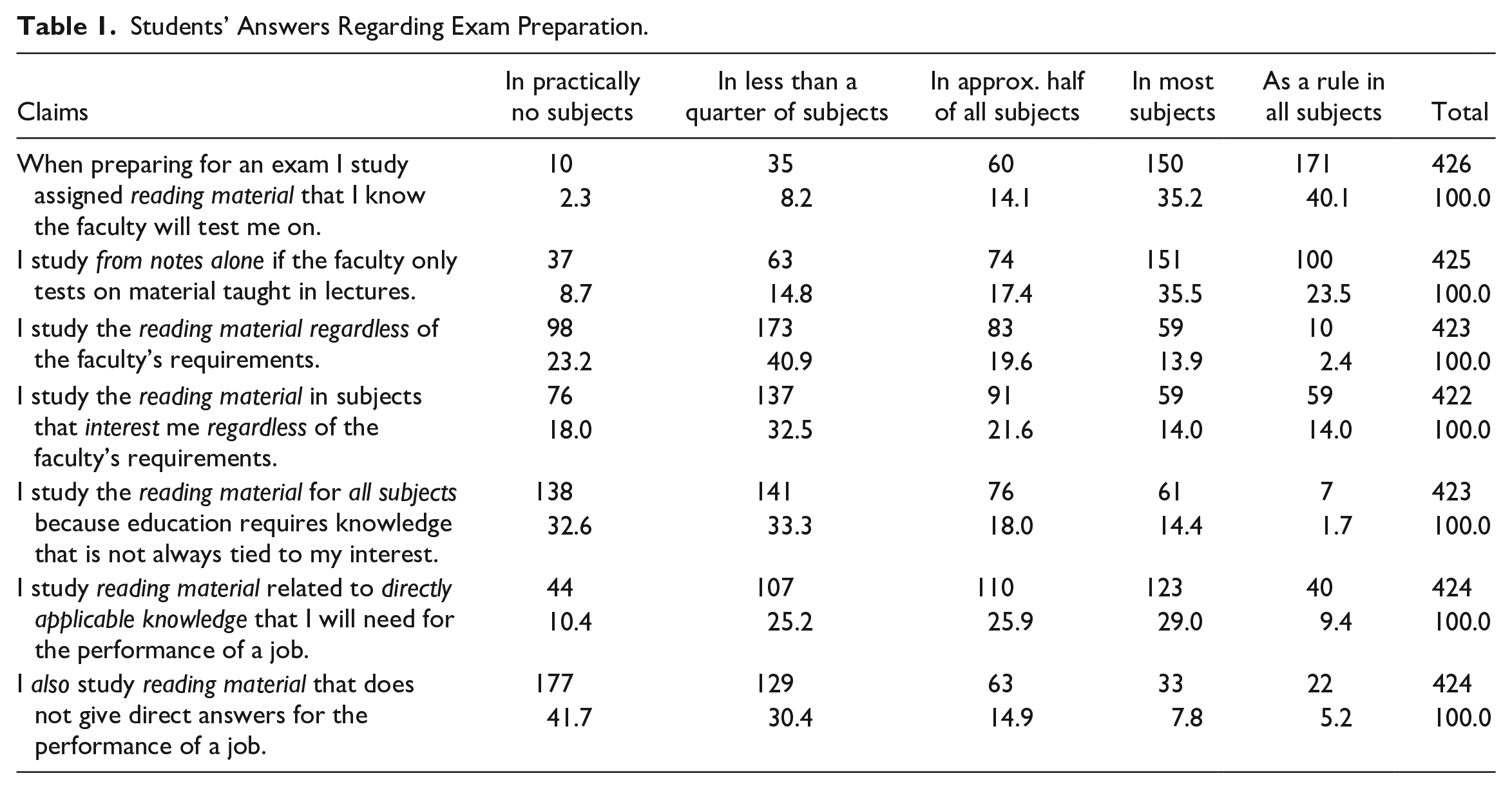
The answers of the students included in the study reveal that a relatively low share of students (16.1%) study the assigned reading material in all subjects or at least in most subjects because they believe that education requires knowledge that is not always related to their interests. Just over a quarter (28%) of students answered that in most subjects or (as a rule) in all subjects that interest them, they study the assigned reading material regardless of the faculty’s requirements, which indicates that interest in the content of an exam had a slightly greater influence on their study of the related literature, although in the light of their answers this share is still low. The mere fact that a student is interested in specific content does not in itself guarantee that the student will also study the assigned reading material. On the other hand, a statistically significantly higher percentage of students with higher average grades (33%) answered that in most subjects or (as a rule) in all subjects that interest them, they study the assigned reading material regardless of the faculty’s requirements. Among students with lower average grades, the percentage who gave this answer was under 15% (see Table 2).
Average Grade and Study of Assigned Reading Material in Subjects that Interest Students.
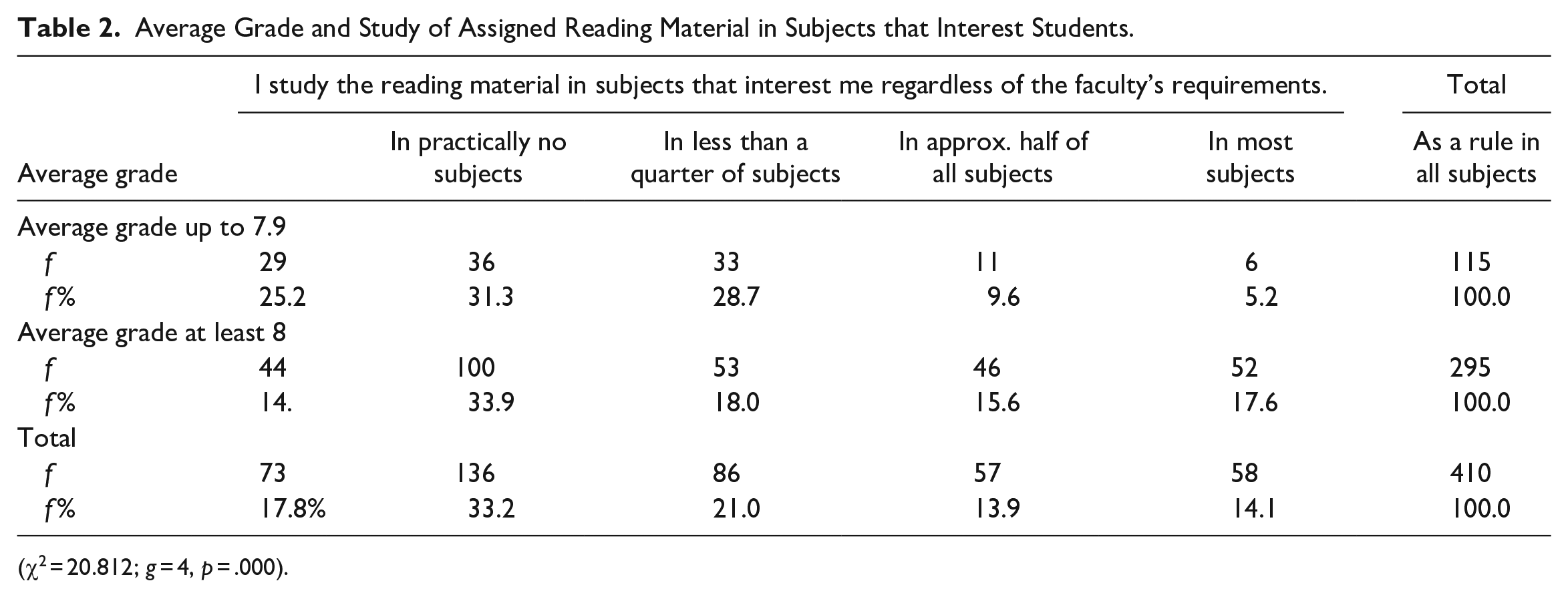
(χ2 = 20.812; g = 4, p = .000).
The answer that in most subjects or (as a rule) in all subjects they also study assigned reading material related to directly applicable knowledge that they will need for the job performance was selected by 38.4% of the students (Table 1). This share draws attention to expectations that clearly relate to university education understood primarily as a means of acquiring knowledge as a tool that is needed because of career reasons. This thesis is confirmed by the fact that only 13% of students answered that in most subjects or almost all subjects they studied reading material that does not give answers directly related to doing a job (Table 1), which is close to the percentage of students who answered that in all subjects or at least in most subjects they study the assigned reading material because they believe that education requires knowledge that is not always related to their interests, that is, including reading material that does not give answers directly related to the job performance.
Significantly, three quarters (75.3%) of the students included in the study (Table 1) answered that in most or all subjects they prepared for exams by studying assigned reading material that they know the faculty member will test them on (the share of such students is slightly higher in the undergraduate level (78%) than in the graduate level (69%)). This means that, regardless of their interest or of the fact that knowledge was directly or indirectly applicable, they studied reading material if they expected it to come up in the exam or if their professor included the requirement to study reading assignments in the assessment criteria. 59% of students studied in most subjects or (as a rule) in all subjects from notes alone if they knew that faculty was only going to test them on material taught in lectures. When preparing for exams, only just over 16.3% of students also study reading material regardless of the faculty’s requirements in most or almost all subjects (Table 1), which is practically identical to the percentage of students who believe that education requires knowledge that is not always related to their interests.
Table 3 shows how students answered the question of how they acquire knowledge in the field they are studying: the largest number chose the answer that they mainly acquire knowledge from lecture notes, combined with notes on compulsory reading material and the study of some texts that do not appear on lists of compulsory reading material (63.6%). We realize here that we did not phrase the question with sufficient precision, in that we were not interested in whether students made their own notes on compulsory reading material or obtained them from their peers.
Method by Which Students Acquire Knowledge in the Field They are Studying.

(χ2 = 13.665; g = 5, p = .018).
A comparison of students in terms of performance (better average grade: 8 or more; worse average grade: up to 7.9) shows that statistically significant differences appear among them (p = .018), above all in the answer I mainly acquire knowledge in the field I am studying from compulsory reading material, combined with lecture notes, which was the answer selected by a considerably larger share of students with poorer results (31%), while fewer than 19% of the more successful students chose this answer. It is also interesting that the shares are almost identical but inverted in the case of the answer I mainly acquire knowledge in the field I am studying from lecture notes, combined with the study of some texts on lists of compulsory reading material, where this answer was selected by 31% of students with better average grades and just under 21% of those with poorer grades. There are also slightly more successful students (5.2%) who mainly acquire knowledge from compulsory reading material, combined with lecture notes and additional (non-compulsory) reading material, where only one of the less successful students selected this answer (see Table 3).
However, the data in Table 4 reveal that the answer most frequently selected by students was that when preparing for an exam they use their own lecture notes (77.1%). Around half also use their own notes on reading material (54.7%) and literature in Slovene from the list of compulsory reading material (50.2%). Those who answered that they most frequently use their fellow students’ notes on reading material or notes they find online accounted for 36.5% of those included in the study. Just over a fifth (20.6%) chose the answer that they study using photocopied lecture notes.
Sources Most Frequently Used by Students When Preparing for an Exam.

The figures in Table 4 also reveal that half the students in the survey answered that they study from materials written in Slovene, which is close to the percentage (54.7%) of those who answered that they mainly use their own notes on reading material. Very few students answered that they mainly use foreign-language reading assignment from the list of compulsory reading material (14%). Only four students also selected the answer that they study reading assignment from the list of additional (non-compulsory) reading material. In addition, 75.3% of students answered that when preparing for exams in most or all subjects they study assigned reading material that they know the faculty will test them on (see Table 1), while 59% of students answered that they study from notes alone if they know that the faculty is only going to assess them on content imparted via lectures (see Table 1), and not even 1% of students responded that they also study reading assignment from the list of additional (non-compulsory) reading material. It is thus possible to conclude that exam preparation is significantly conditioned by the expectations of the faculty with regard to the assessment of students’ knowledge. These expectations play more important role than motivation deriving from students’ own interests.
Discussion
At least at first glance, then, the research results appear to indicate somewhat contradictorily that among more successful students there are actually fewer who mainly study from assigned reading material (Table 3). We would have expected academic success to be proportionately greater among those who rely more on reading assignments when studying. It seems that an explanation of this phenomenon must take into account two aspects. On one hand we can assume that the expectations of faculty, when setting exams, are more explicitly tied to their own lectures and, consequently, to notes from these lectures, while the testing of familiarity with or understanding of content covered by reading assignments does not play such a big or decisive role in the assessment of knowledge. It is therefore possible that among those students who answered that they study “mainly from compulsory reading material” there is a greater share of those who resort to this form of study because (or especially because) they did not attend lectures (regularly) and therefore rely more on reading assignments when preparing for an exam, combining this with other students’ notes, although their absence from the direct learning process is nevertheless reflected in a lower mark in the exam.
The results also show that almost 65% of the students included in the study selected both answers simultaneously, that is, that they study from their own notes on reading assignments material and from notes on reading assignments made by other students or found online. Over 60% of students (59.3% at the undergraduate level and 63.4% at the graduate level) answered that they most frequently study from their own lecture notes and at the same time from their own notes on reading assignments. Almost 48% of students (41.3% at the undergraduate level and 64% at the graduate level) answered that they most frequently study from photocopied lecture notes and notes on reading assignments prepared by fellow students or notes found online. This figure is particularly interesting in the light of the considerations mentioned in the introduction that there are too many students enrolled in undergraduate study programs and that it is only possible to expect and demand more of them in graduate study programs; the figure is also interesting in light of the students’ average grades, which are higher at the graduate level than at the undergraduate level. All this indicates that in order to properly understand these changes, we will have to do a survey on expectations of faculty members regarding the type and quality of knowledge acquired by students. It will also be necessary to verify how many students had part-time or even full-time jobs besides being enrolled in full-time courses of study, and whether there is a significant difference in this regard between undergraduate and graduate level students. It would be useful to ascertain how many students are present at lectures and other prescribed activities at the faculty and, again, whether there is a significant difference between undergraduate and graduate level students. Finally, it will also be necessary to understand why, even at graduate level teacher education programs in the humanities and social sciences, a significant proportion of students respond that they do not read assigned texts but instead study from notes on the material made by their fellow students. Does the post-Bologna university environment thus differ from the expectations presented in the introduction? Are graduate study programs perhaps even more oriented toward directly applicable knowledge and job-related competences?
Research results imply that it is not realistic to expect that all students will be motivated to read all their assignments. Yet, this does not exonerate faculty members from insisting that students should acquire requested knowledge in all subjects. In short, it is not right to make an equation mark between the internal (natural) positive orientation of a student with his or her interest: the latter is also mediated by external factors such as professor, grades, success, etc. (more on this in Kovač Šebart & Krek, 2001; Štefanc & Kovač Šebart, 2020). As the research results show, students in most cases adapt to the requirements and expectations of an individual teacher. In other words, when students are preparing for an exam, as a rule they also take into account the faculty’s implicit and explicit expectations and ty Štefanc pical approach to assessment. Studying or learning is, in fact, always studying or learning for a concrete assessment that takes place in specific circumstances and in a specific manner—which is something that necessarily affects the student’s approach to studying. The average grades of the students included in the study warn us that faculty members do not reflect this to a sufficient extentor that they do not have the power to insist that students read and master the required reading assignments.
Conclusion
Even if a university course is student-centered and built in a way that it should boost student’s motivation, by the very nature of the study, students must nevertheless acquire a certain amount of knowledge that does not interest them. As a result, faculty could not expect that students will acquire knowledge merely by a thirst for knowledge.
Students’ preparation for exams therefore depends significantly on what kind of knowledge faculty expect from them and how they assess it. In the context of university study that primarily encourages the acquisition of directly applicable knowledge related to an occupation, where any abstract and general knowledge will be viewed with suspicion on the grounds that it places an unnecessary burden on students, it is unrealistic to expect students to be motivated to read all those assignments that are not related to directly applicable knowledge. In order to better understand these processes, expectations placed on students by faculty including the criteria for knowledge assessment. will have to be analyzed (cf. Huon et al., 2007).
Footnotes
Declaration of Conflicting Interests
The author(s) declared no potential conflicts of interest with respect to the research, authorship, and/or publication of this article.
Funding
The author(s) disclosed receipt of the following financial support for the research, authorship, and/or publication of this article: The article is a product of a research program No. P5-0174 Pedagogical-andragogical research—Learning and education for quality life in a community, funded by Slovenian Research Agency, and the project “Innovative Learning and Teaching in Higher Education (INOVUP),” co-funded by the Republic of Slovenia and the European Union from the European Social Fund.
