




Abstract
Inclusive entrepreneurship has increasingly received attention as a promising means of simultaneously fostering economic growth and mitigating inequality. This study explores the motivational enablers that facilitate inclusive entrepreneurship and how they do so, using a given country’s economic and entrepreneurial contexts as moderators. Results of the hierarchical regression analysis using 987 country-year cases compiled from the Global Entrepreneurship Monitor (GEM) indicate that entrepreneurial ability positively affects general and inclusive entrepreneurship outcomes. In contrast, entrepreneurial optimism contributes to facilitating general entrepreneurial activity. This study does not find evidence of social recognition and career desirability effects on entrepreneurship outcomes. The country’s economic and entrepreneurship contexts partially moderate the relationship between the motivational enablers and entrepreneurship outcomes. The country’s economic context intensifies the positive effect of entrepreneurial ability on TEA, and the country’s entrepreneurship environment accentuates the positive effect of career desirability on TEA and the positive effect of social recognition on inclusive entrepreneurial outcomes. Notably, positive social perceptions of and attitudes toward entrepreneurship are more evident in emerging economies than in developed countries. As one of the first to explore inclusive entrepreneurship from a motivational lens, this study provides significant implications for academics and policymakers who wish to foster inclusive entrepreneurship.
Keywords
Introduction
The literature has encouraged entrepreneurship as a vehicle of economic and societal transformation and has long-term effects on job creation and economic growth (Acs et al., 2016; Dabla-Norris et al., 2015; Welter et al., 2017). Entrepreneurship has also been cited as a promising means of achieving sustainable development goals in some areas, such as poverty and hunger eradication, gender equality, decent work and economic growth, and peace, justice, and strong institutions (Dhahri & Omri, 2018). However, it remains to be seen how precisely entrepreneurship influences poverty and inequality (Acs & Amoros, 2008; Bruton et al., 2021).
For instance, some previous studies have yielded mixed results, such as a U-shaped relationship between entrepreneurship and poverty (Amoros & Cristi, 2008; Carree et al., 2002). Moreover, entrepreneurial activities may be restricted in some areas where access to public goods is less equitable and where the barriers to starting a business are more severe (Pilkova et al., 2016). In this context, inclusive entrepreneurship, as the intersection of entrepreneurship and social inclusion, has increasingly received attention as an alternative type of entrepreneurship (Organisation for Economic Co-operation and Development [OECD], 2016). It refers to the involvement of underrepresented or disadvantaged groups in entrepreneurial activities that can benefit both themselves and society by providing equal opportunities to such groups and helping them overcome their economic and social problems (OECD, 2013, 2019; Weidner et al., 2010).
Despite the increasing attention on inclusive entrepreneurship in the literature, significant gaps in our knowledge still need to be discovered, particularly on how to promote inclusive entrepreneurial activities (Rodrigues et al., 2022). Two main strands of the literature address inclusive entrepreneurship: inclusive growth and social entrepreneurship. First, “inclusive growth” forms the theoretical and research foundation for exploring the relationship between social inclusion and economic development. Research on inclusive growth focuses on how institutions should be designed to encourage underprivileged people to start their businesses (Chataway et al., 2014; Cozzens & Sutz, 2014; George et al., 2012; McMullen, 2011). It also explores relevant policies—that is, from the government’s perspective—that foster sustainable growth and reduce poverty in emerging economies (Joseph, 2014; Qiang et al., 2016) and, therefore, seldom addresses the entrepreneur’s perspective (Wu et al., 2022).
Second, research on social entrepreneurship employs the logic of business to improve the situation of socially excluded and marginalized groups and presents theoretical and practical foundations for poverty reduction, minority empowerment, and inclusive growth in social transformation and institutional change (Alvord et al., 2004; Datta & Gailey, 2012; Ghauri et al., 2014; Saebi et al., 2019). However, this strand of the literature focuses on “social purpose” and tends to overlook the general entrepreneurial purpose of underrepresented groups. Overall, previous studies need to report on what precisely promotes inclusive entrepreneurial activities and how they do so, particularly from the perspective of the motivations and perceptions of entrepreneurs.
Prompted by this gap in the literature, the present study delves into the motivational enablers of inclusive entrepreneurship, which can be understood as the dynamic interaction of approaches associated with entrepreneurial perceptions, attitudes, and behavior to recognize opportunities across stages of business development. This set of enablers emphasizes the potential of the novel phenomenon as a mechanism to re-establish and kick-start entrepreneurial activity. For instance, a cheerful optimism toward entrepreneurship regarding career desirability significantly affects the start-up intention influenced by factors such as knowledge concerning entrepreneurs, a sense of equality, and social respect (Ali & Jabeen, 2022). We present a research framework that encapsulates the following question: How do societal positive perceptions and attitudes of entrepreneurship effects differ according to the country context’s economic development level? Furthermore, this study compares the impact of such motivational enablers on inclusive entrepreneurial activities.
This study contributes to the existing literature in three distinct ways. First, it is one of the first to examine the connection between motivational enablers and inclusive entrepreneurship outcomes at a country level. Previous studies focusing on underrepresented groups, such as women, the youth, and the elderly, examine the effects of entrepreneurs’ traits, attitudes, and skills on entrepreneurial activities (Ahmad et al., 2014; Chhabra et al., 2020; Holienka & Holienkova, 2014; Pilkova et al., 2016). However, these studies need more theoretical grounding, case studies, and empirical tests conducted using a limited sample of country settings. Therefore, the present study presents a plausible explanation of what promotes inclusive entrepreneurship and how they do so by employing the motivational perspective at a societal level, which can extend our understanding of the inclusive entrepreneurship formation process and performance. Second, this study clarifies our understanding of inclusive entrepreneurship by considering different necessity- and opportunity-based characteristics. For instance, necessity-based start-ups, which represent inclusive entrepreneurs in the informal sector, may not, under the circumstances, be the same as opportunity-driven start-ups composed of typical entrepreneurs. Such heterogeneity in entrepreneurship is yet to be fully addressed. This study proposes that necessity-based entrepreneurship can be a critical characteristic of inclusive entrepreneurship, focusing on the entrepreneurial efforts of underrepresented and disadvantaged groups. Third, this study enriches the literature by providing empirical evidence of the similarities and differences of motivational enablers in facilitating inclusive entrepreneurship in different economic contexts.
As a result, we can summarize the contributions of this study as follows. This study delves into inclusive entrepreneurship from a societal motivational perspective at a country level. A national comparative analysis using a large aggregated sample inspires academic and policy inquiries on how societal entrepreneurial culture fosters inclusive entrepreneurship. The present study provides a better understanding of inclusive entrepreneurship by considering different necessity- and opportunity-based characteristics. This study also explores the interplay of societal motivational enablers and the country’s contexts on inclusive entrepreneurship, which implies that a contingency approach could be more suitable to understand the dynamic nature of inclusive entrepreneurship.
This study is organized as follows: Section “Theoretical Background and Hypothesis Development” reviews the literature on inclusive entrepreneurship and proposes the links between its motivational enablers, outcomes, and the moderator. Section “Research Methodology” describes the research methodology, and the data used; Section “Results and Discussion” presents the empirical findings and discusses the study’s contributions to the existing literature and its policy implications for inclusive entrepreneurship. Section “Conclusion” ends with a summary, description of limitations, and directions for future research.
Theoretical Background and Hypothesis Development
Inclusive Entrepreneurship
The OECD and the European Commission first proposed inclusive entrepreneurship to facilitate discourse on the role of entrepreneurship in simultaneously mitigating inequality and fostering economic prosperity (OECD, 2013). Economic inequality persists, and its levels worldwide have dramatically risen in the last three decades (Bapuji et al., 2020; OECD, 2011; Piketty, 2014). Entrepreneurship is encouraged to drive economic growth, but only some reports detail how precisely entrepreneurship contributes to the distribution of the benefits of growth (Dabla-Norris et al., 2015; Lloyd-Ellis & Bernhardt, 2000). Given this context, inclusive entrepreneurship is conceived as an alternative form of entrepreneurship that provides all people with equal opportunities to start a business by targeting vulnerable groups, including the youth, women, the elderly, ethnic minorities, immigrants, and the disabled (OECD, 2017; Qiang et al., 2016). Entrepreneurship in the informal sector of an economy can result in more inclusive institutions and help decrease inequality (Bruton et al., 2021).
Inclusive entrepreneurship is a new, complex, dynamic, and multidimensional form of long-standing ventures (Pilkova et al., 2016). However, a common ground from which to understand inclusive entrepreneurship is to view it as the integration of inclusive economies and entrepreneurial activities. In this study, we conceptualize inclusive entrepreneurship as the attitudes of the underrepresented and disadvantaged actors in society toward entrepreneurial activity and their engagement in it. It consists of all the efforts to eliminate their social exclusion, unleash their creative potential through self-employed work, facilitate their participation in opportunities for venture creation, and help their start-ups become long-standing, innovative, and employable.
Inclusive entrepreneurship reflects equal and suitable opportunities for advantaged and underrepresented social groups (Du & Kim, 2021). Individuals with a favorable entrepreneurial attitude are more likely to gather information about entrepreneurship, which increases their likelihood of identifying particular features of the solution they choose to develop into a potential business (Eller et al., 2020). Such an attitude also increases their likelihood of recognizing sustainable entrepreneurial opportunities related to their prior knowledge regarding their natural and communal environments; it motivates them to develop gains for others and themselves (Patzelt & Shepherd, 2011). Attitude and motivation are significant predictors of an individual exerting effort and taking action to attain a goal given a set of problems (Ajzen, 1991). For underrepresented groups in society, the factors of attitude and motivation may play a more vital role in these groups’ efforts to seek opportunities and pursue actions than infrastructural and institutional factors (Tsordia & Papadimitriou, 2019) because one’s attitude toward entrepreneurship focuses on a degree to which one has a positive or indifferent perception of building an entrepreneurial career (Rosique-Blasco et al., 2018).
Social perspectives of inclusive entrepreneurship may provide a plausible explanation of the entrepreneurial formation processes and performance (Gruber & MacMillan, 2017). The cultural legitimation of entrepreneurs is closely related to an increased rate of entrepreneurship (Powell & Rodet, 2012) because, in such a case, the cultural resources of society are made available to support potential ventures and ideas (Gehman & Soubliere, 2017). In contexts where social and cultural norms are supportive of entrepreneurship, entrepreneurs are willing to transform their aspirations into reality (Lounsbury & Glynn, 2001; Wang & Richardson, 2021; Wry et al., 2011).
Necessity- and Opportunity-Based Entrepreneurship
Understanding the difference between necessity- and opportunity-based entrepreneurship helps explore entrepreneurship from a motivational perspective. In particular, differences in the manifestation of inclusive entrepreneurship at the country level are influenced by the collective attributes of how members of society perceive, initiate, and behave. Societies’ political, economic, and social foundations vary across countries, affecting individuals’ intentions to start new businesses (Agarwal et al., 2020). Necessity and opportunity are complementary rather than exclusive motivators of entrepreneurship. For instance, low expectations of wealth creation opportunities through new business are not necessarily a deterrent to entrepreneurship. When the social environment is more need-driven than opportunity-driven, individuals can be motivated to start a new business regardless of low prospects for opportunity (Ali & Jabeen, 2022).
Necessity-based entrepreneurship is often linked to informal activities, which are generally motivated to resolve financial hardship mainly because they have no better option (Amoros et al., 2019). In contrast, opportunity-based entrepreneurship is associated with innovative activities derived from perceptions that an unexplored or underexplored business opportunity exists (Acs, 2006; Chhabra et al., 2020). It can directly impact job creation and productivity improvements (Amoros et al., 2019). Opportunity entrepreneurship is related to identifying an attractive business opportunity, while necessity entrepreneurship usually builds on a more challenging environment with limited opportunities (Angulo-Guerrero et al., 2017). Necessity can generate entrepreneurship and businesses; however, its impact on national economic development is limited (Dhahri et al., 2021). Recent studies have reported that necessity and opportunity can co-evolve as national economies progress (Amoros et al., 2019; Bastian et al., 2019).
For instance, in less developed economies, people are more likely to engage in necessity-based entrepreneurial activities to escape poverty and meet their basic needs. However, necessity has a weak effect on more prosperous economies. As a country’s economy grows, the resources of society become abundant, which can mitigate people’s basic needs and catalyze opportunity-seeking motivations. These two distinctive but complementary attributes of entrepreneurship can better capture expectations regarding the future and entrepreneurs’ intentions (Anglin et al., 2018). In this regard, the novel inclusive entrepreneurship phenomenon can be an essential mechanism for understanding economic development by combining necessity- and opportunity-based entrepreneurship in the formation processes of different types of motivations (Alvarez & Barney, 2014).
Hypotheses Development
An optimistic attitude toward entrepreneurship is a valuable motivational element that increases opportunity (Bao et al., 2017; Murnieks et al., 2014). Attitudes are usually domain-specific (Foo, 2010); therefore, if individuals change their mindsets, society can undergo significant transformation (Agarwal et al., 2020). Individuals’ attitudes based on subjective values influence their conduct, and their perceived behavioral control affects their decision to modify their behavior; that is, they have the optimism to venture into start-ups (Ali & Jabeen, 2022; Feng & Chen, 2020). Potential entrepreneurs have different levels of specific skills, mindsets, and behaviors (Kassean et al., 2015; Krueger, 2020; Mitchell et al., 2008; Naumann, 2017). As the theory of planned behavior assumes, individuals believe their outcomes to be determined by their behaviors (Ajzen, 1991, 2020; Kautonen et al., 2013). As such, positive perceptions of and attitudes toward entrepreneurship will likely lead to entrepreneurial intentions and activities. This study considers two perceptional motivation factors regarding entrepreneurship: optimism toward entrepreneurship and belief in one’s own ability.
Societal conditions can affect individuals’ efforts to conceive new business ideas and start ventures. In this regard, the societal atmosphere surrounding entrepreneurship—including the relevant knowledge disseminated to the public, shared success stories, esteem accorded by society to entrepreneurs, and social pressure—can be an incentive or a disincentive (Ali & Jabeen, 2022; Angulo-Guerrero et al., 2017). This study considers two aspects of the societal atmosphere of entrepreneurship from a motivational perspective: the social acknowledgment and career desirability of entrepreneurship.
First, optimism can be understood as expecting positive events to happen in the future, outweighing all other adverse events. It eases recognizing many opportunities and fosters expectations (Baron, 2006; Chhabra et al., 2020). Optimistic attitudes shape how opportunities are assessed (Foo, 2010). It is an essential building block of entrepreneurship (Cassar, 2010), as it is a critical motivational component that drives individuals to start a business and work harder. For instance, researchers believe entrepreneurial passion is an emotional experience, not a reflection of individual characteristics. Entrepreneurs with abundant entrepreneurial passion can enact behaviors that align with their identity (Feng & Chen, 2020). Likewise, alertness is essential in discovering opportunities; however, impoverished people find it difficult to transform such opportunities into realities (Alvarez & Barney, 2014; Naumann, 2017). Under the same conditions of barriers to entry, potential entrepreneurs’ resultant behaviors differ depending on their willingness, which can be fortified by optimism (Anglin et al., 2018), as this attitude informs their confidence about future results. Therefore, optimism shapes the impact of the cognitive evaluation of the opportunity on the tendency to exploit it (Welpe et al., 2012). As such, all opportunity-driven motivations directly influence opportunity exploitation.
Second, optimism is significantly linked to one’s belief in one’s own ability. When entrepreneurial optimism spreads through the population of small business owners through their observation and imitation of other entrepreneurs, individuals are likely to be more confident in their ability to generate desirable results by starting new businesses (Anglin et al., 2018; Bao et al., 2017; Gruber & MacMillan, 2017). In this regard, entrepreneurial ability includes comprehending complex ideas, adapting effectively to the environment, learning from experience, and engaging in many forms of reasoning to overcome obstacles (Neisser et al., 1996). For instance, role identity provides a clue to understanding what drives the behavior of people with different roles in new business creation (Chhabra et al., 2020; Gruber & MacMillan, 2017). Individuals with optimistic views are likely to focus more on opportunities than threats, resulting in their pursuit of entrepreneurial activities (Bao et al., 2017). A strong belief in one’s entrepreneurial ability leads to one taking action, positively affecting the would-be entrepreneur (Farmer et al., 2011). Moreover, individuals’ entrepreneurial identity can be developed by learning what it means to be an entrepreneur in society and by being exposed to the social norms governing the roles and expectations associated with entrepreneurship (Gruber & MacMillan, 2017; Murnieks et al., 2014).
Third, people in a society are encouraged to act by referring to others when uncertain about what to believe and do in some contexts. As a result, the optimism of one’s peers inspires one to view situations optimistically, which in turn catalyzes the entrepreneurial intention (Anglin et al., 2018). This interaction of people helps them be aware of opportunities and find relevant approaches to pursue them, making potential entrepreneurs more competent (Baron, 2006; Mitchell et al., 2008). In a society where entrepreneurship is acknowledged and admired, the motivation of its members to start businesses and startups can be easily activated, which in turn stimulates the economic prosperity of both the entrepreneurs and society as a whole (Chhabra et al., 2020). The effect of a society’s entrepreneurial atmosphere can result in necessity- and opportunity-based entrepreneurship motivations (Dhahri et al., 2021). The motivation to pursue entrepreneurial activities at a societal level may change over time and become institutionalized as a norm. In a society where entrepreneurial activity is highly admired, nascent entrepreneurs can be easily noticed. The social norm of entrepreneurs with higher social status can positively affect individuals to start a business venture (Schmutzler et al., 2019). Positive social attitudes toward entrepreneurship are necessary for high entrepreneurial intentions (Nowinski & Haddoud, 2019; Welpe et al., 2012).
Fourth, entrepreneurial motivations at the individual level can be enhanced when society supports entrepreneurs in pursuing desirable careers. Accordingly, entrepreneurship education is one of the essential tools to ensure reliable investments in human capital, improve the social learning process regarding entrepreneurship, and bring about changes in the way individuals think and act (Agarwal et al., 2020; Alvarez & Barney, 2014; Wennekers et al., 2010). Entrepreneurial education and training are essential in initiating new ventures (Arthur & Adom, 2019). Education facilitates knowledge transfer and skills, cultivates entrepreneurial intention and competencies, and changes personal attitudes toward entrepreneurship (Mentor & Friedrich, 2007). Education increases the social desirability of starting a business, promoting the available pool of potential entrepreneurs in society (Agarwal et al., 2020).
The literature on the motivations that drive inclusive entrepreneurship is minimal. There is little empirical evidence of inclusive entrepreneurship in developed and emerging economies. Therefore, understanding the motivational enablers of inclusive entrepreneurship requires extending the findings of the entrepreneurship literature. Positive social entrepreneurial culture can foster knowledge-based inclusive economies, which enhances inclusiveness regarding entrepreneurial activity. In this context, this study’s reasoning about the relationships between social perceptions and attitudes toward inclusive entrepreneurship can be a plausible explanation by distinguishing the role of necessity- and opportunity-based entrepreneurial motivations. Underrepresented groups can encounter circumstances in which they are forced to choose options because they have limited resources. In this situation, motivational enablers can change their perceptions and actions by positively affecting their cognitive process, which can lead to entrepreneurial outcomes. It implies that the entrepreneurial culture of a society can influence individuals, which motivates them to start their businesses regardless of their substandard circumstances. As a result, the exploration of motivational enablers for inclusive entrepreneurship, as addressed in this study, contributes to the development of the literature on inclusive entrepreneurship, which stems from the need for knowledge dissemination.
The motivation for entrepreneurship, particularly for underrepresented groups for whom a necessity-based motivation can be the dominant factor, is reinforced by society’s norms and attitudes toward how entrepreneurship is acknowledged as a respected and desirable pursuit. This reasoning leads to the following hypotheses.
Hypothesis 1. Positive social perceptions and attitudes toward entrepreneurship are associated with inclusive entrepreneurship.
Hypothesis 1a. Entrepreneurial optimism is positively associated with inclusive entrepreneurship.
Hypothesis 1b. Entrepreneurial ability is positively associated with inclusive entrepreneurship.
Hypothesis 1c. Social recognition of entrepreneurs is positively associated with inclusive entrepreneurship.
Hypothesis 1d. Career desirability of entrepreneurship is positively associated with inclusive entrepreneurship.
The critical differences between economies, particularly emerging and developed economies, primarily result from the different characteristics of their institutions (Acemoglue & Robinson, 2012; Webb et al., 2010), which in turn constitute differences in the foundations of inclusive entrepreneurship (Bruton et al., 2021; Prahalad, 2004). For instance, the structures of the formal and informal sectors vary across countries and economies. The formal sector is characterized primarily by market-supporting institutions inhabited by privileged actors, whereas the informal sector represents disadvantaged and underrepresented groups (Bruton et al., 2021). The literature has provided evidence that the effects of entrepreneurial intentions vary according to the country context. For instance, Bastian et al. (2019) presented significant variations influencing entrepreneurial intention, particularly in the Middle Eastern and North African regions. Beynon et al. (2020) found that low-TEA is predominantly, but not exclusively, associated with more developed economies. Furthermore, countries with lower levels of entrepreneurial activity are at a higher level of per capita income. The middle group of countries is in a phase of transition from a middle-income level to a higher-income level, with some experiencing a surge in entrepreneurial activity. High-income countries, on the other hand, exhibit relatively low levels of entrepreneurial activity (Acs, 2006).
Countries are also characterized by various levels of growth, such as factor-, efficiency-, and innovation-driven economies (Bosma & Levie, 2010; Pilkova et al., 2016; Wennekers et al., 2010). Developed countries usually give greater importance to the formal sector and innovation-driven economies, whereas emerging and less developed ones rely on the informal sector and factor-driven economies (Bosma & Levie, 2010; OECD, 2020; Pilkova et al., 2016). However, factor-driven individuals express more positive attitudes toward entrepreneurial measures than efficiency- and innovation-driven persons. Such differences may affect the pathway of effects of institutions on inclusive entrepreneurship outcomes because these differences shape not only an individual’s work but also such factors as where people live and with whom they interact (Singer et al., 2015). Also, geographical mobility, even within a country, may reflect the effort of individuals to match their abilities with recognized opportunities that are not readily available in the immediate environment (Baughn et al., 2013).
A recent study reports the connection between entrepreneurship dynamics and an economy’s institutional conditions and level of development, which either support or hinder new business creations in general and inclusive entrepreneurship in particular (OECD, 2020). Countries need to select a pathway that aligns with their specific conditions. For instance, countries can challenge two possibilities: a “low track,” which keeps on growing through the conventional system that relies on established practices and traditional methods, without putting primary emphasis on innovative entrepreneurship, and a “fast track,” which promotes innovative entrepreneurship to create new and better business startups (Amoros & Cristi, 2008, p. 394).
For instance, nascent entrepreneurs in developed countries are likely to start their ventures for opportunity-related reasons, not for just survival or the necessities of living. By contrast, nascent entrepreneurs may be driven more by necessity in less developed economies where opportunities are scarce because the preconditions for productive entrepreneurship may be scarce (Amoros et al., 2019). Thus, the level of economic development influences the incentives for opportunity- and necessity-based entrepreneurial effort because wealth changes shape how opportunities manifest. In particular, improvements in economic development can cultivate the incentives for opportunity- and discourage necessity-based entrepreneurship. Conversely, declines in economic development can generate further incentives for necessity- and hinder opportunity-based efforts (Amoros et al., 2019). In general, opportunity-based entrepreneurship is associated with recognizing an attractive opportunity pursued voluntarily. In contrast, necessity-based entrepreneurship often arises from a more complex environment with limited opportunities, where nascent entrepreneurs may feel forced to launch their ventures due to unemployment and difficulty in finding a job (Angulo-Guerrero et al., 2017; Chhabra et al., 2020).
In emerging and less developed countries where the informal economy is dominant, employment opportunities for job-seekers are more limited than in developed countries. Accordingly, in these economies, the necessity-based motivation of entrepreneurs is likely to be stronger than the opportunity-based motivation, which in turn drives inclusive entrepreneurship (Dhahri et al., 2021; Pietersen & Botha, 2021; Rolle et al., 2020; van der Zwan et al., 2016). In this regard, we posit that a country’s economic context forms conditional incentives that catalyze or hinder the effects of societal motivations for entrepreneurs on inclusive entrepreneurship (Amoros et al., 2019; Beynon et al., 2020; Douglas et al., 2021; Kiran & Goyal, 2021). Thus, economic development moderates the effects of the motivational enablers toward entrepreneurship outcomes.
Hypothesis 2. The effects of positive social perceptions and attitudes toward entrepreneurship on inclusive entrepreneurship outcomes vary according to the level of economic development. In particular, the effects are accentuated in less developed and emerging countries.
As a result, this study presents a research framework and hypotheses that examines the enablers of inclusive entrepreneurship from a motivational perspective at a socioeconomic level (Figure 1).

Research framework: societal motivational enablers of inclusive entrepreneurship.
Research Methodology
Sample
This study compiled a sample from the Adult Population Survey of the Global Entrepreneurship Monitor (GEM APS). The GEM has been collecting country-level data on entrepreneurship since 1999. In particular, the GEM APS examines various aspects of entrepreneurship, including motivation, distinct types of activities, perceptions, and attitudes, based on a representative sample of the general population in each participating country (Ali & Jabeen, 2022; Amoros et al., 2019; Beynon et al., 2020). We used the country-level data of the GEM APS as aggregated from a country’s individual-level responses. The data consisted of a total of 987 country-year observations, covering 115 countries from 2001 to 2020, which was based on 3,187,368 individual responses. Table 1 presented the sample. The demographics of individual respondents of the GEP APS are summarized in Table A1 in the Appendix. The dataset encompasses countries across five continents, allowing the comparison of behaviors and attitudes relating to inclusive entrepreneurship.
Sample.

Measurement
In this study, the four independent variables consist of entrepreneurial optimism (optimism), entrepreneurial ability (ability), the social recognition of entrepreneurs (social recognition), and the career desirability of entrepreneurship (career desirability). The two dependent variables are entrepreneurial activity and inclusive entrepreneurial outcomes, and the moderator is the country context. First, the independent variables are used to measure the perceived opportunities, capabilities, social status, and career preference for entrepreneurship in the GEM APS. Second, the total early-stage entrepreneurial activity (TEA) is used to measure the general entrepreneurship outcome (entrepreneurial activity). We employ the female-to-male TEA ratio in the GEM APS as a proxy for the inclusive TEA and the female-to-male opportunity-based TEA ratio for measuring the opportunity-based inclusive TEA. Third, this study categorizes sample countries into four groups according to their level of economic development (Baliamoune-Lutz & McGillivray, 2008; UNDP, 2011): advanced (coded as 1), upper-middle-income (coded as 2), lower-middle-income (coded as 3), and less developed countries (coded as 4).
Control Variables
This study employs four control variables at the country level that may influence inclusive entrepreneurship: ethnic diversity, cultural diversity, income inequality, and net migration rate. Differences may arise in the number of entrepreneurs opening new businesses, perception of economic prosperity, and persistence of fear of failure (Alesina et al., 2003; Garcia-Montalvo & Reynal-Querol, 2005; Zelekha, 2013). We employ the measurement used in previous studies (Garcia-Montalvo & Reynal-Querol, 2005). Cultural differences across countries may account for the heterogeneous paths of economic prosperity. This study controls the possible effect of cultural diversity on entrepreneurship by adopting the measurement used in Goren’s (2013) study. We employ the Distributional National Account (DINA) used in the World Inequality Database (WID, 2023) as a proxy for income inequality, and the net migration rate is derived from the United Nations (UN, 2023) database. TableA2 in the Appendix details the constructs and measures employed in this study.
Results and Discussion
Descriptive Statistics and Correlations
Table 2 presents the descriptive statistics and results of the correlation analysis for the variables used in this study. Optimism and ability are significantly and positively correlated with TEA and inclusive TEA and negatively correlated with inclusive entrepreneurship opportunity. However, the correlations of social recognition and career desirability of entrepreneurship with entrepreneurial outcomes are not significant. Moreover, lower economic development is significantly correlated with positive perceptions (i.e., optimism and ability) and the societal atmosphere of entrepreneurship (i.e., social recognition and career desirability).
Descriptive Statistics.

Note. TEA = total early-stage entrepreneurial activity.
p < .05. **p < .01.
Results of the Analysis
This study postulates that the enablers and consequences of inclusive entrepreneurship may differ depending on the country’s context. In particular, emerging and less developed countries are more likely to rely on the informal sector and factor-driven economies (Bosma & Levie, 2010; OECD, 2020) and need more employment opportunities than developed countries. Table 3 presents the results of the ANOVA, which indicate the differences between the country contexts: advanced, upper-middle-income, lower-middle-income, and less developed economies.
ANOVA: Country Context.

Note. Opp. Inc. TEA represents the opportunity-based inclusive TEA.
p < .05. **p < .01.
First, perceptions of entrepreneurship are more positive in lower-income countries than upper-income countries. People in lower-income economies (i.e., lower-middle-income and less-developed countries) are likelier to see good business opportunities and believe they have the required skills to become entrepreneurs. Second, entrepreneurship’s social recognition and career desirability are higher in developing and less developed countries than in developed countries. Regarding social norms, in less developed countries, successful entrepreneurs are more likely to be accorded high status, and starting a business is more likely to be seen as a desirable career choice. Third, entrepreneurial activities are more vibrant in less developed countries. The TEA and the female-to-male TEA ratio are higher in these countries than in developed economies. This is because fewer job opportunities exist in established organizations in less developed economies, which drives people to hold a positive stance toward entrepreneurs and starting a business. Noteworthy is that the female-to-male ratio of individuals who start a business driven by opportunity (i.e., Opportunity-based inclusive TEA) is lower in less developed countries than in developed ones. This result indicates that entrepreneurs in less developed economies are more likely to be driven by necessity than opportunity. The motivations of entrepreneurs in these country contexts involve finding no other option for work and the need to maintain their extant income.
Table 4 presents the test results for the group of the first hypotheses. First, with 60% explanatory power, the regression equation of the independent variables and TEA is statistically significant. Optimism and ability are positively associated with TEA at a 1% cutoff level (β = .24 and β = .55, respectively). However, this result does not provide evidence of social recognition and career desirability having significant relationships with TEA. Second, regarding inclusive entrepreneurship outcomes (i.e., inclusive TEA and opportunity-based inclusive TEA), this analysis presents that ability is positively associated with inclusive TEA (β = .31, p < .01). However, no significant relationships between optimism, ability, social recognition, career desirability, and opportunity-based inclusive TEA are demonstrated. This result aligns with the finding that inclusive entrepreneurship is more likely to be driven by necessity rather than opportunity (Amoros et al., 2019). This further indicates that necessity-based entrepreneurship is reinforced in a society that considers entrepreneurship a desirable career choice. Overall, these results partially support H1a and H1b, suggesting that societal positive perceptions and attitudes toward entrepreneurship, particularly ability, enhance inclusive entrepreneurship.
Results of the Regression Analysis for the Independent Variables.

p < .05. **p < .01.
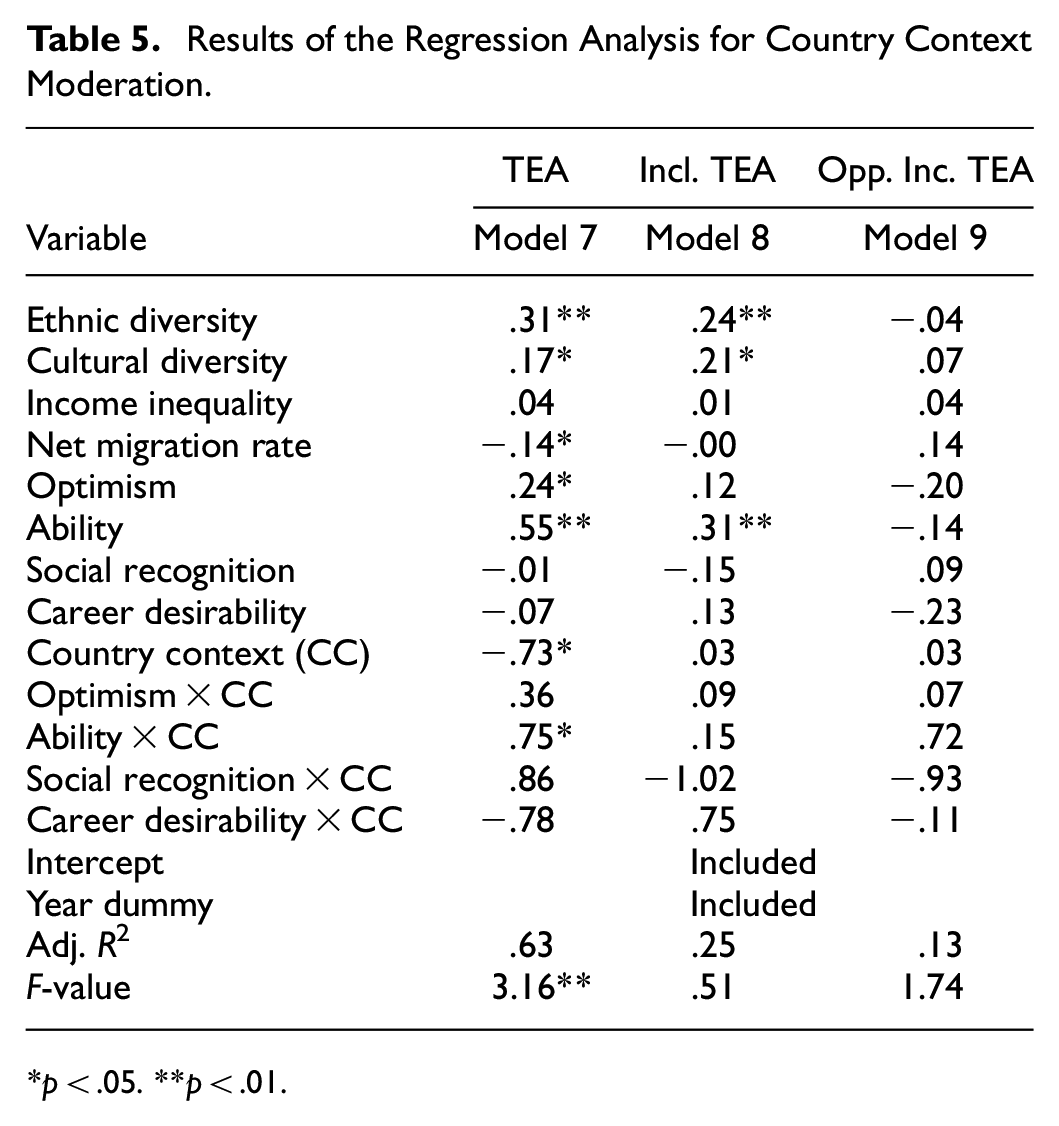
Table 5 presents the regression analysis results for testing the second hypothesis, indicating that country context (i.e., the levels of economic development) moderates the relationships between societal perceptions and attitudes toward inclusive entrepreneurship. This result, however, does not provide evidence to support this hypothesis. Country context’s moderating effect is significantly positive only in the relationship between ability and TEA. In general, the relationships between the independent and dependent variables do not differ across country contexts, that is, regarding economic development.
Results of the Regression Analysis for Country Context Moderation.
p < .05. **p < .01.
Further Analysis
Using the National Entrepreneurship Context Index (NECI) of GEM as a composite indicator that represents the level of a country’s entrepreneurial environment, this study conducted a regression analysis. Since NECI was launched in 2018, only 3 years of data (2018–2020) can be available for this analysis, which the result and its interpretation should be limited. Table 6 presents the result of NECI’s moderating effect on the relationship between motivational enablers and entrepreneurial outcomes. The moderating effect of NECI is limited to the relationships between career desirability and between social recognition and opportunity inclusive TEA. For instance, career desirability facilitates TEA only when NECI is high. Likewise, the effect of social recognition on opportunity inclusive TEA is positive when NCEI is high, but negative when NCEI is low.
Results of Regression Analysis for NECI Moderation.

p < .05. **p < .01.
Robustness Analysis
This study examines the robustness of the results using jackknife estimators. This study shows that ordinary least squares (OLS) estimators can be biased in stationary autoregressive (AR) processes. Jackknife estimators provide substantial reductions in bias compared to the OLS and maximum likelihood estimators (MEL) of the parameters in an AR (Chambers & Kyriacon, 2012) and minimize the overall root mean square error (RMSE) (Anglin et al., 2018; Chambers, 2013; Sorbye et al., 2022). Table 7 presents the results based on a range of AR parameter values that would appear to be the most relevant in practice (θ = 0.10, 0.30, 0.50, 0.70, 0.90, 0.95, 0.99), as well as the bias of the OLS estimator (Chambers, 2013). The results of the robustness test show that the difference between the OLS estimator and RMSE is not significant for this dataset, indicating that the information of our sample is acceptable for testing (Sorbye et al., 2022).
Bias of the OLS and Jackknife Estimators.

Note. *Results of the study.
Discussion
While inclusive entrepreneurship has increasingly received attention for its expected capacity to foster economic growth and mitigate inequality simultaneously, very few studies have reported on what facilitates inclusive entrepreneurial activities. We suggest enablers of inclusive entrepreneurship from a motivational perspective. The positive perceptions of and attitudes toward entrepreneurship may motivate entrepreneurial intention, fostering more inclusive entrepreneurial outcomes. This study arrives at mixed results. While we confirm the positive effects of optimism and ability on TEA and the positive effect of entrepreneurial ability on inclusive TEA, we do not find empirical evidence confirming the impact of social recognition and career desirability on TEA and inclusive TEA. However, those relationships vary depending on the economic development of a country’s context. For instance, according to the categorization of the countries derived from their economic development on entrepreneurial activity, such categorization positively affects the entrepreneurs’ ability. Conversely, using NECI positively affects career desirability of entrepreneurship and social recognition of entrepreneurs on opportunity inclusive entrepreneurial activity. These results and insights contribute to the literature on inclusive entrepreneurship.
First, this study extends our current understanding of the motivations for inclusive entrepreneurship. We show that the positive perception of entrepreneurship, notably optimism, and ability, can be critical in facilitating general and inclusive entrepreneurial activities. As one of the first studies on inclusive entrepreneurship, this research provides empirical evidence that a perceptional approach, which considers individuals’ psychological recognition and attitudes as critical antecedents for motivating underrepresented groups to start a business, can improve our understanding of the intersection of entrepreneurship and social inclusion when integrated with existing institutional, motivation, and planned behavior theories (Ajzen, 1991; Foo, 2010; Murnieks et al., 2014; Naumann, 2017; Nowinski & Haddoud, 2019).
Second, this study sheds light on the nuances of inclusive entrepreneurship by considering necessity- and opportunity-based entrepreneurship, two categories that still need to be explored. A conventional view of entrepreneurship emphasizes the ability and motivation of entrepreneurs to discern and utilize market opportunities (Kirzner, 1973; Shane & Venkataraman, 2000). However, recent studies report that many new businesses are driven by necessity rather than opportunity (Angulo-Guerrero et al., 2017). In particular, necessity-based entrepreneurship is considered a promising mechanism for escaping poverty and addressing the failures of the state (Amoros et al., 2019). The findings of this study provide evidence that opportunity-based inclusive entrepreneurship is greater in advanced than in less advanced countries.
In contrast, inclusive TEA is more significant in less advanced than in advanced countries. Inclusive entrepreneurship represents the intersection of entrepreneurship and social inclusion. Building on this, the current study implies that necessity-based entrepreneurship is a more plausible explanation for inclusive entrepreneurship, the type of entrepreneurship pursued by underrepresented and disadvantaged groups.
Third, we find that entrepreneurial activities are more robust in emerging and less developed countries than in developed countries, which is the opposite of the conventional view (Amoros et al., 2019; Angulo-Guerrero et al., 2017). The results of this study are in line with the self-employment school of thought on entrepreneurship, which explains that creating a business is less the product of an ambitious and well-thought-out project than the solution for entering the labor market during a time of structural mass unemployment and job insecurity (Afawubo & Noglo, 2022). The unemployment rate is significantly higher in emerging and less developed countries than developed countries (OECD, 2022). This is why, in these country contexts, the societal perception of entrepreneurship is more positive, and entrepreneurial activities are more robust. As unemployment and job insecurity are more severe among excluded and disadvantaged groups, the role of entrepreneurship in the economy has changed. This study extends the understanding of entrepreneurship by combining social inclusion, economic crisis, necessity, and differences in the economic development of country contexts.
Fourth, the GEM database provides access to informal entrepreneurship, especially in developing and less developed countries (Afawubo & Noglo, 2022). Informality, or starting a business without necessarily registering it, can be one of the most significant characteristics of inclusive entrepreneurship. More studies need to measure inclusive entrepreneurship. As one of the first to examine the intersection of social inclusion and entrepreneurship, this study provides generalizable evidence that can help improve the validity and reliability of the measurement of inclusive entrepreneurship. Building on this, since opportunity is more likely to be the driver of entrepreneurship than necessity in advanced economies, improving the quality of formal institutions is a fundamental step to ensuring that individuals undertake opportunity-based inclusive entrepreneurship in less developed and emerging economies. By contrast, emerging economies must remove barriers that hinder inclusive entrepreneurship based on perceptional and societal enablers. Furthermore, in a favorable environment (Amoros et al., 2019; Baughn et al., 2013; Wennekers et al., 2010), inclusive entrepreneurship will improve economic and social prosperity, particularly in emerging economies. Thus, any government policy in this sense may favor potential opportunity entrepreneurs.
This study also presents significant implications for policymakers who aim to foster inclusive entrepreneurship by lowering the barriers to entry of underrepresented social groups. The results indicate that positive perceptions of entrepreneurship foster inclusive and general entrepreneurial activities.
First, governments should work to cultivate an optimistic and positive attitude among their people toward starting ventures. For instance, relevant financial resources that are easy to access may lower psychological barriers when people consider starting a business. Governments must devise new forms of entrepreneurial financing, such as financial products and assistance services to micro- and small-sized businesses, that can be easily accessed by disadvantaged and vulnerable groups. Education and training are vital to improve entrepreneurial optimism and ability. For instance, educational level is related to optimism or the disposition to see good opportunities for starting a business wherever the nascent entrepreneur lives (Autio & Acs, 2010; Wafeq et al., 2019). Entrepreneurship training at school can cultivate the human capital of vulnerable groups and improve their capacity to start a business.
Second, governments should formulate entrepreneurship policies by classifying entrepreneurs into opportunity- and necessity-based categories. Inclusive entrepreneurship is driven more by necessity than opportunity. Public policies regarding entrepreneurship should be transparent, easily accessible, and favorable to vulnerable groups. Policies should guarantee disadvantaged groups’ access to relevant and necessary assistance, protect them from potential exploitation by established groups, and provide a social safety net, particularly for nascent entrepreneurs, to reinforce their confidence to start ventures.
Third, government policies should be detailed and customized for underrepresented groups. For instance, men are generally more positive and overestimate their future success than women (Puri & Robinson, 2007). However, female entrepreneurship has seen progress alongside changes in social norms and atmosphere (Bui et al., 2018; Zelekha, 2013). Underrepresented groups, such as women, make an abundant pool of human resources in a society. Governments should design policies that shape positive attitudes around such groups and keep in step with them from one stage of the business to the next (Hundera et al., 2019).
Conclusion
This study examines the enablers of inclusive entrepreneurial activities from the motivation perspective. Using country-year samples compiled from the GEM database (Global Entrepreneurship Monitor, 2023), we contribute to the entrepreneurship literature by examining positive perceptions and attitudes toward entrepreneurship at a societal level under the lens of social inclusion. The findings of this study are summarized as follows: First, the optimistic perception of and the ability to engage in entrepreneurship play a vital role in enhancing TEA and inclusive entrepreneurial activities. Second, the positive perceptions and attitudes of entrepreneurship and entrepreneurial activities (TEA) are more robust in developing economies than in developed ones. Third, opportunity-based entrepreneurship occurs more in developed countries, and necessity-based entrepreneurship is more prevalent in developing countries. The results only support our prediction partially related to the moderating role of the economic development of a given country context.
However, the results show that NECI moderates positively and affects social recognition, career desirability on entrepreneurial activity, and opportunity inclusive entrepreneurial. Building on this, social perceptions and attitudes express the general feeling of the population and their activity, considering, among others, to what extent individuals perceived good social recognition and career desirability to set up a business. These findings contradict the results of Angulo-Guerrero et al. (2017), which evidence that individuals discern entrepreneurship as a desirable career choice analyzing the period from 2001 to 2012. Therefore, the current study’s findings highlight the effects of motivational enablers, such as optimism and ability, as critical predictors toward inclusive entrepreneurship and the social recognition and career desirability of individuals related to inclusive activity.
We clarify the limitations of this study to suggest directions for future research. This study uses the GEM database, widely used in the entrepreneurship literature. It provides data on entrepreneurial initiatives at a very early stage and on businesses that form part of the informal economy and may grow to operate in the formal sector. This study’s research framework and findings should be re-examined to ensure robustness. In this regard, future research can provide a better understanding using other entrepreneurship databases, such as the World Bank Group Entrepreneurship Survey (WBGES), the Global Entrepreneurship and Development Index (GEDI), and the World Economic Forum’s Inclusive Development Index (WEF IDI) to provide benchmarks for inclusive entrepreneurial activities. Moreover, future research can contribute to a more nuanced understanding of inclusive entrepreneurship by using NECI as a significant composite indicator that represents a country’s average entrepreneurial environment conditions. The current study limited its impact to the analysis of 3 years derived from the purpose of the current cross-country comparative examination until 2020. Building on this, the homogenous GEM methodology across countries and the motivational enablers evidence different connotations in different contexts should be explored. Future research is also needed to understand their link better, mainly dealing with the diverse economic components derived from NECI.
Second, there needs to be more in measuring and evaluating the level of inclusive entrepreneurship. This study employs the female-to-male TEA and the female-to-male opportunity-based TEA ratio. Underrepresented groups include women, the youth, the disabled, ethnic minorities, and the elderly. Future research should devise valid and reliable measures for inclusive entrepreneurship that encompass all these groups. Moreover, future research should examine how NECI influences inclusive entrepreneurship, derived from acknowledging the underrepresented groups. These groups are crucial in fostering inclusive activity, and it’s important that we recognize their significance in our research.
Third, this study implies that necessity-based entrepreneurship may come closer to characterizing inclusive entrepreneurship than opportunity-based entrepreneurship. However, the results of this argument remain exploratory. Motivational factors and their effects on entrepreneurial activities may vary across necessity- and opportunity-driven business contexts, which should be explored in future research. Future research is strongly encouraged to tackle the differences in the allocation between opportunity-based and necessity-based activities. This is a key area that requires attention.
Fourth, since the literature on inclusive entrepreneurship is still in its early stages, the concept, definition, and measurement of inclusive entrepreneurship employed in this study should be elaborated further through critical literature reviews and grounded on in-depth case-based research theories. For instance, the role of the motivational enablers in the development of inclusive entrepreneurship acts as a channel for new knowledge dissemination regarding opportunities that emerge from complex patterns of changing conditions, for example, social, demographic, and economic conditions. Recognizing these opportunities is crucial, as it is closely linked to perceiving identifiable patterns. Therefore, the motivational enablers are crucial for performance and targeting particular groups for success, such as the underrepresented. Relevance from the beneficiary’s perspective is derived from future research contributions that impact their lives, businesses, and society.
Footnotes
Appendix
Variables, Measures, and Data Sources.

| Category | Variable | Definition and measure | Scale | Source |
|---|---|---|---|---|
| Control variable | Ethnic diversity | The existence of people from various ethnic and cultural backgrounds or identities | Polarization-Algorithm | Garcia-Montalvo and Reynal-Querol (2005) |
| Cultural diversity | Two geographical regions with the same population share, the one with the lowest resemblance across groups should exhibit a higher measure of diversity | OLS-Algorithm | Goren (2013) | |
| Income inequality | Equal-split adults (income distributed to adults and distributed equally within couples or households) | DINA-equal-split adult | WID.world | |
| Net migration rate | The number of immigrants minus the number of emigrants over a period, divided by the person years lived by the population of the receiving country over that period (expressed as the net number of migrants per 1,000 population) | Per-1,000 population | U.N-IOM | |
| Independent variable | Entrepreneurial optimism (Optimism) | % of the population aged 18–64 who see good opportunities to start a business in the area where they live | % | GEM_APS |
| Entrepreneurial ability (Ability) | % of the population aged 18–64 who believe they have the required skills and knowledge to start a business | % | GEM_APS | |
| Social recognition of entrepreneurs | % of the population aged 18–64 who agree with the statement that in their country, successful entrepreneurs are accorded a high status | % | GEM_APS | |
| Career desirability of entrepreneurship | % of the population aged 18–64 who agree with the statement that in their country, most people consider starting a business as a desirable career choice | % | GEM_APS | |
| Moderator | Economic development of country context | Categorical: advanced, upper-middle-income, lower-middle-income, and less-developed | UN Development Programme | |
| Dependent variable | General entrepreneurial activity (Total early-stage entrepreneurial activity: TEA) | % of the population aged 18–64 who are either a nascent entrepreneur or the owner-manager of a new business | % | GEM_APS |
| Inclusive entrepreneurial activity (Inclusive TEA) | % of the female population aged 18–64 who are either a nascent entrepreneur or the owner-manager of a new business, divided by the equivalent % of their male counterparts | % | GEM_APS | |
| Opportunity-based inclusive entrepreneurial activity (Opportunity inclusive TEA) | % of the female population aged 18–64 involved in TEA who (i) claim to be driven by opportunity as opposed to finding no other option for work and (ii) who indicate that the main driver of being involved in this opportunity is being independent or increasing their income, rather than just maintaining their income, divided by the equivalent % for their male counterparts | % | GEM_APS |
Declaration of Conflicting Interests
The author(s) declared no potential conflicts of interest with respect to the research, authorship, and/or publication of this article.
Funding
The author(s) received no financial support for the research, authorship, and/or publication of this article.

Data Availability Statement
Data sharing not applicable to this article as no datasets were generated or analyzed during the current study.