




Abstract
This study aims to provide a systematic review of research in the field of higher education reform in China. We analyzes 30,952 publications collected from China National Knowledge Infrastructure (CNKI) spanning from 1949 to 2023 and employs CiteSpace and Microsoft Excel for bibliometric analysis. It was found that the research on higher education reform is deeply influenced by the national development strategies and education policies, and the research themes change in stages with the adjustment of the policy contents. The results of the bibliometric analysis show that the overall trend of the number of publications in the field of higher education reform during the past seventy years shows a fluctuating growth; the research output is characterized by talent and geographic clustering; the literature on the themes of discipline construction and talent cultivation is the most concerned by scholars; the high-frequency keywords and term clusters analysis clarify the core research themes in the field; and the burst terms detection reveals the five phases of the development of higher education and the evolution of the research focuses. In addition, we make a forward-looking prediction of the future research directions of higher education based on the results of the visualization analysis and the important national educational policies in recent years. This provides researchers with a systematic knowledge framework to critically reflect on and conduct further research on higher education reform.
Keywords
Introduction
Scholars have long focused on higher education. In the 19th and 20th centuries, several renowned scholars deeply contemplated higher education (Bok, 1982; Newman et al., 1996; Veblen, 2015). Entering the 21st century, the rise of the knowledge economy has become the main reality. The various manifestations of this economy enhance the salience of higher education (Altbach et al., 2019). Higher education carries the important functions of talent cultivation, scientific research, social service, cultural inheritance and innovation, and international exchange and cooperation (Y. Wu, 2022). The level of development of higher education represents the height of the national development to a certain extent. With increasing volatility and uncertainty in politics, economy, technology, and demographics, it is neither easy nor reliable to replicate past development models to predict the future (Le Bras, 2008). Therefore, it becomes especially urgent to create new ways to drive the development of university through reform.
Looking back at the achievements of Chinese higher education in recent decades, they all stem from the government’s uninterrupted reforms. Under the continuous guidance and drive of national policies, Chinese higher education has achieved a historic leap in scale, quality and service capacity (Y. Wu, 2022). According to the theory of stages of development of higher education proposed by Trow (1974), Chinese higher education is now in the universal stage, and the world’s largest higher education system has been built. However, this period is also full of “myths” and “confusion.”J. Wang (2023) points out that the current reform of higher education, especially the construction of world-class universities and the service of economic development, is driving the development of universities into a high-risk zone. Under the erosion of technical rationality, the utilitarian value of universities was strengthened, their spiritual value gradually declined, and the philosophy of seeking truth and educating people also weakened (B. Yang & Wei, 2023). Therefore, some scholars have called for restarting the reform of higher education to break through the dilemma of the development of higher education and return to the original intention of the reform (J. Wang, 2014; Y. Zhang, 2014). In the process of the government’s continuous reform of higher education to adapt to the needs of social development based on reality, scholars in fields such as education and management have formed a system of academic achievements with Chinese characteristics by carrying out a large number of theoretical and empirical studies, which is not only a summary of the reform experience, but also a theoretical support to guide the deepening of the reform. It provides an important academic resource for the construction of the knowledge system of higher education reform in China. Summarizing and organizing the literature in this field can help to understand the knowledge components and development history of higher education reform as a whole, summarize the experiences and shortcomings of the research, and provide references for critical reflection and the next step of higher education reform research.
However, by searching the literature we found that previous scholars have mostly focused on a specific theme under the field of higher education reform, and the amount of data and time span of the studies are insufficient (Qiu et al., 2016; H. Yang, 2015a, X. Yang, 2015b; Z. Yang & Ye, 2023; Y. Zhang, 2012). Given the lack of comprehensive analysis specifically for this field, first, we used CiteSpace to bibliometricly analyze the data in terms of seven dimensions: the number of publications, core authors, core research institutions, highly cited literature, high-frequency keywords, term clusters analysis, and burst terms detection, which enables scholars to clarify the key forces, focus themes, and potential problems in higher education reform research, thus enhancing the subsequent research Targeting. Second, we systematically sorted out the development history of higher education reform in China since the founding of the nation based on the burst terms, which is conducive to scholars clearly grasping the characteristics of higher education in different periods and summarizing the historical experience. Finally, based on the results of the bibliometric analysis and the education development plan promulgated by the government in recent years, we make a prediction on the future research directions of this field, which can help scholars to capture the emerging trends of reform research and provide prospective perspectives for restarting the reform of higher education.
To achieve these goals, this study answers the following five research questions:
H1. What are the numbers and development trends of publications in the field of higher education reform in China since 1949?
H2.Who are the core authors, research institutions, and highly influential literature in the field of higher education reform over the past 70 years?
H3. What are the high-frequency keywords and key research themes in research related to higher education reform?
H4. Between 1949 and 2023, what burst terms have appeared, and what development trends have they shown?
H5. What are the future directions of research in the field of higher education reform?
Literature Review
As the core driving force of the national innovation system, the level of development of higher education is directly related to the core competitiveness and sustainable development capability of the nation. As a nation that always insists on reform and innovation, China has never stopped reforming higher education. In this process, scholars have deeply studied the theoretical and practical issues of higher education reform based on Chinese national conditions, and gradually formed a higher education knowledge system with Chinese characteristics.
Existing studies can be categorized into four dimensions. The first is to review the history of higher education reform. Reform led by the government and policy-driven reform is the typical model of higher education reform and development in China (J. Wang, 2018), and this model has prompted scholars to classify the stages of reform based on the policy cycle (S. Tan & Zhu, 1999; Yu et al., 2019; Zhao, 2009). For example, Yu et al. (2019) divided the higher education reform process into four stages marked by the convening of four national education work conferences and the promulgation of four important documents since the reform and opening-up. The second is to reflect on the reform of higher education. It is true that Chinese higher education has made significant breakthroughs in terms of equipment, disciplines, faculty, and systems, especially the rapid growth in scale (Jia, 2023), but the reform of higher education is far from successful (J. Wang, 2014). Y. Zhu and Ma (2014) summarized the main cruxes of Chinese higher education as the administrativeization of universities, the homogenization of the scale of development, the hollowing out of curricula and teaching, the false prosperity of academic research, and the marginalization of innovation education. The third is to draw on the reform experiences of developed countries. Y. Wu and Li (2013) pointed out that in order to realize the leap from a large higher education nation to a higher education powerhouse, it is necessary to draw on the development experiences of existing higher education powerhouses. Some scholars analyzed the reform experiences and development models of higher education in Japan (Wei & Li, 2000), the United Kingdom (H. Chen, 2004), the United States (Bie & Zhang, 2013), and Canada (Cao & Yin, 2016), and proposed feasible suggestions base on the reality of China. Fourth, hotspot research follows policy evolution. The focus of scholars has been adjusted with the promulgation of national stage policies, and the research themes have shown a transfer trend from “education system” (Pan, 1988; Shao, 1985) to “education marketization” (Min & Chen, 1994; S. Wang, 1997), then to “quality education” (Zheng, 2000; B. Zhou et al., 2001), “massification of higher education” (D. Wu, 2003), and finally to “quality enhancement” (J. Shi et al., 2017; X. Yang, 2015; Y. Wang, 2021).
After decades of reform, higher education has realized leapfrog development in China. In terms of development concepts and value pursuit, Chinese higher education has shifted from incremental reform to stock reform, and connotative development and high-quality development have become social consensus (Y. Liu & Zhang, 2024; W. Zhang, 2023). Specifically, there has been a gradual shift from emphasizing the political and economic attributes of higher education to academics and development, from institutional externality to freedom and autonomy, and from instrumental value to nurturing value (Z. Liu, 2014). In terms of development stage, the gross enrollment rate of higher education in China reached 51.6% in 2019 (Ministry of Education, 2020a, 2020b), and has entered the universal stage (Y. Liu & Zhang, 2024). However, Jia (2023) pointed out that this universalization is not the real universalization in the true sense, and the development of higher education in China still faces various troubles. Therefore, some scholars have called for revisiting the reform of higher education and responding to the demands of the times (J. Wang, 2023; Y. Zhang, 2016).
The dispersed and fragmented nature of existing studies prompts us to conduct a comprehensive bibliometric analysis of the overall state of research on higher education reform in China, with a view to providing scholars with valuable academic references for grasping the key nodes in the field, and for in-depth studies and critical reflections on the reform and development of higher education.
Conceptual Framework
In order to have a clearer understanding of the knowledge composition in the field of higher education reform in China, we have developed a conceptual model of “knowledge visualization”. Before describing this model, it is important to briefly introduce the concept of “knowledge visualization.” Eppler and Burkhard (2004) consider knowledge visualization as the application of visual representation methods to facilitate the dissemination and innovation of group knowledge. It can also be understood as all diagrammatic means that can be used to construct and convey complex knowledge.
In the “knowledge visualization” conceptual model, we have identified seven dimensions, which are: “publication numbers,” “author collaboration analysis,” “institution collaboration analysis” (Kretschmer, 1994), “highly cited literature analysis” (C. Chen et al., 2001), “keyword co-occurrence analysis” (Whittaker et al., 1989), “term clusters analysis” (Börner et al., 2003), and “ burst terms detection.” The aim is to display the logical structure of knowledge through mapping techniques and to uncover the intrinsic connections within knowledge.
Method
Bibliometric analysis is a research method based on literature data that reveals research focuses and trends in a certain disciplinary field through quantitative statistical of publications (Rey-Martí et al., 2016). This method provides valuable information for experts to assess scientific activities (Duque Oliva et al., 2006). Knowledge mapping is a form of bibliometric analysis that visualizes abstract knowledge structures and helps researchers to systematically understand the evolution of literature focus and structure (Hallinger, 2023).
This study uses CiteSpace to map in order to visualize knowledge in the field of higher education reform in China. There are several reasons for choosing CiteSpace: first, in terms of data preprocessing, CiteSpace has a data transformation function, which can transform different types of data into a format recognizable by the software. In addition, CiteSpace allows the user to set up time slices to reduce data and networks as needed (M. Xiao et al., 2013). Second, in terms of data analysis, CiteSpace provides more comprehensive analysis methods, including time-series analysis, spatial geographic analysis, burst detection, and constructing networks. Finally, in terms of map presentation, the knowledge map has a huge amount of information, and the software uses different colors, sizes, thicknesses, etc. to convey the information, which has a good readability and visual effect (Liao, 2011).
Data Selection and Extraction
The choice of CNKI as the data source can be explained by the following points. First, CNKI is the largest continuously updated Chinese academic literature database in China (Zuo et al., 2021), with a strict and comprehensive review mechanism that ensures academic quality, possessing high academic influence and authority. Second, the database boasts rich academic resources, with a long time span of literature collection and a wide coverage of education journals and scholars, meeting the search needs of users. Third, the policy practice and knowledge production of higher education reform in China are highly embedded in the local context, and comprehensiveness, policy sensitivity and historical continuity of CNKI make it a reliable data source.
In order to conduct a comprehensive analysis of research achievements in the field of higher education reform in China, we used “higher education reform” as the subject term to search for publications without setting a time limit. As of October 28, 2023, a total of 35,515 publications were retrieved, including 26,610 academic journal articles, 5,550 dissertations, 576 conference papers, 514 newspaper articles, and 2,265 featured journal articles. Since conference papers are often an important source of information on the latest research results and trends in a field, they were included in the selection range. In addition to excluding notices, statistical bulletins, and interviews, we selected literature based on the title, abstract, and keywords to avoid duplicative results. Synonymous terms, such as “higher education reform” and “reform of higher education,” were removed. Finally, 30,952 effective publications spanning from 1949 to October 28, 2023, were obtained. Filtered publications were exported in Refworks format to .txt files. The stored information includes research type, author, institution, title, year, keywords, etc. The downloaded data, after conversion, was imported into CiteSpace for data analysis (see Figure 1).

Data filtering and extraction process flowchart.
Parameter Settings
To avoid excessive clutter of nodes and to enhance the readability and visual effects of the maps, we set the parameters as follows: “Time Slicing” is set to 1949-2023; “Years Per Slice” is set to 3; in “Selection Criteria,” “Top N” is set to 30. To make the characteristics of the research subject clearer, “Minimum Spanning Tree” is chosen in “Pruning”; “Node Types” are set to include “Author,” “Institution,” and “Keyword”; other settings are kept at their default values.
Data Analysis
The data analysis methods used in this study include descriptive statistics, cluster analysis, co-word analysis, co-citation analysis, and burst terms detection. Descriptive statistics were conducted using CiteSpace and Microsoft Excel software to analyze annual publication numbers and highly cited literature. Cluster analysis categorizes data based on the strength of co-occurrence relationships and marks data with a high degree of association for identifying and detecting subgroups of knowledge clusters (J. Zhou et al., 2020). In this study, cluster analysis mainly involves term clusters. Co-word analysis is a method of relational metrics used to track and map the evolving connections among scientific concepts, methods, and issues (Courtial & Law, 1989). Co-citation analysis includes authors co-citation, institutions co-citation, and references co-citation. Due to software limitations on database access, we only analyzed the first two to explore cooperative relationships between academic communities and research institutions. Burst terms detection is based on the “Burst Detection algorithm” (Kleinberg, 2003) to track and analyze sudden changes in the frequency of terms in different time periods, thereby identifying several nouns representing the research frontier.
Results and Discussion
Publication Numbers and Trends
As shown in Figure 2, from 1949 to 2023, the overall trend in the field of higher education reform in China has been on the rise, closely related to the increasing attention and emphasis placed on higher education reform and development by the nation. From 1949 to 1982, the number of publications remained below 20 annually. This was related to the planned economy system in place at the time, where higher education development was primarily controlled and arranged by the nation, limiting the freedom and diversity of academic research. Between 1983 and 1993, there was a significant increase in publication numbers compared to the earlier period. This phase was the initial reform period of higher education in China, where the enactment of a series of policies provided more opportunities and resources for research in the field. From 1994 to 2011, the number of publications surged, reaching a peak in 2001 with 1,928 publications. During this stage, higher education entered a comprehensive revitalization period. The expansion of enrollment and the implementation of quality education have pushed the prosperity of higher education, but also brought some new problems and challenges, which inspired scholars to conduct extensive studies to find solutions to the problems. After 2011, there was an overall fluctuating downward trend, but the annual average number of literature remained above 1,000. During this period, the national policy gradually focuses on the connotative development and quality improvement, and the reform of higher education enters the “deep water zone” (Zhong, 2013), which makes new theoretical breakthroughs and innovations more difficult. In addition, the increasingly strict academic environment and standards are also important reasons for the suppression of the number of publications. On the whole, changes in publication numbers are closely related to domestic environments, such as systems and policies, reflecting which reflects that research in higher education closely follows and serves the development of the nation and society.

Statistics on annual publication numbers.
Influential Authors, Institutions and Literature
According to Price’s law (López-Muñoz et al., 2006), the number of publications by an author reflects his or her level of engagement in a research field, so it is possible to determine whether he/she is a core author in the field by calculating the minimum number of publications. According to the formula Nmin = 0.749√Nmax (where Nmax refers to the highest publication count of an author in the field, and Nmin is the minimum publication count for core authors), it is calculated that Nmin≈ 8.5, which indicates that the authors with nine or more publications are called core authors in the field of higher education reform. Based on the statistical results, we screened out 56 core authors (see Table 1). As can be seen from Table 1, Zhou has published 130 papers, ranking first among the core authors; Jianhua Wang has the longest duration of research (38 years). Combining these two indicators helps identify active and leading figures within the core group of authors. In terms of cooperation among authors, the knowledge map presented in Figure 3 mainly forms a cooperative network with five core nodes, namely Zhong (13), Bei (13), Hu (11), Zhang (7), and Qu (6), while most of the others form a cooperative network of 2-4 authors. On the whole, the collaborative network is relatively sparse, and the collaborative relationship between researchers is weakly connected. Kuhn (1996) argued that there are certain intellectual barriers between different scientific communities, and that there is incommensurability between different paradigms. Such academic “boundaries” may limit the sharing of knowledge and resources and prevent researchers from collaborating across units and disciplines, which is not conducive to the healthy development of the research. Therefore, regular seminars should be organized to establish an academic exchange platform, and academic databases should be opened to establish a knowledge-sharing mechanism. In addition, the government can set up interdisciplinary programs and funds to guide researchers to collaborate.
Statistics on Core Authors.


Knowledge map of authors collaboration network.
Institutions were filtered based on their publication count, selecting those with more than 10 publications as the core institutions. The density of collaborative networks in the knowledge map presented in Figure 4 is only 0.0005. East China Normal University has published 326 papers, and its research output is in the first place. As can be seen in Figure 4, the main issuing institutions are mostly “double first-class” universities and national-level educational and scientific research institutions, and most of the high-impact authors belong to these institutions with high academic reputation. This phenomenon reveals a strong correspondence between academically influential authors and institutions. By analyzing the geographic locations of the core institutions, we find that universities in the eastern region produce more research output than those in the central and western regions, and that there is closer cooperation between institutions. This talent and geographic clustering of research output stems from differences in levels of economic development as well as the institutionally hierarchical development model of the higher education system. The economically developed eastern region concentrates most of “double first-class” universities, and good research infrastructure and sufficient financial support attract the inflow of high-level talents. The clustering effect of resources can cause a certain degree of academic closure and monopoly, affecting the diversity and expansive development of scientific research. Therefore, it is necessary to continue to strengthen the investment of resources in colleges and universities in the central and western regions, set up a special fund for scientific research and development, and encourage colleges and universities in the eastern region to establish long-term and stable cooperation with those in the central and western regions to alleviate the regional differences.

Knowledge map of research institutions collaboration network.
In this study, the top 15 cited literature in the field of higher education reform are selected for analysis. As can be seen from Table 2, the research themes focus on discipline construction, talent cultivation, higher education and economic development, educational philosophy, education system, curriculum and teaching reform. In terms of research continuity and literature citations, discipline construction and talent cultivation receive the most attention from scholars. In terms of the discipline construction, the construction of “emerging engineering education” and the improvement of the quality of higher engineering education have become the focus of research. In 2016, China officially joined the Washington Accord of the International Engineering Alliance. In 2017, the Ministry of Education launched the construction of “emerging engineering education” to transform and upgrade traditional engineering specialties and accelerate the cultivation of engineering and scientific talents in emerging fields, in order to change higher education to meet the challenges of the new round of scientific and technological revolution and industrial change (A. Wu et al., 2019). The emphasis on the construction and development of “emerging engineering education” has driven scholars to actively conduct research and explore the “Chinese experience” and “Chinese model” of engineering education. Since 2010, improving the quality of education has become the theme of education reform (Yu et al., 2019). The adjustment of economic structure and the transformation of the main contradiction in higher education have prompted colleges and universities to focus on improving the quality of talent cultivation (Zhong, 2013). In order to cope with the problems of the development of higher education, exploring the reform paths of talent cultivation modes has also become the focus of researchers. By analyzing these highly cited literature, it can be found that there is a high degree of consistency between economic development, national policies, and scientific research. This not only reflects the reform and development of higher education to adapt to the requirements of national economic construction, but also demonstrates scholars’ close attention to the frontiers of higher education research and national policies.
Statistics on Highly Cited Literature (Top 15).

High-Frequency Keywords
The frequency of keywords can reflect the importance of a research theme. In this study, we define high-frequency keywords as those exceeding the average keyword frequency. The betweenness centrality refers to the degree of control a keyword exerts over the entire network’s resources (Small, 1986). If the value is greater than 0.1, it indicates that this keyword is at the center of the co-occurrence network, possessing significant influence (G. Zhu & Han, 2023). Employing CiteSpace, keywords with a frequency higher than 100 and betweenness centrality greater than 0.1 were extracted. Table 3 shows that there is not a one-to-one correspondence between high-frequency keywords and keywords with high betweenness centrality, indicating the need to combine both to comprehensively judge the keywords that are heavily discussed and focused on by scholars. Overall, the hot keywords cover areas such as teaching, education system, educational philosophy, quality improvement, higher vocational education, and adult education in the field of higher education reform. Table 3 also reveals that the number of keywords with high betweenness centrality is much lower than that of high-frequency keywords. The reasons for this discrepancy may include: firstly, the disciplinary structure of higher education is complex, with weak connections between disciplines and specializations. Secondly, researchers tend to use common, widely discussed concepts as keywords, which may not necessarily have high betweenness centrality. Thirdly, the data comes from multiple different research fields or institutions, leading to variations in the number and betweenness centrality of keywords.
Statistics on High-Frequency Keywords and Keywords with High Betweenness Centrality.

Note. R = Rank; F = Frequency; BC = Betweenness centrality.
Term Clusters Analysis
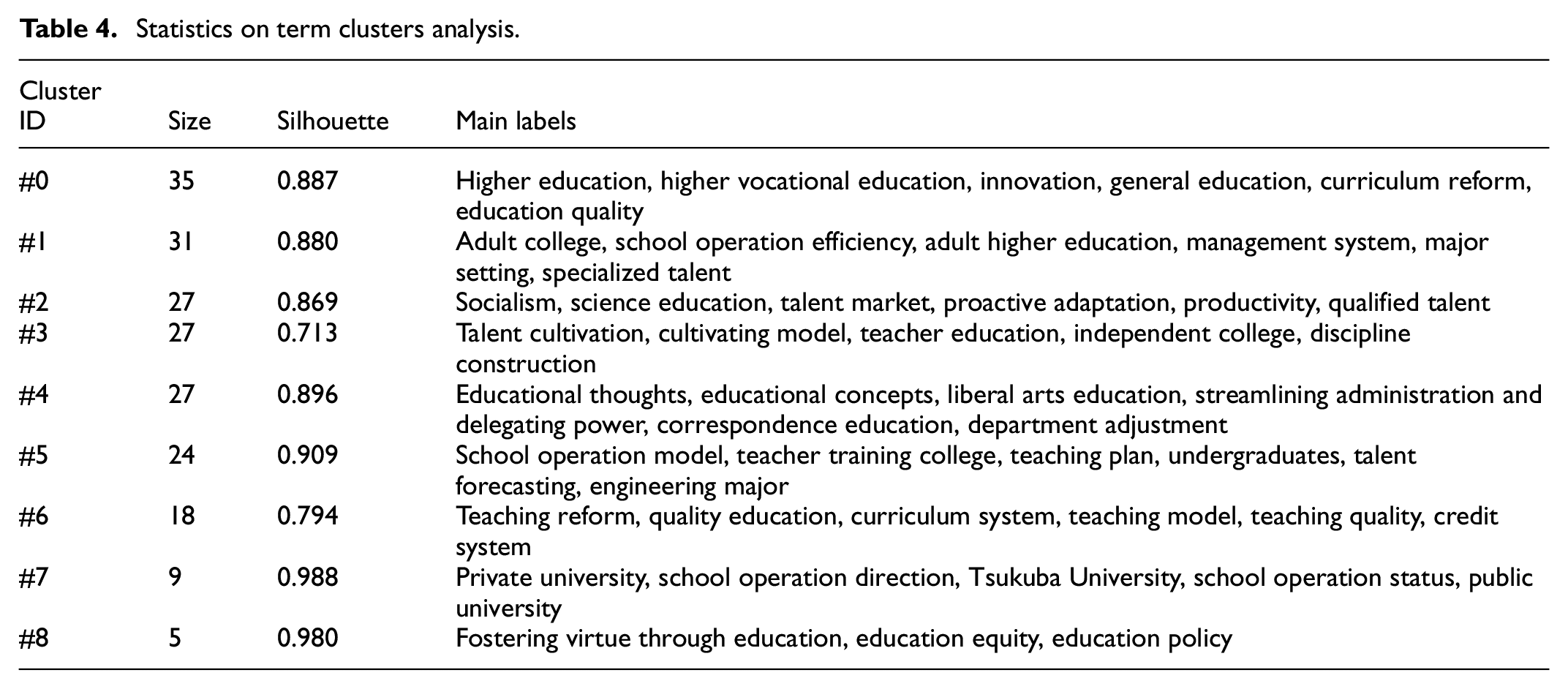
Using the LLR algorithm (Log-Likelihood Ratio) in CiteSpace, this study analyzed keywords in the sample data and generated a knowledge map consisting of 227 nodes, 376 links, and a network density of 0.0147. Based on the criteria set by Y. Chen et al. (2015) for modularity value (Q value) and silhouette value (S value), the cluster map generated in this study is efficient and convincing (Q value of 0.6209, S value of 0.8372). Figure 5 displays nine clusters, with smaller cluster label numbers indicating a larger number of contained keywords. Table 4 lists the number of keywords, silhouette values, and main keywords for each cluster. As can be seen in Figure 5, the clusters have varying degrees of connections. To focus and clarify the research themes, we integrated the nine clusters into five themes based on the content of each cluster and the connections between them. These themes are Education Quality (#0, #3, #5, #6), Adult Higher Education (#1), Educational Philosophy (#2, #4), Internationalization (#7), and Moral Education (#8).The following will discuss the themes in turn.

Knowledge map of term clusters analysis.
Statistics on term clusters analysis.
Education Quality
Since the expansion of university enrollment in 1999, particularly after higher education entered the universal stage in 2019, China has issued several relevant laws and policies to promote the quality improvement of higher education. Reviewing existing research, scholars’ studies on higher education quality can be broadly divided into three aspects. The first is comparative studies, which are numerous. Some scholars aim to examine the quality assurance systems of higher education in other countries to draw successful experiences for the development of Chinese higher education (Bie et al., 2018). The second is research on external quality assurance, mainly involving discipline evaluation, institutional evaluation, and university rankings. The third is research on internal quality assurance, mainly including undergraduate teaching quality and postgraduate teaching quality (Han, 2020; Yan et al., 2016).
Adult Higher Education
Although the history of adult higher education is relatively short, it has made significant contributions to Chinese economic development and the improvement of talent quality. However, due to complex real-world factors, its development faces many practical difficulties, which are highlighted by the lack of a sound mechanism for quality assurance and talent cultivation. To enhance its educational function, scholars have discussed extensively from the dimensions of transformational development (C. Tan et al., 2011; M. Xia & Li, 2021), talent cultivation (Y. Li et al., 2017), faculty construction (J. Chen et al., 2012), and network education (Z. Wang et al., 2015).
Educational Philosophy
Educational philosophy reflects the essential characteristics of education, fundamentally answering the question of why education is necessary (P. Li & Zhong, 1998). Since the founding of the People’s Republic of China, especially since the reform and opening-up, driven by top-down political decisions and bottom-up demands for change, China has proposed a series of philosophies that have led to leapfrog development in higher education. X. Liu and Zhou (2009) broadly classified Chinese higher education philosophies into three types: exogenous transformative philosophies, politically grafted philosophies, and spontaneously endogenous philosophies. This classification reveals that the transformation of higher education philosophies is a conditional response to social systems and the times, bearing strong imprints of the era. Taking into account the global trends in higher education development and the domestic social and educational environment, the “China Education Modernization 2035” proposes eight fundamental philosophies to guide the modernization of Chinese future-oriented higher education.
Internationalization
Internationalization is the most powerful and substantial development in the history of higher education in China. With the ongoing push of globalization, internationalization has become a fundamental characteristic of modern higher education. Y. Wu (2023a) summarized the content of internationalization in Chinese higher education as curriculum internationalization, faculty internationalization, student internationalization, management internationalization, and cultural internationalization. Through reviewing relevant literature, we summarize the hot themes in higher education internationalization into three aspects: development strategy, experiential learning, and regional cooperation. Among these, experiential learning studies are more numerous, with the United States being a focal nation for scholars’ research. Y. Li and Li (2016) studied the evolution of national policies for higher education internationalization in the United States. Z. Zhu et al. (2020) explored the strategies implemented by the United States in promoting the internationalization process of higher education, hoping to offer references for the construction of “double first-class” in China.
Moral Education
Moral education is the core objective of higher education development, and its essence lies in moral practice. At present, China has established “Fostering Virtue through Education” as the fundamental task of education. It is a critical inheritance and development of the educational philosophy of Chinese excellent traditional culture, a necessity for cultivating and practicing socialist core values, and also the mission of ideological and political education in colleges and universities (Deng, 2020). Accordingly, the academic community has also conducted research and discussions on the theme of “Fostering Virtue through Education.” Some scholars analyze the connotations from a dialectical perspective (M. Wang, 2017); others explore how to optimize the implementation of fostering virtue in colleges and universities from online, cultural, and psychological perspectives (H. Chen & Pan, 2019; W. Xiao, 2019; S. Zhu, 2014).
Burst Terms Detection
Burst terms are keywords that suddenly increase or decrease in number, and they are wind vane for tracking the evolution of research hotspots (G. Zhou, 2023a, P. Zhou, 2023b). In order to reveal the development process of higher education reform research in China, we obtained a total of 125 burst terms using the Burstness function of CiteSpace. In this study, we chose the first 25 and mapped them according to the time of burst (as shown in Figure 6). From Figure 6, it can be seen that higher education reform research has gone through five distinct stages.

Knowledge map of burst terms (top 25).
The first stage is 1949–1977. There was no emergence of burst terms in this stage, which was related to the historical background and academic research environment at that time. The implementation of the planned economy system determines that the nation needs to unify the planning of higher education, and the enrollment, distribution, and specialty setting of higher education are arranged by the nation, so the development of higher education lacks diversity, and the research themes have a strong convergence. In addition, the weak foundation of academic research is also an important reason for the absence of burst terms at this stage.
The second stage is 1978–1991. Seven burst terms appeared in this period, among which “socialism” and “reform of higher education” had a high intensity of burst. After the reform and opening-up in 1978, China entered a new period of socialist modernization. The “Decision of the Central Committee of the Communist Party of China on the Reform of the Education System” clearly stated that “education must serve the socialist construction,” and put forward the tasks of reforming the distribution system of graduates, expanding the autonomy of institutions of higher education, and adjusting the structure of higher education (Central Committee of the Communist Party of China, 1985). In response to a number of problems in the development of higher education, researchers have responded enthusiastically to the question of how to explore feasible paths of reform on the basis of adhering to the direction of socialism in the running of schools (Shao, 1985; K. Zhu, 1991).
The third phase was 1992–1997. In this period, three burst terms, “market economy”, “university-run industry” and “teaching content”, appeared. Among them, “market economy” had the highest burst strength. In 1992, the 14th National Congress of the Communist Party of China explicitly put forward the strategic goal of establishing a socialist market economic system, which raised new and higher expectations and requirements for higher education. The core issue of reform in this period was how to marketize education in order to adapt to the transformation of the economic system (S. Wang, 1997). The “Several Opinions on the Development of Science and Technology Industries by Colleges and Universities” encouraged colleges and universities to set up science and technology industries, which provided a new perspective for researchers to explore the relationship between education and the market economy.
The fourth phase is 1998–2009. Five burst terms appeared in this phase. Among them, “knowledge economy” and “quality education” have the highest burst intensity. The arrival of the knowledge economy based on intellectual and knowledge resources has greatly increased the status of higher education in society (Q. Xia, 1998). D. Yang (1998) pointed out that higher education needs to shift its main task to cultivate creative talents to adapt to and promote the development of knowledge economy. In order to improve national quality, especially the ability to innovate, China promulgated the “Decision on Deepening Education Reform and Comprehensively Promoting Quality Education” to cope with the challenges of the knowledge economy. Scholars generally agree that the cultivation of ideology and morality is fundamental to the implementation of quality education (C. Zhang, 2002; Zheng, 2000), and the improvement of cultural quality is the foundation (B. Zhou et al., 2001).
The fifth phase is from 2010 to the present. In this phase, 10 burst terms appeared, and the research themes showed diversified development characteristics. It is worth noting that “talent cultivation”, as a long-term research theme throughout the period from 1983 to 2023, has seen a significant emergence of academic attention after 2013, and has become the core focus of higher education reform research in the past ten years. This is closely related to the promulgation of relevant national policies, and since 2010, “connotative development” has gradually become the core philosophy of higher education development in China. The design and implementation of policies such as innovation and entrepreneurship education, vocational education, and the construction of “emerging engineering education” all point to the improvement of the quality of higher education training, which has triggered the academic community to focus on the discussion of talent cultivation mode (M. Li & Xing, 2020; H. Yang, 2015; Zhong, 2013).
Prediction of Research Directions
Predicting the future directions of higher education is an important dimension in exploring the path of reform and development of higher education. There are currently two prediction ways: one is the national future planning of higher education in education policies, and the other is scholars’ future outlook of higher education in their research (Jia, 2023). In this study, we make predictions of the future research directions of higher education based on high-frequency keywords, term clusters analysis, burst terms detection, and important educational policies enacted by the nation in recent years.
Quality Improvement
From the cluster map, it can be seen that quality improvement has been a key theme in the research of Chinese higher education reform. Currently, higher education is shifting from expansion-focused conditional development to quality-centered connotative development in China. Apart from domestic drivers, international competition in science, technology, and talent has also intensified Chinese determination to train innovative talents and enhance national strength. Therefore, we believe that one of the focuses of future reforms and development in higher education in China will still be on “improving quality and efficiency.” Accordingly, the research content generally focuses on two aspects. First is the cultivation of top-notch innovative talents (Jia, 2023). Current research by Chinese scholars on higher education focuses on macro aspects, with content mostly centered on quality, assessment, and systems, paying less attention to micro aspects such as curriculum, teaching, teachers, and students (H. Yang, 2015). This research tendency is not conducive to identifying problems in specific educational and teaching processes, hence the need for research to advance in both dimensions. Second is the construction of a Chinese model for higher education development (Hu, 2018; J. Wang, 2020). Present research on higher education mostly focuses on guiding and evaluating Chinese universities based on the experience of top Western universities, pursuing superficial similarities and neglecting local feasibility. Therefore, future research should aim to achieve harmonious development of localization and internationalization, innovating based on the actual needs of Chinese higher education development while drawing from foreign experiences, to construct a development model for higher education with Chinese characteristics.
Education Evaluation
Both high-frequency keywords and term clusters analysis show that teaching reform is a central research theme that cannot be ignored, and that educational evaluation is an important baton for educational and teaching reform. In 2020, the “Overall Plan for Deepening the Reform of Education Evaluation in the New Era” explicitly stated the need to achieve substantive breakthroughs in key areas of educational evaluation. The higher education evaluation system is a crucial lever for promoting high-quality development in higher education (G. Zhou, 2023). However, in its implementation, there has been a gradual deviation from the original philosophy of using evaluation to drive improvement and construction, leading to an alienation phenomenon (Y. Shi, 2022). These irrational phenomena diminish the practical guidance value of the evaluation itself and hinder the construction of a positive educational evaluation system, which is not conducive to the healthy and balanced development of higher education. In the new era, the higher education evaluation system needs to adapt to new requirements and undergo new changes. This requires educational evaluation to return to the essence of education (Z. Shi, 2020), reflecting the true nature of universities. It should place the fundamental significance of higher education reform in moral education and talent cultivation, guiding teachers to devote themselves to education and promoting the comprehensive development of students.
Higher Education Informatization
How to promote the deep integration of information technology and higher education is an important strategic task for advancing the modernization of higher education and achieving high-quality development in the new era. In 2019, “China Education Modernization 2035” explicitly proposed accelerating the transformation of education in the information age. By 2022, the Ministry of Education initiated strategic actions for educational digitalization. The issuance of these policies has provided a favorable policy environment for the development of informatization in higher education, highlighting the national emphasis on the construction of educational informatization. Traditional views hold that machine teaching is impersonal and, regardless of how advanced educational technology becomes, it can only supplement school education and classroom teaching (Z. Liu & Liu, 2020). However, the arrival of the pandemic in 2020 has, to some extent, changed this stereotypical perception. Some scholars believe that the impact of the pandemic on higher education is not as simple as a shift from online to offline; there may be significant or even fundamental changes in educational models (J. Wang, 2021). Viewing the rapidly developed educational technology from a rational perspective, it is seen as a temporary emergency measure, with shortcomings in aspects like curriculum resources, organizational management, and teachers’ information literacy, and has not truly achieved integration with higher education. How to effectively alleviate the difficulties encountered in the construction of higher education informatization, truly harness its utility, and achieve normalized development will be one of the main themes for scholars to explore in the future.
System Construction
“China Education Modernization 2035” explicitly proposed to prioritize the development of education and vigorously promote the modernization of educational philosophy, systems, institutions, content, methods, and governance. Among these, the “construction of a modern university system” has always been a hot theme in academic research and educational practice. As policy discourse evolves, its research themes are continuously changing. Currently, “university governance” is the most popular theme. J. Zhou (2020) argued that the core of the university system is governance issues, which are also the foundation of university governance. University governance includes both external and internal governance. The former refers to the management of relationships between universities and the government, and universities and society. In China, the most fundamental and important aspect is reforming the relationship between the government and universities (L. Zhang, 2012), which demands the return of university autonomy. Although certain reform results have been achieved, there are still issues such as unclear government responsibilities and lack of motivation for universities to manage and govern themselves (Pan & He, 2021). The latter refers to handling the relationship between academia and administration. The modern university system requires universities to return to their academic organizational characteristics. To enhance academic authority and reduce administrative power, the government has implemented professor-led teaching, democratic management, and staff representative assemblies in universities (Pan & He, 2021). After entering the universal stage, higher education has encountered difficulties and deviations, such as governance imbalance and emphasis on indicators over substance in China, urgently requiring scientific top-level design guidance. In this context, the modern university system as a kind of macro-guidance has become an important hand to break through the bottleneck of higher education development. Therefore, how to construct a scientifically reasonable internal and external governance structure for universities, clarify the boundaries of rights and responsibilities, and promote a “good governance” pattern holds significant importance for the sustainable development and modernization of universities, and should be a key focus for scholars.
Graduate Education
In the burst terms detection map, the theme of “talent cultivation” has remained persistently prominent over the long term and continues to the present. This phenomenon is not only a reflection of the achievements of higher education reform over the past decade, but also a clear signal for continued and deepened reform in the future. As the apex of the talent cultivation system, the graduate student community deserves prioritized attention. As socialism with Chinese characteristics enters a new era, the status and role of postgraduate education have become more prominent (Ministry of Education, 2020a, 2020b). Among them, doctoral education, as the highest level of the higher education system, carries the dual mission of producing profound knowledge and creating top-notch innovative talents, and is the key support of the national innovation system (Y. Zhang, 2024). The “Opinions on Accelerating the High-Quality Development of Doctoral Education” have made a systematic deployment to deepen the comprehensive reform of doctoral education (Ministry of Education, 2024). We must realize that while the quality of postgraduate training has achieved remarkable results, there are also some outstanding problems such as the selection mechanism is not perfect and the talent cultivation is difficult to adapt to the needs of social development (Y. Wu, 2023a, 2023b). Future researchers should focus on how to effectively improve the quality of graduate students, especially doctoral students, which is a proposition of the times that higher education must answer.
Conclusion and Limitations
In this study, CiteSpace and Microsoft Excel are used to conduct bibliometric analysis of relevant literature included in CNKI during 1949–2023, and to visualize knowledge in the field of higher education reform in China by means of knowledge mapping. It is found that higher education reform research is deeply influenced by national development strategies and education policies, and the research themes change with the adjustment of policy contents. This dynamic correlation reflects both the pulling effect of national policies on theory construction and the concern of academic research for real issues. From the bibliometric results, the phase fluctuation of the number of publications is significant, but the long-term trend of growth is shown; the research output is characterized by talent and geographic clustering, and the cooperation between influential authors and institutions shows a loose relationship; the literature on the subject of discipline construction and talent cultivation is most concerned by scholars; the high-frequency keywords and key themes reflect the research hotspots in the field of higher education reform, and the education quality, adult higher education, educational philosophy, internationalization and moral education are the core themes of scholars’ attention; the burst terms detection reveals the five stages of higher education development and the evolution of research focus; scholars can strengthen their attention to quality improvement, education evaluation, higher education informationization, system construction and graduate education in the future.
We have conducted a systematic bibliometric analysis of the achievements in the field of higher education reform. On the one hand, it helps scholars to identify the key research strengths, key issues, and potential problems in the field, so as to improve the pertinence of subsequent research; on the other hand, retracing the history of higher education reform and looking forward to the future research directions can allow researchers to summarize the historical experience while expanding their academic horizons prospectively, so as to provide references for the restarting of higher education reform.
However, there are some limitations in this study. First, we chose only CNKI as a single data source. Although this database is rich in academic resources, it is difficult to cover all research themes, and the international perspective is limited to a certain extent. In the future, a mixed-method design can be used to incorporate international literature to enhance the comprehensiveness of the study and the ability of international dialogues. Finally, CiteSpace provides several functions that can intuitively display the “mainstream trends” in a specific research field. However, this may undermine the value of non-mainstream voices (Apple, 1999). In the future, we should combine multiple analytical methods to explore the “neglected” research content in depth, so as to avoid the one-sidedness of a single method.
Footnotes

Ethical Considerations
This study is a bibliometric analysis of publicly available literature in database. This study did not involve human participants, animal experiments, or sensitive personal data. According to international guidelines for non-interventional research, ethical approval and informed consent were not required for this study.
Consent to Publication
All authors have reviewed the manuscript and consent to its submission.
Author Contributions
Dongyuan Xu: Writing – original draft, Conceptualization, Data curation, Software, Visualization, Formal Analysis. Jiwei Zhang: Writing – original draft, Methodology, Resources, Formal Analysis. Zhichao Wang: Writing – review and editing, Resources, Investigation, Supervision.
Funding
Not applicable.
Declaration of Conflicting Interests
The author(s) declared no potential conflicts of interest with respect to the research, authorship, and/or publication of this article.