




Abstract
Current literature on employees’ work attitudes often fails to examine how employees’ specific sociocultural values influence work attitudes. This study of 211 bank managers examined specifically the cardinal sociocultural values (moral values, religious values, communal values, attitude toward others, and family values) within the Ghanaian society and how they influence job satisfaction. The study further tested the mediating role of social support on the relationship between sociocultural values and job satisfaction. Data were analyzed using structural equation modeling (SEM)/partial least squares (PLS) to test for the relationships between sociocultural values (as the endogenous variable) and job satisfaction (as the exogenous variable) and the mediating role of social support. Based on the results, it is concluded that there exist a significant positive relationship between sociocultural values and job satisfaction. The strongest relationship observed is between moral values, religious values, and job satisfaction. Social support mediated the sociocultural values and job satisfaction relationships, sometimes fully and sometimes partially, depending on which specific sociocultural value was being examined. Theoretical and practical implications of the proposed research are discussed.
Introduction
Sociocultural values (SCV) which a society maintains continue to remain strong among workers in spite of all its conflicting values with organizational culture. These SCV remain part of individuals wherever they find themselves including the workplace. Generally, culture has been identified to influence various organizational outcomes directly or indirectly. This makes it an important issue to investigate to help management maximize the positive and minimize the negative effects of cultural values on employee’s job satisfaction. Cultural values have been defined by House, Javidan, Hanges, and Dorfman (2002) as shared motives, beliefs, values, identities, and ascribed meanings to significant events that ensue from common experiences of members of a collective group and are transmitted across generations, and this play a vital role in a way our social institutions works (Sagiv & Schwartz, 2007). In a more practical sense, SCV reflect what a society accepts to be the way of life and standards for individual’s behavior within a society, which influence behavior.
Every organization has its own corporate culture, which spells out how employees should conduct themselves (Deal & Kennedy, 2000). Although every organization has its own common values and codes of conduct that guides employees’ behavior at the workplace, it is believed that organizations that considers the societal values in which it is located is more likely to survive. Sagiv and Schwartz (2007) in their study made this assertion very clear by illustrating a significant relationship between organizations and the societal culture where cultural values within a society have a direct and indirect influence on the function of employees within an organization. In view of this, the individual’s own SCV which are embedded in them may also be transferred to the workplace consciously or unconsciously, hence when the attention not given may influence employees’ work attitude (job satisfaction) level, which generated the researchers’ interest. These effects could be positive or negative.
According to Pirraglia (2017), when corporate culture meets ethnic culture, there is always an effect, which could either be positive or harmful to job satisfaction. There is strong evidence in the literature that the impact of culture on work attitudes should be investigated (Wang, Lawler, Walumbwa, & Shi, 2004). Interestingly, a consistent body of literature has also identified differences in levels of satisfaction among employees and across cultures (Clugston, Howell, & Dorfman, 2000; Lincoln & Kalleberg, 1985). Some researchers have also attributed employees’ satisfaction to their cultural values (Dorfman & Howell, 1988).
Although some studies have linked cultural values to some employees’ work attitudes, they do not explain specifically which of the cultural values affect employees’ work attitudes the most (Sommer, Bae, & Luthans, 1996). Anafarta (2011) revealed that this construct (SCV) has again received little or no attention which needs much attention. Studies done on cultural values have mainly relied on Hofstede’s (1980) cultural values. Hofstede revealed, for example, that Africans are said to be high on dimensions’ power distance, collectivism, uncertainty avoidance, and masculinity–femininity, which he described them as cultural values. This he identified as cultural values in the existing literature, which may not necessarily be applicable to this current generation of employees in Ghana as his study limits itself to only South Africans. Opoku Mensah (2016) study has recently identified specific SCV, which influence employees’ work attitudes (moral values, attitude toward others, family values, religious values and communalism) and are considered to be the cardinal values that are transferred to the workplace by employees.
The SCV identified by Opoku Mensah (2016) as the cardinal cultural values at the workplace suggest that work environment should be flexible enough to embed these cultural values in the organizational values. According to her, employees who value their families should be given the opportunity to attend to family matters during working hours when urgent matters arise. Within the Ghanaian work context, employees expect that the work environment should accommodate the practice of their religious values, management and employees should also live as one people and work together (communalism), and younger employees are expected to respect older ones and vice versa. For example, in a typical Akan setting in Ghana, it is extremely common to see or hear a young person referring to an elderly male at the workplace as “Papa” (father) and an elderly female as “maame” meaning (mother) even when they are not their biological parents. These are manifestation of respect for those in authorities. This can also be done in several ways. For instance, greeting is considered as a sign of respect among the people of Ghana and younger ones at the workplace are expected to greet elders or those in authority wherever they see them.
The Ghanaian SCV undoubtedly also consider men as the head of their family which is accorded with authority. These values according to this study are transferred to the workplace consciously or unconsciously. It is also expected by the Ghanaian society that each one should be the other ones keeper and care about each one at the workplace as we are one people. Work environment where these values are not recognized will likely have a negative effect on employee’s job satisfaction.
The bases for this thinking is that people who, for some reasons their existing organizational culture and policies prevents them from upholding or practicing these cultural values, are likely to be dissatisfied with their jobs and also see their work environment to be unfriendly. Thus, employees expect management to factor their cultural values into the organizational values to make the work setting more accommodating. Findings from Adams (2008) showed that incorporating religious values into work, for example, allowing employees to say prayers at work, leads to employee’s perception of justice at the workplace and increases their satisfaction. Another study by Ellison (1991) also showed that people with higher religious attitudes have higher rates of life satisfaction and the totality of all societal-cultural values influence the way individuals behave at the workplace (Gelder, 2012). Lyons, Higgins, and Duxbury (2010) and Ueda and Ohzono (2012) also tend to share similar views. Cultural values (collectivism, power distance, doing orientation, and resistance to teams, resistance to self-management) have also been reported to have a significant relationship with job satisfaction.
The fundamental argument in this research is that SCV demonstrated at the workplace, by employees, could influence work attitude either in a positive or negative way. Nevertheless, these have not been examined. It is again argued that employees’ cultural values when not embraced at work may create resistance to initiative and feeling of belongingness, which in turn, leads to negative work attitudes or positive work attitudes. This study therefore seems to be timely, and in all sense reasonable in that going beyond what previous researchers focused on, this study can be considered a novelty in the work–family conflict literature using a sample of bank managers in the financial services sector in Ghana.
In this present study, it is predicted that individual’s SCV, which when incorporated into organizational culture, will in turn probably be associated with lower levels of job satisfaction. Social support is also predicted to mediate the relationship between SCV and job satisfaction. According to Willigen and Drentea (2001), social support represents the resources that are available to an individual from other people in their social network. They are normally in a form of emotional support or instrumental support like helping an individual to carry out household chores and take care of babies and support from colleagues and friends. In other words, it can be defined as having access to helping relationships of varying quality or strength that provide resources such as emotional empathy or tangible assistance (Viswesvaran, Sanchez, & Fisher, 1999). Job satisfaction has been associated with employees who sees their work environment to be supportive and friendly (Agbozo, Owusu, Hoedoafia, & Atakorah, 2017; Rahman, Waheed, & Khan, 2017). A supportive work environment where employees’ cultural values are cherished could boost their perception of the organization, hence influence their job satisfaction. Accordingly, these cultural values may have a measurable effect on the bank managers’ job satisfaction.

Shows the theorized relationship among the exogenous, endogenous, and mediating variable in the study.
The first objective of the study was to empirically examine the relationship between employees SCV and job satisfaction. The second objective was to explore the relationship between the composition of SCV and job satisfaction and finally test the mediating role of social support on the relationship between SCV and job satisfaction, which the current existing literature does not address the magnitude of these effects on job satisfaction.
The findings of this research will be a major contribution that will provide a deeper understanding of the relationships between SCV and work attitude which will help management understand and appreciate the specific values that influence job satisfaction to promote a cordial working environment hence increase job satisfaction. It is anticipated that the findings will also provide baseline information on how SCV and work attitudes are related upon which other researchers can build on.
Based on the above discussion the following Hypotheses were formulated for testing:
Method
Sample and Research Procedure
A comprehensive survey was conducted using structured questionnaire for data collection. Three main cities (Accra, Kumasi, and Takoradi) of Ghana where there are lots of bank branches were used for this survey using a purposive sampling technique. A total of 28 licensed commercial banks were initially contacted, however, those that showed interest (15 banks) participated in the research. Unfortunately, this low response was not surprising at all in Ghana where researchers more often than not get lower response rate from respondents in the industries. Possible reasons given in this study were against organizational policies to involve in students research, security of information given, and corporate image. Interestingly, some never gave any reasons for turning down their participation. Finally, the 15 different types of licensed banks were included in the sample where permission was sought from the bank headquarters to enable the researcher who approached the bank branches from the three cities. The researcher presented carefully documents highlighting the main objectives of the study, the methodology, and the relevance of the study. Respondent had to indicate their agreement to participate in the study after carefully reading the documents and being orally informed of the study by the researcher. An attempt was made to visit all the bank branches in the three cities. The census technique of data collection was employed to include all bank managers as representative of a sample as possible from the three cities. The researcher personally visited the bank branches and met each bank manager for obtaining consent and then responses to the questionnaire statements. Other employees aside, the bank managers were excluded in this study. Respondents had the option to quit participating whenever they wished without any penalty. They were ensured of confidentiality of their data.
Pretesting
An initial pilot testing was conducted to pretest the research instruments using a total of 21 bank managers from a different city (Takoradi) from where the main data collection was done. This helped in evaluating whether the questions are clear and understandable by identifying the ambiguous or difficult-to-comprehend items and items that although are understood by the respondents, are interpreted differently than what the researcher planned.
Main Data Collection
Of the total 241 questionnaires distributed by the researcher, 221 filled-in questionnaires were received representing a return rate of 71%. Of these 221 questionnaires, 211 were valid responses that were included for the final analysis, representing a usable response rate of 61%.
Out of the total sample size for the survey, respondent comprised of 68.2% males and 31.8% females. Only about .95% were between the ages of 20 and 30 years, while a clear majority (65.40%) were between the age range of 31 and 45 years; 33.65% were 46 years and above. Regarding the marital status, 93.4% indicated that they were married while only 6.6% of the managers indicated that they were not married. A clear majority (90%) of the managers were living with dependants while less than one third (10%) of them were living without dependants. The average number of dependants that managers reported to be living with was four dependants. As regards the managers with dependants, almost half of the managers (47.4%) had less than four dependants while 24.7% had between four and six dependants living with them. About 27.9% however lived with more than six dependants.
Measures
SCV were measured using a scale developed by Opoku Mensah (2016). The scale comprised of 18 items with five subcomponents. The first subscale was labeled Moral Values and it consisted of three items, the second subscale was labeled Religious Values and it consisted of three items, the third subscale was labeled Communal Values and it consisted of five items, the fourth subscale was labeled Attitude Toward Others consisted of four items, and finally, the fifth subscale was labeled Family Values and it consisted of three items. High mean scores correspond to higher degrees of holding on to SCV in all the five subscales. Response options ranged from strongly disagree (5) to strongly agree (1) on a 5-point Likert-type scale with the maximum score of 90 and a minimum score of 18. The scale reported a Cronbach’s alpha of .91 and total items of 16 after the final measurement model analysis which shows adequate internal consistency.
In measuring job satisfaction, the Minnesota Satisfaction Questionnaire (MSQ) short-form was adapted and used. This scale was developed and validated by Weiss, Dawis, England, and Lofquist (1967). The MSQ short-form scale has 20 items with original Cronbach’s alpha of .98. Out of the total, 12 items focus on the intrinsic scale which measures employees’ internal feelings about their job duties and six items were the extrinsic scale which measured company polices and the quality of working conditions. The remaining two items are included in the general satisfaction scale, which are not necessarily related to either the intrinsic scale or the extrinsic scale. The scale asked respondents to indicate how they felt about different aspects of their job. After the final measurement model analysis in the present study, job satisfaction scale reported a Cronbach’s alpha coefficient of .971 with six items that loaded well. The minimum score on the scale was 20 and the maximum 100. Minimum score indicate low level of job satisfaction and maximum score indicate high level of job satisfaction.
Social support was measured using Zimet, Dahlem, Zimet, and Farley (1988) Multidimensional Scale of Perceived Social Support (MSPSS) with a total of 12 items with four items measuring each of the three subscales. The items are scored on a 5-point Likert-type-scale ranging from strongly disagree (1) to strongly agree (5) with Cronbach’s alpha ranging from .72 to .85. After the final measurement model analysis in the present study all the 12 items used in measuring social support were retained with a Cronbach’s alpha coefficient of .991. The minimum score on the scale was 12 and the maximum 60. Minimum score indicated less social support and maximum score indicated more social support.
Analysis and Results
In examining the effects of SCV on job satisfaction, partial least squares–structural equation modeling (PLS-SEM) is employed. The process of estimation using the PLS-SEM approach requires examination of the measurement model as a precursor to examination of the structural relationships between constructs. The examination of the measurement model aims to ensure that sufficient levels of validity and reliability are satisfied. As such, various indices are used as reported in Table 1.
Summary of the Final Measurement Model for Constructs.

Note. AVE = average variance extracted; SCV = sociocultural values; SCVATO = sociocultural values attitudes toward others; SCVCV = sociocultural values communal values; SCVFV = sociocultural values family values; SCVMV = sociocultural values moral values; SCVRV = sociocultural values religious values.
(Initial Number of items) final model.
Starting with the average variance extracted (AVE), this is a measure of the convergent validity of the construct. AVEs of at least 0.5 signifies that the latent variable can explain more than half of the variance of the indicators on average. As AVEs of all the constructs are more than 0.5, sufficient convergent validity is achieved. Next, the composite reliability and Cronbach’s alpha scores are indicators of the reliability of the constructs. For each of the indexes, a score greater than 0.7 shows sufficient reliability. All constructs show adequate levels of reliability as the composite reliability and Cronbach’s alphas are above the .7 threshold. The only construct which falls short of this is moral values with a Cronbach’s alpha of .3529. However, in PLS-SEM, more emphasis is placed on the composite reliability score as the Cronbach’s alpha underestimates the reliability of the construct (Henseler, Ringle, & Sinkovics, 2009). The loadings give an indication of the discriminant validity at the indicator level. First, the cross-loadings of all the reflective indicators are all sufficiently large giving an indication of good level of discriminant validity. In addition, all cross-loadings of all indicators are smaller than the indicator loadings. For SCV, the lower bound of the loadings range is 0.2650, which is lower than the 0.7 threshold. However, this indicator is a second order construct, which is formed by the reflective subconstructs which all have adequate levels of discriminant validity.
As the validity and reliability checks have been made and satisfied, the next step is the examination of the causal relationships between SCV and job satisfaction. This is the assessment of the structural or regression model. Results of these are presented in Table 2. Note that first the relationship between SCV and job satisfaction is presented in Table 2. Furthermore, the effects of the subcomponents of SCV on job satisfaction are examined.
Path Coefficients.

Note. SCV = sociocultural values; JS = job satisfaction; SCVATO = sociocultural values attitudes toward others; SCVCV = sociocultural values communal values; SCVFV = sociocultural values family values; SCVMV = sociocultural values moral values; SCVRV = sociocultural values religious values.
p < .05. **p < .01. ***p < .001.
The results presented in Table 2 come along with R2 and Q2 values which give indication on the coefficient of determination and predictive relevance of the models, respectively. Q2 values in both models are positive giving evidence of the predictive relevance of the models. For the R2, the score of the subcomponents (Model 2) seem to provide larger values than the composite level. This gives an indication that assessment of the effect at the composite level may not provide a holistic picture of this relationship.
Now to the causal relationships, Model 1 presents the effect of SCV on job satisfaction. This effect is seen to be positive and significant (B = 0.2622, p < .01). By implication, higher levels of SCV is associated with higher levels of job satisfaction among respondents. However, it is important to consider which particular SCV seem to be contributing to this observed effect. This is where results in Model 2 become useful. It is evident from this result that SCVATO (sociocultural values attitudes toward others), SCVMV (sociocultural values moral values), and SCVRV (sociocultural values religious values) are the significant contributors to job satisfaction. The effect of SCVATO is however negative (B = −0.4135, p < .05). Implying that the higher the SCVATO a respondent has, the lower the level of job satisfaction this respondent is expected to exhibit. For SCVMV and SCVRV, however, are the major contributors to the positive impact on SCV on job satisfaction.
Mediating Role of Social Support on Relationship Between SCV and Job Satisfaction
Mediation analysis is a key empirical tool that is used in examining the relationship between constructs. Mediation effect examines if social support can be used to explain the relationship between SCV and job satisfaction. Here the direct and indirect effects are examined. In mediation analysis, two main approaches are available for such assessment. These are the Sobel’s (1982) test and the Preacher and Hayes’s (2004) approach based on bootstrap sampling distribution. As the strict distributional assumptions of the Sobel’s approach may not hold for indirect effect and requires unstandardized path coefficients which the PLS-SEM approach do not provide (Hair, Hult, Ringle, & Sarstedt, 2014), the Preacher and Hayes approach based on bootstrap sampling distribution is rather used in this study. The steps of this approach are shown in Hair et al. (2014).
The first step of the mediation analysis is the assessment of the direct effect of SCV on job satisfaction without the inclusion of the mediator (social support) in the model. Significant relationship mean the possibility of mediation, however, insignificant relationship means there cannot be a mediation effect.
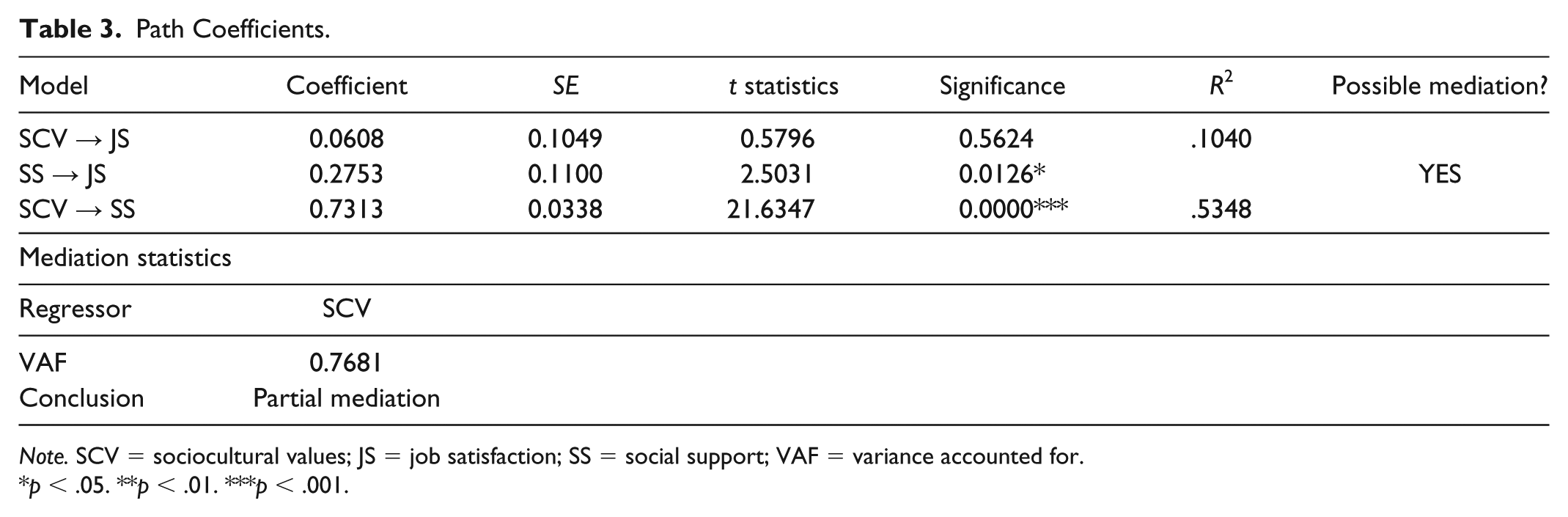
Table 2 has already established a significant effect of SCV on job satisfaction signifying possible mediation. Next step is to include the mediator in the PLS path model. If the indirect effect is significant then further analysis can be made in terms of mediation, if not then no mediation exists. This result is presented in Table 3.
Path Coefficients.
Note. SCV = sociocultural values; JS = job satisfaction; SS = social support; VAF = variance accounted for.
p < .05. **p < .01. ***p < .001.
From Table 3, the effects of SCV on social support (B = 0.7313, p < .01) and social support on job satisfaction (B = 0.2753, p < .05) are both significant implying that the indirect effect is significant. This lays a good foundation to assess the strength of the mediating role of social support on the relationship between SCV and job satisfaction.
The final step of this approach is the calculation of the VAF or the Variance Accounted For score which determines the size of the indirect effect in relation to the total effect (Hair et al., 2014). VAF score larger than 80% shows full mediation. A VAF score lower than 80% but greater than 20% shows partial mediation. Finally, a VAF score lower than 20% shows no mediation.
Results in Table 3 show a VAF score of 0.7681 which is larger than 20% and close to the 80% mark. Indeed, because the effect of SCV on job satisfaction is no more significant when social support is controlled for, it seems the mediation effect should probably be a full mediation. By implication, there is evidence that social support mediates the relationship between SCV and job satisfaction of respondents. This mediation is partial. This means that if a respondent has higher level of SCV, this may translate to respondent receiving higher levels of social support, which will lead to more job satisfaction.
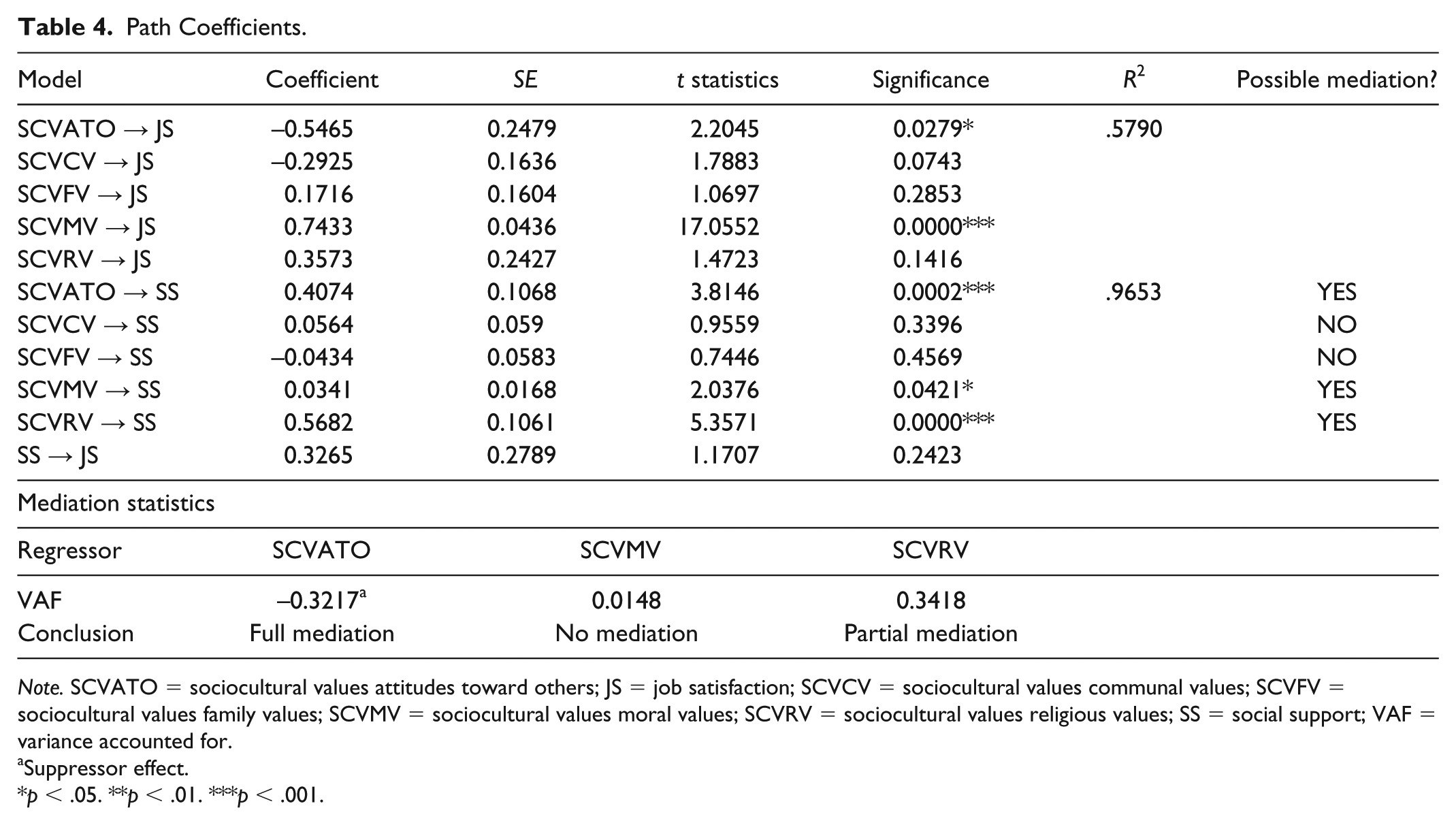
Similar assessment was made at the subcomponent level. As only SCVATO, SCVMV, and SCVRV had a significant effect on job satisfaction in Table 4, these variables are the candidates for possible mediation.
Path Coefficients.
Note. SCVATO = sociocultural values attitudes toward others; JS = job satisfaction; SCVCV = sociocultural values communal values; SCVFV = sociocultural values family values; SCVMV = sociocultural values moral values; SCVRV = sociocultural values religious values; SS = social support; VAF = variance accounted for.
Suppressor effect.
p < .05. **p < .01. ***p < .001.
Effect of SCVATO, SCVMV, and SCVRV on social support are all significant providing evidence of possible mediation. Although the effect of social support on job satisfaction is significant, this is not a necessary requirement for mediation analysis (Hair et al., 2014). Also reported in the table are the VAFs of three constructs that show possible mediation. By the value of the VAFs, social support does not play a mediating role in the relationship between SCVMV and job satisfaction. However, it plays a partial mediating role on the relationship between SCVRV and job satisfaction. For the VAF of SCVATO, it is negative showing the suppressor effect which characterizes a sign change of the direct relationship after the mediator variable is included and is an indicator of full mediation effect (Hair et al., 2014).
Discussion
At this point, the results of the SEM/PLS analysis revealed a significant positive effect of SCV on job satisfaction variables among the bank managers. Employee’s job satisfaction is very important to any employer because when employees are not satisfied with their jobs it affects their total output. The findings are in line with some studies (Gyekye, 2003; Mugunthan, 2013) which clearly show a direct and indirect effect of cultural values on individuals’ work attitudes and behaviors. In addition, the findings support other studies done by Elfenbein and O’Reilly (2007) and Ostroff, Shin, and Kinicki (2005) which show that cultural values are directly related to some work outcomes such as commitment and performance and hence proper integration must be done to ensure friendly work environment.
It is imperative to appreciate the role of SCV in employees’ attitude toward work as values are directly related to job satisfaction of employees. This finding supports other studies’ findings by Griffeth and Hom (1995) and Saini, Rai, and Choudhary (2014). Their studies also revealed that employees tend to be more satisfied and also less likely to quit their jobs when their personal values are integrated in the organization’s values. This according to Hom and Griffeth leads to positive work attitudes. However, when employees’ SCV collide with the organizational values, conflict occurs which affects the job satisfaction level of employees.
Individuals’ perception and acceptance of SCV within a society, affects not only how they behave within their homes but also their overall behavior at work and this in turn reflects their attitude toward work. For example, a full-time employee who is also the head of an “abusua” (extended family) may value funeral rite because technically he is in charge of organization and burial ceremonies for anybody who dies within the family. Such a family head would always absent himself in such times from work and when this permission is not granted he may feel not valued by the organization. This assertion by the researcher is confirmed in the works of Akuoko (2008), who concluded that some cultural values within the Ghanaian context (funeral rites) influences some human resource practices or organizational behavior. A related study by Amoah (2013) concluded that SCV such as familism, ethnicity, respect for age, authority and traditional leadership, religious beliefs, and fear of the unknown have consequences for work relations and management practices at the workplace.
Regarding the mediation effect, the results show social support as a mediator or important predictor of job satisfaction. This supports the hypothesis that social support mediates the relationship between SCV and job satisfaction which is inconsistent with Kirkman and Shapiro’s (2001) earlier contention that cultural values may not all the time have a direct influence on employees work attitudes. A further analysis was done which show the strength of mediation for social support to SCV and job satisfaction which varied across the types of SCV. Although the researcher found social support to mediate the SCV-job satisfaction relationship, specifically, social support mediated the effect that SCVATO has on job satisfaction as predicted however was negative, but mediation-related predictions regarding religious values and job satisfaction were only partially supported.
Limitations and Needs for Future Research
Despite the major contributions of this study, it has some limitations which future researchers may consider. The study included one sample group who were all managers; therefore, their responses cannot be generalized to employees who do not occupy any managerial positions hence the need to replicate this study using employees from different sectors as well as lower level employees.
In addition, there is no qualitative data as respondents were asked to rate their agreement or disagreement to some questions concerning cultural values and job satisfaction on a 5-point Likert-type scale which limits the analysis to only quantitative approach. Respondents were not asked how their SCV conflict with the organizational culture, how their employers helped or hindered their success at exhibiting their SCV at the workplace, and how this can be improved for them. It is proposed that in view of the type of data collected, future research should consider using qualitative approach as certain questions regarding cultural values can only be addressed qualitatively. A qualitative approach is recommended for other researchers by replicating this study to probe further and to get detailed explanations of how these cultural values are transferred to the workplace.
Conclusion and Perspective
This study presents a unique Ghanaian employees attitude toward work. First, there is a clear influence of SCV on job satisfaction. Specifically, the Ghanaian bank managers exhibit these cultural values at the workplace which reflects in their attitude and behavior hence affects their job satisfaction. This notwithstanding, the findings cannot be generalized based on the limited sample size used in the study. Generally, the respondents tend to exhibit more of their moral values and religious values at the workplace which reflects positively in their attitude toward work. This is to say that the Ghanaian employee shows strongly high levels of moral values and religious values at the workplace. This pattern seems to explain their desire to care for one another, take care of their employers properties, and work as if their reward is in heaven. Thus, the organizational structure of Ghanaian firms may show employees going the extra mile to ensure that their colleagues at work do not find themselves in trouble. Informally, they incorporate their religious values at the workplace where one may see, for example, employee praying before starting work and after work. This kind of attitude of Ghanaian employees are derived from Ghanaian cultural values, such as the emphasis on the fear of punishment from the supreme being when one does the wrong thing and communalism bond that exist among Ghanaians (Gyekye, 2003). This implies that employers and management should enhance employee satisfaction by structuring the work environment and incorporate employee’s cultural values.
This implies that organizations must therefore passively work on organizational culture and policies to embed these SCV into their corporate culture to minimize these effects on employees’ job satisfaction. However, more work needs to be done on these variables on teasing out the holistic effects to create a more conceptually accurate model.
This Ghanaian worker attitudinal profile has other implications for employers and future research. Ghanaian workers tend to be religious at the workplace and this they show in their utterances, attitudes, and behavior toward one another as well as to the entire organization. All these influence their satisfaction at the workplace; hence, the need to see the importance of these cultural values by aligning it with organizational culture can increase job satisfaction. In addition, moral values which emphasize doing the right thing seem to have influenced positively on their job satisfaction. For example, informally, taking over or assisting colleagues job role when he or she is behind schedule are all, for example, done because they see themselves to be one and also the right thing to do when your sister or brother is lacking behind. Culturally, one is expected to extend hands and help and not to be selfish. All these cultural expectations play a very important role in the life of the employees; hence, the need to also make the workplace environment flexible to accommodate and support employees who hold on strongly to these values to operate by implementing some policies will cater for such a value ensuring that it does not conflict with the organizational culture. At this point, this moral value is recommended to be promoted at the workplace because of the significant positive effect it has on job satisfaction. Understanding these diverse sociocultural values may help employers or management to factor these values at work for employees to generate the most pride of achievement from each employer.
This analysis of Ghanaian workers contributes to the role of culture at the workplace. Some research indicates that culture affects work attitudes; however, this current study suggests, then, that some specific cultural values influence work attitudes than the others and therefore they should be studied and analyzed separately to get those specific cultural values that influence employees work attitudes the most.
Footnotes
Ethical Approval
All procedures performed in studies involving human participants were in accordance with the ethical standards of the institutional and/or national research committee and with the 1964 Helsinki declaration and its later amendments or comparable ethical standards.
Informed Consent
Informed consent was obtained from all individual participants included in the study. Additional informed consent was obtained from all individual participants for whom identifying information is included in this article.
Declaration of Conflicting Interests
The author(s) declared no potential conflicts of interest with respect to the research, authorship, and/or publication of this article.
Funding
The author(s) disclosed receipt of the following financial support for the research, authorship, and/or publication of this article: This study was funded by University of Cape Coast, Cape Coast, Ghana (PhD Thesis Grant: Award 1).