



Abstract
This studyexamined whether gender and age interacted with subjective well-being to influence the relationship between emotional intelligence and academic self-efficacy of students in the colleges of education in the Ashanti and Brong Ahafo zones of Ghana. The study collected data from 682 participants using a cross-sectional design. Purposive sampling, proportionate technique, and a table of random numbers were utilised to select the colleges and respondents for this study. The study revealed that emotional intelligence had a positive influence on the academic self-efficacy of students. The study also found that subjective well-being (i.e., health status and happiness) moderated the association between emotional intelligence and the academic self-efficacy of students. When gender and age interacted with subjective well-being, the relationship between emotional intelligence and academic self-efficacy was not moderated. However, gender and age independently moderated the relationship between emotional intelligence and the academic self-efficacy of students. The study strongly recommends that the Ministry of Education, in collaboration with college principals, should establish comprehensive student well-being programs as a core part of the educational system. Since subjective well-being enhances the impact of emotional intelligence on academic self-efficacy, college principals must embed structured well-being curricula, mental health services, and emotional intelligence training at all levels of education. This will boost students’ academic confidence and equip them for enduring accomplishment.
Plain Language Summary
Keywords
Introduction
Ghana, like many other nations, has committed to advancing sustainability aspirations established through the United Nations to promote sustainable development (Antwi-Agyei et al., 2018). Of particular relevance are sustainability goals, which seek to guarantee accessible, fair, and excellent education and encourage possibilities for continuous education for everyone (Agbedahin, 2019). Central to the attainment of this goal is the provision of high-quality teacher education that equips educators with the competencies needed to deliver effective and transformative learning experiences (Kim et al., 2015). Colleges of Education in Ghana play a central role in this endeavour by cultivating a cadre of skilled and dedicated teachers who are equipped to promote inclusive education, foster critical thinking, and nurture the holistic development of learners (Akrong, 2022). As key institutions tasked with training educators, these colleges serve as the cornerstone of Ghana's educational system, imparting knowledge, skills, and values that lay the foundation for lifelong learning and societal progress (Tagoe et al., 2022). However, college of education students worldwide face the challenge of supporting students’ mental well-being, particularly when it comes to addressing low academic self-efficacy (Freire et al., 2019; Yusoff, 2012). Low academic self-efficacy, characterised by a person's absence of assurance and belief in capabilities, poses significant obstacles to academic success and overall student flourishing (Jia, 2022). Within the classroom, low academic self-efficacy can manifest as hesitancy to participate in discussions, reluctance to tackle challenging tasks, and diminished motivation to pursue academic goals (Rizki et al., 2024). These negative perceptions of one's capabilities hinder individual learning and undermine the overall classroom dynamic, impeding collaboration and engagement among peers (Hansen & Stephens, 2000).
Despite efforts to foster a supportive learning environment, students grappling with low academic self-efficacy may struggle to overcome academic hurdles and experience stress and anxiety. Studies examining college students globally have highlighted a concerning prevalence of low self-efficacy within this demographic, with rates varying from extremely high to low (Al-Khatib, 2012; Varghese et al., 2015). For instance, research indicates a substantial volume of college students experience minimal self-efficacy, ranging from 10% to 85%, surpassing prevalence rates observed in the general population (Valenti & Faraci, 2021). This trend is consistent within the African context, where studies in countries such as Nigeria, Kenya, and Ghana have reported notably low academic self-efficacy among college students (Ansong et al., 2019; Ajayi & Olamijuwon, 2019). As introduced by Bandura (1977), academic self-efficacy in an academic sense relates to the trust of students in their abilities to conduct such academic activities as examination planning, daily lecture participation, and writing term papers effectively. Academic self-efficacy comprises four dimensions: grades, verbalising, studying, and attendance (Sander & Sanders, 2003). These dimensions capture specific facets of students’ self-confidence in achieving educational goals.
The term emotional intelligence (EI) describes the ability to identify, comprehend, govern, and efficiently communicate emotions in both a person and alongside other people (Elfenbein & MacCann, 2017). It involves a collection of abilities and proficiencies that allow people to successfully negotiate the complexity of human emotions both within themselves and in their interactions with others (Ashford et al., 2018). Emotional intelligence encompasses four dimensions: self-management, relationship management, social awareness, and self-awareness. These components are critical for grasping how humans notice, regulate, and express sentiments in academic contexts (Goleman, 1995). Prior studies (e.g., Mikolajczak et al., 2007) demonstrate how these dimensions contribute uniquely to accomplishment. For instance, studies have shown that self-awareness and self-management aid in stress regulation, while social awareness and relationship management enhance collaborative academic activities (Goodall, 2021). Enhancing a student's emotional intelligence may be advantageous for their sense of academic self-efficacy. Given that efficacy beliefs are closely linked to important outcomes such as student learning, this improvement could ultimately lead to higher academic achievement (Komarraju & Nadler, 2013).
It has been found that emotional intelligence (EI) and academic self-efficacy (ASE) are associated in numerous studies across different populations and contexts (Hashemi & Ghanizadeh, 2011). For instance, in Scotland, Putwain et al. (2013) identified a substantial impact of EI on ASE, while García-Álvarez et al. (2021) similarly found a relationship between EI and ASE. Non-significant findings of the relationship between EI and ASE have been documented across various geographical contexts, including Spain (Baños et al., 2023) and England (Sanchez-Ruiz et al., 2016). Gharetepeh et al. (2015) found that EI was not an accurate indicator of ASE, suggesting that the level of EI displayed by students does not significantly influence their perceived capacity to finish academic assignments and accomplish academic objectives. These conflicting findings could arise due to differences in the measurement of EI and ASE (Adeyemo, 2007). Variations in assessment tools, scales, or methodologies used across studies may lead to discrepancies in results (Sousa & Rojjanasrirat, 2011). Emotion Regulation Theory (Gross, 1998) closely links EI to ASE. Emotion Regulation Theory (ERT) posits that learners with higher EI possess enhanced capabilities to monitor and manage emotional states, which directly supports the development of confidence and resilience in academic settings. For example, self-management enables students to regulate stress and anxiety during challenging tasks, allowing them to focus on problem-solving and goal attainment. Moreover, Goleman’s (1995) Emotional Intelligence framework underscores the role of competencies such as self-awareness, emotional self-regulation, and motivation in fostering academic success. These competencies contribute to ASE by reducing the emotional disruptions that might otherwise deter students from persevering through complex academic challenges. For instance, students with higher EI are far more prepared to employ adaptive coping strategies, such as reframing failures as learning opportunities, which directly enhances their belief in their ability to succeed.
Subjective well-being (SWB) is a broad concept that encompasses individuals' subjective evaluations of their lives and experiences. Subjective well-being relies on individuals' perceptions and evaluations of their lives rather than external criteria (Diener et al., 2018). It covers affective reactions (emotional, social, and psychological well-being) and cognitive judgments (satisfaction with life, happiness, and health status) (Dolan & Metcalfe, 2012; Zheng et al., 2022). Although SWB has been studied internationally and in Ghana (Agormedah et al., 2024), most of these investigations have concentrated on the association between EI and SWB (Bar-On, 2005) and ASE and SWB (Céspedes et al., 2021). For example, studies in Australia (Schutte & Malouff, 2011) and Spain (Sánchez-Álvarez et al., 2016) observed that EI is positively related to SWB. Additionally, there is evidence linking EI to SWB, including happiness (Chamorro-Premuzic et al., 2007) and life satisfaction (Austin et al., 2005). This result implies that people who possess higher EI also typically document higher levels of SWB. In other words, learners who recognise their sentiment document higher life satisfaction, happiness, and fulfilment.
However, Luna et al. (2019), Steinmayr et al. (2019), and Zeidner and Olnick-Shemesh (2010) found contradictory results. Their findings show no correlation between EI and SWB. In Indonesia, Laili and Aghniacakti (2023) found a link between ASE and SWB, while Céspedes et al. (2021) observed similar results, indicating that ASE and SWB are associated. Grounded in Emotion Regulation Theory (ERT) (Gross, 1998), which emphasises the essence of emotional self-regulation in attaining psychological and behavioural outcomes, SWB is proposed to moderate the relationship between EI and ASE. Even though there aren't many studies on this moderating effect, research from Branagan (2017) supports the idea that students who feel positive about themselves will use helpful coping methods, which can strengthen the impact of EI on ASE. Additionally, the relationship between EI and SWB is based on how emotionally intelligent people can understand and control their feelings, which leads to more happiness, satisfaction, and resilience, all of which can be explained by Emotional Regulation Theory. Emotional intelligence facilitates the handling of unpleasant emotions and the enhancement of positive affect through adaptive strategies such as cognitive reappraisal, mindfulness, and effective communication. For example, individuals with higher EI perceive challenges as potentials for advancement, thereby cultivating a sense of purpose and fulfilment in their lives (Dries & Pepermans, 2007). This aligns with findings by Schutte and Malouff (2011) and Bar-On (2005), who argue that EI contributes to subjective well-being by enabling individuals to sustain positive emotional states and navigate social interactions effectively.
Several empirical studies have rigorously tested the combined impact of gender and age on subjective well-being (SWB). In Ghana, a large survey of senior high school students found that older females reported higher subjective well-being than older males, while a reversal of patterns was observed in younger cohorts. Age also moderated the link between sense of coherence and well-being, with younger students experiencing higher well-being at equivalent coherence levels (Agormedah et al., 2024). In a Turkish study spanning adolescents to adults (ages 14–45), adult males (26–45) reported higher well-being than their female peers, while younger ages showed no such gender gap (Dost-Gözkan, 2022). A multivariate study in Israel (ages 21–87) revealed significant age and gender interactions in life satisfaction, though these effects were partially explained by factors like health and marital status (Shmotkin, 1990). Among older adults in Germany (65–90), women reported lower subjective well-being than men, and their well-being declined more steeply with age (Inglehart, 2002). A Nigerian study comparing younger (16–24) and older (65+) respondents found that gender and age influenced how different components of SWB (e.g., happiness) are interrelated (Afolabi & Aina, 2014). Siedlecki et al. (2008), through a meta-analysis, observed that older individuals consistently demonstrate higher levels of life satisfaction compared to younger individuals. Blanchflower (2021) identified a U-shaped connection between age and SWB, with both young and older adults reporting higher well-being than those in midlife. These findings consistently highlight the value of modelling both gender and age as moderators in SWB research.
Moreover, despite an insufficient corpus of works that directly addresses how gender and age interact with subjective well-being (SWB) in the relationship between emotional intelligence (EI) and academic self-efficacy (ASE), some studies do indirectly explore related themes or examine similar interactions. For example, studies have indicated that female students exhibit superior emotional awareness compared to their male counterparts (García & López, 2019; Simon & Nath, 2004). Research suggests that females display greater EI than males, as highlighted by Fischer et al. (2018) and Britwum et al. (2024). Conversely, Petrides and Furnham’s (2000) research indicates that males typically achieve higher scores on EI assessments compared to females. Additionally, a longitudinal study conducted observes that male participants displayed superior EI capabilities compared to females across multiple age brackets (Kim, 2020). In contrast, an investigation undertaken in Canada (Brown & Garcia, 2019) demonstrate the absence of gender disparities in EI. On age disparities in EI, numerous investigations have produced inconsistent outcomes (Daus & Ashkanasy, 2005; Joseph & Newman, 2010). For instance, Roberts et al. (2001) identified age-associated variation in EI, indicating that older individuals generally demonstrate higher levels of EI. Conversely, Lopes et al. (2003) found that younger adults surpass older adults in EI.
Additionally, regarding gender differences in academic self-efficacy (ASE), Huang (2013) identified a gender disparity in ASE levels, with males typically demonstrating higher levels. Conversely, prior investigation has discovered that females often report greater ASE than males, despite males tending to overestimate their efficacy (Pajares, 2002). In Ghana, another study discovered non-significant gender variation in self-concept of students (Kaedabi-Donkor et al., 2025). Concerning age differentials in ASE, Belsky and Gilovich (2010) discovered that older adults who were optimistic made only small mistakes, whereas those who were unsure made enormous mistakes. Similarly, Lachman and Jelalian (1984) found that older adults exhibit higher ASE than younger adults. Broady et al. (2010) also discovered that people often perceive older students as having less confidence in their learning abilities compared to their younger counterparts. These differing results show that current studies need to do more studies and use strong research methods to better understand how gender and age affect EI and ASE. These propositions support the study’s use of a moderated moderation framework. According to Emotion Regulation Theory (Gross, 1998), demographic factors such as gender and age not only influence how individuals regulate emotions but also shape how SWB operates as a psychological resource. Specifically, the strength of SWB's moderating effect on the EI–ASE link may itself vary based on gender and age. Research suggests that females employ emotion-focused coping strategies (Theodoratou et al., 2023), whereas males lean toward problem-focused strategies (Tamres et al., 2002), which could influence how SWB enhances the benefits of EI. Similarly, older individuals are believed to possess more refined and adaptive emotion regulation strategies than younger individuals (Charles & Carstensen, 2010; John & Gross, 2004), reflecting that age moderates the emotional intelligence-mental health link (Gómez-Hombrados & Extremera, 2025). Additionally, a study of adolescents aged 11 to 18 showed that gender and age jointly moderate the perceived emotional intelligence–subjective well-being association (Azpiazu et al., 2023). This suggests that the role of SWB in amplifying or weakening the impact of EI on ASE may not be uniform but instead depends on demographic factors such as gender and age. Thus, modelling a moderated moderation effect (SWB and gender and SWB and age) offers a theoretically sound way to examine how these interdependencies shape students' academic self-beliefs.
Students from the Colleges of Education (CoE) in the Ashanti and Brong Ahafo zones are considered a sensitive group because they face various obstacles and unusual events throughout their lives, which can lead to negative feelings (Abukari, 2018), potentially impacting their subjective well-being (SWB) (Quansah et al., 2023). The current monetary challenges facing the nation may worsen this. However, in the Ghanaian discourse, little is known about the complexities of SWB and the contribution of EI to enhancing ASE. Furthermore, the results of Western investigations cannot be applied to Ghana because of differences in culture (collectivism versus individualism), societal norms, and thought systems related to the evaluation of SWB, EI, and ASE. From investigations, Ghana’s idea of SWB varies from that of other countries, with substantial disparities observed in non-West African states (Bull et al., 2010; Osei-Tutu et al., 2020; Quansah et al., 2023). Although cultural factors can influence the associations examined in this study, the current investigation does not include a direct assessment of those variables. Thus, any differences observed between the current results and prior research should be interpreted with caution and may warrant further exploration in future studies that explicitly measure these cultural dimensions. Additionally, while previous studies have looked at how subjective well-being, emotional intelligence, and self-efficacy individually affect student outcomes, not much research has focused on how they work together and what factors might influence these relationships. In particular, the specific cultural environment of Colleges of Education in the Ashanti and Brong Ahafo areas offers a chance to see how cultural factors might influence the relationships between these concepts. Therefore, the current study examines how gender, age, SWB, EI, and ASE interact with each other among .students.
Objectives of the Study
Examine the association between emotional intelligence and academic self-efficacy,
Examine the association between emotional intelligence and academic self-efficacy as moderated by subjective well-being, which differs across gender and age.
Conceptual Framework
The conceptual framework in Figure 1 depicts the hypothesised relationships guiding this study.

Conceptual framework illustrating the relationships among age, gender. subjective well-being, emotional intelligence and academic self-efficacy.
The first objective examines the direct association between emotional intelligence (EI) and academic self-efficacy (ASE). The second objective extends this relationship by proposing that SWB moderates the strength of the association between EI and ASE. Specifically, individuals with higher subjective well-being (SWB) are expected to show a stronger positive relationship between EI and ASE, while those with lower SWB may show a weaker relationship. Further, gender and age are hypothesised to moderate the moderating effect of SWB, representing a moderated moderation model. Differences in socialisation patterns, cultural norms, and life experiences across gender and age groups are expected to influence how SWB shapes the relationship between EI and ASE. Understanding these dynamics will contribute to the design of tailored interventions aimed at enhancing ASE through the development of EI and SWB, with consideration for demographic differences.
Emotion Regulation Theory
Emotion Regulation Theory (ERT) was propounded by Gross (1998). The theory strives to comprehend how learners impact the intensity, duration, and articulation of their emotions. It focuses on the routes by which individuals track, assess, and adjust their emotional manifestations to achieve specific goals or maintain psychological well-being (Gross, 1998; Zapf, 2002). ERT acknowledges that emotions arise in response to various stimuli, both internal and external. Emotions are viewed as dynamic and multifaceted processes that involve physiological, cognitive, and behavioural components (Gross, 2002). ERT emphasises that individuals regulate their emotions to achieve specific goals, such as achieving desired outcomes, maintaining social relationships, or preserving psychological well-being. Success in achieving these goals often evaluates the efficiency of ERT. ERT recognises that individuals vary in their propensity to use many techniques for regulating mood (Sheppes & Gross, 2012). These individual differences are a result of cognitive abilities, cultural norms, and past experiences (Aldao et al., 2015).
ERT provides a comprehensive framework for comprehending the interplay between emotional intelligence (EI), subjective well-being (SWB), and academic self-efficacy (ASE). According to ERT, people with higher EI use different ways to manage their emotions, like changing how they perceive situations, holding back their feelings, and finding solutions, to stay mentally stable and reach their goals. These strategies directly influence SWB by reducing emotional distress and enhancing positive affect, as well as encouraging an individual's autonomy in academic pursuits. For example, students with higher EI can navigate the social and emotional challenges of academic life, thereby boosting their confidence and SWB simultaneously. Additionally, Aldao et al. (2015) suggest that the situational flexibility inherent in emotion regulation allows emotionally intelligent students to adapt their responses to academic stressors, contributing to both immediate and long-term success.
ERT (Gross, 1998) asserts that individual disparities in emotional regulation capabilities are influenced by dispositional and demographic factors such as gender and age (Renna et al., 2018). These demographic factors influence the type, frequency, and effectiveness of emotional regulation strategies employed by individuals. For instance, females engage in coping techniques such as rumination, emotional expression, and seeking social support, reflecting a greater tendency toward internalisation of emotional experiences (Theodoratou et al., 2023). In contrast, males often adopt problem-focused strategies like cognitive distancing or suppression, which are oriented toward controlling or minimising emotional arousal (Tamres et al., 2002). These tendencies have implications for how subjective well-being—a composite of happiness, life satisfaction, and perceived health—interacts with EI to influence ASE. Similarly, older individuals generally possess more refined, adaptive, and contextually sensitive emotional regulation skills compared to younger individuals (Charles & Carstensen, 2010; John & Gross, 2004). This is due to the accumulation of life experiences, cognitive maturity, and improved socio-emotional selectivity. Older students may be better equipped to leverage SWB as a stabilising force that enhances their emotional regulation and, by extension, their ASE (Tang & Zhu, 2024). For younger students, who are still learning to manage their emotions, the effect of SWB might not be as strong or consistent, making the link between EI and ASE less clear. These differences can influence how SWB operates as a psychological resource. Therefore, based on ERT, gender and age are critical moderators that shape the extent to which SWB enhances the beneficial impact of EI on accomplishment. Understanding how these strategies relate to EI, SWB, and ASE can be central to this study.
Methods and Materials
Research Approach and Design
The study employed a numerical method, specifically utilising a cross-sectional methodology. To test theories or provide answers for scholarly issues, the quantitative approach entails gathering and analysing amounts of data (Lewin, 2005). Researchers use this design to gather information from a selected group of subjects at a specific moment. It allows researchers to assess relationships among parameters at a specific instant and provides a snapshot of the population at that time (Mohajan, 2020). By collecting data from participants representing different genders and age groups simultaneously, researchers can explore how these demographic factors influence the association between emotional intelligence, academic self-efficacy, and subjective well-being. This design is advantageous since it facilitates the collection of numerical data, statistical analysis of relationships between variables, and generalisation of findings to broader populations (Myers et al., 2013).
Participants’ Selection
There are thirteen Colleges of Education (CoE) in the Ashanti and Brong Ahafo zones. This study included level 300 CoE students in the Ashanti and Brong Ahafo zones, Ghana. Level 300 students were chosen because they have completed a significant portion of their coursework and may have a better comprehension of the subject matter compared to students in level 200 and level 100. This depth of understanding could result in more nuanced responses to questions about emotional intelligence, academic self-efficacy, and subjective well-being. We used Krejcie and Morgan’s (1970) table to guide the selection (262) of the sample from the population. For inferences, an investigator is permitted to utilise a larger segment of the population, as noted by Cresswell (2014). Therefore, the study used 682 CoE students.
We used purposive sampling to select four Colleges of Education (CoE) from the total of thirteen CoE. The proportional method was utilised to allocate responses according to the chosen CoE. The study utilised a proportionate sampling approach to to ensure an equitable representation of the various CoEs across the population and the gender of the participants. The study utilised proportionate sampling at Agona CoE to ascertain the necessary number of participants at level 300. The proportion for level 300 students at Agona CoE is calculated by dividing the total number of level 300 students (196) by the total number of CoE students in the population (808) and then multiplying by the sample size (682). A sample of 165 out of 196 students was selected for Agona CoE using the formula. The sample consisted of 105 males and 60 females. The study followed this procedure for the remaining CoE (refer to Table 1).
Distribution of Samples of the Colleges of Education.

We used a table of random numbers and a list of each grade level as the sample frame. A database of random numbers was utilized to pick 165 students from a total of 196 at Agona college of education. We obtained the list from the colleges of education, which included the names of all level 300 students. The table was populated randomly, with numbers assigned from 1 to 196, representing the total population of level 300 students at Agona college of education. Vertically on the random number table, numbers within the specified range were sequentially chosen until the requisite 165 students for Agona college of education were selected (refer to Table 1).
Measures
Predictor Variable: Emotional Intelligence
Emotional intelligence (EI) was evaluated utilising 30 items formulated by Mohapel (2012) with four sub-scales, involving “self-awareness” (6 items), “self-management” (6 items), “social awareness” (6 items), and “relationship management” (12 items). Self-awareness measures the ability to be aware of your thoughts, feelings, and behaviours and how they impact yourself and others. Self-management measures the ability to skillfully manage difficult emotions such as anxiety and frustration while also exerting control over impulsive emotional reactions. Social awareness measures the ability to understand and relate to others, as well as the social and ethical norms that govern behaviour, and relationship management measures the ability to collaborate with others in a variety of situations. This survey instrument evaluates EI utilising a 5-point Likert-type scale, with choices for responses ranging from 1 “never” to 5 “always.” Some items on the scale include “I recognise the things that are happening to me while I’m angry,”“I stay calm even in difficult circumstances,”“I am an emotionally balanced person because I know when to react to a situation and when not to do so,” and “I accept responsibilities for my reactions being good or bad.” The original alpha value of the scale was .82, with sub-scales constituting four dimensions, namely social awareness (.78), self-awareness (.72), relationship management (.80), and self-management (.76). The reliability examination for the 30-item EI tool showed a Cronbach’s alpha value of .84, with the sub-scales scoring as follows: social awareness (.68), self-management (.74), self-awareness (.75), and relationship management (.78). Omega ω analyses yielded a reliability estimate of .85.
Criterion Variable: Academic Self-Efficacy
The academic self-efficacy (ASE) scale by Sander and Sanders (2003) had 17 items with four sub-scales, namely grades (6 items), verbalising (4 items), studying (4 items), and attendance (3 items). Grades measure students’ confidence in obtaining excellent grades as a result of effort and preparation. Verbalising measures students’ confidence in delivering oral presentations or participating in debates. Studying measures consistency and effectiveness in completing academic tasks, and attendance measures regular attendance at lectures, tutorials, and other academic events. The instrument was calculated using a Likert scale with five points varying from 1, “Not at all Confident,” to 5, “Very Confident.” The original uniformity of the items was 0.88, with subscales of 0.78 for verbalising, 0.78 for grades, 0.74 for attendance, and 0.72 for studying. Some of the items include “I am capable of giving a presentation to a small group of peers,”“Throughout the semester, I attend the majority of class sessions,”“In my work, I receive excellent grades,”“I can hold a productive academic debate with my classmates,” and “During a lecture, I can question lecturers about the content they are teaching.” The 17 items for the efficacy scale yielded a value of 0.89 with sub-scales of 0.77 for grades, 0.73 for verbalising, 0.70 for studying, and 0.71 for attendance. Omega ω analyses yielded an estimation of dependability of 0.88.
Moderator Variables: Subjective Well-Being, Gender and Age
The questionnaire employed by Zheng et al. (2022) was modified to gauge subjective well-being (SWB) as assessed through indicators of happiness, life satisfaction, and health status. Three questions were prepared to measure happiness, life satisfaction, and health status. It was requested of respondents, “Overall, how happy are you in life?” Five alternatives were put in front of them: 1 “very unhappy,” 2 “unhappy,” 3 “fair,” 4 “happy,” and 5 “very happy.” Respondents were also asked, “Overall, how satisfied are you with your life?” Five alternatives were put in front of them: 1 “very unsatisfied,” 2 “unsatisfied,” 3 “fair,” 4 “happy,” and 5 “very happy.” Concerning health status, respondents were asked to select an option from 1, “very unhealthy,” to 5, “very healthy.” Happiness embodies transient perceptions of daily existence, while life satisfaction denotes enduring sentiments about life experiences, and health is feeling positive about your overall well-being and life (Liao et al., 2021; Ma et al., 2020; Zheng & Ma, 2021). The alpha values for the sub-scales of SWB as reported by Zheng et al. (2022) are as follows: Happiness (0.87), life satisfaction (0.89), and health status (0.83).
With gender and age, the study included 682 participants, comprising 372 males (54.5%) and 310 females (45.5%), with (M = 1.44; SD = 0.49). Three age groups of participants were created: 18 and under (n = 17; 2.3%), 19–23 (n = 356; 52.3%), and 24 and above (n = 309; 45.4%), with (M = 2.43; SD = 0.54), respectively. While age was categorised for descriptive purposes, it was reanalysed as a continuous variable in the moderation models. This method keeps the strength of the statistics, prevents random grouping, and more accurately reflects how age affects EI and ASE.
Data Collection and Ethical Consideration
Ethical procedures were followed before data collection. Approval for the study was obtained from the Ethical Review Board of [Blinded Institution], and a reference number [Blinded Reference Number] was issued. Students from colleges of education who consented to partake in the study were the subjects of the investigation. Permissions were initially acquired from tutors and school administrators, who received education about the objective and benefits of the investigation. Field assistants, trained specifically to assist with data gathering, were hired to visit selected colleges of education within the Ashanti and Brong Ahafo zones. Participation was entirely voluntary, with assurances provided that students’ academic standing or institutional relationships would remain unaffected by their choice to participate or withdraw. The informed consent form was distributed to the selected learners for signing. Participants under the legal consent age (younger than 18 years) were required to have their guardians sign written parental consent forms before participation, ensuring strict adherence to ethical standards for involving minors in the research. The large student population and logistical requirements necessitated in-person data collection to enhance participant understanding and guarantee accuracy. The study encouraged tutors to explain the academic relevance of it to students and parents, thereby garnering their support. The attendees were advised of their ability to exit the investigation at any time without repercussions. Additionally, participants were assured of complete anonymity; no names were recorded on any forms, ensuring their identities remained confidential. A total of 690 learners were initially approached to participate in the investigation. Out of these, 682 students consented to participate, yielding a response rate of 100 percent. This process ensured a representative sample from the colleges of education in the Ashanti and Brong Ahafo zones.
Data Analysis Strategy
We initially executed descriptive statistics and correlation analyses to examine the connections among the variables. Structural Equation Modelling (SEM) was subsequently employed to look at the predictive connection between emotional intelligence and academic self-efficacy. We performed a moderated moderation analysis to test the conditional effects of subjective well-being, gender, and age on this relationship (emotional intelligence and academic self-efficacy). All three moderators that issubjective well-being, gender, and age were treated as continuous variables. Specifically, we analysed age as a continuous moderator across all relevant moderation and moderated moderation models. This analytical decision was guided by the need to retain statistical power, minimise information loss, and enhance the accuracy of the findings. Artificially categorising a continuous variable such as age can lead to reduced variability and misinterpretation of developmental trends. Consistent with recommendations by Hayes (2018), modelling age as a continuous construct provides a more nuanced perspective on how age-related changes influence the connection between emotional intelligence and academic self-efficacy.
Results
Relationships Among Study Variables
The relationships among the study variables were evaluated. The results are shown in Table 2.
Relationships among Subjective well-Being, Emotional, Intelligence, Academic Self-Efficacy, Gender and Age.

Note.* denotes significance at the p < .05 level, and ** denotes significance at the p < .01 level.
As illustrated in Table 2, the correlation coefficient between happiness and satisfaction is .48, indicating a moderate positive correlation. Self-management has a negative correlation with happiness (−.11) and satisfaction (−.09), though the correlations are relatively weak. Relationship management demonstrates a somewhat strong association with satisfaction (0.66) and a weak connection with happiness (−0.09). Social awareness has a moderate connection with happiness (0.28) and satisfaction (0.11). Gender reveals a moderate positive correlation with satisfaction (0.36), happiness (0.26), and self-awareness (0.28). The study observes no strong correlations in terms of age.
Moreover, between the two dimensions of subjective well-being, happiness has the highest (M = 3.19, SD = 2.51) score, indicating relatively higher levels of happiness on average. Among the sub-scales of emotional intelligence self-management has the highest (M = 5.05, SD = 1.03) score, indicating that, on average, participants reported relatively high levels of self-management. However, social awareness has a relatively low (M = 3.67, SD = 1.39) score, indicating relatively low levels of social awareness on average. Among the sub-dimensions of ASE, attendance follows (M = 4.35, SD = 4.35), indicating relatively high levels of attendance on average. However, verbalising has the lowest (M = 3.71, SD = 0.84) score, indicating lower verbalisation.
Relationship Between Emotional Intelligence and Academic Self-Efficacy
The study examines the association between the sub-dimensions of emotional intelligence (EI) and academic self-efficacy (ASE) through SEM analysis. The exogenous variable was EI (self-management, relationship management, social awareness, and self-awareness), while the criterion variable was ASE (grades, verbalising, studying, and attendance). Moreover, the overall model of EI and ASE was also analysed. Table 3 shows the results.
Coefficient of Emotional Intelligence and Academic Self-Efficacy.

Std. Residual (Min=−4.04, Max=2.47); VIF=1.00; R2= .15; Criterion Variable: Academic self-efficacy; Predictor: (Constant), emotional intelligence.
We employed a SEM analysis to examine the predictive effects of the emotional intelligence (EI) sub-dimensions on the various dimensions of academic self-efficacy (ASE). The investigation observed several EI factors that significantly predict ASE outcomes. Specifically, self-management significantly predicts grades (β = .11, SE = 0.04, CR = 2.78, p = .01), studying (β = .44, SE = 0.02, CR = 18.30, p < .01), and attendance (β = .07, SE = 0.02, CR = 3.06, p < .01). Similarly, relationship management was a strong positive predictor of grades (β = .21, SE = 0.02, CR = 8.51, p < .01), verbalising (β = .13, SE = 0.02, CR = 5.55, p < .01), and attendance (β = .10, SE = 0.01, CR = 6.63, p < .01). In addition, social awareness emerged as a significant predictor of studying (β = .20, SE = 0.01, CR = 18.15, p < .01), while self-awareness also positively influenced studying (β = .09, SE = 0.02, CR = 4.62, p < .01).
Path analysis was also used to determine the overall construct of EI and ASE. In Table 3, EI explained 15.3% of the variability in ASE. The result further reveals that EI positively predicts the ASE of students (β = .04, SE = 7.83, CR = 0.56, p < .01). Additionally, multicollinearity was evaluated by calculating the Variance Inflation Factor (VIF). The VIF value was 1.0, which is well less than the standard threshold of 10 (Pallant, 2016), signifying insignificant multicollinearity concerns among the predictor variables. The residuals model predicting academic self-efficacy based on emotional intelligence showed no signs of systematic bias. Standardised residuals ranged from −4.04 to 2.47, while Cook’s Distance values were all below 1, signifying that no individual cases had a disproportionate influence on the model. These findings support the overall adequacy of model fit.
Model fit
Table 4 shows the model’s fitness.
Goodness of Fit of the Link Between Emotional Intelligence and Academic Self-Efficacy.

The study using SEM to connect EI and ASE shows that the model doesn't fit well based on several fit indices (Table 4). This may be due to the model’s misspecification (Kline, 2011). However, the AIC score of 341.22 is closer to reality and demonstrates an adequate match (Civelek, 2018). Although the SEM analysis found important links between EI and ASE, the fit indices show that the model isn't a good match, highlighting the need to improve the model in future research.
Emotional Intelligence and Academic Self-Efficacy as Moderated by Subjective Well-Being, Differ Across Gender and Age
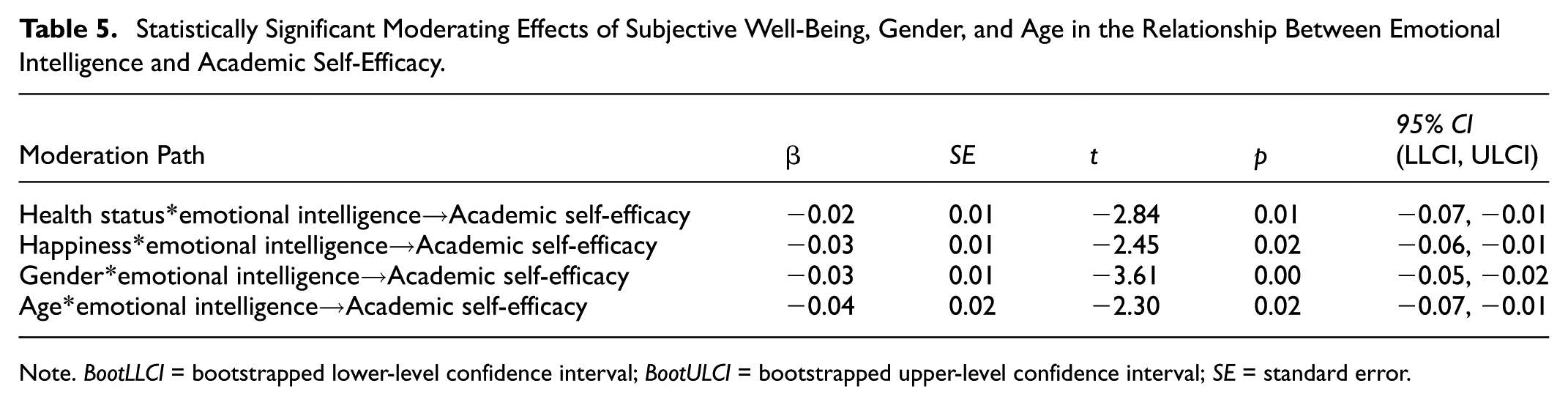
The study examined whether gender and age could interact with subjective well-being (SWB) to moderate the connection between emotional intelligence (EI) and academic self-efficacy (ASE). Gender, age, and SWB (health status, happiness, and satisfaction) served as the moderators. The predictor was EI, whereas the outcome variable was ASE. The results are presented in Table 5.
Statistically Significant Moderating Effects of Subjective Well-Being, Gender, and Age in the Relationship Between Emotional Intelligence and Academic Self-Efficacy.
Note. BootLLCI = bootstrapped lower-level confidence interval; BootULCI = bootstrapped upper-level confidence interval; SE = standard error.
To improve focus, Table 5 reports only statistically significant moderation effects. Health status moderates the association between EI and ASE, β = −.04, SE = 0.01, 95% CI [−0.07, −0.01]. Happiness also moderates the connection between EI and ASE, β = −.03, SE = 0.01, 95%CI [−0.06, −0.01]. However, satisfaction failed to moderate the EI andASE relationship. Additionally, it was determined that independently gender alone moderates the link between EI and ASE, β = −.03, SE = 0.01, 95%CI [−0.05, −0.02] and age moderates the relationship between EI and ASE, β = −0.04, SE = 0.02, 95% CI [−0.07, −0.01] (see Table 5). However, when gender and age interacted with SWB, there was insignificant interaction found between EI and ASE, β = .06, SE = 0.17, 95% CI [−0.28, 0.40].
Given the important moderation effect shown in Table 5, more research was done to understand this moderation effect better. Figures 2, 3, 4 and 5 provide comprehensive details of the probing process.

Significant moderating effect of health status in the relationship between emotional intelligence and academic self-efficacy.
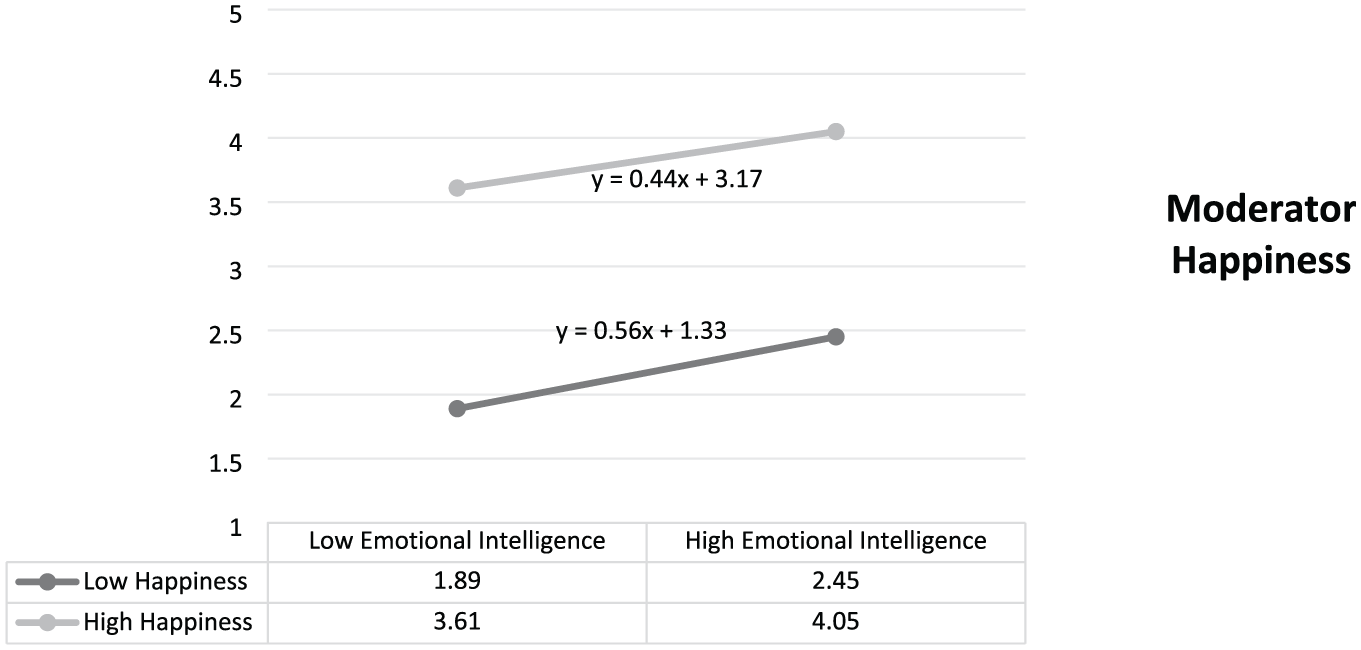
Significant moderating effect of happiness in the association between emotional intelligence and academic self-efficacy.

Significant moderating effect of gender in the relationship between emotional intelligence and academic self-efficacy.

Significant moderating effect of age in the association between emotional intelligence and academic self-efficacy.
Figure 2 shows that health status moderates the positive relationship between EI and ASE. For students with low health status, the relationship is slightly stronger (slope = 0.62) compared to those with high health status (slope = 0.54). In both groups, higher EI is associated with higher ASE, but the effect is more pronounced for students with lower health status.
Figure 3 reveals that for individuals with low happiness, the slope of the connection is steeper (y = 0.56x+ 1.33), indicating that increases in EI are associated with a relatively larger increase in ASE. In contrast, for individuals with high happiness, the slope is shallower (y = 0.44x+ 3.17), suggesting that while EI still predicts ASE positively, the effect is weaker. This means that, although EI contributes to ASE in both groups, the boost it provides is greater when happiness is low. High happiness appears to cushion or dampen the reliance on EI for achieving high ASE.
From Figure 4, the lower line, representing males (coded 1), shows a steeper positive slope compared to the upper line, representing females (coded 2). Specifically, for males, the slope of the regression line (y = 0.24x+ 1.17) indicates a stronger positive association between EI and ASE. In contrast, females exhibit a smaller slope (y = 0.12x+ 4.29), suggesting that increases in EI result in smaller corresponding gains in ASE compared to males. While both genders demonstrate a positive relationship, the effect is more pronounced among males, indicating that gender dampens the positive link between EI and ASE.
The plotted interaction effect shows that age dampens the positive relationship between EI and ASE. For individuals of high age, the regression slope (y = 0.32x+ 3.94) is smaller compared to those with low age (y = 0.48x+ 0.86). While both age groups demonstrate a positive association, the smaller slope for the high age group suggests that improvements in EI yield smaller increases in ASE for older individuals. In contrast, younger individuals experience a stronger boost in ASE as their EI skills improve.
Revised Conceptual Model
The revised conceptual model is shown in Figure 6

Revised conceptual model.
Discussion
Despite prior studies that have shown a link between emotional intelligence (EI) and academic self-efficacy (ASE) (Hashemi & Ghanizadeh, 2011), the impact of subjective well-being (SWB), gender, and age in this association has not been investigated. The study findings revealed that EI provides a favourable forecast to ASE of students. The findings confirm a strong association between EI and ASE (Putwain et al., 2013). Students who have EI may be equipped to manage stress, navigate interpersonal relationships with teachers and peers, and maintain focus on their studies (Mikolajczak et al., 2007). As a result, students may achieve higher grades and academic success. García-Álvarez et al. (2021), who similarly found a link between EI and ASE, support the current study. Therefore, students with high EI will successfully complete their academic tasks, in contrast to those with low EI. Goleman’s (1995) model of EI suggests that EI is a set of skills and abilities that are closely linked to ASE. By developing this set of skills, students can bolster their trust in their capacity to succeed academically and effectively navigate their challenges. EI on ASE may have ramifications for accomplishment because learners with higher EI and ASE may experience less emotional distress, contributing to elevated learning outcomes and overall wellness, as well as the potential implications for counselling and advising practices in higher education settings.
Additionally, Emotion Regulation Theory (ERT) can theoretically ground the positive impact of EI on ASE. ERT emphasises that those with higher EI are better equipped to monitor, assess, and regulate their emotions effectively, enabling them to remain focused on their goals despite emotional challenges (Aldao et al., 2015; Gross, 1998). For instance, students with higher EI may use adaptive regulation (cognitive reappraisal or seeking social support), which helps mitigate stress and maintain motivation during academic tasks. This ability to manage emotional states could directly influence their confidence in undertaking challenging academic responsibilities, thus enhancing self-efficacy. Additionally, Goleman’s (1995) model of EI shows that recognising and regulating one's thoughts are key parts of EI that are important for achieving goals and being resilient, both of which are crucial for believing in one’s academic abilities. In this current study, the predictive role of EI dimensions like self-management and relationship management on ASE could reflect these theoretical principles.
While no preceding research has addressed the gender and age link with subjective well-being (SWB) in moderating the association between EI and ASE, specific studies examine the link separately. The current study revealed that SWB (i.e., health status and happiness) moderated the relationship between EI and ASE. Students with excellent health status and happiness may experience a strengthening of the association between EI and ASE. In other words, when students perceive themselves to be in satisfactory health and feel happy, their EI could impact their ASE (Hashemi & Ghanizadeh, 2011). These findings are intriguing for Ghana, especially in colleges of education, because they support earlier research showing that coping methods play a role in the link between EI and ASE.
While previous studies have examined coping strategies and other variables as mediators, this current study shifts the focus to subjective well-being (SWB) as a moderator. This study is unique in that it specifically investigates college of education students in Ghana. This contextual specificity is important because cultural and contextual factors can influence how emotional intelligence (EI), academic self-efficacy (ASE), and subjective well-being (SWB) are understood and experienced (Branagan, 2017). This study adds to existing research by looking at how SWB affects the link between EI and ASE in this specific setting, showing that it has a necessary role in this link. Additionally, the ERT framework explains the moderating function of SWB in the link between EI and ASE. Positive well-being, characterised by high happiness, life satisfaction, and good health, may provide a psychological buffer that enhances students' capacity to deploy emotional regulation strategies effectively (Morrish et al., 2018). Diener et al. (2018) argue that SWB influences individuals’ perceptions of their capabilities and resilience, which in turn impacts their performance in goal-oriented activities. In the present study, students with higher SWB likely experienced a dual advantage: higher emotional resilience due to EI and a positive mental state that reinforced their belief in their academic capabilities. For example, happiness and life satisfaction might amplify the benefits of EI by enabling students to focus on their studies without being derailed by negative emotions.
The current findings revealed that gender and age interaction with subjective well-being (SWB) failed to moderate the connection between emotional intelligence (EI) and academic self-efficacy (ASE). However, gender and age independently moderated the link between EI and ASE. This means that the nature of the link between EI and ASE varies depending on whether the individual is male or female and their respective age groups. This observation matches up with previous studies that have demonstrated that the gender of students moderates the association between EI and ASE, with males having higher EI than females (Kim, 2020; Petrides & Furnham, 2000). The implication is that, in stressful situations, males can manage their emotions compared to their female counterparts. This perspective contradicts some viewpoints indicating that individual variations and societal expectations, such as the belief that girls should be more emotionally expressive than boys, particularly in Asia and Africa, where a man is expected to keep his emotions in check and refuses to express them, regardless of how terrible the situation is (Brody & Hall, 2010; Chaplin, 2015).
Moreover, age independently influences the link between emotional intelligence (EI) and academic self-efficacy (ASE) in the present context. Additional investigation demonstrates that while there is an association between EI and ASE, the nature of the link is higher for younger individuals than older ones (Tariq et al., 2013). This discovery proves that the link between EI and ASE varies with age. Higher EI leads to greaterr ASE in all ages, with younger people having a higher degree of EI than older people. From a theoretical perspective, these findings align with developmental psychology, which suggests that emotional skills and self-efficacy evolve with age and life experience (Lopes et al., 2003). Younger students may possess more refined emotional regulation strategies, contributing to stronger ASE outcomes, as observed in this current investigation. Similarly, the observed gender in the EI and ASE relationship reflects societal gender norms and expectations. Males often socialised to display emotional resilience and confidence may report higher ASE, especially in the academic setting (Petrides & Furnham, 2000). However, contexts where females have greater access to emotional support networks could reverse this dynamic, indicating a need for further investigation.
Theoretical Contributions
The results of this study pose multiple crucial considerations for educational psychology, particularly in the domains of emotional development, motivation, and academic performance. This research shows that subjective well-being (SWB) plays a key role in how emotional intelligence (EI) affects academic self-efficacy (ASE) for College of Education students in Ghana, which adds to the understanding of Emotion Regulation Theory (ERT). ERT emphasises the role of emotional regulation strategies, such as reappraisal, suppression, and adaptive coping, in maintaining psychological stability and achieving goal-oriented behaviour. The study shows that when people feel good about themselves, it boosts the effect of EI on their confidence in academic abilities, supporting the idea that how we feel can greatly influence our motivation. Additionally, the study shows that gender and age affect the link between EI and ASE on their own, but they do not change how SWB influences this relationship. This finding contributes a demographic dimension to the theoretical framework, indicating that emotional regulation processes may not function uniformly across populations. As such, the results refine existing theoretical models within educational psychology by highlighting the need to contextualise emotion-based interventions according to gender and age.
Practical Contributions
The results observed that emotional intelligence (EI) plays a critical role in shaping academic self-efficacy (ASE). Students with greater EI regulate stress effectively, build strong interpersonal relationships, and maintain confidence in their academic abilities. The moderating role of subjective well-being (SWB) further indicates that interventions targeting emotional development should be paired with efforts to enhance students' overall happiness, life satisfaction, and health status. Educational psychologists, guidance counsellors, and teacher educators are therefore encouraged to implement integrated socio-emotional learning programs that include emotional awareness training, stress management strategies, and activities that promote well-being. Additionally, because the effects of EI on ASE differ by gender and age, these programs must adopt developmentally and gender-responsive approaches. For instance, younger learners may necessitate additional EI skills, while older students may benefit from advanced training in leadership, conflict resolution, and collaboration. Similarly, interventions for female students may focus on building academic confidence in high-stress settings, while those for male students may emphasise emotional expressiveness and empathy development. These insights offer practical guidance for tailoring support mechanisms that foster emotional competence and academic success across diverse student populations.
Policy Contributions
From a policy perspective, the study offers evidence-based recommendations for educational reform and curriculum development. Given the critical role of emotional intelligence (EI) and subjective well-being (SWB) in academic performance, there is a compelling case for the Ministry of Education in Ghana and related stakeholders to formally integrate socio-emotional learning (SEL) into teacher education programs. SEL frameworks should be embedded within national teacher training policies, with clear guidelines for equipping future educators with skills in emotional self-regulation, interpersonal communication, and psychological resilience. Furthermore, policy directives should mandate the inclusion of mental health and well-being components in the training curriculum, with particular emphasis on differentiated strategies that account for age and gender. These policy interventions are aligned with Sustainable Development Goal 4, which calls for inclusive and equitable quality education and the promotion of lifelong learning opportunities. Implementing these recommendations can strengthen teacher education in Ghana by producing emotionally intelligent, self-efficacious, and mentally resilient educators capable of addressing both academic and psychosocial challenges in today’s complex educational environments.
Conclusion and Recommendations
This study explored subjective well-being (SWB) in the link between emotional intelligence (EI) and academic self-efficacy (ASE), while also examining how gender and age interact within this model. The findings reveal that SWB (i.e., health status and happiness) significantly moderates the link between EI and ASE, such that students with heightened levels of well-being derive good academic benefits from their EI. However, when gender and age interacted with SWB, their joint moderation effect was not significant. Interestingly, gender and age independently moderated the link between EI and ASE, suggesting the importance of considering demographic factors in emotional and academic development.
In light of these conclusions, the study emphatically advocates that the Ministry of Education, in collaboration with college principals, should establish comprehensive student well-being programs as a core part of the educational system. Since SWB enhances the impact of EI on ASE, schools must embed structured well-being curricula, mental health services, and EI training into all levels of education. This will boost students’ academic confidence and produce emotionally resilient learners prepared for lifelong success.
The school boards should establish EI training as a core component of the curriculum, with special emphasis on supporting female students. Since the study indicates that males benefit more from the EI–ASE link, targeted interventions such as girls’ EI workshops, peer coaching, and resilience-building sessions must be introduced to empower female students and bridge the self-efficacy gap.
Given that age moderated the link between EI and ASE, favouring younger students, the study recommends that school administrators and the Ministry of Education implement structured EI development programs tailored for older students. By enhancing the EI of older students, schools can facilitate their development of a comparable level of ASE as their younger counterparts, thereby narrowing the age-related gap and fostering academic success across all age groups.
Limitations and Future Research
Subjective well-being (SBW) was assessed using single-item indicators for happiness, life satisfaction, and health status. While these items offer practical advantages such as brevity and ease of administration, they may lack the depth and nuance required to capture the full complexity of SWB. This limited scope may compromise the construct validity of the SWB measure and fail to reflect its multidimensional nature fully. Future studies should use multi-item scales that provide more comprehensive and reliable evaluations of SWB, such as the Satisfaction with Life Scale (SWLS) or the WHO-5 Well-Being Index, to enhance measurement accuracy and theoretical alignment. Additionally, while age was analysed as a continuous variable in moderation models to preserve statistical power, it was initially treated as a categorical variable for descriptive reporting. This dual treatment may introduce interpretive inconsistencies or reduce the level of detail about age-related developmental patterns.
Future researchers should investigate additional mediators (e.g., coping strategies, peer relationships) that may explain the linkages between emotional intelligence and academic self-efficacy.
Footnotes
Acknowledgements
None declared.

Ethical Considerations
This study was conducted in accordance with established ethical standards for research involving human participants. Ethical approval was obtained from the Ethical Review Board of the University of Cape Coast, Ghana (Approval Reference: CES-ERB/ucc.edu/V5/21-53). All participants provided informed consent prior to participation. The informed consent form was distributed to the selected learners for signing. Participants under the legal consent age (younger than 18 years) were required to have their guardians sign written parental consent forms before participation, ensuring strict adherence to ethical standards for involving minors in the research. Measures were taken to ensure the confidentiality and anonymity of participants, and data were handled in compliance with relevant local and international regulations on research ethics.
Funding
The author received no financial support for the research, authorship, and/or publication of this article.
Declaration of Conflicting Interests
The author declared no potential conflicts of interest with respect to the research, authorship, and/or publication of this article.
Data Availability Statement
The data is available from the corresponding author upon reasonable request.