




Abstract
This study examined the relationships between emotional intelligence (EI) and the delinquent behavior (DB) of the students. The level of DB reported by the students is categorized under the headings of crime, drugs, vandalism, pornography and sexual behavior, other misbehavior, and dishonesty. Meanwhile, EI is investigated by looking at the level of EI domains, such as self-awareness, self-regulation, self-motivation, empathy, social skills, maturity, and spiritual awareness. Data were gathered from a sample of 300 secondary school students aged 15 to 18 years in Selangor. The schools they attended were selected from the so-called “hardcore schools,” which were identified by Schools Division in the State of Selangor. Two instruments, namely, surveys on the “Behavior of Students” and “Malaysian Emotional Quotient Inventory (R)–Adolescence (MEQI),” were utilized to collect the research data and were analyzed using SPSS 19.0. The data showed that the highest delinquency among the adolescents was misbehavior in school, followed by crime, vandalism, pornography, dishonesty, and drugs. Results also revealed a negative linear relationship between EI (r = −.208, n = 300, p = .001) and DB, implying that adolescents with better EI had lower levels of delinquency. Multiple regression analysis revealed that EI is a significant predictor of DB and self-awareness is the main factor of DB. This study contributes to the knowledge of the importance of EI in understanding DB. EI can be used to identify and discriminate emotional skills among those adolescents who exhibit DB. Addressing the role of EI as a predictor would probably prove to be effective in reducing DB.
Keywords
Introduction
In Malaysia, the school population has become increasingly diverse, and includes students from a range of different cultures, languages, and socioeconomic backgrounds. This diversity challenges the schools to create environments that are sensitive to the myriad backgrounds. One of the issues that challenges the schools is student delinquency. Student delinquency is one of the most prevailing problems affecting school discipline not only in Malaysia but also around the world (Arum & Ford, 2012). These students dare to break the rules without feeling guilty or fear of punishment. In fact, they know the consequences they are going to face—warning or suspension. Thus, delinquency in school will result in eventually dropping out of school, which will then lead to various societal problems, such as drug addiction, criminality, and rape (Moffitt, 1993).
Like many other countries, schools in Malaysia practice the disciplinary policies of zero tolerance and punitive measures. Although traditional punishment and exclusion may seem to work as an instant solution, it provides a short-lived reprieve from disciplinary problems. According to Graves and Mirsky (2007), such policies actually hinder academic achievement and increase both disciplinary problems and drop-out rates. Furthermore, research has shown that in the long term, punishment and exclusion are ineffective and can lead to renewed incidents of disruption and escalation of behavior (Mayer, Caruso, & Salovey, 2000).
It was reported that in 2011, a total of 111,484 students in Selangor were involved in disciplinary cases of which 72,557 were students from secondary schools and 38,927 were from primary schools. Of the cases recorded, 17,595 involved crime, 19,545 truancy, 3,031 pornography, 5,212 vandalism, and 8,563 other disciplinary problems. In 2012, a total of 108,650 cases were recorded (Ministry of Education: Daily Management Division). These are huge numbers, and within these large numbers lie the potential dropouts and those who may fit the criteria of being suspended or expelled from schools.
Delinquent Behavior (DB)
In this study, DB refers to the delinquency in school as crime, taking or selling drugs, pornography and sexual behavior, dishonesty, truancy, and any misbehavior that is against schools’ rules. In the context of this study, these inappropriate behaviors occur in school and it is believed that the early stage of DB has the potential to cause school failure, impairment in socioemotional development, peer rejection, delinquency, and adult crime (Moffitt, 1993). According to Loeber and Farrington (2000), the early onset of delinquency significantly increases the risk of serious crime and violence in later years.
School “crime,” in this study, refers to the use of drugs, and the presence of weapons; “vandalism” includes behavior, such as breaking windows, slashing the tires of the teachers’ cars, spray painting on the school walls with graffiti, and destroying the property of the school; “dishonesty” is cheating, such as in examinations, lying, and other forms of dishonest behavior; “pornography” for secondary school students includes watching pornographic videos and engaging in sexual behavior, such as molesting, kissing, and sex; and “misbehavior” refers to any behavior that disrupts the teaching and learning activities, truancy, making commotion in public, or teasing their school friends.
Sprinthall and Collins (1995) also mentioned two broad dimensions of behavior disorders—internalizing and externalizing behavior. Internalizing behavior is directed inward and involves behavioral deficits, such as isolation, withdrawal, and depression, whereas externalizing behavior is directed outwards and takes the form of disturbing others, verbal and physical aggression, and acts of violence.
As such, delinquency is considered as an externalizing problem because it presents “acting out” behavior, whereas emotional difficulties are regarded as internalizing, because problems are turned inward. Problems, such as depression, suicide, stress, and eating disorders are examples of internalizing reactions that will increase during adolescence. These prompt researchers to find a solution to meet the social and emotional needs of all students, particularly the emotional intelligence (EI) of those delinquent students.
Emotional Intelligence (EI)
EI involves the capacity to carry out acceptable emotional behavior and enhancement of reasoning. More specifically, EI involves the ability to perceive and accurately express emotion, to use emotion to facilitate thought, to understand emotions, and to manage emotions for emotional growth (Mayer & Salovey, 1997). According to Mayer, DiPaolo, and Salovey (1990), EI was described as a type of emotional information processing that includes the accurate appraisal of emotions in oneself and others, appropriate expression of emotions, and adaptive regulation of emotions. While Weisinger (1998) defined EI as the intelligent use of emotion, he suggested that EI also enables individuals to obtain positive results in utilizing their emotions to regulate their behavior. In fact, EI is not a trait, but can be nurtured, developed, and augmented.
Similarly, Goleman (1998a) and Mayer and Salovey (1997) described EI as an influential concept that impacts on the education of students in school. This ability allows one to discriminate among one’s emotions to best guide one’s behavior. According to Goleman (1997b), many students who faced emotional challenges manifest unmanageable behavior and are more vulnerable to school discipline problems.
EI and DB
Several studies have found that EI could have a significant impact on one’s life. It was found that higher EI was a predictor of life satisfaction. In addition, people who are high in EI are also more likely to use an adaptive defense style against deviant behavior and thus exhibit healthier psychological adaptation ( Mayer et. al, 2000). Performance measures of EI have illustrated that higher levels of EI are associated with increased positive interactions with friends and family. Negative relationships have likewise been identified between EI and problem behavior. Mayer et al. (2000) found that lower EI was associated with lower self-reports of violent and trouble-prone behavior among college students, a correlation that remained significant even when the effects of intelligence and empathy were partialed out. According to Mayer, et al. (2000), lower EI (as measured by the Mayer–Salovey–Caruso Emotional Intelligence Test [“MSCEIT”]) has been significantly associated with higher use of illegal drugs and alcohol, as well as increased participation in deviant behavior (e.g., involvement in physical fights and vandalism).
Erasmus (2007), indicated that young people who are lacking in social and emotional competence might end up becoming self-centered and unable to empathize and relate to others. Moreover, students with DB often struggle with difficult personal and emotional problems. Psychological factors could be an important factor to provide protection against delinquent and violent behavior patterns, such as the ability to be flexible during periods of change in school or work schedule, having effective and efficient communication skills, the ability to use humor in deescalating negative situations, and the use of a wide range of social skills (Benard, 1995; Dobbin & Gatowski, 1996).
A longitudinal study conducted by Fortin (2003) showed that delinquent students lack self-control. This causes them to react negatively to criticism and renders them unable to accept the opinion of others. In addition, being unable to control their emotions and moods will lead them into conflicts with other students and adults. In fact, a child’s emotional life has an impact on his or her behavior.
In Malaysia, Liau, Liau, Teoh, and Liau (2003), in their research on EI, found that higher levels of EI were hypothesized to be associated with lower levels of internalizing problem behavior, such as academic anxiety, depression, somatic complaints, and stress, as well as lower levels of externalizing problem behavior, such as aggression and delinquency.
In this study, EI focused on personal and social competencies. EI consists of seven domains: self-awareness, self-regulation, self-motivation, empathy, social skills, maturity, and spiritual. Those were the independent variables used to hypothesize the predictors of DB.
Research Questions
Method
Sample
The participants in the study were 300 secondary school students (200 boys, 100 girls; 178 Malays, 84 Chinese, 40 Indians) aged 15 to 18 years from 10 schools in Selangor. These schools were selected because they were listed as “hardcore schools” in relation to discipline problems obtained from the Schools Division in the State of Selangor. The respondents were identified with the help of teachers and counselors based on their DB represented in their school’s demerit systems.
Procedure
The researcher first obtained written permission from the Educational Planning and Research Department (EPRD) of the Ministry of Education, Malaysia, for the study. Later, the researcher sought written permission from the State Education Department to carry out the research in the school. With the permission from the authorities concerned, the researcher then approached the administrator of the schools to coordinate the data collection. Before the data collection, the researcher approached the school to get permission from the school to set the time and date to conduct the survey. The researcher, with the cooperation of the disciplinary teacher and counselor, identified the students through the merit and demerit system of the respective schools. From each school, 30 Form 4 students were selected randomly for this research. The selected students were of various races and both genders. The researcher arranged to come on the day that had been fixed for the survey. The survey took 2 days in each of the schools.
Instrumentation
Two instruments, namely, surveys on the “Behavior of Students,” and “Malaysian Emotional Quotient Inventory (R)–Adolescence (MEQI)” were utilized to collect the research data and were analyzed using SPSS 19.0.
“Behavior of students.”
This instrument was designed by Rozumah et al. (2003). Permission to use the instrument was obtained from the author for this study. Rozumah et al. (2003) had reported a reliability of .92 confirming that this instrument has high reliability and is suitable for assessing the behavior of secondary school students. Meanwhile, the reliability of this instrument in the current study was .73. This instrument comprises 35 items with six subscales to identify the delinquent acts of the respondents. The six subscales of this instrument are the DBs of students categorized as crime, vandalism, drugs, pornography and sexual behavior, dishonesty, and other misbehavior. It was used to assess the involvement of students in DB over the 8 months immediately prior to when the questionnaires were administered. These 35 items are scored based on a 5-point Likert-type scale, namely, 1 = not very frequent, 2 = not frequent, 3 = moderately frequent, 4 = frequent, and 5 = very frequent. The lowest score is 35 while the highest is 175. The higher the score in each category, the more frequently the particular delinquent act is committed. Answers to the items cover the following offenses: stealing something worth RM50.00 or less, stealing something worth RM50.00 or more, shoplifting, buying stolen goods, selling drugs, and discipline problems in school, such as fighting, vandalism, throwing items, verbal bullying, graffiti in school, or threatening or using violence in the classroom.
MEQI
MEQI was developed by Noriah Mohd Ishak et al. (2000) to assess the EI of adolescents based on the Goleman (1998) model of EI. The instrument has 183 items and measures the seven domains of EI. The seven domains are (a) self-awareness, (b) self-regulation, (c) self-motivation, (d) empathy, (e) social skills, (f) spiritual, and (g) maturity. MEQI-Adolescence uses a 5-point Likert-type scale, ranging from 1 (strongly disagree) to 5 (strongly agree). MEQI-Adolescence consists of 11 sections: Section A to Section K. The items measure the performance of the respondents to perceive, facilitate, manage, and understand their emotions based on the seven domains. These items assess respondents’ EI ability in terms of self-awareness (35 items), self-regulation (40 items), self-motivation (36 items), empathy (45 items), social skills (52 items), spirituality (9 items), and maturity (6 items). Meanwhile, the Cronbach’s values for the instruments are between .80 and .97. These values confirmed that this instrument is reliable and suitable for secondary school students in Malaysia. Examples of the items are, “I can be moved by an extraordinary event”; “I know when I have negative thoughts about myself”; “I can execute what I have planned”; “I am aware that anger is bad for my health.”
Results
Table 1 shows the overall analysis of the levels for the six DBs—crime, drugs, vandalism, pornography and sexual behavior, other misbehavior, and dishonesty.
Level of Delinquency Categories.

Among the six categories of delinquency, it was found that “other misbehavior” was the highest (M = 2.24, SD = .61) compared with other categories. “Crime” (M = 1.95, SD = .56) ranked second and “vandalism” (M = 1.77, SD = .06) ranked third. This was followed by “pornography and sexual behavior” (M = 1.63, SD = .63) and “dishonesty” (M = 1.45, SD = .43). The last category was “drugs” (M = 1.17, SD = .54).
This section is to answer level of EI among students with DB. Table 2 shows the mean score of the seven domains—self-awareness, self-regulation, self-motivation, empathy, social skills, spirituality, and maturity.
Mean Percentage of EI Domains.

Note. Low Level = <60; Average = 61-80; High = 81-100.
Based on Table 2, among the seven EI domains, self-awareness (M = 59.39, SD = 16.24) was the lowest. Followed by self-regulation (M = 67.86, SD = 9.73), maturity (M = 68.25, SD = 13.24), social skills (M = 68.51, SD = 11.29), self-motivation (M = 70.28, SD = 13.72), spiritual (M = 70.45, SD = 13.71), empathy (M = 70.52, SD = 9.53). The empathy domain was the highest among the seven EI domains.
An independent-samples t test was then conducted to compare the mean EI score for male and female delinquent students. There was no statistically significant difference in the mean EI score for male (M = 66.65, SD = 10.08) and female delinquent students, M = 68.84, SD = 9.69; t(298) = −1.796, p = .074. An inspection of the two means suggests that male and female delinquent students were not significantly different in their EI.
To determine the relationship between EI and DB, Pearson product–moment correlation coefficient was used to determine the significance of the correlation between EI and DB.
The findings, as depicted in Table 3, show there was a statistically significant negative correlation between EI and DB (r = −.208, n = 300, p = .001). The negative correlation coefficient of .208 indicates that as the score of EI increases, the delinquency will decrease considerably. Table 4 showed a correlation between EI domains and DB.
Pearson’s Correlation Between EI and Delinquent Behavior.
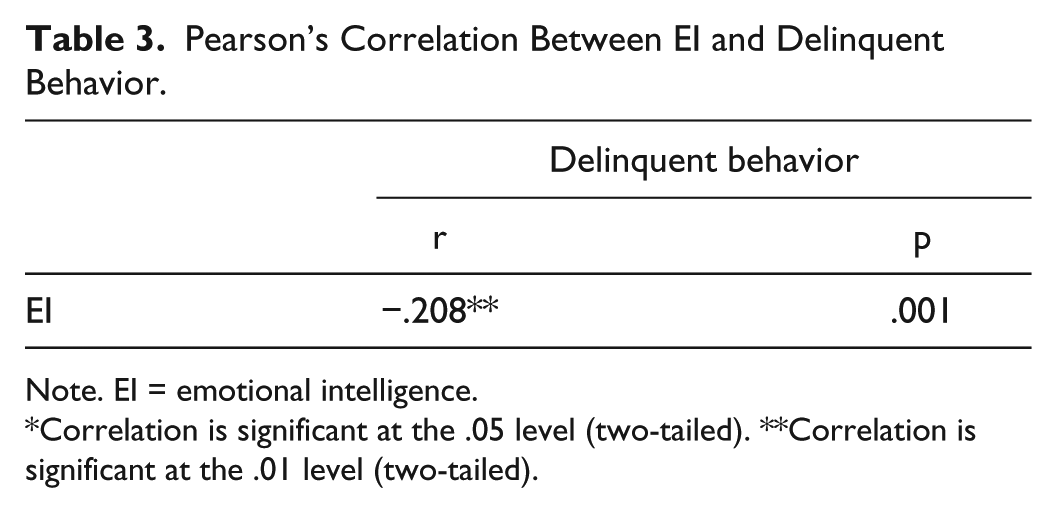
Note. EI = emotional intelligence.
Correlation is significant at the .05 level (two-tailed). **Correlation is significant at the .01 level (two-tailed).
Pearson’s Correlation Between the EI Domain and Delinquent Behavior.
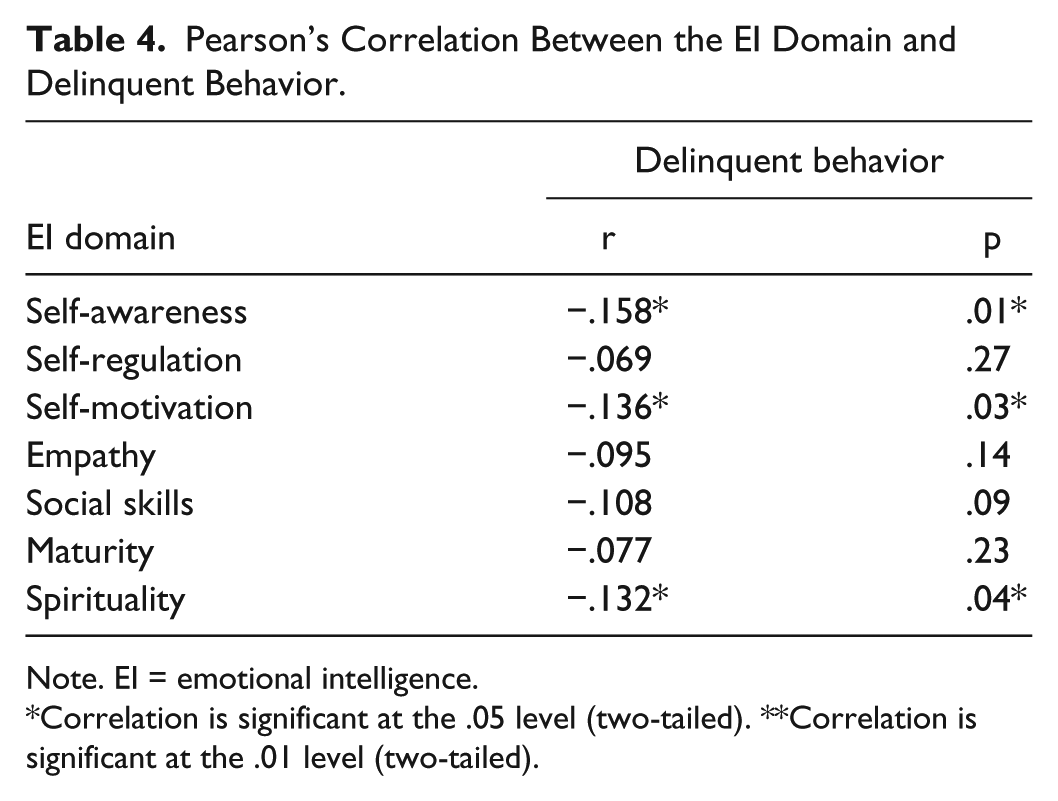
Note. EI = emotional intelligence.
Correlation is significant at the .05 level (two-tailed). **Correlation is significant at the .01 level (two-tailed).
The correlation between EI domains and DB was investigated using the Pearson product–moment correlation coefficient. There were seven domains: self-awareness, self-regulation, self-motivation, empathy, maturity, and spirituality. As shown in Table 4, there was a statistically significant negative relationship between self-awareness and DB (r = −.158, n = 300, p < .05). The negative correlation coefficient indicates that as the score of self-awareness increases, the delinquency decreases considerably.
However, there was a statistically significant negative correlation between self-motivation and DB (r = −.136, n = 300, p < .05). The negative correlation coefficient indicates that as the score of self-motivation increases, the delinquency decreases considerably.
Finally, there was a significant negative correlation between spirituality (r = −.132, n = 300, p < .05) and DB, whereby the negative correlation coefficient indicates that as the score of spirituality increases, the delinquency decreases considerably.
Hence, the findings show that (a) there was a significant negative relationship between the overall EI and DB; higher EI will decrease the DB and (b) there were also significant negative relationships between self-awareness, self-motivation, and spirituality and DB.
Table 5 displays the answer to the research question. A stepwise multiple linear regressions was conducted to determine the predictors (self-awareness, self-regulation, self-motivation, empathy, social skills, maturity, and spirituality) of DB among the respondents.
Model Summary of Emotional Intelligence Construct for Delinquent Behavior.

Significant at p < .05. **Significant at p < .01. ***Significant at p < .001.
The results reported that only one of the EI domains, that is, self-awareness, predicted DB. Table 5 shows that 3.0% (r = .16) of the variants in the criterion variable were explained by the predictor variable, that is, self-awareness.
The results from the ANOVA analysis in the regression model are presented in Table 6. The results show that self-awareness was a statistically significant predictor variable of DB, F(1, 291) = 6.12, p < .05.
Results of ANOVA for Emotional Intelligence Domain for Delinquent Behavior.

Note. Dependent variable: Delinquent behaviour
Significant at p < .05. **Significant at p < .01. ***Significant at p < .001
The data in Table 7 indicate that the self-awareness (β = −.16, p < .05) was a statistically significant factor of DB. The self-awareness contributed 3.0% (r = .16) on DB, F(1, 291) = 6.12, p < .05. The other EI domains do not contribute to DB.
Standard Coefficients for Emotional Intelligence Domain on Delinquent Behavior.

Note. Dependent variable: Delinquent behavior.
Significant at p < .05. **Significant at p < .01. ***Significant at p < .001
Discussion
Table 1 shows that the majority of the respondents were involved in the category of “other misbehavior” (M = 2.24, SD = .61). Among such misbehavior, most of the respondents played truant because of working part-time to earn extra money. In addition, they also skipped class for no reason. These types of misbehavior were very common among the students and in line with the study by Shamsul Azhar Shah et al. (2012), who reported that truancy happened in every school. Students who stated that they often skipped classes would be engaged in at least one form of delinquency-related behavior.
In this study, crime acts (M = 1.95, SD = .56), such as bringing weapons to school, assaulting other students, and involvement in gangsterism and fighting, were frequently committed by the students. This is followed by vandalism (M = 1.77, SD = .06), referring to damaging and destroying somebody else’s property on purpose, and pornography and sexual behavior (M = 1.63, SD = .63) in which most students were involved with pornographic materials. In addition, students frequently committed dishonesty (M = 1.45, SD = .43) whereby they refused to pay for movie, bus, or commuter tickets. The last category is drugs (M = 1.17, SD = .54) whereby taking drugs is more frequent than selling drugs. Although only 3 (1%) students were frequently involved in selling drugs, this result shows a very alarming situation that could eventually lead to serious social criminal behavior. The researcher concluded that the level of delinquency of the students is mild. This could be attributed to the fact that the sample did not include students or youth engaging in serious DB. Most of the delinquent students just misbehave in the school, such as truancy, and are not involved in serious offenses.
This result is also consistent with the findings of Norlizah Che Hassan (2008) concerning adolescent delinquency in that the level of the adolescents’ DB did not achieve 10%. According to Norlizah (2008), 98.9% of the adolescents’ delinquency is at a low level with only 1.1% adolescents at the high level. This implies that the level of delinquency in Malaysian schools is controllable. Moreover, in the study on violence among adolescents, Lee, Chen, Lee, and Kaur (2007) found that 10.7% had been involved in a physical fight with other people, theft (4.3%), vandalism (2.7%), and had carried a weapon (2.4%). Although all these types of behavior in the school are still controllable, with only a small percentage involved in delinquency, it is still alarming as these could lead to more serious forms of delinquency and social ills.
The findings of EI are consistent with Mayer et al. (2000) who found a negative relationship between EI and problem behavior. A lower EI was associated with lower self-reports of violent and trouble-prone behavior among adolescents, a correlation which remained significant even when the effects of intelligence and empathy were partialed out. Lower EI (as measured by the MSCEIT) has been significantly associated with the higher use of illegal drugs and alcohol, as well as increased participation in deviant behavior (i.e., involvement in physical fights and vandalism).
Self-awareness was found to have a significant relationship with DB. The result shows the delinquent students paid less attention to emotions or feelings. This lack of emotional awareness means that delinquent students are unable to connect their feelings with their thoughts (Goleman, 1998) and their feelings, such as anger or frustration. Therefore, if the students are aware of their emotional states, and their strengths and weaknesses, they will become aware of their values and goals in their life. Self-awareness will make them mindful that they have to accept criticism and feedback regardless of whatsoever happens.
Based on the findings in Table 4, motivation was found to have a statistically significant relationship with DB. Motivation is an emotional tendency that guides or facilitates toward goal achievements. Under the motivation domain, are three motivational subdomains such as achievement drive, commitment, initiative and optimism. Students who have self-motivation would strive to excel in their undertakings and have high self-esteem. Delinquent students lack the motivation to learn and have limited ability to focus and maintain a positive sense of self-worth while being confronted by daily school challenges (Lopes, Salovey, & Straus, 2003). They do not have the determination to achieve a goal and to excel in their work.
Spiritual awareness was found to have a statistically significant relationship with DB. One of the elements in the social control theory is belief. According to the theory of Hirschi (1977), if a person has strong beliefs in society’s norms, then the individual would avoid delinquency or criminal behavior. Those people who are deeply engaged in religion would be less likely to be involved in crime and deviance. However, a study by Mapp (2009) concerning the role of religiosity and spirituality in juvenile delinquency reported a negative and statistically significant relationship between religion and spiritual, and marijuana use. Hence, this study supports the study by other researchers.
The result in Table 7 shows self-awareness is one of the EI constructs that predicts DB. The inability to understand emotions in oneself and others, including understanding how emotions can be changed and how people react to different emotions, would contribute to delinquency. According to Liau et al. (2003), in their research on EI, higher levels of EI were hypothesized to be associated with lower levels of internalizing problematic behavior, such as academic anxiety, depression, somatic complaints, and stress, as well as lower levels of externalizing problem behavior, such as aggression and delinquency.
Based on the results, the relationship between DB and the set of predictor variables can be characterized as relatively weak. Total contribution by the combined set of predictors: EI accounted for 3% of the variance of DB. Eron, Gentry and Schlegel (1994) argued that no single factor explains much of the variance in delinquency but that it is the combination of the identified risk factors that makes the difference. In addition, psychological factors, such as EI could be an important factor to provide protection against delinquent and violent behavior patterns including regulation of their emotions and awareness of their own strengths and weaknesses.
Conclusion
After the discussion on each variable, this study has documented considerable knowledge for all walks of society in understanding DB. Deficiency in EI is considered to be impaired in emotional and social functioning. Goleman (1995) also agreed that social skills and managing emotions are related to coping strategies and that deficiencies in those skills are related to the involvement in risk-taking behaviors. To gain success at school, students should have confidence, intentionality, self-control, capacity to communicate, and the ability to cooperate. These skills are very important to hinder any problematic behavior.
EI can be used to identify and discriminate emotional skills among those adolescents who exhibit DB. In this study, the deficiencies of certain EI domains of the delinquent students are highlighted. These are emotional awareness, accurate awareness, self-confidence from the self-awareness domain; trustworthiness from the self-regulation domain, and influence and conflict from the social skills domains. As such, these delinquent students need to be guided and given the opportunities to build up those competencies. This study has documented a complete profile of EI on delinquent students.
The study also provides a realization that delinquent adolescents do have their own strengths whereby their EI domain of empathy is higher (Table 2). They are motivated, innovative, and have the tendency to initiate or manage a change of situation. Sadly, we often label them and only see their weaknesses. Opportunities should be given to these adolescents to show their potential and personal abilities as these delinquent adolescents can happen to be future leaders who can make changes in a group or organization. Furthermore, emotional knowledge can be improved through education practices; perhaps training children and adults in EI can lead to more adaptive behavior.
Footnotes
Declaration of Conflicting Interests
The author(s) declared no potential conflicts of interest with respect to the research, authorship, and/or publication of this article.
Funding
The author(s) received no financial support for the research and/or authorship of this article.