




Abstract
This research explores the influence of ideological and political education on university students’ civic engagement and social behavior, focusing on Sindh Agriculture University (SAU) Tandojam, Pakistan. Employing a sequential mixed-methods design, the study combines quantitative surveys (n = 200) with qualitative interviews (n = 10) to examine the role of education in shaping students’ political awareness and social attitudes. The study is situated in the broader context of Pakistan’s socio-political and educational disparities, offering insights into how such education can promote active citizenship and democratic values. Quantitative findings reveal significant correlations between educational exposure and enhanced civic engagement and social responsibility. Regression analysis identified educational impact (B = 0.148, p < .001), civic engagement (B = 0.142, p < .001), and social behavior (B = 0.135, p < .001) as predictors of active participation in political and social activities. Students reported higher engagement in voting (M = 4.2, SD = 0.8) and volunteering (M = 3.6, SD = 1.1), coupled with strong support for social justice and inclusivity (M = 4.3, SD = 0.6). However, qualitative insights highlighted concerns about curriculum bias and limited practical exposure to political processes, emphasizing the need for a more balanced and applied approach. The study concludes that ideological and political education enhances civic engagement and fosters inclusivity, aligning with frameworks of Political Socialization Theory. To address identified gaps, the research recommends diversifying curricular content to incorporate a wider range of political perspectives and implementing experiential learning opportunities, such as internships and community initiatives. These strategies are crucial for translating theoretical learning into meaningful societal contributions, ultimately strengthening democratic practices and social cohesion. This research provides actionable recommendations for policymakers and educators seeking to develop effective civic education programs in developing nations.
Plain Language Summary
This study examines how ideological and political education affects university students’ involvement in civic and social activities, with a focus on Sindh Agriculture University (SAU) in Tandojam, Pakistan. The research combines surveys and interviews to explore how education influences students’ political awareness and social attitudes. The findings suggest that the more students are exposed to political education, the more likely they are to engage in activities such as voting and volunteering. Students also showed strong support for social justice and inclusivity. However, the study highlights some concerns, including biases in the curriculum and limited opportunities for students to practically engage with political processes. To improve education and promote more active citizenship, the study recommends broadening the curriculum to include diverse political perspectives and offering more hands-on learning experiences, like internships and community involvement. These changes are important for strengthening democratic values and social unity in Pakistan. The research offers practical suggestions for policymakers and educators who want to create better civic education programs in countries with developing political and educational systems.
Keywords
Introduction
The role of higher education in shaping civic engagement and social behavior has become an increasingly prominent area of academic inquiry and policy focus worldwide (Slimi & Carballido, 2023). Universities, functioning as centers of intellectual advancement, cultural knowledge, and demographic insights, serve as critical platforms for fostering political consciousness, social accountability, and inclusivity among students (Ansar Hayat & Bilal, 2024; Whitley & Yoder, 2015). However, (SAU)’s exceptional conditions for analyzing civic behavior stem from its location in Sindh—a region marked by ethnic diversity, agrarian economies, and systemic educational disparities (Adnan & Fatima, 2018). As a public university, (SAU) operates at the intersection of state policies and regional socio-political narratives, making it a critical site for studying how institutional missions (public vs. private) mediate civic education. In this circumstance, ideological and political education, whether it is comprised in the formal curriculum or delivered through supplementary programs, playing an important role in preparing students with the knowledge, expertise, and values that are essential for vigorous participation in representative processes, advocating for social justice, and creative cooperation in community development (Chen, 2015; Rong & Gang, 2021). In (SAU)’s context, efficacy may be undermined by students’ lived experiences of political marginalization—a tension underscoring the need to contextualize theory (Mayo, 1995). Youth disengagement in Pakistan reflects not only curricular gaps but also structural barriers (e.g., rural-urban divides, economic precarity) that undermine political efficacy (Bouillion & Gomez, 2001). However, the impact of such education diverges in different situations, especially in developing countries, where socio-political, economic, and educational differences often contour the nature and effectiveness of civic education programs (Da’as & Ali, 2021). The study of global cases provides important visions into how ideology and political education stimulus the civic attitudes and social attitudes of university students (Ying et al., 2024). In the United States, academic studies have shown that engaging with political education helps students understand the appliances of democracy and escalations involvement in their political activities, such as voting and community organizing (Heidenheimer, 1973). In Scandinavian nations, where civic education is a fundamental component of the national curriculum, university students generally exhibit elevated levels of political participation and social trust (Henriksen et al., 2019; Lieberkind, 2015). This is indicative of the prioritization of democratic principles within their educational systems (Lahdenperä et al., 2022). Internally, in republics such as India, where political education is often uncoordinated and uninterrupted, and student participation in democratic activities appears to be low, despite the passion of that country’s democratic landscape (Mishra & Aithal, 2023). These international encounters highlight transformations in the effectiveness of ideological and political education contexts, and the need for local studies to comprehend how different educational systems shape civic engagement. The role of universities in shaping civic engagement is contingent upon their institutional structure, historical mission, and socio-political context. Public universities often function as instruments of state policy, fostering inclusive political education and civic awareness, whereas private institutions may align more with market-driven educational models, which could influence their civic education mandates (Scott, 2011; Verger et al., 2017). By situating our analysis within this broader dichotomy, we enhance the manuscript’s contextual depth and provide a nuanced examination of how different university models contribute to democratic participation.
Pakistan, as a developing country facing encounters associated to political and educational disparities, provides a stimulating environment where the impact of higher education and political education on students’ civic engagement has the potential to be inspected. The country’s political climate is considered by significant regional variances that have a noteworthy impact on the quality and convenience of civic education in its provinces (Adnan & Fatima, 2018). (SAU), which is positioned in a culturally and socially diverse region of Sindh, provides a unique background for evaluating these demonstrations. The institute facilitates an assorted student population, including people with inquiry debilities, citizens, and disadvantaged sections. This assortment provides an opportunity to scrutinize how students from different socio-cultural backgrounds understand and fascinate ideological and political education into their individuality.
The occurrence of unsuitable political consciousness among youth in Pakistan is mostly linked to the absence of a solitary framework of civic education and the noteworthy effect of regional political influences on the educational curriculum (Rehan et al., 2021). The appearances of ideological and political education in (SAU) are prejudiced by both editorial drifts and regional socio-political background. Given the somatic nature of its various students, this research examines how political education affects students’ perceptions of civic inclusion, social attitudes, and democratic norms. By assimilating the principles of behavioral science, suggesting that exterior factors such as education and culture, as well as inherited characteristics, inspires human behavior (Lynch, 2019), this research seeks to achieve the goal of how education and civic inclusion are interrelated and provides important visions for understanding the relationship between theoretical and political education and student behavior, particularly civil engagement, social behavior, and involvement in community development. Existing research has demonstrated that well-implemented civic education programs can enhance student engagement in political processes and social activities (Andolina & Conklin, 2020). However, empirical studies that examine the specific effects of ideological and political education in the context of Sindh, and at (SAU) in particular, are limited. As this study uniquely examines (SAU), where rural marginalization, ethno-linguistic tensions, and feudal power structures distort political education, a gap ignored in urban/Western-centric studies. This research, therefore, addresses a critical gap by providing an in-depth analysis of how students at (SAU) interact with and are influenced by political education, contributing to the broader understanding of how such education can promote active citizenship and social responsibility in Pakistan. Moreover, this study draws on theoretical frameworks that explore the role of education in shaping political and social behavior, particularly in post-colonial and developing country contexts (Mayo, 1995). The university is widely recognized as one of the most significant settings for socialization due to its unique role in shaping students’ ideological, political, and civic identities during a critical transitional phase of their lives. At (SAU), ideological and political education (IPE) is integral to the curriculum, aiming to cultivate responsible citizenship. However, its actual effects on students’ civic engagement and social behavior remain empirically underexplored in Pakistan’s context. By evaluating the impact of ideological and political education on civic engagement and social behavior at (SAU), this research aims to generate insights that can inform educational practices and policies. The findings are expected to contribute not only to the academic literature on political education but also to the practical refinement of educational strategies that foster active citizenship, social cohesion, and democratic values in Pakistan and similar contexts. Therefore, this study aims to answer the following research questions:
Theoretical Framework for Political Socialization Theory
Political Socialization Theory examines how individuals acquire political knowledge, values, and behaviors through interaction with various socializing agents, including family, peers, the media, and educational institutions (Easton, 1976). While this theory is typically applied in stable democracies, its adaptation to (SAU)’s context accounts for how inequality and regional politics filter students’ political learning (Shutaleva, 2023). For instance, (SAU)’s rural student body often encounters curricula influenced by dominant regional ideologies, which may limit exposure to pluralist perspectives—a key gap this study addresses). Political-social training is an ongoing process that outlines the individual’s understanding of political systems, discrete role as a citizen, and ability to participate in social life. Educational institutions, especially universities, play an imperative role in this manner because they influence students’ political attitudes, attitudes, and involvement in democratic processes (Easton, 1975; Giroux & McLaren, 1986). Universities serve as pivotal institutions for sociocultural education, where scholars are instructed in political theory, governance frameworks, social equity concerns, and democratic principles (Galston, 2001). Through this educational framework, universities foster not only political acumen but also civic virtues such as responsibility, tolerance, and activism. The framework of political-social education posits that educational experiences enhance political efficacy; specifically, the conviction among students that they can affect political outcomes is vital for fostering engaged citizenship (Darder, 2015). The investigation further underscores how formal education exerts a beneficial influence on democratic inclusion. As students’ progress through their academic paths, they become increasingly cognizant of societal challenges and engage more actively in community endeavors (Bouillion & Gomez, 2001). For instance, research indicates that university students with substantial political education exhibit greater enthusiasm for participation in activities such as voting, social service, and political discourse (Sedwal, 2024). Concurrently, political education cultivates attitudes of social tolerance and civic duty, which are critical for the sustenance of robust democratic societies (Abulibdeh et al., 2024).
Nonetheless, the efficacy of political education is frequently contingent upon factors such as socio-political context, cultural norms, and geographical disparities. In nations grappling with political volatility, resource constraints, or ideological rifts, educational systems may struggle to deliver a balanced political education.
This issue is particularly pronounced in developing nations, where disparities in educational resources and politically skewed curricula can obstruct students from acquiring a holistic understanding of diverse political ideologies (Adnan & Fatima, 2018). In these contexts, regional and political influences may restrict students’ capacity to critically evaluate and engage with various political viewpoints (Shutaleva, 2023).
Theory Based Justification
This study is informed by Political Socialization Theory, which suggests that individuals develop political knowledge, values, and behaviors through interactions with various socializing agents, including educational institutions (Easton, 1976). Universities, in particular, serve as pivotal platforms for political socialization, influencing students’ political attitudes, participation, and overall engagement in democratic processes (Lawrence, 2010). By utilizing this framework, the study seeks to explore the impact of ideological and political education at Sindh Agriculture University on students’ political involvement and social behavior. Specifically, it examines key outcomes including,
Methodology
Research Design
This investigation aligns with the descriptive research methodology with an objective of evaluating the influence of ideological and political education on civic engagement and social behavior among university students specifically at (SAU) Tandojam. The research employed a mixed method (quantitative/ qualitative) approach by including sequential explanatory design through primary interactive source from university students employing stratified random sampling techniques to ensure representation across faculties, year of study, degree, and gender. Consequently, the study initiates with a preliminary quantitative phase, subsequently transitioning to a qualitative phase to enrich the understanding and contextualization of the numerical findings. By integrating surveys and interviews, this research endeavors to perform a thorough examination of the extent to which ideological and political education impacts students’ civic inclusion and social attitudes. This collaborative methodology guarantees a well-rounded perspective, which comprehensively addresses the overarching trends associated with learning alongside the elements of intuitive experiences. So far, the quantitative data alone cannot capture the nuanced experiences of students, while qualitative data alone lacks generalizability. Integrating both allows for a deeper, more contextualized understanding. The sequential design helps first identify broad trends (quantitative) and then explore underlying reasons.
Sampling and Data Collection
The research will target undergraduate and graduate students enrolled at (SAU) Tandojam, because of its varied student demographics and the regional socio-political environment, thereby providing a pertinent case study to investigate the extensive ramifications of ideological and political education for higher education institutions within Pakistan. The research employs a stratified random sampling method to select 200 students from various faculties, ensuring diverse representation across academic disciplines, gender, and year of study through five-point Likert scale. This approach will capture a broad range of perspectives on ideological and political education. Nevertheless, the questionnaire for quantitative survey was validated in local context for better implementation. For linking the quantitative results to the qualitative phases the research opted the sequential explanatory design, where quantitative surveys informed the qualitative interviews ensuring purposeful sampling of key subgroups. Additionally, 10 students was purposefully selected from the survey participants for in-depth semi-structured interviews, ensuring a diversity in civic engagement levels (5 highly engaged and 5 less-engaged individuals). This number aligns with saturation principles in qualitative research, where additional interviews yield diminishing new insights. The quantitative phase utilized a structured survey questionnaire, collecting data on students’ perceptions of ideological and political education, their civic engagement, and social behavior, with components such as demographic information, civic participation, and educational impact conducted individually in person. The qualitative phase involved a detailed interviews with 10 students to explore their personal experiences and the perceived influence of ideological and political education on their civic engagement and social attitudes. Besides that, the respondents participated in the quantitative phase had also participated in the qualitative data. The field survey was carried out in 2024 march to May 2024, where the researcher was living in a hostel among students to gather more in-depth information. Besides that the relationship of researcher with the university is that, one of the researcher was part of the university in his bachelor’s education. Nevertheless, the ethical safeguard and confidentiality of the data was informed to the respondents before interviews and surveys. (SAU) administration endorsed the study but was blinded to individual responses.
Demographic Information of the Respondents
The demographic attributes of the research cohort elucidate a heterogeneous student body from (SAU) tandojam, ensuring thorough representation across variables such as age, gender, faculty, and academic level. Age ranges were derived from a direct question in the survey (“What is your age?”) and categorized into groups (e.g., 18–21, 22–25) for analysis. The data in Table 1 revealed that a notable 33.5% of participants were aged 24 to 26, followed by 26.5% within the 21 to 23 range, while younger individuals aged 18 to 20 constituted 13.5%, and their older peers aged 27 and above accounted for 26.5%, highlighting the varied ages of those involved. The distribution revealed that 72.5% identified as male, and 24.5% as female within the sample group. The faculty representation was majorly influenced by Social Sciences (28.5%), trailed by Agricultural Engineering (21.5%). In terms of academic progression, the largest group comprised students in their 4th year or higher (39%), with significant representation from 3rd year (26.5%), 2nd year (20.5%), and 1st year (14%). This demographic diversity facilitates a comprehensive analysis of the impact of ideological and political education across various student segments.
Demographic Information of the Respondents.

Data Analysis Methods
The quantitative data was analyzed using SPSS software version 27.0, including, mean, standard deviation, percentage minimum, maximum, and regression analysis. Whereas, the qualitative data including in-depth interviews were performed manually including (coding, decoding, transcribing, translating) using NVIVO software version 15 to generate word cloud passing various stages like recording, transcribing, translating, further interpretation of themes for better understanding and enhance the accuracy of results.
Regression Analysis
Regression analysis, specifically Multiple Linear Regression, was used to evaluate the relationship between independent variables Educational Impact, Civic Engagement, and Social Behavior with the dependent variable representing overall Civic Participation or Social Engagement measuring combined behavior (Voting, volunteering and political discussion). This methodology was chosen to assess how these independent variables collectively influence the outcome.
The multiple linear regression model can be specified as follows:

Where:
Y is the dependent variable representing social engagement.
β0 is the intercept term.
β1, β2, and β3 are the coefficients for the independent variables, representing the effect of Educational Impact, Civic Engagement, and Social Behavior, respectively, on Civic Participation.
ε is the error term, accounting for unexplained variance.
Model Estimation
The regression model was estimated using statistical software such as SPSS, which generated unstandardized and standardized coefficients, standard errors, t-values, and p-values.
Interpretation of Results
The unstandardized coefficients (B) indicate the magnitude of the effect of each independent variable on the dependent variable. The standardized coefficients (Beta) provide insight into the relative importance of each predictor. T-values and p-values were used to assess the significance of the predictors.
Validity and Reliability of the Data
Validity and reliability play a crucial role in minimizing usability issues, as they ensure that an instrument is easy for participants to complete. Sigerson and Cheng (2018) define reliability as the consistency of a measurement scale, which can be evaluated using Cronbach’s alpha. Meanwhile, validity can be confirmed through Confirmatory Factor Analysis (CFA), a statistical method that examines the relationships between observed variables and underlying constructs (Brown, 2015). For validity assessment, Average Variance Extracted (AVE) values of 0.40 or higher are considered acceptable, indicating strong construct validity and warranting further analysis. Additionally, reliability is demonstrated when Cronbach’s alpha exceeds 0.70, as shown in Table 2, which presents satisfactory results.
Reliability of the Data.

Ethical Considerations in the Study
The study was conducted in accordance with the ethical guidelines of 1964 Helsinki declaration. The study prioritized participant safety by ensuring confidentiality, anonymity, and voluntary participation, minimizing any potential harm. Surveys and interviews avoided sensitive topics, focusing instead on general perceptions of education and civic engagement. The benefits of the research—such as informing policy and improving educational practices—outweighed minimal risks, offering societal value while giving participants a platform for reflection. Informed consent was obtained through clear explanations, written or verbal agreements, and assurances of data anonymity, with ethical approval from the university ensuring adherence to research integrity standards.
Results
Restructured Results Opening
The findings are structured according to the study’s three core research questions. RQ1 & RQ2: Addressed using quantitative surveys + regression + descriptive analysis (Tables 3–5). RQ3: Addressed through thematic qualitative analysis (Section “Ideological and Political Education on Student’s Civic Engagement and Social Behavior “ & Word Cloud Figure).
Regression Analysis Summary for Educational Impact, Civic Engagement, and Social Behavior.

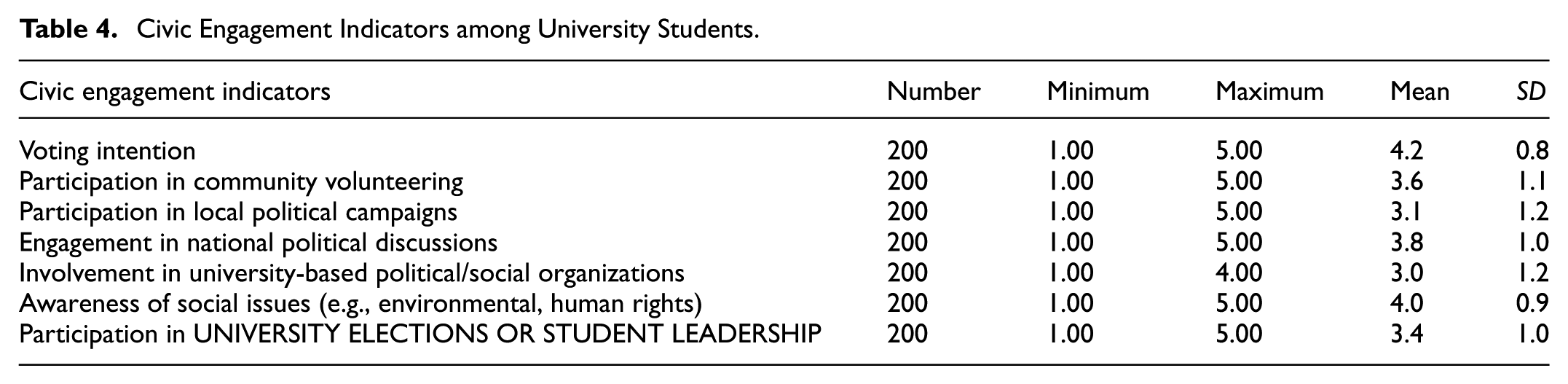
Civic Engagement Indicators among University Students.
Descriptive Statistics for Social Behavior Indicators Among University Students.

Statistical Outcomes of Study Using Regression Analysis
The regression analysis demonstrates in Table 3 that Educational Impact, Civic Engagement, and Social Behavior significantly influence the dependent variable, which likely pertains to social participation. Educational Impact had the highest unstandardized coefficient (B = 0.148) and a statistically significant effect (p < .001), indicating that greater exposure to ideological and political education enhances participation. This finding aligns with Political Socialization Theory, which posits that exposure to political education, such as that received in university settings, increases political efficacy and fosters greater civic involvement. The standardized coefficient (B = 0.135) highlights its notable contribution relative to other predictors, confirming the theory’s assertion that education shapes students’ political attitudes and encourages active participation in democratic processes. Similarly, Civic Engagement (B = 0.142, B = 0.120, p < .001) emerged as a significant predictor, reflecting the strong association between active involvement in civic activities and positive outcomes. This reflects the core premise of Political Socialization Theory, which emphasizes that political education in universities can cultivate a sense of civic duty and responsibility, leading students to engage in activities such as voting and community volunteering (Easton, 1976). Social Behavior (B = 0.135, B = 0.110, p < .001) also showed a significant positive relationship, underscoring the influence of behavioral traits like tolerance and open-mindedness. These findings repeat the theory’s argument that education fosters not only political knowledge but also social virtues like tolerance and social justice, which are crucial for the functioning of a democratic society (Denny & Doyle, 2009). The narrow confidence intervals and statistical significance of all predictors validate the model’s robustness, emphasizing the value of ideological and political education in fostering civic participation and shaping social behaviors. The statistically significant association between political education and civic participation raises questions about the specific university initiatives driving these outcomes. Future research should explore how institutional programs (e.g., curriculum design, extracurricular activities) or students’ lived experiences mediate this relationship. These results provide valuable insights for policymakers and educators aiming to enhance civic and social engagement through curriculum design.
For conducting the quantitative data, the structure questionnaire involving 5 point Likert-scale was used to gather the perception of the students on civic engagement indicators, where participants rated their participation in diverse actions ranging from 1 to 5. While, the 1 shows (Strongly Disagree) and 5 shows (Strongly Agree). The Likert scale is widely recognized for its effectiveness in capturing subjective responses and quantifying attitudes and behaviors in a structured manner (Ho, 2017). This method helped to investigate students’ engagement level across multiple dimensions including voting, volunteering and political participation and their engrossment in university based organization. The analysis of civic engagement indicators in Table 4 provides a detailed overview of students’ involvement in various civic and political activities. The mean scores as shown in Table 4, indicates that the highest levels of engagement were observed in Voting Intention (M = 4.2; SD= 0.8) and Awareness of Social Issues (M = 4.0; SD= 0.9), reflecting strong interest in democratic participation and societal concerns. This could be attributed to the perceived ease and importance of voting, which is a relatively low-effort yet impactful way to engage politically. Moderate engagement levels were seen in Engagement in National Political Discussions (M = 3.8; SD = 1.0) and Participation in Community Volunteering (M = 3.6; SD= 1.1), highlighting students’ involvement in broader societal and community-oriented activities. Lower mean scores were noted for Participation in Local Political Campaigns (M = 3.1; SD= 1.2) Involvement in University-Based Political/Social Organizations (M = 3.0; SD= 1.2) and Participation in University Elections or Student Leadership (M = 3.4; SD= 1.0), indicating comparatively less engagement in these specific areas. This discrepancy may stem from students’ perceptions of university elections as less consequential or possibly less connected to broader political issues. While high voting intentions and awareness of social issues are noted, the gap between intention and action (e.g., low participation in local campaigns or university organizations) suggesting a disconnect. Further qualitative investigation is needed to understand whether “over-ideologization” in educational programs or lack of institutional support for practical engagement (e.g., involvement in collegiate bodies) explains this discrepancy. These findings suggest varied levels of civic engagement among students, with higher engagement in activities directly related to broader societal issues and lower participation in institutional or localized political activities.
Table 5 represents the analysis of social behavior indicators reveals students’ attitudes and openness toward social and cultural diversity, the results indicate the highest positive responses in Support for Social Justice and Equal Rights (M = 4.3; SD = 0.6) and Tolerance toward People of Different Religious Belief (M = 4.2; SD = 0.7), reflecting a strong commitment to fairness and acceptance. This is consistent with the broader cultural and educational contexts in which students are exposed to ideological education, which often emphasizes human rights, equality, and tolerance. These high scores also suggest that political education, especially when it covers social issues, may foster progressive attitudes toward diversity and inclusion. High scores were also noted for Tolerance toward People of Different Ethnicities (M = 4.1; SD = 0.8) and Attitudes toward Gender Equality (M = 4.0; SD = 0.9), suggesting inclusive and equitable perspectives. Moderate levels were observed in Open-Mindedness toward New Ideas and Perspectives (M = 3.8; SD = 1.0), suggest that while students may support these ideals, translating these values into actions—such as engaging in dialogue—may be more challenging, particularly when deep-seated cultural or ideological differences exist. Respect for Different Political Views (M = 3.9; SD = 1.0), and Willingness to Engage in Interfaith/Intercultural Dialogue (M = 3.7; SD = 1.1), indicating potential areas for further development. These findings highlight the importance of educational initiatives that promote diversity, encourage respect for differing viewpoints, and support active dialogue in fostering a more inclusive and cohesive social environment.
Table 6 presents the results of students’ perceptions regarding the impact of ideological and political education, the indicator for Exposure to Ideological Education Content had the highest mean score (M = 4.1; SD= 0.7), suggesting that students generally acknowledge the presence and importance of such content in their curriculum. Students also reported a positive perception of the relevance of their courses to Civic Responsibility (M = 4.0; SD = 0.8) and Political Awareness (M = 3.9; SD= 0.9), signaling the effectiveness of course material in fostering political and civic engagement. Moderate scores were found for Relevance to Social Engagement (M = 3.8; SD= 1.0). Participation in University Political Discourse (M = 3.6; SD= 1.2), indicating moderate engagement in these areas. The lowest mean was observed for Engagement in Extracurricular Political Education (M = 3.2; SD= 1.1), showing a less substantial level of extracurricular involvement. Similarly, the Influence of Political Ideology in Education (M = 3.5; SD= 1.0) indicated variability in students’ perceptions of political bias or ideological influence in their educational experience. These findings highlight the importance of incorporating more focused extracurricular activities and balanced ideological content to strengthen students’ political and social involvement.
Students’ Perceptions of Ideological and Political Education and Its Impact on Civic and Social Development.

Ideological and Political Education on Student’s Civic Engagement and Social Behavior
For conducting the in-depth information, 10 students from (SAU) Tandojam were randomly selected with the main objectives including influence of ideological and political education on students’ civic engagement and social behavior. The selection of the respondents were diverse in nature in terms of gender, year of study, academic discipline and the political view. Besides that, the word cloud was generated from the responses perceived by the participants, where the larger words shows the repetition of topics mentioned frequently and the smaller words highlighting topics used rarely but are still a part of discussion as shown in Figure 1. Most of the participants recognized that ideological and political education played a pivotal role in shaping their awareness of political and social issues. One of the respondent noted that “before university life, I had less experience with regards to the political ideologies. Whereas, I have expanded my knowledge regarding the understanding of global issues, politics and governance being enrolled in university” (Respondent-1). While students generally valued the content, a few respondents expressed concerns regarding the narrow scope of the topics covered. Some believed the education leaned toward particular political ideologies, lacking a balanced representation of differing viewpoints. As Respondent remarked that “The educational content is useful, but sometimes it feels overly focused on one side of politics. It would be beneficial if we were introduced to a wider range of political perspectives” (Respondent-2). A significant portion of respondents reported an increase in their political awareness and civic participation due to the political education programs offered at the university. One of the participant shared that “I didn’t vote before, but after being exposed to political education here, I now understand the importance of voting, and I encourage my friends to vote too” (Respondent-3). Several students mentioned joining political groups or student unions, indicating a shift from passive learning to active participation. Respondent, for example, explained “After engaging with political education, I joined the student union because I felt motivated to contribute to the change I want to see in the university and beyond” (Respondent-10). However, couple of students highlighted that while their awareness of political matters increased, opportunities for active political participation, especially in rural areas, remained limited.

Word cloud of In-depth interviews.
In addition to that, the respondents indicated that their ideological education had positively influenced their social behaviors, promoting a greater sense of empathy and social responsibility, as specified that “The ideological education made me more conscious of social inequalities. I’ve started volunteering with local NGOs, which was something I didn’t consider before” (Respondent-4). Despite these positive changes, the respondent observed that while students engaged in political discussions frequently, this intellectual engagement did not always translate into concrete actions within their local communities: “We talk a lot about social issues, but there’s a gap when it comes to taking action. Maybe we need more practical guidance on how to act” (Respondent-7). Thus, it was observed from the students that the education made them consider individual values and attitude toward ethical concerns, boosting to a higher assurance to equality and inclusivity in their interactions.
There were mixed reactions observed toward university’s approach to ideological and political education. While the mainstream 7 out of 10 of respondents documented its importance, there were concerns about the perceived bias within the curriculum. One of the respondent, for instance, stated: “I see the value in political education, but at times, it feels like we’re only exposed to one political ideology. It would be more beneficial to have a more balanced approach” (Respondent-10). In contrast, another respondent highlighted the educational benefit, mentioning “I think political education is crucial for developing critical thinking skills. It helped me become more informed about political issues and equipped me to form my own views” (Respondent-5). Many students called for more practical experiences, such as internships or participation in local political campaigns, to complement theoretical learning. Besides that, a respondent indicated, “The curriculum often focuses on one political perspective, which limits our ability to explore diverse viewpoints” (Respondent-9). This sentiment underscores a broader concern about the ideological slant in political education, which may shape students’ long-term political attitudes in ways that discourage balanced engagement with diverse political ideologies. Several suggestions for improving the ideological and political education programs were provided: including “Collaborating with civil society organization or local parties would be great implementation for gaining hands-on exposures in political campaigns and community initiatives” (Respondent-6). Additionally, students expressed a desire for a broader range of viewpoints to be included in the curriculum. Respondent suggested: “To foster critical thinking, the curriculum should cover a variety of ideologies. We need exposure to different political systems and schools of thought” (Respondent-8).
Discussion
This research examines how ideological and political education affects university students’ civic inclusion and social attitudes, highlighting the important role of educational programs that promote participation in social and political activities. Regression analysis shows strong links between educational influence, civic inclusion, and social attitudes, indicating that political education is an important factor for promoting active citizenship. These results are consistent with previous research, which suggests how important a role education plays in conscious involvement and meaningful participation in democratic processes (Timidi & Okuro, 2024).
Educational Impact and Civic Engagement
The analysis indicates that Educational Impact (B = 0.148) emerges as the most salient predictor of civic engagement, corroborating prior scholarly investigations that posit that exposure to political education significantly augments students’ engagement in civic endeavors, such as voting, volunteering, and political discourse (Macedo, 2006). The statistically significant relationship (p < .001) substantiates the hypothesis that political education enhances students’ comprehension of political frameworks and governance, thereby amplifying their sense of political efficacy (Hooghe & Marks, 2015). This observation aligns with the research conducted by (Torney-Purta, 2002), which underscores the pivotal role of political education in incentivizing students to interact with political systems and democratic mechanisms. Nevertheless, the study also elucidates a distinction between students’ engagement with broad societal issues and their participation in localized or institutional politics. For instance, although students exhibited elevated levels of engagement in Voting Intention and Awareness of Social Issues, their involvement in University Elections and Student Leadership was comparatively diminished. This phenomenon implies that students are more inclined toward matters of national or global significance than toward politically specific activities within their campus environment (Kahne & Westheimer, 2006). This trend mirrors wider patterns identified in other scholarly works, which underscore students’ predilection for engagement with large-scale issues over localized political undertakings (Finkel et al., 2005).
Social Behavior and Tolerance
The analysis disclosed that social attitudes significantly influenced (B = 0.135) students’ ideological orientations toward diversity and inclusion. The findings indicated that students who received theoretical education exhibited a robust commitment to tolerance and social justice. These outcomes are in accordance with previous scholarly research, which suggests that ideological learning fosters empathy and inclusive behaviors, particularly concerning social justice and cultural diversity (Denny & Doyle, 2009). To illustrate, a significant backing for social justice issues (M = 4.3) and openness to different faiths (M = 4.2) acts as a testament to the constructive role that this type of education plays in shaping students’ social ethics. These findings are consistent with investigations that demonstrate that political learning cultivates balanced attitudes (Denny & Doyle, 2009). However, despite the observable positive social attitudes among students, the research also revealed that these attitudes did not invariably translate into actionable steps within their fraternities. This discrepancy between cognitive acknowledgment and practical application of knowledge reflects contemporary research, which posits that although students attain enhanced understandings of social issues, they frequently lack the requisite guidance and opportunities to engage (Antal, 2011). It underscores the imperative for universities to furnish opportunities for experiential learning and community engagement to facilitate the bridging of the divide between knowledge and tangible societal impact.
Curriculum Design and Political Bias
Numerous respondents articulated apprehensions regarding the discernible political trends present within the curriculum, a topic that is frequently examined in contemporary literature on political education. While many respondents recognized the significance of political education, they emphasized the necessity for a more equitable representation of diverse political ideologies. This sentiment aligns with ongoing critiques that assert that political education programs sometimes privilege specific ideas over others, thereby constraining students’ capacities to critically appraise a variety of political perspectives (Hidayah et al., 2020). The recommendations put forth by the respondents regarding a more inclusive and diverse curriculum unveil previously unexamined educational strategies that endorse multi-theoretical learning frameworks. Such methodologies are deemed vital for the enhancement of critical thinking skills and for equipping students for active engagement in the political sphere (Torney-Purta, 2002). Moreover, students underscored the significance of experiential learning modalities, such as internships or involvement in local political events, to augment theoretical comprehension. While, Universities face a paradox: promoting political engagement risks accusations of ideologization, while neutrality may seem like disengagement. Resolving this requires reframing “balance” not as equal biased representation, but as equitable access to critical tools for navigating polarized discourse. This perspective aligns with research that highlights the critical nature of experiential learning and the cultivation of facilitative competencies that contribute to political inclusivity (Smith, 2009). When academic institutions integrate practical experiences into their curricula, they afford students the opportunity to engage directly with political mechanisms, thereby facilitating the integration of academic insights with tangible civic participation.
Extending Existing Theories and Frameworks
The findings of this study significantly contribute to Political Socialization Theory, particularly in the context of university students in developing countries. While much of the existing literature on political education has focused on Western contexts (Carpini & Keeter, 1996; Lahdenperä et al., 2022), this research extends those frameworks by examining the impact of political education in a developing country like Pakistan, where political education is often inconsistent due to socio-political and economic disparities (Mahmood et al., 2014; Muzaffar et al., 2020). This study highlights how regional political landscapes and educational inequalities influence the effectiveness of political education programs, offering a nuanced understanding of how political socialization occurs in diverse socio-political environments. The results align with existing research on political socialization, particularly studies by Macedo (2006) and Torney-Purta (2002) confirming that exposure to political education enhances students’ civic engagement. Students at (SAU) demonstrated increased participation in political activities such as voting, community volunteering, and political discussions, reinforcing the theory’s assertion that education fosters informed and active citizens.
Our findings reveal a marked skepticism toward institutional politics among students, consistent with broader trends in post-dictatorship societies (e.g., Latin America), where unaddressed inequality and broken democratic promises fuel distrust in parties. This explains participants’ preference for social activism over voting or party affiliation—a divergence underscoring the need to analyze civic, institutional, and social participation as distinct yet interconnected spheres. The findings support the idea that political socialization through education equips students with the knowledge and confidence to engage in democratic processes. Furthermore, the study extends frameworks by Denny and Doyle (2009) regarding the relationship between education and social behavior. Ideological and political education was found to promote inclusive social behaviors, such as tolerance toward different ethnicities and religions and support for social justice. These results align with the concept of socialization for democratic values within political socialization theory, where education helps cultivate civic virtues, empathy, and social responsibility. However, the study also identifies a gap between students’ intellectual engagement with these social issues and their ability to translate these values into practical actions, a limitation that has been observed in previous political education research (Kahne & Westheimer, 2006). This gap highlights the need for more opportunities to apply theoretical knowledge in real-world contexts. Another key contribution of this study is its emphasis on curriculum bias and the call for a more diverse ideological approach in political education. Previous critiques, such as those by Ahmed and Masood (2025), have highlighted the risks of ideological bias in political education, and this study adds empirical evidence from a Pakistani university context. The findings suggest that a more balanced representation of political perspectives is necessary to foster critical thinking and ensure that students are exposed to a broad range of political ideologies, furthering their capacity for independent thought and analysis. Finally, the study builds on the experiential learning aspect of political socialization by recommending that universities incorporate practical political engagement, such as internships and community-based projects, into their curricula. This suggestion aligns with literature on experiential learning (Smith, 2009), which argues that real-world political experiences are essential for bridging the gap between academic knowledge and active political participation. By providing students with opportunities for hands-on engagement, universities can enhance the socialization process, empowering students to take more active roles in their communities and democratic institutions.
Limitations and Future Directions
While this study provides important insights into the role of theoretical education in shaping students’ civic and social attitudes, it is important to keep some limitations in mind. The study was conducted at a single university in Pakistan, with limitations in generalizing the results to other circumstances. In the future, the aim of the research should be to include more samples from different universities and regions in order to assess whether these findings apply to different political and cultural environments. Furthermore, while this study used a 5-point Likert scale and in-depth interview from students to measure political and ideological education, civic involvement and social attitudes, incorporating big data such as focus group discussions from larger population or interviews into future studies will help to understand in more detail how students interpret and apply their learning to a real-world environment. Comparative analysis could give more handful help to justify the research with other university situations. In addition, the study highlights the need for curriculum reforms that not only incorporate different political ideologies but also emphasize practical political education. Future research should explore how experimental skills, such as internships and fraternity-based projects, can be integrated into university programs to increase students’ involvement in political and social activities.
Conclusion
This study underscores the pivotal role of ideological and political education in fostering civic engagement and positive social behavior among university students, with (SAU), as a case study. The findings reveal that such education enhances students’ political participation, awareness of social issues, and tolerance toward diversity. Regression analysis confirms that educational impact, civic engagement, and social behavior significantly shape students’ active citizenship, aligning with Political Socialization Theory. While these outcomes highlight the value of political education, the research also identifies challenges. A notable gap exists between students’ theoretical understanding and their ability to translate these insights into practical civic actions. Concerns about curriculum bias further emphasize the need for inclusive and balanced representation of political ideologies. Additionally, introducing practical opportunities, such as internships and community involvement, is crucial to complement theoretical learning. This study contributes valuable insights for improving educational policies and programs, emphasizing the importance of active, socially responsible citizenship. Future research should explore diverse contexts and educational systems to better understand how ideological and political education can promote civic and social engagement, particularly in developing regions.
Recommendations for Enhancing Political Education and Civic Engagement in Universities
In order to improve political education and civic engagement, universities should include different political theories in the curriculum to ensure a balanced and comprehensive understanding of political systems. Opportunities for practical inclusion, such as internships and participation in local political events, should be included in the curriculum, so that theoretical knowledge can be linked to real-world practice. Fostering inclusive campus discussions and encouraging civic participation beyond voting will further enrich students’ understanding and actions regarding social and political issues. Additionally, incorporating social justice topics into the curriculum, addressing regional disparities in political education, and providing leadership roles for students can strengthen their sense of civic responsibility and encourage active participation in community development. These strategies aim to bridge the gap between awareness and action, equipping students to contribute meaningfully to society.
Footnotes
Acknowledgements
I express sincere gratitude to all who aided my research on ideological and political education’s impact on civic engagement at Sindh Agriculture University, Tandojam, Pakistan. I am thankful to my coauthor for her time and consideration on the research. I am also grateful to Sindh Agriculture University Tandojam and their staff for their resources and encouragement. Participants: Appreciation to the students for their invaluable insights, pivotal to this study. Family and Friends: Thanks for the ongoing support and motivation throughout this endeavor. Researchers: Recognition of all authors whose works inspired this research. This research’s success is attributable to the collective support of these individuals, for which I am profoundly thankful.

Ethical Considerations
An ethical review and approval waiver for this study was granted by the institutional review body at Sindh Agriculture University. The research was deemed exempt as it involved minimal risk, with the probability of harm or discomfort not exceeding those encountered in daily life. The study adhered to the ethical principles of the 1964 Helsinki Declaration. The research was non-invasive, conducted in an educational setting, and did not involve vulnerable populations.
Informed Consent
Informed consent was obtained from all participants involved in the study. Prior to data collection, participants were informed about the research objectives, the voluntary nature of their participation, and their right to withdraw at any time without penalty. Verbal consent was deemed appropriate and was formally documented, as the study presented no more than minimal risk and the consent procedure was the only record linking the participant to the study.
Consent to Participate
Informed consent was obtained from all subjects involved in the study. Participants were informed about the purpose and nature of the research, and they voluntarily consented to provide the requested data. All respondents were assured of the confidentiality of their identities, and measures were taken to protect their personal information throughout the study.
Author Contributions
Q.C has contributed in drafting, helped in data analysis and also the support in APC charges. While, A.R.K has conducted the study, data collection, writing the original draft.
Funding
The authors disclosed receipt of the following financial support for the research, authorship, and/or publication of this article: Social Mechanisms of Green Development in Ecologically Vulnerable Counties, 25BSH033.
Declaration of Conflicting Interests
The authors declared no potential conflicts of interest with respect to the research, authorship, and/or publication of this article.
Data Availability Statement
Data would be available after the paper acceptance.
Any Other Identifying Information Related to the Authors and/or Their Institutions,Funders,Approval Committees,etc.,that Might Compromise Anonymity
None.