




Abstract
Globalization and educational reforms in higher education have prompted the widespread adoption of English for Specific Purposes (ESP) programs in China. The effective implementation of ESP programs hinges on the integration of language and content, necessitating ESP teachers’ awareness of content knowledge and appropriate positioning of the integration within this framework. However, there remains a scarcity of empirical studies examining ESP teachers’ awareness of content knowledge and its integration with language. This study sought to investigate the development of language and content knowledge integration (LCKI) through a 1-year team teaching collaboration between a Chinese ESP teacher and a content teacher in the field of hotel management. Through interviews and observations carried out over a period of 1 year, the study traced how teacher views and practices changed through collaboration and team teaching. Employing Thematic Analysis for data analysis, the study revealed ESP teacher’s understanding and attitudes toward LCKI and presented ESP teacher’s significant changes in the integration within the pedagogical context. Additionally, it offered valuable insights for ESP teacher education and presented novel perspectives for content teachers.
Introduction
With the globalization of the world economy, the exchanges between China and the world in various fields are increasingly frequent. The demand for graduates who can both have professional knowledge and proficiency in English is increasing (Li, 2021a). Based on this social background, ESP has been regarded as the main trend in college English language education in Chinese universities (Cai, 2015) as English for Specific Purposes (ESP) programs seek to meet the demands of learners from different disciplines in the language aspects and in content knowledge aspects (Bayram & Canaran, 2020). College English Teaching Guidelines 2020, compiled by the National Steering Committee of the Ministry of Education on College English Teaching, clearly clarifies that ESP combines the objectives of specific subject content with language teaching. Therefore, it is expected of an ESP instructor to develop the academic competencies required by students within their particular fields of study (Tiongson, 2018).
However, ESP teachers may be confronted with the lack of subject knowledge of disciplines, lack of familiarity with industry jargon, and insufficient understanding of the real industrial needs (Siddiq et al., 2019). As a result, there is now wide recognition among language instructors to have sufficient content knowledge in the specific areas in order to teach ESP effectively, which is a new demand and challenge for them (Sukying et al., 2023). In other words, a successful implementation of ESP teaching means that in actual practice, ESP teachers who are primarily language teachers should also have knowledge of the subject content (Coleman & Albertson, 2021). Besides teaching, ESP teachers also need to develop other skills related to the content knowledge, and this may include the ability to conduct needs analysis, syllabus construction, textbook writing, and assessment (Chauhan & Kumar, 2022).
To help ESP teachers gain a better ability to integrate language and content knowledge, collaboration between language and content teachers comes to the fore as a possible solution (Doiz et al., 2019). Some scholars believe that the collaboration between language teachers and content teachers, also believed as a way of language and content integration, is for a better teaching outcome (Lasagabaster, 2018). Many researchers also pointed out that language-subject integration is a kind of team-teaching, which provides a platform for language and subject teachers to work together in a classroom setting (Chaovanapricha & Chaturongakul, 2020). However, there is a lack of empirical evidence regarding how collaboration occurs and what factors contribute to making it more effective. There are many potential factors that can impact the effectiveness of the collaboration between language and content teachers. Studies on collaboration teaching between language instructors and content teachers are still a rarity.
Based on the background and the statement of the problem, two research questions have been formulated to explore how collaboration can help ESP teachers develop their language and content knowledge integration (LCKI).
Research Question 1: What are ESP teachers’ understanding and attitudes towards LCKI?
Research Question 2: How does the ESP teacher’s LCKI manifest during a 1-year collaboration experience?
Literature Review
In this section, essential discussions related to the research questions are examined. This encompasses the integration of language and content knowledge for ESP instructors, the collaborative dynamics between language and content teachers, and the theoretical framework underpinning these considerations.
LCKI for ESP Teachers
Interdisciplinary communication among lecturers within higher education institutions has traditionally been limited, largely due to the distinct differences between language and content disciplines (Kuteeva & Airey, 2013). Early on, Dudley-Evans and St John (1998) highlight the challenge ESP teachers face in acquiring specialized content knowledge. Thus, there is a gradual attachment of importance given to the integration of language and content knowledge in ESP classes. College English Teaching Guidelines 2020 from the National Steering Committee of the Ministry of Education on College English Teaching underscored ESP as the fusion of language instruction with specific subject content objectives. This approach targets the resolution of content knowledge barriers encountered during ESP teachers’ professional teaching, while simultaneously enhancing English proficiency pertinent to the students’ majors. Nevertheless, in practical teaching, ESP instructors typically serve as language instructors and may not possess a deep familiarity with the subject matter to make the integration (Coleman & Albertson, 2021). Based on this, Chaovanapricha and Chaturongakul (2020) highlight the classroom as a pivotal arena for ESP instructors to integrate language with subject content, indicating the importance of joint efforts between language instructors and content teachers in ESP teaching.
Collaboration Between Language Instructors and Content Teachers
Collaboration with professional content teachers is deemed essential for enhancing ESP teaching quality and fostering ESP teachers’ professional development. Basturkmen (2019) believes that language instructors and teachers in content areas could work together to enhance student academic performance results. ESP teachers engage in collaboration by consulting subject teachers on various academic aspects and co-designing syllabi and teaching activities. With the widespread recognition of the benefits of collaboration between language and content teachers (Li, 2019), studies indicated that varying degrees of collaboration between language and content teachers have the potential for optimization through team teaching (Xu & Zhang, 2022). In team teaching, where both English and content teachers are present in the ESP classroom, delivering material simultaneously (Luo & Garner, 2017) and where the complementary abilities of each other enhance learning outcomes in synergy is seen to be mutually beneficial (Lasagabaster, 2018). This collaborative dynamic is mutually beneficial, as content teachers enhance language teachers’ understanding of content knowledge, while language instructors assist in developing language awareness for content teachers (Pei & Milner, 2016), hence a win-win situation.
Various forms of collaboration can enhance its effectiveness. This involves language teachers and content teachers working together in the design, planning, and even reflection on their ESP practices (Supunya, 2023). Based on the different types of collaboration, it underscores the importance of forming special interest groups within different departments to facilitate language improvement and content knowledge development in teaching practice (Pei & Milner, 2016). Additionally, both language and content teachers expressed a preference for collaboration with support from their respective faculties (Bayram & Canaran, 2020).
Collaboration Between Language Instructors and Content Teachers in Global Contexts
The collaboration between language instructors and content teachers in teaching English to foreign students differs across countries and even between universities. Higher education institutions that integrate language and content learning are primarily found in English-speaking countries or their international campuses. Foreign students who apply to these schools are often highly motivated to study in English, as these institutions are generally prestigious (Hurajová, 2021).
However, each country has its unique features when it comes to the collaboration between language instructors and content teachers in teaching English to foreign students. For example, in Slovakia, most universities offer study programs in the Slovak language. Some Slovak universities have begun considering the integration of language and content knowledge as a way to enhance their international appeal (Hurajová, 2021). In contrast, collaboration between language and content teachers in the Algerian context is less common. Ghezali (2021) claims that university colleagues rarely collaborate in the true sense of the word. In Algeria’s higher education system, ESP teachers are typically only engaged in the initial phase of cooperation, where they focus on practical aspects like selecting materials, tasks, and language usage. The findings indicate that the overwhelming majority of ESP teachers support collaborating with content teachers. After this initial stage, students are expected to use the language skills and abilities gained to deal independently with the content that is presented to them. Additionally, a study conducted in Vietnam aims to explore the extent of collaboration between ESP teachers and content teachers in addressing challenges. The findings indicate that collaboration is limited by various factors, such as teachers’ beliefs, time constraints, and heavy workloads. The study also offers suggestions for fostering ongoing collaboration as part of professional development activities (Hải & Hiền, 2023).
Compared to global trends and characteristics, Chinese universities have traditionally been organized in a manner that reinforces disciplinary separation and this has generally hindered collaboration between language and content areas (Li, 2021b). However, the ongoing development of language teaching in China has created a sense of urgency for such partnerships, recognizing their potential to enhance student learning and contribute to the professional growth of both ESP teachers and content teachers (Li, 2021b). At the same time, although some Chinese language teachers have expressed frustration over the challenges of collaborating with content teachers, they recognize the importance of such collaboration and view it as a key component of their commitment to professional development (Li & Ma, 2020).
Theoretical Framework: PCK Theory
The Pedagogical Content Knowledge (PCK) model, proposed by Shulman (1987), is a theory that blends specific content knowledge with pedagogical knowledge to assist teachers in conveying subject knowledge to students. PCK acts as a key framework for educators, helping them integrate specialized content knowledge with teaching strategies to effectively educate students. This model has been modified and refined by researchers in various educational fields (Mulyadi et al., 2020). Additional components, such as knowledge of cultural diversity (Dursun et al., 2021), professional practice (Phillips et al., 2009), and context (Graham, 2011), have been incorporated into PCK theory by scholars according to their fields of study.
While it is a significant theory and is widely employed in teaching contexts, where PCK encompasses pedagogical strategies tailored to students’ learning processes and the intricacies of curricular content in their specific areas (Chen & Wei, 2015), PCK alone is not sufficient for ESP teaching, as ESP involves two types of content knowledge. For ESP, one type is professional content, and the other is the language component. Thus, in this study, content knowledge for ESP teachers includes not only language knowledge but also professional and occupational expertise. PCK may need to be adjusted to incorporate the language component. However, because ESP teachers are primarily language instructors, they may not have sufficient professional or occupational knowledge. To better address these three key components of ESP teachers, this study also seeks to explore the potential of PCK in fostering collaboration between language and content teachers in ESP teaching.
Research Methodology
Context
The tourism university in Guilin which boasts over 12,000 full-time students, is designed to nurture the skills of tourism professionals in various related areas including food, accommodation, transportation, travel, shopping, and entertainment. This extensive approach by the university aligns with the needs of the tourism industry, making it a pivotal hub for educating and training talents for the China—the Association of Southeast Asian Nations (ASEAN) tourism sector. Since 2019, the university has fully implemented the “English for General Purposes (EGP) + ESP” teaching model across all disciplines, where ESP instruction is tailored to students’ specific majors, ensuring relevance to their academic pursuits and future careers and EGP emphasizes general English communication and the fundamentals of the language, such as everyday vocabulary and grammar. The ESP course selected for this study is Hotel Management English, and three ESP teachers were selected as the participants.
To support the professional development of the preselected ESP teachers in the fundamental principles and standards of hotel management, and to adequately equip them for upcoming ESP courses, the School of Hospitality paired by pairing ESP teachers with content teachers. The goal of this decision was to encourage arrangement encouraged collaborative discussions between the ESP instructors and content teachers especially at a more individual and personalized level.
Selection of the Case and Participants
In this research, one pair of instructors consisting of an ESP teacher and a content teacher is the prime focus and treated as a case study as among the three pairs examined, two failed to reach a functional collaborative agreement during the initial discussions due to various reasons. Between these two pairs, one pair dropped out at the start because they found the study too complex to complete. The entire process required too much of their time and effort. Another pair voluntarily withdrew after their first co-teaching session due to disagreements during the session, which negatively affected the overall classroom dynamics. Only one ESP teacher, using the pseudonym Teresa, managed to establish a consistent collaboration with a content teacher named Victor (pseudonym). Teresa was granted regular access to Victor’s content class. Consequently, the researchers invited Teresa and Victor to participate in the study to explore the development of Teresa’s integration of language and content knowledge over the course of their year-long collaboration.
Although it was unfortunate that two pairs dropped out during the study, as their participation could have enriched the data and allowed for comparisons among the three pairs, it was still possible to obtain useful insights by examining the only remaining pair. Teresa and Victor managed to establish a strong working relationship during their collaboration. By focusing more intensely on this single working collaboration over the period of the study rather than on three pairs, more specific details on their collaboration could be obtained.
At the time of the study, Teresa held a Master’s degree in English Education from a renowned Chinese university and had accumulated 8 years of EGP teaching and 2 years of ESP teaching experience. Despite lacking a background in hotel management or any industry experience, Teresa was tasked with teaching the ESP course, particularly Hotel Management English. On the other hand, Victor possessed a Master’s degree in hotel management from a prestigious Chinese university and had been instructing hotel management courses for 5 years. However, Victor had limited knowledge of the English language and had not utilized English since his graduation from university many years ago. Despite this, Victor was receptive to classroom observation during the study.
Research Design
The collaboration in the study spanned over approximately 1 year, progressing through three distinct stages. Initially, Teresa observed Victor’s classroom sessions for about 40 min per class on four sessions. Subsequently, they transitioned to co-planning, during which Victor assisted Teresa in preparing ESP lectures by providing explanations on content knowledge and jointly designed the exercises. They met once a week for planning. During these meetings, they discussed the challenges Teresa faced throughout the week and exchanged suggestions. Finally, they moved on to the ESP classroom, where Teresa led the class and Victor acted as an assistant, focusing on areas where content knowledge needed improvement or clarification, also for about 80 min per class over three sessions. It’s worth noting that co-planning and co-teaching were not mutually exclusive. Following each ESP class, Teresa and Victor held informal meetings to refine their classroom design or address content-related issues. During co-planning, they selected appropriate content related to the topics and devised exercises. In the co-teaching sessions, which lasted 80 min each, Teresa allocated approximately 70 min to impart ESP knowledge, with the remaining time dedicated to Victor for addressing content-related issues. The initial bi-directional classroom observation fostered mutual trust, facilitating subsequent co-planning and co-teaching sessions.
Teresa and Victor also communicated informally through various means, such as instant messaging, at informal meetings, or casual gatherings. These informal interactions took place almost daily, allowing them to quickly exchange ideas and address any doubts. Over a 1-year collaboration, they became very familiar with each other and developed a friendship. Teresa gained a great deal from Victor, not only in terms of content knowledge but also insights into the industry trends. Meanwhile, Victor learned a lot about language and came to appreciate the importance of integrating English into his content classes. They even planned to apply for research projects focused on integrating language and content knowledge for students. This collaboration had a significant impact on both of them.
One of the researchers had the opportunity to observe the entire team-teaching process and take notes of the classroom observation, as both Teresa and Victor were colleagues of the researcher and were supportive of the study. Institutional support for the team-teaching practice was also secured from administrative staff. While the collaboration provided content knowledge support to Teresa in the ESP context, the research specifically focused on improving teaching outcomes of the ESP course through collaboration.
Data Collection and Analysis
Two primary sources of data were utilized to facilitate understanding of the development of integration between language and content knowledge in the ESP class (refer to Table 1). The first source comprised three formal semi-structured interviews conducted at the beginning, the middle, and the last of the collaboration. During these interviews, Teresa was asked questions regarding her comprehension of (1) the relationship between language and content knowledge, (2) integration challenges encountered by herself and the significance of providing content knowledge support, and (3) the roles she should assume in the ESP class. All interviews were conducted in English to preserve the original nuances of the perspectives. The researcher performed a member check with the participants to ensure the accuracy of their interpretations, as there was a possibility of misinterpreting the participants’ intended meanings, which could result in inaccurate conclusions and compromise the reliability of the study.
Data Sources.
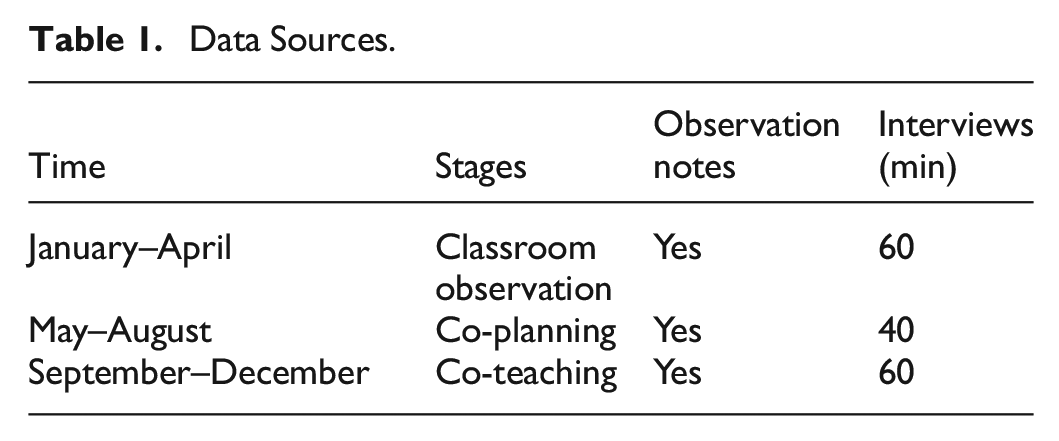
The second source consisted of classroom observation notes conducted by the researcher. Three observation note clips were selected to analyze how Teresa managed content knowledge-related issues and interacted with students, as well as how Teresa and Victor collaborated to integrate language and content during co-teaching. These three clips came from co-teaching phases. Additionally, the research assistant engaged in several informal discussions with Teresa to aid in formulating interview questions and providing detailed descriptions, including Teresa’s educational background, English teaching experience, and her motivation for participating as an ESP teacher in the collaboration.
Table 1 outlines the entire process of the study. From January to April, Teresa observed Victor’s class for four times, during which she acquired essential content knowledge. This phase could be seen as a preparatory stage where Teresa established a foundation in content knowledge. From May to August, they spent 4 months engaging in co-planning, during which they prepared and discussed the design of Teresa’s ESP class and worked on exercises together. This phase could be viewed as the middle stage of their collaborative preparation. Finally, from September to December, they began co-teaching for three times. This period represented the core stage, where significant progress was made in their collaboration. The researcher made comprehensive notes at each stage, and interviews were conducted following each step. Teresa’s responses during the interviews, as well as her interactions with Victor and the students in the classroom, were used to verify interpretations of her understanding of integration.
Since thematic analysis (TA) is a widely used method for qualitative data analysis (Braun & Clarke, 2006), it was chosen as the primary approach for analyzing both the interview data and classroom observations. This process was carried out manually by highlighting hard copies of the transcripts. First, the researchers familiarized themselves with the entire dataset and took notes on key aspects of the participants’ understanding of collaboration, their challenges, suggestions, and other relevant issues. An initial list of collaboration-related ideas was then created using coding, with similar codes grouped together to remove redundancies. In the second phase, all coded data from the first phase were organized into categories and themes relevant to the research questions. In this study, data extracts were coded to identify emerging themes related to various aspects of Teresa’s development in integrating language and content knowledge through collaboration, which was the central focus of this study. In the third phase, the initially generated ideas were reviewed and renamed. To ensure clarity, all themes developed in the second phase were reassessed, and their final names were carefully verbalized for accuracy. Table 2 presents a brief example of the codes, categories, sub-themes, and themes derived from all phases of data analysis.
The Process of Initial Coding to Final Thematic Categorization.

Ethical Considerations
In the absence of a formal ethics committee, participants were informed about the study and signed the consent forms. Additionally, permits were obtained from both participants and the school administration to allow the researcher to observe classroom settings. Prior consent from participants was also sought before disclosing any information to third parties when reporting the findings. Ethical considerations also extended to potential time commitments and stress for participants during data collection, particularly during classroom observations.
Regarding positionality, since the participants are colleagues of the main researcher, they may have concerns about how the study could affect their future interpersonal relationships with the researcher. This could lead them to feel uncomfortable during interviews or classroom observations, or even cause them to withdraw from the study partway through. To prevent any potential issues, the research objectives were clearly communicated to colleagues to ensure there were no conflicts of interest before beginning. Participants were reassured to feel at ease in providing honest and authentic data. Additionally, member checks were conducted to verify that the participants’ intended meanings were accurately interpreted, helping to avoid any bias introduced by the researcher’s positionality. Pseudonyms were also used when reporting.
Findings
First, Teresa’s understanding and attitudes in LCKI is presented with the thematical analysis of interview transcripts, which focuses on Research Question 1. Following this, three clips of specific observation notes of classroom data are examined to address Research Question 2.
Understanding and Attitude Toward LCKI
As the collaboration progressed from classroom observations to co-teaching, Teresa seemed to undergo significant shifts in her comprehension and attitude regarding LCKI.
ESP Integrates Language and Content Knowledge
In the initial phase of classroom observations, though Teresa acknowledged the necessity of content knowledge in ESP and stressed on the need for ESP teachers to familiarize themselves with content knowledge, including mastering terminologies, she insisted on her role as a language instructor who only focuses on language teaching. However, as the collaboration progressed, Teresa’s perspective shifted. Through Victor’s insights into terminologies, principles, and fundamental knowledge of the hotel industry during co-planning sessions, Teresa began to realize the reciprocal relationship between language and content. This led to her enhanced understanding of the content knowledge that ESP courses could provide students. She came to realize that ESP aims to assist students in describing content knowledge in English rather than acquiring content knowledge through English.
I can learn some basic terminologies, rules and principles in hotel industry from the classroom observations, which can enhance my ESP teaching and my teaching confidence. However, I realized that I didn’t have to grasp all of them in-depth. For me, my task is to help students describe them in English, not teach them content knowledge in English (Teresa).
The experience of co-teaching served to deepen Teresa’s comprehension of the integration of language and content knowledge. She gradually realized that they didn’t hold equal significance. Teresa reiterated in the final interview that language continued to exert a dominant influence in classroom instruction, but language and content knowledge can be well integrated.
Before the collaboration, I worried about my qualification because I didn’t have any hotel industrial experience at all. I think to gain such content knowledge may need a long time. In fact, I’m just a language instructor. Students are in the middle. They have neither good language knowledge nor sufficient content knowledge. So, teaching language and providing them language support to help them describe the content knowledge is my dominant task, while content teachers can illustrate them that complex content knowledge (Teresa).
Figure 1 shows Teresa’s developing understanding and attitude toward the relationship between language and content knowledge for an ESP teacher.

Teresa’s developing understanding and attitude toward LCKI in ESP context.
Figure 1 illustrates the evolving perspective of an ESP teacher regarding the relationship between language and content knowledge. At the initial stage, while content knowledge remains essential, the focus of teaching for an ESP instructor primarily centers on language proficiency. Transitioning to stage 2, there is a shift in focus toward integrating language and content knowledge effectively, emphasizing the need for strategic integration rather than language emphasis only. The final stage highlights the predominant role of the ESP teacher as a language instructor, with language teaching taking precedence over content knowledge, but integrating well.
Victor, the content teacher, also developed a growing understanding and perspective on the relationship between language and content knowledge. Figure 2 illustrates the stages of Victor’s evolving awareness of LCKI, visually emphasizing the reciprocal nature of collaboration and how both teachers’ attitudes and practices change over time. His development further highlights that collaboration is a shared learning process, providing a more comprehensive view of how each participant both influences and gains from the partnership.

Stages of Victor’s evolving awareness of LCKI.
Figure 2 illustrates the evolving perspective of Victor on the relationship between language and content knowledge. In the initial stage, Victor perceives content knowledge as unquestionably more important and dominant over language knowledge. However, in the second stage, through the collaboration with Teresa, he gradually develops an emerging appreciation for language and recognizes its value. He comes to understand that language and content are interconnected, influencing and benefiting each other. By the third stage, Victor actively integrates content and language and becomes an advocate for their combined approach.
ESP Supports Students in Gaining International Industry Insight
Teresa’s evolving understanding and attitude in integrating language and content led her to perceive herself primarily as a language instructor and also as a facilitator of content knowledge, rather than a specialized content teacher. Initially, during classroom observations, Teresa rejected the notion of being accountable for students’ content-related challenges. In the initial interview, she emphasized her role as a language instructor, stating, “I am a language teacher… My responsibility is to impart grammar knowledge and analyze sentence structures.”
As the team teaching progressed, Teresa increasingly recognized her role as both a learner and facilitator of content knowledge in the presence of her students. This aligns with the assertion made by Coleman and Albertson (2021) that ESP teachers are primarily language instructors but should possess knowledge of subject content as well. Teresa expressed her apprehension about co-teaching with the content teacher, noting, “It would be stressful for me…I need to be very cautious to avoid misunderstanding content knowledge…I should position myself as a learner of content knowledge, while demonstrating how English can enhance their understanding in that field.” Interestingly, Teresa acknowledged her role as a facilitator of content knowledge but not as a content teacher: I am a language teacher primarily and don’t have any hotel industrial knowledge, nor the experience. So, I don’t have to pretend I know everything. I’m just a content knowledge learner, but I should make my students realize that I can help them open their eyes and obtain an international insight toward their industry. Collaboration is a good way to solve the content knowledge problem. What I need to focus now is to help them to identify the language features in hotel industry and develop their abilities to gain international cutting-edge information. As for the practice of content knowledge, the content teachers are much better than me. However, the collaboration needs support from the school (Teresa).
ESP Shifts from Language Focus to Content-Aware Instruction
Teresa’s evolving perception of her roles in ESP also impacted her stance on content knowledge matters. Initially, adopting a perspective typical of a language teacher, Teresa was somewhat indifferent to and uninformed about her students’ future practical needs during the early stages of classroom observation. However, as she recognized her role as a facilitator of content knowledge, Teresa became more attuned to her students’ practical requirements and endeavored to create authentic scenarios and design activities tailored to their needs based on industry demands. Teresa occasionally corrected errors related to content knowledge during their practice sessions. This aligns with Sukying et al. (2023) that ESP teachers need to have sufficient content knowledge in specific areas to teach effectively, which presents a new demand and challenge for them. Nevertheless, Teresa stated that while occasional corrections on simple content aspects were manageable for her, providing professional explanations of content knowledge or sharing firsthand industrial experiences was beyond her expertise. During the classroom design phase for practical scenarios based on needs analysis, Victor offered Teresa numerous suggestions, as Teresa highlighted: Initially, I focused on teaching grammar and analyzing language structure, particularly those language norms and language exam skills. However, I noticed that ESP classes asked for more. My class should beyond language and create real scenarios according to students’ future needs. So, Victor and I jointly designed some activities, like role play, to help them practice the occasion when they have the reception task of foreign customers. Victor gave me a lot of advice to help me realize what the students really need and what they may encounter in their future career development (Teresa).
ESP Encourages Smart Use of Illustration to Enhance Content Understanding
From the beginning, Teresa translated the content knowledge parts in her lectures into Chinese, believing that students would struggle to understand without Chinese explanations. Moreover, she lacked familiarity with the terminologies herself, making it difficult to describe them in English accurately. In the interviews, Teresa noted that “I think the role of some Chinese translation of content knowledge is irreplaceable, so that students can fully understand the meaning.” Students were also encouraged to provide Chinese illustrations during their oral presentations to aid comprehension of complex content knowledge. She emphasized the importance of using Chinese to ensure full understanding among students. Teresa’s preference for using Chinese exclusively in class may have stemmed from her concerns about students’ comprehension of content knowledge and her unfamiliarity of content knowledge description. Over time, as Teresa embraced her role as a learner and facilitator of content knowledge, she gradually transitioned to using English exclusively, even during content instruction, as she mentioned in the final interview “With the help from Victor, I accumulated more terminologies and clarify more about the basic industrial principles, so I have confidence and try to express them in English to students.” There was also an observed increase in students using English to describe content knowledge and deliver presentations. Eventually, students adapted to receiving content knowledge exclusively in English without requiring much Chinese illustration. However, as PCK involves teachers taking pedagogical strategies tailored to students’ learning processes and the intricacies of curricular content (Chen & Wei, 2015), Teresa recognized that the appropriate use of Chinese could alleviate cognitive burdens in students’ understanding of complex content knowledge. She expressed “Now I realized that make a balance is necessary. We can use English as often as possible, but Chinese illustration is also necessary if necessary.”
Manifestation of Teresa’s LCKI Development
Teresa’s evolving LCKI significantly improved her pedagogical approach, as illustrated in this section. This is to answer research question 2 that “How did the ESP teacher’s LCKI manifest during a 1-year collaboration experience?” Drawing from observation notes, three teaching episodes from various stages are provided to demonstrate shifts in Teresa’s teaching methods.
Teresa’s LCKI Development in Observation Stage (Stage 1)
Episode 1 represents the initial stage of Teresa’s LCKI development, demonstrating that at this observation stage, she clearly maintains an entirely language-dominant perspective in ESP teaching.
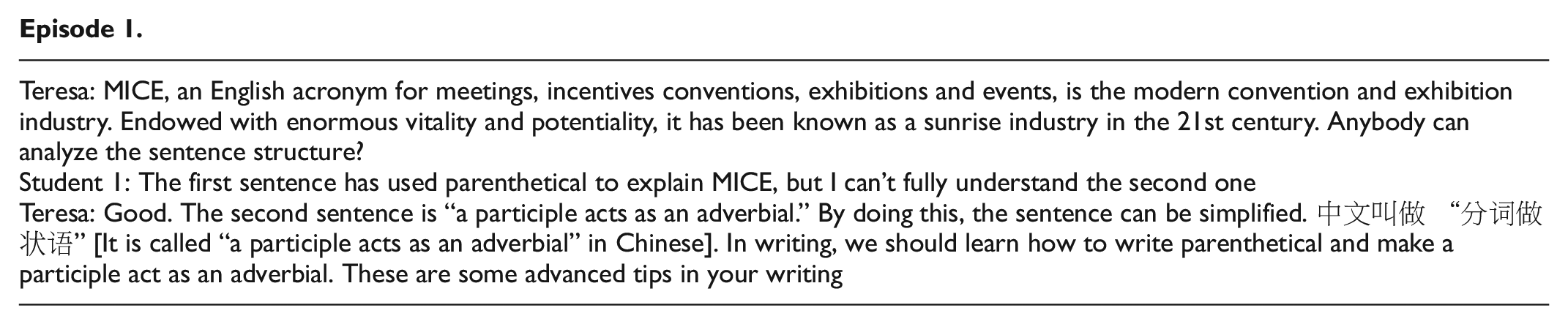
In this particular instance, at the beginning of the collaboration, Teresa engaged Student 1 in analyzing sentence structure. Despite the presence of numerous tourism-related terms unfamiliar to students, such as “MICE,”“incentives conventions,” and “endowed with,” Teresa proceeded directly to analyzing sentence structure without providing explanations for the new vocabulary or introducing the background. Her focus remained solely on elaborating grammar, disregarding the importance of content knowledge. This episode highlights Teresa’s initial perception of her role strictly as a language teacher and her lack of consideration for students’ content understanding.
As Teresa’s grasp of LCKI developed, she broadened her explanations to encompass content-related concepts and acknowledged the importance of directing students to articulate emerging tourism-related trends in English, such as “MICE.”
Teresa’s LCKI Development in Co-Planning Stage (Stage 2)
Episode 2 represents the second stage of Teresa’s LCKI development, showing that during the co-planning period, she gradually acknowledges the significance of content knowledge in ESP teaching and begins to develop an appreciation for it.

In Episode 2, Teresa introduced a practical exercise aimed at simulating a real-working scenario at the start of the co-teaching phase. The exercise involved guiding students in designing an itinerary. Teresa structured the exercise to align common tourism-related vocabulary with content knowledge in tourism. As depicted in the episode, Teresa not only guided students through the exercise but also supplemented their learning with additional information, such as considering customer preferences and providing attentive services. This episode illustrates how Teresa’s writing exercise, coupled with her timely additions, offered students opportunities to practice content knowledge.
As the co-teaching session neared its end, Victor took on the role of assisting with content when it became necessary to clarify a complex structure that could hinder comprehension of the content matter.
Teresa’s LCKI Development in Co-Teaching Stage (Stage 3)
Episode 3 takes place during the third stage of Teresa’s LCKI development, namely the co-teaching period. In Episode 3, Teresa presents several images illustrating the process of a turn-down service and subsequently prompted students to discuss their comprehension of the concept.
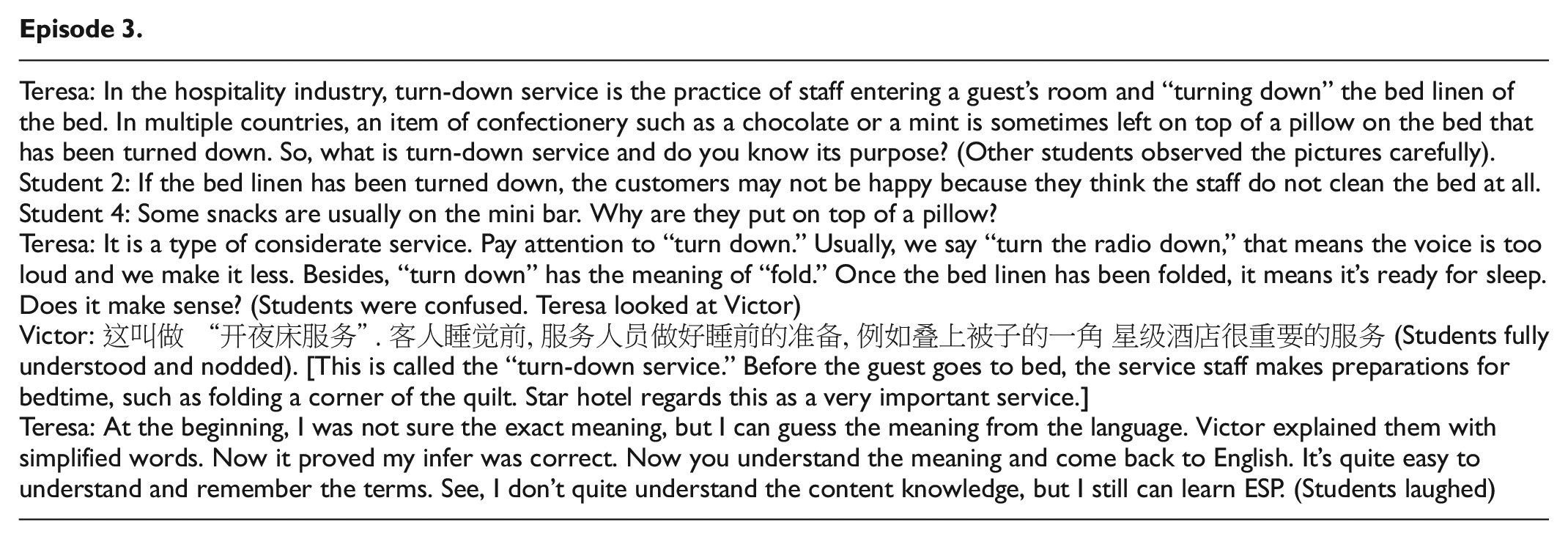
Episode 3 illustrated Teresa’s keen awareness of the students’ understanding and response of the content terms. Despite lacking explicit content knowledge, Teresa inferred meanings from language cues and capitalized on the presence of a content teacher. When two students struggled to comprehend the concept of “turn-down service,” Teresa asked for Victor’s assistance, who then served as a content knowledge aide by offering explanations in Chinese. Towards the end of the episode’s end, Teresa reflected on her approach in information processing, highlighting the importance of integrating language and content knowledge while also encouraging student to think in English. Interestingly, the evolving dynamics between the two teachers prompted Victor’s immediate provision of content knowledge support.
Discussion
This study investigated a single instance of collaborative ESP teaching and its impact on Teresa’s LCKI development and pedagogical methods. Teresa demonstrated significant shifts in her remarks (as indicated by interview data) and classroom approach, underscoring the significance of different levels of collaboration between language and content teachers in potentially enhancing effectiveness (Xu & Zhang, 2022). Teresa’s LCKI development is described in the following subsections:
Stage 1: Role Shift from Language Instructor to Content Facilitator
Through team teaching, Teresa’s integration of LCKI underwent significant development. She viewed the transition to her role as a facilitator of content knowledge, expressing her belief in the interviews as “My class should beyond language and create real scenarios according to their future needs.” Initially, Teresa perceived ESP teachers as lacking in-depth knowledge of specific disciplines, unfamiliarity with specialized terminology, and having insufficient learning of industry demands (Siddiq et al., 2019) since they are primarily language teachers and do not know the subject content very well (Coleman & Albertson, 2021). Consequently, she prioritized language instruction, seldom identifying opportunities within ESP courses for students to acquire content knowledge practice.
Stage 2: Embracing Collaboration and Industry-Oriented Perspectives
As classroom observation progressed to collaborative planning and teaching, Teresa gained a deeper understanding for the mutually beneficial collaborative approach. She came to recognize that it is necessary to have the skills to adjust teaching strategies due to the various teaching purposes and contents in ESP (Hu, 2019). In other words, Teresa gradually recognized the practical significance and insights that ESP could offer to students, becoming increasingly aware of her potential role in fostering students’ international perspectives within their specific field and more attuned to their real industrial needs.
Stage 3: Integration of Language and Content Through Collaboration in ESP
As the co-teaching process progressed, the strengthening relationship and mutual trust between the two teachers during classroom interactions facilitated Teresa’s increasing acknowledgment of the dynamic fusion between language proficiency and content expertise. In addition, she gained increasing attentiveness to students’ feedback concerning the challenges they face in understanding the content knowledge. When there arose a necessity to illustrate complex terminologies to support ESP learning, Teresa and Victor would assume their separate roles—Teresa as the language instructor and Victor as a content knowledge aide—underscoring the classroom as a pivotal arena for ESP instructors to integrate language and content. This proved the significance of collaborative efforts in ESP teaching (Chaovanapricha & Chaturongakul, 2020). The shift in instructional practices demonstrated that Teresa’s engagement in team teaching contributed to her nuanced understanding that collaborative endeavors between language and content teachers make full use of the complementary skills of each other, thereby jointly enhancing learning outcomes (Lasagabaster, 2018). In this process, content teachers could enrich language instructors’ comprehension of content knowledge, while language teachers could assist in overcoming language barriers for content teachers to some extent (Pei & Milner, 2016).
More notably, Teresa came to realize that ESP entails merging language instruction with specific content objectives, as stated in College English Teaching Guidelines 2020. ESP aims to assist students in articulating their content knowledge in English, rather than teach content knowledge. Teresa also held the view that, ESP instructors, as highlighted by Mulyadi et al. (2020), encounter difficulties in effectively integrating language pedagogy and content knowledge to meet the diverse professional needs of students, where the importance of Chinese translation and explanation in aiding both students’ understanding and teachers’ communication of intricate topics, as emphasized by Maxwell-Reid (2017), cannot be underestimated. Teresa’s development of LCKI and the evolution of her teaching practices can be understood through the sociocultural perspective, which claims that each stage of development paves the way for the next (Ngo, 2018). Victor’s frequent informal discussions with Teresa and the clear explanation of the terminologies during classroom observation prompted her to reconsider her potential role as a facilitator of content knowledge to address the diverse professional needs of students, as suggested by Mulyadi et al. (2020). Consequently, the improved LCKI empowered Teresa to merge language and content knowledge and collaborate with Victor, thereby maximizing the efficacy of ESP programs more effectively (Xu & Zhang, 2022). Through collaborative planning sessions, their comprehensive exchanges highlighted the importance of content knowledge support in practice and inspired Teresa to design exercises centered on real-world scenarios. Similarly, these pedagogical content activities during co-teaching solidified Teresa’s LCKI and her recognition of appropriate use of Chinese translation and explanation for students’ better acquisition of content knowledge. Notably, despite the co-teaching being a normal step in teaching, it significantly contributed to the development of Teresa’s content knowledge and teaching confidence. As a result, collaborative team teaching, as advocated by Lasagabaster (2018), leverages the complementary strengths of language and content teachers to enhance learning outcomes jointly. To satisfy such demands, the training of ESP teachers in China need to be approached in a goal-oriented and sophisticated manner (Luo & Garner, 2017).
Conclusion
Numerous studies have examined the integration of language and content knowledge within the ESP context by engaging with various disciplines. The literature review has highlighted that independent teaching by language teachers, as well as content teachers, along with cooperation, collaboration, and team teaching, are common practices adopted in different regions around the world.
In this study, within an ESP context, there seems to be a significant disparity between the intended language objectives and the specific disciplinary learning objectives. Additionally, ESP teachers, primarily language instructors, often prioritize language proficiency over content knowledge acquisition, despite the necessity for familiarity with content matter (Coleman & Albertson, 2021). They may lack awareness regarding the importance of selecting content aligned with students’ objectives and evaluating student learning outcomes (Zaghar & Wafaâ Zaghar, 2021). As a result, this study explores the integration and collaboration between language teachers and content teachers in ESP settings and emphasizes the importance of creating specialized interest groups within different departments to promote cooperation. This approach could lead to improvements in language skills, content expertise, and teaching methods (Pei & Milner, 2016). Undoubtedly, a close collaboration between language and content teachers is essential for the effectiveness of an ESP program (Lasagabaster, 2018). This study also emphasizes the implementation of collaboration in ESP contexts, proposing that it can bring about significant changes for both language and content teachers. It promotes mutual learning, fosters appreciation for each other’s expertise, and helps ESP teachers build confidence while overcoming challenges. Such collaboration could prove to be an effective strategy for enhancing ESP teachers’ LCKI and improving the effectiveness of ESP instruction. Moreover, it can broaden their understanding of their educational roles (Xu & Zhang, 2022). The collaboration can also prompt the school to construct the standard and system. However, the successful execution of team-teaching hinges not only on the involvement and initiative (Tao & Gao, 2017) between language instructors and content teachers, but also largely on the support from universities due to the considerable factors involved in team teaching (Doiz et al., 2019).
It is crucial to recognize that team teaching operates as a bilateral process (Pei & Milner, 2016), wherein content teachers also reap benefits. This study recognized the role of content teachers in providing and designing industry-based teaching practices. Moreover, it suggests a novel approach to considering the development of content teachers by prompting them to reconsider their potential contributions within ESP and how to cultivate students’ international perspectives within specific domains. Besides, content teachers can gain deeper insights into language proficiency for describing content knowledge and gain international perspectives within their specific fields, thereby enriching their English Medium Instruction (EMI) lessons.
Finally, it is worth noting that this study gathered qualitative data, the richness of which could have been further enhanced with broader participation from lecturers across various departments or from multiple universities. However, the gathered responses provide a thorough understanding of participants’ viewpoints and attitudes toward ESP teachers’ LCKI through collaboration. They also present opportunities for collaboration and highlight the benefits between teachers specializing in content and language (Doiz et al., 2019).
Footnotes

Ethical Considerations
This study was approved by the School of Foreign Studies, Guilin Tourism University Research Ethics Committee on September 10, 2022. (Reference Number: 0002).
Consent to Participate
All participants provided written informed consent prior to participating.
Consent for Publication
Not applicable.
Funding
The author(s) disclosed receipt of the following financial support for the research, authorship, and/or publication of this article: This work was supported by the Doctoral Research Fund provided by Guilin Tourism University. This work was also supported by Universiti Teknikal Malaysia Melaka (UTeM).
Declaration of Conflicting Interests
The author(s) declared no potential conflicts of interest with respect to the research, authorship, and/or publication of this article.
Data Availability Statement
Data sharing not applicable to this article as no datasets were generated or analyzed during the current study.