




Abstract
This study investigated the development of the integration among EFL student-teachers’ PCK components during a 16-week mentoring-enriched practicum course. Data were collected from three EFL student-teachers using the content representation, follow-up interviews, and classroom observation. These data were then analyzed using the PCK Mapping approach. The findings revealed that the interplay among PCK components was fragmented initially but gradually integrated by the end of the course. Notably, the component concerning instructional strategies emerged as the most frequently engaged element in this integration process. Conversely, knowledge of purposes for teaching English exhibited the fewest interactions with the other PCK components. Based on the findings, practical implications pertaining to improving student-teachers’ instructional practices in teacher education programs are discussed.
Introduction
Waves of educational reforms have progressively complicated and challenged the profession of teaching (Mu et al., 2018; Subramaniam, 2021). To keep abreast of innovative policies, enact new curricula in classrooms, and accommodate learners’ diverse interests, teachers are required to develop a special type of knowledge that secures quality teaching. For this purpose, an essential and specialized knowledge that professionalizes the act of teaching is PCK, a special amalgamation of content and pedagogy that empowers teachers with pedagogical reasonings and experiential repertoires for teaching specific subjects (Shulman, 1986; Shulman, 1987). Since its inception, PCK has been acceptably viewed as an overarching conceptual tool for revealing the complexities of teachers’ instructional practices (Chan & Hume, 2019; Gao et al., 2021). Its critical role in shaping instructional quality and the positive effect it has on student learning has been well identified (Hume et al., 2019; Subramaniam, 2021). While the definition and construct of PCK vary according to different research agendas, researchers agreed that PCK is a dynamic construct that involves integrating different knowledge components coherently (Nilsson & Loughran, 2012; Park & Chen, 2012). Therefore, PCK is dependent not only on what the constituent components are but also on how and to what extent those components are interconnected. Although the interrelatedness among PCK components is vital, researchers have focused on how a single PCK component develops and how to advance that development (Chan & Hume, 2019).
Emerging arguments and evidence have shown that to perform quality instruction for specific students in a particular context, teachers should have an adequate command of all PCK components and be able to integrate those components coherently (Park & Oliver, 2008b; Van Driel et al., 2002). Considering the importance of a coherent and integrated PCK, it is important to explore how all PCK components are interconnected in a way that enables the entire PCK structure to function for facilitating student learning. However, tracing the research stream on PCK, there were few studies investigating the nature and development of PCK components integration. Even in the few studies on this topic, the subjects were mostly beginning or experienced teachers. Very limited studies have focused on student-teachers’ integration of PCK components. It is generally known that student-teachers have fragmented PCK and need special support and guidance to stimulate their ability to incorporate PCK components (Aydin et al., 2015; Lee et al., 2007; Oztay et al., 2023). Considering PCK development essentially begins in teacher education programs, there is an implicit hope that each student-teacher will integrate the PCK components effectively when necessary support is provided. However, to the best of our knowledge, how various opportunities (e.g., teaching practice, explicit PCK introduction, mentoring support) provided in teacher education courses enhance student-teachers’ ability to integrate PCK components has not been meticulously examined.
Furthermore, of the little efforts to delineate the interplay among student-teachers’ PCK components, most were carried out in the domains of science and mathematics. There is a paucity of research investigating how PCK components interact with each other in the English as a foreign language (EFL) teaching context. Unlike other disciplinary domains, EFL teaching is more distinctive as the subject matter of language teaching and the medium of instruction are the same (Evens et al., 2018; König et al., 2016; Liu et al., 2022). The scarcity of studies on the interaction among student-teachers’ PCK components and the unique feature of EFL teaching suggest that research on the interrelations among EFL student-teachers’ PCK components is worthy of in-depth investigation. In this regard, this study aims to investigate the nature and development of the integration among PCK components within the context of student-teachers’ learning experiences in teaching English during a practicum course. The research question that guided this study was: How does the interplay among all components of EFL student-teachers’ PCK develop throughout a mentoring-enriched practicum?
Literature Review
Evolution of PCK Conceptualization
L. S. Shulman (1986) was the first to address the notion of PCK as a central element of teacher knowledge. PCK refers to a sense of knowing how particular subjects, problems, or questions are simplified and reconstructed in a way that is easily understood by different levels of learners. (Shulman, 1987). Shulman originally identified two facets of PCK: (1) knowledge of representations and instructional strategies; and (2) knowledge of students’ learning difficulties.
Inspired by Shulman’s work, many educational researchers have conceptualized PCK in various discipline contexts including English (Grossman, 1990), Mathematics (Marks, 1990); and Science (Gess-Newsome, 1999). Some scholars further elaborated and extended the concept of PCK according to their own beliefs, experiences, and empirical studies and then added more complexities to the notion of PCK by introducing more components to its original construct, such as knowledge of the purpose of teaching the subject matter, curriculum knowledge (Grossman, 1990), assessment knowledge (Tamir, 1988), orientations toward teaching subjects (Magnusson et al., 1999). With new PCK components identified, many scholars argued that PCK is not a mere addition of its constituent components and suggested that the different PCK components might interact in complicated ways, and those interactions ought to be studied (Abell, 2008; Nilsson, 2008).
The dependencies among the components of PCK were first identified by Grossman (1990), who argued that there was a reciprocal relationship between different domains of knowledge for teaching. Then, Cochran et al. (1991) proposed that PCK involves the transformation of different knowledge components, and these components are so integrated and interconnected, should not be treated as separated knowledge bases. Likewise, Fernández-Balboa and Stiehl (1995) claimed that it is not the isolated involvement of one PCK component, but rather the interconnection of all components that ensures quality instruction. Magnusson et al. (1999) also highlighted that the interrelations among PCK components are significant and the lack of a coherent relationship may be problematic for teachers’ professional development. However, they organized the five PCK components in a linear way and only exhibited the hierarchical interrelations between orientations toward science teaching and the other four PCK component. In contrast to the linear PCK model, a pentagonal model of PCK was proposed by Park and Oliver (2008a), with an emphasis on the reciprocal interactions across all five constituent elements. Their work conceptualized PCK as an integration of two or more constituents, and argued that the extent of the integration among PCK components indicates the teaching proficiency.
Understanding each component thoroughly can serve as a gateway to promote our development of PCK. However, many scholars admitted that increased knowledge of one single component may not simultaneously enrich the integrity of the entire PCK construct (Gao et al., 2021; Norville & Park, 2021; Park & Oliver, 2008a). Strong PCK requires all PCK components to connect consistently and function as a whole to scaffold student learning. This synergistic view of PCK components calls for more research on the interrelatedness among PCK components than on each single component (Chan, 2022; Park & Suh, 2019).
Research on Integration Among PCK Components in Teaching
Studies to explicate the interplay among PCK components have been carried out in three major approaches. The first one focuses on how a singular PCK component affects another component. For instance, Padilla et al.’s (2008) research reported on how the instructors’ different orientations toward science teaching impacted their implementation of instructional strategies regarding a particular topic. Cohen and Yarden (2009) found that teachers’ insufficient understanding of curricular knowledge limited their approaches to teaching a biology topic. The second approach investigates how a particular component might influence the entire PCK construct and actual practice. Park and Oliver (2008b) suggested that teachers’ knowledge about students’ understanding (especially about misconceptions) significantly affected the quality of PCK. Similarly, Monte-Sano and Budano (2013) argued that the Knowledge of learners, specifically attending to learners’ ideas about framing history, seemed to be a prominent factor that influenced novice teachers’ enactment of PCK.
The third approach tried to reveal the integrative aspects and complexities of PCK through exploring how individual constituent parts connected with others to organize and structure PCK. Park and Chen (2012) explored the nature and dynamics of the integration of five PCK components through analyzing four biology teachers’ video teaching episodes. To delineate the interplay, they utilized a PCK Mapping approach to visually represent the interactions among PCK components. The constant comparison of PCK maps resulted in some common features which were: the integration of PCK components was idiosyncratic and topic-specific; knowledge of learners was substantially linked to the knowledge of instructional strategies; The assessment knowledge had the fewest linkages to other components. Similarly, Suh and Park (2017) mapped out and enumerated the interactions among PCK components concerning three experienced science teachers’ sustained utilization of an innovative teaching approach. In addition to the features revealed in Park and Chen’s (2012) research, new patterns of interactions were identified in this study, for example, orientations to teaching science specialized for a new approach played a pivotal role in arranging the interactions between PCK components. Ottogalli and Bermudez’s (2024) research also confirmed the profound impact of orientations toward science teaching on guiding teachers’ decisions about curriculum content and students’ understandings. Conversely, Wu et al. (2018) found that business English teachers’ orientation toward Business English teaching was an implicit PCK component, which was not closely related to other PCK components and did not function actively in BE classrooms.
Unlike the aforementioned studies, there were few studies investigating student-teachers’ ability to incorporate PCK components during their teaching practices (Aydin et al., 2015; Oztay et al., 2023). Aydin et al. (2015) observed three chemistry student-teachers’ instruction of reaction rates and drew pre-and-post-PCK maps to portray their development of the interactions among PCK components. They found that the integration among PCK components was idiosyncratic; the most robust connections occurred between the curriculum knowledge and other PCK components; the assessment knowledge was the least interacting component. In a similar vein, Oztay et al. (2023) studied with four chemistry student-teachers to portray the integration among their enacted PCK components in the chemical equilibrium topic. Besides similar findings revealed in the study of Aydin et al. (2015), this study emphasized that knowledge of instructional strategies was maximally incorporated into PCK construction.
The evidence reviewed here opened a fruitful avenue to understanding the interrelatedness among PCK components of beginning and experienced teachers. Further studies need to be carried out to investigate how student-teachers’ integration of PCK components develops in different discipline areas, especially in the EFL teaching context. However, EFL student-teachers usually have weak PCK (Aydin et al., 2015; Lee et al., 2007). In addition to supporting and enhancing student-teachers’ ability to connect PCK components, it is vital to diagnose the components that they may have difficulty incorporating into PCK while enacting instruction on a particular topic. To address this gap, this study aims to investigate how the interplay among EFL student-teachers’ PCK components developed during a practicum course.
Conceptual Framework
In this study, the PCK model for EFL teaching was adopted as the conceptual framework, which was developed from a thorough analysis of domain-general PCK, and various efforts to elaborate on the content-specific subcomponents of EFL teaching (see Figure 1). Although PCK has been categorized and constructed in multiple ways, many researchers have tried to identify the central components constituting PCK in different subject areas and then explored how these components incorporate together to organize PCK (Park & Chen, 2012). Based on existing studies on PCK (Grossman, 1990; Magnusson et al., 1999; Park & Oliver, 2008b; Wu et al., 2018), the five PCK components used in EFL teaching are (1) knowledge of the purposes for English teaching (knowledge and beliefs about the goals and objectives for teaching English and the use of language); (2) knowledge of instructional strategies for English teaching (knowledge of implementing specific strategies appropriate for English teaching); (3) knowledge of learners in English teaching (knowledge of learners’ prior knowledge and difficulties in learning English); (4) knowledge of English curriculum (knowledge of setting the instructional goals and sequencing curriculum materials); (5) knowledge of assessment of English learning (knowledge of methods of assessment and dimensions of English learning to assess). Given the integrative nature of PCK, this PCK model for EFL teaching underscores the interrelatedness of all five components, as depicted by the two-way arrows in Figure 1.

The PCK model for EFL teaching.
Considering EFL teaching is closely related to context-specific issues, such as cultures, schools, and individual attributes, this framework also emphasizes the role of context, which could amplify teachers’ perceptions and purposes of teaching, impact their instructional decision-making, and thus mediate students’ learning (Carlson & Daehler, 2019; Gess-Newsome, 2015). As EFL teaching is both a linguistic and educational enterprise (Johnston & Goettsch, 2000), it makes the PCK model, with its five components, a useful framework for explicating EFL teaching where language teaching and student learning occur.
Methods
Context
The context of this study was a 16-week mentoring-enriched practicum course, which is compulsory for EFL student-teachers who enrolled in a 2-year postgraduate program at X Normal University. The Normal University is a public institution of higher education specifically dedicated to the training and development of teachers. In this practicum course, certain methods (e.g., explicit PCK introduction, the use of CoRe matrix during instructional practices), and opportunities (e.g., teaching practices, mentoring support) were included to improve their PCK. At the beginning, the university instructor explicitly explained the PCK framework for English teaching and the format of CoRe matrix, which served as conceptual tools to stimulate student-teachers’ meaningful learning about English teaching. Then, student-teachers were encouraged to understand the teaching profession, school, classroom environment and learner profiles. To this end, they were placed at the collaborating local schools for 1 week each month, in total 4 weeks for one semester.
These 4 weeks of teaching practices focused on improving student-teachers’ instructional practice, namely, the planning, enacting, and reflecting upon an English lesson. During the process, student-teachers were instructed to search various content resources pertinent to a specific topic, and then transform their comprehension of the curriculum content into a lesson plan for subsequent implementation. Their pedagogical reasoning, simulated and authentic enactment, actions of deliberate reflections and evaluation were all facilitated by PCK framework and the CoRe matrix, which were initially introduced in the course. In this way, student-teachers were exposed to various PCK components and learn to incorporate them in their instruction for a particular English topic. Besides the university instructor, each student-teacher was also paired with a supportive secondary school mentor, who assisted them in developing a deeper understanding of the teaching content, recognizing target students’ prior knowledge and fostering disciplinary talk about the problems of teaching practices.
In addition to teaching practices at local schools, student-teachers had a 1.5-hr instructional session each week at the university. In these sessions, they learned some theories and rationales concerning English teaching, reflected upon their school experiences, and discussed how to conduct the teaching activity with their instructors and peers. With the collaborative mentoring of university instructors and secondary school mentors, student-teachers were guided to use their PCK and learned to incorporate PCK components to create proper instruction.
Participants
A purposeful sampling approach was adopted in the study to select information-rich cases (Patton, 2002). Three EFL student-teachers who were Year 1 postgraduate students in a 2-year teacher education program at X Normal University taking the practicum course during the 2020 to 2021 fall semester, participated in this study. They are two females and one male, and their demographic information was presented in Table 1. These cases were purposefully selected for the following reasons: (1) they agreed to participate in the study and cooperate with researchers actively; (2) they are all high-achieving students who excelled at the postgraduate entrance examination and performed better in the micro-teaching at the entry to the program; (3) they varied in gender, educational backgrounds, and practicum schools they are placed in. Given the above conditions, these three participants were considered “information-rich” cases as they could provide more insights for understanding EFL student-teachers’ representations of PCK.
The Demographic Information of the Three Selected Participants.

Data Collection
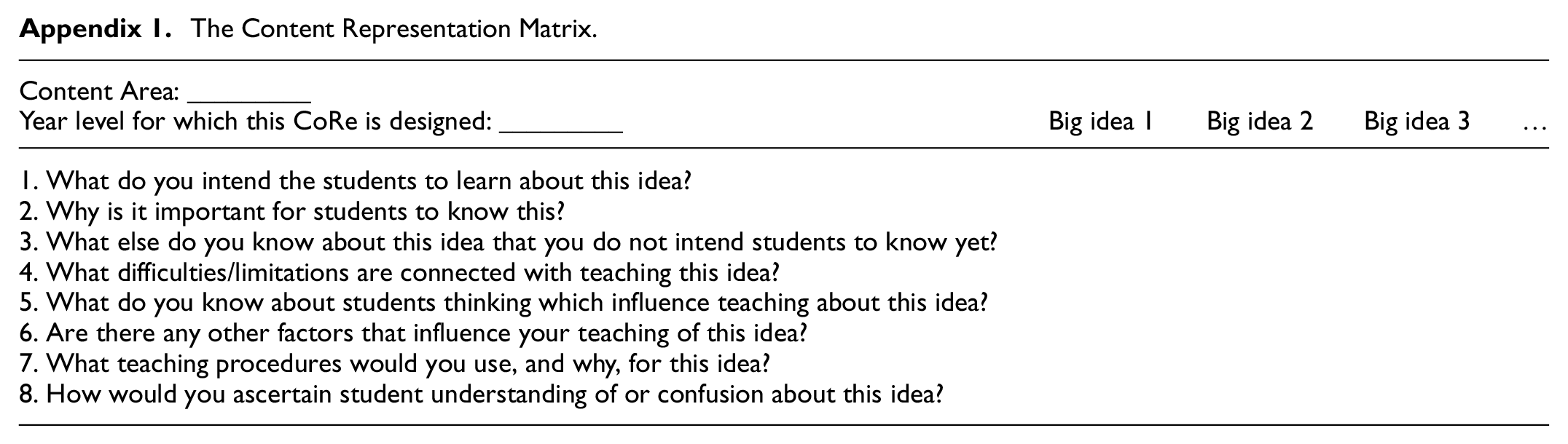
Since the research focus was on the nature and development of integration among PCK components within the context of student-teachers’ instructional practices during a practicum course, approaches to elicit, portray, and measure the construct of PCK were needed. Accordingly, we collected data mainly through the Content Representation (CoRe) matrix, follow-up interviews, and non-participant observations. The CoRe matrix (Loughran et al., 2004) was a widely applied instrument used to obtain teachers’ PCK relating to teaching a particular topic, which comprises several big ideas or concepts about a specific topic and eight framed pedagogical questions to elicit teachers’ reasoning behind instructional decisions (see in Appendix 1). Table 2 details the timeline for the data sets collected throughout the 16-week practicum course. In total, we asked participants to prepare the CoRe on the assigned topic (i.e., describe people’s looks) three times, respectively at the stages of planning, enacting, and reflecting. To ensure the accuracy of the CoRe data, further explanation and guidance concerning filling in the CoRe were accessible upon request.
Data Collection Timeline.

Each time after preparing the CoRe, a 20-min follow-up interview was conducted with each participant. Questions, for instance, “What is your purpose when you teach English? What difficulties might students experience while understanding this topic? Have you thought about the students when you decided to use this strategy or activity?,” were asked to further identify his or her purposes in teaching English and elaborate on the interactions between PCK components as elicited by the CoRe. The interviews were conducted in Mandarin Chinese, the native language of the participants, to facilitate clear and detailed communication and to ensure that the participants could articulate their thoughts and ideas with clarity and thoroughness. All the interviews were fully transcribed and translated into English by the researchers. Then, the data were sent to the participants for verification. Moreover, each participant was also told to provide instruction on the assigned topic—once microteaching session held at the university and twice authentic instructions at local schools. Although observations cannot be used to explore PCK directly, it is effective to collect evidence of each participant’s PCK integrations in the real classroom environment. Therefore, three participants’ instructional sessions were videotaped and transcribed verbatim. Supplementary data, such as participants’ lesson plans and PPTs, were also collected for data triangulation.
This study was carried out in accordance with rigorous ethical standards to ensure the protection and well-being of all participants. All the participants voluntarily attended this study by signing a consent form after they were fully informed about the research purpose, data collecting tools and their unconditional right to withdraw at any stage without penalty. Unique codes were assigned to participants to preserve confidentiality and anonymity, and to ensure that no personally identifiable information was collected or disseminated throughout the entire research process. Furthermore, all the data were securely archived and access was exclusively granted to the researchers and coders involved in this study. Therefore, ethical issues concerning confidentiality, data protection and participants’ rights were ensured.
Data Analysis
In total, we collected three CoRe responses, three interview transcripts, and three video transcripts, from each participant. To analyze the complex interacting process of PCK components, the PCK Mapping approach (Park & Chen, 2012) was adopted to portray EFL student-teachers’ PCK. PCK Mapping is an analytic device that is designed to visualize and quantify the relationships between PCK components, which was conducted following a three-step procedure: (1) In-depth analysis of explicit PCK: Informed by the conceptual framework, we first generated the categories for analyzing the data (i.e., the CoRes, interview, and video transcripts). In total, we found 10 categories reflecting all possible two-way interactions among PCK components. Considering the categories in Table 3, we searched the data to identify teaching segments that explicitly exhibited the integration of two or more PCK components. Once such a teaching segment was identified, it was then described in detail regarding what occurred in the teaching activity, the role of the teacher and students, and what components were involved. With the teaching segments identified at different instructional phases, the first author and an external coder who are experienced in English education, qualitative study, and PCK independently and thoroughly analyzed the interactions among those PCK components. The initial inter-coder agreement for the possible PCK interactions stood at 68%, and each conflict were further negotiated until an 88% consensus was achieved.
Interaction Categories for Analyzing PCK Data and Their Explanations.

(2) Enumerative approach: After identifying interactions within each teaching segment, an enumerative analysis was used to find out the frequency of connections between PCK components. We counted the interactions and created PCK maps for all participants’ PCK at different phases respectively. These maps were grounded in the PCK model for EFL teaching. Each PCK map included circles representing the five PCK components, and lines indicating interactions between the components. Once an interaction between any two PCK components was detected, a line would be drawn between the related components. For example, in a teaching segment, three interacting components (KOC, KOL & KIS) were identified and thus one connection with equal strength was recorded between any two of the three in the map as depicted in Figure 2. The PCK map suggests that the more connections between PCK components in a map, the more integrated PCK the student-teacher possessed.

Example of the first step of the enumerative approach.
(3) Constant Comparative Method: In addition to the PCK Mapping approach, the same dataset (i.e., the CoRes, interviews, and video transcripts) was analyzed through the Constant Comparative Method, which includes open coding, axial coding and selective coding, to specify the common themes and patterns pertaining to the integration among PCK components (Strauss & Corbin, 1998).
Specifically, all the data were first coded by identifying the major concepts and meanings without using any prior codes or framework. Afterward, axial coding were conducted to group these open codes into larger categories according to their similarities and differences. Finally, we performed selective coding to identify some main themes through analyzing the relationships across the established categories. After we analyzed the data for each case, a comparative analysis was also conducted to juxtapose the findings across different cases. The results from this method were then compared to those derived from the PCK map approach to ensure methodological triangulation.
Findings
To delineate how the interplay among EFL student-teachers’ PCK components developed throughout the practicum course, we constructed maps for each participant’s PCK at different instructional phases (see Table 4). The patterns that emerged from the Constant Comparative Method and the analysis of the student-teachers’ PCK maps indicated four distinct features of the interactions: (1) the interplay among PCK components was fragmented initially but gradually integrated throughout the practicum course; (2) the interplay among PCK components developed from simple to complicated; (3) knowledge of instructional strategies was the most frequently involved component in the integration, which had relatively stronger connections with other components; (4) knowledge of purposes for teaching English was the least contributing component in the integration, which had the fewest interactions with other components. In the following, the characteristics of the interactions are explained explicitly with examples from the CoRes, interviews, and video transcripts.
PCK Maps at Different Instructional Phases.

Note. 1-3  ; 4–7
; 4–7  ; 8+
; 8+
Feature 1: The Interplay Among PCK Components Was Fragmented Initially But Gradually Integrated Throughout the Practicum Course
As shown in Table 4, the participants gradually integrated more components into their PCK maps throughout the practicum course. Particularly Ela, who demonstrated a more coherently structured PCK map compared to Bill and Tina by the end of the course. However, the participants’ PCK maps at the planning stage presented more missing and irregular linkages among PCK components than those of the enacting and reflecting stages, which suggested that their initial PCK was weak, and they could not connect all five PCK components. For instance, Ela’s PCK map only revealed 13 connections when she planned for the assigned topic individually, whereas she created 24 connections at the enacting stage. After reflecting upon her authentic performance in classrooms, she added 6 more connections to the map and finally got 30 PCK connections in total. Similarly, Bill’s and Tina’s PCK connections increased from 16 to 26 to 30, and from 14 to 24 to 29 respectively (see Table 5).
The Frequency of Total Interactions Among PCK Components at Different Phases.

Notably, each PCK map at the planning stage showed that KOIS, KOL and KOC were more prevalent components in the integration. The participants rarely incorporated KOP and KOA into their PCK. However, the PCK maps at the reflecting stage revealed more interactive connections among all PCK components, suggesting that participants achieved a better understanding of all PCK components and were more able to integrate all PCK components to structure their PCK. For example, Tina’s first PCK map only included one KOP connection, but she related KOP with other PCK components seven times by the end of the practicum. Of the seven KOP connections, her KOP had relatively strong interplays with KOIS, which implies that her purposes and goals for teaching English had affected her instructional decisions about the best way to teach and learn. Specifically, in Tina’s final CoRe, she first asked students to brainstorm the key features of people’s physical appearance. After taking students’ ideas, she explained those key features by using pictures and created different scenarios in which students are required to role-play the conversations that focused on how to describe their best friends’ looks to their partners. Regarding the purpose of designing such activities for her students, Tina explained as following:
I believe that English teaching is more concerned with the development of communicative skills than with the acquisition of linguistic knowledge. Teachers should assist students to apply their language skills more effectively in everyday situations. Therefore, I want to create more activities for students to think independently and use language practically [KOP-KOIS].
Another example showing the development of an integrated PCK was noticed in interactions between KOA and other PCK components. For instance, Bill’s PCK maps revealed an improvement in connecting KOA with other components. At the planning stage, he incorporated KOA five times (i.e., with KOL and KOC), while he could relate assessment knowledge 11 times (i.e., with KOL, KOC, and KOP) at the reflecting phase, which indicated that Bill enriched his understanding upon assessment knowledge and could utilize KOA more actively than he could at the beginning. Although he has not embraced the idea that assessing student learning is a core part of language teaching, he has engaged in delivering effective assessment activities. Some product-oriented and social-contextual features of the assessment of students’ language acquisitions are embedded in Bill’s instruction. For instance, in his final CoRe, he included the objective that enables students to describe people’s looks by using the new words and sentence patterns learned. After teaching these new words and sentence patterns by giving daily life examples, he designed a “People Hunting Game” to evaluate to what degree students could describe the target person. His tendency to assess student-generated products not only addressed the teaching objective but also reached his goals and purposes for English teaching, as he elaborated on this instruction during the interview:
Students should learn to deal with daily life situations using their language knowledge. Therefore, I designed the “People Hunting Game,” which includes many situations, for example, hunting for Amy’s friends, hunting for your classmates, and helping shopkeepers and police find thieves. The game not only allows students to use the language in different situations but also reveals the possible misconceptions that need more explicit explanations [KOP-KOA-KOL].
Similar to Bill, Tina did not connect KOA and KOC in her first PCK map, whereas her knowledge of curriculum and assessment informed each other four times at the reflecting stage. In her final CoRe, she asked students to draw a mind map illustrating the key features that describe people’s looks (e.g., hair, height, build) and reveal what they know about this topic. Tina explained the underlying reason for conducting this assessment activity as follows:
I did it because one of the teaching objectives stated in this unit is to enable students to grasp the adjectives that describe people’s physical appearance. I first introduced all these adjectives by using pictures. Then, I asked students to categorize them and draw a mind map to illustrate how to use these adjectives to describe different features of people’s looks [KOC-KOA].
Tina’s example demonstrated a possible interaction between her curriculum knowledge and methods of assessment, which implied that she could use effective methods and strategies to assess what the students understand concerning the stated curriculum objectives.
Feature 2: The Interplay Among PCK Components Developed From Simple to Complicated
When all the interactions among PCK components at different instructional phases were examined, a range of complexity of the interactions was noticed. We realized that some of the integrations detected were simple whereas others were complicated. Specifically, we found that participants usually created simple integrations in that one PCK component informed another one at the planning stage, and they gradually learned to develop complicated integrations that included more than two interacting PCK components at the enacting and reflecting stages. For instance, there was a teaching objective concerning enabling students to describe people’s physical appearance in Unit 9 of the grade seventh English curriculum. To address this objective, in Tina’s first CoRe, she covered all the aspects that are included when describing people’s hair, face, build and height, and prepared a lot of pictures to illustrate those features. Throughout her instruction, she employed many specific examples, such as ponytails, oval faces, and medium build that students usually come across in their daily life. Tina also designed a “role-play” activity in which students were asked to perform the conversations that focused on describing other people’s looks. She never considered that students might have difficulties in using alternative questions led by “be” or “do” when asking about other people’s looks. At the planning stage, Tina’s instruction attempted to use appropriate strategies to help students gain a deep understanding of these big ideas, which exemplified a simple integration that her understanding of the specific curriculum objectives informed her application of instructional strategies. However, after discussing and refining the lesson with the cooperating teachers and peers, she realized that the instruction was not determined by the big ideas that the teachers considered as teaching objectives. Instead, it was being shaped by students’ thinking about the big ideas, which are their prior knowledge and learning difficulties toward learning the topic. This view influences her teaching expectations and instructional strategies. Therefore, in Tina’s final CoRe, she specifically focused on students’ learning difficulties in this teaching objective. To eliminate students’ difficulties, she retargeted the teaching objectives and enriched her instruction with more strategies, such as explanation, demonstration and discussion. This complicated interaction among these three PCK components is shown in the interview excerpt below:
When teaching those key features of describing other people’s looks, I specifically focused on students’ learning difficulties (i.e., how to use alternative questions to ask about other people’s looks). Since students cannot use these sentence patterns correctly if I do not eliminate their misconceptions and difficulties. Therefore, I refined my instruction with more explanation, demonstration, and discussion [KOL-KOC-KOIS].
Similarly, Ela also learned to construct complicated PCK integrations throughout her instructional practices during the practicum. As an example, in Ela’s first CoRe, she expressed that teaching how to write a short passage to describe your best friend’s looks was challenging to her because she was not quite sure how to incorporate the passage structure and the key features that describe people’s looks effectively into the writing activities. Consistent with this confusion, her micro-teaching focused more on introducing the features that can be included when describing people’s physical appearance than engaging students in writing activities that encourage students’ practical use of language.
However, after taking suggestions from cooperating teachers and peers, she determined to bridge students’ prior learning with the new teaching objectives. Students have learned a short passage named “An interesting job” in this unit, which described how a police artist draws pictures of criminals to catch them. She first used informal questioning to remind students of the key features that should be included when describing people’s looks. Being aware that students might have difficulty organizing those features into a new passage that describes their best friends’ looks, Ela integrated a writing sample to illustrate the structure and content of the passage and analyzed what should be included in the beginning, body, and ending parts, as described in her CoRe at the enacting stage:
Students had some background on what features should be included when describing people’s looks, but they still didn’t have the full story of how to organize them into their passage… so I introduced a writing sample to help students understand how to organize the content in different parts of the passage [KOL-KOC-KOIS].
In her authentic teaching, students were engaged in a series of writing activities in which they brainstormed ideas, analyzed the passage structure, organized the content, and generated their writing. Accordingly, her PCK map at the enacting stage reflected more connections among KOL, KOC, and KOIS. Ela’s example reflected that the knowledge of learners and curriculum functioned actively in diagnosing learners’ difficulties or problems, which further informed the application of instructional strategies.
In a similar case, Bill constructed a complicated PCK integration in one of his teaching segments at the enacting stage. To illustrate, in his second CoRe, there was a listening activity in Section B of the unit, which read “to listen and write Johnny Dean’s and Tina Brown’s jobs in the chart,” and then describe “what do they look like?.” In general, students in grade seventh might have difficulty extracting detailed information from the listening materials. To resolve the difficulties and make an evaluation, Bill designed a series of activities in which students first predict which one is Johnny Dean or Tina Brown and their jobs based on the picture provided in the textbook, then complete the chart while listening to the materials, and finally make a report describing Johnny Dean’s or Tina Brown’s jobs and looks. After class, Bill reflected on the instructional strategy choices made as to what degree they facilitate students’ understanding and remove the difficulty detected. In the final interview, he stated, “the students could recognize which one is Johnny Dean or Tina Brown based on the picture provided and they also completed the chart and described their looks correctly in the report.” This example showed that Bill’s deep understanding of students’ learning difficulties enlightened his application of instructional strategies as well as the way he assessed students’ learning.
Feature 3: Knowledge of Instructional Strategies Was the Most Frequently Involved Component in the Integration, Which Had Relatively Stronger Connections With Other Components
Another common pattern across the participants’ PCK maps was that KOIS was the central and most frequently involved PCK component in the integration. This means that KOIS played a positive role in transforming participants’ PCK into their instruction. Specifically, in participants’ first PCK maps, the frequency of connections between KOIS and KOL or KOC was similar, only Tina interplayed KOIS more frequently with KOC (i.e., six out of nine KIOS connections). Among her six KOIS interactions with KOC, her curriculum knowledge informed her use of instructional strategies all in a similar way, mainly by referring to the English Curriculum Standards and objectives stated in the curriculum to make corresponding instructional decisions. She rarely considered students’ prior knowledge and possible learning difficulties and felt challenging to judge what curriculum content to include or eliminate. Her undeveloped learner knowledge at the planning stage posed an obstacle for her to incorporate appropriate instructional strategies into her instruction.
However, interestingly, the following PCK maps showed that all participants began to place more emphasis on the connections between KOIS with KOL. To generate appropriate instructional decisions, teachers should know what the students have already learned (i.e., prior knowledge) and what they may have difficulty exploring (i.e., learning difficulties) when learning a particular topic. Therefore, the relatively strong interactions between KOIS and KOL seem natural (Park & Chen, 2012). Regarding this interaction, Bill demonstrated rich instructional strategies based on his understanding of the learner profile, such as illustrations, examples, stick drawings and pictures. For instance, he realized that students often find it challenging to describe people’s facial shapes, especially using new words such as oval, square, and round. Additionally, they have difficulties understanding the meaning of some common sayings, like pulling a long face. A quote from Bill’s CoRe indicated how he helped students tackle these problems:
I followed the 3“C” approach which includes Conveying meaning, Checking and Consolidation, to teach these new words and expressions. I first used pictures to teach those new words, then asked students to sort them into different groups, and finally designed a game about describing criminals’ looks for the police artist to consolidate their understanding [KOIS-KOL].
During Ela’s teaching segments, it could also be observed that she adjusted her instructional strategies to satisfy students’ learning needs and eliminate their possible learning difficulties. As we mentioned in Feature 2, Ela organized a discussion to brainstorm ideas and integrated a writing sample to tackle students’ difficulty in writing a new passage that describes their best friends’ looks. The connections between KOIS and KOL seemed central and frequently appeared in all participants’ PCK maps. In contrast, the interplay between KOIS and KOA was relatively weak, especially at the planning stage, there was no interaction between KOIS and KOA at all in participants’ PCK maps. Only Ela could integrate KOIS with KOA sporadically in her PCK map at the enacting stage. In this example, she connected KOIS with KOA:
I used students’ writings to check how much they have learned about the topic. However, students’ writings indicated that they still have difficulty organizing those ideas into the passage even after introducing a writing sample. With this new understanding, I redesigned this class by using peer editing… so that they could see the strengths and weaknesses of each other’s written works [KOIS-KOA].
Ela’s example highlighted that the feedback from the assessments helped teachers gauge where the students are in learning a specific topic, and thus updated their understanding of students’ developmental zone. With the updated learner knowledge derived from the assessments, the teachers could work out new strategies to better scaffold students’ learning and enrich their repertoire with effective strategies and representations.
Feature 4: Knowledge of Purposes for Teaching English Was the Least Contributing Component in the Integration, Which Had the Fewest Interactions With Other Components
When analyzing the PCK maps across different phases, we could easily observe that it was the KOP with which they built the fewest linkages. Knowledge of purposes for teaching English refers to teachers’ beliefs about the goals and objectives for teaching English and the use of language. These features of the KOP cannot be easily recognized through analyzing the PCK maps as the number in the circles only indicates if the integration was counted. During the interview, participants explicitly articulated their understanding of EFL teaching and learning and the use of language.
A close analysis of participants’ interviews revealed that all three student-teachers appeared to have similar goals and purposes for teaching English. For instance, in talking about their understanding of EFL teaching and language use, they all agreed with the view suggested in the English Curriculum Standards (China Ministry of Education, 2017) that the purpose of EFL teaching is to promote students’ English subject core competencies, more precisely, is to develop students’ language proficiency, arouse their cultural awareness, improve their thinking capacity, and enhance their learning ability. They acknowledged that language plays an essential role in teaching and learning English, which serves as both the medium of instruction and the content of language teaching. They also believed that students construct language knowledge through meaningful practices. Participants’ ideal purposes for English teaching reflected what they intended to implement, however, only a small portion of those ideal beliefs was translated into their actual instructional practices. For example, participants’ first PCK maps reported that they rarely incorporated KOP into their PCK. Only Bill integrated KOP sporadically into his PCK and linked KOP with KOL at the planning stage. The following statement from his interview is an example of the interaction between KOP and KOL:
I want to help students understand that English is useful in their personal lives. They could use it to solve problems in real life. I aim to promote the practical use of language rather than force students to memorize things. Students should learn to talk, clarify, modify, and consolidate their ideas through language practices [KOP-KOL].
However, after Bill’s first authentic instruction, he adjusted his instruction and provided more explanations of the new vocabulary and sentence patterns before carrying out the practice activities. When asked why during the interview, he explained:
In the first lesson I taught, I skipped some explanations of the new vocabulary and sentence patterns, because the content was too loaded. However, I found that it was challenging for Grade 7th students to use language correctly without a good grasp of the language knowledge. Therefore, I want to add this explanation back to my instruction to enhance students’ understanding of the new content [KOP-KOIS].
From the above statement, we can see that Bill’s beliefs about the importance of encouraging students’ practical use of language co-existed with his belief about the necessity to provide students with a body of language knowledge. Those compatible beliefs of English teaching directed his use of other PCK components, especially the KOL or KOIS.
Although Bill’s PCK maps revealed relatively strong KOP throughout the instructional phases, his KOP failed to inform his use of KOC by the end of the course. While Ela was the only one who could relate KOP with KOC at the enacting stage. Her interaction between KOP and KOC is manifested in the statement provided below:
In general, the teaching objectives in the curriculum focused more on lower levels, but there should be higher-level objectives. We should go beyond the limits of the curriculum, try to insert some new objectives, and provide additional teaching materials and documents to our English instruction [KOP-KOC].
Taken together, the understanding of the purposes for EFL teaching and language use that all participants incorporated into their instruction constitute evidence of their developing KOP. However, compared to the other four PCK components, participants’ KOP did not function actively throughout their instructional practices and was not integrated coherently to structure their PCK.
Discussion
In this study, we aimed to investigate how the interactions among EFL student-teachers’ PCK components developed throughout a 16-week mentoring-enriched practicum course and the nature of those interactions. Specifically, the study presented the following findings: (1) the interplay among PCK components was fragmented initially but gradually integrated at the end of the practicum course; (2) the interplay among PCK components developed from simple to complicated; (3) knowledge of instructional strategies was the most frequently involved component in the integration, which had relatively stronger connections with other components; (4) knowledge of purposes for teaching English was the least contributing component in the integration, which had the fewest interactions with other components. While previous studies emphasized the development of individual PCK constituents (Chan & Hume, 2019; Gao et al., 2021), this study contributed to the increasing number of PCK studies through examining the nature and development of the integration among all five PCK components and revealing the dynamic and sophisticated interacting process of PCK components in the EFL teaching context. This study also provided a deeper insight into the research on probing student-teachers’ PCK, especially in the context of EFL teaching, as they provide a rich portrayal of how EFL student-teachers incorporate PCK components during their instruction by utilizing the PCK Mapping approach, thus enriching the research on language teachers’ professional knowledge and practice.
Specifically, this study shed light on several key aspects. As shown in the findings, the interplay among PCK components developed from fragmented to integrated by the end of the practicum. It was found that student-teachers started their instructional practice with a knowledge of the separated PCK components and could not incorporate all five PCK components during their instruction. There were also some missing and infrequent integrations of PCK components in student-teachers’ first PCK maps. Since the PCK level was not determined by the existence of individual PCK components, but by the degree of internal coherence among the components (Park & Chen, 2012; Friedrichsen et al., 2009). In this regard, this finding supported the evidence from previous studies that most student-teachers have little PCK (e.g., Can-Kucuk et al., 2022; Lee et al., 2007). Therefore, student-teachers’ inadequate PCK may impede their ability to integrate PCK components at the beginning. However, with the special support and guidance provided during the practicum, our findings revealed that student-teachers gained a better understanding of all PCK components and were able to utilize them more actively than they could at the beginning. This finding aligns with the conclusion of Aydin et al. (2015) revealing that the synergistic utilization of collaborative mentoring support, explicit PCK introduction, and the CoRe matrix was effective in enhancing student-teachers’ ability to integrate PCK components.
The finding of this study also revealed that the interplay among PCK components developed from simple to complicated. Research has indicated that PCK consists of several interrelated constituent components (Magnusson et al., 1999), and it is vital to explicate the complexities of those interrelations. After examining the integrations of PCK components throughout the instructional phases, it was noticed that all student-teachers taught the assigned topic with similar curriculum materials, while the level of complexity of their PCK integrations varied. We found that when student-teachers planned for the topic individually, they were more likely to create simple PCK integrations that one PCK component informed the other, while they were assisted by the special support and guidance provided throughout the instructional phases, some of their PCK integrations become complicated that include at least two different components. A plausible reason for this finding is that student-teachers may have insufficient professional knowledge to deal with the intricate process of classroom teaching and limited teaching experience to incorporate those PCK components harmoniously. However, once their PCK acquisition was assisted by mentoring support over time, they were more likely to draw upon more PCK components harmoniously. This result is consistent with the conclusion in Norville and Park’s (2021) research, as they found a positive influence of mentors on student-teachers’ PCK especially during the planning and reflecting stages.
Furthermore, although student-teachers deploy different PCK components to respond to the same instructional event, the accessibility of individual components was not the same. As shown in our study, KOIS was the most frequently involved component in the integration, which had relatively stronger connections with other components. Homogeneous results were also found in Reynolds and Park’s (2021) research, where they concluded that KOIS is one of the most frequently integrated PCK components, with its interactions with KOL and KOA accounting for over 50% of all PCK interactions. L. S. Shulman (1986) conceptualized KOIS and KOL as core components constituting PCK, most researchers agreed with his model although their construct of PCK differs (Park & Chen, 2012). In this respect, KOIS as a central PCK component has received great attention both theoretically and practically and could be easily learned and acquired through instructional practices (Park & Oliver, 2008a). Therefore, it is reasonable that KOIS accounted for the most interactions with the other four PCK components. The relatively strong connections between KOIS and KOL can also be anticipated given that teachers are required to understand what students have learned in their prior experiences, and what they may have difficulties in learning the new topic to generate appropriate instructional decisions (Magnusson et al., 1999).
Finally, the findings showed that sometimes even though student-teachers had the knowledge component, they may lack the ability to translate their knowledge into actual practice. For example, student-teachers articulated their understanding of the purposes for teaching English and language use during the interview, however, they rarely incorporated those understandings into their PCK throughout the instructional phases, thus KOP was the least contributing component in the integration, which had the fewest interactions with other components. This finding is inconsistent with the conceptual and practical aspects of KOP when student-teachers implement their PCK, because KOP is an overarching component that filters and mediates teachers’ instructional decisions, which may have a shaping effect on the development and the application of the other four PCK components (P. Friedrichsen et al., 2011). Additionally, KOP could provide a conceptual map to guide teachers in outlining and depicting their instructional goals from a more comprehensive perspective (Grossman, 1990). However, as KOP is a cognitive concept, student-teachers may lack the awareness and experience to transform their understanding of KOP from knowledge into actual practice. Moreover, student-teachers’ KOP toward English teaching was broad and non-specific, which may also inhibit their ability to arrange the interactions between KOP and other components (Demirdöğen, 2016; Soysal, 2017). Unlike student-teachers, in-service teachers tend to possess more specific and practical teaching orientations, as their teaching experience can guide them in reflecting on their pedagogical decisions and constructing interconnections between orientations and other PCK components (Ekiz-Kiran & Boz, 2019).
Implications and Conclusion
A primary limitation of this study was that we emphasized the frequency of connections among PCK components while constructing PCK maps for EFL student-teachers. Since all the interactions between PCK components were considered to have equal strength, it was impossible to differentiate the quality of individual interactions. Such differentiation is valuable for a more precise evaluation of teachers’ integration of PCK (Chan, 2022; Park & Suh, 2019). Moreover, indicating the direction in PCK integration analysis can help researchers to better interpret the available data and determine the quality of PCK (Şen, 2023). Therefore, further studies are needed to consider both the strength and direction of PCK integration in relation to teachers’ proficiency in teaching performance across various contexts.
Several valuable implications can be drawn in relation to improving student-teachers’ instructional practices in teacher education programs. First, although student-teachers usually have weak PCK, the present study indicated that their ability to integrate PCK components could be enhanced when they are given special support and guidance in teacher education programs. Therefore, like the previous researchers (e.g., Aydin et al., 2015), we suggest that mentoring support, PCK instruction, and the CoRe matrix should be provided synergistically in order to promote student-teachers’ development of professional knowledge. Second, simple integrations that one PCK component informs the other or just a mere addition of them may be insufficient to stimulate changes in teachers’ practice (Aydin & Boz, 2013). Student-teachers should not be satisfied with the simplistic ideas of teaching and need to learn from experienced teachers who construct teaching from a complicated perspective. Third, one increased PCK component does not ensure development in the whole PCK structure. Therefore, it is necessary to consider all PCK components in professional development activities. Finally, although student-teachers could articulate their ideal beliefs, they cannot make them explicit and incorporate those ideas into actual performance. Therefore, teacher educators should provide substantial support and guidance to clarify student-teachers’ beliefs and help them transfer their ideal convictions into actual practices (Akın & Uzuntiryaki-Kondakci, 2018).
Footnotes
Appendix
The Content Representation Matrix.
| Content Area: _________ |
Big idea 1 | Big idea 2 | Big idea 3 | … |
|---|---|---|---|---|
| 1. What do you intend the students to learn about this idea? | ||||
| 2. Why is it important for students to know this? | ||||
| 3. What else do you know about this idea that you do not intend students to know yet? | ||||
| 4. What difficulties/limitations are connected with teaching this idea? | ||||
| 5. What do you know about students thinking which influence teaching about this idea? | ||||
| 6. Are there any other factors that influence your teaching of this idea? | ||||
| 7. What teaching procedures would you use, and why, for this idea? | ||||
| 8. How would you ascertain student understanding of or confusion about this idea? |

Ethical Considerations
The study involving human participants was reviewed and approved by Northeast Normal University Ethics Committee. The participants provided their written informed consent to participate in this study.
Author Contributions
All authors listed above have made substantial, direct, and intellectual contributions to the work, and approved of it for publication.
Funding
The author(s) disclosed receipt of the following financial support for the research, authorship, and/or publication of this article: This study was supported by the National Social Science Fund of China (Grant number 19BYY219) awarded to the corresponding author, Anne Li Jiang.
Declaration of Conflicting Interests
The author(s) declared no potential conflicts of interest with respect to the research, authorship, and/or publication of this article.
Data Availability Statement
The datasets generated for the study were available on request to the corresponding author.