




Abstract
Shared expertise, team teaching, and cooperation among lecturers from different fields have become more and more important in promoting learning and achieving more innovative learning outcomes in multidisciplinary universities. To increase and improve sharing expertise between teachers from different faculties and disciplines, we wanted, on one hand, to identify skills and competences that teachers have in common and, on the other hand, to find areas in which they identify that they need complementation. As a framework for this research, we applied Lee Shulman’s (1986) seven categories of teachers’ knowledge base including the theory of pedagogical content knowledge (PCK). The data were collected by group discussions. The teachers (N = 22) represented all seven faculties of Helsinki Metropolia University of Applied Sciences (UAS), that is, Business School, Civil Engineering and Building Services, Culture and Creative Industries, Health Care and Nursing, School of Information and Communication Technology (ICT), Industrial Engineering, and Welfare and Human Functioning. The data were analyzed using theory-based content analysis. According to our data, the mutual core competence of a teacher is the capacity to interact effectively. It is a basis for shared expertise. Interaction skills are necessary in collaborative construction of knowledge as students, teachers of different fields, and their partners inside and outside the organization co-operate. Multidisciplinary co-operation among colleagues also helps to maintain subject matter knowledge, as it supports peer learning and encourages everyone to move out of their comfort zones.
Keywords
Background
Interdisciplinarity will become more important in both research and education in the future (Melin et al., 2015). Knowledge is seen as socially constructed through shared acts of collaboration that cut across disciplinary borders. The importance of shared expertise has increased when more effective and innovative learning is pursued. Working in teams with members from different fields can only be successful and innovative if team members have the ability to apply knowledge and transfer it to new contexts. In the context of our research, we define shared expertise as interprofessional collaboration and communication among the participants to enable them to achieve together what they could not have achieved alone and so that new fields of skills and know-how can be reached.
The focus of this research is on the shared expertise of the teaching staff of Metropolia University of Applied Sciences (UAS), which caters more than 16,000 students and 1,100 staff members in 64 degree programs. Shared expertise is very much needed because the aim of Metropolia UAS as a multidisciplinary university is to give students the possibility to take advantage of multidisciplinarity so that they can build their degree on a broad basis by combining studying in different degree programs in a useful and innovative way. The majority of courses are 5 to 15 credit units (ECTS), and 2 to 5 different subjects have been combined to form courses so that subject matter knowledge as well as generic skills can be integrated in a more profitable way. Team teaching is exploited in these extensive courses.
The aim of this research is to enhance shared expertise—find a way to build networks over different faculties and disciplines and promote collaboration between them. To reach this goal, we want to interpret, understand, and describe the knowledge and competence of lecturers from different faculties and disciplines both comprehensively and in terms of cross-disciplinary knowledge bases. As a theoretical framework for this research, we applied Lee Shulman’s (1986, 1987) seven categories of teachers’ knowledge base including pedagogical content knowledge (PCK) as metaknowledge. This theoretical framework has been successfully applied in a large number of researches concerning a wide range of educational contexts such as mathematics and physical sciences, engineering, nursing, law, languages, and arts (Ball, Thames, & Phelps 2008; Fernández-Balboa & Stiehl, 1995). Shulman’s theory offers a useful framework by which a teaching profession can be studied and described as well as developed (Abell, 2008; Kind, 2009).
Theoretical Framework
At the end of the1980s, Lee Shulman (1986) outlined the categories of knowledge necessary for teachers to successfully promote student learning and understanding. The idea is that there is a vast difference between mastery of certain subject matter and concepts and phenomena related to it, and knowing how to teach these issues (Bucat, 2005). Teaching is essentially about promoting learning and in doing so, combining one’s professional knowledge about an issue, concept, or phenomena with one’s pedagogical knowledge and achieving in consequence the ability to explain these in a way that is understandable to students (Shulman, 1986, 1987). In the context of UAS, subject matter knowledge encompasses a rigid working experience in the industry, health care, and social services or business life (Savander-Ranne, 2003). It also consists of up-to-date scientific knowledge.
Thus, the work of a teacher needs other dimensions in addition to subject matter knowledge and pedagogical knowledge. Nate McCaughtry (2005) extends teachers’ knowledge to encompass the knowledge brought to the learning environment by the student. This is consistent, as pedagogical principals inevitably include the learners as active participants in the learning process instead of their being a passive recipient of information. Inevitably, the learning process is also influenced by the learning environment itself (Abell, 2008; Bishop & Denley, 2007; Loughran, Berry, & Mulhall, 2006; Shulman, 1986).
To form a comprehensive picture of a teacher’s profession, we apply Shulman’s (1987) seven categories of knowledge using the specifications named above, modified to a UAS environment including knowing, know-how, skills, and mastery of subject matter as well as the competence brought about by a solid experience in the working life. As Vanessa Kind (2009) argues, teaching, learning, and the learning process are multidimensional, dynamic, and continuously developing. There is a continuous and dynamic interaction between different elements (Cochran, de Ruiter, & King; Kansanen, 2009). Isolating an element is only possible in research, not in real life. Our specific definitions of the seven elements are the following.
The social foundation of education comprises knowledge of learning goals, purposes, social meaning, and historical background. This knowledge helps to understand the significance of a specific field in a social context as part of a larger entity (Bishop & Denley, 2007; Shulman, 1987). Martha Nussbaum (2010) argues that Western societies have changed so that nowadays, education is a tool for the gross national product instead of giving students the capacity to be democratic citizens both of their own nations and of the world. Government policy and the financing of educational institutions influence how learning environments are developed (Shulman, 1987). This leads, for example, to questions of what kind of technology will be available in the learning environments (Mishra, Koehler, and Henriksen, 2011).
The focus of learning is dependent on the current societal context. The needs of society tend to influence the design and content of curricula. Curricula direct our learning goals and content as we strive toward both self-realization and welfare of society (Shulman, 1987). It is the duty of the student to learn the contents of the curriculum. The curriculum also forms a framework for the teachers (Kansanen, 2009). Sharon Fraser and Agnes Bosanquet (2006) have examined the various perceptions of curricula among academics. Some academics perceive the concept curriculum equivalent to syllabus (e.g. Stark & Lattuca, 1997).
Knowing the target group along with subject matter knowledge and pedagogical know-how makes up the teacher’s core knowledge and competence (Ball et al., 2008) and helps to promote a good teacher–student relationship and to take into account the students’ special needs and skills (Shulman, 1987). Knowledge about students encompasses their characteristics, attitudes, self-directed learning readiness, self-efficacy, learning styles and strategies, among others.
Grossman, Wilson, and Shulman (1989) mean by subject matter knowledge the mastery and structuring of content that is taught, and thus, this means the same as content knowledge. For example, this means understanding what kinds of challenges comprehending the concepts of the subject matter brings to the learner. Lee Shulman (1987) defines general pedagogical knowledge as knowledge about learning in general, the learning environment, broad principles and strategies of classroom management, and so on, without linking it to any specific subject matter. Pedagogics refers to the skill to guide and instruct the learner. According to European tradition, pedagogics is more about understanding the relationship between teaching and learning so that it promotes the learner’s growth and development than merely about teaching (Loughran et al., 2006).
What is PCK? Combining pedagogics and subject matter knowledge encompasses structuring an issue or phenomenon, and organizing and applying this knowledge so that it is understandable to learners with diverse backgrounds, levels of prior knowledge, skills, and motivations. It is a question of presenting subject matter to the learner in a comprehensive way (Shulman, 1987). According to Keith Bishop and Paul Denley (2007), combining pedagogics and subject matter knowledge, that is, PCK, is comprehended as metaknowledge.
Our assumption is that it is easier to share expertise if teachers know how their colleagues from different faculties and disciplines describe their own knowledge and competence. Therefore, we identify how teachers regard their profession as educators in the Finnish society given the circumstances and environment in which they work; how they structure their subject matter knowledge, pedagogics, and the combination of these two; and how they perceive the learning process. We want to know what they think about (a) the social foundation of education, (b) the learning environment, (c) curricula, (d) teacher–student relationship, (e) subject matter knowledge, (f) pedagogics, and (g) combining pedagogics and subject matter knowledge.
Materials and Method
Twenty-two academic teachers from all seven of Metropolia’s faculties participated in group discussions for this research in 2012-2013. All teachers had a teaching experience of at least 3 years. The participants were from the faculties of Business School, Civil Engineering and Building Services, Culture and Creative Industries, Health Care and Nursing, School of Information and Communication Technology (ICT), Industrial Engineering, and Welfare and Human Functioning. We had altogether seven group discussion sessions, and the participants of each group represented teachers from the same faculty but mostly from different degree programs. They represented 17 of Metropolia’s 64 degree programs. The participants in the groups were of heterogeneous professional background, which we hoped would help them have an active, open, and unprejudiced dialogue. However, a heterogeneous background might keep the discussion at a more lightweight level, which we hoped to avoid, as well as avoid possible differences of meaning in the participants’ conceptual vocabulary. Thus, we compiled the groups so that the overarching factor of each group was the faculty they represented. The specialist fields of the participants were structural engineering, building services engineering, information technology, industrial management, automotive and transport engineering, electrical engineering, health informatics, radiography and radiotherapy, biomedical laboratory science, midwifery, oral hygiene, occupational therapy, physiotherapy, social services, fashion and clothing, design, pop and jazz music, and business administration.
To get an extensive data, we organized group discussions for the participants of the degree program. We preferred group discussions to interviews because in group discussions, the participants inspire each other. The interaction between group members becomes more vivid in group discussions, as the members can use the flow of the discussion to ask questions and define their own views. There were two to four participants in each discussion session. The role of the facilitator in these discussions was minimized. The facilitator was in charge of all participants gaining equal chances to express their opinions, and that the discussion would follow the assigned themes.
We had four themes for these group discussions. The themes were chosen on a broad basis and were typically issues of interest in developing the quality of teaching in Metropolia UAS but also with a connection to the categories of knowledge presented by Shulman (1986, 1987). The first theme was about the lecturers’ own work, how they perceive the culture of the environment in which they work, and how they perceive the future evolution of the fields in which they work. A further theme dealt with a teacher’s academic knowledge and career trajectory. The third theme was about the changes in subject expertise, which are inevitable in higher education. The fourth discussion theme dealt with the experience of belonging and engagement, being able to influence your work, and the organizational support framework. We got permissions to record the group discussions. The transcribed data included 134 pages.
We used theory-based content analysis to analyze the data (Mayring, 2002; Strauss & Corbin, 1998). Our analysis was directed by Shulman’s theory. The content analysis followed accurately the following format: (a) reducing the data, (b) regrouping the data, and (c) interpreting and making conclusions on basis of the data (Miles & Huberman, 1994). We started out our analysis by reading the transcribed data thoroughly several times. We divided the data into separate areas and then reorganized it according to how the expressed views related to Shulman’s seven categories. Some of the data were discarded at this point due to its irrelevance. We used words, phrases, and whole sentences when compiling the data for analysis. After that, we created main categories and secondary categories under the theory-based themes by varying the use of an inductive and deductive approach. Then we used an abductive approach. This enabled us to gradually build up further information around the core we had established. Our work resulted in the creation of a categorized interpretation of each of the seven teacher’s knowledge fields with main categories and sub categories. The main categories are presented in Figure 1.
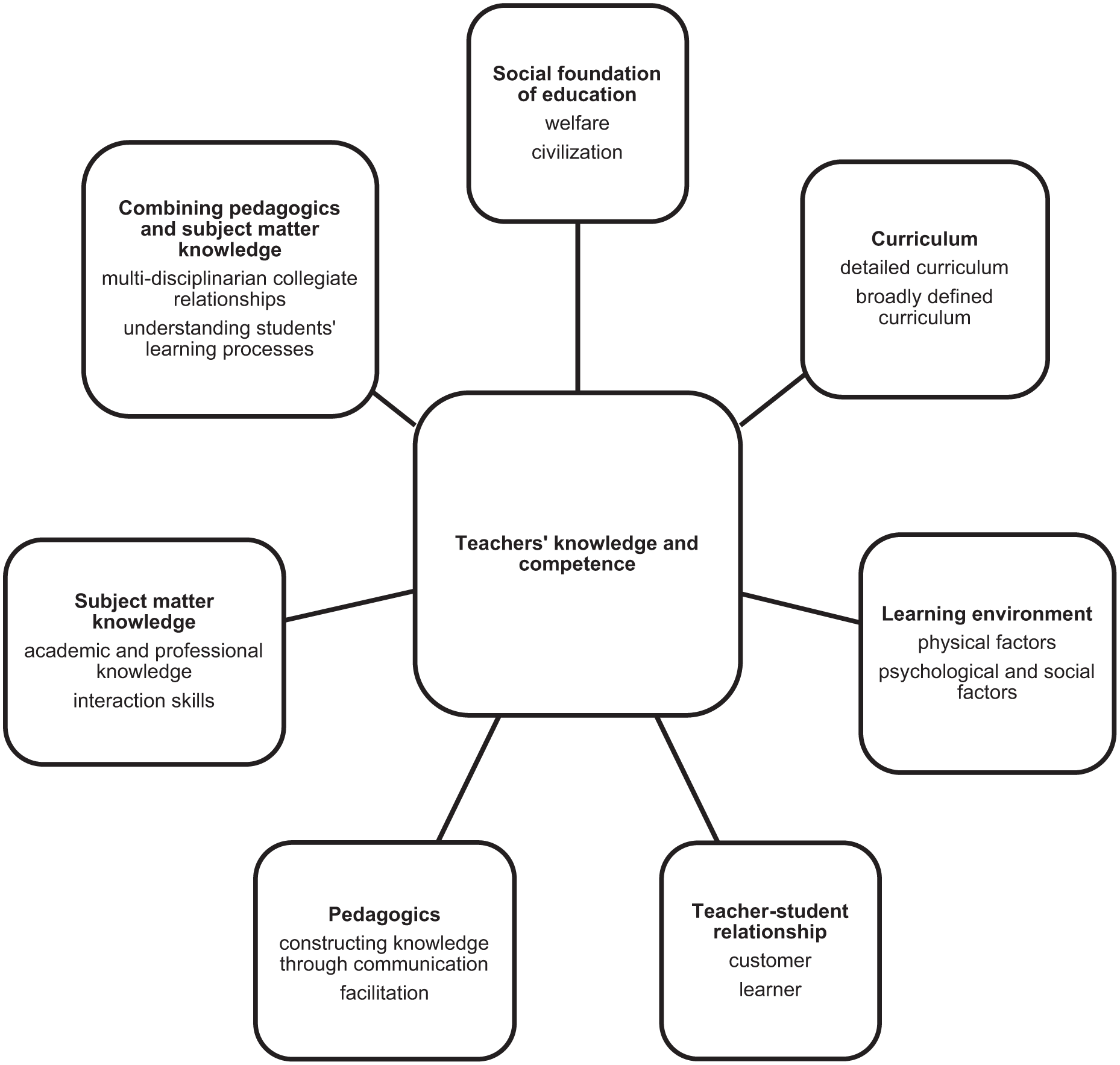
Main categories of a teacher’s knowledge and competence at a multidisciplinary university of applied sciences.
Results
According to our data, the social foundation of education lies on teachers’ possibilities to promote welfare. The participants discussed the instrumental value of a lecturer’s work. They seemed to have an increasingly multifaceted outlook on welfare as the general population becomes more and more heterogeneous. This can be seen in the diversity of the students’ backgrounds and the internationalization of higher education. The diversity of the organization presented itself as multicultural, although the degree of diversity varied to some extent according to different faculties and degree programs. However, as a whole, diversity seems to be overtaking uniformity. This is why there from time to time seems to be certain ethical conflicts. Ensuring the efficiency of an educational institution, with its struggle for funding and the aim of equipping graduates with the necessary professional competences, is not always an easy job.
According to the participants, a teacher’s duty in the society also has a wide educational aspect. Civilization was in this case defined as special knowledge and know-how of your own specialty field, which for its part complements the necessary knowledge and know-how needed in society. There is, however, always a risk that in trying to foresee future demands, the knowledge and competence students possess when graduating do not anymore meet the needs of society, industrial, and business life in the best possible way. However, civilization was seen as a wide perspective of your own field, where it is quite natural to see how your own special field is linked to other fields. This furthers better confidence when approaching future challenges instead of insecurity when facing the changes in society.
According to the data, on one hand, the curriculum should be detailed for three main reasons: Previously acquired knowledge by students can be recognized and acknowledged, special and common features of the content of each degree program are easy to identify, and co-operation between degree programs is more easily facilitated. On the other hand, a detailed curriculum will lead to tension because teachers have their own ideas about content and methodology and, at times, wish to incorporate them into the curriculum. Regarding society in general and the needs of the labor market in particular, change is the norm. This can have a significant influence on a lecturer’s ideas about how to apply the curriculum.
I don’t follow the curriculum, I apply it in a way I see as most beneficial in view of the needs of the industrial and business life. (Participant 17)
A broadly defined curriculum allows a teacher’s own applications and experiments better than a rigidly defined one. This brings the lecturer a greater sense of freedom.
I need some kind of latitude, something reflecting what life today is for our young students. (Participant 6)
A broad curriculum also supports co-operation among faculties and enables integration of instruction and flexibility for students to enroll on courses of other degree programs.
The participants divided the learning environment of the university into physical and psychological factors (Table 1). A physical factor is the campus and how it is perceived as a meeting place, where one can discuss and challenge thoughts and opinions in a safe atmosphere with one’s peers. The premises of partner organizations and enterprises and other interest groups were seen as suitable arenas for communication. In terms of physical factors, elements that affect our everyday routines and processes were also emphasized. These include the act of identifying and giving recognition to students’ previously acquired knowledge. If one can take action due to a need rather than an externally imposed obligation, it is an intrinsically more valuable motivation for gaining knowledge. Not to waste resources, the participants suggested we create new systems and processes to store and access tacit knowledge.
The Lecturers’ Perceptions and Structuring of Their Learning Environment.

The psychological factors dealt with the concepts of belonging and excessive workload. Not having a sense of belonging can suffocate an individual, while working together often enhances a person’s performance, providing him or her a greater sense of respect among his or her peers. The feeling of being able to offer ideas and influence the course of events varied considerably depending on which degree program the participant represented. To mitigate the sensation of overwork, leadership style plays an important role; the older you get, the more important delegation of tasks and assignments becomes. When delegating, greater emphasis should be placed on work distribution and the suitability of certain tasks for older members of faculty, allowing them to focus more on research and development and guiding younger staff members. Ensuring the health and well-being of faculty members should be of high priority. The trend toward an ever-increasing workload can overwhelm the individual and stifle creativity. It was also widely expressed among participants that the failure to fulfill a growing workload could be a strong contributor to the sense of inadequacy.
The teacher–student relationship is challenging because students of a multidisciplinary UAS are heterogeneous: Individual students are very different, but we can also identify cultural differences . . . among engineering students we see a clear orientation towards problem-solving and goal-achievement. Students are also strongly performance-driven, they want to learn and move on. On the other hand, in the faculty of cultural and creative industries students tend to be more reflective. They also tend to discuss different issues for longer periods and argue different viewpoints more readily. (Participant 13)
There have been debates over the issue as to whether students are “customers” or “learners.” Some of the teaching staff perceive their students as customers and others as learners. When the student is seen as a customer, the focus is on the mastery of the teaching process. The course content stipulates the activities, and the main goal is the student’s graduation. The graduates are the justification for a teacher’s work. The teachers approach the learning process mainly through themselves. The focus is also, to some extent, on the system and the organization when the student is perceived as a customer. This seems to help in distinguishing the overlaps in the courses and advancing co-operation within the organization. Moving on from teaching toward learning, promoting know-how, and understanding the learning process is described by one of the participants in the following words: If I think of myself, at the beginning of my career I focused quite a lot on teaching but the more experienced I have become, the more I try to focus on the learners and their progress. (Participant 15)
When perceiving the student as a learner, the teacher accepts that the learning process is not always predictable. Learning, however, becomes the central focus of all activities. Learning is defined as mutual knowledge construction in which the learner, the teacher, the industrial and business life, and the working life in general interact. It is widely recognized that the goal of learning is an increase in knowledge and competence. The teacher’s enthusiasm is of great value in the process, and when the student is perceived as a learner, the learning process is seen as a coherent whole. A variety of student learning outcomes are acceptable, and their individual attributes are valued. Teachers also take an active interest in student welfare (see Table 2).
Categories of the Teacher–Student Relationship.

The participants’ perceptions of subject matter knowledge were divided. On one hand, perceptions refer to the background, comprising of academic and professional knowledge, including professional work experience, and on the other hand, they refer to the importance of interaction and interpersonal or “soft” skills. The academic and professional backgrounds obviously ensure knowledge of the subject matter of the course and mastery of the applications related to the areas the course covers. Subject matter knowledge is usually achieved by supplementing academic studies by working in the industrial or business world or in some other field related to ones’ special field. It can also be supplemented through experience in the international business environment. The participants drew attention to the development of their professional skills, and this issue seems to be a cause for concern among the teaching staff at Metropolia UAS. Academic studies ensure critical thinking, which is especially valuable in project learning, innovation projects, and other development projects. Opinions were expressed about how diverse a teacher’s role can be: In the end, subject matter knowledge isn’t necessarily the most important thing, the skills you need may differ from what your own field of expertise is. (Participant 10) A teacher’s role is to arouse questions, promote reflection and curiosity and the need to find answers and solutions. (Participant 6) . . . . but in the end, I think we all (3 participants) agree that mastering our subject matter is a core competence for teachers. (Participant 7)
According to the participants, interaction skills are built through professional co-operation within the organization and with partner organizations and networking all in all. Interaction was seen as an excellent opportunity to exploit one’s specialist knowledge and know-how. Another factor of interaction skills is the talent of guiding. This we can see in tutoring skills, the capacity to empathize with students’ concerns and preoccupations, and the encouraging attitude toward students, which help them perform beyond their own expectations. An additional skill is the ability to guide students in the direction of co-operative learning: a teacher–student and student–student learning process. Participant 17 noted that you can’t do learning if you don’t know how humans function. (Participant 17)
Pedagogics was seen as the skill of constructing competence through communication, as well as the skill of facilitating. That is the skill of creating an enriching and constructive environment for learning.
I have thought that maybe I should try to create more openness, more guiding, facilitating or something like that. (Participant 11)
Participants pointed out that, in addition to university premises, the world of industry and business is also an appropriate arena for communication and knowledge construction. When operating in these environments, pedagogical skills manifest themselves through an attitude of encouragement, openness, equality, and the capacity to co-teach.
According to the participants, facilitating the learning process consists of three factors: professional education, a proficient use of teaching technologies, and the ability to take full advantage of what the group brings to the learning situation. The aim of professional education is the growth of professional identity, which includes an enthusiastic attitude, the ability to motivate and inspire, and a demonstration of humanity and warmth toward the learners. Regarding educational technology, the characteristics of the student group and mastery of subject matter and phenomena were seen as highly significant factors influencing how we utilize such technology.
The participants mentioned combining subject matter knowledge and pedagogics as an essential part of a teacher’s know-how in a UAS context (Table 3). There were differences among the degree programs in how these were emphasized; in some degree programs, the pedagogical matters were given more weight than subject matter issues and vice versa. When discussing combining subject matter and pedagogical content matter, the participants stressed the importance of multi-disciplinarian collegiate relationships among faculties, as well as understanding the differences in students’ learning processes. This multi-disciplinarian relationship includes peer learning among colleagues and recognizing the similarities and specialties of colleagues, in their courses as well as in the whole community. This is made possible through working across faculty boundaries and team teaching, which can foment pedagogical experimentation as well as the transfer of specialist know-how across degree programs. All of us have our own conceptions of how people learn—our data indicate that there was a questioning attitude toward these conceptions: There’s no way I will accept that we “teach.” I actually believe we are mutually constructing knowledge and know-how. (Participant 9)
Teachers’ Perceptions on Combining Pedagogics and Subject Matter Knowledge.
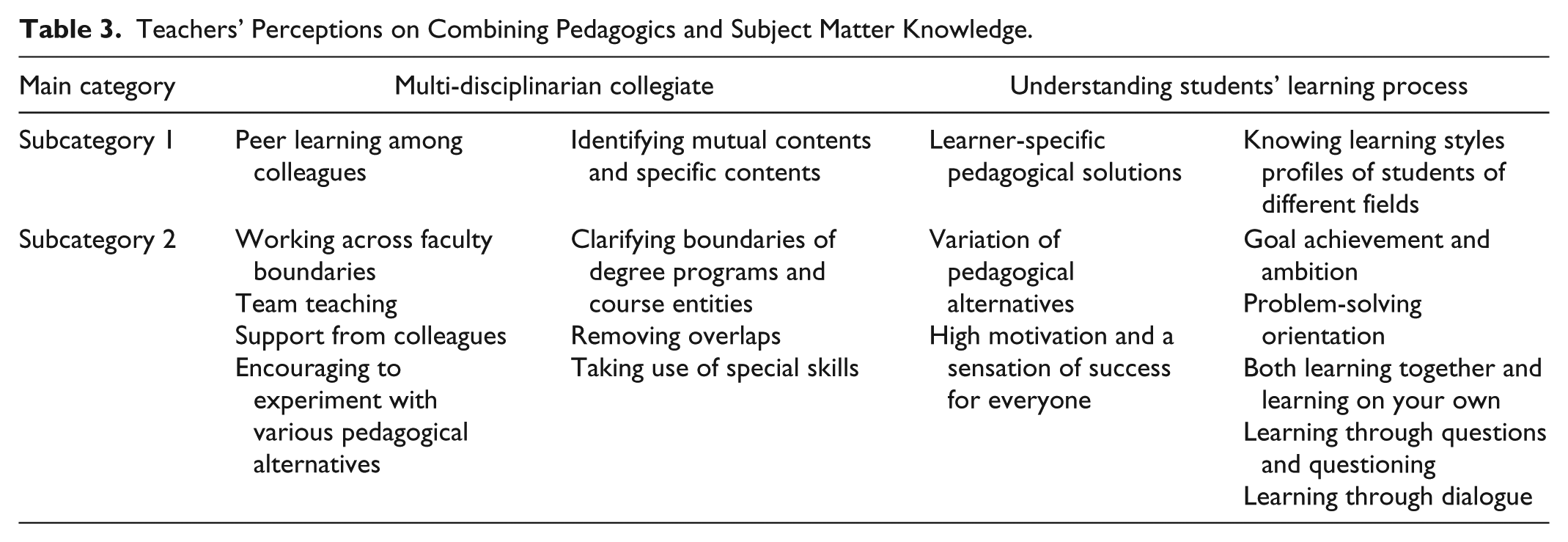
According to the participants, understanding the learning process of various students could be seen as their ability to differentiate the instruction and vary the pedagogical solutions depending on what suits the learner. Thus, the students could have assignments that fit their learning process, and optimal learning outcomes could be achieved in class, as well as high motivation and a sensation of success. In a UAS, this calls for knowledge of the students’ prior knowledge, learning styles and strategies, and self-directed learning readiness among others. The participants’ adaptive agility and capacity to adjust their teaching style can be seen from comments such as the following: When you said you changed all your teaching all at once, unlike you, I haven’t been able to change all my teaching at once. I have only tried experimenting doing it in another way in one course. (Participant 20)
In the following section, we will discuss our findings on teachers’ knowledge and competence in view of earlier research carried out into the subject. In particular, we will make reference to studies on the Finnish higher education learning environment and relating the discussion to this context.
Discussion
The mutual core of a teacher’s skill to promote learning is the combination of good subject matter knowledge and the ability to present an issue or phenomenon in a way that is easy to comprehend (Shulman 1986, 1987). Teachers with different backgrounds defined pedagogics as professional skills composed of the following attributes: communication skills; interpersonal skills; ability to motivate, inspire, and activate students; skills to facilitate mutual construction of knowledge; and the ability to work in diverse learning environments (see Etkina, 2010; Mishra et al., 2011). These generic skills are widely transferable, but subject matter is obviously context-specific.
Pamela Grossman, Hammerness, and McDonald (2009) have stressed the significance of coaching and facilitating in teaching. The change from transferring knowledge toward showing students how to find knowledge and apply it is necessary. Change is so rapid in post-industrial society that certain knowledge can be outdated by the time a student graduates (Barrett & Green, 2009). Creating and sustaining circumstances that are enriching, and building a constructive atmosphere are founded on educational skills and the ability to use teaching technology proficiently and adapt one’s teaching according to the target group (Mishra et al., 2011). Educational skills can be identified in our data as having emotional intelligence when interacting with students (see Virtanen, 2013). The work teachers do with students is targeted at guiding them toward their own personalized adaptation of the curriculum. The positive dependency on one another engenders a support framework, which makes up the basis of collaborative learning (Repo, 2010).
According to our results, the most important elements of a teacher’s work are co-operation when constructing, de-constructing, and re-constructing knowledge; planning together; team teaching; and a fundamental grasp of the student’s learning process (Johnson & Johnson, 2009; Savonmäki, 2007). To a certain extent, interpersonal skills were perceived important vis-à-vis subject matter knowledge, because good networking is an effective way to keep one’s knowledge base on a particular subject as up-to-date as possible. Saara Repo (2010) discusses collaboration in the context of university teaching and development. In addition, Johanna Jauhiainen (2013) argues that a teacher’s knowledge base and competence develop through collaboration. Pasi Savonmäki (2007) points out that collaborative teachership calls for a leadership style, which heavily involves participation by and consultation with the body of the teaching staff.
Comparing our data with that of Kimmo Mäki (2012), we did not discover a dichotomy between teachers who participate in research and development projects (R&D) and those who only teach in the classroom. In his studies among teaching staff, Pasi Savonmäki (2007) could identify dynamics between an individualistic approach and collaboration. In comparing our results with his studies, we could see a distinct preference for social interdependence rather than maintaining an individualistic approach and a reluctance to collaborate.
In the attitude toward students, a slight polarization could be sensed. Some teachers approached learning from their own particular perspective, seeing students as customers. These teachers perceived their own role as experts of subject matter knowledge. The result is easy to understand because many universities operate as a corporation. However, Martha Nussbaum (2010) argues that this kind of developing may undermine humanism and democracy in society. Moreover, according to Stephen Marglin (2008), thinking like an economist may undermine co-operation and social interdependence. The other group of teachers saw the students as, foremost, learners. These teachers emphasized the importance of accumulated knowledge about human beings and about the learning process. These results are coherent with results of Anita Malinen (2003). She has researched a teacher’s responsibility from an epistemological, existential, and ethical point of view. Altogether, it is clear that the knowledge and know-how that students bring to the learning environment will, at its best, promote learning. This should be taken advantage of by educators (also McCaughtry, 2005).
Developing the curriculum seemed to generate the most controversy in our data. According to the data, the optimal curriculum should be both detailed and broad at the same time. A detailed curriculum can be justified by the prospect to easily recognize and acknowledge prior knowledge and skills and a greater potential to evaluate similar and common features in other degree programs and courses. However, a detailed curriculum can also lead to educators using a curriculum of their own if they perceive that the official one does not meet the needs of the rapidly changing society and industrial life. A broadly formulated curriculum increases freedom to apply it according to how one sees fit under the circumstances. In a society, where competition for students among educational institutions is ever greater, a broad and loosely defined curriculum in many degree programs can limit the chances of attracting students, as it may be seen as being insufficiently focused. There are also certain degree programs, such as Building and Construction Engineering, Electrical Engineering and Health Care and Nursing were a certain competence is very strictly defined and this does not leave much space for adaption by the educator or for changes in the curriculum. An undoubted strength of a broad curriculum at a multidisciplinary university is that it allows for the mixing of student groups from different degree programs and to integrate teaching. According to Liisa Kivioja (2014), a compact curriculum promotes the teacher to follow it more meticulously than a curriculum that is massive and detailed. However, it would be beneficial in the future to approach curricula development in a more visually clear and student-centered way (Fraser & Bosanquet, 2006; Kotila, 2000).
The change from repeating old teaching practices and operations toward true development of the regional environment seems to be progressing as Pekka Auvinen (2004) has presented in his research. In view of our study, a multidisciplinary UAS offers a promising environment for combining education, research and development, and co-operation with business and industry. According to Simo Saurio (2003) and Ursula Hyrkkänen (2007), a UAS that is able to operate effectively in education, research, and development, and in co-operation with the business and industrial life will be successful and keep its place. From this perspective, the aim to merge universities into bigger units would be a positive outcome. However, there are ambitions for more efficiency, which will inevitably lead to heavier and more stressful workloads. Our interpretation is that this efficiency drive is causing some concern and feelings of inadequacy among the teaching staff. The measures taken to increase the efficiency of the educational sector and the aim of educating students to a high professional standard certainly cause some ethical conflicts. This is also a cause of stress for the teachers. Shared expertise can be a solution to this challenge.
The results of our study show that teachers from different faculties and disciplines agree that interaction skills are of great importance. The result resembles that of Savonmäki (2007), who has studied the changes in the teaching profession brought about by the foundation of the UAS network in Finland. The teaching profession is changing more and more toward building and maintaining co-operation with colleagues and partners within and outside the organization. The capacity to co-operate and collaborate is becoming increasingly important in the day-to-day work of a UAS teacher. It is a basis for shared expertise.
Conclusion
There are some limitations in this research. Even if we managed to get the rich data, our respondents came from only 17 degree programs of the all in all 64 Metropolia’s degree programs. Second, we analyzed our data using theory-based content analysis. As a result, the structure of teachers’ knowledge and competence includes Shulman’s seven categories. Both of these reasons mean that we might have lost some information that is essential for the teachers’ work and their opportunities to share expertise. To increase reliability, we collected our data using a broader scope of themes than those of Shulman’s seven categories of a teacher’s knowledge base. Despite this, we could well identify these seven categories of knowledge base. We have also tried to write this report with an accuracy that enables the replication of this study.
Our conclusion is that interaction skills create a basis for shared expertise in the multidisciplinary Helsinki Metropolia UAS. The significance of interaction skills became obvious as we reflected on our data from the perspective of Shulman’s seven categories of a teacher’s knowledge base, including PCK. Good interaction skills are needed when teachers co-operate as they plan their courses on a multidisciplinary basis, as well as in supporting the student’s learning process in a holistic way. Moreover, interaction skills are necessary in collaborative construction of knowledge as students, teachers of different fields, and their partners inside and outside the organization co-operate dealing sometimes with difficult issues, some of which might not be of equal familiarity to all co-operating parties.
What we also found was that interaction skills were seen as part of a teacher’s subject matter knowledge in itself and as PCK. This means that shared expertise can be extended to subject matter knowledge instead of merely including pedagogical issues. PCK can be seen as an important part of interaction skills as it enables a more successful collaboration between colleagues from different fields as the parties will be able to communicate, speak the same language, and share knowledge that might be quite unfamiliar to some of the co-operating partners. Interaction is a means to keep up developing one’s subject matter knowledge by communicating with peers of the same field and relating fields. Good interaction skills also increase the possibilities to work at the interface of different degree programs and with partners of different fields as well as promoting experimentation of new pedagogical methods and sharing one’s know-how.
Multidisciplinary co-operation among colleagues helps to maintain and broaden professional skills, as it supports peer learning and encourages everyone to move out of their comfort zones. Working at the boundaries of different degree programs and other fields encourages teachers to experiment with new pedagogical approaches and to share their expertise with others, not only with those colleagues with whom they regularly interact but also with other professionals of other degree programs.
Sharing expertise can lead to collaborative learning that joins students, teachers, and partners to meet the demands of an ever changing society, and can be defined as mutual construction of knowledge, training of skills, and building of attitudes. All parties bring their special knowledge and skills to the learning community to which they feel they belong. They are given the possibility to work in their own personal way and so that they can feel that they have autonomy. The dissimilarities of associates, which can be seen as a complementary factor, are the driving force of collaborative learning.
It would be interesting to find ways to promote shared expertise in society and to study what benefits shared expertise will bring in the future. Which fields would benefit the most and in what ways: the private sector, the public sector, or the third sector? We see that it is essential to increase co-operation and share expertise to improve welfare.
Footnotes
Declaration of Conflicting Interests
The author(s) declared no potential conflicts of interest with respect to the research, authorship, and/or publication of this article.
Funding
The author(s) received no financial support for the research and/or authorship of this article.