



Abstract
Recent studies have highlighted the value of providing teachers TPACK-based courses in English-as-a-second-language (ESL) teacher training, yet its role in English-as-a-foreign-language (EFL) settings remains largely unexplored. This study, focusing on the case of a semester-long TPACK-based teacher preparation course designed for pre-service English teachers in South Korea, explores how a technology-infused teacher preparation course affects pre-service English teachers’ confidence and skills in integrating technology into their language teaching. Both quantitative and qualitative data show that a TPACK-based teacher education course effectively increased pre-service teachers’ sense of self-efficacy about technology integration into their teaching practice, reduced their anxiety about technology integration, and equipped them with knowledge and skills to effectively use digital technologies in their content areas. Despite limitations in sample size and study duration, the findings of the study demonstrate the transformative potential of TPACK-based instruction in EFL teacher preparation. The results have significant implications for addressing technology integration in language education, particularly in EFL contexts where authentic language learning environments increasingly depend on effective technology integration.
Plain language summary
In recent years, many countries have started to adopt AI-digital textbooks and encourage the use of digital devices in their primary and secondary school classrooms due to the need to enhance digital competency and to meet the expectations and interests of students who are digital-natives. Because technology and English teaching integration requires teachers to acquire new skills and knowledge, teacher education programs have begun to provide technology-related courses to train teachers about technology. This study, focusing on the case of a semester-long technology-infused teacher preparation course designed for pre-service English teachers in South Korea, explores how a technology-infused teacher preparation course affects pre-service English teachers’ confidence and skills in integrating technology into their English teaching. Findings of the study show that a technology-infused teacher education course positively influenced pre-service English teachers’ sense of confidence about technology integration and reduced their anxiety about adding technology in their teaching materials. Findings of this study can help teacher educators, language practitioners, school administrators and policy makers to see the importance of providing both preservice and in-service language teachers technology-infused teacher preparation courses and training in order to encourage teachers to be more open and willing to use technology in their approaches to teaching.
Keywords
Introduction
As the advancement of technology has transformed the ways in which we teach and learn, this trend has resulted in an increasing demand for technology integration in education. Technology-enhanced learning and teaching enables teachers to incorporate innovative approaches in their teaching practice that can meet the evolving needs of our digitally native generation (Kirkwood & Price, 2014). The integration of technology has become particularly important in the field of second language teaching and learning because it can offer students more authentic and interactive language learning environments (Chung & Choi, 2024; Ertmer & Ottenbreit-Leftwich, 2013; Lomicka, 2020; Raygan & Moradkhani, 2022, among many).
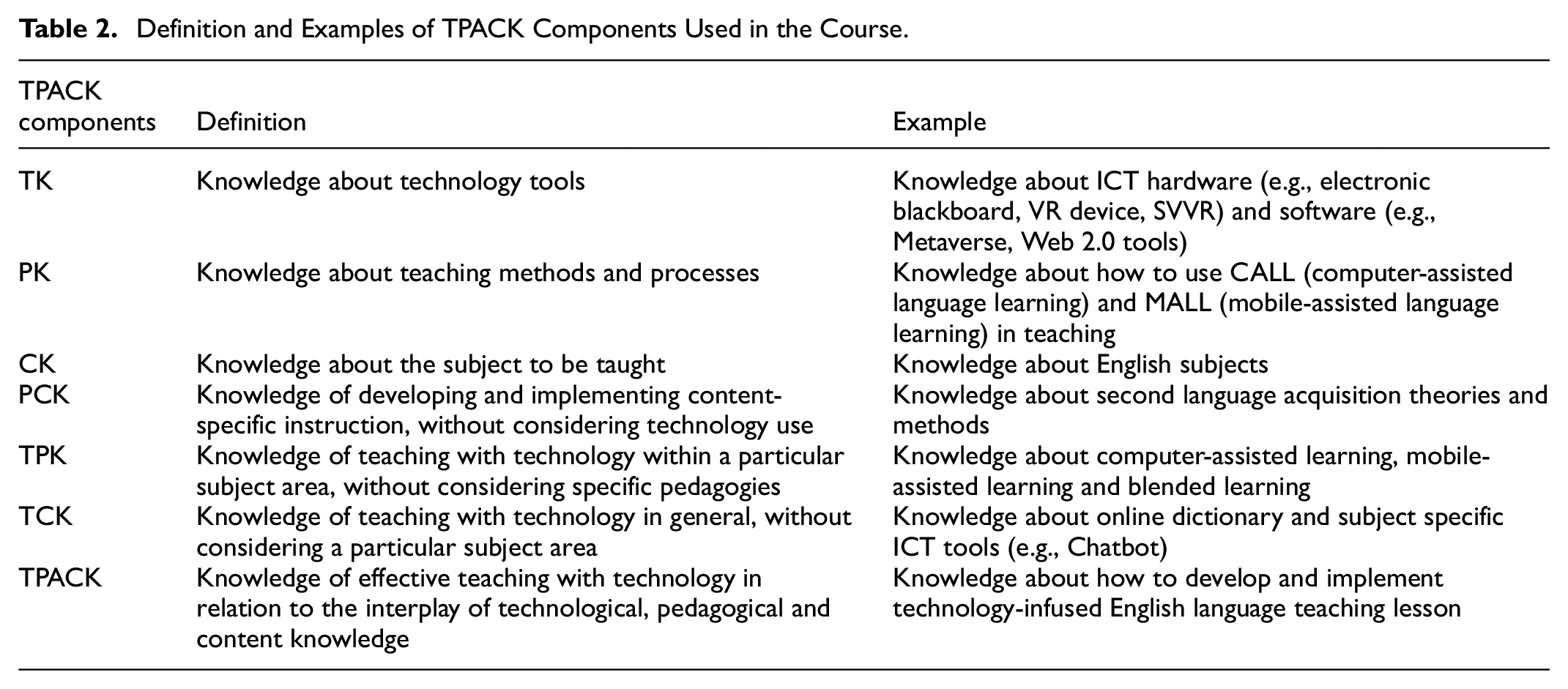
In recent years, many EFL countries have started to adopt AI-digital textbooks and encourage digital devices into their primary and secondary school classrooms due to the need to enhance digital competency and to meet the expectations and interests of students who are digital-natives. Because technology integration into teaching practice requires pre-service and in-service teachers to acquire new skills and knowledge, teacher education programs in these educational contexts have begun to provide technology-related courses. Many of these courses, however, teach technology skills and techniques in isolation, thereby neglecting their deeper connection to specific content areas (Choi, 2024; Stinken-Rösner et al., 2023). To address this disconnection and enhance teachers’ self-efficacy in technology integration, Mishra and Koehler (2006) proposed the Technological Pedagogical Content Knowledge (TPACK) framework as a more integrated approach that allows teachers to deeply understand how technology enhances and limits their content area teaching. This integrated approach not only helps teachers equip themselves with the necessary technological knowledge but also helps them develop confidence in effectively connecting technology to their content areas, which could potentially reduce their anxiety about technology integration (Dong et al., 2020; Henderson & Corry, 2021; Wang et al., 2024). The TPACK framework includes three core components: pedagogical knowledge (PK), content knowledge (CK), and technological knowledge (TK), as well as four integrated components: pedagogical content knowledge (PCK), technological pedagogical knowledge (TPK), technological content knowledge (TCK), and technological pedagogical content knowledge (TPCK; see Mishra & Koehler, 2006 for more discussion).
While most studies investigating TPACK have been widely conducted in the field of education, many have examined in-service teachers’ TPACK without considering their subject matter (e.g., Kim et al., 2021; Weidlich & Kalz, 2023). Research investigating how TPACK-based courses can impact EFL teachers’ self-efficacy and anxiety regarding technology are sparse (e.g., Cahyono et al., 2016; Lai Wah & Hashim, 2021; Ma et al., 2024). In order to address the need for language educators and language teacher educators to become more tech-savvy and confident in their ability to effectively integrate technology, this paper presents on how an English Education department at a private university in South Korea developed and analyzed a technology-infused TPACK development course. The study investigates the course’s effectiveness in enhancing participants’ technological knowledge, skills, and self-efficacy while reducing their anxiety about technology integration. Specifically, this paper addresses the following questions:
(a) To what extent did pre-service English teachers’ perceived TPACK change, if at all, after a semester-long TPACK-based course?
(b) How does a semester-long TPACK-based teacher preparation course enhance pre- service teachers’ self-efficacy beliefs about technology integration in language teaching?
Literature Review
The TPACK Framework
TPACK is a widely used framework that describes the inextricable interaction and integration of technology, pedagogy and content knowledge needed to effectively integrate technology into teaching practice (Mishra & Koehler, 2006). Shulman (1986) initially introduced content knowledge (CK), pedagogy knowledge (PK), and pedagogical content knowledge (PCK) as three core knowledge domains for teachers. Mishra and Koehler (2006) introduced the TPACK framework by expanding Shulman’s (1986) model and adding technological knowledge (TK) as an additional knowledge domain. The TPACK consists of seven core knowledge domains: CK, PK, PCK, technological content knowledge (TCK), technological pedagogical knowledge (TPK), and technological pedagogical content knowledge (TPCK) (Mishra & Koehler, 2006).
PCK refers to teachers’ knowledge on how to content and pedagogy can be used for effective learning. TPK refers to teachers’ knowledge on how to effectively use technology for teaching purposes. TCK indicates teachers’ understanding on how different technology can be used to represent contents for specific subject matter. TPACK refers to teachers’ knowledge for effectively using and integrating technology into their teaching (Mishra & Koehler, 2006). TPACK can be defined as follows: TPACK is the basis for effective teaching with technology, requiring an understanding of the representation of concepts using technologies, pedagogical techniques that use technologies in constructive ways to teach content, knowledge of what makes concepts difficult or easy to learn and how technology can help redress some of the problems that students face, knowledge of students’ prior knowledge, and theories of epistemology and knowledge of how technologies can be used to build on existing knowledge to develop new epistemologies or strengthen old ones (Koehler et al., 2013: 16)
The TPACK framework highlights the importance of integrating three basic areas of knowledge (pedagogy, content, and technology) with the use of technology (Baran et al., 2011). The TPACK framework provides both the integrative and transformative views in that it emphasizes the strategic and integrative use of technology to support content pedagogies within a particular content area, and at the same time enables teachers to use innovative teaching methods and technologies through the interplay of different knowledge components (Schmid et al., 2021). That is, the TPACK framework can be used as an effective guide for how both pre-service and in-service teachers can most effectively develop this integration of knowledge (Baran et al., 2011; Ma et al., 2024; Raygan & Moradkhani, 2022; Tondeur et al., 2012).
TPACK and Its Impact on the Professional Development of the Teachers
TPACK has been widely used as a framework to explore and access teachers’ knowledge of teaching with technology (Schmid et al., 2021). Previous studies have found that TPACK can be conceptualized and examined through an integrative lens, in that TPACK knowledge can be developed and measured using self-reports, questionnaires, and/or interviews (e.g., Doering et al., 2014; Liu & Kelinsasser, 2015; Tseng et al., 2019; Wang, et al., 2023). In the context of English language teaching, several studies have provided insights into how teachers develop and apply TPACK knowledge. Liu and Kleinsasser (2015), for example, investigated the growth of TPACK knowledge among EFL high school teachers in Taiwan through pre- and post-surveys and interviews. Their findings revealed significant growth across multiple TPACK domains, particularly in technological pedagogical knowledge (TPK), technological content knowledge (TCK), and technological pedagogical content knowledge (TPACK). These results suggest that structured teacher education can enhance teachers’ ability to integrate technology meaningfully into their language teaching practices.
Other studies that investigated language teachers through the incorporation of TPACK have shown both challenges and patterns in TPACK development among language teachers. In-service language teachers often demonstrate stronger competencies in pedagogical knowledge (PK) and content knowledge (CK) compared to their technological integration skills (Chai et al., 2013). In contrast, pre-service teachers often struggle to differentiate between technological content knowledge (TCK), technological pedagogical knowledge (TPK), and technological pedagogical content knowledge (TPACK) components (Baser et al., 2016). Research focusing specifically on pre-service teachers’ TPACK have consistently found lower competence levels in technological knowledge (TK), technological pedagogical knowledge (TPK), and content knowledge (CK) compared to other TPACK domains (Chai et al., 2010; Cheng, 2017; Xiong et al., 2020).
While these studies investigated how TPACK can develop among in- and pre-service teachers and whether pre-service language teachers have the ability to distinguish the facets of TPACK, further research analyzing how pre-service teachers in EFL learning environments can develop and incorporate TPACK by introducing them to more modern technology, such as chatbot and metaverse, can benefit language teacher educators and pre-service teacher program curriculum developers to take risks in using newer technology to meet the demands and interests of young generation language learners. Furthermore, previous studies have investigated participants’ awareness or validated the TPACK survey (e.g., Baser et al. 2016; Bostancıoğlu & Handley, 2018; Chai et al., 2010, 2013), but these studies have not been able to provide a deeper understanding of how pre-service language teachers use technology in their lesson planning through an educational technology course that introduce them to modern technology advancements.
A more recent study by Ma et al. (2024) investigated the integration of corpus technology in pre-service ESL teacher online collaborative learning to develop TPACK. They found that a 4-week training successfully helped the participants learn corpus technology and develop pedagogical strategies. Building upon their findings, the current study takes a broader approach by empowering pre-service teachers to select and implement various digital tools and technologies suitable for their lessons, potentially offering insights into more flexible and adaptable approaches to technology integration in language teaching and learning.
Methods
Context of the Study
The participants in the study included 34 pre-service English teachers who were enrolled in a TPACK-based teacher preparation course held at a private university in Seoul, South Korea. All 34 participants (24 females; 10 males) who volunteered and consented to participating in the study were majoring in English education. Participants include 30 juniors and 4 seniors who had prior experience in lesson planning and microteaching where pre-service teachers practice teaching skills in a controlled, small-scale setting. While they all had taken an introductory educational technology course, none of them had experience in applying digital tools to language instruction. The institutional review board approved the study and informed consents were obtained from all the participants (7002340-202312- HR-031).
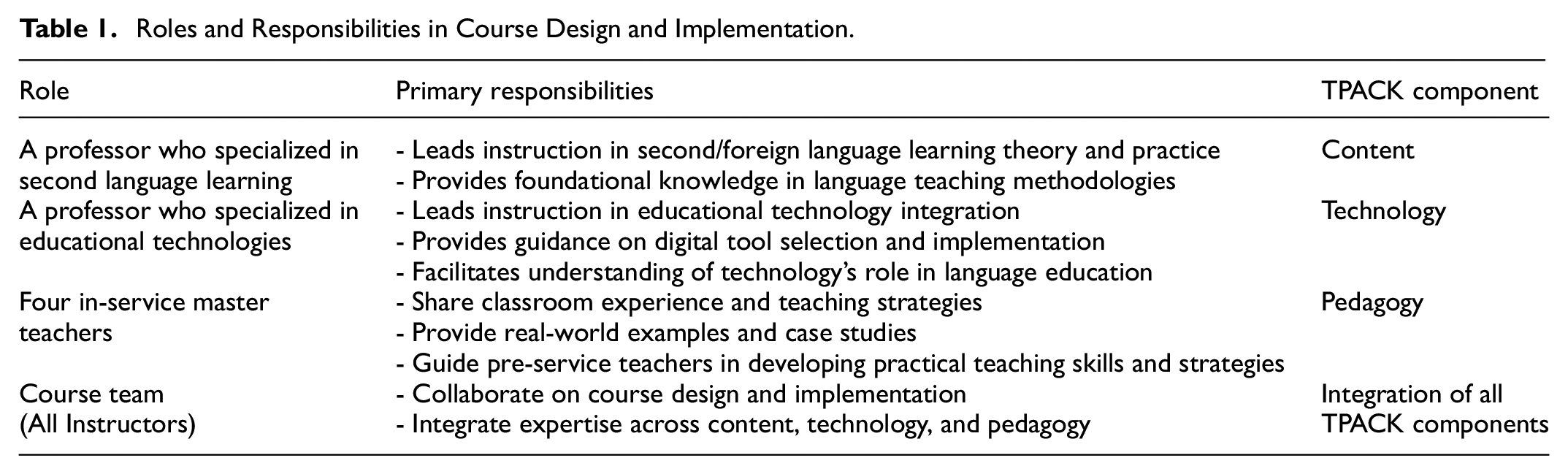
The course was designed to prepare future language educators to understand the possibilities of integrating digital tools into second/foreign language learning and utilize technology into their teaching practices. Language learning content was taught by a university professor who specializes in second language learning, who also provided the Content of the TPACK. The technology content was offered by a university learning technologies professor, who offered the Technology of TPACK. Four in-service master teachers provided the Pedagogy of the TPACK, including pedagogical strategies related to technology integration. All instructors collaborated to design and deliver instruction that integrated and strengthened each other’s area of expertise (see Tables 1 and 2 for more detail on the course).
Roles and Responsibilities in Course Design and Implementation.
Definition and Examples of TPACK Components Used in the Course.
Throughout the semester, the participants were introduced to various digital technologies, including Chatbot, Metaverse, Virtual classroom platforms, and a spherical video-based virtual reality (SVVR) program through participating in a series of lectures and workshops. While those lectures given by in-service English teachers who shared their own experiences of integrating technology in their teaching practice enabled pre-service teachers to fully understand how different technology can be used in actual classroom settings, two sets of workshops offered by two in-service teachers who specialize in developing educational technology for language teaching and learning gave pre-service teachers hands-on experiences where they could not only explore different digital tools but also develop an exemplary language learning activity. By participating in a series of lectures and workshops, they were afforded opportunities to gain hands-on experience regarding how to use these technologies in language instruction, and critically evaluate the efficacy of technology in language teaching (see Table 3 for more details).
Course Description.

All participants, in groups of four or five, were asked to collaboratively work on designing 45-minute lesson plans and conducting online microteaching, which integrated technology, pedagogy and content. This semester-long project aimed to help future language educators develop adequate knowledge and skills necessary to effectively teach their students in online or hybrid language learning and teaching environments. The participants were asked to design and implement their lessons using online video conferencing platforms (e.g., Webex, Zoom), metaverse platforms (e.g., Gather.town) or VoIP social platforms (e.g., Discord) where teachers meet and teach students virtually. They were also required to utilize at least one of the digital tools that they had learned and experimented in the course, including online learning platforms (e.g., Flipgrid, Kahoot!, Google Classroom, Padlet), chatbot (e.g., Chatfuel), generative AI (e.g., ChatGPT, Gemini), learning management systems (e.g., Blackboard, Classting, Classnet), and social networking sites. By providing pre-service teachers adequate training and design-based experiences for implementing technology in their content areas, this semester-long project aimed to help them develop their TPACK and influence their beliefs and practices in the integration of digital technology in their instruction All participating teachers could rent SVVR cameras, SVVR invisible sticks, VR goggles, and video cameras to create their lesson materials. The instructor provided financial support for necessary memberships such as a ChatGPT membership so that they could freely browse through different online platforms and digital tools.
Data Collection
The current study used a mixed-methods, one-group, pretest-posttest, quasi-experimental design. The TPACK survey (Mishra & Koehler, 2006) was used to investigate the TPACK development of pre-service teachers. Participants twice completed the TPACK survey using Google Form during the semester (Week 1 and Week 15). Each survey consisted of 42 items, which included all seven components of TPACK knowledge domains. The participants self-assessed their TPACK knowledge on a five-point scale (1 = “strongly disagree” to 5 = “strongly agree”).
Data were also collected from students’ reflection journals in which they assessed their learning process and shared their thoughts. Students were asked to submit their reflection journals on a biweekly basis and a total of 220 entries were collected.
Data Analysis
Paired samples t-tests were used to examine whether there were significant differences between the pretest and posttest of pre-service students’ self-assessment. In addition, Cohen’s d value also was conducted to determine the effect size of the technology-infused course: d = 0.2 represents a small effect size, 0.5 represents a medium effect size, and 0.8 represents a large effect size (Cohen, 1988). Additionally, SPSS 29 was used for statistical analysis.
The data obtained from students’ reflection journals were analyzed by using the thematic analysis to organize the data and search for recurring themes and categories (Strauss & Corbin, 1998). All data underwent an initial line-by-line open coding process to identify emergent themes, properties, and recurring issues. This initial coding was performed independently by two coders. Subsequently, selective coding was employed to consolidate the various datasets and delineate core themes and categories. The two coders then collectively discussed and refined these themes. To enhance the integrity and quality of the thematic analysis, themes were cross-referenced with the raw data, and both contradictory and supporting examples were actively sought. The main themes emerged from the thematic analysis included pre-service teachers’ perceived TPACK and pre-service teachers’ self-efficacy beliefs about technology integration in their instruction. Under these main themes, sub-themes were identified, including pre-service teachers’ increased sense of confidence in their ability to integrate technology in their teaching and their willingness to try new technology.
Results
Students’ Self-Assessment of TPACK: TPACK-Survey Data
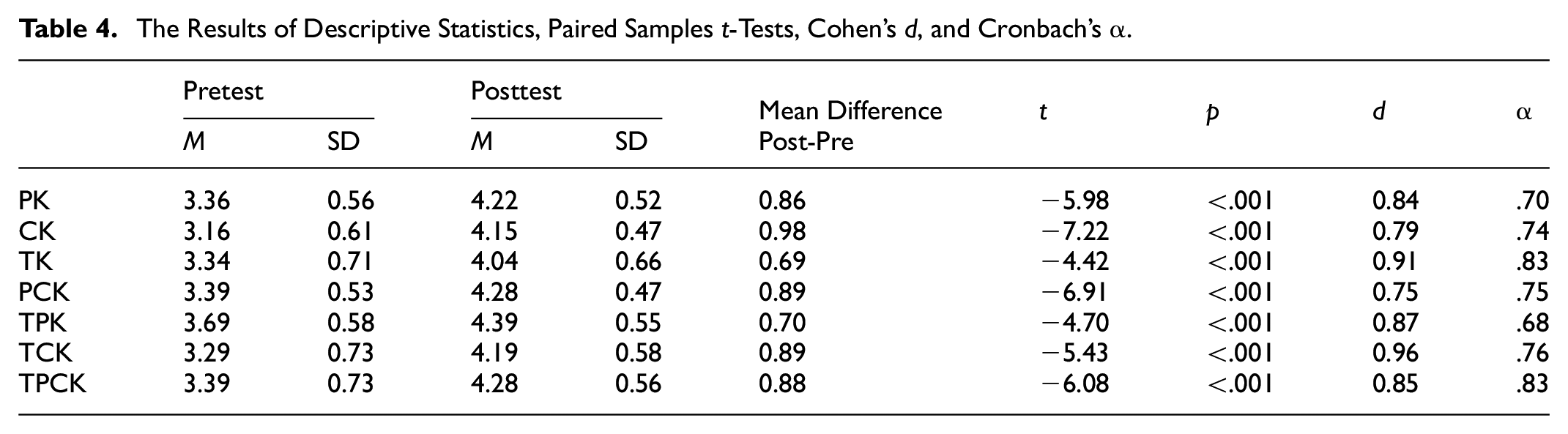
The TPACK-survey results that show the descriptive statistics, paired samples t-tests, Cronbach’s α, and Cohen’s d are summarized in Table 4. Based on students’ awareness of their TPACK prior to instruction, CK had the lowest mean (M = 3.16, SD = 0.61) whereas TPK had the highest mean (M = 3.69, SD = 0.58). This shows that before the participants started their TPACK-based teacher preparation course, students perceived their knowledge about the English language and how English should be taught and learned to be the weakest and their knowledge regarding how to use digital tools to teach English without considering specific pedagogies to be the strongest. After the participants received the TPACK-based teacher preparation course, the lowest mean in the TPACK self-report was TK (M = 4.04, SD = 0.66) and the highest was TPK (M = 4.39, SD = 0.55). The mean differences of TPACK components between the pretest and posttest ranged from 0.69 to 0.98. The highest increase was observed in the CK component (0.98), which showed the lowest pre-instructional mean, followed by PCK (0.89) and TCK (0.89). The smallest increase was seen in the TK component (0.69), followed by TPK (0.70). The paired samples t-test analyses of the TPACK survey found that pre-service teachers’ self-assessment of all seven components of TPACK showed statistically significant growth from the pretest to the posttest. Furthermore, the effect size was measured by Cohen’s d, which was large for all seven components (0.75–0.96).
The Results of Descriptive Statistics, Paired Samples t-Tests, Cohen’s d, and Cronbach’s α.
Students Self-assessment of TPACK: Qualitative Data
Enhanced Self-Efficacy Among Pre-Service Teachers
Similar to the findings of the survey data, the analysis of pre-service teachers’ reflective journals reveals both their increased TPACK and their enhanced self-efficacy beliefs about technology integration in language teaching. Many of them stated that observing technology in action within actual classroom settings and working with digital technologies to create and implement their own lessons allowed them to witness firsthand the practical applications and pedagogical benefits of technology. They also pointed out that such experiences increased their knowledge of teaching with technology and their sense of confidence in their ability to integrate technology, pedagogy and content, and heightened their willingness to use technology in their future lessons (c.f., Han et al., 2017; Lee & Lee, 2014). Here are two sample comments in this regard: “I am so-called a digital native, but I was always unsure what to do with technologies in language teaching. Because the way I use technology in my daily life through things like KakaoTalk and Instagram is very different from the way I use technology to teach my students as a teacher…All the workshops and lectures taught me when and how to effectively use technology in my teaching practices. They also made me think a lot about how I could use the technologies I am already familiar with in my daily life more effectively in my classes.” “I am so proud of myself and my teaching, where I was able to incorporate Zep (a metaverse space) into my lesson. I had never imagined that I could do it, but I did! During the COVID-19 outbreak, I saw some extraordinary teachers using the metaverse to teach their students on TV, but I never actually thought that I was able to do it by myself. It was so fun to design my lesson using Zep and I would definitely use Zep when I become a teacher. I also would like to learn other new technologies!”
Development in the Pre-Service Teachers’ Ability to Use Technology
In their final reflection journals, more than 80% of the participants stated that they learned not only how to use different sets of digital technologies and tools but also how to use them effectively in their instruction. This indicates that the course and the semester-long project helped the participating teachers increase their TPACK. The participants’ development in their ability to use technology in pedagogy can be demonstrated in Figure 1, which shows a participants’ attempt at developing a chatbot that the participant had never tried prior to the course.

An online writing activity using Chatbot.
The following excerpt shows the participant’s experience of building a chatbot for the course: “When I was told that we were going to create a chatbot together in the workshop, I was super stressed out. [I thought to myself], ‘I can’t even code, let alone programming, so how can I create a chatbot?’. In the workshop, I learned how to create a chatbot without coding using Chatfuel, and it was incredibly easy and fun! Our group conducted an online English writing activity using the chatbot we had learned in the workshop. Students found a chatbot-based writing activity very engaging and motivating because it provided individualized feedback. I love it so much and I will definitely use it in my future lessons.”
Increase in Pre-Service Teachers’ Creativity Through TPACK Development
In addition, both the participants’ reflection papers and final projects reveal that pre-service teachers’ enhanced self-efficacy beliefs about technology integration positively increase their creativity. Klassen et al. (2014) argue that teacher with a high level of self-efficacy beliefs about technology integration tend to leverage digital technologies and tools to create innovative and localized learning environments. Similarly, while some used same technologies and digital tools introduced by a series of lectures and workshops in their final microteaching projects, five groups (approximately 60%) used online learning platforms and technologies that were not directly introduced in the course. For example, one of the groups chose to use Zep (see Figures 2 and 3) as a main online learning platform after critically evaluating the affordances and constraints of other online platforms and technological options in language teaching. They reflected their choice as follows: “Our group found metaverse very effective in terms of interaction and learner motivation than any other online platforms. However, in the case of Gather.town, which was covered in the workshop, the overall graphics and operation system did not seem to be interesting or new to students. So, we [group members] self-studied various metaverse platforms such as Zep, iFriend, and Zepeto and chose the platform that was most suitable for our lesson. Although we were little anxious about using a new platform that we had not experimented with the professor, the whole process of actively searching and trying new technologies on our own was very meaningful and fun.”
Other groups also actively explored various digital technologies and tools to make their lessons more interactive and engaging and some options they chose to integrate into their teaching practice included the digital virtual assistant (e.g., Bixby), Google Earth VR (see Figure 4), an online collaboration platform (e.g., ALLO, see Figure 5), and an online engagement platform (e.g., Nearpod).

Whole class instruction using Zep

A customized word/grammar quiz using Zep.
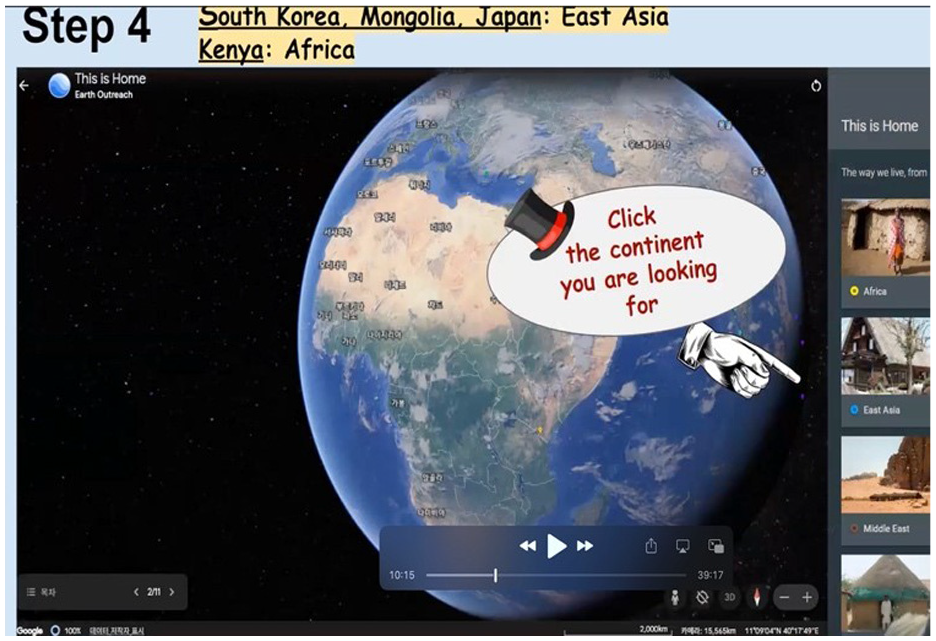
A group activity using Google Earth.

A sample activity using ALLO.
Discussion
Teacher preparation programs play a critical role in shaping how future educators integrate technology into their classrooms. Since pre-service teacher education significantly influences how teachers adopt and use technology in their classrooms in the future, equipping them with the needed skills and experiences during their preparation is crucial for successful technology integration within their content areas (Koehler et al. 2013; Mishra & Koehler, 2006). As both quantitative and qualitative data show, a TPACK-based teacher education course not only increases pre-service English teachers’ sense of self-efficacy about including technology integration into their language teaching practice but also leads them to develop new knowledge and skills to effectively use digital technologies in their content areas.
The TPACK-based instruction demonstrated significant positive impacts across all seven components of the framework. The results of the current study support the effectiveness of TPACK-based instruction for pre-service English teachers in increasing participants’ self-awareness and self-efficacy regarding all seven components of TPACK. It is interesting to note that even though the course aimed to enhance pre-service teachers’ technology knowledge and practice, it significantly improved their content knowledge as perceived by the participants. Pedagogical content knowledge (PCK), which focuses on teaching methods without technology integration, also showed substantial growth, with a mean difference of 0.89. TPK, which showed the highest pre- and post-instructional mean was also perceived to have shown statistically significant improvement by the participants of the study. The findings could suggest that the focus on technology during the course assisted in increasing awareness and development not only on domains related to using technology in English teaching, but also on aspects related to traditional core knowledge domains for teachers. In other words, it shows that the technological support from the TPACK course helped pre-service EFL teachers gain self-efficacy regarding technology knowledge and pedagogical and content knowledge.
Statistical analysis demonstrates unexpected patterns in how pre-service language teachers developed their content knowledge throughout the course. Based on the results of the paired samples t-test, all three core components, as well as the four integrated components of TPACK showed statistically significant growth, with CK, despite having the lowest mean prior to instruction, showing the largest gain (0.98). This observation is different from the findings from Chai et al. (2013) who found CK to be in-service language teachers’ strongest rated factor while the technology-related factors were rated comparatively lower. The participants of the current study initially found their CK to be the lowest while TPK and TPCK were rated the highest. The differences found in the participants’ self-efficacy between the two studies could be due to the differences in the participants’ teaching status, which can further offer support to the introduction of TPACK to pre-service language teachers. Even though the current study was conducted in an educational technology course, CK, at the end of the course, was the component that the students felt that they had developed the most. This could imply that students’ learning and application of the technologies and digital tool could have encouraged them to better analyze their subject content to find more suitable pedagogical connections between technology and content. This is supported by Chai et al. (2010) who found that pre-service teachers were challenged to adapt the content of their subject to make it more appropriate for the ICT environment in an ICT course which did not specifically teach content knowledge. Chai et al (2013) also advocated the introduction of ICT in language teacher professional development because ICT-integration can have “substantial pedagogical affordances” (2013, p. 662). The overall results indicate that a TPACK-based educational technology course and designing lesson plans using technology can have a significant impact on pre-service English teachers’ TPACK self-efficacy.
As the pre-service teachers had gradually recognized the potential for technology integration during their participation in the course, their initial anxiety or low self-efficacy beliefs about technology integration were replaced by a genuine excitement regarding its benefits. They also reported an increased level of confidence in incorporating technology integration into their teaching practices, which then led them to become more active in their use of technology in their language teaching practice. This was shown in the various technologies and digital tools that were used in their lesson planning, even tools that were not directly introduced through the course. The student excerpts demonstrate how pre-service teachers’ enhanced self-efficacy regarding technology integration and use empower them to be more willing to embrace change and utilize technology in their current and future teaching practice (c.f., Schrum, 1999; Klassen et al., 2014). Because self-efficacy directly influences teacher decisions, actions, perspectives, and attitudes (e.g., Birisci & Emin, 2019; DelliCarpini, 2012; Ertmer & Ottenbreit-Leftwich, 2013; Han et al., 2017), fostering high self-efficacy in technology integration can result in increasing technology use in classrooms. In their final reflection papers submitted at the end of the semester, more than 80% of participating pre-service teachers expressed their willingness to use technology in their future teaching practice. They stated that using technology could “increase language learners’ motivation,”“better reflect language learners’ unique needs and interests,”“provide individualized feedback and supports,” and “make language learning more engaging and interactive.” Students also demonstrated enhanced self-efficacy beliefs about technology integration in language teaching increased their willingness to try new technologies and digital tools, and made them become more agentive in their use of technology in teaching (c.f., Shafiee et al., 2022).
Conclusion
The current study showed the potential of enhancing pre-service EFL teachers’ self-efficacy and creativity while participating in a TPACK-based course. By introducing pre-service teachers to a variety of available online tools while demonstrating teaching methods to integrate their content and pedagogical knowledge, the pre-service EFL teachers were able to develop all areas of TPACK. A TPACK-based course where a team of experts with different professional experiences and educational backgrounds can offer opportunities for pre-service EFL teachers to take risks in using novel technology in material development. While focusing on developing pre-service EFL teachers’ technology knowledge, it was found that the participants were also able to enhance their understanding and application of content and pedagogical knowledge and adopt varying teaching activities resulting in developing their TPACK.
Despite the implications for teaching that the findings of this study provide, some limitations of the study should be addressed. First, data were collected from self-report questionnaires. Future studies that look at the development of TPACK from different stakeholders can help enhance the understanding of TPACK development of pre-service language teachers. Second, this case study did not have a control or comparison group, which can limit our understanding and effect of the TPACK-based course. Still, this study can provide researchers and practitioners who are considering introducing more interactive and modern digital tools to pre-service teachers the motivation and guidance necessary to take risks to develop their programs. Also, a future study that investigates more pre-service language teachers from various regions should be conducted. Because this study only analyzed data from only 34 participants, a more comprehensive study could contribute to the field. Future iterations of the current TPACK-based course model need to consider how pre-service teachers made decisions for technology use and pedagogical approach to help teacher educators to find ways to harmonize content, pedagogy, and technology to meet the requirements and expectations of specific subject matter.
Findings highlight the importance of providing pre-service language teachers, especially those EFL teachers, with TPACK-based teacher education courses. By developing their self-confidence, encouraging a positive outlook on the use of digital technologies in language teaching, and equipping them with the necessary knowledge and skills, TPACK-based teacher education courses can prepare teachers who are not adept at using technology while encouraging them to be more open and willing to use technology in their approaches to teaching.
Footnotes

Ethical Considerations
The institutional review board of Hongik University approved the study.
Consent to Participate
Informed consents were obtained from all the participants (7002340-202312- HR-031).
Funding
The author(s) received no financial support for the research, authorship, and/or publication of this article.
Declaration of Conflicting Interests
The author(s) declared no potential conflicts of interest with respect to the research, authorship, and/or publication of this article.
Data Availability Statement
The datasets used and/or analysed during the current study are available from the corresponding author on reasonable request.