



Abstract
The quality of online learning is generally acknowledged to be a crucial element in students’ academic achievement. Using a quantitative, cross-sectional paradigm, this study sought to analyze the link between university students perceived online course experiences and deep learning, with an emphasis on the mediating function of self-regulation through the adapted instruments of the Online Course Experience Questionnaire, Self-regulated Learning Questionnaire, and Deep Learning Scale. Employing a convenience sampling strategy, we collected data from an online questionnaire survey of 1,098 Chinese undergraduate students in November 2022. Structural equation modeling analysis indicated that students’ perceptions of good teaching in online course experience questionnaire (OCEQ) significantly predicted deep learning during online. Additionally, our research showed that the association between students’ opinions of effective instruction and deep learning strategies was mediated by self-regulation. Deep learning was found to be influenced indirectly by how clearly goals and standards were perceived, with self-regulated learning as the mediator. However, appropriate workload and assessment in OCEQ were neither directly nor indirectly related with deep learning. This study extends the understanding of student course experiences and provides actionable insights for educators to design strategies that foster deep learning in digital environments, ultimately enhancing the quality of online education systems.
Plain Language Summary
We explored how Chinese university students’ experiences in online courses influence their ability to deeply engage with learning. Specifically, we focused on the role of self-regulated learning, which involves students managing their own learning through strategies like setting goals, staying motivated, and monitoring progress. Using survey data from 1,098 undergraduate students, we found that students who perceived their online courses as having good teaching were more likely to engage in deep learning. Our study showed that self-regulated learning played a key role in this process. For example, when students felt their courses had clear goals and standards, they were more likely to use self-regulated learning strategies, which in turn supported deeper learning. However, other factors, such as workload and assessment, did not directly or indirectly influence deep learning. These findings highlight the importance of effective teaching practices and clear expectations in online courses. By fostering self-regulated learning, educators can help students engage more deeply with course material, leading to better learning outcomes. This research provides valuable insights for improving the quality of online learning environments and supporting students’ academic success.
Introduction
The widespread of digital transformation in education has significantly increased and accelerated the shift towards online learning. This trend underscores the urgent need to create high-quality online learning environments by enhancing students’ course experiences and promoting deep learning. In line with this, higher education has extensively embraced digital education amid the swift advancement of contemporary technological tools (Jung & Shin, 2021), as it offers learners rich resources and convenience without being restricted to a specific time and space. When compared to traditional in-person classes, online learning is said to give students greater autonomy (Adedoyin & Soykan, 2023). However, some previous research has found that students often faced numerous obstacles in virtual environment, including inadequate digital infrastructure and connectivity issues (Asio et al., 2021) and high requirements for self-regulation (Broadbent, 2017; Wong et al., 2019), with some students reporting difficulties with concentrating (Tulaskar & Turunen, 2022). Such challenges of online learning may lead to surface learning (S. Zhang et al., 2022), highlighting the need to construct quality online learning environments for cultivating students’ capacity for deep learning, especially in the digital age.
Students’ course experiences have been regarded as significant factors for assessing teaching and learning quality (Ramsden, 1991; H. Yin et al., 2022). According to some previous studies, the course experience of students was linked to learning results and engagement in traditional educational settings (Kassab et al., 2015; H. Yin & Wang, 2015). In higher education, students’ perception has been demonstrated as being able to effectively predict students’ approach to deep learning, self-regulation, and satisfaction (Yin & Wang, 2015; H. Yin et al., 2016).
The significance of students’ course experiences for their learning has been highlighted. However, existing research has focused mostly on students’ views of pedagogical and learning quality in personal learning context. As a result, there is a gap in evidence regarding online learning environments. Furthermore, while prior studies (e.g., ElSayad, 2024; Ning & Downing, 2012; D. Yin & Luo, 2024) have demonstrated that self-regulated learning practices serve as an intermediary mechanism through which course experiences translate into academic outcomes, this mediating role remains largely unexplored in the context of online courses.
This research aims to bridge the existing gaps by examining how university students’ understanding of their online learning course experiences influence deep learning, with dedicated attention to the mediated function of self-regulatory practices. Consequently, the outcomes of this study are intended to deliver practical recommendations for improving digital pedagogy, highlighting that enhancing deep learning requires not only creating courses perceived positively by students but also actively fostering their self-regulatory capacities.
Literature Review and Hypotheses
Students’ Online Course Experiences
Course experience reflects students’ understanding of and interaction with the quality of their academic environment (Cano, 2018, p. 165), and it has been considered a key factor in shaping effective student outcomes and learning processes (H. Yin et al., 2016). In recent years, the growing popularity of online education has significantly altered how students perceive their academic experiences (Greaves, 2024; Pokryszko-Dragan et al., 2021), resulting in an insufficiently explored research area on how online learning may impact students’ learning.
Existing literature highlights the significant relationship between students’ perceptions of digital learning environments and their educational success (H. Yin et al., 2022). However, such studies have suggested that students who are learning online received less teacher supervision and feedback than those in traditional educational settings (Fernandez et al., 2022; K. Zhang & Wu, 2022). In addition, some research has also found that the students were not restricted by specific physical location and not required to adhere to any specific learning pace (Abdullah et al., 2024; Alzahrani, 2022). Therefore, students need to be more self-regulated during online learning (Das, 2022), or their learning achievement may be affected if such requirements are not met.
Drawing on the framework of university teaching and learning pedagogy, numerous measurements have been developed to quantitatively assess students’ course experiences, such as the Course Experience Questionnaires (CEQ) which has been extensively adopted by many studies (Wilson et al., 1997; H. Yin & Wang, 2015). Furthermore, the Online Course Experience Questionnaire for the context of online education based on CEQ has been developed by H. Yin et al. (2022). Even though there exist a number of similar terminologies and varied categorizations of course experience: clear goals and demands, good teaching, appropriate workload and appropriate assessment have been the key factors for assessing higher education quality in most instruments. These factors have been established as crucial in influencing students’ emotions and behaviors during online courses (Kassab et al., 2015; H. Yin et al., 2022).
We examined how Chinese learners perceived their online learning experience through the lens of four critical dimensions: clear goals and demands, good teaching, appropriate workloads, and appropriate assessment. In our particular study involving the online learning context, we defined that clear goals and standards involve implementing goal-oriented online teaching strategies to guarantee that students are conscious of what they are expected to produce in the online learning courses. Good teaching entails various pedagogical behaviors of online instructors that provide continuous feedback, reflecting a teacher’s commitment to the quality of their online courses. Appropriate workload requires teachers to assign a reasonable amount of online learning tasks to students who have enrolled in their online courses. Appropriate assessment involves the use of suitable evaluation methods to facilitate student learning online and accurately measure their progress in online course (Ramsden, 1991; Richardson, 2005; H. Yin et al., 2022).
Students’ Self-Regulated Learning in the Online Learning Context
Self-regulated learning (SRL), a pivotal theory in psychology, describes how individuals strategically align mental focus, emotional responses, and behavioral efforts toward academic success (Pintrich, 2000; Zimmerman & Schunk, 2011). It is crucial for successful online learning where students must independently direct their learning activities (Wong et al., 2019; D. Yin & Luo, 2024). However, online learning’s independence can make self-regulated learning challenging caused by the deficiency in accessible, on-demand support (S. Zhang et al., 2022). Teachers and course designers must prioritize equipping students with self-regulated learning practices to ensure them thrive in digital education programs (Zhu et al., 2020).
In internet-based learning platforms, self-regulated learning describes the active role students play in managing their cognitive, behavioral, and strategic engagement, which encompasses environment structuring, goal setting, time management, help seeking, task strategies, and self-evaluation (Barnard et al., 2009). Recent studies on self-regulated learning in digital education contexts reveal a surge in attention to this field. Empirical findings show that metacognitive self-regulation, disciplined time management, and proactive effort regulation are strongly linked to enhanced academic performance across disciplines (Oxford et al., 2024; Ueno et al., 2025; Xu et al., 2022; Zhong, 2025). Specifically, self-regulated learning positively impacted academic writing and second-language use (Chen et al., 2025; Gong & Pang, 2025; Lam & Sato, 2025). Meanwhile, many research explored self-regulated learning intervention and barriers, such as personal factors like socio-economic status, prior education, gender differences, technical limitations, inconsistent learning environments, and lack of cohesive course structure (Alonso-Mencía et al., 2021; Khalil et al., 2020; C. Y. Liu et al., 2022; Yeung & Yau, 2022). To address the challenges, empirical work suggested that course design modifications, structured self-regulated learning training, peer feedback, technology-assisted instruction, and group work can significantly enhance students’ self-regulated learning within internet-delivered education systems (Chen et al., 2025; Hadwin et al., 2022; Lam & Sato, 2025; Öztürk et al., 2025).
Students’ Deep Learning and its Relationships With Their Course Experience
Deep learning is an essential aspect in evaluating the efficacy of online education (S. Zhang et al., 2022). Deep learning in education refers to a learning approach that emphasizes the development of a profound understanding of concepts and knowledge construction (Aderibigbe, 2021). It contrasts with surface learning, where students focus on memorization and rote learning while lacking a true comprehension of the material or the ability to implement it in diverse situation (Marton et al., 1976). As an important indicator of high-quality learning, deep learning facilitated students’ knowledge construction (S. Wang & Zhang, 2019). In addition, deep learning was found to be influenced by student-perceived course experience (Webster et al., 2009). In traditional face-to-face settings, clear goals and standards, good teaching, appropriate workload, and appropriate assessment have been observed to moderate students’ deep learning processes (Diseth, 2013; Thien & Jamil, 2020; H. Yin et al., 2014; H. Yin et al., 2016).
Recently, more and more researchers have investigated students’ deep learning in online context (Jiang, 2022; Lin et al., 2023; K. Zhang & Wu, 2022). Building on Biggs et al.’s (2001) conceptual model of deep learning, this research evaluated how students navigate and adopt their approach to learning within digital platforms. According to Biggs et al. (2001), a deep learning approach involves engaging in advanced learning practices designed to successfully manage tasks or solve complex problems. It involves using higher-order cognitive skills rather than lower-order ones. A deep approach is evident when motives, strategies, and approaches are predominantly deep. Thus, adapting this definition to an online learning context involves creating online educational environments and activities that encourage students to interact meaningfully with the material, think critically, and form their own conclusions.
To our knowledge, although deep learning in online courses has received some attention, previous studies have focused mainly on enhancing student learning in online environments, investigations into enhancing deep learning according to curriculum and pedagogy remains sparse. Moreover, present debates on how course experience influences deep learning have focused mainly on offline learning settings. Therefore, considering the aforementioned factors, the following research hypotheses are proposed:
Hypothesis 1 (H1): Students’ perceived clear goals and standards correlates positively with deep learning within the virtual learning setting.
Hypothesis 2 (H2): Students’ perceived good teaching correlates positively with deep learning within the virtual learning setting.
Hypothesis 3 (H3): Students’ perceived appropriate workload correlates positively with deep learning within the virtual learning setting.
Hypothesis 4 (H4): Students’ perceived appropriate assessment correlates positively with deep learning within the virtual learning setting.
Students’ Self-Regulated Learning as a Mediator in Online Learning Context
Existing evidence underscores that self-regulated learning is not only a substantial outcome affected by the learning context (Wong et al., 2019), but is also a crucial determinant of students’ academic success (Ueno et al., 2025; Xu et al., 2022; Zhong, 2025). Studies have shown that the quality of online learning environments significantly influences learners’ ability to self-regulate their academic activities (Kassab et al., 2015). Simultaneously, it has been discovered that self-regulated learning fosters students’ active engagement in their educational experiences (Alonso-Mencía et al., 2020).
Because of its role in connecting course experiences to student success, self-regulated learning has been identified as central mechanism through which learning environments influence learning outcomes (Barnard et al., 2008, 2009; Stan et al., 2022; X. Wang et al., 2022). These results underscores that students’ perspective of online course design directly impact learning outcomes by shaping self-regulated learning behaviors in digital environments. However, in virtual instructional settings, the how mediating mechanism of self-regulated learning has worked on course experience and deep approach to learning has rarely been explored. Thus, the following hypothesized association was suggested:
Hypothesis 5 (H5): Students’ perceived clear goals and standards correlates positively with self-regulated learning within virtual learning environments.
Hypothesis 6 (H6): Students’ perceived good teaching correlates positively with self-regulated learning within virtual learning environments.
Hypothesis 7 (H7): Students’ perceived appropriate workload correlates positively with self-regulated learning within virtual learning environments.
Hypothesis 8 (H8): Students’ perceived appropriate assessment correlates positively with self-regulated learning within virtual learning environments.
Hypothesis 9 (H9): Students’ perceived self-regulated learning correlates positively with self-regulated learning in online education.
Hypothesis 10 (H10): Self-regulated learning performs the role of mediating how students understand online course experience and deep learning within online education.
The Present Study
Focusing on Chinese undergraduates in digital learning environments, we analyzed the extent to which deep learning approaches are linked to the perceptions of online course quality and the development of self-regulated learning practices. The study further assessed how self-regulated learning mediates the relationship between learners perspective of digital course experience and their utilization of deep learning practices. The proposed theoretical model, illustrated in Figure 1, outlines these hypothesized relationships.
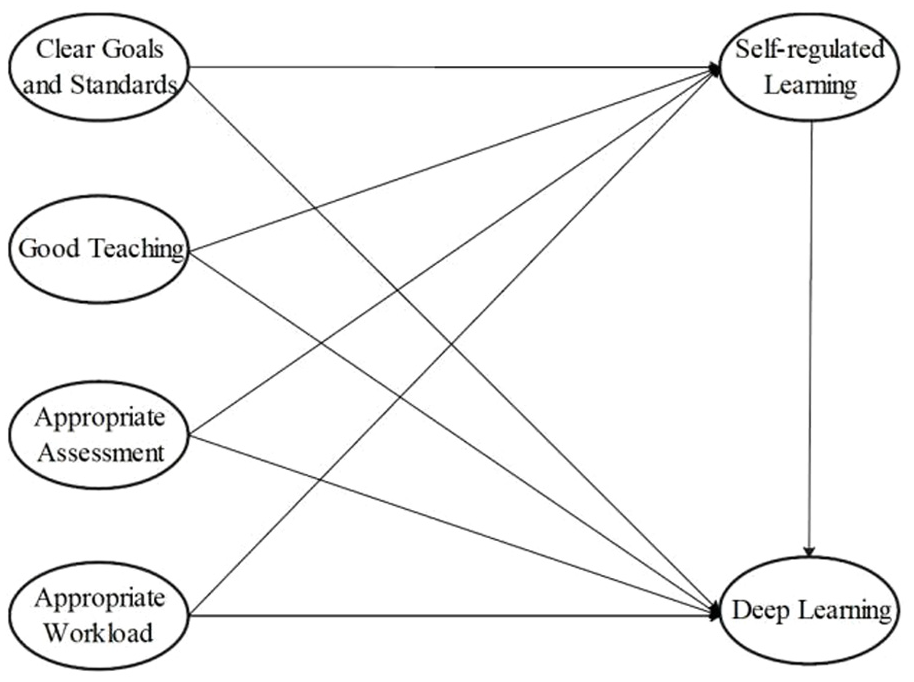
The proposed theoretical mode.
Methods
Research Design
This quantitative, cross-sectional study (Creswell & Creswell, 2023) surveyed university students on their perceived online course experiences, self-regulation, and deep learning. This non-experimental approach examines naturally occurring relationships and the potential mediating role of self-regulation. Confirmatory factor analysis (CFA) validated the survey instruments (Brown, 2015), while structural equation modeling (SEM) tested the proposed mediation model (Hayes, 2022; Kline, 2016). The cross-sectional survey allows for efficient large-scale data collection, ensuring statistical power for CFA and SEM (Dillman et al., 2014).
Participants
Participants were required to be current Chinese university students who had taken official online courses structured by their institution, excluding voluntary extracurricular ones. Convenience sampling, aided by participants sharing the survey link, yielded 1,162 responses from 14 universities. After data screening, 1,098 valid responses remained (a 94.50% valid rate).
The study analyzed a total of 1,098 valid survey responses to develop its findings. The sample of this study consisted of 186 males (16.90%) and 912 females (83.10%). This unequal gender distribution of the sample aligns with previous research findings demonstrating that females are more likely than their male counterparts to participate in online surveys (Porter et al., 2006; Van Mol, 2017). Of the total 1,098 participants, there were 404 students (36.80%) from rural areas and 694 (63.20%) from cities. As for the grades, approximately 18.60% of the total participants were in their freshman year, 40.10% were juniors, 29.00% were sophomores, and 12.30% were seniors.
Instruments
This study employed a questionnaire-based survey which consisted of two parts: the first part collected participants’ demographic information, and the second part investigated three scales (OCEQ, self-regulated learning, and deep learning). Chinese was the main language we used to distribute surveys. However, to ensure the research quality, two research assistants, who were selected on the basis of their fluency in English and Chinese, conducted a translate-and-back-translate process individually to translate the original scale from English to Chinese. Survey respondents answered each item using a 5-point Likert scale as 1 represents “strongly disagree” and 5 represents “strongly agree.”
Online Course Experience Questionnaire
To evaluate participants’ experiences in online education settings, the Online Course Experience Questionnaire (OCEQ) was implemented. The adapted tool was derived from the Student Course Experience Questionnaire (SCEQ, Webster et al., 2009), with refinements made to tailor it to the specific context of digital pedagogy. The instrument consisted of 17 items. The original SCEQ demonstrated strong validity (CFI = 0.97, RMSEA = 0.049, SRMR = 0.049). The four-factor SCEQ model (χ2 = 605.95; df = 113; p > 0.05; RMSEA = 0.076; NNFI = 0.75; CFI = 0.80; AGFI = 0.95) showed reliability with Cronbach’s alpha ranging from .575 and .837. Based on SCEQ, the OCEQ consisted of four factors corresponding to good teaching (six items), clear goals and standards (four items), appropriate assessment (three items) and appropriate workload (four items). To ensure relevance to digital learning contexts, the items were revised. One such example reads: “The workload is too heavy during online learning.”
Self-Regulated Learning Questionnaire
This study assessed students’ self-regulatory behaviors in digital learning environments through a Self-Regulated Learning Questionnaire, modified from Barnard et al.’s (2008) Online Self-Regulated Learning Questionnaire (OSLQ). Designed to measure students’ self-regulatory behaviors in the internet-delivered educational programs, the OSLQ comprises 24 Likert scale items. The original OSLQ’s reliability and validity have been demonstrated, with a Cronbach’s alpha of .93 (Barnard et al., 2008).
Deep Learning Scale
The Revised Two-Factor Study Process Questionnaire (Biggs et al., 2001) served as the foundation for adapting the Deep Learning Scale used in this study. The original scale’s validity and reliability have been demonstrated, with a Cronbach’s alpha of .73 for its Deep Approach scale (Biggs et al., 2001). Ten items in total, modified for online learning contexts (e.g., “I usually engage in online learning with questions”), are rated on a 5-point Likert scale to evaluate students’ deep learning approaches.
Data Analysis
The statistical software SPSS 26.0 and AMOS 24.0 were applied in analyzing the data. First, in AMOS 24.0, we implemented a confirmatory factor analysis (CFA) to check the construct validity of the instruments. In SPSS 26.0, Cronbach’s alpha coefficient was calculated to assess the internal consistency of the subscales and analyze Pearson’s correlations. Second, we constructed structural equation modeling (SEM) to explore the links between students’ online course experiences and other related constructs.
The chi-square statistic (χ2), the root means square error of approximation (RMSEA), the Tucker-Lewis Index (TLI), and the Comparative Fit Index (CFI) were performed to evaluate the model fit of the CFA and SEM. We used Schreiber et al.’s (2006) standards, that is, CFI and TLI values ≥0.90 and an RMSEA value ≤0.08, to evaluate the modal fit of this study.
Ethical Consideration
Approval was obtained from the Ethics Committee. Participants received written information detailing the study’s purpose, minimal risks, and potential benefits (informing policy improvements), and they provided verbal informed consent online. Participation was voluntary with the right to withdraw at any time. To ensure confidentiality, data were collected anonymously, no personal identifiers were requested, and any potentially identifying information was removed.
Results
Construct Validity and Reliability
The result of the CFA on the OCEQ demonstrated a good model fit (χ2 = 210.57, df = 71.00, p < 0.001, GFI = 0.97, CFI = 0.97, RMSEA = 0.042, TLI = 0.97) after removing Item 7 (“In online courses, students usually have sufficient time to go through and understand the course materials thoroughly.”), Item 40 (“In online courses, course instructors provide sufficient feedback on student assignments or other course activities.”) and Item 42 (“Memorization is not enough for students to excel in online courses.”) with factor loadings lower than 0.50. The factor loadings for the remaining items fell within the range of 0.626 to 0.765. The composite reliability coefficients for the CT, GT, AW, and AA subscales were 0.78, 0.78, 0.75 and 0.60, respectively.
The CFA indices of the deep learning were within the acceptable limits (χ2 = 226.84, df = 27.00, p < 0.001, GFI = 0.95, CFI = 0.94, RMSEA = 0.082, TLI = 0.92) after removing one item (Item 9, “I only feel satisfied about my schoolwork when I am able to do a comprehensive work that allows me to form personal insights about the subject matter.”), which indicated low factor loading. The remaining 9 items were calculated for their factor loadings and the results were all fell within the range of 0.52 to 0.72, indicating a composite reliability coefficient of 0.86.
The CFA result of the self-regulated learning demonstrated an acceptable data fit (χ2 = 79.80, df = 9.00, p < 0.001, GFI = 0.98, CFI = 0.98, RMSEA = 0.085, TLI = 0.96) after removing Item 10 (“In online courses, I always have my questions and doubts about the course before the course session begins.”), Item 14 (“I do my online course works and assignments with the same attitude as in traditional face-to-face courses.”), Item 20 (“I will read aloud what is presented on the screen to stay focused and avoid distractions while studying online.”), Item 27 (“I prefer meeting classmates in a physical setting.”) and Item35 (“I dedicate more time in online courses than in traditional face-to-face course.”) with factor loadings lower than 0.50. The factor loadings of the remaining items fell between the range of 0.577 to 0.758. The composite reliability coefficient result was 0.92.
Descriptive Statistics and Correlations
The results of the descriptive statistics (means and standard deviations) and the correlation analysis are demonstrated in Table 1. Among the four OCEQ factors, appropriate workload scored the lowest (M = 3.00, SD = 0.53), and appropriate assessment the highest (M = 3.84, SD = 0.51). Additionally, the mean scores for deep learning and self-regulated learning were 3.37 (SD = 0.52) and 3.38 (SD = 0.49) respectively.
Correlation Matrix, Reliability, and Descriptive Statistics.
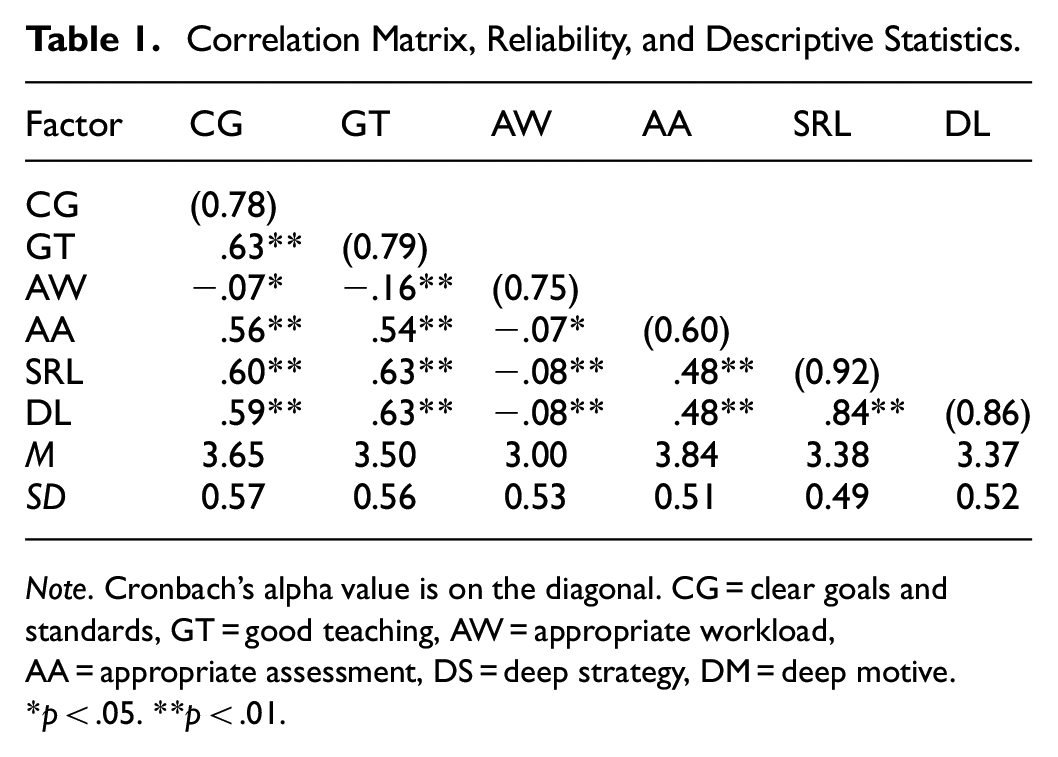
Note. Cronbach’s alpha value is on the diagonal. CG = clear goals and standards, GT = good teaching, AW = appropriate workload, AA = appropriate assessment, DS = deep strategy, DM = deep motive.
p < .05. **p < .01.
Moreover, Table 1 indicated that all the factors of OCEQ were significantly positively correlated except for workload. The other three subscales, good teaching, clear goals, and appropriate assessment, manifested a remarkably positive correlation with deep learning and self-regulated learning. Also, self-regulated learning displayed a substantial positive link to deep learning. While appropriate workload showed negative correlations with deep learning and self-regulation.
SEM and Mediation Analysis
SEM was performed to evaluate the associations between students’ perceptions of online course experiences, self-regulated learning, and deep learning. In this study, the four aspects of OCEQ were used to predict students’ self-regulation and deep approaches in online course environments, considering the mediating effect of students’ self-regulation. The SEM results demonstrated a satisfactory model fit (χ2 = 1,603.49, df = 360.00, p < 0.001, GFI = 0.90, CFI = 0.92, RMSEA = 0.056, TLI = 0.91). Figure 2 shows the significant paths from the predictors to students’ self-regulation and deep learning approaches (the dotted line indicates no significant effect).

The influence path of students’ online learning course experience on deep learning through self-regulation.
The findings indicate that, among the OCEQ factors, good teaching (β = .12, p < 0.01) has a significant positive impact on deep learning. Additionally, clear goals and standards (β = .36, p < 0.001) and good teaching (β = .37, p < 0.001) functioned as significant positive contributors to self-regulation. Self-regulation (β = .92, p < 0.001) demonstrated a robust positive effect on the students’ deep learning. Thus, H2, H5, H6, and H9 were accepted. In contrast to our hypotheses, clear goals, appropriate workload, appropriate assessment had no significant influence on deep learning, and the latter two were significantly related with self-regulation. Thus, H1, H3, H4, H6, H7 were rejected.
This study used the bootstrapping function of AMOS24.0 to conduct a mediating analysis to evaluate the mediating role of self-regulation. Table 2 presents that self-regulation demonstrated a the significantly mediating effects of two OCEQ indicators (i.e., clear goals and good teaching) on deep learning in online learning environments.
Mediating Analysis of Self-Regulation on the Relationship Between CEQ Factors and Students’ Deep Learning.
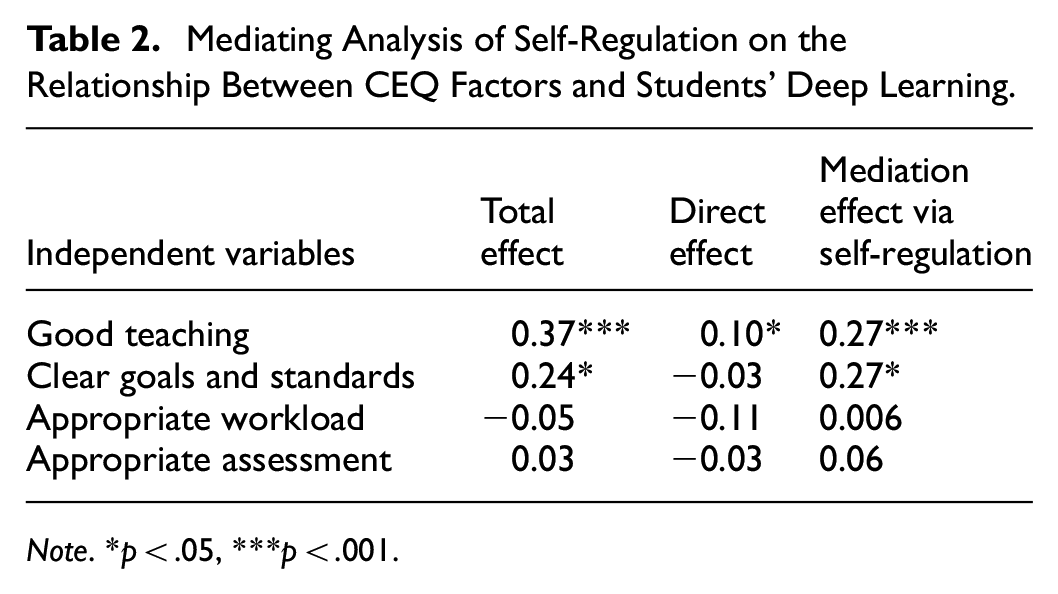
Note. *p < .05, ***p < .001.
Discussion
This research enhances the comprehension of online learning dynamics by combining the Online Course Experience Questionnaire (OCEQ) with self-regulated learning theory to clarify the mechanisms that drive deep learning among Chinese undergraduate students. The present research has confirmed the reliability and construct validity of the OCEQ, and the mean scores for the four factors varied between 3.04 to 3.75 on the 5-point Likert scale, supporting the existence of OCEQ. Moreover, the present study focused on the influence of OCEQ in students’ self-regulated learning and deep learning, and examined the mediation effect of self-regulation on deep learning in an online context.
The Role of Online Course Experience in Facilitating Deep Learning
Our results reveal that, of the four OCEQ variables, “good teaching” emerged as the sole significant predictor of deep learning approaches in virtual environments. This suggests that students were more inclined to engage in deep learning approaches when they felt they received more suitable instruction, including clear explanations and constructive feedback. This result aligns with earlier research showing that educators’ supportive teaching has a positive relationship with students’ propensity to engage in deep learning strategies (Takase et al., 2020). It also corroborates prior suggestions that instructional support encourages meaningful adoption of advanced learning strategies among students in online context (Han et al., 2023). This is probably because lecturers’ efforts, enthusiasm and commitment to teaching can effectively engage students who are easily distracted in online learning to participate actively to achieve deep understanding, critical thinking and higher levels of performance. Teaching presence with scaffolding support enhances learners’ higher levels of cognitive presence (Al Mamun & Lawrie, 2024). Therefore, students who perceive the teaching they receive to be good tend to employ ‘meaning-based’ learning strategies and are less likely to adopt reproductive ones.
In contrast to our expectations, however, statistically insignificant association between workload appropriateness and deep learning outcomes, implying that no direct linkage between students’ perceptions of suitable workload and their engagement in higher-order learning strategies. The current statement contradicts the previous results which demonstrated a perceived appropriate workload positively affect the application of deep learning strategies (e.g., J. S. Wang et al., 2015; H. Yin et al., 2016). One possible explanation is that students find it challenging to identify what is an appropriate workload as there is lack of valid standards (Grace et al., 2012). Another possible reason may be that workload in the OCEQ refers to teachers setting proper tasks or assignments for students to learn, with “time” and “amount” being the main measurement components (Lizzio et al., 2002), thus focusing on the quantity of the workload, while, previous findings indicated that quantitative workload has no impact on deep learning (e.g., Kyndt et al., 2011). Furthermore, quantitative workload, which pertains to external task demands and falls under extraneous cognitive load (ECL), alone may not enhance students’ deep learning. Sweller et al. (2019) posited that effective learning require the integration of ECL, intrinsic cognitive load (ICL) and germane cognitive load (GCL). These may explain why there was no significant relationship between appropriate workload and deep level of learning of this research.
In addition, this study uncovered that there was no substantial link between the perceived appropriateness of the assessment and deep learning. This finding demonstrated that assessment emphasizing knowledge construction and learning process had no impact on the students’ perceptions or their use of deep approaches to learning. Even though some studies have emphasized the significance of assessing students’ comprehension rather than merely their capacity to recall facts (e.g., H. Yin et al., 2022), this study shows such assessment to be irrelevant to deep learning in online education. One potential reason for the non-significant association between appropriate assessment and deep learning in online learning may be attributed to a mismatch between the knowledge construction required of students in appropriate assessment and the presence of teachers in online learning. This mismatch can hinder critical thinking and knowledge integration. Specifically, teachers face difficulties in assessing students’ academic progress, participation, and discussion in online learning in a timely manner, while students rarely receive timely guidance due to the absence of teachers’ physical supervision (Tulaskar & Turunen, 2022; Y. Liu, 2023). This lack of timely feedback and guidance can impede students’ ability to engage in reflecting their learning and making connections between different concepts. Furthermore, the effectiveness of appropriate assessment largely depends on monitoring progress and promoting the development of effective learning strategies among students (Gikandi, 2011). The mechanisms outlined above may clarify the absence of a statistically significant association between suitable assessment and deep learning observed in this investigation.
Mediation of Self-Regulation in the Relationships Between Online Learning Experiences and Deep Learning
The SEM findings described self-regulated learning played a mediator in how students understand their online course experiences and their adoption of deep learning. As the results show, self-regulated learning was significantly related to good teaching, clear goals and teachers’ demands. These findings indicate that an increase in teachers’ teaching efforts may enhance students’ perceptions of self-management in online learning, which echoes the idea that teachers’ direct support could promote students’ self-regulation during learning online (Miao & Ma, 2023). The results from this study further corroborate previous findings, indicating that students’ perceptions of teaching quality were linked with academic outcomes positively (Yin et al., 2015). Further, as Pintrich (2003) suggested, teachers’ goal orientation and motivational expectations are crucial in motivating and guiding students’ regulation of their own learning processes. Therefore, students who perceive their online courses utilized effective instructional methods and clear directions would like to adapt a deep approach to online learning.
Moreover, the study has found a strong connection between self-regulation and the use of deep approaches to learning. Consistent with our hypotheses, evidence from this investigation indicated that students’ engagement in self-regulated learning activities was significantly and directly associated with the deep learning. This discovery suggests that individuals with greater self-regulation skills are more willing to employ deep approaches when understanding and constructing knowledge. Prior research has emphasized that improving students’ self-regulation ability is a core principle in online education to achieve higher level online learning (Boor & Cornelisse, 2021). In fact, self-regulated learners typically engage in forward-thinking strategies to optimize their approach to upcoming tasks, actively monitor their learning progress while performing the task, and critically reflect on their performance outcomes (Lam & Sato, 2025). This cyclical process of planning, monitoring, and reflecting aligns with the principles of deep learning, where learners delve deeply into content, reflect their understanding, and refine their learning strategies to enhance knowledge construction. As a result, learners with high capacity for self-regulated display a greater readiness to engage in online learning with the emphasis of critical analysis.
Our data have demonstrated good teaching has positive influence on deep learning, and validated the important mediating function of self-regulation in impacting effective teaching on deep learning practice. This implies that deep learning in online context can be enhanced through the provision of quality teaching that encourage students’ positive self-regulation. Some empirical studies have suggested that a perceived assistive educational atmosphere can enhance learners’ positive self-regulation in virtual learning environments (Kassab et al., 2015), subsequently affecting their motivation to pursue deep learning.
Although this study did not find direct relations between these Chinese learners’ perceptions of clear goals and deep learning, self-regulation was found to be a significant mediator for the relationship between the variables. Additionally, results of the mediator analysis demonstrated that self-regulation exerted a more pronounced mediating influence on the relationship between clear goals/standards and deep learning compared to its role in mediating the impact of good teaching. It indicates that clear goals established by teachers serve as a necessary but insufficient condition for deep learning, as their efficacy is contingent upon the mediated transformation via students’ regulated learning capacity. Clear learning objectives enhanced students’ capacity for metacognitive monitoring, enabling them to transform teachers’ well-defined goals to their own personal learning goals (Panadero, 2017). Additionally, through the incorporation of clear guidance provided by teachers, students can engage in self-reflection, thereby enhancing their capacity for deep learning. Theoretically, students who can effectively oversee their learning progression, think critically about their own learning behavior, and employing more metacognitive methods are more likely to develop critical approaches to learning and achieve deep understanding (Heikkilä & Lonka, 2006). Therefore, without a direct impact on deep learning, the perception of clear of goals and standards had their primary effect as the mediator role of self-regulation.
In summary, students’ ability of self-regulation served as a mediator in facilitating the relationship between their perceptions of clear goals, teaching quality and their use of deep learning methods. In line with the theoretical developments of Biggs and Tang’ s (2011) 3P model, having well-designed teaching plans and clearly articulated goals (Presage) serve to stimulate students’ self-regulation abilities. By employing self-regulated learning strategies in the activities (Process), students refine their learning processes, which ultimately results in deep learning outcomes (Product).
Conclusions and Implications
The research enhances our understanding of Chinese undergraduates’ views of their course experiences in online context and their connection to deep learning, emphasizing the mediator role of self-regulation. We discovered that perceived good teaching was a major factor in fostering deep learning, as it showed positive connection with deep approaches to learning in an internet-based background. Furthermore, the study has also identified the intermediary function of self-regulation in connecting students’ perception of good teaching and clear goals with deep approach to learning in the online learning context.
These findings provide implications for how students’ perceptions of their course experiences and their self-regulation should be attended to when designing courses aimed at enhancing deep learning. Practically, these discoveries provide suggestions for encouraging deep approaches to online learning, offering additional guidance for ensuring high-quality learning outcomes in online contexts.
First, teachers need to prepare instruction well to increase students’ intrinsic motivation and critical thinking. For instance, teachers could prepare learning resources according to learners’ needs and interests through big data analysis, give immediate helpful responses through AI-driven analytics platforms to clarify students’ misunderstandings, answer their questions timely, and adopt hybrid approaches that integrate synchronous problem-solving activities with asynchronous discussions in online learning with the support of AI technology to maintain student engagement while minimizing unnecessary cognitive load. These teaching supports are particularly important when online learning is implemented.
Second, teachers should provide student-friendly teaching goals formally in multiple forms (e.g., verbally and in written form) and in various ways (e.g., syllabus, announcements, modules, tasks, discussion board) to enhance students’ understanding of the course expectations throughout the course. Students could be reminded at different times during the learning expectation, and thus would be able to develop more self-regulated behaviors (e.g., manage their learning paces) to generate deep learning for better online course performance. Based on the clear goals, teachers could implement backward design principles by utilizing tools such as Mentimeter to put learning goals into practice, thereby ensuring consistency with students’ cognitive schema.
Third, teachers can adopt a three-phase scaffolding approach to enhance self-regulated learning based on their commitment to online instruction and clear communication of expectations. In pre-learning stage, attention should be paid to design effective self-regulated learning interventions which could stimulate students’ involvement in self-regulated activities. For example, teachers could design structured framework to guide students to set their own learning goals. During learning stage, teachers could utilize e-portfolios or encourage students to adapt a self-monitoring system to record learning progress, foster reflection, contain feedback, and regulate learning. In the post learning stage, teachers could encourage students to integrate concept mapping tools for knowledge integration. Meanwhile, access to visualized digital tools should be provided to support students to do interdisciplinary connection and identify misunderstandings.
Limitations and Directions for Future Studies
Despite this research yields some findings, it is noteworthy that there are three limitations, which also paved the directions for future research. First, the present study did not take into consideration of the range of students’ demographics and their specific discipline. The study used convenient sampling to focus on college students, the representativeness of the results of this study was relatively limited. Future investigations encompassing different disciplines, grades and curriculum would deliver a profound understanding of the association among self-regulation, online course experience, and deep learning. Secondly, as a single quantitative study, it could not sufficiently prove that undergraduates’ self-regulation mediates the impact of online course experience on deep learning. Therefore, future research with a hybrid design is recommended to study the deeper association among self-regulation, online course experience, and deep learning in the Chinese context. Finally, although this study supported that clear goals/standards, and good teaching in the online course experience have positive effect on self-regulation, yet, suitable assessment and workload are not examined in relation to self-regulation and deep learning. As a relatively free and flexible environment, the appropriate assessment and appropriate workload given by teachers may be limited by the timely interaction and feedback, which has a certain impact. Future research could also pay more attention to the research comparison in various environments, for example, the differences between virtual education and in-person learning environments, and between the online learning settings and self-directed learning after-school self-learning environments.
Footnotes
Acknowledgements
We are grateful to the students who helped with circulating the questionnaire and the students who carefully completed the questionnaire in this study.

Ethical Considerations
This study was approved by the Ethics Committee of Guangdong Polytechnic Normal University (No. ER-202203-015).
Consent to Participate
Verbal informed consent was obtained for anonymized participant information to be published in this article.
Author Contributions
Conceptualization: Lingli Li, Shuqing Chen; Writing—original draft: Shuqing Chen, Pingping Tang, Ping Li, Yunying Xu; Writing—review and editing: Lingli Li, Shuqing Chen, Ping Li, Yunying Xu; Methodology: Pingping Tang; Formal analysis: Pingping Tang, Kai Lv; Funding acquisition: Lingli Li; Resources: Lingli Li; Supervision: Yunying Xu.
Funding
The author(s) disclosed receipt of the following financial support for the research, authorship, and/or publication of this article: This work was supported by the Guangdong Philosophy and Social Sciences Planning Program [number: GD25YWY03], 2025 Guangdong Province Postgraduate Education Innovation Program Project (2025JGXM-111), the Planning Projects of Philosophy and Social Sciences in Guangdong Province [Grant number: GD22YJY10], and Guangdong Provincial Higher Vocational Education Teaching Reform Research and Practice Project [Grant number: 2023JG466].
Declaration of Conflicting Interests
The author(s) declared no potential conflicts of interest with respect to the research, authorship, and/or publication of this article.
Data Availability Statement
The data are available upon request through email contact.