



Abstract
Social networks accelerate information communication in public health emergencies. Some negative information may cause an outbreak of public opinion crisis. Accurately predicting online public opinion trends can help the relevant departments take timely and effective measures to cope with risks. Therefore, this research proposes a prediction model incorporating the swarm intelligence optimization algorithm and the deep learning method. In this model, we improve the Harris Hawks Optimization (HHO) algorithm by introducing the Cauchy distribution function, the stochastic contraction exponential function, and the adaptive inertia weight. Then we utilize the improved HHO (IHHO) algorithm to optimize the hyperparameters of the deep learning method LSTM, including the learning rate and the number of neurons in the hidden layer. Finally, we construct the IHHO-LSTM model to make predictions in three public health emergencies. The experiments verify that the proposed model outperforms other single and hybrid models. The MAPE values reduce by 78.34%, 54.46%, and 46.42% relative to the average values of the three single models. Compared with the mean values of the two hybrid models, the MAPE values decrease by 47.69%, 18.45%, and 5.78%. The IHHO-LSTM model can be applied to public opinion early warning and reversal identification, providing a reference in public opinion management.
Plain language summary
[Purpose] Social networks accelerate information communication in public health emergencies. Some negative information may cause an outbreak of public opinion crisis. Accurately predicting online public opinion trends can help the relevant departments take timely and effective measures to cope with risks. [Method] This research proposes a prediction model incorporating the swarm intelligence optimization algorithm and the deep learning method. In this model, we improve the Harris Hawks Optimization (HHO) algorithm by introducing the Cauchy distribution function, the stochastic contraction exponential function, and the adaptive inertia weight. Then we utilize the improved HHO algorithm to optimize the hyperparameters of the deep learning method LSTM, including the learning rate and the number of neurons in the hidden layer. Finally, we construct the IHHO-LSTM model to make predictions in three public health emergencies. [Conclusion] The experiments verify that the proposed model outperforms other single and hybrid models. The MAPE values reduce by 78.34%, 54.46%, and 46.42% relative to the average values of the three single models. Compared with the mean values of the two hybrid models, the MAPE values decrease by 47.69%, 18.45%, and 5.78%. [Implication] The IHHO-LSTM model can be applied to public opinion early warning and reversal identification, providing a reference in public opinion management. [Limitation] For countries with underdeveloped social networks, the prediction of the proposed model may be biased.
Keywords
Introduction
A social network is defined as an online community that facilitates the sharing and dissemination of information (Palos-Sánchez, Saura & Debasa, 2018). Compared with traditional media, online platforms such as Twitter and Microblog have the characteristics of rapid dissemination, vast influence, and robust interactivity (Cai et al., 2023). As a result, these platforms become the primary means for Internet users to acquire information and communicate with each other (Li et al., 2023). The perspectives, attitudes, and sentiments generated by netizens form online public opinion (J. Liu et al., 2022). Some valuable information can be obtained through sentiment analysis and text mining (Sánchez et al., 2022). However, public health emergencies’ complexity and destructive nature make it difficult to control online public opinion. Due to involving life safety issues, the public tends to be more sensitive and concerned. If not handled properly, negative public sentiment may erupt and jeopardize society’s safety and stability (Zhao et al., 2022). The government’s credibility will also be damaged (Lian et al., 2020). Forecasting public opinion trends can help decision-makers provide timely guidance and prevent a potential crisis. Therefore, this research has important practical significance.
Time series prediction is a challenging and complex problem (Z. Liu et al., 2021). Time series data are obtained chronologically and describe how the observed object changes over time. Currently, there exist two methods for forecasting: statistical and machine learning. Some of the techniques are shown in Table 1. Although statistical methods are straightforward and convenient, they can not address irregular and nonlinear prediction issues due to linear structure (Tong et al., 2022). By contrast, machine learning methods can model nonlinearities (J. Jiang et al., 2023), and the forecasting accuracy is usually superior to statistical methods (Huang et al., 2021). The commonly used machine learning techniques are BP and SVR. BP is a multilayer feed-forward neural network that automatically updates weights and thresholds (Meng & Dou, 2023). Considering the powerful self-learning and adaptive capabilities, BP is fit for constructing a nonlinear prediction model (Zuo et al., 2023). SVR is a significant branch of the support vector machine (Dong & Li, 2022), which has an excellent regression capability to process various types of continuous data and obtain the optimal hyperplane. By reducing the prediction error, SVR can find a function close to the training examples (W. Chen et al., 2022). Machine learning methods have many benefits but have limited generalization and feature-mining capabilities. There is room for improvement in predicting speed and accuracy (Y. Lin et al., 2022).
The Types and Techniques of Time Series Forecasting Methods.

Deep learning is a new research area for machine learning. As a special recurrent neural network, the long short-term memory network (LSTM) has excellent learning ability and comprehensive coverage, which can handle long-term dependency well and solve the gradient explosion and disappearance problems in long sequence predictions (Yu et al., 2019). Relevant forecasting studies have proved that LSTM outperforms other statistical and machine learning methods (F. Zhang & Xia, 2022). However, hyperparameters determine LSTM’s performance. The hyperparameters are usually set manually based on subjective experience and lack a uniform standard (Mu et al., 2023). How to solve this problem has become a novel research point for scholars. Additionally, swarm intelligence optimization algorithms are becoming more popular for solving optimization problems and are widely used in many applications (Tang et al., 2021). For example, researchers constructed the CS-LSTM model integrating the Cuckoo Search (CS) algorithm and LSTM. The hybrid model has better prediction performance by optimizing LSTM’s structure (Hu et al., 2022).
The HHO algorithm builds the homologous mathematical model by imitating the process of preying on prey (Elgamal et al., 2020). This algorithm has a robust search capability, simple structure, few preset parameters, and fast convergence, which is better suited to perform optimization tasks than other algorithms (Hussien et al., 2022). Nevertheless, the HHO algorithm is a stochastic optimization algorithm and may suffer from low convergence accuracy and fall into the local optimum (Khan et al., 2023). Thus, an improved HHO algorithm must be proposed to enhance the prediction model’s performance further.
Our research aims to solve two research questions:
(1) How to accurately predict the non-linear online public opinion trends?
(2) How to effectively cope with online public opinion in public health emergencies?
Here, we can get two motivations for this paper:
(1) Deep learning method LSTM can forecast the non-linear time series data.
(2) The IHHO algorithm can optimize the hyperparameters of LSTM to obtain better forecast results.
Innovation is reflected in the following aspects. Firstly, we improve the HHO algorithm by introducing the Cauchy distribution function, the stochastic contraction exponential function, and the adaptive inertia weight. Secondly, we construct the IHHO-LSTM model by optimizing the hyperparameters of LSTM. Thirdly, we select three public health emergencies to make predictions and add other comparison models, which can prove the proposed model’s generality and superiority. Finally, we propose several specific governance suggestions.
This article’s remaining sections are below: Section “Literature Review” summarizes the related work. Section “Method” explains the methods and models. Section “Empirical Analysis” is an empirical analysis. Section “Conclusion and Future Prospect” proposes some conclusions and prospects. Figure 1 shows the framework of the full text.

The framework of the full text.
Literature Review
Public Health Emergencies
Public health emergencies include major infectious disease outbreaks, mass disease, and food poisoning incidents (Zeng et al., 2023). Two main research areas are emergency management and electronic health (e-health). The frequency and complexity of emergencies have been increasing, which poses significant challenges to emergency management (Yang et al., 2022). Scientific and efficient management can minimize the risk of emergencies (Wen et al., 2023). Emergency management includes monitoring, warning, recovery, and reconstruction. When public health emergencies occur, massive goods and materials must be rapidly supplied (Y. Zhang et al., 2021). Consequently, collaborative governance across departments is necessary to ensure timely emergency response (H. Wang et al., 2022). Furthermore, it is also vital to assess public opinion in impoverished areas. Those areas have poor infrastructure and are vulnerable to public health emergencies’ direct or indirect effects. To improve public health management, practitioners must be highly attentive to people’s potential views and attitudes in deprived areas (Kearney & Bell, 2019). With the development of the Internet, telemedicine and e-health have become crucial elements of healthcare (Palos-Sánchez et al., 2021). E-health provides health services and information online (M. Chen et al., 2020). During public health emergencies, e-health is recognized as an essential tool (Wong & Rigby, 2022). For example, mobile health applications can monitor users’ health (Palos-Sánchez, Saura, & Álvarez-García, 2018). Telemedicine, including telephone consultations, text messaging services, and video conferencing, minimizes the risks posed by direct patient-physician contact (Grosman-Dziewiszek et al., 2021). Establishing an electronic medical record system can also document the patients’ behavior changes (Gong et al., 2021). To sum up, the existing research plays a momentous role. More technical studies can be carried out to help the relevant departments deal with public health emergencies.
Online Public Opinion in Public Health Emergencies
The relevant research mainly includes public opinion evolution, early warning, and trend prediction. Most scholars focus on topic analysis and sentiment evolution for public opinion evolution (J. Sun et al., 2023). Unlike general events, Internet users are affected by public health emergencies to post emotional comments. Decision-makers can use social media information to understand public sentiment better and formulate response strategies (Cai et al., 2022). In other words, it is necessary to adopt topic mining and sentiment analysis techniques to reveal the evolutionary pattern of public opinion. Furthermore, online public opinion in public health emergencies has a high topic discussion quantity and lasts for a long time (X. Zhang et al., 2021). Inadequate monitoring and analysis can accelerate the spread of negative public opinion. For this reason, early warning is becoming a popular research direction. The critical point is establishing a scientific evaluation index system to classify the public opinion risk levels in public health emergencies (Peng et al., 2021). Some other researchers specialize in trend prediction studies of online public opinion. They analyze changes in topic hot-degree over time at the macro level. Topic hot-degree can be quantified by the number of comments, retweets, and likes (Su et al., 2022). Fitting to actual data from social media can parameterize the model to forecast public opinion trends (Yin et al., 2021). In summary, these studies have been very in-depth. Under the challenge of the Internet, more accurate models and evaluation index systems should be constructed to improve reliability.
Method
LSTM
Compared with RNN, LSTM adds a memory cell unit in the hidden layer (Hochreiter & Schmidhuber, 1997). The memory cell unit selectively remembers and forgets the input information. Therefore, LSTM can extract features from time series data (Xu et al., 2022). Figure 2 shows the structure of LSTM. The descriptions of notations are listed in Table 2.

The structure of LSTM.
The Descriptions of Notations in LSTM.

The first step is to decide what information is discarded in the cell state. The forget gate




The HHO Algorithm
The HHO is a population-based and gradient-free optimization algorithm, which consists of the exploration, transition, and exploitation phases (Heidari et al., 2019). In the HHO algorithm, the hawks are the candidate solutions. The best candidate solution is considered as the expected prey or near-optimal solution.
In the exploration phase, the hawks perch randomly and wait to detect prey based on two strategies by equation (7). The random locations are generated inside the interval (LB, UB). The notations of the exploration phase are described in Table 3.
The Descriptions of Notations in the Exploration Phase.


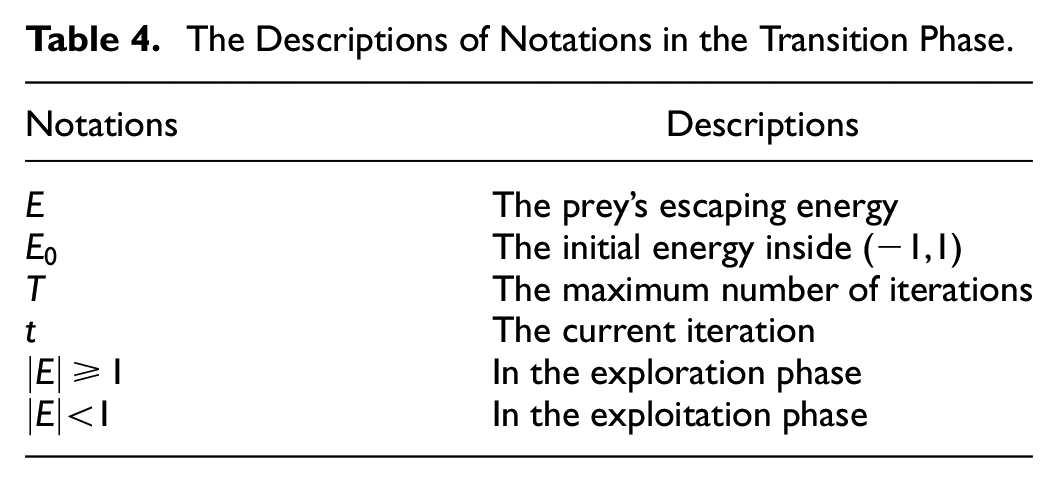
In the transition phase, the HHO algorithm can transfer from the exploration to the exploitation phase based on the prey’s escaping energy
The Descriptions of Notations in the Transition Phase.

In the exploitation phase, the hawks execute a surprise attack on prey detected in the previous phase. According to the natural behavior of escaping and capturing, the HHO algorithm performs the following four strategies depending on the successful escape’s probability
The Descriptions of Notations in the Exploitation Phase.


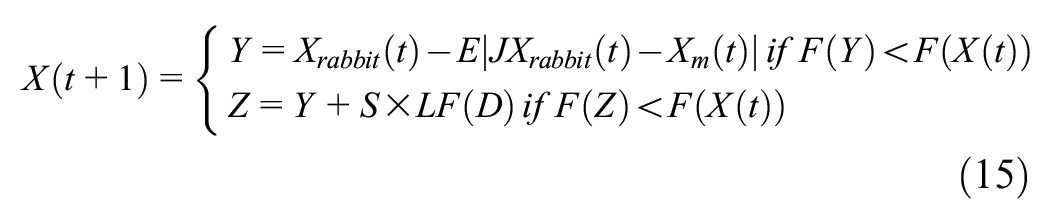
The Proposed IHHO Algorithm
The HHO algorithm has low convergence accuracy issues and falls into the local optimum. As a result, we improve the HHO algorithm from the following three aspects.
Introduce the Cauchy Distribution Function
The Cauchy distribution function has a relatively tiny peak and drops gently from the ridge to both sides. After updating the position by the Cauchy variation, the HHO algorithm is subject to a decrease in the binding force of the local extremum points. Therefore, the HHO algorithm can jump out of the local optimum and utilize more time to search for the optimal global solution. In other words, the HHO algorithm’s global search capability is improved. After obtaining the current optimal global solution, the optimal solution is updated by equation (16).

Innovate the Stochastic Contraction Exponential Function
The escaping energy

Add the Adaptive Inertia Weight
In the HHO algorithm, the prey’s location represents the optimal solution and determines the optimization performance. The HHO algorithm utilizes more time for global search if the inertia weight is relatively large. Conversely, if the inertia weight is comparatively small, the HHO algorithm has better local exploration ability and search results. As a result, we add the adaptive inertia weight. In the four strategies of the HHO algorithm, the inertia weight decreases slowly with the increase of iterations, and the prey will update its position using minor weights by equation (18). That is to say, the HHO algorithm’s local search capability is improved.

The Proposed IHHO-LSTM Prediction Model
The number of neurons in the hidden layer and the learning rate are crucial hyperparameters in LSTM (Y. Jiang et al., 2022). Therefore, these hyperparameters are optimized by the IHHO algorithm. In this study, mean square error is used as the fitness function. The parameter settings of the IHHO algorithm are shown in Table 6.
The Parameter Settings of the IHHO Algorithm.

The concrete steps of the IHHO-LSTM prediction model are as below:
Step 1: Input data divided into training and testing sets in a ratio of 7 to 3.
Step 2: Initialize the parameters of the IHHO algorithm and LSTM.
Step 3: Construct the initial population and calculate the fitness value.
Step 4: Calculate the value of the prey’s escaping energy
Step 5: If
Step 6: Obtain the optimal hyperparameters after reaching the maximum iteration.
Step 7: Train the LSTM network, make predictions, and output prediction results.
Model Evaluation Criteria
In this paper, the model evaluation criteria are root mean square error (RMSE), mean absolute error (MAE), and mean absolute percentage error (MAPE), which are enumerated by equations (19) to (21). The closer the criteria are to 0, the better the performance is. The criteria’s notations are described in Table 7.
The Descriptions of Notations in the Model Evaluation Criteria.


Empirical Analysis
Data Acquisition
This paper chooses three public health emergencies and acquires relevant data from a Chinese public opinion data website (https://ef.zhiweidata.com). This site covers various topical issues in society, which can be used for public opinion research. The data is the hourly information volume published on Microblogs, WeChat public platforms, and Chinese news websites. Microblog and WeChat are popular social platforms in China. Microblog has the functions of retweeting, mentioning, and hyperlinking, but messages are limited to 140 characters (N. Zhang & Skoric, 2019). Unlike Microblog, WeChat public platform has no character limit. Nevertheless, only official accounts can create and publish original posts once a day (Guo & Zhang, 2020). The Chinese news websites include the People’s Daily Online, the China News, the Xinhua Net, and other authoritative sites. Considering the distinct communication influence, the three platforms are assigned corresponding weights by equation (22) to describe the total data accurately. The changes in information volume of three public health emergencies with time are shown in Figure 3. The values in the figure have been calculated by weight multiplication.

As shown in Figure 3, at the beginning, middle, and end of the three public health emergencies, the changes in information volume show a slow growth, a sharp increase, and a gradual leveling off, respectively. According to the information life cycle theory, public opinion evolution trends are categorized into incubation, outbreak, and dissipation periods (J. Chen et al., 2022), which are consistent with the changes in information volume. Therefore, these data can be used for trend prediction research. Some crucial times are presented better to understand the turning points of three public health emergencies:

The changes in information volume of three public health emergencies with time: (a) The Changsheng Biological Vaccine Falsification in Changchun, (b) The Novel Mutated Virus Omicron in South Africa, and (c) The Local Confirmed COVID-19 Cases in Shanghai.
The first incident occurred on July 15, 2018, in Changchun, China. The Chinese State Food and Drug Administration informed Changsheng Biological Company that the rabies vaccine records were false. On July 23, some authoritative news websites reported the General Secretary’s attitude and stance. On July 29, the public security organ requested the arrest of the relevant person in charge.
The second incident occurred on November 26, 2021, in South Africa. A novel mutated virus was detected in COVID-19-positive cases. On November 29, the Chinese National Health Commission answered questions about how to deal with the novel mutated virus Omicron. On December 4, Zhong Nanshan, a respiratory expert and academician of the Chinese Academy of Engineering, made relevant remarks to allay the masses’ fears.
The third incident occurred on March 1, 2022, in Shanghai, China. A new confirmed COVID-19 local case was reported. On April 6, 38,000 medical staff from 15 provinces went to Shanghai for support. On May 1, the risk of community communication in Shanghai was effectively curbed.
Prediction Results
The experimental data in this paper consistently select the information volume of three public health emergencies within 600 hr. The prediction results of three public health emergencies are shown in Figures 4 to 6. The prediction models are BP, LSTM, HHO-LSTM, and IHHO-LSTM.
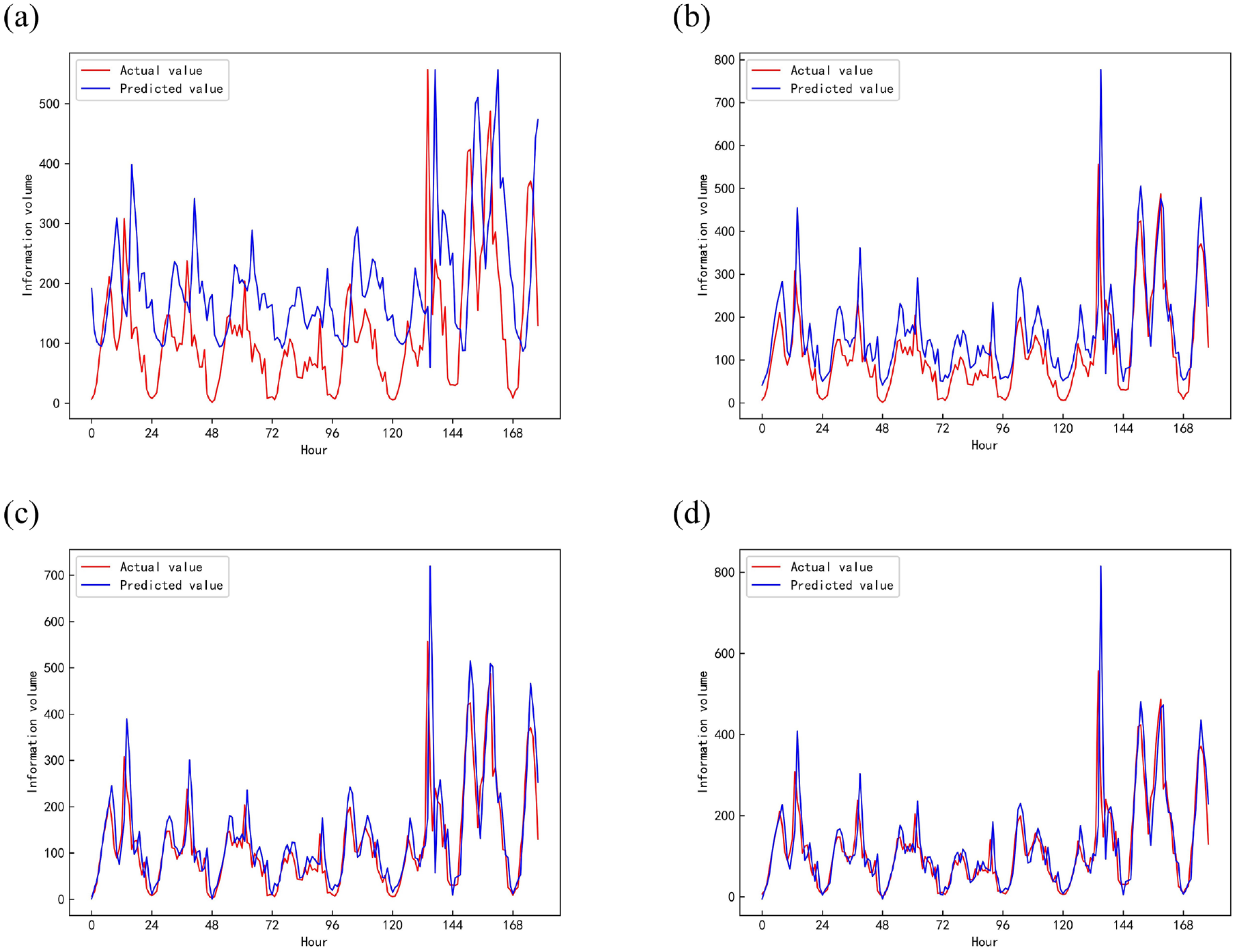
The prediction results of the Changsheng Biological Vaccine Falsification in Changchun: (a) BP, (b) LSTM, (c) HHO-LSTM, and (d) IHHO-LSTM.

The prediction results of the Novel Mutated Virus Omicron in South Africa: (a) BP, (b) LSTM, (c) HHO-LSTM, and (d) IHHO-LSTM.

The prediction results of the Local Confirmed COVID-19 Cases in Shanghai: (a) BP, (b) LSTM, (c) HHO-LSTM, and (d) IHHO-LSTM.
The comparisons of model prediction results reveal the following findings:
(1) Due to the particular structure with a memory cell unit, the deep learning method LSTM outperforms the machine learning method BP.
(2) By utilizing the HHO algorithm to optimize the number of neurons in the hidden layer and the learning rate of LSTM, the HHO-LSTM model predicts better than the single LSTM.
(3) After introducing the Cauchy distribution function, the stochastic contraction exponential function, and the adaptive inertia weight to solve the HHO algorithm’s issues, the IHHO-LSTM model combining the improved HHO algorithm and deep learning method LSTM performs best.
Model Comparison and Evaluation
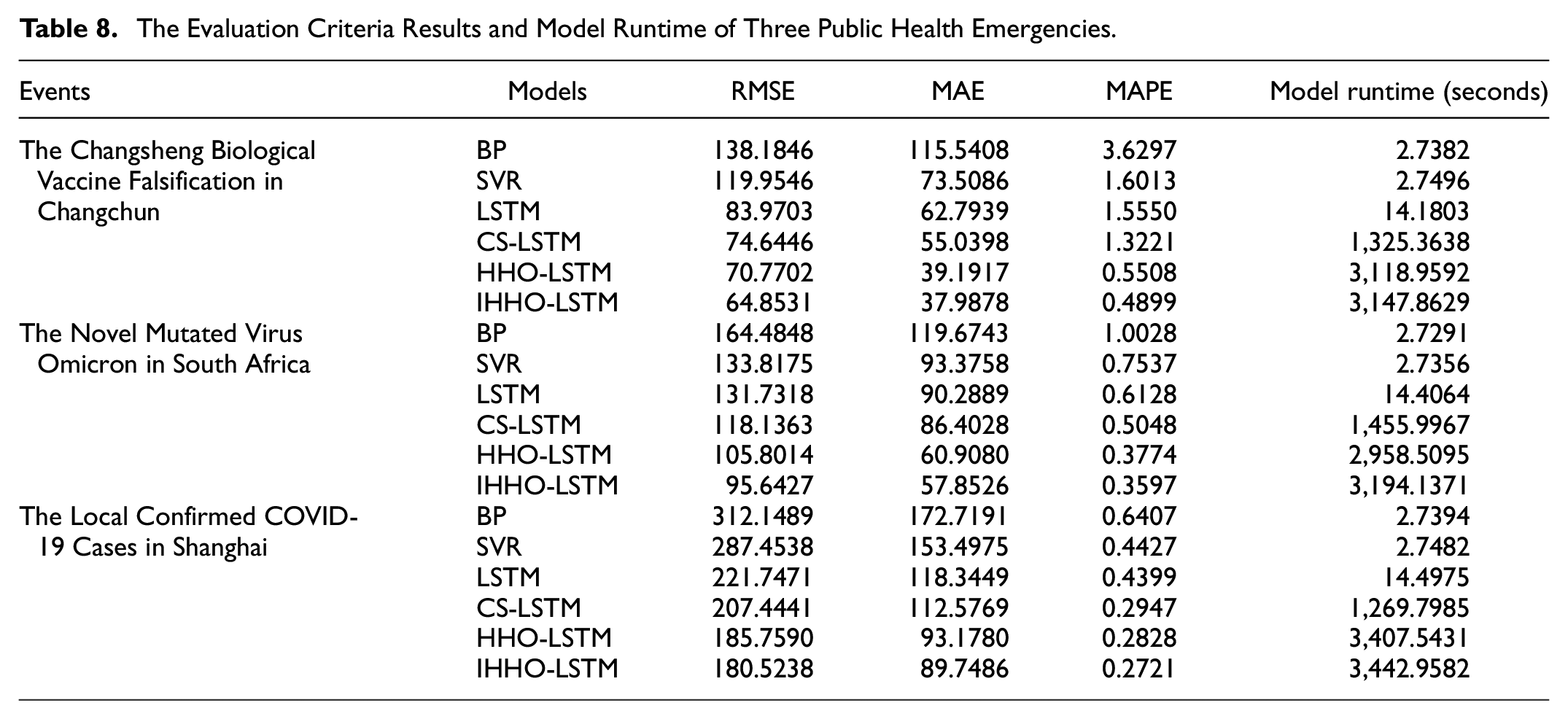
Table 8 displays the evaluation criteria results and model runtime of three public health emergencies to provide a more intuitive comparison. Single models contain BP, SVR, and LSTM. Hybrid models include CS-LSTM and HHO-LSTM.
The Evaluation Criteria Results and Model Runtime of Three Public Health Emergencies.
The specific comparative analyses are as below:
(1) The RMSE values of the IHHO-LSTM model are 64.8531, 95.6427, and 180.5238. The average values of the three single models are 114.0365, 143.3447, and 273.7833. The IHHO-LSTM model reduces by 43.13%, 33.28%, and 34.06%. The mean values of the two hybrid models are 72.7074, 111.9689, and 196.6016. The IHHO-LSTM model decreases by 10.80%, 14.58%, and 8.18%.
(2) The MAE values of the IHHO-LSTM model are 37.9878, 57.8526, and 89.7486. The average values of the three single models are 83.9478, 101.1130, and 148.1872. The IHHO-LSTM model reduces by 54.75%, 42.78%, and 39.44%. The mean values of the two hybrid models are 47.1158, 73.6554, and 102.8775. The IHHO-LSTM model decreases by 19.37%, 21.46%, and 12.76%.
(3) The MAPE values of the IHHO-LSTM model are 0.4899, 0.3597, and 0.2721. The average values of the three single models are 2.2620, 0.7898, and 0.5078. The IHHO-LSTM model reduces by 78.34%, 54.46%, and 46.42%. The mean values of the two hybrid models are 0.9365, 0.4411, and 0.2888. The IHHO-LSTM model decreases by 47.69%, 18.45%, and 5.78%.
(4) The model runtime of the IHHO-LSTM model is 3,147.8629, 3,194.1371, and 3,442.9582 s. Because the swarm intelligence optimization algorithms need to obtain the optimal hyperparameters first, the running time of the hybrid models is generally longer than single models. However, the IHHO-LSTM model still performs well, with roughly the same running time as the HHO-LSTM model. The proposed model runs for much more time than the LSTM, but the extra time has minimal impact on event development. In exchange for the improvement of prediction accuracy is entirely worthwhile. The IHHO-LSTM model completes the prediction within 1 hr. In other words, the current forecast has been completed before the next hour’s data is collected. For the overall public health emergencies, the government can take reasonable supervision measures in a controllable time range.
(5) As shown in Figure 3, the initial information volume of the Changsheng Biological Vaccine Falsification incident is lower than the other two events. However, it can be seen from Figures 4 to 6 that the IHHO-LSTM model improves the prediction effect most significantly in three emergencies. In fact, many public health emergencies are consistent with the evolution trend of the first event. It is crucial to predict trends in such events quickly and accurately. The earlier the government predicts the abnormal point, the lower the loss caused by emergencies. Specifically, compared with BP, the MAPE values of the IHHO-LSTM model reduce by 86.50%, 64.13%, and 57.53% in three public health emergencies. The RMSE values decrease by 53.07%, 41.85%, and 42.17%. The MAE values reduce by 67.12%, 51.66%, and 48.04%. Therefore, the proposed model can accurately forecast online public opinion trends with low initial attention.
In general, the proposed IHHO-LSTM model is superior to other single and hybrid models and effectively improves the prediction accuracy of online public opinion trends in public health emergencies.
Conclusion and Future Prospect
Conclusion
The online public opinion trends in public health emergencies are characterized by nonlinearity and protracted nature. As a result, research on building an accurate prediction model is necessary. Some defects of single models can be improved. So this paper thoroughly combines the advantages of swarm intelligence optimization algorithm and deep learning method to propose the IHHO-LSTM model.
Statistical methods can not address irregular and nonlinear prediction issues. Machine learning methods’ generalization and feature mining capabilities are limited. The deep learning method LSTM effectively solves the existing problems. Thus, LSTM is applied to construct the model in this paper. Nevertheless, the performance of LSTM depends on the setting of hyperparameters. Relying on manual settings alone increases the difficulty of experiments and exists large randomness.
The swarm intelligence optimization algorithms are created by researchers inspired by natural biological groups and based on the imitation of animal behavior, which can effectively solve the optimization problem. The HHO algorithm has more advantages, such as a robust search capability, simple structure, few preset parameters, and fast convergence speed. So we utilize the HHO algorithm to optimize the number of neurons in the hidden layer and the learning rate of LSTM. However, the HHO algorithm is a stochastic optimization algorithm and may suffer from low convergence accuracy and falling into the local optimum.
Subsequently, we improve the HHO algorithm by introducing the Cauchy distribution function, the stochastic contraction exponential function, and the adaptive inertia weight to construct the IHHO-LSTM model. To prove the proposed model’s generality and superiority, we select three public health emergencies to make predictions and add some comparison models. The experiment results show hybrid models have better prediction effects than single models. Compared with the MAPE average values of the three single models, the mean values of the two hybrid models reduce by 58.60%, 44.15%, and 43.13%. Furthermore, the IHHO-LSTM model is more effective than hybrid models. The MAPE values decrease by 47.69%, 18.45%, and 5.78% relative to the average values of the two hybrid models.
In summary, this research is of great significance. Trend forecasting of online public opinion analyzes and quantifies future development and changes based on the current data. Anomalies can be identified when the actual hourly data deviates significantly from the predicted data. Analyzing abnormal points and creating an early warning system can identify reversals and issue warnings. In addition, some public health emergencies in real life often attract little attention in the early stages. If the government does not respond promptly, online public opinion will deteriorate. The proposed IHHO-LSTM model is remarkably accurate in predicting such potential events. Relevant departments will have enough time to formulate policies, and media platforms will release news more objectively and fairly, which will help respond to online public opinion.
Suggestion
In order to deal with online public opinion in public health emergencies more effectively and rationally, this paper proposes some suggestions from three aspects: netizens, media platforms, and the government.
Due to the openness and concealment of the network environment, everyone is free to communicate using a virtual name. Netizens should improve their legal awareness and abilities to identify false information to reduce the occurrence of extreme emotions. With many fans, opinion leaders’ words and deeds directly impact netizens. They should rely on their influence and take responsibility actively.
As a bridge of information transmission, media platforms are essential for netizens to obtain public opinion topics. The platforms should provide truthful coverage of crucial stages and points in public health emergencies and become a balancer, motivator, and organizer of public opinion information. Additionally, rumors should be clarified promptly to reduce the spread of negative emotions.
Relevant government departments should publish timely warning information to stabilize public sentiment and implement effective governance. By using information technologies to collect public opinion data, the government can establish a scientific monitoring and analysis system to grasp online public opinion development trends in public health emergencies.
Limitation and Future Prospect
There are certain limitations in this study. For countries with underdeveloped social networks, the prediction of the proposed model may be biased. Different social media platforms and multi-modal online public opinion data can be obtained in the future. The related calculation of netizens’ emotional value can also be added for research.
Footnotes
Acknowledgements
The authors are grateful to the financial support by the National Social Science Fund of China (No. 19BJY246) and the Science and Technology Development Plan Project of Changchun Science and Technology Bureau (No. 21ZY61).
Declaration of Conflicting Interests
The author(s) declared no potential conflicts of interest with respect to the research, authorship, and/or publication of this article.
Funding
The author(s) disclosed receipt of the following financial support for the research, authorship, and/or publication of this article: the National Social Science Fund of China (No. 19BJY246) and the Science and Technology Development Plan Project of Changchun Science and Technology Bureau (No. 21ZY61).
Ethical Approval
N/A

Data Availability Statement
Data sharing not applicable to this article as no datasets were generated or analyzed during the current study.