



Abstract
A growing concern for online course learning is to what extent learners are concentrated and self-regulated when they are isolated from their classmates and instructors. To address this issue, this study collected both quantitative and qualitative data from a sample of 580 Chinese university learners from varied majors, who were taking online English courses in Emergency Remote Teaching (ERT) mode during COVID-19. This study identified specific psychological and contextual factors that impact learners’ e-learning acceptance and online self-regulation, based upon Technology Acceptance Model (TAM). Learners’ actual use of three sub-processes of self-regulated strategies, namely, goal setting, task strategies, and self-evaluation was also examined. Partial least squares (PLS)-structural equation modeling (SEM) technique was used to test hypotheses and proposed research model. The quantitative results indicate that media richness, as a contextual factor, and social presence and flow, as two typical psychological factors, are determining antecedents that impact Chinese learners’ e-learning acceptance. Meanwhile, quantitative findings show that learners’ behavioral intention to use e-learning is a main contributor of their use of all three sub-processes of self-regulated learning strategies. Furthermore, thematic analysis was conducted to study the qualitative data, revealing that learners held rather divided and mixed perceptions regarding online learning experience. These findings have important implications for effective online English course design and implementation.
Keywords
Introduction
The explosion of e-learning or distance learning technology in recent years has contributed to a rapid revolution in education, as the features and unique attributes of e-learning lead to “new modes of educational delivery, new learning domains, new principles of learning, new learning processes and outcomes and new educational roles and entities” (Harasim, 2000, p. 45). The abrupt outbreak of COVID-19 at the beginning of 2020 caused further massive changes in education and has greatly boosted the use of e-learning all over the world. In China, Emergency Remote Teaching (ERT), “a temporary shift” of teaching to a fully online delivery mode under crisis circumstances (Hodges et al., 2020) was carried out across the nation during COVID-19. The Ministry of Education of the People’s Republic of China (Wu, 2020) reported that between February and June in 2020, the number of universities implementing online teaching had reached 1,454 and 12.26 million courses were offered online, in which approximately 1 million teachers and over 17 million students participated in this unforeseen educational shift from traditional face-to-face education to online education. It seems that its outcome is rather encouraging and promising. A nationwide survey has shown that the 80% of the credit-receiving undergraduate students were satisfied with their online learning experience and 84% of the teachers reported their acceptance of online teaching, which demonstrated high level of approval among both students and teachers in China (Wu, 2020). Online teaching and learning has made higher education more accessible and reachable than ever, allowing learners to study anytime and anywhere.
This round of online teaching and learning for a whole semester in Chinese universities was unprecedented in scale and scope. It was in a modality that was different from the adjunct online learning mode, in which networking is used to assist traditional face-to-face education, and also different from blended or mixed learning, in which networking is integrated as significant portion of traditional face-to-face education. In this case of online learning, it was a “totally online mode” (Harasim, 2000, p. 47), as it relied on networking as the primary teaching and learning medium for an entire course or program.
Online learning, e-learning or distance learning is typically characterized with its fewer time and place constraints, lower costs, and greater flexibility (Sadaghiani, 2011). However, these agreed benefits or advantages do not necessarily mean consistent recognition of online learning among learners (Alhamami, 2018). Online teaching and learning faces many challenges and uncertainties, including issues concerning students’ perception of media richness, the sense of community, students’ concentration, which have been proven to play a significant role in students’ learning outcomes (Mayer, 2003; Yi & Hwang, 2003; Zhao et al., 2020).
Therefore, a growing body of literature has turned attention to the technology acceptance of online learning and investigated various influencing factors of technology acceptance (Al-Adwan et al., 2018). As one of the most commonly used theoretical frameworks for measuring the acceptance of information systems, technology acceptance model (TAM) has been applied in online learning environments and over the last few decades, a considerable literature has grown up around the theme of students’ technology acceptance from this perspective (Al-Adwan, 2020). The examination of the acceptance of e-learning necessitates “a solid understanding of the user acceptance processes” (Saadé & Bahli, 2005, p. 317), as the student is a learner as well as a computer and system user. Most of the previous studies based on TAM have, however, focused on examining key external antecedents of e-learning acceptance, and thus not adequately explained students’ use of cognitive learning strategies, of which learners’ e-learning acceptance might be a major predictor. Moreover, it is worth noting that much of the existing research focuses particularly on the adjunct mode or blended mode of e-learning and there have been few discussions about learners’ perceptions and technology acceptance in instructor-led and course-based fully online learning environments.
Another primary concern of online learning is that learners have to be self-regulated, concentrated and enjoy learning in order to achieve satisfactory academic outcomes. Online mode of teaching and learning generally requires a deeper engagement of students (Trenholm & Peschke, 2020), compared to face-to-face learning mode. Furthermore, online self-regulation and learning experience could be influenced by a number of psychological and contextual factors, such as peer community, social presence, the feeling of flow (an optimal state when someone is immersed in something which embodies high concentration of attention, feeling of fleeting time, and pleasant mood) and confidence (Farrell & Brunton, 2020). In addition, the rich media use such as text messages, audio messages, and video conferences in online learning environments necessitates further research on the influence of this feature.
While prior research has examined media richness theory, social presence theory, flow theory, TAM, and self-regulation in both adjunct mode and blended mode of e-learning, to the best of our knowledge, few study has yet theoretically combined these research interest and study them in a totally online learning environment. The primary contribution of this study is the integration of media richness theory, social presence theory, flow theory, TAM, and self-regulation in measuring, predicting and explaining the key contextual and psychological factors (i.e., media richness, social presence, and flow) that might influence learners’ e-learning experience and acceptance. Moreover, this study further investigates the causal relationships between students’ behavioral intention and their actual adoption and use of cognitive learning strategies in fully online learning environments during COVID-19. The findings from this study may therefore help better understand university students’ acceptance of ERT and bridge the existing gap between acceptance and self-regulation in e-learning. The results of this research are expected to facilitate effective online English course design and implementation. Specifically, we explore answers to three research questions related to learners’ online English language learning:
Theoretical Background and Research Hypotheses
Online Learning and its Technology Acceptance
Technology acceptance model (TAM) provides a useful theoretical framework to account for the correlation between system design features, perceived usefulness, perceived ease of use, attitude toward using, and actual usage behavior. The proposed TAM (Davis, 1989, 1993) hypothesizes that attitude toward using is a major determinant of users’ behavioral intention to use and in turn, attitude toward using is significantly and directly predicted by two major beliefs: perceived usefulness and perceived ease of use. In this study, perceived ease of use is defined as the degree to which students believe that ERT would be free of effort, and perceived usefulness is defined as the degree to which students believe that ERT would enhance his/her English performance.
E-learners’ technology acceptance has been elaborated on in a considerable number of studies in education (Al-Adwan, 2020; Al-Adwan et al., 2018). Perceived ease of use and perceived usefulness were found to be decisive antecedents that affect learners’ acceptance of English mobile learning (Chung et al., 2015), collaborative learning technologies in a web 2.0 environment (Cheung & Vogel, 2013) and e-learning (Liu et al., 2009; Mohammadi, 2015), learners’ intention to use Moodle (Escobar-Rodriguez & Monge-Lozano, 2012), MOOCs (Al-Adwan, 2020; Joo et al., 2018) and machine translation (Yang & Wang, 2019), learners’ attitude toward using e-portfolio system (Shroff et al., 2011), using technology as well as their behavior intention in blended learning scenario (Francescucci & Foster, 2013).
Meanwhile, much of the literature based on TAM is concerned with the impact of external variables from other theories and models on technology acceptance. Self-efficacy, subjective norm, perceived enjoyment, computer anxiety and experience were reported as the mostly commonly used external factors of technology acceptance of e-learning (Abdullah & Ward, 2016). More recently, the external variables in e-learning environments including self-determination (Joo et al., 2018), media richness, social presence, flow, and self-regulation have attracted growing attention and their related theories will be reviewed in the following sections.
Based on the findings reported in prior studies, the following hypotheses regarding the basic relationships among constructs within TAM were tested:
H1: Perceived ease of use can positively and significantly affect perceived usefulness.
H2: Perceived ease of use can positively and significantly affect attitude toward using.
H3: Perceived usefulness can positively and significantly affect attitude toward using.
H4: Attitude toward using can positively and significantly affect behavioral intention.
Social Presence
E-learners’ perceived social presence has been considered as a key psychological factor to overcome learners’ feeling of lack of a sense of community resulting from spatial isolation in online learning (Sung & Mayer, 2012). In online learning environments, social presence is defined as “the degree to which a learner feels personally connected with other students and the instructor in an online learning community” (Sung & Mayer, 2012, p. 1738). The role of social presence in online learning has received increased attention over the last decades. Previous research has identified a positive and significant impact of social presence on flow in e-learning environments. Liao (2006), for instance, concluded that the most important independent variable with the highest effect over flow is interactivity in a distance learning environment. Joo et al. (2014) demonstrated a direct significant impact of social presence on learning flow perceived by students in a cyber university. Zhao et al. (2020) reported that social presence can stimulate a higher level of concentration or flow on e-learning content.
Likewise, social presence has been reported as a decisive factor to produce effective e-learning outcomes, with a particularly significant effect on improving learning satisfaction and perceived learning (Hu, 2013; Zhao et al., 2020). For example, Zhan and Mei (2013, p. 131) suggested that “online students are in greater need of higher-level social presence,” which in turn has a significant impact on their learning outcomes and satisfaction. Moreover, Tu (2000, 2001) proposed three dimensions of social presence (i.e., social context, online communication and interactivity), which were proven to significantly affect Chinese students’ perception of computer-mediated communication in online learning environments. Similarly, Hilliard et al. (2020) demonstrated that increased level of social presence with a more supportive social and emotional climate could reduce students’ anxiety in a collaborative project.
Therefore, the following hypotheses were proposed for the present study:
H5: Social presence can positively and significantly affect flow.
H6: Social presence can positively and significantly affect attitude toward using.
Flow Theory
Flow is an integrated construct to measure individuals’ motivation, personality, and subjective experience from the perspective of human behavior and psychology (Csikszentmihalyi & Robinson, 1990; Liao, 2006). Flow theory, proposed by Csikszentmihalyi (1990), refers to the phenomenon that when individuals concentrate fully on a particular task, they will produce flow which embodies high concentration of attention, feeling of fleeting time, and pleasant mood. The two key characteristics of flow are the total concentration and the enjoyment one experiences in an activity (Ghani & Deshpande, 1994). Learners may enter such a state of concentration that they become immersed in learning activities and perform activities without being aware of time and their surroundings.
Learners’ experiences of enjoyment, interest, and concentration (i.e., flow) are proven to play an essential role in computer-mediated distance education. Enjoyment, as a crucial element of flow state, is found to significantly and positively influence perceived ease of use and usefulness (Yi & Hwang, 2003). Particularly, the perceived feeling of flow has been proven to be a contributor affecting online learners’ willingness to continue learning (Zhao et al., 2018), self-efficacy (Choi et al., 2007), learners’ positive emotional and cognitive response (Rodríguez-Ardura & Meseguer-Artola, 2017), satisfaction (Li et al., 2021), and e-learners’ academic performance (Yen & Lin, 2020).
This study applies flow theory to the online learning perception measurement and proposes the following hypotheses based on previous findings:
H7: Flow can positively and significantly affect perceived ease of use.
H8: Flow can positively and significantly affect perceived usefulness.
H9: Flow can positively and significantly affect attitude toward using.
Media Richness Theory
Media richness theory hypothesizes that “communication effectiveness depends on the match between task requirements and medium capacity” (Otondo et al., 2008, p. 21). The medium’s capacity, the number of cues and channels and language variety can account for the media richness differences (Daft & Lengel, 1986). A typical presentation of high-level media richness conveys information using a wide variety of presentation formats (e.g., texts, graphics, audios, videos) (Lim & Benbasat, 2000). Media richness is found to be positively associated with communicators’ social presence (Short et al., 1976) and communication outcomes by “increasing the relevance of the message and receivers’ involvement” (Otondo et al., 2008), as social presence is correlated with the words conveyed as well as the nonverbal cues during communication (Rice, 1993).
Learning with multimedia resources could help students build mental representations from words and pictures and thereby enable students to learn more deeply from communication of a higher level of media richness (Mayer, 2003). However, recent research applying the media richness theory to e-learning technologies has produced mixed results. In one study, Sun and Cheng (2007) demonstrated that multimedia content alone did not make a significant difference to e-learning performance and satisfaction. In other studies (Aloraini, 2012; Liaw, 2008), multimedia quality was shown to be a significant predictor of learners’ satisfaction, learning effectiveness, and academic achievement. The media richer presentation, for instance, interface (text-audio-video presentation) predicted higher level of perceived usefulness and concentration than text-audio based or audio-video-based presentations (Liu et al., 2009). More research is needed to assess the impact of media richness on students’ virtual experience. Therefore, the following hypotheses were tested in this study:
H10: Media richness can positively and significantly affect perceived ease of use.
H11: Media richness can positively and significantly affect flow.
H12: Media richness can positively and significantly affect social presence.
Self-Regulated Learning
In recent years, there has been growing recognition of the vital links between self-regulated learning (SRL) and learners’ academic achievements (Paechter et al., 2010; Schunk & Zimmerman, 1994). Zimmerman (2000, p. 14) described self-regulation as “cyclical” of three “self-oriented feedback loops” and three cyclical phrases are identified from social cognitive perspective: forethought, performance, and self-reflection processes (Zimmerman, 2000). SRL has been evaluated as an essential psychological determinant on academic learning in current research in the field of education (Paechter et al., 2010; Schunk & Zimmerman, 1994). Previous studies have shown that SRL could positively influence students’ self-efficacy, task value, satisfaction, learning attitudes, and course completion in online learning environments (Su et al., 2019; Zhu et al., 2020).
Relatively few studies, however, have been conducted to explain how SRL is influenced by students’ virtual experience and perception. More recently, Liaw and Huang (2013) investigated learner self-regulation in e-learning environments and observed that the perceived satisfaction, perceived usefulness, and interaction could well predict self-regulation. Hood et al. (2015) provided empirical evidence that learners’ context and role not only influenced their self-regulation in a MOOC but also predicted how a learner implements each specific SRL sub-process. Li (2019) established that MOOC learners’ age, gender, degree, and prior experience in online courses significantly predict SRL. Zheng and Wang (2020) conducted a survey on 289 college students in China, reporting that learners’ perceived usefulness can significantly predict their online self-regulated learning, while a significant negative predictive relationship was found between perceived ease of use and online self-regulated learning. Based on these findings and the basic assumptions in TAM, we posit the following three hypotheses to examine if online self-regulated English learning strategies used in forethought process (goal setting), in performance process (task strategies) and in self-reflection process (self-evaluation) could be predicted by behavioral intention to use e-learning:
H13: Behavioral intention can positively and significantly affect goal setting.
H14: Behavioral intention can positively and significantly affect task strategies.
H15: Behavioral intention can positively and significantly affect self-evaluation.
Research Purpose and Model
Based on TAM, media richness theory, flow theory and self-regulation theory, the research model (Figure 1) is proposed for the present study, aiming to investigate the causal relationships between media richness, social presence, flow, TAM, and SRL. Firstly, three external variables, namely media richness, social presence and flow, are hypothesized to significantly affect learners’ technology acceptance, including perceived ease of use (PEU), perceived usefulness (PU), attitude toward using (ATT), and behavioral intention (BI). Secondly, it is posited that the behavioral intention to use e-learning systems has a significant and positive impact on students’ actual use of three sub-processes of online self-regulated English learning strategies, namely goal setting (forethought process), task strategies (performance process), and self-evaluation (self-reflection process), in the course-based online English learning environment.

Research model.
Materials and Methods
Instruments
A survey was employed to test the hypotheses and research model discussed in the previous sections. The questionnaire was designed with two sections to test the theoretical model. The first section included demographic questions about the participants, while the second section had questions measuring the constructs in the research model. The measures used in this article were primarily adapted from relevant prior studies and the content of this questionnaire had been modified to fit the online English learning environment. Ten items for social presence, flow and media richness were adapted from research by Zhao et al. (2020). Eleven items for TAM (perceived usefulness, perceived ease of use, attitude toward using, behavioral intention) were adapted from prior work by Liu et al. (2009). The scales for online self-regulated English learning include three sub-processes: goal setting (forethought process), task strategies (performance process), and self-evaluation (self-reflection process), which were measured by the seven items derived from Su et al. (2018). The Appendix provides an overview of the measures. Each item corresponding to the constructs was measured using a five-point Likert scale, with answer choices ranging from “disagree strongly” (1) to “agree strongly” (5). The items were translated into Chinese to ensure respondents understand all the items clearly. At the end of the questionnaire is one open-ended question soliciting the students’ perceptions of the online English courses.
Participants
This study used a convenience sampling technique. The sample participants were undergraduate students from all academic majors (including science, social science, and humanities) in two Chinese universities. All the participants, at the time of survey, were enrolled in at least one credit-receiving English course and learned the course in fully online teaching-learning environment during the pandemic of COVID-19. The questionnaires were distributed online via the Wenjuanxing survey platform by English course instructors. Altogether 607 questionnaires were retrieved but 27 cases were found invalid and therefore excluded. Thus, a total of 580 valid questionnaires were used and analyzed for the present study.
Demographic information was collected regarding the information about participants’ age, gender, experience in online English learning. They were 323 males and 257 females between 17 and 22 years of age, with 91.2% of the students reporting that they had been learning English courses online for at least 2 weeks.
Data Analysis
First, the hypotheses and research model were tested using partial least squares (PLS)-structural equation modeling (SEM). SmartPLS 2.0 software was used. In comparison to other structural equation modeling methods, PLS, a variance-based structural equation modeling method, is more suitable when the research model is complex (Hair et al., 2013). In addition, PLS is believed to have more advantages when the focus of research is to predict and develop a theory, rather than testing and confirming an existing theoretical model (Reinartz et al., 2009). In this current study, the research model is rather complex with as many as 10 constructs, attempting to develop and extend TAM by including three external variables as well as students’ actual use of cognitive learning strategies. Therefore, it is assumed that PLS is a more appropriate structural modeling equation method to adopt considering the characteristics and purpose of the present study.
Second, thematic analysis was conducted to examine learners’ responses to the open-ended question in the questionnaire, from which qualitative findings are presented in this paper as a complement to the quantitative results.
Results
Descriptive Analysis (Research Question 1)
Table 1 shows the mean and standard deviation for all 10 constructs examined in the research model. Each construct was assigned value choice from 1 to 5, with 3 as the mid-point. The mean scores for the 10 constructs ranged from 3.256 to 3.862, indicating students’ overall positive perception for each of these variables. It can be seen from Table 1 that students most positively perceived media richness (M = 3.862) followed by PEU (M = 3.831) in online English courses. In contrast, students perceived least positively BI (M = 3.256), compared with the mean scores of other constructs.
Descriptive Statistics, Results of the Measurement Model, and Q Square.

Note. FL = factor loadings; SD = standard deviation; CR = composite reliability; CA = Cronbach’s α.
The Measurement Model
The reliability and validity were tested by assessing the individual item reliability, internal consistency, convergent validity, and discriminant validity. Table 1 shows that factor loadings for all constructs were above .8 and Cronbach’s Alpha for all constructs were above .7 (Hair et al., 2006), which suggest that individual item reliability was adequate. Moreover, all the constructs were internally consistent, as the composite reliabilities were above .7 (Nunnally & Bernstein, 1994). In addition, as shown in Table 2, the constructs in the research model met the convergent validity criteria, as the average variance extracted (AVE) values for all 10 constructs were greater than .5 (Fornell & Larcker, 1981). Finally, discriminant validity was also acceptable, as the value of the square root of the AVE in each construct was greater than correlation coefficients among other constructs (Fornell & Larcker, 1981).
AVE and Correlation Matrices.

Note. ATT = attitude toward using; BI = behavioral intention; FL = flow; GS = goal setting; MR = media richness; PEU = perceived ease of use; PU = perceived usefulness; SP = social presence; SE = self-evaluation; TS = task strategies. The diagonal elements in bold are the square roots of the AVEs and the off-diagonal ones are the correlation values.
The Structural Model (Research Question 2)
The hypothesized structural model was then tested. Figure 2 presents the summary of statistic results obtained via structural modeling equation testing method. A bootstrapping procedure was employed to examine the path coefficient, t-statistics, and variance (the R-squared value). The number of cases for bootstrapping was equal to the sample size, which were 580 cases and the number of re-samples used for this study was equal to 5,000 (Hair et al., 2006). A blindfolding procedure was adopted to work out the predicative relevance (Q square). The path significance was examined by the two-tailed test, in which the .05 significant level, or p < .05, requires a t-value >1.960, and the .01 significance level, or p < .01, requires a t-value >2.576. The .001 significant level, or p < .001, requires the t-value >3.291.
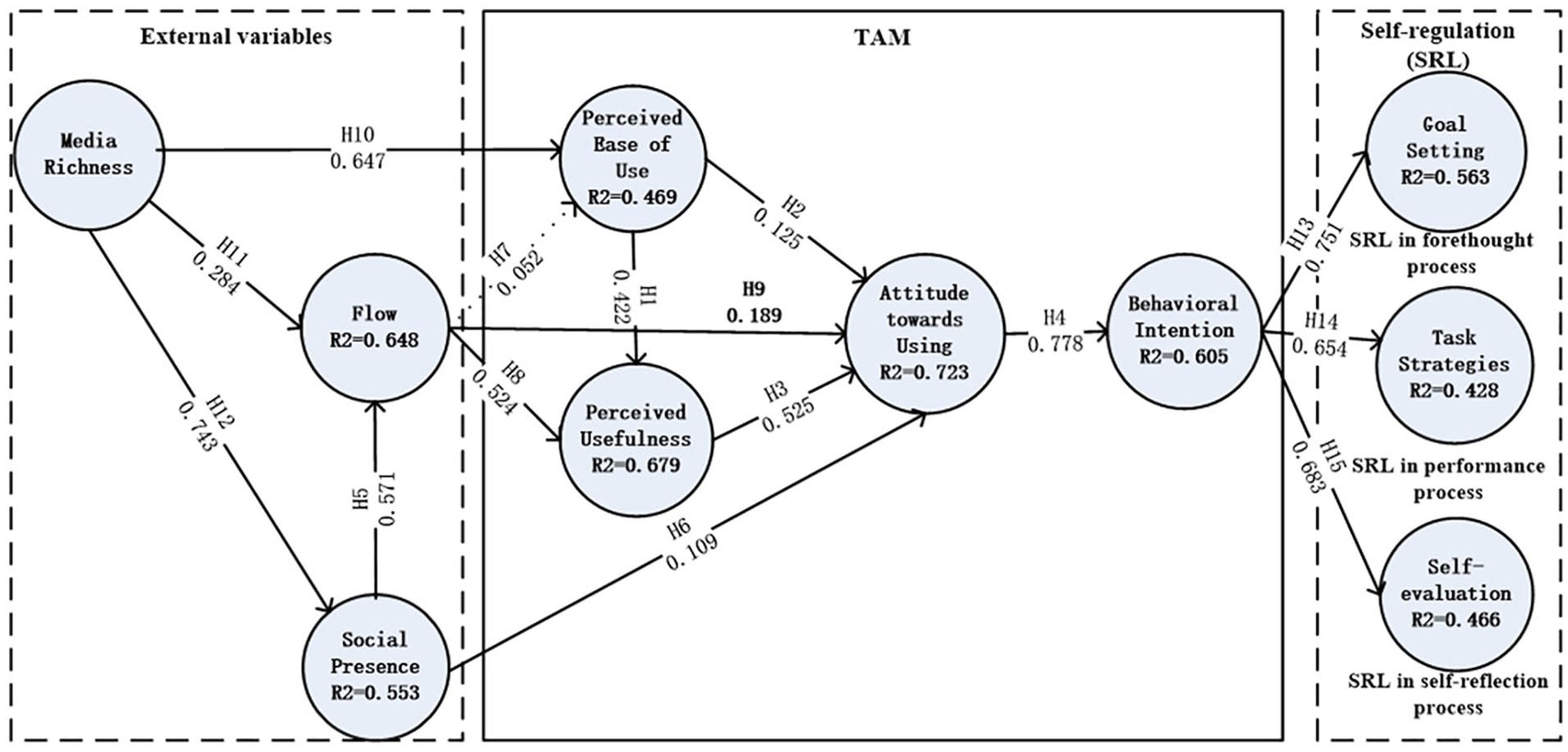
Hypotheses testing results in research model.
The path coefficient, t-value and their significance are reported in Table 3. First, the results indicate, as expected, that all the paths within TAM model were significant. Among them, PEU had a significant influence on PU (β = .422, t > 3.291 at p < .001) and ATT (β = .125, t > 2.576 at p < .01); PU could significantly influence ATT (β = .525, t > 3.291 at p < .001); ATT was found to have significant effect on BI (β = .778, t > 3.291 at p < .001). Thus, H1, H2, H3, and H4 were supported.
Path Coefficients and t-Values.
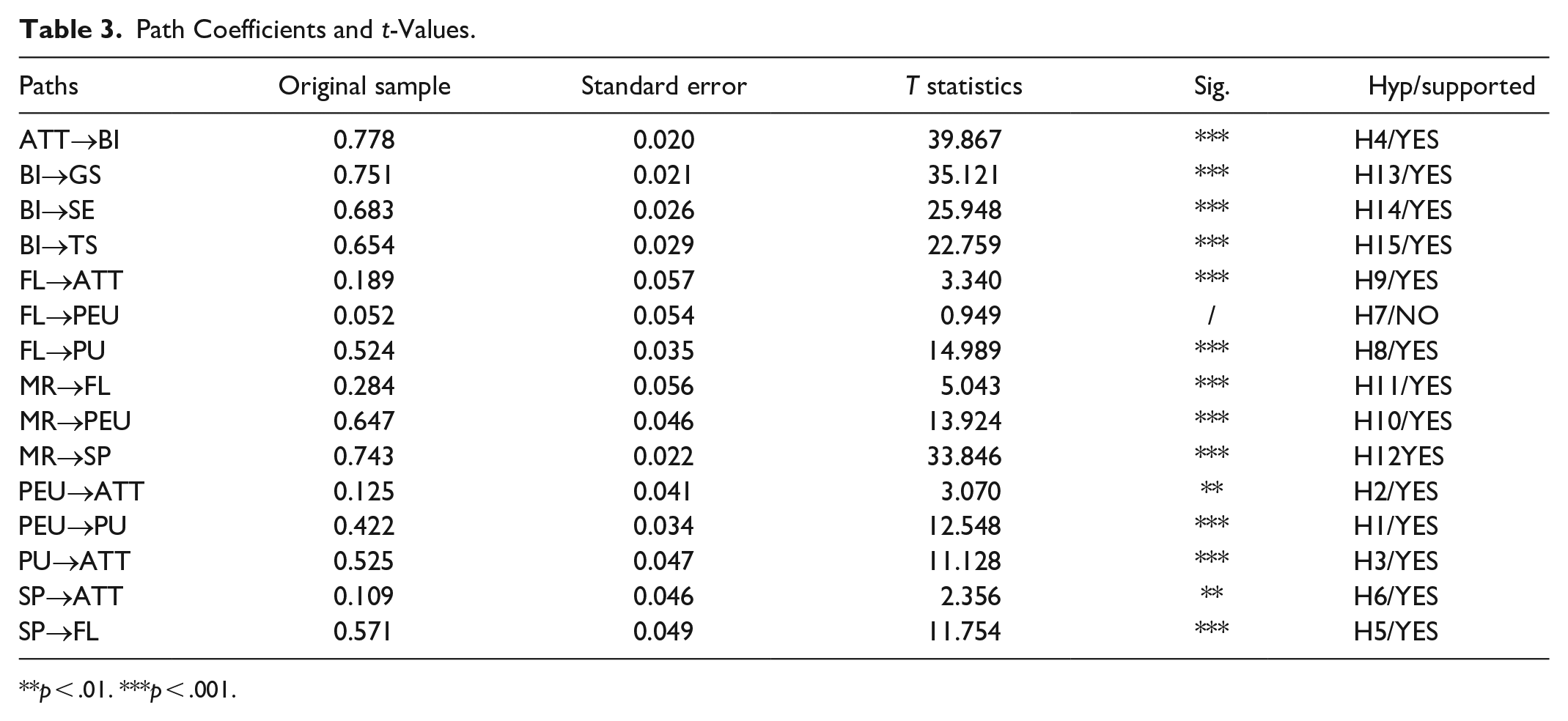
**p < .01. ***p < .001.
Second, it was found that media richness as an external variable could significantly influence PEU (β = .647, t > 3.291 at p < .001), flow (β = .284, t > 3.291 at p < .001) and social presence (β = .743, t > 3.291 at p < .001), which supported H10, H11 and H12. Similarly, as supposed by H5 and H6, the second external variable social presence was significantly correlated with flow (β = .571, t > 3.291 at p < .001) and ATT (β = .109, t > 2.576 at p < .01). Flow was found to have a significant effect on PU (β = .524, t > 3.291 at p < .001) and ATT (β = .189, t > 3.291 at p < .001), supporting H8 and H9. However, flow was not found to have no significant effects on PEU (β = .052, t = 0.949 < 1.960), rejecting H7.
Third, regarding the impact of BI on three sub-processes of SRL in research model, the results showed that BI had significant effects on goal setting (β = .751, t > 3.291 at p < .001), task strategies (β = .654, t > 3.291 at p < .001), and self-evaluation (β = .683, t > 3.291 at p < .001), supporting H13, H14, and H15.
Furthermore, the coefficient of determination (R square) is an important criterion to assess the adequacy of a PLS-SEM model (see Figure 2). For the research model, the media richness accounted for 46.9% of the variance of PEU and 55.3% of the variance of social presence. Media richness and social presence accounted for 64.8% of the variance of flow, which in turn, together with PEU, explained 67.9% of the variance of PU. Within the TAM, the constructs of flow, social presence, PEU and PU accounted for 72.3% of the variance of ATT. Moreover, ATT explained 60.5% of the variance of the behavior intention. In addition, BI explained 56.3% of the variance of goal setting, 42.8% of the variance of task strategies and 46.6% of the variance of the self-evaluation in research model. The R square for all 10 constructs were significantly large (>.26) (Chin, 1998), proving a satisfactory predictive effect of the research model. Besides, as reported in Table 1, the Q square values were all above zero recommended by Hair et al. (2014), which revealed sufficient predicative relevance of the proposed model.
Qualitative Results From Open-Ended Question (Research Question 3)
An open-ended question was set up at the end of questionnaire, inviting the participants to share their learning experience in online English courses. In total, 399 participants responded to this open-ended question. While 141 respondents directly showed their positive attitude on online English learning, 101 respondents explicitly expressed their negative attitudes, with 47 showing their preference for traditional face-to-face classroom learning (as shown in Table 4). Further, we made a thematic analysis on all participants’ statements about their online English learning experience and identified four main themes: “satisfactory online English learning experiences,” “unsatisfactory online English learning experiences,” “continuous intention,” and “no comments.” Table 5 presents themes and sub-themes generated from the participants’ answers to this open-ended question, with examples illustrated for each sub-theme.
Explicit Expressions of Attitude Toward Online English Learning.

Main Themes and Sub-Themes of Responses.

Discussion
Result Discussions
This study empirically proposed and tested an integrated theoretical framework, aiming to investigate the causal relationships among Chinese undergraduate students’ virtual experience, e-learning acceptance, and their actual use of self-regulated learning strategies in online English course learning environments. Results show that the research model explained 72.3% of the variance associated with learners’ attitude toward using e-learning system and 60.5% of the variance of their behavior intention. Moreover, respectively 56.3%, 42.8%, and 46.6% of the variance of the three sub-processes of online self-regulated English learning strategies was explained. The results are rather encouraging, strongly supporting the validity of the theoretical framework proposed in the present study.
Firstly, the study confirms that media richness has a significantly positive impact on perceived ease of use, social presence as well as flow. This result broadly supported the work of other studies in this area (Aloraini, 2012; Liaw, 2008; Liu et al., 2009), suggesting that e-learners tend to perceive more concentration, easier use of the e-learning system and more active social participation when they are presented with a richer variety of the media forms.
Secondly, the results of the present study verify that the feeling of flow, that is, the feeling of concentration and involvement, is significantly and positively influenced by perceived media richness as well as social presence, which is in accordance with evidence from previous work on this topic (Joo et al., 2014). Furthermore, perceived flow was found to have a significant positively effect on perceived usefulness, which suggests that if students become more involved and more concentrated in the online course, they perceive higher level of usefulness of the online learning. However, statistics revealed that the perceived flow state did not predict perceived ease of use. The missing link between the flow and perceived ease of use was not expected, because the feeling of enjoyment, which is an indispensable element of flow, is proved to be correlated with perceived ease of use (Yi & Hwang, 2003). A possible explanation for this missing link might be that perceived ease of use is a factor that is, to a large proportion, directly influenced by learners’ experience of using the e-learning systems, rather than indirectly by learners’ perceptions.
Thirdly, consistent with the relevant theories and previous research (Liu et al., 2009; Mohammadi, 2015), the results obtained indicate that all four tested paths within TAM were statistically significant. Based on this finding, it could be assumed that when students experience higher level of perceived ease of use and perceived usefulness, they tend to develop more positive attitude and stronger behavior intention associated with e-learning.
Fourthly, a further significant and remarkable result that emerged from the data is the correlation between e-learners’ behavior intention and their actual use of cognitive learning strategies. The results demonstrate that all three sub-processes of online self-regulated English learning strategies used by e-learners in forethought process, performance process and self-reflection process were positively and significantly influenced by their behavior intention. In other words, when students have greater behavior intention to use e-learning systems, they are more likely to employ and utilize more effective online cognitive English learning strategies. This result is consistent with Zimmerman’s (2000, p. 14) explanation of self-regulation as “cyclical,” and is also supported by Zheng and Wang’s (2020) demonstration that undergraduates’ perceived usefulness can significantly predict their online self-regulated English learning in Chinese universities. This is a valuable finding, providing evidence for the conceptual premise that learners’ use of cognitive learning strategies is not only an essential psychological antecedent factor on academic learning (Paechter et al., 2010; Schunk & Zimmerman, 1994), but also a consequent factor of their immediate learning experience and state in a particular environment.
Finally, the qualitative analysis of learners’ response to an open-ended question shows that students have mixed and divided perceptions toward online English course learning. On the one hand, satisfactory aspects are reported to include convenient teacher-student interaction, concentrated learning, flexible time arrangement, and enhanced self-regulation. On the other hand, students claimed unsatisfactory learning experience in such aspects as difficult teacher-student interaction, not-easy-to-use learning platform, low English learning proficiency, unstable internet access, and more attention distractions. It’s worth noting that 242 out of 399 respondents answered this question by explicitly expressing their general attitude toward online English course learning experience: 141 students declared a positive attitude while 101 learners took a negative stand. The qualitative finding is valuable, offering supplementary insight into learners’ personal experience and perception that the quantitative results can hardly reveal.
Implications and Limitations
This study offers fresh and valued insights into learners’ virtual experience, e-learning acceptance and their use of cognitive learning strategies by extending and developing the TAM to include online self-regulated English learning strategies. On the one hand, this study successfully extended TAM to include communicative, social, and psychological external variables in e-learning context, and the influence of the media richness, social presence and flow on student’s technology acceptance of e-learning was tested and evaluated. Results add to a growing body of evidence suggesting that the increasing of media richness, social presence and flow may promote learners’ e-learning acceptance. On the other hand, this study bridges a gap to integrate learners’ usage of online self-regulated English learning strategies into the original TAM model, which has been largely neglected in the literature so far. Results show e-learners’ adoption and actual use of cognitive learning strategies were significantly correlated with their behavior intention to use e-learning. This finding is particularly valuable, drawing our attention to a deeper understanding of learners’ cognitive and behavioral learning patterns in online learning environments.
This study offers a number of important implications for future practice. First, the results of this study could inform information system developers and educators who have kept testing and identifying the factors that significantly influence the acceptance of e-learning systems among both students and teachers to ensure its success (Al-Emran et al., 2018). Second, this study provides empirical evidence on the crucial role of media richness and social presence, which is believed to be applicable to a wide range of online learning context. Instructors should try to design their teaching materials and illustrations with a higher level of media richness. Meanwhile, it is also critical to create sufficient chance of interaction opportunities among learners and instructors. Third, this study confirms that students’ perception toward e-learning is of vital importance to learners’ use of cognitive learning strategies. For instructors, administrators and researchers, understanding this correlation is particularly helpful and meaningful. This valuable finding offers an important reference for practitioners to adequately consider the determining factors that are able to encourage learners’ behavioral intention to use e-learning, which in turn would help students to become more self-regulated in course-based online English learning.
This study has several limitations. First, although 56.3%, 42.8%, and 46.6% of the variance in three sub-processes of self-regulated learning strategies was explained respectively, the remaining variance remains unknown in this study. Future studies might include such factors and constructs as self-determination (Joo et al., 2018; Zhou, 2016), student engagement (Bergdahl et al., 2020), and user characteristics (Lee et al., 2012). Second, this study solely uses self-reported survey data. Further studies might combine quasi-experimental research method for online course design.
Conclusion
A primary concern for the quality and effectiveness of online learning is to what extent students are self-regulated, concentrated, and psychologically positive. The overall goal of the current study is to develop a research model to examine the causal relationships among prominent contextual and psychological antecedent factors, e-learning acceptance and learners’ adoption, and use of cognitive learning strategies in instructor-led and course-based online English learning environment. Incorporating TAM model theory, media richness theory, flow theory, social presence theory, and self-regulation theory, the findings of the current study clearly indicate that media richness, social presence and flow are dominant contextual and psychological variables that have significantly great impact on e-learning acceptance. The second major finding suggests that learner’s behavioral intention emerge as a reliable and strong predictor of students’ actual use of online self-regulated English learning strategies in forethought process, in performance process as well as in self-reflection process. Before this study, evidence of this correlation was rather anecdotal. In addition, findings from qualitative data reveal that students’ perceptions vary widely regarding their general online English course learning experience.
This research contributes to the existing literature through its proposition of an integrated and coherent theoretical framework, an in-depth exploration of the structural-modeling correlations, and investigation of students’ actual use of online self-regulated English learning strategies in online English courses under Emergency Remote Teaching mode. The insights gained from this study may be of general interest to researchers, instructors, administers, and system information managers in higher education, who are striving to create a learner-friendly environment, improve learners’ learning experience and thus enhance the quality of online education in the post-COVID-19 period.
Footnotes
Appendix
Survey Items.
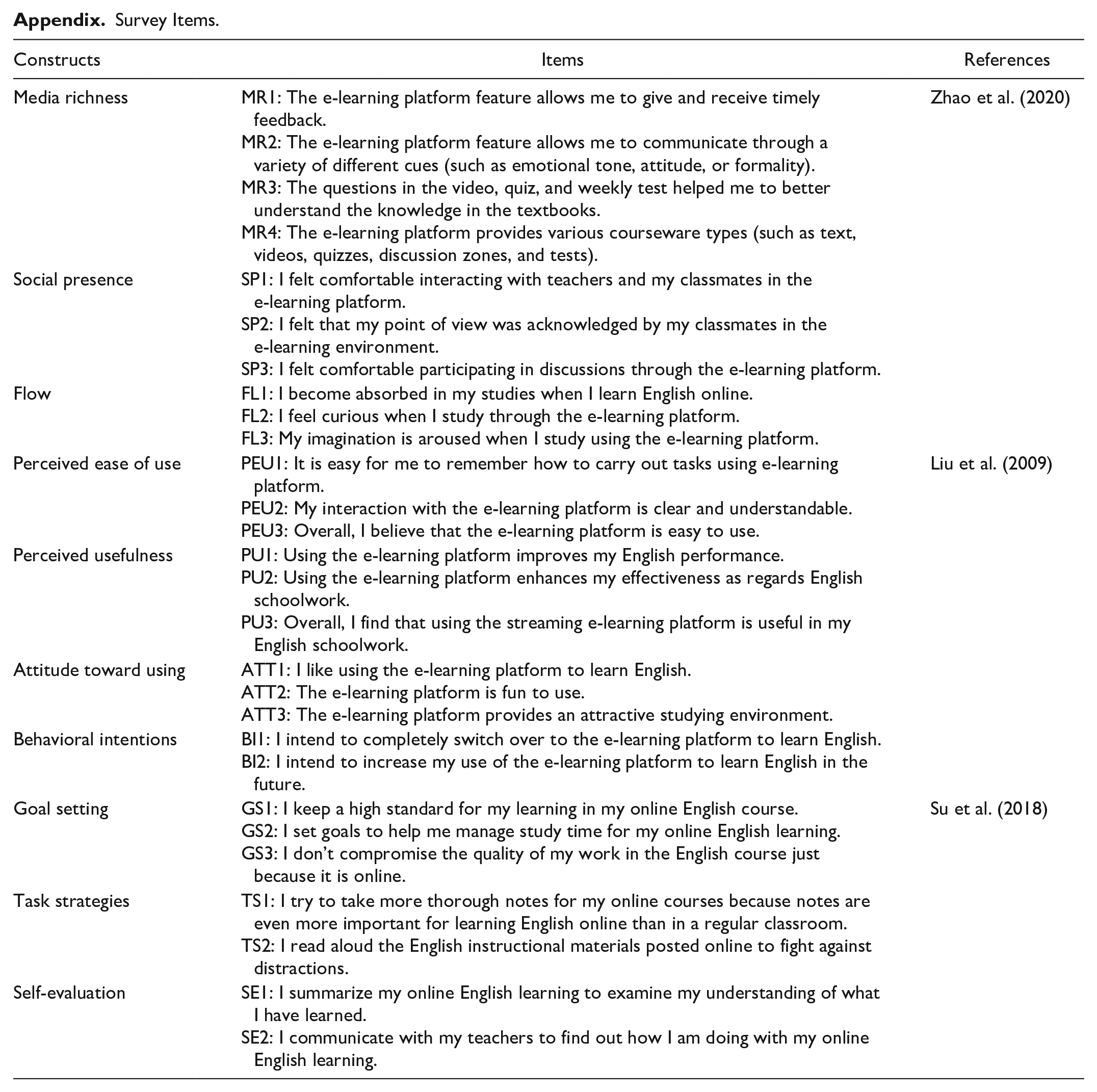
| Constructs | Items | References |
|---|---|---|
| Media richness | MR1: The e-learning platform feature allows me to give and receive timely feedback. MR2: The e-learning platform feature allows me to communicate through a variety of different cues (such as emotional tone, attitude, or formality). MR3: The questions in the video, quiz, and weekly test helped me to better understand the knowledge in the textbooks. MR4: The e-learning platform provides various courseware types (such as text, videos, quizzes, discussion zones, and tests). |
Zhao et al. (2020) |
| Social presence | SP1: I felt comfortable interacting with teachers and my classmates in the e-learning platform. SP2: I felt that my point of view was acknowledged by my classmates in the e-learning environment. SP3: I felt comfortable participating in discussions through the e-learning platform. |
|
| Flow | FL1: I become absorbed in my studies when I learn English online. FL2: I feel curious when I study through the e-learning platform. FL3: My imagination is aroused when I study using the e-learning platform. |
|
| Perceived ease of use | PEU1: It is easy for me to remember how to carry out tasks using e-learning platform. PEU2: My interaction with the e-learning platform is clear and understandable. PEU3: Overall, I believe that the e-learning platform is easy to use. |
Liu et al. (2009) |
| Perceived usefulness | PU1: Using the e-learning platform improves my English performance. PU2: Using the e-learning platform enhances my effectiveness as regards English schoolwork. PU3: Overall, I find that using the streaming e-learning platform is useful in my English schoolwork. |
|
| Attitude toward using | ATT1: I like using the e-learning platform to learn English. ATT2: The e-learning platform is fun to use. ATT3: The e-learning platform provides an attractive studying environment. |
|
| Behavioral intentions | BI1: I intend to completely switch over to the e-learning platform to learn English. BI2: I intend to increase my use of the e-learning platform to learn English in the future. |
|
| Goal setting | GS1: I keep a high standard for my learning in my online English course. GS2: I set goals to help me manage study time for my online English learning. GS3: I don’t compromise the quality of my work in the English course just because it is online. |
Su et al. (2018) |
| Task strategies | TS1: I try to take more thorough notes for my online courses because notes are even more important for learning English online than in a regular classroom. TS2: I read aloud the English instructional materials posted online to fight against distractions. |
|
| Self-evaluation | SE1: I summarize my online English learning to examine my understanding of what I have learned. SE2: I communicate with my teachers to find out how I am doing with my online English learning. |
Acknowledgements
We would like to express much gratitude for students who have voluntarily completed our questionnaires and interviews. Meanwhile, great thanks should go to my colleagues who have helped to distribute our online questionnaires. We also would like to express our great thanks to Prof. Yang Yanxia, Prof. Li Rui, and my friend Guo Qiang for their invaluable suggestions and insightful comments on early versions of the paper.
Availability of Data and Material
The data that support the findings of this study are available for the reviewers.
Declaration of Conflicting Interests
The author(s) declared no potential conflicts of interest with respect to the research, authorship, and/or publication of this article.
Funding
The author(s) disclosed receipt of the following financial support for the research, authorship, and/or publication of this article: This work was supported by Education Department of Hunan Province [grant number: Xiangjiaotong 2018 (164)].
Research Involving Human Participants and/or Animals
This article does not contain any studies with human participants or animals performed by any of the authors.
Informed Consent
The authors posted an online questionnaire for this study and all the college students voluntarily and anonymously filled in the questionnaire.
