




Abstract
This case study investigated students’ response to feedback in the lens of student engagement with teacher feedback on their translation work. Drawing upon data from multiple sources, including students’ translation assignments, classroom observations, semi-structured interviews, stimulated recalls, and other documents, it explored how three Chinese undergraduates engaged with the feedback affectively, behaviorally, and cognitively. The findings reveal that (a) the students went through varying mood swings, and their expectations and teacher-related beliefs impacted their judgments of the feedback; (b) their failure to undertake self-editing upon receiving feedback was attributable to both student individual factors and teacher practices; and (c) extensive cognitive and behavioral operations could contribute to students’ deeper understanding of the feedback. These indicate the complex and interrelated relationship among the three dimensions of student engagement and contribute to our limited knowledge on the interplay between teacher translation feedback and student responses. Pedagogical implications are put forward for translation teachers to provide feedback and improve translation students’ engagement.
Keywords
Introduction
Feedback is regarded as “the most powerful single moderator that enhances achievement” (Hattie, 1992, p. 9). Although feedback provided by teachers on students’ drafts could be well-rounded, its utility relies on how and to what extent students engage with it (Handley et al., 2011; Yu et al., 2019; Zheng & Yu, 2018), as student engagement that indicates their responses serves a mediated role between feedback and learning outcomes (Ellis, 2010).
Although several recent studies on student engagement with feedback have taken place in L2 writing context (e.g., Yu et al., 2020; Zhang, 2017; Zheng & Yu, 2018; Zheng et al., 2020), we know little about this topic in other contexts, particularly in translation programs (Yu et al., 2020; Pietrzak, 2016; Wang & Han, 2013). In translation teaching, providing feedback to students’ translation assignments is one of the most effective pedagogical methods (Bruton, 2007; Sheen & Ellis, 2011; Washbourne, 2014; Yu et al., 2019). To enhance students’ translation competence, teachers in those programs devote a considerable amount of time and effort to providing written and oral feedback to students’ translation works.
Previous studies on translation feedback have found that teacher feedback can improve students’ translation abilities (Sheen & Ellis, 2011), contribute to student’s vocabulary development with the help of a dictionary (Bruton, 2007), and promote students’ active learning as feedback “models drafting as an iterative and recursive process” (Washbourne, 2014, p. 240) and “promotes reflective practice” (Washbourne, 2014, p. 241). Although the provision of feedback serves as an effective tool for translation teaching, it takes effort and is time-consuming (Chandler, 2003; Ferris, 1999). As a result, most teachers are eager to know the cost-effectiveness of their time spent in feedback and its learning outcomes (Bruton, 2007). The effectiveness of teacher translation feedback, however, depends on how students engage with it (Handley et al., 2011; Zheng & Yu, 2018; Zheng et al., 2020).
Despite many studies advocating the need to understand student engagement in translation teaching, surprisingly few have contributed empirical evidence of how students engage with translation feedback. It seems that no study has investigated student engagement with teacher translation feedback through a comprehensive model involving three perspectives: affective, behavioral, and cognitive. To fill this void, this case study, drawing on multiple sources of data, including the students’ translation assignments, semi-structured interviews with students, classroom observations, field notes, and other documents, attempted to explore three Chinese students’ engagement with teacher translation feedback. By providing contextualized case narratives that uncover the complexity of student engagement, the study provides implications to improve translation teacher feedback practice to maximize students’ learning outcomes.
Conceptualizing Student Engagement with Translation Feedback
We deem a multidimensional conceptual framework of particular theoretical relevance to the current exploration of student engagement with teacher translation feedback. To demonstrate the conceptual framework, we first present how student engagement has been operationally defined in feedback situations and then proceed to introduce each dimension under the overarching construct.
Ellis (2010) views a student’s response to feedback as engagement. Several researchers (e.g., Han & Hyland, 2015; Zhang, 2017; Zheng & Yu, 2018; Zheng et al., 2020) further argue that a student’s engagement with a teacher’s written corrective feedback is manifested as affective, behavioral, and cognitive engagement. The present study views student engagement with teacher translation feedback as the student’s response to the feedback that is manifested in the affective, behavioral, and cognitive aspects.
Affective engagement entails a student’s emotional and attitudinal response. Martin and Rose (2007) have explained that attitudinal response includes “affect (people’s feelings), judgement (people’s character) and appreciation (the value of things)” (p. 29). Accordingly, students’ affective engagement with teacher translation feedback comprises their affect, judgment and appreciation.
Behavioral engagement pertains to a student’s behavioral operation. As Han and Hyland (2015) have argued, students’ revision behaviors as well as their revision strategies need to be considered in examining behavioral engagement. Accordingly, students’ behavioral engagement with teacher translation feedback could be manifested in their behaviors and strategies for revision and improving translation competence.
For cognitive engagement, the current study investigates how students attend cognitively to teacher translation feedback, that is students’ mental efforts to deal with the feedback (Ferris et al., 2013).
The Study
Context and Participants
This study took place at a Chinese mainland university devoted to training qualified translators of foreign languages. To graduate, the translation-major undergraduates must gain the required credits and pass two English proficiency tests, namely, the Test for English Majors Band 4 and Band 8 (a national English proficiency test for English major undergraduate students in China), together with one translation proficiency test, namely, the China Accreditation Test for Translators and Interpreters Band 3.
We focused on two classes of students (N = 40) who took the Basics of Chinese to English Translation course, which included two 40-min sessions per week for 16 weeks. The course was given by a male teacher who was a non-native speaker of English but had over 20 years of teaching and translation experience. The course assignments usually included hands-on translation practice between Chinese and English. The teacher used his own teaching portfolio for the instructions and the assignments. In responding to the students’ assignments, he tended first to give a score and indirect written feedback on the drafts, followed by oral feedback in class. Although he did not require the students to submit a revised draft, in the oral feedback he categorized students’ errors into different types, such as tense and cohesion problems, and demonstrated some problematic sentences for the students to correct. A sample translation was also provided by the teacher.
Our participants were purposively selected based on their assignment grades for the first 6 weeks, observed in-class performance, and teacher recommendation. Ultimately, three participants were recruited as representatives of comparatively low (Ling), average (Yang), and high (Wang) translation proficiency levels. The participants’ demographic information is shown in Table 1.
Demographic Information of the Participants.

Data Collection
Data collection took place in the 10th week and lasted 6 weeks. The major data sets included students’ assignments, class observations, semi-structured interviews, stimulated recall, and other documents.
Specifically, the participants’ assignments were collected together with the teacher’s written feedback. The weekly class sessions were observed and audio-recorded as a supplement to the written feedback. Field notes were also taken for better understanding of the context and students. Other documents collected were teaching materials such as textbooks and PowerPoint slides. In the last week, semi-structured interviews with each participant (see the appendix for the interview guide) and a stimulated recall were conducted in Mandarin (their first language). Each interview lasted approximately 1.5 hr. In the stimulated recalls, students were asked to state their understanding of the teacher written feedback on their assignments.
Data Analysis
Data analysis incorporated text analysis of the student participants’ translation assignments and content analysis of semi-structured interviews, stimulated recalls, field notes, documents, and other teaching materials.
For the text analysis of assignments, the drafts were read repeatedly and each sentence was compared both within the drafts of each participant and across the drafts of the other participants to uncover evidence supporting students’ remarks in the interviews and to better understand the differences in their wording and expressions. In addition, the number of errors was calculated for each draft.
For content analysis, first, the audio-recordings of interviews, stimulated recalls, and classroom observations were transcribed verbatim by one researcher and translated when necessary. The transcripts and translation were proofread by another researcher. Second, the two researchers analyzed the excerpts of field notes related to the research questions. Third, the depth of understanding of teacher written feedback was analyzed cosidering the number of participants’ correct understanding of feedback point in the stimulated recall and the total feedback received. All the transcripts and text analyses of students’ translation assignments were qualitatively conducted following the advice of Miles et al. (2014) regarding within-case analysis and cross-case analysis. The purpose of within-case analysis was to find out what happened in a single case, whereas cross-case analysis aimed to generate deeper understanding by comparing and contrasting cases. For within-case analysis, the data of each student were repeatedly read, identified, coded, and categorized based on our conceptualizations of engagement. For the initial coding, the researchers conducted data reduction by coding the data that were related to engagement. For further coding, the engagement-related data were categorized into affective, behavioral, and cognitive perspectives in accordance with the possible sub-constructs for each perspective. The coded data and initial analytical reports were sent back to the participants for confirmation and accuracy before conclusions were drawn. To conduct cross-case analysis, the three cases were compared and contrasted with the assistance of matrices and memos.
Findings
Affective Engagement
Wang was emotionally affected by the grades and comments she received from the teacher. Receiving high grades in her first, second, and fourth assignments, she expressed happiness and contentment: “Of course I feel happy to get high grades because it proves that my English and Chinese proficiency is at a satisfactory level”. When she received positive teacher feedback, for instance, for her use of the adjective “obviously,” she felt satisfied and was motivated to memorize the expression and adopt similar expressions for future assignments.
In contrast with her satisfaction with high grades and positive comments, she expressed disappointment when she received low grades. For instance, when one of her assignments received only 70 (the full score was 100), she felt disappointed: “I can’t accept a score of 70, because I spent lots of time on this assignment. I expected I would receive at least 80 on this assignment”. She suffered similar disappointment when receiving negative comments for some linguistic errors. For example, when she received comments about the wrong use of “themselves” as a reflexive pronoun of “everyone,” she was upset and disappointed.
I thought there could be no mistake because I had checked the dictionary about the reflexive pronoun of “everyone.” In the Longman dictionary, it said both “themselves” and “itself” were correct. When I first saw the comment, I was disappointed and upset. (Interview)
Although sometimes Wang had doubts about the teacher feedback, she thought highly of the way the teacher gave feedback, perceiving it as helpful in improving her self-editing skills and noticing grammar and translation errors that she had overlooked. In line with her admiration, Wang quite appreciated her teacher’s feedback effort. She said, “Teacher feedback is useful in helping us find out what problems we have about translation and English”.
Likewise, Ling’s feelings and emotions fluctuated with the grades and comments provided by the teacher. For example, when she received a lower score on her third and fifth assignments together with exclusively negative teacher feedback, she was frustrated, which led her to doubt her English and translation proficiency. The frustration and doubt were evident in her interview response that For that assignment, I only got 65! [ . . . ] I suddenly felt I would be frustrated and sad throughout the whole class [ . . . ] I always have the score of 65, I really trust my teacher’s feedback, so I think 65 is my level of proficiency. (Interview)
In contrast, when receiving a higher score (the second assignment was scored 85), she was overjoyed. “For that assignment, I was really really really happy about it. But that (getting high score) doesn’t often happen”.
As for Ling’s judgment about the teacher translation feedback, she expressed unreserved trust and admiration of the teacher, which was indicated in her response that “Our teacher is sincere and everyone likes him. Whatever he says is right [ . . . ] I never doubt his feedback”. Not surprisingly, Ling highly appreciated teacher feedback, as she perceived “Teacher feedback is useful in that it can help me correct my errors”.
Unlike Wang and Ling, Yang was surprisingly calm when receiving higher scores and positive teacher comments on her drafts, showing neither happiness nor doubt. “If you did not make any grammatical errors, you will get high scores”, she commented. When further asked why she did not feel happy about high scores, she explained, Now content, ideas, themes are more important than form. I think form is less important. You got a high score, not because your content or ideas were good, but because you did not make grammatical mistakes. This cannot make me happy. (Interview)
Moreover, Yang was not satisfied with the way feedback was provided. She perceived the feedback as failing to cater to the needs of the individual student: I think his oral feedback is targeted to all students [ . . . ] It was not tailored to the specific needs of each student [ . . . ] If I think I have already grasped it, I will ignore it. (Interview)
Taken together, this yields two major findings about the participants’ affective engagement. First, they all had negative emotions when receiving low scores and negative feedback but did not necessarily respond positively when receiving higher scores and positive feedback. Second, as for their judgments of teacher translation feedback, two participants (Wang and Ling) admitted its worth from their unreserved trust and admiration of the teacher, but one (Yang) was dissatisfied with feedback that was grammar-focused (particularly for Chinese to English translations) and the way translation feedback was provided.
Behavioral Engagement
Wang’s behavioral engagement with teacher feedback was the most extensive. She recalled that upon receiving translation feedback, she first read through the feedback carefully and thought about why the teacher underlined and circled some expressions. However, she did not self-edit her draft. Usually, the students would receive their assignments with teacher feedback right before the next class began. They were allowed 10 min to read the written feedback before the extra oral feedback in class. The time constraints seemed to discourage her self-editing.
Whereas Wang did not revise her drafts in response to the written feedback, she paid particular attention to the teacher’s oral feedback in class. She took down notes for points that she agreed with, and every time she had a disagreement, she asked the teacher after class. Wang adopted a wide range of strategies to improve her English and translation competence, as by reading literary works the teacher suggested for translation improvement. Moreover, she sought extra assistance to improve her English proficiency, reading a grammar book in particular. “He (the teacher) said our grammar should be improved, so I bought a small grammar book [ . . . ] I can read it when I have time,” she said in the interview. In addition, she organized her notes taken in class and reviewed them at times: “I have a folder to put all of notes inside so that I can read the notes like reading a book”.
Ling failed to self-edit her drafts and she accepted the feedback without questioning its appropriateness. Like Wang, she failed to self-edit her draft due to time constraints. Her failure to self-edit could also be attributed to her firm trust in the teacher translation feedback and her self-concept as a low-proficiency learner. However, unlike Wang, when she had opinions different from the teacher’s, she chose to follow the teacher’s revision advice. She said, “sometimes I have different opinions from the teacher, but I will revise my draft following his advice because my proficiency is low and he is always right”. Apparently, Ling’s trust toward teacher feedback and self-concept of her English proficiency might have affected her behaviors. She did not seek extra support when she disagreed with the teacher feedback.
Yang seemed to behaviorally disengage from teacher translation feedback. She described her behavioral response as strictly copying the teacher’s sample sentences and expressions. The interview provides a glimpse of her disengagement.
When I get my draft, I first look at the teacher’s feedback, then I wait for the class to begin and the teacher to explain, then I just copy his translation . . . His translation is better than mine, I can use some of the words and expressions in future translations.
Yang’s behavioral disengagement was also reflected in her failure to adopt any strategies to improve her linguistic and translation competence. She admitted, “if you want to get a good grade or improve your competence, you need to put effort into it [ . . . ] but I am lazy”.
Behaviorally, the participants engaged with teacher translation feedback at a limited level. They did not self-edit their drafts, nor did they adopt effective strategies to improve the accuracy of their assignments and translation competence.
Cognitive Engagement
To examine the depth of processing, the study adopted Qi and Lapkin’s (2001) notion of “quality of noticing” (p. 291), which refers to two kinds of linguistic awareness raised by teacher translation feedback: the levels of noticing (notice only without reasons) and understanding (notice and give reasons). Table 2 shows the total number of errors receiving feedback of each participant and their understanding.
Understanding of Teacher Translation Feedback.
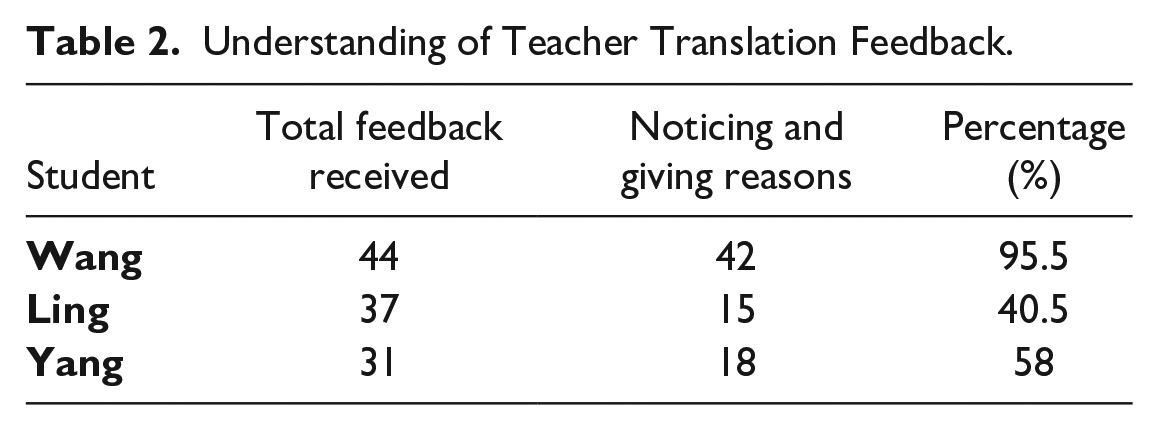
Wang noticed and articulated reasons for 95.5% of the feedback points on her six drafts. It was intriguing to note that in spite of her success in understanding translation feedback, she made the most errors in assignments among the three participants. Through an analysis of those errors and comparison with the errors of the other two students, it was found that she tended to incorporate longer and more complex sentence structures. Example 1 presents Wang and Yang’s translations of a sentence in their first assignments (Table 3). An attributive clause (“whose”) was incorporated into Wang’s translation and a coordinate structure (“and”) was used in Yang’s.
Example 1: Wang and Yang’s Translations.

When asked why she adopted a more complex sentence structure, Wang said, “Your English will not improve if you do not practice it. By writing complex sentence structure, I can practice my English. The teacher’s comments can help me find out problems”. This belief in the power of practicing and teacher translation feedback resonated with her appreciation of the value of translation feedback.
Another possible reason for Wang’s error lay in her effort to use a variety of structures. For example, whereas other students tried to correct but conservative expressions, she would like to try to keep her “translation alive.” Example 2 shows such an effort (Table 4).
Example 2: Wang’s Translations.

When asked why she incorporated the above expressions, Wang stated, I tried to make my sentences sound alive, to find out how the teacher would react. He [the teacher] just told us the expression was not right but did not tell us whether it is good to express sentences in a vivid way. I am still not sure if it is good to do this. (Stimulated recall)
This response was in alignment with her valuing translation feedback as it could help her find problems. She further expressed that it would be better if the teacher feedback could give equal attention to translation techniques as much as to grammatical and linguistic points.
It is important to note that Wang’s deep understanding of her errors was attributed to her adoption of a wide range of meta-cognitive and cognitive operations to deal with her translation feedback. For example, upon receipt of translation feedback, she planned out the steps to process the feedback: read it first, then listened in class, marked down the translation feedback she agreed with, and asked the teacher about the translation feedback she did not understand or disagreed with. As one example of her cognitive operations, when the word “obviously” received praise from the teacher, Wang attempted to memorize it and use it in future assignments. Her interview data confirmed that she did actively process her translation feedback: According to the feedback, this word (“obviously”) was a good word, so I tried to memorize it. When I found an opportunity to use this word in the next assignment, I was happy because maybe I could get a good score. (Stimulated recall)
This indicated that she had deep processing of the usage of words and adopted coping strategies. These examples also demonstrated that affect (i.e., happiness at getting a good score, and doubt) could have affected her cognitive and behavioral engagement with teacher translation feedback.
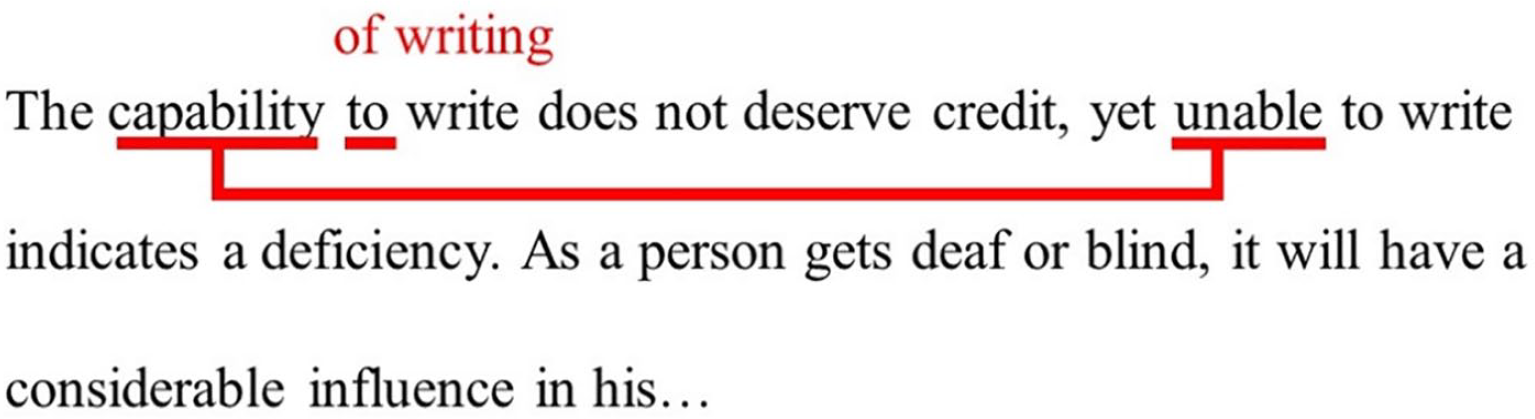
Ling’s cognitive engagement with teacher translation feedback was at a minimal level, probably due to the fact that she was emotionally overwhelmed. Receiving 37 feedback points altogether, she could only provide correct explanations for 15 (40.5%) of them, most of which were related to grammar and wording. She did process translation feedback cognitively but was led by the intention of memorizing instead of understanding the translation feedback. For example, she used audio and the haptic sense to remember feedback when she learned that the collocation of “capability” should be “of” not “to”; she read “capability of” a few times and wrote it down on her draft. As a result, when her understanding of why to use “capability of” instead of “capability to” was checked, she failed to articulate the reason. Example 3 (Figure 1) shows how Ling translated this sentence taken from a Chinese essay on writing (“The capability to write does not deserve credit, yet unable to write indicates a deficiency”) with translation feedback underlining “capability to.” The following excerpt demonstrates her response in the stimulated recall.
(Original text) 能写文章算不得什么可以夸耀的事儿,不能写文章却是一种缺陷 (The capability of writing is not worthy of being boosted, however, the incapability of it is a drawback.) Researchers: Why did you change it into “capability of”? Ling: It is a collocation. Researchers: But “capability to write” is also a collocation. Why was “capability to” underlined? Ling: . . . um . . . maybe . . . I don’t know. (Stimulated recall)
Example 3: An example of Ling’s translation.
Moreover, Ling employed limited meta-cognitive operations. She read her drafts a few times, thought about the reasons for her errors first, and then paid particular attention to the teacher’s oral feedback in class, but when she disagreed with or had doubts about a piece of translation feedback, she accepted it without truly understanding it. The interview showed that it was because she thought her English and translation proficiency were low and she trusted the teacher indiscriminately.
Yang seemed to cognitively engage with translation feedback successfully. First, she had a moderate understanding of translation feedback. Receiving 31 feedback points on her drafts, she could give correct explanations for more than half of them (N = 18, 58%). Second, she adopted limited but effective cognitive operations to process translation feedback. For example, she attempted to activate her previous knowledge to help her better understand and memorize the feedback in Example 4 (Figure 2).
(Original text) 写文章不是生活的点缀和装饰,而就是生活本身 (Writing an article is not a decoration of life, but a part of life.)

Example 4: An example of Yang’s translation.
When the teacher explained that writing an article was not “life itself” but “a part of life,” she activated her previous knowledge about a similar expression, “It’s a part of life. 食色性也,” which occurred in a previous assignment, and wrote it down on her draft (Figure 3).

Example 5: An example of Yang’s notes.
Yang provided the reason she made the note: “Writing down this similar sentence can help me better understand the context where this expression is used and also help me remember the expression”. Obviously, her cognitive operation had an influence on her behavior and, in turn, this behavior could affect her cognitive processing of translation feedback. As for meta-cognitive operation, there was little data found to indicate that she adopted a meta-cognitive operation. It was interesting to note that Yang seldom communicated with the teacher, nor did she check other resources. According to the interview, Yang sometimes had disagreements with the teacher translation feedback, but she would “let it go,” and she did not want to talk to her teacher or peers. The reason for her failure to seek extra help was confusion: “Sometimes, you will find the theories held by teachers are different and even contradictory. I don’t know what to believe. Sometimes, what this teacher said was wrong was right for the other teacher. I am so confused”. It seemed that Yang had cognitively engaged with translation feedback successfully, but behaviorally engaged with translation feedback at a minimal level. To a certain extent her confusion (affect) played a mediated role between them.
Discussion
Student Engagement With Teacher Translation Feedback
The investigation of the three students’ affective engagement with teacher translation feedback involved their affect when receiving teacher translation feedback and their judgment and appreciation of teacher translation feedback. The finding indicated that the students went through mood swings to varying degrees; more specifically, they exhibited disappointment (Wang and Yang) and overwhelming frustration (Ling) from low scores, as well as happiness for high scores (Wang and Yang) and positive feedback (Wang). This echoed the statement of Martin and Rose (2007) that the sub-construct of affect is quite unstable and thus merits more attention, and it lent support to Truscott’s (1996) argument that feedback could give rise to negative emotions that hinder learning. In their judgments of translation feedback, two factors were identified as having an impact on judgment: learners’ expectations toward translation feedback and their teacher-related beliefs. For example, Ling admired teacher translation feedback because of her unreserved trust in the teacher. The trust may be due to the teacher’s position of authority in the translation classroom that made the student believe in his feedback as useful and important. Ling also held a firm belief in the teacher’s crucial instructional role in her development of translation knowledge and skills. However, Yang felt dissatisfaction with translation feedback because the way translation feedback was given and the focus of translation feedback failed to match her expectations. It seemed the student had her own expectations of the translation assignment. When teacher feedback indicated her work had lower quality than what she expected, the student expressed negative emotions, that is, dissatisfaction, which further affected her judgment of the feedback. As suggested by the two examples, it was the influence of students’ individual factors on their judgment that then impacted their affective engagement.
Behavioral engagement involved students’ revision operations and observable strategies to improve the accuracy of their written works. As no requirement for revised drafts was made by the teacher and none of the participants volunteered to revise their drafts, their self-editing practice when they received drafts with teacher translation feedback was analyzed. However, the findings showed that none of the participants self-edited their assignments upon receiving them. The drafts with teacher translation feedback were returned to them during the break before the translation class. They had only 5 to 10 min to read the translation feedback, and sometimes even less time was given. Although it was understandable that in these circumstances students’ immediate revision operations could be impeded, the lack of self-editing in subsequent revisions was interestingly noticeable. What they did was to read over the translation feedback, think about what the translation feedback meant, listen to the teacher’s explanation, and mark down some sample sentences provided by the teacher in class. The interview seemed to reveal that the students’ self-concept and belief in teacher translation feedback could hinder their self-editing in subsequent revisions, such as Ling’s self-concept that her translation and English proficiency were low and her unreserved trust in teacher translation feedback, and Yang’s self-concept that she was “lazy”. In addition to the student factor, it seemed that the teacher failed to encourage the students to self-edit their drafts by allowing limited time and also failed to motivate them by adopting a single source of feedback, namely teacher translation feedback. Different from Yu et al. (2019) study that revealed teacher facilitative role in student engagement, the current study showed that teachers’ ways of providing feedback and guiding the students to respond to the feedback could impede student engagement in terms of self-editing. As was found in Wang’s (2017) study, when teacher translation feedback was the only source of response, students tended to be demotivated to solve problems and edit their drafts. In other words, the combination of student factors and teacher practice had an impact on students’ behavioral engagement that was largely manifested in their failure to self-edit.
Regarding cognitive engagement, depth of processing of teacher translation feedback and meta-cognitive and cognitive operations were examined. The findings suggest that a deep level of noticing (at the level of understanding) was attributable to the adoption of wide ranges of meta-cognitive and cognitive operations. Wang had achieved a high level of understanding of teacher translation feedback as a result of her implementation of various cognitive and meta-cognitive operations. In addition, her understanding may also be attributed to her adoption of extensive behavioral strategies to improve her language competence and the accuracy of her drafts. It seemed to reveal the significance of adopting various and active cognitive and behavioral operations to prompt the student’s understanding. This was consistent with Storch and Wigglesworth’s (2010) finding that extensive engagement could result in high levels of uptake. Moreover, this finding also showed that students with high English proficiency were more motivated to use translation and translation feedback as methods to solve problems about language and to practice English. Wang had a higher proficiency in both English and translation, but she committed more errors than the other participants because she practiced her English using more complex sentence structures and looked for answers by trial and error through translation assignments and teacher translation feedback. This seems to support Liao’s (2006) finding that translation could motivate students to learn English, and supports Titford’s (1985) argument that high-level students tended to use translation to solve their problems with language. However, the effectiveness of cognitive operations needs to be taken into consideration. Whereas Yang adopted a limited but effective cognitive operation (activating previous knowledge), Ling’s cognitive operation of solely using haptic and audio sense to memorize translation feedback led to her superficial understanding of the translation feedback, thus negatively influencing her translation and English learning.
Interrelatedness of Affective, Behavioral, and Cognitive Engagement
The analysis of the three cases demonstrates a complex and interrelated relationship among the three dimensions of student engagement. First, the findings indicated that emotions and feelings had an influence on students’ revision operations and strategies to improve accuracy and language competence. For instance, Ling was overwhelmed by her frustration and thus failed to seek extra assistance when she disagreed with the translation feedback; when Wang had doubts about translation feedback, she adopted a coping strategy (e.g., looking up in a dictionary). This adds support to Zhang’s (2017) finding that affective engagement is often accompanied by behavioral actions. Second, the finding indicated an interactive relationship between behavioral and cognitive engagement. By retrieving previous knowledge about a piece of translation feedback, Yang wrote it down, which in turn helped her better cognitively process the translation feedback. Finally, the finding also demonstrated the imbalances among the dimensions. In spite of Ling’s seemingly successful revision operation, her behavioral and cognitive engagement was at a minimal level and, whereas Yang engaged cognitively with translation feedback, she had limited behavioral engagement. The findings above seem to reveal the complicated and interactive relationship among affective, behavioral, and cognitive engagement. These findings confirm the conclusions of previous studies that engagement is a complex and multidimensional construct (Ellis, 2010; Fredricks et al., 2004; Zhang, 2017) and therefore any attempt to examine student engagement from only one dimension would be insufficient (Ellis, 2010).
An emerging theme from the data was the effect of the students’ person-related beliefs about their engagement with translation feedback. “Person-related belief” in this study mainly refers to self-concept and belief in the teacher. For instance, Ling’s minimal cognitive engagement with teacher translation feedback was due to her self-concept of low English and translation competency and her belief in the teacher always being right, whereas Yang’s behavioral disengagement with translation feedback was partly due to her self-concept that she was “lazy”. The finding also shows that students’ affect and emotions could have an impact on their self-concept. For example, Ling’s overwhelming frustration had a negative impact on her self-concept that her translation proficiency was at a low level, thus influencing her cognitive engagement, and consequently her language and translation learning. This seemed to reveal the negative effects of a student’s affective engagement on her self-concept of language proficiency and thus her learning outcomes. This finding, on one hand, confirms Yan et al. (2010) and Yan and Wang’s (2012) finding that students’ self-concept of their English proficiency and their translation performance are closely connected; on the other hand, it could contribute to one of the factors (affective engagement) that caused negative self-concept, which was seldom explored in previous research. Accordingly, prompting a more positive affective engagement with translation feedback might inculcate a positive self-concept of English proficiency, which could enhance students’ English and translation ability.
Having bridged the gap in understanding the multifaceted and complex nature of student engagement with teacher translation feedback and how translation students engaged with teacher translation feedback, two major pedagogical implications can be drawn from the study. First, as students’ negative affect can negatively influence their behavioral and cognitive engagement, but positive affect can positively influence it, translation teachers should pay attention to students’ feelings and emotions, especially negative emotions such as frustration and dissatisfaction. One-on-one conferences initiated by the teachers or students can be held at regular intervals, which can help teachers detect students’ negative emotions, clear up students’ confusion, and also improve communication between teachers and students. In addition, as students’ self-concept and their expectations of how the teacher should give translation feedback can have an impact on their affective engagement, these two factors also need to be considered before and while providing translation feedback.
Second, students’ deep level of understanding of translation feedback requires them to adopt extensive and effective meta-cognitive and cognitive operations, but as this study shows, students can adopt operations that are ineffective and indeed adopt only a few of them. Therefore, to facilitate cognitive engagement, translation teachers should assist students in developing effective cognitive and meta-cognitive strategies; for example, some training can be provided by translation teachers to train students to plan steps to process and ask about translation feedback and to adopt effective strategies to act on translation feedback. Moreover, as students demonstrate different levels of understanding of translation feedback, translation teachers should check whether students understand or just notice their errors by eliciting their explanations in or after class.
Conclusion
To sum up, this case study investigated three Chinese translation majors’ engagement with teacher translation feedback along the affective, behavioral, and cognitive dimensions based on data from multiple sources. A few limitations of the study need to be acknowledged. First, as student engagement is also a dynamic construct, it is important to investigate the development of how students engage with translation feedback. However, due to time constraints, this study failed to investigate the dynamic nature of student engagement with translation feedback over time. Second, considering that this case study involved only three participants, some of the findings are difficult to generalize to a wider student population. However, through a detailed account of how the three students engage with teacher translation feedback along these three dimensions, we are aware that translation student engagement with teacher translation feedback is a complicated process. Therefore, further research needs to be conducted longitudinally that involves more participants in the translation context.
Footnotes
Appendix
Guide for the Semi-Structured Interview (Translated)
Declaration of Conflicting Interests
The author(s) declared no potential conflicts of interest with respect to the research, authorship, and/or publication of this article.
Funding
The author(s) disclosed receipt of the following financial support for the research, authorship, and/or publication of this article: The study is funded by MYRG2016-FED-00100, University of Macau.