




Abstract
The purpose of this quantitative study is to explore the relationship between the availability of literacy learning materials and teachers’ practices in early childhood classrooms in Saudi Arabia. The overall goal is to promote an understanding of the influence of these factors on how children use these materials to improve their emergent literacy skills. A questionnaire survey was administered to 302 early childhood teachers, and the collected data were analyzed using partial least squares structural equation modeling (PLS-SEM). The findings revealed that children’s use of literacy learning materials in the learning environment plays a role in the acquisition and development of their emergent literacy skills in early childhood classrooms, while also showing a significant relationship with the availability of literacy learning materials and teachers’ practices in the classrooms. The study results have several important implications related to teachers, the Ministry of Education, and the administration of early childhood schools in terms of enhancing children’s acquisition and development of emergent literacy skills in the classroom.
Keywords
Introduction
Building and acquiring literacy skills in early childhood is a complex process that encompasses various milestones, such as the identification of letter shapes and sounds, understanding word meanings, and developing reading and comprehension abilities (Al-Qaryouti & Kilani, 2015; Neuman & Cunningham, 2009). Thus, young children need to learn emergent literacy early to prepare them for formal literacy instruction in elementary school (Auleear Owodally, 2015). In Saudi Arabia, various factors, such as early literacy learning spaces, the physical environment (both the learning materials and the furniture), and the adults who deal and communicate with children of early childhood age (3–6 years), affect emergent literacy (Alsubaie, 2022). In addition, according to AlAhmari (2022), many families in Saudi Arabia have considered enrolling their children in kindergarten approximately 1 year earlier than the mandatory enrollment age as a way to enhance the child’s literacy skills earlier. If children are to become literate individuals who understand what they learn, they should have access to an abundance of literacy learning materials that are relevant to their literacy levels in the classroom learning environment (Wildová & Kropáčková, 2015). Simultaneously, teachers must understand how to utilize these materials effectively in their practice to promote children’s emergent literacy skills and influence their application of literacy learning materials (Neuman & Cunningham, 2009).
Teachers’ literacy practices in the learning environments of early childhood classrooms significantly impact literacy development in young children. According to A. Barber et al. (2018), teacher practices, which involve cognitive and motivational strategies, impact children’s literacy skills, such as reading comprehension, thereby enabling children to develop literacy skills and engage in meaningful interactions with literacy learning materials through related activity engagements. Furthermore, other teacher practices, such as social motivation and children’s engagement in literacy activities, enable the building and development of young children’s literacy skills, including writing their names, understanding the meaning of printed words, knowing alphabet letters and rhymes, facilitating sharing, exchanging, and talking, asking, and communicating, by immersing them delightfully in literacy activities (A. T. Barber & Klauda, 2020; Guthrie & Wigfield, 2017). Teacher–child interaction practices increase literacy skills in children by aiding teachers in directly guiding children when introducing vocabulary, sentence structure, and story analysis (Alatalo & Westlund, 2021). Consequently, as indicated by Öngören (2022), Kılınçcı and Bayraktar (2021), and Lehrl and Smidt (2018), teachers’ practices, including read-aloud exercises and teacher–child interactions, can boost children’s learning and knowledge acquisition, thereby improving their emergent literacy development. Therefore, increasing teacher–child interaction practices is essential for enhancing young children’s engagement with literacy learning materials in early childhood classrooms as a means of promoting the development of children’s emergent literacy skills.
A few studies indicate that teachers’ practices in early childhood classrooms must include a variety of activities and strategies that enable the development of all literacy skills. This is achieved by adopting several kinds of learning materials but must avoid focusing on some and neglecting others, as some teachers’ practices in early childhood literacy classrooms lack a focus on important literacy skills, such as auditory and visual discrimination (Johari & Yunus, 2019; Safi et al., 2020; Veziroglu-Celik & Acar, 2018). Therefore, the teachers themselves should receive effective training in practices that would enhance the development of literacy skills among preschool children. For instance, teachers’ literacy practices in early childhood classrooms should incorporate shared reading, open-ended conversations, language games, small group instruction, interaction with learning literacy materials, read-aloud exercises, and print referencing (Birbili, 2019; Kelly, 2015; Mihai et al., 2017). These teaching practices that use appropriate learning literacy materials in early childhood classrooms play a role in the development of children’s literacy skills. Consequently, teachers must necessarily strive to improve their instruction of emerging literacy skills in young children by improving their own practices in the classroom environment through the adoption of teaching practices based on the use of appropriate learning literacy materials.
A number of studies have indicated that the availability of literacy learning materials, as determined by a combination of factors (e.g., the practical knowledge and cognition of the preschool teachers, their pedagogical content knowledge, and strong knowledge of their children’s cognitive abilities), can lead to the provision, adaptation, and customization of literacy materials that best suit the needs of the children in a classroom (Bingham & Hall-Kenyon, 2013; Hindman & Wasik, 2008; Piasta et al., 2012). Several studies based on the literature have also emphasized the importance of the availability of learning materials for enhancing children’s literacy development in early childhood classroom environments (Hofslundsengen et al., 2020; Rance et al., 2023). Once children begin to use learning literacy materials, such as picture books, fairy tale books, children’s comics, crayons, and wooden alphabet letters in early childhood classrooms, their emerging literacy skills improve as their interactions with the materials increase. This, in turn, boosts beginner-level vocabulary skills, promotes story analysis, and results in new concept and language knowledge among children (Hidayat & Fitria, 2021; Lehrl & Smidt, 2018; Manu et al., 2019; Mercader et al., 2021; Reyes & Caballes, 2021; Strouse et al., 2018; Wiescholek et al., 2018). Therefore, the availability of literacy learning materials fosters and encourages children’s engagement with and enjoyment of the literacy learning process, thereby fostering emergent literacy development in the early childhood stage. In particular, the use of picture books as significant learning materials for language and concept development increases children’s engagement with these materials, as Strouse et al. (2022) have indicated.
One of several factors that could contribute to the availability of literacy learning materials in early classrooms is the amount of resources and funding available in early childhood education settings, as schools with greater financial resources may have the capacity to provide a broader selection of high-quality learning literacy materials (Hindman & Wasik, 2015; Neuman & Celano, 2012). To develop children’s emergent literacy skills, the availability of literacy learning materials has a particularly important role to play, in addition to the teachers’ practices in the early childhood classroom.
In the present study, the term “emergent literacy” is defined as young children learning to respond to reading and writing acts, activities, and learning materials. The primary skills of emergent literacy are oral communication, phonological awareness, book knowledge, letter knowledge, and print awareness, and these help young children advance overall in their reading and writing (Christ et al., 2019). To our knowledge, no studies have yet addressed the impact of the availability of learning materials in early childhood classroom environments on the acquisition and development of literacy skills among children in Saudi Arabia. We were able to find some studies, including those by Alsubaie (2022) and AlAhmari (2022), that have addressed the impact of the availability of educational materials in the home environment in Saudi Arabia on children’s acquisition of literacy skills. We also found an Arab study conducted in early childhood classrooms in Jordan that dealt with teachers’ practices, such as designing reading teaching materials and creating a library in the classroom, as well as with teachers’ role in developing children’s literacy skills (Al-Barakat & Bataineh, 2011). However, we did not find any studies that dealt with the impact of teachers’ practices in early childhood classrooms in Saudi Arabia and their impact on children’s acquisition and development of emerging literacy skills.
One study by Alsiddiqi et al. (2022) investigated the relationship between developmental language disorders and emergent literacy skills in Arabic-speaking children. However, to our knowledge, no study has examined whether the availability of literacy learning materials and teachers’ literacy practices in the classroom have a clear relationship with the development of emergent literacy skills among young Arabic-speaking children in Saudi Arabia. Therefore, the objective of the present study was to answer a key research question: What is the relationship between teachers’ literacy practices in early childhood classrooms and children’s development of literacy skills via their use of literacy learning materials?
By answering this question, the researcher hopes that the results of this study will provide insights into how teachers’ practices and the availability of literacy learning materials in early childhood classrooms influence the development of emergent literacy skills among young children. Based on the study findings, suggestions are also made for practices and activities that teachers can share with young children while teaching literacy using literacy learning materials. The results of this study may also help early childhood teachers understand how their practices and activities with regard to literacy learning materials influence the emergent literacy skills of young children.
Following this introduction, the second, third, and fourth sections describe the theoretical framework and hypothesis development, the methodology, and the results of the data analysis. The subsequent Discussion and Implications sections position the study findings within the context of existing knowledge. The paper concludes with a summary of the main results and a presentation of the study limitations and prospects for future studies.
Theoretical Framework and Hypothesis Development
This study is based on the Comprehensive Emergent Literacy Model of Rohde (2015), which aims to explore teachers’ practices by examining how teachers of early childhood grades implement their teaching practices to enable children to use the literacy learning materials available in their classrooms. Literacy is also considered a social event that requires complex responses and interactions along with skills, understanding, and knowledge. Therefore, this study is also based on social constructivist theory, as explained by Vygotsky (1978), which provides crucial information relating to children’s literacy development based on the assertion that human knowledge development is constructed through interactions with various individuals, such as parents, teachers, and peers (Vygotsky, 1978). Based on the Comprehensive Emergent Literacy Model and social constructivist theory, we theorize that children learn and develop their emergent literacy skills in early classrooms by interacting with teachers and peers through the use of learning literacy materials. This sets the basis for this study.
Based on the above-mentioned model and theory, this study was conducted through a proposed model framework consisting of the following three variables: literacy learning materials in early childhood classrooms, teachers’ practices in literacy early childhood classrooms, and children’s use of these materials to improve their emergent literacy skills (see Figure 1).

The proposed model framework of the study.
In this study, the
The
Several studies have indicated the existence of a relationship between the availability of literacy learning materials and teachers’ practices in early childhood classrooms. For instance, studies by Kılınçcı and Bayraktar (2021) and by Hofslundsengen et al. (2020) asserted that the availability of literacy learning materials, such as books and worksheets, guides teachers’ general classroom practices, such as engaging children in various activities that involve drawing lines for children’s early literacy development. Thus, hypothesis one (H1) was proposed:
Various studies have discussed literacy learning materials and the development of children’s emergent literacy skills through interactions with these materials. For example, Altun et al. (2018) indicated that children’s engagement with the materials in the early childhood classroom environment was increased by the availability of literacy learning materials, such as print-related resources and books with appropriate and engaging features, including pictures. The determination that these features increased the utilization of literacy materials and enhanced the development of their emergent literacy skills led to the proposal of hypothesis two (H2):
Teachers’ practices and children’s interactions with learning materials in early childhood literacy classrooms have also been addressed in several studies. For instance, Hendi and Asmawi (2018) noted that teachers’ practices, when appropriately aligned with children’s interests, motivate children to engage with the learning materials, resulting in their emergent literacy development. Hence, hypothesis three (H3) was formulated:
Methods
Data Collection and Analysis
During the third semester of 2023, after the study gained an ethical approval from the Research Ethics Committee (REC), 302 respondents answered the survey questionnaire. A link to the survey questionnaire was shared with target participants via social media and email. Participants were also given informed consent forms that assured the privacy and confidentiality of their responses. The completion and submission of the online questionnaire were entirely voluntary for the participants. A link to the survey questionnaire was shared with target participants via social media and email. Participants were also given informed consent forms that assured the privacy and confidentiality of their responses. The completion and submission of the online questionnaire were entirely voluntary for the participants. The quantitative method of a survey questionnaire was adopted to conduct this study, and partial least squares structural equation modeling (PLS-SEM) was used to examine the data using the Analysis of Moments Structures (AMOS) software (Wong, 2019). The researcher relied on a book on SMART PLS by Hair et al. (2019) to explain and determine what the PLS-SEM results imply.
Sample and Setting
The sampling for this study targeted early childhood teachers in Saudi Arabia. The survey received 302 valid responses from the sample in the Eastern Province of Saudi Arabia. Most respondents held bachelor’s degrees (81%), while the rest had graduate degrees. More than half of the respondents (56%) had a kindergarten major, and 34% had majored in the Arabic language. All the respondents indicated having teaching experience ranging from 1 to more than 15 years, and these frequencies suggested that the data were representative of the target population.
Instrument
To ensure the questionnaire’s content validity and that it was related to the study objectives, the questionnaire items were slightly adjusted to fit the context of this study and were then reviewed by several professors who specialize in early childhood education. The survey questionnaire involved two sections. The first section was conducted to collect the participants’ demographic data, such as their academic qualifications, academic majors, and years of experience. The second section included three constructs. The first, consisting of seven items, concerned the availability of literacy learning materials in early childhood classroom environments. The second, consisting of six items, involved children’s use of literacy learning materials that improve emergent literacy. The last section, consisting of 11 items, covered teachers’ literacy practices in early childhood classrooms. All these constructs were adapted from the information presented on the Get Ready to Read: Classroom Literacy Environment website (see Table 1).
Constructs of Research Measurements.

Descriptive Statistics
The descriptive statistics indicate that the responses were normally distributed with no outliers. Table 2 shows the variables’ descriptive statistics.
Descriptive Statistics.
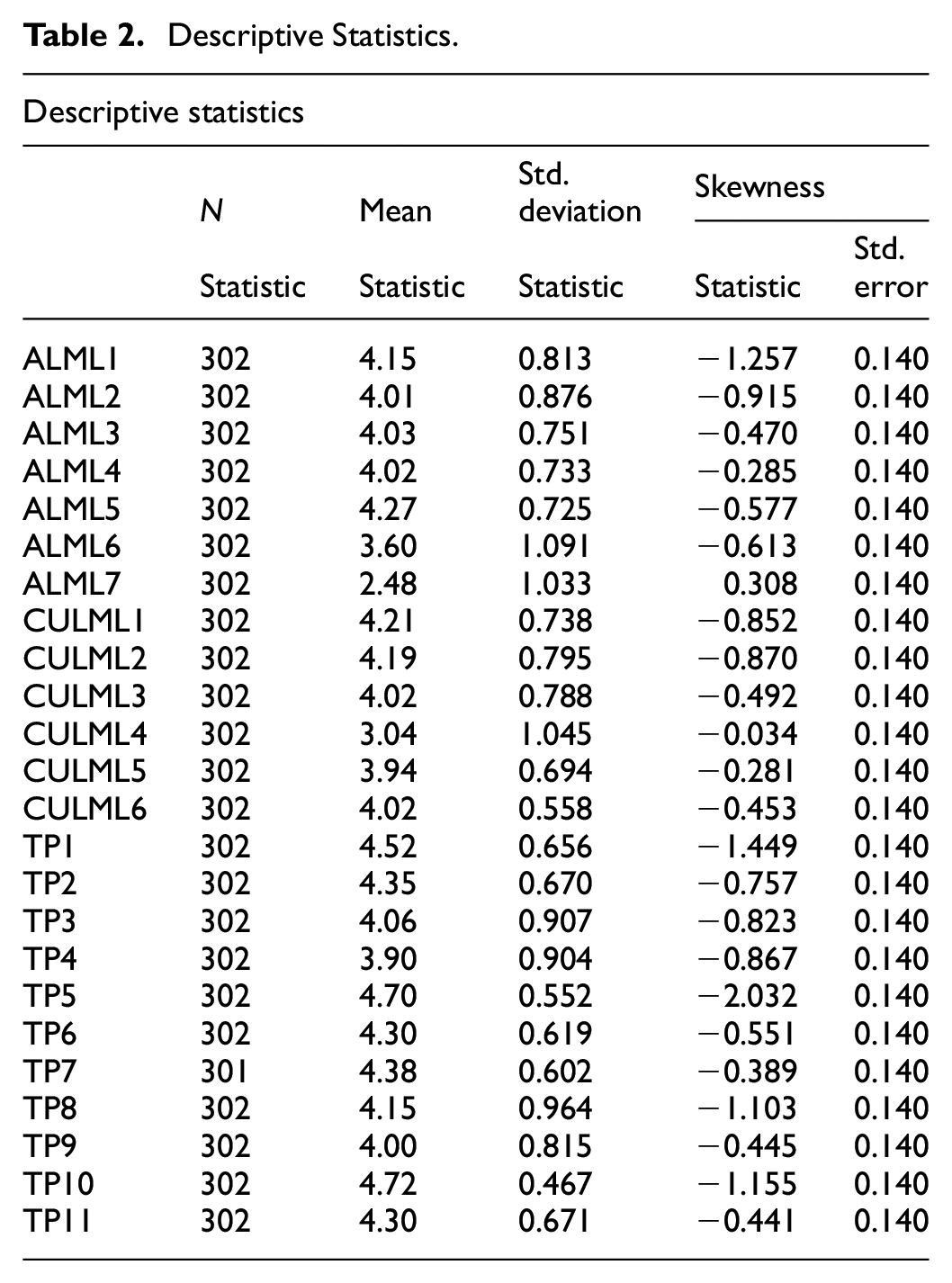
Most of the values approximated a normal distribution based on the low skewness. Therefore, parametric statistics could be used to analyze the data.
Instrument Reliability and Validity
The purpose of the validity analyses is to determine how well the instrument measures the intended constructs within the premise of the research shown in Table 3. Table 4 shows the survey’s Cronbach’s alpha.
Reliability Analysis.

Item-Total Correlations and Impact on Scale Reliability.

The Cronbach’s alpha score of .903 confirms the survey items’ internal consistency. In addition, a separate analysis of the internal consistency of the three distinct constructs (availability of literacy learning materials, teacher practices, and children’s use of literacy learning materials) indicated that the items maintained reliable internal consistency in measuring the desired construct.
According to Wijaya et al. (2022), observation the value of HTMT (heterotrait–monotrait ratio of correlations) is needed to highly analyze discriminant validity specifically. Table 5 present a thorough criterion use for assessment of discriminant validity when compared to the Fornell-Larcker technique, particularly in cases where constructs are extensively interrelated.
Validity Discriminant Measurement Results Based on HTMT.

Wijaya et al. (2022) research stated that even though the Fornell–Larcker criterion is widely used to test discriminant validity, it might be insufficient when latent variables have high correlations. On the other hand, the HTMT ratio can yield a superior assessment. In this analysis, the HTMT values are mostly below the threshold of 0.90, indicating acceptable discriminant validity among most constructs.
Correlation Matrix
Table 6 shows the correlation coefficients among the variables analyzed.
Correlation Coefficients.

The low values of the correlation coefficients between the variables consistently show weak inter-variable relations-a factor favorable to multivariate analysis. Minimal correlation reduces the potential for multicollinearity, which may skew the regression coefficients and ensures that the independent contribution of the variables toward the estimates of the model are made (Hair et al., 2020; Sarstedt et al., 2020).
Goodness of Fit Test
A goodness of fit test was performed to evaluate the model’s ability to reflect the actual model. Table 7 shows the model fit parameters.
Goodness of Fit Statistics.

The model fit indices, as explained in Table 7, show a chi-square statistic of 940.22, which is statistically significant, indicating that the variation in the predicted values is more than that due to random error. However, the measures such as the GFI and CFI are greater than the threshold level of 0.5, indicating an adequate fit between the hypothesized and the observed values. Thus, the fit of the model is considered adequate enough to take a look at the proposed relationships.
Results
The aim of this study was to explore the relationship between the availability of literacy learning materials and teachers’ practices in early childhood classrooms in Saudi Arabia with the overall goal of promoting an understanding of the influence of these factors on children’s use of these materials to improve their emergent literacy skills.
SEM Analysis
A structural equation model was developed to estimate the relationships among the three construct variables. This model presents the two-way relationships between variables in a hypothesized relationship.
According to Table 8, teachers’ practices had the strongest direct impact on children’s use of literacy learning materials, underscoring the invaluable role of teachers in imparting knowledge and skills. By contrast, the variable of availability of literacy learning materials had a minimal effect on children’s use of literacy learning materials. Nevertheless, a t-test for these effects showed that all coefficients were statistically significant at the 5% level, suggesting the existence of a relationship as hypothesized (Hair et al., 2019). Therefore, the results could be used to test the three hypotheses.
Direct, Indirect, and Total Effects.

The analysis explored the statistical significance of each construct’s impact on dependent children’s use of learning materials using a t-test at the 5% significance level. The coefficient estimates and significance tests for the initial hypothesized model are presented in Table 8.
According to Table 8, teachers’ practices had the strongest direct impact on children’s use of literacy learning materials, underscoring the invaluable role of teachers in imparting knowledge and skills. By contrast, the variable of availability of literacy learning materials had a minimal effect on children’s use of literacy learning materials. Nevertheless, a t-test for these effects showed that all coefficients were statistically significant at the 5% level, suggesting the existence of a relationship as hypothesized (Hair et al., 2019). Therefore, the results could be used to test the three hypotheses.
The results validate that the availability of learning materials and teacher practices significantly affect children’s use of literacy earning materials, which play a role in developing their emergent literacy in early childhood classrooms. This analysis focused on the direct effects of the availability of literacy learning materials on the children’s use of literacy learning materials, with teacher practices as a mediator variable. The results validate that the children’s use of literacy learning materials and knowledge acquisition depends on the availability of literacy learning materials, with teacher practices acting as a significant mediator variable that guides and enhances this use to develop children’s emergent literacy skills.
Discussion
This study examined the effects of two factors (availability of literacy learning materials and teachers’ practices) on children’s use of literacy learning materials to improve their emergent literacy in early childhood classrooms. In terms of teachers’ practices, the study results demonstrate a significant effect of these practices on children’s use of literacy learning materials, in agreement with previous work by Al-Barakat and Bataineh (2011), who reported that teachers’ practices, such as creating a library in the classroom and allowing children to use its contents, aided in developing children’s emergent literacy skills in early childhood classrooms. Thus, teachers can play a role in training children to take responsibility for and maintain literacy learning materials in good condition in the early childhood classroom through the teachers’ practices, directives, and working together with the children upholding this responsibility. Overall, these results indicate that teachers’ practices should be focused on encouraging children to use literacy learning materials in the classroom by allowing the children the freedom to use alphabet books, plastic or wood dimensional alphabet letters, picture books, paper, crayons, and pencils when engaging in educational activities and games. This will instill enthusiasm about literacy activities in the children; thus, their emergent literacy skills will develop.
This conclusion is supported by A. T. Barber and Klauda (2020), who reported that teacher practices, such as engagement of children in literacy activities and interaction with them in early childhood classrooms, lead to learning and development of young children’s literacy skills, such knowing their alphabet letters, learning rhymes, writing their names, and understanding the meaning of printed words, by immersing them delightfully in literacy activities and facilitating sharing, exchanging, talking, and asking. This result suggests that teachers have to ask children questions and give them opportunities to talk about the events of their days with peers, and with teachers as well, as these interactions have a role in linking emerging literacy concepts with children’s experiences and lead to the development of their listening and speaking skills. This idea is consistent with the results of a previous study by Doane and Seward (2021), who suggested similar recommendations. Furthermore, teacher practices, such as read-aloud exercises and introducing new words to children while reading picture books, in early childhood classrooms boost children’s ability to develop sentence structures and aid their acquisition of vocabulary, as confirmed by Alatalo and Westlund (2021).
The findings presented here also suggest that teachers should seek to develop their skills and practices in teaching emerging literacy skills by registering in workshops and courses specialized in teaching literacy skills to children in early childhood, allowing the teachers to exchange experiences with peers from other early childhood schools. This will expose the teachers to other thoughts and diverse ideas that they can exploit in terms of the literacy learning materials available in their own classrooms and enable them to harness new ways of developing children’s emergent literacy skills. This is consistent with the results reported by Alsubaie (2024), who encouraged teachers to develop their teaching practices and skills by engaging in professional development courses and programs that suited their needs and specializations.
In terms of literacy learning materials, the finding of the relationship between the availability of literacy learning materials and children’s use of them in early childhood classrooms agreed with the results of studies by Dynia et al. (2018), who indicated that the availability of literacy learning materials and their diversity in early childhood classrooms is important and has implications for children’s behavior, their interaction with the learning materials, and their emerging literacy skills. The findings of the present study confirm that children’s use of literacy-related learning materials, which is important to the development of emergent literacy skills in early childhood classrooms, is highly influenced by the availability of these resources and the teachers’ teaching practices. For instance, the study revealed a significant association between the availability of literacy learning materials and teachers’ practices with and children’s use of literacy learning materials in early childhood classrooms and that this association may affect the development of children’s emerging literacy skills. This is consistent with the results of Guo et al. (2012), who indicated that the availability of literacy teaching materials, such as writing materials like pencils and paper, in early childhood classrooms encourages teachers to teach children to write their names.
The findings of the present study also confirmed a significant relationship between the availability of learning materials for literacy, the children’s use of literacy learning materials, and teachers’ practices in early childhood classrooms. This finding was in line with the results of Gerde et al. (2012) and of Nitecki and Chung (2013), who noted that the availability of educational literacy materials, such as paper, pencils, and crayons, in early childhood classrooms supports children’s attempts to write and express themselves through scribbling and experimenting with pretend writing.
Several factors may affect the relationship between the availability of educational materials, teachers’ practices, and children’s literacy skills. One is the issue of the financial support the teacher receives, which affects the availability of literacy educational materials. The number of children in one classroom may positively or negatively affect the extent to which children benefit from the learning materials and teachers’ practices that affect children’s emergent literacy. Previous studies (Alsubaie, 2024; Hindman & Wasik, 2015; Neuman & Celano, 2012) have indicated the importance of financial support for schools to provide learning literacy material in early childhood classrooms.
In summary, the results of the present study were expected, and they supported the hypotheses of this study, confirming that a relationship exists between the variables examined. For example, the findings revealed a significant association between the availability of literacy learning materials and both teachers’ practices and children’s use of literacy learning materials in early childhood classrooms. This relationship would be expected to affect the development of children’s emerging literacy skills; therefore, it should be an important consideration among decision makers in Saudi education. The Ministry of Education should intensify the provision of early childhood teachers with opportunities for training and professional development in teaching emergent literacy skills. Training programs should also be centralized to enhance teachers’ knowledge of learning in children at this stage and to aid the teachers in dealing with their children’s needs and interests.
The teachers themselves also have to diversify their teaching practices to make the best use of the available literacy learning materials inside the early childhood classrooms. As Alsubaie (2015, 2024) pointed out, taking full advantage of the learning materials available in the classrooms is essential for eradicating illiteracy and for enriching the experiences of children in early childhood classrooms to ensure the full development of their emerging literacy skills.
Implications
The availability of literacy learning materials and their diversity in early childhood classrooms is important and has implications for children’s behavior, their interaction with these materials, and their emerging literacy skills. Drawing the attention of the Ministry of Education to the importance of ensuring the availability of literacy learning materials in early childhood classrooms should be a priority to ensure that early childhood classrooms are equipped with a variety of learning materials of suitable high quality that will retain in their usability for a long time. In addition, budget allocations should provide learning materials for literacy learning in classrooms, especially in early childhood schools in villages that may presently lack learning materials known to play fundamental roles in helping teachers embed emergent literacy skills in children at this age.
The findings of this study also imply that early childhood school leaders should provide spatial and pedagogical support for teachers to facilitate the provision and preservation of these learning materials. This could be effected by the formation of a committee that checks the condition of literacy learning materials in classrooms and writes a report on their condition to maintain and renew what is needed. Likewise, the school administration can contribute to providing these materials in early childhood classrooms by opening the door to participation and encouraging parents who are able to contribute and volunteer to provide literacy learning materials, such as tables and chairs, educational picture books, paper, pencils, crayons, educational games, etc. Moreover, the school administration must ensure, through interactions with the teachers, that every child has their own basic educational materials to learn literacy so that they can participate whenever the teacher requests. One point to be noted here is that some learning materials, such as paper and pencils, required for teaching literacy are supposed to be present in the classroom, and the parents are responsible for providing them. Therefore, the school administration and the teacher should remind parents and encourage them to provide these basic learning materials for their children. The parents should also ensure that the children bring the items daily to their classrooms to achieve the desired teaching benefits and development of their emerging literacy skills.
In general, the availability of literacy learning materials, including storybooks, picture books, and alphabet books, in early childhood classrooms across Saudi Arabia has an impact on the acquisition of literacy skills among children (AlAhmari, 2022), in light of several teaching practices that let children interact with and use these materials in early childhood classrooms.
Conclusion, Limitations, and Future Studies
This study explored the relationship between the availability of literacy learning materials and teachers’ practices in early childhood classrooms in Saudi Arabia. The aim was to promote an understanding of the influence of these factors on children’s use of literacy learning materials to improve their emergent literacy skills. The study results revealed that children’s use of these materials, which are recognized as important for the development of emergent literacy, is highly influenced both by the availability of literacy learning materials in the classroom and by the teachers’ teaching practices. The teachers’ practices had the strongest impact on children’s use of literacy learning materials, underscoring the invaluable role of teachers in imparting knowledge and skills. By contrast, the availability of literacy learning materials as a variable had a minimal effect on children’s use of literacy learning materials. Thus, the study’s results contribute to the existing literature by providing information about the context of the development of emergent literacy skills in young children in Saudi Arabia through teachers’ practices and perspectives and provide insights into how teachers’ practices and the availability of literacy learning materials in early childhood classrooms influence the development of emergent literacy skills among young children. Additionally, the results of this study may also assist early childhood teachers understand how their practices and activities with regard to literacy learning materials influence the emergent literacy skills of young children.
Several limitations were identified in this study. First, the participants were all early childhood teachers from the schools of the Eastern Province in Saudi Arabia; therefore, generalization of the findings to other regions of the Kingdom of Saudi Arabia may be difficult. Therefore, the samples in future studies should be more diverse and should cover participants from different regions of Saudi Arabia. Second, this study did not include or examine the influence of some factors related to the participants, such as their years of experience or their academic qualifications. These factors could influence their practices in the early childhood literacy classrooms, and consequently could positively or negatively affect the children’s use of literacy learning materials and the ability of children of this age to acquire and develop emerging literacy skills. Therefore, we suggest that future studies should examine the influence of these factors. Third, this study did not include the effect of digital learning materials on the development of emergent literacy skills in early childhood. Hence, we suggest that future research should look at how early childhood teachers view the possible influences of digital literacy learning materials as aids for improving children’s use of literacy learning materials and the acquisition and development of emerging literacy skills. Lastly, while the present study adopted a descriptive approach, future studies may consider adopting other experimental approaches to explore the relationship between the availability of literacy learning materials and teachers’ practices in early childhood classrooms in Saudi Arabia to promote an even deeper understanding of their influence on the use of these materials as preschool children improve their emergent literacy skills.
Footnotes
Acknowledgements
The author acknowledges the Deanship of Scientific Research at King Faisal University for financial support.

Ethical Considerations
The study was conducted with approved by the Institutional Review Board (or Ethics Committee) of the Research Ethics Committee (REC) of King Faisal University (KFU-REC-2023-MAY-ETHICS875) from the Research Ethics Committee (REC).
Funding
The author disclosed receipt of the following financial support for the research, authorship, and/or publication of this article: The author acknowledges the Deanship of Scientific Research at King Faisal University for its financial support under the grant number: KFU241779.
Declaration of Conflicting Interests
The author declared no potential conflicts of interest with respect to the research, authorship, and/or publication of this article.
Data Availability Statement
The data that has been used is confidential.