




Abstract
This study examines the beliefs and practices of English teachers in China regarding pronunciation instruction, with a focus on how teaching experience and instructional context shape their beliefs and practices. Utilizing a mixed-methods approach, data were collected from 436 teachers across primary, junior high and senior high schools, including 100 pre-service and 336 in-service teachers, who completed questionnaires. Additionally, semi-structured interviews were conducted with 15 teachers to gain further qualitative insights. Results reveal that while the majority of teachers acknowledge the importance of pronunciation, both teaching experience and instructional context notably impact their beliefs and instructional approaches. Teachers with more experience demonstrate greater reluctance to engage in pronunciation instruction and emphasize a stronger need for professional development in this area. The study also shows that although teachers across all levels value intelligibility as the primary goal of pronunciation instruction, many still adhere to nativeness norms. Notably, less experienced and elementary-level teachers report more frequent engagement in pronunciation activities and a wider variety of instructional methods. These findings offer valuable insights for improving English teacher training and enhancing pronunciation instruction practices within Chinese educational contexts.
Plain language summary
This study investigates how teaching experience and the level of students being taught influence English teachers’ beliefs and practices in pronunciation instruction in China. By surveying 436 teachers and interviewing 15 of them, we uncovered notable trends in how teachers approach pronunciation teaching. Teachers across all experience levels recognize the importance of teaching pronunciation. However, as teachers gain more experience, they often find pronunciation instruction more challenging and express a stronger need for professional development. While newer teachers engage more actively in pronunciation instruction, experienced teachers tend to prioritize specific advanced features like rhythm and stress. Additionally, teachers with more experience often retain a preference for teaching native-like pronunciation, despite a broader agreement that the primary goal should be intelligibility—helping students speak English in a way that is easily understood. Teachers’ practices also vary based on the age group they teach. Elementary school teachers are more likely to integrate pronunciation teaching into their lessons and use interactive methods, whereas high school teachers focus more on advanced topics such as intonation and word stress. This aligns with curriculum requirements but highlights gaps in training and support, particularly for high school teachers. These findings suggest that tailored professional development is crucial. Training should focus on fostering intelligibility as the goal of pronunciation instruction and equipping teachers at different career stages with appropriate strategies. This study highlights the need for educational policies that align teacher training and curriculum standards to support effective pronunciation teaching.
Keywords
Introduction
It is well accepted that teachers are the core component of the teaching process. As Richards and Lockhart (1994) pointed out, the key to the success of teaching lies in excellent teachers, and excellent teachers arise from their internal beliefs. Therefore, since the study of teachers’ beliefs has emerged in the 1970s, a plethora of studies have explored various aspects, including the definition of teachers’ beliefs, the factors influencing their beliefs, and the relationship between beliefs and teaching practices across multiple educational domains, including foreign language instruction. Many studies have demonstrated the significant influence of teaching experience (Borg, 2019; Cho, 2014; Qiu et al., 2022; Yazan & Lindahl, 2023) and instructional context (Shah et al., 2017; Tan, 2023) on shaping teachers’ beliefs.
Despite this extensive body of research, studies specifically addressing English teachers’ beliefs and practices in pronunciation teaching remain scarce, particularly in contexts where English is taught as an international language (EIL). This gap is especially pronounced in mainland China, where historical emphasis on reading and writing for high-stakes examinations and a prevailing preference for native-like pronunciation as the standard have overshadowed pronunciation instruction.
However, global shifts in the role and use of English challenge traditional norms. Since non-native speakers are now the majority of English users (Jenkins, 2002), researchers argue that the focus of English education should prioritize intelligibility over the pursuit of native-like pronunciation (Derwing & Munro, 2015). The release of the 2022 New Curriculum Standards for English in China can also reflect this trend by removing explicit requirements for native-like pronunciation and including diverse oral activities (Y. Wang & Wen, 2023). Despite this policy shift, challenges remain in classroom practice. M. X. Wang and Gao (2015) found that both university teachers and students in China continue to favor native-like accents over intelligibility, revealing a disconnect between research advances and classroom practices.
This disjunction between evolving global pedagogical goals and entrenched local preferences is not unique to China. Around the world, teachers must navigate the tension between traditional ideals of linguistic nativeness and the practical demands of fostering communicative competence in diverse and multilingual settings, as discussed in many studies (e.g., Hofer & Jessner, 2025; Kirkpatrick, 2011; Lee, 2024; Triyoko & Kidwell, 2023; Zeaiter, 2022). Understanding how teachers’ beliefs and practices in pronunciation teaching are shaped by factors such as teaching experience and instructional context can thus provide valuable insights into global teacher education.
By addressing these dynamics, this study tries to examine English teachers’ beliefs and practices in China concerning pronunciation instruction, emphasizing on revealing how teaching experience and instructional context shape their beliefs and practices in EIL contexts.
Literature Review
Teachers’ Beliefs and Practices
Researchers have defined teachers’ beliefs in various ways. Bandura (1997) emphasized their explicit and implicit nature, while Buehl and Beck (2015) noted their stability, though they can change with experience. The relationship between beliefs and knowledge is debated, with some viewing them as separate (Nespor, 1987; Pajares, 1992) and others as interconnected (Cash et al., 2015; Kagan, 1992). This study sees beliefs as part of teachers’ cognition (Borg, 2015), shaped by knowledge, experience, and context, influencing their teaching. Beyond definitions, researchers have explored beliefs about teaching (Prawat, 1992), learning (Clark & Peterson, 1986), assessment (Brown, 2004, 2006; Harris & Brown, 2009; X. Liu, 2024). Two major topics in the area, the relationship between language teachers’ beliefs and practices and factors influencing the development of beliefs, are discussed below.
Many studies have explored the relationship between language teachers’ beliefs and practices. Practice, as defined by Buehl and Beck (2015), includes all actions related to teaching, such as planning, decision-making, and assessment. It is commonly accepted that practices stem from beliefs (Johnson, 1999; Pajares, 1992), and researchers often study both to determine their consistency (Basturkmen, 2012; Chen et al., 2024). However, findings are mixed, with some studies showing alignment (Farrell & Kun, 2007), while others report limited correspondence (Chen et al., 2024; Mitchell, 2005; Ng & Farrell, 2003; Ye & Hu, 2024). Basturkmen (2012) suggests that case studies, being specific, may explain these inconsistencies. This study aims to address this gap by using both quantitative and qualitative methods with 436 English teachers in China, followed by interviews with 15 teachers.
The development of beliefs has also been intensely discussed and researched. Six sources, which are formal education, formal bodies of knowledge, observational learning, collaboration with others, personal teaching experiences, and self-reflection, were identified by Buehl and Fives (2009). B. Levin and He (2008) collected 472 self-reported pedagogical beliefs from 94 pre-service teachers who had participated in an average of 140 hr field experiences. They found out that 66% of the beliefs came from the participants’ observations and teaching experiences and their coursework in their teacher education program. This is in line with the results of 22 in-service teachers participating in the follow-up study (B. B. Levin et al., 2013). More specifically, 28% was from what they learned in teacher education program, 24% from their teaching experience and 8% from the observations from other teachers. Other than the experience in teacher education program and the practical teaching, Borg (2015) and Ng et al. (2010) further confirmed that teachers’ belief can be influenced by their interactions with different students. Tan (2023) mentioned that teachers in different instructional contexts, namely, their students at different education levels, may have different expectations which would influence teachers’ beliefs. However, Fukuda et al. (2024) found that although elementary school teachers showed a stronger preference for teaching activities that promote active learning compared to their middle and high school counterparts, there were no significant differences in their underlying teaching beliefs.
Even though a consensus seems to be reached concerning the factors affecting the development of beliefs, why and how some beliefs can be affected are still not clear. Therefore, this current study explores how teachers’ beliefs and practices differ according to their different teaching experience and instructional contexts (elementary, junior high and senior high), hoping to draw implications for teacher education.
Nativeness Principle vs. Intelligibility Principle
Pronunciation teaching began to gain prominence during the late 19th-century Reform Movement (Celce-Murcia et al., 2010) and under the mid-20th-century “nativeness principle,” which prioritized native-like accuracy (J. Levis, 2020). With the decline of the audiolingual method, the nativeness principle has been increasingly challenged by the view that achieving native-like pronunciation is both unattainable and unnecessary (J. Levis, 2020, p. 313; J. Levis, 2024). The notion of unattainability refers to the fact that it is rare for adult learners to achieve a native-like accent since they are strongly influenced by the age at which they begin learning the language (Flege et al., 1995), limited exposure to the L2 (Bohn & Munro, 2008), and difficulties in perceiving and producing L2 sounds (Kartushina & Frauenfelder, 2014) and so on. The notion of unnecessary refers to the argument that native-like pronunciation is not essential for communicative success, as empirical studies have shown that accentedness does not always correlate with reduced intelligibility (Derwing & Munro, 1997; Munro & Derwing, 1995).
To promote a more realistic and practical approach to pronunciation instruction, the Intelligibility Principle has been widely advocated. J. Levis (2020) revisited the Nativeness and Intelligibility Principles and clarified that “intelligibility” encompasses not only whether speech is understood but also the ease with which it is understood in communication. In comparing the two principles, Levis described them as “contradictory,” noting that they stem from fundamentally different theoretical frameworks in language education. These differences lead to divergent priorities in assessing student success and teacher qualifications. Nevertheless, both principles recognize the significance of pronunciation teaching in language education. The Intelligibility Principle is more closely aligned with the broader goal of communicative competence, emphasizing functional effectiveness over adherence to native-like norms.
The tension between these principles is particularly evident in EFL contexts, where policy and practice have historically favored native models. For example, debates have emerged in Japan, where the curriculum historically emphasized native English norms (Morikawa, 2019; Rudolph, 2023). Lee (2024) argued that Korean students experience “English trauma”—anxiety and self-doubt due to societal pressure to achieve native-like English proficiency. Gordon and Barrantes-Elizondo (2024) explores how nonnative-speaking English pronunciation teachers in Costa Rica construct their professional identity by navigating between the idealization of nativeness and the legitimacy gained through linguistic expertise and teaching knowledge.
In China, from 2001 to 2017, English curriculum continued to prioritize native-like pronunciation, particularly British (RP) and American models, reinforcing the nativeness principle in both policy and practice (Tan, 2023; Q. Wang & Luo, 2019). Chinese textbooks and materials remain focused on RP, with little inclusion of diverse English accents (J. Bai, 2013; Q. Huang, 2019; Shen, 2014). National English curriculum standards in 2022, which shows the latest revision, explicitly highlights the communicative roles of pronunciation and intonation and introduces the concept of “lingua franca” reflecting the subtle shift of priorities in teaching English pronunciation. However, it remains unclear to what extent this shift has been reflected in actual classroom practices, particularly in terms of teachers’ beliefs and instructional approaches to pronunciation.
Pronunciation Teaching in China
Although pronunciation is widely recognized as important for English learners in China, it has not received equivalent instructional focus (Fang, 2022). Scholars and teachers attribute this to several factors: (1) Neglect of Pronunciation in Teaching Objectives: In China’s elementary, junior high, and senior high schools, English teaching is guided by curriculum standards set by the Ministry of Education. While these standards have emphasized pronunciation since 1949, consensus on specific teaching goals remains elusive (Y. Wang & Wen, 2023). Additionally, about 70% of English exams focus on reading, writing, and grammar, leaving limited time for pronunciation instruction (Yao, 2016). (2) Issues with Teachers’ Pronunciation: The training in pronunciation teaching received by language teachers is insufficient (D. Liu et al., 2025). Consequently, many teachers lack confidence in teaching pronunciation due to their own pronunciation challenges, which may lead to students imitating incorrect models (Y. Huang, 2023).
Among limited studies focusing on English teachers’ beliefs and practices in a Chinese setting, Yao (2016) conducted a qualitative study involving questionnaires, classroom observations, and interviews with three primary school teachers in Guangzhou. The findings revealed a gap between teachers’ beliefs and practices: although teachers believed pronunciation was important and correction was necessary, they spent little time on it in class and did not correct errors promptly. However, Yao’s study focused only on elementary teachers and did not address differences between teaching levels nor discuss teaching experience. To address these gaps, the current study examines English teachers across different contexts, focusing on how teaching experience and instructional settings influence beliefs and practices.
The Current Study
Considering the proven influence of teaching experience and instructional contexts on teachers’ beliefs and practices in previous studies, and the necessity of conducting studies in pronunciation teaching in a Chinese setting, this study gathers questionnaire and interview responses from teachers with varying experience levels across elementary to senior high schools, aiming to address the following research questions:
How does teaching experience influence teachers’ beliefs about pronunciation teaching, regarding its significance, instructional objectives, and teaching strategies?
How does teaching experience affect teachers’ classroom practices, in terms of the frequency of different contents (e.g., segmentals and suprasegmentals) and instructional activities?
How do instructional contexts (elementary, junior high, and senior high schools) influence teachers’ beliefs about pronunciation teaching, regarding its significance, instructional objectives, and teaching strategies?
How do instructional contexts shape teachers’ actual classroom practices in pronunciation teaching, in terms of the frequency of different contents (e.g., segmentals and suprasegmentals) and instructional activities?
Method
This study used a mixed-method design combining quantitative and qualitative methods. Quantitative data included the questionnaire responses collected from 436 teachers and qualitative data consisted of the interview data gathered from 15 teachers. This section presents a detailed explanation about the participants, instruments (questionnaire and interview) and data analysis methods.
Participants
A total of 436 teachers, 100 pre-service and 336 in-services, completed the questionnaires. The pre-service teachers were fourth-year undergraduates pursuing a Bachelor’s in English Education. Most had completed two 8-week field teaching practices, giving 89 of them 1 to 4 months of experience. Seven did not finish the practice due to personal issues, and four gained 6 to 10 months of experience through volunteer teaching. Some pre-service teachers taught in both junior and senior high schools during different rounds of practice, which explains why the number of students listed in Table 1 exceeds the total number of pre-service teachers.
Background Information of Participants in the Questionnaires.

Note. F = female; M = male; E = elementary school; J = junior high school; S = senior high school.
All in-service English teacher participants were working in public schools at the time of data collection. The questionnaire was distributed through professional networks, and all respondents were recruited via colleagues working in public schools who shared the survey with their peers. Among in-service teachers, 107 had been working as English teachers for less than 5 years, followed by 88 teachers with 5 to 10 years of experience. There were 73 teachers who had 10 to 15 years of experience, and 68 had more than 15 years of experience. As for their instruction contexts, 32.4% of them taught elementary school students, 32.7% junior high, and 34.8% senior high.
Questionnaire
The questionnaire, containing a total of 49 questions, was designed based on the ones used in the study of Foote et al. (2012) and Yao (2016). It consists of three parts, background information (5 Qs), teachers’ beliefs (15 Qs) and teachers’ practice (28 Qs), and an invitation question asking the participants to leave their phone number if they would like take the interview. The dimensions of the questionnaire are presented in Table 2.
Dimensions of the Questionnaire.

Note. PT = pronunciation teaching.
The questionnaire was delivered in Chinese on an online survey platform in China www.wjx.com. It is translated into English and shown in Part A of Appendix. Totally, 439 people took part in the survey, but 3 peoples’ questionnaires were invalid because they missed either one or two sections. Consequently, 436 questionnaires were tabulated.
Interview
A total of 395 teachers (316 in-service and 79 pre-service) expressed interest in participating in the semi-structured interviews. To ensure a diverse and representative sample, 12 in-service teachers were randomly selected across four experience brackets: 1 to 5, 5 to 10, 10 to 15, and over 15 years. Within each experience group, one teacher was chosen from each instructional context: elementary, junior high, and senior high school. Additionally, three pre-service teachers, each with internship experience in one of the three instructional contexts, were selected for interviews.
The semi-structured interview questions (see Part B of Appendix) were adapted from B. Bai and Yuan (2019). The interviews were conducted in Chinese to ensure clarity and comfort for the participants, and the responses were subsequently translated into English for analysis.
Data Analysis
To address the research questions, the data analysis was divided into two parts based on the nature of the data: quantitative and qualitative.
The quantitative data were derived from the questionnaire responses, which included Likert-scale items measuring teachers’ beliefs and practices. The responses were coded numerically. The reliability and validity were tested using SPSSAU after collecting and coding the data, and the results are shown in Tables 3 and 4. Descriptive statistics (i.e., percentages) were used to identify general trends in teachers’ responses. The data were further categorized according to teaching experience and students’ educational level (elementary, junior high, senior high) to examine patterns across subgroups.
Reliability of the Questionnaire.

Validity of the Questionnaire.

The qualitative data were drawn from the open-ended responses and semi-structured interviews conducted with a subset of 15 teachers. The responses were translated and transcribed. Recurring ideas and themes were identified inductively to support the results in questionnaire responses and explore the reasons. Based on Braun and Clarke’s (2006) six-phase approach, the transcripts were first read multiple times for familiarization, then systematically coded using a codebook developed from both the interview questions and themes. Key themes included teaching practices, curriculum influence, teacher confidence, instructional challenges, and support needs, along with cross-cutting issues such as belief–practice gaps and shifting orientations from nativeness to intelligibility.
Ethical Considerations
This study was approved by the Institutional Review Board of the university where the corresponding author is affiliated. To minimize risk, participation was voluntary and anonymous.
The questionnaire included no sensitive questions, and the optional interview invitation involved no obligation. Informed consent was obtained by participants clicking the survey link after reading a description of the study. Interviewees provided verbal consent before participation.
The study posed minimal risk and aimed to inform more effective pronunciation teaching, providing potential benefits to both participants and the broader educational community.
Results
Beliefs in Teaching Pronunciation Among Teachers With Different Teaching Experience
Figures 1 to 3 display participants’ responses regarding the importance (items 6, 8, 9, 10, and 13), objectives (items 7, 11, 12, 16, and 17), and strategies (items 14, 15, 18, 19, and 20) of pronunciation teaching. Responses are categorized by teaching experience into five groups: “<1” for pre-service teachers, “<5” for in-service teachers with less than 5 years of experience, “<10” for teachers with 5 to 10 years of experience, “<15” for those with 10 to 15 years of experience, and “>15” for teachers with over 15 years of experience. Different colors represent the percentages for each response option.

Percentage of responses in

Percentage of responses in

Percentage of responses in
Importance of Pronunciation Teaching
Figure 1 demonstrates that the vast majority of teachers believe that teaching English pronunciation in class is very important. Specifically, the combined percentages of teachers who selected “strongly agree” (79%–82.86%) and “agree” (16.92%–21.5%) range from 98.1% to 100%. This finding is further corroborated by the data from Item 9, which shows that the majority of teachers disagree with the notion that there is no need to teach pronunciation in class. The combined percentages of teachers who selected “disagree” (65.42%–72.31%) and “strongly disagree” (14.02%–20%) range from 80% to 89%.
For Items 8, 9, and 10, differences are observed based on teachers’ experience. As experience increases, more teachers find teaching English pronunciation challenging, show reluctance to teach it, and express a desire for further training. In Item 10, the combined percentages of teachers who “strongly agree” or “agree” with “I am not willing to teach English pronunciation in my class” increase with experience: 21%, 31.78%, 37.15%, 37.93%, and 46.16% across the five experience groups. This trend may be understood in light of the theme of low teacher confidence, which can be found in interviews with more experienced teachers. One elementary school teacher with over 15 years of experience commented, “I would not consider myself confident in teaching pronunciation. I found that the more I teach, the more exceptions in pronunciation I meet. For example, some students asked me why the pronunciation for “ough” in “cough” and “through” is different. I had no clue. And I noticed that some of my students can even pronounce better than I.” This can show how accumulated classroom experience may lead to greater awareness of the complexity of English pronunciation, resulting in reducing confidence and increasing reluctance to teach pronunciation explicitly.
Objective of English Pronunciation Teaching
Figure 2 shows that the majority of teachers agree that the primary goal of teaching English pronunciation is to help students speak English in a way that others can understand. Specifically, the combined percentages of “strongly agree” (17.24%–26%) and “agree” (46%–50.77%) for Item 12 range from 65.52% (Group < 15) to 74.28% (Group < 10). However, an interesting finding is that, according to the results for Item 16, between 65.4% and 76.9% of teachers reported that they would still correct students’ pronunciation, even if they can understand the students’ English.
This inconsistency might be explained by the fact that between 45.71% and 62.07% of the teachers still believe the standard for assessing students’ English pronunciation should be based on how closely it resembles native English speaker pronunciation (Item 11). Furthermore, many teachers agreed that English pronunciation is best taught by native speakers (Item 7). For Items 7 and 11, the combined percentages of “strongly agree” and “agree” range from 45.71% to 62.07%. Notably, teachers with more than 15 years of teaching experience (53.23% for Item 7; 55.39% for Item 11) and those with 10 to 15 years of experience (59.17% for Item 7; 62.07% for Item 11) were more likely to agree with these statements compared to teachers with less teaching experience. Furthermore, the dilemma of when and whether to correct students’ pronunciation found in the theme “shifting orientations from nativeness to intelligibility” in teachers’ interviews may help explain the inconsistency. One teacher with 10 to 15 years of experience mentioned: “I’m not sure whether or when I should correct students’ pronunciation. For example, I can clearly tell that they’re making mistakes, but I understand them just fine. At first, I thought that meant I didn’t need to correct them. But then I started to worry—would people from other countries also be able to understand my students’ English if they continued to make these pronunciation errors?”
A more noticeable difference among teacher groups based on their length of teaching experience is observed in the results for Item 17. While more than half of the teachers (between 66.21% and 92%) selected “strongly agree” or “agree” for this item, the data reveal a clear trend: the shorter the teaching experience, the more likely teachers are to agree that individual sounds, pauses, linking, and intonation should all be considered when assessing students’ pronunciation.
Strategies of Pronunciation Teaching
Figure 3 shows that a large majority of teachers across all groups agree with Item 14, 15 and 19, supporting the integration of pronunciation teaching into regular English classes, the allocation of designated time for pronunciation instruction, and the use of supplementary resources beyond textbooks. However, a noticeable trend emerges when only in-service teachers are considered: more experienced teachers generally exhibited higher levels of combined agreement. This suggests that more experienced teachers may place more emphasis on integrating pronunciation teaching in class, having dedicated time for it and utilizing resources beyond textbooks, compared to their less experienced counterparts.
Interestingly, when examining the percentage of “strongly agree” responses, the opposite trend is observed. Less experienced teachers exhibited higher percentages of strong agreement, indicating that they may be more enthusiastic about these strategies at the outset of their careers. Moreover, the 10-year mark in teaching experience seems to serve as a turning point, reflecting a shift in how teachers approach pronunciation instruction as they gain more experience.
As for Item 18, a notable difference between pre-service teachers (group < 1) and in-service teachers is displayed in the way that the agreements with this item for in-service teachers are much higher than those for pre-service teachers. This suggests that teachers having more practical experience may be more inclined to emphasize immediate correction of pronunciation errors. This difference is further proved by the qualitative theme of teaching practices. To the interview question “What are the challenges you face in teaching pronunciation?,” one pre-service teacher mentioned that “During my internship, sometimes I would ask students to read sentences in the textbook. When they made mistakes, I was not sure I should give immediate correction. Because I do not know whether the students would feel embarrassed.”
Regarding the results for Item 20, the 10-year mark again appears to be a pivotal point. The combined percentages of “strongly agree” and “agree” decrease as teaching experience increases, indicating that more experienced teachers are less likely to believe that pronunciation rules and techniques should be explained to students in the classroom. However, this trend reverses after 10 years of experience. Teachers having more than 10 years of teaching experience reported higher combined percentages of “strongly agree” and “agree” (72.67% for group < 15 and 77.9% for group > 15), which are as much as or even more than those of less experienced in-service teachers. This complex trend reflects the qualitative theme of teaching practice and curriculum influence. To illustrate, we compared the responses to Interview Question 1—“How do you teach pronunciation in your classroom?”—from two junior high school teachers: one with 1 to 5 years of teaching experience and the other with over 15 years. The less experienced teacher emphasized systematically covering all pronunciation rules at the end of each unit. In contrast, the more experienced teacher stated, “I think my students have already mastered basic pronunciation rules in elementary school. I’d rather spend more time having them read aloud than explicitly reviewing the rules.” This contrast suggests that teachers may shift their instructional approach over time.
Practice in Teaching Pronunciation Among Teachers With Different Teaching Experience
The results for pronunciation teaching practices are presented in two sections: the frequency of teaching content and activities. The complete data displaying all response categories (Never, Seldom, Sometimes, Often, Always) from teachers with varying teaching experience are presented in Appendix C-1 (frequency of teaching content) and Appendix C-2 (frequency of teaching activities). These comprehensive figures provide an overview of the general response patterns, while Figures 4 and 5 highlight the specific results discussed below.

Percentage of responses on the frequency of

Percentage of responses on the frequency of
Frequency of Teaching Contents
A general trend occurs: more experienced teachers (<15 years and 10–15 years) tend to less frequently teach English pronunciation which is reflected in their higher percentages of “Never” and “Seldom” responses, while less experience teachers (<5 and <10 years) reported higher percentages of “often” and “always” indicating they teach pronunciation more regularly (See Appendix C-1).
Clear patterns also emerge for several specific items (See Figure 4). For Item 9, which is intonation in English sentences, group > 15 displayed evident higher percentage for “Never” and a much lower percentage for “Often” than teachers with experience less than 5 years. This indicates that more experienced teachers are less likely to teach pronunciation topics, especially intonation.
For Item 11 (strong and weak forms) and 14 (sound changes), teachers with more than 15 years of experience surprisingly report teaching these topics in class “Often.” The percentages are similar to or higher than those of less experienced teachers, suggesting that while they may neglect certain pronunciation topics like intonation, more experienced teachers might focus on some pronunciation topics such as sound changes and strong/weak forms.
Frequency of Teaching Activities
The lines shown in Appendix C-2 are more closely aligned compared to Figure 4, making it harder to distinguish clear differences in the frequency of teaching activities for teachers with different years of experience. However, some differences are shown for some specific items. For example, as shown in Figure 5, teachers with more than 15 years of experience show consistently lower percentages for the response category “Often,” particularly for Items 5 (Using touch), 8 (Visual aids), 9 (Games), and 12 (Listening). This indicates that more experienced teachers may be less likely to use these interactive methods frequently.
Across all 15 items, Item 1 (Imitation and repetition) is consistently the most frequently used by teachers, while Item 15 (Using mirrors) is the least used, which can be noticed either in Appendix C-2 or Figure 5. In addition, all 15 interviewed teachers (12 in-service and 3 pre-service teachers) mentioned asking students to repeat or imitate pronunciation from either the teacher or native speaker recordings when they were asked to provide examples to illustrate how they teach pronunciation in their classes.
Beliefs in Teaching Pronunciation Among Teachers in Different Instructional Contexts
Figures 6 to 8 present the responses to each of the five items assessing teachers’ beliefs differentiated by the level of students they teach (elementary, junior high, and senior high).

Percentage of responses in

Percentage of responses in

Percentage of responses in
Importance of Pronunciation Teaching
In Figure 6, Item 6, which evaluates the perceived importance of teaching pronunciation in class, reveals widespread agreement across all three groups. The majority of teachers, regardless of the student levels, either “strongly agree” or “agree” with the importance of teaching pronunciation, as indicated by the predominant blue and light blue responses.
However, a divergence is observed in the responses to Item 9, which examines whether teachers believe students can learn pronunciation independently, without formal instruction. 79.69% of junior high teachers and 71.43% of senior high teachers expressed agreement. In contrast, only 7.34% of elementary school teachers agreed, indicating that they view classroom instruction as essential for developing pronunciation skills at the elementary level. This disparity suggests that while high school teachers acknowledge the importance of pronunciation instruction (as seen in Item 6), they may feel it is less necessary to address it explicitly in their classes, perhaps due to the assumption that older students can self-learn pronunciation. Another reason can be found in the qualitative theme of curriculum influence. One senior high school teacher with experience between 5 and 10 years mentioned: “To be honest, I do not teach pronunciation or I should say I do not teach pronunciation purposely. Because this is not the part included in the College Entrance Examination.” This response reflects how curricular and testing pressures shape classroom decisions, even when teachers acknowledge the importance of pronunciation.
For Item 8, which measures the perceived difficulty of teaching pronunciation, the data show that 53.21% of elementary teachers, 54.69% of junior high teachers, and 57.14% of senior high teachers find it challenging to teach this skill. This gradual increase suggests that as the students’ language proficiency advances, teachers face greater challenges in addressing pronunciation, possibly due to the more complex phonetic and phonological issues encountered at higher educational levels.
This perception of difficulty is reflected in the responses to Item 10, which indicates the teachers’ unwillingness to teach pronunciation. Elementary school teachers show the least reluctance (6.42%). As the perceived difficulty increases among junior and senior high teachers, a larger percentage may feel hesitant to focus on pronunciation in class, potentially prioritizing other aspects of language instruction.
Regarding Item 13, elementary school teachers (19.27%) report a lower percentage of interest in receiving training compared to their colleagues in junior (34.38%) and senior (33.34%) high schools. This finding could be linked to the greater challenges perceived at the higher levels, where teachers may feel more in need of specialized training to effectively address pronunciation issues.
Objectives of English Pronunciation Teaching
Figure 7 illustrates the beliefs regarding the objectives of teaching English pronunciation for teachers teaching students at different levels. The results for Item 7 and 11 demonstrate that teachers teaching senior high school students place the least emphasis on native speaker norms. Their combined percentages of “strongly agree” and “agree” are 42.86% for Item 7 and 42.85% for Item 11, both lower than the other two groups of teachers. This indicates that senior high school teachers may have a more flexible approach toward pronunciation standards.
For Item 12, between 69.72% and 75.01% of teachers across all levels agreed that the primary goal of pronunciation teaching is intelligibility. However, the percentage of teachers who “strongly agree” decreases with higher student levels: 28.44% for elementary, 21.88% for junior high, and 15.87% for senior high. Despite emphasizing intelligibility, many elementary teachers (77.99%) still believed pronunciation correction is necessary (Item 16), suggesting they prioritize both intelligibility and accuracy, likely due to the foundational nature of early language education.
Finally, for Item 17, between 60.32% (9.38% for “strongly agree” and 50.94% for “agree” for junior school teachers) and 67.14% (12.7% for “strongly agree” and 54.44% for “agree” for senior school teachers) teachers across all levels show a general consensus on the broader scope of pronunciation evaluation, which includes suprasegmental features such as pauses, linking, and intonation. This suggests that teachers, particularly at higher levels, recognize the importance of these advanced features of pronunciation in achieving natural and fluent speech.
Strategies of Pronunciation Teaching
Figure 8 presents the beliefs concerning the strategies of pronunciation teaching among teachers having students at different levels (elementary, junior high, and senior high). The results for Item 14, 15, 18, and 19 display a general pattern that the combined percentages of “strongly agree” and “agree” decreased as the level of students rises. In Item 14, the combined percentages for teachers in elementary, junior high and senior high schools are 39.07%, 33.02% and 31.74% respectively, indicating that elementary school teachers are more likely to support the integration of pronunciation into the overall language curriculum, designated time for pronunciation in class (Item 15), prompt correction for mispronunciation (Item 18) and the use of additional resources other than textbook (Item 19). This trend may reflect the different priorities teachers at each level place on pronunciation in their English classes.
For Item 20, the lowest percentage of teachers who find it necessary to provide explicit explanations occurs for elementary school teachers, with only 17.43% “strongly agreeing” compared to 20.44% of junior high and 21.11% of senior high teachers. This aligns with the idea that younger students benefit more from implicit learning and modeling.
Practice in Teaching Pronunciation Among Teachers in Different Instructional Contexts
The complete data displaying all response categories (Never, Seldom, Sometimes, Often, Always) from teachers in different instructional contexts are presented in Appendix C-3 (frequency of teaching content) and Appendix C-4 (frequency of teaching activities). These comprehensive figures provide an overview of the general response patterns, while Figures 9 and 10 highlight the specific results discussed below.

Percentage of responses on the frequency of
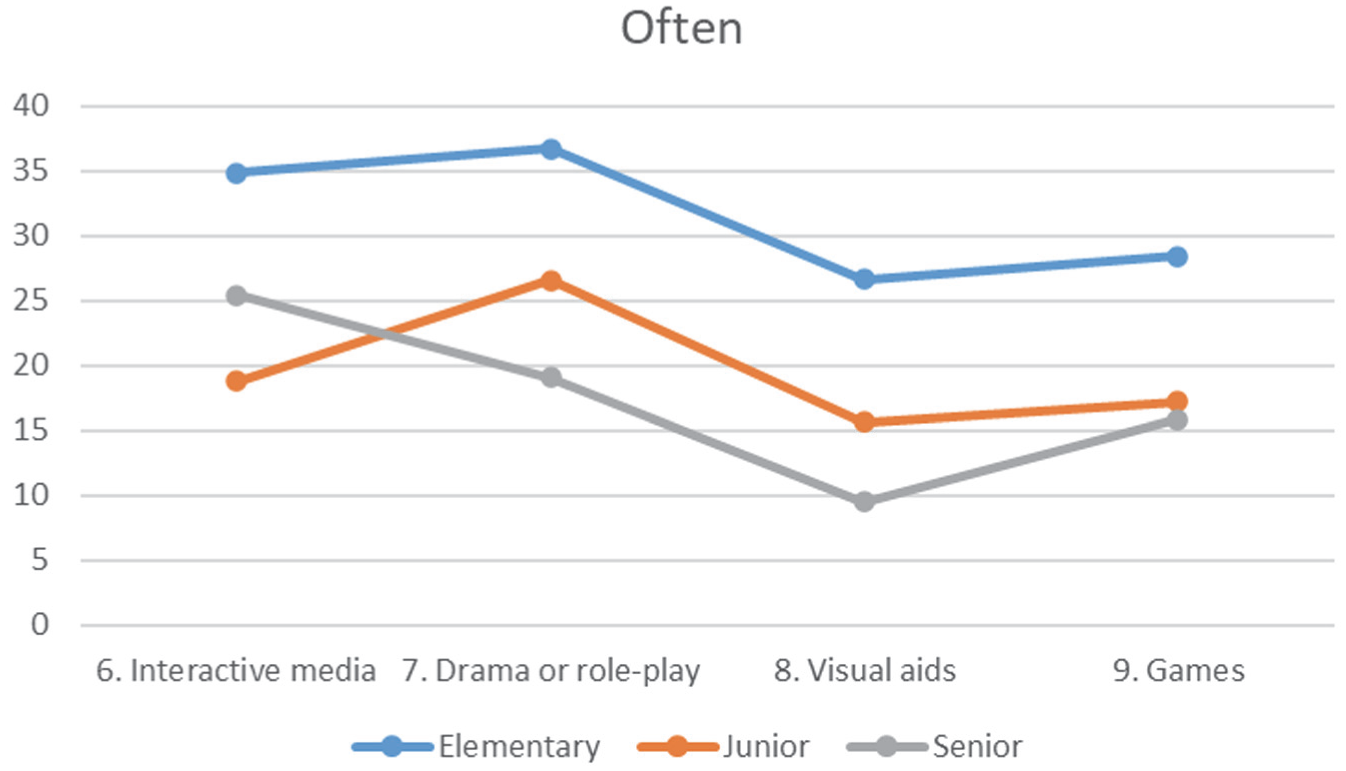
Percentage of responses on the frequency of
Frequency of Teaching Contents
In general, senior high school teachers report a higher percentage of responses in the “Seldom” category and a lower percentage in the “Often” compared to junior high school teachers and elementary school teachers as shown in Appendix C-3. However, there are notable exceptions for specific topics as displayed in Figure 9. Item 5 (word stress) shows that 34.92% of senior high teachers “Often” teach word stress, which is slightly higher than the 32.11% of elementary teachers. Similarly, for Item 11, 28.57% of senior high teachers report “Often” teaching “strong and weak forms,” higher than both junior high (21.88%) and elementary school teachers (22.94%). Finally, for Item 12 (English rhythm), 31.75% of senior high teachers report “Often” teaching it, which surpasses both junior high (18.75%) and elementary school teachers (22.94%).
These findings suggest that while senior high school teachers may generally de-emphasize pronunciation compared to those at lower levels, they tend to focus more on advanced pronunciation topics such as word stress, strong and weak forms, and English rhythm. The reason can be found in the qualitative theme of curriculum influence. More specifically, one interviewee, a senior high school teacher, explained: “I think the curriculum standards already provide clear guidance for pronunciation teaching. I remember the standards explicitly stating that high school students should be able to use stress and rhythm to express themselves better in English.”
Frequency of Teaching Activities
A comparison of the lines across these panels shows that as the item numbers increase, the percentage of “Often” and “Always” responses generally decreases, suggesting that activities later in the list (Items 8–15) are used less frequently by teachers, particularly in senior high settings (See Appendix C-4). Notably, as presented in Figure 10, the most clear decreases are observed for Item 6 (Interactive media), Item 7 (Drama or role-play), Item 8 (Using visual aids) and Item 9 (Games), where senior high teachers report much lower usage compared to elementary and junior high teachers.
A general pattern reveals that senior high school teachers report higher percentages in the “Never” category and lower percentages in the “Often” category. This trend, however, should not be interpreted as indicating that senior high teachers avoid activities altogether. Rather, it highlights that teachers at different educational levels may prioritize different approaches to teaching pronunciation.
These variations suggest that while senior high teachers may be less likely to engage students with interactive or visual-based activities such as games or visual aids, they focus more on phonetic symbols and other structured methods, which are considered more suitable for advanced learners.
Discussion
Influence of Teaching Experience on Teachers’ Beliefs
The findings indicate that teaching experience substantially influences teachers’ beliefs about pronunciation instruction. While teachers at all experience levels acknowledge its importance, those with greater experience perceive pronunciation instruction as increasingly complex and challenging. Among these, teachers with over 15 years of experience exhibit a marked reluctance to teach pronunciation but express the greatest need for additional training. This aligns with Cho’s (2014) study, which found that more experienced teachers often have lower confidence in their English proficiency, likely due to their heightened awareness of instructional complexities gained over time.
The influence of teaching experience is also evident in teachers’ beliefs about strategies for teaching pronunciation. More experienced teachers show higher overall agreement on integrating pronunciation teaching in class, having dedicated time, and using resources beyond textbooks, but less experienced teachers show higher levels of “strong agreement.” And in-service teachers are more likely to support immediate correction than pre-service teachers. These findings are aligned with some recent studies (Borg, 2019; Qiu et al., 2022; Yazan & Lindahl, 2023) which argue that teacher cognition evolves over time, with more experienced teachers developing a more nuanced understanding of instructional complexities and adjusting their beliefs and practices accordingly.
In terms of the beliefs about the objectives of teaching pronunciation, teachers across different levels of experience show similar patterns: The majority support intelligibility as the primary objective of pronunciation instruction, while also acknowledging the nativeness norm. The agreement in intelligibility as the prime goal is consistent with the study conducted by Tran and Nguyen (2020) taking English teachers in Vietnam as subjects. The persistence of the nativeness norm in the current study reflects the opinion issued by B. Bai and Yuan (2019) that English teachers in Hong Kong still highly value a native-like accent and prefer a “standard” pronunciation. This coexistence reflects the tension between the Nativeness Principle and the Intelligibility Principle in teaching pronunciation as discussed in section 2.2. Reasons for this tension are speculated from two perspectives.
From a research perspective, the Nativeness Principle dominated the field prior to the 1960s and has continued to exert influence, despite the decline of the audiolingual method, which somewhat diminished its impact. In contrast, the Intelligibility Principle—developed by Jenkins (2000), J. M. Levis (2018, J. Levis 2020, 2024), and Derwing and Munro (2005)—has gradually gained recognition among scholars, particularly in response to the growing use of English as a lingua franca. Nonetheless, the ongoing debate between the Nativeness and Intelligibility Principles remains unresolved, and language curricula continue to be shaped by both frameworks (J. M. Levis, 2005).
From the perspective of practical teaching, the subtle changes in the most recent revisions of the national English curriculum standards reflect some concepts aligned with the Intelligibility Principle. This shift has emerged as Chinese scholars (Qiong, 2004; H. Wang & van Heuven, 2003) began participating in debates on English as a Lingua Franca (ELF) and intelligibility in the post-2000 era. However, the curriculum standards still do not specify any particular accent norms. Currently, the audio and video materials accompanying textbooks feature only Received Pronunciation (RP) and General American (GA; Y. Wang & Wen, 2023), implicitly guiding teachers in their pronunciation instruction and assessment. Although the changes in the curriculum standards offer a general orientation, they remain abstract and lack the specificity needed for practical classroom implementation. In contrast, the native-speaker norms embedded in textbooks provide teachers with concrete reference points. As a result, while many teachers recognize intelligibility as the primary goal of pronunciation instruction, they also tend to support the use of native norms as instructional standards. Moreover, although teachers may be especially skillful in understanding accented L2 speech (Derwing & Munro, 2015), they often remain uncertain whether their students’ speech will be intelligible to English users from diverse linguistic backgrounds—as noted by one of the interviewees. Consequently, adopting native-speaker norms may be seen as a more straightforward and practical approach for classroom use.
Influence of Teaching Experience on Teachers’ Practices
The results suggest a distinct shift in the frequency with which pronunciation topics are taught in classes as teachers gain more experience. Less experienced teachers (those with fewer than 5 years of teaching) are more likely to teach pronunciation regularly. In contrast, teachers with more experience—particularly those with over 15 years—tend to teach pronunciation less frequently, even though these contents are all required to teach according to the corresponding curriculum standard. This trend is consistent with the findings from section 5.1, where more experienced teachers expressed a reluctance to teach pronunciation, which also reflects Agustina’s (2017) observation that experienced teachers can maintain their beliefs despite external constraints. This result also aligns with Huberman’s (1993) Teacher Career Cycle Model, which outlines distinct phases of professional development. Specifically, Huberman identifies the “Survival and Discovery” phase (1–3 years) and “Stabilization” phase (4–6 years), where early-career teachers prioritize classroom competence, identity building, and adherence to structured practices. Day and Gu’s (2007) findings corroborate this, demonstrating that teachers in their first 5 years focus intensely on foundational skills to establish efficacy and meet curriculum expectations. What is more, Beltman and Poulton (2025) confirmed that teachers’ teaching priorities shift over the course of their careers. Pronunciation, as a core component of language instruction, fits naturally into this phase, as newer teachers strive to master and demonstrate pedagogical effectiveness. Their intrinsic motivation to “prove themselves” and comply with institutional standards likely drives this emphasis. In contrast, teachers with over 15 years of experience often shift toward broader roles involving curriculum management, leadership, or adaptation to policy changes (Beltman & Poulton, 2025; Day & Gu, 2007; Huberman, 1993). This transition may lead to reduced attention to specific skills like pronunciation.
In addition to career-stage influences, differences in pronunciation teaching may also be shaped by generational shifts in curriculum exposure. China’s national English curriculum underwent significant reforms between 2001 and 2017 (Y. Wang & Wen, 2023), with pronunciation gaining prominence post-2005. Teachers with more than 15 years of experience likely received their own schooling before this shift, during a period when pronunciation was minimally emphasized. Their training may have focused more on grammar and reading, leading to lower confidence or reduced priority in teaching pronunciation. In contrast, newer teachers educated under the post-2005 curriculum likely internalized pronunciation as a key component and were trained accordingly. Thus, the interplay of career phase priorities (early-career focus on classroom fundamentals) and generational curriculum shifts (post-2005 emphasis on pronunciation) helps explain why less experienced teachers prioritize pronunciation instruction more consistently.
The difference in the frequency of teaching activities among teachers with different levels of teaching experience is not as pronounced as for the frequency of content. Regardless of teaching experience, imitation and repetition are the most frequently employed strategies. This aligns with prior research, such as Morley (1991), which identified “Listen and Repeat” as a dominant technique in pronunciation instruction.
Influence of Instructional Contexts on Teachers’ Beliefs About Pronunciation Teaching
The results show that the educational level of students impacts teachers’ beliefs about pronunciation teaching. Teachers working with elementary students are more likely to believe that formal pronunciation instruction is essential, whereas teachers at the junior and senior high levels feel that students can self-learn pronunciation to a greater extent. This finding echoes the results of Shah et al. (2017), who observed that some ESL teachers at the secondary level tend to avoid explicit pronunciation instruction in their classes.
The beliefs held by high school teachers in the current study actually contradict the curriculum standards revised in 2020, which mandate the teaching of specific pronunciation skills in the classroom. Two possible explanations for this discrepancy can be considered. First, teachers may assume that by the time students reach high school, they have already acquired the knowledge and skills enabling them to engage in more independent learning. This assumption is also supported by Tan (2023), who found that high school teachers often expect students to develop pronunciation autonomously. Second, the required pronunciation skills outlined in the curriculum—such as suprasegmental features like lexical stress, rhythm, liaison, and intonation—may present greater challenges for teachers. Teaching these more complex, abstract aspects of pronunciation might require specialized training.
Regarding the objectives of pronunciation teaching, compared to high school teachers, more elementary school teachers place a strong emphasis on the intelligibility norm. However, their beliefs about the necessity of immediate correction suggest that they not only value intelligibility but also see standard pronunciation as a tool for achieving this goal. This dual focus is supported by Yao (2016), who conducted a case study on three elementary school teachers’ beliefs about pronunciation instruction in China.
As for the strategies, the findings show that elementary school teachers favor integrating pronunciation into the broader language curriculum and prefer immediate correction over explicit rule explanation. This aligns with Constructivist Principles (Piaget, 1954; Vygotsky, 1978) and Task-Based Language Teaching (TBLT) frameworks (Ellis et al., 2019), which emphasize that young learners acquire language more effectively through experiential, context-rich activities than through abstract rule memorization. Constructivist theories suggest that children build linguistic knowledge through active engagement and meaningful interaction, while TBLT highlights the benefits of implicit learning via communicative tasks, given younger learners’ limited capacity for complex rule processing. Empirical support, such as Yeung et al. (2013), confirms that embedding pronunciation instruction in interactive activities enhances children’s phonological awareness and retention. These theoretical and empirical insights help explain why elementary teachers tend to favor integrated, experience-based approaches over direct instruction in pronunciation rules.
Influence of Instructional Contexts on Teachers’ Pronunciation Teaching Practices
Teachers’ pronunciation teaching practices vary by educational level. Senior high school teachers focus more on advanced topics like word stress, rhythm, and strong/weak forms, which enhance fluency and naturalness. In contrast, elementary and junior high teachers emphasize basic topics like vowel and consonant contrasts. These practices are influenced by curriculum guidelines: the Compulsory Education English Curriculum Standards specify pronunciation topics for elementary and junior high levels, while the English Curriculum Standards for Senior High Schools highlight lexical stress, intonation, and rhythm. This aligns with Tan (2023), who also found that curriculum standards significantly influence pronunciation teaching. Interview results further confirm this, as all interviewees cited the term “Guidance” in response to the second question.
In terms of teaching activities, elementary school teachers tend to employ a wider variety of methods compared to junior and senior high school teachers, who reported more frequent use of phonetic symbols. This again reflects the guiding influence of the English Curriculum Standards, which explicitly require the teaching of phonetic symbols during grades 7 to 9, corresponding to junior high school. However, there is evidence that some senior high school teachers do not fully adhere to the curriculum standards. Specifically, while the standards recommend the use of diverse activities—such as drama, singing, and movie dubbing—these activities were not frequently reported by senior high school teachers.
Implications
The findings of this study offer key implications for teacher education and curriculum development in pronunciation teaching, both in China and globally.
Experienced teachers express a greater need for training as they encounter the complexities of pronunciation instruction. Thus, teacher training programs should address the evolving needs of teachers at different career stages. Additionally, programs should incorporate concepts like World Englishes and intelligibility to shift teachers away from the nativeness norm, particularly among experienced educators. For novice teachers, foundational workshops focusing on key concepts such as segmental and suprasegmental features, pronunciation pedagogy, and activity design can be beneficial. For more experienced teachers. For more experienced teachers, structured workshops could focus on practical strategies for prioritizing intelligibility over nativeness, such as teaching stress-timed rhythm, nuclear stress, and functional consonant clusters for teachers at senior high schools particularly (J. M. Levis, 2018). For example, activities could include analyzing recordings of successful non-native English speakers (e.g., business leaders using English as a Lingua Franca) to demonstrate communicative effectiveness (Jenkins, 2000).
To address discrepancies in curriculum implementation—particularly among experienced teachers—this study recommends workshops focusing on aligning established practices with updated standards, emphasizing communicative and intelligibility-based approaches (J. Levis, 2024) for experienced teachers. Novice teachers could benefit from mentored training that supports curriculum-aligned assessment design informed by World Englishes (Y. Wang & Wen, 2023). Collaborative initiatives between teachers and curriculum developers, such as co-creating pilot units, can help bridge policy and practice gaps.
Limitations
This study provides insights into the impact of teaching experience and instructional context on teachers’ beliefs and practices regarding pronunciation instruction in China. However, it has limitations.
Firstly, although the study combines quantitative and qualitative methods, it relies on self-reported data, which may be subjective and not fully reflect actual classroom practices. Classroom observations could have provided more objective insights, but this was not feasible due to the wide geographical distribution of participants across China. Most were recruited through professional networks and worked in different regions, making in-person observations logistically challenging. Future research could include classroom observations or video recordings to validate self-reported data and offer a more comprehensive understanding of pronunciation instruction in practice.
Secondly, while this study provides a snapshot of teachers’ beliefs and practices, these findings may not fully capture the dynamic interplay between evolving educational standards (e.g., China’s 2022 emphasis on communicative competence) and pedagogical adaptations. A longitudinal study could systematically validate and extend these insights by tracking shifts in teachers’ beliefs and practices over multiple years, as demonstrated by Bönke et al. (2024). For instance, researchers could employ a mixed-methods design, collecting annual surveys, classroom observations, and semi-structured interviews with teachers. By analyzing these data over a 5-year period, it could reveal how and why teachers’ beliefs evolve and identify institutional or contextual barriers to change (e.g., exam-driven pressures).
Conclusion
This study highlights the considerable impact of teaching experience and instructional context on English teachers’ beliefs and practices in pronunciation instruction, with broader implications beyond China. The findings indicate that more experienced teachers recognize the need for professional development as they become aware of pronunciation’s complexities. While teachers at all levels prioritize intelligibility, many, especially those with more experience, still adhere to nativeness norms. Additionally, less experienced teachers engage more in pronunciation instruction, while more experienced ones focus on specific features like rhythm and stress. Differences across instructional contexts show that elementary teachers integrate pronunciation more into their curriculum. These insights suggest a need for tailored professional development and a greater emphasis on intelligibility in teacher training and curriculum design.
Footnotes
Appendix
Acknowledgements
The corresponding author would like to acknowledge that the writing of this manuscript was conducted while serving as a visiting scholar, with support from the China Scholarship Council. The authors also wish to thank the anonymous reviewers for their constructive and thoughtful feedback, which greatly improved the quality of the manuscript.

Ethical Considerations
This study was approved by the Institutional Review Board at the College of International Studies in Yangzhou University. As there is no specific approval number, please consider this statement as confirmation of ethical approval for the research.
Consent to Participate
Informed consent was obtained from all participants prior to data collection. Participants were informed about the purpose of the study, their rights to confidentiality and anonymity, and their right to withdraw at any time without penalty. All procedures complied with institutional ethical standards. Informed consent was obtained from all participants through their voluntary participation via the online questionnaire link.
Author Contributions
Xiaojiao Xue contributed to the conception and formalization of the study, experimental design, data analysis, and led the drafting and revision of the manuscript. Yuqing Zhong was responsible for questionnaire distribution, data collection, and contributed to manuscript revision. Orooba Mushtaq participated in data analysis. Min Zhou also contributed to data analysis. All authors have read and approved the final manuscript.
Funding
The authors disclosed receipt of the following financial support for the research, authorship, and/or publication of this article: This research was supported by a grant from the National Office for Philosophy and Social Sciences of China (Project No. 23BYY147).
Declaration of Conflicting Interests
The authors declared no potential conflicts of interest with respect to the research, authorship, and/or publication of this article.