




Abstract
A 10-question Likert-type scale survey was presented to parents of children enrolled in the Imagination Library’s (IL) program. IL sends age-appropriate books once a month to children from birth to age 5 so that their parent can read to them. After registering for the program and receiving books, 93 parents answered the survey questions electronically. The questions noted the difference in family literacy behavior after receiving the books. Nine of the questions were multiple-choice whereas the last question was open-ended. This third-year survey was compared with the earlier surveys to establish reliability and used repeated questions to establish validity. The respondents were drawn from a rural minority population in an economically depressed area. The survey results suggested that parents spend more time reading to their children regularly after enrolling in the program. The percentage of parents who read to their children more than once a day rose from 24% to 43%. According to the survey, 48% of parents reported that their child was much more interested in reading. More than half of the parents (67%) reported that their child asked more frequently for books to be read to them after enrolling in the program. In addition, 68% of the families reported that multiple members of the family were engaged with the reading activities. Families report that reading the books had been a positive experience for their children and had helped 70% with vocabulary development and 66% with listening skills.
The number of books in the home is a powerful indicator of future success in school (Evans, Kelly, Sfkora, & Trefman, 2010; Feitelson et al., 1986; Moerk, 1985; Robbins & Ehri, 1994). In fact, it is so powerful that the National Assessment of Educational Progress has used this number to define socio-economic status rather than the traditional measure of how many students qualify for free and reduced lunch, based on evidence collected by Evans et al. (2010). “The 2012 NAEP student background questionnaire also includes items yielding data that could be understood as reflecting family income: books in the home, encyclopedia in the home, magazines in the home, computers in the home” (Hauser et al., 2012, p. 18).
According to a 20-year study by Mariah Evans (2010), University of Nevada, the number of books in the home predicted the level of education of a child more accurately than did the educational level of the parents. (Evans, Kelly, Sfkora, & Trefman, 2010). In addition, the study found that “children of lesser educated parents benefited the most from having books in the home” (University of Nevada, Reno, 2010, p. 1). Students with books in the home tended to average 3 years longer attendance in school. “While the ideal home library size was 500 books, students with as few as twenty books showed a marked increase in reading achievement” (Conyers, 2012, p. 222). With only 20 books in the home, a child reached a higher level of education. According to the Evans (2010) study, with each new book added, the child gained academically.
The Imagination Library’s (IL) purpose is to increase the number of books in the home while also increasing the amount of time that children are exposed to quality books. As a function of assessing the success of this effort, a survey was sent to the parents of those students receiving IL books in the mail each month.
The participants being investigated in this study are drawn from 1,129 registered families who have received books monthly for the past 26 months. The age-appropriate titles are chosen by the IL based on multicultural stories, award-winning literature, and artwork. Both predictable text and non-predictable text are chosen for the book lists along with a variety of narrative and expository text. The books are selected by a group of preschool educators who have years of experience with children’s literature (http://usa.imaginationlibrary.com/program_replication.php#.UaUG7thjGrk). After the children have been in the program for 26 months, they have accumulated a library of 26 books so they can choose favorites to reread.
A Review of the Literature
A tremendous vocabulary gap exists in students beginning Kindergarten. School-age students from third grade to sixth generally add new word meanings at about the same rate across vocabulary levels according to Biemiller and Slonim’s study (2001). The problem is the huge gap in vocabulary levels with beginning Kindergarteners. “In the preliterate period, children come to differ by several thousand root-word meanings. This is a gap that is too often not closed in later years. Hence, we must find ways of supporting vocabulary acquisition during the preliterate period” (Biemiller, 2006, p. 42).
By listening to stories, young children develop an understanding of decontextualized vocabulary, which is composed of words that express ideas other than the here-and-now. Young children develop new vocabulary by inferring word meanings from the context of the story. Storybook language is often more formal than spoken language and offers a word choice variety that might not be found in day-to-day speech patterns. “A strong relationship has been found between experience with books during early years and language development” (Schickedanz, 1999, p. 44). After listening to stories regularly, children develop story sense, or the understanding of the organization of narrative discourse. They learn that stories have a problem and a solution with a beginning, middle, and end. With exposure to stories, children understand what format to expect. Therefore, they are able to devote their attention to the story and they are able to anticipate and predict the story sequence automatically. Experience with stories builds background knowledge and helps children to sort new information into similar groupings. “This helps children recall information, access it, and connect it to incoming information. Stein and Glenn (1979) found that well-read-to children internalized a form of story grammar which aided in understanding and retelling simple stories” (Neuman, 2006, p. 32).
Reading to young children provides more benefit than just developing vocabulary. Phonological awareness is also developed from listening to stories. The child becomes aware of different sounds of the language and matches them to letters. Story books offer linguistic games, rhymes, and jingles to help children become aware of letters and words. According to the study of 1,171 first graders and their parents from 19 schools in Rogaland County, Norway, a significant difference in school achievement was attributed to reading to children before they attended school. This study found that the parents’ own motivations to read also influenced the child’s reading skills. A book in the hands of the parents advertises the value of reading. The Norwegian study concluded that home reading environment is crucial for developing children’s reading skills (The University of Stavanger, 2015).
If children arrived at Kindergarten ready to read, with well-developed print concepts and book handling skills, would this help them launch into a successful journey with literacy? If they have parents who value literacy and actively engage in reading regularly, would this factor influence their school success? For years, researchers suggested that these factors play an important role in literacy development (Elley, 1989; Feitelson et al., 1986).
According to the national 2012 Scholastic survey, about half of parents feel their children do not spend enough time reading books for fun. The IL books encourage families to spend more time reading books for entertainment. With the purpose of supporting emergent reading skills, it sends free books in the mail to families who register to be a part of the program. “Over the last 10 years, the IL grew from one small county in east Tennessee to being supported locally in almost 2,000 communities in three countries” (http://usa.imaginationlibrary.com/program_replication.php#.UaUG7thjGrk).
Population
The Southwest New Mexico area served by this project is rural, with 7.4 people per square mile having an average per-capita annual income of US$21,726. Sixty percent of the population is below the poverty level, and 48.3% identify themselves as having Latino origins. Therefore, rural poverty is the pervasive element of this minority population, with 6% of the population composed of children under the age of 5. This population has been receptive to free books which arrive in the mail, and which can be shared with small children. Over two thirds of the homes with preschoolers have received more than 13,500 books during the past 26 months.
Purpose of the Program and the Study
This question emerged during the assessment of the program: Would receiving books in the mail increase the time parents report reading to young children? To answer this question and to measure the effectiveness of the program, a 10-question Parent Satisfaction Survey was emailed to 333 of the 1,129 book recipients. The survey is attached as Table 1. This third-year survey was compared with the earlier surveys to establish validity and reliability. Ninety-three participants responded, which represents a 20% return rate. The survey questioned the change in family literacy practices as a result of the availability of convenient picture books at no expense to the parents. These specific questions were asked: How often did you read to your child before and after receiving books from IL? Since receiving books from IL, how often does your child ask to be read to? Has receiving books from the IL made your child more interested in books? What impact has participation in the IL had on your child? Are other members of the family benefiting from IL books? Do you use the community libraries? What differences have you noticed in your child after using IL books? What type of eBooks has your child experienced?
1.




Q10: Are there other comments you would like to share about the Imagination Library program? (You may be anonymously quoted in our communications with the press and others). Here are some sample responses: 1. Thank you for the program. 2. This is a great program, I just wished it was available in more areas. I tried to recommend it to a friend in Idaho, but they couldnot get them there because there was no sponsor. 3. This is a fantastic program. My daughter looks forward to the book in the mail each month.
Materials and Procedures
The Likert-type scale method used in this study is a familiar instrument used to measure responses. It facilitates data coding and analysis (Li, 2012). This Likert-type scale survey was written by the local IL Advisory Board, which consisted of professors of education, administrators, and parents. The survey was based on a time-tested template, used nationally by the IL, which originated in the National Center for Education Statistics about reading frequency and behavior. The research center purports “that based on academic literature, the best way to assess family reading behavior is through surveying parents” (Ridzi, Sylvia, & Singh, 2011, p. 2).
Open coding and theme-based concept style was used to analyze the data. A qualified survey was used which analyzes frequencies in the number of characteristics in a population; the open-ended comments question used coding suggested by Jansen (2010).
This survey was sent to 333 parents (25% of 1,325 book recipients). A 27% response rate with an n = 93 was produced. The survey was sent to email addresses that were provided using MailChimp and SurveyMonkey and the Dollywood Foundation’s secure database. All book recipients were invited to participate in the survey. This is the third annual survey, so ineffective questions have been removed and new questions have been added. Trends in the annual survey responses suggest that the survey is valid and reliable. A reliability of r = .91 was established from surveys taken over a 3-year period. Validity from repeated questions on the survey was r = .87.
Nine survey questions had multiple-choice responses. The Likert-type scale was used to report these responses. The median was used for analyzing the data from the Likert-type scale (McLeod, 2008). A number was assigned to each response and this number was multiplied by the frequency of responses to arrive at a weighted score for each answer. An average of the weighted scores was arrived at by dividing the total weighted score by the number of responses. This number was used to decide the common factor most respondents reported. The descriptive percentage of each response was also reported.
A comment section was added where parents could mention additional information concerning the question. These responses were coded into five categories (Jansen, 2010). First, they were divided into positive and negative comments. The positive responses were subsequently sorted into topics: Multiple children benefited from the books, bonding occurred within the family, titles were interesting, and infants were included in literacy time.
Limitations of the Study
The study was limited to self-reporting of the time parents spent reading to their children. The danger in self-reporting surveys is the tendency to overinflate responses. A comparison group of self-reporting parents who did not participate in the program was not acquired. In addition, the parents who had limited access to computers may not have been able to respond electronically to the survey and their responses were not recorded.
Results
The Likert-type scale analysis of Question 1, “How often did you read to your child before receiving books from the IL?” revealed that before entering the program, the average family read to their child only 3 or 4 times a week (M = 3.4). A quarter (24%) of the parents read to their child once a day while another quarter read more than once a day. Those parents reading “not at all” to their child was 4%.
After entering the program, the average family read to their child once a day (M = 4.21) according to the results of Question 2: “How often did you read to your child after receiving books from the IL?” The number of parents who read more than once a day increased from 24% to 43% and the parents who read not at all shrank from 2% to 0.
By interpreting the results of Questions 1 and 2, a marked change in family literacy behavior is noted. These results were consistent with the previous year’s survey results, which reported that daily reading rose from 46% to 78%, while the parents who seldom read to their children dropped from 9.3 to 0. In both years, the percentage of parents who read more than once a day almost doubled. The value of this change in behavior is validated by the National Association for the Education of Young Children which advises that children be read to every day for 20 min. By the age of 5, the child will have listened to stories for 600 hr. This activity arms children with a vocabulary and a depth of background knowledge that prepares them for success in school.
The average family reported that their child asked to be read to more often after entering the program, according to the results of the Likert-type scale analysis of Question 3 (M = 2.63): “Since you enrolled in the program, how often does your child ask to be read to?” This question demonstrates the connection between the exposure to books and the motivation for reading them. The bonding that occurs during read-aloud time makes reading a comforting experience. The survey suggests that more than 67% of the children were motivated to request the reading experience since they have been enrolled in the program. Other school-related benefits are derived from motivation to read. Children understand reading, have developed concepts of print, and can quiet themselves and direct their attention to listen to a story.
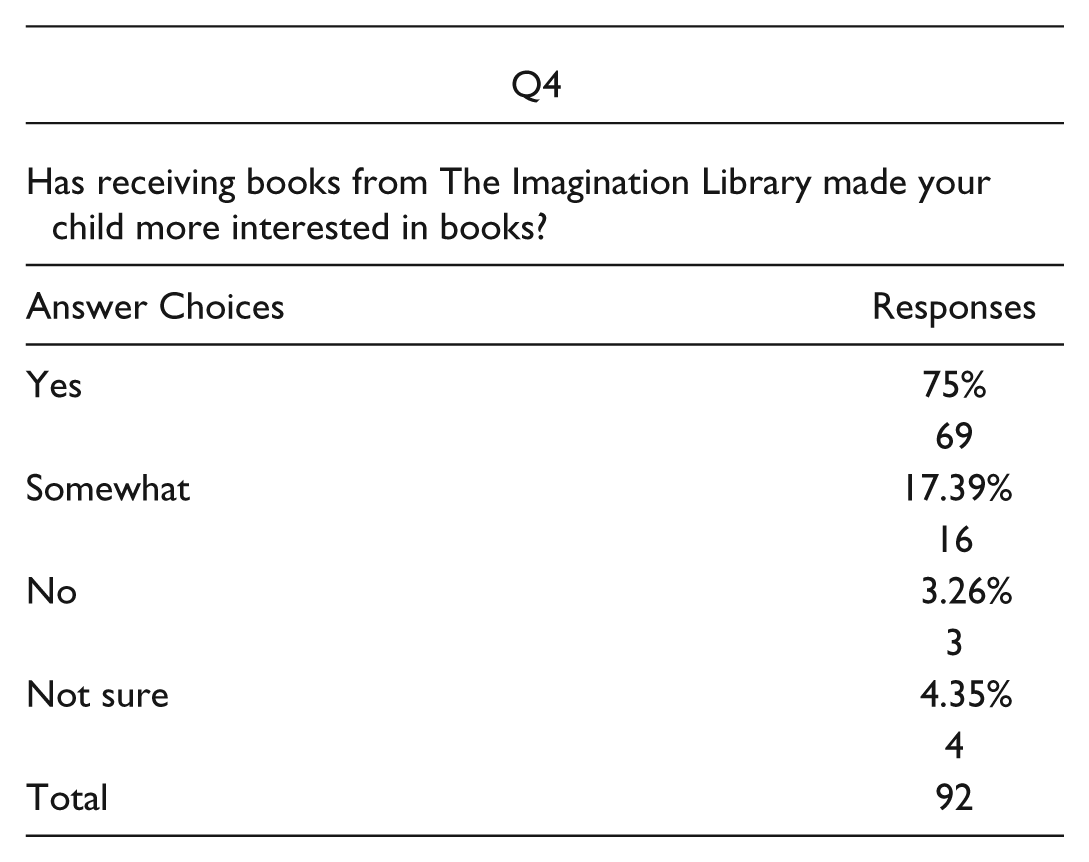
An increased interest in reading books was also recorded by Question 4: “Has receiving books from the IL made your child more interested in books?” The results of the Likert-type scale analysis (M = 1.1) demonstrated that most families reported that their child was more interested in reading after entering the program. Almost half (47%) of children were reported to have more interest in reading. Both Questions 4 and 5 “What impact has participation in the IL had on your children?” focus on the motivation to read and the bonding process. Both responses show that family time spent sharing books had a positive impact on the family.
Question 6, “Are other members of the family benefiting from having IL books in the home?” asked about the number of family members who read the IL books. The construct which determined this question was the cost-effectiveness of the resources expended. As many as 67% of the families reported that more than one person in the household benefited from the program, according to the results of the Likert-type scale analysis (M = 2.65). Often, more than one member of the family received books, and this doubled the exposure by the number of books read to the child. Open-ended responses show that older children enjoyed receiving books in the mail so that they could read to the younger children. Fathers also spent more time reading to the kids.
The number of library visits is also a measure of reading motivation. Ten percent of the families used the library once a week. Responses to Question 7, “Do you and your child check out books from the library?” revealed that the percentage of children attending the local public library remained steady at around 46%. Those families who never used the library remained at 52%. Living in a remote part of New Mexico does not lend itself to frequent public library use. This fact underscores the value of having a new book arrive in the mail once a month.
Question 8, “What differences have you noticed in your child who is participating in the IL?” measured the parent’s perceptions of improvement from using the IL books. The design of this question measured the effect of reading to children on the executive function of the brain that has been shown to improve with parent–child interaction (Center on the Developing Child at Harvard University, 2011). The development of the executive function determines the ability to avoid distractions, control impulse, and handle multiple tasks at the same time. The three distinctive aspects are working memory, inhibitory control, and cognitive or mental flexibility.
Seventy percent of the parents noticed increased vocabulary skills exhibited by their child. Thirty-seven percent of the parents believed that their child had improved in social skills from having experienced the books while 67% of the parents had noticed an increase in their child’s listening skills. Only 9% of the parents noticed no difference in their child’s development.
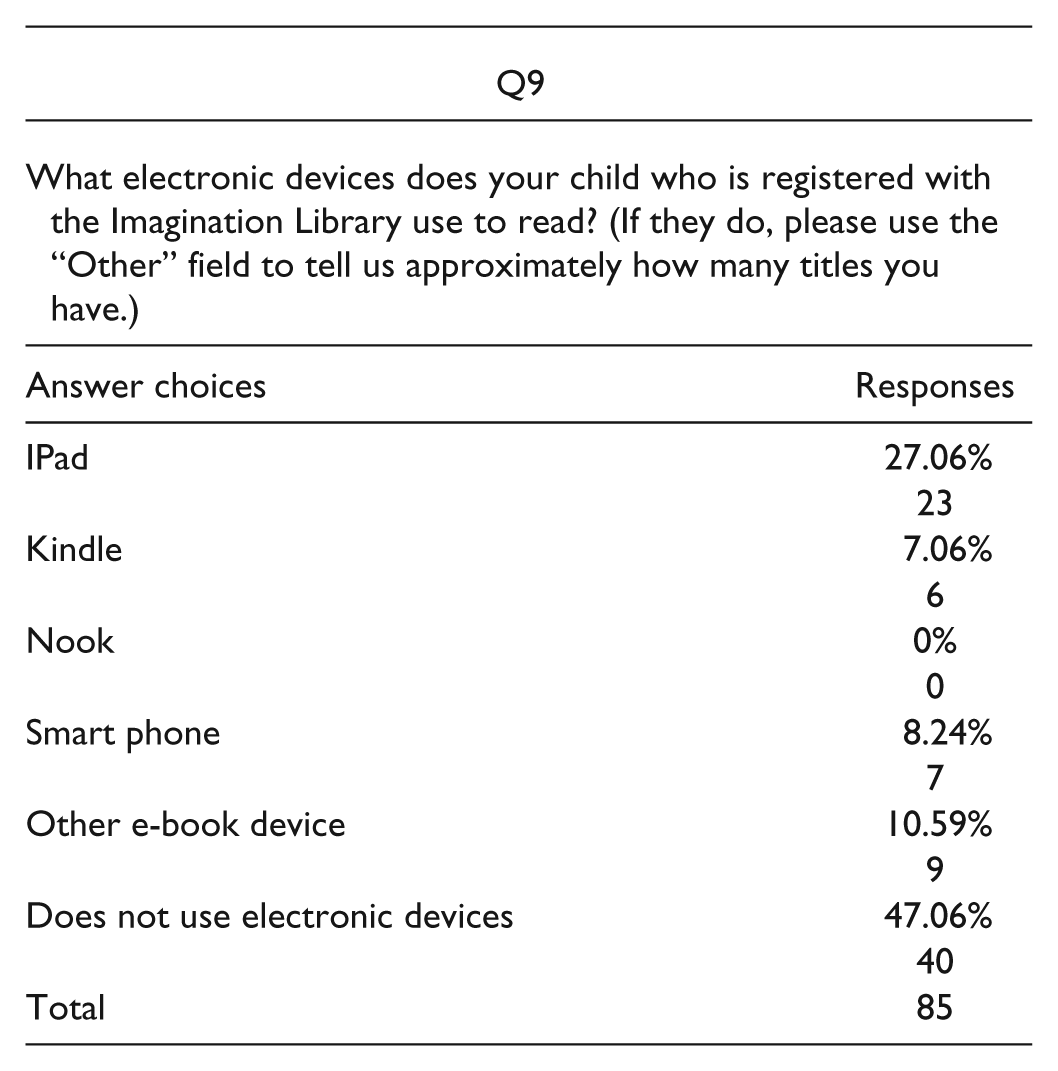
Electronic books (eBooks) were the focus of Question 9: “What electronic devices does your child use to read?” EBooks are defined as books viewed on a screen that turn pages and might have interactive features such as read-alouds or dictionaries which search for word meanings. Half of the students used eBooks in the form of iPads (20%), Kindles (7%), and the Smart phone (8%). Results correspond with the recent Scholastic survey on eBook use which reports that 47% of preschoolers have been exposed to eBooks (Scholastic, 2012). Parents responded that they had more than 10 titles on these devices and they used this list of programs: Leap Pad and Leap Frog, Tag Reader with Tag Reader Junior, Nabi, Inno tab, and the Android tablet with Kindle applications. As IL books are paper and not electronic, the changing reading interests of the parents and children were a concern.
The last survey Question 10, “Are there other comments you would like to share about the IL program?” was open-ended and the responses were coded into major themes. First, they were sorted into positive and negative answers. Forty-five of the 46 responses noted a positive reaction to the program. The only negative response was that one title was repeated. Typical examples of the positive comments were as follows: “Reading to my children on a daily basis has made me more aware of their intellectual growth. It’s as important to us as eating a sit-down meal with the family.”
These major themes emerged from the responses:
Twenty-nine people noted the high quality of the books and the interesting book choices. “These are delightful books we wouldn’t have thought to choose.”
Getting the books in the mail was an exciting event according to sixteen parents. “It allows them to associate literacy with the thrill of receiving something with their name on it in the mail.”
Nine responses suggested an increase of family bonding after reading the books together. “We read the books when they come in the mail instead of watching TV.” “It gives me a reason to spend more quality time with my child.”
Intellectual developments as a result of IL were noted in seven comments: “A world of imagination was opened to the child.” “The IL is an amazing initiative to help develop our kid’s intellectual, social, and speech skills.”
According to four written responses, multiple people in the household benefited from the books. “My older child (6) likes to read the books to her little brother so it is a great experience for both of them with interaction that promotes development.”
Infants are included in literacy time according to three respondents. “My child is not able to talk, but she does grab for books.”
Conclusions and Recommendations
The survey results suggest that families are spending more time reading to children, and relationships between and among family members are changing. The parents who read more than once a day rose from 24% to 43%. The number of parents who never read to their children shrank from 2.0% to 0. Fathers and older siblings participated in reading stories to younger children. As one respondent wrote, “Her father spends more time with her reading.” Reading at home became routine in the families who receive books monthly. Electronic books were available in the homes of about half of the families that were polled. This number corresponded to the use of eBooks nationally according to the 2012 Scholastic Survey.
The purpose of the IL program is to nurture emergent readers and provide them with reading choices that they might not otherwise encounter. The survey reports validate that the goals of the Southwest IL program have been met and that the literacy behavior of the families has experienced a positive change. Furthermore, this change has resulted in improved reading scores in the early grades and higher pass rates on the end of year competency scales. This data will be used to persuade legislatures that the program is worthy of state-wide replication at the low cost of US$2.10 per book. As the heavy lifting of administering the program, publishing, and mailing the books is assumed by the Dollywood Foundation, a great service is rendered to the parents and children of the state at minimal cost.
Footnotes
Declaration of Conflicting Interests
The author(s) declared no potential conflicts of interest with respect to the research, authorship, and/or publication of this article.
Funding
The author(s) received no financial support for the research and/or authorship of this article.