




Abstract
Foreign language education can promote international trade, which, in turn, informs the planning of foreign language education. This study examines how bilateral trade between China and other countries promotes the development of Chinese language education from the perspective of policy planning. The research introduces the structural absorption hypothesis and utilizes trade data alongside indicators to construct regression models. These models analyze the trade between China and countries which possess economies with distinct characteristics and their corresponding demand for business Chinese talent (BCT): (1) Across countries with all three types of economies, the demand for BCT is consistently higher in the export sector compared to imports from China. (2) In the export trade, demand for BCT is stably absorbed into specific sectors: mineral products in resource-oriented economies, mineral products and low-end manufactured goods in resource-and-labor oriented economies, and high-end manufactured goods in capital-and-technology oriented economies. (3) In the import trade, resource-oriented and resource-and-labor oriented economies have a higher demand for BCT in high-end than in low-end manufactured goods. Conversely, capital-and-technology oriented economies demonstrate a stronger need for BCT in low-end than high-end manufactured goods. These findings offer theoretical guidance for the planning of business foreign language education (BFLE).
Keywords
Introduction
The globalization of the world economy has made communication increasingly essential. Language is crucial to international communication and trade. A common language among countries significantly reduces the cost of information exchange, enhances the efficiency of business communication, and promotes global trade. As a result, language and trade have attracted the attention of linguists and economists.
In linguistic research, language and trade are studied within the scope of business foreign language education (BFLE). This field covers many areas, including vocabulary (Chen & Li, 2012; Hsu, 2011), syntax (Chaal, 2011; Dzhagaeva, 2020), and the implications of language variation for international trade (Bloch & Starks, 1999) in business contexts. Other areas of focus include teaching materials (Khoshhal, 2018; Tu, 2011), instructional methodologies (Esteban & Pérez Cañado, 2004), and needs analysis, which is considered fundamental to BFLE. Several classic frameworks underpinning needs analysis in this field have been developed, such as target situation analysis (TSA; Munby, 1978), present situation analysis (PSA; Allwright, 1982; Richterich & Chancerel, 1978), learning situation analysis (LSA; Chambers, 1980; T. Hutchinson & Waters, 1987), and means analysis (Dudley-Evans & St John, 1998).
Economists study the social factors influencing international trade and employ trade gravity models to evaluate their impacts. Foreign language education is viewed as a tool to reduce transaction costs and enhance trade efficiency (W. K. Hutchinson, 2002). Key topics in this area include how foreign language education reduces trade costs (Grin, 1996), the mechanisms through which it facilitates international trade (Melitz, 2008), and the factors influencing its effectiveness (W. K. Hutchinson, 2005; Selmier & Oh, 2013).
This study introduces an analytical framework to examine the impact of international trade on the demand for BFLE using economic modeling. We selected a BFLE subcategory (business Chinese education) and focused on its demand in 30 countries that have strong trade relations with China. The remainder of the paper is structured as follows: Section 2 provides a literature review, Section 3 outlines the theoretical foundation and research design, Section 4 presents the modeling results and discusses the findings, Section 5 offers policy recommendations and conclusions, emphasizing the importance of understanding the trade-driven demand for BFLE to inform effective policy development.
Literature Review
We begin by reviewing the literature on needs analysis in BFLE from a linguistic perspective. Next, we explore studies on the promotion of BFLE in the context of international trade. Finally, we assess previous research findings and discuss the importance of studying the demand for BFLE from an interdisciplinary perspective.
Needs Analysis in BFLE
We analyze the need for BFLE in terms of the theoretical models of business English education and the practical application of business Chinese education.
Needs Analysis Models in Business English Education
Needs analysis is widely used in various industries, such as economics, trade, manufacturing, and education. In foreign language education, need analysis was first applied to English for specific purposes (ESP). Business English education is an area of interest for ESP and several theories have been developed to guide the needs analysis of business English education.
Target situation analysis (TSA) is a pioneering theory that focuses on the functional use of language and the specific needs of learners in BFLE. Munby (1978) defines TSA as encompassing topics, participants, and media, with the objective of establishing a communicative needs structure for learners using a “communication needs processor.” This processor identifies micro-level communicative elements but does not prioritize them (Chambers, 1980). To address this limitation, Richard Allright proposed present situation analysis (PSA), also known as deficiency analysis, which considers both the learning process and the target situation. PSA analyzes the gap between what learners currently know and what they need to succeed in the target language environment. However, these early models of needs analysis overlook the cognitive and emotional factors that influence learners. To address this gap, the Learning Centre Model (LCM), also referred to as learning situation analysis, was proposed. T. Hutchinson and Waters (1987) elucidate that LCM integrates both target and learning needs analysis. LCM involves choosing appropriate learning conditions, such as learners’ knowledge, skills, strategies, and motivation, all of which course designers must consider to ensure effective business language teaching (Strevens, 1980). Further enhancing the analysis framework, Dudley-Evans and St John (1998) proposed means analysis (MA), which takes into account a variety of factors, including teachers, teaching methods, management, student facilities, and local contexts. MA examines how to adapt the curriculum to fit these factors. By integrating learners’ language needs with personal and professional backgrounds, MA offers a practical, comprehensive approach to meeting their demands.
Application of Need Analysis to Business Chinese Education
Chinese scholars initially applied TSA to analyze the demand for business Chinese education (BCE) among international students studying in China. The communicative activities in business Chinese can be categorized into two types: external business communication, which includes transactional activities with clients, and internal business communication, which involves managerial activities with colleagues (Zhang, 2006). Transactional activities, such as business negotiations, require stronger oral and listening skills compared to reading and writing skills. In contrast, managerial activities require comprehensive proficiency in Chinese, including both oral and written skills (W. Liu, 2010; Zhang, 2006). Furthermore, LCM has been widely adopted by Chinese scholars. This model highlights three distinct learning needs in BCE: academic and non-academic education, beginner and advanced learning, and single versus integrated language-skill learning ((Zhang, 2006). Based on LCM, a framework for analyzing the Chinese learning needs of foreign students is designed, which focuses on “enrollment needs, classroom needs, and learning and assessment needs” (Ni, 2007). Amid the rise of online education due to the COVID-19 pandemic, BCE must adjust its evaluation strategies to align with new teaching modalities. Several Chinese academics have studied the online needs of Chinese language learners at Confucius Institutes based on LCM, examining factors such as student situations, course situations, target needs, and learning needs (D. Liu, 2020).
While numerous studies on TSA and LCM have been conducted in the context of Chinese education, other models remain underexplored. Furthermore, most research has focused on general Chinese education rather than BCE.
Language in International Trade
Jacob Marschak, a pioneering economist, was among the first to integrate economic analysis into the study of language. He emphasized the crucial role of codified information within a language in influencing the efficiency of internal communication (Marschak, 1965). As global economic and trade cooperation intensifies, the cross-border flows of capital and labor has reached unprecedented levels. Language plays a role that extends beyond mere communication efficiency. It is imperative to examine which language proves most effective in transactional settings, as this can have profound implications for international trade. Therefore, the study of language’s function in facilitating international trade become an important research area within the economics of language.
Lingua Franca in International Trade
Language in international trade functions much like currency, serving as a shared medium that lowers communication barriers and facilitates bilateral trade (Cremer & Willes, 1998; Ferro & Ribeiro, 2016). Various factors, including expenses pertaining to information retrieval, negotiation, and supervision, significantly influence communication costs in international trade, all of which are closely related to language barriers. Selmier and Oh (2013) highlight that linguistic similarity in international trade can effectively alleviate these trading costs.
First, a lingua franca minimizes the expenses associated with information exchange (Abdel-Latif & Nugent, 1996; Oh et al., 2011). In cross-border trade, parties must obtain business intelligence about their counterparts. Sharing a common language facilitates the reduction of expenses related to information exchange (Abdel-Latif & Nugent, 1996). This ease of communication allows trading partners to access and evaluate one another’s business intelligence more efficiently, fostering accurate assessments of potential collaborations. By lowering the costs of information exchange, a lingua franca increases the likelihood of successful trade partnerships (Amelung, 1991; Bergstrand, 1985; Rugman, 1981).
Second, a lingua franca reduces negotiation costs (Selmier & Oh, 2013). Effective communication during business negotiations is critical to establishing legal relationships and ensuring mutual understanding. A shared language minimizes the risk of information distortion caused by translation (W. K. Hutchinson, 2005) and enhances the efficiency of the negotiation process (Lai et al., 2010).
Third, a lingua franca lowers supervision costs. Shared language facilitates clearer communication, fostering trust between trading partners and reducing the need for extensive oversight (Abdel-Latif & Nugent, 1996). Conversely, language barriers can increase communication challenges, undermine trust, and escalate supervision costs (Amelung, 1991).
English as a Lingua Franca
Economists have extensively studied the role of English as a lingua franca in facilitating international trade, particularly in border trade. Research highlights a “common language effect” (Magura, 2021), where English enhances trade among English-speaking countries. Frankel and Rose (2002) discovered that the trade volume among English-speaking countries often exceeds that between English- and non-English-speaking countries by a factor of 1.8, a figure roughly equivalent to that of border effects on trade. Conversely, language barriers impose trade costs equivalent to a 7% tariff, exceeding the 6% impact attributed to other information-related trade costs (J. E. Anderson & van Wincoop, 2004).
W. K. Hutchinson (2002) employed proportion of a country’s population that speaks English as a first or second language as a proxy for the lingua franca effect, revealing a positive correlation between the proportion of the English-speaking population and trade volume with the United States. Melitz (2016) introduced the concepts of “open-circuit communication” and “direct communication.” Languages spoken by more than 20% of a population are categorized as “open-circuit,” while those spoken by more than 4% are “direct communication” languages. The study found that “direct communication” languages impact trade over three times more than “open-circuit” languages, indicating that a language’s trade influence is not solely determined by its prevalence.
Finally, language distance has been introduced in some studies to explore how language similarity affects trade. W. K. Hutchinson (2005) found that larger language distances between English and the official languages of U.S. trade partners correlated with lower bilateral trade volumes, as increased linguistic distance raises the likelihood of communication barriers. Lohmann (2011) developed a language barrier index that leveraged the World Atlas of Language Structures and revealed that a 10% increase in the index could trigger a decrease of 7% to 10% in trade flows between two nations. Similarly, Isphording and Otten (2013) observed higher trade volumes among linguistically similar countries but noted that language distance had a smaller impact on trade compared to common languages or lingua franca effects.
Chinese as a Lingua Franca
While English preponderates in trade transactions among English-speaking countries and between English-speaking and non-English-speaking nations, its role in trade among non-English countries is increasingly being questioned. Empirical evidence indicates that English, despite its dominant status as a lingua franca, does not invariably serve as the necessary choice for bilateral trade, particularly when trading partners share a regional lingua franca, such as Spanish in Latin America, Russian in Eastern Europe, or Chinese in Southeast Asia (Melitz, 2018). In such cases, the communicative efficiency afforded by linguistic proximity often supersedes the generalized advantages of English in trade transactions. With China’s rise as a global economic powerhouse, scholars are exploring the potential of Chinese as a lingua franca in international trade, particularly in China’s economic exchanges with other nations. Although Chinese currently has a limited global status compared to English, it has the potential to become a lingua franca as China’s power and influence grow in various fields (Bianco, 2007; Gil, 2011). A common methodological approach employs the density of Chinese language institutions in a target country as a linguistic variable.
First, the global dissemination of the Chinese language reduces communication barriers between China and its trading partners, thereby facilitating bilateral trade. Chinese culture influences international trade by promoting linguistic and cultural exchange. Research shows that the global promotion of Chinese can boost China’s exports to target countries by 4% to 27% (Lien, 2012). Moreover, for every newly established Chinese language institution in a country, its exports to China can increase by 5% to 6% (Lien & Co, 2013). These findings underscore the growing importance of the Chinese language in international trade, reflecting China’s economic rise. Like English, Chinese has the potential to serve as a lingua franca that promotes bilateral trade between China and its partners.
The global promotion of the Chinese language fosters international investment and trade by addressing cultural and linguistic barriers that hinder information exchange and increase trade costs (J. Anderson & Sutherland, 2015). Foreign direct investment (FDI), which requires long-term commitments, relies heavily on trust and effective communication. Establishing Chinese language institutions can significantly enhance mutual understanding and communication among trading partners, thereby boosting FDI (Lien & Co, 2013). Additionally, these institutions promote cross-cultural exchanges, fostering friendships and trust between individuals from different nations. By bridging information gaps and reducing transaction and communication costs, Chinese language promotion strengthens international connections and substantially increases FDI (Lien et al., 2012).
The global spread of the Chinese language also supports the international tourism industry. Language plays a crucial role in tourism, as travelers tend to prefer destinations where they can communicate easily, enhancing their experience and sense of security (Gemar et al., 2019). Research shows that the widespread use of Chinese reduces cultural barriers, lowers information acquisition costs for international visitors, and increases tourism to China. The establishment of Chinese language institutions in other countries can boost inbound tourism to China by 2.98% and business and work-related travel by 3.75% (Lien et al., 2014). Consequently, establishing Chinese language institutions has profoundly affected the growth of China’s international tourism industry.
Insights
From a linguistic perspective, we have thoroughly examined the research on needs analysis in BFLE. Moreover, from an economics viewpoint, we have explored studies on the significance of a lingua franca in international trade. While the research offers invaluable insights, it is not without its limitations, which we aim to address.
Traditional needs analysis has predominantly focused on the requirements of foreign language learners in specific business settings, particularly classroom teaching. However, we argue that there is an essential link between international trade and BFLE that cannot be overlooked. Variations in trade patterns among different countries inevitably lead to diverse demands for business languages. Unfortunately, traditional needs analysis often fails to account for this crucial factor, which is vital for adapting BFLE to the specific needs of different countries.
Research on common trade languages highlights the catalytic role of language in international trade, often quantifying the contribution of specific languages to trade volumes. However, these studies lack actionable guidance for policymaking. Policymakers seek deeper insights into how international trade dynamics shape the demand for foreign language learning, which is crucial for developing effective policies in BFLE.
This study investigates BCE based on language economics. We develop the Structural Adsorption Model, which systematically examines the dynamic relationship between bilateral trade structures and the demand for BCT. Our study makes two significant contributions: First, we develop a novel analytical framework that quantitatively links specific trade patterns to corresponding linguistic demands, thereby bridging the theoretical divide between international trade dynamics and language education policy. Second, through our focused examination of Chinese as an emerging trade lingua franca, we provide empirical evidence demonstrating the correlation between China’s bilateral trade structures with other nations and the demand for BCE. Our findings offer valuable reference for other countries in planning their local language development strategies in the context of bilateral trade relations.
Theoretical Foundation and Research Design
Theoretical Development
The Heckscher-Ohlin model (H-O model, also known as the factor proportions model), originally proposed by Swedish economist Eli Heckscher, argues that disparities in factor endowments between countries significantly shape their foreign trade structures and, consequently, influence the allocation of resources and economic development patterns. According to the theory, a country’s factor endowment typically remains stable over time, leading to a distinct industrial structure. While transferring factor endowments between countries is difficult in peacetime, unrestricted trade allows for the exchange of factors, enabling countries to adjust their endowments. The H-O model has been fundamental in international trade theory, with many theories adopting its core idea: factor endowments determine industrial structures, which in turn shape foreign trade patterns (Baskaran et al., 2011). This study uses the H-O model as its theoretical foundation.
Structural Adsorption Hypothesis
Based on the H-O model, we introduce the structural absorption hypothesis: the trade structure between the target country and China has a significant impact on business Chinese talent (BCT). The impact of this trade structure is outlined as follows (Figure 1):
(1) We define a set of industries, which is denoted as Industry = {α, β}. Industry α specializes in producing product α’, whereas industry β produces product β’. The production efficiencies of these products differ between China and the target country as follows: α’: Proα’ (target country) > Proα’ (China) β’: Proβ’ (target country) < Proβ’ (China)
(2) To trade with China, the target country has developed comprehensive BCE programs. These programs aim to cultivate a pool of skilled BCTs who serve as information intermediaries. These talents have observed that Industry α is more competitive in their home country but less so in China, while Industry β holds a competitive advantage in China but faces challenges at home.
(3) Driven by national interests, the target country formulates trade strategies accordingly. In export trade with China, the focus is on exporting their competitive product α’. Conversely, in import trade with China, they prioritize importing China’s competitive product β’. To support these trade objectives, BCTs from the target country are drawn to both export and import trades with China. Some talents specialize in export trade and provide language services to support the export of product α’. Others focus on the import trade and offer language services to facilitate the import of product β’.

Structural adsorption model.
Research Question
According to the structural absorption model, we posit that examining how international trade influences the demand for BCT is crucial to uncovering the absorption effect of bilateral trade structures between China and its trading partners on the country’s BCT. We focus on the following topics:
Chosen Target Country
This study examines 30 countries, categorized by their economic development models: Resource-oriented economies (10 countries), resource-and-labor oriented economies (10 countries), and capital-and-technology oriented economies (10 countries), as listed in Table 1.
Classification of Target Countries.

Bilateral Economic and Trade Relations
All target countries maintain stable economic and trade relations with China. To explore the relationship between international trade and BCE demand, we selected countries with significant trade reliance on China. Each of these countries has a trade reliance coefficient exceeding 60%, demonstrating their strong dependence on China’s economy. Consequently, these countries are prioritized for studying the correlation between international trade and BCE demand.
Representativeness of Economic Development Patterns
To ensure the universality of research conclusions, the economic development models of the target countries must be representative. IMF classifies the economic development models of 224 countries into three categories: (a) Resource-oriented economies: Primarily dependent on the exploitation and utilization of natural resources. (b) Resource-and-labor oriented economies: Heavily reliant on both natural resource exploitation and inexpensive labor. (c) Capital-and-technology oriented economies: Driven mainly by capital accumulation and technological innovation. 1
Development of Chinese Education in Target Countries
All selected countries have incorporated Chinese into their national education systems at various levels, a factor that significantly impacts the development of BCE. Notably, current data indicate that 85 countries have formally incorporated Chinese into their national education systems, 2 underscoring its growing global prominence in education. Accordingly, we narrow our focus to these countries.
Potential Diplomatic Risks
To minimize potential diplomatic risks, we excluded five English-speaking developed countries (the United States, the United Kingdom, Australia, Canada, and New Zealand) from our sample. Tensions in China-U.S. relations have negatively impacted Chinese education in those countries. Moreover, the foreign policies of the UK, Australia, Canada, and New Zealand, which often align with those of the U.S., could hinder the promotion of Chinese education in these countries.
Models and Data
According to the trade gravity model (Tinbergen, 1962, as cited in W. K. Hutchinson, 2005), the model in this study is defined as follows:


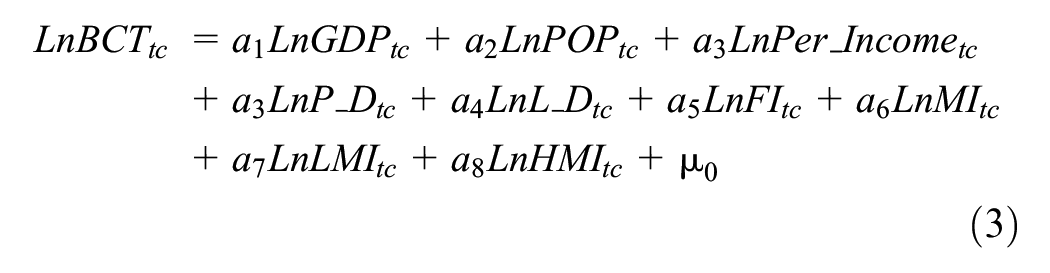
Equations 1–3 correspond to research questions 1, 2, and 3, respectively, where t and c denote the year and target country.. The explained variable is the number of BCT in the target countries, which is obtained from the “Database of Global Chinese Spreading Dynamics.” 3
The explanatory variables (Trade) are trade data for the target countries and comprise total exports to China (Export), total imports from China (Import), total farm products exports to China (FE), total mineral products exports to China (ME), total low-end manufactured goods exports to China (LME), total high-end manufactured goods exports to China (HME), total farm product imports from China (FI), total mineral product imports from China (MI), total low-end manufactured goods imports from China (LMI), and total high-end manufactured goods imports from China (HMI). The above data are obtained from the Trade Database of the Ministry of Commerce of the People’s Republic of China. 4
We used the target countries’ Gross Domestic Product (GDP), total population (POP), per capita disposable income level (Per_Income), political distance (PD), and language distance (LD) as control variables. These variables are grouped into three categories:
The first category includes GDP, total population (POP), and per capita disposable income (Per_Income). These variables are widely recognized as significant determinants of trade patterns (De Groot et al., 2004; Mostafiz et al., 2024). They offer insights into a country’s economic aggregate, labor resources, and living standards, serving as vital indicators for evaluating economic development. These data were obtained from the IMF’s Global Key Country Economic Indicators database. 5
The second category of control variable includes political distance, which assesses the economic impact of institutional differences between China and the target countries. It is a common econometric measure for assessing how variations in governance impact trade policies and practices (Hutzschenreuter et al., 2014). In international trade research, numerous studies have given full attention to the impact of political distance on trade activities (Bosone et al., 2024; Umana Dajud, 2013). Data of political distance were obtained from the World Bank’s Worldwide Governance Indicators database. 6
The third category of control variables addresses language and cultural differences, commonly measured as language or cultural distance in econometric studies due to their significant impact on communication and negotiation in international trade (Lai et al., 2010). Mostafiz et al. (2024) took Bangladesh as the target country of their research and empirically investigated the impacts of cultural distance and linguistic distance on Bangladesh’s bilateral trade. They found that these distances have different effects on different types of trade. Given that language and culture are closely linked, with high collinearity between language and cultural distances. Consequently, only one variable is typically included as a control. For this study, we selected language distance (LD). LD data reflect the linguistic characteristics of the official languages in both trading countries and were sourced from the Automated Similarity Judgment Program database. 7
This study covers data from 2008 to 2022. Data collection was automated using a Python-based web crawler, while statistical analyses were performed using R (built on R Studio 3.4.3). Descriptive statistics for the explanatory, explained, and controlled variables are summarized in Table 2:
Descriptive Statistics.

Analysis
To ensure reliability, we employed a fixed-effects model and addressed potential endogeneity by applying a lagged regression, where each explanatory variable was lagged by 1 year. For conciseness, we present only the lagged regression results from the fixed-effects model. This quantitative analysis forms the basis for exploring the three research questions outlined earlier.
Regression of Imports, Exports, and the Number of BCT
We categorized target countries into resource-oriented, resource-labor-oriented, and capital-and-technology oriented economies. A regression analysis was then conducted to investigate the relationship between economic indicators and demand for BCT.
The findings indicate that for resource-oriented economies, a 1% increase in total exports to China corresponds to an 85% rise in BCT demand, while a 1% increase in imports leads to a 56% increase. In resource-and-labor-oriented economies, a 1% growth in exports to China results in a 52% rise in BCT demand, and a 1% increase in imports corresponds to a 46% increase. For capital-and-technology-oriented economies, a 1% increase in exports to China drives a 15% rise in BCT demand, while a 1% increase in imports results in a 6% increase (Table 3).
Regression Results for Import and Export Trade and the Number of BCT. 8

These findings reveal the following facts: First, the regression coefficients for export trade in all three economic categories are higher than those for import trade, indicating a stronger demand for BCT in exports to China compared to imports. Second, the regression coefficients follow a consistent ranking across the three economies for both exports and imports. For exports, the coefficients are ranked as follows: resource-oriented (0.85) > resource-and-labor oriented (0.52) > capital-and-technology oriented (0.15). Similarly, for imports, the ranking is resource-oriented (0.56) > resource-and-labor oriented (0.46) > capital-and-technology oriented (0.06; Table 3). These results demonstrate that variations in the economic development models of target countries significantly influence their demand for BCT.
Regression of Exports to China and the Number of BCT
We analyzed the regression results for the export trade of the target countries to China and their demand for BCT, revealing distinct differences across the three types of economies. For resource-oriented economies, only the regression coefficient for ME achieved statistical significance, indicating that a 1% increase in ME leads to a 54% increase in BCT demand. For resource-and-labor oriented economies, both ME and LME exhibit statistical significance, with a 1% increase in ME and LME leading to a 21% and 40% increase in BCT demand, respectively. For capital-and-technology oriented economies, only the regression coefficient for HME is significant, with a 1% increase in HME associated with a 13% increase in BCT demand (Table 4).
Regression Results for Export Trade to China and Demand for BCT.

There appears to be a correlation between BCT demand and the advantageous industries of each economy. In resource-oriented economies, BCT demand is concentrated in the ME sector. In resource-and-labor oriented economies, demand is primarily in both the ME and LME sectors. In capital-and-technology oriented economies, demand is focused on the HME sector. Notably, none of the economies exhibit consistent demand for BCT in the FE sector.
Regression of Imports From China and the Number of BCT
Finally, we examined the demand for BCT in import trade from China. Table 5 reveals a consistent focus on both LMI and HMI across all three economies. However, the magnitude of their regression coefficients differs.
Regression Results for Import Trade from China and Demand for BCT.

In resource-oriented economies, a 1% increase in LMI results in a 40% increase in BCT, while a 1% increase in HMI leads to a 47% increase. In resource-and-labor oriented economies, a 1% increase in LMI or HMI causes a 13% and 51% increase in BCT, respectively. Nevertheless, in capital-and-technology oriented economies, the impact is comparatively smaller, with a 1% increase in LMI or HMI leading to only a 6% and 5% increase in BCT, respectively (Table 5).
The regression results reveal the following findings. First, the demand for BCT in imports from China is primarily driven by industrial manufactured goods. Second, developing and developed countries show distinct patterns: developing countries exhibit consistently higher demand for BCT in the HMI sector than in the LMI sector, while developed countries exhibits the opposite trend. Finally, among developing countries, resource-oriented economies exhibit particularly strong demand for BCT in the LMI sector, surpassing that of resource-and-labor oriented economies.
Discussion
Trade Direction and Demand for BCT
The regression analysis of trade directions and BCT demand reveals two key findings. First, demand for BCT is consistently higher in exports to China than in imports from China across all three types of economies, regardless of the target country’s economic development pattern. Second, there is a clear correlation between an economy’s development model and its demand for BCT: resource-oriented economies exhibit the highest demand, followed by resource-and-labor oriented economies, with capital-and-technology oriented economies showing the lowest demand.
The demand for BCT exhibits a consistent trend: countries with strong trade ties to China show higher demand for BCT in exports to China rather than imports from China. Exporting to China offers significant trade benefits, such as increased foreign exchange earnings, higher domestic employment, and overall economic growth. In contrast, importing from China may lead to the loss of competitive advantages or market shares in domestic industries. Given the importance of maintaining a trade surplus, these countries are motivated to ensure their exports to China exceed imports, thus supporting economic prosperity and stability. As a result, BCT demand is predominantly centered around the export trade sector, with a stronger emphasis on exports to China.
The position of a target country in the global division of labor significantly influences its demand for BCT. Capital-and-technology oriented economies, which lead in innovation, technological capabilities, and high-value industries, occupy a privileged position in the global hierarchy. These economies are heavily involved in high-tech manufacturing, research and development, and global service. Next are resource-and-labor oriented economies (Gereffi, 2005), which leverage natural resources and a large labor force for international trade. Resource-oriented economies, reliant on raw material extraction and export, hold the least advantageous position in this hierarchy. Economies with more diversified industrial structures, like capital-and-technology oriented ones, maintain diverse global trade relationships, and are less dependent on any single country. Consequently, BCT demand is lowest in capital-and-technology oriented economies, followed by resource-and-labor oriented economies, with the highest demand for BCT.
Export Trade to China and Demand for BCT
The pattern of economic development significantly influences the absorption effect of trade structures on BCT within export trade. Specifically, in resource-oriented economies, primarily focused on mining and extraction, the ME consistently shows a stable absorption effect on BCT. In resource-and-labor oriented economies, both the ME and LME demonstrate a stable absorption effect. Similarly, in capital-and-technology oriented economies, the HME exhibits a comparable stable absorption effect. Notably, none of these economies exhibit consistent demand for BCT in the FE sector. Overall, the absorption effect of the export structure on BCT is closely linked to the economic development patterns of these countries.
First, resource-oriented economies, primarily rely on mining and depend on exporting mineral products to China to earn foreign exchange. This export-oriented activity creates a consistent demand for certain BCT services within the ME sector. As a result, a stable and continuous absorption effect of BCT emerges in these economies. For instance, when negotiating and finalizing export contracts, professionals skilled in Business Chinese are needed for communication, documentation, and relationship management, thereby driving the demand for BCT.
Second, China’s aging population has led to a gradual decline in the comparative advantage of its low-end manufacturing industry. In contrast, resource-and-labor oriented economies, with abundant natural resources, low labor costs, and some industrial technology accumulation, have strengthened their comparative advantage in both mining and low-end manufacturing. These economies primarily export mineral products and low-value-added industrial goods, creating a demand for BCT in both the ME and LME sectors. As evidenced in econometric models, BCT absorption in these sectors remains stable. For example, in the export of basic consumer goods like textiles and simple electronics, BCT is essential for managing trade relations and understanding Chinese market preferences.
Moreover, as a major consumer of high-value-added industrial goods, China collaborates with capital-and-technology oriented economies in high-end manufacturing. This collaboration drives a stable absorption of BCT in the HME sector, as effective communication and business cooperation in fields like advanced machinery and high-tech electronics require professionals with BCT expertise.
Finally, China prioritizes self-sufficiency in agricultural products as a key aspect of national economic security, particularly due to its population of 1.4 billion. China can largely meet its agricultural needs domestically. Although China has an international demand for agricultural products, this demand mostly pertains to non-essential or luxury items, preventing overreliance on agricultural imports. Thus, there is no consistent demand for BCT in agricultural exports to China across different economies.
Import Trade from China and Demand for BCT
The research reveals that the demand for BCT is primarily associated with LMI and HMI. However, the economic development models of the target countries significantly influence how BCT is allocated within import trade from China. Specifically, resource-oriented economies and resource-and-labor oriented economies exhibit a stronger demand for BCT in the HMI, while capital-and-technology oriented economies demonstrate a greater need for BCT in LMI.
The comparative advantages of target countries relative to China affect both their demand for BCT in exports and imports of manufactured. Resource-oriented and resource-and-labor oriented economies lack the capacity to produce high-value-added industrial goods, relying on China’s high-end manufacturing. Therefore, BCT in these economies tends to focus more on the HMI sector. Additionally, their limited low-end manufacturing capabilities drive demand for BCT in the LMI sector. Resource-and-labor oriented economies, with more developed low-end manufacturing, are less dependent on Chinese products in this area, resulting in a lower demand for BCT in the LMI compared to resource-oriented economies.
In bilateral trade between China and capital-and-technology oriented economies, China has made initial progress in high-end manufacturing. However, a significant gap remains between its capabilities and those of developed countries. While capital-and-technology oriented economies have well-established industrial and trade models for high-end manufacturing, China is still in the early stages of development in this sector. In contrast, China maintains a clear comparative advantage in low-end manufacturing, with a robust system in place, exemplified by export hubs like Yiwu for low-end handmade goods. Consequently, the demand for BCT in LMI is higher in developed countries than in HMI.
Suggestions and Conclusion
Our findings lead to the following recommendations:
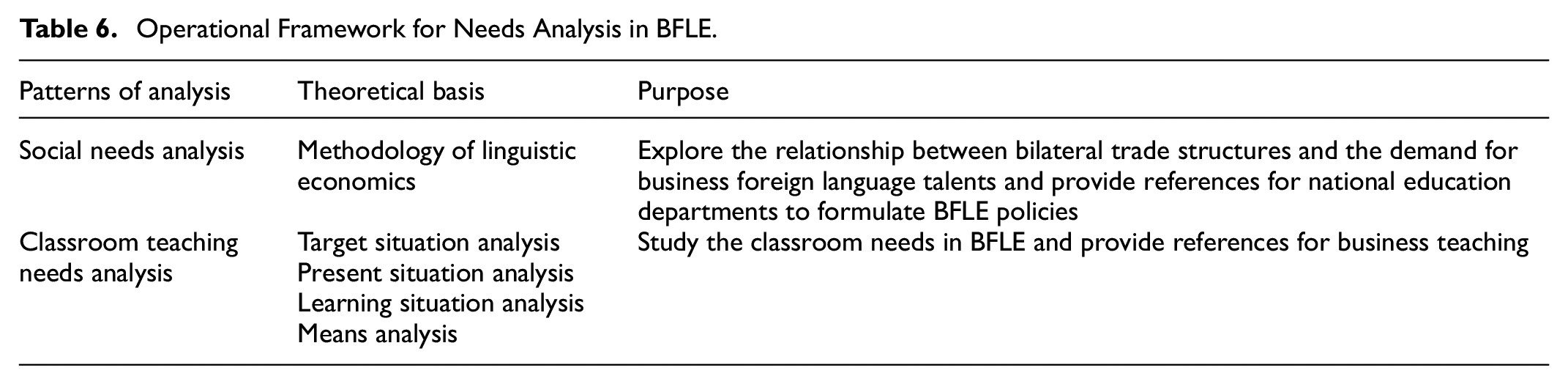
First, we propose reconstructing the needs analysis framework. There is a clear connection between BFLE and international trade, and language economics theories can guide policymakers in foreign language education. Traditional needs analysis for foreign language classrooms can also inform the teaching of business foreign languages. The operational framework for needs analysis in BFLE consists of two steps (Table 6). The first step is social needs analysis, rooted in language economics, which examines the link between bilateral trade structures and the demand for business foreign language talent. The second step is classroom teaching needs analysis, grounded in ESP theory, which focuses on the specific needs of business language instruction. These two types of needs analysis have distinct impacts on BFLE: social needs analysis can guide policies of national education, while classroom teaching needs analysis can provide references for business teaching.
Operational Framework for Needs Analysis in BFLE.
Second, understanding the relationship between international trade and the demand for BCT is crucial, as it allows for the formulation of effective policies for BCE (Zeng, 2021). Regarding trade directions, demand for BCT can be categorized as follows. The first is the demand for BCT in the import business. This benefits China directly, highlighting the need for Chinese colleges to focus on cultivating BCT for import-related roles. The second is the demand for BCT in the export business. This benefits target countries directly, necessitating training programs for BCT within those countries. Our study found a consistently higher demand for BCT in export trade to China than in import trade, regardless of economic patterns. As such, the primary need for BCE arises in countries with strong trade ties to China. Local BCE institutions should prioritize research on BCT demand in export trade with China, develop tailored BCE policies, innovate teaching materials, and reform teaching methodologies. These efforts will enhance BCE’s effectiveness and support international trade cooperation with China.
Third, align BFLE with competitive industries. The demand for BCT in export trade is tied to a target country’s advantageous industries, while import trade demand reflects China’s advantageous industries. Target countries should evaluate BFLE needs in their key industries and develop localized programs accordingly. For instance, the demand for BCE in target countries corresponds to their export trade to China, with variations across economic types: resource-oriented economies focus on mining, resource-labor oriented economies on mining and low-end manufacturing, and capital-and-technology-oriented economies on high-value-added industrial products. These differences suggest that educators should tailor business Chinese textbooks, teaching plans, and topics to address local industry needs. Similarly, China should assess BCT demand under its “going global” strategy, particularly in the high-end manufacturing sector. High-value-added industrial goods dominate exports from China to target countries, influencing BCT needs in this area. Chinese BCE institutions should focus on specialized vocabulary and linguistic skills for high-end manufacturing transactions, enhancing BCE to support China’s global economic strategy.
Fourth, modernizing the approach to international Chinese education. Language dissemination is inherently tied to cultural transmission (Kuppens, 2013). The global promotion of Chinese involves not only teaching the language but also sharing Chinese culture. However, cultural exchange can sometimes be perceived as political propaganda, particularly in today’s landscape of heightened cultural tensions and polarized public opinion. To address this, the relationship between language education and cultural dissemination must be carefully managed. While attitudes toward Chinese culture vary across countries, shared goals like economic development, income growth, and poverty alleviation are universal. Therefore, prioritizing BCE in global Chinese education initiatives offers a practical solution. This approach minimizes potential cultural conflicts, supports talent development for bilateral trade, and provides learners with tangible benefits such as employment opportunities and income growth. By focusing on BCE, China can foster mutual economic prosperity while mitigating cultural sensitivities.
In conclusion, this study highlights the dynamic relationship between international trade and foreign language education through economic analysis, uncovering their interconnected nature. The framework established here can be extended to other languages, such as Business English, to develop targeted education strategies that align with market needs. Such programs have the potential to mutually enhance international trade and foreign language education.
Nevertheless, this study has certain limitations. (1) Monolingual focus: The analysis centers on the role of Chinese in trade, affirming its facilitative impact. Future research should explore multilingual dynamics in China’s foreign trade and evaluate the diverse linguistic needs across different languages. (2) Macroscopic Emphasis: While this study emphasizes language education policy and offers insights for advancing BCE in China, further research could focus on individual-level impacts, a significant aspect of language economics that requires deeper exploration. (3) AI Unconsidered: Emerging AI technologies are instrumental in bridging language barriers and accelerating global trade. Due to space constraints, this study did not address this topic in depth. Future research could examine the implications of AI-driven advancements on international trade and language education. Despite these limitations, the study represents a significant step in understanding the intersection of international trade and foreign language education, laying a solid foundation for further research in this field.
Footnotes
Acknowledgements
None.

Ethical Considerations
In accordance with guidelines and the Declaration of Helsinki, no ethics approval or consent statements were necessary.
Consent to Participate
This is a study that does not contain any studies with human or animal participants.
Funding
The author(s) disclosed receipt of the following financial support for the research, authorship, and/or publication of this article: This work was supported by the State Language Commission of People’s Republic of China – General Foundation [grant number: YB145-86]
Declaration of Conflicting Interests
The author(s) declared no potential conflicts of interest with respect to the research, authorship, and/or publication of this article.
Data Availability Statement
The data used to support the findings of this study are available from the lead author upon request.