




Abstract
This study investigates methods and effectiveness of implementing Differentiated Instruction (DI) in intelligent education based on learners’ learning needs. The paper employs a mixed-method approach to collect and analyze data from various learner groups. Guided by the assessment results of the KANO model, the research prioritizes attributes for intelligent enhancement during the learning process and devises appropriate methods for instructional interventions. Experimental results demonstrate that DI tailored to learning needs effectively enhances language teaching achievements. Specifically, in language education, regarding Performance Attributes (PA), meticulous segmentation of instructional content is crucial to correspond with specific language knowledge. For Threshold Attributes (TA), emphasis should be placed on fostering autonomous learning and adaptive communicative functions during the teaching process. Regarding Excitement Attribute (EA), it is essential to consider the distinctive needs of learner groups. Finally, the paper discusses collaborative issues among teaching teams, learners, and technical teams.
Plain language summary
This study examines how to improve learning experiences for students by customizing teaching methods in language education. Using a mix of research methods, it focuses on understanding what students need to succeed in their learning. Guided by the KANO model, which helps identify key features that enhance learning, the study explores how different teaching approaches can better support students. Results from experiments show that tailoring instruction to individual learning needs significantly boosts language learning outcomes. Specifically, the study highlights the importance of carefully organizing lesson content to match specific language skills (Performance Attributes). It also emphasizes the need to promote self-directed learning and adaptable communication skills (Threshold Attributes) during teaching. For maintaining student engagement (Excitement Attribute), the study underscores the importance of addressing diverse learner needs. Lastly, the paper discusses collaboration challenges among teachers, students, and technical support teams.
Introduction
Differentiated Instruction (DI) represents a successful pedagogical approach designed to enhance student performance and engagement in classrooms characterized by diverse student backgrounds (Tomlinson, 1999, 2001, 2003). With the breakthrough of artificial intelligence technology, its leveraging advantages such as big data computing and vast resource distribution, offers unparalleled benefits in supporting differentiated teaching methods, creating educational content, processes, and products tailored to learners’ needs (Li & Wang, 2020; Akgun & Greenhow, 2022; Schiff, 2021). However, achieving these objectives requires systematic technological advancements. Nevertheless, in developing countries like the Philippines, constrained by insufficient infrastructure and budgetary limitations, the attainable level of intelligent teaching technology within a short timeframe is restricted. Therefore, the imperative lies in designing intelligent enhancements based on DI that are suitable for developing nations.
Taking Philippine Chinese Teaching Institution A as an example, this organization aims to align its instructional practices with the directives issued by the Philippine Department of Education, which emphasize “improving students’ communication skills and developing multilingual abilities” and “enhancing scientific technology to elevate intelligence levels” (Department of Education in the Philippines, 2020). However, the institution serves diverse student populations with varying levels of abilities and learning objectives. Factors such as the post-pandemic shortage of Chinese teachers, students unable to attend offline classes from across the country, and learners’ subjective preference for intelligent learning in the global trend of digitalization, make intelligent transformation of DI a pressing and essential requirement.
Differentiated language instruction enhances teaching effectiveness by customizing language learning environments to meet individual learner needs, delivering tailored learning content, ensuring suitable learning processes, and aligning learning outcomes with educational objectives (Tomlinson, 2001). Therefore, achieving the intelligent enhancement of DI within limited time requires precise investigation into learners’ needs and addressing several key questions: (1) In the context of intelligent enhancement of DI, what are the most urgent and direct needs of different learner groups for implementing differentiated teaching? (2) Specifically in the field of language instruction, how can these needs be effectively met to enhance learning products? (3) How should teaching teams, learners, and technical teams collaborate to successfully implement the intelligent enhancement of DI? This study addresses these three critical questions.
This study, based on Tomlinson (2001)’s theory of DI, focuses on Philippine Chinese Teaching Institution A as a case study. It explores methods to the intelligent enhancement of DI by addressing the learning needs of different language learner groups through learning content, processes, and products. To pinpoint learners’ diverse needs, the study employs the KANO model to design a needs analysis questionnaire, conducts surveys and interviews, and analyzes learner needs characteristics to classify their actual requirements. For the intelligent enhancement of DI, the study develops intervention plans based on the classified needs, conducts teaching experiments, and quantitatively verifies the effectiveness of the intelligent enhancement of DI in enhancing learning products. Lastly, the study discusses the characteristics of learning needs in differentiated teaching in the digital teaching era, the integration of digital technologies with differentiated teaching methods, and issues related to team collaboration in the intelligent enhancement of DI.
Major stakeholders in the field, including educators, curriculum developers, and educational technology providers, can benefit from these insights. For example, educators can better tailor their differentiated teaching methods to student needs, while curriculum developers can optimize content delivery. Educational technology providers can also use this research to design more adaptive and user-centric tools, ultimately improving the quality and efficiency of language education in both online and offline settings. Overall, the research process and findings of this paper contribute empirical data and case studies aimed at implementing intelligent enhancements in DI within language education in developing countries, thereby enhancing both teaching efficacy and learning outcomes.
Literature Review
Based on a needs analysis, this study investigates methodologies and outcomes associated with intelligent enhancements in DI within the realm of language education. The subsequent literature review offers perspectives on critical factors and discoveries pertinent to these research goals.
The Enhancement of Learning Efficiency and Satisfaction Through DI
DI is a method that allows teachers to systematically meet the diverse needs of every student. It is grounded in the belief that differences among learner groups impact teaching effectiveness (Tomlinson, 1999, 2001, 2003). DI has been shown to enhance learning outcomes and satisfaction, transcending racial and cultural barriers (Keefe & Jenkins, 2008; Pozas et al., 2020; Roy et al., 2013). DI can be implemented across teaching content, processes, and outcomes (e.g., Redding, 2019; Tomlinson, 2003), as evidenced by numerous studies exploring its specific designs and experiments (e.g., Grecu, 2023; Griful-Freixenet et al., 2020; Meutstege et al., 2023), and its promotion of diverse learning outcomes. Research on ability grouping indicates positive effects when instruction is tailored to subgroup needs and group arrangements are flexible (Alsalhi et al., 2021; Campbell & Campbell, 1999; Kulik & Kulik, 1992; Lou et al., 2000; Tieso, 2003).
DI spans almost all educational domains from early childhood to university, covering disciplines such as STEM, science, and language teaching (e.g., Estaiteyeh & DeCoito, 2023; Muthomi & Mbugua, 2014; Yavuz, 2020).
Differentiated Learning Needs Based on the KANO Model
The KANO model, originally introduced by Karino and Li (1984), serves as a crucial tool for categorizing user needs and prioritizing developmental efforts. Its application spans diverse domains, including education, where it effectively analyzes personalized learning requirements (Gong, 2020; He, 2020; Wang et al., 2021). Recently, scholars such as X. Zhao (2022), Barrios-Ipenza et al. (2024) have employed the KANO model to enhance interactive teaching quality and learner satisfaction, aligning with the current study’s focus on understanding differentiated educational needs.
Scholarly investigations have also explored differentiated online learning needs. For instance, Chen et al. (2022), Bhutoria (2022), and Cevikbas and Kaiser (2022) examined strategies for content differentiation based on the KANO model. Meanwhile, Kumar et al. (2010), Ömürgönülşen et al. (2021) and Kem (2022) explored methods to differentiate learning processes. Studies by Peng et al. (2019), Szeliga-Duchnowska and Szewczyk (2018), and Grunwald et al. (2024) focused on approaches to differentiating learning products.
Furthermore, researchers such as Chien (2007), Yang et al. (2010), Venkateswarlu et al. (2020), and Nzumile and Taifa (2021) have utilized the KANO model to enhance learner satisfaction studies.
The Integration of Language Teaching and Intelligent Technology
Intelligent teaching, integrating technology, plays a crucial role in contemporary education. Yuan (2023) defines intelligentization as leveraging advanced technologies such as artificial intelligence and big data to enhance educational services. Scholars like Martinez (2001), Peng et al. (2019), Z. Zhang et al. (2021), and Y. Zhao and Lai (2023) underscore the importance of data collection and analysis for personalized learning plans. Many researchers have shared practical examples and experiences in developing intelligent language education products. For instance, in learning content, studies highlight the efficacy of artificial intelligence tools, robotics, and systems like ChatGPT in improving efficiency in learning foreign languages and cultures (e.g., Alam, 2022; Bailey & Barley, 2020; Hidayat et al., 2022; Kasneci et al., 2023; Qureshi et al., 2021; Su & Yang, 2022).
As technology evolves, numerous studies report on the application of intelligent technologies in language education content (e.g., Mageira et al., 2022; Rusmiyanto et al., 2023; Tapalova & Zhiyenbayeva, 2022), educational processes (e.g., Bukhtoyarov et al., 2023; Dogan et al., 2023; Uunona & Goosen, 2023), and instructional outcomes (e.g., Alam, 2023; Dimitriadou & Lanitis, 2023; Duin & Tham, 2020; Liu & Yu, 2022; R. Zhang & Zou, 2022).
Conceptual Framework
Previous studies have emphasized the importance and effectiveness of DI in enhancing learning achievements and satisfaction, as well as the application and effects of intelligent technologies in teaching content, processes, and products (Tomlinson, 2001). Previous research has also demonstrated that the KANO model is an effective tool for identifying learning needs. Therefore, this study aims to utilize the KANO model for identifying differentiated learning needs in the implementation of intelligent enhancements, thereby conducting research on intelligent enhancements in differentiated language instruction across developing countries.
Based on Tallerico’s (2005) framework for ensuring the effectiveness of differentiated instruction (DI) implementation, the study comprises three main phases: identification of differentiated learning needs, implementation of DI intervention experiments, and assessment of DI outcomes. The research follows a systematic approach to ensure a comprehensive understanding and implementation of intelligent learning strategies.
In the section focusing on identifying differentiated learning needs, this study utilizes the KANO model to recognize and differentiate learning needs among various learner groups. By systematically categorizing learner needs into Threshold Attributes (TA), Performance Attributes (PA), and Excitement Attributes (EA), it helps prioritize areas for improvement, ensuring that the focus is on addressing the most critical aspects of the learning experience. This study incorporates interviews aimed at elucidating differentiated learning needs for intelligent enhancements in teaching content, processes, and outcomes, as perceived by learners, educators, and technical teams involved in DI.
In the section dedicated to differentiated teaching intervention experiments, following Tomlinson’s (2001) framework for DI research, the study will incorporate intelligent enhancements in DI across three dimensions: instructional content, instructional processes, and instructional outcomes.
Regarding the evaluation of DI effects, the study will conduct quantitative analysis comparing the learning achievements and satisfaction levels between the experimental group (undergoing DI) and the control group (not undergoing DI). This analysis aims to observe the effectiveness of the intelligent enhancements in DI.
The study will propose two hypotheses:
H1: Intelligent enhancements in DI, based on learning needs, can enhance learners’ language proficiency.
H2: Intelligent enhancements in DI, based on learning needs, can augment learners’ satisfaction with their educational experiences.
In summary, the research model of this study is illustrated in Figure 1.
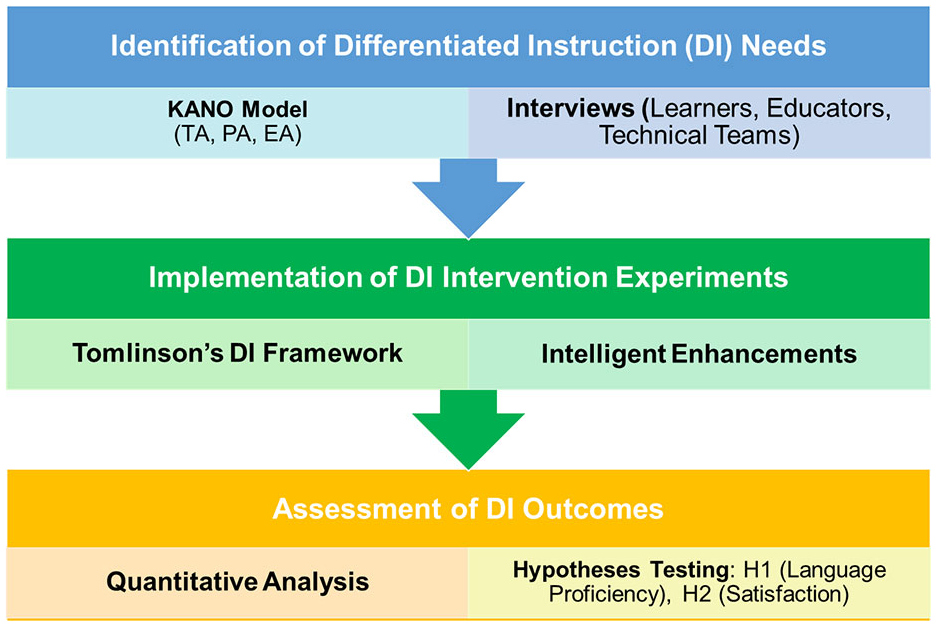
The diagram of the conceptual framework of the study.
Next, this paper will present the research methods and results of three parts, followed by a comprehensive discussion.
Methodology
Part 1 Positioning Research on Differentiated Learning Needs
Research Methodology
This section employs the KANO model to conduct qualitative and quantitative analyses of learners’ educational requirements. The findings identify critical learning needs that necessitate immediate attention for implementing intelligent enhancements in DI, aligning these needs with specific learner demographics. This phase of the study encompasses four distinct stages:
(1) Identification and selection of learning needs for intelligent enhancement
The research team conducted surveys of current digital language teaching institutions and apps, combined with interviews with the teaching team, technical team, and learners to identify13 learning needs: Chinese character phonetics, English annotation, micro course videos, word combinations, word extensions, typical example sentences, grammar/word discrimination, and new word pictures, AI-based Pronunciation Tools, cloze exercises, class circle interaction, communicative exercises, and multiple-choice exercises, as detailed in Table 1.
(2) Designing a survey questionnaire based on the KANO model.
Identified Learning Needs for Intelligent Enhancements in DI.

Based on the KANO model, the research team developed the “Survey Questionnaire on Intelligent enhancements Needs in Differentiated Language Education Based on the KANO Model.” The questionnaire primarily consisted of positive and negative KANO questions related to the 13 user requirement elements listed in Table 1. These questions aimed to evaluate the subjective feelings of students when a certain requirement element was provided or not provided in teaching improvement. The survey respondents were required to choose from five options: “very satisfied,” “satisfied,” “average,” “dissatisfied,” and “very dissatisfied” based on their actual experiences. To ensure the authenticity and reliability of the survey data, the options were explained in detail before each question to improve the respondents’ understanding.
(3) Classification of user demand attributes.
The KANO model questionnaire was disseminated through Google Forms to collect responses. Upon completion of data collection, the research team utilized the KANO model’s two-dimensional attribute classification matrix to evaluate the attributes of each need and to calculate the frequency of positive and negative issues for each need. Then, utilized the better-worse index to determine the attributes of users’ needs and to classify them accordingly.
(4) Positioning differentiated learning needs of user groups
Based on the classification of differentiated learning attributes of user groups, match the corresponding learning needs that different groups of learners urgently require. Through interviews, clarify the specific requirements of different learning groups and teaching teams regarding the digital enhancement of differentiated language education.
Participants
(1) Survey respondents
Since 2022, Philippine Language Teaching Institution A has embarked on the intelligent enhancements in DI within language education. The research team distributed a survey questionnaire to Chinese language learners participating in the intelligent teaching program at Education Institution A in the Philippines from January 2022 to December 2022. A total of 317 questionnaires were received, of which 282 were considered valid after screening and verification. The survey participants were primarily non-Chinese, constituting 94.33% of the sample. The respondents were sourced from various programs, including local teacher training programs, government officials’ training programs, international Chinese education master’s programs, and SPFL high school Chinese language courses programs.
According to the statistical results of the survey questionnaire, 65.25% of the respondents had an HSK proficiency level of 1 to 2; this group was mainly composed of high school students, government officials, and some local teachers. Respondents with HSK proficiency levels of 3 to 4 accounted for 10.64% and mainly consisted of senior local teachers and some international Chinese language education master’s degree students. Respondents with HSK proficiency levels of 5 to 6 accounted for 24.11% and were mainly composed of international Chinese language education master’s degree students. The sample distribution was reasonable, as it included participants from various educational levels, that is, high school students, college students, and graduate students. It also covered different occupations, including students and the general population. In terms of HSK proficiency, the distribution was similar to that of learners in international Chinese education; the majority were concentrated at the intermediate to lower levels, undergraduate and graduate students majoring in Chinese studies who had reached advanced levels, and others hovering at the intermediate level. The sample was therefore representative and typical, whereby the findings can be generalized to a broader population of learners, fulfilling the purpose of this study. The sample’s demographic distribution is presented below in Table 2.
(2) Interviewees
Distribution of Survey Respondents.

In January 2023,the researchers conducted interviews with the teaching team (8 individuals, 2 per project team), the learners (2 representatives), and the technical team (2 representatives) to collect their perspectives on intelligent learning needs, inter-group differences, improvement processes, and collaboration models.
Survey Data Collection and Reliability and Validity Test
The research team conducted a reliability test on the questionnaire by SPSSAU software to calculate the Cronbach’s alpha coefficient of the survey results to test the internal consistency of the scale. The results showed that the overall Cronbach’s alpha coefficient was .765, indicating good reliability, so it could be used for further analysis. The validity test results of the questionnaire showed that the KMO test value was 0.869 and the p-value of Bartlett’s sphericity test was less than 0.05, indicating that the structural validity of the survey questionnaire was suitable for extracting information. Table 3 below shows the results.
Results of Questionnaire Reliability and Validity Test.

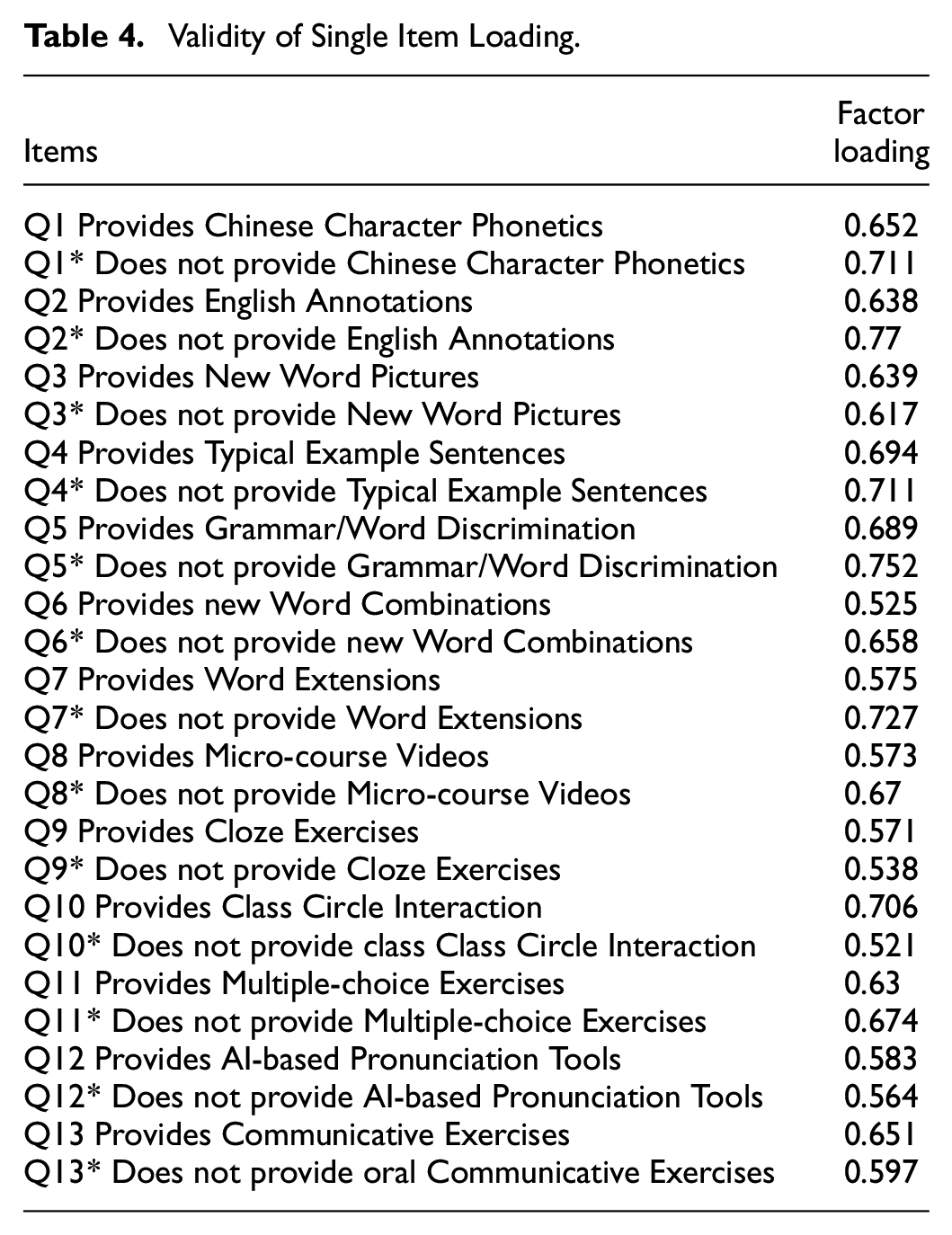
After conducting factor analysis on the questionnaire data, the rotated component matrix indicated that the mean scores of all factors in the scale were greater than 1 and there were significant differences among the various subscales, indicating good structural validity and discriminant validity of the items. The loading of all items in the single dimension was above 0.5, which indicated good construct validity of the questionnaire items, as shown below in Table 4.
Validity of Single Item Loading.
Results of Basic Classification of Learning Needs
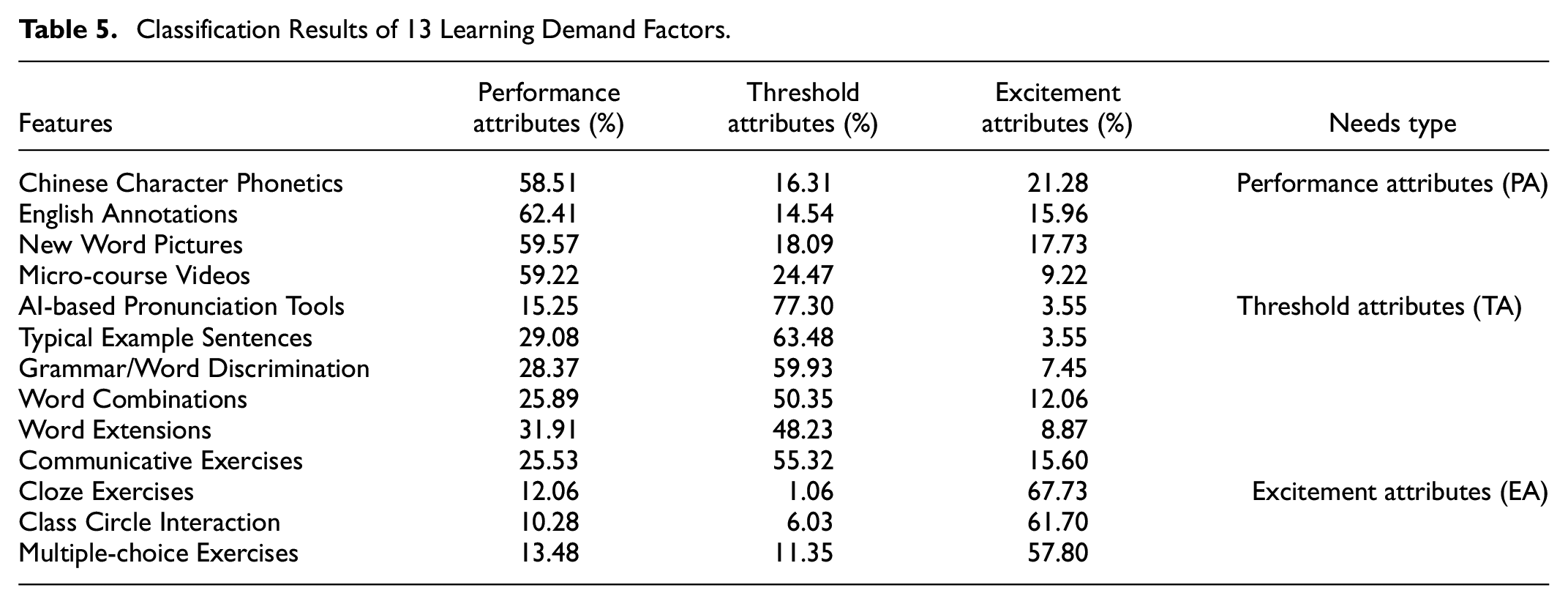
Using the KANO model, the research team calculated the classification results of 13 needs features for all learners surveyed: Chinese character phonetics, English annotations, new word pictures, and microcourse videos belonged to PA, while AI-based Pronunciation Tools, typical example sentences, grammar/word discrimination, word combinations, word extensions, and communicative exercises belonged to TA. Cloze exercises, class circle interaction, and multiple-choice exercises belonged to EA, as shown below in Table 5.
Classification Results of 13 Learning Demand Factors.
Based on the analysis results of the KANO model, the research team used the better-worse satisfaction impact index method to further rank learners’ need level for the 13 need features based on the attribute frequency statistical data. The better-worse satisfaction impact values of the 13 needs features were obtained and were used to draw a learning needs features coordinate diagram. As shown in Figure 2, when the worse value and the better value of the functional scatter plot were both higher than the average value, the need level of the needs features was higher and vice versa.

Distribution of better-worse coefficients for learners’ needs features.
As shown in Figure 2, AI-based pronunciation tools, typical example sentences, grammar/Word discrimination, communicative exercises, word extensions, and word combinations fell into the first quadrant. Although they all belonged to PA, the better and worse values of AI-based pronunciation tools were 0.81 and 0.92, respectively, which were much higher than the other attributes, indicating that they should be given priority for functional development. The demand for new word pictures, micro-course videos, Chinese character phonetics, and English annotations, which belonged to TA, fell into the second quadrant. The better and worse values of micro-course videos were 0.85 and 0.31, respectively, indicating that if this function is developed in intelligent teaching improvement, it can greatly enhance teaching attractiveness. The three learning products needs of multiple-choice exercises, cloze exercises, and class circle interaction were judged by learners to be EA. It should be noted that the intelligent enhancement of these three teaching products may not be fully recognized by all learners, and further investigation and discussion of the specific grouping of learners might be necessary.
Comparison of the Characteristics of Learner Needs Among Four Groups
The variance analysis results of the learners’ learning needs showed significant intergroup differences in the needs of different learner groups, as shown below in Table 6.
Results of Inter-Group Variance Analysis of Learning Needs among Different Learners.

p < .05. **p < .01.
According to the further analysis results of the KANO model, there were also differences in the classification of learning needs for different groups of learners as shown below in Table 7.
Distribution Table of Learning Demand Differences among Different Learners.

As shown in Table 7, the classification of learning needs for each type of learner differed from the overall classification results. For local teachers, word extension was classified as TA rather than PA. For international Chinese education professional master’s students, since their HSK level was generally at level 5 to 6, they believed that adding Chinese character phonetics, new word pictures, and communicative exercises to the system during intelligent teaching enhancement was not TA or PA but EA. For government officials, the demand for expanding vocabulary and communicating with colleagues/classmates in the class circle was higher than other types of learners and were classified as PA and TA, respectively (other students classified them as PA and EA, respectively). For high school students, the game-like multiple-choice mode of exercises was highly appealing, and they classified these exercises as TA, whereas other types of learners regarded them as EA.
Interview Results
In interviews, learners’ concerns regarding language intelligent teaching mainly revolve around the following themes.
(1) Teaching content
Many learners often feel that teaching content in intelligent platforms are richer but also more complex compared to traditional learning materials in print. Therefore, they hope that the content can be presented in a targeted manner:
“In traditional paper textbooks, the sequence is clear - starting from the beginning and progressing linearly. However, with current apps or teaching platforms, upon logging in, all content is presented at once. Each content item leads to further sub-content, leaving me unsure of where to begin.”
“I find short videos particularly interesting and hope that the short videos on the teaching platform can be as engaging as TikTok.” (High school student)”
(2) Teaching process
During the interviews, learners expressed a desire to engage in self-learning through intelligent teaching and also hoped that intelligent teaching could compensate for the shortcomings of objective learning conditions.
“I really wish intelligent systems had automatic pronunciation correction functionality. Then I wouldn’t have to constantly ask the teacher if my pronunciation is correct. Otherwise, it feels embarrassing…”
“As a mother and teacher, I often lack time for both online and offline teaching. It would be great if intelligent systems could enable self-learning. I could utilize fragmented time to study.”
(3) Teaching products
Learners expect intelligent systems to enhance instructional methods, automate performance evaluation, and offer appropriate rewards based on their achievement scores. Meanwhile, diverse learning groups exhibit distinct requirements for instructional products:
“I believe teachers can gauge our proficiency levels, but current intelligent systems seem incapable of doing so. Perhaps incorporating a language proficiency test similar to Duolingo’s could be beneficial?”
“I particularly enjoy the ’practice mode’ in assignments. Each time I receive a set of different questions, completing them gives me a sense of accomplishment.”
“I find those game-like questions to be a waste of time. They seem simple, yet clicking through them is tedious.” (MAED student)
“I prefer multiple-choice questions because they are straightforward, and it’s easy to earn trophies and stars.” (High school student)
“I find Class Circle Interaction really awkward… Teachers always ask us to post our assignments in the class group. But I don’t want others to see my work.” (Local teacher)
“Class Circle Interaction is not bad because, as students, we don’t usually communicate much. Looking at what others post, liking, and commenting makes me feel less isolated in my studies.” (Government Official)
The teaching team’s demands for intelligent differentiated teaching primarily revolve around several themes:
(1) Teaching content
In terms of teaching content, the teaching team is primarily concerned about the issue of mismatch between teaching content and students’ skill progression.
“In traditional classrooms, typically for at least one semester of an academic year, the same set of textbooks and teaching resources are used. But on intelligent platforms, many students will select their preferred content across textbooks. This leads to inconsistencies in the teaching system and brings about new issues such as word repetition, vocabulary, and grammar difficulty progression. These are issues we must consider for the future.”
(2) Teaching process
In the teaching process, the teaching team aims for intelligent enhancements to alleviate teachers’ workload, particularly in language education, including automated pronunciation correction and language drills.
“I believe the most crucial aspect of intelligent teaching is achieving AI content distribution, automatic error correction, and automatic retrieval. During class, teachers cannot address all students’ needs. I hope AI can fulfill this.”
(3) Teaching products
In teaching products, the teaching team seeks intelligent enhancements capable of automatically assessing students’ language content.
“We wish for AI pronunciation correction to directly inform students whether it’s a consonant, vowel, or tone error. Currently, there are no mature modules available for integration into the platform. Developing them ourselves would be too costly.”
Summary of Differentiated Learning Needs Positioning
(1) Attribute classification
Chinese character phonetics, English·annotations, New·word pictures, Micro-course·videos are categorized under the Performance Attribute (PA). Notably, micro-course videos exhibit significantly higher satisfaction and dissatisfaction scores, suggesting that prioritizing their development could significantly enhance teaching attractiveness. AI-based pronunciation tools, typical example sentences, grammar/word discrimination, communicative exercises, word extensions, and word combinations belong to the Threshold Attribute (TA). Among these, AI-based pronunciation tools show significantly higher satisfaction and dissatisfaction scores compared to other attributes, indicating a priority for further development of its functionalities. Cloze exercises, Multiple-choice·exercises, and Class·circle interaction are identified as Excitement Attributes (EA) by learners. It indicates that their potential for intelligent enhancement may not be universally recognized by all learners, necessitating further investigation and discussion.
(2) Classification of learning group attributes
Local teachers classify Word·extensions as Threshold Attributes (TA). International Chinese education master’s students, typically at HSK levels 5 to 6, consider Chinese character phonetics, New word pictures, and Communicative exercises as Excitement Attributes (EA). Government officials prioritize Word·extensions and Class circle interaction, classifying these needs as Performance Attributes (PA) and Threshold Attributes (TA). High school students find game-style multiple-choice exercises modes very appealing, also classified as Threshold Attributes (TA). Additionally, fragmented, knowledge-based short videos are highly favored by high school students, providing immediate feedback, a sense of achievement, and value, thus stimulating student interest in learning.
(3) Interview results
Interview results indicate that learners perceive the content on intelligent platforms to be richer but more complex compared to traditional print textbooks. They desire targeted content presentation to avoid confusion caused by excessive information. During the teaching process, learners expressed a desire for autonomous learning through intelligent teaching systems. They hope for features like automatic speech correction to aid self-improvement in pronunciation and support for self-study to flexibly utilize their time. Regarding educational outputs, learners expect intelligent systems to offer diverse output methods and automatically evaluate output performance to receive corresponding rewards. This sentiment is acknowledged by the teaching teams.
Teaching teams are concerned about the potential mismatch between teaching content on intelligent platforms and students’ progress in capabilities, emphasizing the need to address consistency in the educational system. During the teaching process, teaching teams seek intelligent systems to assist in teaching, reducing mechanical repetition, particularly in pronunciation and language training.
PART 2 DI Intervention Experiment
Building upon the findings from the first part of the study, researchers classified learning needs and the differentiated classifications of each group, along with specific expectations for achieving DI in language teaching. Based on these research results, the technical team subsequently implemented corresponding intelligent enhancements tailored for DI on the digital teaching platform. From 2022 to 2023, the teaching team designed specific intervention methods for intelligent enhancements in language teaching. These interventions were implemented in a one-semester experiment on differentiated language instruction following digital enhancements at Language Education Institution A in the Philippines.
Participants
The participants in this experiment encompassed all groups that responded to the Part 1 survey questionnaire. Language learning achievements and satisfaction levels of learners after participating in the teaching experiment will be used as experimental group data. The learning achievements and satisfaction levels of learners who did not participate in the teaching experiment will serve as control group data.
Teaching Experiment Measures
In the intelligent enhancement experiment of differentiated language instruction, the research team implemented the following teaching intervention measures regarding teaching content, teaching processes, and teaching products:
(1) Teaching content
Given learners’ preference for targeted presentation of teaching content to avoid confusion caused by excessive information, we have precisely tailored our teaching content for PA, such as Micro-course videos and New word pictures, to closely align each segment with specific language or functional points. This approach enhances learners’ resource retrieval and acceptance.
For TA attributes like Grammar/Word Discrimination, Word Combinations and Typical example sentences, we adopt an “on-demand” presentation method to enhance content relevance—these are hidden under normal circumstances but revealed when learners have questions or make mistakes, ensuring resources are concise and targeted. For instance, Typical example sentences are dynamically presented through animations, highlights, and other modalities to capture learners’ attention, remaining hidden when not required.
In identifying differentiated learning needs among learner groups, given the widespread popularity of fragmented, knowledge-based short videos among Filipino high school students, the team has focused on developing corresponding fragmented micro-course videos in the intelligent enhancement experiment.
(2) Teaching process
Acknowledging learners’ needs for intelligent learning, this enhancement in the teaching process primarily focuses on developing autonomous learning functions. For instance, we recognize learners’ appreciation for AI-based pronunciation tools, as the AI pronunciation practice provided during pre-class preparation and post-class exercises allows learners to choose exercises based on their differentiated learning needs, rather than simply following the teacher or textbook reading.
The enhancement in the teaching process also emphasizes the identification of differentiated learning needs among learner groups. For instance, learners requiring high proficiency in pronunciation, such as Chinese language master’s students, have needs focused on error identification, error recording, and repetitive correction. To address these needs, the research team collaborated with the technical team to develop functionality that generates logs of pronunciation errors and evaluates students’ oral proficiency automatically. This feature offers learning resources tailored to students’ specific errors and directs them in remedial learning to overcome identified pronunciation challenges.
(3) Teaching products
Enhancements in teaching products primarily focus on enriching output types and aligning them differentially. Multiple-choice exercises, cloze exercises, and Class circle interaction are categorized under the EA, highlighting that intelligent enhancements should prioritize their relevance to specific learner groups. Consequently, the research team has tailored these enhancements to meet diverse learner needs. For instance, Class circle interaction has been tailored for government officials, while Multiple-choice exercises have been enriched for primary and secondary school students, incorporating immediate feedback such as sound effects and audio prompts. Cloze exercises with grammar selection questions have been introduced for local teachers to bolster their theoretical understanding of language, integrating grammar concepts into selection exercises to enhance comprehension among learners.
Part 3 DI Effectiveness Evaluation
After completing the DI intervention experiments, the research team proceeded with a comparative analysis of language learning achievement and satisfaction levels between the experimental and control groups. Valid data were collected from 143 participants in the control group, who provided both final language exam scores and evaluations of teaching satisfaction. Similarly, 120 valid data sets were collected from the experimental group. The evaluation of differentiated teaching included both quantitative assessment and instructional feedback.
Quantitative Assessment
Quantitative assessment was conducted using SPSSAU software to perform significant correlation analyses between the learning achievement and teaching satisfaction survey results of learners involved and not involved in the experiment on differentiated intelligent enhancements. This measurement aimed to gage the effectiveness of the instructional enhancements.
(1) Analysis of learning achievement and significance of DI
Student learning achievement data are derived from final language examination scores, with a maximum score of 200 points (comprising 100 points for reading and 100 points for listening and speaking). The data were analyzed using an Independent Samples t-test to compare the learning achievements between two groups of students. The average score for students participating in the intelligent enhancements in DI was 149.483 (standard deviation = 26.38), while for non-participating students, it was 118.203 (standard deviation = 26.56). The t-test results indicated a t-value of 9.543, with p = .000**, indicating statistical significance well below the .01 level. This suggests a significant difference in learning achievement between the two groups, with students participating in the intelligent enhancements in DI achieving significantly higher scores than their non-participating peers, demonstrating the positive impact of DI on enhancing student learning outcomes.
The t-test results for reading and listening scores also showed statistical significance, with the t-values for average reading scores being 2.847 and for listening and speaking scores being 11.820. This indicates that the intelligent enhancements in DI improvements primarily enhanced learners’ listening and speaking skills.
The t-test data results for both groups are shown in Table 8:
(2) Analysis of learning satisfaction and significance of DI
Statistical Analysis of t-Test Results.

**p < .01.
The sample size for students participating in the intelligent enhancements in DI was 200, while for non-participating students it was also 200. Student learning satisfaction data were obtained from a questionnaire survey using a five-point Likert scale, where 1 indicates “very dissatisfied” and 5 indicates “very satisfied.” Data analysis was conducted using SPSSAU software. An Independent Samples t-test was employed to compare the learning satisfaction between the two groups of students. The average satisfaction score for students participating in the intelligent enhancements in DI was 4.41 (standard deviation = 0.53). For non-participating students, the average satisfaction score was 4.15 (standard deviation = 0.56). The t-test results indicated a t-value of 3.755, with p = .000**, demonstrating statistical significance well below the .01 level. This suggests a significant difference in teaching satisfaction between the two groups of students.
The results indicate that students participating in the intelligent enhancements in DI reported significantly higher average satisfaction scores than non-participating students, indicating higher satisfaction with their learning experience among those who engaged in differentiated teaching.
In conclusion, students participating in the intelligent enhancements in DI exhibited significantly higher satisfaction with the teaching mode and course content compared to non-participating students. This demonstrates that DI is not only effective in improving learning achievements but also significantly enhances student satisfaction with the learning experience.
Teaching Feedback
In this teaching experiment, despite the significant effectiveness of the intelligent enhancements in DI in enhancing learning achievements and student satisfaction, feedback also highlighted some limitations and challenges:
(1) Contradictions in data collection and feature enhancement
Team members from the teaching team stated:“The technical team requires more student information from us to complete user profiles. However, we need them to fulfill functionalities before we can gather more student data. It seems like a deadlock.”
(2) Insufficiency of student information and algorithm technology
Members of the technical team expressed, “The teaching team always hopes we can achieve smarter student profiles. However, student information is currently insufficient, and algorithm technology is still not perfect. We can only strive together.”
(3) Issue of content overload
“There is an overwhelming amount of content in apps. I feel like I either attempt to learn everything or end up not mastering anything.”
Discussion
DI Design and Personalized Learning Needs
In the digital age, the study of differentiated learning needs exhibits distinct characteristics compared to traditional teaching methods. For instance, following the conclusion of the project, platform analytics indicated that the most utilized feature was “AI Pronunciation Tools,” achieving a 100% completion rate, categorized under the PA attribute, highlighting its specific necessity. This addresses a shortfall in traditional teaching where teachers are unable to individually correct pronunciation errors.
Conversely, the least utilized feature was “Class Circle Interaction,” with only 48.14% of students completing all sharing tasks, and three students never participating in class circle sharing at all, categorized under the EA attribute with a lower priority than AI. This contrasts with traditional teaching where students often need to showcase their learning achievements to classmates and friends.
These findings underscore the importance of beginning intelligent enhancements in DI by comprehensively understanding learners’ needs and accurately identifying personalized requirements to enhance study engagement and improve learning outcomes.
In digital improvement initiatives, conducting research on learning needs is crucial. For instance, interviews revealed that learners encountered difficulties in understanding video information and lacked interactive capabilities when using digital micro-lessons. In response, intelligent enhancements in DI integrated micro-lessons, cultural videos, and AI interactive exercises. Back-end data analysis indicated that this integration resulted in an average increase of 0.5 to 1 hr per week in students’ language engagement.
In summary, digital enhancements in DI necessitate preliminary research tailored to the learning characteristics of the digital age. It is essential to prioritize the features of personalized learning needs in the digital era.
Intelligent Enhancements in DI in the Field of Language Teaching
When implementing intelligent enhancements in language teaching content, reference can be made to the survey results presented in this paper. For instance, in improving learning content related to DI, selecting resources that align with learners’ psychological and learning characteristics, and exploring diverse distribution channels to facilitate easier access to resources for learners with specific needs, are recommended approaches. Currently, video and audio educational resources with diverse forms, sources, and modalities, should be divided into finer-grained resource units below the unit and course level to realize fine-grained resource organization with communication skills and cultural points. Furthermore, these resources should be associated with specific learning objectives to enhance the effectiveness of resources and functionalities.
During the teaching process, enhancing the integration of human and machine and promoting autonomous learning is crucial. The results of our study on learning needs reveal that the demand for “interaction” in teaching is prominent. Moreover, the need for human-machine interaction (e.g., AI functionalities) takes precedence over interpersonal interaction (e.g., social media features).
In terms of teaching products, intelligent teaching should be capable of automatically collecting relevant data, conducting learner analysis, and anchoring students’ learning characteristics to corresponding intelligent modules. Human-machine interactions in language content development should facilitate adaptive error correction.
Intelligent Enhancements in DI and Teamwork
During the interviews and throughout the project implementation process, all project participants emphasized the critical importance of close cooperation among the teaching team, learners, and technical team.
For example, in enhancing teaching content, the technology team should utilize knowledge graph technology to annotate and structure resources, establish connections and hierarchical relationships among intelligent teaching concepts, and facilitate intelligent retrieval and dissemination of knowledge information to meet the demands for finely-grained and networked resources.
In improving the teaching process, the technical teams should address the self-adaptive requirements of human-machine interaction. This involves enhancing data collection and utilization during interactions, creating comprehensive learner and educator profiles based on platform big data, and delivering intelligent educational services aligned with the teaching team’s needs.
Simultaneously, learners should provide timely feedback without concerns about affecting teachers’ assessments. The technical team can leverage big data to promptly capture student learning needs that may not be apparent to the teaching team, develop and integrate corresponding modules, and adapt to students’ intelligent learning needs. This establishes a virtuous cycle where educational functionalities are developed based on teaching theories and needs, validated in teaching practices, and continuously refined through iterative enhancements in intelligent teaching.
Conclusion
The experimental data and interview results of this study demonstrate that intelligent enhancements in differentiated education, implemented based on learning needs assessment, can enhance learners’ language proficiency and increase learner satisfaction. Therefore, both hypotheses of this study are supported.
The current educational landscape is undergoing a significant transformation, and the improvement of teaching through the integration of information technology and traditional teaching is an important attempt at personalized and d intelligent teaching resources. For developing countries, the human, temporal, and technological resources dedicated to intelligent transformation are extremely valuable. Therefore, conducting a needs assessment of learners and categorizing and prioritizing these needs before implementing intelligent improvements is essential.
This article’s findings indicate that there are inter-group differences in learners’ intelligent learning needs, and satisfying these needs through intelligent means can enhance learners’ satisfaction with teaching improvements. Both teaching and technical teams should conduct in-depth research on these needs and develop DI models that can dynamically adjust to the characteristics of the teaching subjects based on research outcomes.
In the realm of language teaching, intelligent enhancements in DI can manifest in several ways: in teaching content, this involves refining functionalities such as micro-course videos, new word pictures to meet specific learning needs with fine granularity. In the teaching process, incorporating features like AI-based pronunciation tools and communicative exercises simulates a dynamic language learning environment. For teaching products, diversifying products formats, such as class circle interactions and cloze exercises tailored to distinct learner profiles, should be modularized and dynamically delivered based on individual characteristics. Implementing these functionalities necessitates the development of teaching resources, meticulous segmentation and annotation of instructional content, targeted distribution channels, and flexible modular reconstruction of intelligent teaching frameworks.
In the digital era, the learning needs of DI exhibit distinctive characteristics compared to traditional teaching methods. Within the context of intelligent enhancements in differentiated language education, it is imperative to integrate digital technologies to achieve the overarching goals of shaping the language environment and enhancing communicative proficiency. Furthermore, differentiated education aims to foster personalized student development and elevate teaching satisfaction. The process of intelligent enhancement necessitates close collaboration among the teaching team, learners, and technical team to advance the depth of educational intelligence effectively.
Limited Scope and Future Prospects of the Study
While this study has illuminated several crucial facets of the focal topic, it is imperative to acknowledge its limitations to provide a more well-rounded perspective.
First, a notable limitation pertains to the relatively modest sample size. This study primarily concentrated on a specific geographic region and demographic group such as an educational institution A in the Philippines, potentially constraining the generalizability of the findings to a broader population. In terms of the study’s scope, the selection of teaching needs was also narrowly focused, limited to the core requirement projects during the initial development phase.
Second, due to the administration of the questionnaire within educational institutions, the focal learners might have harbored concerns that their responses could influence their own or their teachers’ evaluations. The respondents may have therefore been inclined to provide answers they perceived to be socially acceptable or in conformance with societal norms. This introduces the possibility of social desirability bias, which could potentially impact the accuracy of the reported data.
In subsequent research, the project team intends to augment the sample size and diversify the learners’ demographics and promote technology integration by exploring the role of emerging technologies. The research will be extended to an international context for comparative analyses of educational systems and outcomes across different countries and to thereby identify the best practices.
Footnotes
Acknowledgements
We would like to express our gratitude to Professor Zhu Zhiping’s group for their valuable assistance during the research and writing of this paper. Their data collection was instrumental in the completion of this project. We would also like to thank the participants who generously gave their time and shared their insights for the study. Finally, we acknowledge the support of Chinese Ministry of Education and National Social Science Fund for their support in this research endeavor.
Declaration of Conflicting Interests
The author(s) declared no potential conflicts of interest with respect to the research, authorship, and/or publication of this article.
Funding
The author(s) disclosed receipt of the following financial support for the research, authorship, and/or publication of this article: This work was supported by the Humanities and Social Science Fund of Ministry of Education of China under Grant 23YJCZH246; International Chinese Language Education Research Program: 23YH11C.
Ethical Statement
The data collection and research process of this paper were approved by the Ethics Committee of the affiliated institution. Informed consent was obtained from all participants, and all data were collected and analyzed confidentially and anonymously to protect the privacy of the participants.

Data Availability Statement
All data generated or analyzed during this study are included in this published article and its supplementary information files.