




Abstract
Sustainable development aims to balance current and future needs across economic, social, and environmental dimensions. This study explores the relationships among tourist numbers (Tr), sustainability (SDG), and globalization, divided into economic (GOE), social (GOS), and political (GOC) dimensions, with COVID-19 (CO) included as a short-term factor. Using annual panel data from ASEAN countries (2001–2022), panel unit root, cointegration, and autoregressive distributed lag (Panel ARDL) models were applied to analyses short- and long-term relationships. The findings reveal that sustainability (SDG) and the political globalization dimension (GOC) significantly influence tourist numbers (Tr) in the long term. COVID-19 (CO) affected tourism in the short term. The results underscore the positive impact of sustainable development on tourism and its integration with globalization’s economic and social dimensions. ASEAN countries should prioritize sustainable tourism policies and strengthen international political cooperation to enhance tourism’s long-term benefits.
Plain Language Summary
Tourism plays an important role in the economy of ASEAN countries. This study looks at how sustainable development, globalization, and COVID-19 have influenced the number of tourists visiting these countries. The results highlight the benefits of sustainable development and international political cooperation for boosting tourism. ASEAN countries should focus on policies that promote sustainable tourism and strengthen global partnerships to ensure long-term growth.
Keywords
Introduction
Southeast Asia is a region which has strength in the tourism industry. There are a variety of attractions, whether it be nature, cultural, historical and modern tourism attractions, due to their geographical characteristics and climate, which have created many diverse tourist attractions throughout the region. Additionally, Nonthapota (2020) also found a forward linkage and complementary relationship among tourists across five countries within the Greater Mekong Subregion (GMS), which is advantageous for promoting cross-country tourism. Before the COVID-19 pandemic, there were 143 million visitor arrivals to ASEAN in 2019 (Table 1). Thailand was the most visited destination this year, followed by Malaysia and Singapore. However, the effect of the pandemic significantly dropped the number of visitors to 26 million people in 2020. Until the pandemic was controlled in 2022, the visitors recovered slightly in the year and dramatically increased to 101 million people in 2023. The recovery of the tourism industry in this region implies that ASEAN may be one of the destinations which captured the hearts of tourists in this decade.
Visitor Arrival to ASEAN Member States (in Person).

Source.ASEANstats (n.d.).
Note. There are missing data of Lao PDR in 2021.
In general, the success of the tourism industry in attracting visitors is influenced by numerous factors, including economic dimension, environmental aspects and others. However, these factors are often components of broader, global-level agendas such as globalization and sustainable development. In other words, the achievement of progress in globalization and sustainable development goals can support the tourism industry. On the part of globalization, there are studies which confirm this discussion. While Cerovic et al. (2015) found that the influences of globalization motivate tourism through changing modes of transportation, communications, modern technologies, and the internet. Furthermore, a study in India by Soshte (2020) illustrates how globalization impacts tourism, highlighting factors such as improved comfort of transportation, easier international money transfers, and readily accessible tourism information. Regarding the sustainable development topic, a study by Iftikhar et al. (2022) found positive long-term relationships with sustainable development in Belt and Road Initiative (BRI) countries.
Tourism provides a lot of benefits in economic dimensions. Aini (2024) found that the increase of 22,000 international tourists raised employment by 6.14% and generated $894 million in revenue in 11 countries of Southeast Asia. However, this study is a contrast with the studies of Van Trung et al. (2025), which found the negative effect of international tourists’ arrival on gross domestic product per capita in ASEAN and the results of Rahmiati et al. (2021) in ASEAN, which presents the negative effect of international tourists’ arrival on gross domestic product in the short run. However, the Rahmiati et al. (2021) results also found the positive effect of tourism receipts and tourist expenditure on GDP. Policymakers may utilize tourism’s economic advantages to achieve sustainable growth.
In the social dimension, a recent study by Tan et al. (2025) across five ASEAN countries (Malaysia, Indonesia, Singapore, Thailand, and the Philippines) highlights tourism’s long-term impact on human development. Their findings indicate that increased tourism activity enhances key human development indicators, particularly in healthcare, education, and overall living standards. A well-developed tourism sector can thus contribute to broader societal well-being, aligning with Sen’s emphasis on expanding individual capabilities and improving quality of life.
Consistent with the findings of Song et al. (2022), whose study investigated the effectiveness of tourism development on health in Asian economies, tourism activity was found to have an insignificant effect on health outcomes in the short run but yielded improvements in the long run. More than the benefit to economics, tourism may also improve this region in many social dimensions, which make sustainable well-being.
However, beneath the reputation of this region as a tourist magnet, there are significant issues of concern. One of the issues concerned was presented by Ha Van et al. (2024), which highlights the presence of numerous sensitive environmental issues within this region: tourism growth increases renewable energy use, carbon dioxide (CO2) emissions and ecological footprints. Conform with the study by Aini (2024), which found that the increase in international tourism to 22,000 people leads to CO2 emissions by 21 million in 11 countries in Southeast Asia. For a while, the study in five countries of Southeast Asia (Indonesia, Malaysia, the Philippines, Thailand, and Vietnam) of Fafurida et al. (2025) also found environmental degradation because of tourism from the positive direction effect of the volume of international flight passenger traffic on CO2 emissions. The study largely aligns with previous research, but it also found a negative effect of foreign tourist visits on CO2 emissions, which contrasts with the former findings. According to the above studies, tourism seems to be the cause of environmental degradation through CO2 emissions, which may reflect the failure of sustainable development by the tourism industry in its implementation.
The impact of tourism on sustainable development in Southeast Asia isn’t a new subject of discussion. Trupp and Dolezal (2020) highlighted tourism’s potential to achieve Sustainable Development Goals when paired with suitable management. However, many studies still find insignificant or negative impacts of tourism on these sustainable development indicators across various dimensions. This may reflect an inefficiency in the strategies adopted for advancing this agenda through tourism in the region. Meanwhile, primary studies about the impact of tourism on sustainable development focus on some of the indicators of sustainable development when the overall is still a challenge.
In addition to the impact of sustainable development, tourism’s influence on globalization was presented by Song et al. (2017) discussing tourism’s potential to foster globalization through increased global interconnectedness, particularly via transnational corporations that facilitate cross-border investment and management. Moreover, this paper also proposed that this relationship warrants further empirical investigation.
As well as the relationship between Globalization and Sustainable Development, which constitutes a critical global agenda, Gasimli et al. (2022) found a positive and significant effect of economic and political globalization on sustainability. This finding is corroborated by Chuong et al. (2025), who, in their panel data study across 104 countries, also identified a positive relationship between globalization indicators and sustainable development.
As presented above, the complex interrelationship between tourism, globalization, and sustainable development has been highlighted. While numerous studies address individual facets of these topics, comprehensive research on their holistic interrelationship remains limited. Therefore, a significant research gap exists concerning the overall interplay of these agendas. This study aims to investigate the interrelationship between these factors from an overarching perspective, as reflected by their respective indices: the Sustainable Development Goals Index (SDG Index) and the KOF Globalization Index, utilizing tourism arrivals as a proxy for tourism factors.
Literature Review
Tourism, globalization, and sustainable development are subjects of widespread contemporary discourse. Each of these crucial topics possesses intricate and profound details. Furthermore, they reveal considerable overlaps in their beneficial and detrimental effects. To fully grasp their interrelationships, we must first explore the foundational concepts and some discussion of each in the latter. While some of these concepts have historical roots, understanding their origins is key to appreciating their current relevance.
Sustainable development is a development concept which is recommended for solving many issues at a global level with the succinct and simple idea of “a form of development that emphasizes balancing present and future needs” (World Commission on Environment and Development, 1987). The idea begins with the realization that there are a lot of problems in the economic, social and the environment at the global level related to human activity (Meadows et al., 1972).
Climate change is one of the significant indicators which reflect an environmental issue. Long-term shifts in temperature and weather patterns trigger numerous environmental changes, including the melting of polar ice caps, the changing of the cold and warm ocean currents and the irregular season, among others, which affect directly and indirectly the way of human life around the world (Intergovernmental Panel on Climate Change, 2021). In addition to climate change, other environmental issue was also mentioned, such as chemicals and microplastics which contaminate soil and water (Thompson et al., 2009), and the presence of Particulate Matter 2.5 in the air (World Health Organization, 2021), Which also reflects the degradation of the environment.
Highlighting the social issues, there are numerous individuals globally who lack access to vital opportunities such as education, employment, healthcare (United Nations, 2023). The World Health Organization (2024) highlights that women, infants, children, and adolescents are at particular risk of malnutrition, and poverty exacerbates this vulnerability. On the education issue, there are 77.9% of schools in Ghana which have deprivation in 2018/2019 (Partey et al., 2024). This may suggest that there are a lot of people who are experiencing a life characterized by instability and uncertainty.
And the part of economic difficulties, despite rapid economic growth in many countries, these nations are also experiencing increasing inflation rates which raise the cost of living too. This situation may not impact on individuals with the potential to increase their income, but it can adversely affect underprivileged or disadvantaged people who lack access to opportunities for income improvement (Easterly & Fischer, 2001). This disparity could contribute to income inequality. When production costs rise in certain countries, investors often relocate their investments to other nations with lower expenses (Henderson et al., 2002). Without appropriate regulations from the government, the outflow of foreign investment may disrupt the business structure in the host country (Djordjevic et al., 2015). Depending on the circumstances, this may exacerbate the disparity between developed and developing nations (Milanovic, 2016).
Numerous efforts are underway to adapt the concept to address these issues, which may require significant time (United Nations, 2012). Seventeen sustainable development goals were established in 2015 (in Table 2), derived from unfinished achievements related to People (social), Prosperity (economic), Planet (environmental), Peace and Partnership dimensions, to serve as a global agenda (United Nations, 2015). Although sustainable development was discussed as a concept of development, interestingly, the topic recalls the goals for improving human well-being and a sustainable planet which is unattainable without collaboration worldwide.
List of Sustainability Development Goals.

Source.United Nations (2015).
To assist countries in assessing their SDG baselines and monitoring future progress, Bertelsmann Stiftung and the Sustainable Development Solutions Network (SDSN) jointly published the initial SDG Index and Dashboards in July 2016 (Sachs et al., 2016). The SDG Index score, along with scores by goal, represents the percentage of achievement toward sustainable development goals. The SDG Index score illustrates a country’s progress, ranging from the worst possible outcome (0) to the best or target outcome (100). Consequently, the gap between 100 and a country’s score signifies the remaining percentage required to fully accomplish the SDGs and their specific targets. Hence, the SDG Index score serves as a valuable metric for assessing and tracking the advancement of sustainable development in individual nations.
Highlighting Globalization, this topic has been a frequently discussed subject from the late 20th century to the early 21st century and was discussed again in contrast as “Deglobalization,” particularly following various global crises and dangerous situations such as the American-China Trade War, the War of Russia-Ukraine, when major powers challenged global norms. The concept of globalization is about integration from local to global, such as the definition of globalization, which can be succinctly described as the process through which nations become increasingly interconnected and interdependent on a global scale, not only economic aspects but also social and political dimensions (Steger, 2017). Several theories concerning globalization usually explain the process of transformation.
In the economic dimensions, Wallerstein (1974) expresses the opinion that globalization thrived alongside capitalism, which expanded by assimilating smaller economic systems worldwide into a comprehensive production and market network. Robison (2003, 2004) discusses how integrated trade and finance in the international market link to national economic development. He views this as a transformation of the nation into new global circuits of production and accumulation, effectively marking a shift from a world economy to a global economy.
From a social perspective, globalization theory addresses several topics. For instance, the theories of transnationality and transnationalism were discussed in relation to the behavior of newcomers who integrated their origin and settlement, living in multiple social spheres and concurrently engaging with both their origin and settlement societies. These theories are also widely discussed in many fields, such as the case of the inequality between citizens and non-citizens (Espiritu, 2003) and the relocation of women from poor countries to abroad (Salazar-Parreñas, 2001).
In political views, globalization was also discussed on the topic of international institution design. Coglianese (2000) mentions to them global problems which can be separated into three types; (1) Coordination problems arise from inconsistencies in regulations or standards. These discrepancies act as obstacles to cross-border trade, investment, and the exchange of products, finance, and information, even when there’s demand for such activities. (2) Common problems arise concerning public goods and shared resources at a global level. These include the clear negative consequences of unsustainable natural resource consumption, which manifest as an inefficient externality of production, most evidently because of climate change. Finally, (3) problems of core values stem from challenges in enforcing transcendent or universal values such as human rights, human dignity, freedom, equality, and democratic principles. These issues arise because of differences in interpretation or application across countries. The above issues can’t be solved unilaterally; they require agreement and collaborative solutions. This is especially true for serious problems which necessitate the involvement of international institutions like the United Nations and the International Court of Justice and similar organizations. Their existence reflects the progress of globalization in merging the world into the political dimension.
Globalization is a widely discussed topic from several perspectives, whether they be the process which transforms local to global, explaining the change in people’s behavior, or the regulation of the problems ensuing from globalization and other related challenges that cannot be comprehensively addressed in this paper. Significantly, when considering these concepts, the Sustainability Development and Sustainability Development Goals are also the results of globalization, which is created by international institutions, the United Nations, and coordination between member countries for protecting our planet and resolving many public issues.
When considering the relationships between globalization and sustainable development, globalization might provide both advantages and disadvantages for sustainable development because its related issues can be considered in various dimensions. Particularly, if considering the relationships with the environmental dimension, for example, GHG emissions (Kaygusuz, 2009) and deforestation (Yameogo, 2021), globalization usually worsens these environmental factors. However, when considering the overview, the study of Gasimli et al. (2022) identified the long-term effects of globalization in economic and political dimensions on sustainable development, as applied from the Sustainable Development Index. Globalization might also be affected by tourism (Song et al., 2017). Cohen (2012) gave a reason for this case that tourism is an activity that facilitates modern transportation and creates more comfortable travels.
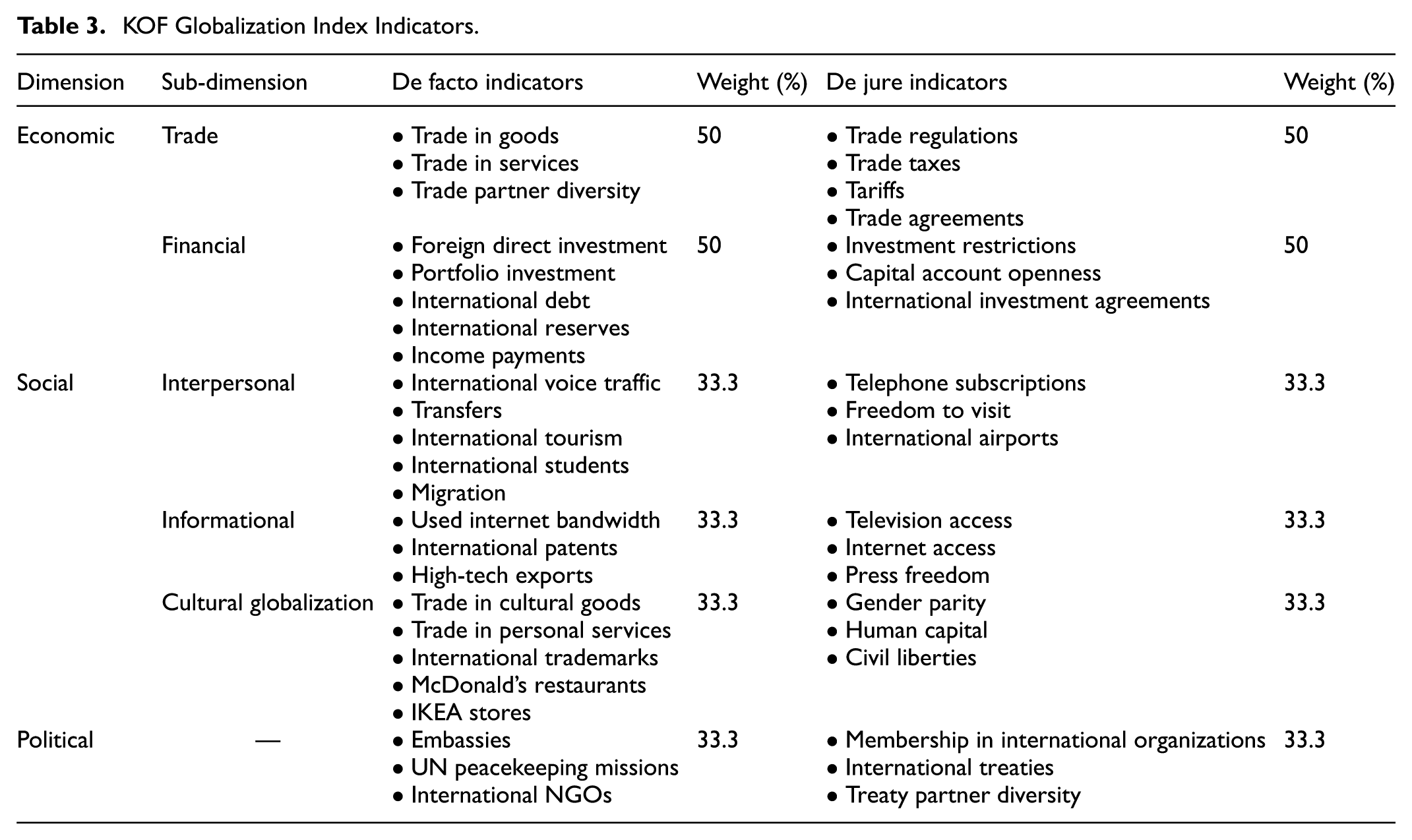
Currently, globalization is understood through several concepts and diverse perspectives. To facilitate its monitoring, various indices have been developed, with the KOF Globalization Index (in Table 3) being a prominent tool for measuring each country’s level of globalization. It can be considered in overview and separately across its various dimensions: economic (comprising trade and financial sub-dimensions), social (encompassing interpersonal, information, and cultural sub-dimensions), and political. These measurements are categorized into de facto and de jure types (Gygli et al., 2019). The index, which was developed from the concepts of Clark (2000) and Norris (2000), has a scale ranging from 1 to 100, with a higher score reflecting a higher globalization level for each country.
KOF Globalization Index Indicators.
Unlike intricate concepts such as the SDGs or globalization, tourism isn’t driven by a grand purpose; it’s primarily a leisure activity deeply intertwined with a broad spectrum of human activity, encompassing economic, social, and environmental dimensions (World Tourism Organization, 2018). Economically, tourism connects with numerous businesses throughout their supply chains (Mulyani, 2024). Its growth also fuels an increase in downstream partners and facilitates income distribution, aligning with several Sustainable Development Goals (SDGs) in the economic dimension. However, for sustainable development, host countries must also plan for the continual growth of income from tourism over the long term and permanently increase the number of tourists. Meanwhile, the incredible diversity of tourism products presents an opportunity to drive agendas through customers as tourists. This allows operators to focus on several types of tourism products, creating immense appeal by enhancing existing offerings, such as traditional culture (Richards & Wilson, 2004), or by developing entirely new ones, like amusement parks such as Universal Studios and Disneyland (Gartner & Lime, 2000).
In addition, tourism products can be designed to entice tourists by offering experiences, knowledge, or the attractiveness of attractions (Stasiak, 2024), including the positive perception which may be influenced by the achievement of Sustainable Development Goals and familiarity or convenience which may be influenced by the closeness resulting from globalization, encouraging them to visit the destination and recognize its value. Cerovic et al. (2015) stated that the increasing number of visitors and income from tourism are influenced by globalization through changes in the transportation sector, communications, modern technologies, and the internet. While the various and specific destinations also attracted tourists to the destination, as in the case of Trung and Mohanty (2023) at Tra Que traditional village in Vietnam, and satisfied with the infrastructure, agricultural experiential activities and restaurant services (Van Trung & Mohanty, 2021). The consumption of these designed products inherently generates numerous externalities from both the production and consumption of tourism products. However, these externalities can be either positive or negative, depending on the specific activity. For instance, in marine tourism, destroying coral reefs during an activity creates a negative externality of consumption, whereas mangrove planting yields a positive one.
As for the relationships of the tourism sector with sustainable development, when considering environmental issues, Zhao and Li (2018) presented the positive and negative impacts of tourism on the environment in China, that is, the transportation for the tourism sector, the development of the attractiveness of tourist attractions, and the number of available hotels. In the meantime, the positive impacts on the environment are from improved infrastructure and more awareness of environmental development. Surprisingly, the quantitative results found long-term relationships in the same way in sustainable development (Iftikhar et al., 2022).
Immersing oneself in new cultures during travel can broaden perspectives and foster relationships between travelers and local communities. This directly links travel experiences to a wider understanding and engagement in the social dimension of globalization (Sharpley, 2014). However, the culture is often transformed into a tourism product and an attractive trade (tourism is a service trade), drawing in outbound investment into areas that also support economic globalization. However, traditional culture also faces a higher risk of deviating from its origins (OECD, 2009), which is a negative externality of production.
Notably, tourism is a human activity intricately linked to supply-side decisions. Depending on the effectiveness of control mechanisms in host countries, tourism can either support or undermine globalization and sustainable development. The number of tourists is just the chance of the destination to drive their designed agenda. Thus, the effect of demand for tourism in each country on SDG and Globalization reflects their own success in using the tourism strategy to achieve these achievements.
Returning to the initial point, the overlapping beneficial and detrimental effects of tourism, sustainable development, and globalization have been explored through various theories and discussions. The inherent vagueness in the interrelationship among these factors necessitates case-by-case investigation. Fortunately, the interrelationship among these factors can be proved in an interesting case, when each factor has a proxy: SDG index for Sustainable Development Goals, KOF index for Globalization and tourism demand (such as number of tourists) for tourism. For interpretation, tourism’s effect on Sustainable Development Goals (SDGs) and globalization signifies the success of strategies host countries employ to advance these agendas. Conversely, SDGs’ effect on tourism reflects the impact of a positive image, much as globalization’s effects on tourism represent the influence of familiarity stemming from an interconnected world. Furthermore, globalization’s impact across various dimensions on SDGs demonstrates the success of collective efforts in driving the global agenda (SDGs). Meanwhile, SDGs’ effect on globalization illustrates how a better world fosters greater integration among people across all facets of global interaction.
Methodology
This research aimed to study the relationships among tourism, sustainability, and globalizations. More specifically for globalization, they were divided into economic, social, and political dimensions among the 10 ASEAN member countries, that is, Cambodia, Laos, Vietnam, Thailand, Myanmar, Malaysia, the Philippines, Singapore, Indonesia, and Brunei Darussalam. The following panel data of these countries between 2001 and 2022 was used, with a total of 22 years.
The number of international tourists (thousands), or TR, collected from involved agencies in those countries are as follows.

2. Globalization levels in the economy (GOE), social (GOS), and cultural (GOC) dimensions. KOF Globalization Index was used for consideration of each dimension.
The data was collected from the KOF Swiss Economic Institute (2024).
3. Sustainable Development Index (SDG) from the SDG Transformation Center (2024).
4. COVID-19 (CO), a dummy variable to be considered to reduce the effects of the outbreak on tourism. This variable was equal to 1 for the years 2020–2021, the affected duration and was equal to 0 in other durations.
All data, except for the dummy variable, underwent the unit root test and cross-sectional independent tests to avoid errors in the results. As for the effects of the data with a unit root process and with cross-sectional dependence as shown by the Pesaran (2004, 2015) cross-sectional independence test, interference from the effects of cross-sectional independence in the variables were considered. Testing was conducted under the key hypothesis that the data used for analysis must have either strict cross-sectional independence (Pesaran, 2004) or weak cross-sectional dependence (Pesaran, 2015). Rejection of the key hypothesis implied interference from the effects of cross-sectional independence in the variables.
For the unit root test, it was done to consider interference in the time-series data, which could cause conclusion errors of relationships considered among the variables. In the case of cross-sectional dependences, the unit root test by the second generation unit root test would relieve cross-sectional dependences on the panel variables. In this study, cross-sectionally augmented Im, the Pesaran test, and the Shin test (CIPS test) were used. The key hypothesis was that the data to be considered must not contain unit root. In other words, it must be stationary data despite interference from the unit root process at the data level. In case of cointegration in relationships among the variables, their long-term relationships were certainly reliable.
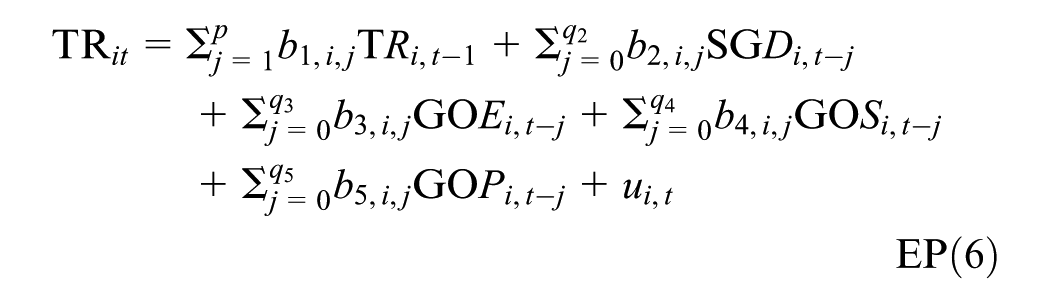
In this regard, the selection of methods for testing cointegration required consideration of slope homogeneity of the relationships to be considered. This was another factor that might cause conclusion errors. Slope homogeneity was tested under the hypothesis that the independent variables in the cross-sectional data had the same effects on the dependent variables. In case slope heterogeneity was found, testing panel cointegration by the Pedroni test and Westerlund test would be suitable. In this study, the relationships to be considered were written in a basic form as follows.


where Tr, SDG, GOE, GOS, and GOP refer to the number of tourists, the SDG, and globalization in the economic, social, and political dimensions, respectively.
For consideration of the effects among the variables, panel autoregressive distribution lags (panel ARDL) were used. It could reveal short-term and long-tern relationships, including adjustment to long-term equilibrium when relationships are affected by external issues/factors. The models were written in a basic form as follows.

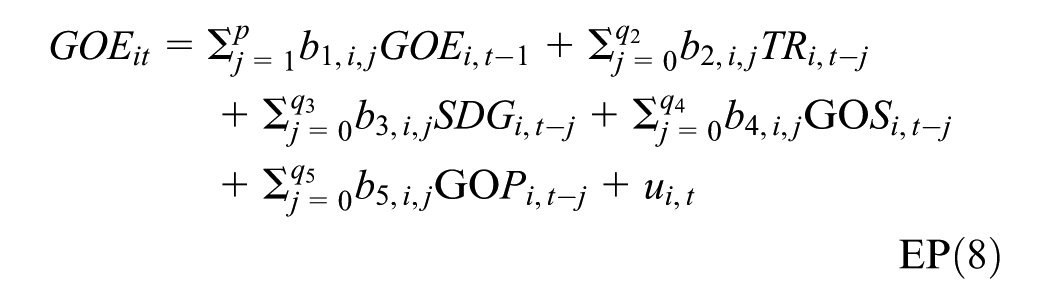


They were converted into a vector error correction mechanism as follows.


These models were estimated by three methods, that is, pooled mean group (PMG), mean group (MG), and dynamic fixed effects (DFE). Then, the suitable estimation results were selected by the Hausman test under the hypothesis that the values among the models must not be different (suitable estimation results by the mean group). PMG and MG were considered first. If it was found that the estimation results by the mean group were suitable, DFE would be used for re-consideration and comparison of those results.
The PMG (pooled mean group) model, MG (mean group) model, and DFE (dynamic fixed effects) model are highly valuable tools for panel data analysis, particularly in examining the complex interrelations among tourism, globalization, and sustainable development in Southeast Asia. These estimators demonstrate their strength when applied to panel data characterized by dynamic heterogeneity, as outlined by Blackburne and Frank (2007), Kim et al. (2023), Pesaran (2006), and Pesaran et al. (1999).
Dynamic heterogeneity, as described by Pesaran and Smith (1995) and Pesaran et al. (1999), emphasizes the coexistences of dynamic interdependencies among variables with substantial heterogeneity across groups. This characteristic is especially pertinent for Southeast Asia, where countries exhibit diverse economic structures, cultural contexts, and developmental stages. As such, the PMG, MG, and DFE models provide robust frameworks for this study, enabling the estimation of both long-run and short-run relationships. These models are particularly well-suited to accommodate the unique variations and heterogeneity inherent to the region, making them indispensable for investigating the multifaceted linkages among tourism, globalization, and sustainability developments.
Results and Discussion
According to the cross-sectional independence test, it was found that all variables, except for GOE, contained cross-sectional dependence (Table 4). Therefore, the unit root test in those variables required the methods in the second generation, that is, cross-sectionally augmented Im, the Pesaran test, and the Shin test (CIPS test).
The Results of the Cross-Sectional Independence Test on the Panel Variables.

, **, * significant at 99%, 95%, and 90%, respectively.
When the data for analysis was brought for the CIPS test (Table 5), it was found that TR, SDG, and GOS were stationary at the 1st difference while GOE and GOP were stationary at the data level. Therefore, the results of the analysis by regression equations might be affected by interferences from the unit root. Therefore, relationships among those variables might require the cointegration test because it is a qualification to confirm that their long-term relationships were reliable. The method for the cointegration test required consideration of slope homogeneity in the relationships first.
The Results of Unit Root Testing by the CIPS Test.

, **, * significant at 99%, 95%, and 90%, respectively.
When considering the results of the slope homogeneity test (Table 6), it was found that about the long-term relationships among the variables in this study, the effects of the independent variables on the dependent ones in each model might be different or with slope heteroskedasticity. Therefore, cointegration in this study was tested by the Pedroni and Westerlund tests, which relieved the stated regulation for verifying cointegration in relationships.
The Results of Slope Homogeneity Testing.
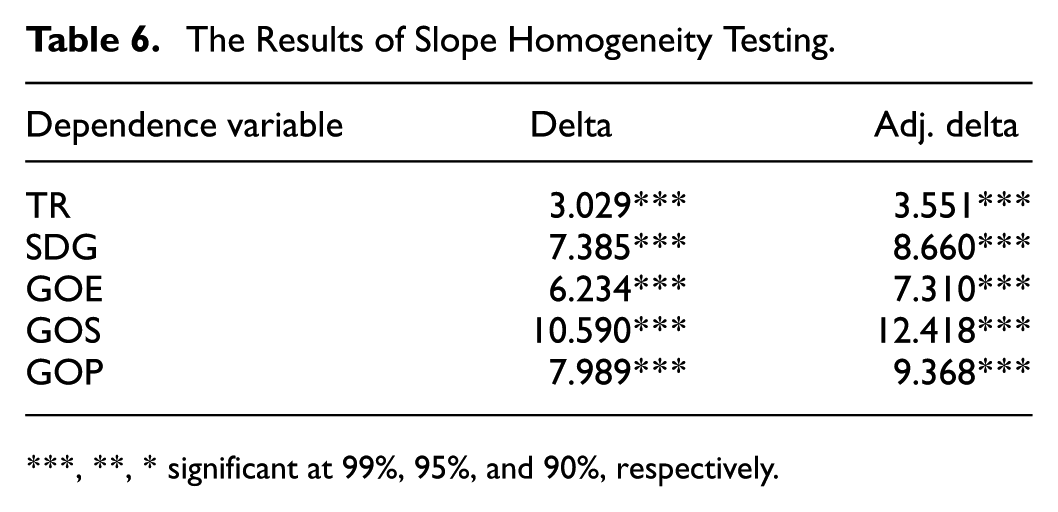
, **, * significant at 99%, 95%, and 90%, respectively.
Table 7 displays the results of the cointegration test from the long-term relationships that were considered. The testing results of the statistics used were different. Yet, those considered relationships contained at least two statistics of cointegration. To confirm cointegration, it was considered with the estimation results by panel ARDL from adjustment to equilibriums.
The Results of Cointegration Testing by Pedroni and Westerlund.

, **, * significant at 99%, 95%, and 90%, respectively.
According to Table 10, when considering ECM (Error Correction Model) in all relationships that were estimated by different methods, cointegration from the independent variables to the dependent ones were found in all relationships. ECM obtained by estimation was significantly negatives, implying adjustment to long-term equilibrium between the independent variables and the dependent variables, except for relationships from the dependent variables to GOS.
Furthermore, considering the results of testing suitable models from the Hausman test (Table 8), it was found that estimation by PMG was more suitable than MG for relationships from the independent variables to TR, SDG, and GOE. As for the relationships from the independent variables to GOS and GOP, estimation by DFE was more suitable than PMG and MG.
The Suitable Models from the Hausman Test and Cointegration Test from ECM.

, **, * significant at 99%, 95%, and 90%, respectively.
The pooled mean group (PMG) model is an econometric estimation technique designed for dynamic panel data analysis. It was introduced by Pesaran et al. (1999) to address scenarios where short-term dynamics vary across groups (e.g., countries, firms, or regions), but the long-term relationships are assumed to be homogeneous.
The PMG model is employed to quantify the short-term dynamic relationships between the dependent variables are the tourism factor (TR), sustainability factor (SDG), and economic factor (GOE) and the independent variables are social factors (GOS) and political factors (GOP). This model accounts for variation across groups, such as the 10 ASEAN countries (Cambodia, Laos, Vietnam, Thailand, Myanmar, Malaysia, the Philippines, Singapore, Indonesia, and Brunei Darussalam). In the long run, the PMG model assumes homogeneity to estimate these relationships. This approach is particularly suitable for confirming that, in the short run, the interactions among tourism (TR), sustainability (SDG), and economic growth (GOE) are influenced by the diverse and complex social (GOS) and political (GOP) factors within the ASEAN countries. These dynamics are more complex and diverse than those captured in the long-run analysis.
Finally, the DFE model is very powerful for allowing the dynamic effect on the variables in the model while it can control unobserved heterogeneity across countries. The Hausman test has already confirmed again that the DFE model is appropriated model when allowing the independent variables (TR, SDG, and GOE) to have relationship with the dependent variable (the GOS and the GOP) under control for unobserved heterogeneity across countries and consider the time varying effect. This result might be suggested that independent variables such as tourism factor (TR), sustainability factor (SDG), and economic factor (GOE) of verity or diversity of across countries are played important role to drive both the variety or diversity of social factor (GOS) and the politic factor (GOP) in among of 10 ASEAN countries (Cambodia, Laos, Vietnam, Thailand, Myanmar, Malaysia, the Philippines, Singapore, Indonesia, and Brunei Darussalam) on averaging effects for the short-run relationship and long-run relationship.
The dynamic fixed effects (DFE) model is highly effective for incorporating the dynamic effects of variables while controlling unobserved heterogeneity across ASEAN countries. The Hausman test confirms that the DFE model is appropriate for examining the relationships between the independent variables are tourism factors (TR), sustainability factors (SDG), and economic factors (GOE) and the dependent variables social factor (GOS) and political factors (GOP) factors. The model also accounts for time-varying effects.
This finding suggests that the diversity of the independent variables (TR, SDG, and GOE) across ASEAN countries significantly influences the variation in social (GOS) and political (GOP) factors. The DFE model captures these dynamics effectively by averaging the effects across the ASEAN countries (Cambodia, Laos, Vietnam, Thailand, Myanmar, Malaysia, the Philippines, Singapore, Indonesia, and Brunei Darussalam), providing insights into both short-run and long-run relationships.
According to the estimation results of the long-term relationships as seen in Table 9, there were positive effects from SDG and GOP on TR. Those relationships might be caused by the perceived positive images of each country through sustainable development, which have appeared in tourist attractions through various media, and the role of participation in politics at the international level of a certain country. This is a factor that reflects globalization in politics dimensions.
Long-Term Relationships from Panel ARDL.

, **, * significant at 99%, 95%, and 90%, respectively.
On the contrary, SDG was positively affected by TR, GOE, and GOS. This conformed to Iftikhar et al. (2022) in terms of the long-term effects of tourism on sustainable development, and Gasimli et al. (2022) in terms of the long-term effects of globalization in the economy dimensions on sustainable development. Nevertheless, the effects of globalization in the political dimensions on sustainable development were not found in this study. This point did not conform Gasimli et al. (2022). The effects of those factors affecting sustainable development might be caused by the reason that those factors could help spread development to different sectors in the countries more efficiently, including the success of impact control measures that might happen to the society and the environment due to economic expansion and the number of tourists.
The results also found that GOS was positively affected by GOP and negatively affected by GOE. For the relationships of globalization in the social dimension supported by the political dimensions, they might result from operations according to the roles specified in world politics. Therefore, people have acknowledged increasingly various pathways of social development in different dimensions. GOP was also affected by the positive and long-term effects of GOS, possibly caused by globalization in the social dimension. Therefore, operations in different aspects of the countries were supported by people in accordance with their roles on the world stage, as well. No matter what, it was found that GOE was without the long-term effects of all variables.
When considering short-term relationships (Table 10), it was found that TR had a negative short-term effect on GOP and was also affected by COVID-19. The negative short-term effect of GOP on tourism contrasts with the study of Huang et al. (2024), which found the negative short-run effect of political crisis (contrast of GOP) on tourists’ intentions of visiting a place. Meanwhile, the short-run effect of COVID-19 on tourism reflects the limits on transportation in this period. Conversely, TR had short-term and positive effects on GE, reflecting unsustainable relationships between tourism and international trade/investment. Distinct from the Rahmiati et al. (2021) study in ASEAN which presents the negative effect of international tourists’ arrival on gross domestic products in the short run. Furthermore, GOS was very negatively affected by COVID-19, though no other factors showed short-term relationships with GOS. This indicates a decrease in the well-being of people during COVID-19, such as the study of Musa and Basir (2021) which found food transportation loss because of the limited to travel aboard. Meanwhile, SDG and GOP weren’t influenced by the short-term effects of other factors, including COVID-19. These findings suggest that the growth or progress of SDG, GOS, and SDG (likely meant to be another variable, for example, GE or a repetition for emphasis) could not arise from abrupt changes in any of the factors.
Short-Term Relationships from Panel ARDL.

, **, * significant at 99%, 95%, and 90%, respectively.
Conclusions and Suggestions
The main aim of this study was to consider the relationships between tourism and sustainability, and globalization. More specifically for globalization, it was divided into economic, social, and political dimensions among the ASEAN member countries, of which tourism was affected by the long-term effects of sustainable development and globalization in the political dimension. Similarly, sustainable development was positively affected by tourism and globalization in the economic and social dimensions.
According to the study on the governments of the member countries, there should be support tourism policies and sustainable development simultaneously for mutual reinforcement of these two issues. If their governments promote the roles of international politics, for example, operation in accordance with agreements for international peace, it will surely help promote their domestic tourism. Also, policy implementation for free trade, along with more investment and more freedom in several aspects/dimensions in their countries, particularly access to media, will also drive them to sustain national development more efficiently.
Additionally, globalization in the social dimension was also affected by the long-term effects of globalization in the political dimension, but with economic dimension as an obstacle. Even so, globalization in the political dimension supported globalization in the social dimension. Therefore, if the governments expect social standard development in their own countries to be like those of the global society, they should follow international practices and support the operations of nonprofit organizations to enter globalization in the political dimension. Likewise, support from the governments for globalization in the social dimension, for example, giving more freedom for their citizens, will give those member countries a higher chance of globalization in the political dimension.
Finally, the research employs both the PMG model and the DFE model to analyses relationships. between variables, with each offering distinct assumptions and perspectives. Consequently, the conclusions and policy recommendations derived from these models may differ. The PMG model highlights the importance of accounting for variability across ASEAN countries in the short run. Using this estimator, the analysis confirms that short-run relationships between the dependent variables tourism factors (TR), sustainability factors (SDG), and economic factors (GOE) are significantly influenced by the independent variables of social factors (GOS) and political factors (GOP). This finding reflects the diversity among the 10 ASEAN member countries (Cambodia, Laos, Vietnam, Thailand, Myanmar, Malaysia, the Philippines, Singapore, Indonesia, and Brunei Darussalam). In the long run, however, the PMG model suggests that these countries converge toward stability and security regarding social (GOS) and political (GOP) factors. This alignment emphasizes the importance of fostering stable and secure social and political environments to support long-term development across the ASEAN region.
In addition, the second appropriate model is the DFE model, which can explain the total difference/heterogeneity among panel data in both short-run complexity or instability and long-run behaviors. However, this research study found both short-run and long-run dynamics. Regarding the independent variables (TR, SDG, and GOE), the dependent factor (GOS), and political factors (GOP) in the DFE model, both the PMG model and DFE model point out that both the short-run model and long-run model might be concerned that they cannot balance current needs and future needs at the same time, but for the future, it might be good if they can address all main problems: social, environmental, and economic issues.
Limitation
This study was conducted under certain data collection challenges from secondary sources, resulting in some missing data. Consequently, these missing data points had to be estimated for use in calculations. Furthermore, the study lacked a process for conducting causality tests, which interested researchers could explore in future studies.
Footnotes

Funding
The authors disclosed receipt of the following financial support for the research, authorship, and/or publication of this article: This research was funded by Chiang Mai University and Khon Kaen University.
Declaration of Conflicting Interests
The authors declared no potential conflicts of interest with respect to the research, authorship, and/or publication of this article.
Data Availability Statement
Data sharing not applicable to this article as no datasets were generated or analyzed during the current study.