




Abstract
The sustainability of social security has become a critical global concern, yet the relationship between regulation and social security remains a subject of debate. Most scholars and policymakers primarily examine the role of social regulation in shaping social security while often overlooking the impact of market regulation. This study utilizes data on the relaxation of market regulation (RMR) from the China Marketization Index Report, combined with balanced panel data for 31 Chinese provinces from 2008 to 2019. Applying instrumental variable methods to address endogeneity concerns, this study empirically examines the impact of China’s RMR on social security levels (SSL) and its underlying mechanisms. The findings suggest that a one-standard-deviation increase in RMR intensity is associated with a 2.25% rise in SSL. The study also identifies social security expenditure and efficiency as mediating variables in the RMR-SSL relationship, while failing to support a mediating role for social security fairness. Moreover, regional heterogeneity tests indicate that the positive impact of RMR on SSL is significant only in regions with high marketization levels or strong economic development. These findings provide valuable insights for optimizing regulatory and social security reforms in China, while also offering useful guidance for emerging economies in prioritizing coordinated reform strategies.
Introduction
Assessing the impact of China’s relaxation of market regulation (RMR) on social security is a complex and important issue. Previous research has shown that the impact of market regulation on social security has long been a subject of controversy. This is especially true for countries undergoing a transition to market economies, where challenges to the sustainable development of social security arise not only from the need for institutional optimization but also from uncertainties inherent in the political and economic environment. China, as a prototypical nation transitioning to a market economy this century, has established the world’s most extensive social security system. Examining the impact of RMR on social security in China not only facilitates the optimization of coordination mechanisms and development pathways for both market regulation and social security but also offers valuable insights for other emerging economies.
Theoretically, RMR can dismantle monopolistic structures, stimulate competition, and foster innovation, thereby enhancing the efficiency of resource allocation (Alfaro & Chari, 2014; Anzia & Moe, 2016; Bae & Woo, 2020; Naughton, 1992). Such efficiency gains are anticipated to spur economic growth, broaden the tax base, and augment government fiscal revenues, thereby providing ample financial support for expanding social security coverage and enhancing benefits (Lin et al., 2013; Midgley, 1999). In developed economies, well-established legal systems and regulatory mechanisms typically allow for the maintenance of market order even as regulation is relaxed, thereby facilitating social security development through effective public expenditure (Acemoglu & Robinson, 2013; Dassiou et al., 2015; Ebner, 2015). However, in most emerging economies, the absence of robust legal systems and regulatory mechanisms implies that government-led regulatory reforms are frequently driven by political incentives and bureaucratic self-interest, thereby creating uncertainty about the impact of market regulation relaxation on social security in these countries.
Furthermore, the challenges that countries face in developing their social security systems extend beyond simply increasing expenditures; they also encompass ensuring that these systems operate efficiently and that resource allocation is equitable. As Q. Zhu (1995) and Korpi and Palme (1998) have noted, an effective social security system must balance three critical dimensions: the scale of expenditures, operational efficiency, and fairness. Without improvements in operational efficiency or enhancements in the fairness of the distribution mechanism, merely increasing spending does not guarantee that social security resources will be utilized effectively (Reeskens & van Oorschot, 2013). From a public choice perspective, political incentives and bureaucratic self-interest can affect the allocation of these resources (Dreher et al., 2015), potentially leading to unequal service provision—particularly in emerging economies, where institutional weaknesses are more pronounced (Haque, 2001). Therefore, enhancing social security is not solely a technical challenge; it is also closely linked to governance and political dynamics. In the context of market-oriented reforms, if emerging economies do not clearly comprehend the mechanisms or pathways through which these reforms impact social security, a premature implementation of deregulation may jeopardize both the fairness and efficiency of the social security system (Acemoglu & Robinson, 2013).
In China, the authority over social security management and market regulation decision-making is primarily concentrated in local governments, thereby establishing an inherent relationship between social security and market regulation. On one hand, from the perspective of local government political rights and resource allocation motives, the dual challenges of intensified population aging and economic downturn (Lo, 2016) suggest that relaxing market regulation (RMR) will lead local governments to increasingly rely on measures such as land, finance, and taxation to achieve their political performance goals. This shift might transfer the tensions between the market and society into the realm of political governance, and under conditions of crisis or high pressure (Bardhan, 2020), it may exacerbate errors or abuses of power, thereby intensifying the misallocation of social security resources (Tian, 2011).
Conversely, the relaxation of market regulation (RMR) may also yield positive effects. Since Xi Jinping assumed office in 2013, China has enacted reforms aimed at RMR. These reforms have not only re-established the responsibilities of local governments in both economic and social governance but also transformed the assessment mechanism—from a singular emphasis on economic growth as the primary political objective to a dual target of sustaining both economic growth and social stability (X. Huang, 2013; G. Huang & Cai, 2021). Consequently, social security governance performance has emerged as a crucial criterion for evaluation. Simultaneously, the reform has advanced the RMR approach by anchoring it in the preservation of public interests as its foundational standard (H. Feng, 2024). Moreover, these reforms have relaxed entry restrictions on social security programs, including healthcare and pension schemes (Xing, 2022), enhanced market freedom and competitiveness, and improved the coordination between the government and the market in delivering public services such as healthcare, pension, and education (Haveman et al., 2017). In this regard, China’s reforms to RMR may offer new opportunities for the development of social security.
To clarify the impact of China’s relaxation of market regulation (RMR) on social security and its underlying mechanisms, this study utilizes data on RMR for 31 Chinese provinces, as reported in the China Marketization Index Report (CMIR) for the period 2008 to 2019, along with social security and other relevant variable data from the China Statistical Yearbook (2009–2020), to construct a balanced panel dataset. Instrumental variable methods are employed to conduct the empirical analysis. In comparison with previous literature, this study makes incremental contributions in three key aspects.
Firstly, from the perspective of local government political power and resource allocation, our study offers new insights into the relationship between market regulation and social security. Previous studies have predominantly examined how market regulation influences employee welfare in enterprises (Barbieri & Bozzon, 2016; Rodriguez-Pose & Storper, 2020) and how it dismantles monopolistic structures to enhance liquidity and market efficiency (Hastings et al., 2017; Heidenheimer, 2017; Liebman & Luttmer, 2015). However, in China, local governments play a pivotal role in allocating both market and social resources. Therefore, clarifying the motives behind local governments’ management of the interplay between market regulation and social security is essential for promoting the coordinated development of both domains.
Secondly, this study not only empirically examines the impact of RMR on social security but also provides a detailed analysis of the specific mechanisms underlying this influence. This study employs the social security level (SSL) as a measure of the development of China’s social security system. Generally, an improvement in SSL necessitates that expenditure requirements are adequately met, that the system is equitable, and that it operates efficiently (Korpi & Palme, 1998; Q. Zhu, 1995). Therefore, RMR may enhance SSL by impacting these three dimensions.
Thirdly, previous research has predominantly concentrated on the impact of social regulation reforms on social security, while largely neglecting the effects of market-oriented regulatory reforms. In reality, enterprise activities are inherently both economic and social; therefore, efforts to enhance the economic aspects through economic regulation inevitably affect the social dimensions as well, thereby influencing the willingness of enterprises and employees to participate in social security. Additionally, countries around the world are transitioning toward a “competent state” (Von Mises, 2011) model aimed at enhancing their economic and social governance capabilities. This approach aligns with the key tenets of New Structural Economics, which emphasize the need for efficient markets and proactive government (Lin, 2011). Therefore, comprehending the impact of market regulation on social security is of considerable practical importance.
Literature Review
Previous empirical studies provide mixed yet insightful evidence regarding the impact of relaxing market regulation (RMR) on social security. For instance, Abrahamson (2010) finds in his study of Europe that increased market competition and technological innovation resulting from deregulation significantly enhance overall economic performance, thereby enabling governments to broaden the scope of social security programs. Similarly, Andrews and Cingano (2014) report that in OECD countries, RMR enhances the Pareto efficiency of public resource allocation, thereby providing institutional support for optimizing social security systems. Conversely, other studies have reported contradictory findings. For example, Givel (2006) observes that in the United States, hybrid approaches combining neoliberal policies, RMR, and self-regulation have resulted in a reduction in social welfare programs, whereas Tourtouri et al. (2020) demonstrate that in Greece, RMR has reduced the coverage of employment protection schemes.
These empirical findings underscore the notion that the extent to which relaxing market regulation (RMR) can enhance social security largely depends on several complex factors, including (1) the local legal framework and historical traditions of social policy, and (2) strategies and motivations for government reform. In line with this perspective, scholars such as Alfaro and Chari (2014), Kastanos (2021), and Yusuf (2024) have examined the impact of RMR on social security using empirical data and case studies from emerging economies such as India, Nigeria, and Turkey. However, the market reform processes in emerging economies—particularly in China—exhibit more nuanced dynamics (Wu, 2007). An analysis that focuses solely on the government–market relationship may fail to capture the full complexity of how RMR affects social security.
In China, decision-making regarding resource allocation and market regulation by local governments is influenced by a combination of political competition, fiscal imperatives, and social objectives (Helmsing, 2002; G. Li et al., 2021; Yu et al., 2020). For instance, during the process of RMR, government actions are frequently driven by local government competition and interest-group bargaining (Fan et al., 2019; Xu, 2011), which largely determine the specific content, pace, and outcomes of RMR (K. Jiang et al., 2019). Moreover, the impact of government intervention on social security is far more complex than a simple trade-off between efficiency and equity (Halpern et al., 2013), as the social security level (SSL) is determined by a combination of expenditure, operational efficiency, and fairness (Korpi & Palme, 1998; Q. Zhu, 1995). In light of these considerations, this study will employ empirical data from China to examine the impact of RMR on social security and its underlying mechanisms. The findings are expected to provide valuable insights into how emerging economies can promote market-oriented reforms while prioritizing social security development.
Background: SSL and RMR in China
Social Security Level (SSL)
Social security in any country is a fundamental institution designed to safeguard the basic livelihood and health of its residents. China has established the most extensive social security system globally (Zheng, 2018). However, China is also among the countries with the highest levels of population aging worldwide, with the population aged 65 and above exceeding 200 million and continuing to grow at an accelerating pace. According to calculations based on the method proposed by Professor Mu (1997), China’s social security level (SSL) is rapidly increasing to safeguard the basic rights of all citizens in areas such as healthcare, old-age support, and employment. Influenced by the 2008 global financial crisis, SSL in China experienced a brief decline, followed by slow growth from 2009 to 2013. Notably, since 2013, China’s social security level has exhibited an accelerating growth trend. In 2019, the ratio of China’s social security expenditure to GDP reached 14.9%, marking the highest level ever recorded (see Figure 1).

Annual trends in the proportion of social security and major program expenditures to GDP.
Furthermore, pension, medical, and unemployment insurance constitute the three primary components of China’s social security programs. Figure 1 illustrates the expenditure levels of these three components. Among these components, pension insurance system expenditure accounts for the largest share of total social security spending and has experienced the most significant growth, primarily due to China’s large retired elderly population and the accelerating rate of aging (Cai & Cheng, 2015; H. Zhu & Walker, 2018). Medical insurance system ranks second, with the intensification of aging driving increased expenditures in long-term care insurance, health insurance, and general healthcare services (Z. Feng et al., 2012; X. Li & Zhang, 2013), as well as an expansion of the medical insurance system’s coverage (X. Li et al., 2017).
Relaxation of Market Regulation (RMR)
Market regulation plays a crucial role in modern market economies. As a prototypical nation undergoing global marketization this century, China’s marketization level increased from 4.19 in 2000 to 8.19 in 2019—a growth rate of 95.4%—according to data from the China Marketization Index Report (CMIR). In contrast, the “Reduced Government Intervention Index,” which reflects the level of RMR, exhibits an initial increase followed by a subsequent decline. Specifically, the index stood at 4.19 in 2000, peaked at 5.76 in 2007, and declined to 3.67 in 2019 (see Figure 2). This trend indicates that China’s market regulation reforms have undergone a fluctuating process even as marketization continues to advance. Nevertheless, this fluctuating reform process may introduce additional uncertainty into the social security system, and empirical studies in various regions—including the United States (Eichhorst et al., 2017), the European Union (Bothfeld & Rosenthal, 2018), Germany (Kongtip et al., 2015), and Greece (Zhou, 2010)—have produced inconsistent findings regarding these impacts.
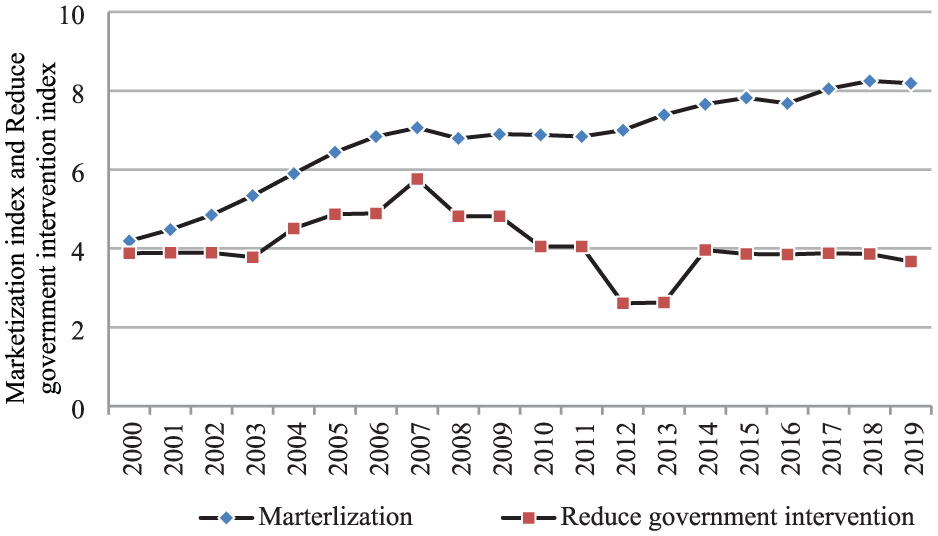
China’s marketization index and reduce government intervention index.
During the process of relaxing market regulation (RMR), local governments have adjusted their regulatory strategies by reducing direct involvement and micro-intervention in economic activities. Instead, they have adopted macroeconomic policies in areas such as finance, land, and taxation to regulate the allocation of both market and social resources. Previous research has indicated that in political and economic environments characterized by fiscal decentralization systems such as the “promotion tournament” (Zhou, 2010) and “fiscal federalism” (Qian & Weingast, 1997), where economic growth is prioritized, local governments in China tend to direct market and social resources toward economic production rather than social welfare (Fu & Zhang, 2022). To some extent, RMR has weakened local governments’ direct intervention in the allocation of market and social resources, aligning more closely with market allocation and competitive mechanisms. However, variations in market conditions and economic foundations across provinces have resulted in significant differences in the implementation of RMR by local governments (see Figure 3; H. Li & Zhou, 2005). This may exacerbate the uncertainty regarding the impact of RMR on social security in China.

Reduce government intervention index of 31 provinces in China.
Research Design
The Construction of the Econometric Model
To evaluate the impact of China’s relaxation of market regulation (RMR) on social security and its underlying mechanisms, this study develops an econometric model based on a hierarchical regression framework. The specific empirical model is presented as follows:

In Model (1), i and t denote provinces and years, respectively; SSL represents the social security level in China’s provinces, β denotes the estimated coefficient capturing the effect of RMR on SSL. RMR denotes the variable of China’s relaxation of market regulation, Xit represents the control variables, α is the coefficient matrix associated with the control variables, ρi denotes individual-specific effects that remain constant over time, τi represents the controlled year-fixed effects, and εit is the random disturbance term.
When a correlation exists between an independent variable and the error term, that variable is classified as endogenous. In China, various provinces have recently implemented multiple institutional reform projects in the social security system. These projects include expanding social insurance coverage, facilitating inter-regional transfer and continuity of social security, and adjusting the social security tax base, all of which are closely related to business activities. For instance, to enhance the quality of social security information statistics and promote information sharing and mutual recognition, the Chinese government has revised the procedures for collecting enterprise social security data, which may, to some extent, affect enterprises’ non-production business activities. Therefore, there is a high likelihood of a reverse causality, whereby SSL may also influence RMR.
To mitigate this potential effect, the authors will re-estimate Model (1) using an instrumental variable approach. Specifically, the authors will employ the one-period lag of China’s relaxation of market regulation (L.RMR) as an instrument variable for RMR. Additionally, because using only one instrumental variable precludes testing for over-identification and strict exogeneity, we have selected historical data for the RMR index from 1997 to 2008—rather than contemporaneous data for the independent variable—as a second instrumental variable (H-RMR). Subsequently, we conduct a two-stage least squares regression. The first-stage regression equation is as follows:

In addition, to examine the mediating effects of RMR on SSL, the author developed a model to test the intermediary mechanism (T. Jiang, 2022; Wen et al., 2004) as follows:


Where M represents the mediator variable, φ denotes the estimated coefficient for the effect of RMR on SSL, θ represents the estimated coefficient for the effect of the mediator variable on SSL, δ stands for the estimated coefficient for the effect of RMR on the mediator variable; all other symbols retain their meanings as in Model (1).
The Model (1) suggests a causal effect of RMR on SSL; Model (4) indicates a causal effect of RMR on M; Model (3) signifies, on one hand, the causal effect of M on SSL, thus establishing a causal chain of RMR→M→SSL, and on the other hand, suggests that apart from M, RMR may independently affect SSL. The estimated coefficients of Models (1), (3), and (4) are related by the equation: β = φ+δθ. If all four coefficients are statistically significant, it indicates that the mediating mechanism is established. This set of relationships is clearly illustrated in Figure 4.

Decomposition of the mediation effect of RMR on SSL.
Variable and Measurement
Dependent Variable
The dependent variable in this study is the social security level (SSL), measured using the method proposed by Professor Mu (1997). Drawing on the actual operation of China’s social security system and grounded in demographic structure theory and the Cobb-Douglas production function, he constructed the following equation:

where, S represents the level of social security, Sa denotes the total social security expenditure, W stands for the total wage expenditure, G represents the GDP, Q denotes the social security burden coefficient, and H represents the proportion of labor factor input distribution. Based on this model, the author can directly compute the social security level (SSL) for each province in China. This indicator has been widely employed by scholars in research on China’s social security in relevant literature (Gao, 2002; Guo & Yang, 2010; Liu et al., 2023; Liu & Ren, 2015).
Independent Variable
The Relaxation of market regulation (RMR) serves as the independent variable in this study. The author employs the “reduction of intervention in enterprises index” from China Marketization Index Report (CMIR) to measure RMR. The basic data for this index are derived from surveys conducted on more than 2,000 companies nationwide, based on evaluations by corporate executives regarding whether “government administrative approval, industry access, and other government interventions are excessive” (Fan et al., 2019). It should be noted that although the initial RMR data were collected at the enterprise level, the researchers aggregated the dataset to the provincial level using systematic sampling surveys and rigorous data processing methods. Furthermore, to facilitate both cross-sectional comparisons among provinces and longitudinal comparisons over different years, standardization techniques were applied to the data, ultimately yielding a provincially comparable index.
Mediating Variables
The social security level (SSL) is a multifaceted construct that can be measured across several dimensions, including the scale of social security expenditures, the efficiency of institutional operations, and the fairness of the system. Q. Zhu (1995) and Korpi and Palme (1998) contend that evaluating the social security level should involve not only the magnitude of social security expenditures but also the fairness and efficiency with which these resources are allocated. For example, Yang and Zhao (2022) assessed the development level of China’s social security system from the perspectives of social security expenditures and fairness, while Liang and Ji (2020) examined the effectiveness of China’s social security policies in the labor market by focusing on institutional efficiency and fairness. Therefore, in exploring the mechanism through which RMR affects SSL, this study incorporates three mediating variables: social security expenditures, social security efficiency, and social security fairness.
Control Variables
Models employing econometric regression equations must include control variables, all of which must be independent of both the independent and dependent variables. Therefore, the control variables used in this study include provincial fiscal autonomy, economic growth rate, the old-age dependency ratio, central government transfer payments to provinces (Tang & Liu, 2012), and the intensity of intra-provincial competition (Chirinko & Wilson, 2017). Because these variables all influence the level of social security, their inclusion enhances the model’s goodness-of-fit. Moreover, unobservable regional and temporal heterogeneity may also affect the model’s fit, so dummy variables for regions and years are incorporated into the regression estimation.
Data Sources
This study employs panel data from 31 provinces in mainland China covering the period 2008 to 2019 for empirical analysis. The data on relaxing market regulation (RMR) were extracted from the China Marketization Index Report (CMIR), which is jointly developed and published by scholars from the Chinese Academy of Social Sciences, Peking University, the State Administration of Foreign Exchange, and other institutions. The report is designed to continuously track the progress of China’s marketization process (Fan et al., 2019); to date, it has published scores and rankings of marketization progress for China and its provinces from 2008 to 2019, making it a crucial source of both literature and data for current research on China’s market reforms. The measurement data for the dependent variable, along with those for the various mediating and control variables, are drawn from the China Statistical Yearbook (2009–2020). Table 1 summarizes the measurement methods and descriptive statistics for all variables.
Variable Measurement Methods and Descriptive Statistics.

Results and Discussion
The Impact of RMR on SSL
In Table 2, the OLS estimation results are presented in columns 1 and 2. Regardless of whether control variables are considered, the coefficient of the independent variable RMR is not statistically significant. Furthermore, Columns 3 and 4 present the Two-Stage Least Squares (2SLS) estimation results. In column 3, the first-stage estimation result indicates that the instrumental variable L.RMR is significantly correlated with the endogenous variable RMR. The over-identification test indicates that the instrumental variable is uncorrelated with the error term (εit), thereby confirming its exogeneity. Moreover, the robust F-statistic is significantly greater than the critical value of 10, further confirming that the instrument is not weak. These results demonstrate that the selected instrumental variables are valid. Columns 4 presents the second-stage estimation results, which reveal that the estimated coefficient of the independent variable is positive and statistically significant, indicating that RMR has a positive effect on SSL. Specifically, a one-standard-deviation increase in the intensity of RMR is associated with a 2.25% increase in SSL.
The Impact of RMR on SSL.
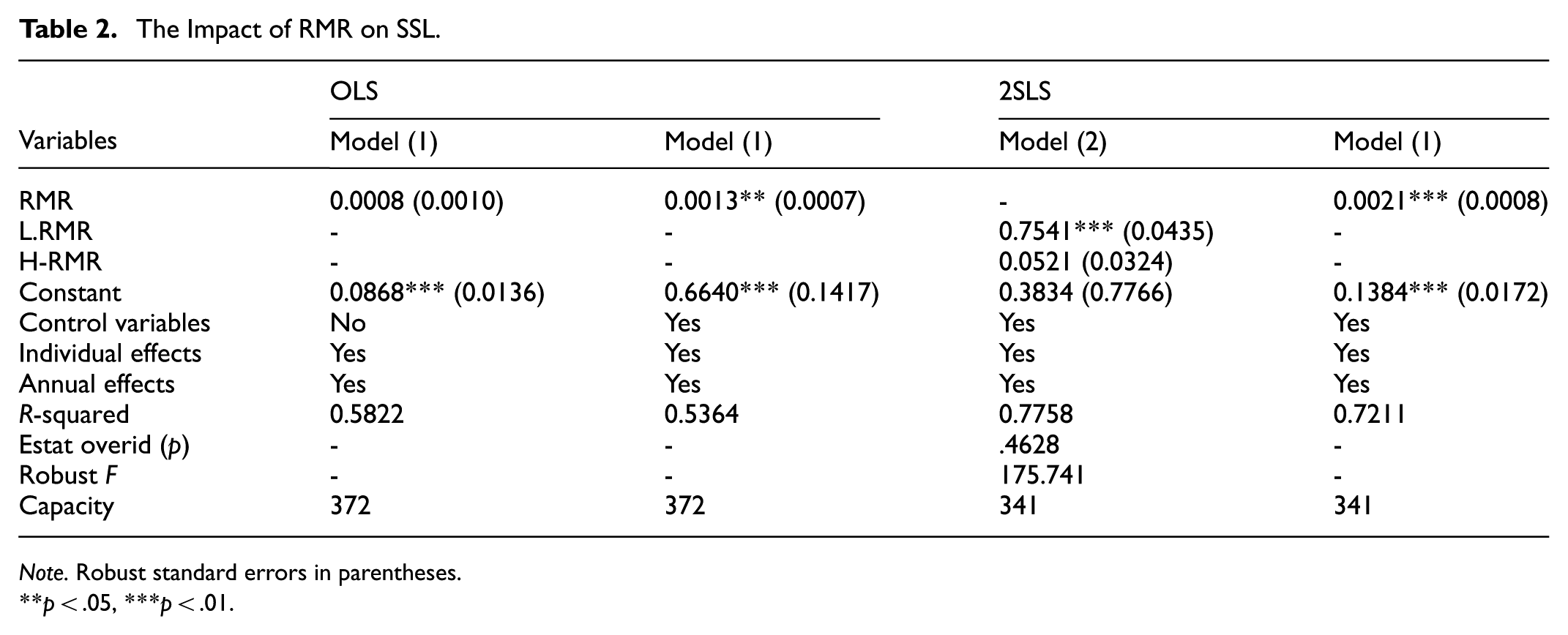
Note. Robust standard errors in parentheses.
p < .05, ***p < .01.
Robustness Test
The primary purpose of conducting robustness tests is to verify the stability of the model estimation results, thereby ensuring their validity and reliability in the presence of potential data biases or incomplete model assumptions. Although the preceding model employed instrumental variable methods to address endogeneity issues, it may still be susceptible to instability arising from factors such as data processing errors or external shocks. Firstly, the independent variable is subjected to a 1% two-tailed trimming, and Model (2) is re-estimated using both OLS and 2SLS. The estimation results are presented in columns 1 and 2 of Table 3. The results indicate that the coefficient for the independent variable in column 2 remains positive and statistically significant at the 1% level under these conditions.
Robustness Test.

Note. Robust standard errors in parentheses.
p < .05, ***p < .01.
Secondly, the study examines the impact of policy shocks. Since 2013, the central government of China has implemented reforms to relax market regulations, a significant initiative in deepening China’s market-oriented transformation (B. Chen, 2016). To test whether the effect of RMR on SSL remains robust under this policy shock, we introduce a dummy variable, denoted as Policy, with a breakpoint in 2014—assigned a value of 0 for the years 2008 to 2013 and 1 for the years 2014 to 2019. We incorporate this variable into Model (2) for OLS estimation, and the results are presented in column 3 of Table 3. Under this scenario, the coefficient for RMR remains statistically significant and positive.
Mediation Analysis
In China, the mechanisms through which relaxing market regulation (RMR) may influence social security level (SSL) can be categorized into three dimensions: social security expenditure (SSEX), social security efficiency (SSEF), and social security fairness (SSFA). To examine whether these mechanisms hold, this study employs the mediation analysis and conducts regressions using the two-stage least squares (2SLS) method for Models (3) and (4). Table 4 presents the results.
Estimation of the Mediation Effects of RMR on SSL Impact.

Note. Robust standard errors in parentheses.
p < .10, **p < .05, ***p < .01.
Columns 1 and 2 display the estimation results when SSEX is employed as the mediating variable. Firstly, the coefficient of the independent variable RMR in Model (4) is positive and statistically significant, indicating that RMR effectively expands the scale of expenditure. Secondly, the coefficient of the mediator variable SSEX in Model (3) is also positive and statistically significant, suggesting that increased expenditure promotes the improvement of SSL. Therefore, it can be concluded that SSEX serves as a positive mediating variable through which RMR enhances SSL. Similarly, SSEF also functions as a mediating variable. However, in Columns 5 and 6, the coefficients of the main dependent variables do not reach statistical significance, indicating that SSFA may not serve as a mediating variable.
Further Analysis: Why Didn't SSFA Play a Mediating Role?
Table 4's conclusions indicate that the relaxation of market regulation (RMR) may not enhance the social security level (SSL) through its impact on social security fairness (SSFA). The authors suggest that this phenomenon is not solely attributable to the strategy of China’s market regulation relaxation reforms but also involves structural issues within China’s social security system. To further investigate, Table 5 examines two key questions: first, has the rapid pace of China’s RMR led to uncertainty regarding its effect on social security fairness? Second, is the structure of China’s social security system a critical factor contributing to this outcome? Addressing these questions will help us better understand why China’s RMR fails to improve social security fairness and, consequently, to enhance the overall SSL.
The Pace of RMR and Structure of Social Security System’s Explanation.

Note. Robust standard errors in parentheses.
p < .05, ***p < .01.
The results in Column 1 of Table 5 indicate that the estimated coefficient for RMR is significantly positive, suggesting that China’s RMR has effectively promoted improvements in pension fairness. However, Column 2 shows that while the estimated coefficient for RMR-speed is positive, it fails to reach statistical significance and remains relatively small, indicating that the effect of the pace of RMR on pension fairness is extremely weak and unstable. In Column 3, the estimated coefficient for RMR is negative, but it does not reach statistical significance, suggesting that the impact of China’s RMR on medical insurance fairness cannot be consistently determined. In Column 4, the estimated coefficient for RMR-speed is negative and passes the statistically significance at the 1% level, indicating that the pace of RMR may have exceeded the capacity of the medical insurance system, thereby exerting a negative impact on medical insurance fairness.
Regional Heterogeneity Analysis
The degree of marketization and the level of economic development constitute fundamental conditions that shape the strategies adopted by local governments in selecting the relaxation of market regulation (RMR; Fleischer et al., 2024; Ofoeda et al., 2024). In this study, we utilize the 2019 marketization index for 31 provinces, as reported in the CMIR, to rank the provinces and subsequently categorize the top 50% as the “high-level group” and the bottom 50% as the “low-level group.” Furthermore, economic development is measured by per capita GDP; based on the 2019 per capita GDP of these provinces, they are classified into a “high economic development group” and a “low economic development group.” Subsequently, we conduct two-stage least squares (2SLS) estimations using Model (1) for each of these groups. The results presented in Columns 1 and 3 of Table 6 indicate that the estimated coefficient for RMR is significantly positive, whereas in Columns 2 and 4, it does not reach statistical significance. These findings suggest that RMR promotes improvements in social security level only in regions characterized by high levels of marketization and robust economic development.
Heterogeneity Test: Based on Marketization Degree and Economic Development Level.
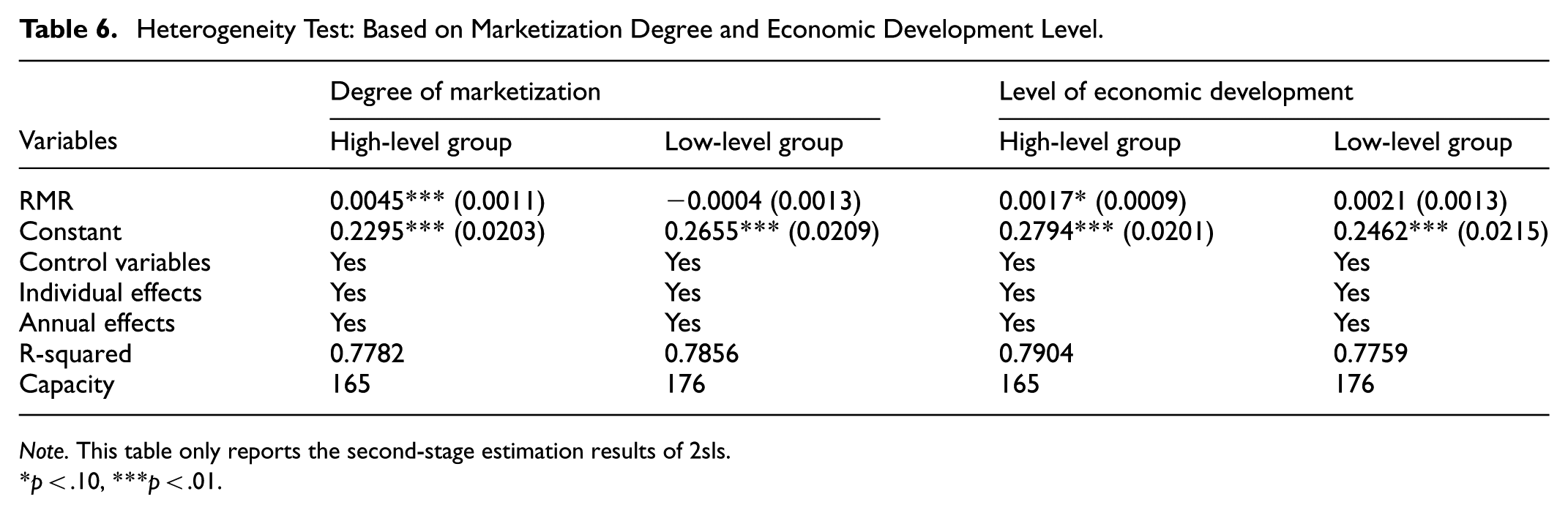
Note. This table only reports the second-stage estimation results of 2sls.
p < .10, ***p < .01.
Discussion
This paper utilizes data on the relaxation of market regulation (RMR) for 31 Chinese provinces, sourced from the China Marketization Index Report (2008–2019), along with data on social security level (SSL) and other variables from the China Statistical Yearbook (2009–2020), to construct a balanced panel dataset. Subsequently, the authors then employ a two-stage least squares (2SLS) method to address potential endogeneity issues in the models and empirically assess the impact of China’s RMR on SSL and its underlying mechanisms. The empirical results indicate that RMR has a statistically significant positive effect on SSL. Specifically, a one-standard-deviation decrease in the intensity of market regulation is associated with a 2.25% increase in SSL. This conclusion is consistent with previous research findings on the impact of labor market RMR on social security and welfare in Western countries (Eichhorst et al., 2017).
As China continuous to deepen its reforms toward a market economy, the reform of relaxing market regulation (RMR) has become an integral part of its reform agenda. However, the impact of RMR on social security remains both complex and significant.
Firstly, from the perspective of local government political power and resource allocation motives, RMR can enhance the accessibility of resources for social security, thereby promoting the effective growth of social security expenditure. This is because Chinese local governments have long engaged in a “tournament” competition (Q. W. Zhu, 2020). On one hand, as the central government gradually prioritizes social security governance performance in its evaluations of local governments, ensuring an adequate supply of social security resource supply becomes a key criterion in the interactions among local governments when adjusting resource allocation strategies (Huang & Cai, 2021). On the other hand, RMR can also enhance economic efficiency. In the context of a “Race to Bottom” among local governments, RMR can yield Pareto improvements in the provision of public services (Ashworth et al., 2014; Boyne, 1996). For example, in the reform of China’s medical insurance payment methods, local governments have achieved Pareto sub-improvements in the allocation of medical insurance resources through effective market supervision and competitive interactions between regions (L. Li, 2021; L. Li & Yu, 2022).
Secondly, RMR can effectively enhance the efficiency of social security operation, which in this study is measured by social security coverage. RMR can stimulate entrepreneurship and innovation, boost job opportunities (Gebel & Giesecke, 2016), and balance employment opportunities among different groups (G. Chen, 2015), thereby positively influencing the participation rate in social security (Heyes & Lewis, 2014). Additionally, RMR may enhance the flexibility and competitiveness of enterprises, encouraging them to prioritize employee welfare and social responsibility (Mai & Abdul Hamid, 2021), This, in turn, can improve the inclusiveness of social security policies (Rubery & Piasna, 2017), thereby better meeting the needs of diverse groups. For example, in the past, cumbersome government-imposed market regulations were closely tied to specific industries and enterprises, restricting market access and establishing barriers that led to disorderly competition significant inefficiencies in resource use and cost for enterprises (Yaprak, 2012). Under RMR, market mechanisms govern the allocation of funds, technology, and market shares, thereby improving the production efficiency and stimulating greater investment enthusiasm among enterprises—particularly in labor-intensive industries—which encourages more firms to contribute to social security payments for their employees (Vergeer & Kleinknecht, 2010).
The above viewpoints are corroborated by our study. The authors regard social security expenditure and social security efficiency as the mechanisms through which RMR influences SSL. Regression analyzes employing two-stage least squares (2SLS) methods reveal that both serve as positive mediating variables that facilitate the enhancement of SSL in China through RMR. However, our tests do not support the mediating role of social security fairness, implying that China’s RMR cannot promote the improvement of SSL through enhancing fairness. International experience demonstrates that in emerging market economies, the process of relaxing market regulations is frequently accompanied by protracted negotiations among various stakeholders—such as governments, trade unions, employers, social organizations—regarding social security, which in turn restricts individuals’ freedom of choice and exacerbates welfare inequality (Findling et al., 2002). In China, the rapid pace of RMR may have outstripped social development, thereby disadvantaging certain groups in accessing social security resources. For instance, although the integration of medical insurance has increased the utilization of healthcare services among residents (Y. Ren et al., 2022; L. Zhang et al., 2023), the accessibility and fairness of medical insurance across various groups remain questionable (Y. Liu & Luo, 2022).
Further empirical findings support this perspective. Specifically, the pace of China’s RMR and the structural characteristics of its social security system are key contributing to the failure of RMR to enhance social security fairness.
On one hand, as shown in Figure 2, the “reduced government intervention index,” which reflects the level of regulation relaxation, increased from 3.38 in 2000 to 5.76 in 2007, and then fluctuated downward to 3.67 by 2019 (Fan et al., 2019). This indicates that although the Chinese government’s market intervention has decreased over the past decade, the process has been marked by significant fluctuations. Such volatility reflects the ongoing contestation among the Chinese government, employers, and other stakeholders. During the process of market regulation relaxation in China, the government’s intervention in enterprises did not continuously diminish; at times, it stalled or even increased. According to the private interest theory of regulation (Stigler, 1971), market regulation is often designed to serve private interests rather than public welfare, aiming to redistribute welfare among different groups. Therefore, the objectives of RMR are not always aligned with maximizing social welfare; rather, they are closely linked to the redistribution of benefits (Viscusi et al., 2018). Consequently, the volatility in China’s RMR reflects a power struggle among the government, enterprises, and other stakeholders, leading to an uncertain impact on the fairness of social security.
On the other hand, China’s social security system exhibits unique characteristics. Currently, China’s pension system is predominantly reliant on public decisions-making and government intervention, with fiscal influence playing a substantially greater role than market forces. In contrast, medical insurance system in China has undergone market-oriented reforms since 2009, whereby market mechanisms now play a more prominent role than public decision-making in the medical sector. Consequently, our empirical findings indicate that RMR has a significant positive impact on the fairness of the pension system, primarily driven by Pareto improvements in the allocation of public resources under RMR
However, the effect of RMR on the fairness of medical insurance remains uncertain. The pace of RMR reforms appears to have outstripped the capacity of the medical insurance system, thereby exacerbating challenges to fairness in medical insurance. While China’s medical insurance system is largely market-driven, substantial regional disparities (Meng et al., 2015), urban-rural divides (Ma et al., 2021; X. Zhang et al., 2017), variations in implementation standards (L. Li & Fu, 2017), and barriers to the mobility of accounts across regions (D. Zhang et al., 2016) persist. Coupled with delayed legal oversight and inconsistencies in policy reforms (G. G. Liu et al., 2017; X. Li et al., 2020), the rapid implementation of RMR has struggled to enhance fairness within the medical insurance system. In fact, it may have exacerbated existing inequalities, thereby hindering the achievement of equitable access to medical insurance services across diverse populations.
The regional heterogeneity test indicates that the positive effect of RMR on SSL is evident only in regions with advanced marketization or higher levels of economic development. This is because regions or countries with advanced marketization and economic development generally exhibit stronger legal frameworks and regulatory mechanisms (Acemoglu & Robinson, 2013; Dassiou et al., 2015; Ebner, 2015), thereby offering the institutional safeguards required for RMR to enhance SSL. Conversely, in less economically developed and marketized regions or countries, the premature implementation of RMR may lead to heightened uncertainty concerning SSL improvements. This finding aligns with existing research. Furthermore, this conclusion suggests that advancing RMR in China requires a region-specific approach that considers local conditions, coupled with a phased reform strategy. Likewise, for various social security programs—such as medical insurance, where effective legal safeguards and regulatory mechanisms may be insufficient—specialized oversight remains essential to uphold fairness throughout the RMR process.
In 2019, China enacted a national policy to advance market-oriented reforms. In recent years, the relaxation of market entry restrictions and the introduction of the “negative list” mechanism have played a crucial role in fostering enterprise innovation (Z. Zhou et al., 2023), mitigating income inequality (Lei et al., 2023), and increasing employment and labor income shares (Liu et al., 2023; Lv & Wang, 2024). However, given China’s long-standing absence of a well-established institutional tradition in social regulation (B. Ren, 2023), further RMR may exacerbate challenges to the equity of social security entitlements.
For example, in 2023, China introduced the individual pension system to complement the basic pension scheme. However, due to the deceleration of income growth—particularly among middle- and low-income groups with constrained savings capacity—the tax-deferred incentives and account-based stimulus mechanisms have had limited appeal, leading to lower-than-expected coverage and participation rates (Wang & Huang, 2023). Conversely, this system has unintentionally evolved into a tax shelter primarily benefiting high-income groups (Tuo, 2022). Going forward, as China progresses with its RMR, policymakers must reinforce social regulatory frameworks to prevent pension security programs from encountering equity challenges similar to those of the medical insurance system. This necessitates increased fiscal investment, enhanced fund oversight, and strengthened social regulation of pension security programs, rather than an exclusive emphasis on RMR.
Despite its contributions, this study has certain limitations. First, the RMR data from the CMIR are available solely at the provincial level and lack firm-level microdata. This may pose challenges in fully addressing potential interaction effects between variables in the macro estimation model. However, this study employs instrumental variable techniques to mitigate this issue and incorporates winsorization and external policy shocks to enhance the robustness of the empirical results. Notably, the CMIR remains the most authoritative and comprehensive database for analyzing China’s market reform processes.
Second, the measurements of SSL and the three mediating variables rely on indicators specifically designed to capture the unique characteristics of China’s social security system. Researchers examining other countries may consider adopting alternative indicators that align more closely with the specific contexts and conditions of their respective social security systems. Despite these limitations, this study provides significant empirical evidence for understanding the relationship between China’s market regulation relaxation and social security levels. Furthermore, it offers valuable policy insights for emerging market economies aiming to advance market-oriented reforms and enhance social security systems.
Conclusions and Implications
Conclusions
This study’s empirical analysis indicates that since 2008, China’s relaxation of market regulation (RMR) has significantly contributed to the enhancement of social security levels (SSL). Empirical results suggest that, on average, a one-standard-deviation reduction in market regulation intensity correlates with a 2.25% increase in SSL. Moreover, mechanism tests across three dimensions—social security expenditure, operational efficiency, and fairness—demonstrate that the positive effect primarily operates through enhanced expenditure scale and institutional efficiency. However, the mediating role of social security fairness is not substantiated, largely because the pace of RMR in China has outstripped the capacity of certain highly marketized welfare programs (e.g., such as medical insurance). This misalignment challenges or even exacerbates disparities in program fairness, rendering the overall impact of RMR on social security fairness inconclusive. Additionally, regional heterogeneity tests indicate that the positive impact of RMR on SSL is evident only in regions with higher levels of marketization or economic development. These regions typically feature more robust legal frameworks and regulatory mechanisms, offering the institutional safeguards necessary for RMR to enhance SSL.
Implications
Based on the findings of this study, we present five specific policy recommendations. These recommendations can help policymakers in China, and other emerging economies, maximize the benefits of relaxing market regulation (RMR) while mitigating its risks, ultimately fostering a more efficient and equitable social security system.
First, implement a phased and region-specific approach. Given the heterogeneous effects of RMR on the level of social security (SSL) across regions, policymakers should tailor deregulation strategies to local conditions. In highly marketized and economically developed regions, more aggressive RMR measures may be suitable. Conversely, in less developed areas, a gradual approach is advisable to prevent exacerbating social inequalities and overwhelming social security systems.
Second, enhance legal and regulatory frameworks. Findings suggest that regions with robust legal frameworks and regulatory institutions are more effective in translating market deregulation into social security improvements (Acemoglu & Robinson, 2013; Dassiou et al., 2015; Ebner, 2015). Therefore, it is imperative to complement RMR initiatives with reforms that strengthen the rule of law and regulatory oversight. This is particularly vital for highly marketized welfare programs, such as medical insurance, where insufficient legal support may undermine fairness.
Third, develop comprehensive monitoring and evaluation mechanisms. Ongoing monitoring and evaluation of RMR are crucial to ensuring sustained positive impacts on social security. Policymakers should establish robust assessment frameworks to track the efficiency and fairness dimensions of social security. This would enable timely adjustments to reform strategies in response to any unintended negative consequences, particularly in sectors where rapid deregulation may introduce risks.
Fourth, strengthen intergovernmental coordination and policy alignment. This study underscores that local governments frequently pursue RMR reforms driven by political competition and fiscal constraints. To mitigate the risks of fragmented or inconsistent policy implementation, enhanced coordination between central and local governments is essential. Establishing intergovernmental frameworks that align regional RMR strategies with national social security objectives would help ensure that market reforms are implemented in a coherent and balanced manner.
Finally, align reforms with the structural characteristics of social security systems. Emerging economies should recognize that the structural features of their social security systems are key determinants of RMR reform outcomes. Policies should align the pace of deregulation with the capacity of existing social security infrastructures, preventing an overextension of market mechanisms that could undermine fairness or sustainability.
Footnotes
Acknowledgements
The authors extend their appreciation to the National Social Science Fund Major Project of China for funding this research work through project number 23ZDA099.

Funding
The author(s) disclosed receipt of the following financial support for the research, authorship, and/or publication of this article: This research was funded by National Social Science Fund Major Project of China, grant number is 23ZDA099.
Declaration of Conflicting Interests
The author(s) declared no potential conflicts of interest with respect to the research, authorship, and/or publication of this article.