




Abstract
This study aims to investigate how shared meaning within a supply chain impacts inter-organizational cooperation and its subsequent influence on firm performance. The proposed research model is empirically tested using survey data collected from 305 manufacturers worldwide. The study’s findings suggest that shared meaning directly improves firm performance and indirectly enhances inter-organizational cooperation. These results theoretically contribute to supply chain management (SCM) research, expanding the practical understanding of how shared meaning enhances SCM performance by effectively engaging external supply chain partners in information sharing and cooperative coordination. The findings also highlight the importance of lead firms within supply chains.
Keywords
Introduction
The trading environments of manufacturing enterprises have experienced significant changes due to the rapid global economic development from 2012 to 2019. These enterprises’ transactional landscapes have evolved from domestic trade and one-time transactions to international trade and long-term collaborations. Competition has shifted from individual enterprises engaging in isolated battles to holistic competition involving supply chains (Shahabadkar et al., 2021). The market has also become more dynamic and customer-centric (Al-khawaldah et al., 2022; Rupčić & Jakopič, 2014). This transformation changes competition patterns among enterprises and promotes supply chains to become central to competition.
Today’s manufacturing environment is characterized by increasingly sophisticated consumers demanding customized products and shorter delivery times. Thus, many companies that previously relied on low-cost, standardized production methods have adapted by becoming more flexible and collaborative (Baah et al., 2022). Restructuring efforts within and between companies, as well as enhanced inter-firm connections, have helped firms maintain competitiveness, suggesting they must work together to maximize system optimization benefits across supply chains to attain long-term, sustainable development (Jo & Kwon, 2021; Wu & Chiu, 2018).
Supply chain management (SCM) entails integrating all activities from raw materials to end-users, encompassing information flow and raw material transformation (D. Singh & Verma, 2018). It has consistently been recognized as a main strategy for enhancing organizational performance and gaining competitive advantages in markets (Li et al., 2006). Effective SCM requires seamless information flow and mutual understanding to establish and maintain synergistic relationships between supply and distribution companies. This approach enables each supplier to harness their unique capabilities to improve efficiency and cost savings for all involved (Rupčić & Jakopič, 2014). However, exclusively focusing on cooperation could hinder supplier motivation and innovation, obstructing information flow, creating coordination challenges, fragmenting power dynamics, and heightening external competition. In such cases, a leading company with strong leadership must take charge, integrate, and manage the supply chain effectively.
As a system, the purpose of SCM is to connect and integrate all constituent parts, such as suppliers, manufacturers, distributors, and retailers, while navigating the competitive and cooperative dynamics of other systems, including logistics networks, transportation systems, and financial infrastructures (L. Chen et al., 2017; Herden, 2020; Oberhausen & Plapper, 2016; Zimon et al., 2019). Extant SCM research has overlooked the synergistic effects of shared meaning and inter-organizational coordination, especially the mediating role of inter-organizational coordination on the relationship between shared meaning and firm performance. Instead, most studies have primarily concentrated on the macro-level optimization of SCM (Khan et al., 2021). In addition, some only focus on the direct impact of shared meaning on business performance (Fantazy & Tipu, 2019). These studies’ neglect of the mediating role of inter-organizational coordination limits our ability to understand the impact of shared meaning on business performance.
This study attempts to address this research gap by elucidating the potential indirect mechanisms through which shared meaning within a supply chain can enhance a company’s ability to satisfy customer demands. Specifically, this research uses inter-organizational coordination as an intermediary variable linking shared meaning to improved corporate performance.
Shared meaning defined as the establishment of a common understanding and consistent values within an organization (Schein, 2010), and inter-organizational coordination, which involves collaboration between multiple organizations to achieve shared objectives (Barratt, 2004), are critical components of organizational effectiveness. In the context of SCM, shared meaning, which emphasizes organizational culture, can be leveraged through inter-organizational coordination, underscoring the importance of partnerships across organizational boundaries in facilitating cooperation and synergy (Flynn et al., 2016). Specifically, shared meaning in SCM involves organizations’ exchange of resources and knowledge to enhance efficiency and resource allocation. It also addresses the complex challenges, opportunities, and objectives resulting from common issues that require collective response efforts.
Accordingly, this study selected 305 manufacturing companies from various countries and regions as research subjects. As previous literature has yet to examine the internal mechanism of the effect of more abstract shared meaning on firm performance, this research contributes to the SCM literature by incorporating inter-organization coordination into the shared meaning–performance relationship. Furthermore, it explores the moderating role of supply chain leadership, providing insights into how companies can enhance performance by effectively leveraging shared meaning through increasing collaboration with supply chain partners. The findings from this exploration are valuable for improving manufacturing companies’ performance, facilitating supply chain coordination, and promoting product innovation and upgrades.
Theory and Hypotheses
Shared Meaning and the Ability to Meet Customers’ Needs
Within SCM, shared meaning (SM) pertains to the extent to which a manufacturing facility and its primary suppliers share a common understanding of supply chain dynamics, processes, communication channels, and information (Huber, 1991). Additionally, it refers to suppliers’ and partners’ common understanding of customer needs and expectations, encompassing factors like information sharing, mutual comprehension, operational activity awareness, and prioritizing close collaboration with other suppliers. Organizational information processing theory (OIPT) highlights information’s critical role in firm success and stresses the need for firms to proactively manage information to remain competitive and efficient (Tiwari, Bryde, Stavropoulou, Dubey, et al., 2024), emphasizing the importance of information management in shared meaning.
The relational view suggests that firms can gain a competitive advantage through relational rents or benefits generated in partnerships and that inter-firm relationships produce strong performance when partners exchange specific assets like knowledge (Dyer & Singh, 1998). Thus, shared meaning can be seen as a relationship-specific asset enhancing trust and cooperation between organizations. Information flow and exchange are pivotal in promoting supply chain integration (Y.-H. Chen et al., 2014; Colicchia et al., 2019; Yang et al., 2019), supporting shared meaning by empowering supply chain partners to transcend their corporate organizational boundaries, enabling them to transfer knowledge and experiences. Furthermore, exchanging information can help partners share understanding and goals regarding customer needs and expectations, fostering product and service delivery collaboration. Information sharing also facilitates supply chain flexibility and delivery (He et al., 2017). For instance, information sharing within supply chains effectively mitigates the bullwhip effect (i.e., the fluctuation and amplification of demand downstream to upstream within a supply chain [Costantino et al., 2014]). In other words, it improves supply chain performance by facilitating understanding and information sharing among partners.
When employees share a common understanding of an organization’s goals, they are likelier to align their individual efforts and activities with these objectives (Brhane & Zewdie, 2018). This alignment can enhance their focus and efficiency in achieving key business outcomes (Bouckenooghe et al., 2015). Furthermore, employees are likelier to comprehend each other’s viewpoints, facilitating smoother operations through improved communication due to fewer misunderstandings, conflicts, and information gaps (Hee et al., 2019). Shared meaning also cultivates a stronger sense of belonging and responsibility among employees. It helps them adopt values that align with those of the organization, boosting their motivation and concentration at work and positively influencing productivity and performance (Randel et al., 2018). Thus, we hypothesize the following:
Hypothesis 1: Shared meaning among suppliers is positively associated with manufacturers’ abilities to meet customers’ needs, including the desire for quality, low cost, and flexibility.
Shared Meaning and Inter-Organizational Coordination
Supply chain collaboration has gained substantial prominence since the mid-1990s due to increased uncertainty in market demand, global competition, and supply chain disruptions (Flynn et al., 2016). Inter-organizational coordination (IC) pertains to collaboration between suppliers and other partners in jointly planning and coordinating production-related information. It involves strategic planning, new product and project planning, product conceptualization and design, sharing operational information, and coordinating production planning (Tan & Cross, 2012). Unlike shared meaning at the strategic level, inter-organizational coordination represents practical collaboration between enterprises, necessitating enterprises to promptly adapt directions based on collaborative plans and make practical adjustments in response.
Firms are pursuing collaboration and reinforcing inter-firm connections throughout the supply chain due to increased global competition, the expanding customization and diversification of products and services, and technological advancements (Bell & Cooper, 2015; Oberhausen & Plapper, 2016). However, supplier conflicts may arise from differences in philosophy, technology, management, pricing, and even interest. A lack of supply chain coordination can occur when decision-makers possess incomplete information, or their incentives are misaligned with their objectives (Lei et al., 2015).
Information sharing fosters a common understanding of supply chain activities among suppliers, enhancing flexibility and responsiveness and promoting knowledge creation (Baah et al., 2022; Colicchia et al., 2019; Yang et al., 2019). It can also support socio-cognitive harmony through promoting shared meaning and the development of collectivism (Mylan et al., 2015). To improve coordination and cooperation between parties in a supply chain, it is important to establish agreed-upon theoretical strategies through information exchange (Krause et al., 2007; Saffer, 2016). This alignment of information positively affects collaboration (Dubey et al., 2021).
A common understanding of the supply chain enhances suppliers’ identification with other suppliers’ business philosophies, technology, personnel, etc. This helps develop shared strategies and goals among all parties, improving information transparency and mitigating uncertainty, suspicion, mistrust, and concerns about losing valuable assets (Y.-H. Chen et al., 2014; Shahabadkar et al., 2021). Supply chain members must act as a team; however, when team members’ perceptions of goals or tasks differ, their morale, job satisfaction, willingness to stay, and commitment can become significantly diminished (Seo et al., 2020). Therefore, it is vital that organizations share resources or competencies, as mutual trust allows partners to clarify issues and resolve conflicts fairly, reducing the cost of collaboration and improving collaborative performance (Moshtari, 2016).
Group learning theory suggests that a shared identity among team members reduces conflicts and addresses concerns regarding supply chain members’ commitment to allocating resources. This shared identity can also improve inter-organizational collaboration by helping members emulate the mindsets and behaviors of others, ensuring knowledge availability, facilitating continuous mutual learning, and establishing a framework of coordination models integrating supply chain processes (Rupčić & Jakopič, 2014).
Therefore, this study posits the following hypothesis:
Hypothesis 2: Suppliers’ shared meaning is positively associated with inter-organizational coordination.
Inter-Organizational Coordination and the Ability to Meet Customers’ Needs
Effective supplier coordination is crucial for meeting customer demands (Baah et al., 2022). When suppliers collaborate on and synchronize their activities, they can respond more swiftly and efficiently to changes in supply and demand. Inter-organizational coordination can provide the necessary technological infrastructure to facilitate the seamless flow of information across the supply chain, ensuring the smooth movement of goods (Sundram et al., 2020). Furthermore, well-coordinated suppliers can share information and resources, such as raw materials and equipment, to reduce turnaround times. Partnerships within the supply chain help reduce costs through integration, restructuring, optimization, and the introduction of technology (Rupčić & Jakopič, 2014). They can also increase revenue by enhancing customer service through inventory reduction and timely information provision. Inter-organizational collaboration can enable asset sharing, minimize sales variability, and foster a long-term commitment to mutual improvement. These outcomes boost asset/cost efficiency, profit stability, and growth potential through innovation (Tan & Cross, 2012). Numerous studies have demonstrated that organizational collaboration enhances performance (Shahabadkar et al., 2021). Communication characterized by collaboration and a clear information flow beyond mere information sharing facilitates supply chain agility and robustness, essential for coping with change and disruption (Wieland & Wallenburg, 2013).
Lusch and Vargo (2006) refer to service-dominant (S-D) logic as collaboratively creating value within supply chains through ongoing interactions. The resource-based view of strategic management (RBV) emphasizes the significance of a firm’s unique internal resources and capabilities (Collins, 2021; Madhani, 2010; Yang et al., 2019). Inter-organizational coordination among suppliers can be a resource for enhancing supply chain efficiency and competitiveness. Furthermore, a comprehensive supply chain leverages the integration of proprietary technologies from firms within the supply chain to maintain products’ scarcity, inimitability, and irreplaceability.
The extended resource-based view of a firm, as advocated by Foss et al. (2010), contends that a firm’s competitive advantage increasingly relies on inter-organizational coordination (Loebbecke et al., 2016). In addition, regarding the recent promotion of green supply chains, research has identified that environmental processes can improve enterprises’ financial performance through their green innovation ability due to inter-organization coordination (Jo & Kwon, 2021). Accordingly, we propose the following hypothesis:
Hypothesis 3: Suppliers’ inter-organizational coordination is positively associated with manufacturers’ ability to meet customers’ needs.
Inter-Organizational Coordination as a Mediator of the Relationship Between Shared Meaning and the Ability to Meet Customers’ Needs
This study’s theoretical framework uses transaction cost economics to examine the costs associated with suppliers. Typically, an enterprise experiences production and transaction costs. Due to economies of scale and specializations, manufacturing firms often exhibit higher asset specificity and transaction costs and lower production costs.
Transaction costs encompass coordination costs and are characterized by operational and opportunistic risks. Coordination costs entail the expenses incurred in exchanging information related to products and demand. Operational risk pertains to the likelihood of partners providing inaccurate or incomplete information or delivering subpar performance due to disparities in objectives and information asymmetry among partners.
From a relational view, shared meaning, a relationship-specific asset, facilitates inter-organizational trust and communication and supports successful collaboration (Tiwari, Bryde, Stavropoulou, & Malhotra, 2024). Through collaborative work, organizations can improve their ability to respond to marketplace changes (Cao & Zhang, 2011). Collaborating by sharing information and engaging in inter-organizational coordination helps reduce coordination costs and operational risks. Simultaneously, supply chain firms can anticipate opportunistic behaviors from their trading partners based on interoperability and information sharing. For example, firms can strategically implement exclusive asset utilization to escalate sunk costs, thereby increasing the transaction costs caused by partners’ adoption of opportunistic behaviors. This strategy compels partners to curtail these behaviors, fostering stable supply chain partnerships (Um & Kim, 2019).
Sundram et al. (2020) contend that supply chain integration can be improved through sharing information and coordinating logistics, presenting significant prospects for performance enhancement. Fuks et al. (2008) expand on inter-organizational coordination, conceptualizing it as a comprehensive system categorized into three levels based on complexity: communication, coordination, and cooperation. Tiwari, Bryde, Stavropoulou, and Malhotra (2024) summarize SCM activities from a resource-based theory perspective, identifying the three sequential processes of mutually sharing information, cooperation, and process integration. Thus, it is evident that coordination assumes a top-down role in facilitating information exchange, sharing, and implementing strategies.
Based on these assertions, this study posits the following hypothesis:
Hypothesis 4: Inter-organizational coordination mediates the relationship between shared meaning and manufacturers’ abilities to meet customers’ needs.
Supply Chain Leadership as a Moderator of the Relationship Between Inter-Organizational Coordination and the Ability to Meet Customers’ Needs
Supply chain leadership (SCL) pertains to a facility’s role as a leader within the supply chain. These leaders maintain integrated databases and consult and disseminate knowledge to other supply chain members (Mentzer et al., 2008). In this study’s context, we posit that exercising supply chain leadership is a non-coercive strategy aimed at influencing behavior by conveying the positive outcomes of compliance.
Inter-organizational coordination among supply chain partners can provide many business opportunities. However, not all coordination is devoid of challenges and straightforward to implement. According to social exchange theory (SET), individuals make decisions based on their expectations of and anticipated benefits from exchanges. They strive to maximize their interests, and as a result, even those with similar goals may have conflicting interests. In such situations, a leader is essential for coordinating and ensuring both parties derive mutual benefits. A similar challenge arises in the exchange processes involving various parties within the supply chain.
To ensure effective coordination, a leading company with strong management must be part of the supply chain. Such a leader is essential for imparting knowledge, guiding practices, and rectifying potential opportunistic behaviors. Leaders also ensure that organizations align their contexts, goals, and actions, enabling the full implementation of collaborative decisions. R. K. Singh (2011) contends that supply chain leadership is the primary driver of enhancing supply chain coordination enablers. Under the guidance of leaders, centralized decision-making can promote closer cooperation in decentralized coordination efforts. The system coordination mechanism that develops under strong leadership encourages decentralized decision-makers to act in the system’s best interests (Sahin & Robinson, 2005). While all suppliers engaged in inter-organizational cooperation reap benefits, the initiator of the information flow often gains more, typically placing this firm in a leadership role. Therefore, we hypothesize that supply chain leadership facilitates the impact of inter-organizational coordination on manufacturers’ abilities to meet customer demands. Consequently, we propose the following hypothesis (Figure 1) :
Hypothesis 5: Supply chain leadership moderates the relationship between inter-organizational coordination and manufacturers’ abilities to meet customers’ needs, such that the effect of inter-organizational coordination is stronger when supply chain leadership is more robust.
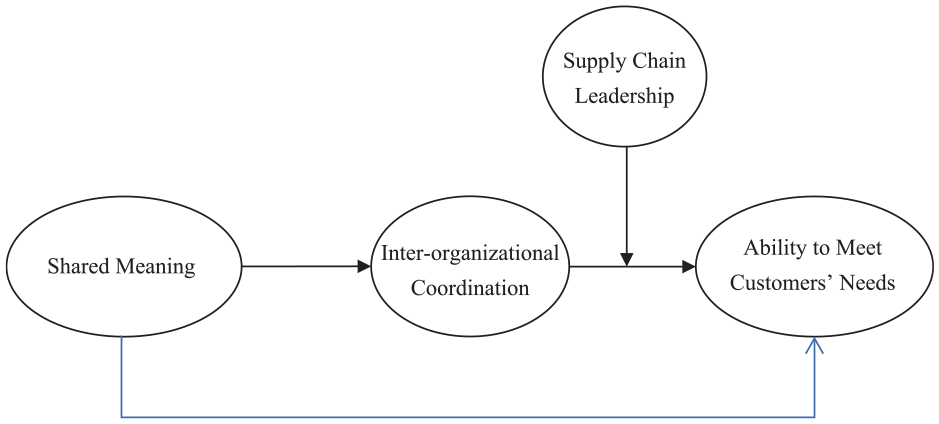
Conceptual research model.
Research Methods and Hypothesis Testing
Data Collection
To test the proposed hypotheses, we utilized a dataset from HPM Project, a global research collaboration that has been ongoing for over 30 years. It involves a team of academic researchers specializing in quantitative approaches to operations and SCM practices within manufacturing plants.
The HPM Project questionnaire was administered in English, translated into the local language by the regional coordinator, and subsequently back-translated to ensure and verify the accuracy of expressions. The fourth round of HPM Project was conducted between 2012 and 2019. This round’s dataset was collected from manufacturing companies in 15 diverse regions, encompassing various cultural and economic characteristics (Bozarth et al., 2009). The developed economies in the dataset are Germany, Sweden, Brazil, Spain, Israel, Italy, Finland, Japan, the United States, Switzerland, and the United Kingdom. South Korea and Taiwan (Republic of China) are also included, representing recently developed economies, and the Chinese mainland and Vietnam constitute emerging economies.
Plants from each region were randomly selected from the three distinct industries of machinery, electronics, and transportation, all operating within a stable yet rapidly evolving competitive environment. Local HPM Project research team members contacted potential respondent plants via phone calls or site visits. Once a company agreed to participate, the questionnaire and accompanying instructions were dispatched to a designated coordinator responsible for distributing and collecting the questionnaires within each plant.
Measures were employed to mitigate common methodological bias during data collection. In particular, most questionnaire items were answered by two individuals, and the results were subsequently averaged to generate a single value for each item. Furthermore, respondents from various departments completed different questionnaires to ensure data collection from reliable sources, and the survey items were interspersed within the questionnaire to prevent artificially inflating the measurement validity. A total of 331 responses were collected for this study; however, 26 samples were excluded, resulting in a final dataset of 305 samples for statistical analysis (Table 1).
Sample Demographics.

Measurement
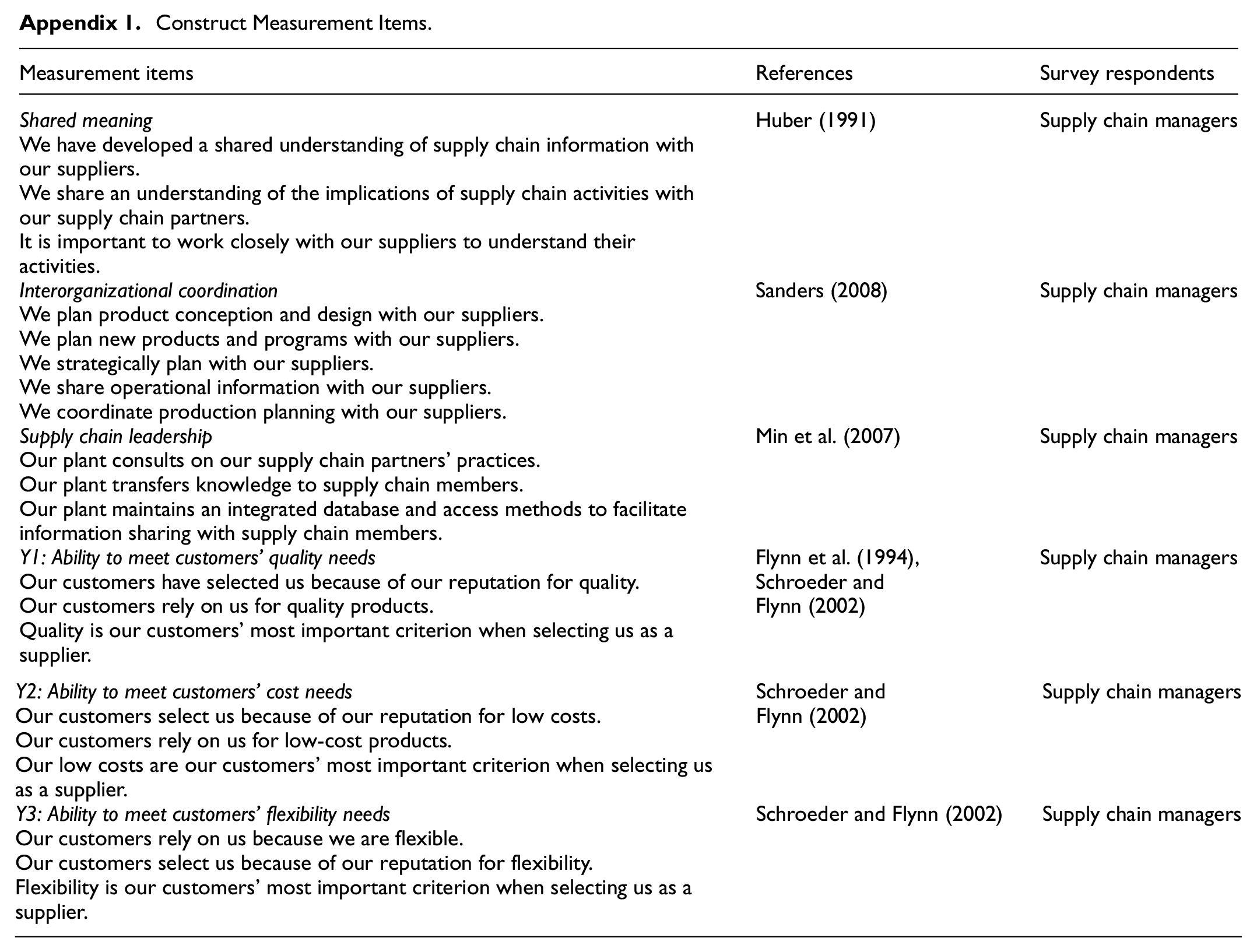
Three questions were adopted from Huber (1991) to gauge the independent variable of Shared Meaning. Informants were asked to evaluate the degree to which the plant and its key suppliers shared a common understanding of supply chain relationships, activities, communication, and information, as well as their perceptions regarding the significance of this shared understanding. To measure Inter-organizational Coordination, we employed five questions from Sanders (2008) to assess the extent to which suppliers and partners collaborated and coordinated their production plans. Supply Chain Leadership was evaluated using three items following guidelines provided by Min et al. (2007).
Evaluating enterprise performance is crucial for measuring the effectiveness of SCM. Given that SCM cannot be directly observed quantitatively, this study utilizes suppliers’ capacity to fulfill customer requirements as a metric for assessing SCM performance. Unlike the preceding three variables, the dependent variable, a Firm’s Ability to Meet Customers’ Needs, is evaluated by downstream supply chain vendor informants. This assessment is adapted from nine questions from Flynn et al. (1994) and Schroeder and Flynn (2002) and is used to gauge a firm’s ability to satisfy customers’ needs for quality, cost, and flexibility. All items were assessed using a 7-point Likert scale. A full list of the measurement items is provided in Appendix 1.
Our analysis included Firm Size (FS) as a control variable. Larger firms, endowed with ample resources, typically put a greater emphasis on resource acquisition and integration. These firms often boast well-established departments and may have designated personnel for coordinating and collaborating with partners, fostering an environment conducive to achieving optimal supply chain integration. We contend that a positive correlation exists between firm size and firm performance. The natural logarithm of the number of employees was employed to measure firm size.
Common Method Variance
We implemented several strategies to address common method bias concerns. First, we collected data from multiple informants on the independent and dependent variables to mitigate the possibility of common method variance (CMV; Podsakoff et al., 2003). For instance, upstream supply chain managers responded to the survey questionnaire regarding SM, IC, and SCL, and downstream supply chain managers addressed the capability to meet customers’ needs.
Second, Harman’s one-way test is commonly used to detect common method bias. It suggests using Principal Component Analysis (PCA) to determine if a single factor explains most of the total variance. Common method bias may exist if this factor explains more than 50% of the variance. Our PCA results showed that the first factor accounted for 40.78% of the total factors, less than 50%, suggesting no significant CMV in our study.
Reliability and Validity
This study primarily employed statistical analysis software, specifically SPSS 26.0 and STATA 17.0, to conduct various data analyses, including descriptive statistical analyses, reliability assessments, and validity examinations. As per Narasimhan and Jayaram (1998), Cronbach’s α assumes a significant role in assessing reliability while ensuring the unidimensionality of measurements. A Cronbach’s α value exceeding .7 for the total scale indicates good reliability, while a value lower than 0.7 necessitates scale revision or adjustments to the corresponding questionnaire items. As depicted in Table 2, Cronbach’s α values ranged from .716 to .874, signifying an acceptable level of internal consistency (Numally & Bernstein, 1978). The KMO value surpassed 0.8, and the significance level was less than .05, confirming good validity.
Reliability.
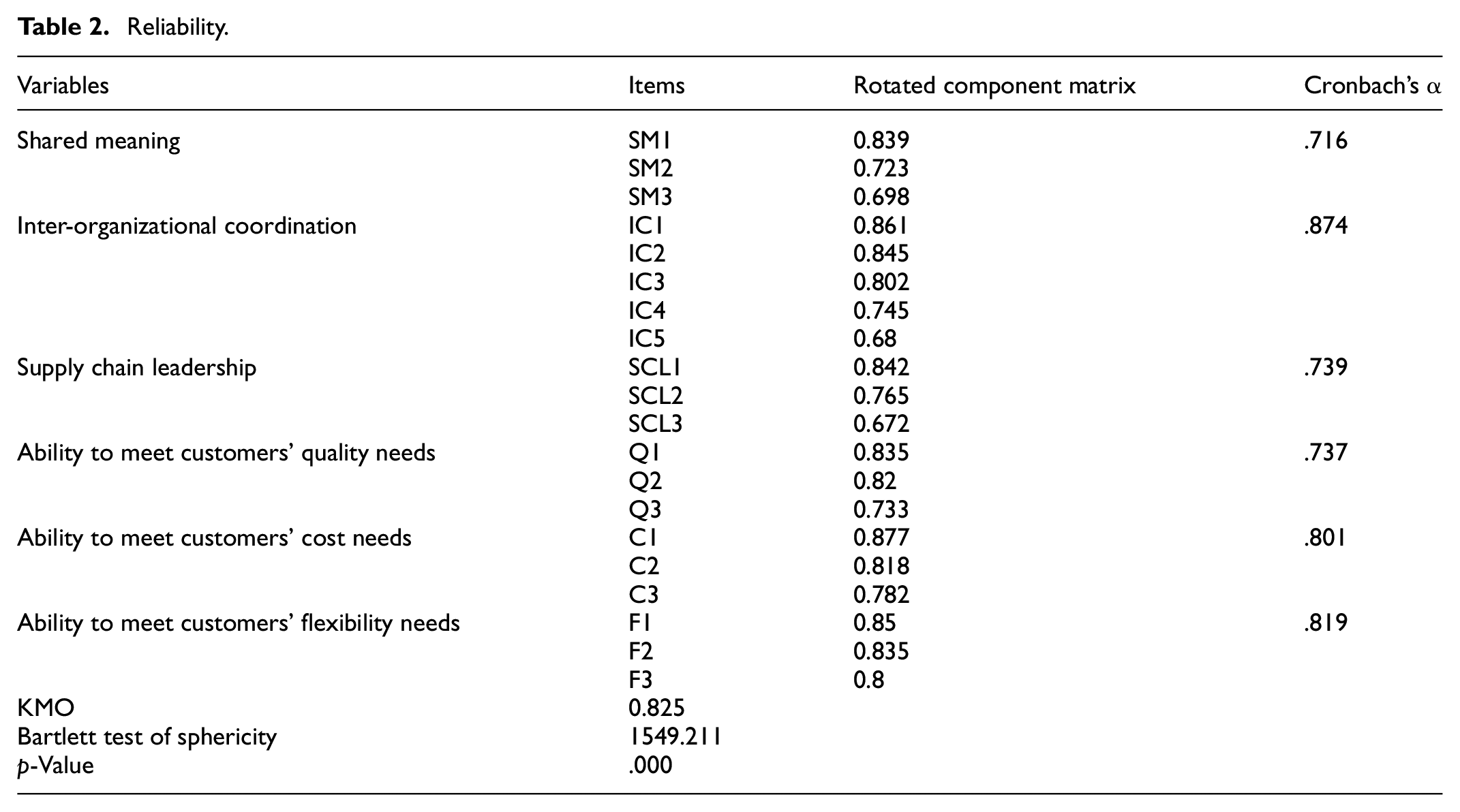
We performed exploratory factor analysis (EFA) for each latent variable to validate the construct’s reliability. Principal component analysis was employed for factor extraction, resulting in the identification of six factors. The outcomes of the exploratory factor analysis revealed that all items exhibited loadings above 0.6 and were appropriately aligned with the factors they measured, affirming a satisfactory level of unidimensionality within the measurements. The mean values, standard deviations, and correlation coefficients for each variable are presented in Table 3.
Descriptive Statistics and Correlation Coefficients.

*p < .05. **p < .01. ***p < .001.
Hypothesis Tests
This study utilized the process plugins of STATA 17.0 and SPSS 26.0, specifically PROCESS V4.1 by Hayes (2017), to perform a linear regression analysis to validate the proposed hypotheses. Hypotheses 1 and 2 suggest the positive effects of Shared Meaning (SM) on Firms’ Abilities and Inter-Organizational Coordination (IC). The linear regression model’s relationships were positive and statistically significant for both cases (coefficient = 0.170, p-value < .01 for H1; coefficient = 0.532, p-value < .001 for H2), robustly supporting Hypotheses 1 and 2. Furthermore, Hypothesis 3, which suggests a positive relationship between IC and Firms’ Abilities, was empirically supported (coefficient = 0.159, p-value < .001).
To ensure the reliability of the study’s results, we conducted a moderated mediation effect test using SPSS 26.0 PROCESS V4.1, employing the bootstrap method as proposed by Hayes (2017). We selected Model 4 to examine Hypothesis 4 and Model 14 for Hypothesis 5, with a sample size of 5,000, at a 95% confidence interval. The results are presented in Tables 4 and 5. The 95% confidence interval for the total mediating effect ranges from 0.0722 to 0.2684, with values that do not encompass 0.
Hypotheses Test Results.

The Mediating Effect of IC.

Additionally, the 95% confidence interval for the indirect effect also excludes 0, while the 95% confidence interval for the direct effect includes 0. These findings affirm the presence of a complete mediating effect, validating Hypothesis 4. The 95% confidence interval for the interaction term between IC and SCL spans from 0.0263 to 0.1772, indicating that SCL moderates the relationship between IC and Firms’ Abilities, supporting Hypothesis 5 (Figure 2).

Research model. Indirect Effect: H4:0.07***, Bootstrapped CI = [0.0217311, 0.1184072].
Figure 3 visually illustrates that the positive relationship between IC and the Ability to Meet Customers’ Needs is pronounced when SCL is high. Conversely, the relationship exhibits flatter slopes when the moderating variable is low. This outcome demonstrates that SCL moderates the positive impact of IC on the Ability to Meet Customers’ Needs.

The moderation effect of supply chain leadership.
Discussion
Theoretical Implications
This study presents several theoretical implications that contribute to the existing research. First, this study is the first to systematically explore shared meaning as a core variable in supply chain management (SCM) and its direct impact on supply chain performance. While prior research has largely focused on trust and collaboration, shared meaning has often been discussed only in relation to these variables or as an implicit contextual factor. This study explicitly defines shared meaning as the foundation for common understanding and coordination among supply chain members. The results demonstrate that shared meaning enhances the supply chain’s ability to meet customer needs (Hypothesis 1) and plays a pivotal role in facilitating inter-organizational coordination (Hypothesis 2).
Second, this research enriches the theoretical understanding of inter-organizational coordination in SCM by showcasing its positive impact on customers’ demands (Hypothesis 3) and its crucial mediating role between shared meaning and supply chain performance (Hypothesis 4). By emphasizing coordination as a central mechanism for transforming shared meaning into performance improvements, the study extends the current SCM literature on the role of collaboration mechanisms in driving organizational success.
Additionally, this is the first study to introduce supply chain leadership (SCL) into the relationship between inter-organizational coordination and supply chain performance. The findings reveal that SCL significantly amplifies the impact of coordination on performance, especially in cases where leadership is strong (Hypothesis 5). This contribution deepens the theoretical understanding of SCL and provides new insights into the critical role of leadership in fostering effective supply chain collaboration.
Managerial Implications
This study provides valuable managerial insights that manufacturing firm leaders can apply to improve supply chain performance. When selecting suppliers for collaboration, firms should prioritize those with shared values and openness to value alignment, as this facilitates smoother coordination and knowledge sharing.
In managing day-to-day operations, it is essential to foster an organizational culture that promotes openness, inclusivity, and robust information-sharing practices with supply chain partners. Such practices help unlock the full potential of the supply chain system. However, managers should be cautious about blind cooperation, which may lead to complacency and opportunistic behaviors, potentially eroding trust and undermining collaboration.
Thus, strategic planning and context-specific adaptation are crucial. Managers should emphasize leveraging the firm’s comparative advantages while maintaining vigilance over partnership dynamics. Furthermore, strengthening leadership within the supply chain is vital, as strong leadership can enhance collaboration effectiveness. Carefully managing the scale of partnerships and strategically influencing partners can foster a more cohesive and high-performing supply chain ecosystem.
Suggestions for Future Research
This study offers valuable insights into how manufacturing firms can enhance their performance in terms of quality, cost, and flexibility by effectively utilizing shared values, inter-organizational coordination, and supply chain leadership.
Nevertheless, the study’s results have certain limitations, presenting suggestions for future research. Future research could extend this study’s focus on shared meaning in manufacturing supply chains to other industries, such as services, retail, or high-tech, to explore whether the role of shared meaning changes in different industrial contexts. As supply chain digitization and automation advance, technology’s role in facilitating shared meaning and inter-organizational coordination becomes increasingly important. Thus, future research should explore how information technology (e.g., big data, blockchain, cloud computing, etc.) affects shared meaning and coordination capabilities among supply chain members and analyze the critical role of technology in enhancing supply chain performance.
The concept of shared values is multifaceted and intricate. This study primarily concentrates on dimensions related to information sharing and understanding while overlooking others. Thus, future research should explore the heterogeneous impact of shared value levels on inter-organizational collaboration and enterprise performance. Additionally, interdisciplinary perspectives and methods can be employed to investigate the role of shared meaning in interpersonal relationships and relationship networks, which can be integrated with other fields within the humanities and social sciences.
Footnotes
Appendix
Construct Measurement Items.
| Measurement items | References | Survey respondents |
|---|---|---|
| Shared meaning | Huber (1991) | Supply chain managers |
| We have developed a shared understanding of supply chain information with our suppliers. | ||
| We share an understanding of the implications of supply chain activities with our supply chain partners. | ||
| It is important to work closely with our suppliers to understand their activities. | ||
| Interorganizational coordination | Sanders (2008) | Supply chain managers |
| We plan product conception and design with our suppliers. | ||
| We plan new products and programs with our suppliers. | ||
| We strategically plan with our suppliers. | ||
| We share operational information with our suppliers. | ||
| We coordinate production planning with our suppliers. | ||
| Supply chain leadership | Min et al. (2007) | Supply chain managers |
| Our plant consults on our supply chain partners’ practices. | ||
| Our plant transfers knowledge to supply chain members. | ||
| Our plant maintains an integrated database and access methods to facilitate information sharing with supply chain members. | ||
| Y1: Ability to meet customers’ quality needs | Flynn et al. (1994), Schroeder and Flynn (2002) | Supply chain managers |
| Our customers have selected us because of our reputation for quality. | ||
| Our customers rely on us for quality products. | ||
| Quality is our customers’ most important criterion when selecting us as a supplier. | ||
| Y2: Ability to meet customers’ cost needs | Schroeder and Flynn (2002) | Supply chain managers |
| Our customers select us because of our reputation for low costs. | ||
| Our customers rely on us for low-cost products. | ||
| Our low costs are our customers’ most important criterion when selecting us as a supplier. | ||
| Y3: Ability to meet customers’ flexibility needs | Schroeder and Flynn (2002) | Supply chain managers |
| Our customers rely on us because we are flexible. | ||
| Our customers select us because of our reputation for flexibility. | ||
| Flexibility is our customers’ most important criterion when selecting us as a supplier. |

Ethical Considerations
The research focuses on technical analysis and does not involve any sensitive topics or personal privacy information, nor does it pose any physical or psychological risks to individuals. Therefore, it was deemed unnecessary to apply for ethical permission. All participants in this study provided their informed consent. Written consent was obtained from each participant after they were fully informed of the study’s purposes, procedures, potential risks, and benefits.
Funding
The author(s) received no financial support for the research, authorship, and/or publication of this article.
Declaration of Conflicting Interests
The author(s) declared no potential conflicts of interest with respect to the research, authorship, and/or publication of this article.
Data Availability Statement
The dataset used in this study was collected collaboratively by members across multiple countries and regions. Due to data ownership and confidentiality agreements, the data cannot be shared publicly.