




Abstract
In the digital era, the incorporation of digital technology into educational settings has underscored the critical role of teachers’ digital competence. Concurrently, self-efficacy has emerged as a key contributor to this competence, attracting significant scholarly attention. This study conducts a scoping review of journal articles published in the Web of Science Core Collection from 2000 to April 2025, aiming to explore the main interactive relationships and influencing factors between teachers’ self-efficacy and their digital competence in the context of the rapid development of educational technology. Research has found that there is heterogeneity in the definitions and measurement methods of self-efficacy and digital competence in the literature. Although existing literature relatively often adopts Bandura’s self-efficacy theory and the European Union’s DigComp digital competence framework, more scholars use self-designed or adapted questionnaires to measure and examine the relationship between the two. Moreover, many studies have confirmed a direct or indirect association between the two, but research on the complex relationship between them is lacking. In addition, factors such as professional development, collaborative practices, access to digital resources, and institutional support were found to play significant roles in shaping teachers’ digital competence and self-efficacy. Drawing on these insights, future research should strive to refine the operational definitions and improve the measurement techniques for evaluating teachers’ digital competence. Additionally, it is vital to delve deeper into the complex interplay between teachers’ self-efficacy and digital competence.
Plain language summary
This study revealed a bidirectional relationship between teachers’ self-efficacy and digital competence, with each construct positively influencing the other. Factors such as professional development, collaborative practices, access to digital resources, and institutional support were found to play significant roles in shaping teachers’ digital competence and self-efficacy. Furthermore, variations in the conceptualization and measurement of these constructs across studies highlight the need for standardized frameworks to facilitate more comprehensive assessments. There is a lack of consensus among scholars regarding the definitions and methods for measuring self-efficacy and digital competence. Although the literature frequently cites Bandura’s theory of self-efficacy and the European Union’s DigComp framework for digital competence, the measurement tools employed are diverse. Researchers often utilize customized or modified questionnaires to assess these concepts as separate variables, examining their interaction.
Keywords
Introduction
The necessity for digital competence in education has become a worldwide phenomenon, underscored by the rapid shift toward remote learning recently (Sehar & Alwi, 2023). This transition has highlighted the importance of teachers’ digital competence and revealed varying levels of willingness among educators to adopt new digital teaching methods. Additionally, self-efficacy plays a critical role, as it strongly influences teachers’ willingness to engage with and use digital tools in their teaching (Z. Wang & Chu, 2023). As technology advances and societal needs evolve, teachers play a pivotal role in advancing educational digitalization and sustainable development, becoming crucial to teaching quality. The European Union introduced the concept of digital competency in the “Key Competence for Lifelong Learning: A European Reference Framework” in 2006, defining it as the confident and critical use of information technology for work, leisure, and communication (Council of the European Union, 2018). From 2013 to 2017, the European Union initiated the Digital Competence Framework for Citizens (DigComp) and the European Framework for the Digital Competence of Educators (DigCompEdu), marking the first attempts to standardize digital competence frameworks (Cabero-Almenara et al., 2021). Over time, the definition of digital competence has evolved to keep pace with technological advancements. The latest version, DigComp2.2, released by the European Union in 2022, expands digital competency to include information and data literacy, communication and collaboration, digital content creation, safety, and problem-solving. However, the lack of a unified academic definition for digital competency confuses with related terms such as information and communication technology literacy (ICT literacy), ICT competency, digital skills, and digital capability (Almerich et al., 2016; Saikkonen & Kaarakainen, 2021; Tsankov & Damyanov, 2019). Consequently, this study embraces a broad interpretation of digital competency, incorporating these associated concepts.
In this study, we adopt the term digital competence as our core construct, following the European Union’s DigComp framework (Vuorikari et al., 2022), which encompasses not only technical ICT skills but also cognitive, social, and ethical dimensions of digital engagement. We distinguish this from digital literacy, which typically refers to the ability to access, evaluate, and create information in digital contexts. ICT skills refer more narrowly to technical abilities such as operating software and hardware, while AI competence represents an emerging subset of digital competence related to understanding and applying artificial intelligence tools in educational settings. Throughout this study, we use these terms carefully to reflect their specific meanings.
In today’s interconnected world, digital literacy is essential. Teachers must be proficient in digital tools for their professional duties. They also need to teach their students these crucial skills (List, 2019). Students, as digital natives, expect technology to be seamlessly integrated into their education. That is why crucial for teachers to remain current with emerging digital technologies (Tzafilkou et al., 2023). More than just givers of knowledge, teachers must now foster a digitally enriched learning environment that is engaging, open to everyone, and responds to each student’s needs (I. K. R. Hatlevik & Hatlevik, 2018; Kreijns et al., 2013; Lim, 2023). Ensuring that teachers possess both the skills and the confidence to use technology is essential for building a digitally literate society prepared for 21st-century challenges (Cosby et al., 2023). Such an approach will transform both teaching practices and how students perceive technology and learning (Sarva et al., 2023). Teachers with high levels of self-efficacy who skillfully integrate digital tools into their teaching are more likely to experiment with new approaches (Dias-Trindade & Ferreira, 2020; Salem & Elshaer, 2023; Vivian & Falkner, 2018), thereby engaging their students in previously inconceivable ways. As a result, students learn more. Addressing resistance to change and institutional inertia is challenging but can be facilitated when teachers have strong confidence in their digital skills. Understanding the challenges and opportunities related to enhancing digital skills and self-confidence requires a global perspective on educators’ readiness to embrace digital education (Saikkonen & Kaarakainen, 2021). This study addresses a key research gap by linking two critical frameworks and exploring how practices and policies can foster the development of educators’ digital competencies.
Self-efficacy is primarily understood in two contexts. The first, grounded in Bandura’s (1997) social cognitive theory, views self-efficacy as a crucial self-perception mechanism that influences thoughts, motivations, emotions, and actions (Clipa et al., 2023; Dofková & Kvintová, 2019). This interpretation is commonly applied in studies that examine attitudes toward the use of digital technology. The second, rooted in behavioral theory, pertains to an individual’s confidence in their ability to achieve desired outcomes and avoid undesired ones, giving rise to concepts, such as computer self-efficacy and information literacy self-efficacy (Agyei et al., 2022; Santi et al., 2020).
Previous studies highlight the necessity for teachers to enhance their digital skills as classrooms become increasingly technologically advanced (O. E. Hatlevik, 2017; Niyazova et al., 2022; Nordén et al., 2017; Srivastava & Dangwal, 2021; Tsankov & Damyanov, 2019). For instance, higher education teachers in China believe in their capability to improve these skills under the right conditions, focusing not just on acquiring the skills but also on pursuing their objectives (Peng et al., 2023b; Z. Wang & Chu, 2023). The literature further emphasizes the significance of operational measures in developing and boosting teachers’ digital competence (Niyazova et al., 2022). Studies from the Turkestan region point out a pressing need for initiatives to bridge the digital competence gap among teachers, stressing the importance of both developing and assessing teachers’ digital competence (Niyazova et al., 2022). This perspective is supported by research identifying barriers to developing teachers’ digital competence, such as uncertainties in digital skills (Saikkonen & Kaarakainen, 2021), lack of motivation (Kaarakainen & Saikkonen, 2021), and the absence of necessary support for using digital tools (Timotheou et al., 2023).
There is substantial evidence of a strong positive association between self-efficacy and the enhancement of digital competency. For example, Birisci and Kul (2019) observed in their study of 174 pre-service teachers in Turkey that self-efficacy significantly positively correlated with all technical teaching ability sub-dimensions, such as design and ethics, indicating that teachers’ self-efficacy directly affects digital competency. Additionally, research has identified an indirect positive relationship between teacher self-efficacy and digital competency, for instance, through the mediation of self-regulated learning strategies (Elstad & Christophersen, 2017; Sezen-Gultekin et al., 2021). Moreover, a survey of different formulations seen in the body of knowledge targeting the competence of educators with regards to making use of digital technology networks a diversity of explications and models (Demissie et al., 2022). This multiplicity of accounts indicates the intricacy of the role of digital competence in terms of a multi-angled construct gathering diverse abilities and fields of learning, crucial for surviving in an era of technological advancement (Skantz-Åberg et al., 2022). The auto-reflection of pedagogical specialists of the future in relation to their digital competence underlines the necessity of empirical experience with information and communication technology (ICT) in practical problem-solving, arguments in favor that practical experience has a focal place in the formation of digital competence (Demissie et al., 2022).
Incorporating digital technologies into educational settings poses a double hurdle: It demands that instructors not only possess adequate digital competence but believe in themselves enough to apply their advanced digital skills effectively (Kaarakainen & Saikkonen, 2021). If digital technologies keep ripping along as they have been, they will vastly improve learning experiences (Demissie et al., 2022). But meeting new demands will always demand evolution. In today’s ever-changing educational system, a major concern is the differing digital skills of teachers (Bahar et al., 2023). How well they perform with technology determines how well their students learn. The first critical determinant identified is a teacher’s self-efficacy, broadly defined as a teacher’s belief in his or her capability to integrate technology successfully into their teaching. In addition, prior research highlights how intricate it is to determine and evaluate digital competency and confidence in oneself, which are vital to grasping the substance of further research. In reality, the significance of these two areas has been recognized, yet there is no universally accepted method for interpreting and assessing them. This lack of consensus makes it extremely challenging to measure and enhance the preparedness of instructors for digital education (Skantz-Åberg et al., 2022). Furthermore, this initial confusion hampers the development of targeted training programs and the creation of consistent, comparative studies across various educational systems.
Despite the growing body of research on digital competence (Boronenko & Fedotova, 2021; Niyazova et al., 2022; Sarva et al., 2023; Srivastava & Dangwal, 2021; Tzafilkou et al., 2023) and self-efficacy (Agyei et al., 2022; Dofková & Kvintová, 2019; Gözüm et al., 2023; Holincheck & Galanti, 2023; Santi et al., 2020), our understanding of how these concepts influence digital-age teaching remains incomplete. A notable gap is the limited exploration of how self-efficacy encourages the growth and application of digital competence among teachers. Although some studies have investigated the relationship between these two notions (O. E. Hatlevik, 2017; Mannila et al., 2018; Sehar & Alwi, 2023), there is a need for more comprehensive research that delves into the nuanced ways teachers’ confidence affects their acceptance and use of digital technology in the classroom. Additionally, current research tends to focus separately on aspects of Digital Literacy or self-confidence, with little attention given to how combining these concepts relates to specific teaching methodologies and outcomes. Furthermore, research on the factors that affect teachers’ abilities and confidence in using digital technology is scarce. While a few studies have explored the role of support and institutional backing, there is a distinct necessity for thorough investigations into the various systems and policies that influence teachers’ digital competencies.
This study seeks to fill in the gaps stemming from previous studies. Our goal is to understand better how teachers’ digital skills and their confidence in those skills affect one another. This study could give a clearer picture of how digital literacy informs teacher training and development and can guide the design of more effective education policies and programs. Despite growing research on digital competence and self-efficacy, several critical issues remain unresolved. First, there is considerable variation in how these constructs are conceptualized and measured, making cross-study comparisons difficult. Second, while many studies suggest associations between self-efficacy and digital competence, the nature and dynamics of this relationship remain underexplored. Third, limited attention has been given to identifying the broader factors that shape these constructs in different educational contexts. Addressing these gaps requires a systematic synthesis of the existing literature. Accordingly, this study is guided by the following research questions:
(a) How are digital competence and self-efficacy among teachers conceptualized and measured across different studies?
(b) What is the relationship between teachers’ self-efficacy and their digital competence?
(c) What factors influence the development of digital competence and self-efficacy among teachers?
This study provides a systematic overview of the existing literature on teachers’ digital competence and self-efficacy, identifying prevailing themes and gaps, and offers insights into effective strategies for fostering these critical skills among educators. This analysis enhances the scholarly discussion by thoroughly examining the interconnection of digital competence and self-efficacy within the realm of teacher training. This essay, by bringing together the outcomes of a wide range of studies, aims to bring the reader to an appreciation of some outlooks and strategies to be used in instruction, as well as to present many new studies. This study is distinctive in that it encompasses a wide array of geographical contexts and educational systems to provide a comprehensive and balanced overview of teachers’ digital competence and self-efficacy across diverse settings.
Methodology
Research Design
The scoping review is a methodology introduced relatively recently, with its origins dating back to the five-stage process framework devised by Arksey and O’Malley (2005). This framework was created to guide the execution of scoping reviews and encompasses the following stages: (1) defining the research question; (2) formulating a literature search strategy; (3) establishing inclusion and exclusion criteria; (4) extracting and graphically presenting information; and (5) summarizing the findings along with discussions and analyses. This study used a scoping review method to map out the existing literature on the relationship between teachers’ efficacy and their digital competence in today’s digital age.
Research Protocol
The research protocol acts as a guide for the scoping review, concentrating on the convergence of the digital prowess, assurance in oneself, and preparations for the world ruled by the digital era. While following the PRISMA-ScR guidelines, we made a structured research protocol to continually identify and examine studies that are relevant to this subject (Tricco et al., 2018). The approach we used made combined information from multiple sources so it would be a thorough and reliable method, which is what we were aiming for. This way of doing it would give us a better understanding of research from this subject. The PRISMA-ScR plan is a very good framework that comes from a lot of evidences (McGowan et al., 2020). In adhering to the PRISMA-ScR checklist, we systematically documented the review process, including search strategy, selection criteria, data extraction, and synthesis. While the checklist provided valuable structure and transparency, limitations include the lack of quantitative synthesis (meta-analysis) due to study heterogeneity, and reliance on available reporting in primary studies, which may introduce reporting bias. The major components of the research protocol are presented in Table 1.
Research Protocol.

Search String and Strategy
The literature search was restricted to papers published up to April 2025, utilizing the Web of Science Core Collection as the database for sourcing English-language literature. We selected 2000 as the starting point because this period marks the emergence of early large-scale policy initiatives on digital competence (e.g., the European Union’s 2000 eLearning Action Plan) and growing scholarly interest in teachers’ integration of ICT in education, providing a relevant and coherent timeframe for capturing the evolution of this research field. We acknowledge that other databases may contain further relevant literature. However, we prioritized the Web of Science Core Collection due to its rigorous curation of high-impact, peer-reviewed journals and its extensive cross-disciplinary coverage, which includes all major journals indexed in ERIC, Scopus, and PsycINFO in the fields of educational technology and teacher education. Using a single high-quality database ensured consistency in indexing practices and avoided duplication biases across sources. The search terms were divided into three categories: Self-efficacy, digital competence, and teacher. The term digital competence was used as the core search term and complemented by related terms, including digital literacy, ICT competence, ICT literacy, information literacy, digital skills, and AI competence. While these terms overlap conceptually, we distinguish them analytically in our study (see Introduction). Thus, the search terms were divided into three categories: “Self-efficacy,”“Digital competence and related constructs,” and “Teachers.” The following search formula was used: Topic: (“self-efficacy”) AND Topic: (“digital competence*” OR “digital capability*” OR “ICT competence*” OR “digital literacy*” OR “ICT literacy*” OR “information literacy*” OR “digital skill*” OR “AI competence*” OR “AI skill*”) AND Topic: (“teacher*” OR “educator*” OR “instructor*”).
Wildcards (*) were used to retrieve variations in key terms (e.g., “competence” and “competency”).
Inclusion and Exclusion Criteria
The initial screening involved examining titles and abstracts to exclude: (a) studies lacking full-text availability; (b) literature not in English; (c) studies not focusing on teachers; and (d) duplicate studies. Further full-text screening eliminated: (a) literature reviews or descriptive studies; (b) studies lacking operational measures of self-efficacy or digital competency; and (c) studies not exploring the correlation between self-efficacy and digital competency. These exclusion criteria helped sift out duplicates, non-English articles, and studies not directly related to the study’s primary themes.
Criteria of Analysis for Scoping Review
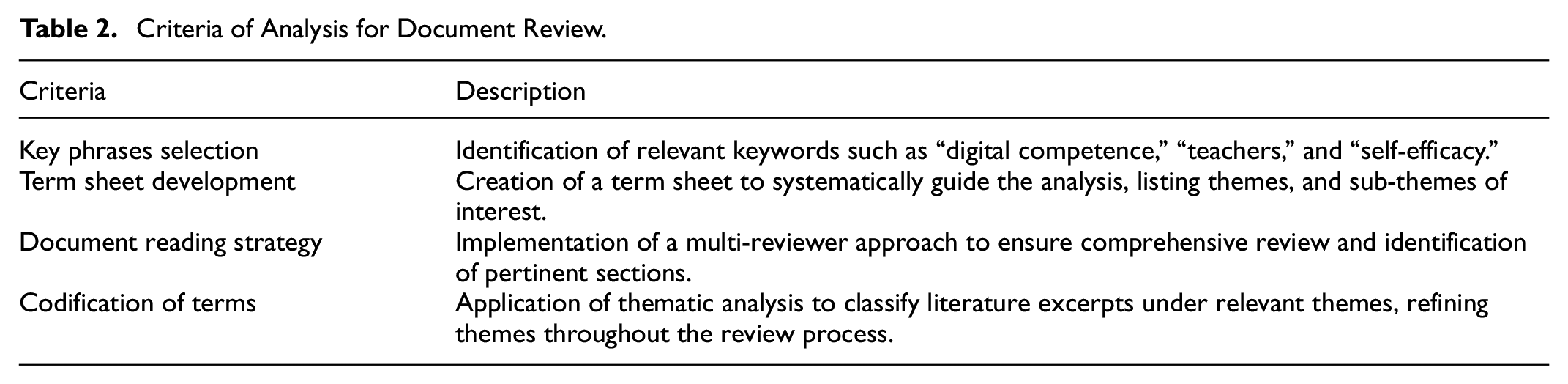
The selected documents were analyzed methodically, as outlined in Table 2. This approach enabled both a broad and detailed examination, employing guidelines conducive to an in-depth review of the studies included in this analysis.
Criteria of Analysis for Document Review.
Qualitative Aspects of Analysis
Thematic analysis was used to synthesize the results from the selected publications, following the approach described by Braun and Clarke (2006). The “dataset” in this study comprised the full texts of the 120 included articles, from which relevant content related to teachers’ self-efficacy, digital competence, and their relationship was extracted and coded. The analysis aimed to identify universal themes connected to the constructs of interest.
Acquaintance with the Data
Every chosen paper was thoroughly read several times to develop a deep understanding of the subject matter, emphasizing the findings about teachers’ digital competence and self-efficacy.
Generating Initial Codes
The researchers followed a methodical procedure to classify the most essential features in the dataset. This process emphasized specific text sections that directly addressed the research inquiries, focusing on examples of building digital competence or demonstrations of self-efficacy.
Theme Identification
The codes were combined and structured into potential themes, with relevant data pulled beneath these themes to help with analysis. This process played a key role in identifying the main areas to focus on, particularly the effects of self-efficacy on developing digital competence.
Reviewing Themes
The themes went through a process of being reviewed and improved to make sure they accurately summarized the data. This involved clarifying the terminology used and making necessary modifications to encapsulate our findings fully. Upon finalizing the themes, they served as the foundation of the results section, which was bolstered by excerpts from the literature reviewed, incorporating data-supported evidence (Table 3).
Term Sheet for Thematic Analysis.

Note. ICT = Information and Communication Technology; TPCK = Technological Pedagogical Content Knowledge.
Data Analysis
To analyze the data systematically and comprehensively, this study was undertaken according to well-established frameworks and approaches. First, the comprehension of all selected documents was thoroughly examined to deeply explore teachers’ main themes of self-efficacy and digital competence. Second, data were systematically coded and organized into pre-identified and emergent themes (e.g., self-efficacy in ICT-related use, professional development, and cooperation practices). Third, a thematic synthesis method was applied, systematically identifying and analyzing the apparent similarities and differences across the data and highlighting the complex interactions between teachers’ self-efficacy and digital competence. Fourth, themes were iteratively validated and refined through collaborative reviews with the co-authors to maximize coherence and consistency. Finally, the findings were categorized into themes to allow for actionable insights that are tied to the study’s research questions and objectives.
Bias Resolution
An integrated approach was taken to counter biases and ensure credibility in findings. First, to enhance reliability, a multi-reviewer system was implemented. Two researchers independently screened the full texts and conducted initial coding. Inter-coder discrepancies were discussed and resolved through consensus meetings. Although formal inter-rater reliability statistics such as Cohen’s kappa were not calculated due to resource constraints, coding consistency was ensured through an iterative consensus process: two reviewers independently coded a random sample of 30 articles, discussed discrepancies in regular calibration meetings, and refined the coding manual until complete agreement was reached before coding the remaining articles. Second, transparent inclusion criteria and exclusion criteria were rigorously implemented for selecting documents to ensure an unbiased selection process. Thirdly, cross-validation was employed on multiple data sources to demonstrate reliability and consistency. The fourth step involved iteratively refining themes based on feedback from peers and external experts. Integrating multiple data sources, such as empirical studies, theoretical papers, and educational frameworks, provided a balanced perspective, while reflexivity techniques were utilized to reduce biases arising from researchers’ interpretations or preconceptions.
Results
Descriptive Results
Document Identification
Initially, two researchers skilled in scoping review methodology identified 712 documents relevant to the study from the Web of Science Core Collection database. Following this, three researchers independently reviewed the titles and abstracts, applying the exclusion criteria to weed out studies that were not pertinent. They coded the literature and shared their insights, which resulted in the elimination of 505 articles due to various reasons: lack of full text (n = 92), non-English language (n = 77), lack of teacher focus (n = 253), and duplicates (n = 83). This process narrowed the field to 207 articles. In the second screening phase, two researchers examined the full texts independently, enforcing the secondary exclusion criteria. Specifically, the primary exclusion criteria included eliminating articles that lacked full-text availability, were not in English, did not focus on teachers, or were duplicates, as described in “Inclusion and Exclusion Criteria” section. The secondary exclusion criteria involved excluding literature reviews, descriptive studies, studies lacking operational measures of self-efficacy or digital competence, and studies not exploring the correlation between these constructs. They discarded an additional 87 documents—40 for being reviews and descriptive studies, 13 for lacking operational measures, and 34 for not addressing the relationship between self-efficacy and digital competency, leaving 120 English-language documents for in-depth analysis and review (Figure 1).

Literature screening flow chart.
Basic Characteristics of the Selected Documents
The basic characteristics of the 120 articles analyzed reveal that a substantial portion of the research emanated from China (n = 26, 21%), closely followed by the United States (n = 15, 13%) (Table 4). The studies were grouped based on the teaching environment: online teaching, offline teaching, and comprehensive studies. The surge in research related to online teaching (n = 20, 17%) aligns with the recent pandemic’s impact. Regarding participant demographics, pre-service teachers were the most frequently studied group (n = 32, 27%), with elementary school teachers coming next (n = 17, 14%). There was a notable lack of research focusing on preschool and university educators. Regarding the methodology, most studies used cross-sectional comparative surveys (n = 104, 87%), while a smaller portion conducted longitudinal follow-up surveys (n = 8, 7%).
Summary of Basic Characteristics of Literature.

Note. (a) includes countries such as Norway, Australia, Spain, and South Korea. (b) encompasses in-service teachers in educational institutions, as well as educators for whom the schooling stages are not clearly distinguished in the literature.
These characteristics highlight the growing international interest in the topic and reveal important gaps, such as limited studies on preschool and university educators, and the predominance of cross-sectional survey designs.
Publication Trends
As shown in Figure 2, an analysis of the English literature on teachers’ self-efficacy and digital competency indicates that the earliest discussion of a relationship between the two is in 2000 (n = 1), with another notable mention in 2002, highlighting a paucity of research during that period. There is a slight increase by 2011. However, a significant surge in relevant publications began in 2016, reaching a peak in 2024 with 30 papers published. This trend underscores a growing academic interest in this topic.

Publication trend over the years.
Definition and Measurement Tools of Self-Efficacy
Of the 120 articles analyzed, most studies used Bandura’s (1997) social cognitive theory to define self-efficacy, describing it as “an individual’s belief in their ability to organize and execute the necessary actions to manage prospective situations.” The other 22 articles delved into self-efficacy within specific contexts. For example, Rigotti et al. (2008) introduced the concept of “occupational self-efficacy,” which refers to an individual’s confidence in performing work-related tasks and responsibilities. Bahar et al. (2023) applied Bandura’s theory to conceptualize teachers’ ICT integration self-efficacy, defining it as their belief in their ability to integrate ICT into their teaching practices. Chou et al. (2024) proposed “AI teaching self-efficacy,” describing it as a teacher’s judgment and confidence in their ability to complete AI tasks.
As outlined in Table 5, the instruments used to measure self-efficacy differ, reflecting the varied research traditions and standards across different countries. Among the established scales, the General Self-Efficacy Scale (GSES) by Schwarzer and Jerusalem (1995) is the most frequently used, appearing in 8% of the studies, followed by the Teacher Self-Efficacy Scale (TSES) developed by Tschannen-Moran and Woolfolk Hoy in 2001 (Tschannen-Moran & Hoy, 2001), which is used in 7% of the studies. Other significant scales include the Information Literacy Self-Efficacy Scale (ILSES) and the Technological Pedagogical Content Knowledge Scale (TPACK-Deep), which accounted for 3% and 4%, respectively. A notable proportion of researchers (30%) employ self-efficacy scales, and 21% use adapted scales for their measurements. These adapted and customized scales typically assess aspects such as confidence in using IT, awareness of digital skills, teachers’ experience, and attitudes toward IT adoption. Across definitions of self-efficacy, common elements include confidence in using digital tools, integrating them into teaching, and solving ICT-related problems. However, aspects such as adapting to new technologies and fostering students’ digital competence are less frequently addressed.
Self-Efficacy Measurement Tools and Usage.

Concept Definition and Measurement Tools of Teachers’ Digital Competency
The concept of digital competency lacks a universally accepted definition. Among the 120 papers analyzed, 48 articles proposed detailed definitions of digital competency. Twenty-five of these adopted the European Union’s 2018 definition from “Key Competences for Lifelong Learning,” which describes digital competency as the confident, critical, and responsible use of and engagement with digital technology for learning, work, and social participation. The remaining 23 articles employ frameworks like the TPACK model to articulate digital competency. Furthermore, due to the occasional lack of clear distinction from related concepts, 72 documents provided definitions or interpretations that closely align with digital competency. For example, Cosby et al. (2023) interpreted digital literacy as the ability to use information and communication technology effectively. Almerich et al. (2016) delineated teachers’ ICT capabilities using a dual-domain model that includes technical and teaching capabilities: technical capabilities entail the knowledge and skills required to fully utilize teaching resources, whereas teaching competencies encompass the skills needed to effectively integrate these technical resources into curriculum design, professional development, and classroom organization. Ning et al. (2025) identified AI literacy as a teacher’s ability to acquire knowledge of AI technologies and to apply AI knowledge to instructional design.
In measuring teachers’ digital competency, as detailed in Table 6, there are notable differences in the assessment tools employed. Among the more widely utilized scales are the DigCompEdu Check-In Questionnaire introduced by the European Union in 2020, the “Survey of Preservice Teachers’ Knowledge of Teaching and Technology” by Schmidt et al. (2009) based on the TPACK framework, and the “Digital Literacy Scale” compiled by Rodríguez-de-Dios et al. (2018). Moreover, researchers frequently modify existing scales or develop new ones tailored to their specific research subjects and objectives, representing a significant portion of the measurement approaches. Definitions of digital competence consistently cover technical skills, information literacy, and pedagogical integration. Less emphasis is placed on critical digital literacy, competence in emerging technologies, and considerations of equity and accessibility.
Teacher Digital Competency Measurement Tools and Usage.

Note. The count exceeds 120 since some papers utilize multiple scales simultaneously.
Cluster Analysis of Self-Efficacy and Teachers’ Digital Competency
This study employs VOSviewer software for cluster analysis on the keywords from the included literature, aiming to illustrate the correlation between self-efficacy and teachers’ digital competency through a keyword co-occurrence network map. As depicted in Figure 3, the graph demonstrates clusters radiating from the center, with dense node connections indicating a high degree of inter-topic keyword linkage. The size of each circle represents the frequency of the associated keyword. The ten most common keywords are self-efficacy, ICT, attitudes, technology, information, digital competence, validation, technology integration, and acceptance. This analysis contributes to Research Question 1 by identifying key conceptual focuses in the literature, and informs Research Question 2 by highlighting which aspects of the self-efficacy–digital competence relationship are emphasized or underexplored. This keyword network provides additional validation for the thematic structure identified in our analysis, as key clusters correspond closely to the core themes and sub-themes explored in “Analytical Results” section (such as ICT self-efficacy, attitudes, collaborative practices, and technology integration). The visual mapping thus reinforces the conceptual relationships underlying our thematic synthesis.

Research Literature Keyword Co-occurrence Network Map.
Analytical Results
Following an extensive screening process, this study ultimately included 120 relevant English-language publications. For accuracy, the study adopted methodologies from scholars like Munn et al. (2018) and Tricco et al. (2018), closely following the scoping review framework proposed by Arksey et al. (2005). In line with “Qualitative Aspects of Analysis” section, a thematic analysis approach was applied following Braun and Clarke (2006) to systematically identify and synthesize key themes and patterns across the included studies. A narrative review method was used to extract data from the 120 chosen articles. This data primarily encompassed the articles’ titles, research areas, contexts, participant groups, sample sizes, research methodologies, and the definitions and measurement tools for self-efficacy and digital competency. The analysis also focused on the connection between self-efficacy and digital competency among teachers and the mechanisms influencing this relationship. This information was then systematically coded based on its retrieval order and subsequently organized, summarized, and analyzed. While most studies provided valuable insights, we observed that the heavy reliance on cross-sectional survey methods and the lack of consistent reporting on sampling and validation procedures limit the generalizability and robustness of the evidence. These methodological patterns are critically appraised in “Critical Appraisal of Methodological Quality” section.
Direct Association Between Self-Efficacy and Teachers’ Digital Competence
There are several critical sub-themes implicated in the main theme relating to the direct effect of the teachers’ digital literacy. These sub-themes encompass varied aspects of the teacher’s belief in their capabilities, each of which impacts their competence in the digital incorporation in their classrooms. The essence of these sub-themes’ significance is supported by an empirical record that posits the confirmation of digital capabilities in pedagogy. The convergence of these sub-themes suggests that higher levels of teachers’ self-efficacy are consistently associated with higher levels of digital competence (Table 7).
Direct Effect of Self-Efficacy on Teachers’ Digital Competence.

ICT self-efficacy is the fundamental aspect of an individual’s capability to use digital competence among instructors, which incorporates confidence in utilizing digital technologies. Research demonstrates an unequivocal relationship between this confidence and enhanced digital integration in pedagogic practices, showing that particular preparation can develop ICT self-efficacy and, afterwards, digital competence (Nurhikmah et al., 2024). Teachers’ self-confidence regarding their ability to apply technology to teaching and their knowledge of information significantly enhances their competency with digital tools. This implies that it is important for TPCK to cultivate self-confidence to use digital materials in educational activities effectively (Kukul, 2022). Confidence in addressing technical challenges in the classroom is a crucial aspect of digital competence. By instilling an attitude based on problem-solving and technology, educators can further and more effectively generate a blend of digital learning and teaching in their classes (Ibragimova & Kandaurova, 2022). Self-efficacy’s direct influence on teachers’ digital competencies is complex. It includes ICT self-efficacy, confidence in teaching activities, the mastery of TPCK, and problem-solving skills (Baroudi & Shaya, 2022). The findings show the necessity of educational policies and teacher training programs (Baroudi & Shaya, 2022). They must try to improve these examples of self-efficacy. By doing so, teachers’ digital competencies can grow, and they will be ready to face the new challenges of the digital age.
Indirect Associations Between Self-Efficacy and Teachers’ Digital Competence
Few scholars have explored the indirect relationship between self-efficacy and digital literacy. Under this theme, different sub-themes elaborate on how self-efficacy indirectly influences digital literacy levels, particularly emphasizing the important role of self-regulated learning, attitude, cooperation, infrastructural support, classroom practice, and information assessment. By synthesizing the works of others in this particular area of study, it can be ascertained that teachers’ digital competence can significantly benefit from indirect routes, provided that a group of ideas aligns in a specific way (Table 8).
Indirect Effect of Self-Efficacy on Teachers’ Digital Competence.

J. Zhang et al. (2021) reported that self-regulated learning strategies act as an intermediary in the relationship between self-efficacy and digital competence. This discovery indicates that by building an environment of encouragement and fostering self-regulated learning, teachers can indirectly amplify their digital competence levels by promoting proactive initiatives for occupational improvements. Peng et al. (2023a)’s research emphasizes the important role played by teachers’ feelings about technology, perceived simplicity of use, and the amount of assistance given to them. When attitudes are positive and there are good support systems in place, it can markedly change the course of action and increase the level of digital competency in teaching. Continuous professional growth accelerates progress by improving teachers’ skills and confidence (Ibragimova & Kandaurova, 2022). Dai (2023) pointed out collaborative practices among teachers (such as peer learning and team teaching) and infrastructure support are crucial. These collaborative practices and technical facilities can promote the innovative application of digital technologies in education through self-efficacy, enhancing teachers’ digital literacy. In addition, the studies show that best practices in classrooms and strategies to evaluate information also mediate the relationship between teachers’ self-efficacy and their digital competence.
Complex Relationship Between Self-Efficacy and Digital Competence
The studies also reveal the complex and evolving relationship between self-efficacy and digital competence, illustrating how they intertwine rather than simply support each other, with their success depending on a wide array of external and situational factors (Table 9).
Complex Relationship Between Self-Efficacy and Digital Competence.

Some studies explore the dynamic and intricate relationship between self-efficacy and digital competence, revealing that their interaction is not one-way. Lim (2023) identifies a bidirectional relationship where improvements in one area can lead to advancements in another. This mutual influence suggests that enhancing educators’ digital competence (including but not limited to digital literacy) could, in turn, strengthen their self-efficacy, creating a positive feedback loop that elevates both aspects. The connection between self-efficacy and digital proficiency evolves as educators and students progress through different learning and teaching stages. This variability questions the foundational assumptions of content and pedagogy. Saikkonen and Kaarakainen (2021), along with Paetsch et al. (2023), provide evidence that the relationship between efficacy and competence remains stable during periods of significant systemic disruption. The study highlights the critical role of external influences, such as technological advancements and improved educational policies, in shaping individuals’ confidence in digital technology. Olimpo (2013) and Sarva et al. (2023) advocate for a broader approach considering these extensive impacts as we aim to enhance teachers’ proficiency with digital technology. Thus, they challenge the notion that the relationship between efficacy and competence can be fully understood during periods of profound change. In addition, numerous studies have verified significant differences in self-efficacy and digital literacy among different sample characteristics (age, gender, teaching experience, environment). This suggests the need for different, place- and demographic-sensitive professional development programs.
Influencing Factors of Self-Efficacy and Digital Competence
Recent studies have shown that various factors, ranging from educators’ personal characteristics to the educational systems in which they operate, influence teachers’ self-efficacy and digital literacy. However, the most critical factors are concentrated in policy and organizational support, digital technology and application practice, teaching and collaborative environment, ethics and security, and individual factors (Figure 4).

Influencing factors and their specific indicators.
The intricate link between self-efficacy and digital competence illustrates the correlation of teachers’ capability to integrate digital tools into their teaching, influenced by internal and external components. It is crucial to examine both the direct and indirect impacts of self-efficacy in conjunction with the effect of larger contextual factors, to devise solutions for improved technological proficiency among teachers. Pinpointing these specific areas of need presents an opportunity for targeted interventions and government regulations which can better prepare educators for the demands of the digital era and support improved educational outcomes.
Discussion
Conceptualization and Measurement of Self-Efficacy and Digital Competence
The identification and evaluation of teachers’ self-efficacy and digital competence are now crucial topics in the ongoing conversation about integrating technology into education. In this discussion, we further synthesize key insights from the literature reviewed in “Analytical Results” section and critically interpret how definitions and measurement practices reflect broader theoretical trends. This study examines the diverse ways researchers define and measure these constructs, emphasizing the need for a clear, consistent perspective.
The understanding of digital competence, digital literacy, ICT skills, and AI competence varies across the literature, with different definitions and measures used to assess these related but distinct constructs. In this study, we adopt digital competence as our primary focus. As digital skills, we understand the ability to use technology in a way that makes learning and teaching more effective (Santi et al., 2020). This includes mastering not only basic digital skills but also pedagogical skills, using information technology or multimedia. Teachers’ self-confidence in digital skills, on the other hand, is understood broadly as the extent to which they feel they can successfully implement digital tools in teaching (Lim, 2023).
Digital competence involves not only technical skills (Olimpo, 2013) but also cognitive, creative, communicative, and collaborative skills needed to function effectively in the digital world (Tsankov & Damyanov, 2019). Recent frameworks such as DigComp 2.1 and DigCompEdu list an inventory of skills and attitudes that highlight the role of digital competence as an important means for fostering autonomous, self-regulated learning (Dias-Trindade & Ferreira, 2020; Vuorikari et al., 2022).
Measuring self-efficacy and digital competence remains an active and evolving area of research. The General Self-Efficacy Scale (GSES) developed by Schwarzer and Jerusalem (1995) remains the most widely used instrument; many scholars adapt it to focus on teachers’ confidence in using information technology, awareness of digital skills, and attitudes toward adopting digital tools. For digital competence, numerous studies follow the DigiComp 2.0 framework and related standards to document and support teachers’ integration of digital literacy into the curriculum (Nordén et al., 2017).
The Relationship Between Self-Efficacy and Teachers’ Digital Literacy
Direct Effect of Self-Efficacy on Teachers’ Digital Competency
Out of the 120 papers analyzed, most studies report a positive association between teachers’ self-efficacy and their digital competency. Due to the highly situational nature of self-efficacy, related studies often define it in specific contexts, such as ICT self-efficacy, Self-efficacy in teaching tasks, and self-efficacy in problem-solving. Some papers further divide self-efficacy into different dimensions to explore its relationship with teachers’ digital literacy. For instance, Dai (2023) found a moderate positive correlation between ICT self-efficacy and digital competency in a survey of pre-service English teachers, indicating that higher ICT self-efficacy corresponds to higher digital competency. Chen (2019) found that self-efficacy directly influences digital competence. Specifically, teachers’ self-efficacy affects TPCK regardless of their service status. Additionally, Taggart et al. (2023) propose that short interventions might be used by pre-service teachers to assess their digital skills and create a plan of action to improve them. The study found that all three types of self-efficacy are positively correlated with digital competency, with teaching task self-efficacy showing a significantly stronger correlation with TPK than the other types of self-efficacy.
Indirect Effect of Self-Efficacy on Teachers’ Digital Competency
A subset of the literature indicates that self-efficacy indirectly influences teachers’ digital literacy. The mediating variables in existing studies mainly focus on self-regulated learning, attitudinal factors, collaborative practices, infrastructural support, practices in classrooms, and strategies to evaluate information. Except for one study suggesting a complete mediating relationship (J. Zhang et al., 2021), all other conclusions show a partial mediating relationship. This indicates indirect effects coexist with direct effects, further validating the main effect model. For example, Peng et al. (2023b) surveyed 685 teachers in Henan Province, China, and they found that self-efficacy not only directly affects digital competence but also indirectly affects digital competence through teachers’ attitudes.
Complex Relationship Between Self-Efficacy and Teachers’ Digital Competency
Conceptually, self-efficacy represents a motivational and cognitive readiness to engage with digital technologies, while digital competence reflects the concrete knowledge, skills, and attitudes required for effective technology use. Understanding how these two constructs interact offers critical insight into both the psychological drivers and practical outcomes of teachers’ digital engagement. Our synthesis builds on this complexity by explicitly integrating Bandura’s self-efficacy theory and the DigComp framework, showing how their interaction creates a dynamic, reciprocal relationship influencing teachers’ digital readiness. This complexity is reflected in the mutual influence between the two, their different effects in different stages or contexts, and the heterogeneity of different subject characteristics. A crucial element of education dynamics is the interconnectedness of teachers’ self-efficacy and digital competence. Lim (2023) empirically showed a mutual influence where teacher self-efficacy positively predicts digital literacy, which, in turn, enhances self-efficacy. Furthermore, the influence of self-efficacy on digital literacy varies across different stages and educational settings. Saikkonen and Kaarakainen (2021) observed a positive link between self-efficacy and digital information skills during on-the-job training without comparing this to other periods. Paetsch et al. (2023) divided their analysis into three pandemic phases, discovering an initial negative relationship between teachers’ self-efficacy and ICT literacy pre-pandemic, contrary to usual expectations. Their study underscored a shift toward a positive association between ICT use for teaching and learning after the initial school shutdowns.
The reviewed studies reveal that cultural, infrastructural, and policy environments significantly shape teachers’ self-efficacy and digital competence. Centralized ICT policies in China and Turkey (Birisci & Kul, 2019; Dai, 2023; Z. Wang & Chu, 2023) contrast with Nordic countries’ emphasis on collaborative learning and school autonomy (Andreasen et al., 2022; O. E. Hatlevik, 2017; I. K. R. Hatlevik & Hatlevik, 2018). In developing contexts, infrastructural gaps (Demissie et al., 2022; Niyazova et al., 2022) hinder both competence and self-efficacy, while advanced systems face fewer such barriers. Cultural attitudes also matter—Finland (Kaarakainen & Saikkonen, 2021) fosters innovation, whereas more risk-averse cultures show reluctance despite technical competence. These findings highlight the need to adapt policies and training to local contexts rather than applying universal models. In addition, numerous studies highlight significant differences in self-efficacy and digital competence across both individual characteristics (age, gender, teaching experience, environment) and broader contextual factors such as national policies, infrastructure, and cultural attitudes (Cataudella et al., 2024).
While existing studies often employ Bandura’s (1997) self-efficacy theory and the DigComp framework (Vuorikari et al., 2022) separately, our synthesis reveals important synergies between these conceptual lenses. Bandura’s theory explains how beliefs in personal capability (self-efficacy) influence motivational and behavioral outcomes—in this case, teachers’ willingness and persistence in using digital technologies. The DigComp framework, on the other hand, provides a structured set of competencies that define what teachers need to be digitally competent. Our findings suggest that teachers’ self-efficacy not only supports the acquisition of specific DigComp domains (e.g., digital content creation, problem solving), but also reinforces their continued application and pedagogical integration. Conversely, achieving proficiency in these competencies further enhances teachers’ digital self-efficacy through mastery experiences—a reciprocal relationship consistent with Bandura’s model of self-regulation and learning.
Moreover, factors such as professional development, collaborative practices, institutional support, and attitudinal variables act as mediators and moderators that shape this bidirectional relationship. Synthesizing these insights, we propose a conceptual model (Figure 5) illustrating how self-efficacy and digital competence co-evolve, driven by internal beliefs, contextual supports, and practical experiences. This model advances the theoretical integration between Bandura’s theory and the DigComp framework by positioning self-efficacy not merely as an antecedent or outcome, but as a dynamic driver of digital competence development in educational settings.

Conceptual model of the relationship between self-efficacy and digital competence in teachers.
Factors Influencing the Development of Self-Efficacy and Digital Competence
Several considerations are at stake in building teachers’ digital self-efficacy and competence: policy and organizational support (Ikhlas & Dela Rosa, 2023; Pettersson, 2018; Somekh, 2016; Tsankov & Damyanov, 2019); digital technology and application practice (Boronenko & Fedotova, 2021; Chu et al., 2023; Moorhouse, 2023; Olimpo, 2013; Taggart et al., 2023); teaching and collaboration environment (Andreasen et al., 2022; Baroudi & Shaya, 2022); ethics and security (Boronenko & Fedotova, 2021; Sharpton, 2021; Shonfeld et al., 2022; Southall, 2012); and individual factors (Cataudella et al., 2024; Moorhouse, 2023; Nagy & Dringó-Horváth, 2024; Qu et al., 2023). These factors manifest themselves through specific variables that influence digital competence and self-efficacy of teachers, respectively. Their interplay demonstrates the complexity of addressing and nurturing both components simultaneously within a systemic framework; teachers’ self-efficacy and digital competence are two. As such, macrolevel measures include policy development, management, and infrastructure. Personal development practice should be implemented to promote teachers’ digital competency to help fulfill their educational responsibilities more easily.
Identified Research Gap
To address the research gap, future studies could enhance this field of research in three key ways:
Standardize the Definition and Measurement of Teachers’ Digital Competency
Currently, there is no unified definition of digital competency in the academic world, and measurement tools vary. Claro et al. (2018) noted that defining digital literacy is at the center of a heated debate over the evolving nature of literacy in our culture. The dynamic nature of digital competency makes it challenging for researchers to adopt a single, dominant tool or model for measurement. This inconsistency complicates cross-study comparisons and impedes knowledge development in the field. To address this, future research should aim to refine the definition and understanding of digital competency through theoretical analysis and empirical study, providing more unified standards and more precise guidance for both research and practice. Additionally, focusing on the development of standardized measurement tools will enhance the consistency and reliability of these instruments, offering more precise and dependable data for research and practical applications.
Deepen Research on the Relationship Between Self-Efficacy and Teachers’ Digital Competency
The existing literature primarily explores the direct or indirect relationships between self-efficacy and digital competency, emphasizing the strong association between these constructs. However, causal inferences remain unsupported due to the predominance of correlational designs. However, focusing narrowly on these relationships may oversimplify their dynamics. While some studies have begun to explore the nonlinear aspects of this relationship, much remains to be discovered about its complexities (Chen, 2019; Maftei et al., 2023). Moreover, studies have mentioned the influence of different sample characteristics (such as gender and environment) on these variables, as shown by Clipa et al. (2023). However, there are few studies on the differences in other sample characteristics in the process of digital competence changes. Few studies systematically compare how this relationship evolves over time, presenting an opportunity for further research.
Enhance Cross-Domain
The reviewed literature often focuses on singular backgrounds, types, or regional subjects, with limited comparative studies across domains, such as between pre-service and in-service teachers (Gu & Lai, 2019). Future research should examine differences across teacher groups, identify the required digital competencies, and explore how these variations influence the self-efficacy–digital competence relationship. This approach will provide more nuanced training and development recommendations for diverse groups and offer the academic community insights beyond fixed and singular perspectives.
Critical Appraisal of Methodological Quality
While our scoping review aimed to provide a broad mapping of the literature, a critical appraisal of the methodological quality reveals important insights and limitations in the existing evidence base. Most studies (87%) employed cross-sectional survey designs, often relying on self-reported data and convenience sampling, which introduces potential risks of social desirability bias and limits causal inferences. Only 7% of studies used longitudinal designs, and very few included experimental or quasi-experimental methods to test interventions to improve self-efficacy or digital competence. Furthermore, although many studies reported satisfactory internal consistency for their instruments (e.g., Cronbach’s alpha), few studies conducted thorough construct validation or tested for measurement invariance across teacher subgroups or cultural contexts. This highlights the need for further effectiveness testing and validation before widespread application of existing measurement tools in diverse educational settings. Risks of publication bias are also present, as studies with positive associations between self-efficacy and digital competence are more likely to appear in the literature. Finally, detailed reporting of sampling procedures and response rates was inconsistent, which poses challenges for assessing the external validity of findings. Future research would benefit from stronger methodological designs, including mixed-methods approaches and robust longitudinal analyses, to better establish causality and reduce bias risks in this important area of teacher education.
Practical Implications for Policy and Practice
The findings of this study offer several actionable insights for education policymakers, teacher training programs, and curriculum designers. First, education policy frameworks should explicitly integrate self-efficacy building strategies into national and regional digital competence initiatives (e.g., through DigComp-based teacher standards), recognizing that self-efficacy is both a driver and outcome of digital competence development. Second, teacher training programs should embed targeted interventions to enhance ICT self-efficacy alongside technical skill development—for example, through scaffolded mastery experiences, modeling of effective digital pedagogy, and structured opportunities for reflective practice. Third, curriculum design for teacher education should adopt a holistic view of digital competence, including not only technical and pedagogical components but also fostering confidence in problem-solving and innovation with digital tools. Additionally, ongoing professional development should prioritize collaborative learning environments where peer exchange and shared experiences can build both digital competence and self-efficacy. Finally, institutional leaders should provide robust infrastructural support and cultivate a school culture that encourages experimentation and reduces the fear of failure, as these contextual factors were shown to moderate the self-efficacy–competence relationship. By addressing these actionable priorities, education systems can move beyond generic capacity building to foster sustainable and confident digital readiness among teachers.
Conclusions
This article reviews 120 English-language publications on the relationship between self-efficacy and teachers’ digital competency, guided by the PRISMA-ScR checklist for scoping reviews. Through an in-depth analysis of recent literature, this study has explored the conceptualization and measurement of these constructs, the nature of their relationship, and the factors influencing their development among teachers. The results illustrate a complex view where teachers’ self-efficacy in digital domains is strongly associated with their ability to integrate digital tools effectively into teaching practices. While the existing research has yielded significant findings, it also highlights areas for improvement. This study has revealed the critical interplay between teachers’ self-efficacy and digital competence. This connection is crucial to avoid challenges related to distribution of information and in dealing with new opportunities presented by online communication and data-sharing possibilities. A crucial element presented is the dual direction between self-efficacy and digital competence relationship where these constructs appear to reinforce each other in a bidirectional association. This highlights the unavailable capabilities of specific treatment with the intent of perfecting self-confidence to boost teachers’ capability in digital spheres in problem-solving. Additionally, the evaluation emphasizes the significance of group effort in professional development and framework creating an environment more suitable for developing crucial abilities. The strong connection among teachers’ skill, confidence in themselves to control classes, and stability in using digital tools toward the requirement of entire preparation systems for professionals. Their entire goal is to develop technology, knowledge, and skills aside from focusing on enhancing confidence and capability by using digital equipment for education. The review also pinpointed several external factors, including the growth of digital technology and the way of teaching in schools, that will affect the relationship between self-efficacy and digital competence to navigate the digital world. By addressing these critical aspects, this study makes a timely and valuable contribution to the ongoing discourse on fostering digital competence and teacher self-efficacy in the digital age.
Overall, this study offers valuable insights regarding the intricacies of preparing educators for the digital era. This study places front and center the crucial role of self-perception in developing digital skills and argues that specific, top-down plans need to implemented to bolster the professional growth of instructors, with a particular focus on digital capabilities. In addition to identifying what is missing and strengthening what is already available, the paper argues that stronger systemic support is needed to help educators bridge the digital divide. Moreover, future research should adopt innovative approaches to fostering educators’ confidence and expertise in digital teaching, with a concentrated effort directed not only toward in-person instruction overall but also to making sure educators can withstand and evolve during the coming transformative period in which communication and information sharing is done mostly electronically.
Based on our synthesis, we recommend that education policymakers and teacher educators adopt targeted interventions to build teacher self-efficacy alongside digital competence, embed such strategies in curriculum design and professional development, and create supportive institutional environments that promote sustainable digital teaching practices. Future efforts must also account for contextual differences, as variations in policy, infrastructure, and cultural attitudes substantially influence how teachers develop and apply digital competence and self-efficacy.
Limitations and Future Research Directions
Even though this thorough scoping review is extensive, it has several limitations. Firstly, this study mainly focused on articles that were published in English. It might have missed some significant insights from studies conducted in other languages. Secondly, the reliance on published academic literature can introduce a bias in favor of certain publications. Thirdly, how digital competence and self-efficacy were conceptualized and measured varied significantly among the studies reviewed. Fourthly, digital technology is constantly changing, so the digital competence needed today may not be the same tomorrow. This may mean that the research findings might not last for long. Finally, while the review highlighted the relationship between self-efficacy and digital competence, the causal direction of this relationship remains an area needing further exploration. To address the limitations, future research should focus on several issues. First, future research should include more diverse perspectives and phenomena. This will deepen our understanding of educators’ digital competence and self-efficacy, laying the foundation for research in different cultural categories and educational contexts. Secondly, there is a necessity for longer-term investigations that can more precisely evaluate the progression of digital competence and self-efficacy as time goes by, thereby supplying enlightenment into their causal linkage and the extended influence of measures tailored to fortify these ideas. Thirdly, the development of universally agreed-upon methods for measuring digital competence and self-efficacy will make it much easier to compare findings across studies and educational environments. Fourthly, future research should examine the results of newfangled digital technologies regarding the digital competence that educators ought to have to make good use of the fresh tools and resources. Finally, intervention-based research must be conducted. This research will assess the effectiveness of particular strategies in enhancing teachers’ self-efficacy and digital competence simultaneously.
Footnotes

Author Contributions
HU conceptualized the research. HU, WX, ZW, ML, and WDX conducted the analysis and wrote the original manuscript. HU, WX, ZW, ML, and WDX edited the manuscript. All authors approved the current version for publication.
Funding
The author(s) disclosed receipt of the following financial support for the research, authorship, and/or publication of this article: This study is funded by the Sichuan Philosophy and Social Sciences Fund (SCJJ24ND158), the Sichuan Compulsory Education High-Quality Development Research Center (Project Number: YWYB-2023-03), and the Sichuan Province Teacher Education Research Center (Project Number: TER2022-012).
Declaration of Conflicting Interests
The author(s) declared no potential conflicts of interest with respect to the research, authorship, and/or publication of this article.
Data Availability Statement
Due to institutional policies, the datasets generated and/or analyzed during the current study are not publicly available but are available from the corresponding author upon reasonable request.