




Abstract
Content and Language Integrated Learning (CLIL), widely established as a mainstream approach in ESL countries, is gaining traction in EFL contexts through selective programs and initiatives. Reflecting this trend, Vietnam’s educational reforms under the 2018 General Education Program have incorporated CLIL-informed lessons into newly adopted English textbooks, signaling a step toward integrating language and subject learning. However, the CLIL-informed lesson remains relatively new to EFL teachers in Vietnamese high schools. Surveying EFL teachers’ understandings and their teaching practices are crucial to discover their theoretical knowledge and practical application in teaching CLIL. It is essential to examine how other factors influence this relationship and identify the challenges and support teachers need in delivering these new lessons. The study employed a mixed-methods approach aimed at investigating EFL high school teachers’ understandings, teaching practices, challenges and needs when delivering CLIL-informed lessons. The study collected quantitative data from 326 participants, along with qualitative data from interviews from 6 chosen teachers. Findings revealed that with differing cognitive factors, educational backgrounds, and working circumstances, teachers demonstrated their adaptability by tailoring the lessons with their own “localized CLIL model” and expressed further support in training for maximizing CLIL benefits in harmony with other contextual constraints. These findings, under the lens of Cultural-Historical Activity Theory, serve as valuable references for other EFL teachers, curriculum developers and textbook publishers in supporting the implementation and diffusion of CLIL.
Keywords
Introduction
CLIL is widely adopted in English-speaking and ESL countries as a mainstream approach that combines language learning with academic subjects, thereby enhancing both linguistic proficiency and content knowledge (Coyle et al., 2010; Mattheoudakis et al., 2018). In EFL contexts, however, the implementation of CLIL tends to be more limited, often confined to experimental projects or select programs aimed at developing language competence (Raud & Orehhova, 2023). Within a similar educational landscape, the Vietnamese government and Ministry of Education and Training have recently prioritized the development of learners’ intercultural communicative competence in foreign language teaching (H. T. Nguyen et al., 2025). This shift is further reinforced by broader policy directions, including Conclusion No. 91-KL/TW by the Politburo of Vietnam, which signals a gradual transition from viewing English as a foreign language (EFL) to positioning it as a second language (ESL) in schools, particularly through the instruction of other subjects in English. As part of these reforms, English textbooks have introduced CLIL-informed lessons into the national curriculum to align language education more closely with interdisciplinary learning goals. However, for in-service EFL high school teachers (EHTs), particularly those trained in language-dominant methods in the late 20th century, CLIL remains a relatively unfamiliar pedagogical approach. Given the central role teachers play as agents of educational change (Fullan, 2015), it is vital to understand how they perceive, interpret, and implement CLIL-informed instruction in practice. To address this need, the present mixed-methods study investigates EHTs’ understandings of CLIL and their classroom strategies, drawing on survey data from 326 teachers and in-depth interviews with 6 participants. The study aims to offer timely insights on the current state of CLIL-informed teaching in Vietnamese high schools and identify areas for professional development and systemic support.
Literature Review
Understandings of “What is CLIL?”
CLIL was initially introduced in Europe in the 1990s (Budiarta et al., 2020). CLIL is defined as an “umbrella term” covering different educational methodologies promoting simultaneous teaching of content (science, mathematics, or history) and language flexibly and can be adapted to diverse levels of language proficiency and curricular demand (Dalton-Puffer, 2011). CLIL is “a dual-focused educational approach in which an additional language is used for the learning and teaching of both content and language,” stressing that content and language learning goals are equally important, with learners development in both areas simultaneously (Coyle et al., 2010, p. 1; Marsh et al., 2012, p. 1). In line with its aims to investigate EHTs’ understandings of CLIL and their practices in CLIL-informed lessons, this research defines CLIL as a dual-focused educational approach where content and language are taught through English to enhance content knowledge and linguistic competence. The 4Cs framework (Coyle, 2006) is essential for ensuring that the content and language objectives in a CLIL-informed lesson are addressed effectively. The 4Cs framework for CLIL (see Figure 1) includes “Content (progression in knowledge, skills), Communication (interaction and language in use), Cognition (engagement for critical thinking), and Culture (self awareness/citizenship).”

The 4Cs framework for CLIL (Coyle, 2006, p. 10).
This study adopts the 4Cs framework (Coyle et al., 2010) to investigate how Vietnamese high school English teachers understand and apply a CLIL-informed approach in their classrooms. In this approach, Content refers to the subject matter or cross-curricular themes that are integrated into language lessons. Teachers must identify key concepts and processes central to the topic, ensuring the content is meaningful and relevant. Communication involves planning how language will support content access, focusing on the language of learning (e.g., vocabulary and structures specific to the topic), language for learning (e.g., expressions for classroom interaction), and language through learning (i.e., emergent language developed through engagement with content). Cognition refers to the thinking skills required to engage with content meaningfully; rather than relying on rote learning, teachers are encouraged to design cognitively challenging tasks based on revised Bloom’s Taxonomy (Anderson & Krathwohl, 2001), which promotes skills ranging from remembering to creating. Culture encompasses the development of intercultural understanding and global awareness, encouraging students to examine how people from different backgrounds approach similar issues, thereby fostering a more inclusive and critical worldview. By using this CLIL-informed conceptual framework, the study explores how EFL teachers incorporate content, language, cognition, and culture into their teaching practice in ways that reflect adapted CLIL principles suited to local EFL contexts.
CLIL-informed Principles Underlying English Teaching and Learning Activities
A CLIL-informed lesson resembles an integrated-skills English lesson, but with a more explicit focus on content-based themes, delivered by EFL teachers using CLIL strategies. This adaptation is particularly relevant in contexts like Vietnam, where English teachers often incorporate academic or interdisciplinary content into their instruction without fully adopting a dual-teacher model.
Existing literature identifies eight driving principles of CLIL that inform this study. These principles highlight how content and language learning can be intertwined to promote deeper subject engagement and language development (Pokrivčáková, 2015):
(1) Dual-focused learning: CLIL aims to develop learners’ academic content knowledge and language proficiency simultaneously (Coyle et al., 2010). This principle underpins the CLIL-informed approach, where language is acquired in meaningful content-rich contexts.
(2) Scaffolding: Teachers support learners through modeling, visual aids, and structured language inputs. Authentic materialsm such as social media posts, news articles, and video clips, are used to contextualize learning and make content accessible (Coyle et al., 2010).
(3) Cognitive overload: Learners engage with content through higher-order thinking tasks, which involve analyzing, evaluating, and creating in a foreign language. This promotes both deeper learning and more meaningful language use (Coyle et al., 2010).
(4) Language in use: Rather than isolating grammar and vocabulary, language is learned through real-world use and classroom interaction. “Meaningful communication” is central, with students acquiring language through engagement with content (Dalton-Puffer, 2011, p. 185).
(5) Cultural awareness: CLIL-informed lessons foster intercultural competence by embedding cultural perspectives into content and language instruction. Understanding diverse viewpoints becomes an integral goal (Coyle et al., 2010).
(6) Integration of skills: A CLIL-informed lesson develops listening, speaking, reading, and writing simultaneously. Listening and reading serve as input sources; speaking emphasizes fluency; writing provides opportunities for recycling language through content tasks (Darn, 2006).
(7) Active learning: Student-centered approaches encourage engagement through group work, inquiry, and problem-solving. Active learning tasks promote autonomy and communication (Bentley, 2010).
(8) Assessment for learning: Formative and summative assessments in CLIL-informed approach must evaluate both language and content knowledge. Alternative assessments such as projects, portfolios, and peer assessment reflect the dual focus of learning (Bentley, 2010; Lasagabaster & Sierra, 2010).
In a CLIL-informed framework, language is viewed as a vehicle for communication, not just a subject of study. English textbook activities that align with this approach – such as content-rich discussions, projects, or critical thinking tasks – can be adapted to secondary school settings to foster both collaboration and deeper understanding of subject matter (Hanesová, 2015). This study employs the above principles, along with Coyle et al.’s (2010) 4Cs framework (Content, Communication, Cognition, Culture), to explore the extent to which Vietnamese high school EHTs are aware of and use CLIL-informed strategies in their classroom practice.
Empirical Studies on EFL Teachers Experiences With CLIL
The integration of language learning with subject content has gained prominence in ELT globally since the mid-2010s. Recently, some studies have been conducted to explore perceptions of CLIL and the practices of CLIL, and some results have been achieved in international context. A recurring theme in the literature is the generally positive perception of CLIL among educators, despite varying levels of familiarity with its methodologies. Hashmi (2019) found that Saudi EFL teachers recognized the potential of CLIL to enhance teaching outcomes, although it remained an underutilized approach in the region. Similarly, Yavuz et al. (2020) reported that Turkish teachers were enthusiastic about integrating content and language learning, acknowledging its advantages for student engagement and learning outcomes. In Indonesia, Mukadimah and Sahayu (2021) infered that CLIL’s alignment with vocational education was well-received, as it facilitates the integration of English language learning with professional content. Meanwhile, Fielden Burns and Martínez Agudo (2023) noted that Spanish secondary school teachers appreciated CLIL’s benefits but identified gaps in its practical application, particularly regarding the use of the second language in classrooms.The need for ongoing professional development (PD) programs was anothert central theme across the studies. Mukadimah and Sahayu (2021) amplified the necessity of equipping educators with dual expertise, particularly in contexts like vocational education, where the integration of technical content and language learning is crucial. Banegas et al. (2023) extended this focus to early childhood education in South America, emphasizing the significance of PD programs to address gaps in teachers’ content and language expertise. Another key factor influencing CLIL implementation is the availability of institutional and policy support. Studies consistently identified insufficient resources, inadequate training opportunities, and limited institutional backing as major obstacles. Mukadimah and Sahayu (2021) noted that a lack of resources and institutional support hindered CLIL integration into vocational curricula in Indonesia. Myronenko et al. (2024) found similar challenges in Ukraine, where limited investment in teacher training and teaching materials impeded the long-term viability of CLIL programs. Fielden Burns and Martínez Agudo (2023) also mentioned the role of school administrators in providing teachers with the requisite resources, training, and flexibility to implement CLIL effectively.
In Vietnam, several studies have explored perceptions and practices of CLIL in education. T. B. N. Nguyen (2019) identified initial challenges such as limited communicative content, lack of English interaction, and low confidence among teachers and students in using English for subject learning. Over time, as familiarity with CLIL grew, perceptions improved, with increased motivation and recognition of its benefits. However, Nguyen stressed the need for ongoing teacher support through PD and resources. Other studies echoed these concerns. Thai et al. (2020) found that CLIL in math faced practical constraints despite positive perceptions, calling for stronger policy and curriculum support.P. B. T. Nguyen and Sercu (2021) highlighted the impact of low English proficiency and weak content-language integration among university students. Phan (2021) emphasized that lecturers in CLIL programs faced linguistic and cultural challenges, underscoring the need for targeted pedagogical training. Collectively, these studies show that while CLIL holds potential in Vietnam, its success depends on systemic support and capacity-building. Taken together, the existing body of literature reveals several important gaps in understanding how EFL teachers conceptualize and implement CLIL-informed lessons, particularly within secondary school contexts. While international research has highlighted issues such as teacher preparedness, professional development needs, and the inherent challenges of integrating content and language learning, research on CLIL and CLIL-informed approaches remains limited and fragmented in the Vietnamese context. Although a few studies have explored CLIL at university levels, little is known about how CLIL is understood and practiced by high school EFL teachers, who are central to the nationwide curriculum reform. This presents a significant gap, particularly given the increasing curricular push for content-language integration in secondary education. Moreover, the unique challenges faced by in-service EHTs have yet to be sufficiently explored. This study addresses these gaps by examining how EHTs understand and implement textbook-based CLIL lessons in Vietnamese high schools, digging onto both their classroom practices and the broader institutional conditions shaping their experiences.
Methodology
Research Questions Formulated Through Dialectical Self Scale (DSS) and CHAT
In cognitive science, understanding is the mental process of thinking about abstract things or how individuals understand or frame a certain idea (Goldstone, 2019). Going from understandings to choices of practices with emerging challenges and needs, this study aims to address four research questions:
RQ1. How do EHTs understand the principles of CLIL-informed lessons?
RQ2. What are EHTs’ strategies for teaching CLIL-informed lessons in the English textbook?
RQ3. What factors affecting EHTs’ understandings and practices in teaching CLIL?
RQ4. What are EHTs’ challenges and needs for teaching CLIL-informed lessons?
In response to the research questions, the mutual influence between EHTs’ understandings and pratices could be explained by the manifestation of factors (contradiction, cognitive change, behavioral change) in the Dialectical Self Scale (DSS; Spencer-Rodgers et al., 2015). Theoretically, The Cultural-Historical Activity Theory (CHAT) further provides a comprehensive lens to explain how EHTs adapt their current practices to the CLIL approach through its interrelated and tension-prone components (as illustrated in Figure 2).

Theoretical blueprint underpinning the study.
Specifications of the Blueprint
Key Components
(1) Subject: EHTs are the primary actors in this system, engaging with and attempting to understand and implement CLIL practices.
(2) Object: EHTs’ understandings and practices of CLIL-informed approach serves as the focus of their activity. This includes their conceptual grasp of CLIL principles, methodologies, and strategies for integrating content and language learning effectively in their teaching context.
(3) DSS factors: factors that affects understandings and practices in teaching CLIL-informed lessons.
(8) Outcome: EHTs’ adaptation for teaching CLIL-informed lessons reflect how they understand and adjust their practices in classrooms to achieve the target outcomes in CLIL.
Contextual Components Based on Demographic Background
(4) Tools: physical tools (textbooks and other teaching materials) and conceptual tools (teachers’ background knowledge, qualifications, and pedagogical expertise).
(5) Rules: top-down mandates including curriculum standards and institutional frameworks for CLIL implementation and assessment.
(6) Community: students, colleagues, and administrators in their working contexts.
(7) Division of labor: teachers’ roles as practitioners teaching CLIL-informed lessons, lesson planners designing CLIL activities, and trainees of CLIL; related stakeholders’ roles as supporters, enforcers, or collaborators in implementing CLIL policies and practices.
Research Design
This study employed a divergent mixed-methods design, also referred to as an explanatory sequential design (Plano Clark, 2016). It began with a quantitative phase, where a survey was conducted to identify significant patterns and relationships in self-reported teaching strategies. Qualitative phase involved semi-structured interviews with participants who were purposefully selected after the quantitative analysis (Tashakkori et al., 2020, 2009; Table 1).
Research Instruments and Their Aims.
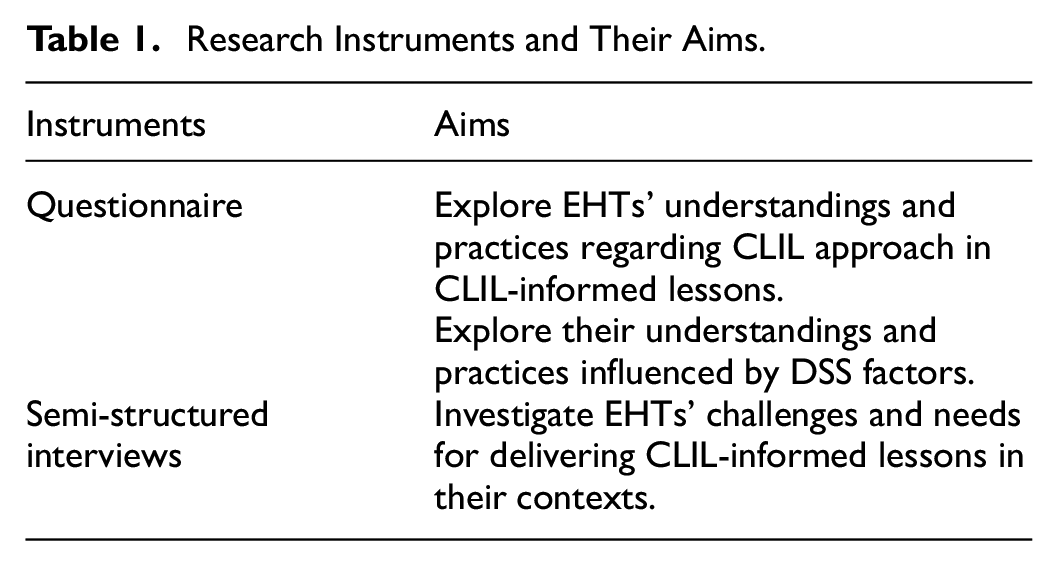
Research Instruments
Questionnaire
A questionnaire is cost-effective, quick, and anonymous (Kumar, 2011) for broad data collection within a thesis timeline. This categorical Likert-scale questionnaire included the demographic section (gender, teaching experiences, qualifications, workplace) and three clusters: (1) understandings of CLIL, (2) strategies employed in teaching CLIL, and (3) DSS factors affecting the understandings and practices in teaching textbook CLIL-informed lessons. Cluster 3, drawing on the DSS framework, includes three sub-clusters: (1) Contradiction focused on teachers’ ability to recognize and manage the challenges they faced in adopting CLIL-informed teaching, (2) Cognitive change assessed shifts in teachers’ understanding of CLIL-informed approach compared to other teaching methods, (3) Behavioral change examined how teachers modified their teaching practices and strategies to align with CLIL-informed lessons. These DSS dimensions are particularly relevant in contexts of new adoption in education, where adaptability and openness to change are essential (Spencer-Rodgers et al., 2015). Items were structured using a 5-point Likert scale for Clusters 1 and 3 (1. Strongly Disagree – 2. Disagree – 3. Neutral – 4. Agree – 5. Strongly Agree) and a frequency scale for Cluster 2 (1. Never – 2. Rarely – 3. Sometimes – 4. Often – 5. Always; see Table 2).
Summary of the Questionnaire.

Semi-structured Interviews
The semi-structured interview is an exploratory interview used in the social sciences regularly for qualitative research purposes (Magaldi & Berler, 2020). In semi-structured interviews, the question set is thoughtfully designed based on the research’s framework, offering flexibility in the conversation. This research used semi-structured interviews to thoroughly explore the participants’ experiences and perspectives on the research topics (Guest et al., 2012). The semi-structured interviews modified the practical challenges when EHTs teach CLIL-informed lessons, which are yet to be found in the questionnaire. Each face-to-face interview lasted approximately 45 min and was conducted at their workplace for participants’ convenience. All consent forms, participants’ volunteering, and their rights to withdraw were ensured throughout the study.
The interview protocols were designed to ensure that EHTs’ reflections on their CLIL teaching experiences were fresh and relevant (as shown in Table 3). Interviews were conducted shortly after the teachers had finished delivering CLIL-informed lessons using the “Tiếng Anh Global Success textbook” for grade 11, allowing them to provide immediate and accurate insights into their experiences. Each interview began with participants’ general reflections on the rewards and challenges of teaching CLIL-informed lessons. This was followed by deeper questions about specific difficulties. The interviews concluded with teachers’ views on the support, resources, and professional development needed to improve their CLIL teaching.
Summary of the Interview Questions.

Sampling Techniques and Participants
Snowball sampling was used to distribute a questionnaire via Google Forms in Zalo groups targeting 326 EHTs in Vietnam, teaching grades 10 and 11 with the “Tieng Anh Global Success” textbook, which includes CLIL-informed lessons. Due to the online distribution, the pool of participants was unpredictably varying, leading to uneven representation in their demographic data. Teaching experience was categorized as novice (less than 5 years), experienced (6–15 years), and veteran (more than 16 years), a classification commonly used in educational research, which aligns with Huberman’s (1995) framework of early-, mid-, and late-career stages. Besides, gender, qualifications, and working contexts were also included (as shown in Table 4).
Questionnaire Participants’ Demographic Features.
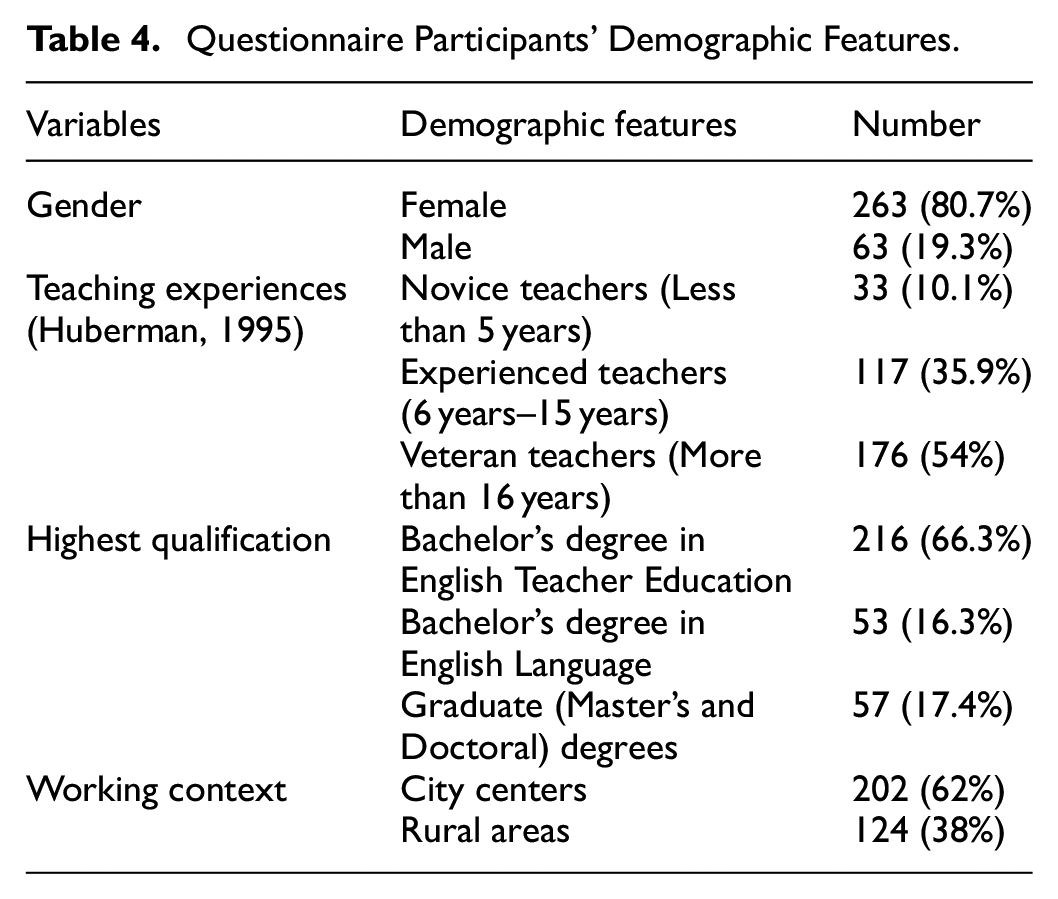
Regarding the semi-structured interviews, purposive sampling was employed to select six participants based on three criteria: (1) prior experience teaching Grade 11 using the same English textbook, (2) differing teaching experience, and (3) differing working context, (see Table 5). These criteria were determined following the quantitative analysis, which revealed differences across demographic groups.
Interview Participants’ Demographic Features.

Data Collection and Data Analysis Procedure
The 6-month procedure in this study began with piloting the instruments. Consent forms were distributed to all pilot participants and duly accepted. The questionnaire was piloted with 35 EFL teachers, and the internal consistency reliability was found to be satisfactory, with Cronbach’s α values of .87, .89, and .87 for the three clusters of items. During this phase, feedback from participants indicated that some statements were too lengthy or unclear, especially given the overall length of the questionnaire, which included 45 items. In response, several items were revised for clarity and conciseness while preserving their intended meaning. To address concerns about the questionnaire length, minor streamlining was also carried out to enhance usability without compromising content validity. The interview protocol was piloted with three novice, experienced, and veteran EFL teachers to ensure the questions were relevant and accessible across levels of experience. Their responses helped refine the interview prompts to better elicit reflective and practical insights.
Following the pilot, the revised questionnaire was administered to collect quantitative data over the course of 2 months. Subsequently, semi-structured follow-up interviews were conducted with six EFL teachers to explore their rationale behind teaching practices, the challenges they faced, and the types of support they considered necessary for implementing CLIL-informed lessons effectively. These interviews offered nuanced, experience-based perspectives that enriched the interpretation of the survey data and identified areas for targeted professional development.
The questionnaire on EHTs’ understandings and practices in teaching CLIL was proofread by an external expert, with feedback addressing grammar, word usage, Vietnamese translations, and clarity. Using SPSS 26.0, 3 reliability analyses were conducted to evaluate the internal consistency of a categorical Likert-scale questionnaire consisting of three clusters, with responses from 326 participants. The results yielded Cronbach’s α values of .923 for Cluster 1 (15 items), .927 for Cluster 2 (15 items), and .93 for Cluster 3 (15 items), demonstrating high internal consistency. These values exceed the acceptable threshold, confirming the reliability of the instrument (Nunnally & Bernstein, 1994). Oxford’s Scale was applied for interpreting the data (Khatri et al., 2024). One-sample T-tests were used to compare individual item means, while independent-sample T-tests and one-way ANOVAs examined the impact of demographic factors on teachers’ understandings and practices of CLIL. While Cohen’s d is a commonly applied in controlled experimental designs, this explanatory study relied on descriptive statistics and qualitative interpretation to align with its design.
The qualitative data were analyzed using thematic analysis, guided by a framework of pre-identified themes (Muzari et al., 2022). Interview questions were piloted with three EFL teachers representing novice, experienced, and veteran stages of teaching to ensure relevance across career levels. Coding procedures were refined through multiple rounds of analysis, and intercoder reliability was assessed using the Kappa coefficient (κ = .76), indicating substantial agreement. Final themes were validated through peer debriefing and alignment with the raw data. Trustworthiness was ensured through methodological triangulation, piloting with feedback, member checking of interview transcripts, and the inclusion of representative quotes (Creswell & Creswell, 2017). Ethical protocols were observed throughout the study, including informed consent, ethical approval, the use of pseudonyms, confidentiality, and secure data storage.
Results
RQ1: EHTs’ Understandings of the Principles of CLIL-informed Lessons
The first research question examined EHTs’ understanding of the CLIL-informed principles via the first 15 items of the questionnaire (Cluster 1). These items addressed topics such as the definition of CLIL, CLIL models, the 4Cs framework, and core principles driving CLIL. The overall mean score for Cluster 1 was relatively high (M = 4.06, SD = 0.63; as shown in Table 6).
Descriptive Statistics Cluster 1 (N = 326).

The mean scores for the 15 items exploring EHTs’ understandings of the CLIL approach ranged from 3.64 (item 15) to 4.38 (item 10). Specifically, items 2, 4, 9, and 10 scoring very high. Item 2 highlights that EHTs recognize the flexible emphasis on content and language in CLIL. Item 4 reflects their alignment with CLIL’s dual-focused objective of integrating content knowledge and skills. Item 9 emphasizes the value EHTs place on using authentic materials like videos or songs, while item 10 shows strong agreement on employing varied assessments to capture both content and language mastery. The remaining items scored high ranging from 3.64 to 4.20. Item 1 demonstrates EHTs’ understandings of CLIL’s dual-focused nature, and item 3 suggests their appreciation of the 4Cs framework. High scores on items 5, 6, and 7 reflect EHTs’ recognition of the pillars of Communication, Cognition, and Culture. Item 8 highlights the importance of designing cognitively diverse questions, while item 11 mentions a balanced approach to listening, speaking, reading, and writing. High scores on items 12 to 15 showed EHTs’ high understandings of emphasis on both receptive and productive skills, though item 15 indicated a relative underemphasis on writing in CLIL-informed lessons. A One-Sample T-test was run on item mean scores of cluster 1 (MU = 4.06) to check whether there was a statistically significant difference from the value of 4.21, representing a very high level of agreement in light of the Oxford Likert Knee Score (Khatri et al., 2024). The result indicated that the difference was statistically significant (t = −4.42; p = .00), showing that the actual level of EFL teacher’s understandings of CLIL approach is not very high.
RQ2: EHTs’ Practices for Teaching CLIL-informed Lessons
The second research question investigates EHTs’ practices in teaching CLIL-informed lessons using the “Tieng Anh Global Success 11” textbook, based on 15 questionnaire items in Cluster 2. Mean scores are used to analyze these practices, with higher scores indicating more frequent implementation of strategies for delivering CLIL-informed lessons. Responses from 326 EHTs revealed a high frequency mean score of 3.83 (SD = 0.62). Descriptive statistics (see Table 7) show commonly-employed practices and provide insights into recent CLIL implementation, offering a basis for improving the approach’s effectiveness in practical teaching contexts.
Descriptive Statistics of Cluster 2 (N = 326).

Regarding CLIL practices in teaching “Tieng Anh Global Success 11,” the highest mean score was for item 18, showing frequent use of pair and group work to foster collaboration and meaningful interaction, aligning with CLIL objectives. Other items in cluster 2 also scored high, reflecting teachers’ often use of strategies to balance content and language needs (item 17) and basing lesson plans on the 4Cs Framework (item 16). Teachers frequently promote intercultural understanding by encouraging students to compare their own and target cultures (item 19) and use authentic materials like videos and songs to enhance engagement (item 21). Both formative and summative assessments are usually employed (item 22), along with alternative assessments (item 23), ensuring diverse evaluation methods. Teachers often prioritize fluency over accuracy in the early stage of speaking activities (item 25) and integrate all four language skills of listening, speaking, reading, and writing (item 24) to provide a well-rounded learning experience. Students are often guided to produce outputs like presentations or blogs (item 27) after engaging with meaningful reading texts (item 26). Activities requiring higher cognitive skills (item 30), role plays, and information gap exercises (item 29) are common, while reading strategies like mind mapping are often used to support comprehension (item 28). Another One-Sample t-test was run on item mean scores of cluster 2 (MP = 3.83) to check whether there was a statistically significant difference from the value of 4.21, representing a very high frequency in light of the Oxford Likert Scale (2001). The result indicated that the difference was statistically significant (t = −11.11; p = .00), suggesting that EHTs’ practices with CLIL principles was not at a very high frequency. For visual clarity, Figure 3 presents the frequency of CLIL-informed teaching strategies used by EHTs, based on teachers’ self-reported data and ranked from most to least frequent according to the mean scores.

Frequency of CLIL-informed teaching strategies used by EHTs.
RQ3: Factors Affecting EHTs’ Understandings and Practices in Teaching CLIL-informed Lessons
To investigate more factors related to EHTs’ understandings and practices, the questionnaire cluster 3 of factors from DSS (M = 3.83, SD = 0.61) indicating that DSS factors highly affect EHTs’ understandings of CLIL approach and their practices in teaching CLIL-informed lessons (as summarized in Table 8).
Descriptive Statistics for Cluster 3.

Overall, the three DSS factors (contradictions, cognitive changes, and behavioral changes) that affect the affairs EHTs understand and practise the CLIL approach were high. This implies that the understandings and practices in teaching CLIL-informed lessons in practical EFL teaching contexts are significantly influenced by the teachers’ cognitive and behavioral changes (Mfcc = Mfbc = 3.95) and lastly their contradictions (Mfc = 3.6). Two independent t-tests and two one-way ANOVAs were run to compare EHTs’ contradiction, cognitive and behavioral change between demographic groups. The first independent T-test and second one-way ANOVA showed that varying genders and highest qualifications do not impact EHTs’ understandings and practices, but the first one-way ANOVA revealed that their years of teaching experiences had influences on their behavioral change (see Table 9). Specifically, the result shows no significant differences in contradiction factors and cognitive change across novice, experienced, and veteran teachers. However, a significant difference was found in behavioral change, with novice and experienced teachers reporting higher levels of behavioral change compared to veteran teachers.
Between Groups ANOVA Results on EHTs’ Teaching Experiences.

The second independent T-test also revealed that EHTs’ working contexts, in either modern cities or rural areas, had impact on their cognitive change (see Table 10). The result reveals that there are no significant differences in contradiction factors and behavioral change between city and rural teachers. However, city EHTs showed a lower level of cognitive change compared to rural teachers.
Independent T-test Results on EHTs’ Working Contexts.

RQ4: Teachers’ Challenges and Needs When Teaching CLIL-informed Lessons in Their Classrooms
Semi-structured interviews were conducted with six EHTs to explain and enrich the quantitative findings, following an explanatory sequential design. The interviews explored teachers’ attitudes, challenges, and support needs when teaching CLIL-informed lessons, using the “Tiếng Anh Global Success” textbook for Grade 11. This qualitative phase aimed to clarify how these experiences varied by teaching experience (novice, experienced, veteran) and school context (urban vs. rural), offering deeper insights into the factors shaping CLIL implementation in Vietnamese high schools.
Overall Attitudes About Teaching CLIL-informed Lessons in the Current Textbooks
Meanwhile T5 found CLIL “normal, not new, just like Task-based,” the other five teachers furthered expressed that CLIL-informed lessons help students develop communication skills in real-life contexts, learn about cultures, improve language abilities, and acquire subject knowledge. T1 said CLIL effectively links classroom learning with real life, promoting comprehensive skill development and meeting the MOET’s goals. T2 noted that previous textbooks lacked focus on everyday communication. At the same time, T3 felt CLIL-informed lessons brought significant improvements, stating, “I feel that the CLIL-informed lesson enhances students’ communication skills because it conveys daily communication patterns.” T4 emphasized that CLIL integrates language with real-life content, helping students “develop communication skills” and “be confident in their use of language” while increasing their motivation and interest. T6 added that CLIL improves both language skills and subject knowledge, offering students opportunities to engage with content in the target language, enhancing their “language flexibility,” and exposing them to cultural and integrated knowledge.
Challenges in Teaching CLIL-informed Lessons in the Textbook
Teachers encountered several challenges in implementing the CLIL approach in their classrooms. One major difficulty was the time-consuming nature of lesson preparation, particularly in sourcing suitable materials like videos and images, as highlighted by T1 “It’s challenging to find videos and images that fit the lesson.” Managing large class sizes further compounded these challenges, making it difficult to ensure active participation and adherence to lesson timing. T1 expressed difficulty in ensuring all students participated in communication activities, while T2 shared that “monitoring students’ pronunciation, participation, and adherence to lesson timing” was particularly challenging in large classes. T3 echoed this concern, stating, “With large class sizes, I can only ask a few pairs to practice.” Additionally, the balance between content and language knowledge posed difficulties for teachers, especially when interdisciplinary topics made lessons lengthy and complex. T4 emphasized, “It takes me much time to learn the content before I can be confident teaching my students.” Similarly, T6 noted the effort required to create CLIL-aligned activities that allowed students to “speak the topic of the lesson in English and understand the lesson.” Overall, teachers expressed concerns about the “idealized CLIL model” pointing out its heavy requirements for EFL learners, who have limited exposure to the target language outside the classroom.
The challenges were further amplified by the requirements of the “Tiếng Anh Global Success” textbook for grade 11, which incorporates interdisciplinary CLIL content. While the textbook aligns with CLIL principles, it often presents lengthy and complex topics that are difficult for students to digest. T3 described these lessons as “lengthy and hard to swallow,” highlighting the need for additional teacher effort in simplifying the content for student comprehension. T4 mentioned spending significant time preparing lessons to address cultural aspects confidently, while T6 explained the need to balance cultural content with language skills to ensure students could “speak the topic of the lesson in English and understand the lesson.” Teachers also noted the necessity of adapting lessons creatively to make the content engaging and accessible for students with varying proficiency levels. Despite these challenges, the textbook offers a structured framework for integrating cultural and language learning, providing a valuable yet demanding platform for implementing CLIL in EFL classrooms.
Needs for Support in Teaching CLIL-informed Lessons
Teachers emphasized the importance of professional development opportunities to deepen their understandings of CLIL, especially in sequencing activities and assessing learners’ outcomes to improve their holistic teaching practices. Four teachers (T1, T2, T4, and T6) highlighted the value of peer observations, where educators could visit each other’s classes to exchange experiences and learn effective strategies. T1, T4, and T6 further emphasized the need for regular participation in seminars and training sessions, noting that CLIL is a relatively new component of the English curriculum and requires ongoing guidance. T3 shared her approach to innovating teaching methods and seeking the best strategies to fit specific lessons, advocating for professional development initiatives that encourage creative teaching adaptations. T6 expressed a desire for coaching or mentoring programs and training workshops jointly organized by the Department of Education and publishers, enabling teachers to refine their skills through structured, hands-on experiences. T4 suggested leveraging resources from foreign experts to support EHTs in understanding and applying CLIL principles.
Teachers also expressed a need for better textbooks, supplementary materials, and improved teaching tools to enhance the delivery of CLIL-informed lessons. T1 and T3 called for new adoption of textbooks, T2 requested additional teaching materials that better align with their contextual needs. Regarding school administrators, T1 and T2 emphasized the need for upgraded equipment and facilities, such as TVs, projectors, and reliable internet access, to support CLIL teaching effectively. Book publishers were also seen as key stakeholders in providing adequate resources. T1 suggested including detailed assessment tools and varied activities within the textbooks, T2 and T3 recommended incorporating demonstration videos to aid lesson delivery, and T4 emphasized the importance of accessible, reliable, and updated content. These resources would not only facilitate lesson preparation but also enhance student engagement and comprehension, ensuring the successful implementation of CLIL in context-specific classrooms.
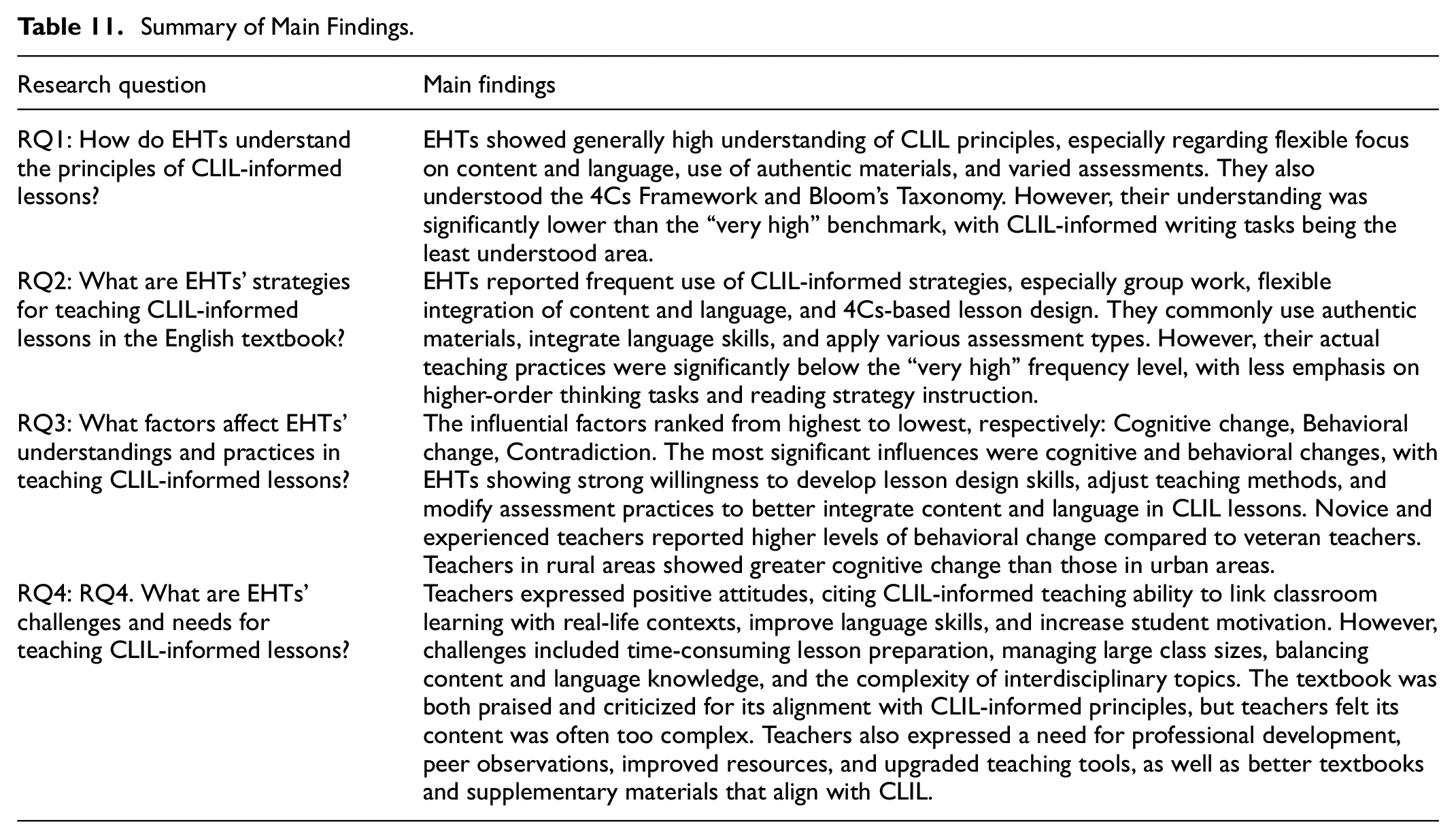
In summary, Table 11 presents an overview of key findings addressing each four RQs.
Summary of Main Findings.
Discussion and Conclusion
Regarding RQ1 and RQ2, the findings from this research on EFL teachers’ application of CLIL-informed principles offer an overview of their theoretical and practical engagement with the methodology. Teachers demonstrate a solid understanding of the 4Cs framework, aligning with previous research highlighting the importance of familiarizing educators with CLIL (Hashmi, 2019). EHTs’ acknowledgment of active learning techniques supports previous findings on CLIL’s benefits in enhancing communication skills for EFL learners (Banegas et al., 2023; Raud & Orehhova, 2023). From the questionnaire and interviews, EHTs reported lower levels of understandings and self-confidence in Content compared to the other 3Cs. This finding could be unpacked through CHAT, highlighting the limitations in teachers’ backgrounds, as 82.6% of them come from conventional English teacher education or English studies, which traditionally focus on English grammatical features or translation. This implicates that undergraduate programs should make some gradual shifts in strengthening both theoretical understandings and hands-on teaching coursework in interdisciplinary contexts. This could involve offering more integrated curricula that connect language teaching with social science subject knowledge from fields like history or geography, which would be essential for CLIL implementation. For PD programs, fostering cross-faculty and cross-subject collaboration would be beneficial, enabling teachers to work together with content-area experts. This collaborative approach could help EFL teachers learn from other colleagues to bridge the gap between language and other contents, enhancing their ability to apply CLIL principles easier.
As for RQ3, there were certain tensions between teachers’ theoretical understandings of CLIL and their practical application. Specifically, their years of experience, ranging from less than 5 years to more than 16 years, play a significant role in shaping their adaptive behaviors in teaching CLIL. In terms of behavioral change, veteran EHTs are less likely to change their teaching strategies compared to novice and early-career teachers. Through the lens of CHAT, this difference can be attributed to the influence of their established familiar practices, which may create resistance to change. Veteran teachers, with their longer teaching experience, often exhibit more entrenched behaviors and mental models, which can make it challenging to adapt to new methodologies like CLIL, despite acknowledging their value. This mirrors findings from Estonia, as reported by Myronenko et al. (2024). Moreover, EHTs working in urban areas exhibited lower cognitive change when introduced to CLIL compared to those from rural areas. This can be explained that urban teachers had more exposure to similar communicative approaches for a longer period. As T5, an urban teacher mentioned in the interview, “CLIL is not new.” In contrast, teachers in rural areas have typically faced lower demands for learning and fewer opportunities to engage with CLIL and similar models. Therefore, rural teachers experienced greater cognitive change when introduced to CLIL, as they were less familiar with inductive teaching methods and exhibited higher beliefs in their ability to adapt to CLIL.
The tension between teachers’ understandings of CLIL principles and their actual practices in Vietnam can be partly attributed to the country’s status as an EFL context, where cultural and learner expectations are not always aligned with the ideals of the CLIL model. In CLIL classrooms, there is an emphasis on students using the target language fluently in real-life contexts, yet in Vietnam, English is primarily used in the classroom, and its application in daily life remains limited. This results in learners’ focus more on grammar and exam-driven learning rather than actively using English for communication. Consequently, as Mukadimah and Sahayu (2021) noted in vocational settings, classroom realities such as learners’ resistance and lower expectations for language proficiency can significantly hinder the full implementation of CLIL. Teachers, although aware of CLIL’s pedagogical tools and principles, often revert to more familiar practices, like assigning writing as homework, due to these contextual limitations. This issue can be reflected back in Yavuz et al.’s (2020) findings, where teachers, despite understanding CLIL, struggled to consistently apply its principles due to classroom constraints. Additionally, the underutilization of Bloom’s Taxonomy in assessing student cognition mirrors this gap between theoretical knowledge and classroom practice. Similarly, the limited integration of cultural comparisons implies how CLIL’s cultural dimension is often overlooked, concurred with Fielden Burns and Martínez Agudo’s (2023) study. These challenges are compounded by a lack of coherent top-down policies between teaching, assessment, and materials, further hindering effective CLIL implementation in a country where learner expectations and language use are still developing.
Based on these challenges and needs from RQ4 findings, the CLIL model needs to be “localized” to reduce some of the burdens imposed by teacher readiness and other contextual constraints. Several implications were deduced regarding components of CHAT framework:
(1) Subject (EHTs as primary actors) – (2) Object (understandings and practices of CLIL): Given their exposure to traditional grammar-focused teaching, EHTs often face challenges in shifting toward CLIL’s communicative approach. To address these challenges, targeted PD programs should focus on aligning EHTs’ existing knowledge with CLIL principles to foster deeper engagement and reflective transition. When EHTs have a higher grasp of CLIL principles and benefits, they become more confident in navigating different circumstances, knowing that, regardless of the paths, they can achieve outcomes aligned with those CLIL aims for. Teacher variables ((3) Dialectical Self Scale factors) should be considered when distributing training programs. Younger teachers who are more receptive to theoretical concepts could better acquire and implement CLIL theories. Veteran teachers, who may be more resistant to changes, benefiting from more hands-on, immediate practice-oriented sessions.
(4) Tools: Adapting the idealized CLIL to a localized model involves allowing flexible techniques like moderate translanguaging or code-switching. EHTs can leverage the mother tongue as a strategic tool that can help bridge linguistic gaps, enabling teachers to clarify complex concepts, explain terminology, and check comprehension while gradually transitioning to English. For EHTs accustomed to grammar-focused instruction, flexibility in using both languages can offer a more accessible pathway into CLIL’s communicative approach. Integrating translanguaging into PD programs can also empower teachers to view bilingualism as an asset to confidently apply CLIL principles. While EHTs may possess conceptual tools for CLIL teaching, the lack of relevant and accessible teaching materials, as well as CLIL-specific resources, significantly limits their ability to apply the methodology. To address this, PD programs should focus on enhancing teachers’ pedagogical knowledge, not only by providing ready-to-use CLIL teaching aids and digital tools, but also equipping teachers to tailor materials to local curricula and student needs, ensuring a more effective and context-sensitive implementation. Ensuring teachers understand how to access to and adapt materials effectively will help them overcome resource gaps and boost their autonomy in material development.
(5) Rules (Top-down mandates): Top-down policies often influence the extent to which CLIL can be implemented. In CLIL, fluency and communication are encouraged, yet traditional assessments often focus on discrete grammar and vocabulary skills through multiple-choice tests. This creates a clash when students can use language dynamically, but their tests prioritize accuracy on complex grammar points or do not involve performance-based assessments. This leads to a need for more consistent institutional supports for CLIL, including top-down alignment in classroom practices, materials choice and assessment methods, to ensure that teachers can fully integrate CLIL into their teaching without facing contradictory expectations.
(6) Community (working context): Students’ low language proficiency and parents’ skepticism about new approaches can limit the effectiveness of CLIL. The lack of support from colleagues and administrators, especially in rural areas, can hinder teachers’ efforts to adopt and improve CLIL practices. Building a supportive community through collaborative support, institutional backing, and awareness-raising is key for CLIL’s success. Additionally, offering EHTs both mental rewards of recognition and physical rewards, like financial incentives or career advancement opportunities, can sustain motivation and commitment to CLIL implementation.
(7) Division of labor (Roles of teachers and stakeholders): Vietnamese learners have been learning more than ten subjects ranging from natural to social sciences in their mother tongue during 12 years of pre-tertiary education. Nonetheless, EHTs typically focus on teaching text-based grammatical features and receptive skills, with little exposure to interdisciplinarity. This gap leaves EHTs struggling to bridge language and subject knowledge, as they may have forgotten or fallen behind in subject-specific content after years of focusing solely on language teaching. If EHTs receive proper training in content integration, they could help students transfer and associate knowledge more effectively and find learning English more meaningful. Textbook writers should start with less challenging, relevant topics to ease teachers and students into CLIL before gradually introducing more complex content. Trainer experts need to provide PD programs that include not only pedagogical training for teachers but also guidance on how to collaborate with cross-subject teachers, researchers and curriculum developers to implement CLIL within the broader educational framework.
Overall, this study contributes to Vietnamese and international educational contexts by deepening the understanding of how CLIL-informed teaching is interpreted and enacted in EFL classrooms, particularly where textbook-driven instruction dominates. In Vietnam, the findings provide practical insights for policymakers, curriculum developers, and teacher educators seeking to support teachers in implementing integrated content-language instruction in line with national reforms. Internationally, the study adds to the diverse literature on CLIL in resource-constrained, exam-oriented environments, highlighting the importance of context-sensitive professional development, material design, and institutional support. These insights are valuable for other countries aiming to integrate CLIL into mainstream EFL education. However, certain limitations impacted its outcomes, primarily due to constraints in time and consent, which restricted the study from incorporating classroom observations and conducting longitudinal research. The use of snowball sampling may have introduced bias by relying on participants’ networks, potentially limiting the diversity of perspectives represented. These limitations prevented a deeper exploration of real-life CLIL-informed lessons and the opportunity to triangulate findings through multiple data sources. In light of these challenges and the anticipated shift from EFL to ESL in Vietnam, future research should address these gaps by incorporating observational studies and extended timelines to capture the dynamics of CLIL implementation in authentic classroom settings. Studies should explore curriculum adjustments that prioritize communicative competence through the integration of contextualized learning materials and cross-cultural communication skills. Research could also investigate the effectiveness of comprehensive teacher training programs in ESL methodologies and the implementation of immersive practices, such as English-only zones, to simulate ESL environments.
Footnotes
Acknowledgements
The authors would like to thank Can Tho University and Can Tho University of Medicine and Pharmacy for their support in providing structural and logistic assistance to in-service lecturers, which was essential in completing this article. Special thanks go to all volunteer participants of this study.

Ethical Considerations
Research objectives and your data collection using the classroom observations and interviews for the project were assessed to meet the ethical standards.
Author Contributions
Funding
The author(s) received no financial support for the research, authorship, and/or publication of this article.
Declaration of Conflicting Interests
The author(s) declared no potential conflicts of interest with respect to the research, authorship, and/or publication of this article.
Data Availability Statement
Data is available by the corresponding author upon official request.