




Abstract
Despite the growing body of literature on the structural problems of emergency remote teaching during the COVID-19 pandemic, far too little empirical research has been conducted on university academics’ challenges in online pedagogy and what is needed to facilitate their teaching during a time of educational crisis. Thus, this study selects a high-profile Chinese language university as a case study to explore how university academics in China have dealt with the challenges of emergency remote teaching during the pandemic. This paper conducts open-ended interviews with 22 academic faculty members and adopts TPACK concepts to interpret the findings. The results demonstrate how participants find avenues to deal with emergency remote teaching, effective measures universities need to adopt, and ways to facilitate TPACK with academic faculty.
Introduction
With the development of new technology, online teaching resources have been widely used in universities worldwide. However, a rising concern has grown in higher education about the increasing demands of Technological Pedagogical and Content Knowledge (TPACK) on the professional development of academic faculty members, in particular novice instructors (Kilgour et al., 2019). Novice online instructors are generally defined as those who are not proficient in TPACK and lack digital literacy. For university academics accustomed to engaging in conventional face-to-face teaching, online teaching has not been a primary concern (Kennedy, 2015).
Nonetheless, the recent outbreak of COVID-19 has forced universities worldwide to promote a new educational movement by implementing distance learning policies through the adoption of emergency online teaching and course management platforms; thereby they expect to maintain their educational systems (Gao & Zhang, 2020; Valsaraj et al., 2021). In contrast to online courses that are planned from the beginning, emergency remote teaching (ERT) is a temporary shift of instructional delivery to an alternate delivery mode due to crisis circumstances (Hodges et al., 2020). In spite of the promises of online education, the rapid policy implementation has caused structural problems regarding remote teaching and situated many academic faculty members as novice instructors (Fhloinn & Fitzmaurice, 2021; Houlden & Veletsianos, 2020; König et al., 2020; Macintyre et al., 2020; Stewart, 2021).
Due to the rapid policy paradigm shifts toward online teaching, numerous university academics encountered time restrictions to absorb digital literacy materials, to redesign courses, to utilize the teaching and course management platforms, and to provide essential course materials (e.g., syllabus and texts) to their students (Fu & Zhou, 2020). In addition, work-life balance has also been a major barrier faced by university academics (Erlam et al., 2021). Nevertheless, faculty members have struggled to adapt their pedagogical practice to the ever-changing environment. In particular, they have faced challenges in engaging students (Jung et al., 2021). These diverse, personal, technological, and pedagogical factors can potentially affect university academics’ psychological well-being, leading to stress, anxiety, and other emotional challenges (Houlden & Veletsianos, 2020; Macintyre et al., 2020; Valsaraj, et al., 2021). Empirical studies have also revealed that a lack of technical support and training during the pandemic was common, and faculty members had to rely on informal, self-directed learning with their professional learning networks and teaching assistance (Bao, 2020; Valsaraj et al., 2021).
Despite the increasing attention to the impact of COVID-19 on the structural problems of ERT and the challenges faced by university academics, most research on this area has focused on the psychological challenges (Kim & Asbury, 2020; Macintyre et al., 2020; Moorhouse, & Kohnke, 2021; Osman, 2020), technological barriers triggered by specific softwares (e.g., Castelli & Sarvary, 2021; Fhloinn & Fitzmaurice, 2021; Zamora-Antuñano et al., 2021), and sociodemographic or institutional factors potentially influencing instructors’ adaptation to ERT (i.e., gender, education level, and mode of delivery; Jelińska & Paradowski, 2021). However, these recent lines of inquiry have paid scant attention to the general challenges faced by university academics due to the lack of TPACK, and how they can cope with the challenges of ERT by developing their TPACK during the pandemic. Watermeyer et al. (2021) investigated the impact of COVID-19 on digital disruption among academics affiliated with institutions of higher education, and found that compared with other disciplines, the pandemic-fueled transition to online teaching was particularly difficult for language instructors. Thus, gaining more in-depth insights into how university academics can cope with ERT and develop their TPACK competence during difficult situations is vital. Therefore, this study adopts the framework of TPACK to explore the online teaching experiences of language instructors at a top-tier language university in China (anonymized as S University) during the COVID-19 pandemic.
Theoretical Framework
Based on Shulman’s (1986) work on pedagogical content knowledge, which describes the connection between content and pedagogical knowledge, Mishra and Koehler (2006) introduced a knowledge framework for how instructors need to develop competencies in order to teach effectively with technology. Known as the Technological Pedagogical and Content Knowledge (TPACK), Mishra and Koehler (2006) highlighted the interplay of three elements that characterize learning environments today: technological knowledge, pedagogical knowledge, and content knowledge.
Initially, Content Knowledge illustrates teachers’ knowledge about the nature and coverage of the subject matter to be learned or taught. Pedagogical Knowledge describes the methods and processes of teaching and learning. Finally, Technological Knowledge describes the ways of thinking about and working with technology that entail fundamental instruments and resources, ranging from high- to low-technology proficiency. Moreover, Pedagogical Content Knowledge views how instructors transform their teaching subjects, find multiple ways to represent contents, and adapt appropriate learning materials to students’ fundamental knowledge. Technological Content Knowledge explains the use of specific technologies to equip learners to absorb specific concepts in a given content area. By the same token, Technological Pedagogical Knowledge increases an understanding of how the use of particular technologies change over time in the teaching and learning processes. Overall, the Technological Pedagogical and Content Knowledge (TPACK) is the skill sets and strategies for how to promote teaching competencies with technology meaningfully and skillfully (Mishra & Koehler, 2006).
The integration of technology requires instructors to cultivate an understanding of the complex relationships among users, technologies, tools, and practices. From these perspectives, TPACK has been a prominent theoretical framework in online pedagogy and distance education (Tseng et al., 2020; Voogt et al., 2013). Particularly, within the context of language education, Tseng et al. (2020) stated that language instructors often face challenges regarding how to “represent linguistic context using proper technology in an appropriate manner” (p. 2). They are less interested in interacting with their students as they hope to see their students’ performance and practice in face-to-face classes. Therefore, language instructors’ TPACK and beliefs have so far been limited when compared with other areas.
Pertinent to the current study, TPACK is an appropriate theoretical framework as it is useful for exploring the online teaching experiences of university instructors in languages and for finding avenues to manage the increasing demands of ERT. They may have faced challenges to plan and develop meaningful contents through technology in the new online pedagogical environment and thus struggle to facilitate effective teaching and learning. Accordingly, the current study focuses on exploring the challenges faced by faculty members in languages due to the lack of TPACK in ERT provoked by the pandemic. Following the rationale for the chosen theoretical framework, the central research questions that guide this study are:
RQ1: What challenges did S University’s academics encounter while teaching online in ERT due to the COVID-19 pandemic?
RQ2: How have S University’s academics managed online teaching and developed their TPACK during the COVID-19 pandemic?
Method
Institutional Context: S University’s Online Teaching
The case university, anonymized as S University, was established in Shanghai, China in 1949. The institution currently employs 819 faculty members; 45% are assistant professors, 35% are associate professors, and 20% are full professors. Serving as a crucial vehicle to promote quality academic programs and research in the field of language education, the university’s world language program offers courses in more than 48 foreign languages. The university emphasizes the importance of offering cutting-edge language programs and strives to provide them as face-to-face courses. For these reasons, prior to the pandemic, S University offered only a few online training courses to its students via massive open online courses (MOOCs), some to non-traditional students or to students from other institutions.
S University officially announced the closure of its campus due to the pandemic on February 7, 2020. All faculty members were required to develop course content on the newly adopted course management platform, Blackboard, and to upload the first 4 weeks of those materials onto Blackboard before the spring semester began (on March 2). They were also required to provide online teaching using synchronous online lessons, MOOCs, and video clips, among other tools. For synchronous lessons, faculty members could select their preferred interactive platforms such as Classin, DingTalk, Zoom, and VooV Meeting. The university chose Classin, designed by the Empower Education Online company, as the official teaching platform and blended it with Blackboard for course management. To facilitate communication with students, the university encouraged faculty members to use WeChat, a Chinese multi-purposed messaging and social media app created by Tencent. In order to assist faculty members in using Blackboard and Classin, S University staff organized a faculty-wide support program. Technological support was provided through four main approaches (see Table 1).
S University’s Technological Support During the COVID-19 Pandemic.

Research Design and Participants
Despite a large number of quantitative research on factors influencing university academics’ transition to ERT (e.g., Fhloinn & Fitzmaurice, 2021; Jelińska & Paradowski, 2021; Watermeyer et al., 2021), limited scholarship has been undertaken regarding an in-depth understanding of the lived experiences of university academics and their socio-psychological and socio-cultural impacts on their TPACK practices during the COVID-19 pandemic. Qualitative research can provide more insightful and epistemological approaches to deducing conclusive findings through thick and rich descriptions (Creswell, 2013). Therefore, grounded in a qualitative approach, this study adopted a descriptive case study design to facilitate an in-depth exploration of a real-world situation involving a particular social phenomenon, namely ERT during the time of public health crisis (Yin, 2014) and the participants’ lived experiences and perceptions (Cohen et al., 2011) of ERT during the COVID-19 pandemic.
The current research was conducted during the spring semester of 2020, with observations and data collection taking place in early March through early August. After acquiring Institutional Research Board approval from the researchers’ home institution, the study used purposive and snowball sampling methods to recruit a total of 22 language instructors who were engaged in ERT during the spring semester of 2020. Seven participants were initially recruited by the authors through their personal contacts. These participants introduced their colleagues from various academic programs at S University. As a means of increasing participation and transmission, obtaining information from diverse stakeholders is crucial (Creswell, 2013). Hence, we recruited participants who taught a variety of language courses, including English, Russian, Vietnamese, Kazakh, Italian, Japanese, Portuguese, Hungarian, Swedish, French, Arabic, Hebrew, Chinese, Spanish, and German. Among the participants, 5 were full professors, 6 were associate professors, and 11 were assistant professors and all held a doctoral degree. Demographically, 8 men and 14 women participated, of whom 6 had less than 5 years of teaching experience, 5 had between 6 and 11 years of teaching experience, and 11 had taught for more than 10 years (see Table 2).
Information of the Participants.

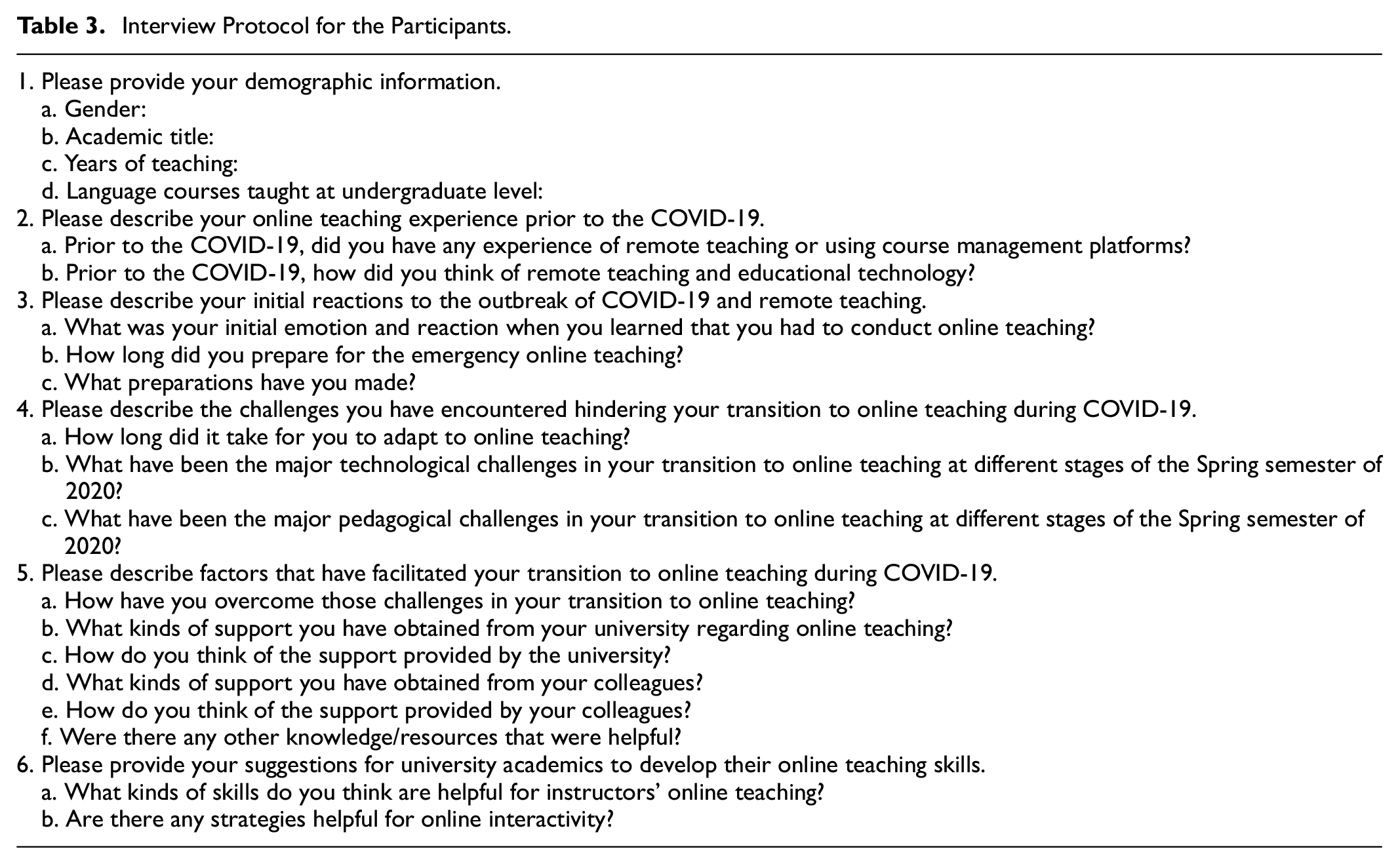
Interviews were conducted over 6-months using the multi-purpose messaging and social media app WeChat, the most widely used platform in China. The interview protocol was developed along with the chosen theoretical framework (i.e., TPACK). We refined the interview protocol further by conducting two pilot interviews with two faculty members (see Table 3). All interviews were conducted in Chinese by the researchers. Participants were asked to describe their feelings during the online teaching transition, the challenges they faced, and the strategies they used to adapt to online language teaching during the COVID-19 pandemic. A typical interview lasted approximately 1 hour. The interviews were audio-recorded and transcribed. Accordingly, member-checking was conducted with the participants. Upon their consent, the authors utilized the transcripts as data.
Interview Protocol for the Participants.
Data Analysis
This study utilized NVivo 12.0 (qualitative data analysis software from QSR International) to code interview data by adopting thematic and taxonomic analysis techniques (see Figure 1 for the utilization of Nvivo 12.0). In the initial phase, the authors openly coded the data to identify potential themes and clusters as units of analysis. The authors categorized and defined key terms along with the growing pandemic and associated issues that intertwined with the specific challenges the participants faced as novice instructors, applying the TPACK components as a priori coding categories. In the next phase, the authors coded the data, focusing on categorizing participants’ more specific challenges, opportunities, events, and issues related to online teaching. In the final stage, the authors merged and summarized the relevant categories removed the redundant texts in the process of induction, established the generic relationships among the themes, and formed the spindle codes.

Data result by Nvivo software.
Overall, the authors developed the main themes with the TPACK framework and established sub-themes along with the participants’ challenges and opportunities for future online teaching practice. The main themes were also developed in a chronological order. In this regard, less influential themes were collapsed or merged into more dominant themes which were intertwined with both socio-psychological and socio-cultural factors such as anxiety toward ERT due to lack of experience, or having an unfriendly working environment. The authors then focused on analyzing the participants’ active challenges to negotiate with diverse barriers such as limited online interactivity and limitations to encourage students to engage in their courses or promote mutual teaching and learning relationships in the new pedagogical environment (for summary of units of analysis, see Table 4). In addition to interviews, written, and textual data sources (i.e., policy documentation, existing scholarly literature, news articles, and fieldnotes, including WeChat group discussions) were utilized to better position the authors to interpret and triangulate the data collected from interview transcriptions (Creswell, 2013; Yin, 2014).
Summary of Units of Analysis, Themes, Illustrative Cores Ideas, and Frequencies.

Note. General (all or all but one of the cases); typical (more than half the cases); variant (half the cases or less).
Psychological, Technological, and Pedagogical Challenges for Emergency Remote Teaching
Psychological Challenges
Anxiety Toward ERT Due to Lack of Prior Experience
During the COVID-19 pandemic, videoconferencing, online course management systems, and recorded teaching videos were the most adopted teaching activities. However, university academics in this study indicated that before COVID-19, none of them had any experience with videoconferencing and only a few had experiences making teaching videos and using online course management software. Namely, except for basic information and communications technology competence, such as working with PowerPoint and word-processing programs, few participants had TPACK knowledge for online teaching. For these reasons, participants confronted enormous anxiety and stress during their preparation for ERT. For example, F10 explained:
I was quite nervous at the beginning and didn’t know how to teach lessons online. I never had any online teaching experience and worried that, since the students could not see each other, it would be hard to raise students’ interest. I just wished that the COVID-19 pandemic would end soon so that the students could come back to school.
However, several participants who had acquired some experience with online course management or teaching videos (e.g., F2, F17, F18, and F19) had less psychological difficulty adapting to online teaching. For instance, F18 shared, “I didn’t find it too difficult to accept online teaching since I had been doing online course management all the time before COVID-19, even during the winter and summer vacations.”
Unfriendly Work Environment
During the 2020 spring semester, university academics had to teach from home, which meant they lacked the physical, temporal, and/or psychological boundaries between school and home. Except for a very few participants who enjoyed working at home (e.g., F9, F18, and F22), most viewed teaching online from their homes as an erosion of their work-life balance. In many cases, instructors had significant others who shared the same space and/or had children who also demanded their attention. For example, as F3 described the situation:
It has been extremely hard for me. Although I have my mother-in-law here helping me to take care of my 2-year-old boy, as long as I am at home, he demands my attention. If I resisted playing with him, he would cry like hell. Every time my online lesson started, I had to pretend to go out and sneak into my study; otherwise, my baby would just interrupt my teaching.
Other factors, such as noisy neighbors, also resulted in an unfriendly work environment for the participants. F5 explained:
The neighbor upstairs has been renovating his apartment recently, which is very noisy. A few days ago, I went upstairs to speak with him and tell him I need to teach lessons, but was told that since he was not allowed to renovate at night or on weekends, he had to do it during working hours.
Stress Out About Heavy Workloads
According to the participants, compared to face-to-face classroom teaching, the workload for online teaching was two to three times greater than classroom teaching due to the need to digitize teaching and learning resources. As F16 described, “The Blackboard platform could integrate all kinds of teaching resources, which can provide richer materials for the students. Although the process is not too significant, you have to do it; otherwise, you would lose track of the students’ learning. I had three courses that had to be converted.”
In addition to digitizing teaching resources, faculty members also faced the task of developing and preparing teaching activities suitable for online teaching. Some faculty members chose to record their courses, which took more time when preparing the lessons as they had to design each PowerPoint slide. Most participants chose to do videoconferencing. However, teaching online is different from the traditional classroom, so faculty members still had to think about how to present their content to the students most efficiently and effectively. Another work-intensive task was grading online homework. To guarantee learning effectiveness, many participants chose to assign students much more work such as writing, translation, and audio recordings than classroom, which meant that they had to grade more work. As F1 explained, “During this semester, I was really tired, there was so much homework to grade. I had 65 undergraduate students and 47 graduate students—two big classes. To make sure that they studied online, I gave them homework every 2 weeks, and I had to grade their homework constantly.” This undermined their efforts to balance their academic and personal lives.
Technological Challenges
Lack of Technological Knowledge
A lack of software-specific skills was one of the main factors that hindered most participants’ transition to online teaching, especially at the start of the semester. For example, participants encountered problems logging on, uploading learning materials, creating assessment questions, sharing screens and authorizations during videoconferences, presenting PowerPoint slides and lecture notes, and playing videos. Generally speaking, compared to the younger participants, the older participants claimed that they were less confident to use the new online teaching system as it was more challenging for them to adjust to the new terminologies and functions in digital literacy and educational technology.
Lack of Technological Content Knowledge
Although participants did not experience severe internet wireless or facility issues since the university provided the faculty members and students with a sufficient wifi package, they did experience problems resulting from a lack of technological content knowledge. One example was F3’s encounter with unexpected technological problems in oral English teaching. Her teaching courses required students to give oral presentations using PowerPoint slides. However, due to her lack of technological proficiency with Classin, she spent a significant amount of time trying to solve problems and struggled to upload and share students’ PowerPoint slides on the new interactive teaching platform. Thus, she perceived that she may have influenced her students’ emotions, making them feel dissatisfied with her online classes. F3 reflected:
Teachers’ technological skills have a great influence on online teaching. When I could not master this tool well, I felt very cramped. It’s like I was wearing a dress with a hole in it, which made me look very stupid. My dignity in being a teacher was gone, and it was difficult for me to present the content confidently and freely.
Pedagogical Challenges
Limited Online Interactivity and Unable to Engage the Students
In language instruction, face-to-face interaction is extremely important. However, the lack of communication in real-time negatively affected the quality of online language curricula. Despite participants’ awareness of and emphasis on the importance of class engagement and turning on webcams, they were unable to motivate their students to turn on their webcams, mainly due to privacy issues as many students did not want to expose their home life to others, including messy hair, casual dress, and home environment. Participants did not want to force students to do something they did not want to do, especially given the pandemic situation. F2 shared, “I didn’t force the students at the beginning. I just said, ‘I really hope you can turn on your webcam.’ Well, there might be one or two students who did it at first, but most people chose not to.” As a result, interactivity during online teaching was identified as a major challenge for the participants.
As no online teaching platform guarantees instantaneous interaction between teachers and students, most participants chose one-on-one interactions with the students. However, compared with face-to-face classroom teaching, students were less willing to answer instructors’ questions orally due to factors such as more complicated operations and time lags. Additionally, due to the absence of face-to-face connections, most participants found it challenging to motivate the students to speak, which made the classroom atmosphere awkward. F14 shared, “It is like smashing a stone into a puddle, and no one reacts.” F1 also described her frustration, “My class used to be very lively. Students were very active in answering my questions. However, this semester, I feel that most of the time I am just talking to the air, getting no response at all, which is very embarrassing!”
Lack of Instructors’ Feedback and Limited Oral Practice for Students
In face-to-face classrooms, instructors can observe students through non-verbal means, such as facial expressions or body language; thereby they can provide feedback to their students in real-time and help them follow topics or teaching content. However, online teaching, even via videoconferencing, is conducted in a virtual space, where face-to-face interaction cannot be achieved with the same effect as in a physical classroom. The lack of communication in real-time negatively affected the quality of online language curricula. For example, when students do not turn on their webcams, it was impossible for the participants to capture any of their students’ micro-expressions, making it a challenge to register any effective feedback. In addition, it was also difficult for instructors to manage classes and monitor student learning. F15 mentioned, “Unlike in the classroom where you can observe the students learning, it is hard to supervise the students during online teaching.” In this context, the language instructors perceived that their students might have been playing on cellphones, sleeping, or even completely absent. It is difficult to recognize what students are doing during online teaching.
For language students, oral practice during a lesson is crucial to improve their oral skills and interpersonal communication skills. Thus, most language instructors prefer to organize oral dialogues or activities in the traditional classroom. However, with limited instant interactivity, it is difficult to organize such activities in online classes. As F2 explained:
Originally, I would organize a lot of group discussions in class for the students. Now I cannot figure out any good methods for organizing online oral discussions, which is really a pity. In a face-to-face classroom, despite some students being introverted, everyone can get an opportunity to speak. But in this kind of online classroom, I find it difficult to achieve.
Specifically, compared with face-to-face classroom teaching, students received significantly less oral language practice and feedback from the instructors during online teaching.
Lack of Knowledge and Training About TPACK
TPACK refers to knowledge about effective and skillful teaching with technology. Participants recognized the differences between teaching in a traditional classroom and teaching online as well as the need for new teaching approaches and teaching skills. However, those novice online teachers who lack TPACK have been struggling to convey online what goes on in a traditional classroom. As the language instructors could not replicate pedagogical content knowledge in person, they adopted a more lecture-based or expository style.
Despite the technological training and guidance, most participants felt it was insufficient for their online teaching. They expressed a strong desire for training and improvement in digital pedagogy, that is, to combine subject, technology and pedagogy. For novice teachers, guidance and training based on sound theory of TPACK was necessary, though it was largely missing from S University’s training. Online teachers were, by and large, left to do their own experiments and learn from their own mistakes. At the same time, they lacked adequate time and access to pedagogical materials. Given this, F1 shared, “we need to use or develop a more accurate approach that is suitable for online teaching, although through the trials and learning, I got familiar with the technology, I am not well knowledgeable about how to apply it to online teaching, especially to facilitate online interaction, I always feel that I need it. I sometimes review the tutorials provided by the school or consult with people around, but it is more like fast tips, not very in-depth.” Overall, the participants perceived that they would like to receive more training and have more personal learning spaces to become a confident online instructor.
Factors Facilitating Transition to Emergency Remote Teaching
Institutional Support
Developing Technological Knowledge With Institutional Support
The S University community faced numerous challenges with respect to e-learning, but university leadership made a considerable effort to ensure that faculty members could receive timely and sufficient support regarding technological issues. Among the four types of support—tutorials, WeChat group, online training and Pre-test—the WeChat group was regarded as the most helpful by all participants. The participants mentioned that they could receive a quick answer and timely solution whenever they encountered a technological problem and raised a question in the WeChat group. Although some of the questions had already been asked by others, the technicians were patient when repeating their answers as most instructors did not check previous answers. F13 explained:
If we encounter any technological problems, we can get help from the technicians in the WeChat group in a timely manner. I feel very moved by that. A lot of similar questions have actually been asked and answered, but since we are very busy and don’t have enough time to check the previous messages, the technicians have to answer them repeatedly. I really appreciate their hard work.
In addition, most participants regarded the tutorials and video clips as helpful because they provided useful information about how to proceed with both Blackboard and Classin. As long as they followed the tutorials, the instructors could understand how to proceed. Further, most participants attended the 90-minute online training and found it helpful, which introduced the terminologies, basic functions, and operation of the course management software and the Classin teaching platform.
As long as they mastered the knowledge of technology and knew how to use it to present teaching content, the participants tended to be psychologically accustomed to teaching online. However, different people take different amounts of time to adapt to online teaching psychologically, ranging from 1 week to 2 months. For example, while some participants, such as F3 and F5 spent more than 1 month getting used to online teaching, other faculty members were able to adapt to online teaching after only 1 to 2 weeks through the use of reflective practice. As F13 stated,
I feel that the process of my transition to online teaching is very much like learning how to skate. At the beginning, I couldn’t skate at all or at most for only a few steps, when someone behind me pushed me, I stumbled a lot, then I had to try to find my balance via many trials and errors, gradually I got used to it.
Colleague Support
Sharing Workloads
Some participants mentioned that they had received important support from their colleagues while they were anxious about online teaching. For example, sharing workloads is an important form of colleague support that many participants received. Faculty members who taught similar courses tended to support each other by sharing workloads, such as preparing learning resources and digitizing the teaching content and online assessment questions.
Developing Technological Content Knowledge
Many participants also mentioned that they had benefited tremendously from colleagues by working together or learning from each other in terms of technological and pedagogical aspects. For example, F10 described how his college invited younger colleagues with better technological skills to share their experiences, such as how to create online assessment questions or how to solve common technological problems. F14 emphasized how group discussion helped the novice teachers become more confident and share innovative teaching strategies with each other. F14 recalled:
Group discussion is very important. What everyone knows or is good at is different. We can learn from each other through group discussion. We have regular meetings every week, during which a lot of discussions are had, covering topics such as how to teach each lesson, what resources to provide, and how to motivate the students’ interactivity.
Reflective Practice for Improving TPACK
While school support and colleague collaboration helped the participants to develop their technological knowledge and technological content knowledge to a great extent, participants developed their TPACK mainly through reflective practice. For the online instructors, this requires rethinking the traditional curriculum to fit with the online environment.
Mastering Technological Knowledge and Technological Content Knowledge
Based on the interviews, after a whole semester teaching online, most participants had mastered technological knowledge and technological content knowledge. For example, they knew how to utilize the available technological tools to present the language knowledge. Instructors adopted several different delivery formats during the COVID-19 pandemic, including synchronous (i.e., videoconferences in real time), asynchronous (i.e., recorded videos and task lists), or a mix of the two. Based on the interviews, videoconferencing was the most popular approach to language teaching at S University when compared to taped videos and task lists, as videoconferencing was similar to classroom teaching in that instructors could not only interact with the students to some extent, but also create a sense of class regularity and supervision. Besides, nearly half of the participants chose Classin as S University had integrated it with Blackboard (i.e., the course management platform), which made it convenient for the instructors. However, many participants also prepared DingTalk or VooV Meeting as an alternative teaching platform as they had different functions and were more popular in China. F11 illustrated:
I decided to use Classin and DingTalk on different occasions after several trials. Classin is good for its stability in screen sharing, so I prefer to use it for the course on Interpretation, as I needed to share some videos in this course. However, for the other courses, I prefer to use DingTalk, because it’s more convenient to login and easier to handle.
The participants also complemented their online teaching with other methods to improve teaching effectiveness such as providing more learning resources or preparing more assignments. Participants also assigned more homework to guarantee students’ online learning effectiveness, which included not only traditional types of language homework (e.g., translation, composition, book reports, weekly online tests, and watching videos), but also innovative types (e.g., recording assignments and making videos). As F1 described:
During COVID-19, I have been trying to use a problem-based method for teaching. For example, I once asked my students to make a video about Chinese food in groups, making a Chinese dish and introducing it to the world in English. To my surprise, the students have been doing much better than me, very innovative indeed. I could see that they enjoyed it very much.
Mastering TPACK
Despite a good knowledge of combining technology and teaching content, only a few of participants reached a high level of TPACK through reflective practice. According to the interviews, most participants adopted a more lecture or expository mode and offered fewer opportunities to employ the kind of activities for activity-based learning. Only some participants, such as F11 and F13, facilitated student learning through the process of oral interaction, including requiring students to turn on their webcams, motivating individuals to answer questions, and designing tasks to promote group collaboration. F11 and F13 made sure that their students turned on their webcams by making strict rules, thereby creating more real-time interactions. Given this, F13 explained:
I told the students that since we were going to do oral practice during the class, I needed to see their faces, so I required them to turn on their webcams. I gave them three days before the semester started to make sure that their conditions were okay for turning on their webcams. And I made it clear in the beginning that if the students didn’t turn on their webcam, then it was unlikely they would get a high score for this course.
Not only being able to see their students’ facial expressions, F11 and F13 also successfully encouraged their students to volunteer to answer questions frequently, thereby creating a very lively and interactive online class environment. Although F11’s strategy was to come up with interesting topics and questions attractive to the students, F13 urged competition and strict rules among the students, providing them with effective feedback:
My online class is still very interactive. I ask each of the students to answer some questions or interpret something and invite another student to comment on his or her performance. Afterwards, I also give the student my own comments, so they all know what their problems are. I have made this rule clear since the first class, so every student tends to know that he must answer some questions and comment on another’s work.
For most participants, organizing online verbal discussions was the most challenging problem for online teaching, and only a few participants figured out a solution. Again, F13 was a pioneer in creating online group activities. She taught the students to use WeChat or DingTalk calls to create online verbal discussions. Similarly, F14, F17, F18, and F21 also motivated their students to engage in online verbal discussion. For example, F17 explained, “Every week, I raise a topic, divide the students into groups and ask them to discuss the topic in a WeChat group or VooV Meeting group. I usually give them 10 minutes for discussion and then ask them to come back to the online class to present their answers.”
When asked how they came up with the strategies of facilitating online interaction, many participants mentioned reflective practice about communicating with their students and considering their needs. As F11 explained:
While preparing for my online lessons, I tend to think in my students’ shoes, I would consider what I wanted if I were one of them in front of the computer. I often consult my students about their suggestions and feedback about my online teaching via WeChat, wanting to make my class more attractive to the students.
Attitudes Toward Online Teaching after the 2020 Spring Semester
When asked how they perceived the effectiveness of online teaching during the spring semester, most participants claimed that—compared to traditional classroom teaching—online teaching could only reach basic teaching goals and could not provide learning conditions or environments for students of equal-quality. This was especially true for oral language, as students reduced the amount of time they spent on oral practice. F14 shared:
Online teaching can basically meet the need of the students’ learning; however, it was still lower than my expectations. I expected students to be able to express themselves more fluently, but it is not as fluent as we thought. We can guarantee the knowledge content, but their fluency and use of language are not as high as we expected.
Due to the deficiency in, and general negative experience of online teaching, most participants viewed it as inherently inferior to face-to-face instruction and did not perceive it could replace traditional classroom teaching. Instead, they tended to perceive it as a good supplemental tool for the traditional classroom, as F13 mentioned, “Technology is a good tool for improving language teaching and learning, but it cannot replace classroom teaching. Language teaching requires a large amount of face-to-face practice. What matters most is still teachers’ teaching design, teaching content, and activities.”
What is more, most participants expressed a strong interest in continuing to blend language teaching in the future, and they indicated that they were willing to make full use of the technological skills they mastered during the spring semester such as providing students with learning materials and explanation videos, collecting homework, conducting assessments, and organizing students’ online discussions. However, they also mentioned the need for certain conditions to be met in order to continue blended teaching, including more useful pedagogical training and policy support from the university.
Discussion and Conclusion
Compared with face-to-face courses, online education offers unique advantages such as being able to reach a broader audience by removing temporal and geographical obstacles. Thus, it was only option for keeping education running in times of crisis, such as the COVID-19 pandemic (Gacs et al., 2020). When the pandemic becomes a memory, we should not simply return to traditional teaching practices and forget about ERT. Future public health and safety concerns may again raise the need for ERT. Moreover, in a fast-moving environment such as computer-supported learning, university academics cannot ‘opt-out’ of using technology since it is deeply embedded in today’s world. Hence, reflecting on the lessons learned from the current experience is significant, so that higher education institutions can be better prepared in the future to address ERT issues and have faculty members more confidently equipped with TPACK.
Recent empirical studies worldwide have shown that institutions have been utilizing online classes and that the online teaching issues for university academics have been minimal problems (Bensaid & Brahimi, 2021; Tiejun, 2020). Those academics who had online teaching experiences before the COVID-19 outbreak most likely were more competent to adjust to the rapid transition to ERT (e.g., Jelińska & Paradowski, 2021; Jung et al., 2021; Valsaraj et al., 2021). In the case of S University, campus support for online teaching before the pandemic was only available to a very small pool of faculty interested in teaching online, most faculty members had to improve their digital literacy in a very short period of time, preparing for ERT and negotiating with emotional challenges such as stress, anxiety, and uncertainty.
Drawing lessons from the pandemic, and to better prepare university and faculty members to respond to such operational challenges in the future, universities need to significantly invest in online and/or blended teaching in terms of facilities, training and encouragement. For example, institutional leadership should provide their faculty members with opportunities and space to train in TPACK, how best to use a particular technological tool, and teach pedagogical approaches to facilitate content. Further, instructors who are in charge of developing and maintaining online courses should be given course releases to compensate them for the curricular development time as well as for the additional maintenance time required because of the changes in technology and materials.
In addition, as mentioned by Mishra and Koehler (2006), online teaching is more than just learning how to use technological tools and applications. Although with the university’s technical support during the pandemic, most faculty members at S University have developed their technological knowledge, for example, knowing how to utilize different tools to present their teaching content. However, only a few participants were able to facilitate online student engagement, such as motiving students to speak and activating the online classroom atmosphere. While strategies such as offering convenient tutorials, timely WeChat assistance, and detailed online training are useful for developing technological knowledge, it is not enough to develop faculty’s TPACK. Instead, systematic and high-quality training on the pedagogical uses and best practices of technology for online teaching should be provided for university academics’ professional development.
Training itself does not guarantee improved TPACK (Nguyen, 2017). University instructors, therefore need to develop their online pedagogical skills through constant reflective practice, which is the ability to reflect on one’s actions to engage in the process of continuous learning (Farrell, 2013). Reflective practice allows teachers to self-assess their teaching knowledge from experience. Reviewing related research regularly, writing reflective journals, peer observation of teaching, undertaking action research, and practicing digital technology have been promoted as useful approaches for reflective practice by other studies (Jung et al., 2021; Leitch & Day, 2000; Thomson et al., 2015). However, the current study also suggests that seeking students’ feedback and considering their needs were also instrumental. Furthermore, the literature and the participants also identified the importance of shared reflections and experiences with others, and close collaboration as valuable resources for instructors who seek to adapt to online teaching (Kennedy, 2015; Valsaraj et al., 2021).
Concerning teaching strategies, the online medium can tempt instructors to become text-heavy, practitioners in the field of online language teaching have long recognized that a lecture-based or expository style is not suitable for online teaching (Gacs et al., 2020; Hampel & Stickler, 2005; Valsaraj et al., 2021). This case study also showed that for online or blended teaching, especially online teaching, facilitating student engagement and online socialization is far more challenging than just presenting teaching content online. Due to a lack of online interactivity, instructors tend to lose track of their students’ effective learning through non-verbal means. In this scene, instructors could not provide useful feedback. Language learners also lost valuable opportunities to practice their oral language.
For more specific strategies, this study demonstrated that laying down ground rules of online communication netiquette will help students to understand the expectations; thereby facilitating active participation. Moreover, while the immediacy of error correction and useful feedback can be achieved to some extent in synchronous online meetings, meaningful and adaptive individual feedback could be designed via asynchronous assignments such as recording and video assignments, forums, or blogs (Chapelle & Voss, 2016). Finally, online instructors can support their learners in other forms, ensuring that learners find useful means and unthreatening spaces for interaction and know how to communicate in them.
In conclusion, this study demonstrated both challenges and opportunities for university academics at a high-profile language university in China during the time of COVID-19. Despite the growing body of evidence on the structural problems of ERT, empirical voices from language instructors in a specific regional and geographical context has so far been limited. The current study attempted to expanding the existing knowledge about the impact of COVID-19 on education crisis and teaching and learning in higher education. Therefore, this study calls upon higher education leaders, policy-makers, and scholars to provide more attention to factors how university academics need to seek avenues to deal with ERT and develop TPACK.
Limitations and Future Research
This study had some notable limitations. As the current study only focused on university instructors’ perspectives about emergency remote teaching at one Chinese language university, its generalizability might be limited. Future research about other disciplines and universities should be conducted for more generalizable and comprehensive findings. Furthermore, though most participants in this study expressed a strong interest in utilizing technology and developing their technological skills in the future, it is not clear whether faculty members have continued to develop their TPACK and integrate technology into their classroom teaching. A follow-up investigation could provide the longitudinal implications of COVID-19 on university academics’ beliefs and TPACK development. Finally, future research can envisage effective policy support and training programs for strengthening university academics’ TPACK in the post-pandemic era.
Footnotes
Declaration of Conflicting Interests
The author(s) declared no potential conflicts of interest with respect to the research, authorship, and/or publication of this article.
Funding
The author(s) disclosed receipt of the following financial support for the research, authorship, and/or publication of this article: This work was supported by the Education and Scientific Research Project of Shanghai[B2021005].
