




Abstract
There is a difference between the ways investment in general and advanced education affects human capital accumulation. Based on the endogenous economic growth model, this study considered the impact of hierarchical education investment on human capital accumulation and economic growth. Using Provincial Panel Data, the empirical analysis found that only investment in general education had a significant effect on economic output per capita, while the effect of investment in advanced education was insignificant. Increasing investment in general education could promote technological progress. However, increasing investment in advanced education does not, which means that the human capital accumulated as a result of advanced education does not have the expected benefit. Furthermore, the expansion of enrolment in colleges and universities promoted the effect of advanced education on economic output and technological progress.
Introduction
According to annual data released by China’s National Bureau of Statistics, during the 12th Five-Year Plan period (2011–2015), China’s average GDP growth rate was 7.93%, while during the 13th Five-Year Plan period (2016–2020), it was only 5.75%, which is lower than the annual growth target of 6% to 6.5% set by the Chinese government. China’s growth rate is indeed falling. Since the founding of the People’s Republic of China, the 5-year plan has been an important measure taken by the government to adjust China’s economic development process. At the end of each 5-year plan, the government sets corresponding economic development targets for the next 5-year plan based on the economic performance of the current 5-year plan. The “Thirteenth Five-Year Plan” period is at a stage when socialism with Chinese characteristics has entered a new era, the main social contradictions have changed, and the economy has shifted from high-speed growth to high-quality development. It is important to update the model of economic growth for the 14th Five-Year Plan and the future. As the most important part of human capital, educational human capital plays a vital role in realizing sustained and rapid economic growth. According to the seventh national census in 2020, 15.127% of the population had advanced education (college education or above), and 74.36% had general education (senior high school or below). Compared with the sixth national census in 2010, the average years of schooling for people aged 15 and above rose from 9.08 to 10.8 years. The overall level of educational human capital in China has been significantly improved. China’s general education (below university-level) has been popularized, and at the same time, China’s advanced education (including university-level and above) is also developing rapidly. China introduced a policy to expand enrolment in advanced education in 1999 and a policy to expand postgraduate enrolment in 2009, which significantly increased the rate of enrolment in advanced education. Education policy has a significant impact on human capital accumulation and contributes to the improvement of economic efficiency and the rapid growth of China’s economy (Asadullah & Xiao, 2020). China’s rate of enrolment in advanced education increased from 1.6% in 1978, when the National College Entrance Examination was resumed, to 54.4% in 2020. Referring to the international standard, China has entered the stage of universal advanced education. According to the Human Development Reports in 2019, the average number of years of education received by people ages 25 and older, converted from education attainment levels using official durations of each level, is only 8.1 years in China, while higher numbers in others countries, such as Germany (14.2 years), the United States (13.4 years), and the United Kingdom (13.2 years), show that China’s educational human capital level still has much room for improvement.
Advanced education can improve the technological level and promote the production possibility frontier (Madsen, 2014). However, the cooperation in the use of human capital in advanced education and general education determines whether the output can reach the production possibility frontier (Che & Zhang, 2018). In general, it has been assumed that advanced and general education have the same production efficiency. However, in reality, education is hierarchical, and an individual can enter advanced education only after receiving a general education. There are differences in the knowledge, skills, and creativity of hierarchical human capital (Driskill & Horowitz, 2002; Zhou et al., 2021). Advanced education cannot fully fulfil its role in promoting technological progress until the agglomeration effect of general education reaches a certain level, which means that quantitative change produces qualitative change (Mastromarco & Simar, 2021). The agglomeration effect of advanced human capital cannot be reflected by a simple aggregation model (Li & Wang, 2018; Mei & Symaco, 2021). Most of the research on education investment has focused on microlevel analysis and is devoted to verifying the causal relationship between educational investment and human capital formation. It has lacked macrolevel analysis within the educational sector. Therefore, it is of great significance to determine the effect of hierarchical education investment on technological progress and economic output. This paper is structured as follows. The second part provides a literature review. The third part builds a theoretical model, sets the educational sector as an independent production sector, establishes the function of human capital accumulation to explain the endogenous mechanism of human capital formation, and then analyses the effect of human capital accumulation on China’s economic growth. The fourth part gives an empirical analysis. The conclusion is made in the final part.
Literature Review
The literature has shown that investment in education could promote economic growth by improving technological innovation by human capital. The experience of investment in advanced education in various countries has shown that there is a positive correlation between economic growth and investment in advanced education (Chang et al., 2016). The promoting effect of education on the economy was mainly reflected in the following aspects: education changed production technology (Romer, 1990); education made the workforce more receptive to advanced technology from abroad (Hall & Jones, 1999); and education was conducive to transforming resources into technological power in economic development (Schiff & Wang, 2004). In addition, education contributed greatly to economic growth and had a positive spillover effect on non-educational sectors, and it was found that the effect of education on economic growth was relatively low, but the spillover effect was relatively high (Alpaslan & Ali, 2018; Haini, 2020).
Investment in education is hierarchical and can be divided into general education (including primary and secondary education) and advanced education. The laborers’ expectations of the nature of the work and salary received is an important factor that determines their actual level of investment and human capital accumulation of the stage of education. After the human capital accumulation resulting from a general education, according to the results of Gaokao, the individual could join the workforce or invest in advanced education to continue the process of human capital accumulation (Lu et al., 2018). Therefore, the human capital generated in each stage is heterogeneous. Psacharopoulos and Patrinos (2018) found that the efficiency of human capital accumulation from investment in advanced education was slightly lower than that from investment in general education, but increasing the share of investment in advanced education could improve the technical efficiency of human capital accumulation on the whole. Luo et al. (2018) showed that the expansion of Chinese advanced education has failed to reduce inequity in China. The structure of investment in education has an inverted U-shaped influence on economic growth and has a lagging influence. China’s structure of investment in education is in the stage of promoting economic growth (Gu et al., 2018; Han et al., 2019). Ross (2019) found that general education could influence advanced education investment and that both can promote economic growth. C. H. Lu (2020) used the international panel data of different development stages to find that investment in both general education and advanced education could increase family welfare and promote economic growth, and the effect would increase with the increase in investment in compulsory education. Bai et al. (2020) compared the investment in advanced education with the investment in general education and found that the investment in general education was more efficient for human capital accumulation and economic output.
A study of the return on investment in general and advanced education can reveal its true impact on wages. Some studies have begun to focus on the structure of the return on investment in education. Balestra and Backes-Gellner (2017) found that the return rate on investment in education increases with increasing income. Education has an obvious effect on the improvement of high-income groups and plays the role of widening the income gap. However, the opposite is true in Southeast Asian countries. Using the two-stage model of human capital accumulation in Lucas’ human capital model containing general and advanced education, the results showed that the effect of general education on promoting economic growth was greater than that of advanced education, while the effect of advanced education was insignificant (Allais, 2017; Patrinos et al., 2021). The increase in the absolute number of opportunities in advanced education brought about by its expansion actually reduced the relative level of income among the most highly educated (Heckman et al., 2018), and the signal effect of the average college degree was reduced, which reduced the return on investment in higher education (Hannum et al., 2019). Vocational education and undergraduate education at university-level and above have an obvious effect on the improvement of income for low-income groups and can narrow the income gap (Chea, 2019). The return on investment in advanced education in China was significantly positive, and the expansion of advanced education also had the production effect of improving efficiency and the fairness effect of improving income distribution (Tong et al., 2020). Based on the empirical analysis of the effect of the structure of investment in education on economic growth, it was found that investment in advanced education had a promoting effect on regional economic growth, but the promoting effect varied greatly among regions and was negatively related to the level of regional economic development (Kirby et al., 2019). The matching degree of the education supply structure to the level of economic development shows an increasing trend from east to the west (Dou et al., 2019).
In most literature with education-human capital as the context, the input–output relationship of the education sector is usually simplified: the factor input of the educational sector and human capital output show a linear transformation relationship. Some scholars have considered the hypothesis of linear human capital production technology in the educational sector and verified it empirically at the micro level. However, few studies have analyzed and verified the production process and efficiency of the education sector at the macro level. To simplify the derivation of the model, differences between educational “production processes” at different levels are usually ignored, and it is assumed that different levels of education have the same production efficiency. However, education is stratified. Only after receiving the education of the lower level can one enter the higher level of education. There are differences in the knowledge, skills, innovation, and allocation of physical capital possessed by the workforce at different levels of education. Human capital accumulated at different levels of education is heterogeneous, and its accumulation effects are different. Based on the above considerations, this paper tries to analyze the efficiency of human capital accumulation and its impact on economic output by using hierarchical educational investment.
Theoretical Model
This section constructs an overlapping generation model consisting of the household sector, representative firm, and government sector. A closed economy is supposed; the size of the population remains the same
Government Sector
In period
Firm Sector
The representative firm uses physical capital and human capital to produce final products in the perfectly competitive market. There are two kinds of labor forces: unskilled workers

where
The supply of unskilled and skilled workers is
Household
The representative household consists of an adult engaging economically actively and a young person. The young person goes through two stages of the process of human capital accumulation: compulsory general education and advanced education. Advanced education is scarce, and only a few unskilled people can enter advanced education. Those who completed an advanced education will be employed as skilled workers, while those who completed a general education will be employed as unskilled workers.
General education
All workers must complete a general education. The accumulation of human capital depends on the investment in general education of the per capita public

Advanced education
This paper assumes that individuals of the same generation accumulate the same amount of human capital after a general education and then decide whether to continue to advanced education based on the results of college entrance examinations. As the highest standard of selection for higher education in China, only those who pass the college entrance examination, called Gao Kao, can enter advanced education. The college entrance examination system connects high school education with higher education through the evaluation of high school academic achievements and determines how scarce higher education resources should be distributed to regions and groups with unbalanced resources. Now assuming the proportion of enrolment in advanced education is πt, the passing rate of the college entrance examination is positively correlated with the national investment in public education and the human capital accumulated in general education. Namely,
The human capital accumulation of advanced education

Household optimizing utility
The expected household utility function is:

where
Adults have completed process of human capital accumulation and obtain income from the firms where they are employed. According to the ex-ante probability that minor members choose to receive an advanced education, the adult members of the family use the after-tax income to consume, save, and pay for the general education and the investment in an advanced education investment for their offspring, with the budget constraints as follows:


where


Equilibrium
The competitive equilibrium of an economy can be defined as the existence of a series of prices
Combined with the supply of skilled and unskilled workers,

In equilibrium, the rate of enrolment in the college entrance examination is determined by the parameters of individual effort
Balanced Growth Path
In the balanced growth path, output, physical capital, and two types of human capital grow at the same and constant rate, and the factor share is constant.
Human capital accumulation equation at the stage of general education and advanced education:


Combined with the production function of the firm sector, the total supply of unskilled workers and skilled workers, and the dynamic equation of physical capital, the economic growth rate on the balanced growth path is

where
Proposition 1: For public policies
If adult parents have a weak tendency of intergenerational altruism (
Comparative Static Analysis
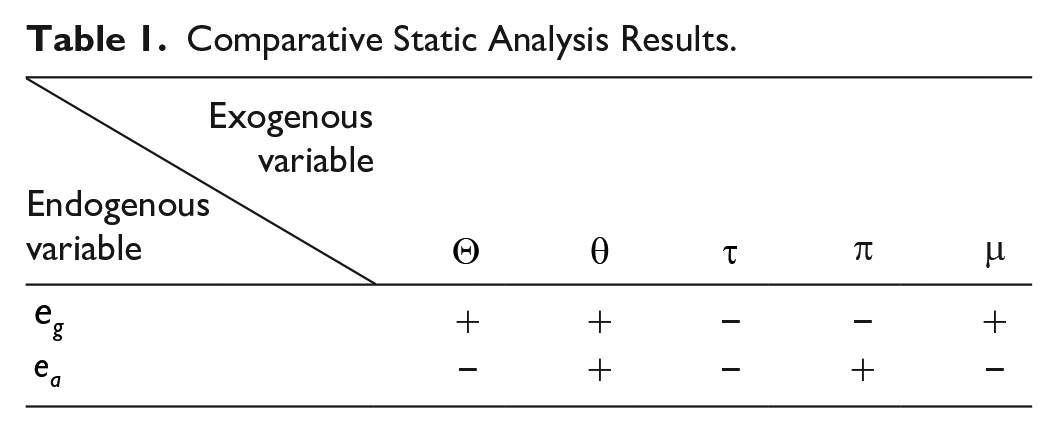
By performing comparative static analysis, we can observe the influence of public policy on household education investment decisions. This paper discusses the influence of the public education investment scale
As shown in Table 1, if the government increases the education budget
Comparative Static Analysis Results.
Regression Analysis
Based on the theoretical analysis in Part 3, this paper built two econometric models to verify the theoretical analysis of hierarchical education investment on economic output and human capital allocation efficiency.
For hierarchical education investment on economic output, the econometric model is as follows:

For the human capital efficiency difference, the econometric model is as follows:

Data Description
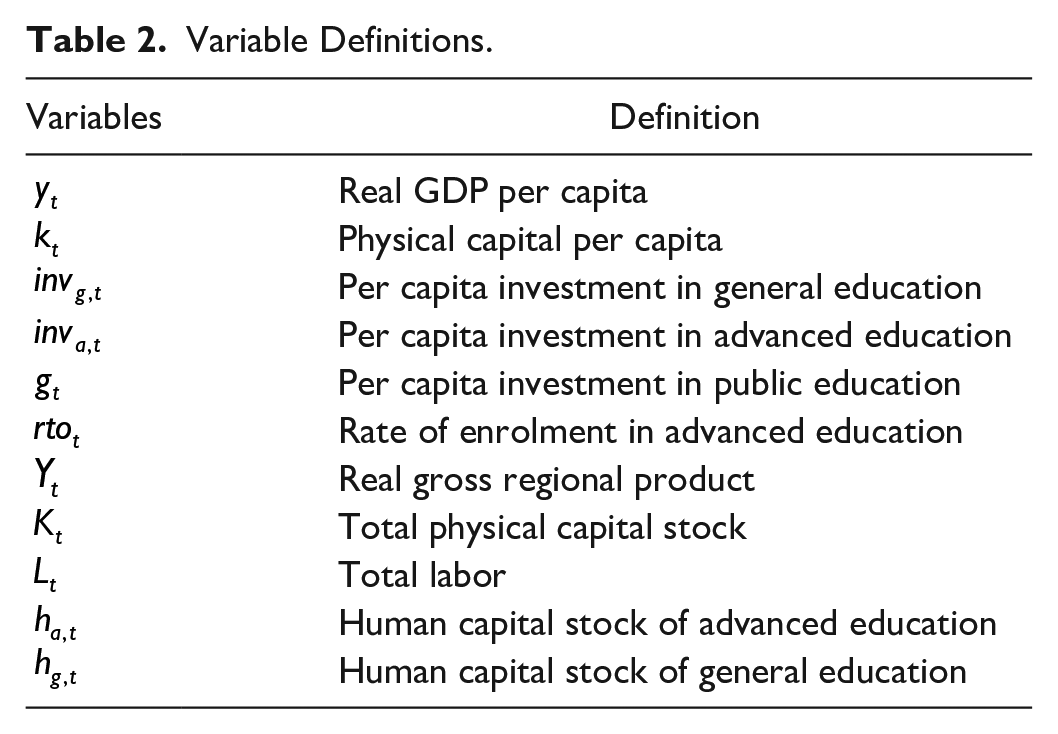
The research sample of quantitative analysis in this paper is taken from Provincial Panel Data. The main data used in this paper are taken from the “China Statistical Yearbook,” “China Labor Statistics Yearbook,” “China Industrial Economics Statistical Yearbook,” and “China Financial Statistics Yearbook.” The years were 1997 to 2020 because the hierarchically education employee data was made available starting in 1997. The sample data contain 30 provinces, and the Tibet Autonomous Region was not included because of the large amount of missing data. It used the panel OLS regression method to carry out regression analysis on equations (11) and (12). All the variable definitions are shown in Table 2.
Variable Definitions.
Data Description
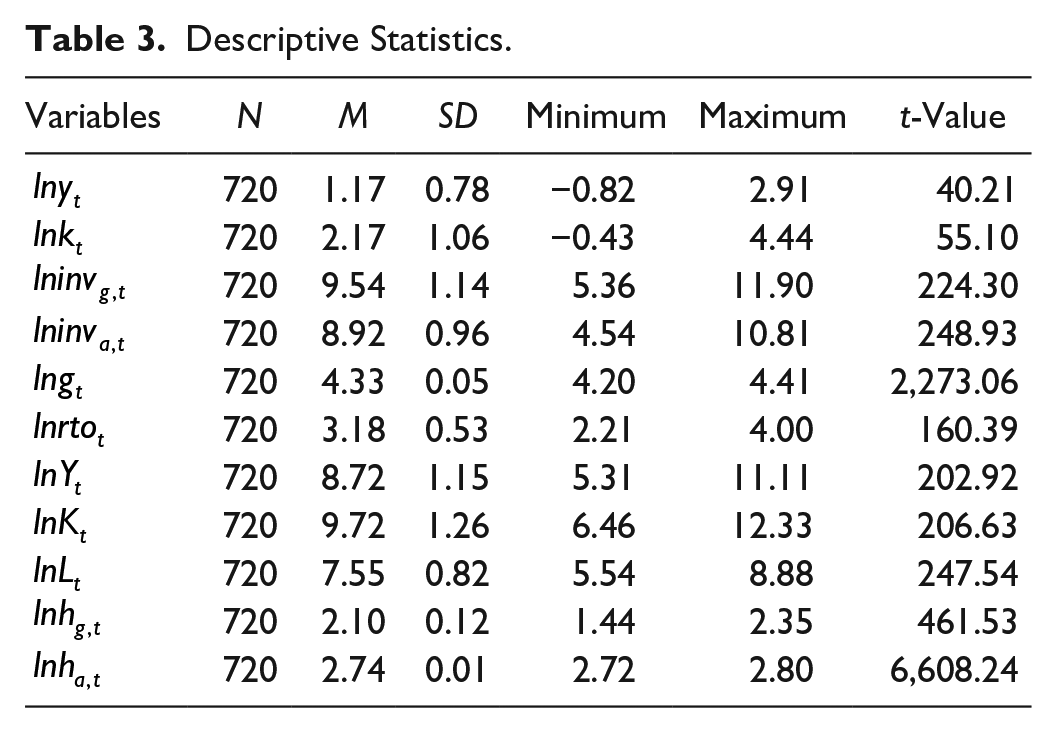
The summary statistics are shown in Table 3. From 1997 to 2020, the total number of observations is 720, which meets the minimum requirements for further analysis. Specifically, for
Descriptive Statistics.
Hierarchical Education Investment in Economic Output
Considering the influence of the financial crisis of 2008 on the expansion of advanced education, the abolition of tuition and miscellaneous fees for urban compulsory education in 2008 greatly reduced the burden of the investment in general education for households. The per capita increments of investment in general education in 2008 showed a relatively large decline. Therefore, the interaction term between the dummy variable and per capita investment in general education increment
The regression results are shown in Table 4. They show that after adding interaction items, the output effects of per capita physical capital and per capita general education investment are significantly positive at the critical level of 1%. The per capita advanced education expenditure is insignificantly positive, and the rate of enrolment in advanced education is significant positive. The structure of investment in public education is significantly positive, which meets expectations.
Hierarchical Education Investment on Economic Output.

Note. The parentheses are standard errors.
, **, and *** indicate significance at 10%, 5%, and 1%, respectively.
The results may be that there is a correlation between
Effect of Human Capital on Economic Output
As shown in Table 5, for the full sample, the regression results show that physical capital stock and general education are positive and significant at the significance level of 0.1%, which is in line with the learning-by-doing hypothesis. This indicates that workers with general education make up most of the labor force at present. In the process of capital deepening, unskilled workers constantly improve efficiency and promote technological progress. Skilled workers with advanced education do not play a role in technological progress. On the whole, the sum of elasticity between unskilled workers, skilled workers, and physical capital is greater than 1, indicating that China’s economic development has a scale effect on the whole. In China, although the number of skilled workers (college degree or above) in employment has increased significantly, from 2.7% in 1997 to 20.1% in 2020, the proportion of skilled workers is still relatively low. As a result, the output share of skilled workers is correspondingly low, at approximately 0.409. In contrast, the output shares of unskilled workers and physical capital are 0.610 and 0.622, respectively, indicating that China’s economic development in recent decades mainly relies on a large amount of unskilled labor provided by physical capital investment and demographic dividends.
Effect of Human Capital on Economic Output.

Note. The parentheses are standard errors.
, **, and *** indicate significance at 10%, 5%, and 1%, respectively.
In view of the significant impact of the expansion of advanced education in 1999 and the expansion of postgraduate enrolment in 2009 on China’s economic growth, this paper divides the sample into three different periods, 1997 to 2003, 2004 to 2008, and 2009 to 2020. As shown in the third column, general education is negative and significant at the 1% level. The negative effect in technological progress shows that the expansion of advanced education rapidly increases the stock of human capital of advanced education, reduces the attractiveness of human capital of general education in the job market, and makes the human capital of general education become an obstacle to economic development. As shown in Columns 4 and 5, with the continuous increase in the scale of human capital accumulated by advanced education, the scarcity of human capital in general education has gradually become prominent, and the role of human capital in general education has gradually shown the expected benefits (from 0.182 to 0.185***). Especially since the expansion of graduate enrolment in 2009, the scarcity of human capital in general education has become increasingly significant (0.185***). Since 2019, China has continuously seen a shortage of blue-collar skilled workers in the manufacturing and service industries. The labor shortage reflects that some industries cannot transform and upgrade to keep up with the speed of China’s economic development, and it also reflects the current irrational structure of educational human capital.
Conclusion
This paper studied the output effect of hierarchical education investment on economic growth based on the endogenous economic growth model. The results show that the accumulation of physical capital is still the main driver of China’s economic growth. The investment in general education and advanced education has a significant output effect, and the investment in general education is greater than that in advanced education. Increasing the investment in general education of the public is helpful to promote economic growth, while increasing the investment in advanced education of the public has the opposite effect. The complementarity between skilled workers and physical capital is slightly greater than that between unskilled workers and physical capital, which indicates that the capital-skills complementarity effect is significant in China. The coefficient of return to scale of factor input is more than 1, which indicates that China’s economic development has a scale effect. In recent decades, China’s economic growth has mainly relied on a large number of unskilled labor forces provided by physical capital investment and demographic dividends. The government should further increase investment in education, and financial investment should give priority to ensuring investment in education.
Discussion
Increasing the proportion of government education funds used for general education will help increase the national economic output. As a developing country, China has a relatively low level of education for its employees. The government attaches great importance to and gives priority to the development of general education. It is beneficial to economic growth to tilt educational resources toward general education. Expanding enrolment in advanced education is bad for economic growth. The impact of expanding the enrolment scale of advanced education on economic growth is complex. On the one hand, increasing the opportunities for young people to receive advanced education is conducive to increasing the proportion of the skilled labor force, thus promoting economic growth. On the other hand, according to results, when the scale of public advanced education investment remains unchanged, expanding the scale of advanced education enrolment will further enhance the crowding effect of advanced education, lead to the decline of education quality, and thus adversely affect economic growth. Besides, the decline in the quality of advanced education will, to some extent, weaken the competitive pressure on general education and lower parents’ expectations for their offspring to receive advanced education, which in turn will restrain education expend.
The government should further increase the investment in education, and the financial investment should give priority to ensuring the investment in education. Give play to the leading and coordinating role of the government in the education financing system and encourage the active participation of the household sector in education investment; we will improve the structure of financial investment on education, clarify the priorities of education development at all levels, and focus on general education. We should reasonably control the enrolment scale of colleges and universities, increase public investment in education, and ensure the steady increase of education investment per student in advanced education. Encourage household to invest in advanced education, and establish a cost-sharing mechanism for colleges and universities that is commensurate with the average investment.
Footnotes
Data Availability statement
Some or all data, models, or code that support the findings of this study are not available from the corresponding author upon reasonable request. The datasets used and/or analyzed during the current study are available from the corresponding author on reasonable request.
Declaration of Conflicting Interests
The author(s) declared no potential conflicts of interest with respect to the research, authorship, and/or publication of this article.
Funding
The author(s) received no financial support for the research, authorship, and/or publication of this article.
Ethical Approval
This article does not contain any studies with human participants performed by any of the authors.
