




Abstract
With the rapid development of international education, China has become a popular destination for international students. In this context, whether students settle in China or return to their hometowns after graduation is a matter of interest. Based on a recent questionnaire survey circulated among international students in Nanjing, Jiangsu Province, and on interviews conducted there, this study applies logistic regression models to examine the determinants of their intentions and the mechanism of their decision to either settle or return. In addition, the gender gap is studied to explore how male and female international students are differently influenced by various determinants. The results show that most international students are satisfied with their experience of studying in China and with their social environment but have less understanding of Chinese policies. The results also indicate that family obligation, social ties, working conditions, and social and policy environment have a significant impact on international students’ intentions. From the gender perspective, family ties and labor market play different roles in the decisions of male and female students, while marital status and policies influence both genders. The results reveal the mechanisms of settling and returning, which may have implications for the Chinese government in its desire to retain foreign talents.
Plain language summary
Introduction
With the global transition from energy-intensive to knowledge-intensive industry (Gilpin & Gilpin, 1987), knowledge is the basis of a nation’s soft power, and higher education has often been the central factor (McMahon, 1992). In this context, students studying across borders for educational purposes have become an important source of talent for countries that host them, and student migration has increased dramatically in the globalized world.
In recent decades, China has experienced unprecedented growth in the international student market. Benefiting from reform and opening up, China has been involved in global affairs and has been the largest “supplier” of international students, often sending academic talents to developed countries. Nevertheless, with the rapid development of its own socio-economy and higher education sector, China has now become the world’s second-largest economy, attracting an increasing number of students to study and seek further opportunities. In order to increase the influence of China, in 2010, the Ministry of Education of China launched the “Studying in China” program, encouraging more international students to study in China. Studying in China was given the same development status as studying abroad at the National Study Abroad Conference in 2014. In this way, China has gradually turned into a “receiver” of international students as much as a “sender.”
Nevertheless, problems arise when international students study in China. When they graduate, where should they go? Going back to their home countries or staying in the host countries is a potentially difficult decision for all international students, who may feel torn between returning to their families and settling in China to take advantage of its resources and opportunities. In fact, the trend of settlement after graduation has been highly prevalent in recent years (Iqbal et al., 2019), especially in China, where the economy and development are booming. Nevertheless, there has been insufficient evidence on the determinants and mechanisms of international students’ settlement or return for universities or governments to work with, which is unfavorable to China in its quest to retain foreign talents.
In previous studies, the migration of international students is thought to have an uneven pattern, moving from developing to developed countries (Perkins & Neumayer, 2014). Studies regarding the post-graduation choices of international students moving in and out have reinforced this stereotype, as the focus is primarily on international students in developed countries. The existing literature has revealed that both push and pull factors influence international students’ decisions. For example, immigration policies are strongly related to the aspiration to remain in host countries (Toma & Villares-Varela, 2019), and certain professional factors may influence international students to stay in host countries because they have personal connections (Alberts & Hazen, 2005). Employment opportunities, economic development and even the natural environment are factors that influence whether or not international graduates return to their home countries. Nevertheless, although the literature concerning international student settlement and return is considerable, research gaps remain. First, most studies ignore international students in developing countries. Most studies focus on the settlement or return of international students in developed countries, as it is generally accepted that developed countries always play the role of “receiver” (She & Wotherspoon, 2013). However, with the development of higher education provision in emerging economies, the destinations of international students are becoming increasingly diverse (Hou & Du, 2020). Therefore, since the number of international students studying in developing countries have increased markedly, the difficult choices they face also deserve academic attention. Second, among the existing literature regarding the determinants of whether or not to return, the push-pull model is usually adopted to explore the external factors that derive from the sending and receiving countries. Nevertheless, the decision to settle or to return is a complicated process (C. Wu & Wilkes, 2017), involving both external conditions and internal features, both of which should be studied. In addition, gender differences in the intention to settle or return should also be taken into account. Third, international students in China have some salient characteristics compared to those in other countries. Unlike other countries, most international students in China come from countries along the “Belt and Road” (B&R), which is a policy led by China to promote cooperation between regions (it refers to the “New Silk Road Economic Belt,” which will link China with Europe through Central and Western Asia, and the “21st Century Maritime Silk Road,” which will connect China with Southeast Asian countries, Africa and Europe). The cultivation of international talents for B&R countries is essential to implementing the B&R framework (Ma & Zhao, 2018). In addition, as Chinese universities are now competing for a higher ranking in international university leagues, the internationalization of Chinese higher education is a crucial part of the path to developing world-class universities (Huang, 2015).
Using a questionnaire survey and recent interviews conducted in Nanjing, this article attempts to fill this research gap concerning international students in an important developing country by identifying the primary factors and underlying reasons for the settlement and return of international students in China. Specifically, this article uncovers the decision-making of international students’ settling or returning. The results of this article help explain the relationship between internal and external conditions and the direction of international students’ flow to China. They are also helpful in extending migration theories by investigating the decision-making process of settlement and return among international students. Furthermore, the implications of this research are relevant to governments who wish to manage and guide the flow of international students. The case of Nanjing, China, can serve as a reference for other developing countries.
This paper proceeds as follows. First, the relevant literature is reviewed to reveal existing findings on international students in China and settlement and return of international students. Second, the data used in this paper are presented, and a theoretical model is constructed. Third, descriptive analysis and regression modeling analysis are developed to examine the determinants of international students’ intentions of settling and returning. We report the results of interviews conducted to reveal the underlying reasons of international students’ decision-making. The final section concludes.
Literature Review
The Settlement and Return of International Students
The prevailing belief in international education is that students flow from economically less developed to developed countries (Massey et al., 1993) because students choose to study abroad to expand their educational and economic opportunities (Cantwell et al., 2009). This can be interpreted through dependency theory, which explains the direction of student flow. The global higher education system is unevenly weighted and can be divided into the center and periphery. The direction of knowledge flow is from the center to the periphery, while international students flow from less developed to more developed countries. Alongside this, human capital and cultural capital are concepts that appear in two similar theories of international student migration. The human capital theory starts from the economic angle, considering studying abroad as a kind of investment in human capital. This investment allows for the acquisition of knowledge and skills and the improvement of competitiveness in job markets, all of which promote the flow of international students. Similarly, the cultural capital approach suggests that different cultures nurture different educational thoughts and theories and that international students tend to acquire cultural capital to benefit their social attributes (Noble & Davies, 2009). Therefore, it is reasonable to assume that the education of international students tends to take place in developed countries.
Nevertheless, these theories only interpret the primary flow of international students, that is, from their home country to foreign countries to study. But they have not explored post-graduation stay-return decisions. The decision concerning whether to return to their home country or stay in the host country after graduation can become more complex with longer stays in host countries (Alberts & Hazen, 2005).
The push-pull model is often introduced to explain the migration behavior of individuals (Hare, 1999). Push factors encourage the floating population to leave their residence, while pull factors encourage them to migrate. However, the post-graduation international student’s willingness to settle or return is a decision involving a social process, which cannot be explained solely by the push-pull model. The multitude of factors at both the macro and micro levels that influence their willingness to do so. For instance, Fritz Heider proposed the attribution theory in 1958, which states that the determinants of incidents can be attributed to internal and external factors. In the theory of planned behavior, it is postulated that people’s behavior is primarily influenced by their intention, which results from individual beliefs. Furthermore, settlement or return is a process of finding a home, so the concept of home encompasses context-specific factors and determines the directions of migration (C. Wu & Wilkes, 2017).
From the perspective of the macroeconomic context, individuals from more economically developed countries and emerging economies have shown a higher rate of return than less prosperous countries (Baruch et al., 2007). While economic factors such as higher salaries, job opportunities, and better career development prospects in host countries play an important role in encouraging students to stay (Lin & Kingminghae, 2017). At the policy level, in countries like Finland, the government has policies to retain and integrate international students in Finland, which do indeed attract students (Mathies & Karhunen, 2020). By contrast, in early 1993, political instability in China was a primary reason for Chinese international students not returning to the United States (Zweig, 1997). Moreover, the flow of international students is also a process of geopolitical importance, so students may face visa restrictions, which may cause them to return to their own countries.
On the other hand, from a microeconomic perspective, social ties and personal, professional, and family factors are the triggers for the decision to settle or return. Specifically, different disciplines influence international students’ decisions, mainly for economic or professional reasons. For example, business or law students are more likely to stay in host countries (Lin & Kingminghae, 2017). In addition, personal and professional ties established in host countries may motivate international students to settle, as they believe there are distinct advantages to staying (Alberts & Hazen, 2005), and they are already familiar with the host countries. Family support is an additional factor related to personal intention, as a student whose family supports the intention to migrate would have a higher intention to settle (Soon, 2018). It has been observed that married students tend to stay in the host country because the company of their spouse makes living abroad less lonely, making settling abroad an acceptable option (S. Kim, 2015). In particular, those with children are more likely to stay for the sake of their children’s education and future (Cheung & Xu, 2015).
Overall, existing research has shown that international students’ intention to return home tends to be low (Novotný et al., 2020). Many are likely to want to stay in the host country (Gribble, 2008). This is especially true of those from developing countries (Lin & Kingminghae, 2017). This phenomenon is traditionally considered a “brain drain” for the sending country and a “brain gain” for the receiving country (Pan, 2010).
International Students in China
Deep inequalities exist in the internationalization of higher education (Altbach, 2015). Generally, it is accepted that international students flow from less developed to more developed countries. Nevertheless, developing countries have also started to establish educational centers and attract international students (Hou & Du, 2020). Especially in recent decades, more and more developing countries are emerging as destinations for international students (Wen & Hu, 2019).
As the largest developing country, China has been the largest international student-sending country (Wen & Hu, 2019). However, with the WTO entry, China has integrated into the global market (Ahmad & Shah, 2018), and it became a host country for international students in 2015 (Hou & Du, 2020). In 2017, China turned into the largest host country in Asia and the third-largest destination country globally, meaning that China has completed the transition from an insignificant player to a major destination (Ding, 2016). According to China’s Ministry of Education, nearly 60% of international students come from Asia, with South Korea, the United States, Thailand, India, Russia, and Pakistan being the top source countries (Miao & Qu, 2022). Countries along the Belt and Road are the primary countries of origin of international students in China. There is evidence that providing education to international students is more than just an educational issue, but is also a diplomatic issue (Wei, 2013). This can be explained by the government-regulated approach in China (Huang, 2007).
The motivations for the flow of international student migration to China vary. According to the push-pull model, motivations can be explained by both push and pull factors. International students are generally self-motivated on the push factors side (M.-Y. Wu et al., 2019). In general, residing and studying abroad provides international students with enriching experiences which are beneficial for their personal growth (Taušová et al., 2019). Considering that the flow of international students follows the structure of the world economy (Chen & Barnett, 2000), it is easy to deduce that the flourishing economic situation in China and the advanced quality of education are predominant factors. China is the second-largest economy in the world behind the United States. Due to its booming economy and increased international status, international students believe that China will improve their opportunities and offer them a bright future (M.-Y. Wu et al., 2019). Nevertheless, the influence of the economy should not be overestimated. In normal circumstances, educational factors rank high (Wei, 2013). In recent decades Chinese higher education, especially its top research universities, has gained global recognition. Therefore, the improvement of the quality reputation of Chinese higher education is the main force attracting international students to China (Ahmad & Shah, 2018; Wen & Hu, 2019; M.-Y. Wu et al., 2019). In addition, affordable tuition, modest living expenses, political stability, and accessible scholarships are important pull factors (Gbollie & Gong, 2020; Jiani, 2017). Nevertheless, there are arguments that cultural motivations play a weak role in attracting international students because Chinese culture does not have a clear image (Wen & Hu, 2019).
After arriving in the host country, students’ intentions to settle or return on graduation may shift significantly based on their actual experiences in the host country. They may face difficulties adjusting to the environment or barriers to the enforcement of their rights while studying abroad. Coupled with political and social issues, international students’ rights are not always adequately protected, and they may be subject to unfair treatment (Deumert et al., 2005; Lee, 2008). For them, the greatest challenge is to adapt to the culture and environment of foreign countries. The most critical period for adaptation is the first year of residency (An & Chiang, 2015). Research has shown that the satisfaction levels of international students in China regarding their living experiences are lower than international benchmarks (Ding, 2016), which presumably has an effect on post-graduation settlement intention. In terms of the learning experience, international students find the learning experience in China satisfactory, except for poor English instruction and limited student-faculty interaction (Wen et al., 2018).
In sum, despite the many studies regarding international students, little attention has been paid to international students’ intentions of settling or returning in the context of China as a host country. As it is often stated that international student flows from less developed to developed countries, existing literature has generally focused on migration or return intentions of international students in developed countries, not in developing countries. Where there has been research on China as a destination, this has mainly focused on why students choose China as a destination and what the international student experience is like, largely in order to gather data to improve Chinese international education. Therefore, to fill the research gaps, this paper attempts to draw attention to the determinants of settlement or return and carries out a comprehensive examination of internal and external factors that weigh on the decision-making of international students in China.
Data and Methodology
Study Area and Survey
In recent decades, China has become an important destination for international students and has devoted much attention to international education. The number of international students in China has maintained an overall growth trend since 1999. Only 44,711 students were studying in China in 1999, but the latest statistics in 2018 show that the number has increased more than tenfold to 492,185. As the number of international students can be used to measure the development of the internationalization of higher education (Wen et al., 2018), we can conclude that China’s international higher education has developed rapidly.
The province of Jiangsu has long been considered the most advanced region in China, not only in socio-economic terms but also in education. Equipped with 167 universities, higher education enrollment reached 658,895 in 2019 (Jiangsu Provincial Bureau of Statistics, 2020). Among these universities, there are 2 first-class universities and 15 first-class discipline construction universities globally, ranking in the top tier of China’s national university league tables. Nanjing, the provincial capital of Jiangsu, is full of high-level universities and research institutions with abundant educational resources. The number of international students in Nanjing is of great magnitude and occupies an important position in Chinese international higher education. In 2018, Jiangsu’s universities enrolled 45,778 international students, while universities in Nanjing were responsible for nearly half (over 20,000) of the province’s total. Therefore, Nanjing was chosen as the study area for this paper.
The data adopted in this paper is from a questionnaire survey conducted between 2021 and 2022, aiming to understand the settlement or return intentions of international students in Nanjing. This questionnaire was designed to elicit the mechanism of international students’ settlement and return. First, the survey focused on basic information about the students, such as their nationality, marital status, and major. Second, the survey focused on more detailed information, including their family background and social characteristics and their personal abilities. Third, “external” determinants were investigated, including questions about career ambitions, living conditions, and policies regarding international students. The questionnaire was distributed through various channels, including an online survey, visits to the campus, and snowball sampling. We distributed the questionnaires to international students from different schools and majors. Then they sent the questionnaire to their foreign friends and classmates in Nanjing. In the end, we collected 400 valid questionnaires completed by international students from around 20 universities in Nanjing, Jiangsu province. The statistical analysis software SPSS.25 was used in this study to process for all statistical analysis of the data and regression modeling.
In addition, we interviewed 23 international students in Nanjing. These interviewees were recruited through the author’s networks and through recommendations from other international students. The ages of our interview participants ranged from 21 to 42 years old. Nine participants were female. Interviews were conducted face-to-face, via video, and using a messaging app. The interviews mainly focused on the student’s earliest ideas about moving to and settling in China, the changes in these ideas after a long stay in China, and the reasons for this change.
Theoretical Model
This paper focuses on the settlement or return of international students. More specifically, two questions are raised in this paper. First, what are the intentions of international students regarding moving after graduation? Second, what determines the settlement and return of international students? Therefore, the analysis strategy of this paper is to run regression models to discover the determinants of return and non-return intentions, and it will also, to some extent, explain the underlying reasons for the international students’ decision-making.
Choosing a destination after graduation is a complicated process for international students (A. M. Findlay et al., 2012). According to the theory of planned behavior, people’s behavior is mainly influenced by their intention, which is a result of individual beliefs. These beliefs are determined by personal antecedents or contextual conditions (Ajzen, 1991, 2011). Similarly, the decision to settle or return after graduation made by international students may vary due to different individual experiences, abilities, and contextual environments. The questionnaire enabled us to investigate the determinants of settlement and return, divided into internal and external factors (see Table 1).
Factors Influencing International Students’ Willingness to Settle or Return.
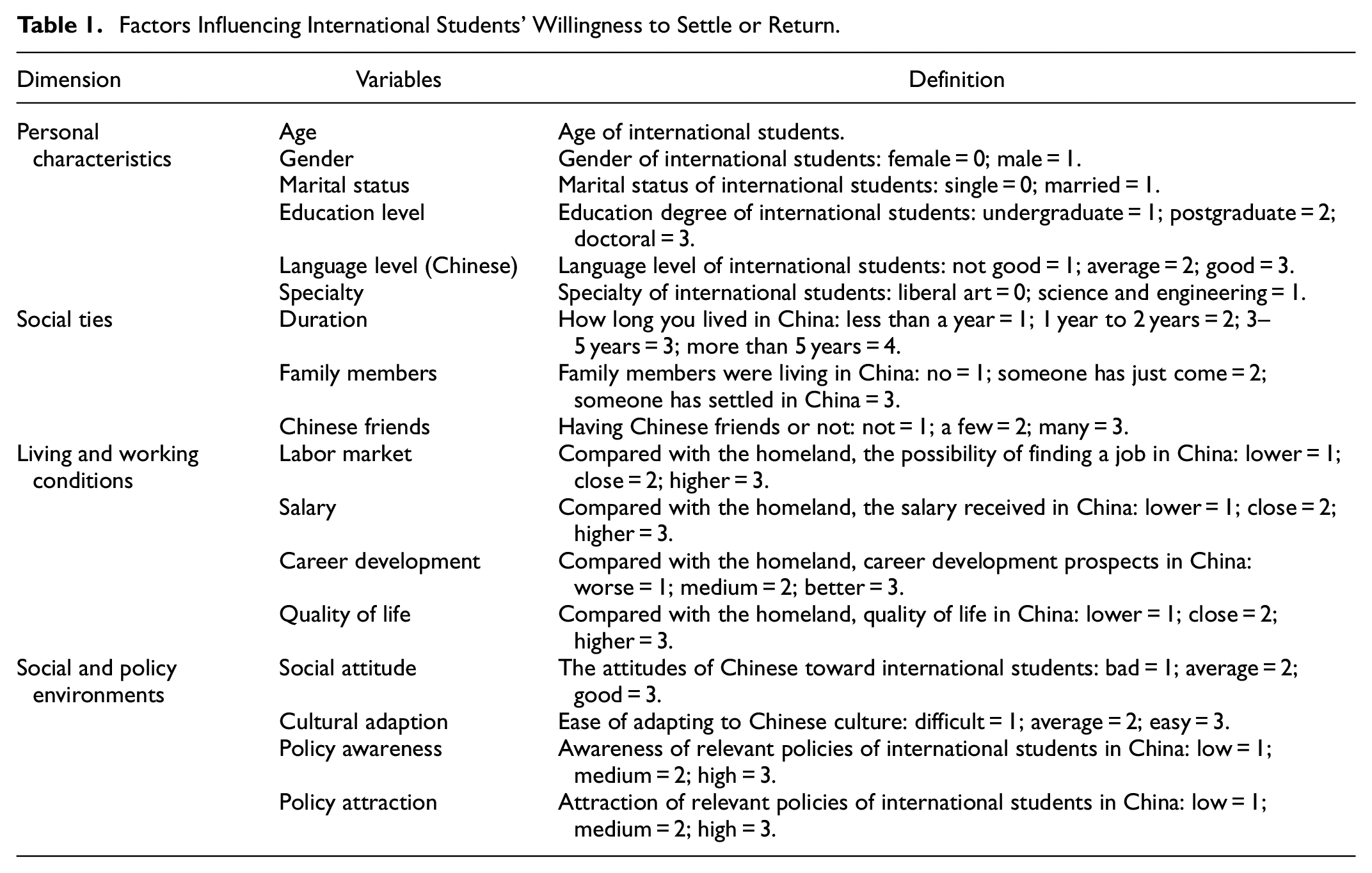
The researchers considered the willingness to return or not to return as having both an internal and external aspect. In the analytical framework of this paper, the internal aspect includes personal traits and social ties, while the external aspect includes living and working conditions and the social and policy environment. Regarding the internal aspect, the dimension of personal characteristics covers basic information, such as age, gender, and marital status and includes an overview of their studies, such as their level of education, specialty, and their level of Chinese. The second dimension (social ties) includes the length of their stay in China. A longer duration of stay in the host country normally increases the likelihood of staying (Lauring & Selmer, 2010). Furthermore, social ties, including networks of family members and Chinese friends, are instrumental in influencing students’ trajectories (S. Kim, 2015). Therefore, factors concerning family members and Chinese friends are included in this dimension.
Regarding the external aspect, salary, labor market, and career development will directly affect students’ future lives in the long run. Cultural adaptation and social attitudes are factors influencing students’ inclination since differing cultural values and attitudes from locals are major potential obstacles for newcomers (Zhai et al., 2019). Government-led policies are also important determinants of international students’ decisions. For example, policies that allow international students to obtain permanent residency status are more likely to encourage students to settle (Guo, 2010). Therefore, this dimension of the external aspect (social and policy environment) includes social attitude, cultural adaption, policy awareness, and policy attraction.
Empirical Analysis
In this paper, the analysis strategy is first to compare the characteristics of international students who intend to return with those who intend not to return. Then, binary logistic regression models are adopted in order to examine the factors that influence intentions. Interviews were conducted among international students to further investigate the detailed mechanism and current realities of settlement or return.
Prior to the model analysis, this study performed a multi-step cleaning and testing exercise on the data, which consisted of the following three main procedures. Firstly, this study examined the data in this study in detail and used the percentile method to find outliers and exclude extreme data. Specifically, this study sorted all observations from smallest to largest and then eliminated the smallest percentile X and the largest percentile X from the data, where X was taken as 2.5. Secondly, this study has examined other possible assumptions including logistic regression in the model selection. For example, this study has examined the assumption of linearity by plotting a scatter plot and the graph shows a non-linear trend indicating that the assumption of linearity is not valid. And, this study attempted to test whether students in different clusters have quite different probabilities of returning home through cluster analysis. However, this study found that the results of cluster analysis of data may not be unique and stable, that is, there may be many different clustering schemes for the same set of data, and small changes in the data may lead to significant changes in the clustering results. In this case, this study abandons the linear assumptions and cluster analysis methods in favor of logistic regression modeling. The modeling focuses on assessing the fit of the model through goodness-of-fit. Thirdly, for the problem of multicollinearity of independent variables, this study tested it by calculating the variance inflation factor (VIF), which showed that the VIF was less than 5, indicating that there was no high correlation between independent variables.
Descriptive Analysis
According to the results of the 400 valid questionnaires received back, 194 international students had chosen to return to their home country after graduation, while 206 had decided to settle in China. Overall, this indicates that the post-graduation intentions of international students in Nanjing are relatively balanced between settlement and return. Table 2 presents the salient traits of international students.
Descriptive Statistics of Main Variables.

Note. Standard deviation in brackets.
The average age of the respondents was around 26 years old, with the youngest being 18 years old and the oldest 47 years old. Most of the respondents were undergraduates and evaluated their own Chinese language level as average. In the area of living and working conditions, we can readily see that these international students largely believe that salary and career development are better in China than in their home countries, and that their expected quality of life is higher, which indicates that international students are generally satisfied with their living experience in China. It also reveals the attractiveness of China for students from “Belt and Road” countries. In addition, the international students surveyed rate China’s social environment highly. The vast majority of respondents believe that Chinese people have a friendly attitude toward them and that they have achieved a high level of cultural adaption. However, the mean value of respondents’ understanding of Chinese policies toward international students is lower than those for their views of social attitude and cultural adaption.
In addition, settlers were more satisfied than returners were with the living and working conditions in China, including labor market, salary, career development and quality of life. Regarding the social and policy environment, settlers had an obviously higher level of “confidence in locals” social attitudes toward them and a higher level of cultural adaptation, and had a better understanding of policies toward international students.
Regression Analysis
In this paper, a binary logistic regression model is conducted to investigate the mechanism of international students forming their intentions of settling or returning (Table 3). In this investigation, we assume that the four dimensions of variables (personal characteristics, family ties, living and working conditions, and social and policy environment) influence international students’ decision to settle down or return. In addition, in-depth interview data are employed to better understand the reasons behind the results of the model.
Binary Logistic Regression for the Intention to Settle Down.

p < .05. **p < .01.
According to Table 3, both age and marital status negatively affect international students’ intention to settle. For example, the chance of settling down decreases by 11% for each additional year of age. The results indicate that older and married international students are less likely to settle in China. One possible explanation is that their spouses and children are in homeland. As a result, family obligation prompts them to return after graduation. In addition, older people and those who are married are more likely than young, single people to seek stability. Those students intend to rejoin their family members and then enter a more stable phase of life.
Compared to internal factors, external factors have a greater effect. Employment opportunities and career prospects in China affect the intentions of international students to stay or return. Education abroad is often seen as an asset to improve future employment options (Arthur & Nunes, 2014) and many students are primarily motivated to study abroad in order to improve their employment opportunities upon returning home. So, for an international student to consider permanently relocating, the career development opportunities in their host country would need to be as good as (or better than) those back home. Through rapid development for decades, China is thriving. Modern cities in China nowadays provides abundant employment opportunities and attractive career prospects due to its booming economy. Hence, international students tend to settle in China if there are more development opportunities in China compared to their home countries, which is often true for those from “Belt and Road” countries with relatively low development levels. Moreover, many international students prioritize employment prospects when choosing their study abroad destination (Zhai et al., 2019). They decide to study in China since they believe that China can offer them a bright future through employment opportunities and career prospects, alongside the increasing connections between China and other countries. However, it is unclear in practice whether or not the job prospects in China are actually favorable for foreigners. As some interviewees said: If there are opportunities to work in China, I would like to settle, but if there are no [job opportunities], I will go back to my hometown… What bothers me most is that I don’t know whether Chinese companies need foreigners… Except for the career problem, I’m willing to settle in China. (28-year-old, male, Korean) Finding a job is important. If I go back, I can find a job, but it will not be suitable for me. Because in my homeland there are no suitable jobs for my major [tourism geography]. But in China, I cannot find a job probably. (26-year-old, male, Indonesian)
Although the effect of having Chinese friends on the intention to settle down is significant, perceived social attitude from locals has no significant effect on international students’ settlement intentions. International students face a relatively unfamiliar environment, social integration is closely related to social interactions (Baruch et al., 2007), particularly the support and friendly attitudes of others. Overall, international students are usually satisfied with Chinese social attitudes because they are treated well. As a Korean student said (28-year-old, male): Personally, I think Chinese are fairly kind to foreigners, and I’ve never met people who are disagreeable. Nevertheless, what bothers international students is that even though they are treated well, their relationships with Chinese people are rarely close, making it difficult for them to truly integrate. In addition to language reasons that can be a barrier to communication, the residential and curriculum arrangements that separate international students from domestic students make it difficult for internationals to make friends with their Chinese peers, accordingly influencing their settlement decisions. However, once a student does establish a close friendship with a Chinese person, their settlement intention becomes strong. The statements of the following two interviewees are typical.
From the point of view of a foreigner, sometimes I feel that someone has stereotypes towards us, considering that it is difficult to communicate with foreigners. Thus, the relationship with them will always be like “Chinese-foreigner,” which won’t be very close. (24-year-old, female, Belarusian) I have many Chinese friends and they encourage me to stay, and I think they will continue to help me if I work in China. (25-year-old, male, Zambian)
Most international students in China come from places that are very culturally different to China, and international students have different expectations of their host culture (An & Chiang, 2015). If they are interested in Chinese culture, they are likely to assimilate into Chinese society through deliberate cultural learning, triggering their settlement intentions. Additionally, the policy environment plays an important role of shaping individual mobility decisions (A. M. Findlay, 2011). An essential macro-context for international students is the immigration policy in the host country. For instance, for many international students, the liberalization of visa constraints and simplification of residence procedures will increase the likelihood of their gaining post-graduation work experience in the destination country (Arthur & Nunes, 2014). As shown in Table 3, the estimate of social integration is 0.774, indicating the important influence on expressed intentions of policies toward international students. In practice, international students in China were often discouraged by unattractive policies. That is because China makes a great effort to increase its influence through international education, but sets up barriers to foreigners working or settling down, especially in large developed cities where employment opportunities are relatively abundant. For instance, large developed cities like Shanghai and Beijing normally target outstanding graduates who have studied at famous universities in certain sectors, which those cities badly needs. In addition, when foreigners apply for work visas, their salaries need to be higher than those of locals, which raises the running costs for companies. As a consequence, it is common for companies to hire the Chinese to reduce costs. The following narratives well reflect such thinking of international students in China.
The difficulty of settling in China may be closely correlated with the policy constraints, for example, visa policies are quite complex for foreigners; also there are lots of formalities involved when finding a job. (24-year-old, female, Belarusian) I would like to stay in China. But the Chinese policies are not friendly to foreigners, so foreigners are not willing to stay in China for a long time. (30-year-old, male, Mongolian)
Settlement intentions vary between male and female international students. Previous studies have shown that the labor market and parental care obligations can explain the gender differences in settlement intention (Sondhi & King, 2017). In the study, we analyzed the determinants of settlement and return for male and female international students in the Chinese context. International students in China have some distinct features by comparison with those studying in many developed countries, and thus gender impacts their considerations about settlement intentions.
Based on the results in Table 4, there are similarities and differences between male and female international students in China regarding the determinants of settling or returning. In terms of personal characteristics, age and marital status negatively impact both genders. For male and female international students, marriage (associated with family obligation) strongly influences their decision-making. Married students tend to return since spouses and children need to be looked after. Those who are single have more freedom to make the settlement/return decision independently. As one interviewee said:
Binary Logistic Regression for the Intention to Settle Down (male/Female).

p < .05. **p < .01.
I am still single now and have no worries about how my spouse thinks. If you are married, things may be different because marriage will constrain you to the place. I want to seize the time when I’m single. Because maybe when I’m married, I will not be as free as today. (28-year-old, male, Nigerian)
From the perspective of social ties, it is clear that female students are more likely to be influenced by their familial relationships. They are more constrained by transnational family ties than male students are, which is suggested by some previous studies (e.g., Lin & Kingminghae, 2018). In addition, compared to male students, female students are more sensitive about their environments, and ties of family members in the host country can provide a sense of stability and security, which encourages an intention to settle. The statement of a female student is typical: Having family members in China will give you the courage to live in a country you are quite unfamiliar with. It is better to have company than to be alone. (21-year-old, female, Tanzanian)
Employment opportunities and career prospects play different roles in the decisions of male and female international students. Compared to men, many women are reluctant to return to their home countries if the labor market there is not satisfactory. One possible explanation is that obtaining satisfactory employment in a male-dominated labor market is relatively difficult for female international students upon return (Sondhi & King, 2017). This effect tends to be amplified for women when the labor market is significantly more limited in their home country than in the host country (D. Kim et al., 2011). In China, the female international students are primarily from South and Southeast Asia, where the labor market is indeed relatively male-dominated. Thus, they normally face great challenges when returning, which highly influences their decision-making. As our interviewees said: In China, there are better opportunities than my home, and there are many [more] job vacancies for my major than in my home country, especially compared with men. In India, many companies are more willing to employ men, and gender discrimination is common. But in China, the labor market is large, and you don’t need to worry about this. (30-year-old, female, Indian)
Cultural adaption has a significant effect on females’ decisions. That is because learning the culture and social norms of host countries can encourage women to make friends with natives and provide them a sense of belonging in host environment. Generally, this is more important for women than men in an unfamiliar environment, especially when there is a large cultural distance between China and their countries of origin. Policy attraction influences both genders, indicating the importance of policies toward foreigners, whether male or female.
Conclusion and Discussion
As the international education market continues to grow, student mobility has increased dramatically in the context of globalization. Despite the volume of studies on international students, few focus on those studying in developing countries. Most attention has been given to developed countries, which are generally considered the destination in the international education system. China, the largest developing country in the world and the largest country of origin for international students, has also become the third most popular destination in this international education system. In addition, the home countries of international students in China are mainly those participating in the “Belt and Road,” which is a different mix of countries to that of international students in developed countries. Therefore, the characteristics of international students in China are worth studying. In addition, in the face of brain drain, the mechanism of entry and exit of international students needs to be studied. For this paper, a questionnaire survey was conducted in Nanjing to examine the determinants of international students’ intentions of settling in China or returning home. The results help Chinese policymakers understand how to retain excellent international students and provide benchmarks for other developing countries seeking to attract international students. At the same time, for local governments, it is recommended that this study be used as an action-oriented case study, for example, the results of which could provide recommendations for policy-making by the Nanjing municipal government.
The results indicate that roughly half the international students intend to settle in China after their graduation. Both internal and external factors play a role in students’ decision-making. The influence of internal factors on international students is primarily manifested through personal characteristics and social ties. Family obligations, the support of family members and support from local friends are important in the decision-making of these students. This is largely in line with what has been mentioned in the literature about transnational migration as part of a family strategy. Specifically, for international students, studying abroad or not and where to go is about this being a long-term strategy deployed by the student and their families (Marcu, 2015). It is clear that the social institution of the family plays an influential role in shaping motivation to migrate and willingness to settle (A. Findlay et al., 2017).
However, there are apparent gender differences in the way that the family strategy is worked out in practice. Having family members also residing in their host countries encourages female international students to stay, revealing the importance of family support and the function of family strategy for women. In addition, the effect of cultural adaption is significant for female international students, indicating the close associations with their “finding a home.” Also, gender differences in international students are reflected in individual responses to the labor market, as a large number of female international students studying in China come from countries where the labor market is dominated by men. As a result, female international students are willing to move to China on a more permanent basis, as there are more job opportunities and friendly, equal living environments for them.
Compared with internal factors, the effect of external factors is more significant. External factors include not only the working conditions in China but also the social and policy environment. International students attach importance to their career path. Just like studying abroad itself, the choice to either settle down or return home after graduation is also a human capital investment behavior related to seeking better career development. Therefore, students will weigh the pros and cons of each choice. If they consider that staying in China can help them gain more advantages, their willingness to stay will increase accordingly, which is similar to the considerations of international students studying in developed countries. With the booming economy of China and the increasing connections with other countries, international students from “Belt and Road” countries often intend to amplify the benefits of their studying in China, which highly influences their decision-making regarding studying and settling in China. The social and policy environment dimension is highlighted as an essential factor in international student mobility, with policies having the most direct influence. The results show that if China’s policies on the employment and settlement of international graduates are attractive to international students, they will have a higher intention to stay.
In reality, there remains a large gap between international students’ settlement intentions and the Chinese government’s willingness to grant permission for this. Limited by their own individual rationality and partial access to relevant information, it is difficult for individuals to predict the direction of these macro policies. The Chinese central government has been relatively ambiguous in its policy orientation toward international education and transnational immigration, being relatively welcoming toward transnational talent that would benefit China’s social, economic, or technological development in particular ways, but relatively unwelcoming toward transnational immigrants who lack special (i.e., particularly valued by contemporary policymakers) talents. This policy instability reveals a clear pragmatic bias, and this sense of tension has been exacerbated by the Chinese government’s control policies in response to the outbreak of the COVID-19 epidemic. This being the case, this survey is an essential reference for policymakers in China. To attract and retain foreign talent and increase its international influence over a long period, the Chinese government needs to implement policies aimed at expanding career development channels for international graduates of Chinese universities.
Specifically, the government could launch vocational training for students to help them better adapt to the Chinese labor market. In addition, companies need to think more about how the expertise of international students can effectively support their businesses. For universities, it is necessary to strengthen school-business cooperation and create job platforms for international students. For example, some universities in Nanjing have already established cooperation with particular enterprises, which can provide more employment opportunities for international students. In addition, international students in Beijing and Shanghai can do short-term internships during their degree courses. These policies may encourage international students to stay after graduation. However, these policies are still only being experimented with in a limited number of cities. Therefore, the next step is to expand these policies to other cities.
The study also has some limitations. Due to the limitations of the sampling method, this study does not apply to all foreign students in China, and the findings are valid only for the sample used in this study. Of course, this study may be useful for other researchers in future related large-scale surveys in China or other countries. Also, it may serve as a reference point for the policy recommendations presented above that are suggested to be piloted in selected cities in China.
Footnotes
Declaration of Conflicting Interests
The author(s) declared no potential conflicts of interest with respect to the research, authorship, and/or publication of this article.
Funding
The author(s) disclosed receipt of the following financial support for the research, authorship, and/or publication of this article: This research was funded by the grant from the National Natural Science Foundation of China (42471251, 42371234), the grant from the Jiangsu Province Social Science Fund Project (23SHB003), and the grant from the Humanities and Social Sciences Foundation of China Ministry of Education (21YJAZH030).

Data Availability Statement
Data sharing not applicable to this article as no datasets were generated or analyzed during the current study.