



Abstract
This mixed-method investigation forays into the influence mechanism of self-sacrificial leadership on employees’ retention intention in exhibition enterprises under crises. In study 1 (the qualitative inquiry), in-depth interviews with 20 employees were conducted, and a process mechanism model was constructed on how self-sacrificial leadership affects employee retention intention, following a story line of “action strategy→phenomenon→result.” In study 2 (the quantitative research), we use social exchange theory and social identity theory to build a structural equation model, which verifies the positive impact of self-sacrificial leadership on employee retention intention through 404 valid questionnaires, and tests the mediating role of organizational identification. In addition, political capital is found to strengthen the relationship between self-sacrificial leadership and employee organizational identification, while employee job insecurity plays an inverted U-shaped moderating role that first strengthens but subsequently weakens during the process of self-sacrificial leadership. In conclusion, this study reveals the functional mechanism of self-sacrificial leadership in exhibition enterprises under crises, verifies the boundary conditions of self-sacrificial leadership, and provides practical implications for sustainability and human capital development for exhibition enterprises under crises.
Keywords
Introduction
The global business landscape has entered an era of unprecedented volatility, where exhibition enterprises face dual challenges from external environmental shocks and internal operational crises. Externally, the COVID-19 pandemic precipitated severe disruptions, including international entry restrictions, visa processing suspensions, and dramatic reductions in exhibition orders (Cai et al., 2023; Y. Kim & Roh, 2022). Internally, organizations grappled with production halts, financial instability, and workforce attrition (I. Kim et al., 2022; Y. Wang et al., 2024). During the epidemic period, many leaders of exhibition enterprises took the initiative to cut salaries, give up dividends, suspend vacations, and stand at the front line to protest together with their enterprises and employees. Through such a self-sacrificial leadership style, they maintained the survival and development of their enterprises and won the confidence and followers of employees (Halverson et al., 2004; Zhang et al., 2024). While preliminary evidence suggests these leadership behaviors helped sustain organizational viability and employee commitment during the crisis, the specific mechanisms through which self-sacrificial leadership influences critical human resource outcomes remain poorly understood.
This research gap assumes particular urgency given the exhibition industry’s acute vulnerability to workforce instability during crises. Current research on retention intention has predominantly focused on individual characteristics (e.g., psychological capital, career adaptability) and working environment characteristics (e.g., perceived organizational support, working conditions; Li et al., 2021; Asghar et al., 2021; Lee et al., 2021), and mainly focuses on high-risk and high-stress occupational groups such as nurses (Bruyneel et al., 2023), teachers (Richter et al., 2022). However, three critical limitations emerge in the exhibition context: First, the unique mediating role of organizational identification in translating leadership behaviors into retention outcomes remains unexplored, despite social identity theory’s emphasis on leader-induced identity formation (Tajfel & Turner, 1979). Second, existing studies neglect crucial boundary conditions, particularly job insecurity and political capital, that may differentially moderate self-sacrificial leadership’s effectiveness in crisis environments. Third, the exhibition sector’s distinct characteristics as a project-based, high-stakes service industry suggest existing findings from manufacturing or healthcare may not directly apply (Chen et al., 2021).
Our study employs a mixed-methods approach to address these research gaps. Given that the impact of self-sacrificial leadership on employee retention intention involves various factors, underlying mechanisms, and the volatile nature of the exhibition industry as a service sector, neither qualitative nor quantitative methods alone can provide a comprehensive understanding. Based on qualitative research, study posit that self-sacrificial leadership primarily enhances employee retention intention by bolstering organizational identification, an effect that may be intensified or weakened by job insecurity and political capital. And then using quantitative research to validate these initial qualitative findings. This study makes three key contributions: it extends social identity theory to crisis leadership contexts, identifies the mechanism and boundary conditions for self-sacrificial leadership’s effectiveness, and offers practical insights for talent retention in exhibition enterprises facing existential threats.
Literature Review
Self-Sacrificial Leadership
Choi and Mai-Dalton (1998) first began to explore the self-sacrificial behavior of managers in the field of organizational behavior, and emphasized that self-sacrificial leadership is a leadership style in which leaders give up personal interests, privileges or welfare in order to achieve organizational interests and team goals, which mainly includes three aspects: reward distribution, right exercise and division of labor. As an effective leadership style, scholars have conducted a wealth of empirical tests on the consequences of self-sacrificial leadership, including the individual and organizational levels. At the individual level, based on social learning theory and social exchange theory, scholars have tested the impact of self-sacrificial leadership on employee cognition and attitude variables such as work passion, psychological ownership, job mission, leadership identity, organizational citizenship internalization and leader trust, and can further predict employee positive work behavior. Such as team helping behavior, organizational citizenship behavior, job remodeling, artisan behavior and voice behavior (Choi & Mai-Dalton, 1999; Iqbal et al., 2022; S. Liu et al., 2024). From the organizational level, self-sacrificial leadership has a positive promoting effect on leadership performance, team cohesion, team performance and organizational performance (Cremer & Knippenberg, 2004; Halverson et al., 2004). Moreover, it has an inhibitory effect on team relationship conflict and team process conflict (Choi & Mai-Dalton, 1999). Moreover, self-sacrificial leadership is also regarded as an effective leadership style in crises. For example, Halverson et al. (2004) show that leaders’ self-sacrifice behaviors in crises can improve leaders’ charisma and employees’ organizational commitment compared with non-crisis situations. However, the empirical studies on the effectiveness of self-sacrificial leadership in major crises are relatively limited, and more breakthroughs in case situations and theoretical perspectives are needed.
Employee Retention Intention
Employee retention intention is an employee’s willingness to remain in their current job, with no desire to pursue other job opportunities (Mowday et al., 1979). The dismissal and retain of employees under a major crisis has always been the core issue of human resource management. At present, the academic circle mainly focuses on employee turnover intention and finds that employees have stronger turnover intention in crisis and adversity (James, 2008; Xie et al., 2022). Individual employee characteristics (e.g., psychological capital, occupational resilience) and work environment characteristics (e.g., perceived organizational support, working conditions) proved to be important antecedents of employee retention intention (Li et al., 2021; Asghar et al., 2021; Bull et al., 2024; Lee et al., 2021), and were mainly focused on high-risk and high-stress occupational groups such as nurses (Bruyneel et al., 2023), teachers (Richter et al., 2022), tourism and hotel employees (Chen et al., 2021). In fact, the academic community has also realized that self-sacrificial leadership, which forgoes individual welfare for the good of the group, can motivate employees to contribute to the development of the organization (Choi & Mai-Dalton, 1999). Unfortunately, although self-sacrificial leadership is an important and effective leadership style, whether, how, and under what conditions self-sacrificial leadership affects employee retention intention in exhibition enterprises has not been paid enough attention and discussed.
Mediating Role of Organizational Identification
Organizational identification originates from social identity and cultural identity in social psychology (Salameh et al., 2023). The definition of organizational identification is mainly divided into three perspectives: cognitive perspective, emotional perspective and sociological perspective. With the continuous advancement of the research process, more and more scholars believe that organizational identification is a comprehensive psychological cognitive process, which includes not only the process of individual cognition of its relationship with the organization, but also the design of employees’ perception and evaluation of organizational environment, atmosphere, follow-up motivation and other aspects (Binyamin, 2024; Vadera & Pratt, 2013). Binyamin (2024) defined organizational identification based on the two characteristics of cognition and emotion. The academic community mainly explores the influencing factors of organizational identification from two aspects: organizational factors and personal factors. From the perspective of organizational factors, organizational identification is influenced by organizational justice, job satisfaction, organizational reputation, corporate culture, and so on (Allen, 2018; Jiang, 2012). From the perspective of personal factors, the relationship between employees, the relationship between employees and customers will also affect the organizational identification of employees (Krypa, 2017; Sousa-Poza & Henneberger, 2004).
Moderating Role of Political Capital
Political capital represents companies with close ties to governments or politicians that may receive benefits such as preferential treatment, lower taxes, deregulation, or stricter regulatory enforcement against competitors, as well as other useful resources (Lin et al., 2014). From the perspective of political embedding, political embedding is the link structure between the organization and the government. It is a bureaucratic, instrumental, and emotional connection with the government and its staff. This connection can be a formal or informal connection between individuals and organizations and the government (Prechel & Morris, 2010). The academic research on political capital mainly focuses on the impact of political capital on enterprises, tax incentives, financing advantages and other economic resources (Adhikari et al., 2006; Krueger, 1974).
Moderating Role of Job Insecurity
At present, scholars have not formed a unified opinion on the connotation of job insecurity. Witte (1999) argues that job insecurity is a personal perception that one may not be able to retain their current job position in the future. In addition, the definition of job insecurity is divided into qualitative and quantitative. Quantitative job insecurity refers to employees’ concerns about unemployment and current perceived threats (Darvishmotevali et al., 2024); qualitative job insecurity refers to employees’ fear of losing valuable resources in the organization (e.g., career prospects, wages) rather than being fired (Hu et al., 2021). This study mainly combines the connotation proposed by Darvishmotevali et al. (2024) to define job insecurity, which is a subjective perception or evaluation of the potential involuntary unemployment under the epidemic and whether it will be unemployed in the future.
Study 1: A Qualitative Exploration of the Mechanism of Self-Sacrificial Leadership
Methodology
Through a literature review, it was found that there are no mature variable categories or theoretical assumptions for self-sacrificial leadership and employee retention intention. Existing theories also fail to explain the mechanism between them fully. Moreover, the exhibition industry is more vulnerable, and prior studies on employee turnover during crises are not applicable to it. So, directly using questionnaires for macro research may not be effective. Based on this, this study combines qualitative inquiry with quantitative research. The qualitative inquiry part, guided by grounded theory, aims to more effectively explore the mechanism between self-sacrificial leadership and employee retention intention. Therefore, this study follows Gioia et al. (2013) and combines existing theories and experience to encode our original data and abstract concepts. To identify open coding, spindle coding and selective coding, we strictly implement theme induction and analysis to build a theoretical model of how self-sacrificial leaders of exhibition enterprises affect employee retention intention under crises.
The collection of in-depth interview data mainly includes two steps. First, from October to December 2021, this study will conduct a pre-interview with the remaining employees of enterprises that hold exhibitions abroad. In order to understand the operation situation of enterprises going abroad to hold exhibitions during the epidemic crisis, and make a preliminary investigation on the status quo of staff retention. Secondly, during the period from December 2021 to February 2022, the theoretical sampling method was adopted to select specific interviewees according to the nature of the enterprise and the age and position of the employees. Finally, 20 interviewees were selected and each interview lasted more than 30 minutes. In order to avoid infection, in addition to face-to-face interviews, this study also adopted WeChat voice, network communication and other interview methods. Informed consent was obtained from participants before interviews. They were informed that the interviews would be recorded and were told the research objectives and the purpose of the interview data. The nature of the respondents’ enterprises included state-owned enterprises (6 people), private enterprises (10 people), and foreign enterprises (4 people). The basic information of the interviewees is shown in Table 1. After compiling the recordings, a written report of more than 25,000 words is formed.
Basic Information of Interviewee.

Findings and Discussions
Open Coding
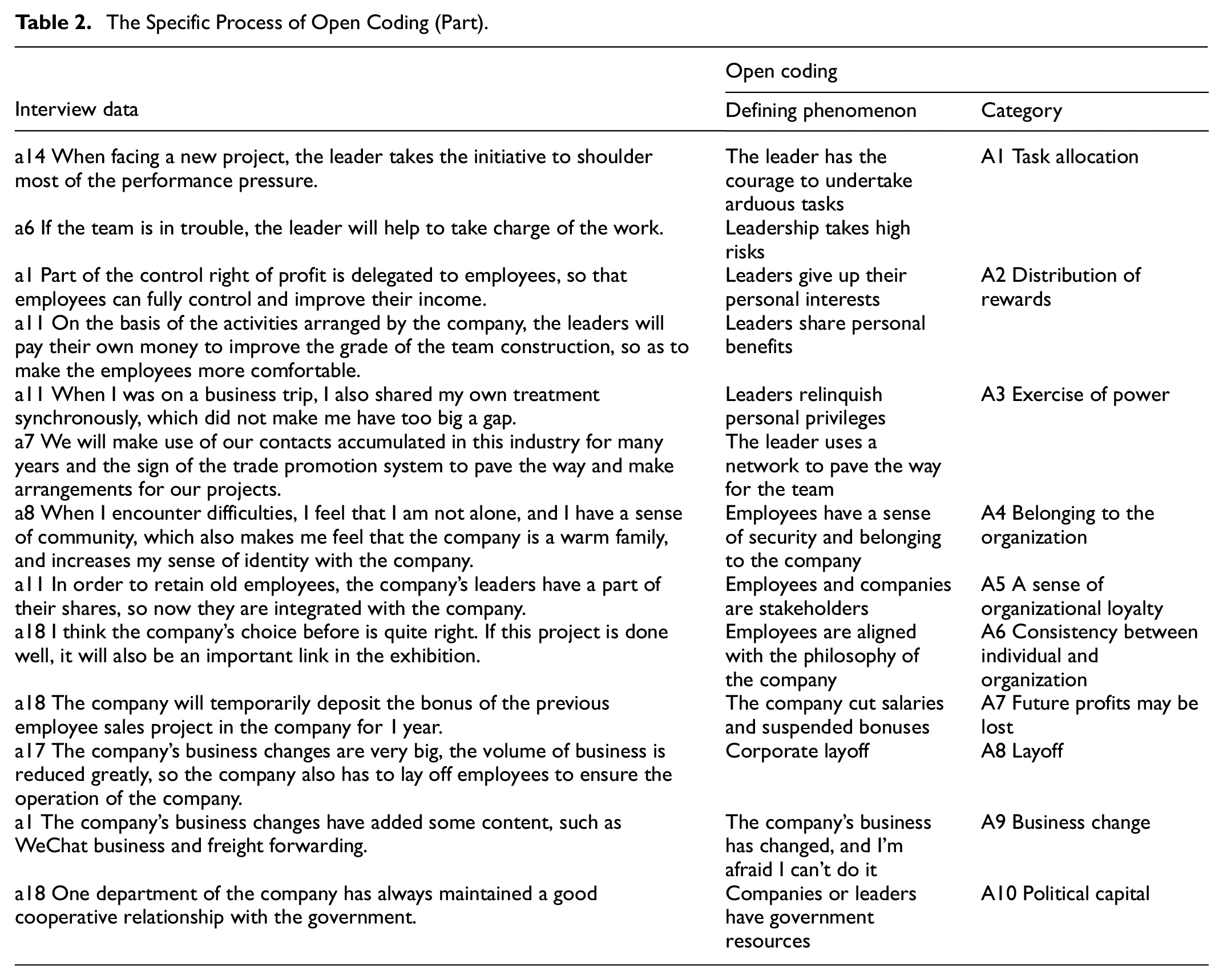
Open coding is based on the research of Gioia et al. (2013). First of all, two professors engaged in MICE tourism management and a master’s student participated in the coding of the original data, and finally classify concepts and initial categories. In the process of coding, this study first uses the original words of interviewees as labels and defines phenomena, then refines initial concepts, and finally integrates related concepts to achieve categorization. In the process of coding, initial concepts that occur less than twice are eliminated. The specific steps are shown in Table 2: (1) Labeling: Label statements in the interview that are related to previous studies on the relationship between self-sacrificial leadership and employee retention, and use “ax” to refer to them. (2) Define the phenomenon: abstract, refine, and preliminary define “ax.” (3) Categorization: Classify the concept of “ax” to define the phenomenon, and reclassify the corresponding category, expressed by “Ax.” Finally, 293 concept groups were encoded. After eliminating the initial concepts that repeated less than twice, 14 concept groups were obtained by classifying and summarizing similar terms, and finally, 10 categories were summarized.
The Specific Process of Open Coding (Part).
Spindle Coding
Based on a deep understanding of the nature of the concept and the theoretical connotation, the researchers abstracted the relevant open coding into spindle coding. According to the basic line of “cause condition – social phenomenon – intervention condition – action strategy – result,” this study logically sorts the conceptual categories obtained in open coding, so as to discover and establish the potential logical relationship between the categories. After classifying 10 categories, 4 main categories are summarized, which are self-sacrificial leadership, organizational identification, job insecurity, and political capital of exhibition enterprises. Among them, self-sacrificial leadership includes three categories: task allocation, reward allocation and power application, which is composed of seven concept groups, accounting for 50%. Organizational identification consists of three categories, namely the sense of belonging to the company, the sense of loyalty, and the sense of conformity with the company identity, which is composed of three concept groups, accounting for 21%. Job insecurity consists of three categories, namely possible loss of future benefits, layoffs, and business changes of the company, accounting for 21%. Political capital consists of one category, accounting for 8%, as shown in Table 3.
Spindle Code Content.

Selective Coding
Drawing on organizational identity theory and other related theories, spindle coding is further summarized as selective coding, and the relationship between selective coding is analyzed. Finally, the data coding will continue until no new concept appears, the data reaches theoretical saturation, and the analysis stops.
As shown in Figure 1, the potential relationship between the main categories can be summarized and guided by the core category of “the process mechanism of self-sacrifice leadership affecting employee retention intention.” The storyline can be abstracted as follows: the self-sacrifice leadership of exhibition enterprises takes caring for employees and protecting their interests as the core action strategy, which promotes employees to have a sense of belonging, loyalty and identity to the company. At the same time, the restrictions on outbound travel caused by the critical incident have increased the job insecurity of employees in exhibition enterprises, which also affects the organizational identification and retention decisions of employees as an intervention condition, and finally forms the result of employee retention intention. Based on the above, the storyline around the core category can be summarized as follows: action strategy → phenomenon (accompanied by intervention conditions) → result.
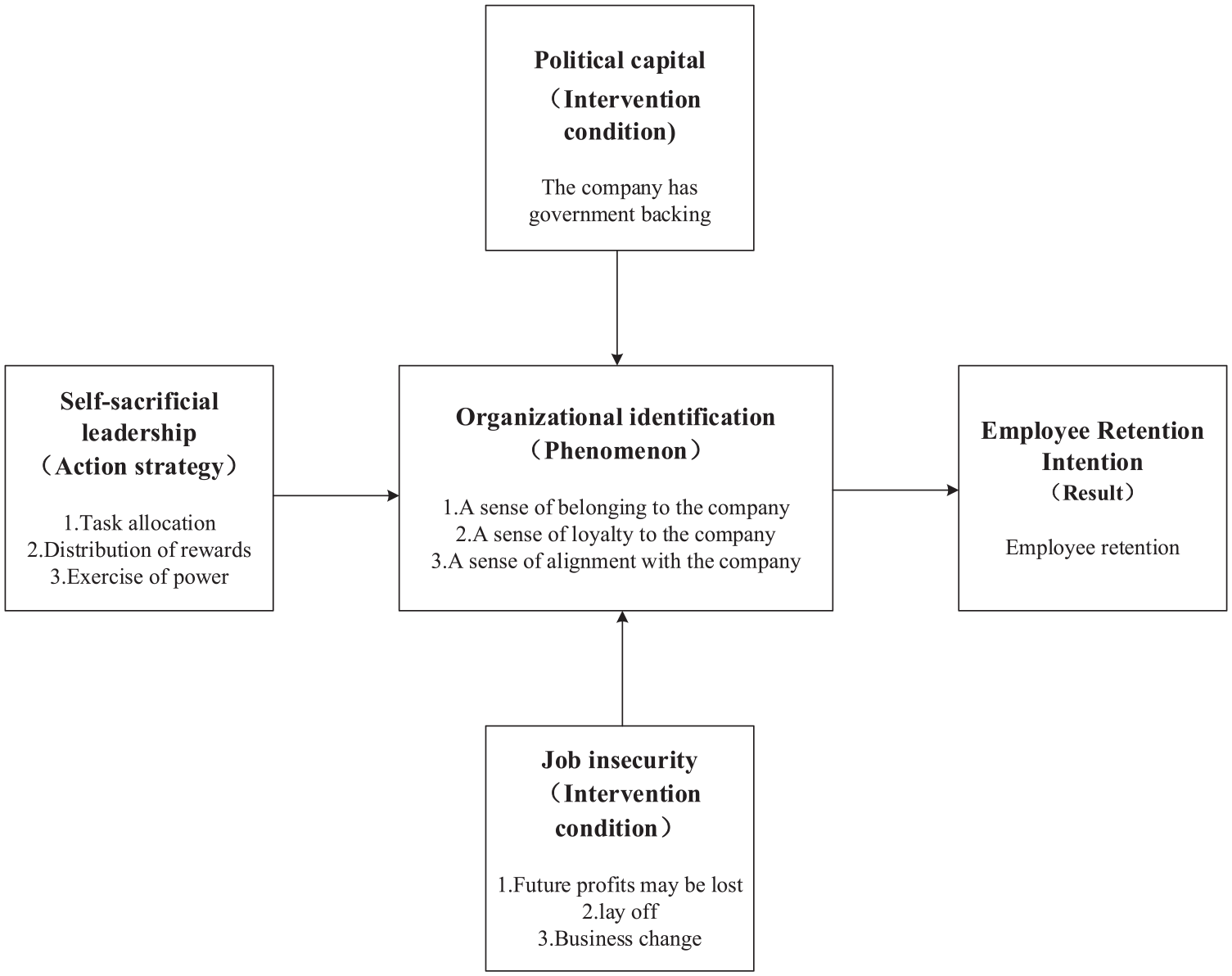
Results of grounded theory.
Theoretical Saturation Test
When the original data collected no longer produces new theoretical categories, it can be judged that the results of qualitative analysis have basically reached theoretical saturation, and other empirical data can no longer be collected for coding analysis and theoretical construction. Therefore, after the coding analysis and theoretical construction, this study conducted in-depth interviews with 10 people again, and used the content summarized by the interviews to conduct theoretical saturation test. The results show that the constructed categories and the potential relationships between them are still in line with the relevant context and storyline of the process mechanism of self-sacrifice leadership affecting employee retention intention, and no new categories and relationships have been formed. Therefore, the constructed theoretical model is saturated.
Discussions
Based on the rooted theory, this paper conducts inductive analysis on the sample of employees of enterprises that organize exhibitions abroad, and builds a theoretical model of the mechanism of employee retention intention in enterprises that organize exhibitions abroad under the background of the epidemic. This study is based on the theory of social exchange and social identity, which is applied to the study of the leader-organization-employee relationship. The main idea of social exchange theory is that parties engage in and maintain exchange relationships with others based on the expectation of getting a return. Social identity theory holds that individuals obtain group identity through certain criteria of social classification in order to obtain self-satisfaction, including the formation of self-concept and belonging. As the problem of employee turnover and retention is an important issue in the study of enterprise human resource management, it has been widely studied in the academic circle. Nowadays, there are more and more factors affecting employee turnover and retention, so many different theories and research methods are involved. In this study, after in-depth interviews with employees of overseas exhibitions, the motivation of employee retention is analyzed, and the research variable of this study is self-sacrificial leadership, and the intermediary variable is introduced as organizational identification.
(1) In the context of the epidemic, the influencing factors of employee retention of overseas exhibition enterprises follow the storyline of “action strategy → phenomenon (accompanied by intervention conditions) → result.” The four main categories that affect the core category of retention intention are self-sacrificial leadership, organizational identification, political capital and job insecurity. These four main categories have a significant influence on employee retention intention. Among them, self-sacrificial leadership is an action strategy, organizational identification is a phenomenon formed by internal driving factors, and political capital and job insecurity are external intervention conditions.
(2) On the premise of further exploring the data materials, this study summarizes the corresponding sub-categories of the 4 main categories explored, including 10 sub-categories such as task allocation and reward allocation.
Study 2: Quantitative Verification of the Mechanism of Self-Sacrificial Leadership
To further verify the universality and stability of the relationship between employee retention intention and its influencing variables during crises, this study employs quantitative research to test the hypotheses and establish causal links among the variables. The dependent variable is the employee retention intention, the dependent variable is self-sacrificial leadership, the organizational identity is selected as the intermediary variable, and the political capital and job insecurity are selected as the adjustment variables.
Self-Sacrificial Leadership
Self-sacrificial leadership refers to the leadership behavior that postpones or sacrifices individual interests for the collective interests of the organization (Choi & Mai-Dalton, 1998). Social exchange theory states that when one party provides resources, support and help to the other party, the other party is granted the obligation to reciprocate, so as to achieve the purpose of mutual benefit (Fan et al., 2021). The help, support and service provided by business leaders to employees will cause employees to reciprocate by providing positive work behaviors. The core feature of self-sacrificial leadership in exhibition enterprises is altruism. Specifically, the leaders of exhibition enterprises are in charge of various details of the exhibition, often work overtime, go on business trips, or take the risk of participating in the exhibition, and communicate with various departments to facilitate the smooth development of the exhibition. Self-sacrifice leadership in exhibition enterprises will encourage employees to continue to work in the enterprise and show positive work behaviors to repay the sacrifice and dedication of leaders. Self-sacrifice leaders in exhibition enterprises are willing to contribute, dare to take responsibility and take the initiative to undertake risky work. Therefore, the self-sacrificial leadership of exhibition enterprises is easy to become a role model for employees to learn, and dares to take responsibility and fearless challenges under major crises such as COVID-19, thus positively affecting employee retention intention (Cai et al., 2023). Accordingly, the following hypothesis is put forward:
H1: Self-sacrifice leadership in exhibition enterprises positively affects employee retention intention
Organizational Identification
As an important variable that psychologically connects individuals and organizations, organizational identification is an identification of employees with organizational identification, which is embodied in employees’ sense of unity and belonging with the organization in behaviors, ideas and many other aspects (Wei & Wang, 2019), and closely link their own development with the success or failure of the organization (Mael & Ashforth, 1992). At present, the antecedents and effects of organizational identification have been widely verified by the academia. Among them, at the individual level, employees’ tenure, job satisfaction, self-construct, psychological contract and psychological safety have significant predictive effects on organizational identification (Ashforth & Mael, 1989; Epitropaki & Martin, 2013; Van Dick et al., 2006). At the organizational level, leadership styles such as servant leadership and transformational leadership have been confirmed to affect organizational identification positively (Liu, 2024; Lv et al., 2022), and human resource management practices and high-performance work systems of enterprises can also positively affect employees’ organizational identification (Z. Wang & Sun, 2011).
Generally speaking, leaders of exhibition enterprises are agents of internal affairs of the organization, and employees’ evaluation of the sense of belonging and identity of the organization is largely affected by leaders’ behaviors and decisions (Pan et al., 2012). When employees are cared for, respected and trusted by leaders in the organization, they can often improve their sense of organizational identification. Among them, the self-sacrificial leadership of exhibition enterprises shows that leaders ignore their own interests, and even self-sacrifice to seek the interests and well-being of organization members, which will make employees feel the respect and care of the organization and leaders, and thus improve employees’ sense of belonging and identity to the organization. Existing empirical studies also find that self-sacrifice leadership has a significantly positive impact on employees’ organizational identification (Halverson et al., 2004; Liu, 2024). Accordingly, the following hypothesis is put forward:
H2: Self-sacrificial leadership in exhibition enterprises positively affects employees’ organizational identification
A large number of studies have shown that organizational identification has a significant impact on employees’ attitudes and behaviors. Intention to stay is represented by the dependence of employees on their current job and their willingness to continue working in the enterprise (Bruyneel et al., 2023; Chen et al., 2021), it is inevitably inseparable from the degree of psychological connection between individuals and organizations. According to the social identity theory, individuals make social classification and obtain group identity through certain criteria, so as to form self-concept, obtain the sense of belonging and improve self-esteem (Tajfel & Turner, 1979). When individuals cannot obtain benefits that meet their expectations in the social group, they often take response measures to change the status quo, such as leaving the group. In other words, when employees of exhibition enterprises cannot obtain satisfaction in the organization and form organizational identification, they will exhibit behaviors that deviate from the organization, such as turnover, and on the contrary, they will stay in the organization and continue to work. Therefore, the higher the degree of identification of the employees with the organization is, the stronger the sense of belonging to the organization will be, which will reduce the turnover intention of the employees and improve the retention intention of the employees. Existing research also confirms that organizational identification negatively affects employees’ turnover intention (Allen, 2018), and positively affects employee retention intention (X. Liu et al., 2021). Accordingly, the following hypothesis is put forward:
H3: Organizational identification of employees in exhibition enterprises positively affects their retention intention
According to the stimulus-organism-response (SOR) theoretical framework, when an individual receives external stimuli, it will promote the individual’s internal psychological reactions such as cognition and emotion, and then affect the individual’s performance and behavioral response (Mehrabian & Russell, 1974). In other words, the individual’s internal state plays a mediating role in the relationship between external stimuli and behavioral responses. Organizational identification is the cognitive process of individuals’ sense of membership and belonging to the organization, which reflects the consistency of values between individuals and organizations (Binyamin, 2024; Tajfel & Turner, 1979), it is an important internal psychological variable for employees to respond to self-sacrifice leadership in exhibition enterprises (Vadera & Pratt, 2013). In summary, this study believes that self-sacrifice leadership in exhibition enterprises will first activate employees’ organizational identification, and then affect employee retention intention. That is, organizational identification mediates the impact of self-sacrifice leadership on employee retention intention, and thus puts forward the hypothesis:
H4: Organizational identification of exhibition enterprises plays a mediating role between self-sacrificial leadership and employee retention intention
Political Capital
At present, there are two main perspectives to define corporate political capital: corporate political strategy perspective and political embedding perspective. From the perspective of political embedding, this study believes that the ability of enterprises to obtain government resources through political embedding forms political capital, which is specifically manifested as the state-owned background of enterprises or the political connections of executives in non-state-owned enterprises (Li & Cheng, 2020; Ashforth & Mael, 1989). Different from having a political title, if an enterprise manager or leader once worked in a redistributive power department, the basis of such formal and informal political relationship is the former colleagues and friends. The formation of such relationship is based on trust, emotion and other factors as well as long-term contacts. Therefore, the enterprise can use the resources embedded in this relationship network to serve the enterprise. It makes it easier for enterprises to obtain access permits for administrative monopoly industries (Prechel & Morris, 2010). In addition, for political goals, group interests and private interests, governments or government officials tend to allocate resources to state-owned enterprises or those closely related to them. State-owned background or public institutions themselves are part of the basic guarantee of the government, so employees tend to remain in enterprises with political capital in a dynamic development environment. It can be seen that enterprises holding exhibitions abroad with high political capital can more quickly perceive the changes and requirements of government policies for overseas exhibitions, and have a more accurate grasp of the direction of government support and subsidies. For enterprises with low political capital, customers will be more willing to cooperate with enterprises with political capital because they are worried that exhibition enterprises cannot resist great risks and uncertainties under the epidemic. This also means that customers of exhibition enterprises with low political capital will decrease sharply under the epidemic, and the corresponding operating income will decrease, so the employees of exhibition enterprises perceive that their income and performance are not guaranteed. Insecurity about the organization will also be elevated and show a lower retention intention . Accordingly, the hypothesis is put forward as follows:
H5a: The political capital of exhibition enterprises plays a moderating role in the relationship between self-sacrificial leadership and employees’ organizational identification
H5b: The political capital of exhibition enterprises has a moderating effect on the relationship between self-sacrifice leadership and employee retention intention
Job Insecurity
Job insecurity is a sense of powerlessness that individuals perceive about whether their work can be sustained in an environment where their work is threatened (Darvishmotevali et al., 2024; Epitropaki & Martin, 2013), it is the perception of potential involuntary unemployment under the epidemic and the subjective perception or evaluation of whether there will be unemployment in the future. Hellgren et al. (1999) conceptualized job insecurity from the two levels of quantity and quality, and pointed out that quantitative job insecurity is manifested as employees’ worry about losing their jobs, while qualitative job insecurity is manifested as employees’ perception of the level of threat and damage to the quality of the employment relationship. During the COVID-19 epidemic, overseas exhibitions have almost been suspended, and as foreign countries lie flat on the epidemic, many people feel that the recovery of overseas exhibitions is far away (Cai et al., 2023; Hidalgo et al., 2022). In addition, online exhibitions are an alternative, and the development prospects of overseas exhibitions are worrying. These factors make the employees of enterprises that hold exhibitions abroad have strong job insecurity. When employees are faced with work pressure brought by the uncertainty of the future of the overseas exhibition market, as well as the asymmetry between work input and organizational return at the present stage, they will eventually induce employees to leave the organization (Kakar et al., 2023).
This study believes that the influence of self-sacrifice leadership on employees’ organizational identification and willingness to retain in exhibition enterprises in the crisis will show significant differences depending on the level of job insecurity. As mentioned above, organizational identification is manifested as individuals’ emotional dependence and belonging to the organization, and self-sacrifice leadership has a positive role in promoting employees’ organizational identification. Compared with the normal situation, the employees of exhibition enterprises generally have higher job insecurity and threat perception in the crisis. In such a threatening and uncertain situation, leaders of exhibition enterprises pay attention to the needs of employees, take care of their feelings and meet their welfare through self-sacrifice, which can better trigger employees’ recognition and belonging to the organization and leaders. However, individuals’ responses to threats and uncertainties have a threshold of psychological control, that is, the signal value of job insecurity may exceed the psychological bearing capacity of employees’ active role. As the perception of job insecurity increases, even strong employees will seek their development through avoidance and resignation. Therefore, at a low level of job insecurity, the influence of self-sacrificial leadership on employees’ organizational identification and retention will be strengthened. However, when the level of uncertainty and threat exceeds the psychological threshold of employees’ response, the exemplary and driving role of self-sacrificial leadership will be weakened. Based on this, the hypothesis is proposed:
H6a: Job insecurity has an inverted U-shaped moderating effect on the relationship between self-sacrificial leadership and employee organizational identification in exhibition enterprises, which first strengthens and then weakens
H6b: Job insecurity has an inverted U-shaped moderating effect on the relationship between self-sacrificial leadership and employee retention intention in exhibition enterprises, which first strengthens and then weakens
The conceptual model of this study is presented in Figure 2.

Conceptual model.
Research Design
Participants and Procedure
A preliminary survey was conducted in June 2022, and 100 valid questionnaires were collected. This study tested the reliability of self-sacrificial leadership, organizational identification, retention intention and job insecurity. Reliability analysis results showed that the Cronbach’s α coefficients of each variable were .895, .966, .837, and .880, respectively, all greater than .8, indicating good internal consistency of each variable. The results of validity analysis showed that the KMO values of each variable were .869, .956, .761, and .821, which were all greater than .7, indicating good construction validity. This indicates that all variables have good reliability and validity, and can be used for formal investigation.
The study was formally conducted for 2 months in July 2022. In view of the high infectivity of the novel corona-virus epidemic, field questionnaire collection may have the risk of epidemic infection, so this study adopts the form of online electronic questionnaire to collect samples. In addition, the research object of this study is the employees of enterprises who are still working in overseas exhibitions. The enterprises are all over the country, and the electronic questionnaire has a wide range of channels for release, which has a wide range of transmission. The research team made an electronic questionnaire based on the Questionnaire Star. The questionnaires were designed to ensure fully anonymity, thereby avoiding the collection of personal identifiers (e.g., names and employee numbers). An informed consent procedure was integrated, featuring a mandatory checkbox for “I have read and agree to participate in the study.” Participants who did not check this box were automatically exited from the survey. The research team invited employees of enterprises hosting exhibitions abroad to fill it out by means of convenient sampling, and invited them to help distribute it. Among them, the exhibition enterprises surveyed cover not only first-tier cities such as Beijing, Shanghai, Guangzhou and Shenzhen, but also second-tier cities such as Quanzhou and Xiamen. In terms of the nature of enterprises, they cover state-owned enterprises and public institutions, as well as private enterprises and foreign enterprises. Finally, a total of 404 valid samples were recovered from the formal investigation. The demographic characteristics are shown in Table 4.
Sample Feature Description.

Measures
Questionnaires designed in this study included the self-sacrificial leadership scale, the organizational identification scale, the retention intention scale and the job insecurity scale. All scales were derived from important journal literature at home and abroad, and adjusted according to the research situation. The involved English scales were also carefully proofread and translated by the research team. Specifically, the measurement of self-sacrificial leadership refers to the research of Cremer and Knippenberg (2004), There are six questions in total; The measurement of organizational identification refers to the research of Ashforth and Mael (1989), with a total of six items. The measurement of job insecurity refers to the insecurity scale compiled by Sverke et al. (2002), including quantity and quality two dimensions, a total of seven questions. The measurement of retention intention refers to the study of Richter et al. (2022). All variables were measured on a seven-level Likert scale. In addition, the measurement of political capital is based on whether enterprise executives have political background, work in government departments or hold positions closely related to government units, or whether the enterprise has long-term and stable project cooperation with the government. If yes, the value is 1; otherwise, the value is 0. This study also collected demographic variables such as gender, age, marital and child-bearing status, educational background, working place, working years and job level of the respondents, as well as basic information statistics such as the nature of the enterprise.
Results
Data Analysis
In this study, common methodological biases in data were circumvented in a variety of ways. Specifically, before data recovery, this study emphasizes that there is no absolute right or wrong answer in the questionnaire link, and uses reverse question items, guaranteeing the right to anonymity and the right to know to control the common method deviation of data in advance. After data collection, all measurements were included in an unrotated factor analysis according to the Harman-single factor test procedure. The results showed that the KMO value was 0.823 and the variance interpretation rate of the first principal component was 41.116%, less than the 50% threshold (Podsakoff et al., 2003). And the rotated component matrix accurately extracted four factors with characteristic roots greater than 1, representing six variables of self-sacrificial leadership, organizational identification, job insecurity and retention intention of exhibition enterprises. Therefore, there is no significant risk of common variance bias in this study.
In this study, SPSS 22.0 and AMOS 21.0 were used to analyze the reliability and validity of the data. From the results of reliability analysis, Cronbach’s α coefficient values of self-sacrificial leadership, organizational identification, retention intention, and job insecurity were 0.922, 0.928, 0.905, and 0.933, respectively, all greater than the critical value of 0.7. From the validity analysis results, exploratory factor analysis results showed that the KMO values of self-sacrificial leadership, organizational identification, retention intention, and job insecurity were 0.702, 0.732, 0.711, and 0.826, respectively, greater than the critical value of 0.7, and the common degree and load value of each variable item were greater than the critical value of 0.5. It indicates that the variable has good construction validity. Meanwhile, the results of confirmatory factor analysis showed that after the deletion of four items, the model fitting results basically met the conditions (χ2/df less than 3, RMSEA less than 0.08, SRMR less than 0.08, CFI, NFI, IFI, TLI, GFI, and AGFI were all greater than 0.9). The factor loading value of each variable item is greater than 0.5, the mean variance extraction value (AVE) is greater than 0.5, and the combination reliability (CR) is greater than 0.7, indicating that each variable has good aggregation validity (Table 5).
Confirmatory Factor Analysis Results.

Note: D.E. denotes defined for estimation (loading fixed at 1.0). Factor loading and t-values not estimated reported.
Measurement Model
As shown in Table 6, significant Pearson correlation exists among the variables discussed in this study, and the correlation is in line with expectations. In addition, the minimum value of AVE square root of each variable (0.774) is greater than the maximum value of the absolute value of the correlation coefficient between variables (−.497), so each variable has good discriminative validity.
Correlation Analysis Results.

Note: Significance levels: *p < .1, **p < .05, ***p < .01.
Hypothesis Testing
In this study, Model 4 in the PROCESS macro plug-in of SPSS software was used to test the direct and mediating effects of self-sacrificial leadership on employee retention intention, and the Bootstrap method was used to test the mediating effect of organizational identification. The sampling times were set to be 5,000 times, and the deviation correction was set to be a 95% confidence interval. The data results showed that (Figure 3), after controlling influence of demographic variables, self-sacrificial leadership had a significant positive effect on employee retention intention (β = .3361, p < .001), so hypothesis H1 was verified. At the same time, self-sacrificial leadership has a significant positive effect on employee organizational identification (β = .3138, p < .001), and employee organizational identification has a significant positive effect on employee retention intention (β = .4238, p < .001). Therefore, hypotheses H2 and H3 are verified. As for the mediating effect, the results of this study showed that organizational identification had a partial mediating effect between self-sacrificial leadership and employee retention intention, and the mediating effect value was 0.1330, with a 95% confidence interval of (0.0765, 0.1936). Therefore, hypothesis H4 is verified.

Model test result.Note: Significance levels: *p < .1, **p < .05, ***p < .01.
Hierarchical regression was used to examine the moderating effects of political capital and job insecurity. In order to test the moderating effect of political capital, data samples in this study were divided into two groups with and without political capital, and regression analysis was conducted on the two groups of data, respectively. The data showed that in the group with political capital (Table 7), self-sacrificial leadership had a significant positive effect on employees’ organizational identification (β = .298, p < .001), while in the group without political capital, self-sacrificial leadership had no significant effect on employees’ organizational identification (β = .250, p > .05), and the relationship between the two models was not significant (F = 0.890, p > .05). Therefore, the influence relationship of self-sacrificial leadership on organizational identification of employees is significantly different under different political capital situations, that is, political capital strengthens the influence relationship of self-sacrificial leadership on organizational identification of employees, and has a moderating effect on the influence relationship between self-sacrificial leadership and retention intention. Hypothesis H5a is verified. In addition, in the groups with or without political capital, the influence relationship between self-sacrificial leadership and employee retention intention has a significant positive impact, and there is no significant difference in the influence coefficient of the two. Thus, political capital has no significant moderating effect on the influence relationship between self-sacrificial leadership and employee retention intention. The hypothesis H5b has not been verified.
Grouping Regression Results of Political Capital.

Note: Significance levels: *p < .1, **p < .05, ***p < .01.
As shown in Table 8, after controlling demographic variables, it is found that the interaction term of self-sacrificial leadership and job insecurity has a significant positive impact on employee organizational identification (β = .138, p < .05), while the interaction term of the square term of self-sacrificial leadership and job insecurity has a significant negative impact on employee organizational identification (β = −.317, p < .001). Moreover, the interaction term of self-sacrificial leadership and job insecurity had no significant effect on employee retention intention (β = .113, p > .05), while the interaction term of the square term of self-sacrificial leadership and job insecurity had a significant negative effect on employee retention intention (β = −.198, p < .05). As shown in Figure 4, when job insecurity is at low, medium, and high levels, respectively, the influence of self-sacrificial leadership on employees’ organizational identification and retention intention first increases and then weakens; that is, job insecurity plays an inverted U-shaped moderating role in the process of self-sacrificial leadership. Therefore, hypotheses H6a and H6b are verified.
The Moderating Effect of Job Insecurity.

Note: Significance levels: *p < .1, **p < .05, ***p < .01.

Curve moderating effects of job insecurity.
Discussions and Conclusions
Taking the critical incident as the background of a crisis case, this study comprehensively adopted a hybrid research design combining qualitative and quantitative methods to analyze the influence mechanism of self-sacrificial leadership on employee retention intention in exhibition enterprises. The main conclusions of this study are as follows:
First, in the qualitative study, this study summarized the four main categories of self-sacrificial leadership, organizational identification, job insecurity and political capital. Among them, self-sacrificial leadership can promote employees’ sense of belonging, loyalty and identity to the company, and further affect employees’ retention decisions in the background of political capital and job insecurity. This is consistent with the findings of S. Liu et al. (2024), indicating that self-sacrificing leadership has a positive impact on employee retention intention. In addition, the process mechanism model of self-sacrificial leadership influencing employee retention intention constructed in this study follows the storyline of “action strategy → phenomenon (accompanied by intervention conditions) → result.” The four main categories affecting the retention intention of core categories are self-sacrificial leadership, organizational identification, political capital and job insecurity, among which self-sacrificial leadership is the action strategy, organizational identification is the phenomenon of internal driving factors, and political capital and job insecurity are the external intervention conditions. This is consistent with organizational identification theory that employees who have a strong sense of identity to the organization are more willing to make beneficial behaviors to the organization (Lv et al., 2022).
Secondly, in quantitative studies, relevant studies have shown that attaching importance to the leadership type of employees (X. Liu et al., 2021). On this basis, this study further verifies that self-sacrificial leadership has a significant positive effect on employee retention intention. Moreover, organizational identification plays a partial mediating role between self-sacrificial leadership and employee retention intention. This is in line with previous research findings (Zhang et al., 2024). The leadership style of self-sacrificial leaders will set an example for employees to sacrifice themselves for the benefit of the organization and employees (Halverson et al., 2004). Internalize employees’ organizational values to enhance their organizational identification. Further, higher organizational identification will encourage employees to practice their responsibilities and obligations in the organization actively, so that employees will have a stronger willingness to remain. This is consistent with the framework of “leadership behavior-organizational identity-employee response” proposed by scholars (Lv et al., 2022). Moreover, this study revealed that political capital moderated the relationship between self-sacrificial leadership, organizational identification, and employee retention intention, which was in line with previous study findings (Q. He & Xie, 2022). The resources, information and opportunities brought by political capital enable enterprises to maintain good dynamic adaptability in crisis situations, thus strengthening the influence of self-sacrificial leadership. Consistent with previous research findings, job insecurity plays an inverted U-shaped moderating role in the influence of self-sacrificial leadership (Kakar et al., 2023).
Theoretical Implications
This study made two main theoretical contributions to the literature. First, it contributed to the investigation of self-sacrificial leadership mechanisms in the study of exhibition enterprises in crisis situations. Different types of leadership have different effects on employee retention intention; therefore, scholars have called for exploring the role of leadership types (Zhang et al., 2024). Previous studies have rarely explored the impact and mechanism of self-sacrificial leadership; however, their mechanisms merit investigation (Mostafa & Bottomley, 2020). This study introduced organizational identity, political capital, and job insecurity into the research framework of employee retention intention, thus revealing the mechanism of self-sacrificial leadership in crisis and enriching the theoretical application dimension of self-sacrificial leadership, and expanding the existing literature on crisis leadership. Previously, self-sacrificial leadership is less studied (X. Liu et al., 2021). The study introduces organizational identification as a mediating variable, thus extended the application field of the organizational identify theory.
Second, this study verified the moderating effect and boundary conditions of political capital and job insecurity in the process of self-sacrificial leadership from the organizational level and the individual level of employees, providing a new theoretical variable for the analysis of the mechanism and effectiveness of self-sacrificial leadership in exhibition enterprises under crisis situations. Currently, the individual level of employee factors (e.g., adjusting focus) and organizational level (e.g., error management culture) have been successively identified as moderating variables in the process of self-sacrificial leadership (Mael & Ashforth, 1992; Van Dick et al., 2006). However, scholars’ identification of boundary conditions in the process of self-sacrificial leadership is relatively limited. Generally, political capital guarantees that exhibition enterprises can obtain more resources and opportunities in crisis (Li & Cheng, 2020), and job insecurity is a common psychological feeling among employees (Darvishmotevali et al., 2024). Both of them may interfere and influence the influence of self-sacrificial leadership in exhibition enterprises. Therefore, the theoretical contribution of this study is to reveal the strengthening effect of political capital and the nonlinear moderating effect of job insecurity, which provides empirical cases and theoretical basis for analyzing the mechanism and boundary conditions of self-sacrificial leadership in exhibition enterprises under crisis situations, and has important implications for future research on self-sacrificial leadership in exhibition enterprises under crisis situations.
Practical Implications
First, exhibition enterprises should take the leadership style of leaders and managers into consideration in the process of enterprise development and seek leaders suitable for enterprise development strategy, especially in major crisis situations such as the COVID-19 pandemic. To be specific, in the selection and training of managers, managers whose leadership style is in line with corporate culture should be selected preferentially, and leaders’ awareness of dedication, group awareness and overall situation awareness should be enhanced in later education and training. Set a good example for employees of exhibition enterprises, cultivate their sense of responsibility, and increase their sense of identity for leaders and organizations. In addition, exhibition enterprises need to improve the loyalty and retention intention of employees, so leaders should pay attention to the distribution of benefits, timely meet the interests of employees, and in the face of crisis, adversity, challenges and difficulties, care about the work and life needs of employees, reduce the work burden and economic pressure of employees as much as possible, so that employees can feel the importance of leaders and organizations to them. Enhance employee’s organizational identification and enhance employee loyalty. Second, political capital of exhibition enterprises is an important regulating factor affecting employee retention intention. Having political capital will give the organization a credible label in the eyes of employees and improve their psychological security. Especially in a major crisis such as the epidemic, the political capital of an enterprise can to some extent eliminate the psychological insecurity brought by the crisis to employees, and even improve their sense of organizational identification. Therefore, in addition to state-owned enterprises and public institutions with their own political capital, private enterprises can strengthen their cooperation and stickiness with the government in the process of enterprise development. In addition, in the selection process of leaders of exhibition enterprises, they can be selected with the relevant background of working in state-owned enterprises or public institutions or as deputies to the People’s Congress. In this way, employees’ recognition of the organization can be better improved in the case of major threats to the enterprise, so as to improve their willingness to retain.
Third, leaders of exhibition enterprises should take measures to reduce employees’ job insecurity under the crisis, so as to avoid the negative impact of these negative emotions on employees’ career decisions. Among them, the self-sacrificial behavior style of leaders in major crises can make employees feel respected, cared for and trusted, and also reduce the risk situation taken by employees at work, thus reducing the negative impact caused by job insecurity. Generally speaking, employees with family burdens or who have made certain achievements in the industry will not quit easily. Therefore, leaders and organizations at this time should make employees feel valued and belonging, and reduce the possibility of income reduction by setting up self-sacrifice models and transferring employees to other personnel methods. In addition, leaders of exhibition enterprises need to analyze the development situation of the industry, expand the business scope, show the strength of the enterprise and other ways to help employees rebuild the attitude and confidence to actively cope with crisis and adversity, so as to reduce the negative impact of job insecurity on employee retention intention.
Limitations and Future Directions
This study also has the following deficiencies. First, in terms of sample collection, this study was limited to collecting data on employees’ self-assessments, and the cross-sectional data was adopted to investigate the influence of self-sacrificial leadership from a static perspective. Moreover, due to the impact of the epidemic, the convenience sampling method has led to poor representativeness of the sample. Therefore, a longitudinal study design can be carried out in future studies, and multi-time point data and paired samples can be used to verify the conclusions of this study, and adopt a more reasonable sampling method that is more in line with the needs of the research purpose. Second, in terms of research context, this study is mainly based on the crisis situation of exhibition enterprises in China, which has certain limitations in terms of universality. Future studies can expand and verify the applicability of the conclusions in different crises, cultural situations and normal situations. Third, in terms of variable selection, this study did not consider the influence of employee personality traits and organizational factors. Future studies may take into account the personality traits and organizational factors that affect employee career decision-making in crises, such as positive personality traits such as self-efficacy and self-esteem, as well as organizational climate and organizational culture.
Footnotes

Ethical Considerations
The study does not require further ethics committee approval, as it does not involve personal privacy information. Since this study is based on routinely collected statement data, the consent requirement is waived.
Author Contributions
Hui Zhang was responsible for funding acquisition, investigation, methodology, project administration and writing-review and editing. Yueyue Tan was responsible for validation, visualization, data curation and writing-review and editing. Shujing Long was responsible for validation, visualization and writing-review and editing. Jing Guo was responsible for conceptualization, software, visualization and writing-original draft. Ruobing Li was responsible for data curation, software and writing-original draft. Qiao Zhou was responsible for formal analysis and resources.
Funding
The author(s) received no financial support for the research, authorship, and/or publication of this article.
Declaration of Conflicting Interests
The author(s) declared no potential conflicts of interest with respect to the research, authorship, and/or publication of this article.
Data Availability Statement
Data sharing not applicable to this article as no datasets were generated or analyzed during the current study.