



Abstract
Employee turnover intention poses significant challenges for organizations globally, incurring financial costs and productivity losses while disrupting workflows and impeding innovation. Effective human resource practices, including extrinsic rewards such as financial incentives and non-monetary benefits, are critical in retaining high-performing employees. However, the influence of these rewards on employee retention is not always straightforward, and organizational prestige—perceived as an indicator of a company’s reputation and status—may play a crucial mediating role. This study explores the mediating effect of organizational prestige on the relationship between extrinsic rewards and employee retention intention within the Klang Valley region, Malaysia. Utilizing partial least squares structural equation modeling (PLS-SEM), the research investigates how financial incentives, promotion opportunities, and relationships with supervisors and peers’ impact organizational prestige and, consequently, employees’ intention to stay. Findings indicate that while financial incentives do not significantly influence organizational prestige, promotion opportunities, supervisor relations, and peer relations positively affect it. Moreover, organizational prestige significantly mediates the effects of supervisor and peer relations on retention intention, highlighting its critical role in enhancing employee commitment. The study provides valuable insights for organizations seeking to improve retention strategies by emphasizing the importance of fostering a prestigious organizational image and cultivating positive workplace relationships. The limitations of this study include the use of a single geographical region and the focus on specific types of extrinsic rewards, suggesting that future research should explore additional contexts and reward types to generalize findings across different settings.
Plain language summary
Keeping talented employees is a big challenge for organizations everywhere, as losing workers costs money, disrupts work, and slows innovation. Offering rewards like salaries, promotions, and strong workplace relationships can help. However, these rewards don’t always guarantee that employees will stay. This study examines whether an organization’s prestige—the respect and admiration it receives—makes a difference. Focusing on employees in Klang Valley, Malaysia, the research uses advanced analysis techniques to explore how financial incentives, promotions, and relationships with colleagues and supervisors affect the organization’s prestige and employees’ decisions to stay. The findings show that: Financial incentives alone don’t improve an organization’s prestige. Promotion opportunities and positive relationships with supervisors and peers strengthen the organization’s reputation. A prestigious organization plays a key role in encouraging employees to stay, especially when they have strong connections with their supervisors and colleagues. These insights are helpful for companies aiming to reduce employee turnover. By focusing on building a strong organizational reputation and fostering supportive workplace relationships, businesses can better retain their workforce. Future studies should explore different types of rewards and other regions to provide broader insights.
Introduction
Employee turnover intention, characterized by an employee’s desire to leave their current organization, poses a significant challenge for businesses globally (Ainer et al., 2019). Repercussions extend beyond financial costs, encompassing lost productivity, disrupted workflows, and the substantial investments required to recruit and train replacements (Society for Human Resource Management, 2023). A 2022 report by Work Institute estimates the average cost of replacing a salaried employee to be 20% of their annual salary, highlighting the significant financial burden associated with high turnover rates (Sharp, 2022). Furthermore, the departure of skilled personnel can lead to knowledge loss, hindering innovation and hampering organizational performance (Onyeaku, 2020).
To counter these challenges, organizations are increasingly focusing on fostering a work environment that encourages employee retention. A crucial strategy involves the implementation of effective human resource (HR) practices, including well-designed reward systems that incentivize and retain high-performing employees (Bratton & Gold, 2017). Extrinsic rewards, encompassing both financial incentives (e.g., salary, bonuses) and non-monetary benefits (e.g., healthcare, paid time off), play a central role in attracting and retaining talent. Empirical research suggests that offering competitive compensation packages can significantly reduce turnover intention (Sorn et al., 2023).
Within the domain of extrinsic rewards, organizational prestige, often referred to as an employer’s brand image or reputation, emerges as a compelling factor influencing employees’ decisions to stay or leave (Cable & Turban, 2003). Highly prestigious organizations are perceived as desirable workplaces, offering employees a sense of pride, social status, and enhanced career prospects (Lievens, 2017). A study by Carmeli et al. (2006) found that employees at prestigious organizations identified more strongly with their companies, leading to increased commitment and loyalty. Another study highlighted how employees who identify strongly with their organization are more likely to feel a sense of belonging and purpose, leading to increased retention (Pratt et al., 2006). Similarly, another research suggests that employees at prestigious organizations may have greater opportunities to craft their jobs in meaningful ways, fostering a sense of empowerment and further strengthening their commitment (Wrzesniewski & Dutton, 2001).
Employee Retention: A Multifaceted Landscape
Employee retention transcends the mere act of keeping employees on board. It encompasses a comprehensive approach that fosters a work environment characterized by employee wellbeing, engagement, and a strong sense of connection to the organization (Srinivasan & Santhanam, 2023). While extrinsic rewards play a pivotal role, other factors such as job security, opportunities for growth and development, and a positive work-life balance also significantly influence employee retention decisions (Sorn et al., 2023). Furthermore, the relative importance of these factors can vary depending on individual employee needs, career aspirations, and life stage.
Understanding the complex interplay between extrinsic rewards, organizational prestige, and other retention factors across diverse organizational contexts is crucial for establishing effective HR practices. This study specifically focuses on the Klang Valley region in Malaysia, a dynamic and geographically diverse area. Exploring employee retention trends within this region can provide valuable insights tailored to the specific needs of the Malaysian workforce.
The Present Study: Delving Deeper
Employee retention is one of the critical challenges across industries, especially considering heightened competition and the changing nature of work. The investments being made by organizations in the form of financial incentives are considerable, but their effectiveness has been inconsistent and context-dependent. Previous research has shown that financial incentives may either enhance or hinder employee retention depending on organizational characteristics, employee demographics, and cultural factors (Ashraf & Bandiera, 2018). However, much of the existing literature focuses on isolated elements of employee retention, leaving the interplay between financial incentives and mediating factors such as organizational prestige underexplored (Andon et al., 2018). This lack of holistic understanding often leads to misaligned retention strategies that fail to address underlying drivers of employee turnover.
Despite the voluminous studies on financial incentives and retention, there is scant empirical evidence regarding how organizational prestige mediates the relationship between extrinsic rewards and turnover intention. Precisely, most research has failed to consider the nuanced ways in which organizational reputation mediates the effectiveness of financial rewards across different contexts (Ashraf & Bandiera, 2018). Furthermore, existing studies tend to focus on Western organizational settings, leaving a gap in understanding how these dynamics unfold in regions like Southeast Asia, where cultural and economic conditions may differ (Kuang et al., 2019). This study aims to bridge this gap by examining the mediating effect of organizational prestige on extrinsic rewards and employee retention in Malaysia, offering insights that are both contextually relevant and theoretically significant.
The subsequent sections of this paper will outline the research questions, delve into the significance of the study, and define its scope. Through rigorous empirical research, this project endeavors to provide valuable insights that can inform organizational practices and policies aimed at enhancing employee retention and ultimately, organizational effectiveness.
Literature Review
Underlying Theories of Study
The investigation into employees’ intention to stay draws upon foundational theories within organizational behavior and strategic management. This study examines two pivotal theoretical frameworks: Herzberg’s Two-Factor Theory and the Resource-Based View (RBV) theory.
Herzberg’s Two-Factor Theory
Herzberg’s Two-Factor Theory, developed by Herzberg (1959), distinguishes between two types of factors influencing employees’ job satisfaction and performance: Hygiene and Motivational Factors (Herzberg, 1959). Hygiene factors, comprising extrinsic elements, focus on mitigating dissatisfaction in the workplace, while motivational factors, intrinsic in nature, contribute to increased job satisfaction, and performance (Fauziah et al., 2013). Extrinsic factors, also known as job context factors, encompass external rewards provided by employers to create a supportive work environment conducive to task completion (Fauziah et al., 2013). Conversely, intrinsic factors, termed job content factors, provide meaningful work experiences aligned with employees’ personal growth and development, fostering job satisfaction, and commitment (Fauziah et al., 2013). Furthermore, Herzberg’s theory emphasizes the interplay between intrinsic and extrinsic factors, highlighting the importance of both for enhancing job satisfaction and productivity (Fauziah et al., 2013).
Social Identity Theory
Social Identity Theory posits that individuals derive a sense of self-worth and belonging from their group affiliations. Employees at prestigious organizations may derive a sense of pride and social identity from being associated with a well-regarded company. This can lead to a stronger attachment to the organization and a reduced desire to leave (Pratt et al., 2006). In essence, affiliation with a prestigious organization becomes part of an employee’s social identity, influencing their decisions and behaviors. This study examines the influence of extrinsic rewards on employee retention intention, with a particular focus on the mediating role of organizational prestige. Social Identity Theory complements this focus by providing a theoretical framework for understanding how organizational prestige shapes employee retention decisions. By incorporating this theory, the study gains a deeper understanding of the psychological mechanisms at play. Several studies support the link between social identity and employee retention. For instance, Carmeli et al. (2006) found that employees at prestigious organizations identified more strongly with their companies, leading to increased commitment and loyalty. Similarly, Pratt et al. (2006) highlighted how employees with a strong organizational identity are more likely to feel a sense of belonging and purpose, leading to increased retention.
Employee Retention and Extrinsic Rewards
Retaining a talented workforce is a critical challenge for contemporary organizations (Aiyebelehin et al., 2020). Employees are increasingly mobile, willing to switch employers for better opportunities (Eketu & Edeh, 2015). This turnover intention can be detrimental to an organization’s success. Understanding the factors that influence employee retention is crucial. This study examines the influence of extrinsic rewards on employee intention to stay, with a particular focus on financial incentives, promotion opportunities, supervisor relations, and peer relations.
Financial Incentives and Intention to Stay
Financial incentives play a crucial role in shaping employee behavior, but their effectiveness can vary significantly across organizational contexts. Financial incentives, encompassing salary, benefits, and compensation packages, are a well-established extrinsic motivator (Merriman, 2014). Recent studies, however, indicate that the impact of financial incentives on retention is context-dependent. For instance, in the banking industry, financial incentives, promotion opportunities, and work environment were found to significantly influence employee retention (Bwana et al., 2022). In a clinical trial setting, different financial incentive strategies showed no significant differences in enrollment or retention rates compared to a constant-payment approach (Krutsinger et al., 2019). Similarly, in the education sector, financial incentives were found to be effective in attracting teachers to challenging schools but not in retaining them. For teacher retention in such environments, a supportive and conducive working environment was deemed more important (See et al., 2020). These findings suggest that while financial incentives can play a role in retention, their impact may be limited or context-dependent, highlighting the need for comprehensive retention strategies tailored to specific industries, and settings. Competitive compensation aligns employee interests with organizational goals by rewarding achievement (Agrasen, 2024). When employees feel their contributions are valued financially, they are more likely to stay (Terera & Ngirande, 2014). Researchers suggests a positive relationship between compensation and retention, as long as the compensation offered is at least equal to market value and opportunity costs (Sorn et al., 2023). However, this relationship may not be linear. Highly compensated employees may have more opportunities elsewhere, potentially leading to a U-shaped relationship between pay and retention (Ryu & Jinnai, 2021). Interestingly, Yeo et al. (2020) found a negative association between compensation and turnover intention in a study of Malaysian bank employees. This finding suggests that financial incentives may not be the sole driver of retention in all contexts. In contexts where intrinsic motivation is predominant, such as in non-profit or academic institutions, financial incentives may be less effective and could even demotivate employees if not aligned with their valuesely, in high-pressure environments like sales or finance, financial incentives can act as strong motivators for achieving short-term goals, although they might undermine long-term loyalty and creativity if improperly balanced .Based on the mixed findings regarding financial incentives, the following hypothesis is proposed:
Promotion Opportunities and Intention to Stay
Opportunities for career advancement are a crucial non-monetary extrinsic reward (Tan et al., 2020). The ability to progress within an organization provides employees with a sense of growth and achievement (Ngqeza & Dhanpat, 2021). A study by Aiyebelehin et al. (2020) found a positive association between promotion opportunities and librarian retention. Employees who perceive limited advancement opportunities are more likely to leave for organizations that offer a clearer career path. Similarly, perceived career progression opportunities and organizational support are positive predictors of intention to stay in the IT sector (Dabke & Patole, 2014). Kraimer et al. (2011) found that organizational support for development is associated with reduced voluntary turnover, but only when perceived career opportunities are high. These findings highlight the critical role of clear promotion pathways and developmental support in fostering employee retention across various industries, emphasizing the importance of aligning organizational practices with employees’ career aspirations. Thus, it is hypothesized that:
Supervisor Relations and Intention to Stay
The quality of the supervisor-employee relationship significantly impacts employee retention (Enwereuzor & Ugwu, 2021). Supervisors act as the human face of the organization, and their leadership style influences employee perceptions of the organization as a whole (Eisenberger et al., 1990). Recent studies have shown that supervisors’ empathy, communication, and leadership style directly influence employee loyalty and job satisfaction (Voon et al., 2011). Supportive supervisors who foster open communication are more likely to retain their employees (Eketu & Edeh, 2015). Similarly, researchers found that supervisor support was a significant factor influencing employee intention to stay (Steiner et al., 2020). In another study, it was found that respectful leadership and supportive supervisor relations positively influence employees’ intention to remain with their organization (Enwereuzor & Ugwu, 2021). Supervisors who demonstrate concern for employee well-being, recognize contributions, and role-model organizational values foster higher engagement and commitment (Cropley et al., 2020). Specifically, supervisor empathy, trust, and sensitivity toward subordinates have direct or indirect effects on employee retention (Vatcharasirisook, 2011). These findings underscore the importance of fostering supportive relationships between supervisors and subordinates, as well as among coworkers, to enhance employee retention. Organizations can benefit from implementing training programs on respectful leadership and evaluating leaders based on their treatment of subordinates (Enwereuzor & Ugwu, 2021). Therefore, it is hypothesized that:
Peer Relations and Intention to Stay
Research indicates a significant relationship between peer relations and employees’ intention to stay. Positive relationships with colleagues contribute to employee engagement and satisfaction (Carmeli & Freund, 2004). Another study reported that positive coworker relationships have been found to independently increase employee motivation and intent to stay, beyond the influence of supervisor support (Basford & Offermann, 2012). Guo et al. (2021) found that social support from peers positively influenced teachers’ intention to stay. Conversely, Yeo et al. (2020) reported a weak association between employee relations and turnover intention. A conceptual model suggests that positive workplace relations can lead to job satisfaction and commitment, predicting employees’ intention to stay, while negative relations may result in cynicism and intention to leave (Abugre, 2017). More research is needed to clarify the complex relationship between peer relations and employee retention. Given the inconclusive findings, the following hypothesis is proposed:
Organizational Prestige
Organizational prestige, often synonymous with an employer’s brand image or reputation, transcends an employee’s perception of how they’re viewed externally (Akgunduz & Bardakoglu, 2015). It encompasses a broader sense of pride and self-respect derived from belonging to a well-regarded organization (Cable & Turban, 2003). Employees at prestigious organizations may experience a “halo effect,” where the positive external perception of their employer spills over to enhance their own sense of value and accomplishment (Cable & Turban, 2003). This can act as a buffer against turnover intention, mitigating the potential pull of alternative employment opportunities.
Organizational prestige is related significantly to intention to stay: perceived external prestige is thus negatively associated with turnover intention. As Rathi and Lee (2015) and Carmeli and Freund (2009) noted, the more highly regarded an organization by its staff, the less likely individuals will want to leave such a well-regarded work environment. These effects are largely mediated through affective commitment and job satisfaction (Carmeli & Freund, 2009; Rathi & Lee, he less likely individuals will want to leave such a well-regarded wo2015). Organizational identification is also closely related to prestige and demonstrates a strong negative relationship with turnover intention (Akgunduz & Bardakoglu, 2015). The factors that make employees intend to stay on include clarity of goals, autonomy, employee engagement, and organizational culture, among other factors like compensation (Ghosh et al., 2013). These findings highlight the importance of enhancing organizational prestige and fostering employee commitment as effective strategies for talent retention, particularly in sectors like retail and social services (Carmeli & Freund, 2009; Rathi & Lee, 2015).
Several mechanisms underpin how organizational prestige might mediate the relationship between extrinsic rewards and employee retention intention. Firstly, prestige can enhance the perceived value proposition of an organization beyond pure financial compensation. Employees at prestigious firms may be willing to accept slightly lower salaries or benefits packages due to the intangible rewards associated with affiliation with a high-status organization. Secondly, organizational prestige can foster a sense of belonging and organizational identity. Employees at prestigious organizations may feel a stronger connection to their workplace, leading to increased commitment, and a reduced desire to leave (Pratt et al., 2006). Finally, prestige can bolster feelings of self-efficacy and empowerment. Employees at well-respected organizations may perceive themselves as possessing greater capabilities and influence due to their association with a successful company (Wrzesniewski & Dutton, 2001). This perceived empowerment can further strengthen employee commitment and deter turnover intention. Based on this theoretical framework, the following hypotheses are proposed:
Based on the comprehensive literature review, this study proposes a framework as seen in Figure 1 in exploring how extrinsic rewards influence employee retention, grounded in Herzberg’s Two-Factor theory, and Resource Base View theories.

Research model.
Methodology
Sampling and Procedure
Using a self-administered survey technique through convenience sampling conducted in Malaysia, the study’s respondents were employees in the private sector. Convenience sampling is a non-probabilistic technique used to access readily available participants (Coca Benites et al., 2023). The study focuses on the exact perceptions of private employees, and convenience sampling provided an easy way to get information from people who are directly related to the research context. In addition, literature explains that convenience sampling is frequently used in organizational studies where specific phenomena are to be studied among a homogenous or well-defined target population, as in the case of private employees in this research study (Islam & Aldaihani, 2021).
In this study, the target population was unknown. Given this situation, GPower software was utilized to conduct a power analysis, which indicated that the sample size was sufficient to detect the anticipated effect size with adequate statistical power. G*Power software yielded a minimum sample size of 92. But 117 responses were collected, for structural equation modeling analysis. GPower is a widely recognized tool for sample size and power calculations across various statistical methods, including t-tests, F-tests, χ2-tests, and z-tests (Faul et al., 2007). While G*Power provided a statistically adequate sample size, it is acknowledged that statistical power does not automatically guarantee practical relevance or external validity. The appropriate sample size should be determined based on statistical power analysis and the specific characteristics of the study (Cohen, 1992; Faul et al., 2007). Therefore, 117 participants was deemed appropriate to achieve a balance between statistical power and practical feasibility (Field, 2013; Memon et al., 2020).
As for the demographic profile, the responses came from 77 females and 40 males, with most respondents, that is, 38.5%, from 41 to 50 years of age. In terms of nationality, 114 were Malaysian, while three were non-Malaysian. Additionally, the highest education level of more than half of the respondents are with a Bachelor’s degree (51.3%), while 28.2% have a Master’s degree. As for their employment status and work sector, most of them are full-time employees (78.6%), with 70.9% working at private companies.
Measures
The scales to measure financial incentives (four items), promotion opportunities (three items), relations with supervisors (three items), relations with peers (three items) were adapted from Tan and Waheed (2011). Organization prestige (eight items) were adapted from Mael and Ashforth (1992) and or intention to stay (four items), the construct was adapted from Markowitz et al. (2012). A five-point Likert scale was used to measure each item, ranging from 1: strongly disagree to 5: strongly agree.
Data Analysis
In accordance with the recommendations of Cain et al. (2017), multivariate skewness and kurtosis were evaluated utilizing the “WebPower” tool (https://webpower.psychstat.org/models/kurtosis/), a complimentary online statistical calculator. The findings demonstrated that the data were not normally distributed, as indicated by Mardia’s multivariate skewness (β = 4.997, p < .01) and kurtosis (β = 31.635, p < .01). Consequently, non-parametric statistical procedure, that is, the partial least squares structural equation modeling (PLS-SEM) technique was used to verify the research model. Moreover, in this study, PLS-SEM is used because it is (1) more flexible when it comes to data assumptions, (2) better suited for predictive studies, and (3) enables complicated modeling (Hair et al., 2019).
Common Method Variance
The presence of bias in common method variance (CMV), also known as common method bias, can potentially compromise the validity and reliability estimations of the underlying constructs (Podsakoff et al., 2012). Thus, it is critical to determine if CMV seriously jeopardizes validity using proper procedural and statistical techniques in the research since Podsakoff et al. (2024) suggested abandoning Harman’s single-factor test. Consequently, this study employed procedural techniques using the five and seven-point Likert scales in the survey design. It also used a statistical method, namely the full-collinearity test. The full-collinearity test revealed that all variance inflation factor (VIF) values were less than 3.3, indicating that CMV never tainted the data (Kock, 2015).
Measurement Model
According to Hair and Sarstedt (2019), evaluating the measuring model is a prerequisite for assessing the structural relationships of the research model. Initially, all constructs in this study have adequate internal consistency by determining Cronbach’s alpha and composite reliability (Hair & Sarstedt, 2019). Table 1 shows that all values were more significant than .7, indicating reliability. Next, items that embody the same constructs ought to converge. Hence, this study looked at each item’s loading to guarantee that all factor loadings exceeded 0.7—only one item, FII4, was deleted. Additionally, the findings also showed that the AVEs were higher than 0.5 (Bagozzi et al., 1991)
Measurement Model.

Note. Due to negative factor loading, FII4 was eliminated.
Lastly, it is necessary to guarantee that constructs inside a single model are separate theoretically and empirically. To determine if there were any problems with the discriminant validity of our data, we employed the heterotrait-monotrait ratio of correlations (HTMT) criteria (Henseler et al., 2015). All of the HTMT values were less than 0.9, as seen in Table 2, indicating no evidence of problems with discriminant validity.
HTMT Criterion.
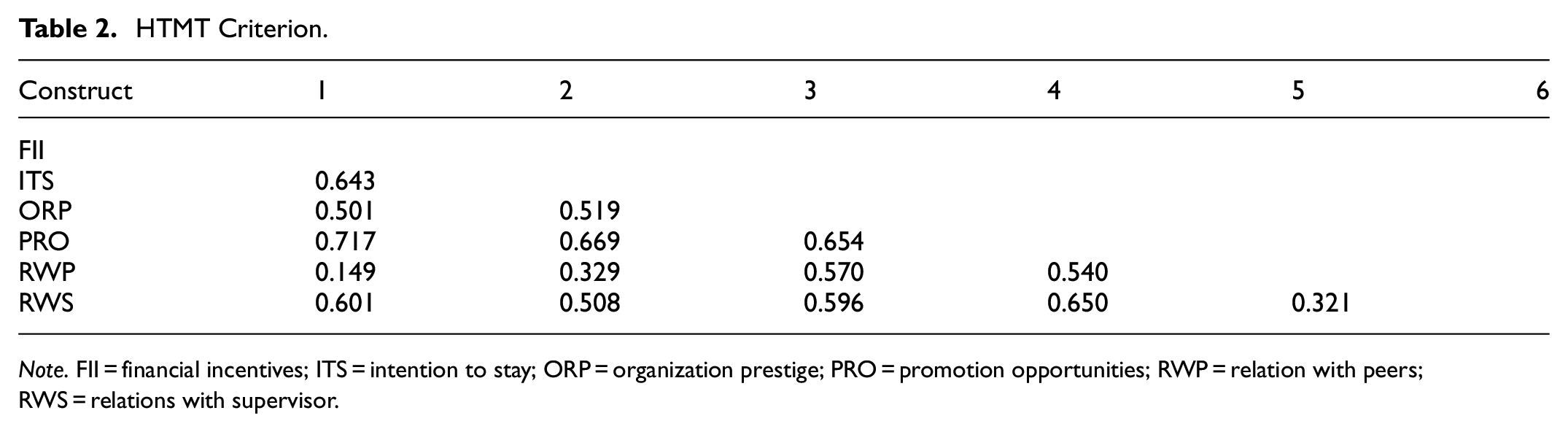
Note. FII = financial incentives; ITS = intention to stay; ORP = organization prestige; PRO = promotion opportunities; RWP = relation with peers; RWS = relations with supervisor.
Structural Model
To test the proposed hypotheses of this study, a bootstrapping procedure was carried out with 10,000 re-samples to acquire the standard error and t-value. Table 3 displays all of the structural model results. The results indicated that financial incentives (β = .137, p < .05) do not significantly influence organization prestige; thus, H1 is not supported. However, promotion opportunities (β = .199, p < .01), relations with supervisor (β = .255, p < .01), and relations with peers (β = .322, p < .01) have positive influences on organization prestige. Hence, H2, H3, and H4 are supported. Moreover, it also found that H5 is supported, that is, organization prestige (β = .468, p < .001) positively influences intention to stay. The coefficient of determination (R2) values for organization prestige and intention to stay are .468 and .219, respectively, in terms of explanatory power. To evaluate each path’s significance, the effect sizes (f2) were examined. Based on the results as shown in Table 3, only the hypothesized path of H5 (f2 = 0.280) has a medium effect size. The paths hypothesized in H1 (f2 = 0.280), H2 (f2 = 0.280), H3 (f2 = 0.280), and H4 (f2 = 0.280) revealed small effect sizes (Cohen, 1988). Lastly, the model’s capacity for making precise predictions was substantiated by the results, as all endogenous variables generated Q2predict values that surpassed 0. This indicates the model’s predictive quality (Hair et al., 2017).
Structural Model Results.
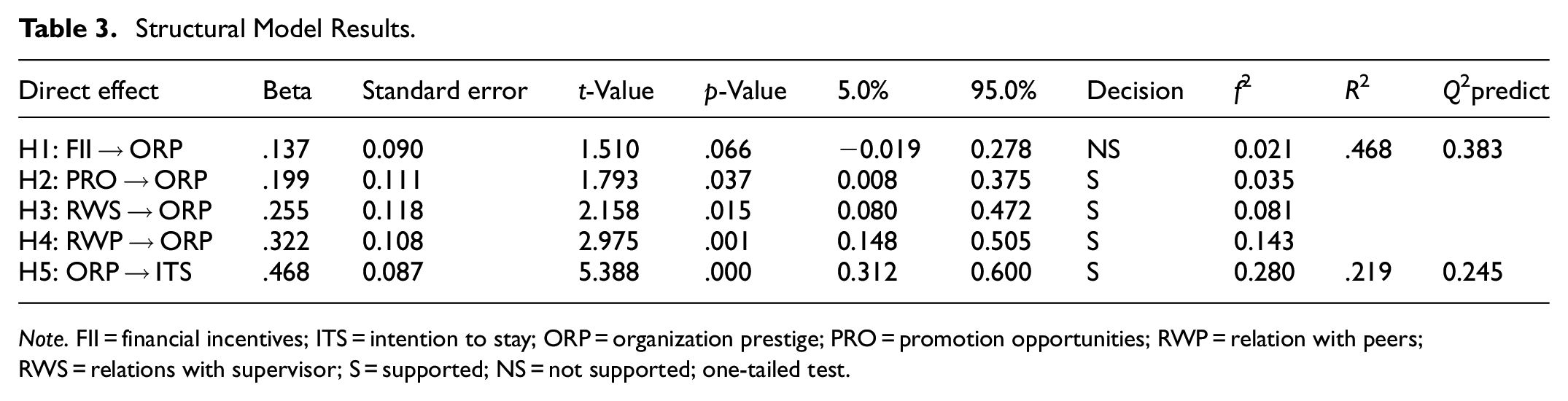
Note. FII = financial incentives; ITS = intention to stay; ORP = organization prestige; PRO = promotion opportunities; RWP = relation with peers; RWS = relations with supervisor; S = supported; NS = not supported; one-tailed test.
In addition, Table 4 displays four indirect effects created by the product of two coefficients, that is, H6a: FII → ORP → ITS; H6b: PRO → ORP → ITS; H6c: RWS → ORP → ITS; H6d: RWP → ORP → ITS were assessed. Table 4 demonstrates that H6a (LB: −0.018; UB: 0.167) and H6b (LB: −0.007; UB: 0.217) were not supported since the indirect effect’s confidence intervals included a zero value. H6c (LB: 0.029; UB: 0.261) and H6d (LB: 0.050; UB: 0.289), in contrast, were supported as the indirect effects’ confidence internals did not have a zero value. The findings imply that organization prestige acted as a sequential and positive mediator in the relationships between relations with supervisor and relation with peers toward intention to stay. The coefficient of determination (R2) values for organization prestige and intention to stay are .468 and .219, respectively, in terms of explanatory power.
Mediation Results.
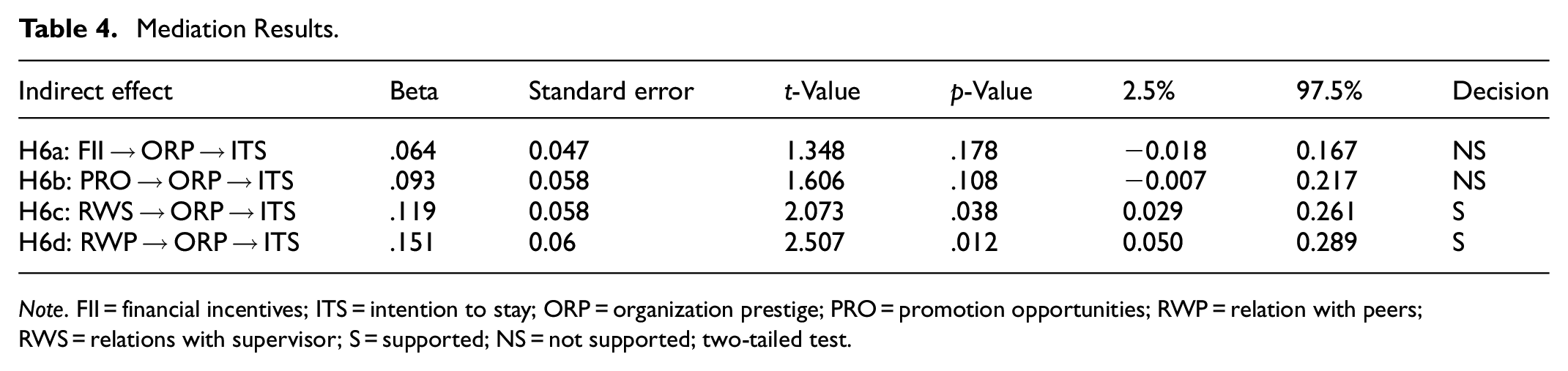
Note. FII = financial incentives; ITS = intention to stay; ORP = organization prestige; PRO = promotion opportunities; RWP = relation with peers; RWS = relations with supervisor; S = supported; NS = not supported; two-tailed test.
Discussion
The current research project aims to examine the mediating role of organizational prestige in the relationship between extrinsic rewards and employee retention.
The H1 of this research project is intended to examine the relationship between financial incentives and employees’ intention to stay in private sectors within the Klang Valley, Malaysia. The findings revealed that financial incentives did not significantly influence organizational prestige (β = .137, p > .05). These findings showed that monetary factors did not significantly contribute to the organizational prestige, with β = .137, p > .05. This is in agreement with previous studies like those by Yeo et al. (2020), where a negative relation between compensation and turnover intention was reported among Malaysian banking employees. Thus, financial incentives, as important as they are, do not enhance organizational prestige. This could be due to cultural or contextual reasons specific only to Malaysia, where other factors such as recognition, work-life balance, and career development opportunities may be valued more than monetary aspects (Ashraf & Bandiera, 2018). Besides, strong emphasis on monetary rewards may have the unintended effect of crowding out intrinsic motivators such as meaningful work and a sense of belonging (Wrzesniewski & Dutton, 2001). While financial incentives remain essential for retaining employees, their effectiveness depends on the presence of intrinsic motivators and organizational culture (Ryan & Deci, 2017).Future research might focus on how the combination of financial and nonfinancial incentives could jointly impact organizational prestige and retention.
The study confirmed that promotion opportunities significantly enhance organizational prestige, β = .199, p < .01, which supports H2. This finding is consistent with the views of Ngqeza and Dhanpat (2021), who noted that career advancement creates a sense of accomplishment and development among employees. Promotion opportunities give rise to perceptions of equity and organizational support that add to the employer’s brand and status (Cable & Turban, 2003). Therefore, organizations that respect clear and equal career-building opportunities not only retain talented workers but also enhance their reputations as employers.
Supervisor relations were found to significantly influence organizational prestige, β = .255, p < .01, supporting H3. This agrees with previous studies that identify supportive leadership as playing a vital role in influencing employees’ perceptions about the organization. Steiner et al., (2020) and Enwereuzor and Ugwu (2021) assert that supervisors are representatives of the organization’s values and, as such, play a key role in building trust and participation in the organization. Such enhancement of supervisor training in areas like empathy, communication, and conflict resolution could bolster their role in promoting organizational prestige.
The outcome of the hypothesis H4 has confirmed that the relations with peers have a significant relationship on the employees’ intention to stay in private sector because relations with peers (β = .322, p < .01) have positive influences on organization prestige. Thus, H4 was supported. This finding was consistent with the previous literature which suggested positive relationships with colleagues contribute to employee engagement and satisfaction (Carmeli & Freund, 2004). This was also reported by Guo et al. (2021) that social support from peers positively influenced teachers’ intention to stay. Collegial support fosters a collaborative and inclusive work culture, which significantly enhances employees’ attachment to their organization. This finding underscores the importance of team-building initiatives and recognition of collective achievements to strengthen peer relations and organizational identity.
The H5 is intended to examine the mediating influence of organizational prestige between extrinsic rewards and employee retention intention to stay. The mediating effect of organizational prestige was thus supported. In specific terms, the relationship between employees’ intention to stay and supervisor-employee relations (H6c) and peer relations (H6d) was mediated by organizational prestige. These results again provide support for the view that the positive impact of workplace relationships on retention is magnified by organizational prestige (Carmeli et al., 2006). However, the mediating effects were insignificant for financial incentives (H6a) and promotion opportunities (H6b). These results show that while prestige is an important factor, its mediating role may be contingent on the nature of the extrinsic reward. For instance, financial incentives may lack a symbolic value contributing to prestige, unlike relational factors that directly influence organizational identity. The findings suggest that financial incentives and promotion opportunities might influence retention through alternative pathways, such as perceived organizational support or individual job satisfaction (Fauziah et al., 2013). Future research could adopt a multi-faceted framework that includes variables like organizational culture, employee engagement, and intrinsic motivators to capture these dynamics comprehensively.
Implications of Study
Findings from the present study have several implications for both theoretical and practice.
Theoretical Implications
From the theoretical perspective, the present study has contributed new information to the body of literature especially one that is related to employees’ retention. The present findings provided empirical evidence and suggested that financial incentives may not be the sole driver of employees’ retention in all contexts. Hence, the present findings further clarify the role of other extrinsic rewards for example, non-monetary incentives such as work-life balance and recognition awards could be used to induce employee retention in the effort of retaining employees (Arshad & Puteh, 2015). Besides, this study has also established a new relationship among relation with peers and relation with supervisors and the intention to stay with oorganisational prestige’s mediating role. The findings of this study focused on expanding this call to examine the direct influences of relation with peers and relation with supervisors by investigating the mediating effects of organizational prestige on the correlation between intention to stay and promotion opportunities and financial incentives. The results of this can assist in answering the query on how and when the promotion opportunities and financial incentives may become a risk factor toward intention to stay among employees.
This study employed has employed different statistical method to verify the theoretical model and analyzd the data with the particial Least Squares-Structureal Equation Modeling (PLS-SEM). This contributed to the previous studies on employee intention to stay with factors which include the relationship between financial incentives, promotion opportunities, relation with peers as well as relation with supervisors, and the mediating influence of organizational prestige were tested. Furthermore, it also evaluated the empirical aid for the theory because promotion opportunities, relation with peers as well as relation with supervisors noticeably affected the organisationa prestige except financial incentices. Based on this context of the findings, the outcomes contributes an essential body of knowledge regarding the retention staff in private sector in Klang Valley, Malaysia.
Managerial/Practical Implications
In terms of implications for practice, the current research findings have several implications for the managers. Supervisor relations significantly impact organizational prestige and, consequently, retention intention. With this finding, it is recommended to implement leadership development programs to train supervisors in effective communication, empathy, and conflict resolution skills. Regular feedback sessions and one-on-one meetings is highly encouraged to foster trust and understanding between supervisors and employees. Apart from that, mentorship initiatives can be developed where experienced supervisors guide employees in their career paths, reinforcing a sense of belonging and professional growth. Moreover, positive peer relations is found to contribute to organizational prestige and higher retention. Few recommendations can be suggested such as to introduce team-building activities and collaborative projects to strengthen interpersonal relationships among employees, to create a supportive work culture by recognizing and rewarding team efforts, not just individual achievements and to establish employee resource groups or social committees to promote inclusivity in the workplace.
The other key finding to this study is that promotion opportunities play a critical role in enhancing organizational prestige and influencing employee retention. To leverage this, organizations should design clear career progression plans with well-defined promotion criteria and timelines to ensure transparency and fairness. Regular communication about advancement opportunities, coupled with providing employees with the necessary resources and training, can help them prepare for and achieve higher roles. Additionally, performance reviews should be utilized not only for evaluation but also as a tool to guide employees toward career milestones, fostering their growth and commitment to the organization.
Financial incentives were found to have no impact on organizational prestige in this context, suggesting they play a lesser role in retention strategies. As such, organizations should prioritize non-monetary benefits, such as flexible work schedules, wellness programs, and recognition awards, to complement monetary rewards and foster a more holistic approach to retention. Financial incentives should be used as short-term motivators for specific achievements, while intrinsic motivators, like meaningful work and career development opportunities, should be emphasized for long-term employee commitment. Additionally, regularly benchmarking salaries and benefits against industry standards is crucial to maintaining competitiveness without overly relying on financial rewards.Additionally, organizational prestige plays a pivotal role in mediating the relationship between rewards and employee retention, highlighting its critical importance. To enhance prestige, organizations should prioritize robust employer branding by publicly showcasing achievements, awards, and employee success stories through social media and other platforms. Building a culture of inclusion and equity is essential, as it ensures employees feel valued and fosters pride in their organizational affiliation. Additionally, investing in corporate social responsibility (CSR) initiatives can further elevate organizational prestige, as employees often associate prestige with companies that contribute positively to society, thereby strengthening their commitment and loyalty.
Limitations and Future Scope
This study targeted private-sector employees in the Klang Valley region of Malaysia, with a reliance on convenience sampling. Although this approach has given insight relevant to the particular region, the narrow sample and regional focus provide limited generalizability. Variations in workforce behavior in other regions in Malaysia or internationally have not been examined. These limitations affect the generalization ability of the findings from the present study, since socioeconomic and cultural factors specific only to Klang Valley cannot be said to represent the general trend. Further research should extend sampling to a wider variety of regions and industries in order to cross-check the findings and enhance generalizability. It is recommended that this research be replicated in various regions within Malaysia and other countries in order to identify cultural and socio-economic differences. For example, a multi-region comparative study of the high-prestige organizations in the urban center compared to rural areas can provide insights into how prestige affects retention.
The cross-sectional nature of the study does not allow any causal inferences to be made between organizational prestige, extrinsic rewards, and retention intention. Temporal changes in employee perceptions and their long-term effects remain unexplored. Self-reported surveys are subject to biases such as social desirability or selective memory, which may impact the accuracy of responses. Answers may become attuned to perceived organizational expectations rather than actual experiences. Future research should examine the long-term implications of organizational prestige for career outcomes, satisfaction, and loyalty. In this aspect, perhaps longitudinal research can be employed that captures the dynamic relationships of interest over time and provides stronger causal evidence. For instance, examining the retention trends over a period of years in organizations undergoing changes in prestige may reveal the long-term impact of such changes.
The focus on financial incentives, promotion opportunities, supervisor relations, and peer relations in the study indicates the exclusion of influential factors like work-life balance, flexible working arrangements, and employee recognition. Organizational culture, employee engagement, and leadership styles can also be critical as mediating and/or moderating variables that better explain employee retention dynamics. This thus could widen the framework into which this paper tries to locate an employee retention concept that provides a more holistic understanding.
Conclusion
This study has provided valuable insights into the complex interplay between extrinsic rewards, organizational prestige, and employee retention. The findings underscore the pivotal role of organizational prestige in mediating the effects of workplace relationships—specifically supervisor and peer relations—on employees’ intention to stay. Conversely, financial incentives and promotion opportunities demonstrated limited mediation through organizational prestige, highlighting the nuanced nature of these relationships. The study advances existing literature by integrating recent theoretical perspectives and empirical evidence to reveal how non-monetary factors significantly shape organizational identity and retention outcomes. It emphasizes that while financial incentives remain essential, their standalone impact on retention is limited in contexts where relational and reputational dynamics dominate. Promotion opportunities and positive supervisor and peer relations emerged as significant contributors to organizational prestige, reflecting the importance of a supportive and growth-oriented work environment. From a practical standpoint, organizations aiming to enhance employee retention must move beyond financial incentives to prioritize non-monetary strategies. Leadership development, team-building initiatives, and transparent career pathways can foster a prestigious organizational image, which is critical in attracting and retaining talent. Furthermore, organizations should leverage employer branding and social responsibility initiatives to solidify their reputation as desirable workplaces. In conclusion, this research highlights the critical need for a holistic approach to employee retention—one that integrates extrinsic rewards with relational and reputational factors. By doing so, organizations can create not just workplaces, but communities where employees feel valued, connected, and committed to staying.
