




Abstract
This reflective article explores the methodological and ethical challenges encountered while researching how teens construct gamer identities through the lenses of social class and gender during the COVID-19 pandemic. To guide this exploration, we pose two research questions: How can researchers ethically and effectively study teens’ gaming experiences in a hybrid online-offline context? What are the implications of gender, class, and age in shaping both access to games and participation in research? We employed a multimethod approach involving qualitative questionnaires, focus groups, virtual semi-structured interviews, and online gaming interviews with 48 teens aged 14 and 15 in two Spanish cities. Rather than presenting findings in detail, the paper focuses on six core research challenges, discussed through Gibbs’ Reflective Cycle. These include issues of sampling, researching gender among teens, legal and ethical constraints, and power dynamics. The discussion offers insights into building flexible, robust research designs capable of adapting to crises such as the COVID-19 pandemic.
Plain Language Summary
This article looks at the challenges we faced while doing research with teens about what it means to be a gamer, especially during the COVID-19 pandemic. We were particularly interested in how gender, social class, and age affect teens’ access to video games and how they see themselves as gamers. To guide our study, we asked two main questions: How can researchers study teens’ gaming experiences in both online and in-person settings in a respectful and effective way? And how do gender, class, and age influence who gets to participate and how? We worked with 48 teenagers aged 14 and 15 in two Spanish cities, using a mix of tools like surveys, group discussions, online interviews, and game-based interviews. Instead of focusing on the results, this article shares the main difficulties we encountered and how we dealt with them, offering useful lessons for future research—especially in uncertain times like a pandemic.
Introduction
Video games have become an essential part of teens’ media diet (Scolari et al., 2018), and have represented the leading entertainment industry in Spain since 2015 (Asociación Española de Videojuegos, 2019). Over the past few decades, the video game industry has experienced significant growth alongside a notable demographic diversification within its fan community (Stone, 2019). The youth market, one of the primary target demographics, has expanded exponentially—a trend further accelerated by the COVID-19 pandemic. The pandemic intensified video game-related practices, positioning video games as a form of escapism and a safe avenue for socialization (Pires et al., 2020).
This diversification has paralleled broader shifts in the construction of gamer identity. Multiple typologies now reflect the diversity of gaming practices and perspectives among distinct communities of players (Muriel & Crawford, 2018). Critical and advocacy movements, particularly those led by women and LGTBIQA+ groups, have challenged the historically hegemonic, masculine conception of gamer identity (Thornham, 2016). Events such as GamerGate have underscored the influence of extremist discourse in gaming spaces (Mortensen, 2018; Schlegel & Kowert, 2024), and the appropriation of gaming conventions by alt-right groups (Romero-Medina & Vilasís-Pamos, 2024).
Within this evolving context, the concept of the videoludic divide, referring to unequal access to video games and the resulting disparities in how teens perceive gamer identity (Vilasís-Pamos & Pérez-Latorre, 2022), has become especially relevant. However, researching these issues with adolescents during the COVID-19 pandemic introduced numerous challenges that extended beyond the content of the study. This article focuses not on the empirical findings of our research, but on the methodological and ethical issues that arose during its implementation.
To frame our reflection, we pose two central research questions: How can researchers ethically and effectively study teens’ gaming experiences in a hybrid online-offline context? What are the implications of gender, class, and age in shaping both access to games and participation in research? We respond to these questions by analyzing the research process undertaken between November 2019 and December 2020 in two Spanish cities (Barcelona and Vic) with 48 adolescents aged 14 and 15. Our methodological design combined a collective approach (focus groups) with individual techniques (qualitative questionnaires, virtual semi-structured interviews, and online gaming interviews), offering a nuanced perspective on the interplay between self-perception and peer influence in identity formation (Creswell & Clark, 2017).
The sampling strategy took into account institutional and socioeconomic dimensions, including family background and school type (public or semi-private), following established indicators of social class (Bourdieu, 1979; Hollingworth et al., 2011). The complexity of working with minors, compounded by pandemic restrictions, required a flexible and ethically robust approach.
This article identifies and reflects on six core challenges encountered throughout the research process: sampling social class in teens; researching gender among teens; legal and ethical issues; adapting to pandemic restrictions; translating gaming interviews into an online format; and managing power dynamics. We employ Gibbs’ (1988) Reflective Cycle as a framework to analyze these challenges and offer insights for researchers designing flexible, ethically sound methodologies, particularly when working with vulnerable populations in uncertain contexts.
Beyond the Hardcore-Casual Dichotomy: A Theoretical Framework for Mapping Contemporary Gamer Identities
A sociocultural approach was implemented in this study to understand how teens construct their gamer identity. This approach considers that playing video games is a socially complex activity generating a wide network of cultural and social engagement forms among peers (Scolari, 2019). To contextualize this approach, it is essential to trace the origins of gaming culture and the associated gamer identity.
Through sociologically oriented research, Kirkpatrick (2013) traced the origins of gaming culture and the associated “gamer identity” to the 1980s, attributing a key role to the emergence of the first fan-based video game magazines in the United Kingdom. Magazines such as Zzap64! and Computer + Video Games offered a distinct proposal compared to traditional computer hobbyist magazines. They shifted focus from technical discourse to a cultural-experiential narrative, emphasizing the enjoyment of gameplay (playability) over technical specificities. This shift also defined a characteristic imaginary, reflected on the covers and tied to adventure and action narrative genres, and implied a gamer-reader profile associated with a competitive, sports-like attitude. This engagement reflected the emerging prototype of the “good gamer.”
To analyze this, Kirkpatrick relied on Bourdieu’s (2005) notions of “cultural field” and “habitus.” The cultural field delineates a cultural domain with internal rules concerning criteria for valuing works and assigning prestige to creators, elements tied to socioeconomic and class factors. Bourdieu (1979) links the cultural field to the concept of habitus, which refers to a set of attitudes and behaviors internalized by individuals within a specific cultural field to interact according to its logic.
Building on this historical context and considering the evolution of the video game industry, the “classic” gamer identity has lost its centrality. This has given rise to a plurality of gamer identities (Vilasís-Pamos & Pires, 2022; Muriel & Crawford, 2018). The advent of casual games geared toward mobile devices (Juul, 2010) and indie games has significantly contributed to this diversification. However, Muriel and Crawford (2018) posit that gamer identities are not strictly tied to specific types of games but rather to more abstract attitudinal aspects and underlying cultural tensions within the contemporary video game world. In their ethnographic study, Muriel and Crawford (2018) identified five core gamer identities within contemporary gaming culture.
First, the hardcore-subcultural gamer stands out. This gamer is characterized by prolonged and intense dedication to video games and a preference for challenging, competitive games. Typical genres include action and sports video games, often criticized for violence and sexism. This identity aligns with the traditional gamer prototype, tied to gaming skill and dominance. Some interviewees associate this identity with a young, white, male teenager, often described as immature and socially inept (Muriel & Crawford, 2018).
Second, the casual gamer emerges as a distinct identity. This gamer approaches video games as a light, enjoyable pastime, contrasting with the intense competitiveness of hardcore gaming. Internal tensions exist, as hardcore enthusiasts often perceive casual gamers as “non-gamers,” reflecting exclusionary dynamics that marginalize women as video game enthusiasts (Muriel & Crawford, 2018).
Third, the gamer foodie-connoisseur describes an enthusiast deeply interested in the artistic, cultural, technical, and economic dimensions of video games. This type of enthusiast distances themselves from the hardcore identity, often disparaging mainstream games as “fast food” (Muriel & Crawford, 2018).
Fourth, the cultural-intellectual gamer shares some affinities with the foodie-connoisseur but is distinct in having a professional or semi-professional relationship with the video game industry. They maintain a critical distance from the medium, often analyzing it from a professional and/or intellectualized lens (Muriel & Crawford, 2018).
Finally, the open category of “everyone is a gamer” is based purely on self-identification. This fluid and fluctuating identity is defined by each individual’s conceptualization (Muriel & Crawford, 2018).
Muriel and Crawford’s (2018) typology challenges the centrality of the hardcore-subcultural identity and identifies a variety of gamer identities coexisting within the contemporary gaming imaginary.
In this context, it is relevant to analyze how adolescents’ relationship with and knowledge of video games influence their construction and understanding of gamer identity. This includes examining the impact of the videoludic divide—unequal access to video games—and how this shapes the construction of gamer identity among adolescents and their perceptions of gaming culture (Vilasís-Pamos & Pérez-Latorre, 2022).
Furthermore, this study proposes analyzing these dynamics through the intersection of social class and gender. Shaw (2012) shows that gamer identity intersects with gender, race, and sexuality, evidencing the marginalization of certain groups that do not fit the prototypical consumer profile generated and promoted by the video game industry. It is necessary to represent and consider these groups to understand the cultural and social implications involved in constructing gamer identities through intersectionality. Crenshaw (1991) highlights the need to consider the overlap with other axes of oppression—such as age, race, and sexuality—that further complicate these problems. By examining the intersectionality of these axes, it is possible to illuminate how different power structures generate oppression, inequalities, and exclusions, particularly when media are consumed and actively engaged with (Pires & Revelles-Benavente, 2020).
As prior studies have shown, the role of schools and families is fundamental in understanding how adolescents perceive their gaming routines and their relationship with video games (Vilasís-Pamos & Pérez-Latorre, 2022; Hollingworth et al., 2011).
Among studies on children and youth, Nasah et al. (2010) demonstrate that factors such as gender and family income influence preferences and usage of ICTs and gaming constructs. More recently, Hovden and Rosenlund (2021) identified significant class-related differences, supporting Bourdieu’s (1979) thesis regarding the criteria and social foundations of taste. These authors argue that class habitus shapes preferences and the repertoire of practices related to media and digital culture (Lindell & Hovden, 2018).
A key reference for this investigation is the study by Hollingworth et al. (2011). Using Bourdieu’s concepts of capital, field, and habitus, they examined the technological practices and perspectives of families from different social classes when supporting and engaging with their children’s education in relation to new technologies. The results show a “digital divide” correlated with parental cultural capital, indicating class-related differences in families’ technological practices and parent-child relationships around technology. These differences influence the learning and relationships children have with technology.
This is significant given that video games serve as a major socializing agent among adolescents, and unequal access to them has substantial social, political, and cultural consequences. A relevant example is the interest of the alt-right in hardcore gamer profiles, who are being targeted as potential voters. These profiles, anchored to the traditional vision of the medium, have fueled movements and situations of violence, such as those experienced during the GamerGate episode (Schlegel & Kowert, 2024). The personification of alt-right leaders in sectors with potential fans akin to the hardcore conception of the video game is already a reality in the Spanish context. Vox leaders, closely following the example of Steve Bannon, personified themselves at Madrid Games Week in October 2019, taking advantage of the massive mobilization of thousands of gamers to capture votes (Romero-Medina & Vilasís-Pamos, 2024).
In light of these dynamics, it is imperative to recognize the multifaceted nature of gamer identities and the socio-cultural factors that shape them. This research underscores the need for a nuanced understanding of gaming culture, one that moves beyond simplistic dichotomies and acknowledges the complex interplay of social class, gender, race, and other axes of identity. By adopting an intersectional approach, we can better comprehend the diverse experiences and challenges faced by different groups within the gaming community. This understanding is crucial for fostering a more inclusive and equitable gaming culture, where all individuals can participate fully and meaningfully.
Methodology
The study applied a multi-method approach that mixed eight focus groups, nine virtual semi-structured interviews (VI) and nine online gaming interviews (OGI). The combination of individual and group techniques is essential when analyzing the social pressure of the context. This aspect is particularly significant considering that the present research addresses identity-related issues, where the negotiation between self-perception and the perception of “others” plays a fundamental role in identity construction processes (De Grove et al., 2015; Shaw, 2012).
Initially, the research was to be carried out entirely in Barcelona. However, due to the pandemic health restrictions some schools left the research project and we had to look for another city that was compatible with team mobility restrictions. The research was carried out during November 2019 and December 2020 with school-age teens between 14 and 15 years old in the Spanish cities of Barcelona and Vic. Four focus groups were held in Barcelona before the pandemic (February 2020). In Vic, four focus groups were implemented in the months of September and December 2020.
All interviews were carried out between September and December 2020. At least one teen from each focus group had participated in the two types of interviews: virtual semi-structured interview (VI), and an online gaming interview (OGI). Conducting those interviews outside of school hours posed a significant challenge in recruiting participants. As a result, participation during this phase of the research was very limited, with only one focus group including two participants who agreed to take part. Consequently, there is minimal representation in the focus groups, with one participant per group, except for this single case. This limitation should be noted, as the low level of participation precluded the possibility of selecting participants for the interview phase. As such, the data collected during this phase are arbitrarily linked to participants’ willingness to engage. A total of 18 interviews were carried out, as shown in Figure 1.

The research methodology.
At the end of the selection process forty-eight adolescents had participated. This selection was carried out by one of the researchers, who was the same that conducts and moderate the focus groups.
Two focus groups were held with six participants in each school. Traditionally, focus groups usually have between six and eight participants; however, when dealing with adolescents, the number is often reduced to a minimum, six. The intention was to promote a relaxed atmosphere among the participants and to achieve equal participation (Hennink, 2014). Thus, homogeneous focus groups were held, separated by gender and social class (Shaw, 2012). Each group lasted approximately 1 hr and 15 min.
The academic contributions on studying the variables gender and social class suggest that the differences between people within the same group can generate interaction difficulties, attributed to social and cultural differences (Shaw, 2012). Thus, by making groups homogeneous, possible stereotyped differences associated with the interventions and sociodemographic conditions of the participants are avoided (DeVane & Squire, 2008). In addition, being among equals, participants tend to be less conformist, and therefore, there is more diversity of opinions (Stewart & Shamdasani, 2015). However, this approach also constitutes a methodological limitation of the study, as it does not allow for the analysis of interactions inherent to heterogeneous groups. This limitation restricts the exploration of diverse perspectives within social class and gender groups (Stewart & Shamdasani, 2014). In this regard, and based on the most significant contributions from cultural and sociological studies in the field of video games (Kowert et al., 2022; Mortensen et al., 2015; Muriel & Crawford, 2018; Shaw, 2012), we have chosen to replicate the criterion of group homogeneity. This decision was made to provide safe spaces for vulnerable groups within the sample, such as girls. Since video games represent a masculinized medium, scholars such as Kowert et al. (2022) and Consalvo (2012) emphasize the importance of separating the sample and creating spaces for dialog for groups marginalized within video game culture, ensuring they have equal opportunities to shape and participate in the construction of gamer identity.
Each focus group followed the same question script. We asked questions related to consumption and gaming preferences, the teens’ opinions about in-game purchases and their relationship with free-to-play and play-to-win games, the perception of virtual violence, the perception of the figure of a gamer and the differences associated with gender, their view of the professionalization of the video game world through the phenomenon of eSports, and the YouTube and Twitch platforms.
The open question guide of the virtual semi-structured interview was mainly focused on the most relevant issues of the focus group and the sensitive issues related to gender and identity, in-game purchases and virtual customization through the video game. These interviews lasted an average of one hour and fifteen minutes each.
Finally, the online gaming interview was conducted an average of about 10 days later and had an average duration of 1 hr and 40 min. They focused on the sociality of the gaming world. Thus, we observed the teens’ environment in first person. In addition, any interventions from the family members during the interviews as well as the interest they have shown during the research were taken into account, similarly to the behavior of the class, understood as a set of dispositions, tastes and practices related to a particular position in society (Bourdieu, 1979).
The Research Challenges
This research has posed several challenges, ranging from sample selection to adapting to a hybrid format due to the COVID-19 crisis, as well as a post-assessment of the power dynamics and imbalances between the researchers and the participants. We define a research challenge as a situation that may arise throughout the entire research process, that is, before (in the design phase), during (in the execution phase), and after (in its evaluation phase). These situations must be addressed or mitigated to ensure the proper development of the research and uphold quality standards. Specifically, we encountered the following challenges, which are outlined one by one in the following subsections: (1) Sampling social class in teens; (2) Researching gender among teens: expectations and realities; (3) Legal and ethical challenges: informed consents; (4) Adapting the research to pandemic restrictions; (5) Adapting the methodology in the middle of the pandemic: talking with, and playing online video games with teens; and (6) Power imbalances dynamics. Subsequently, these challenges are discussed using Gibbs’ (1988) Reflective Cycle provides a structured approach to learning from experiences. This framework is particularly suited to repeated situations, as its cyclic nature facilitates reflection, learning, and planning based on outcomes—whether positive or negative. It comprises six stages: description, feelings, evaluation, analysis, conclusion, and action plan.
Sampling Social Class in Teens
Sampling social class is a common research challenge because there is no consensus about social class definitions and methodological approaches (Lareau & Conley, 2008). This can become even more complicated when studying minors (Alderson & Morrow, 2020). Therefore, we have tackled social class through the characteristics of the education center and its location within the city (Andrino et al., 2019). The segregation of neighborhoods and its correlation with the characteristics of educational institutions appear to be linked to the social class of their members. Specifically, in the cities of Barcelona and Vic, public schools located in neighborhoods with low socioeconomic profiles tend to have a higher proportion of working-class individuals. In contrast, semi-private schools situated in socioeconomically middle- and upper-middle-class neighborhoods have a greater concentration of students from privileged social classes. While these results from the cities of Vic and Barcelona are qualitative and not generalizable, they are consistent with prior studies (Andrino et al., 2019; Instituto Nacional de Estadística, 2021; OECD, 2021). However, they remain heavily influenced by the specific sociodemographic characteristics of the study area.
Along the same lines, Blanco & Nel·lo (2018) show how urban segregation and class differences in Spanish cities are becoming worse as a result of the 2008 crisis. The class differences are reflected in living conditions, education, and health. Moreover, the COVID-19 pandemic has made these class inequalities stand out even more (Amengual-Moreno et al., 2020).
Therefore, we designed a model to study social class among teenagers (Figure 2.), which has the following five steps:

The five steps for sampling social class among teens.
To represent the lower social class, the research prioritized public education centers located in poor areas, and middle-class participants were found in semi-private schools in well-off areas. Thus, we used the data from the Barcelona City Council (2017) and the Socio-Economic Observatory of Osona (2020), which corresponds to the Vic area. The Barcelona district of Nou Barris was selected as the poor area, and the district of Gràcia, as the representative of the affluent middle-income areas of Barcelona. In Nou Barris, out of twelve existing public high schools, three of them agreed to participate and only one carried out all the activities included in the research. In Gràcia, of the ten semi-private schools, three agreed to participate and only one of them made it to the end. In Vic, we applied the same criteria for selecting the centers. However, the territorial delimitation is made up of zones instead of districts. We did this to preserve the average income criterion as the basis for selecting the areas differentiated by their socioeconomic characteristics. Thus, of two possible public centers, only one of them agreed to participate; and, of three possible semi-private centers, only one participated.
The sample was selected by mixing in-depth interviews in each school and a series of questionnaires with participants and their families. The main aim was to profile both crucial institutions, the school and family, to select the teens.
An in-depth interview was conducted with a person who is part of the school management team, giving preference to the school principal. The interview aimed to obtain information about the socio-economic profile of the school, the students, and their families. It included questions related to pedagogical resources, integration and diversity management, detection and action protocols in the case of social vulnerabilities, student grants, and academic results, among others.
Secondly, a questionnaire was distributed among all students between 14 and 15 years old, who also had to consent to participate, both themselves and their families. The aim of the questionnaire was to profile the participants considering their sociodemographic data and their interest in the gaming culture. The final rate of participation was 150 teens.
Thirdly, a questionnaire was distributed to the families to validate and get details about the occupations of the family members and establish a social class category of the participants according to the European Socio-economic Classification (ESeC; Rose & Harrison, 2007). To ensure the highest possible participation rate, this questionnaire was also provided to the students on the same day of the interview in a paper version. The researchers also sent the questionnaire link via WhatsApp and by email to all families that provided data in the consent form.
Researching Gender Among Teens: Expectations and Realities
Another challenge during the research was the high expectation to work beyond binary gender. Initially, the methodology was planned to include binary and non-binary gender. The objective was to include all groups and represent them in the sample. To do this, the open gender option was included in the questionnaires. Nevertheless, no participant marked the non-binary gender option. It should be noted that non-binary identities were given the option of participating in a focus group of boys, girls, or going directly to the phase of personal interviews in the teens’ questionnaire. It was decided not to include the category of non-binary focus group in anticipation that there would not be enough people to do it. Therefore, the subsequent methodological treatment no longer considered this option.
In this case, the fieldwork’s reality did not match the initial expectations included in the research plan. Thus, although it was not possible to represent binary gender in the study sample, the possibility of including it was considered throughout the planning of the study for future research goals.
Legal and Ethical Challenges: Informed Consents
A contrasted legal process is fundamental for ensuring ethical research. Undoubtedly, this means a challenging investment of time, resources, and knowledge to protect the participants and, at the same time, guarantee the completion of the entire research process. It is necessary to take into consideration that research can involve significant ethical concerns, especially for qualitative researchers, who need to be sensitive as they are entering the participants’ private lives and there is the possibility of inflicting harm. Moreover, private life is an entirely new space for the researcher, who has to be aware of the potential risks to the participants, but also to oneself (Pascoe Leahy, 2021). Thus, this research anticipated possible problematic scenarios, designing an action protocol in the unlikely case of becoming a witness to some of them. Thus, a double path of prevention was established.
On the one hand, all participants (minors and families) signed ethical and legal consents about data protection and information about the research (Akella, 2015). All research follows the guidelines laid down by the General Data Protection Regulation (EU GDPR) 2016/679 and the Organic Law 3/2018 about the Protection of Personal Data and the Guarantee of the Digital Rights (LOPD-GDD). These documents are based on the Nuremberg Code (1949), the World Medical Association Declaration of Helsinki (2000), and the Belmont Report (The National Commission for the Protection of Human Subjects of Biomedical and Behavioral Research, 1978), and their guidelines for protecting the data collection, dissemination, the public perception, and expectations of privacy according to the political and legal underpinnings surrounding data.
The informed consent forms had to be designed, drafted, and approved by the Institutional Committee for Ethical Review of the University before the field research could begin. Following the research by Klykken (2021), the entire process was contrasted and co-designed with the schools and researchers, and was finally validated and certified after 6 months. This process made it necessary for the researcher to face a wide variety of considerations and also requirements from schools, which directly affected the time planning of the research.
Specifically, there were six different models of authorizations that were initially designed to be implemented in-situ. They were divided into two parts. The first model of consents authorized participation in the questionnaires and focus groups. The realization of this first part through the schools generated three authorization models (model 1, model 2, and model 3) depending on the target audience: schools, teens, or their families (Akella, 2015).
The second part was the authorization and consent for the virtual semi-structured interviews (VI) and online gaming interviews (OGI) that were adapted to the online environment due to COVID-19. As this part was carried out outside the schools, it only generated two models of consent (model 4 and model 5), one for teens and another for families.
It should be noted that the order of the procedure is strict. The school is the first to authorize, followed by adolescents, who must be consulted as of aged 14 according to the Spanish Organic Law 3/2018 on the protection of personal data and guarantee of digital rights, and finally, their respective families. This mechanism is the same in both parts of the research.
Figure 3 shows the five models of informed consents through the research process.

Models of informed consent.
Following the AoIR guidelines, all authorizations shared the same structure. Nevertheless, this research is not a model, it is only a practice example to function as a reference. There is no unique and exclusive protocol to follow, because each social study is different (Markham & Buchanan, 2012).
All consent models share the same structure. However, the language of the document was adapted to whom it was addressed, and was therefore either in Catalan or Spanish, the official languages of the region. The purpose was to inform all parties about the study. Thus, the participants were informed that their participation was voluntary, they could leave the research at any moment without any harm or retaliation, and their personal data would be protected. In addition, we resolved all doubts associated with the consents. Moreover, it also offered the possibility of providing the information in another language, via online or written, to provide the same opportunity and access to be part of the research.
The ethical decision-making of this research aimed to always balance the rights of the participants and the benefits of the research. Therefore, we have faced two ethical challenges that had direct implications for the study outcome. The first one was the degree of information which was provided to the participants through the informed consents. As an example, we avoided explicitly mentioning the interest in social class and gender influence in the gamer identity construction to prevent biasing the teens’ responses. This challenge was overcome because we had this in mind for the entire design process of the informed consent form. That is, the consents have to use the correct volume of information and, at the same time, the language must be balanced to anticipate the influences it may have on the readers (McCambridge et al., 2012).
The second challenge is related to the volume of information provided to the participants. The ethical responsibility to provide the correct volume of information was, at the same time, a challenge for participation, making it difficult to recruit participants. The main reasons given by the teens who did not want to participate in the focus groups were that there was too much information and it was very detailed. This generated doubts and fear for them. They hesitated about the implications that the research could have for them and even for their lives. In addition, while the informed consent explains that not all parts of the procedure are mandatory and that any participant can leave the study at any time, many schools and teens did not want to participate due to mistrust. This situation was more pronounced in public schools in both cities, as identified previously by the study of DeVane and Squire (2008). This also occurred with the interviews. The selection was not effective because only one participant of each focus group wanted to participate in the interviews. Exceptionally, two boys of the semi-private school in Vic wanted to participate, and both of them were included in the process. Thus, the willingness of participation was the final criteria to participate in the interviews. However, those who accepted to participate stated that they had felt supported and well-informed throughout the research. Therefore, it is important to have a solid ethical procedure.
Adapting the Research to Pandemic Restrictions
The most unexpected structural challenge for the research and social life as a whole was the declaration of the global COVID-19 pandemic on 11 March 2020 by the World Health Organization (2020). This was followed by the declaration of a state of emergency in Spain three days later (14 March). This meant the temporary end of attendance to all education centers in Spain. Taking into account that until then, only four focus groups had been held in Barcelona. The high level of uncertainty meant that all research was put on hold.
The study remained on standby until the students returned to school at the beginning of the school year in September when the schools restarted the face-to-face activities. Therefore, the situation generated changes in the methodology and implied a challenge to continue with the data collection.
The Barcelona schools dissociated themselves from the project, and so we sought an alternative city. Considering the perimetral lockdown imposed in Catalonia, we chose the city of Vic due to its proximity, which facilitated the progress of the study without breaking health restrictions.
Parallelly, during the state of emergency, the researchers kept in contact with the Barcelona participants and, finally, when it was possible to resume the rest of the research in Vic in September, the Barcelona participants began the virtual interviews. It should be noted that, where appropriate, the virtual semi-structured interview included a first part dedicated exclusively to going over the topics discussed during the focus group.
Figure 4. shows that more than half of the research was conducted during the pandemic. However, the structure and techniques were the same throughout the process.
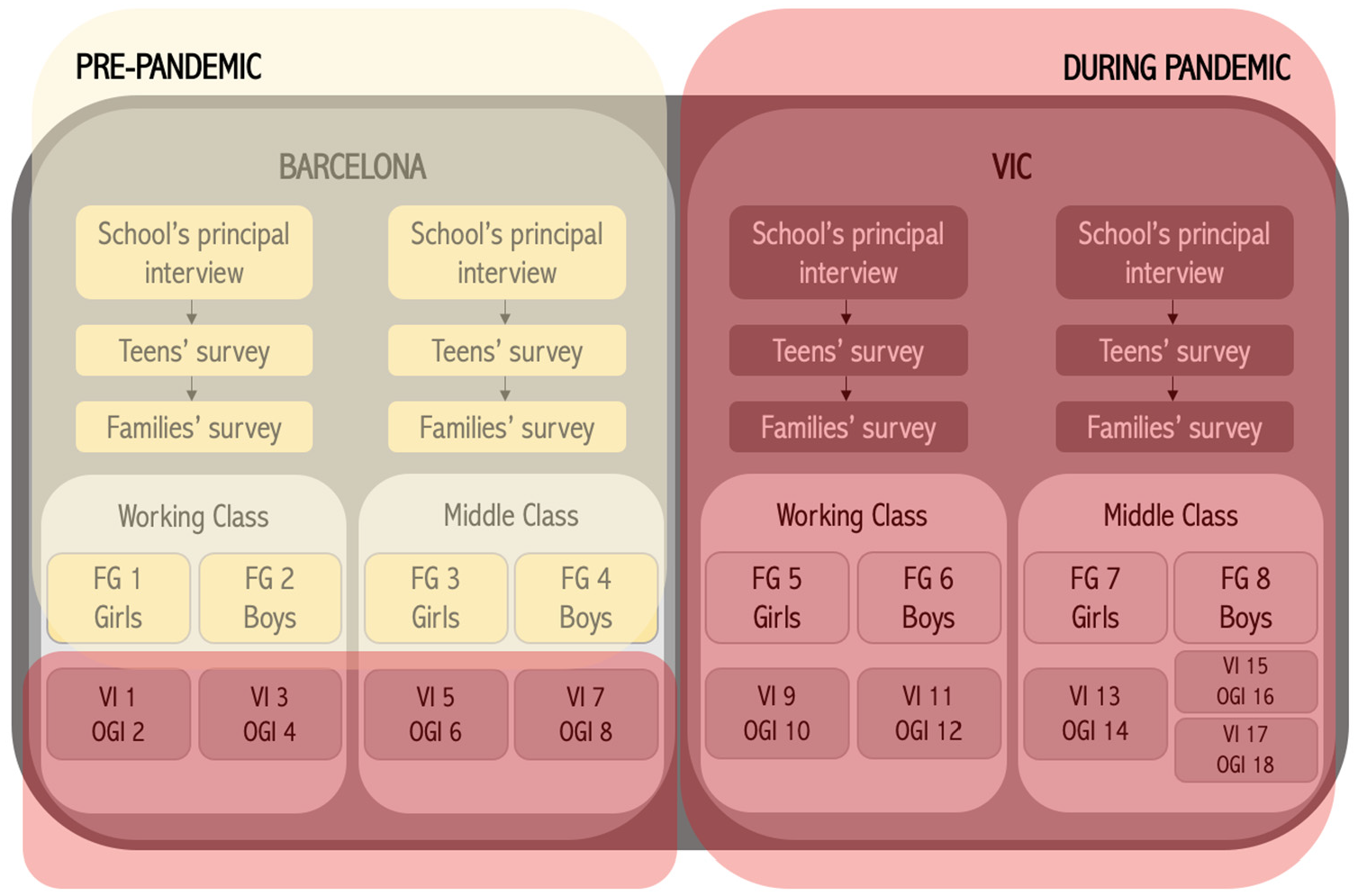
The research process during the COVID-19 pandemic.
In each center, the same methodological techniques were applied without differences derived from COVID-19; therefore, the four remaining focus groups were held face-to-face at the schools in Vic following the safety measures.
Leaving aside the controllable circumstances, unforeseen situations also arose that required adaptation that would not have been possible without flexibility. Firstly, one of the class groups was quarantined in the Vic semi-private school the day before the focus group was to be held, which meant that some of the selected participants were left out of the sample. In order to speed up the research as much as possible and in view of the possibility that the situation would become worse, it was decided to select other participants who, although they met all the criteria, had not been selected the first time because they dedicated less time than the selected participants to playing video games.
Secondly, all focus groups were converted and registered as bubble groups in the case of a COVID-19 infection. A lockdown of the bubble group happened in two of the four focus groups carried out during the pandemic. Therefore, the lockdown protocol was applied to ensure the security and health of all participants and the rest of the school’s students and the people who had contact with them, including the researcher. In one case, a girl had to leave the focus group during the last 15 min, and we continued the discussion individually through WhatsApp. In another, a positive COVID-19 was detected and notified after the focus group was carried out, so that all the participants and the researcher of the focus group were quarantined for 10 days.
All these changes were an inevitable part of the research, converting COVID-19 into an actor that required further flexibility from the researcher.
Adapting the Methodology in the Middle of the Pandemic: Talking With, and Playing Online Video Games With Teens
The fifth challenge of the research process was to adapt the methodology for the gaming interviews (Shaw, 2015) into an online format in the middle of the pandemic. Taking the referent of Adrienne Shaw (2015), the methodological approach prior to COVID-19 was to conduct the two interviews at the participant’s home. In addition, the objective of going to the teens’ homes was to provide ethnographic data linked to social class and family cultural capital. That is, a combination of a long-lasting dispositions, cultural goods, and intellectual qualifications related to a particular social class position (Bourdieu, 1979).
Specifically, the online gaming interview consists in interviewing the teens while they are playing video games in their natural and everyday environment, that is, at home, in the way and at the time that they usually play, connected online with the researcher through the gaming platform or a video call. This technique makes it possible to study teenagers’ practices in an environment that is as day-to-day as possible, avoiding the drawbacks of observation in a laboratory or similar. The vast majority of experimental, but also social research studies with video games are based on an artificial environment that is conditioned for conducting the research (Allen & Anderson, 2019). Thus, using this innovative technique means creating a relaxed atmosphere that encourages interaction and trust between the interviewee and the research (Shaw, 2015). In its online format, as applied in this study, the online gaming interview allowed the researchers to observe the connection between digital practices and the material world.
It should be highlighted that online gaming interviews proved to be useful for researching teens’ social and virtual realities through their gaming worlds. The importance of understanding that there are parallelisms between realities (digital vs. material) is essential to research gamer identity construction, not only based on their avatar choices and creations but also based on their gaming community habits, social relationships, and teens’ daily routines (Hollingworth et al., 2011). This understanding is a crucial step for exploring teens’ professional projections—or non-projections—through new celebrities, such as youtubers and celebrities, plus their perceptions about the eSports world and their actual possibilities and conditions to be part of it.
However, the researcher has to keep in mind the possible harm and social issues that can emerge. This is because harm can be contextual, even more, when axes, such as gender, social class, and family setting, are explored in conjunction (Pires, 2018). Furthermore, it is necessary to be aware of the potential unexpected participants who could intervene during the gaming interviews but who are not initially included in the research. Therefore, the research requires an ongoing process of revision and adaptation, especially when the phenomenon being studied crosses the barriers of online and offline (Markham & Buchanan, 2012).
During the research we had interventions from adults or minors of the same house, but also in the online space. To face this type of situation, the researcher has to prepare a protocol and additional consents for these people. In case someone does not want to be part of the study, the researcher must immediately eliminate all data related to that person and their interventions (Blaikie & Priest, 2019). Specifically, a boy and a girl from the public school in Vic played with friends during the online gaming interview. All of them and their families accepted to be part of the research and signed their respective consents of participation. Involving more participants was part of the natural evolution of the methodology and generated new insights during the gaming interviews.
The research had a degree of unexpected events because the studied phenomenon was not a controlled environment (McCambridge et al., 2012). Thus, this is a fundamental legal and ethical challenge to keep in mind, but it is also a source of enrichment for the study results.
In addition, conducting the gaming interviews in an online format has represented an additional economic cost for the researcher. It has been necessary to buy the games that the adolescents have chosen and become familiarized with them in order to take full advantage of the interview session.
Power Imbalances Dynamics
The sixth challenge identified in this research occurred during the post-evaluation phase, after the study was concluded and the data analyzed. At this stage, it became possible to assess the power dynamics between the researchers and the study participants, which was particularly relevant during the online gaming interviews. The intentional effort to integrate into the participant’s gaming habitus led to changes in their routines and, likely, in their behaviors.
These changes were especially notable when, during one of the online gaming interviews, the participant’s friends joined into the gaming session. The presence of a habitual member relaxed the participant, leading to different dynamics. Until that moment, the interviewee’s demeanor had been more formal and restrained; however, when their usual friends entered to play, the dynamics shifted. From that point on, the interviewer became an outsider. Although she participated in the same game session, she was relegated to a secondary role. Conversely, the interviewees’ attitudes became more informal.
In this context, the concept of bridging the adult-youth age gap becomes particularly relevant. Researchers inherently carry a degree of power derived from their age, authority, and role in the study, which often creates barriers that hinder authentic interaction with younger participants (Trusell, 2008). During the sessions, the entrance of the adolescent participant’s friends brought about a natural shift in these dynamics, momentarily reducing the adult researcher’s influence and making the setting more familiar to the youth.
Observing this shift underscores the complexity of integrating into a participant’s gaming habitus and highlights the importance of adopting strategies to mitigate power imbalances in future studies. Integrating elements of the participants’ everyday environments or facilitating prolonged engagement to normalize interactions aligns with the principle of bridging the adult-youth age gap. These practices not only ease participants into more comfortable and natural behaviors but also enhance the quality of the data by minimizing the external influences of authority (Trusell, 2008). In this regard, future research should incorporate multiple gaming sessions, spaced out over time, to normalize a gaming habitus more aligned with ethnographic and/or participant observation techniques.
Discussion
Utilizing Gibbs’ (1988) Reflective Cycle as a framework for examining the research challenges encountered in this study provides a structured approach to deeply analyze the complexities faced during this investigation. By reflecting on the six stages of the model—description, feelings, evaluation, analysis, conclusion, and action plan—we can achieve a nuanced understanding of how these challenges shaped the research process and outcomes.
Description
The study identified six significant research challenges: sampling social class in teens, researching gender among teens, managing legal and ethical issues, adapting the research to pandemic restrictions, modifying methodologies to include online gaming interviews, and addressing power imbalance dynamics. These challenges emerged throughout the research design, implementation, and evaluation phases, largely due to the unique sociocultural and temporal context of the COVID-19 pandemic. Each challenge posed logistical, ethical, and methodological barriers that required innovative solutions to maintain the study’s integrity.
Feelings
The research process was accompanied by a mix of anticipation, uncertainty, and resilience. Initially, there was enthusiasm about applying a multimethod approach to explore complex sociocultural constructs like gamer identity. However, the onset of the pandemic brought feelings of disruption and anxiety as researchers grappled with shifting health guidelines and their implications for data collection. Ethical concerns, particularly around informed consent and participant well-being, invoked a sense of responsibility and caution. The successful adaptation of methodologies to virtual formats generated relief and a renewed sense of purpose, though challenges like low participation rates evoked frustration and introspection regarding the study’s accessibility and inclusivity.
Evaluation
The successes and limitations of addressing these challenges reveal key insights. For example, the flexibility demonstrated in adapting methodologies to online formats during the pandemic was a clear strength. This adaptation not only ensured the continuity of the research but also highlighted the viability of digital ethnographic techniques. However, the study’s reliance on homogeneous focus groups limited the diversity of perspectives within the data, underscoring a methodological constraint. Furthermore, while the rigorous ethical protocols safeguarded participant rights, the length and complexity of informed consent forms deterred participation, particularly among working-class families. This highlighted the tension between ethical thoroughness and participant engagement.
Analysis
The challenges encountered underscore the intersectionality of methodological, ethical, and contextual factors in researching adolescent gamer identity. The difficulty in sampling social class illustrates the persistent issue of socioeconomic stratification within educational systems, which was further exacerbated by the pandemic. Public schools in lower-income areas exhibited lower participation rates, reflecting systemic barriers to research inclusion. Similarly, the lack of non-binary gender representation in the sample signals the ongoing marginalization of non-binary identities within gaming and academic contexts, despite initial methodological inclusivity efforts.
Adapting to pandemic restrictions required rethinking traditional research paradigms. Virtual semi-structured interviews and online gaming interviews emerged as effective tools for capturing authentic participant experiences within their digital and physical environments. These techniques bridged the gap between online and offline realities, aligning with the study’s sociocultural approach. However, they also amplified power dynamics, as the presence of researchers in gaming sessions subtly influenced participant behavior. This phenomenon underscores the need for critical reflexivity in digital ethnography.
Conclusion
Reflecting on the research process reveals the importance of flexibility, ethical vigilance, and intersectional awareness in navigating complex challenges. The pandemic served as both a disruption and an opportunity for methodological innovation. While the study successfully adapted to unforeseen circumstances, the limitations encountered point to areas for improvement in future research. Addressing the barriers to participation among marginalized groups, such as simplifying consent procedures and exploring mixed-group dynamics, could enhance the inclusivity and richness of data.
Moreover, the integration of digital methods has broader implications for social research. The success of online gaming interviews suggests that virtual methodologies can complement traditional techniques, particularly in studies involving youth and technology. However, they also necessitate ongoing ethical considerations, such as safeguarding participant privacy in shared digital spaces.
Action Plan
To build upon the findings of this study and address its limitations, future research should prioritize several critical areas. Enhancing inclusivity in sampling is paramount and entails the development of strategies to more effectively engage underrepresented groups. This approach may involve tailoring recruitment materials to accommodate varying levels of literacy and fostering collaborations with community partners to establish trust among participants. Refining ethical protocols also warrants attention, with a focus on simplifying consent forms while maintaining ethical rigor. Employing visual aids or step-by-step explanations could enhance accessibility, particularly for adolescent participants and their families.
Expanding methodological approaches by incorporating heterogeneous focus groups will be instrumental in capturing diverse perspectives and investigating the influence of different sociodemographic factors on gamer identity. Furthermore, addressing power imbalances is essential; designing longitudinal studies with multiple points of interaction can help normalize the presence of researchers and reduce hierarchical dynamics within the research process.
By addressing these areas, future research can advance the inclusivity, methodological robustness, and ethical integrity of studies in this domain.
In conclusion, the application of Gibbs’ Reflective Cycle to this study demonstrates the value of reflective practice in understanding and addressing research challenges. By systematically analyzing the experiences and decisions made throughout the research process, we can identify actionable pathways for enhancing the quality, inclusivity, and ethical integrity of future studies.
Concluding Remarks
This study sets a precedent for researching vulnerable populations, particularly minors, in digital and hybrid environments. By navigating the complex interplay of privacy, consent, and methodological innovation, this work underscores the importance of ethical vigilance in protecting participants while advancing scholarly inquiry. These contributions collectively pave the way for future research to explore the multifaceted dimensions of gamer identity with greater inclusivity, ethical rigor, and sociocultural awareness.
Despite these contributions, the limitations of the present study should be brought to the table in order to address future research. The complexity of the object of study, combined with the involvement of minors in the research, presented challenges during data collection. These challenges led to low participation rates, which, as previously mentioned, affected the sample selection criteria in certain phases, particularly during the interview stage. On one hand, the time commitment required outside of school hours for interviews and the length of the consent forms contributed to limited participation, exposing the findings to a degree of arbitrariness tied to participants’ willingness to engage. Despite efforts to adapt the consent forms to the target audience—minors, families, and educational institutions—by simplifying the text and carefully selecting relevant information to ensure comprehension of the study’s implications (McCambridge et al., 2012), the forms ranged from three to five pages in length. This length led to insecurity and misunderstanding among some participants, particularly minors and working-class families, resulting in low or very low participation rates, as observed in the public school in Barcelona.
Given these considerations, and acknowledging that the study is based on a qualitative sample, the results are not generalizable. However, they provide a foundation for further exploration of these critical issues within the field of game studies, particularly across diverse age groups, cultures, and communities. While the findings are not universally applicable, this article highlights a series of challenges that can inform future research, particularly studies involving minors.
Besides, this investigation invites reconsideration of certain methodological decisions, such as the use of homogeneous focus groups, to enhance future research by introducing new variables to the study. For example, a comparative analysis of homogeneous versus mixed groups in the construction of gamer identity among adolescents could offer valuable insights. Specifically, discourse analysis within heterogeneous groups may shed light on the interaction between social class and gender in shaping gamer identity.
Additionally, it is important to acknowledge the “adult-centric” perspective inherent in much of the existing theoretical work on gamer identity—an outlook that is largely influenced by the cultural studies approach to analyzing video game culture. Addressing these issues from a psychological perspective could provide additional insights, particularly by considering the developmental changes in gamer identity during the transition from childhood to adolescence. Conversely, this critique of the dominant perspective could be further expanded within cultural studies, utilizing participatory action research to advocate for adolescents’ active involvement in interpreting and understanding these phenomena.
By highlighting both the ethical challenges and methodological opportunities in researching this area, this reflexive paper sets the stage for future investigations that will continue to refine our understanding of the sociocultural dynamics within the field of Game Studies and the ethics of research involving minors.
Footnotes

Funding
The author(s) disclosed receipt of the following financial support for the research, authorship, and/or publication of this article: University of the Balearic Islands funded the APC fees of this article.
Declaration of Conflicting Interests
The author(s) declared no potential conflicts of interest with respect to the research, authorship, and/or publication of this article.
Data Availability Statement
None.