




Abstract
This critical ethnographic study focused on identifying the leadership practices of past and present leaders involved in the operation of the Nigerian government, with emphasis on the Eastern Region. The author was committed and determined to discovering a pattern of meaning through its natural setting, was equally interested in the process rather than outcomes, in context rather than specific variables, and in discovery rather than confirmation in order to gain in-depth knowledge and understanding of the issues and problems associated with the leadership situation in the country. For clarity, the investigator used Northouse leadership approach to understand the leadership in the current Nigerian leadership situation. Twelve past and present leaders in the government operations of the Eastern Region of Nigeria participated in the study, and the leadership assessment instrument survey questionnaire was used to support the study. While the study showed a great need for change in leadership, the results of the study revealed that most of the leaders and policy makers in the Eastern Region of the country lack effective leadership skills for the positions they hold. The study also suggested some recommendations for improving the current leadership situation in Nigeria.
Keywords
Introduction
Geographically, Nigeria is a country located in the Western African region, bordering the Gulf of Guinea, between Benin and Cameroon. It is made of three major ethnic tribes, the Hausas (occupying the north), the Yoruba (occupying the west), and the Ibos (occupying the east). It has a total area of approximately 923,768 sq. km as well as 4,047 km in land boundaries (Udogu, 2001). Culturally, Nigeria is the most populated country in Africa; its population has risen above 160 million. The population is extremely diverse with well over 250 ethnic groups, some numbering fewer than 20,000 people. Most of its population is concentrated in the southern part of the country, as well as in the area of dense settlement around Kano in the north. Between the two areas is a sparsely populated middle belt (Olaniyan, 1984).
Historically, the Republic of Nigeria came under colonial rule of the British (United Kingdom) during the second half of the 19th century and the first decade of the 20th century, making English its common language. The British dependencies of Northern and Southern Nigeria were merged into a single territory in 1914, commonly known as the amalgamation of northern and southern Nigeria. On October 1, 1960, Nigeria gained its independence from the British rule. Today, Nigeria is a democratic nation with freedom of religion. While 50% of the population is associated with Islamic worship, Christianity and African Traditional practice comprise 40% and 10%, respectively (Olaniyan, 1984).
Culturally, Nigeria is a multitribal system in which every tribe wants to excel or suppress the other, so they are not on the same level playgrounds. Every person in politics is regionalized and people are capitalizing on that. Once leadership is zoned in the country, one cannot expect to get the best, but Nigerians are trying to live with what they presently have. There are more than 300 different tribal groups in Nigeria, all of which belong to the political definition “Nigerian” but are distinct from one another in terms of cultural practices. Added to this are economic disparities among the various groups, as well as potential for conflict on religious grounds, especially between the long-established Muslim population and the rapidly growing Christian sector.
Since its independence in 1960, civil war, military coup d’état, and consequent military governments have created a Nigerian political environment that is not always seen as stable. These circumstances have constantly destabilized and jeopardized Nigeria’s democracy as well as the political states that border Nigeria. There has been a constant and utter lack of rule of law on the part of the government and the governed. The most urgent issues in Nigeria today are the lack of management of the public trust, corruption, government instability, and the maintenance of decaying simple amenities and infrastructures in the nation. The issue of the upsurge of corruption is endemic and troubling. Transparency International consistently rates the levels of corruption in Nigeria among the highest in the world. Pervasive corruption appears to permeate many levels of the Nigerian society (Eti, Ogaji, & Probert, 2006).
Hargreaves (2002) in discussing about the ways of improving basic health care in Nigeria claimed that Nigeria, once heralded as the beacon of Africa, has fallen somewhat short of this potential. Years of plutocratic repressive dictators and military rule, coupled with widespread corruption, have resulted in large-scale neglect and deterioration of public services. According to Kew (2006), the giant was brought to its knees by 20 years of brutal and corrupt military rule, which left a legacy of executive dominance and a political corruption in the hands of Nigeria’s so-called “godfathers”—powerful political bosses sitting atop vast patronage networks who view the government primarily through the lens of their own personal enrichment. (p. 73)
According to Eicher and Liedholm (1970), the pressing problems of everyday survival remain the highest immediate priority. Since the oil boom of the 1970s, the nation’s economy has been in crisis despite continued expansion in oil production. Inefficiency in governance has further deteriorated the Nigerian economy. Political instability and lack of proper accountability in the country have severely impeded the ability of successive governments to implement economic policies for the common good of the people, thus creating a lack of basic amenities for the people in the country.
For Kirk-Greene and Rimmer (1981), the solution for addressing Nigeria’s problems and consolidating democratic governance in the federal republic lies in having a government or leadership that works on the principles of good governance and is, most importantly, accountable to the Nigerian people. Good governance in Nigeria is essential to its stability and growth and that of the economies of West African countries in the Subregion. While corruption and abuse of power long have been features of Nigeria’s economic and political landscapes, they do not have to remain in the country’s future. Studies designed to examine the positive challenges of good leadership as an ongoing leadership process (Northouse, 2004) may have application to Nigeria’s future. In addition, more scientific studies as well as understanding from the experience of past and present Eastern Nigerian leaders will help highlight more specifically the problems of Nigeria’s leadership. Figure 1 shows some of the major problems that are associated with the current situation in the country.
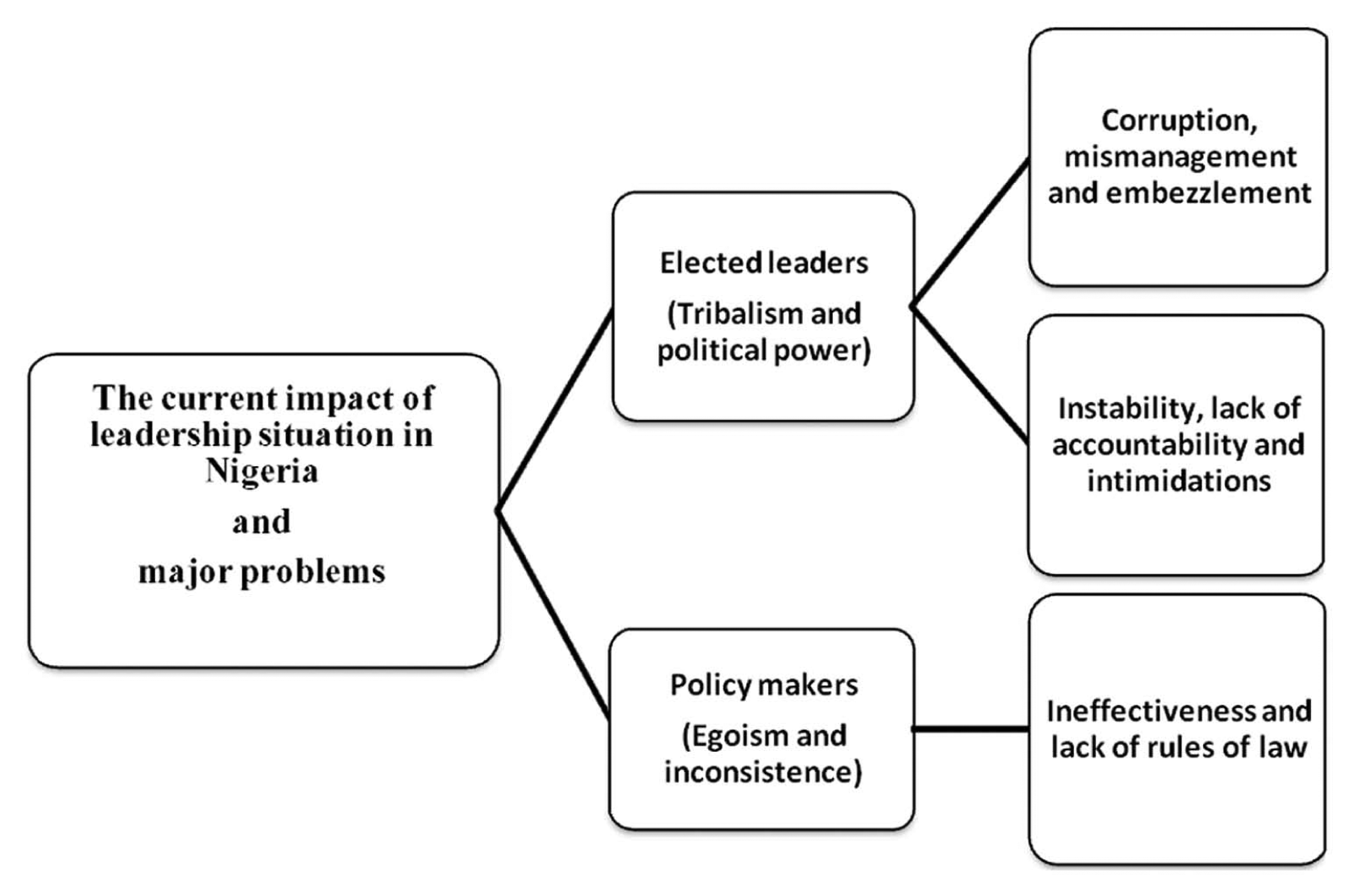
Major problems that are associated with the current situation in the country.
These identified problems are affecting the common people as well as increasing the wave of corruptions and mismanagement in most regions of the country. The current leadership situation in Nigeria is associated with chaos and conflicts.
This study continues to explore the current challenges among elected leaders in Nigeria. The people of Nigeria, like most people in other developing countries in Africa have been disadvantaged and neglected by their elected leaders, lawmakers, and politicians. Many Nigerian leaders are faced with the dilemma of meeting the needs of its poor millions, who have to eke out their living from primary productive activities and maintain the integrity of natural resource and the environment. These leaders have misrepresented and ignored the voice of the people, the common good, peace, and stability of the country, and have equally hindered most people from economic growth and opportunities due to their race, lack of skill, greed, and power. They sometimes create obstacles to future growth and vision of the country. Lipset and Lenz (2000) stated that cultures that stress economic successes as an important goal but, nevertheless, strongly restrict access to opportunities will have higher levels of corruption.
In assessing the leadership situation in Nigeria, Adejimi (2005) indicated that in Nigeria, most of the policy makers as well as those involved in decision making are engaged in bribery, egoism, power, and trade liberalization. They are distracted to an extent that they forget the nation’s policies aimed at improving the lives of people in the society. Although people in a normal society are expected to be honest, law-abiding and hardworking, instead, in the Eastern Region of Nigeria, the lukewarm and unethical attitude of some of their leaders (and those who are supposed to maintain and enforce law and order) are leading the people to engage in corrupt behaviors.
While some studies have provided insight into the constraints and obstacles that many Nigerians, especially people in the Eastern Region of Nigeria, experience in the hands of bad leaders, there is a need for more studies regarding effective leadership and accountability to enable improvements and leadership capabilities on their leaders and policy makers. A great number of leaders and policy makers are occupied with mismanagement and poor leadership skills in their administration of the country. They neglect and ignore policies that are aimed at improving the standard of living among the people of the region. This research, guided by the leadership approach of Northouse, centered specifically on a selected group of 12 past and current leaders of the Eastern Region of Nigeria in an attempt to understand their leadership practices, experiences, and involvements in the operation of the Nigerian government. This study was meant to enable the present leaders and policy makers to better understand the process of leadership as it affects the people of the country with regard to its perspectives, challenges, and realities.
Support of Literature
The study was aimed at understanding the perception and views of some past and current government leaders toward people in leadership as well as how decision-making process operates in the Eastern Region of Nigeria, in their response to the challenges of leadership and mismanagement in their nation. In this regard, it is of vital importance to understand some of the main factors, especially religion, history, tribal, ethnicity, power, colonialism, as well as political, get-rich-syndrome, fraud, and corruption elements that have continued to undermine good leadership in the Nigerian situation. These factors and others have contributed greatly to the instability, poverty, and suffering among the people of the nation.
The review of related literatures in this study reveals a great concern for enhancing the understanding of the current impact of leadership in Nigeria and the challenges the people are experiencing due to poor governance and management in the entire country. The literature review consists of five main sections, namely (a) cultural and historical context, (b) understanding decision-making process, (c) social reform, (d) ethical standards, and (e) the Northouse leadership process. The literature review enabled the author to identify a resemblance, what has been done and what needs to be investigated with regard to the topic. For instance, some recent studies have suggested that Nigeria is a corrupt and a mismanaged country that needs attention as well as an effective leader. The country needs people who are educated, sincere, and honest in administration and leadership styles (Adejimi, 2005).
Regardless of where corruption occurs, the individual or group involved, and what causes it or the form it takes, the facts and outcomes still remain that, in Nigeria, corruption has contributed immensely to greed, mistrust, insecurity, and injustice, as well as to the poverty and the misery of a large segment of the nation’s population. In the views of Lipset and Lenz (2000), poverty and income inequalities are tied to corruption. According to Walter (1990), Nigeria is the giant of Africa and many of its outstanding leaders have been kept in prison or in exile for the sake of criminal act and embezzlement of public funds, as well as lack of accountability and good leadership. Corruption is responsible in a large measure for broken promises, the dashed hopes and shallow dreams that have characterized the lives of most Nigerians in the past few decades, he noted, adding that Nigeria was unlikely to meet the Millennium Development Goals (Walter, 1990).
Mismanagement, government irregularities, and corruption in Nigeria and other developing countries are among the major problems of national growth and development. These problems and their practices occur in nearly every level of bureaucracy, ministries, departments, and polity, as well as in the upper and lower administrations and agencies in the nation. In the mind of McMullan (1970), a public official is corrupt if he accepts money or money equivalent for doing something that he is under duty to do anywhere, that he is under duty not to do, or to exercise a legitimate discretion for improper reasons (McMullan, 1970). Corruption and inefficiency in public services are linked to weak governance and leadership. The political and economic environment of a country determines, to a large extent, the standard and quality of its public services and administrations. There is virtual agreement among observers that corruption and political and economic instability have been responsible for derailing Nigeria’s growth and development and primarily explain the suffering and poverty in the country. Leaders and decision makers in Nigeria should understand that a leader is one who can lead a group of people to accomplish common goals in the right direction, with cost efficiency, within the time frame, and achieve the desired outcomes (Nahavandi, 2004).
Cultural and Historical Context
The understanding of the culture of the people of any group is an authentic way of knowing them. In the views of Frake (1977), culture is not simply a cognitive map that people acquire, in whole or in part, more or less accurately, and then learn to read. People are not just map-readers; they are map-makers. People are cast out continually into imperfectly charted seas of everyday life. Mapping them out is a constant process resulting not in an individual cognitive map, but in a whole chart case of rough, improvised, continually revised sketch maps. Culture does not provide a cognitive map, but rather a set of principles for map making and navigation. Different cultures are like different schools of navigation designed to cope with different terrains and seas (Frake, 1977).
In every collectivistic cultural perspective, leaders have a moral responsibility to take care of their followers and help them develop their personal cares, to be a consultant for followers’ personal problems (Bass, 1995). The Nigerian system is regimented and the people are following a system that is slightly different from our cultural way of doing things, the westernized system is slightly interfering with their own system, but they are trying to cope with what it has produced. Nigeria is a multitribal system where every tribe wants to excel or suppress the other, and so they are not really on the same level playgrounds. Every person in politics is regionalized and people are capitalizing on that. Once the government officials start zoning leadership they will not expect to get the best, but in Nigerian situation most people are trying to live with what they presently have.
The beliefs and cultural values can affect and influence the practice of leadership in any country or region. Leaders must understand their own values and ensure, through their consistent behavior, that they reflect their value and share their vision with their followers (Pielstick, 1998). Morgan (1997) described culture as an active living phenomenon, through which people jointly create and recreate the world in which they live. It is the hope of the researcher that in this study, strong, effective workable leadership techniques will be uncovered to help the Nigerian leaders and policy makers to a new level of understanding and a standard management of the country.
Culture comprised the assumptions, values, norms, people, and their behavior. Each aspect of a cultural element can be seen as a very important environmental condition affecting the system and subsystem in any society. In the views of Edgar Schein (1993), culture is a pattern of a shared basic assumptions that the group learned as it solved its problems of external adaptation and internal integration, that has worked well enough to be considered valid and, therefore, to be taught to new members as the correct way to perceive, think, and feel in relation to those problems. Nigerian leaders should be able to understand the diversity of tribes, tradition, customs, and languages of the different people in Nigeria to enhance a better and comprehensive leadership style and effectiveness in governance of the people. The people’s culture is very important and what they think ought to be done in their society (Hofstede, 2001).
Cultural values and beliefs affect the practice of leadership development, which relates to the values, beliefs, hopes, and fears of human existences. In Nigeria, culture is a phenomenon that surrounds the people as well as the nation’s heritage. Both culture and leadership are intertwined. Many people believe in their customs and traditions as a guide to their way of life. Culture is the sharing of values and beliefs of a society established through the interaction of human thinking, feeling, and action. In highly collective societies, such as Japan, the Philippines, Ghana, Guatemala, Nigeria or Ecuador, where the social bond among members is very strong, and people look out for one another, a strong patriarch at the top of the social hierarchy tends to emerge as an effective leader. Such a leader is not only accepted by the followers but is also expected to protect their interests. People who have different cultural norms and values require different leadership styles. Thus, there are no good or bad value orientations (Hoppe, 1998).
In discussing the current leadership situation of Nigeria, Fagbadebo (2007) stated that the Nigerian State is a victim of high-level corruption, bad governance, political instability, and a cyclical legitimacy crisis. The country’s authoritarian leadership faced a legitimacy crisis, political intrigues, in an ethnically differentiated polity, where ethnic competition for resources drove much of the pervasive corruption, and profligacy. While the political gladiators constantly manipulated the people and the political processes to advance their own selfish agenda, the society remained pauperized, and the people wallowed in abject poverty. This invariably led to weak legitimacy, as the citizens lacked faith in their political leaders and by extension, the political system.
Goodling (2003) in discussing Nigeria’s crisis of corruption maintained that Transparency International consistently rates the levels of corruption in Nigeria among the highest in the world and pervasive corruption appears to permeate many levels of the Nigerian society. Nigeria was positioned at the bottom of Transparency International’s most corrupt nations in 2007, ranking 148 out of the 180 world nations. Both the outgoing and current administrations expressed commitment to stamp out official corruption in the country. According to Ake (1995), decades of efforts have yielded largely stagnation, regression or worse. The tragic consequences of this are increasingly clear: a rising tide of poverty, decaying public utilities and infrastructures, social tensions and political turmoil, and now, premonition of inevitable drive into conflict and violence.
Despite being the eighth largest oil producers in the world, Nigeria has the world’s third largest poverty level (Goodling, 2003). If these problems are not adequately addressed and challenged, the whole nation will remain in chaos. Without adjusting the attitude of the people and without changing our “enormous moral deficit” our “moral and social disorder” will not be mended (Etzioni, 1994, p. 9). In his opinion, Adeseyoju (2006) maintained that corruption is far more dangerous than drug trafficking or other crimes because when it goes unpunished, the public loses confidence in the legal system and those who enforce the law.
Culture, the accumulated shared learning from shared history, focuses attention on the human side of the nation’s life and thereby makes clear the importance of creating an appropriate system of shared meaning to help people work together toward desired goals and outcomes. Culture requires the people, especially the leaders, to acknowledge the impact of their behavior on their environment (Schein, 1993). The understanding of the people’s culture and history can enable any competent leader in any nation, institution or organization to exhibit courage: the courage to embrace complexity, to stop reducing racial relations as ineffective, and to increase the possibility of building bridges, managing conflict, and finding common ground in the nation.
In a nation or culture that stresses participation and autonomy, the function of top leadership is not to control but to support, encourage, and make available hands-on coaching and consultation to help citizens and employees avoid unnecessary frustration and waste of efforts, to increase task-relevant knowledge and skills, and to formulate uniquely appropriate performance strategies that result in process improvements (Tsang, 2002).
Situating the Northouse Leadership Process
Most definitions and descriptions of leadership by different people imply that there should be a good understanding between leaders and their followers to achieve their desired goals and objectives. Leadership is all about getting people to work together to make things happen that might not otherwise occur or prevent that which ordinarily would take place. Northouse (2004) defined leadership as a process consisting of transactions between the leader and the followers: a process whereby an individual influences a group of individuals to achieve a common goal. The paradigm of Northouse suggests that leadership is a process that is ongoing and dynamic in understanding leaders and followers as it affects the situation in Nigerian structure. Leadership involves influence; it occurs in a group context and involves some form of goal attainment.
The author used the Northouse leadership approach to guide the study. The Northouse approach to leadership clearly explained the nature of leadership as well as what is expected of an effective leader. The paradigm of Northouse, which states that leadership is a process whereby an individual influences a group of individuals to achieve a common goal (Northouse, 2004) clearly focused on the leadership style needed in Nigeria. It conceptualizes and identifies the five basic elements common to the phenomenon of leadership. These five components include the following elements and themes that form the core “consensus” components of how leadership is currently conceptualized in the views of Northouse: (a) leadership is a process, (b) leadership emerges out of a reciprocal relationship of influence, (c) leadership occurs in a community or group context, (d) leadership involves goal attainment around shared visions, purposes, and values, (e) leadership is intentional about making real or concrete change.
The aforementioned components of leadership as explained in the Northouse paradigm suggest that leadership is a process that is ongoing and dynamic in understanding leaders and followers in an organization or institution. When applied to Nigeria, this conceptualization rightly suits the situation. Northouse (2004) claimed that Although leaders and followers are closely linked, it is the leader who often initiates the relationship, creates the communication linkages, and carries the burden for maintaining the relationship. (p. 3)
The leadership style in Nigeria is not working effectively and could be addressed through the guidelines of the Northouse concept of leadership. Leaders and followers are involved in effective leadership processes. Leaders need followers and followers need leaders to accomplish desired goals and outcomes (Burns, 1978).
Understanding Decision-Making Process
A good understanding and the establishment of sound decisions and policies are very important for leadership reform. Thus, growth dynamics cannot simply be measured in economic terms. Positive criteria for growth and reform in Nigerian leadership must include governance, efficiency, accountability, and democracy of institutions, as well as involvement of the people. Most of the issues in the country can be linked to poor decisions and bad policies from the leaders, and policy makers. Decision makers must first decide on their values and set goals to insure a fruitful decision-making process. Their decisions fashion the environment in which the people of the nation live. Therefore, before taking any course of action, leaders must discover or create a set of alternative courses of action and gather information about each. Having gathered the information with which to make a decision, they must apply information for each course of action to predict the outcomes of each possible alternative and make a decision for implementation (Deutsch & Coleman, 2000).
For Kirk-Greene and Rimmer (1981), the solution for addressing problems and consolidating democratic governance in the federal republic of Nigeria lies in having government or leadership that works on the principles of good governance and, especially, is accountable to the Nigerian people. Many Nigerians who are highly achievement oriented have been relatively reduced to low access economic opportunities in the current leadership situation in the country. Good governance in Nigeria is thus essential to its stability and growth and that of the economies of West African countries in the Subregion. The apparent lack of confidence in the bureaucratic and political processes is a reflection of the poor governance that has characterized the system for decades.
In today’s society, organizational leadership, decision making, growth, effective management, and organizational success are based on the quality of the decisions policy makers or leaders make. In any country where legal systems fail to protect the rights of groups and individuals, the risk of violence and conflict are bound to increase. For Nigerians, effective leadership and good governance must be for the Nigerian leaders and decision makers the direct result of knowing their criteria for success, the scope of their choices and the inherent risk of each alternative (Nelson & Quick, 2003).
There is a great need for the development and establishment of proper decision, rule of law and leadership styles among the country’s leaders and decision makers that will include a review of the existing policies, strategies and standards to ensure that managers and government officials will continue to achieve efficient and effective management roles in the country. According to Kotter (1990), leaders must know how to lead as well as manage. Otherwise, without leading as well as managing effectively, today’s organizations face the threat of extinction. While leadership involves change, inspiration, motivation, and influence, management and effective leadership must focus on the process of setting and achieving the goals of the nation through the functions of management, with reference to strategic planning, organizing, directing, and controlling.
Nigerian leaders and decision makers should be influenced by collaborators while working together to achieve the common goal of the nation. Nahavandi (2004) claimed that a leader is anyone who influences individuals or groups within an organization, helps them in the establishment of goals, and guides them toward achievement of those goals, thereby enabling them to be effective.
Social Reforms
Nigerian leaders need clear and comprehensive social reform to break the cycle of inefficiency in leadership. For a successful reform to take place in Nigeria accountability and transparency have to be guaranteed and the people have to be involved in issues that affect their lives and immediate environment. It was obvious to the author, that one of the major reasons for the current leadership deficiency in the Eastern Region of Nigeria and in the whole country in general is that many Nigerians have not had the simple opportunity to live and operate in an environment that is under the rule of law. In the views of Edward De Bono (1990), law and order are the basic part of the fabric of society, and the society needs to give priority to this aspect of life because poor quality here downgrades everything else in the systemic network of the place.
Northouse (2004) suggested that sociability refers to leaders’ inclination to seek out pleasant social relationships. Leaders who show sociability are friendly, outgoing, courteous, tactful, and diplomatic. They are sensitive to others’ needs and show concern for their well-being. Social leaders have good interpersonal skills and create cooperative relationships with their followers. According to Fagbadebo (2007), transparency and accountability in governance will increase the sense of national community as well as the level of system affect.
Ake (1995) has rightly suggested that “democratization of considerable depth” would be necessary to halt the impediments created by the problems of poor governance. To ensure more and better government responsiveness, civil society actors who have all the capacity to compel their leaders to be accountable to them should brace up for the challenge. Deliberate and conscious efforts, borne out of patriotism, are needed to ensure the emergence of a virile civil society. An informed civil society is of vital importance to balance the powers of the Nigerian State. For successful reform to occur in Nigerian leadership, leaders and decision makers must possess problem-solving skills. According to Mumford, Zaccaro, and Harding (2000), problem-solving skills refer to a leader’s creative ability to solve new and unusual, ill-defined organizational problems. Nigeria needs problem-solving skills of leaders to help fight fraud and corruption in the country.
To truly clean up the bad leadership and corruption, Nigeria needs sound ethical leadership that is rooted in respect, service, justice, honesty, and community. Leaders who place fairness at the center of decision making, including the challenging task of being fair to individuals as well as to the common interest of the community they serve (Northouse, 2004). The country needs people who are educated, and sincere and honest both in administration and leadership styles. In the Nigerian leadership situation, selfless and charismatic leaders are needed to amend the wrong (Adejimi, 2005).
Ethical Standard Challenges
Ethics codes provide guidelines for the professional conduct and behavior for managers and employees (Pugh, 1991). Leaders and policy makers need to make positive laws and rules as well as implement them to the letter. Laws are not respecters of persons. Adherence to ethical standards both in leadership and decision making must be a foundation of the country’s policies. According to Lewis (1991), ethics codes fulfill the following three purposes: (a) encourage high standards of behavior, (b) increase public confidence, and (c) assist in decision making.
A true leader must be virtuous and a person to be trusted by the governed. This study was concerned with helping the leaders to exercise leadership in a respectful and selfless manner for the common good of the people in the region. Macintyre (1981) affirmed that virtue is an acquired human quality, the possession and exercise of which enables us to achieve those goods which are internal to practices, and the lack of which prevents us from achieving any such goods. Virtuous leaders either in government or business are persons of honesty, integrity, and trust (Dike, 2001; Frankena, 1963; Liebig, 1990). According to Bowman, ethics is action, the way we practice our values; it is a guidance system to be used in making decisions. The issue of ethics in the public sector as well as in the private life encompasses a broad range of concerns, including a stress on obedience to authorities, on the necessity of logic in moral reasoning and on the necessity of putting moral judgment into practice (Bowman, 1991). Ethics codes are a tool for clarifying acceptable behavior and provide guidance to managers when dealing with ethical dilemmas (Lewis, 1991).
Leadership can change followers’ attitudes, beliefs, and behaviors to improve performance (Northouse 2004). They should encourage their followers to see with a new perspective and stimulate them to face challenges and solve problems (Bass & Avolio, 1994). Leaders should help arouse their followers’ uniqueness and potential innovation perspective for more effective problem solving without direct intervention from their leader (Bass & Avolio, 1990). It is of great value and importance that leaders have good moral conduct and ethical responsibility to enable them to attend to the demands, concerns, needs, and problems of the citizens in the country. In the views of Burns (1978), discussions of leadership sometimes are viewed as elitist because of the implied power and importance often ascribed to leaders in the leader–followers relationship. Leaders are not above followers or better than followers. Leaders and followers must be understood in relation to each other and collectively (Burns, 1978).
Research Questions
The purpose of this qualitative critical ethnographic research study was to understand the perception of selected leaders and their experiences in regional and national leadership positions in the Eastern Region of Nigeria. The research questions were as follows:
Research Question 1: How do selected participants see their role as government leaders in Eastern Nigeria?
Research Question 2: How does the decision-making process operate for leaders in Eastern Nigeria?
Research Question 3: What recommendation do these participants have for improving political practices in Eastern Nigeria?
The answers to these and other related questions that have emerged in the course of the study may provide current Nigerian leadership and policy makers with information that, if applied, could enable the people of the country to live happily and enjoy the common good.
Method
The author used the qualitative critical ethnographic paradigm to understand the perception of selected leaders and their experiences in regional and national leadership positions in the Eastern Region of Nigeria. This methodology was based on the experiences of the researcher and the selected participants which focused on identifying the leadership practices of the past and present leaders involved in the operation of the Nigerian government. The author used critical ethnographic design to gain in-depth knowledge and authentic understanding of the issues and problems associated with the current impact of leadership in Nigeria, with regard to its reality, challenges, and perspectives. With this in mind, the critical ethnographic design was used as the most effective means of carrying out comprehensive, systematic, and authentic research on the Nigerian leadership situation. Based on the researcher’s judgment and the purpose of the research (Babbie, 1995; Greig & Taylor, 1999; Schwandt, 1997) and in looking for those who “have had experiences relating to the phenomenon to be researched” (Kruger, 1988, p. 150), the key participants were limited to 12 past and current leaders who served in the eastern part of Nigeria between 1960 and the present. The participants were selected from different cities and towns of the eastern part of the country, and they all have political leadership and administrative experience in the government operation of the country for a minimum of 12 years (2 participants had more than 30 years of experience). The participants consisted of three women and nine men, with an average age of 45. They also had a first degree as the minimum education level, although 3 of the participants hold an honorary PhD. The informed consent agreement form and the purpose of the research study were explained to the participants at the beginning of each interview.
This study was based on a mixed-method, duplicating the self-designed survey questionnaire developed from the research questions and discussions from the focus group interviews. The quantitative survey data were collected as a response to the questionnaire and used to support the qualitative data in the study. The researcher conducted both individual and semistructured interviews with the selected participants forming three groups of four individuals. All selected individuals and each group participated in three separate interviews to avoid responses being filtered only in the single ideas of a particular interviewee. Here, the researcher chose the researcher role as an active listener and collaborator “to tell the story from the participants’ view rather than as ‘expert’ who passes judgment on the participants” (Creswell, 1998, p. 18). All interview sessions were tape recorded with participant’s permission and used as a check to the field notes of the researcher. This method is much encouraged in conducting critical ethnographic research. Because ethnographic analytical procedures vary by researchers’ schools of thought, quantitative as well as qualitative procedures and instruments may be incorporated, if appropriate (Bernard, 2002).
Basically, data analysis employed a concurrent nested model (Creswell, 2003). Having said that, the qualitative data analysis, which is primarily inductive and recursive process, were analyzed and organized into categories to identify themes or patterns as these facilitated a deeper knowledge and understanding of the leadership situation in Nigeria. The questionnaire and final survey revisions were made to support and improve the content and process of the data collections, both incorporated qualitative and quantitative items. Thus, the quantitative data were systematically organized, analyzed, and given a basic descriptive statistical treatment in the study. A follow-up research was conducted by implementing focused interviews of the selected past and present of the Nigerian leaders to corroborate the data from the final survey and identify additional variables. The author allowed the selected participants to serve as a check to the study to ensure immediate validation as to the accuracy and credibility of the narratives in the data. The constant communication between the researcher and the selected participants added to the confidence and validity of the interview transcripts.
Findings
The findings are based on the purpose, objectives, and research questions of this study as well as examined in multiple levels (Creswell, 2003) that include three major sources: (a) open-ended questions posed through interviews, (b) demographics and observation, and (c) the survey questionnaire.
Interview Questions
Relationship to region’s infrastructure and Management:
What is your job? How does your work allow you to interact with the region’s infrastructure? How long did you work in the government operations?
Understanding of leadership process in the Eastern Nigeria?
Can you explain your understanding of leadership and administration in the government operations? What are the changes when you worked in the past and now?
Perception of leadership process and effectiveness:
Can you explain how you see the leadership being managed today? Is this different from that when you were young? What are the opportunities and challenges?
What do you think can be done differently to ensure the trust is preserved?
What would you do differently if you had sole control of the public trust?
Based on the research questions, the interview questions were developed thematically. The interview questions helped to provide the structure for data gathering and also served as a means for recording information that was used in this study.
Demographics
The participants were selected from different cities and towns of the eastern part of the country, and they all had political leadership and administrative experience in the government operation of the country for a minimum of 12 years (two participants had more than 30 years of experience). The participants consisted of three women and nine men with an average age of 45. They also had a first degree as the minimum education level, although three of the participants hold an honorary PhD (Table 1).
The Demographics of the Participants in the Study.

Note. govt. = government.
Survey: The Leaders Attribute Inventory (LAI) Survey data
Thirteen Nigerian leaders completed the Leadership as a Process: Leader Attribute Inventory (LAL; one more than participated in the survey). All of the participants completed the attribution items and 12 completed all of the demographic questions. A general description of the participants shows that they were primarily male (77%), the mean age was 52.75 years old, the mean years of education was 23.75, and the mean years of work was 22.67. Further breakdowns of the demographic information could jeopardize the identities of the participants. Because there were few participants asked to complete the survey only descriptions of attribution item results were needed to support the qualitative findings. The results for the LAI items are listed in Table 2.
The Results for the Attribution Items.
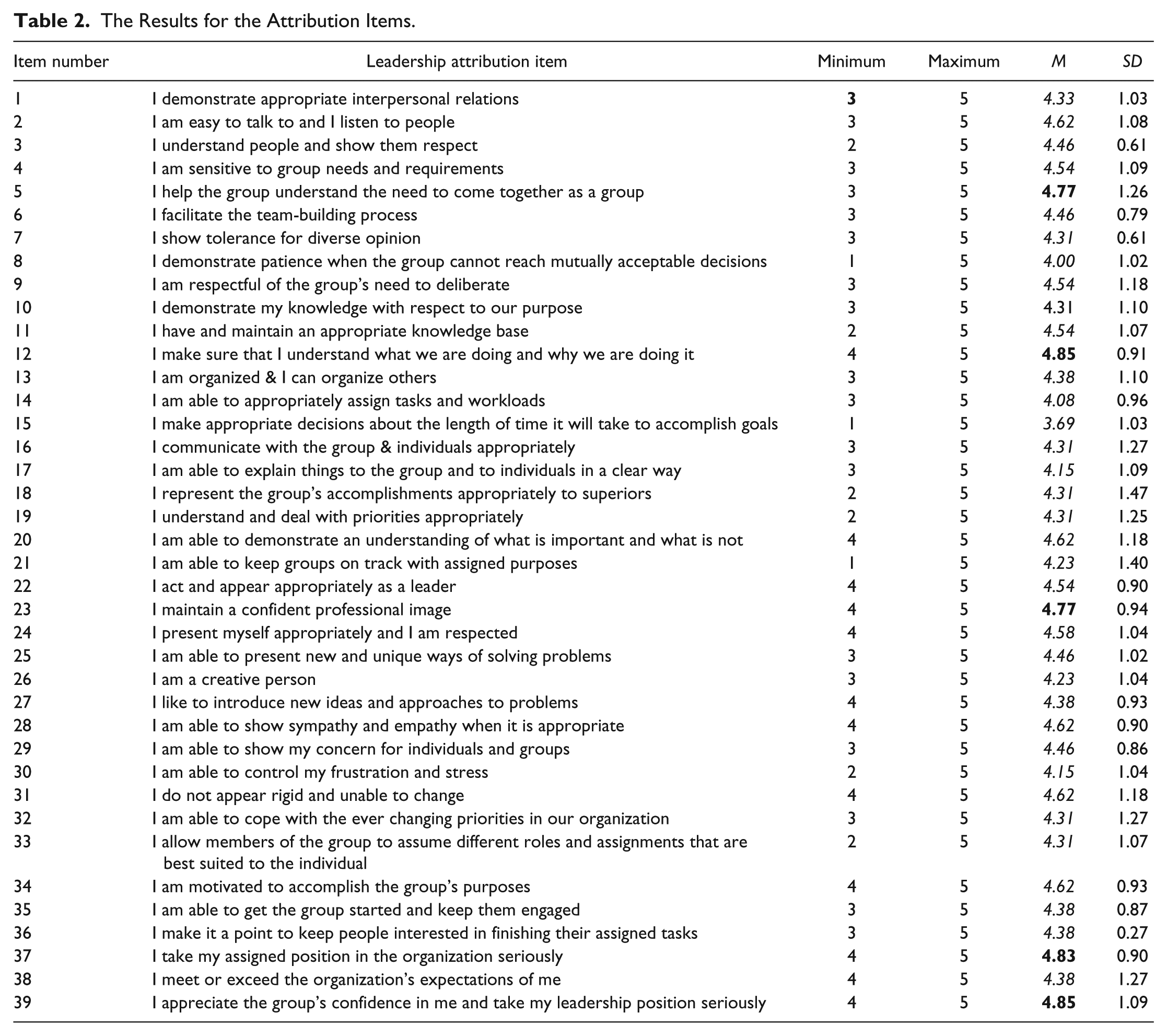
Table 2 shows the minimum score, maximum score, and means for LAL attribution items (means in bold are the largest scores, means in italics are the lowest scores). Overall, the survey completers seemed to have a good opinion of themselves based on the survey results. Only one of the attribution items mean scores was below 4.00 on a 5-point scale—Item 15, “I make appropriate decisions about the length of time it will take to accomplish goals,” which had a mean score of 3.69 (SD = 1.03). The five lowest scored items seem to relate to each other thematically. The other four items are “I demonstrate patience when the group cannot reach mutually acceptable decisions” (M = 4.00, SD = 1.02); “I am able to appropriately assign tasks and workloads” (M = 4.08, SD = 0.96); “I am able to control my frustration and stress” (M = 4.15, SD = 1.04); and “I am able to explain things to the group and to individuals in a clear way” (M = 4.15, SD = 1.09). These items together suggest that there are many things outside of the leaders’ sphere of influence and suggest a lack of structure and accountability within government.
However, the attribution items with the five highest scores suggest that the leaders themselves take their roles seriously and have a desire to move toward real results. These items are “I make sure that I understand what we are doing and why we are doing it” (M = 4.85, SD = 0.96); “I appreciate the group’s confidence in me and take my leadership position seriously” (M = 4.85, SD = 1.09); “I take my assigned position in the organization seriously” (M = 4.83, SD = 0.90); “I help the group understand the need to come together as a group” (M = 4.77, SD = 1.26); and “I maintain a confident professional image” (M = 4.77, SD = 0.94). Due to the small number of survey completers, no inferential statistical tests were conducted.
The findings in this study are in line with the Fagbadebo (2007) perspective that the Nigerian State is a victim of high-level corruption, bad governance, political instability and a cyclical legitimacy crisis. Consequently, national development is retarded, and the political environment uncertain. The country’s authoritarian leadership faced a legitimacy crisis, political intrigues, in an ethnically differentiated polity, where ethnic competition for resources drove much of the pervasive corruption and profligacy.
Discussion
In the views of the participants in this study, Nigeria would have been a very wonderful place, but the only problem is those politicians and retired government officials, those corrupt politicians, and some people who encourage and influence corruption and lawlessness in the country, if they can be swept out of offices or positions, if they can face the law, do what the law says, not just bribing themselves out of the way and trouble in everything, especially crimes, things would be better and well for the common people of the country (Participant A, December 4, 2009).
The stories and experiences of the focus group were the tools and elements used to discover a pattern of meaning and achieve result. The roles of the participants could be seen in most of what the participants shared with the researcher. For instance, one of the Participants stated that If somebody commits a crime, goes back in there, goes through the back door, and give some money and they let him go. If they can get all those corrupt leaders out of the away, then our country will be a very wonderful place. (Participant L, January 18, 2010)
Most of the participants agreed that the nation’s natural resources are being wasted and sold and packed in private pockets. Thus, there are no good roads; the schools are not there; the hospitals are not equipped, and the transport system is neither functioning nor available in most of the cities. If the money and wealth of the country were spent appropriately, the masses would have had at least good schools, good roads, good drinking water, electricity, and health facilities in place. The fact is that these are seriously lacking.
All the participants were very happy to be part of the study. For them, it seemed that through the study the answers to their prayers and requests would be accomplished. They were energetic, motivated, and eager to discover a result. In sharing their knowledge, stories, and experiences as leaders and policy makers in the government operations in the Eastern Region, they also expressed their concerns, suggestions, and recommendations for the current leadership situation in Nigeria. As Participant C (December 7, 2009) in telling his stories said, My role as a leader is to discover the ends and objectives of that particular group so that we work towards achieving them; and to do that, I will identify the group proper, the constituents of that group, what they expect to achieve, as I listen to them, and then as much as possible, pulling them together, making them understand individual participation, individual responsibilities; as much as possible, making sure that the group work as a team, the group work as a peaceful group, because under a confused situation, you can never achieve any good you want to achieve.
The situation in Nigeria during the period of this study was very different from what the country used to be. Most people were living in poverty, fear, and chaos which motivated, and encouraged armed robbery, killings, and kidnapping to make quick money. Many people preferred to stay indoors and at home rather than going elsewhere for the fear of being kidnapped. Movement from one city to the other was very difficult due to the bad roads and lack of security on most of the Nigerian roads. While the armed robbers stole from the travelers, the police extorted money from the commercial drivers, thereby making things difficult for citizens, and commerce. Yet the participants were determined to be involved with the study to find a solution to the current situation. Many of the participants were out and ready to stand and defend the rights and integrity of the country. Most of them were angry about the way things are going in the country’s leadership and administration, the suffering and poor provision of amenities for the people in the society.
As stated earlier, the participants in this study strongly maintained that Nigeria could have been a very wonderful place associated with a situation that is favorable to better living conditions and that encourages growth and development, but that condition is unattainable under the present leadership conditions. Some of the ex-politicians, retired and former government officials, pose as stumbling blocks to effective leadership and administration in the country. These former leaders have refused to exit the public offices and to relinquish their positions to the new leaders. They used the past existing leadership protocols of the government system to either influence or subdue the efforts of the young and newly elected leaders. They encouraged new leaders to follow their corrupt and fraudulent parts in the administration of government duties for fear of being probed or punished for their misconduct in the running of the government operations by their successors.
These leaders through their conduct encourage and influence corruption and lawlessness in the country. These kinds of leaders need to be swept out of offices or positions and brought to face the law, obey the law, and not allowed to bribe themselves out of the crimes they committed during their tenure of office. As a participant emphasized, If somebody commits a crime, goes back in there, goes through the back door, and give some money and they let him go. If they can get all those corrupt leaders out of the way, then Nigeria as a country will be a very wonderful place to live. (Participant L, January 18, 2010)
All the participants agreed that the national resources bestowed on them by nature are being wasted and sold and packed in private pockets.
There are no good roads; the schools are not there, the hospitals are not equipped, and the transport system is not working and available in most of the cities. If the leaders should spent the country’s wealth or money as appropriate, many Nigerians would not be complaining (Participant E, January 19, 2010).
In Nigeria, the decision-making process somehow is believed to belong only to a special interest group of people. The process of decision making is in the hands of powerful and influential leaders and politicians, who control and manipulate the justice system in the country to suit their special and individual interests. As one of the participants postulated, We talk of democracy, government of the people, by the people, for the people, that is in principle as far as leadership in Nigeria is concerned. But if leaders are to lead exactly according to that principle of democracy, things would be different in Nigeria. But in this country, leaders make laws for other people to follow and not for them to follow. (Participant D, January 15, 2010)
In the present Nigerian situation, the interest of the people and the image of the country are neglected. The lawmakers and some leaders and policy makers with money and power do not appear to have the interest of the common people at heart. Laws are made for the common people and not for the leaders. The decision-making process under the current situation was not based on the analysis of the needs of the people. Instead, it is based on political advantage and exists to favor the rich and the special interests of those in authority in the entire country. This poor leadership condition and other negative practices in the country have led many people to participate in different crimes and illegal activities. Many of the Nigerian citizens are fed up and unhappy with the chaotic situation of administration and leadership in the country. The laws and those who make them are not transparent and honest in doing what they were elected to do for the interest of the common good and the welfare of the country. According to Participant K (January 20, 2010), Rules and decisions relating to the country laws are based on the leaders, for what they can get, it is not actually from what the people’s needs are, even though they can present that to the people, but they have a hidden agenda for personal issue in making decisions which they present as decision of the people or for the country. The promotion of rule of law doesn’t hold very much because the people that have the money, they believe that they can buy their way through. Unlike the system they have in the United States where nobody is above the law. But I think that that can be accomplished in Nigeria when the right leaders come into power that respect the rule of law and apply that rule of law to themselves as well.
The laws and rules in the present Nigerian situation are made to represent special interests and the power that matters. Most of the time, the laws are enforced only on the weaker ones and implemented for the common people in the society. The only application to top politicians and government officials is when the image of the high-ranking and powerful leaders is at stake in the eyes of the public. The law under the present condition is not comprehensive, and it is not working well enough to serve the interest of the country due to lack of implementation and enforcement. Most people are sometimes afraid of the system of government, because of insecurity, chaos, and lack of rule of law. As the participants affirmed, there are rules and a constitution that are only on paper and for decoration (Figure 2).
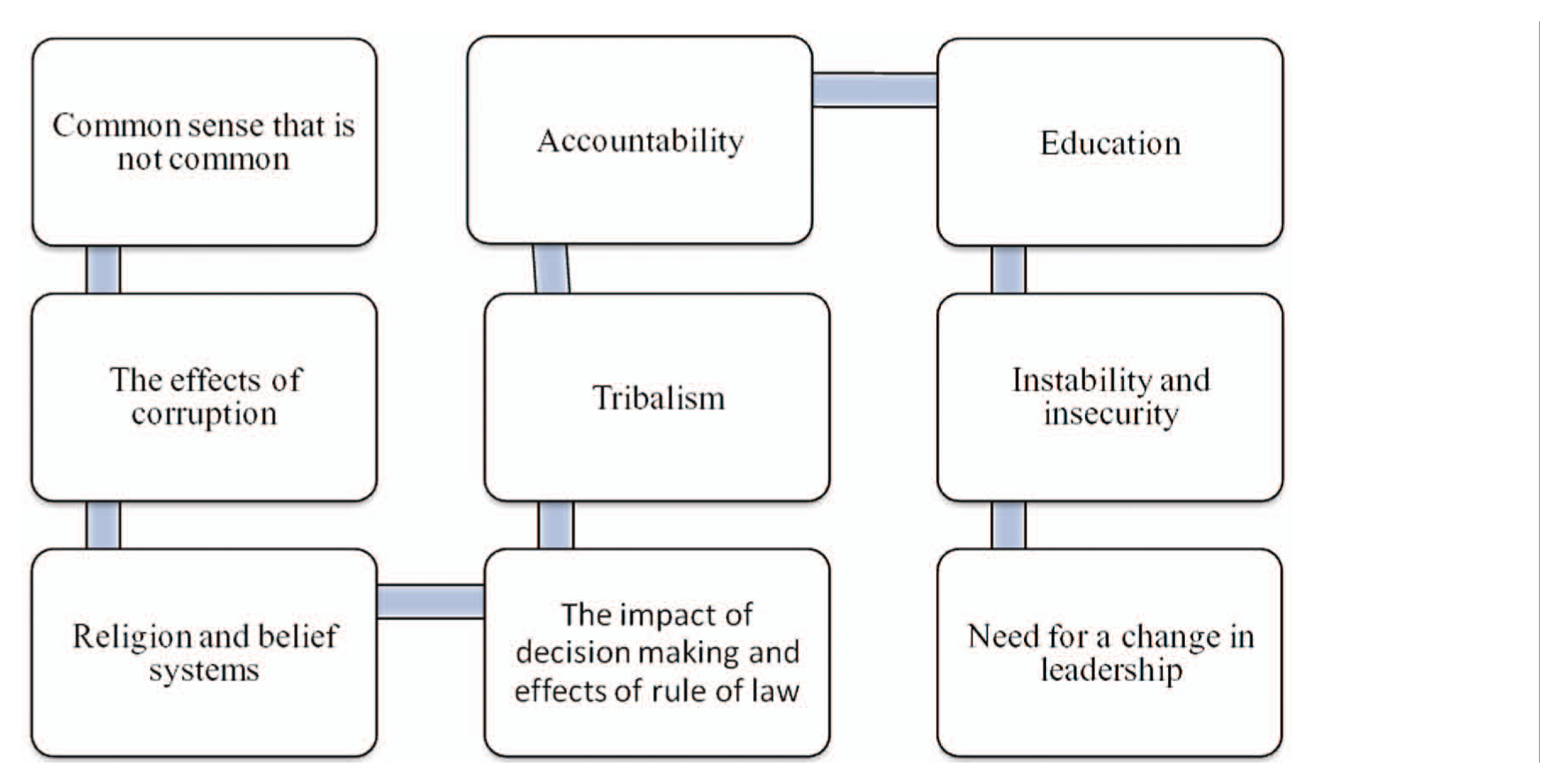
The nine major factors affecting the current situation as identified by participants.
Conclusion
The overall conclusion that emerged from the research can be summarized in the views of Sally Hargreaves (2002) who claimed that Nigeria, once heralded as the beacon of Africa, has fallen somewhat short of this potential. Years of plutocratic repressive dictators and military rule, coupled with widespread corruption, have resulted in large-scale neglect and deterioration of public services. The upsurge of corruption in Nigeria is endemic and troubling. Transparency International consistently rates the levels of corruption in Nigeria among the highest in the world. Pervasive corruption appears to permeate many levels of the Nigerian society (Eti et al., 2006).
All the participants agreed that the national resources endowed to them by nature are being wasted or misappropriated to private pockets. Good roads and schools are missing; the hospitals are not equipped; the transport system is not working or available in most of the cities. If Nigerians spent their wealth as appropriate, they would not be complaining. The masses would at least have good schools, good roads, good drinking water, electricity, and health facilities, but the reality is that these are seriously lacking. A nation that has oil is still begging money to handle health issues and having problems acquiring technology. There is need for awareness in the governance and leadership of the country, so that the people and the society can embrace procedures in accordance with the dictates of the rule of law.
Recommendations for Elected Leaders and Policy Makers
Maintain the rule of law as top priority of any elected leader in Nigeria from the federal to the local government level.
Establish collective effort in decision making in which every part is duly represented and mutually beneficial decisions are made. Any leader that emerges to lead Nigeria must be totally de-tribalized. All decisions must be made bearing one Nigeria in mind and be completely unbiased, filled with objectivity and free of sentiments. Nigeria is made up of different tribes, cultures and religions; no one tribe or religion should be marginalized.
Divide the nation into three different sovereign regions, namely, the Hausa, Igbo, and Yoruba regions. Nigerians need leadership that harmonizes and maintains the geopolitical systems.
Develop a decision-making process that starts from the community, involves the people, and represents the interest of the general public.
Encourage the understanding of the people’s culture and history in the country.
Nigerian leaders should be able to understand the diversity tribes, tradition, customs, and languages of the different people in Nigeria to enhance a better and comprehensive leadership style and effectiveness in governance of the people.
Footnotes
Declaration of Conflicting Interests
The author(s) declared no potential conflicts of interest with respect to the research, authorship, and/or publication of this article.
Funding
The author(s) received no financial support for the research and/or authorship of this article.
Author Biography