




Abstract
This study contributes to the literature on the spillovers of foreign direct investment by presenting empirical evidence on the impact of linkages with foreign-invested firms on the productivity of domestic firms in different local business environments. Using longitudinal data in a transitional economy of Vietnam from 2012 to 2018 and applying different estimation techniques to deal with the potential endogeneity problem, the study shows that linkages with foreign-invested firms have a positive impact on the labor productivity of domestic firms. This relationship is significantly enhanced in an improved local business environment. Additionally, this enhancement effect is observed among firms with a smaller size and those operating in medium- and high-technology industries. The findings suggest important implications to support businesses through improving the local business environment in transition economies.
Introduction
Improving productivity is a fundamental priority in the development agenda of developing countries, as it plays a decisive role in sustaining long-term economic growth (Bastos & Nasir, 2004). At the firm level, productivity enhancement is a key source of firm growth (Syverson, 2011). In the context of increasing international integration, to strengthen firm competitiveness, it is essential to improve firm productivity.
Firm productivity is influenced by both internal and external factors. Internal determinants include labor quality (Abowd et al., 2009), information technology investment (Jorgenson et al., 2008), innovation capacities (Kurt & Kurt, 2015; Lopes & Godinho, 2018; Velucchi & Viviani, 2011), and managerial characteristics (Ali et al., 2022; Bushnell & Wolfram 2009). Meanwhile, external factors shape firm productivity both directly and indirectly by influencing firms’ incentives and capacities to leverage internal resources effectively. These external influences include competitive pressure, regulatory frameworks, input market conditions, and foreign direct investment (FDI) spillovers (Syverson, 2011).
Regarding the external factors, a large number of studies highlight the positive relationship between FDI presence and productivity of domestic firms (Havranek & Irsova, 2011; Monreal-Pérez et al., 2012; Song & Son, 2020). The theoretical foundation for FDI knowledge spillover suggests that domestic firms benefit from linkages with FDI firms in multiple ways. When domestic firms source inputs from FDI firms, they gain access to higher- quality inputs and more efficient supply chains, leading to productivity improvements (Li & Tanna, 2018; Smeets & de Vaal, 2016). In the same vein, when domestic firms supply their goods and services to FDI firms, they must meet stringent quality, cost, and delivery requirements, which compels them to enhance their productivity (Ni et al., 2017). Although an extensive body of literature has examined FDI spillovers through technological transfer and labor mobility, fewer studies have focused on how direct linkages with FDI firms influence the productivity of domestic firms.
Parallel to the literature on FDI spillovers, another strand of research explores the role of institutional environments in shaping firm productivity (Faruq et al., 2013; Goedhuys et al., 2008; Jain, 2020; Roxas et al., 2012; N. H. Vu & Nguyen, 2022). These studies consistently show that a favorable business environment reduces transaction costs, enhances resource allocation efficiency, and fosters firm growth (North, 1990). Strong institutional frameworks support capital formation and improve resource allocation mechanisms, ultimately benefiting firm productivity (Isaksson, 2007). Given these findings, institutional reforms are often advocated as a means to enhance firm productivity and economic development.
While both FDI spillovers and institutional quality have been extensively studied in isolation, limited attention has been given to their interplay. Understanding how business environments influence the relationship between FDI linkages and firm productivity is particularly important, as institutions can either amplify or constrain the benefits of FDI spillovers. This study seeks to address this gap by examining how the impact of FDI linkages on the productivity of domestic firms varies across different business environments. Specifically, we investigate whether local institutional quality enhances or constrains the productivity gains that domestic firms derive from their interactions with FDI firms. By doing so, we bridge the literature on FDI spillovers with that on the role of institutions in firm productivity.
Vietnam provides an ideal empirical setting for this analysis due to its transitional economy status and evolving business environment. While the central government retains substantial control, provincial administrations in Vietnam exercise significant autonomy in economic policymaking (Romeo, 2015). This has resulted in varying business environments across provinces, influencing both FDI attraction and domestic firm performance. Although Vietnam has experienced increasing FDI inflows, the linkages between FDI and domestic firms remain weak (D. B. Le, 2018; Tong et al., 2019). Strengthening these linkages has, therefore, become a policy priority. Additionally, the development of small- and medium-sized enterprises (SMEs) is a strategic focus of the Vietnamese government, as SMEs dominate the economy yet face disproportionate challenges in doing business (Bach et al., 2021a; 2023; D. B. Le, 2018). Understanding how the business environment affects FDI linkages, particularly for firms of different sizes, is critical for designing effective policies that maximize the benefits of FDI.
Our study helps expand the literature on FDI spillovers in many ways. First, we support the FDI spillovers theory by providing the clues from firm-level data set. Our empirical findings confirm the positive impact of FDI linkages on domestic firms’ labor productivity. In addition, we supplement to the literature by specifically analyzing how the effects of FDI linkages on firm productivity differ across business environments and across various firm characteristics, including firm size and technological intensity. We find that a favorable business environment amplifies these productivity gains, particularly among SMEs and firms operating in medium- and high-technology industries. These results offer valuable insights for policymakers in transitional economies, highlighting the need for tailored policies that enhance FDI spillovers by improving business environments and supporting SMEs in their integration into global supply chains.
The remainder of the paper is structured as follows. Section “Literature Review” reviews the relevant literature on FDI linkages, business environment, and firm productivity. Section “Methodology and Data” describes the methodology and data. Section “Empirical Results” presents the empirical results, followed by a discussion in section “Discussion.” Finally, Section “Conclusions” concludes the paper with policy implications and future research directions.
Literature Review
FDI Linkages and Firm Productivity
As suggested by the theory on FDI knowledge spillovers, previous studies have emphasized the role of FDI firms in enhancing the productivity of host countries (Li & Tanna, 2018; Monreal-Pérez et al., 2012; Song & Son, 2020; Suyanto & Sugiarti, 2019). FDI firms can influence the productivity of domestic firms by generating more competition pressure in the market. Competitive pressure to win the deal with FDI firms forces domestic firms to enhance their productivity to improve their likelihood of winning the deal (Chung et al., 2003). Fiercer competition in the market also forces domestic firms to use their existing resources more efficiently and upgrade their technologies (Blomstrom & Kokko, 1998). Domestic firms may also replicate the technology of and hire trained workers from FDI firms, which are the key factors in improving their production capacity (Caves, 1996).
Nonetheless, Javorcik (2004) argues that FDI firms may carry out some actions to prevent their positive spillovers on local competitors in the same sector. They may protect their technology by using intellectual property rights, trade secrecy, paying higher wages for employees, or choosing host countries with limited imitative capacity (Javorcik, 2004). It may explain why recent studies have found little evidence on positive spillovers of FDI firms on their local competitors (Anwar & Nguyen, 2014; Huynh et al., 2021; P. V. Nguyen et al., 2020)
The effects of FDI firms on local firms through linkages between two sectors, however, are widely discovered. FDI firms could affect the productivity of both local suppliers and local buyers in different ways. Unlike domestic competitors, FDI firms may have no incentive to prevent technology diffusion to local suppliers because it is beneficial for them to source improved inputs from domestic markets (Javorcik, 2004). Domestic firms can learn and upgrade their capacity and productivity with knowledge directly transferred from their foreign customers or by exerting efforts to meet stricter requirements for product quality, delivery time, and cost (Ni et al., 2017). Additionally, the increasing demand for inputs from FDI firms makes domestic suppliers expand their production so the latter firms enjoy the benefit of economies of scale and scope, together with a higher level of productivity (Javorcik, 2004). In other words, domestic firms can improve their productivity by selling inputs to their foreign customers. The positive impact of selling to FDI firms on the productivity of domestic firms has been confirmed in a large number of existing studies (Havranek & Irsova, 2011; Newman et al., 2017; Song & Son, 2020). Similarly, FDI firms can influence the productivity of domestic customers in the upstream sectors along their value chains. These domestic firms may become more productive by gaining access to new, improved, and less costly intermediate inputs provided by foreign suppliers (Smeets & de Vaal, 2016). In addition, input supply from FDI firms to domestic firms may be accompanied by the provision of complementary services that are not available when domestic firms import from abroad (Javorcik, 2004). Empirical evidence on the positive impact of FDI suppliers on domestic firms has been provided in numerous studies (Li & Tanna, 2018; Suyanto & Sugiarti, 2019).
Existing studies on the relationship between FDI firms and domestic firms in upstream and downstream sectors in Vietnam have examined the spillover effects of the former on the productivity of the latter. Most FDI firms in Vietnam export their products and rarely sell to domestic firms (H. Q. Le & Pomfret, 2011). In Vietnam, only around 1% of domestic firms source inputs from FDI firms as compared to over 20% of domestic firms that sell their products to FDI firms (GSO, 2020). This observation explains why forward linkages with FDI firms are found to influence the productivity of domestic firms more than backward linkages in many studies on Vietnam (Huynh et al., 2021; Ni et al., 2017; P. V. Nguyen et al., 2020).
Although the impact of FDI linkages on local firms’ productivity is widely explored, existing studies in the literature mainly use the spillover approach in measuring FDI linkages. Most studies use industry-level data to measure the linkages between foreign-invested and domestic sectors and assume that the linkages at the industry level can affect all firms in the same industry. This assumption may not be true because the impact of FDI linkages is not likely to spill over on all firms in the same industry; rather only on firms with direct linkages with foreign-invested partners. Thus, it is necessary to evaluate the impact of FDI linkages on the productivity of local firms by using the direct firm-level approach for linkages instead (Zhang, 2019). Our study attempts to address this research gap by building on the existing literature that highlights the positive impact of FDI linkages on the productivity of local firms. Accordingly, we propose the following hypothesis:
Hypothesis H1: FDI linkages positively influence the productivity of local firms.
Business Environment and Firm Productivity
The literature has emphasized the importance of the business environment for firm productivity enhancement. Using different proxies for business environments, many existing studies have confirmed that a favorable business environment is essential for firm operation (Doan et al., 2022; Nam et al., 2020; Rajesh and Kunal, 2017). Proper institutional regulations reduce transaction costs, leading to an improvement in firm productivity (North, 1990). Isaksson (2007) argues that good institution is one of the drivers for firm productivity growth because it supports capital formation and provides incentives for firms to acquire foreign technology. Goedhuys et al. (2008) show that firms in Tanzania are more productive when their operation is conducted in an environment with less burden of red tape, fewer credit constraints, and more business support services. In search for the impact of corruption and bureaucracy on firm productivity in Ghana, Kenya, and Tanzania, Faruq et al. (2013) point out that poor bureaucratic quality and corruption are likely to depress firm productivity. Roxas et al. (2012) examine the impact of the rule of law on firm performance in South Africa and conclude that a business environment with high security, less corruption, and efficient tax administration is essential to improve firm performance. The role of a favorable business environment on firm productivity is also confirmed in a number of studies (Cahu et al., 2022; Gaganis et al., 2019). For firms in Vietnam, T. Nguyen et al. (2017), H. N. Vu and Hoang (2021), and N. H. Vu and Nguyen (2021) use Provincial Competitiveness Index (PCI) as a proxy for the quality of the business environment and conclude that a favorable business environment is positively associated with labor productivity of firms.
Even though the existing literature mostly agrees on the positive impact of a good business environment on the productivity of firms, little has been learned about how this relationship differs from small to large firms and across firms in different industries. Insights into these groups of firms are crucial to formulating policies for supporting firm development in transition economies such as Vietnam, where small firms account for the majority of firms (Bach et al., 2021b; D. B. Le, 2018; N. H. Vu and Nguyen, 2021).
FDI Linkages and Domestic Firm Productivity: The Role of Business Environment
Extant studies exploring the influence of FDI linkages on the productivity of domestic firms under different institutional environments are limited and reveal conflicting evidence. While some studies confirm a significant and positive moderating effect of a good institutional environment on the spillovers from FDI to domestic firms (Smeets & de Vaal, 2016; Xiao & Park, 2018; Zhang, 2019), others find insignificant evidence of such a moderating role (Gorodnichenko et al., 2014). Moreover, since most studies use the spillover approach at the industry level, they fail to depict the impact of direct firm-to-firm linkages on local firms.
Zhang (2019), using data on Chinese manufacturing firms during the period from 1998 to 2013, confirms that local institutions moderate the effects of FDI spillovers on the total factor productivity of local firms. The study shows that intellectual property rights protection reduces the positive effect of FDI on the productivity of local firms. Meanwhile, a better rule of law enlarges the positive effects of FDI backward and forward linkages on the productivity of local firms. In addition, it is confirmed that government interference lowers the negative competition effect of FDI on the productivity of local firms. The role of the business environment in moderating FDI impacts on Chinese firms’ productivity was also indicated by Xiao and Park (2018). Their study reveals that local firms located in a region with an improved institutional environment, which supports the private sector, input markets, legal environment, and government-market relationship, can improve their productivity more efficiently than those in regions with less facilitating institutional environment. Smeets and de Vaal (2016) also confirm that increased intellectual property rights protection facilitates the productivity of local suppliers in industries that rely on patents.
Gorodnichenko et al. (2014) use firm-level data and national input-output tables from 17 countries during 2002 to 2005 to test the spillovers from FDI to domestic firms under different settings of institutional environment, measured by corruption, red tape, and level of development. While backward linkages are found to have a positive effect on the productivity of domestic firms, the moderating effect of the institutional environment is not detected. Proxies for the institutional environment including bribes or corruption to public officials and regulatory burdens are found to have insignificant direct and indirect influence on the association between FDI linkages and productivity of domestic firms.
Recent development in Vietnam provides an ideal empirical context to test the moderating effects of the institutional environment on the relationship between FDI linkages and the productivity of domestic firms. During the last three decades since the “Doi Moi” or renovation policies implemented in the 1980s, attracting FDI has been taken as an important measure to promote economic growth (MPI, 2018; Vuong & Nguyen, 2020). The FDI sector contributed roughly 18% to total GDP and 73% to total exports (D. B. Le, 2018). A key aim of FDI attracting policies is to link foreign-invested firms with domestic firms and take advantage of spillovers to promote the development of the latter. Therefore, a variety of measures have been used to facilitate these linkages (Tong et al., 2019).
In parallel with increasing FDI, the improvement of the institutional environment has been attached with great importance to the development agenda over the last two decades (Tran, 2019). The policies to improve the institutional environment have been decentralized leading to the competition among provinces in terms of creating a better business environment to attract FDI. The business environment varies across provinces and provincial governments are pivotal in designing and implementing these policies (Nam et al., 2020).
Even though the relationship between FDI linkages and the productivity of domestic firms in Vietnam has been extensively analyzed, only a few of these existing studies have examined how this relationship changes in different business environments. Anwar and Nguyen (2014) are among a few who study the effects of FDI linkage on domestic firms in eight different regions of Vietnam. They conclude that FDI linkages positively impact domestic suppliers in some regions and negatively in other regions. The study, however, fails to explain the reasons for these differences.
To address the research gap in the FDI spillover literature, our study examines how the quality of the local business environment influences the impact of FDI linkages on the productivity of local firms. Therefore, we propose the following hypothesis:
Hypothesis H2: The positive impact of FDI linkages on the local firms’ productivity is enhanced in an improved local business environment.
Methodology and Data
Methodology
To analyze the impact of FDI linkages on labor productivity of firms, we follow the approach adopted by Liu et al. (2001) and Calza et al. (2019). First, we consider how labor productivity of domestic firms is influenced by direct linkages with FDI partners, firms’ characteristics, and industry characteristics. Next, we add the interaction term between FDI linkages and the local business environment into the model to investigate how the impact of FDI linkages on productivity of domestic firms changes under different business environment conditions (Vo et al., 2020; Zhang, 2019). Specifically, our estimation model is specified as follows:

where LPijt is labor productivity of domestic firm i in industry j at year t; FDI_linkageijt−1 is a binary variable for FDI linkage status of the firm at time t – 1; LBEt denotes quality of local business environment; X′ ijt is a vector of control variables including those capturing firms’ characteristics and industry characteristics; λt is included to control for the year fixed effect, which is a set of year dummies; and εijt is the error term.
We follow Monreal-Pérez et al. (2012) to measure productivity of firms by labor productivity (LP), which is either calculated as sales revenue or gross profit divided by average number of working employees (Reddy et al., 2021; Urata & Baek, 2020). Gross profit is calculated by subtracting intermediate costs and labor costs from sales revenue. To eliminate the effects of other factors such as inflation on these variables, we use the real values obtained by deflating nominal values of sales revenue and gross profit by GDP deflators in corresponding years.
The variable for FDI linkages is a binary, which equals one if a domestic firm is either a customer or a supplier of FDI firms and equals 0 otherwise. We employ 1-year lagged values of FDI linkages to capture the fact that domestic firms may need time to absorb spillovers from their connected FDI firms and upgrade their operation to improve productivity (Li & Tanna, 2018). Besides controlling for a number of firm characteristics, we include in the regression industry dummies and year dummies to pick up potential effects of factors that commonly affect firms of the same industry or in the same year.
To measure the quality of the local business environment where domestic firms operate, we follow Vo et al. (2020), H. N. Vu and Hoang (2021), and Vu and Nguyen (2021) in using PCI. This composite index, which is aggregated from ten sub-indices, can be used to measure the quality of the local business environment because it covers various issues related to doing business in provinces in Vietnam. The index was constructed with data from annual surveys of a large number of firms. The quality of the local business environment of each province is ranked by this PCI. In this study, 63 provinces in Vietnam are classified into two groups by their PCI ranking. Provinces with PCI ranks from the 1st to the 31st are classified into the group with the high-quality local business environment and the remaining provinces belong to the group with low-quality local business environment. Hence, the variable LBEjt takes on the value of 1 and 0, respectively corresponding to these two groups.
In addition to these main variables of interest, we follow Calza et al. (2019) in adding time-varying firm characteristics, such as firm size, firm age, capital intensity, wage rate, and technological innovation. Firm size and firm age are measured by natural logarithms of total number of employees and number of years that firms have operated (Calza et al., 2019; Monreal-Pérez et al., 2012; Reddy et al., 2021). Capital intensity, which is measured as equipment and machinery assets value per employee and expressed in logarithmic terms (lnkl), is used to check whether enterprises with more capital-intensive production are more productive. The inclusion of wage rate is to capture the absorptive capacities of firms, as well as the motivation for employees in the workplace. It is expected to be positively correlated with firm labor productivity. The dummy variable of technological innovation is also included in the model to examine whether firms with technology innovation strategy are more productive than their counterparts (Gogokhia & Berulava, 2021; Reddy et al., 2021). Firms following the strategy of technological innovation, which is either product or process innovation, take the value of 1 and 0 otherwise.
D. B. Le (2018) argues that state-owned, foreign-invested, and privately-owned firms in Vietnam perform differently because state-owned and firms with foreign capital may have more privileges and resources. Thus, we control for state and foreign ownership of firms to capture any effects of these patterns. The state ownership variable is binary, which equals one if a firm is state-owned and 0 otherwise. Similarly, the variable of foreign ownership equals 1 if a firm is foreign-invested and 0 otherwise. Industry dummies are also added to capture any specific industry characteristics that may influence firms’ labor productivity in the industry (Li & Tanna, 2018; Ni et al., 2017).
The description of these variables is presented in Table 1.
Summary on the Measurement of Variables.

Source. Authors’ review.
Our main purpose is to examine the impact of FDI linkages on productivity of domestic firms and the moderating role of the local business environment. When estimating Equation 1, endogeneity could be a serious issue that biases the relationship between FDI linkages and domestic firms’ productivity. Although the use of control covariates considerably helps alleviate the unobserved heterogeneity at firm level, there might be other confounding factors that drive both a domestic firm’s productivity and its FDI linkages, for example, the firm’s growth potential or its owner’s/manager’s management capability. Also, reverse causality from firm productivity to FDI linkages could be present as higher productivity may result in production of more sophisticated products for the firm, which in turn strengthens its linkages with FDI firms.
In this paper, we will address this potential endogeneity problem in different ways. We first conduct the Fixed Effects (FE) estimation method on the panel data collected from annual surveys of manufacturing firms combined with data on the PCI in Vietnam from 2012 to 2018. The FE estimation method helps eliminate the unobserved time-invariant elements in the error terms, which mitigates possible biases due to omitted variables. We include the lagged independent variable of FDI linkages to reduce the possible reverse causality running from firm productivity to FDI linkages. To further address this cause of endogeneity, we additionally employ the Instrumental Variable (IV) estimation method and the Propensity Score Matching with Difference-in-Differences (PSM-DID) estimation method.
Specifically, we follow Fisman and Svensson (2007) and N. H. Vu et al. (2023) to use the industry—year mean value of FDI linkages as an IV for FDI linkages. This choice of IV is under the assumption that domestic firms in industries with a higher percentage of firms linked to FDI firms are more likely to establish such FDI linkages. This aggregate measure remains exogenous to the productivity of an individual firm since productivity of a single firm hardly has any impact on the industry averaged FDI linkages. As such, this IV is likely to satisfy the exclusion restrictions.
As for the PSM method, we first construct a comparable control group of firms without FDI linkages and match them with the treated firms having FDI linkages. In doing so, we use the characteristics of firms including firm size, age, ownership, industry, and year for matching (N. H. Vu et al., 2023). After that, we implement the DID to isolate the causal impact of FDI linkages on productivity while accounting for differences in the pre-existing trends between the treated and control firms.
To ensure that our results are not influenced by measurement errors, robustness checks are conducted using alternative measures of productivity. Firm productivity is measured by both real sales revenue and profit per worker, which are adjusted by the GDP deflator. By integrating these methodological approaches, we ensure that our estimates more accurately capture the causal relationship between FDI linkages and firm productivity.
Data
In this study, data on firms’ characteristics, production, and labor productivity are extracted from the Vietnam Enterprise Surveys (VES), which were annually conducted on all Vietnamese firms by the General Statistics Office of Vietnam (GSO). The information on linkages between FDI and domestic firms is taken from Vietnam Technology and Competitiveness Surveys (TCS). These surveys are designed by the Development Economics Research Group of the University of Copenhagen and the Central Institute of Economic Management of the Ministry of Planning and Investment of Vietnam. The samples of the surveys consist of manufacturing firms, which were selected based on a stratified random sampling approach by region and sector. The surveys covered six critical dimensions of technology development and adaptation, which were technological investment and sophistication; input and supplier relations; output and customer relations; technology transfer channels; capacity and business environment; competitors; and corporate social responsibility. Among these factors, the information on FDI linkages is extracted from the input and output sections with details about suppliers and customers of domestic firms. The TCS contains unique information on linkages between foreign-invested and domestic firms in the manufacturing section. Given that these surveys were conducted only during the period from 2012 to 2018, the empirical analysis in our study is, thus, confined by the data availability during this period. Data from VES and TCS are merged by tax codes of firms, thus generating a complete dataset of the performance and characteristics of firms operating all over Vietnam.
Data for the quality of the local business environment are obtained from the PCI surveys. These surveys were annually conducted from 2012 to 2018 in 63 provinces in Vietnam by the Vietnam Competitiveness Initiative (VNCI) and the Vietnam Chamber of Commerce and Industry (VCCI) with the support of the United States Agency for International Development (USAID). The surveys were designed to assess and improve Vietnam’s business environment quality for promoting the development of the private sector. The PCI measures the ease of doing business in each province. The PCI composite index consists of ten sub-indices, each covering a dimension of business environments. These dimensions include entry cost, land access, transparency, time costs of regulatory compliance, informal charges, proactivity of provincial leadership, policy bias, business support services, labor training, and legal institutions.
The score of each sub-index ranges from 1 to 10. The score of the composite PCI index for each province is calculated by aggregating the weighted scores of all ten sub-indices. The higher score of the composite PCI index is for the higher-quality local business environment. Each year, these PCI scores are ranked from the 1st for the highest score to the 63rd for the lowest score for all 63 provinces in Vietnam. In this study, we use these ranks of the composite PCI index scores to measure the quality of the provincial business environment. A total of 63 provinces are classified into two groups. In particular, provinces with ranks from the 1st to the 31st are in the group of high-quality business environments. The remaining provinces belong to the low-quality business environment group. We use province codes to merge the ranks of the PCI index with the two datasets mentioned above to have a set of data containing 36,728 observations of 8,326 domestic firms from 2012 to 2018.
Table 2 presents the basic statistics of these data. It is noted that due to the use of the lagged values of FDI linkages, the sample size is reduced from 36,728 observations to 28,533 observations.
Statistics of Main Variables.

Table 3 reports the correlation matrix among the variables used in our regression model. The correlation coefficients are smaller than 0.56 and the test for the inflation variance (VIF) obtains a maximum of 3.06, suggesting multicollinearity is not a serious concern (Baum, 2006; Filipescu et al., 2009; Monreal-Pérez et al., 2012).
Correlation Matrix of Variables.
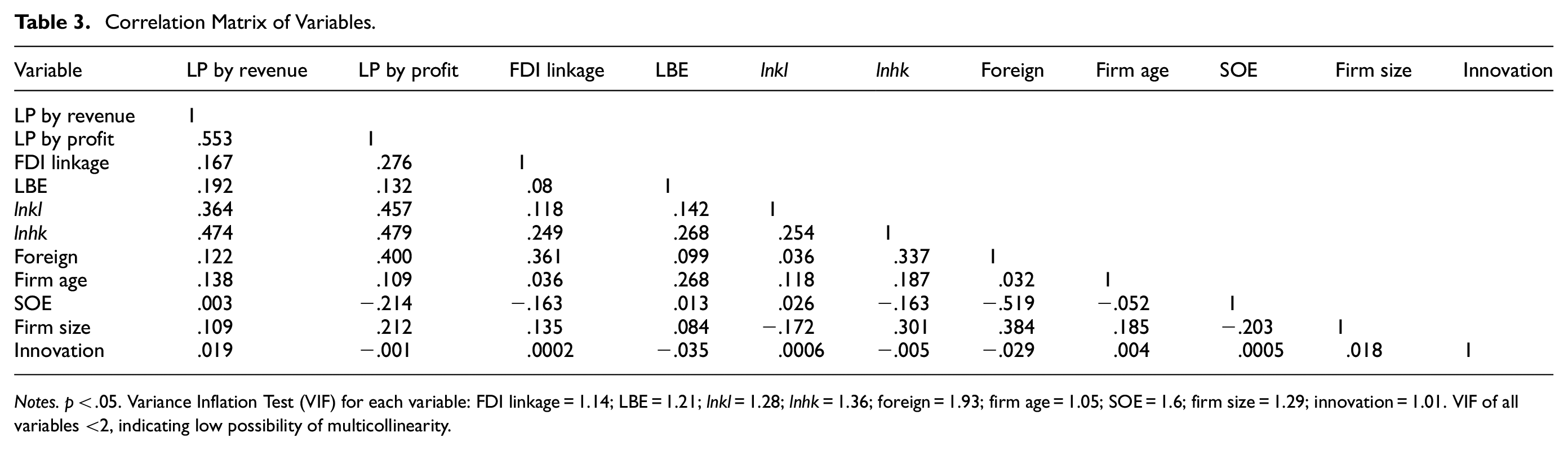
Notes. p < .05. Variance Inflation Test (VIF) for each variable: FDI linkage = 1.14; LBE = 1.21; lnkl = 1.28; lnhk = 1.36; foreign = 1.93; firm age = 1.05; SOE = 1.6; firm size = 1.29; innovation = 1.01. VIF of all variables <2, indicating low possibility of multicollinearity.
Empirical Results
Impact of FDI Linkages on Labor Productivity of Domestic Firms
Table 4 presents estimation results of the effects of FDI linkages on the labor productivity of domestic firms. In Columns from (1) to (3), labor productivity is measured by real sales revenue divided by the average number of workers, which is calculated by the simple average of the number of workers at the beginning and the end of a corresponding year (Monreal-Pérez et al., 2012). In Columns from (4) to (6), labor productivity is measured by real gross profit divided by the average number of workers. For both measurements of firm productivity, regressions using the FE, the FE-IV, and the PSM-DiD are employed.
Effects of FDI Linkages on Domestic Firms’ Labor Productivity.

Note. z statistics are in parentheses.
p < .1. **p < .05. ***p < .01.
The coefficients of FDI linkage variables are statistically significant in all six regressions, including those with the estimation methods that correct for endogeneity problems. These results support our Hypothesis H1, confirming the positive impact of FDI linkages on the local firms’ productivity. In other words, domestic firms that sourced inputs from or supplied products to FDI firms in the previous year are more productive than others. The findings on the positive impact of FDI linkages on the labor productivity of domestic firms are consistent with the literature on the spillovers of FDI (Havranek & Irsova, 2011; Javorcik, 2004; Newman et al., 2017; Ni et al., 2017; Song & Son, 2020). While having business transactions with FDI customers and/or suppliers, domestic firms can learn and improve their labor productivity through various channels, such as acquiring new technology and specialized inputs, receiving technical and financial support, having human resource training, or obtaining market information from these FDI firms. More stringent requirements from FDI customers, including low cost, high quality, and efficient delivery, also force domestic partner firms to improve their productivity (Javorcik, 2004). During the last three decades, Vietnam has been among the top countries in ASEAN that have attracted a large number of FDI projects from many foreign investors from all over the world. In addition, the government has been active in fostering the links between the FDI sector and the private sector. As a result, the backward and forward linkages with FDI firms have been strengthened (Vuong & Nguyen, 2020; N. H. Vu et al., 2023), creating a more favorable condition for domestic firms to improve their productivity.
The estimation results in Table 4 also indicate that smaller domestic firms, that is, firms with a smaller number of workers, are significantly more productive than larger domestic firms. This finding is similar to previous studies showing that smaller firms in Vietnam are more productive than larger firms (P. V. Nguyen et al., 2020; N. H. Vu & Nguyen, 2022). Regarding the effect of ownership type on the labor productivity of domestic firms, the results indicate that domestic firms with foreign invested capital are more productive than privately owned firms. These results are consistent with D. B. Le (2018), who finds that the poor performance of privately-owned enterprises in Vietnam compared to foreign-invested and state-owned firms is due to their limited resources and lower capacities. As expected, domestic firms with higher capital intensity (lnkl) and wage rate (lnhk) are found to be statistically more productive, regardless of different measures of firm labor productivity, confirming other previous studies (N. H. Vu et al., 2023).
FDI Linkages, Local Business Environment, and Labor Productivity of Domestic Firms
Table 5 presents one of the major findings of this study. In this table, the estimation results of the joint effects of both FDI linkages and the quality of the local business environment on the labor productivity of domestic firms are presented. The insertion of the interaction term between these two factors, that is, a dummy variable for FDI linkages and a dummy variable for the quality of the local business environment, is to estimate their joint effects. The positive coefficients of the interaction term are all statistically significant in all six regressions in Table 5, including those with the estimation methods that correct for endogeneity problems. This finding supports Hypothesis H2, indicating that the positive impact of FDI linkages on local firms’ productivity is strengthened in a local business environment with the improved quality. It indicates that being linked with FDI firms and being in a high-quality local business environment have a joint effect on the labor productivity of domestic firms. This finding suggests that neither pressure nor support from FDI firms through backward and forward linkages ensures an increase in the labor productivity of the connected domestic firms. The domestic firms linked with FDI firms need further support from an enabled local business environment to improve their labor productivity. In the other direction, even though a high-quality local business environment may attract FDI firms, an increase in the labor productivity of domestic firms is not warranted if linkages between these two groups of firms are missing. Therefore, an increase in the labor productivity of domestic firms is significantly ensured when they are linked with FDI firms in a high-quality local business environment.
Effects of FDI Linkages on Domestic Firms’ Labor Productivity in Different Local Business Environments.
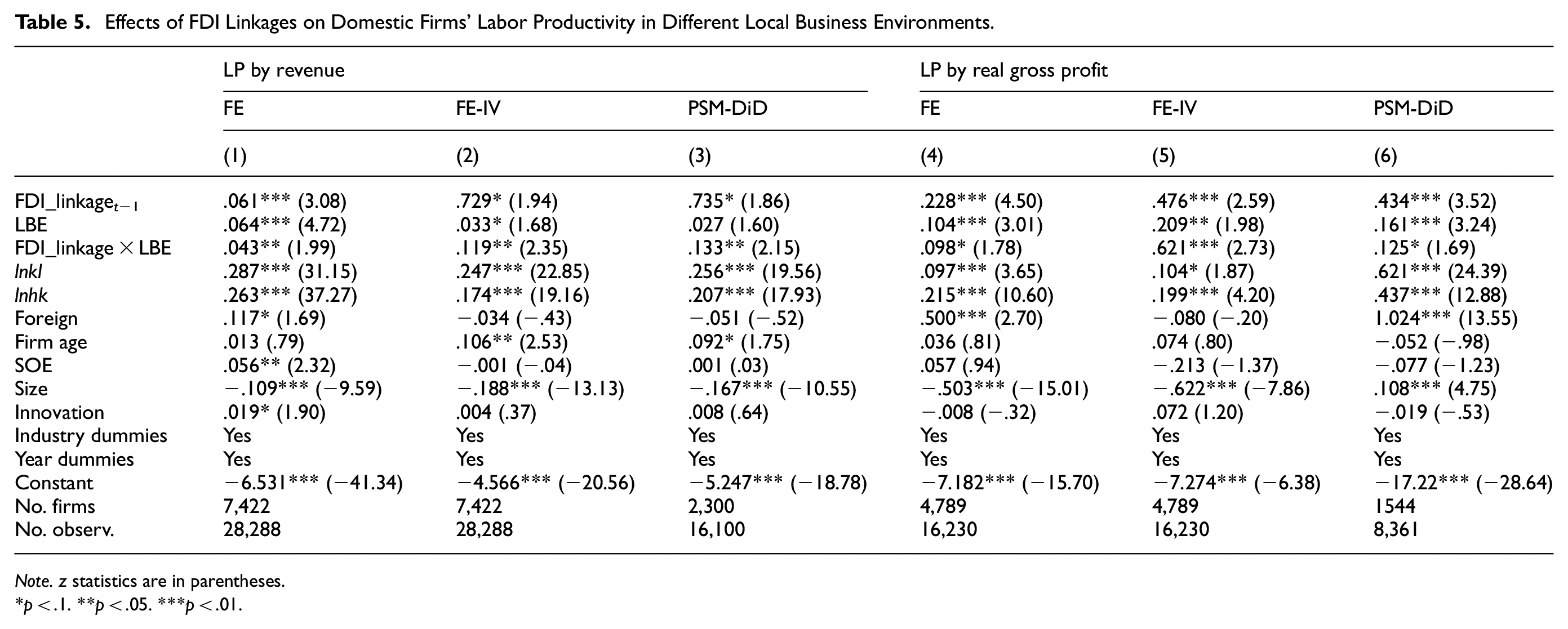
Note. z statistics are in parentheses.
p < .1. **p < .05. ***p < .01.
Despite the inclusion of the interaction term between FDI linkages and the local business environment, the coefficients of variables for the local business environment and FDI linkages in all regressions in Table 5 are still positive and mostly significant. These findings resemble our previous findings in Table 4, confirming our argument that both linkages with FDI firms and improved local business environment are essential for enhancing the labor productivity of domestic firms.
The coefficients of other control variables are consistent with those reported previously in Table 4. Domestic firms with fewer employees surpass their larger-sized counterparts in labor productivity. In addition, either the association between labor productivity and innovation or the association between labor productivity and the age of firms is not consistently detected. Capital intensity and wage rate continue to play a significant role in determining the labor productivity of domestic firms. Foreign ownership is found to have a more consistently positive effect on labor productivity by either measure, while state ownership positively affects only labor productivity measured by sales revenue per worker.
Additional Analysis
Small Versus Large Firms
SMEs and large firms are not the same in their capacity and access to resources, which may cause differences in terms of vulnerability to the local business environment and the effectiveness of FDI linkages (D. B. Le, 2018). Thus, we re-estimate the same regressions using two split samples of domestic firms, which are SMEs and large firms. We classify these two groups of firms based on their total number of employees. According to Vietnam Enterprise Law 2018, a firm is classified as an SME if its total number of employees is less than or equal to 200. Large firms are those with more than 200 employees. Before separating firms into two sub-groups, we use the Chow test to check whether the coefficients estimated over these two subgroups are equal (Chow, 1960). The test result rejects the null hypothesis and confirms that we can run regressions separately on the two sub-groups.
The coefficients of the interaction term presented in Table 6 are statistically significant in the odd columns except in Column (9), while they are not significant in the even columns. These results show that the joint effect of FDI linkages and the quality of the local business environment is only significantly positive for SMEs while it is not important for large firms. This finding suggests that the effects of FDI linkages and the quality of the local business environment are echoed to determine the labor productivity of smaller firms in transition economies like Vietnam. The estimation results show that larger firms depend less on this joint effect to improve their labor productivity.
Estimation of Labor Productivity by Firm Size.

Note. z statistics are in parentheses.
p <.1. **p < .05. ***p < .01.
Analysis of Firms in Different Industries
The effects of FDI linkages and the quality of the local business environment on the labor productivity of domestic firms are likely to be different for firms in different industries (Ni et al., 2017). Therefore, we split our sample into a group of firms in medium- and high-technology and another group in low-technology industries before re-estimating Equation (1). [We follow the OECD technology intensity definition to categorize these two groups of firms (OECD 2011). Medium- and high-technology industries include chemical, rubber, and plastics; mineral products; metal products; and machinery and electronics. The low-technology industries include food, beverage, and tobacco; textile, clothing, and leather; wood and paper; and others.] The Chow test is also employed to check the equality of coefficients of the two sub-samples. The test result ensures the validity of our data division. The obtained estimation results are provided in Table 7. The coefficients of the interaction term between FDI linkages and the quality of the local business environment are positive in all 12 regressions. They are, however, only significant in the odd columns, which are for the group of domestic firms in medium- and high-technology industries. This finding indicates that firms in medium- and high-technology industries need both linkages with FDI firms and the improvement of the local business environment to improve their labor productivity. It might be more complicated and more costly for firms in these medium- and high-technology industries to improve their labor productivity since their level of labor productivity is relatively higher. Therefore, FDI linkages alone might not be enough. FDI linkages need to be complemented by an improved-quality local business environment. This finding confirms the literature on the role of institutions for firm development.
Estimation of Labor Productivity by Industries.

Notes. z statistics are in parentheses.
p < .1. **p < .05. ***p < .01.
Discussion
The Impact of FDI Linkages on the Labor Productivity of Domestic Firms
This study confirms that domestic firms having direct linkages with foreign-invested firms are more likely to improve their labor productivity. The findings are consistent with previous studies that support a positive impact of FDI presence on domestic firms’ productivity (Havranek & Irsova, 2011; Newman et al., 2017; P. V. Nguyen et al., 2020; Song & Son, 2020). A notable contribution of this paper to the literature is the construction of a measure of linkages at the firm level instead of the industry level as in the majority of other existing studies. The results of this study imply that having direct linkages with FDI firms can be an effective tool for domestic firms to improve their labor productivity. This policy implication is important for the Vietnamese government, which wishes to enhance the labor productivity of the economy, given that Vietnamese local firms are substantially less productive than those in neighboring countries (GSO, 2020). Furthermore, although FDI inflows in Vietnam have increased dramatically in recent years, the positive spillovers from this sector to domestic firms are still far below expectations. The results, thus, suggest the necessity of tightening the linkages between foreign-invested firms and domestic firms to boost the labor productivity of domestic firms.
The Role of a High-Quality Local Business Environment in Facilitating the Positive Impact of FDI Linkages on Domestic Firms
Obtained results also reveal that a higher-quality local business environment is likely to enhance the positive spillover effects from FDI firms to strengthen the labor productivity of domestic firms. These results bridge consistent findings about the important roles of the quality of the business environment in firm development in transitional economies (Zhang, 2019) and what the literature on the spillovers of FDI discusses. It is reasonable to observe that linkages with FDI firms in a better business environment are more fruitful for domestic firms in terms of upgrading their labor productivity. Institutions are not just background conditions since they shape firm behaviors in these economies (Xiao & Park, 2018). High-tech FDI firms may be easily attracted by a high-quality local business environment, which may increase the chance of spillover effects on local firms (Zhang, 2019). Lower transaction and transformation costs of production in a well-developed institutional environment are likely to encourage the learning process of local firms. A good business environment fosters capital accumulation and provides high incentives for domestic firms to acquire foreign technology from FDI firms (Isaksson, 2007). As a result, firms that sell or buy products to/from FDI firms in a high-quality business environment may face fewer obstacles in improving their products to meet the higher requirements of FDI firms. One limitation of local firms in Vietnam is that their low capacities do not allow them to provide a large quantity of goods to FDI firms (Tong et al., 2019). The production expansion of domestic firms in an advanced institutional environment may also be easier than in regions with less developed institutions, which allows them to employ economies of scale to improve their productivity. On the other direction, in a secure and favorable business environment, FDI firms may have more incentives to remain in Vietnam for a long time and find local suppliers or buyers to replace their foreign partners to increase their efficiency. Lower transaction costs in a favorable business environment may also connect domestic firms with FDI suppliers and bestow the former with the benefits of buying high-quality inputs from the latter. These findings therefore address the research question presented previously in the introduction section.
The findings provide crucial policy implications for Vietnamese policymakers. Specifically, a high-quality business environment is an important element in facilitating the positive impact of FDI linkages on domestic firms’ productivity. The role of a good local business environment is also proven especially important to firms of small and medium size. In a transitional economy like Vietnam, where the number of SMEs dominates (Bach et al, 2021b; Tran, 2019; H. N. Vu & Hoang, 2021; N. H. Vu & Nguyen, 2022), it is essential for policymakers to focus on improving the quality of the local business environment to help small firms to take advantage of FDI spillovers for their productivity improvement and subsequent growth. Vietnamese firms are mostly young and small. Thus, they have weak absorptive capacities as well as difficulties in establishing linkages with foreign-invested partners (Tong et al., 2019). The government can assist them by collecting and providing information on input requirements or other business needs of local affiliates of foreign MNEs. In the long run, it needs to raise the national industry- and product-specific standards to match international public and private standards. Local governments can also boost the absorptive capacity of local firms through technology transfer programs to enhance their technology level. Additionally, quality of education and training should be given more attention to build up human capital for advanced jobs and R&D activities.
The estimation results on firms with different technology levels also suggest that those in medium- and high-technology industries need both FDI linkages and improved quality of the local business environment to boost their labor productivity. As production in medium- and high-technology industries is more technologically sophisticated than that in low-technology industries, a better business environment should be put in place to make FDI linkages beneficial for domestic firms. This finding has great policy implications for transition economies when they are moving from low-technology to medium- and high-technology industries during the development process.
Conclusions
This study contributes to the literature by showing that the labor productivity of domestic firms in transitional economies is enhanced through their linkages with FDI firms in an improved local business environment. The quality of the local business environment has a positive moderating effect on the impact of FDI linkages on the labor productivity of domestic firms. The study also confirms that the effects of FDI linkages and the quality of the local business environment are significant for smaller firms and those operating in medium- and high-technology industries. Therefore, this study contributes to the literature on the impact of FDI linkages on the performance of domestic firms, which is suggested by the theory on FDI knowledge spillovers, and the literature on the effects of institutional environment on the performance of domestic firms.
Our findings provide important implications for policymakers aiming to boost the labor productivity of domestic firms in transitional and emerging economies, where small firms dominate or are on the move from low-technology to medium- and high-technology industries. To enhance labor productivity in these countries, it is essential to adopt integrated policies. Firstly, it is important to implement policies to enhance the linkages between FDI firms and domestic firms. Secondly, policies to improve the quality of the local business environment need to be warranted. These two policies should go hand in hand so that their joint effects are strengthened and become more effective in boosting the labor productivity of domestic firms.
One limitation of the current study is that the channels through which FDI linkages and business environment affect the labor productivity of domestic firms have not been analyzed due to the unavailability of data. Improvement of labor productivity of domestic firms may come from different channels when doing business with foreign partners. It can be caused by technology transfer from FDI partners to local firms, or by the movement of experienced employees. Studies in the future should focus on discovering the channels through which the labor productivity of domestic firms is enhanced to have more insights into their relationships.
Another future research direction is to develop alternative measures of FDI linkages such as linkage intensity of firms to test the robustness of FDI linkage effects on domestic firms’ productivity. We were not able to construct such a measure in this study due to the unavailability of data. Future research agenda should address these concerns.
Footnotes

Author Contributions
All authors contribute to the paper.
Funding
The author(s) disclosed receipt of the following financial support for the research, authorship, and/or publication of this article: This research is funded by Vietnam National Foundation for Science and Technology Development (NAFOSTED) under grant number 502.01-2021.30.
Declaration of Conflicting Interests
The author(s) declared no potential conflicts of interest with respect to the research, authorship, and/or publication of this article.
Data Availability Statement
Data are provided upon request.