




Abstract
The recent increase in the number of business studies lends us a better understanding of the multi-faceted behaviors of artisans whose product innovation is made to strategically respond to different logics. The purpose of this study is to develop an analytical framework for artisan product innovation based on the interplay between institutional logics, counter-institutional identities, and product innovation. We argue that craft product innovation results from the comparative power between oppositional identity (artisan identity) and relational identity (entrepreneurial identity) when coping with multiple logics. A qualitative methodology that incorporates in-depth interviews and field observations is applied to offer insights into product innovation among Vietnamese artisan businesses. Our research discovers a new strategy, “Core-Satellite,” that is a tactic in reconciling competing logics. When oppositional identity is strong and relational identity is either strong or moderate at the same time, artisan business owners will create a “core” that provides a strong foundation for innovated products (satellite).
Keywords
Introduction
“Blindly following ancient customs and traditions doesn’t mean that the dead are alive, but that the living are dead.”—Ibn Khaldun (1332–1406). We want to start the paper with a quote from a well-known Arabian philosopher who was concerned not only about the perpetuation of tradition but also about the consequences of inertia.
The existing literature on artisanship studies has paid little attention to innovation. Artisan business has been overlooked in the mainstream of business and management literature (Pret & Cogan, 2019). Further, the key studies on artisan business have been located in Western contexts rather than developing contexts where technology adoption in production is by far from catching up with that in the former. As stated by Pret and Cogan (2019), innovation is not a much-cared theme in artisanship and vice versa compared to collaboration, value, competition, growth, and capital. The existing literature has given a varied nature of innovation in artisanship which is one of the most important factors in the survival and prosperity of artisan sectors (Girón et al., 2007; Väänänen & Pöllänen, 2020). Along with a very long history, the nature of craftmanship is varied from pure craft to technical craft and creative craft which are divided into traditional craft and industrialized craft (Kroezen et al., 2021). While pure craft strongly emphasizes human labor, skills & passion, low local tradition, and low interest in the market, the technical craft is characterized by a moderate interest in professionalism and the market, with great importance on mechanization. Creative craft focuses on esthetics and creativity. The craft can become a national identity beyond the place of origin (Costin, 1998). The artisan ceramic community of Bat Trang has been selected as a case study because it has a long tradition of 700 years and now faces the dilemma of making changes to its products or maintaining its ancestors’ ancient methods under the severe competition of global mass–produced products, particularly Chinese ceramics (Bui et al., 2013).
In general, innovation is of vital importance to businesses. This process itself is a strategy of each business and is influenced by many factors. A group of studies focused on market factors such as competition, customers, materials, and technology (Chang & Chen, 2014; Vega-Jurado et al., 2008; Zhang & Duan, 2010). In contrast, the remaining group of scholars mainly focused on intangible factors such as national culture (Evanschitzky et al., 2012). Such literature has provided us with an understanding regarding the organizational behavior in product innovation in a way that product innovation can be determined by whatever can make a strain on organizations or individuals working for such organizations. A gap in the current literature is that if the business is simultaneously facing great pressures from the market (e.g., customer taste and competition) and the inertia of traditional values, how will the product change? Such a grand challenge is now left unanswered by the current literature in organization studies, particularly artisan business (Pret & Cogan, 2019).
From a theoretical view, the institutional logics perspective opens the room for further discussion and explanation of the abovementioned grand challenge. Logics will allow us to better understand the strategic behaviors at organizational and individual levels because they prescribe the institutional demands for organizations or individuals to act upon to avoid the unexpected negative consequence targeting the deviant response (Pache & Santos, 2010). More recently, a stream of research that further bridges our dearth of understanding in organizational and individual behavior focuses on identity construction, particularly in a multi-logic context. As Albert and Whetten (1985) stated, the key to identity in the making is the production of different attributes that clearly define the “self” and others. The identity and action of an entity have a mutually reinforcing relationship with which the former encourages the latter while the latter reinforces the former. They are woven with each other (Goodrick & Reay, 2011). Pratt et al. (2006) suggest that the identity of entities will be determined and “defined by what they do.” Ashforth et al. (2011, p. 1151) used the term “identity foil” to refer to an entity that “defines itself at least partly in opposition to or as the antithesis of another entity.” When combining logics, agents cope with the tension between demands and agents identity. Then, the individual agents have to make decisions on responses. The empirical evidence from Jay’s (2013) research found that each logic will go together with the relevant identity. For example, “One-stop shop identity” goes together with “Business logic” while “Laboratory identity” goes together with non-profit logic. Although it much focuses on product strategy toward innovation, the extant literature often applies an analysis of a single counter- institutional identity and thus fails to provide insights into artisan business where exists multiple competing logics put organizations and individuals in a dilemma of choosing between the newness and the inertia of tradition (Nguyen et al., 2022). The current literature on organizational behavior lacks a framework that enables our systematic understanding of the logic of how products, particularly artisan products, are innovated. The difference between institutional theory and institutional logics perspective suggests that entities (actors) are not only the affected (the follower) but also the agents who can respond strategically to institutional logics, even the ones who can change institutions (Thornton & Ocasio, 2008). Oliveira and Holland (2013) indicate that despite a wide range of literature on institutional logics in organization and management studies, the question of how multiple institutional logics shape innovation has been overlooked. The existing literature not only remains “silent” about the link between institutional logics and identity but also overlooks how they simultaneously frame the entities’ responses (Chreim et al., 2020; Onishi, 2019). Further, the existing body of literature has not gone far enough in exploring the outcome of the strategic response to institutional logics (Jay, 2013).
As a response to the call for future research in terms of “How do artisan entrepreneurs balance tradition and innovation in their pursuit of growth and to what effect” by Pret and Cogan (2019, p. 606), our research will apply institutional logics perspective as an umbrella theory to shed light on the pattern of artisan product innovation. In so doing, the institutional logics will provide the general frame for the actions of artisan businesses while counter-institutional identities are portrayed to better understand how product innovation occurs in the researched context. In addition to the title, abstract, keywords, references, and appendix, this paper is structured to include Introduction, Theoretical framework and Literature review, Research methodology, Research Results, and Discussion. The Conclusion will conclude the paper.
Logics, Counter-Institutional Identities, and Product Innovation
Institutional Logics and Strategic Responses to Logics
A stream of organizational studies has focused on how multiple logics that co-exist shape the hybridization approach of organizations and individuals in their behaviors (Greenwood et al., 2010; Pratt & Rafaeli, 1997). Institutional logics are defined as “the socially constructed, historical patterns of material practices, assumptions, values, beliefs, and rules by which individuals produce and reproduce their material subsistence, organize time and space, and provide meaning to their social reality” (Thornton et al., 2012) or as “the formal and informal rules of action, interaction, and interpretation that guide and constrain decision makers” (Thornton & Ocasio, 1999, p. 804). The rules here are not only related to demands but also the perception toward practices that are well imprinted in a socio-political paradigm (Fuenfschilling & Truffer, 2014). In turn, such a set of rules can guide behaviors at different levels (Reay & Hinings, 2009; Scott, 2008). For instance, Zhao and Wry (2016) define market logic as “a core set of ideas, practices, and policy prescriptions that protect the liberty of individuals to pursue their economic interests and embrace free-market solutions to economic and social problems.” Market logic encourages such organizations to pursue their goal of profit maximization, and business growth by applying multiple strategies from the economy on the scale, and cost efficiency in comparison with competitors to customer orientation (Zhao & Wry, 2016). Institutional logics has different demands that relate to “various pressures for conformity exerted by institutional referents on organizations in a given field” (Pache & Santos, 2010, p. 457). The institutional demands exert specific requirements on the means that the agents need to take to achieve the goal that is perceived as legitimate by institutional referents such as customers, government, or other stakeholders.
Besides finance and corporate social responsibility (Anderson-Gough et al., 2022; Gümüsay et al., 2020; Lewis & Carlos, 2022; Onishi, 2019), innovation and technology have recently been emerging fields for the analysis of institutional logics. In addition to studies on ICT (Ponte & Pesci, 2022; Schildt, 2022), some studies have examined the logics and responses of agents regarding their innovation (Browder et al., 2023; Vargo et al., 2015). For instance, Browder et al. (2023) demonstrate that to cope with institutional complexity between corporate and community logics, the MakerHub follows a so-called hybrid logic. The authors emphasize the role of the structural bridging that affects how a corporate with traditional R&D conforms to the hybridity of the organization which refers to the situation in which an organization needs to follow more than one rationale (Pache & Thornton, 2020).
Multiple-logic context entails the appropriate responses to avoid unexpected consequences (Berman, 2012). There are different ways for organizations or individuals to respond to the co- existence of multiple logics ranging from Dismissing (defiance, deletion, denial), Separating (compromise, compartmentalize), Cumulative (acquiescence, aggregation, rein in), Creative (manipulation, integration, forge) as reviewed by Battilana and Lee (2014), leverage, bolster, and hybridize (Perkmann et al., 2019), compartmentalization (Høiland & Klemsdal, 2022), blending, separating and demarcating (Anderson-Gough et al., 2022), redirecting, reinforcing, and reassuring (Malhotra et al., 2021). Organizations are required to take actions that contend with the competing demands from conflicting logics (Pache & Santos, 2010; Thornton et al., 2012). That is because the incompatibility between the prescribed suggestions for organizational or individual behavior and the practices will return unexpected outcomes for entities (Battilana & Lee, 2014; Cai & Mountford, 2021; McVey et al., 2021). For example, the review of Goodrick and Reay (2011) found that the practices of pharmacists in the USA change through five eras from 1852 as a result of the comparative effects of such four logics as market, state, profession, and corporate. All these four logics that collectively have affected the professional work of pharmacists throughout the long period since the 1800s showed the cooperative and competing relationship. McLoughlin and Meehan (2021) found that the mismatch between social and economic logics can put organizations at risk. “Selective coupling” is useful for organizations that enter a field in which they have low legitimacy. Pache and Santos (2013) theorize that in a context of competing pressures from social welfare logic and commercial logic, WISEs choose to selectively couple some intact components of each logic for a higher legitimacy that benefits firms in business survival.
Artisan Business as a Hybrid Organization
Craft or artisan field has been under–researched in the current literature (Lindbergh & Schwartz, 2021; Solomon & Mathias, 2020). These recent studies have selected craftsmanship as the context for institutional analysis. Lindbergh and Schwartz (2021) analyze the complex situation in which the artisans in the food industry are placed. On the one hand, they try to react to market logic by scaling up their business growth. On the other hand, they control the expansion of their business growth to prevent the image as a food artisan from being ruined. Teixeira and Ferreira (2019) unveil the relationship between the innovation of artisan products and local tourism agents. Artisan businesses may make good use of the brand attached to the name of the community. That may lead to the sustained competitive advantages of the local artisan products. The tourists who flock to a place because of the brand of the community and its products significantly contribute to the development of the local region. Technology application is limited and witnesses no critical role in the local beekeeping sector, particularly in honey productivity growth in Kosovo because local beekeeping artisan family businesses only use the equipment after the honey-harvesting process (Bislimi, 2022).
Artisan business has been recognized as a hybrid organization. Kraatz and Block (2008, p. 244) define hybrid organizations as “the structural embodiment or incarnation of multiple logics” leading to the fact that “multiple things to multiple people.” When organizations are located in a multiple-logic environment or under pressure from more than one logic, the action at the organizational level and the individual in that organization faces diverse requests and then may be at risk of the consequences resulting from conflicting power and directions of logics (Laihonen & Kokko, 2023; Pache & Thornton, 2020). As stated by Hoyte (2019), artisan business owners “utilize their passion and creativity to make and sell handmade products linked to their cultural heritage because of their openness to newness and openness to innovation.” In front of global mass consumption and changing needs of the market, the artisan business is put on the brink of change for survival and growth (Bislimi, 2022; Lindbergh & Schwartz, 2021). Openness to newness and innovation is one of the critical factors seducing artisan business owners to combine the intangible values of cultural heritage and their creativity with craft production and trading.
The existing literature has given a varied nature of innovation in artisanship which is one of the most important factors in the survival and prosperity of artisan sectors (Girón et al., 2007). McAdam et al. (2014) find that innovation in the agri-food sector in the UK takes place at all four levels including market, organization, process, and product. That results from the horizontal network that provides the members within it with open access to knowledge and other resources as well as with reduced cost. Artisan businesses can undertake product innovation at different levels. While incremental innovation refers to the insignificant improvements of the existing product regarding changes in design, color, and function, radical innovation refers to the introduction of breakthrough products to the market (Tidd & Bessant, 2022). For example, product innovation in the ale beer industry has been implemented including flavorsome, bottles (Danson et al., 2015). This type of innovation draws on the market needs and the changes in a social structure such as women’s participation as beer drinkers. Similarly, Cabras and Bamforth (2015) portray how two case studies in the brewing industry located in the UK and the US upscale from micro-business. They show that these two local micro-brewing producers transition from a niche market with a unique group of customers to import markets with a larger sample of customers. Along with this process, although the commitment to quality is assured, the changes in technology and mindset are made to better respond to the new market’s requirements. Kabwete et al. (2019) reveal the varied nature of innovation introduced by craft producers in which craft metal and wood producers upgrade their technological capacity and raw materials to provide new products that satisfy market needs in Rwanda.
Counter-Institutional Identities and Product Innovation
Although identity has been widely studied in the stream of organization literature, the engagement of identity in the institutional logics’ analysis that is needed for the understanding of organizational behavior (Jay, 2013; Lok, 2010; Thornton & Ocasio, 2008) but overlooked in the current literature (Onishi, 2019). Lok (2010, p. 1308) defines identity as “the institutional notions of who or what any social actor might or should be in a particular institutional context, and—by implication—how the actor should act.” Symon et al. (2008) use the term “counter-institution” to show the opposition of a group to the dominant institution when they perceive such an institution as a mismatch. Chreim et al. (2020, p. 1) define counter-institutional identity as “individual and collective constructions of ‘who we are’ that are in strong opposition to dominant values and principles in the field, diverge from roles that are established through socialization and training, and involve practices that are proudly construed in direct contrast to field norms.” The question of how artisan business owners perceive the self of them that helps separate them from business owners has been noticeable in recent organization literature. That is because of the phenomenon in craft communities regarding the transition from being artisans to artisan business owners “who emphasize manual production over mass-production, independence over conglomeration, local community over scale, and value creation over profit maximization” (Solomon & Mathias, 2020, p. 1). Such a phenomenon invokes the debate of two literatures. The first one focuses on emphasizing the features of artisanry that are distinctive to mass production in a globalized world (Frayling, 2011; Richard, 2008; Schwalbe, 2010). Scholars in another stream are interested not only in how artisanry has been transformed to fit-in the contemporary context that witnesses the pivotal role of technology and the diversity of demands (Bruni & Perrotta, 2014; Kabwete et al., 2019; Lemaire et al., 2020; Wendlandt, 2013), but also in-the-making identity among artisans who run business (Kellogg, 2009; Solomon & Mathias, 2020).
The first stream of such literature focuses more on the oppositional identity—“who we are not” (Solomon & Mathias, 2020). The analysis of such organization studies is premised on the uniqueness, values, process, and standards of artisanry. Artisanry or craft, the commonly used alternative term, is often defined as “the application of skill and material-based knowledge to relatively small-scale production” (Adamson, 2010, p.3) or “skill in making things by hand” (Frayling, 2011, p. 9). Craft production is considered a manifestation of the past, legacies belonging to the sense of culture (Bryan-Wilson, 2013). As Terrio (1996), p. 77) emphasized, “The very persistence of skilled craftsmen and family modes of entrepreneurship in these [post- industrial] economies means they can be absorbed within and designated as unique manifestations of a unified national culture.” Unlike mass production, artisanry is where and when artisans so enjoy the self that the world around them “recedes” (Schwalbe, 2010) and it lends craft producers great honor (Tregear, 2005). Many who advocate for artisan identity which is inclined to drive them away from market logic will recognize the responsibility to maintain the traditional legacies of craft production. For instance, Moeran (2013) highlighted the resistance of Japanese pottery makers in Sarayama, Japan to innovation in the way they only remove the use of the communal kiln. Further, artisanry is theorized to reflect the ventures related to cultural values that are either little visible in business literature or the self as an artisan valued over the profit (Lounsbury & Glynn, 2001; Marques et al., 2019; Ratten, 2017; Ratten & Ferreira, 2017). As Humphreys and Carpenter’s (2018) qualitative study revealed, the customers’ tastes are not the source for the wine producers who abide by artisanal logic.
Another stream in the organization studies has tried to unveil the dynamics when artisans take the role of artisan business owners whose businesses are shaped by market logic. Artisan business owners not only advocate for craft authenticity but also care about the disciplines of running a business (Kellogg, 2009; Solomon & Mathias, 2020). As a result, they support innovation at a certain level to achieve the business goal. For example, Solomon and Mathias (2020) found that part of artisan business owners across craft categories who show relational identity are interested in business growth by reducing their independence level in comparison with those who try to gain their independence by maintaining small-scale businesses. The artisan business owners who are for relational identity also invest their effort in serving external stakeholders (Solomon & Mathias, 2020). Artisanry experiences change in materials, tools, and machines or improved products due to the customer’s demand (Kabwete et al., 2019).
The extant literature has provided a foundation for analyzing the dynamics of organizational responses to logics but specific behavior of artisan businesses in product innovation. The current literature also remains “silent” about the link between institutional logics and identity but also overlooks how they simultaneously frame the entities’ responses (Onishi, 2019).
Method
In this study, to develop the analytical framework for artisan product innovation, we applied a grounded theory approach to not only provide more insights into social phenomenon but also capture the connection between abstract concepts in theory development (Creswell & Poth, 2018; Thomas, 2006). The grounded theory approach is helpful for the development of the analytical framework for artisan product innovation because there is a lack of knowledge regarding the pattern with which artisan products are innovated. This approach will shape how we conduct data collection and data analysis for a theory-building process that will be discussed later in this section. Further, an interpretive approach has been adopted to, on the one hand, give more chance to interpret artisan product innovation based on the experience of informants and their view, and provide more room for the theory development (Corbin & Strauss, 2015; Van Maanen, 2011). To collect data, we employed several methods such as in-depth interviews with artisan business owners, community leaders, customers, and local citizens. The demographic details of the informants are presented in Table 1.
Demographic Details of the Informants.

Our research informants mostly reside in Bat Trang, an artisan ceramic community with a 700-year tradition. Bat Trang is selected for several reasons. A long tradition of ancient ceramic-making methods has been maintained in Bat Trang for years. After Doi Moi in 1986 in Vietnam, the transition to the market economy brought much room for mass-produced products, particularly from China, to permeate the Vietnamese market. The new context has put artisan ceramic businesses in a dilemma of introducing innovative products or following ancient products of their ancestors.
Two phases of data collection were organized following Pache and Santos’s (2013) grounded theory approach regarding institutional logics. We rely on purposeful sampling in combination with the snowball technique to reach out to the candidates as our research participants we were aware that access to data sources might be a difficult task as we are outsiders to the researched community. In phase 1, to ease this process, gain more “trustworthiness” for the data, and make sure that the data collected are genuine (Thomas, 2006) and respond well to our research question, a university lecturer cum artist and an architect were recruited to help the authors to get an overview of artisan ceramic production. Next, they connected us to Mr. Tuc who served a long term as a former community leader and great community influencer. He discussed with us socio-economic issues in the researched community. Then, Mr. Tuc continued to connect us further to artisan business owners, and local citizens in Bat Trang. We also reckoned that not being an artisan like Mr. Tuc might help avoid the reluctance of participants because of the fear of unexpectedly disclosing the secret craft technique.
In phase 2, a number of interviews were conducted in Bat Trang. To prepare for this phase, we set up some selection criteria for artisan business owners, the key informants. First, the informants must be officially conferred an artisan certificate at any level. In the case of Vietnam’s current regulation, there may have two artisanal categories. Those whose artisanry is recognized in the local community without any government certificate are folk artisans. In contrast, those whose artisanry meets the required criteria may be awarded artisanal certificates at one of three levels based on the ascending order from village artisan, provincial-level artisan, meritorious artisan, and People’s artisan. To avoid any unexpected problems in later analysis, only artisans with certificates are considered potential informants. Second, artisans must run artisan businesses. To explore the relational identity of artisan business owners, management practices are needed. The final criterion requires that artisan business owners are born and raised in Bat Trang, Hanoi, Vietnam.
During interviews, not to mention the break-the-ice questions, and exploring the career history, the remaining questions used in the in-depth interviews focus on uncovering the artisan identity (oppositional identity), entrepreneurial identity (relational identity), and any degrees of product innovation. For example, the questions “In what way do you perceive your responsibility regarding continuity of craft production?” and “How do you evaluate the comparative importance between craft products and innovated products?” will target artisanal identity and comparative analysis between counter-institutional identities, respectively.
Apart from in-depth interviews, informal talks with customers and local citizens provided us with a higher probability to gain a comprehensive understanding of counter-institutional identities and partly helped avoid the blame for the use of a single method (Patton, 1999). Moreover, we used field notes, observation, and other information available on the website of artisan businesses as additional sources in the triangulation of qualitative data in capturing the social phenomenon in qualitative research (Carter et al., 2014; Patton, 1999). After in-depth interviews with artisan business owners, we check the reliability of the data by comparing those data with additional data sources.
Data were collected from in-depth interviews during 7 months from October 2022 to May 2023 after we found that the emerging strategy is repeated by some artisan businesses and no new strategy emerged. The audio files are manually transcribed no later than 24 hr after data are collected. Collecting and analyzing data are concurrently conducted to improve the reliability and validity of qualitative research (Creswell & Poth, 2018). Although it is time-consuming, manual transcribing can avoid any missing data through multi-round listening. It helps us take further notes on important information from noticeable tones or pitches…
We applied three rounds of coding suggested by Creswell and Poth (2018) to ensure the reliability of the results. We first created the shared frame for data analysis among four authors as coders. All four coders were delivered different transcripts and other notes such as field notes and information available on the website of artisan businesses for independent reading and preliminary analysis. This procedure progresses as four coders share codes and transcripts to create a shared codebook. This step opens the room for discussion among researchers in terms of cross-checking codes in the next step. Next, coders continue to compare their codes to others’ codes and conduct coding other transcripts. Subsequently, coders will justify their points of view on codes they made, and then all coders show their agreement on whether the text is represented by the same code across coders. A percentage of 80% or more in an agreement can be acceptable (Miles et al., 2014). The coding and analysis will continue with the grouping of agreed intercoders’ codes into themes until all themes are created to qualitatively analyze data, we applied the pattern-inducing method introduced by Gioia et al. (2013). Accordingly, the analysis of the current study’s data experienced several steps as follows. First, we created a system of first-order codes that well respond to the informants’ voice and then make a general summary of the first-order codes. In step 2, we grouped first-order codes into second-order themes (theory-centric). Then, second-order themes are grouped to create an aggregate dimension (overarching theoretical dimension). Finally, first-order codes, second-order themes, and aggregate dimensions are presented in the data structure.
Results
Overview of Research Finding
The institutional logics perspective has made a fertile ground for analyzing how counter-institutional identities determine artisan product innovation. Table 2 shows that Oppositional identity is in line with artisan logic and it is characterized by seven sub-attributes including must-have craft, autonomy, localness, collective voice, craft-maintaining responsibility, aesthetic logic, and symbolic values. It helps separate artisan business owners from “who we are not.” In contrast, Table 3 shows that the relational identity that is along with market logic is comprised of five sub-attributes such as competitor orientation, cost-benefit analysis, the utility of craft products, customer orientation, and entrepreneurial attributes. It encourages artisan business owners to innovate artisan products more.
Data Structure for Oppositional Identity.

Data Structure for Relational Identity.

We find that the comparative strength between oppositional identity and relational identity determines how artisan business owners drive their product innovation strategy in multiple directions. In terms of the level of innovation, this study found that artisan business owners have introduced both incremental innovation and radical innovation. In the lens of a strategic response to logic, these two levels of innovation are grouped into the selective coupling. Particularly, we conceptualize a new strategy as a Core-Satellite. Core-Satellite is a strategic response in which the Core refers to not-for-sale artisan unique products while the “Satellite” refers to a group of new or improved products that are produced for profit. The Satellite is anchored to and considers the Core a “bait” to attract much attention from stakeholders, especially customers.
Counter-Institutional Identities and Product Innovation
Oppositional Identity
The identity that separates artisan business from “who we are not” implicitly confirms “who artisan business owners are.” On the one hand, artisan business owners show an apparent appreciation of craft over mass production. On the other hand, they portray the self as artisans or crave for being identified as artisans rather than as business owners, although they continue to scale up their businesses over time.
Must-Have Craft
Although our research emphasizes individual identity, it also identifies organizational behavior via product innovation strategy. That is because the owners will have a decisive role in small-scale businesses that are different from their larger counterparts that have a more complicated hierarchy of power. The oppositional identity helps differentiate artisan businesses from market-driven businesses. First, craft values are recognized as a must-have quality embedded in products. Thanks to craft skills, the craft products are rewarded values. The research informants insist that “the heart and soul” of products come from craft. Craft values are also appreciated over technology-based ones. The core value of products results from craft skills that are defined by “by hand, by hand.”
“These products will have little value if using machines. They will be more like Chinese industrial bricks. They will not have an ego. They must have the ego and energy inside. Unlike the mass-produced cars, artisans create them” (ABO-03)
“We cannot deny the culture of crafting ceramics” (ABO-10)
Autonomy
Autonomy over product and production process is also one of the key attributes of “who we are not.” Artisan business owners take control of their products through their manual work and mind-differentiating their products from mass-produced ones that depend on the technological basis. The interviews reveal that artisan business owners perceive that there is a clear boundary between craft products and technology-based ones.
“I am an artisan who directly makes drawings on, kneads, and shapes my products by hand. So, I appreciate that process and I think other people love me because of that reason, not because I run a business that produces industrial ceramics. In contrast, I am an artisan, genuine artisan.” (ABO-12)
Localness
Further, localness emerges as one of the clear signals of the artisan identity. Craft production is operated within the craft village which is a shared community for artisans. For them, local activities, particularly the series of professional clubs’, are of the artisan business owners’ interest.
“Yes, I join the club for artisans… periodically we have monthly parties to cheer and discuss with each other. We find solutions for solving problems in our work. I join such a club to learn and see that my products are improved. The ones who experienced the failure will teach me how to avoid it” (ABO-08)
Local professional clubs are important for internal knowledge sharing among artisan businessmen. They are concerned about the local development of craftwork which is “a unique attribute that has not been seen anywhere else” (ABO-12).
Collective Voice
Not only do artisan business owners interact merely within the domestic sphere of local professional clubs, but they also recognize the role of their collective voice in coping with being voiceless in policy agendas. They cooperate in pursuit of getting their voice heard by policy makers. Then, the power of collective voice will lend more fruitful results to their work in comparison with the individual voices.
“Along with the introduction of clubs and associations for artisans, the attention and care from the government or other state agencies are more than the single voice of each artisan” (ABO-04)
Craft-Maintaining Responsibility
Preservation of craft skills and production is a responsibility perceived by all research participants. For them, maintaining craft values ranges from self-practicing the craftwork, and guiding their children’s career development to inspiring and training the next generation of artisans. So, the identification of logic occurs in the sphere that is premised on intimate interaction.
“When I live upon this work and for sure I will die with it. That is why I need to inherit the quintessence of craftwork passed on by ancestors to maintain, develop and continue to pass on to the next generations.”(ABO-11)
“For example, I make the job orientation for my children since their childhood, even in the daily meals. My wife and I often talk about products, day after day, about production, etc. In my view, that is such a good way to pass the craftwork on to them. They don’t speak it up but I suppose they already understand it” (ABO-04)
It not only shows the pragmatic way that helps continue the traditional work but also the gratefulness to their ancestors.
“Tradition is a bridge to honor ancestors who introduced the craftwork to us. That is how tradition is maintained. And I think that is very important. That is because there is no future without the root and tradition.” (ABO-10)
Aesthetic Logic
In artisans’ mind, craft product owns incomparable beauty because the esthetic logic for craft products is far more distinctive from the mass products’. Craft is simply an art that has a “spirit.” The passions of customers and producers intersect with each other at a point in craft products.
“Craft has a unique attribute! It has a spirit that charms people. People always say, the craft is art! Artisans put all effort in it.” (ABO-02)
The art helps craft products go further beyond the mundane utility. It “charms” the craft lovers.
“Craft has culture inside. The culture here means beauty. For example, I often joke that brown is a color related to monks, but the brown of ceramic will charm your eyes! It has culture in it, going beyond the material utility. When we look at it, we can put it in a suitable setting to embrace its value” (ABO-12)
Symbolic Values
Finally, craft products are given a symbolic meaning. Our artisanal interviewees confirmed that they feel proud of being artisans. The word “artisan” is very meaningful to them.
“I was born and raised in this craft village and honestly, the word ‘artisan’ means job and human. We are simply the people who do the craftwork. So, we want people to see us as more like artisans, than like business owners or entrepreneurs. If you see us in such a way, you can understand the love, the passion, and the beauty in crafting ceramics” (ABO-11)
The symbolic meaning of craft products is also reflected through the representative values they carry for a community or even the whole country.
“We need to know what comes first, what follows. History never changes. Culture is the tradition of each region, each country. Our culture and country must be this, not that. Western culture is different from our culture, right!? Vietnamese culture is a different notion” (ABO-10)
In the case of artisan business owners in Bat Trang, clear and valuable evidence that proves the representative meaning of craft products is annual traditional festivals in honor of craft products. Such an important event is when they collectively pay tribute to the symbolic value of local craft ceramics.
“On lunar 14-15th February every year, the days that we name ‘village festival’, we display our craft products, make ritual procession and do other ritual practices as our ancestors do” (ABO-09)
So, artisan identity is presented in the artisan business owners’ daily work life. Craft production is where and when artisans feed their “self.” The identification of logic is imbued with the practices and learning from childhood onward and group interaction. It helps us better understand the genuine value of craft products, the passion for craft production, and also the “spirit” of artisans.
Relational Identity
This part of the present paper describes how artisan business owners support the self as “who we are” in craft ceramics production. In the researched artisan community where tradition is valued, the artisans who run businesses also show their identity as business owners. Our interviewees concurrently perceive themselves as artisans and business owners. The market logic is identified when small businesses are scaled up. Such relational identity sheds light on the dynamic changes in the way craft products are made and the add-ons producers apply for craft products.
Competitor Orientation
Competition is a critical concern of our interviews as business owners. Like business owners in other fields, they do focus product price on the cost cut-off. That gives more room for technology- based innovation. Technology is a strategic use to improve low-cost-based competition strategy.
“For example, today the customers want to have a tableware and its suitability with future is when it owns both craft and support of machine intending to reduce the cost” (ABO-08)
Unlike artisan identity that encourages them to adopt a slow craft production, as a business owner, production progress urges them to make products as soon as possible to avoid being left behind.
“1 or 2 months is enough to surprise me with the fast changes of products if I do not go to the market of ceramics. Other people launch their products that surprise me with a question: whether these products are made by our local producers?” (ABO-02)
“The ultimate goal is to meet the contemporary requirements” (ABO-01)
The market pressure from competitors makes our interviews consider the market as a “battle field.” This view infiltrates the mindset of artisan business owners. They report that they need to develop their own “weapon” to react to any move-taking actions on the market.
“Not only in this village, the same for other regions, the field of ceramics, even abroad, they develop and we also need to catch up with them to compete. It is like, an entity launches a nuclear weapon on the battlefield and others have to do the same. The competition will be repeated again and again.” (ABO-04)
So, the “weapon” that helps craft producers to survive on the “battlefield” is the “unique glazing method.” Therefore, the glazing method is diverse within the craft community because it is strongly believed to advance business competitiveness.
“For example, in my business, I created a typical type of glaze. Many others fail to copy. That is the line of moss glaze. Glaze can show pink, blue, red… that helps business survive.” (ABO-05)
However, our results also unveil the paradoxical view between artisan business owners regarding the competition. Most of them emphasize the positive effect of competition in a way that pushes the craft product innovation while others are concerned about negative competition. The problem of copying products and then offering counterfeit products at lower prices undermines the artisans’ motivation.
“Still have something negative that discourages artisans because their work is copied without permission. That is too bad! For example, we make a great effort in creating new products characterized by new designs and/or glaze. However, others who copy our idea, then they sell the replicated products at half price. That is unfair competition!” (ABO-07)
Cost-Benefit Analysis
Our research results recall the commonly used term, economic rationality. Accordingly, artisan business owners often consider cost-benefit analysis in their decision-making. On the one hand, they see the potential for economic benefit for them from craft products.
“Craftwork never dies! Craftwork always brings economic benefits to producers.” (ABO-10)
On the other hand, they try to balance the desire of maintaining craft skills and the pursuit of economic goals. They admit that economic goal is inavoidable resulting from the basic needs of a normal life.
“Generally speaking, I always value the hand-made products because they own the art of beauty and the passion of artisans inside… However, for survival needs, everyone is attracted by benefits… We still need to bring benefits back to our family. We cannot survive if we only live for passion. If we only sell several jugs a year, how can we live?” (ABO-05)
Utility of Craft Product
Instead of ignoring the material utility of products as prescribed in artisan identity, relational identity turns our focus to mundane utility. Particularly, artisan business owners are highly aware of the fact that their customers not only enjoy the artistic beauty but also the pragmatic function of craft products.
“Look, in the past, this kind of jug is only used to hold water but now we make it to be used as a lamp. Such products are equipped with more functions. Incorporating craft to make such products will create economic benefits while meeting social demands.” (ABO-10)
Customer Orientation
When we conducted a series of formal interviews and informal talks with research participants, we soon realized that all of them strongly emphasize the role that the customers play in their business. They indicated that their way of making some sorts of products is driven by customers’ tastes and suggestionss
“Can the life of products last long on the market? Do they still stand strongly against others or do they die soon? If they die soon, it means there is no care from customers. Discovering a way to produce a new product is hard, but the question is whether the customers like it. If the customers pay no attention, it means we are off-track, the innovation is not suitable” (ABO-07)
“That means production is towards what the market wants. It requires artisan business owners to explore the customers’ tastes. Then, they need to produce trial products to get the feedback from customers.” (ABO-08)
Further, the customers’ rapidly changing needs navigate product innovation. They inform that they sometimes need to catch up with rapid changes in their customers’ needs.
“Our customers’ knowledge improves over time. So, artisan business owners will need to improve the product quality” (ABO-02)
Entrepreneurial Attribute
Another interesting and important finding of our qualitative study is entrepreneurial attributes among artisan business owners regardless of age, level of artisanal degree, and business size. First, we find that the change in their mindset regarding the boundary that prevents craft products’ taboo from being invaded gives rise to “trial and error” in the artisan business process. They experience time-consuming trials of either new or improved products that cost them much money or even “blood.”
“That is exactly a trial error! In short, I experienced a lot of failures before I had something today as you see. That is a long journey. It costs ‘bone and blood.’ In this region, they mystify and hide their technique as secrets. So, I must find my own.” (ABO-07)
The interviewees in our current study also crave for being “change makers” in the field.
“I have been the one who took the first move in this region about craft mosaic since 2007 with the remark of the ceramic road for festival towards 1000-year birthday of Hanoi. I also create my own in the way I use craft ceramics. My craftwork leads and orients the market as the first mover in this region.” (ABO-03)
Product Innovation
As presented in Table 4, we not only describe levels of artisan product innovation but also conceptualize them as strategic responses based on the institutional logics perspective. This study unveils the dynamic of artisan products. It demonstrates that incremental innovations are strongly and continuously prevalent over time during a very long period while some artisan businesses take radical innovations. Such incremental and radical innovations are conceptualized as “Selective coupling” with which the retained product lines or products’ identifiable characteristic(s) is the result of the strategic response to artisan logic while the newness in products or production is the result of market logic’s guiding rules. In other words, business owners try to couple institutional demands of different logics in the same products.
Data Structure for Product Innovation.

Selective Coupling
Scholars in the existing literature on institutional logics suggested that entities will come up with strategic responses to cope with multiple logics (Malhotra et al., 2021; Thornton et al., 2012). We have found that “selective coupling” is the more commonly used response to reconcile both market logic and artisan logic. “Selective coupling” means selective conformity to demands of market logic and artisan logics and then making them embedded in artisan products. On the one hand, craft producers maintain some noticeable characteristics of products to make sure their customers still perceive the products as a craft. However, they still apply changes to their products including serving different groups of customers with different types of me-too, new-to-the-world products and rapidly responding to the changing needs of each group of existing customers with improved existing products, on the other hand. In other words, under the competing logics and the counter-institutional identities, artisan business owners try to be conscious about which one can be changed and which one should not be.
Incremental Innovation
First, Improved Existing Products
All of the cases in our study reported that they applied small changes to their products. Incremental innovation in the current study includes two degrees of improved products and me-too products. First, artisan business owners often change the materials, glaze, design, and functions of the existing products. They diversify the materials for ceramic products on purpose, including imported kaolin and glaze. They understand that their products need to catch up with contemporary needs.
“I bought raw materials such as kaolin and colorful glaze that are imported from Japan, China, India, and Germany. Those materials are easily accessible”
(ABO-03)
“The rise in the number of high buildings reduces the demand for crackle glaze, blue glaze or black glaze. It requires the introduction of new glaze, design/model that fit-in the contemporary demands” (ABO-12)
Even though the development of a new glaze is quite a tough task for artisans because it is a costly and time–consuming trial and error process with an uncertain output. However, artisan business owners in this research have made much effort (resources) in creating a new and then a unique glaze that serves the business owners’ purpose in generating the competitiveness.
“I name my recently introduced new glaze ‘Thiên hà’ - galaxy glaze’ because when my products are glazed with it, the layer of products will look like a picture of the galaxy with cloud, stars, and sky” (ABO-12)
Next, the introduction of new glaze will improve the visualized layout of products. It can boost further innovations through a new design. An easier method to satisfy customers’ various needs is to change the design of products due to either new ceramic molds or manual labor.
“Sometimes machines can be applied to support the molding process, make a basic shape but then I can make décor based on craft. That is due to the social demand.” (ABO-09) “By-hand may be through kneading, particularly for products with the difficult model. Then, the next step is fixing the unnecessary parts. Model/design is most likely to be subject to change” (ABO-06)
One of the other flexible ways to innovate craft products is by making the existing products multi-functional. They told us that they invest their time in thinking about how they can transform the utility and function of craft products to better adapt to the contemporary context. Changed or improved utility with new functions of products is introduced quite frequently every year. That partly comes from the feature of ceramic products. Like other product categories, the ceramic product has its own ability to serve end users.
“I add further functions to make this jug a lamp. In the past, it is used only for holding and carrying liquid. Obviously, the similar products with different utilities.” (ABO-10)
Second, Me-Too Products
A less commonly applied method in product innovation is introducing products new to the business, but existing already on the market. The introduction of me-too products is determined by the new market demands. In other words, the market logic itself urges artisan business owners to modify their existing strategy of the product.
“In general, I gradually introduce new products, for example, the large ceramic vase. Our business makes a variety of product categories. Although we focus more on vases for spiritual practices, we also make ceramic toys.” (ABO-05) “In the case of my business, due to external networking, we introduce new products quarterly. That is because our customers’ restaurants need to set up the décor twice a year. Sometimes, our customers bring new sample products and request us to produce them. Then, we try and make.” (ABO-08)
Radical Innovation
Contrary to incremental innovation which is the most common strategy in the research’s research sample, radical innovation is also found in some cases. Several artisan business owners reported that they made an effort in introducing products that are new to the market or sometimes lead to a trend of products in the local market. Although these products are not new for so long, they help businesses to have a sustained competitive advantage over artisan businesses.
“I am not saying that our products are new at the global level because the ceramics industry is very large. But, some of our products are new in Vietnam, we are the ‘changemaker’ who has led the new trend of products” (ABO-14)
“I don’t dare to say I am a changemaker in Vietnam but in Bát Tràng, my artisan business is leading in gilding in ceramics” (ABO-02)
Interviewee 14 (ABO-14) has introduced the craft alcohol-carrying vase that contains new ingredients to address the toxical substances of alcohol. On the website, this alcohol vase is described as a copyrighted craft product that incorporates the new utility.
Core-Satellite
The field of ceramic production in the research context of Bat Trang, Vietnam gives us, the authors, a chance to uncover a new strategy that helps artisan businesses not only survive the extreme local competition but also thrive. We define Core-Satellite as a strategic response with which artisan businesses purposively create duality in their product innovation that allows them to benefit economically from innovated artisan products that are premised on not-for-sale un-innovative unique artisan products. This strategic response has been applied in some cases in our study. We now turn our analysis to how this strategy has been conducted.
On the one hand, purely manually-made craft products are introduced and play the role of “bait.” The business owners abide by the artisan logic in the way in which they make their great effort to master their craft skills to make excellent unique craft products. Such craft products are not for either sale or profit per se. Their role, however, centers on branding and attracting much attention from the public and potential customers. The interesting point is that artisan business owners are consciously aware that they will witness business loss for such craft products. Therefore, such craft products are merely produced periodically. Purely manually–made products are honored as “cultural products” and require a significant source of resources. More importantly, to transfer the attention from artisan products to pro–commerce products, artisans excel in their craft skills to develop the brand. In the case presented below, the artisan has tried over and over again until he made it. He failed a number of times and such failures cost him much. Subsequently, he successfully applied for Guinness Record in 2022 which can give him and his business the particular attention of the public. Such an unprecedented event in Vietnam authorized him as one of the high–class artisans in Bát Tràng and in a broader context in Vietnam. In this case, artisan products are divided into two lines. The first product line is a Collection of the Essence of Ceramics that is not for sale. Another product line is commercial artisan products that are for sale.
“I have made the record ever. For example, 3 products include a 100%-hand-made giant toad weighing 1,500 kg, 1.8 m in length; two 100%-hand-made plates weighing 400 kg each. All is craftwork for all phases. Such products are awarded ‘Guinness Record 2022.’” (ABO-07) “Production of such huge 100%-craft vases or incense burners is very hard and creates the business income loss for such products” (ABO-07)
We find that there exists an invisibly strong nexus between not-for-sale products and for-profit products. Although the abovementioned craft products are not directly for sale they produce the fertile ground for the development of innovative products that are for profit. Serving as bait, excellent unique craft products create a strong customer base for innovative products.
“I have two craft workshops, I do both categories of products. This workshop has 40 employees who make products through craftwork. Another one has 100 employees applying the great support of machines. I maintain the craft workshop to get noticed by people, then their attention will be transferred over to the products produced by another workshop. That is a way!” (ABO-10)
“Producing such huge 100%-craft vase and incense burners directly brings the income loss to the business. However, we must do it. That is because, if we can do it, many more people know us and then they start to care about other products” (ABO-04)
This existence of a Core-satellite builds on the identification of cultural values of craft products.
“100%-craft products are ‘cultural products.’ The sconce of the vase is carved by hand, for example. Burning products with fire is also craft.” (ABO-10)
To triangulate what our informants reported in their response, the quote below from one of the customers will make a case. Another interesting point worth noting is that customers know the existence of the separation in production between purely craft products and technology-based innovated products. However, the interview with the customers as the current research’s informants shows that they still have a higher tendency to buy products from highly–skilled artisans.
“I do know and I am informed immediately when I enter the showroom. Although I advocate for traditional artisan products, I still buy products with a certain level of manual labor. That is because I understand that everyone needs to earn a living. That is the life”(Ha)
In sum, “core-satellite” explicitly presents a strategy in which new or improved products are anchored to unique craft products. The innovated products cannot break up craft products that are strongly characterized by traditional values.
Counter-Institutional Identities and Product Innovation
A matrix has been made to map the results varying case by case in terms of oppositional identity, relational identity, Selective coupling, and “Core-satellite.” Again, we looked back at the data to figure out any possible nexus between identity and product innovation. We tried to fill out the matrix above by giving each cell of the matrix the results of the strength of identity and product innovation. Morse et al. (2002) also recommended that qualitative researchers should think theoretically. If a meaning emerges from data, it should be further checked. So, after identifying the signal regarding the existence of a new strategy in product innovation, the author added some questions to the interview guide to further explore this new idea.
In Table 5, each row will present the strength of counter-institutional identity and the level of the product innovation strategy of the same artisan business (see appendix for further details). For example, the business in case 7 (ABO-07) which reports a strong oppositional identity and a moderate relational identity applies a moderate level of selective coupling and the existence of a “Core-satellite” strategy. Table 5 shows that all 15 examined artisan business owners apply selective coupling at different levels ranging from low, moderate to strong levels.
Nexus Between Counter-Institutional Identity and Product Innovation.
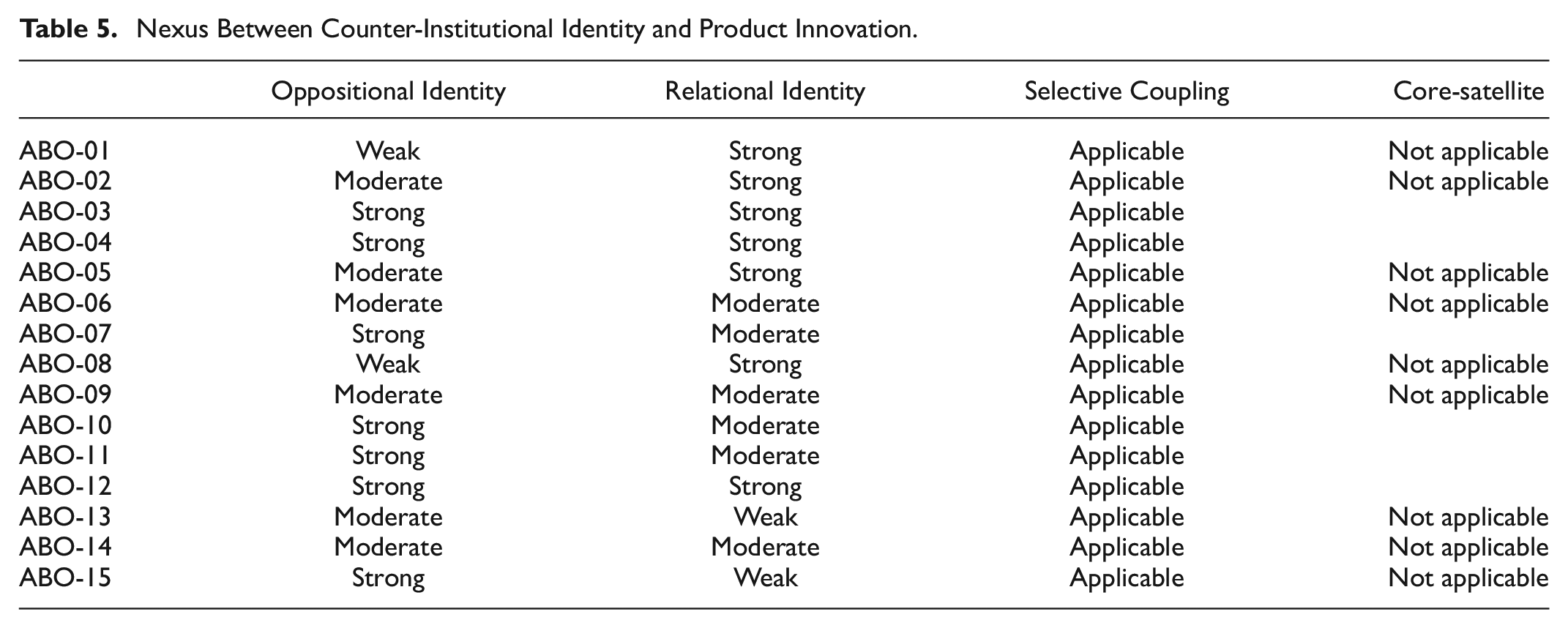
Further, research results show that 6 out of 15 cases applied the “Core-satellite” strategy for product innovation. Then, we looked deeper and recognize that all cases that reported they apply “Core-satellite” show the highest level of oppositional identity (strong) while relational identity is either moderate or strong. The probability for the existence of a “Core-satellite” is anchored to the strength of artisan identity—a necessary condition. Whilst, the sufficient condition for a “Core-satellite” to occur is the strength of entrepreneurial identity. More specifically, a necessary condition of a “Core-satellite” requires that artisan identity must be strong (3-point scale from weak, moderate to strong). The sufficient condition foretells that business owners with moderate or strong entrepreneurial identities will be more likely to partition artisan production.
Discussion of Results
Vietnamese artisan business owners who joined our study as key informants are active agents who show counter-institutional identities that also represent their artisan business when their business faces two institutional logics. In such a multi-logic context of the artisan ceramic community, on the one hand, they perceive themselves and their business as artisans and artisan business, respectively. Their business values traditions that are handed down across generations with craft skills and ancient methods. So, they care about the extent to which such a tradition of artisan products is maintained. On the other hand, because they run and continually scale up their business, they also show relational identity as business owners. Accordingly, they are aware of the importance of business growth based on market needs and competition. As a result, they strategically introduce newness to their products at different levels from incremental innovation to radical innovation.
Regarding the strategic response of artisan businesses, there are two strategies applied. The first strategy is selective coupling which refers to the balance between the oldness and newness embedded in the same product. Market logic requires much innovation while artisan logic suggests the continuity of the oldness. To respond to such different demands, they allow the newness to penetrate the artisan product at a certain level. For example, the newness of design, color, glaze, or utility is launched while the craft is still perceived as critical. The second strategy is Core-Satellite which is new to the existing literature. This strategy itself is conditioned by institutional logics and also a tool to strategically respond to such logics. With Core-Satellite, artisan business owners attempt to strategically separate and couple the institutional demands. Not only do they compromise the institutional demands to satisfy both logics, but they try to create a strong relationship between institutional demands in which not-for-sale unique craft products will not be for sale per se, but serve as a “bait” and lay the robust foundation for innovated products.
Our study contributes to the existing literature in several ways. First, the present study bridges the gap of two literatures between institutional logics and organizational behavior in product innovation through the lens of the comparative analysis of counter-institutional identities. In other words, our study not only provides a comprehensive analysis of the dynamics of product innovation but also highlights how institutional perspective can be used to shed light on the strategic response among a specific group of businesses (Chreim et al., 2020). The existing literature often analyses the effect of a single counter-institutional identity (Fauchart & Gruber, 2011; Gurrentz, 2014; Solomon & Mathias, 2020) leading to ignoring the consideration of the interaction between counter-institutional identities in the same sphere. Second, a new strategy of “Core-satellite” has been found to emerge among artisan businesses as a means to “institutionally bending without organizationally breaking” competing logics that co-exist (Gümüsay et al., 2020). The resilience of artisan business as a hybrid organization can be achieved by the incompatible logics based on the elastic hybridity with which the compatibility between logics can change over time (Gümüsay et al., 2020). Core–Satellite further elaborates and extends the compartmentalization strategy with which hybrid organizations separate logics to follow their demands in different times and places (Battilana & Lee, 2014; Lindbergh & Schwartz, 2021). By exploring a new response, our finding supports the argument made by Norman et al. (2004) in a way that organizations will be likely to have better performance when successfully respond to multiple logics in comparison with those that respond to single logic. The research finding is supported by Toubiana’s (2020) study that insists on the continuity of identity under the influence of institutional logics.
Finally, the contribution of the current study is the development of an analytical framework for artisan product innovation. To explain our theoretical model logically, we present an idea regarding a model of product innovation in the craft area in Figure 1. It starts with the context where multiple logics co-exist and frame the artisan business. It informs us of the long-lasting process in which the identification of logic occurs along with the counter-institutional identities in the making. Oppositional identity (who we are not) is in line with artisan logic that prescribes the artisanal standards serving as a foundation for oppositional identity. Similarly, market logic has “rules of the game” that give rise to relational identity in the making. Rather than the single effect of either oppositional identity or relational identity but the comparative strength between them will play a decisive role in the adoption of a strategic response to logics. When relational identity is strong and oppositional identity is weak, incremental innovation or radical innovation will be adopted as a result of selectively coupling the logics. However, when two identities are strong, “core-satellite” may be applied to reconcile the competing pressure from multiple logics.

Suggested model of artisan product innovation in the multiple-logic context.
Although making propositions is not our initial purpose, we still suggest some for future research, especially quantitative studies, as follows.
Proposition 1: Artisan businesses will be more likely to introduce not-for-sale unique craft products in addition to new or improved products when both oppositional and relational identities are strong.
Proposition 2: The level of artisan certificates of artisan business owners will positively affect the probability of Core-Satellite adoption.
Conclusion
Our study provides further evidence to challenge the bias in the mainstream management literature that considers artisans and artisan business owners as passive and un-innovative. When scaling up the business along with “identity foil,” artisan business owners can maintain the sense of self and at the same time create room for the development of relational identity to successfully introduce the changes to the field that is often perceived as a taboo for any innovation (Crowley, 2019; Pret & Cogan, 2019). They can apply “creative use of cultural background” to reach out to the target customers (Fillis, 2004, p.74) and support export values (Luong et al., 2019).
Relying on qualitative research, this study’s analysis has replied to one of the calls for further investigation into artisan business that has been hidden in the mainstream business literature. The intertwinement of multi–dimensional conceptual meanings in an institutionalized context is presented in this research. By having applied the grounded theory approach, the current study develops a framework for analyzing artisan product innovation. This study’s analysis unveils the nuance of strategic responses among the artisan businesses for institutional logics. Artisan identity and entrepreneurial identity are found to have a collective influence on artisan businesses’ behavior in product innovation. When the artisan identity highly dominates, incremental innovation occurs. In the current study, incremental innovation has been proved as the result of conforming to the demands of the two logics. In contrast, when both counter–institutional identities are influential, the Core–Satellite is found to occur as an intentional reaction to reconcile logics.
Our study has not been done without limitations. First, the dynamic of the comparative strength between counter-institutional identities is still vague. The questions of how the interaction between two identities changes over time or how long the status quo of the comparative strength between them can last are left unclearly answered. Second, although our purposive selection of craft ceramics can help avoid the uncontrollable effects due to the industrial characteristics, the focus on only one unique context may hamper the generalization of qualitative results to the broader context.
Our study recommends some directions for future research agendas. Future research can explore the relative change of the comparative strength between counter-institutional identities (Chreim et al., 2020) and how such change affects organizational and individual behaviors. For scholars interested in quantitative methodology, on the one hand, they can further examine the probability of adopting a Core-Satellite strategy as suggested by the present study for a sample across craft industries. On the other hand, future quantitative studies may analyze the impact of changes in artisan certificates of artisan business owners on product innovation. Our study also recommends that artisan businesses can maintain two product lines at the same time, a line of elite crafts and a product line that changes continuously over time. This strategy still works until the “Core” product line attracts the attention of the market. Businesses need to be aware that these “Core” products can require large financial investment, and capital loss due to repeated failures as these are elite handmade products, not ordinary handmade products. Further, artisan businesses can employ technology but should reduce the adoption of technology to a certain extent. This is because if they lose the craft-based characteristics, these businesses may face difficulties and challenges from customers and the artisan ceramic community.
Footnotes
Appendix
Further public information on the website of artisan business numbered 7 (ABO-07). They show both the artisan products as the Core and the innovated products as the Satellite concurrently on their website. This is the evidence to triangulate the data. The first image presents one of the collections of ceramics named Collection of the Essence of Ceramics. They are unique craft products made by the artisan and play the role of a Core. The second image reports that the Collection of the Essence of Ceramics is displayed on the website next to other collections that have innovated products.
Acknowledgements
Special thanks to Mr. Dinh Tuc Dang, Mr. Ba Hoang Ho, Ms. Van Anh for their valued support for our data collection and initial overview of research site. We are grateful to all informants of this research for their time, willingness and tolerance. This research is funded by National Economics University, Hanoi, Vietnam.
Declaration of Conflicting Interests
The author(s) declared no potential conflicts of interest with respect to the research, authorship, and/or publication of this article.
Funding
The author(s) disclosed receipt of the following financial support for the research, authorship, and/or publication of this article: This research is funded by National Economics University, Hanoi, Vietnam
Ethics Statement
This is not applicable
