




Abstract
The prosperity of the construction industry is the main driving force for national economic development. Smart city technology can assist the digital transformation of the construction industry and thereby enhance the output value of the construction industry. In order to achieve Sustainable Development Goals (SDGs), the application of smart city technology is an essential tool. The purpose of the study is to determine the factors that affect the attitude of construction industry workers to utilize smart city technologies. The hypothesis was formulated through an extensive examination of existing literature, drawing upon the principles of the Unified Theory of Acceptance and Utilization of Technology (UTAUT). The produced proposal includes six primary hypotheses and four moderators. A total of 335 responses in Taiwan were collected in order to develop a structural equation model (SEM) to evaluate the questionnaire data. The results include: (1) Performance expectancy, Effort expectancy, and Social influence significantly affect users’ willingness to utilize smart city technologies; (2) Facilitating conditions and behavioral intentions show insignificant results on actual behavior; The research findings have important reference value for decision-makers and participants in construction industries, as well as other enterprises in the construction industry, regarding the adoption of smart city technology.
Introduction
The construction industry is an important industry related to the national economy and people’s livelihood, but the output value of Taiwan’s construction industry lags far behind advanced countries by more than 50%. According to statistics (Ministry of Interior of Executive Yuan, 2020), the contribution of the construction industry to Taiwan’s GDP is only 3.3%, much lower than that of advanced countries that promote i-construction. For example, the United Kingdom’s construction value is 6.2% of GDP, Japan’s 5.9%, and the U.S. construction value of the contribution is relatively low but still reaches 4.6% of GDP. For the construction industry, it is bound to move toward a technology-intensive industry in the future. In this way, the output value of construction can be increased to the national GDP.
The smart city originated in the early 21st century. IBM put forward the vision of a “smart city.” It believes that the main functions of modern cities, infrastructure, environment, and other core elements are closely related and can be connected with each other in a collaborative way. The city itself is the core of each macro concept of system composition (Gibson et al., 1992). The so-called “smart” refers to the application of new-generation communication technologies (ICT), such as the Internet of Things, cloud computing, artificial intelligence (AI), etc., to urban power systems, water systems, buildings, factories, offices, and home life, etc. In the various objects of the living system, it is possible to form an economical and effective interaction between all the acceptable perceptions and all the equipment systems so that people can have better work efficiency and quality of life (De Guimarães et al., 2020; Einola et al., 2019; Golubchikov & Thornbush, 2020). According to Frost & Sullivan, an internationally renowned market think tank, the global output value of smart cities will reach 2 trillion US dollars by 2025. The key technologies include AI, personalized medicine, robotics, smart transportation, energy technology, etc., except for advanced countries in Europe, and the United States. More than 1,000 cities in Asia and Southeast Asia are promoting smart city initiatives.
In 2015, the United Nations announced the “2030 Sustainable Development Goals (SDGs),” which include 17 SDGs such as the eradication of poverty, the mitigation of climate change, and the development of sustainable cities and communities, and encourage the global community to cooperate toward sustainable development (Envision2030, 2015). Among the goals of sustainable development are ideals with the same concept as smart cities. Smart cities are based on innovation and technology-driven information and communication technologies (ICTs) that can ensure a sustainable future for cities (Rodrigues & Franco, 2020). But it remains unclear how smart city strategies adopted by different countries can contribute to the achievement of sustainable development goals in the long run. Despite the growing popularity of smart city planning in academia, if the SDGs can be integrated into smart city practice, the completion of the SDGs is within sight (Rogers, 2005).
Through some literature research, some technological applications of smart cities in the construction industry are currently known, such as smart life, smart environment, and smart transportation (Javed et al., 2022). However, the desire of construction sector executives to implement smart city technology is uncommon. What are the primary elements that influence the construction industry’s propensity to accept and implement new technologies? The smart city trend has the potential to revolutionize the management of people and physical items beyond conventional urban planning. The transition to intelligent infrastructure is not merely fashionable or aspirational; in so many aspects, it seems to be essential to the future sustainability of cities. However, the construction industry plays a vital role in the process. In light of the aforementioned information, the objective of this research is to investigate the pivotal elements influencing the adoption of smart city technology in the construction industry. The hypothesis of this study uses the unified theory of acceptance and use of technology model as the theoretical basis to explore the impact of four variables, including performance expectations, effort expectations, social influences, and facilitating conditions, on use-intention-to-use behaviors. Once the questionnaires have been gathered, a statistical analysis will be conducted to identify the primary determinants of willingness, which can be provided to the construction industry as important reference indicators for decision-making and take a step forward in the digital transformation of the construction industry.
Literature Review
Research on Smart City and Construction Industry
The smart city is precisely a concept from IBM’s “Smarter Planet Agenda” in 2008, mainly to solve some urbanization challenges; it proposed a new urban outline or plan, the so-called “smart city” (Söderström et al., 2014). In the past decade, global smart city advocacy and related projects have flourished, and it is mainly defined as a city that uses information, data, and technology to create efficiency to promote economic development, improve the quality of life, and improve urban sustainability (Mora et al., 2017). The concept of the smart city usually includes the use of information and communication technology (ICT), combined with high-end computer technologies such as the Internet of Things, artificial intelligence, and deep computing, to improve the environment and infrastructure of citizens.
More specifically, the idea of “smart” refers to the use of cutting-edge information technology to improve human management of industry and daily life. Integrating the Internet of Things via computers and cloud computing will allow for the full realization of the combination of human society and physical systems. Sensors will be embedded and equipped into the city’s power supply systems, water supply systems, transportation systems, buildings, oil and gas pipelines, and other production and living systems to form an interconnected network. Since then, this approach has been recognized worldwide and employed as an economic development point to deal with the financial tsunami. Smart cities are also believed to enhance urbanization, support coordinated and sustainable growth of the urban economy, society, environment, and resources, and advance toward zero-carbon structures. Of course, the most important subject in the definition of a smart city are citizens. However, they are often overlooked. Implementing a smart city initiative means not only achieving technological success but also leveraging technology to create public value. It needs to link smart projects to concrete initiatives, such as providing high-quality electronic services, achieving outcomes that citizens perceive as desirable, and increasing trust in public institutions (Dameri, 2013).
In addition, the issue of sustainable development of smart cities is getting more and more attention. For example, increased population growth puts pressure on cities’ ability to manage waste, natural resources, air pollution, transportation, infrastructure, and governance (Chourabi et al., 2012). So, becoming a smart city increasingly requires rethinking, considering, and designing for sustainability. Its five main dimensions have shaped smart city sustainability: (1) globalization of environmental problems (climate change and biodiversity loss); (2) urbanization (growth in city dwellers); (3) sustainable development (managing the urban environment); (4) ICT (embedded in everyday life); and (5) smart cities (transformative applications of ICT in the public sector; Höjer & Wangel, 2014). In response to these pressures, people are increasingly seeking smart solutions involving the use of new technologies, working toward sustainable urban development.
The construction industry has always been known as the “locomotive industry” and is an important industry for the country’s economic development. The U.S. Bureau of Economic Analysis Points out that the development of the construction industry can effectively promote the development of economic activities in other industries. For every US$1 increase in the GDP of the construction industry, it is estimated that it can bring an additional US$ 0.86 in related economic activities, which is categorized as the industry with the largest spillover effect. If the construction industry is prosperous, it will not only promote the construction of the country and the effective implementation of public investment but also promote the development and growth of many related industries. As reported by the "Global Construction (Global Construction, 2025), it is predicted that the global construction market will grow from US$8.7 trillion to US$15 trillion from 2012 to 2025. Asia’s rapid growth drives growing demand for infrastructure development, including utilities, transportation, telecommunications, and health. Looking ahead, the Asian Development Bank expects to invest US$1.7 trillion annually until 2030 (Robinson et al., 2021). This indicates that the construction industry still has considerable growth in the future.
In the 21st century, the industry has made tremendous technological and scientific advances that have brought it to the 4.0 era. Industry 4.0 can be defined as the integration of smart digital technologies into manufacturing and industrial processes. It covers many technologies, including the Internet of Things, AI, big data, robotics, and automation. The construction industry has also benefited from this progress, giving rise to the term “Construction 4.0.” However, as stated in a study on industry digitization by McKinsey Global Institute (Agarwal et al., 2016), the degree of digitization of the construction industry ranks second to last among 22 industries and is only slightly better than Agriculture and Hunting. The study assessed the degree of digitization in three dimensions: digital assets, digital operations, and digital labor. From past studies (Emmanuel et al., 2018; Taher, 2021; Tijhuis, 2003), it is clear that the digital environment of the construction industry needs to overcome many technical problems. However, the real obstacle to its promotion lies in the people, and how to clarify and discover the key factors affecting it is an urgent issue that needs to be solved in the era of Construction 4.0.
Discussion on a Unified Theory of Acceptance and Use of Technology
Evolution for Technology Acceptance Model, TAM
Prior research has emphasized that there are multiple factors that have an impact on the acceptance and uptake of new information technology by users (Im et al., 2008; Lai & Li, 2005; Majchrzak et al., 2000; Wu & Wang, 2005; Yi et al., 2006). This has often served as an effective framework for explaining users’ acceptance and usage behavior of novel technologies, as exemplified by the “Technology Acceptance Model” (TAM) proposed by Davis.
Given the proliferation of theories across various domains concerning users’ acceptance of new technologies, this study aims to investigate the application of technology pertinent to the implementation of smart cities within the construction industry, drawing on the literature associated with the aforementioned theories. Here, we present the pertinent theoretical model integrated into this study.
(1) Theory of Reasoned Action (TRA)
The Theory of Reasoned Action (TRA) was developed by American social psychologists Ajzen and Fishbein. This theory elucidates and predicts individual behavior, predicated on the assumption that people are rational individuals who, prior to acting, assess its significance, and ramifications. This theory posits that most behaviors are rational and deliberate, with attitudes toward behavior (AT) and subjective norms (SN) governing behavioral intentions (Ajzen & Fishbein, 1977). Furthermore, it is believed that behavioral intention (BI) to some extent dictates individual behavior, with both AT and SN exerting influence on behavioral intent. Exogenous variables impact AT and SN through beliefs and evaluations of behavior, standard beliefs regarding behavior, and the motivation for compliance, as depicted in Figure 1.

Theory of reasoned action model, TRA (Ajzen & Fishbein, 1980).
(2) Technology Acceptance Model, TAM
In 1989, building upon the Theory of Reasoned Action (TRA), Davis (1989) introduced the Technology Acceptance Model (TAM), as illustrated in Figure 2. The Technology Acceptance Model replaces the attitude indicators in TRA with two fundamental factors: Usefulness and Ease of Use (Oye et al., 2014). The foundation of this theory posits that users’ beliefs influence their attitudes, which subsequently impact their willingness to adopt a technology, ultimately leading to actual technological adoption.

Technology acceptance model, TAM (Davis, 1989).
Usefulness pertains to the extent to which an individual’s work performance is enhanced by utilizing a particular system, while ease of use concerns the level of difficulty associated with operating that system. Although TAM is rooted in TRA, significant distinctions exist between the two. For instance, TAM underscores the pivotal role of a new technology’s usefulness and ease of use in shaping the intention to use it. In contrast, TRA places greater emphasis on the impact of behavioral attitudes and subjective norms on usage intentions. Consequently, compared to the Theory of Reasoned Action, TAM provides a more intuitive reflection of the willingness of individuals or organizations to embrace information technology.
Unified Theory of Acceptance and Use of Technology, UTAUT
Scholars, including Venkatesh et al., sometimes overlook the contributions of those who have not adopted their approaches when selecting aspects and theoretical models from the array of technology acceptance theories in the past. The Unified Theory of Acceptance and Use of Technology (UTAUT) serves as a valuable tool for researchers in fields related to future research. It provides a foundation for exploring the continuous development of new aspects that are poised to reshape user behavior in the future (Chau, 1996; Venkatesh et al., 2003).
This study asserts that when users are confronted with the decision of whether to embrace new information technology, the strength of their individual intention to adopt information technology plays a pivotal role in determining their adoption choices. Eight relevant theories are enumerated below (Al-Okaily et al., 2019):
Theory of Reasoned Action (TRA)
Theory of Planned Behavior (TPB)
Technology Acceptance Model (TAM)
Modified Technology Acceptance Model (Technology Acceptance Model-2, TAM2)
Combined TAM and TPB (C-TAM-TPB)
Motivational Model (MM)
Social Cognitive Theory (SCT)
Personal New Architectures such as Model of PC Utilization (MPCU) and Innovation Diffusion Theory (IDT), as depicted in Figure 3.

Integrate eight theories and models to access the UTAUT model (Al-Okaily et al., 2019).
These theories collectively provide a comprehensive framework for understanding and studying the dynamics of technology acceptance and usage.
The Unified Theory of Acceptance and Use of Technology (UTAUT) model comprises four key dimensions that elucidate behavioral intentions and actual user behavior. These dimensions are drawn from the amalgamation of the most significant theoretical models in the realm of science and technology acceptance behavior, as considered by scholars such as Venkatesh and Davis (2000). Each main dimension encompasses multiple theoretical models and is complemented by control variables. The model has been found to be highly effective, explaining up to 70% of usage behavior at present. Let’s delve into the four main dimensions and their associated control variables:
(1) Performance Expectancy:
This dimension gages users’ confidence in the system’s ability to enhance productivity. It encompasses five sub-facets:
□ Perceived Usefulness
□ Job-fit
□ Relative Advantage
□ Outcome Expectation
□ Extrinsic Motivation (Venkatesh et al., 2003)
(2) Effort Expectancy:
Effort Expectancy evaluates how user-friendly the system is. It comprises three sub-facets:
□ Ease of Use
□ Complexity
□ Perceived Ease of Use (Venkatesh et al., 2003)
(3) Social Influence:
Social Influence measures the degree to which users perceive that significant other believe they should use the system. This dimension consists of three sub-facets:
□ Image
□ Social Factors
□ Subjective Norm (Bozionelos, 1996; Moore & Benbasat, 1991)
(4) Facilitating Conditions:
Facilitating Conditions assess users’ perception of the support provided by their organizations, technology, and infrastructure for system utilization. It includes three sub-facets:
□ Perceived Behavioral Control
□ Facilitating Conditions
□ Compatibility (Venkatesh et al., 2003)
(5) Moderators:
Among the four dimensions, Performance Expectancy, Effort Expectancy, and Social Influence affect behavioral intentions to utilize information technology. In contrast, behavioral intentions and enabling conditions impact actual actions. These facets can be influenced by moderating variables such as gender, age, experience, and voluntariness of use. Researchers have noted that the influence of these moderating variables significantly affects the extent of the impact of the facets (Lynott & McCandless, 2000; Moore & Benbasat, 1991; Rogers, 2005).
Brief Summary and Hypothetical Framework
The Unified Theory of Acceptance and Use of Technology (UTAUT) has garnered widespread adoption for explaining the acceptance and usage intentions of new technology, as evidenced by numerous studies (Dwivedi et al., 2019; Taherdoost, 2018). When compared to other models, UTAUT offers distinct advantages in terms of interpreting behavioral intentions and technology utilization. It is often considered an ideal model to assess whether individuals will accept new information technology. The selection of the UTAUT model as the theoretical framework for this study is underpinned by several compelling reasons:
(1) Broad Applicability:
UTAUT has demonstrated its versatility through practical testing and its suitability for research in fields related to new information technology. It stands as an effective tool for verifying users’ willingness to adopt such technologies (Chen & Zhao, 2023).
(2) Unique Context:
The application of smart city technology in the construction industry is a relatively novel and emerging field, lacking established models for measuring individual behavior. UTAUT’s adaptability makes it a valuable choice for exploring and understanding the adoption of smart city technology in this context.
(3) Strong Empirical Support:
UTAUT has received substantial empirical support from numerous studies. Its robust foundation lends confidence to its applicability and ability to comprehensively assess the influencing factors behind construction personnel’s adoption of smart city technology.
The research framework of this study is rooted in the integrated technology acceptance theoretical model developed by Venkatesh et al. It delves into four dimensions that influence behavioral intentions, comprising Performance Expectancy, Effort Expectancy, Social Influence, and Facilitating Conditions, along with other direct variables. Additionally, it considers moderating factors that impact the following four aspects: gender, age, experience with usage, and voluntary participation among others.
In the past, there were few studies discussing the construction industry and the application of new technologies, because the construction industry is a traditional industry that relies on traditional work procedures to achieve its goals. However, in recent years, with the rapid development of technology and the fact that the work efficiency of the construction industry has always been the lowest among all industries. Therefore, it is necessary to explore the application of new technologies in the construction industry. The factors and moderating factors in the study are selected from papers on the application of new technologies in other industries (Gurtoo & Tripathy, 2000; Haddad, 1996; Johari & Jha, 2020; Wong et al., 2021). Figure 4 provides a visual representation of the research structure, delineating the variables involved:

Diagram of the UTAUT architecture (Venkatesh et al., 2003).
(1) Independent Variables:
Performance Expectancy, Effort Expectancy, Social Influence, Facilitating Conditions
(2) Dependent Variables:
Behavioral Intent (Phase I), Actual Conduct (Phase II)
(3) Moderating Variables:
Gender, Age, Use Experience, Voluntariness to Use
This comprehensive research framework aims to explore the interplay of these variables in the context of technology acceptance and utilization, offering valuable insights into the factors influencing behavioral intentions and actions of individuals. The hypotheses of this UTAUT model can be summarized as follows (Table 1):
The Hypotheses of this UTAUT Model.

Methodology
The research process of this study can be represented by the figure below. Through data collection, model establishment, and then model verification, the prediction results of the model are finally obtained (Figure 5).
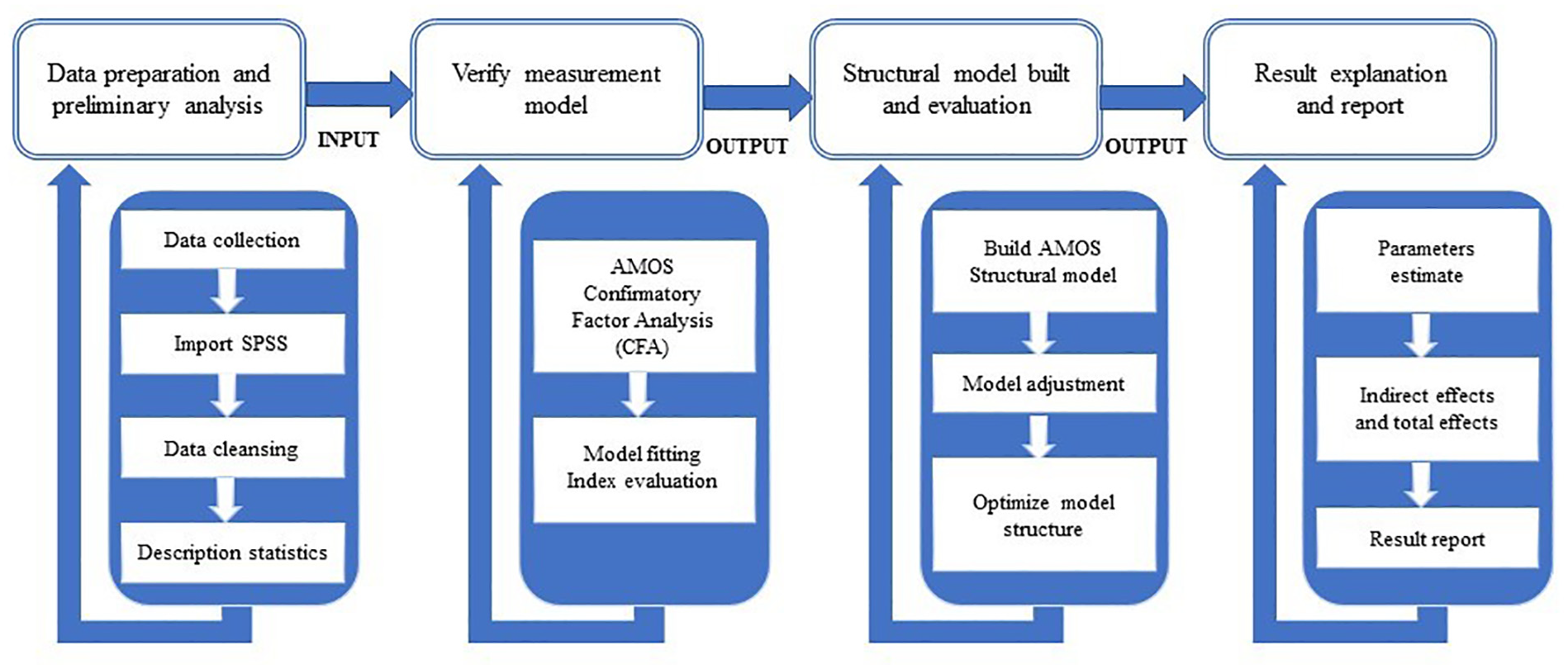
Data analysis and model building process.
Questionnaire Design
Based on the theoretical basis of the integrated technology acceptance model, this research explores relevant literature. It combines it with the construction industry employees and smart city technology, and develops a questionnaire for the willingness to use factor. This study was conducted through a questionnaire without human testing and use of human tissue samples, and it is acknowledged and agreed that all responses were for academic research purposes only before starting to answer the questionnaire. The questionnaire employs a Likert five-point scale (1 = strongly disagree; 5 = strongly agree). Each question is designed clearly and succinctly to improve respondents’ grasp of the content. This research utilizes exclusively positive indicators to facilitate respondents’ understanding. This approach simplifies the comprehension process for participants, aiding them in responding more accurately. As a result, it enhances survey response rates and data quality. Moreover, it minimizes the cognitive load required to answer, enabling participants to express their views more clearly without the need to toggle between positive and negative statements. Table 2 illustrates the relevant indicators and their bibliographic sources.
Latent Variables and Observed Variables.

Sample Description and Data Collection
The main research objects of this research are practitioners in the construction industry, including construction, civil engineering, and other construction-related practical and academic fields. Therefore, the data collection methods of this research are paper, E-MAIL, and online questionnaires for the Taiwan construction industry in related fields employees (construction plants: 211, construction companies: 98, engineering consulting companies: 34, other: 14). The online questionnaire method uses the form service provided by Google as a questionnaire distribution tool. Questionnaires will be distributed for 20 days, from May 11, 2022, to May 30, 2022.
A total of 411 questionnaires were sent out in this study. After retrieving the 357 questionnaires, the data check was performed first. After deleting inappropriate sample data, 22 invalid questionnaires were deleted, resulting in 335 valid questionnaires. The data characteristics of the recovered samples are shown in Table 3.
Evaluation of a Sample Attribute.

Analytical Methods
Structural Equation Model
The structural equation model (SEM) was selected for this study due to its unparalleled capability to simultaneously investigate complex relationships among latent and observed variables. Unlike traditional regression techniques, SEM facilitates the modeling of both direct and indirect effects, rendering it particularly suitable for testing theoretical frameworks with mediating or moderating pathways. Moreover, SEM amalgamates measurement and structural models into a cohesive framework, thus accounting for measurement errors and yielding more precise parameter estimates. This approach is highly advantageous in research involving multifaceted constructs and hierarchical data structures, ensuring a comprehensive understanding of the relationships within the study (Schuberth et al., 2023).
Structural Equation Modeling (SEM) is a sophisticated multivariate statistical technique, mainly used to clarify the complex interactions among variables, especially latent ones (Schlittgen et al., 2020). SEM integrates factor analysis with multiple regression methods to evaluate numerous interdependent relationships at once. This approach helps researchers uncover underlying structures that are not directly observable. SEM allows researchers to validate theoretical models, examine hypothesized relationships between variables, and assess model fit. Consisting of measurement and structural models, SEM explains how observed variables reflect latent variables, usually by measuring each latent variable through multiple observed variables to improve reliability, and reduce error impact. For exogenous latent variables (ξ) and their observed variables (x), refer to equation 1; for endogenous latent variables (η) and their observed variables (y), see equation 2.


Where Λx and Λy represent the factor loading matrices, and ex and ey signify the measurement errors.
The structural model outlines causal relationships among latent variables, which can be either direct or mediated through one or more intervening variables, as indicated in the corresponding formula

Where B represents the coefficient matrix between endogenous latent variables, Γ indicates the coefficient matrix from exogenous latent variables to endogenous ones, and Em stands for the error term within the structural model.
The covariance matrix of the observed variables for the complete model can be calculated as follows:

where Λ combines Λx and Λy, Φ signifies the covariance matrix of exogenous latent variables, and Θ includes the covariance of error terms for all observed variables.
Hypotheses to Assess Their Validity and Reliability
The UTAUT model hypothesis is tested using AMOS structural equation modeling software. Before path analysis, the measurement mode should undergo confirmatory factor analysis (CFA) to determine the correct path coefficient. Following the theoretical basis, the model after confirmatory factor analysis must be modified, the inappropriate interfering variables in the relationship should be deleted, and the reliability, validity, and fitness of the modified model should be tested.
Data Analysis and Results
Measurement Model Verification
In order to ensure the observed variables of each facet have a single membership, exclude the possibility of collinearity, and avoid the poor adaptability of the later structural model, the measurement model verified CFA first. CFA model adaptation indicators for each facet are shown in Table 4
CFA Model Adaptation Indexes.

Note. (1) “\” means that the model is just recognized and does not need to be corrected, so it is not displayed. (2) “ꜛ” = smaller-better; “ꜜ” = bigger-better.
In Performance Expectancy, in the initial model of it, all the adaptation indexes are poor. Through the MI value test, it is found that the chi-square value of the model involved in the observed variables PE4-PE6 is too large, which indicates that establishing a correlation between the residuals of the two can effectively reduce the chi-square value of the model (Ajzen, 1991). However, the establishment of correlation will lead to the non-independence between residuals. Therefore, in order to avoid residual inconsistency and improve model fitness, PE4 -PE6 were removed in this study, and the results showed that all other fitness indexes except RMSEA were within the required range, RMSEA = 0.073. Therefore, this research believed that the above adaptation indexes meet the requirements. It is consistent with the research of scholars Ghosh et al. (Venkatesh & Zhang, 2010).
In Effort Expectancy, the chi-square value of the model generated by the observed variable EE2 of Effort Expectancy is too large, which is 35.506, so EE2 is excluded. Other adaptation indexes after model modification reach the optimal level.
In Social Influence, the standardized factor loading of the observed variable SI2 was lower than 0.6, so SI2 was removed, and the chi-square value of the model generated by the observed variable SI7 was too large. After the two were removed, the Chi-square value of the model was reduced by 124.82, and other adaptation indexes all met the requirements.
In Facilitating Conditions, the observed variables FC1 and FC5 made the model chi-square value too large. After removing FC1 and FC5, respectively, χ2/DF were 5.964 and 9.398, respectively, and RMSEA was 0.133 and 0.173, respectively, which still failed to meet the requirements of model adaptation. Therefore, this study excluded both of them. So, there are only three measurement variables (FC2-FC4) in Facilitating Conditions, and the measurement model of this dimension reaches the exact recognition level. Regarding behavioral Intention and Actual Behavior, considering the number of observed variables possessed by both of them, their measurement models are exact recognition, and, therefore do not need to be modified.
In summary, after modification, the fitness of measurement models of all facets achieves good results. The results of Table 5 show that after modification, the unstandardized (UNSTD) parameter estimates of Performance Expectancy, Effort Expectancy, Social Influence, Facilitating Conditions, and Behavioral Intention are all positive and significant (p < .001), indicating that there is no offending estimate; The standardized (STD) factor loading is more significant than 0.6; Squared multiple correlation(SMC) >0.36, indicating that the observed variables have good reliability; Composition reliability (CR) Values between 0.858 and 0.900 are more significant than 0.7, explained that the composition reliability is good and the facet indicators have sufficient internal consistency; The Average Variance (AVE) value between 0.548 and 0.649 is more significant than 0.5, indicating that the convergent validity of the facet itself meets the requirements. The number of observed variables possessed by the Actual Behavior facet is not enough to carry out the CFA test, which has little impact on the overall fit of the later structural model, so it is not considered.
Summary Table of CFA Index Intervals.

Note: * is significant on p < .05; ** is highly significant on p < .01; *** is extremely significant on p < .001 (two-tailed test).
Based on the above analysis, the observed variables contained in Performance Expectancy, Effort Expectancy, Social Influence, Facilitating Conditions, and Behavioral Intention can well reflect each facet, the effectiveness and reliability of the indexes are acceptable, and measurement models pass the CFA verification.
The verification of “gender” was conducted using T-test analysis, yielding an average p-value of .512 within the results facet. A result greater than .05 indicates a lack of statistical significance, thereby precluding further discussion on the impact of gender. Additionally, ANOVA was employed to investigate the factor of “age.” The average impact on each aspect was found to be 0.031, which, falling below the significance threshold of 0.05, suggests that the factor of age does not warrant inclusion in the discussion of impact.
Discriminant Validity Verification
Discriminant validity testing is used to analyze whether there are differences in statistics between different facets; this study uses the AVE method to test, if the AVE value of the configuration is more significant than Pearson correlation coefficient between the facet and other facets, the measurement model has a difference in validity between each facet. The Pearson correlation coefficient matrix for each facet is shown in Table 6; the diagonal number is AVE’s square root of the corresponding facet, and the non-diagonal number is the Pearson correlation coefficient of the corresponding facet. Comparing AVE’s square root of each facet, the values are more significant than Pearson correlation coefficients on the horizontal and vertical lines, so there is a big difference between each facet in this study.
Discriminant Validity Statistics Table.

Structural Model Verification
Model Fit Analysis
In this study, the suitability indicators refer to recommendations (Alshaer et al., 2021; Schlittgen et al., 2020; Schuberth et al., 2023) to select several indicators for the assessment of the suitability of the overall structural model. where χ2 = 507.127, χ2/df = 2.561(recommended value < 5), GFI = 0.854(recommended value > 0.8), AGFI = 0.813 (recommended value > 0.8), RMSEA = 0.075 (recommended value < 0.08), TLI = 0.913 (recommended value > 0.9), IFI = 0.926 (recommended value > 0.9), CFI = 0.925 (recommended value > 0.9), SRMR = 0.065 (recommended value < 0.8). The above indicators all meet the fitting requirements of SEM; overall model fit is acceptable.
Model Path Analysis
The statistical results of the structural model in Figure 6 and Table 7 show that For Behavioral Intention, due to the triple influence of Performance Expectancy, Effort Expectancy, and Social Influence, the total interpretable variation of Behavioral Intention of three is 0.63, between 0.33 and 0.67, with medium-to-upper explanatory ability. Performance Expectancy increases by 1 unit, Behavioral Intention correspondingly increases by −0.739 units, increases one standard deviation, Behavioral Intention correspondingly increases by −0.51 standard deviations, and the influence coefficient of Performance Expectancy on Behavioral Intention shows that there is a specific impact on the two and significant (p < .001), it shows that Performance Expectancy plays a positive role in the generation of Behavioral Intention of intelligent city, and the direct effect is obvious. Effort Expectancy increases by 1 unit, Behavioral Intention correspondingly increases by 0.033 units, increases by one standard deviation, Behavioral Intention correspondingly increases by 0.031 standard deviations (p = .773), it shows that the effect of Effort Expectancy on the acceptance of smart city’s Behavior Intention is not apparent, and there is no positive relationship between the two. The Social Influence increased by 1 unit, the Behavior Intention correspondingly increased by 1.507 units, an increase of 1 standard deviation, Behavior Intention correspondingly increased by 1.175 standard deviations, and the influence coefficient of social integration on residence willingness was significant by 1‰. It shows that the Social Influence of smart cities will make people more willing to accept it. In terms of the effect of smart cities Behavior Intention, it is evident that the role of Social Influence is greater than Effort Expectancy; the least impact on the perception of happiness is Performance Expectancy.

Overall model path diagram.
Overall Model Path Coefficients.
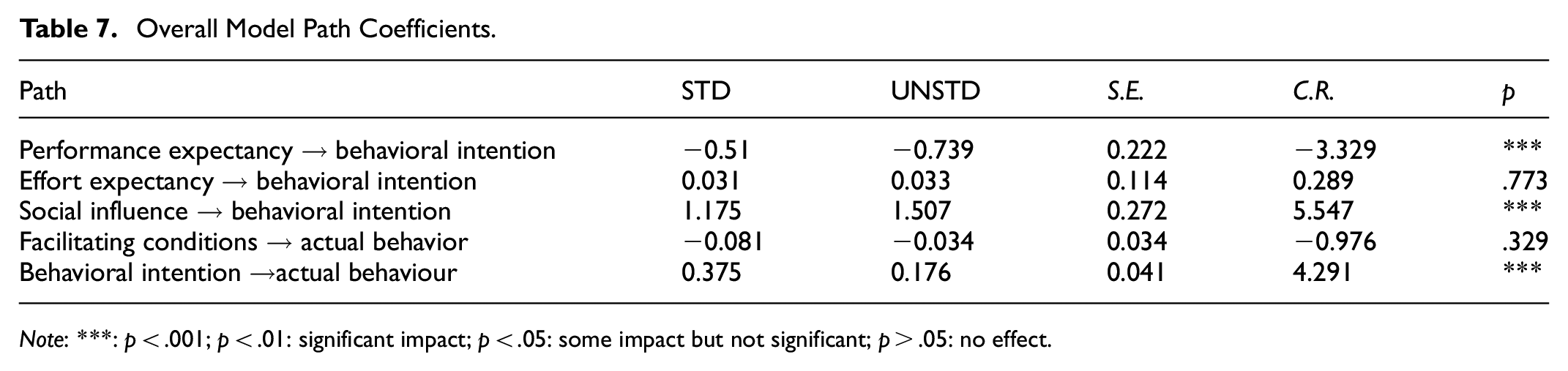
Note: ***: p < .001; p < .01: significant impact; p < .05: some impact but not significant; p > .05: no effect.
For Actual Behavior, due to the dual influence of Facilitating Conditions and Behavioral Intention, the combined interpretable variation of the two on the residence willingness is 0.11(<0.19), which has lower interpretive ability. Among them, Facilitating Conditions increases by 1 unit, the Actual Behavior increases by −0.034 units, one standard deviation is added, the Actual Behavior increases −0.081 standard deviations, and the impact coefficient of Facilitating Conditions on Actual Behavior has no effect (p = .329), it shows that the direct influence between the two is not obvious.
For Behavioral intention increases by 1 unit, Actual Behavior increases by 0.176 units, and if it increases by 1 standard deviation, Actual Behavior correspondingly increases by 0.375 standard deviations. The impact coefficient of Behavioral Intention on Actual Behavior was significant at 1‰, which shows that the Behavioral Intention of smart city technology is closely related to the Actual Behavior to use smart city technology, and the two have positive effects.
In terms of the effect on the Actual Behavior of smart city technology, the results show that in the process of accepting smart city technology, Behavioral Intention plays a much greater role than Facilitating Conditions, and it indicates that construction industry employee acceptance of smart city technology has a positive effect, but the Facilitating Conditions has no significant effect.
Integration of Research Findings
This study uses the unified theory of acceptance and use of use of technology (UTAUT) to explore the altitude of utilizing intention of construction industry practitioners to use smart city technology and to examine whether external factors and moderating variables have an impact on behavioral intentions and subsequent actions. Based on the findings from the questionnaire survey and data analysis, it appears that certain research hypotheses do not align with the theoretical assumptions. For example, neither the facilitating conditions nor behavioral intentions seem to exert a positive influence on actual behavior, based on the analysis. Some moderators do not adhere consistently to the theoretical assumptions. The results of the hypotheses are shown in Table 8.
1. Factors influencing behavioral intention on application in smart city technology
Outcome of the Study Hypothesis.

Among the respondents to the questionnaire, 44% have not used smart city technology. Since the application of smart city technology has not yet been widely popularized in the construction industry, and many applications are still in the conceptual stage, the acceptance level of users has been affected. It’s not high either. The results obtained during the study are described below:
(1) The impact of performance expectancy on behavioral intentions
In terms of direct variables, assuming H1 is validated, that is, performance expectancy has a significant positive impact on users’ behavioral intentions, which is consistent with (Boomsma, 2000; Kanti Ghosh et al., 2021; McDonald & Ho, 2002). It means that practitioners in the construction industry have felt that the application of technology in smart cities has improved the performance of their work.
(2) The impact of effort expectancy on behavioral intentions
In terms of direct variables, assuming H2 is validated, that is, effort expectancy has a significant positive impact on users’ behavioral intentions. Empirical studies in many literatures have also found that (Alblooshi & Abdul Hamid, 2021; Chao, 2019; Schreiber, 2008) whether technology is easy to use will lead to perceptions that technology is helpful to work. The results of the study are also consistent with relevant literature. It means that construction industry practitioners are more likely to use smart city technology if the technology is easy to operate.
(3) The impact of social influence on behavioral intentions
In terms of direct variables, assuming H3 is established, that is, social influence has a significant positive impact on users’ behavioral intentions. When influential people around users are using new technologies, technology applications are more likely to be accepted. The same results were found in past studies (Ghalandari, 2012; Hung et al., 2019; Nurkhin, 2020). Model results show that workers in the construction industry are more likely to accept new technologies due to the influence of influential people around them.
(4) The impact of facilitating conditions on behavioral intentions
In terms of direct variables, assuming H4 is not validated, that is, facilitating conditions do not have a positive impact on users’ behavioral intentions. The same results were found in past studies (Khatimah et al., 2019; Mardikyan et al., 2012; Sair & Danish, 2018). Model results show that the working environment of construction industry workers does not create support for the use of new technology.
(5) The impact of behavioral intentions on actual behaviors
In terms of direct variables, assuming H5 is not validated, that is, behavioral intentions do not have a positive impact on users’ actual behaviors, which is consistent with past studies (Cheung et al., 2000; Nassar et al., 2019). The result represents the construction industry’s conservative attitude toward the application of smart city technology. The reason may be that the user wants to use it, but the environment does not support it. Furthermore, the application of smart city technology has not yet become popular; workers in the construction industry do not really feel that the application of technology is useful for their work.
2. The impact of moderators on utilizing smart city technology
This study analyzes the impact of the moderators on the construction industry’s utilization of smart city technology. The findings indicate that various conditions, including gender, age, experience, and voluntariness, moderate the effects on both behavioral intentions and actual behavior. Gender differences serve as moderators for both effort expectancy and social influence. Differences in voluntariness act as moderators for social influence. Differences in experience serve as moderators for facilitating conditions. The results are described below:
(1) The impact of performance expectancy on behavioral intentions does not have a moderating effect on user gender and age. In other words, whether or not conscious use of smart city technology can support work will influence the willingness to use them, and this does not necessarily differ by gender and age. The result is consistent with past studies (Hossain et al., 2017; Mardikyan et al., 2012).
(2) Irrespective of gender, the level of perceived effort expectancy will impact the actual behavior of individuals (Alblooshi & Abdul Hamid, 2021; Mardikyan et al., 2012).. It is important for the construction industry to make it easier to use smart city technology. The age group (20–29), which tends to find technology applications easy to learn and use, demonstrates a clear understanding of these technologies. Furthermore, in regard to their usage experience, they place significant importance on the challenges associated with smart city technology.
(3) The research findings reveal the extent of perceived social influence among construction workers regardless of gender, will have an impact on their actual behavior (Al-Khaldi & Olusegun Wallace, 1999; Ghalandari, 2012).. Additionally, individuals in the age group (over 40 years old) and those with high levels of experience will be concerned about the influence of influential figures on their adoption of new technology. Regarding voluntariness, users with a strong sense of voluntary choice tend to possess a greater intention to utilize smart city technology.
(4) The relationship between the influences of facilitating conditions on actual behavior under the moderators can be found: the influence of facilitating conditions on the actual usage of smart city technology within the construction industry is associated with the age and experience levels of users. Research results show that one group (over 40 years old) values more support for the construction industry in terms of policies, technologies, equipment, etc., than another group (under 40 years old), and hopes to provide assistance in the use of new technologies. Bonesso et al. (2014) and Choi et al. (2013), also have the same research results (Nan & Madden, 2012; Venkatesh et al., 2008).
Conclusions
The construction industry is known as the “locomotive industry.” Promoting the construction industry can drive the development of many related industries. Whether the construction industry develops sustainably will be related to the overall economic development of the country. In terms of technology applications in the construction industry, as digital technology continues to improve, more and more smart engineering applications are being seen. With the digital trend, the construction industry can increase the contribution of construction output value to national GDP in the future.
The main goal of this study is to explore the attitude of utilizing the Smart City technology in the construction industry through the unified theory of acceptance and use of the use of technology model (UTAUT) and to conduct an analysis of how external factors and moderators impact both behavioral intentions and actual behaviors. That correlation for model does not imply causation, and insights are not drawn from statistical significance. The findings indicate that the primary factors influencing the willingness of construction workers to use smart city technology are performance expectancy, effort expectancy, and social influence. This means that the most important factors influencing user acceptance include the feeling that smart city technology can help work performance, ease of learning and use, and influential people’s support for their use.
The adoption of smart city technologies in the construction industry aligns with several key SDGs (Deakin & Al Waer, 2012; Komninos, 2018; Trindade et al., 2017; Visvizi & del Hoyo, 2021; Yigitcanlar & Kamruzzaman, 2015).
SDG 9: Industry, Innovation, and Infrastructure
Smart city technologies, such as the Internet of Things (IoT), artificial intelligence (AI), and robotics, enhance the efficiency and sustainability of construction projects. These innovations help build resilient infrastructure and foster innovation.
SDG 11: Sustainable Cities and Communities
Smart city initiatives focus on creating sustainable urban environments. By integrating energy-efficient technologies, green building materials, and smart infrastructure, the construction industry contributes to making cities more sustainable and resilient.
SDG 13: Climate Action
Smart city technologies help reduce greenhouse gas emissions by optimizing energy use, improving waste management, and promoting sustainable transportation solutions. This supports global efforts to combat climate change and its impacts.
SDG 17: Partnerships for the Goals
Collaboration between public and private sectors, as well as international partnerships, is crucial for the successful implementation of smart city projects. These partnerships help mobilize resources and share knowledge to achieve sustainable development goals.
By integrating these smart technologies, the construction industry can significantly advance the SDGs, making urban environments more efficient, livable, and environmentally friendly. The holistic approach to sustainability through smart technologies ensures that economic growth, social well-being, and environmental protection go hand in hand.
Meanwhile, there are several challenges and barriers that need to be addressed to ensure the adoption of smart city technologies in buildings aligns with sustainable development goals. First, many cities’ current physical infrastructure may require extensive upgrades to support smart technologies, which can be both expensive and disruptive. Second, the growing use of IoT devices and extensive data collection has raised significant concerns about protecting citizens’ privacy and data security. Final, adopting smart city technologies demands significant financial resources, which can pose a challenge for many cities.
Reflecting on the findings of this study, the discrepancy between facilitating conditions and behavioral intentions and their impact on actual behavior in the construction industry can be attributed to several factors:
Complexity of the Construction Environment: The construction industry is characterized by its inherent complexity, which encompasses the involvement of multiple stakeholders, diverse project requirements, and dynamic on-site conditions. This intricate nature can attenuate the impact of facilitating conditions and behavioral intentions on actual behavior.
Communication Barriers: Effective communication is of paramount importance in the construction industry. However, miscommunication or the absence of communication can result in misunderstandings and misaligned actions, even when intentions are positive and conditions are favorable.
Unethical Practices: Unethical behaviors, including bid rigging, bribery, and inadequate supervision, can significantly undermine the positive effects of facilitating conditions and behavioral intentions. Such practices foster a culture wherein actual behavior diverges from intended actions.
Psychological Factors: Cognitive factors, including perceived threat severity and response efficacy, have the potential to shape individuals’ attitudes, and intentions. These influences may result in discrepancies between intended and actual behaviors.
And The findings that facilitating conditions and behavioral intentions showed insignificant results on actual behavior for the use of new technology in the construction industry have several practical implications:
Focus on Behavioral Expectations: Introducing behavioral expectations as a predictor could be beneficial. This means setting clear expectations about the use of new technology and ensuring that employees understand the benefits and necessity of adopting it.
Addressing Resistance to Change: It’s crucial to identify and address any underlying resistance to change among employees. This could involve engaging with employees to understand their concerns and providing support to help them adapt to new technologies.
Continuous Monitoring and Support: Continuous monitoring and support can help ensure that employees are effectively using the new technology. Regular feedback sessions and support mechanisms can help address any issues that arise during the adoption process.
By addressing these areas, the construction industry can better leverage new technologies to improve efficiency, safety, and overall project outcome.
However, in terms of practical application, smart city technology in all aspects is still in the development stage. The construction industry may have high risks and low profits due to immature technology. Because of the above considerations, the construction industry has discouraged the use of smart city technology. However, considering the findings that social influence has a notably positive effect on users’ behavioral intentions, the construction industry should develop policies starting with supervisors (i.e., influencers). Moreover, from the words and deeds of influential people, it is emphasized that smart city technology can highly improve work performance. Finally, the government promotes relevant policies for digital transformation in the construction industry to let the industry understand the benefits of using smart city technology. With those strategies, the construction industry will be able to increase its output value in the future and move toward digital transformation. SDGs set by the United Nations through the “2030 Agenda for Sustainable Development” aim to solve global environmental, economic, and social problems and propose specific solutions. The results of this study can provide the construction industry with the opportunity to contribute to sustainable development.
Recommendations for follow-up research
(1) The main object of this study is the employees of the construction industry. Nevertheless, the construction industry covers many industries and sectors. And questionnaire respondents work in different positions. An in-depth study for behavioral intentions and actual behavior is lacking. The decision-making power held by the respondents is not the same. Future researchers can compare and discuss other related and limited fields or investigate the groups in a specific field of the construction industry. (i.e., bridge engineering, tunnel engineering, etc.). Meanwhile, this study did not explore confounding variables, which be included in future research plans.
(2) Behavioral intention has several definitions and measurement tools. Due to time constraints, the study use the UTAUT model to analyze. Future researchers could further explore the topic of this study using different models or increasing the number of samples. Developing a more suitable theoretical model will aid in predicting user intention and behavior when using technology, providing a clearer explanation of the relationship between these variables. Additionally, the model does not examine other important possible moderators, such as industry sector, salary level, and career expectations. If the influence of these factors needs to be considered, other models may be used for analysis.
Footnotes

Ethical Considerations
All methods have been carried out in accordance with relevant guidelines and regulations. All experimental protocols have been approved by a named institutional and/or licensing committee.
Consent to Participate
Informed consent was obtained from all respondents and/or their legal guardian(s).
Funding
The author(s) received no financial support for the research, authorship, and/or publication of this article.
Declaration of Conflicting Interests
The author(s) declared no potential conflicts of interest with respect to the research, authorship, and/or publication of this article.
Data Availability Statement
The datasets used and/or analyzed during the current study are available from the corresponding author on reasonable request.